Kelli J. Schutte
William Jewell College
Robbins, Judge, and Vohra
Organizational Behavior
14th Edition
Copyright © 2012 Dorling Kindersley (India) Pvt. Ltd
Authorized adaptation from the United States edition of Organizational
Behavior, 14e
Attitudes and Job Satisfaction
3-1
Copyright © 2012 Dorling Kindersley (India) Pvt. Ltd
Authorized adaptation from the United States edition of Organizational
Behavior, 14e
Chapter Learning Objectives
 After studying this chapter, you should be able to:
– Contrast the three components of an attitude.
– Summarize the relationship between attitudes and behavior.
– Compare and contrast the major job attitudes.
– Define job satisfaction and show how it can be measured.
– Summarize the main causes of job satisfaction.
– Identify four employee responses to dissatisfaction.
– Show whether there are cultural differences in job
satisfaction.
3-2
Copyright © 2012 Dorling Kindersley (India) Pvt. Ltd
Authorized adaptation from the United States edition of Organizational
Behavior, 14e
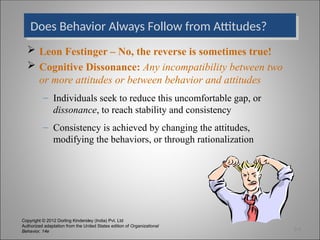
Does Behavior Always Follow from Attitudes?
 Leon Festinger – No, the reverse is sometimes true!
 Cognitive Dissonance: Any incompatibility between two
or more attitudes or between behavior and attitudes
– Individuals seek to reduce this uncomfortable gap, or
dissonance, to reach stability and consistency
– Consistency is achieved by changing the attitudes,
modifying the behaviors, or through rationalization
3-3
Copyright © 2012 Dorling Kindersley (India) Pvt. Ltd
Authorized adaptation from the United States edition of Organizational
Behavior, 14e
Does Behavior Always Follow from Attitudes?
– Desire to reduce dissonance depends on:
• Importance of elements
• Degree of individual influence
– Individuals will be more motivated to reduce dissonance
when the attitudes or behavior are important or when they
believe the dissonance is due to something they can
control.
• Rewards involved in dissonance
– high rewards accompanying high dissonance tend to
reduce the tension inherent in the dissonance.
Copyright © 2012 Dorling Kindersley (India) Pvt. Ltd
Authorized adaptation from the United States edition of Organizational
Behavior, 14e
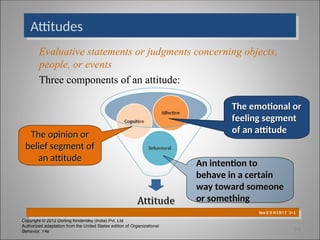
Attitudes
Evaluative statements or judgments concerning objects,
people, or events
Three components of an attitude:
The emotional or
The emotional or
feeling segment
feeling segment
of an attitude
of an attitude
The opinion or
The opinion or
belief segment of
belief segment of
an attitude
an attitude
An intention to
An intention to
behave in a certain
behave in a certain
way toward someone
way toward someone
or something
or something
See E X H I B I T 3–1
3-5
Copyright © 2012 Dorling Kindersley (India) Pvt. Ltd
Authorized adaptation from the United States edition of Organizational
Behavior, 14e
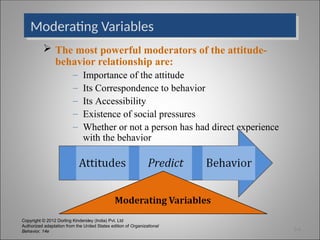
Moderating Variables
 The most powerful moderators of the attitude-
behavior relationship are:
– Importance of the attitude
– Its Correspondence to behavior
– Its Accessibility
– Existence of social pressures
– Whether or not a person has had direct experience
with the behavior
3-6
Copyright © 2012 Dorling Kindersley (India) Pvt. Ltd
Authorized adaptation from the United States edition of Organizational
Behavior, 14e
Predicting Behavior from Attitudes
– Important attitudes have a strong relationship to
behavior.
– The closer the match between attitude and
behavior, the stronger the relationship:
• Specific attitudes predict specific behavior
• General attitudes predict general behavior
– The more frequently expressed an attitude, the
better predictor it is.
– High social pressures reduce the relationship and
may cause dissonance.
– Attitudes based on personal experience are
stronger predictors.
3-7
Copyright © 2012 Dorling Kindersley (India) Pvt. Ltd
Authorized adaptation from the United States edition of Organizational
Behavior, 14e
What are the Major Job Attitudes?
 Job Satisfaction
– A positive feeling about the job
resulting from an evaluation of its
characteristics
– A high level of job satisfaction
equals positive attitudes toward the
job and vice versa.
– Employee attitudes and job
satisfaction are frequently used
interchangeably.
– Often when people speak of
“employee attitudes” they mean
“employee job satisfaction.”
3-8
Copyright © 2012 Dorling Kindersley (India) Pvt. Ltd
Authorized adaptation from the United States edition of Organizational
Behavior, 14e
Predicting Behavior from Attitudes
 Job Involvement
– Degree of psychological identification with the job where
perceived performance is important to self-worth
– High levels of job involvement are thought to result in fewer
absences and lower resignation rates.
– Job involvement more consistently predicts turnover than
absenteeism.
– Psychological empowerment—employees’ beliefs in the
degree to which they impact their work
 Psychological Empowerment
– Belief in the degree of influence over the job, competence,
job meaningfulness, and autonomy
Copyright © 2012 Dorling Kindersley (India) Pvt. Ltd
Authorized adaptation from the United States edition of Organizational
Behavior, 14e
Another Major Job Attitude
 Organizational Commitment
– A state in which an employee identifies with a particular
organization and its goals.
– Affective commitment—emotional attachment to the organization
and belief in its values
– Continuance commitment—perceived economic value of
remaining with an organization compared to alternatives
– Normative commitment—obligation to remain with the
organization for moral or ethical reasons
– A positive relationship appears to exist between organizational
commitment and job productivity, but it is a modest one.
– As with job involvement, the research evidence demonstrates
negative relationships between organizational commitment and
both absenteeism and turnover.
3-10
Copyright © 2012 Dorling Kindersley (India) Pvt. Ltd
Authorized adaptation from the United States edition of Organizational
Behavior, 14e
And Yet More Major Job Attitudes…
 Perceived Organizational Support (POS)
– Degree to which employees believe the organization values
their contribution and cares about their well-being.
– Higher when rewards are fair, employees are involved in
decision making, and supervisors are seen as supportive.
– High POS is related to higher OCBs and performance.
 Employee Engagement
– The degree of involvement with, satisfaction with, and
enthusiasm for the job.
– Engaged employees are passionate about their work and
company.
3-11
Copyright © 2012 Dorling Kindersley (India) Pvt. Ltd
Authorized adaptation from the United States edition of Organizational
Behavior, 14e
And Yet More Major Job Attitudes…
 Highly engaged employees have a passion for their work and feel a
deep connection to their company
 Disengaged employees have essentially checked out—putting time but
not energy or attention into their work
 Engagement becomes a real concern for most organizations because
surveys indicate that few employees—between 17 percent and 29
percent—are highly engaged by their work
 Engagement is a very general concept, perhaps broad enough to
capture the intersection of the other variables we’ve discussed. In
other words, it may be what these attitudes have in common.
3-12
Copyright © 2012 Dorling Kindersley (India) Pvt. Ltd
Authorized adaptation from the United States edition of Organizational
Behavior, 14e
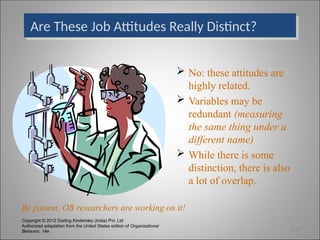
Are These Job Attitudes Really Distinct?
 No: these attitudes are
highly related.
 Variables may be
redundant (measuring
the same thing under a
different name)
 While there is some
distinction, there is also
a lot of overlap.
Be patient, OB researchers are working on it!
3-13
Copyright © 2012 Dorling Kindersley (India) Pvt. Ltd
Authorized adaptation from the United States edition of Organizational
Behavior, 14e
Job Satisfaction
 One of the primary job attitudes measured.
– Broad term involving a complex individual summation of a number of discrete job elements.
– Jobs require interacting with coworkers and bosses, following organizational rules and
policies, meeting performance standards, living with less than ideal working conditions, and
the like.
 How to measure?
– Single global rating (one question/one answer):
• Is a response to one question, such as “All things considered, how satisfied are you with your
job?” Respondents circle a number between 1 and 5 on a scale from “highly satisfied” “highly
dissatisfied.”
– Summation score (many questions/one average):
• The summation of job facets, is more sophisticated. It identifies key elements in a job such as the
nature of the work, supervision, present pay, promotion opportunities, and relations with
coworkers
 Are people satisfied in their jobs?
– In India, yes. Seventy-one percent of Indian employees
– surveyed are satisfied with their jobs.
– Results vary by employee facets of the job.
– Compensation, benefits, and incentives are the most problematic elements in India.
See E X H I B I T 3–2
3-14
Copyright © 2012 Dorling Kindersley (India) Pvt. Ltd
Authorized adaptation from the United States edition of Organizational
Behavior, 14e
Job Satisfaction
How to measure?
– Single global rating (one question/one answer):
• Is a response to one question, such as “All things considered,
how satisfied are you with your job?” Respondents circle a
number between 1 and 5 on a scale from “highly satisfied”
“highly dissatisfied.”
– Summation score (many questions/one average):
• The summation of job facets, is more sophisticated. It
identifies key elements in a job such as the nature of the work,
supervision, present pay, promotion opportunities, and
relations with coworkers
See E X H I B I T 3–2
3-15
Copyright © 2012 Dorling Kindersley (India) Pvt. Ltd
Authorized adaptation from the United States edition of Organizational
Behavior, 14e
Job Satisfaction
Are people satisfied in their jobs?
– Most people are satisfied with their jobs in the developed
countries surveyed.
– Research shows that over the past 30 years, the majority of
workers have been satisfied with their jobs.
– Seventy-one percent of Indian employees surveyed are
satisfied with their jobs.
– Indian workers seem to be less satisfied with their
compensation and benefits and with their incentive pay.
See E X H I B I T 3–2
3-16
Copyright © 2012 Dorling Kindersley (India) Pvt. Ltd
Authorized adaptation from the United States edition of Organizational
Behavior, 14e
 Pay influences job satisfaction only to a point.
– Once an individual reaches a comfortable level of living, there
is no relationship between amount of pay and job satisfaction.
– Money may bring happiness, but not necessarily job
satisfaction.
 Personality can influence job satisfaction.
– Negative people are usually not satisfied with their jobs.
– Those with positive core self-evaluation are more satisfied
with their jobs.
Causes of Job Satisfaction
See E X H I B I T 3–3
3-17
Copyright © 2012 Dorling Kindersley (India) Pvt. Ltd
Authorized adaptation from the United States edition of Organizational
Behavior, 14e
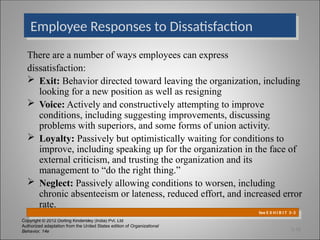
There are a number of ways employees can express
dissatisfaction:
 Exit: Behavior directed toward leaving the organization, including
looking for a new position as well as resigning
 Voice: Actively and constructively attempting to improve
conditions, including suggesting improvements, discussing
problems with superiors, and some forms of union activity.
 Loyalty: Passively but optimistically waiting for conditions to
improve, including speaking up for the organization in the face of
external criticism, and trusting the organization and its
management to “do the right thing.”
 Neglect: Passively allowing conditions to worsen, including
chronic absenteeism or lateness, reduced effort, and increased error
rate.
Employee Responses to Dissatisfaction
See E X H I B I T 3–3
3-18
Copyright © 2012 Dorling Kindersley (India) Pvt. Ltd
Authorized adaptation from the United States edition of Organizational
Behavior, 14e
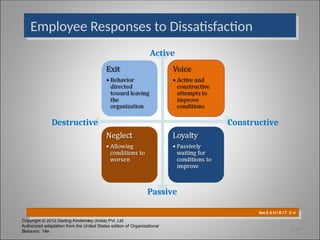
Employee Responses to Dissatisfaction
See E X H I B I T 3–4
Active
Passive
Constructive
Destructive
3-19
Copyright © 2012 Dorling Kindersley (India) Pvt. Ltd
Authorized adaptation from the United States edition of Organizational
Behavior, 14e
 Exit and neglect behaviors encompass our performance variables—
productivity, absenteeism, and turnover.
 Voice and loyalty are constructive behaviors allow individuals to
tolerate unpleasant situations or to revive satisfactory working
conditions. It helps us to understand situations, such as those
sometimes found among unionized workers, where low job
satisfaction is coupled with low turnover.
Employee Responses to Dissatisfaction
See E X H I B I T 3–3
3-20
Copyright © 2012 Dorling Kindersley (India) Pvt. Ltd
Authorized adaptation from the United States edition of Organizational
Behavior, 14e
Outcomes of Job Satisfaction
 Job Performance
– Satisfied workers are more productive AND more productive
workers are more satisfied!
– At the organization level, there is renewed support for the original
satisfaction-performance relationship. It seems organizations with
more satisfied workers as a whole are more productive
organizations.
 Organizational Citizenship Behaviors
– It seems logical to assume that job satisfaction should be a major
determinant of an employee’s organizational citizenship behavior.
More recent evidence, however, suggests that satisfaction influences
OCB, but through perceptions of fairness.
– Basically, job satisfaction comes down to conceptions of fair
outcomes, treatment, and procedures. When you trust your
employer, you are more likely to engage in behaviors that go beyond
your formal job requirements.
3-21
Copyright © 2012 Dorling Kindersley (India) Pvt. Ltd
Authorized adaptation from the United States edition of Organizational
Behavior, 14e
Outcomes of Job Satisfaction
 Customer Satisfaction
 Evidence indicates that satisfied employees increase customer
satisfaction and loyalty.
 Customer retention and defection are highly dependent on how
front-line employees deal with customers. Satisfied employees are
more likely to be friendly, upbeat, and responsive. Customers
appreciate that.
 Companies hire upbeat, friendly employees, train them in the
importance of customer service, provide positive employee work
climates, and regularly track employee satisfaction through attitude
surveys.
 Absenteeism
 We find a consistent negative relationship between satisfaction and
absenteeism. The more satisfied you are, the less likely you are to
miss work.
 It makes sense that dissatisfied employees are more likely to miss
work, but other factors have an impact on the relationship and
reduce the correlation coefficient. For example, you might be a
satisfied worker, yet still take a “mental health day” to head for the
beach now and again.
3-22
Copyright © 2012 Dorling Kindersley (India) Pvt. Ltd
Authorized adaptation from the United States edition of Organizational
Behavior, 14e
More Outcomes of Job Satisfaction
 Turnover
– Satisfaction is also negatively related to turnover, but the
correlation is stronger than what we found for absenteeism.
– Other factors such as labor market conditions, expectations about
alternative job opportunities, and length of tenure with the
organization are important constraints on the actual decision to
leave one’s current job.
– Evidence indicates that an important moderator of the satisfaction-
turnover relationship is the employee’s level of performance. in
high performers and to weed out lower performers
 Workplace Deviance
– If employees don’t like their work environment, they will respond
somehow.
– Job dissatisfaction predicts unionization, substance abuse, stealing, and
tardiness.
3-23
Copyright © 2012 Dorling Kindersley (India) Pvt. Ltd
Authorized adaptation from the United States edition of Organizational
Behavior, 14e
Managers often “don’t get it”
 Given the evidence we’ve just reviewed, it should come as
no surprise that job satisfaction can affect the bottom line.
 Stock prices of companies in the high morale group grew
19.4 percent, compared with 10 percent for the medium or
low morale group
 Regular surveys can reduce gaps between what managers
think employees feel and what they really feel.
3-24
Copyright © 2012 Dorling Kindersley (India) Pvt. Ltd
Authorized adaptation from the United States edition of Organizational
Behavior, 14e
Global Implications
 Are Employees in Some Cultures More Satisfied With Their Jobs?
– Although job satisfaction appears relevant across cultures, that doesn’t
mean there are no cultural differences in job satisfaction.
– Western cultures have higher levels of job satisfaction than those in
Eastern cultures
– Another study showed that Indian employees rated their satisfaction higher
than other employees in the Asia-Pacific region.
– Evidence suggests that individuals in Eastern cultures find negative
emotions less aversive more than do individuals in Western cultures, who
tend to emphasize positive emotions and individual happiness.
See E X H I B I T 3–5
3-25
Copyright © 2012 Dorling Kindersley (India) Pvt. Ltd
Authorized adaptation from the United States edition of Organizational
Behavior, 14e
Summary and Managerial Implications
 Managers should watch employee attitudes:
– They give warnings of potential problems
– They influence behavior
 Managers should try to increase job satisfaction and
generate positive job attitudes
– Reduces costs by lowering turnover, absenteeism, tardiness,
theft, and increasing OCB
 Focus on the intrinsic parts of the job: make work
challenging and interesting
– Pay is not enough
3-26
All rights reserved. No part of this publication may be reproduced,
stored in a retrieval system, or transmitted, in any form or by any
means, electronic, mechanical, photocopying, recording, or otherwise,
without the prior written permission of the publisher. Printed in the
United States of America.
Copyright ©2011 Pearson Education, Inc.
Publishing as Prentice Hall
3-27

Attitudes and Job Satisfaction topic.ppt

  • 1.
    Kelli J. Schutte WilliamJewell College Robbins, Judge, and Vohra Organizational Behavior 14th Edition Copyright © 2012 Dorling Kindersley (India) Pvt. Ltd Authorized adaptation from the United States edition of Organizational Behavior, 14e Attitudes and Job Satisfaction 3-1
  • 2.
    Copyright © 2012Dorling Kindersley (India) Pvt. Ltd Authorized adaptation from the United States edition of Organizational Behavior, 14e Chapter Learning Objectives  After studying this chapter, you should be able to: – Contrast the three components of an attitude. – Summarize the relationship between attitudes and behavior. – Compare and contrast the major job attitudes. – Define job satisfaction and show how it can be measured. – Summarize the main causes of job satisfaction. – Identify four employee responses to dissatisfaction. – Show whether there are cultural differences in job satisfaction. 3-2
  • 3.
    Copyright © 2012Dorling Kindersley (India) Pvt. Ltd Authorized adaptation from the United States edition of Organizational Behavior, 14e Does Behavior Always Follow from Attitudes?  Leon Festinger – No, the reverse is sometimes true!  Cognitive Dissonance: Any incompatibility between two or more attitudes or between behavior and attitudes – Individuals seek to reduce this uncomfortable gap, or dissonance, to reach stability and consistency – Consistency is achieved by changing the attitudes, modifying the behaviors, or through rationalization 3-3
  • 4.
    Copyright © 2012Dorling Kindersley (India) Pvt. Ltd Authorized adaptation from the United States edition of Organizational Behavior, 14e Does Behavior Always Follow from Attitudes? – Desire to reduce dissonance depends on: • Importance of elements • Degree of individual influence – Individuals will be more motivated to reduce dissonance when the attitudes or behavior are important or when they believe the dissonance is due to something they can control. • Rewards involved in dissonance – high rewards accompanying high dissonance tend to reduce the tension inherent in the dissonance.
  • 5.
    Copyright © 2012Dorling Kindersley (India) Pvt. Ltd Authorized adaptation from the United States edition of Organizational Behavior, 14e Attitudes Evaluative statements or judgments concerning objects, people, or events Three components of an attitude: The emotional or The emotional or feeling segment feeling segment of an attitude of an attitude The opinion or The opinion or belief segment of belief segment of an attitude an attitude An intention to An intention to behave in a certain behave in a certain way toward someone way toward someone or something or something See E X H I B I T 3–1 3-5
  • 6.
    Copyright © 2012Dorling Kindersley (India) Pvt. Ltd Authorized adaptation from the United States edition of Organizational Behavior, 14e Moderating Variables  The most powerful moderators of the attitude- behavior relationship are: – Importance of the attitude – Its Correspondence to behavior – Its Accessibility – Existence of social pressures – Whether or not a person has had direct experience with the behavior 3-6
  • 7.
    Copyright © 2012Dorling Kindersley (India) Pvt. Ltd Authorized adaptation from the United States edition of Organizational Behavior, 14e Predicting Behavior from Attitudes – Important attitudes have a strong relationship to behavior. – The closer the match between attitude and behavior, the stronger the relationship: • Specific attitudes predict specific behavior • General attitudes predict general behavior – The more frequently expressed an attitude, the better predictor it is. – High social pressures reduce the relationship and may cause dissonance. – Attitudes based on personal experience are stronger predictors. 3-7
  • 8.
    Copyright © 2012Dorling Kindersley (India) Pvt. Ltd Authorized adaptation from the United States edition of Organizational Behavior, 14e What are the Major Job Attitudes?  Job Satisfaction – A positive feeling about the job resulting from an evaluation of its characteristics – A high level of job satisfaction equals positive attitudes toward the job and vice versa. – Employee attitudes and job satisfaction are frequently used interchangeably. – Often when people speak of “employee attitudes” they mean “employee job satisfaction.” 3-8
  • 9.
    Copyright © 2012Dorling Kindersley (India) Pvt. Ltd Authorized adaptation from the United States edition of Organizational Behavior, 14e Predicting Behavior from Attitudes  Job Involvement – Degree of psychological identification with the job where perceived performance is important to self-worth – High levels of job involvement are thought to result in fewer absences and lower resignation rates. – Job involvement more consistently predicts turnover than absenteeism. – Psychological empowerment—employees’ beliefs in the degree to which they impact their work  Psychological Empowerment – Belief in the degree of influence over the job, competence, job meaningfulness, and autonomy
  • 10.
    Copyright © 2012Dorling Kindersley (India) Pvt. Ltd Authorized adaptation from the United States edition of Organizational Behavior, 14e Another Major Job Attitude  Organizational Commitment – A state in which an employee identifies with a particular organization and its goals. – Affective commitment—emotional attachment to the organization and belief in its values – Continuance commitment—perceived economic value of remaining with an organization compared to alternatives – Normative commitment—obligation to remain with the organization for moral or ethical reasons – A positive relationship appears to exist between organizational commitment and job productivity, but it is a modest one. – As with job involvement, the research evidence demonstrates negative relationships between organizational commitment and both absenteeism and turnover. 3-10
  • 11.
    Copyright © 2012Dorling Kindersley (India) Pvt. Ltd Authorized adaptation from the United States edition of Organizational Behavior, 14e And Yet More Major Job Attitudes…  Perceived Organizational Support (POS) – Degree to which employees believe the organization values their contribution and cares about their well-being. – Higher when rewards are fair, employees are involved in decision making, and supervisors are seen as supportive. – High POS is related to higher OCBs and performance.  Employee Engagement – The degree of involvement with, satisfaction with, and enthusiasm for the job. – Engaged employees are passionate about their work and company. 3-11
  • 12.
    Copyright © 2012Dorling Kindersley (India) Pvt. Ltd Authorized adaptation from the United States edition of Organizational Behavior, 14e And Yet More Major Job Attitudes…  Highly engaged employees have a passion for their work and feel a deep connection to their company  Disengaged employees have essentially checked out—putting time but not energy or attention into their work  Engagement becomes a real concern for most organizations because surveys indicate that few employees—between 17 percent and 29 percent—are highly engaged by their work  Engagement is a very general concept, perhaps broad enough to capture the intersection of the other variables we’ve discussed. In other words, it may be what these attitudes have in common. 3-12
  • 13.
    Copyright © 2012Dorling Kindersley (India) Pvt. Ltd Authorized adaptation from the United States edition of Organizational Behavior, 14e Are These Job Attitudes Really Distinct?  No: these attitudes are highly related.  Variables may be redundant (measuring the same thing under a different name)  While there is some distinction, there is also a lot of overlap. Be patient, OB researchers are working on it! 3-13
  • 14.
    Copyright © 2012Dorling Kindersley (India) Pvt. Ltd Authorized adaptation from the United States edition of Organizational Behavior, 14e Job Satisfaction  One of the primary job attitudes measured. – Broad term involving a complex individual summation of a number of discrete job elements. – Jobs require interacting with coworkers and bosses, following organizational rules and policies, meeting performance standards, living with less than ideal working conditions, and the like.  How to measure? – Single global rating (one question/one answer): • Is a response to one question, such as “All things considered, how satisfied are you with your job?” Respondents circle a number between 1 and 5 on a scale from “highly satisfied” “highly dissatisfied.” – Summation score (many questions/one average): • The summation of job facets, is more sophisticated. It identifies key elements in a job such as the nature of the work, supervision, present pay, promotion opportunities, and relations with coworkers  Are people satisfied in their jobs? – In India, yes. Seventy-one percent of Indian employees – surveyed are satisfied with their jobs. – Results vary by employee facets of the job. – Compensation, benefits, and incentives are the most problematic elements in India. See E X H I B I T 3–2 3-14
  • 15.
    Copyright © 2012Dorling Kindersley (India) Pvt. Ltd Authorized adaptation from the United States edition of Organizational Behavior, 14e Job Satisfaction How to measure? – Single global rating (one question/one answer): • Is a response to one question, such as “All things considered, how satisfied are you with your job?” Respondents circle a number between 1 and 5 on a scale from “highly satisfied” “highly dissatisfied.” – Summation score (many questions/one average): • The summation of job facets, is more sophisticated. It identifies key elements in a job such as the nature of the work, supervision, present pay, promotion opportunities, and relations with coworkers See E X H I B I T 3–2 3-15
  • 16.
    Copyright © 2012Dorling Kindersley (India) Pvt. Ltd Authorized adaptation from the United States edition of Organizational Behavior, 14e Job Satisfaction Are people satisfied in their jobs? – Most people are satisfied with their jobs in the developed countries surveyed. – Research shows that over the past 30 years, the majority of workers have been satisfied with their jobs. – Seventy-one percent of Indian employees surveyed are satisfied with their jobs. – Indian workers seem to be less satisfied with their compensation and benefits and with their incentive pay. See E X H I B I T 3–2 3-16
  • 17.
    Copyright © 2012Dorling Kindersley (India) Pvt. Ltd Authorized adaptation from the United States edition of Organizational Behavior, 14e  Pay influences job satisfaction only to a point. – Once an individual reaches a comfortable level of living, there is no relationship between amount of pay and job satisfaction. – Money may bring happiness, but not necessarily job satisfaction.  Personality can influence job satisfaction. – Negative people are usually not satisfied with their jobs. – Those with positive core self-evaluation are more satisfied with their jobs. Causes of Job Satisfaction See E X H I B I T 3–3 3-17
  • 18.
    Copyright © 2012Dorling Kindersley (India) Pvt. Ltd Authorized adaptation from the United States edition of Organizational Behavior, 14e There are a number of ways employees can express dissatisfaction:  Exit: Behavior directed toward leaving the organization, including looking for a new position as well as resigning  Voice: Actively and constructively attempting to improve conditions, including suggesting improvements, discussing problems with superiors, and some forms of union activity.  Loyalty: Passively but optimistically waiting for conditions to improve, including speaking up for the organization in the face of external criticism, and trusting the organization and its management to “do the right thing.”  Neglect: Passively allowing conditions to worsen, including chronic absenteeism or lateness, reduced effort, and increased error rate. Employee Responses to Dissatisfaction See E X H I B I T 3–3 3-18
  • 19.
    Copyright © 2012Dorling Kindersley (India) Pvt. Ltd Authorized adaptation from the United States edition of Organizational Behavior, 14e Employee Responses to Dissatisfaction See E X H I B I T 3–4 Active Passive Constructive Destructive 3-19
  • 20.
    Copyright © 2012Dorling Kindersley (India) Pvt. Ltd Authorized adaptation from the United States edition of Organizational Behavior, 14e  Exit and neglect behaviors encompass our performance variables— productivity, absenteeism, and turnover.  Voice and loyalty are constructive behaviors allow individuals to tolerate unpleasant situations or to revive satisfactory working conditions. It helps us to understand situations, such as those sometimes found among unionized workers, where low job satisfaction is coupled with low turnover. Employee Responses to Dissatisfaction See E X H I B I T 3–3 3-20
  • 21.
    Copyright © 2012Dorling Kindersley (India) Pvt. Ltd Authorized adaptation from the United States edition of Organizational Behavior, 14e Outcomes of Job Satisfaction  Job Performance – Satisfied workers are more productive AND more productive workers are more satisfied! – At the organization level, there is renewed support for the original satisfaction-performance relationship. It seems organizations with more satisfied workers as a whole are more productive organizations.  Organizational Citizenship Behaviors – It seems logical to assume that job satisfaction should be a major determinant of an employee’s organizational citizenship behavior. More recent evidence, however, suggests that satisfaction influences OCB, but through perceptions of fairness. – Basically, job satisfaction comes down to conceptions of fair outcomes, treatment, and procedures. When you trust your employer, you are more likely to engage in behaviors that go beyond your formal job requirements. 3-21
  • 22.
    Copyright © 2012Dorling Kindersley (India) Pvt. Ltd Authorized adaptation from the United States edition of Organizational Behavior, 14e Outcomes of Job Satisfaction  Customer Satisfaction  Evidence indicates that satisfied employees increase customer satisfaction and loyalty.  Customer retention and defection are highly dependent on how front-line employees deal with customers. Satisfied employees are more likely to be friendly, upbeat, and responsive. Customers appreciate that.  Companies hire upbeat, friendly employees, train them in the importance of customer service, provide positive employee work climates, and regularly track employee satisfaction through attitude surveys.  Absenteeism  We find a consistent negative relationship between satisfaction and absenteeism. The more satisfied you are, the less likely you are to miss work.  It makes sense that dissatisfied employees are more likely to miss work, but other factors have an impact on the relationship and reduce the correlation coefficient. For example, you might be a satisfied worker, yet still take a “mental health day” to head for the beach now and again. 3-22
  • 23.
    Copyright © 2012Dorling Kindersley (India) Pvt. Ltd Authorized adaptation from the United States edition of Organizational Behavior, 14e More Outcomes of Job Satisfaction  Turnover – Satisfaction is also negatively related to turnover, but the correlation is stronger than what we found for absenteeism. – Other factors such as labor market conditions, expectations about alternative job opportunities, and length of tenure with the organization are important constraints on the actual decision to leave one’s current job. – Evidence indicates that an important moderator of the satisfaction- turnover relationship is the employee’s level of performance. in high performers and to weed out lower performers  Workplace Deviance – If employees don’t like their work environment, they will respond somehow. – Job dissatisfaction predicts unionization, substance abuse, stealing, and tardiness. 3-23
  • 24.
    Copyright © 2012Dorling Kindersley (India) Pvt. Ltd Authorized adaptation from the United States edition of Organizational Behavior, 14e Managers often “don’t get it”  Given the evidence we’ve just reviewed, it should come as no surprise that job satisfaction can affect the bottom line.  Stock prices of companies in the high morale group grew 19.4 percent, compared with 10 percent for the medium or low morale group  Regular surveys can reduce gaps between what managers think employees feel and what they really feel. 3-24
  • 25.
    Copyright © 2012Dorling Kindersley (India) Pvt. Ltd Authorized adaptation from the United States edition of Organizational Behavior, 14e Global Implications  Are Employees in Some Cultures More Satisfied With Their Jobs? – Although job satisfaction appears relevant across cultures, that doesn’t mean there are no cultural differences in job satisfaction. – Western cultures have higher levels of job satisfaction than those in Eastern cultures – Another study showed that Indian employees rated their satisfaction higher than other employees in the Asia-Pacific region. – Evidence suggests that individuals in Eastern cultures find negative emotions less aversive more than do individuals in Western cultures, who tend to emphasize positive emotions and individual happiness. See E X H I B I T 3–5 3-25
  • 26.
    Copyright © 2012Dorling Kindersley (India) Pvt. Ltd Authorized adaptation from the United States edition of Organizational Behavior, 14e Summary and Managerial Implications  Managers should watch employee attitudes: – They give warnings of potential problems – They influence behavior  Managers should try to increase job satisfaction and generate positive job attitudes – Reduces costs by lowering turnover, absenteeism, tardiness, theft, and increasing OCB  Focus on the intrinsic parts of the job: make work challenging and interesting – Pay is not enough 3-26
  • 27.
    All rights reserved.No part of this publication may be reproduced, stored in a retrieval system, or transmitted, in any form or by any means, electronic, mechanical, photocopying, recording, or otherwise, without the prior written permission of the publisher. Printed in the United States of America. Copyright ©2011 Pearson Education, Inc. Publishing as Prentice Hall 3-27

Editor's Notes

  • #3 Sometimes we observe people who will change what they say so it doesn’t contradict their behavior. When attitudes and behaviors don’t line up, individuals will experience cognitive dissonance. This incongruity is uncomfortable and individuals will seek to reduce the dissonance to find consistency. People are willing to live with some discomfort but the degree to which this is true depends upon the importance of the elements, how much influences the individual has in the situation, and the rewards available.
  • #5 Attitudes are evaluative statements or judgments concerning objects, people, or events. Attitudes are made up of three components. The cognitive component is made up of the belief in the way things are. The affective component is the more critical part of the attitude as it is calls upon the emotions or feelings. The behavioral component describes the intention to behave in a certain way toward someone or something. These three components work together to aid in our understanding of the complexity of an attitude.
  • #6 Some variables do moderate the relationship between attitude and behavior. These factors include the importance of the attitude, the correspondence of the attitude to the behavior, the accessibility of the attitude, the existence of social pressures on behavior, and the personal and direct experience of the attitude. These variables will impact the ability to predict how a certain attitude will predict behavior.
  • #7 Predicting behavior from attitudes is more of an art than a science. There are many relationship factors that influence the ability to predict behavior. Some factors include the importance of the attitudes. The more tightly related the attitude is to values we hold dear, the stronger the relationship will be to the behavior. Also, the stronger the match between attitude and behavior, the stronger the relationship. Attitudes that are frequently expressed, based on experience or where there is high social pressure, will also have a stronger relationship to the resulting behaviors.
  • #8 The field of Organizational Behavior focuses on how attitudes will influence the workplace. There are several major job attitudes we will look at throughout the book. The first is job satisfaction, which is the positive feeling about the job resulting from an evaluation of its characteristics. The second is job involvement. Job involvement looks at the degree of psychological identification with the job. An additional job attitude is psychological empowerment, the belief in the degree of influence over the job, competence in the job, and job meaningfulness.
  • #10 A very important job attitude is organizational commitment or identifying with a particular organization and its goals. There are three dimensions to this job attitude – affective, continuance commitment, and normative. Organizational commitment has been found to have some relationship to performance and in particular for new employees. Over the years, this may be losing importance as people are tending to be more loyal to their profession than to a given employer.
  • #11 Perceived Organizational Support is the degree to which employees believe the organization values their contribution and cares about their well-being. Perception of fairness is a key factor in determining employees’ willingness to work hard for the organization. Employee Engagement goes beyond just job satisfaction and includes involvement and enthusiasm for the job. The more engaged the worker is, the more passionate they will be about their work.
  • #12 Perceived Organizational Support is the degree to which employees believe the organization values their contribution and cares about their well-being. Perception of fairness is a key factor in determining employees’ willingness to work hard for the organization. Employee Engagement goes beyond just job satisfaction and includes involvement and enthusiasm for the job. The more engaged the worker is, the more passionate they will be about their work.
  • #13 There is a high degree of overlap between the different job attitudes. If a worker has higher job satisfaction, they tend to be more engaged and show a stronger commitment to the organization. Researchers are looking into trying to find ways to measure the different attitudes to get at their distinctiveness.
  • #14 Job satisfaction is defined as a positive feeling about a job resulting from an evaluation of its characteristics. This is an important job attitude because it incorporates so many of the other measures. There are multiple ways to measure job satisfaction, but the most accurate way is to ask the question if people are satisfied in their jobs and provide them with a scale to report their degree of satisfaction. People are generally satisfied in their jobs in the United States, but over the last several years, job satisfaction has been decreasing. When work is divided up into facets, results vary. Typically, workers are more satisfied with the work itself and coworkers, while remaining less satisfied with promotion and pay.
  • #15 Job satisfaction is defined as a positive feeling about a job resulting from an evaluation of its characteristics. This is an important job attitude because it incorporates so many of the other measures. There are multiple ways to measure job satisfaction, but the most accurate way is to ask the question if people are satisfied in their jobs and provide them with a scale to report their degree of satisfaction. People are generally satisfied in their jobs in the United States, but over the last several years, job satisfaction has been decreasing. When work is divided up into facets, results vary. Typically, workers are more satisfied with the work itself and coworkers, while remaining less satisfied with promotion and pay.
  • #16 Job satisfaction is defined as a positive feeling about a job resulting from an evaluation of its characteristics. This is an important job attitude because it incorporates so many of the other measures. There are multiple ways to measure job satisfaction, but the most accurate way is to ask the question if people are satisfied in their jobs and provide them with a scale to report their degree of satisfaction. People are generally satisfied in their jobs in the United States, but over the last several years, job satisfaction has been decreasing. When work is divided up into facets, results vary. Typically, workers are more satisfied with the work itself and coworkers, while remaining less satisfied with promotion and pay.
  • #17 Pay has an influence on job satisfaction but not as much as one might think. Typically, once a worker exceeds $40,000 per year, pay has limited impact on the level of satisfied workers. Personality tends to be a bigger influence in job satisfaction levels. People who have a negative outlook on life tend to be less satisfied with their jobs. In addition, workers who have a strong sense of self-evaluation are more satisfied.
  • #18 Pay has an influence on job satisfaction but not as much as one might think. Typically, once a worker exceeds $40,000 per year, pay has limited impact on the level of satisfied workers. Personality tends to be a bigger influence in job satisfaction levels. People who have a negative outlook on life tend to be less satisfied with their jobs. In addition, workers who have a strong sense of self-evaluation are more satisfied.
  • #19 When employees are dissatisfied with their jobs, they have four basic responses they can utilize. These options are divided into active and passive choices. The active options are exit and voice. If employees select to exit, they choose to leave or move in a direction of leaving the organization. In voice, the employees will work toward active and constructive attempts to improve conditions. The passive options are neglect and loyalty. Employees may choose to neglect their work and just allow conditions to worsen or they may choose to remain loyal to the organization and just wait for change.
  • #20 Pay has an influence on job satisfaction but not as much as one might think. Typically, once a worker exceeds $40,000 per year, pay has limited impact on the level of satisfied workers. Personality tends to be a bigger influence in job satisfaction levels. People who have a negative outlook on life tend to be less satisfied with their jobs. In addition, workers who have a strong sense of self-evaluation are more satisfied.
  • #21 When employees are satisfied with their work, there are many positive outcomes in the workplace. However, the inverse is true as well, if employees are dissatisfied in their work, these same job outcomes will be negatively impacted.
  • #22 When employees are satisfied with their work, there are many positive outcomes in the workplace. However, the inverse is true as well, if employees are dissatisfied in their work, these same job outcomes will be negatively impacted.
  • #23 If a worker is satisfied in their job, they will remain in the job for a longer period of time than dissatisfied workers. However, as we have seen recently, workers are willing to stay in jobs where they are not satisfied because the job market is tight due to tough economic conditions. Dissatisfied workers are more likely to cause problems in the workplace by stealing, absenteeism, limiting productivity, and other negative work outcomes.
  • #24 If a worker is satisfied in their job, they will remain in the job for a longer period of time than dissatisfied workers. However, as we have seen recently, workers are willing to stay in jobs where they are not satisfied because the job market is tight due to tough economic conditions. Dissatisfied workers are more likely to cause problems in the workplace by stealing, absenteeism, limiting productivity, and other negative work outcomes.
  • #25 Job satisfaction is not solely a U.S. concept, but much of the research has been done in the U.S. so more research is needed to effectively expand these theories to other cultures. Workers in Western cultures do tend to be more satisfied in their jobs, but this could be due to the fact that Western cultures put greater emphasis on emotions and individual happiness than other cultures do.
  • #26 Attitudes are important components of the workplace and definitely influence behaviors. Managers should be aware of job attitudes and their influence on job satisfaction. The most effective way to do this is to focus on making work challenging and interesting, especially at higher-level jobs where pay is not enough to satisfy workers.