Slide
1 of 25
Chemistry 4.2
© Copyright Pearson Prentice Hall
Slide
2 of 25
Structure of the Nuclear Atom
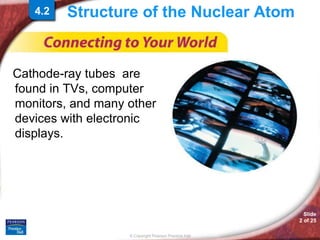
Cathode-ray tubes are
found in TVs, computer
monitors, and many other
devices with electronic
displays.
4.2
© Copyright Pearson Prentice Hall
Structure of the Nuclear Atom >
Slide
3 of 25
Subatomic Particles
Subatomic Particles
What are three kinds of subatomic
particles?
4.2
© Copyright Pearson Prentice Hall
Structure of the Nuclear Atom >
Slide
4 of 25
4.2 Subatomic Particles
Three kinds of subatomic particles are
electrons, protons, and neutrons.
Slide
5 of 25
© Copyright Pearson Prentice Hall
>
Structure of the Nuclear Atom Subatomic Particles
Electrons
In 1897, the English physicist J. J. Thomson
(1856–1940) discovered the electron. Electrons
are negatively charged subatomic particles.
4.2
Slide
6 of 25
© Copyright Pearson Prentice Hall
>
Structure of the Nuclear Atom Subatomic Particles
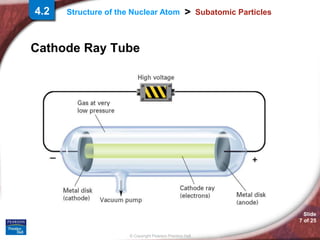
Thomson performed experiments that involved
passing electric current through gases at low
pressure.
The result was a glowing beam, or cathode ray,
that traveled from the cathode to the anode.
4.2
Slide
7 of 25
© Copyright Pearson Prentice Hall
>
Structure of the Nuclear Atom Subatomic Particles
Cathode Ray Tube
4.2
Slide
8 of 25
© Copyright Pearson Prentice Hall
>
Structure of the Nuclear Atom Subatomic Particles
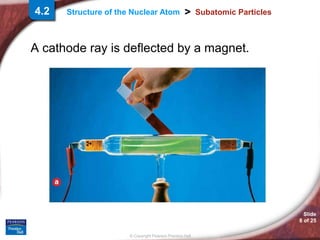
A cathode ray is deflected by a magnet.
4.2
Slide
9 of 25
© Copyright Pearson Prentice Hall
>
Structure of the Nuclear Atom Subatomic Particles
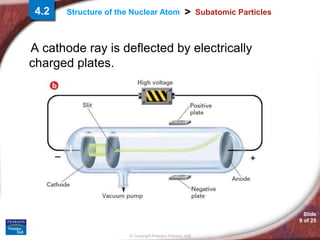
A cathode ray is deflected by electrically
charged plates.
4.2
Slide
10 of 25
© Copyright Pearson Prentice Hall
>
Structure of the Nuclear Atom Subatomic Particles
Thomson concluded that a cathode ray is a
stream of electrons. Electrons are parts of the
atoms of all elements.
4.2
Slide
11 of 25
© Copyright Pearson Prentice Hall
>
Structure of the Nuclear Atom Subatomic Particles
Protons and Neutrons
In 1886, Eugen Goldstein (1850–1930) observed
a cathode-ray tube and found rays traveling in
the direction opposite to that of the cathode rays.
He concluded that they were composed of
positive particles.
Such positively charged subatomic particles are
called protons.
4.2
Slide
12 of 25
© Copyright Pearson Prentice Hall
>
Structure of the Nuclear Atom Subatomic Particles
In 1932, the English physicist James Chadwick
(1891–1974) confirmed the existence of yet
another subatomic particle: the neutron.
Neutrons are subatomic particles with no
charge but with a mass nearly equal to that of a
proton.
4.2
Slide
13 of 25
© Copyright Pearson Prentice Hall
>
Structure of the Nuclear Atom Subatomic Particles
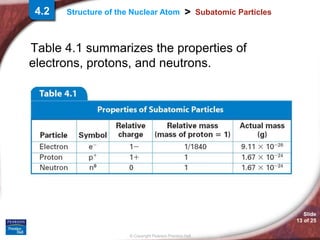
Table 4.1 summarizes the properties of
electrons, protons, and neutrons.
4.2
© Copyright Pearson Prentice Hall
Structure of the Nuclear Atom >
Slide
14 of 25
The Atomic Nucleus
The Atomic Nucleus
How can you describe the structure of
the nuclear atom?
4.2
Slide
15 of 25
© Copyright Pearson Prentice Hall
>
Structure of the Nuclear Atom The Atomic Nucleus
J.J. Thompson and others supposed the atom
was filled with positively charged material and
the electrons were evenly distributed throughout.
This model of the atom turned out to be short-
lived, however, due to the work of Ernest
Rutherford (1871–1937).
4.2
Slide
16 of 25
© Copyright Pearson Prentice Hall
>
Structure of the Nuclear Atom The Atomic Nucleus
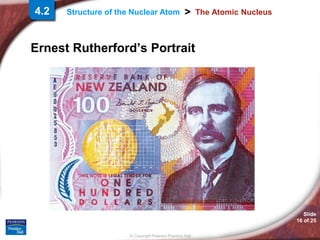
Ernest Rutherford’s Portrait
4.2
Slide
17 of 25
© Copyright Pearson Prentice Hall
>
Structure of the Nuclear Atom The Atomic Nucleus
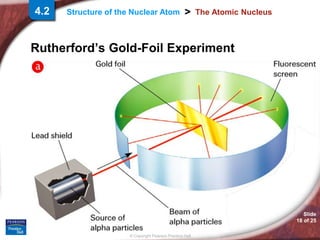
Rutherford’s Gold-Foil Experiment
In 1911, Rutherford and his coworkers at the
University of Manchester, England, directed a
narrow beam of alpha particles at a very thin
sheet of gold foil.
4.2
Slide
18 of 25
© Copyright Pearson Prentice Hall
>
Structure of the Nuclear Atom The Atomic Nucleus
Rutherford’s Gold-Foil Experiment
4.2
Slide
19 of 25
© Copyright Pearson Prentice Hall
>
Structure of the Nuclear Atom The Atomic Nucleus
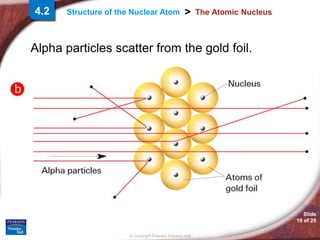
Alpha particles scatter from the gold foil.
4.2
Slide
20 of 25
© Copyright Pearson Prentice Hall
>
Structure of the Nuclear Atom The Atomic Nucleus
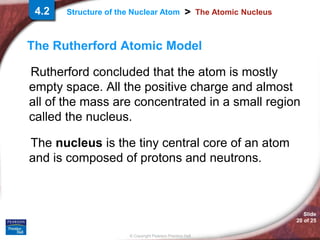
The Rutherford Atomic Model
Rutherford concluded that the atom is mostly
empty space. All the positive charge and almost
all of the mass are concentrated in a small region
called the nucleus.
The nucleus is the tiny central core of an atom
and is composed of protons and neutrons.
4.2
© Copyright Pearson Prentice Hall
Structure of the Nuclear Atom >
Slide
21 of 25
The Atomic Nucleus
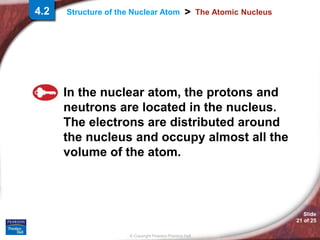
In the nuclear atom, the protons and
neutrons are located in the nucleus.
The electrons are distributed around
the nucleus and occupy almost all the
volume of the atom.
4.2

atomic structure...pptx

  • 1.
  • 2.
    © Copyright PearsonPrentice Hall Slide 2 of 25 Structure of the Nuclear Atom Cathode-ray tubes are found in TVs, computer monitors, and many other devices with electronic displays. 4.2
  • 3.
    © Copyright PearsonPrentice Hall Structure of the Nuclear Atom > Slide 3 of 25 Subatomic Particles Subatomic Particles What are three kinds of subatomic particles? 4.2
  • 4.
    © Copyright PearsonPrentice Hall Structure of the Nuclear Atom > Slide 4 of 25 4.2 Subatomic Particles Three kinds of subatomic particles are electrons, protons, and neutrons.
  • 5.
    Slide 5 of 25 ©Copyright Pearson Prentice Hall > Structure of the Nuclear Atom Subatomic Particles Electrons In 1897, the English physicist J. J. Thomson (1856–1940) discovered the electron. Electrons are negatively charged subatomic particles. 4.2
  • 6.
    Slide 6 of 25 ©Copyright Pearson Prentice Hall > Structure of the Nuclear Atom Subatomic Particles Thomson performed experiments that involved passing electric current through gases at low pressure. The result was a glowing beam, or cathode ray, that traveled from the cathode to the anode. 4.2
  • 7.
    Slide 7 of 25 ©Copyright Pearson Prentice Hall > Structure of the Nuclear Atom Subatomic Particles Cathode Ray Tube 4.2
  • 8.
    Slide 8 of 25 ©Copyright Pearson Prentice Hall > Structure of the Nuclear Atom Subatomic Particles A cathode ray is deflected by a magnet. 4.2
  • 9.
    Slide 9 of 25 ©Copyright Pearson Prentice Hall > Structure of the Nuclear Atom Subatomic Particles A cathode ray is deflected by electrically charged plates. 4.2
  • 10.
    Slide 10 of 25 ©Copyright Pearson Prentice Hall > Structure of the Nuclear Atom Subatomic Particles Thomson concluded that a cathode ray is a stream of electrons. Electrons are parts of the atoms of all elements. 4.2
  • 11.
    Slide 11 of 25 ©Copyright Pearson Prentice Hall > Structure of the Nuclear Atom Subatomic Particles Protons and Neutrons In 1886, Eugen Goldstein (1850–1930) observed a cathode-ray tube and found rays traveling in the direction opposite to that of the cathode rays. He concluded that they were composed of positive particles. Such positively charged subatomic particles are called protons. 4.2
  • 12.
    Slide 12 of 25 ©Copyright Pearson Prentice Hall > Structure of the Nuclear Atom Subatomic Particles In 1932, the English physicist James Chadwick (1891–1974) confirmed the existence of yet another subatomic particle: the neutron. Neutrons are subatomic particles with no charge but with a mass nearly equal to that of a proton. 4.2
  • 13.
    Slide 13 of 25 ©Copyright Pearson Prentice Hall > Structure of the Nuclear Atom Subatomic Particles Table 4.1 summarizes the properties of electrons, protons, and neutrons. 4.2
  • 14.
    © Copyright PearsonPrentice Hall Structure of the Nuclear Atom > Slide 14 of 25 The Atomic Nucleus The Atomic Nucleus How can you describe the structure of the nuclear atom? 4.2
  • 15.
    Slide 15 of 25 ©Copyright Pearson Prentice Hall > Structure of the Nuclear Atom The Atomic Nucleus J.J. Thompson and others supposed the atom was filled with positively charged material and the electrons were evenly distributed throughout. This model of the atom turned out to be short- lived, however, due to the work of Ernest Rutherford (1871–1937). 4.2
  • 16.
    Slide 16 of 25 ©Copyright Pearson Prentice Hall > Structure of the Nuclear Atom The Atomic Nucleus Ernest Rutherford’s Portrait 4.2
  • 17.
    Slide 17 of 25 ©Copyright Pearson Prentice Hall > Structure of the Nuclear Atom The Atomic Nucleus Rutherford’s Gold-Foil Experiment In 1911, Rutherford and his coworkers at the University of Manchester, England, directed a narrow beam of alpha particles at a very thin sheet of gold foil. 4.2
  • 18.
    Slide 18 of 25 ©Copyright Pearson Prentice Hall > Structure of the Nuclear Atom The Atomic Nucleus Rutherford’s Gold-Foil Experiment 4.2
  • 19.
    Slide 19 of 25 ©Copyright Pearson Prentice Hall > Structure of the Nuclear Atom The Atomic Nucleus Alpha particles scatter from the gold foil. 4.2
  • 20.
    Slide 20 of 25 ©Copyright Pearson Prentice Hall > Structure of the Nuclear Atom The Atomic Nucleus The Rutherford Atomic Model Rutherford concluded that the atom is mostly empty space. All the positive charge and almost all of the mass are concentrated in a small region called the nucleus. The nucleus is the tiny central core of an atom and is composed of protons and neutrons. 4.2
  • 21.
    © Copyright PearsonPrentice Hall Structure of the Nuclear Atom > Slide 21 of 25 The Atomic Nucleus In the nuclear atom, the protons and neutrons are located in the nucleus. The electrons are distributed around the nucleus and occupy almost all the volume of the atom. 4.2