-- by Prof. M.K.Deshkar
Atmega 328P
Advanced RISC Architecture
– 131 Powerful Instructions
– Most Single Clock Cycle Execution
– 32 x 8 General Purpose Working
Registers
– Fully Static Operation
– Up to 20 MIPS Throughput at
20MHz
– On-chip 2-cycle Multiplier
Peripheral Features
– Two 8-bit Timer/Counters with
Separate Prescaler and Compare
Mode
– One 16-bit Timer/Counter with
Separate Prescaler, Compare Mode,
and Capture Mode – Real Time
Counter with Separate Oscillator
– Six PWM Channels – 8-channel 10-
bit ADC in TQFP and QFN/MLF
package
• Temperature Measurement
– 6-channel 10-bit ADC in PDIP
Package
• Temperature Measurement
– Two Master/Slave SPI Serial
Interface
– One Programmable Serial USART
– One Byte-oriented 2-wire Serial
Interface (Philips I2C compatible)
Special Microcontroller
Features
– Power-on Reset and
Programmable Brown-out
Detection
– Internal Calibrated Oscillator
– External and Internal Interrupt
Sources – Six Sleep Modes: Idle,
ADC Noise Reduction, Power-
save, Power-down, Standby, and
Atmega 328P- features
of Atmega 328P
AVR Microcontroller
•AVR Micro controllers is Family of RISC Microcontrollers from Atmel.
•There are multiple architectures
RISC (Reduced Instruction Set Computer)
CISC (Complex Instruction Set Computer)
RISC Microcontroller
Reduced Instruction Set Computers Advantages
•Fast Execution of Instructions due to simple instructions for CPU.
•RISC chips require fewer transistors, which makes them cheaper to
design and produce.
•Emphasis on software
•Single-clock , reduced instruction only
•Register to register: “LOAD" and "STORE“ are independent instructions
•Spends more transistors on memory registers
AVR Architecture
•Registers
•Instruction Set
•I/O ports
•Memory (flash & RAM & ROM)
•CPU
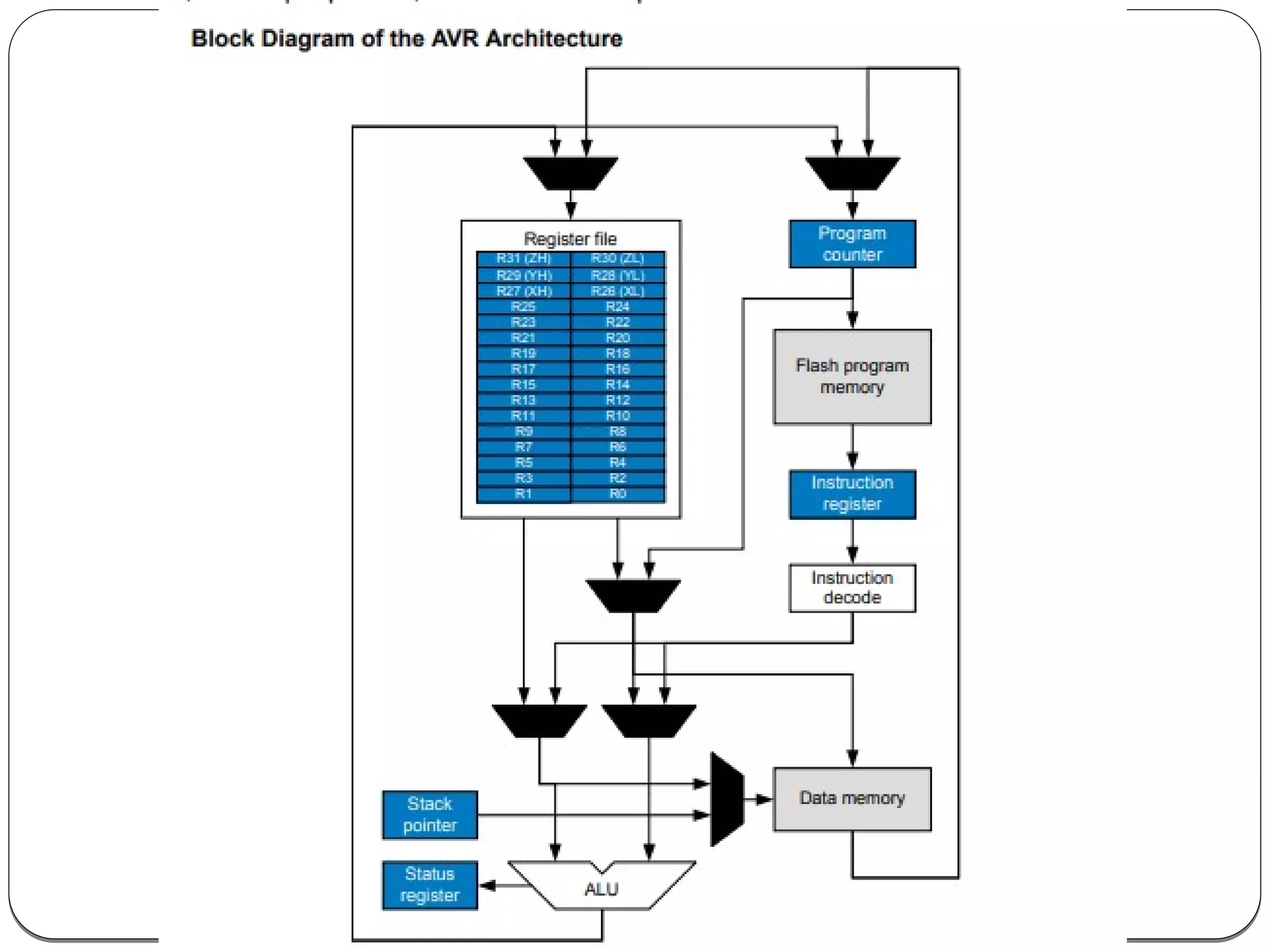
•In order to maximize performance and parallelism, the AVR uses a Harvard
architecture – with separate memories and buses for program and data.
• Instructions in the program memory are executed with a single level
pipelining.
• The fast-access Register File contains 32 x 8-bit general purpose working
registers with a single clock cycle access time.
• Six of the 32 registers can be used as three 16-bit indirect address register
pointers for Data Space addressing – enabling efficient address calculations.
• The ALU supports arithmetic and logic operations between registers or
between a constant and a register.
• Program Flash memory space is divided in two sections, the Boot Program
section and the Application Program section.
• The Stack Pointer (SP) is read/write accessible in the I/O space.
• The memory spaces in the AVR architecture are all linear and regular memory
maps.
Applications
There are hundreds of applications for ATMEGA328P:
Used in ARDUINO UNO, ARDUINO NANO and ARDUINO MICRO
boards.
Industrial control systems.
SMPS and Power Regulation systems.
Digital data processing.
Analog signal measuring and manipulations.
Embedded systems like coffee machine, vending machine.
Motor control systems.
Display units.
Peripheral Interface system.
THANK YOU

Atmega 328p

  • 1.
    -- by Prof.M.K.Deshkar Atmega 328P
  • 2.
    Advanced RISC Architecture –131 Powerful Instructions – Most Single Clock Cycle Execution – 32 x 8 General Purpose Working Registers – Fully Static Operation – Up to 20 MIPS Throughput at 20MHz – On-chip 2-cycle Multiplier Peripheral Features – Two 8-bit Timer/Counters with Separate Prescaler and Compare Mode – One 16-bit Timer/Counter with Separate Prescaler, Compare Mode, and Capture Mode – Real Time Counter with Separate Oscillator – Six PWM Channels – 8-channel 10- bit ADC in TQFP and QFN/MLF package • Temperature Measurement – 6-channel 10-bit ADC in PDIP Package • Temperature Measurement – Two Master/Slave SPI Serial Interface – One Programmable Serial USART – One Byte-oriented 2-wire Serial Interface (Philips I2C compatible) Special Microcontroller Features – Power-on Reset and Programmable Brown-out Detection – Internal Calibrated Oscillator – External and Internal Interrupt Sources – Six Sleep Modes: Idle, ADC Noise Reduction, Power- save, Power-down, Standby, and Atmega 328P- features
  • 3.
  • 5.
    AVR Microcontroller •AVR Microcontrollers is Family of RISC Microcontrollers from Atmel. •There are multiple architectures RISC (Reduced Instruction Set Computer) CISC (Complex Instruction Set Computer) RISC Microcontroller Reduced Instruction Set Computers Advantages •Fast Execution of Instructions due to simple instructions for CPU. •RISC chips require fewer transistors, which makes them cheaper to design and produce. •Emphasis on software •Single-clock , reduced instruction only •Register to register: “LOAD" and "STORE“ are independent instructions •Spends more transistors on memory registers
  • 6.
    AVR Architecture •Registers •Instruction Set •I/Oports •Memory (flash & RAM & ROM) •CPU •In order to maximize performance and parallelism, the AVR uses a Harvard architecture – with separate memories and buses for program and data. • Instructions in the program memory are executed with a single level pipelining. • The fast-access Register File contains 32 x 8-bit general purpose working registers with a single clock cycle access time. • Six of the 32 registers can be used as three 16-bit indirect address register pointers for Data Space addressing – enabling efficient address calculations. • The ALU supports arithmetic and logic operations between registers or between a constant and a register. • Program Flash memory space is divided in two sections, the Boot Program section and the Application Program section. • The Stack Pointer (SP) is read/write accessible in the I/O space. • The memory spaces in the AVR architecture are all linear and regular memory maps.
  • 7.
    Applications There are hundredsof applications for ATMEGA328P: Used in ARDUINO UNO, ARDUINO NANO and ARDUINO MICRO boards. Industrial control systems. SMPS and Power Regulation systems. Digital data processing. Analog signal measuring and manipulations. Embedded systems like coffee machine, vending machine. Motor control systems. Display units. Peripheral Interface system.
  • 8.