Recommended
PDF
02 Sensors and Actuators Understand .pdf
PDF
Making things sense - Day 1 (May 2011)
PPTX
PDF
arduinoworkshop-160204051621.pdf
PDF
PDF
PDF
NSTA 2013 Denver - ArduBlock and Arduino
PPTX
Arduino Workshop (3).pptx
PPTX
Introduction to Arduino Webinar
PDF
Advanced View Arduino Projects List - Use Arduino for Projects-3.pdf
PPTX
embedded_in_Arduino_with_basic_embedded.pptx
PDF
PPTX
KEY
PDF
Intro to Arduino Revision #2
PPT
PDF
Arduino Comic-Jody Culkin-2011
PPTX
Intro_to_Arduino_-_v30.pptx
PDF
PPTX
PPTX
PDF
PDF
Arduino: Libros de proyectos para Arduino
PDF
Arduino Development For Beginners
PPTX
Arduino Robotics workshop Day1
PPTX
Arduino Slides With Neopixels
PDF
PDF
Arduino Workshop Day 1 - Basic Arduino
More Related Content
PDF
02 Sensors and Actuators Understand .pdf
PDF
Making things sense - Day 1 (May 2011)
PPTX
PDF
arduinoworkshop-160204051621.pdf
PDF
PDF
PDF
NSTA 2013 Denver - ArduBlock and Arduino
PPTX
Arduino Workshop (3).pptx
Similar to ATL_Arduino_Complete_Presentation_AI_Visuals.pptx
PPTX
Introduction to Arduino Webinar
PDF
Advanced View Arduino Projects List - Use Arduino for Projects-3.pdf
PPTX
embedded_in_Arduino_with_basic_embedded.pptx
PDF
PPTX
KEY
PDF
Intro to Arduino Revision #2
PPT
PDF
Arduino Comic-Jody Culkin-2011
PPTX
Intro_to_Arduino_-_v30.pptx
PDF
PPTX
PPTX
PDF
PDF
Arduino: Libros de proyectos para Arduino
PDF
Arduino Development For Beginners
PPTX
Arduino Robotics workshop Day1
PPTX
Arduino Slides With Neopixels
PDF
PDF
Arduino Workshop Day 1 - Basic Arduino
ATL_Arduino_Complete_Presentation_AI_Visuals.pptx 1. Welcome to ATL Tinkering Lab
• Let's Explore the World of Arduino &
Innovation!
• By [Your Name]
2. What is ATL (Atal Tinkering Lab)?
• • Initiative by NITI Aayog
• • Promotes STEM & innovation
• • Equipped with tools like Arduino, sensors,
motors, etc.
3. What is Arduino?
• • Open-source microcontroller platform
• • Easy to use hardware & software
• • Used for creating interactive electronics
projects
4. Types of Arduino Boards in ATL
• • Arduino UNO (Most common)
• • Arduino Nano
• • Arduino Mega
• (Include images of each)
5. What Can We Do with Arduino?
• • Control lights, motors
• • Sense environment using sensors
• • Build robots & automation systems
6. Arduino UNO – Basic Parts
• • USB port, power jack, digital & analog pins
• • ATmega328 microcontroller
• (Labelled image of Arduino UNO)
7. Basic Tools Available in ATL
• • Breadboard, jumper wires
• • LEDs, resistors, switches
• • Screwdrivers, multimeter, soldering kit
• (Show pictures of each)
8. Most Used Sensors in ATL
• • Ultrasonic sensor
• • IR sensor
• • Temperature sensor
• • Motion sensor (PIR)
• (Show real photos)
9. Output Devices in ATL
• • Buzzer
• • DC Motor, Servo Motor
• • LEDs, Relay Module
• • LCD Display
10. 11. Uploading Code to Arduino
• 1. Connect Arduino via USB
• 2. Open Arduino IDE
• 3. Write or paste code
• 4. Select correct Board & Port
• 5. Click Upload Button
• (Add diagram/image)
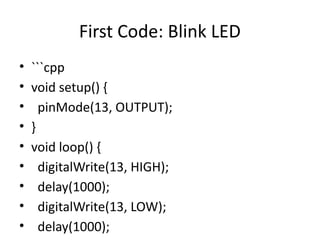
12. First Code: Blink LED
• ```cpp
• void setup() {
• pinMode(13, OUTPUT);
• }
• void loop() {
• digitalWrite(13, HIGH);
• delay(1000);
• digitalWrite(13, LOW);
• delay(1000);
13. 14. 15. How Sensors Work
• • Analog vs Digital sensors
• • Input vs Output
• • Sensor = input; motor = output
16. What is Breadboard?
• • Used for making circuits without soldering
• • Internal connection structure
• (Show image of breadboard wiring)
17. 18. Using Motors with Arduino
• • Types: DC, Servo, Stepper
• • Motor Driver usage (L298N)
• • PWM Control
19. 20. 21. Safety Rules in ATL
• • Don’t short circuits
• • Work under guidance
• • Turn off devices when not in use
22. 23. Fun With Arduino – RGB LED
Project
• • Mix colors with code
• • PWM signal use
• (Add GIF/photo)
24. Internet of Things (IoT) – Basics
• • Connect sensors to internet
• • Arduino + WiFi (ESP8266)
• • Smart home examples
25. 26. 27. Helpful Websites to Learn Arduino
• • www.arduino.cc
• • www.circuitdigest.com
• • www.instructables.com
• • YouTube: CodeSmith, Robu.in
28. 29. 30. Thank You & Keep Tinkering!
• “Explore – Invent – Inspire”
• (Creative robot background)
• Your contact/email (if required)
![Welcome to ATL Tinkering Lab
• Let's Explore the World of Arduino &
Innovation!
• By [Your Name]](https://image.slidesharecdn.com/atlarduinocompletepresentationaivisuals-250804150435-18598e58/85/ATL_Arduino_Complete_Presentation_AI_Visuals-pptx-1-320.jpg)