2/11/2016 Industrial Automation and Control ­ ­ Assessment
https://onlinecourses.nptel.ac.in/noc16_ee02/assessment?name=20 1/5
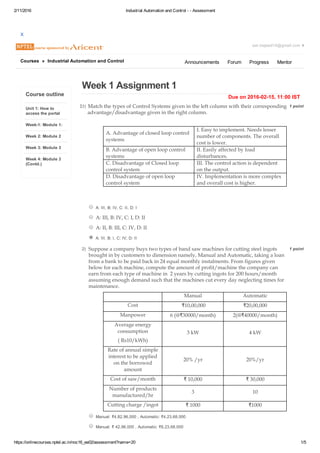
1)1.      Match the types of Control Systems given in the left column with their corresponding
advantage/disadvantage given in the right column.
 
A. Advantage of closed loop control
systems
I. Easy to implement. Needs lesser
number of components. The overall
cost is lower.
B. Advantage of open loop control
systems
II. Easily affected by load
disturbances.
C. Disadvantage of Closed loop
control system
III. The control action is dependent
on the output.
D. Disadvantage of open loop
control system
IV. Implementation is more complex
and overall cost is higher.
 A: III, B: IV, C: II, D: I
 A: III, B: IV, C: I, D: II
 A: II, B: III, C: IV, D: II
 A: III, B: I, C: IV, D: II
1 point
2) Suppose a company buys two types of band saw machines for cutting steel ingots
brought in by customers to dimension namely, Manual and Automatic, taking a loan
from a bank to be paid back in 24 equal monthly instalments. From figures given
below for each machine, compute the amount of profit/machine the company can
earn from each type of machine in  2 years by cutting ingots for 200 hours/month
assuming enough demand such that the machines cut every day neglecting times for
maintenance.
  Manual Automatic
Cost  ₹10,00,000 ₹20,00,000
Manpower 6 (@₹30000/month) 2(@₹40000/month)
Average energy
consumption
( Rs10/kWh)
3 kW 4 kW
Rate of annual simple
interest to be applied
on the borrowed
amount
20% /yr 20%/yr
Cost of saw/month ₹ 10,000 ₹ 30,000
Number of products
manufactured/hr
3 10
Cutting charge /ingot ₹ 1000 ₹1000
 Manual: ₹4,82,96,000 , Automatic: ₹4,23,68,000
 Manual: ₹ 42,96,000 , Automatic: ₹8,23,68,000
1 point
Due on 2016­02­15, 11:00 IST
Week 1 Assignment 1
X
Courses  »  Industrial Automation and Control
aal.majeed14@gmail.com ▼
Announcements Forum Progress Mentor
Course outline
Unit 1: How to
access the portal
Week­1: Module 1:
Week 2: Module 2
Week 3: Module 3
Week 4: Module 3
(Contd.)
 
2/11/2016 Industrial Automation and Control ­ ­ Assessment
https://onlinecourses.nptel.ac.in/noc16_ee02/assessment?name=20 2/5
 Manual: ₹ 82,96,000 , Automatic: ₹4,23,68,000
 Manual: ₹ 82,96,0000 , Automatic: ₹4,23,68,00
3) What type of automation system would you recommend for manufacturing Fluorescent Tube Lights &
Garments?
 Fluorescent Tube Lights: Flexible & Garments: Fixed
 Fluorescent Tube Lights: Programmable & Garments: Flexible
 Fluorescent Tube Lights: Fixed & Garments: Programmable
 Fluorescent Tube Lights: Fixed & Garments: Flexible
1 point
4) Match the types of Production Systems in factories given in the left column with their corresponding
products given in the right column
A) Continuous Flow Process I. Pharmaceuticals
B) Mass Manufacturing Of Discrete ProductsII. Garments
C) Batch Production III. Steel
D) Job Shop IV. Cycles
 A: III, B:  IV,  C: I, D: II
 A: II, B:  IV,  C: III, D: II
 A: III, B:  I,  C: IV, D: II
 A: IV, B:  II,  C: I, D: III
1 point
5) A,B and C are three different product manufacturing systems whose characterisation in terms of product
quantity vs product variety is shown below. Choose the right option for automation system for A, B and C. 
 A:  Fixed Automation System, B:  Flexible Automation System, C:  Programmable Automation System.
 A:  Fixed Automation System, B:  Programmable Automation System, C:  Flexible Automation System.
 A:  Fixed Automation System, B:  Flexible Automation System, C:  Programmable Automation System.
 A:  Flexible Automation System, B:  Fixed Automation System, C:  Programmable Automation System.
1 point
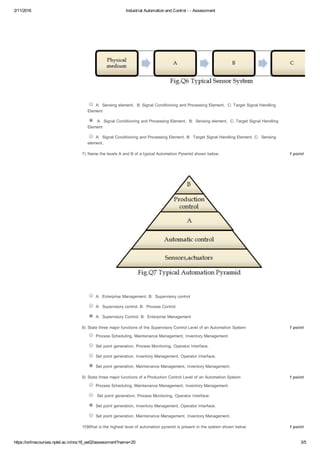
6)   Name the subsystems A, B and C of a typical sensor system shown below.   1 point
2/11/2016 Industrial Automation and Control ­ ­ Assessment
https://onlinecourses.nptel.ac.in/noc16_ee02/assessment?name=20 3/5
 A:  Sensing element,  B: Signal Conditioning and Processing Element,  C: Target Signal Handling
Element
  A:  Signal Conditioning and Processing Element,  B:  Sensing element,  C: Target Signal Handling
Element
 A:  Signal Conditioning and Processing Element, B:  Target Signal Handling Element, C:  Sensing
element.
7) Name the levels A and B of a typical Automation Pyramid shown below.
 A:  Enterprise Management, B:  Supervisory control
 A:  Supervisory control, B:  Process Control
 A:  Supervisory Control, B:  Enterprise Management
1 point
8) State three major functions of the Supervisory Control Level of an Automation System
 Process Scheduling, Maintenance Management, Inventory Management.
 Set point generation, Process Monitoring, Operator Interface.
 Set point generation, Inventory Management, Operator Interface.
 Set point generation, Maintenance Management, Inventory Management.
1 point
9) State three major functions of a Production Control Level of an Automation System
 Process Scheduling, Maintenance Management, Inventory Management.
  Set point generation, Process Monitoring, Operator Interface.
 Set point generation, Inventory Management, Operator Interface.
 Set point generation, Maintenance Management, Inventory Management.
1 point
10)What is the highest level of automation pyramid is present in the system shown below 1 point
2/11/2016 Industrial Automation and Control ­ ­ Assessment
https://onlinecourses.nptel.ac.in/noc16_ee02/assessment?name=20 4/5
 Level 0
 Level 3
 Level 2
 Level 1
11)What is the highest level of automation pyramid is present in the system shown below
 Level 0
 Level 3
 Level 2
 Level 1
1 point
You may submit any number of times before the due date. The final submission will be considered for grading.
Submit Answers
2/11/2016 Industrial Automation and Control ­ ­ Assessment
https://onlinecourses.nptel.ac.in/noc16_ee02/assessment?name=20 5/5
A project of In association with Funded by
Powered by
© 2014 NPTEL ­ Privacy & Terms ­ Honor Code ­ FAQs ­ 

Assessment 01