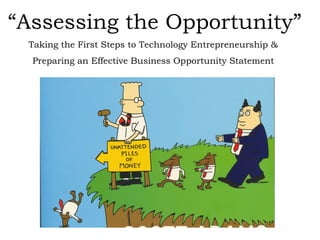
“ Assessing the Opportunity” Taking the First Steps to Technology Entrepreneurship &  Preparing an Effective Business Opportunity Statement
Bob de Wit – quick bio Entrepreneur Canadian V-Chip Design, TechBC Corporation, Flintbox Investor, Advisor, Mentor WUTIF, Angelwest Capital, Axonwave Software, Pangaea Ventures, Energy Aware, ClearVision, RIP.TV, VANTEC, BC Technology Business Mentorship Program (dozens of companies) Consultant Talent Technology Corp, Wurldtech Security, Visiphor, SFU, UBC, BCAHC, etc Community service NVBC, FVTN, Shad Valley Contact info: e. rdewit@alumni.sfu.ca , t. 604.916.3434
Entrepreneur (noun): A person who organizes, operates, and assumes the risk for a business venture.  A person who has possession of an enterprise, or venture, and assumes significant accountability for the inherent risks and the outcome. An innovator of business enterprise who recognizes opportunities to introduce a new product, a new process or an improved organization, and who raises the necessary money, assembles the factors for production and organizes an operation to exploit the opportunity. A person who has been granted a Letter of Approval by the Development Commissioner under sub –section (9) of Sec 15 of the SEZ Act,2005. Any business person in any size or stage of company, dedicated to acting dynamically with an open mind in pursuit of a corporate mission. Entrepreneurs renew society by constantly looking for opportunities to make products, institutions and practices better. Better than a bail-out!
Famous Entrepreneurs: Richard Branson (Virgin brand) Ted Turner (Turner Broadcasting) Bill Gates (Microsoft) Jimmy Pattison (Pattison Group) Don Rix (Metro Labs)  Thomas Jefferson (Louisiana Purchase, Lewis & Clark) Sir John A. MacDonald (Canada, railway) And many, many more… Maybe you?
Some good quotes: “ Ambition is a dream with a V8 engine.” – Elvis Presley “ First they ignore you, then they laugh at you, then they fight you, then you win.”– Mahatma Ghandi “ We were young, but we had good advice and good ideas and lots of enthusiasm.“ – Bill Gates “ Business opportunities are like buses, there's always another one coming.“ – Richard Branson “ Do you want to know who you are? Don't ask. Act! Action will delineate and define you.“ – Thomas Jefferson
Successful  Entrepreneurs understand: the market to which their product is sold; the key  defensible  qualities that gives their product or service an edge against competition; that they must have a strong supporting team around them; and that “cash is king”
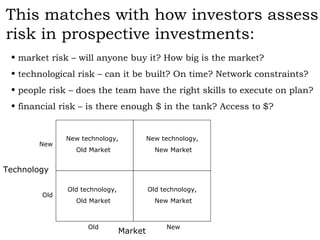
This matches with how investors assess risk in prospective investments: market risk – will anyone buy it? How big is the market? technological risk – can it be built? On time? Network constraints? people risk – does the team have the right skills to execute on plan? financial risk – is there enough $ in the tank? Access to $? Market Technology New Old New Old New technology,  New Market Old technology,  New Market New technology,  Old Market Old technology,  Old Market
It’s good to be the king. Entrepreneurs: Control their own destiny Don’t have to answer to a boss (so to speak) Can express natural leadership tendencies Opportunity to realize huge $$$ rewards – utilize the life time capital gains exemption…   Lots of challenges – constantly wearing multiple hats Always learning, usually on the fly
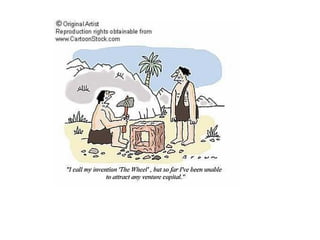
The bad: Responsibility = STRESS! Managing cash-flow is the opposite of free-wheeling it Making payroll is often a frequent challenge Partners, investors and customers don’t always do what they say they were going to do! Not everyone will love your baby the way you do…
 
The ugly: Loss of life savings Loss of control – and then getting punted from the company Loss of relationships – usually “just” spouses, but also often family members who drank your Kool-Aid Mental and/or physical break-down Opportunity cost of not having a “normal” career
Usual Excuses: I’m too old! I’m too young (inexperienced)! If others learn of my idea, they’ll steal it! I’m not smart enough to wear all those hats! Most start-ups fail or become “the living dead" I’m worried about the impact on my family No one would invest in a venture like this (too far to CFP?) I like the predictability of a regular pay-cheque Which ones do you think are valid?
Top 10 Tips: Find mentors and advisors who inspire you to expand the vision for your company Don’t over-plan – take action! Hire people who are smarter than yourself Know thy customer inside and out – make sure your market is well segmented – develop an “ideal customer profile” that describes who your customer is, how they buy, why they buy and how often they might buy, and whether they’ll tell their friends by-the-bye to buy Always know what your “cash runway” is and manage it carefully, but know when not to be cheap!
Top 10 Tips: Develop an elevator pitch. Tailor it to different audiences – use the Mom/Grandma test Play to win, but be willing to risk failure. Perfectionists make better employees than employers Acknowledge the enemy (or make one up) – never say “there is no competition!” Is your baby ugly? Don’t let the hosers get you down!  Above all: have fun and don’t take yourself too seriously!
Where to Look for Help: Your regional Science Council NRC IRAP:  irap-pari.nrc-cnrc.gc.ca New Ventures BC Competition:  www.newventuresbc.com Mike Volker’s web site:  www.sfu.ca/~mvolker/biz/index.htm www.ventureblog.com
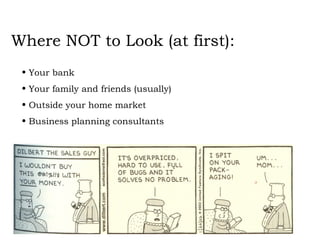
Where NOT to Look (at first): Your bank Your family and friends (usually) Outside your home market Business planning consultants
New Ventures BC Education. Networking. Mentorship. Prizes. A province-wide competition for early stage technology start-ups. $309,000 in prizes. www.newventuresbc.com Introducing:
Entering its 9th year, the New Ventures BC Competition  supports early-stage technology companies by giving them the tools & resources to build a viable business. NVBC offers: Education via a comprehensive seminar series Mentoring via 1:1 and mentor panels for final 30 co.s Prizes, including $119+k to the first prize winner Networking – several networking events
ELIGIBILITY B.C.-based, privately held company that has not been incorporated for more than five years  The clear intent is to build an economically viable, for-profit, new business  Less than $500,000 of equity financing has been raised from outside investors (i.e. investors other than friends, family and company founders)  It must meet NVBC’s criteria of being an innovative product or service involving new technology.
What Defines an Innovative Product?  It utilizes new technology. (“technology” defined as: The application of a practical system of knowledge concerning the physical world and its phenomena); or It combines existing technologies in a way that results in new intellectual property; or It utilizes technologies to develop new or improved existing products or services; or It utilizes technologies to develop new or improve existing production processes; or It is the early-stage development of a new technology.
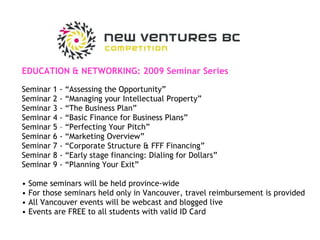
EDUCATION & NETWORKING: 2009 Seminar Series Seminar 1 - “Assessing the Opportunity”  Seminar 2 - “Managing your Intellectual Property”  Seminar 3 - “The Business Plan” Seminar 4 - “Basic Finance for Business Plans” Seminar 5 – “Perfecting Your Pitch” Seminar 6 - “Marketing Overview” Seminar 7 - “Corporate Structure & FFF Financing” Seminar 8 - “Early stage financing: Dialing for Dollars” Seminar 9 - “Planning Your Exit” Some seminars will be held province-wide For those seminars held only in Vancouver, travel reimbursement is provided All Vancouver events will be webcast and blogged live Events are FREE to all students with valid ID Card
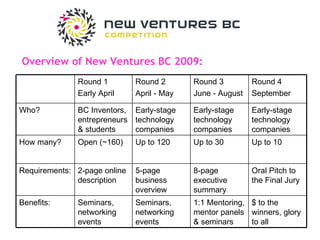
Overview of New Ventures BC 2009: $ to the winners, glory to all 1:1 Mentoring, mentor panels & seminars Seminars, networking events Seminars, networking events Benefits: Oral Pitch to the Final Jury 8-page executive summary 5-page business overview 2-page online description Requirements: Up to 10 Up to 30 Up to 120 Open (~160) How many? Early-stage technology companies Early-stage technology companies Early-stage technology companies BC Inventors, entrepreneurs & students Who? Round 4 September Round 3 June - August Round 2 April - May Round 1 Early April
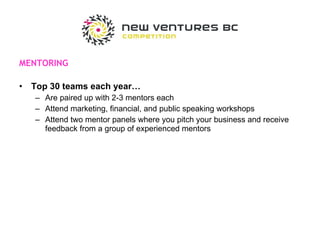
MENTORING Top 30 teams each year… Are paired up with 2-3 mentors each Attend marketing, financial, and public speaking workshops Attend two mentor panels where you pitch your business and receive feedback from a group of experienced mentors
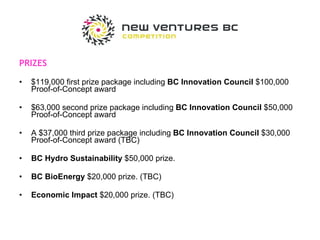
PRIZES $119,000 first prize package including  BC Innovation Council  $100,000 Proof-of-Concept award $63,000 second prize package including  BC Innovation Council  $50,000 Proof-of-Concept award A $37,000 third prize package including  BC Innovation Council  $30,000 Proof-of-Concept award (TBC) BC Hydro Sustainability  $50,000 prize. BC BioEnergy  $20,000 prize. (TBC) Economic Impact  $20,000 prize. (TBC)
“ Regional” Success Stories RFind Systems –  Kaleden, BC, won the competition in 2006 TeamPages Inc  - Uvic students won 2nd prize in 2007 SyncWave  – Pemberton-based winner of 2005 Sustainability Prize Aquasure Bath Products  – Kelowna, won 3rd prize in 2004
How you can participate Enter your company or project!  Entry deadline is April 20 2009.  $100 entry fee per individual or team Sign-up for the seminars only (free for students) Be a mentor. Email your bio: mentor@newventuresbc.com
SPONSORS Title Sponsor BC Innovation Council Gold Sponsors BC Hydro BC BioEnergy Network Ernst & Young LLP Fasken Martineau DuMoulin LLP Ministry of Advanced Education,  Province of BC The Vancouver Sun Western Economic Diversification Silver Sponsors BCIT Simon Fraser University University of British Columbia University of Northern British Columbia University of Victoria Bronze Sponsors AceTech Canadian Financing Forum Techvibes.com Vancouver Enterprise Forum Webnames.ca
For more information visit   www.newventuresbc.com or email:  [email_address]   Join facebook group for updates (search for “New Ventures BC”)   Questions?
Today’s Agenda: Crafting an Effective Business Opportunity Statement Defining the pain; Defining the solution;  Why anyone should care; How you’re going to win; and The call to action (i.e. show me the money)
Sounds Easy Right?
100 – 200 Words: <say what you do in one sentence> + <describe the pain in 1-2 sentences> + <describe your solution in 1-2 sentences> + <why it matters in 1-2 sentences> + <how you win in 1-2 sentences> + <call to action in one sentence>
Not Easy!  Blaise Pascal (not Mark Twain) said: &quot;I have made this letter longer than usual, only because I have not had time to make it shorter.&quot;
Let’s try an example: Saltworks Technologies 2008 NVBC 1 st  Prize & Sustainability Prize winners My unauthorized version of their business (i.e. don’t blame them for this, blame me!)
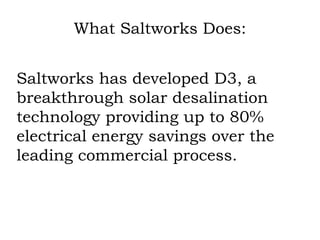
What Saltworks Does: Saltworks has developed D3, a breakthrough solar desalination technology providing up to 80% electrical energy savings over the leading commercial process.
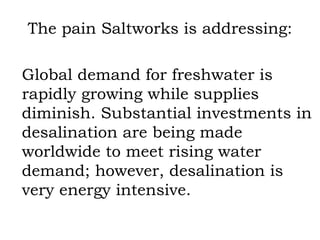
The pain Saltworks is addressing: Global demand for freshwater is rapidly growing while supplies diminish. Substantial investments in desalination are being made worldwide to meet rising water demand; however, desalination is very energy intensive.
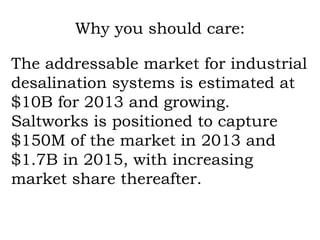
Why you should care: The addressable market for industrial desalination systems is estimated at $10B for 2013 and growing. Saltworks is positioned to capture $150M of the market in 2013 and $1.7B in 2015, with increasing market share thereafter.
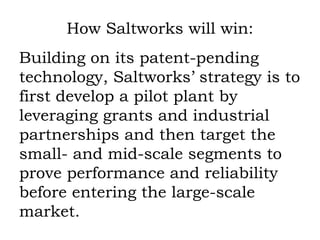
How Saltworks will win: Building on its patent-pending technology, Saltworks’ strategy is to first develop a pilot plant by leveraging grants and industrial partnerships and then target the small- and mid-scale segments to prove performance and reliability before entering the large-scale market.
What Saltworks needs next: To fund growth, Saltworks is envisioning three investment rounds: (1) $K to <details deleted>; (2) $x-xM to <details deleted>, and (3) $xxM <details deleted>
Today’s Agenda: Getting to the money round of New Ventures BC Step-by-Step: Round 1, The Idea Step-by-Step: Round 2, Feasibility Test
Round 1 Entry, The Idea Deadline for entry is April 20, 2009 Entry is done via  www.newventuresbc.com Judging is all about determining eligibility Four ‘big’ questions to answer, only two matter
Round 1 Questions Describe the product or service offering Describe the innovation behind the idea without disclosing proprietary technology (what it does, not how it works) Briefly describe the technology sector your business stems from Provide a brief analysis of the market and competition
Our (WIPO) Definition of IP: “ Creations of the mind” inventions, literary and artistic works, and symbols, names, images, and designs used in commerce  Two Categories: Industrial Property:  inventions (patents), trademarks, industrial designs, and geographic indications of source Copyright ( software,   databases, web pages, literary and artistic works such as novels, poems and plays, films, musical works, artistic works such as drawings, paintings, photographs and sculptures, and architectural designs )
Round 2 Entry, Feasibility Test Deadline for entry is May 27, 2009 Important to understand judging criteria Five judges will review your submission; the top 30 companies based on weighted-average results move on to Round 3 Nine ‘big’ questions to answer; all of them matter Only five pages. Remember Blaise Pascal.
Round 2 Judging Criteria Nine questions, grouped into: Baseline questions; and Evaluation questions Baseline questions (four in total) aren’t judged but are important – where you ‘sell’ the judge on your venture Evaluation questions (five in total) are reviewed by judges using the following scale: Poor = 1;  Fair =2;  Good = 3;  Very good = 4; Excellent = 5 Points are awarded on the basis of the clarity and credibility of your submission.
Round 2: Baseline Information no more than one page to describe: Product/Service. Describe your product or service and the nature of the technology Technology Development. Describe the development stage of your product/service Team. Describe your company's strengths. List the credentials of your technical and management teams, and if applicable, advisors and board of directors. If you don't have a team, describe the key positions and critical skill sets that you plan to add. Business Plan Status: What research has been conducted, and what remains to be done. What key sources are included to document and support your plan?
Q1: Intellectual Property Describe the various forms of intellectual property related to your product/service that you own or are developing under license Describe your IP strategy, including any plans for IP protection and how your IP gives you a  defensible competitive advantage Remember: IP is not just patents! Don’t forget: trade secrets, know-how, copyright, trademark, industrial design, databases, customer-lists, etc, etc Important: if patents are important to your strategy, make sure you’re not hindering your ability to file by disclosing too much. What it does vs. how it does it.
Q2: Market Describe the target market in terms of size, segments, and trends – BE SPECIFIC! Describe your ideal customer-type and the value your customers will derive from purchasing your products or services (what’s their ROI? And/or what is the payback period?). Why will they become customers? Describe your revenue model (how you plan to make money) Explain what your market-penetration goals are (by market share, by number of units, by revenue)
 
Q3: Distribution Explain the go-to-market plan (how you plan to market and sell to your ideal customer type) What, if any, alliances do you intend to strike? Why and when? Explain how the product/service is produced.
Q4: Competition Describe your company and product's primary competitive differentiators What makes you unique, better? What is your relative value proposition? (refer back to customer ROI) Describe substitutes for your product or service (existing or potential – please do not say “none!”) What are the barriers to competition?
 
Q5: Financial (key numbers) What have you spent to date? What funds have been raised? From where? How much money do you need? (for the current business plan; to reach cash-flow positive) When will your venture be cash-flow positive? What kind of return can investors expect? When? How? Include your key assumptions that drive your forecasts
Investor Math Present Value of your company The VC vs. Angel views Future (exit) Value Implications for required revenue growth
PV of your Company: Is whatever it’s worth! (mark-to-market) Angels generally invest earlier and expect higher ROIs – 6 – 20x their money back over 5-10 years VCs invest a bit later and need at least 10x their money back over 5-7 years Angel valuations range from $500k - $2MM VC valuations range from $2MM - $5MM (here) Angel round: $250k - $750k (sometimes more) VC round (s): $2MM - $5MM (over time)
Angel Rules of Thumb on PV: A great idea, with IP = $500k The right team for the current biz plan = $250k Some market validation = $250k Early revenue from early adopters = $500k More than the above justifies higher value All of the above depends on other deals being done by companies like yours (+/-)
Future (exit) value Exits are usually via M&A and are harder to come by right now Valuations are often measured as a multiple of revenue Typical multiples are 1 – 2 times revenue Less for one-time revenue, more for recurring revenue Much less for service businesses
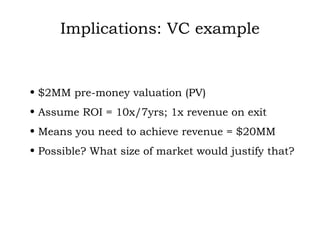
Implications: Angel example $1MM pre-money valuation (PV) Assume ROI = 10x/7yrs; 1x revenue on exit Means you need to achieve revenue = $10MM Possible? What size of market would justify that?
Implications: VC example $2MM pre-money valuation (PV) Assume ROI = 10x/7yrs; 1x revenue on exit Means you need to achieve revenue = $20MM Possible? What size of market would justify that?
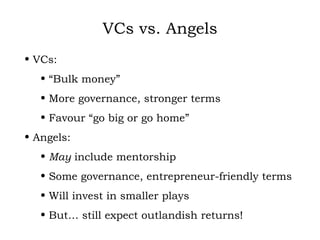
VCs vs. Angels VCs: “ Bulk money” More governance, stronger terms Favour “go big or go home” Angels: May  include mentorship Some governance, entrepreneur-friendly terms Will invest in smaller plays But… still expect outlandish returns!
Thank You! Bob de Wit Contact info: e. rdewit@alumni.sfu.ca t. 604.916.3434

Assessing The Opportunity 2009 V2

  • 1.
    “ Assessing theOpportunity” Taking the First Steps to Technology Entrepreneurship & Preparing an Effective Business Opportunity Statement
  • 2.
    Bob de Wit– quick bio Entrepreneur Canadian V-Chip Design, TechBC Corporation, Flintbox Investor, Advisor, Mentor WUTIF, Angelwest Capital, Axonwave Software, Pangaea Ventures, Energy Aware, ClearVision, RIP.TV, VANTEC, BC Technology Business Mentorship Program (dozens of companies) Consultant Talent Technology Corp, Wurldtech Security, Visiphor, SFU, UBC, BCAHC, etc Community service NVBC, FVTN, Shad Valley Contact info: e. rdewit@alumni.sfu.ca , t. 604.916.3434
  • 3.
    Entrepreneur (noun): Aperson who organizes, operates, and assumes the risk for a business venture. A person who has possession of an enterprise, or venture, and assumes significant accountability for the inherent risks and the outcome. An innovator of business enterprise who recognizes opportunities to introduce a new product, a new process or an improved organization, and who raises the necessary money, assembles the factors for production and organizes an operation to exploit the opportunity. A person who has been granted a Letter of Approval by the Development Commissioner under sub –section (9) of Sec 15 of the SEZ Act,2005. Any business person in any size or stage of company, dedicated to acting dynamically with an open mind in pursuit of a corporate mission. Entrepreneurs renew society by constantly looking for opportunities to make products, institutions and practices better. Better than a bail-out!
  • 4.
    Famous Entrepreneurs: RichardBranson (Virgin brand) Ted Turner (Turner Broadcasting) Bill Gates (Microsoft) Jimmy Pattison (Pattison Group) Don Rix (Metro Labs) Thomas Jefferson (Louisiana Purchase, Lewis & Clark) Sir John A. MacDonald (Canada, railway) And many, many more… Maybe you?
  • 5.
    Some good quotes:“ Ambition is a dream with a V8 engine.” – Elvis Presley “ First they ignore you, then they laugh at you, then they fight you, then you win.”– Mahatma Ghandi “ We were young, but we had good advice and good ideas and lots of enthusiasm.“ – Bill Gates “ Business opportunities are like buses, there's always another one coming.“ – Richard Branson “ Do you want to know who you are? Don't ask. Act! Action will delineate and define you.“ – Thomas Jefferson
  • 6.
    Successful Entrepreneursunderstand: the market to which their product is sold; the key defensible qualities that gives their product or service an edge against competition; that they must have a strong supporting team around them; and that “cash is king”
  • 7.
    This matches withhow investors assess risk in prospective investments: market risk – will anyone buy it? How big is the market? technological risk – can it be built? On time? Network constraints? people risk – does the team have the right skills to execute on plan? financial risk – is there enough $ in the tank? Access to $? Market Technology New Old New Old New technology, New Market Old technology, New Market New technology, Old Market Old technology, Old Market
  • 8.
    It’s good tobe the king. Entrepreneurs: Control their own destiny Don’t have to answer to a boss (so to speak) Can express natural leadership tendencies Opportunity to realize huge $$$ rewards – utilize the life time capital gains exemption…  Lots of challenges – constantly wearing multiple hats Always learning, usually on the fly
  • 9.
    The bad: Responsibility= STRESS! Managing cash-flow is the opposite of free-wheeling it Making payroll is often a frequent challenge Partners, investors and customers don’t always do what they say they were going to do! Not everyone will love your baby the way you do…
  • 10.
  • 11.
    The ugly: Lossof life savings Loss of control – and then getting punted from the company Loss of relationships – usually “just” spouses, but also often family members who drank your Kool-Aid Mental and/or physical break-down Opportunity cost of not having a “normal” career
  • 12.
    Usual Excuses: I’mtoo old! I’m too young (inexperienced)! If others learn of my idea, they’ll steal it! I’m not smart enough to wear all those hats! Most start-ups fail or become “the living dead&quot; I’m worried about the impact on my family No one would invest in a venture like this (too far to CFP?) I like the predictability of a regular pay-cheque Which ones do you think are valid?
  • 13.
    Top 10 Tips:Find mentors and advisors who inspire you to expand the vision for your company Don’t over-plan – take action! Hire people who are smarter than yourself Know thy customer inside and out – make sure your market is well segmented – develop an “ideal customer profile” that describes who your customer is, how they buy, why they buy and how often they might buy, and whether they’ll tell their friends by-the-bye to buy Always know what your “cash runway” is and manage it carefully, but know when not to be cheap!
  • 14.
    Top 10 Tips:Develop an elevator pitch. Tailor it to different audiences – use the Mom/Grandma test Play to win, but be willing to risk failure. Perfectionists make better employees than employers Acknowledge the enemy (or make one up) – never say “there is no competition!” Is your baby ugly? Don’t let the hosers get you down! Above all: have fun and don’t take yourself too seriously!
  • 15.
    Where to Lookfor Help: Your regional Science Council NRC IRAP: irap-pari.nrc-cnrc.gc.ca New Ventures BC Competition: www.newventuresbc.com Mike Volker’s web site: www.sfu.ca/~mvolker/biz/index.htm www.ventureblog.com
  • 16.
    Where NOT toLook (at first): Your bank Your family and friends (usually) Outside your home market Business planning consultants
  • 17.
    New Ventures BCEducation. Networking. Mentorship. Prizes. A province-wide competition for early stage technology start-ups. $309,000 in prizes. www.newventuresbc.com Introducing:
  • 18.
    Entering its 9thyear, the New Ventures BC Competition supports early-stage technology companies by giving them the tools & resources to build a viable business. NVBC offers: Education via a comprehensive seminar series Mentoring via 1:1 and mentor panels for final 30 co.s Prizes, including $119+k to the first prize winner Networking – several networking events
  • 19.
    ELIGIBILITY B.C.-based, privatelyheld company that has not been incorporated for more than five years The clear intent is to build an economically viable, for-profit, new business Less than $500,000 of equity financing has been raised from outside investors (i.e. investors other than friends, family and company founders) It must meet NVBC’s criteria of being an innovative product or service involving new technology.
  • 20.
    What Defines anInnovative Product? It utilizes new technology. (“technology” defined as: The application of a practical system of knowledge concerning the physical world and its phenomena); or It combines existing technologies in a way that results in new intellectual property; or It utilizes technologies to develop new or improved existing products or services; or It utilizes technologies to develop new or improve existing production processes; or It is the early-stage development of a new technology.
  • 21.
    EDUCATION & NETWORKING:2009 Seminar Series Seminar 1 - “Assessing the Opportunity” Seminar 2 - “Managing your Intellectual Property” Seminar 3 - “The Business Plan” Seminar 4 - “Basic Finance for Business Plans” Seminar 5 – “Perfecting Your Pitch” Seminar 6 - “Marketing Overview” Seminar 7 - “Corporate Structure & FFF Financing” Seminar 8 - “Early stage financing: Dialing for Dollars” Seminar 9 - “Planning Your Exit” Some seminars will be held province-wide For those seminars held only in Vancouver, travel reimbursement is provided All Vancouver events will be webcast and blogged live Events are FREE to all students with valid ID Card
  • 22.
    Overview of NewVentures BC 2009: $ to the winners, glory to all 1:1 Mentoring, mentor panels & seminars Seminars, networking events Seminars, networking events Benefits: Oral Pitch to the Final Jury 8-page executive summary 5-page business overview 2-page online description Requirements: Up to 10 Up to 30 Up to 120 Open (~160) How many? Early-stage technology companies Early-stage technology companies Early-stage technology companies BC Inventors, entrepreneurs & students Who? Round 4 September Round 3 June - August Round 2 April - May Round 1 Early April
  • 23.
    MENTORING Top 30teams each year… Are paired up with 2-3 mentors each Attend marketing, financial, and public speaking workshops Attend two mentor panels where you pitch your business and receive feedback from a group of experienced mentors
  • 24.
    PRIZES $119,000 firstprize package including BC Innovation Council $100,000 Proof-of-Concept award $63,000 second prize package including BC Innovation Council $50,000 Proof-of-Concept award A $37,000 third prize package including BC Innovation Council $30,000 Proof-of-Concept award (TBC) BC Hydro Sustainability $50,000 prize. BC BioEnergy $20,000 prize. (TBC) Economic Impact $20,000 prize. (TBC)
  • 25.
    “ Regional” SuccessStories RFind Systems – Kaleden, BC, won the competition in 2006 TeamPages Inc - Uvic students won 2nd prize in 2007 SyncWave – Pemberton-based winner of 2005 Sustainability Prize Aquasure Bath Products – Kelowna, won 3rd prize in 2004
  • 26.
    How you canparticipate Enter your company or project! Entry deadline is April 20 2009. $100 entry fee per individual or team Sign-up for the seminars only (free for students) Be a mentor. Email your bio: mentor@newventuresbc.com
  • 27.
    SPONSORS Title SponsorBC Innovation Council Gold Sponsors BC Hydro BC BioEnergy Network Ernst & Young LLP Fasken Martineau DuMoulin LLP Ministry of Advanced Education, Province of BC The Vancouver Sun Western Economic Diversification Silver Sponsors BCIT Simon Fraser University University of British Columbia University of Northern British Columbia University of Victoria Bronze Sponsors AceTech Canadian Financing Forum Techvibes.com Vancouver Enterprise Forum Webnames.ca
  • 28.
    For more informationvisit www.newventuresbc.com or email: [email_address] Join facebook group for updates (search for “New Ventures BC”) Questions?
  • 29.
    Today’s Agenda: Craftingan Effective Business Opportunity Statement Defining the pain; Defining the solution; Why anyone should care; How you’re going to win; and The call to action (i.e. show me the money)
  • 30.
  • 31.
    100 – 200Words: <say what you do in one sentence> + <describe the pain in 1-2 sentences> + <describe your solution in 1-2 sentences> + <why it matters in 1-2 sentences> + <how you win in 1-2 sentences> + <call to action in one sentence>
  • 32.
    Not Easy! Blaise Pascal (not Mark Twain) said: &quot;I have made this letter longer than usual, only because I have not had time to make it shorter.&quot;
  • 33.
    Let’s try anexample: Saltworks Technologies 2008 NVBC 1 st Prize & Sustainability Prize winners My unauthorized version of their business (i.e. don’t blame them for this, blame me!)
  • 34.
    What Saltworks Does:Saltworks has developed D3, a breakthrough solar desalination technology providing up to 80% electrical energy savings over the leading commercial process.
  • 35.
    The pain Saltworksis addressing: Global demand for freshwater is rapidly growing while supplies diminish. Substantial investments in desalination are being made worldwide to meet rising water demand; however, desalination is very energy intensive.
  • 36.
    Why you shouldcare: The addressable market for industrial desalination systems is estimated at $10B for 2013 and growing. Saltworks is positioned to capture $150M of the market in 2013 and $1.7B in 2015, with increasing market share thereafter.
  • 37.
    How Saltworks willwin: Building on its patent-pending technology, Saltworks’ strategy is to first develop a pilot plant by leveraging grants and industrial partnerships and then target the small- and mid-scale segments to prove performance and reliability before entering the large-scale market.
  • 38.
    What Saltworks needsnext: To fund growth, Saltworks is envisioning three investment rounds: (1) $K to <details deleted>; (2) $x-xM to <details deleted>, and (3) $xxM <details deleted>
  • 39.
    Today’s Agenda: Gettingto the money round of New Ventures BC Step-by-Step: Round 1, The Idea Step-by-Step: Round 2, Feasibility Test
  • 40.
    Round 1 Entry,The Idea Deadline for entry is April 20, 2009 Entry is done via www.newventuresbc.com Judging is all about determining eligibility Four ‘big’ questions to answer, only two matter
  • 41.
    Round 1 QuestionsDescribe the product or service offering Describe the innovation behind the idea without disclosing proprietary technology (what it does, not how it works) Briefly describe the technology sector your business stems from Provide a brief analysis of the market and competition
  • 42.
    Our (WIPO) Definitionof IP: “ Creations of the mind” inventions, literary and artistic works, and symbols, names, images, and designs used in commerce Two Categories: Industrial Property: inventions (patents), trademarks, industrial designs, and geographic indications of source Copyright ( software, databases, web pages, literary and artistic works such as novels, poems and plays, films, musical works, artistic works such as drawings, paintings, photographs and sculptures, and architectural designs )
  • 43.
    Round 2 Entry,Feasibility Test Deadline for entry is May 27, 2009 Important to understand judging criteria Five judges will review your submission; the top 30 companies based on weighted-average results move on to Round 3 Nine ‘big’ questions to answer; all of them matter Only five pages. Remember Blaise Pascal.
  • 44.
    Round 2 JudgingCriteria Nine questions, grouped into: Baseline questions; and Evaluation questions Baseline questions (four in total) aren’t judged but are important – where you ‘sell’ the judge on your venture Evaluation questions (five in total) are reviewed by judges using the following scale: Poor = 1; Fair =2; Good = 3; Very good = 4; Excellent = 5 Points are awarded on the basis of the clarity and credibility of your submission.
  • 45.
    Round 2: BaselineInformation no more than one page to describe: Product/Service. Describe your product or service and the nature of the technology Technology Development. Describe the development stage of your product/service Team. Describe your company's strengths. List the credentials of your technical and management teams, and if applicable, advisors and board of directors. If you don't have a team, describe the key positions and critical skill sets that you plan to add. Business Plan Status: What research has been conducted, and what remains to be done. What key sources are included to document and support your plan?
  • 46.
    Q1: Intellectual PropertyDescribe the various forms of intellectual property related to your product/service that you own or are developing under license Describe your IP strategy, including any plans for IP protection and how your IP gives you a defensible competitive advantage Remember: IP is not just patents! Don’t forget: trade secrets, know-how, copyright, trademark, industrial design, databases, customer-lists, etc, etc Important: if patents are important to your strategy, make sure you’re not hindering your ability to file by disclosing too much. What it does vs. how it does it.
  • 47.
    Q2: Market Describethe target market in terms of size, segments, and trends – BE SPECIFIC! Describe your ideal customer-type and the value your customers will derive from purchasing your products or services (what’s their ROI? And/or what is the payback period?). Why will they become customers? Describe your revenue model (how you plan to make money) Explain what your market-penetration goals are (by market share, by number of units, by revenue)
  • 48.
  • 49.
    Q3: Distribution Explainthe go-to-market plan (how you plan to market and sell to your ideal customer type) What, if any, alliances do you intend to strike? Why and when? Explain how the product/service is produced.
  • 50.
    Q4: Competition Describeyour company and product's primary competitive differentiators What makes you unique, better? What is your relative value proposition? (refer back to customer ROI) Describe substitutes for your product or service (existing or potential – please do not say “none!”) What are the barriers to competition?
  • 51.
  • 52.
    Q5: Financial (keynumbers) What have you spent to date? What funds have been raised? From where? How much money do you need? (for the current business plan; to reach cash-flow positive) When will your venture be cash-flow positive? What kind of return can investors expect? When? How? Include your key assumptions that drive your forecasts
  • 53.
    Investor Math PresentValue of your company The VC vs. Angel views Future (exit) Value Implications for required revenue growth
  • 54.
    PV of yourCompany: Is whatever it’s worth! (mark-to-market) Angels generally invest earlier and expect higher ROIs – 6 – 20x their money back over 5-10 years VCs invest a bit later and need at least 10x their money back over 5-7 years Angel valuations range from $500k - $2MM VC valuations range from $2MM - $5MM (here) Angel round: $250k - $750k (sometimes more) VC round (s): $2MM - $5MM (over time)
  • 55.
    Angel Rules ofThumb on PV: A great idea, with IP = $500k The right team for the current biz plan = $250k Some market validation = $250k Early revenue from early adopters = $500k More than the above justifies higher value All of the above depends on other deals being done by companies like yours (+/-)
  • 56.
    Future (exit) valueExits are usually via M&A and are harder to come by right now Valuations are often measured as a multiple of revenue Typical multiples are 1 – 2 times revenue Less for one-time revenue, more for recurring revenue Much less for service businesses
  • 57.
    Implications: Angel example$1MM pre-money valuation (PV) Assume ROI = 10x/7yrs; 1x revenue on exit Means you need to achieve revenue = $10MM Possible? What size of market would justify that?
  • 58.
    Implications: VC example$2MM pre-money valuation (PV) Assume ROI = 10x/7yrs; 1x revenue on exit Means you need to achieve revenue = $20MM Possible? What size of market would justify that?
  • 59.
    VCs vs. AngelsVCs: “ Bulk money” More governance, stronger terms Favour “go big or go home” Angels: May include mentorship Some governance, entrepreneur-friendly terms Will invest in smaller plays But… still expect outlandish returns!
  • 60.
    Thank You! Bobde Wit Contact info: e. rdewit@alumni.sfu.ca t. 604.916.3434