Leveraging the Power of Associations  To Create a New Magnitude of Sustainable Value   David Cooperrider, Fairmount Minerals Professor and Chair Center for Business as an Agent of World Benefit Case Western Reserve University
Opening Excitement & Today’s Session: It’s Great to Re-connect With You What do associations uniquely bring to the world of social responsibility and sustainability? Is this arena of sustainable value creation truly the biggest business opportunity of the 21 st  Century?  Are there emerging examples—associations helping whole industries—and do these stories show how “doing good and doing well” can help the world, the industry, and strengthen the association as a leader? Why is the “temptation to do good” less effective than the goal to create  sustainable value? How fast is all this happening?
A Story: The Most Exciting Project I Have Ever Worked On
Business as an Agent of World Benefit --More Than 2,000 Interviews --100s of Published Profiles “Positive Institutions”   --s ee  www.worldinquiry.org “Awe is What Moves Us Forward”
Sustainable Value —From Obligation to Design Mindset Stake- holder  Value¹ Shareholder Value Unsustainable (Value Transfer) Unsustainable (Value Transfer) Unsustainable (Lose/Lose) Sustainable Value ¹ absolute standards or relative to competitors Clean energy   vehicles Fossil fuel ICE
Is Sustainability a Passing Fad?
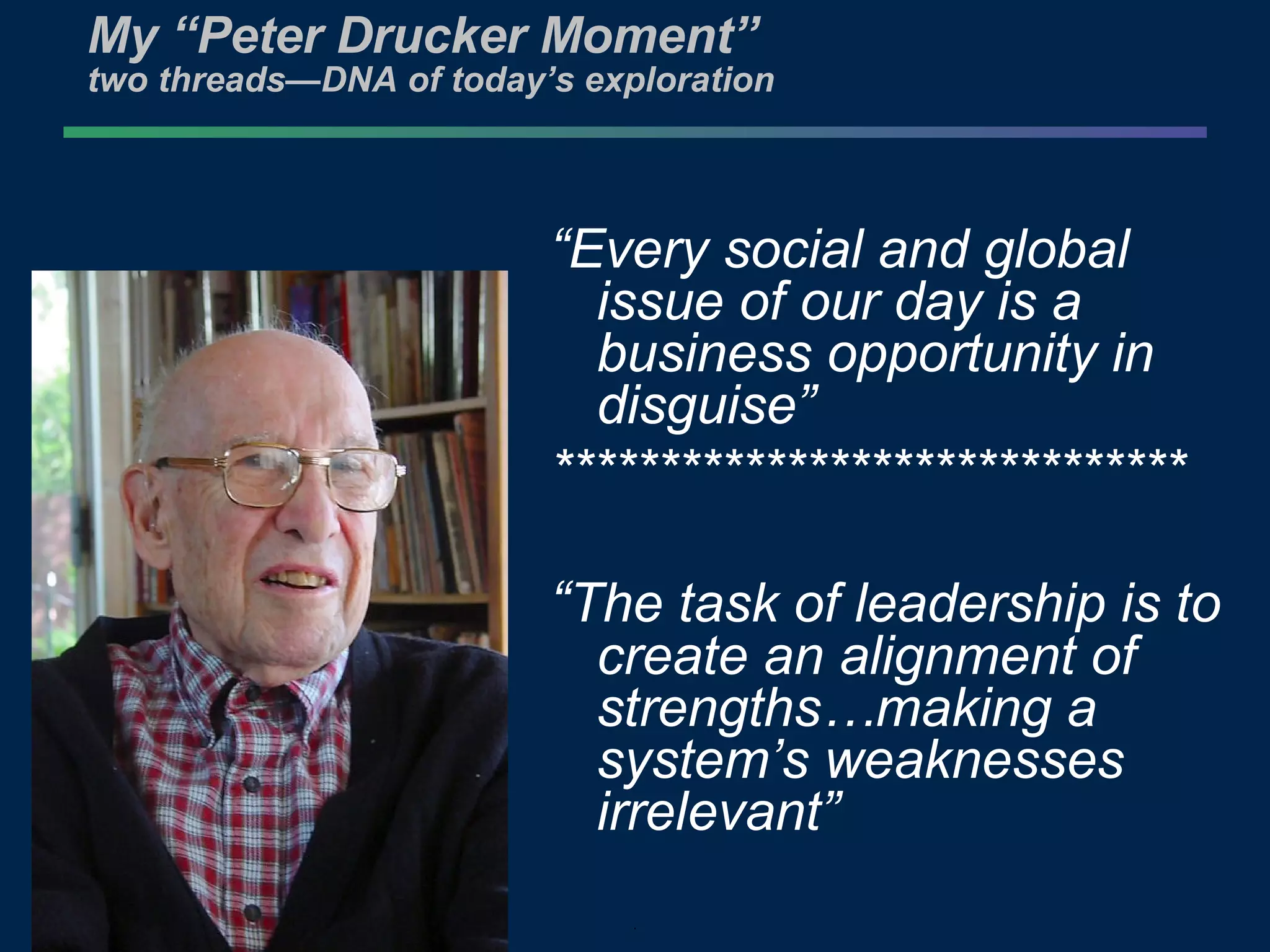
My “Peter Drucker Moment” two threads—DNA of today’s exploration  “ Every social and global issue of our day is a business opportunity in disguise” ****************************** “ The task of leadership is to create an alignment of strengths…making a system’s weaknesses irrelevant”
Appreciative Inquiry  Involves a Shift “ No problem can be solved from the same level of consciousness that created it. We must learn to see the world anew.” “ There are only two ways to live your life. One is as though nothing is a miracle. The other is as though everything is a miracle.”  –  Albert Einstein
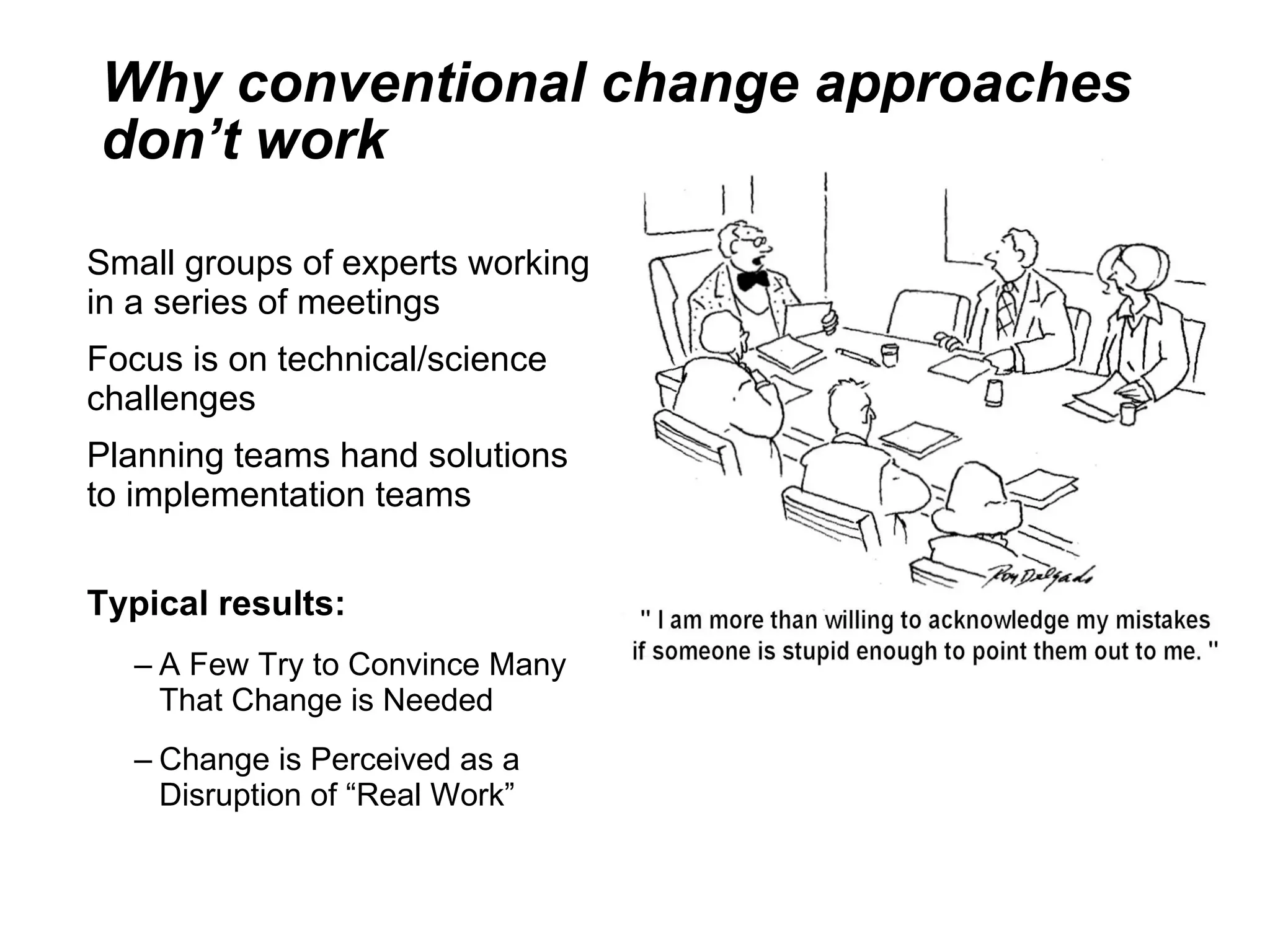
Why conventional change approaches don’t work Small groups of experts working in a series of meetings Focus is on technical/science challenges Planning teams hand solutions to implementation teams Typical results: A Few Try to Convince Many That Change is Needed Change is Perceived as a Disruption of “Real Work”
Fairmount Minerals Story Birth of the “Sustainable Design Factory”
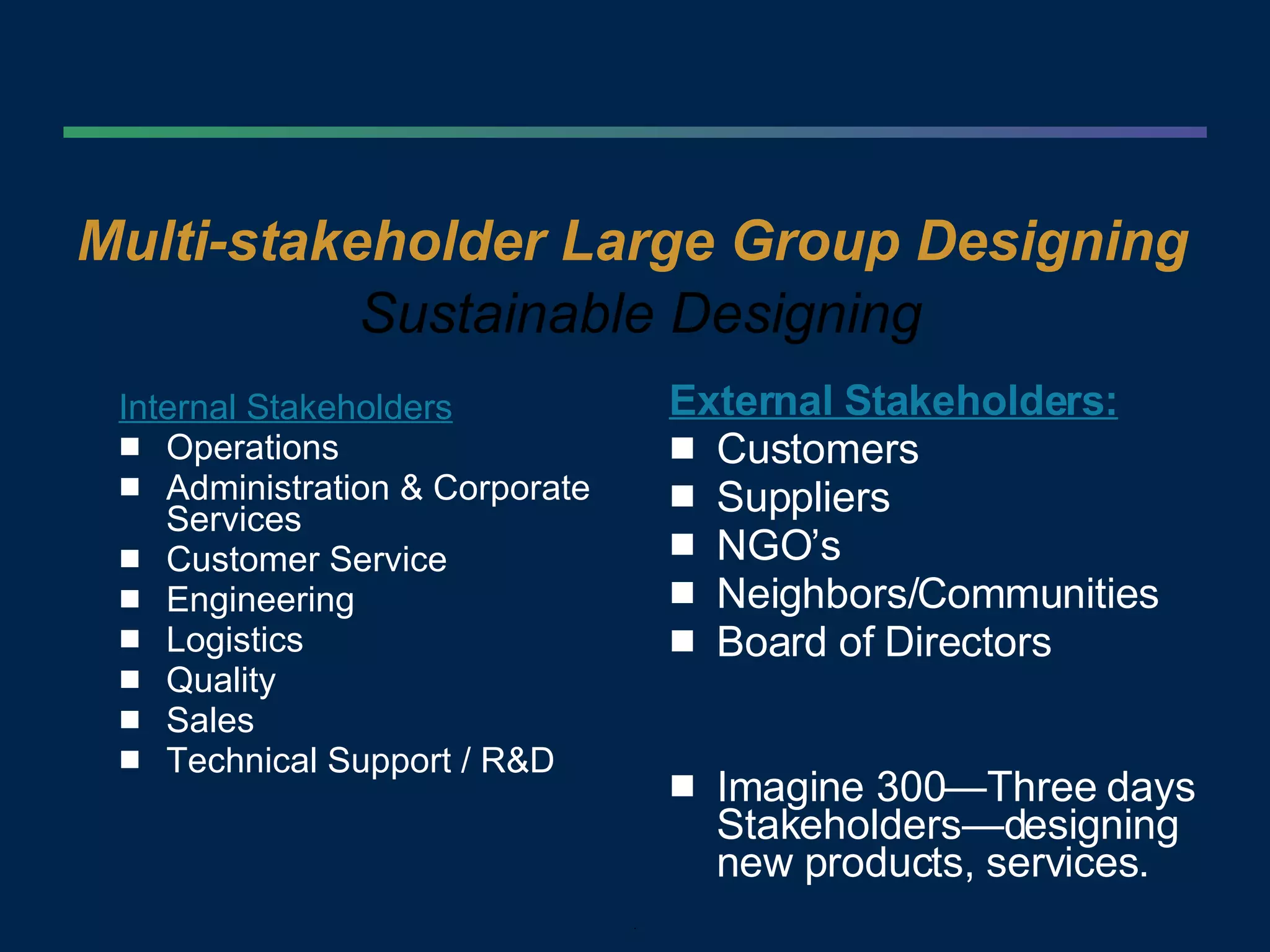
Multi-stakeholder Large Group Designing External Stakeholders: Customers Suppliers NGO’s Neighbors/Communities Board of Directors Imagine 300—Three days Stakeholders—designing new products, services. Internal Stakeholders Operations Administration & Corporate Services Customer Service Engineering Logistics Quality Sales Technical Support / R&D Sustainable Designing
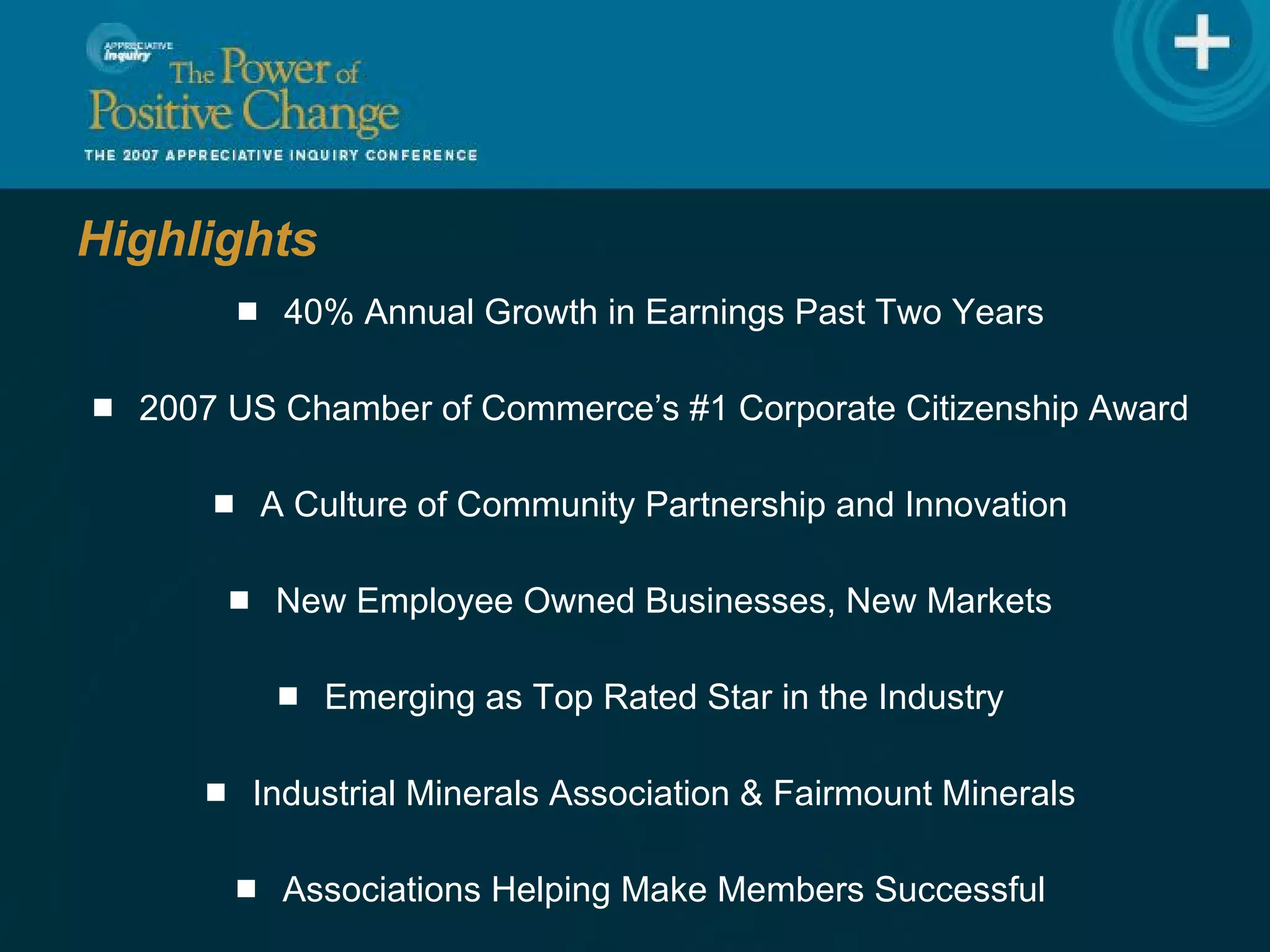
Highlights 40% Annual Growth in Earnings Past Two Years 2007 US Chamber of Commerce’s #1 Corporate Citizenship Award A Culture of Community Partnership and Innovation New Employee Owned Businesses, New Markets Emerging as Top Rated Star in the Industry Industrial Minerals Association & Fairmount Minerals Associations Helping Make Members Successful
Fairmount Started with Appreciative Inquiry in 1990  With a Focus on Empowerment 40% CAGR Past Four Years
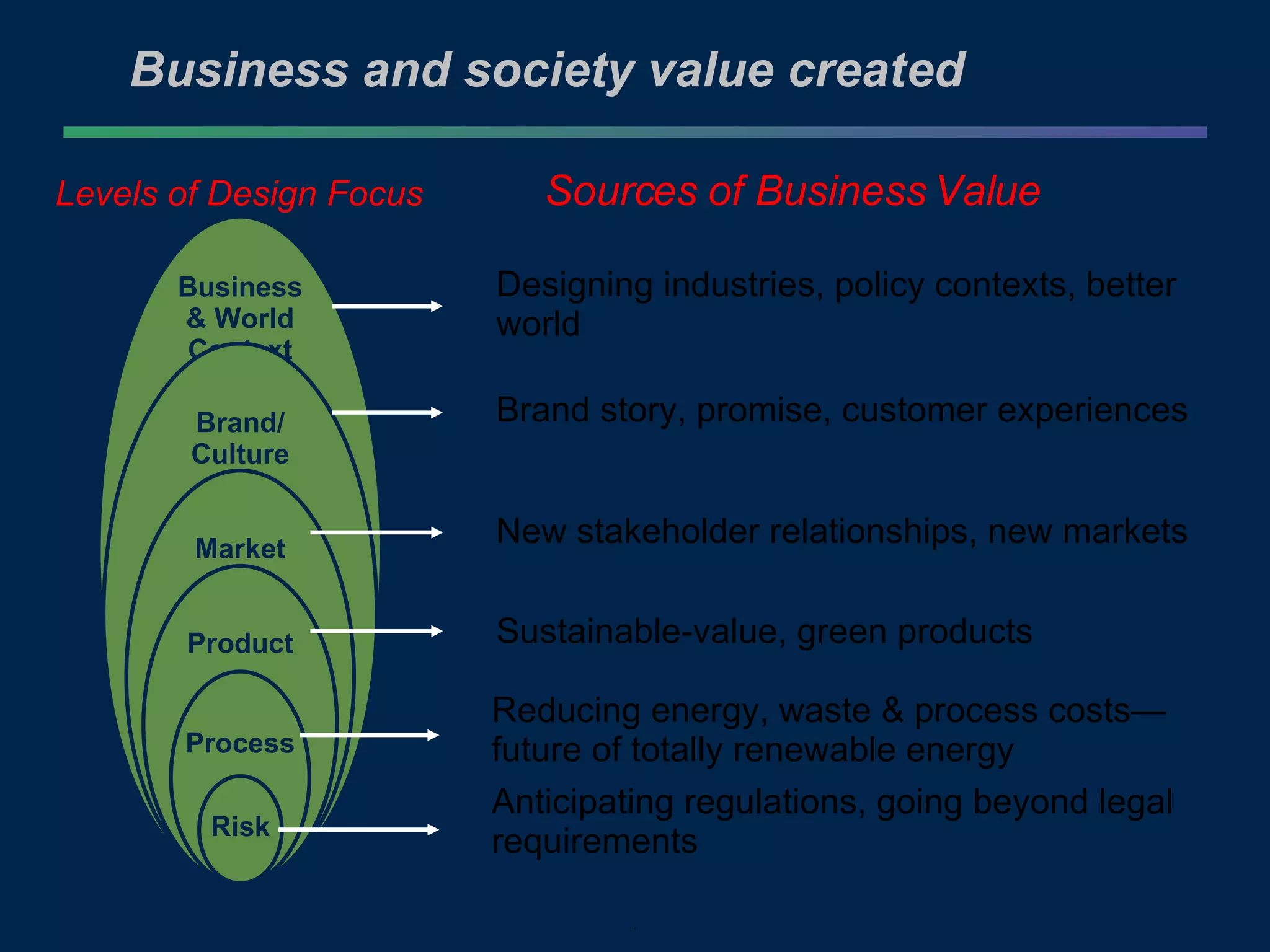
Sources of Business Value Levels of Design Focus Business & World Context Brand/ Culture Market Product Process Risk Business and society value created Anticipating regulations, going beyond legal requirements Reducing energy, waste & process costs—future of totally renewable energy Sustainable-value, green products New stakeholder relationships, new markets Brand story, promise, customer experiences  Designing industries, policy contexts, better world
In June, dairy leaders met in Rogers, Arkansas for the inaugural  Sustainability Summit: Creating Value Through Dairy Innovation.   The Summit was an unprecedented gathering of 250 leaders representing producers, processors, non-governmental organizations, university researchers and government agencies.  Together, these stakeholders generated action steps and made an industry-wide commitment to reduce fluid milk’s carbon footprint while increasing business value, from farm to consumer.
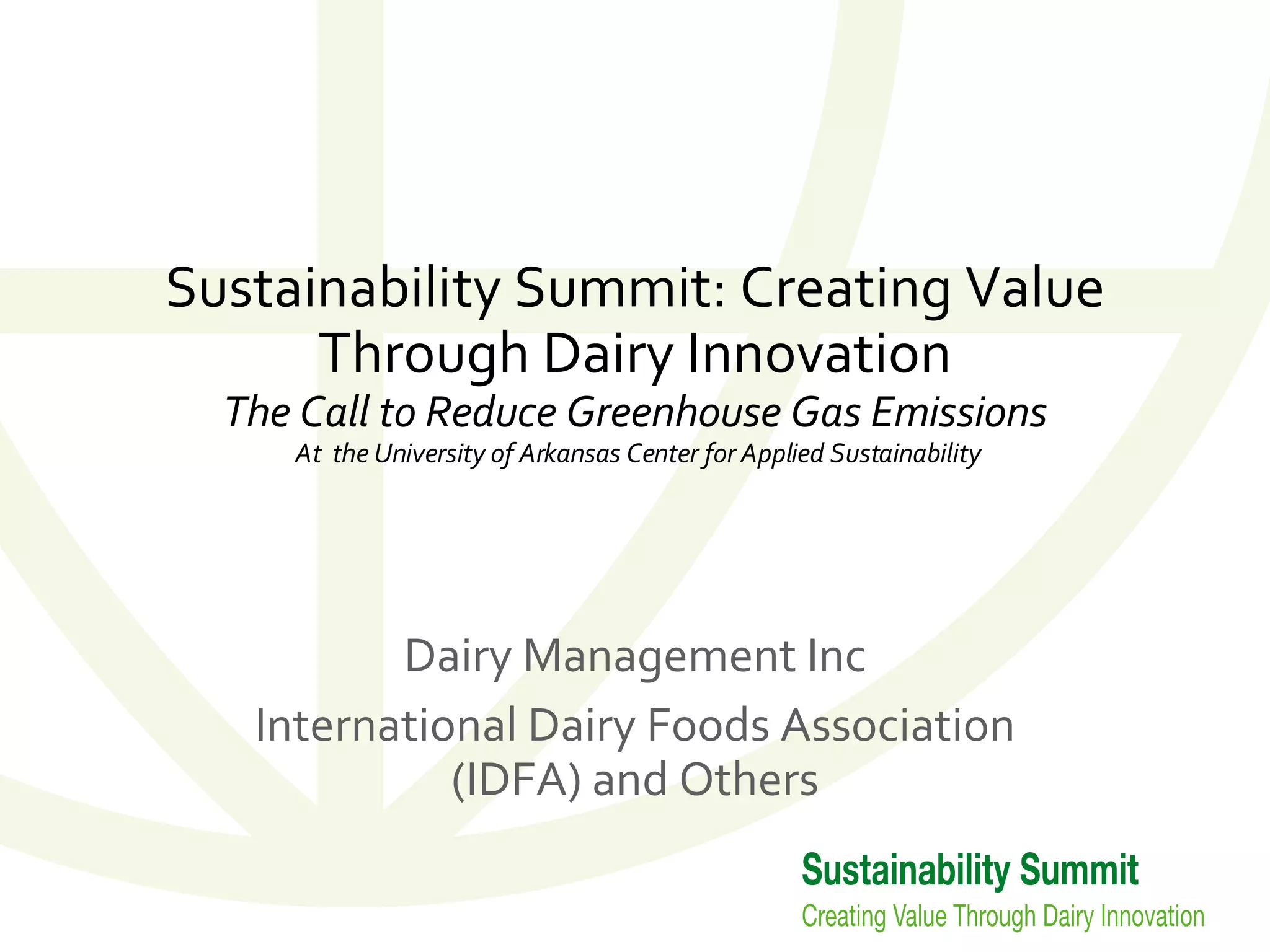
Sustainability Summit: Creating Value Through Dairy Innovation The Call to Reduce Greenhouse Gas Emissions  At  the University of Arkansas Center for Applied Sustainability Dairy Management Inc International Dairy Foods Association (IDFA) and Others
Summit Goal Goals:  Reduce greenhouse gas emissions in the fluid milk value chain AND Increase business value in the fluid milk category Outcomes: Launch a set of initiatives  that leverages industry collaboration
Appreciative Inquiry System-in-the-Room: Broad Enrollment: Special Configuration of People Whole system represented;  innovation inspired by  collaboration and co-creation Leverages strengths and maintains  continuity with the best of the past Full voice Success Factors for Innovation and System Change Success requires: right conditions for engagement  right people in the room Big Change Fast Accomplishes months of work in 2-3 days Action focus around clear task Creates momentum for implementation Breakthrough Results Lens of sustainability opens new possibilities Design  “Rapid Prototypes” Honoring differences & common ground
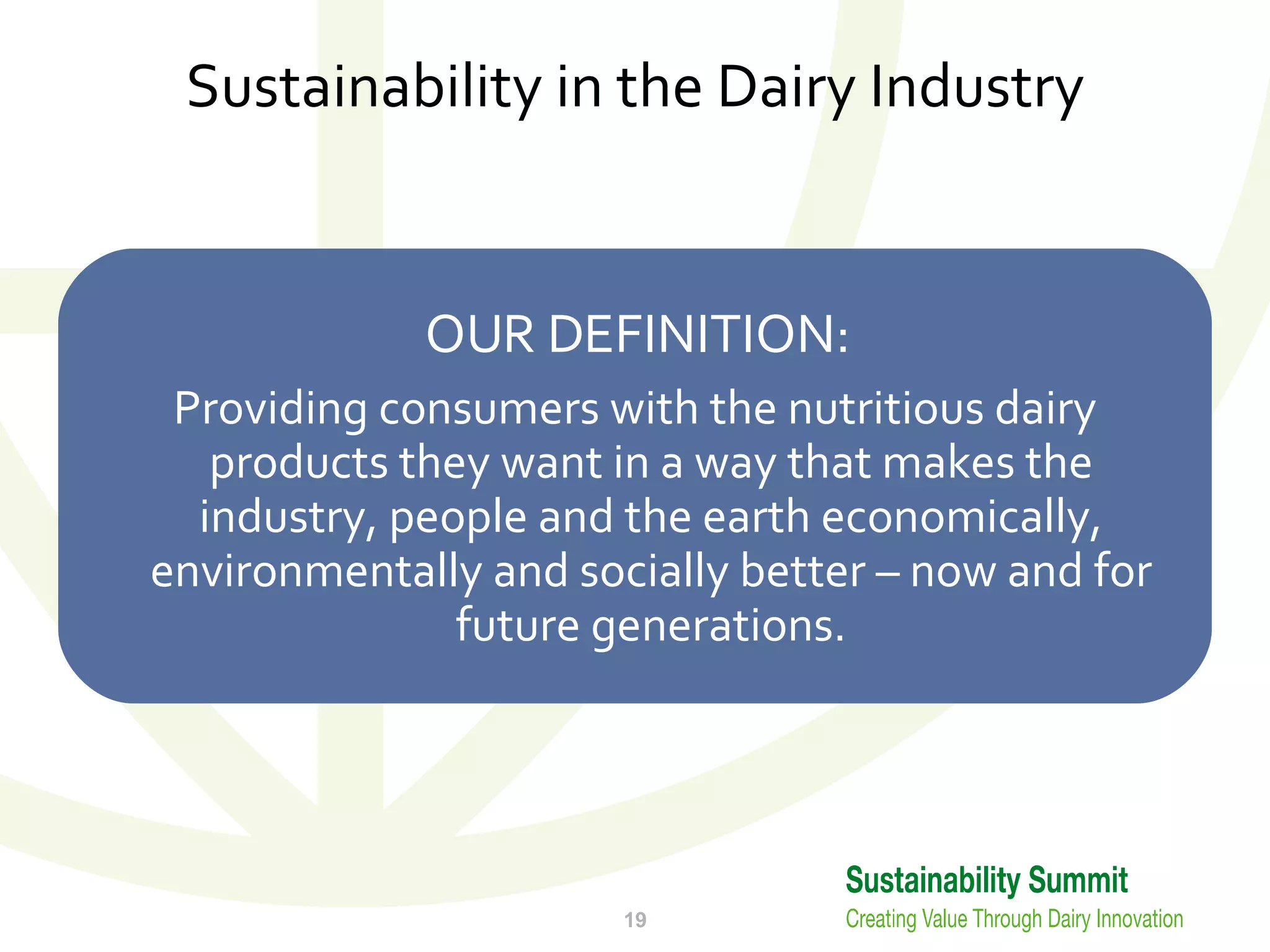
Sustainability in the Dairy Industry OUR DEFINITION: Providing consumers with the nutritious dairy products they want in a way that makes the industry, people and the earth economically, environmentally and socially better – now and for future generations.
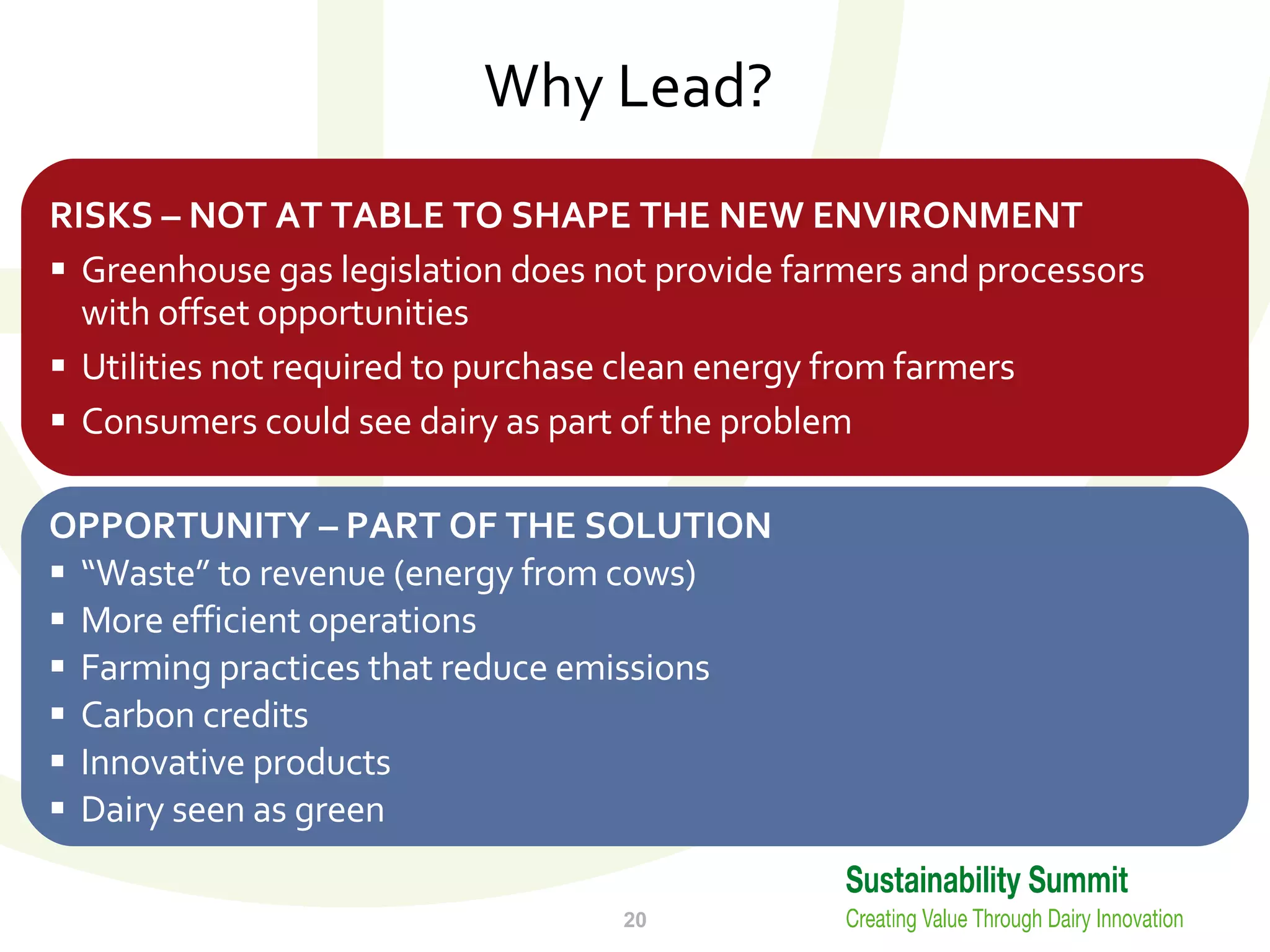
Why Lead?  OPPORTUNITY – PART OF THE SOLUTION “ Waste” to revenue (energy from cows) More efficient operations Farming practices that reduce emissions Carbon credits Innovative products Dairy seen as green RISKS – NOT AT TABLE TO SHAPE THE NEW ENVIRONMENT Greenhouse gas legislation does not provide farmers and processors with offset opportunities  Utilities not required to purchase clean energy from farmers Consumers could see dairy as part of the problem
Sustainability Requires a  Life Cycle Perspective v Waste & Pollution Resources &Energy Consumer/ End of Life
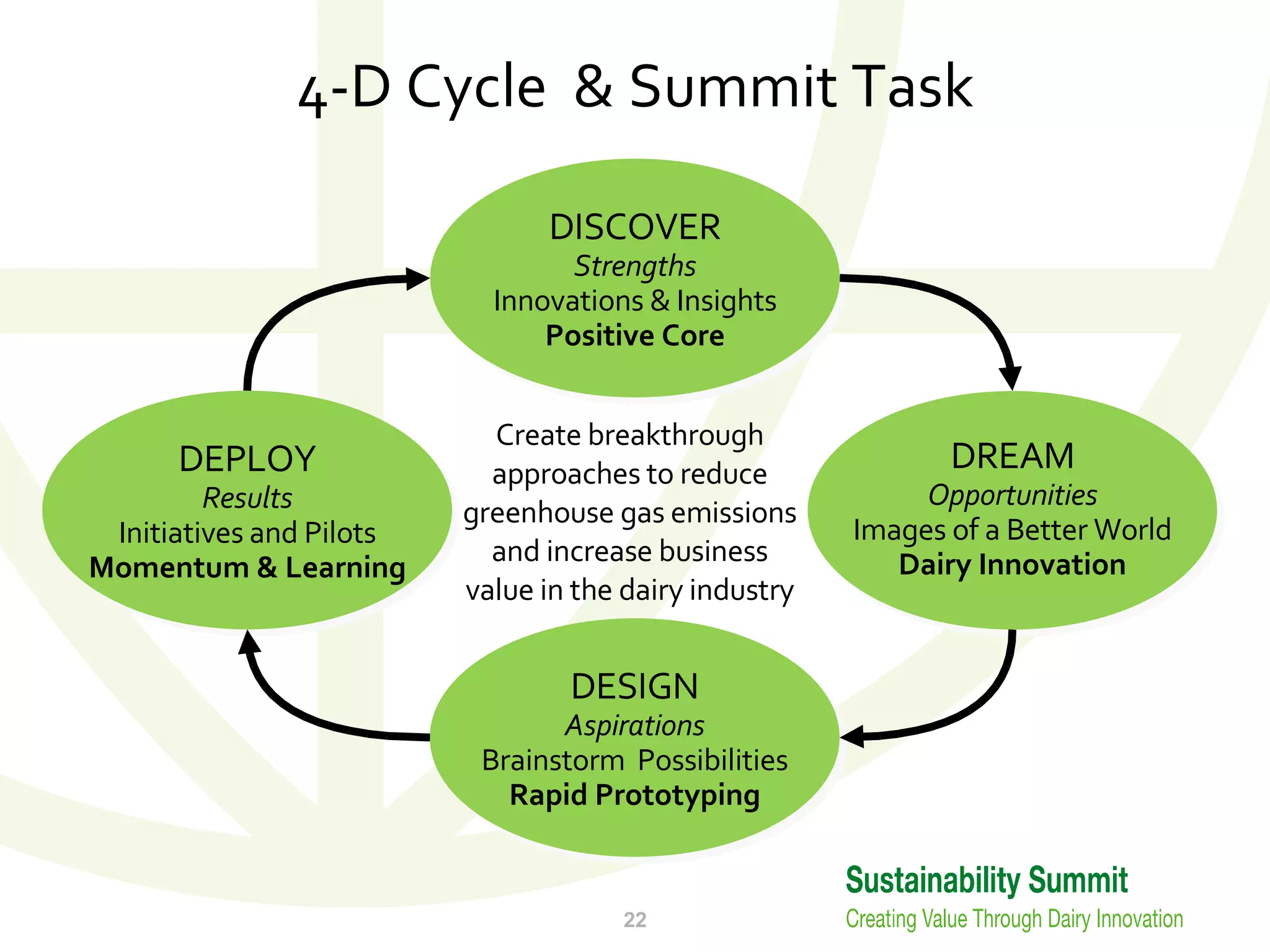
4-D Cycle  & Summit Task DISCOVER Strengths Innovations & Insights Positive Core DREAM Opportunities Images of a Better World Dairy Innovation DESIGN Aspirations Brainstorm  Possibilities Rapid Prototyping DEPLOY Results Initiatives and Pilots Momentum & Learning Create breakthrough approaches to reduce greenhouse gas emissions and increase business value in the dairy industry
Dairy Industry Today 2.7 million U.S. passenger  vehicle emissions per year Emissions today:  30 million metric tons per year Identified potential reductions: 15 million metric tons per year
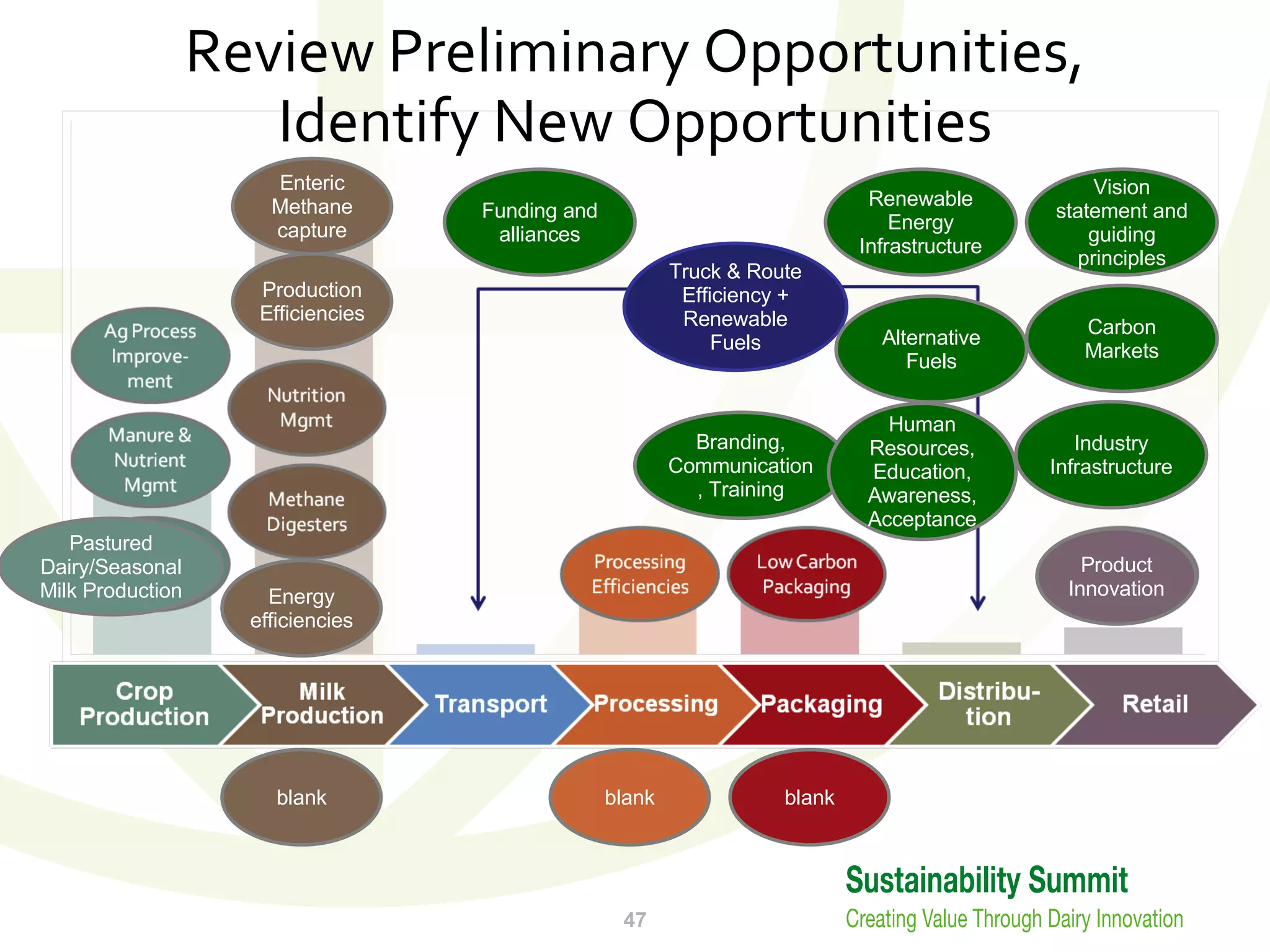
Review Preliminary Opportunities, Identify New Opportunities 47 Vision statement and guiding principles Truck & Route Efficiency + Renewable Fuels blank Pastured Dairy/Seasonal Milk Production Product Innovation blank blank Carbon Markets Energy efficiencies Renewable Energy Infrastructure Industry Infrastructure Branding, Communication, Training Production Efficiencies Alternative Fuels Human Resources, Education, Awareness, Acceptance Funding and alliances Enteric Methane capture
Methane Digesters Opportunity Transform manure into renewable energy Create revenue source and air/water quality benefits for producers Barriers Challenging for individual farmers to finance, permit, build, operate and maintain Lack of appropriate technology Utility pricing structures Potential Strategy Develop third-party owner/financer model to scale Lobby for regulations on utility incentives, carbon offsets and RECs Pilot models in states with favorable regulatory environments Milk Production
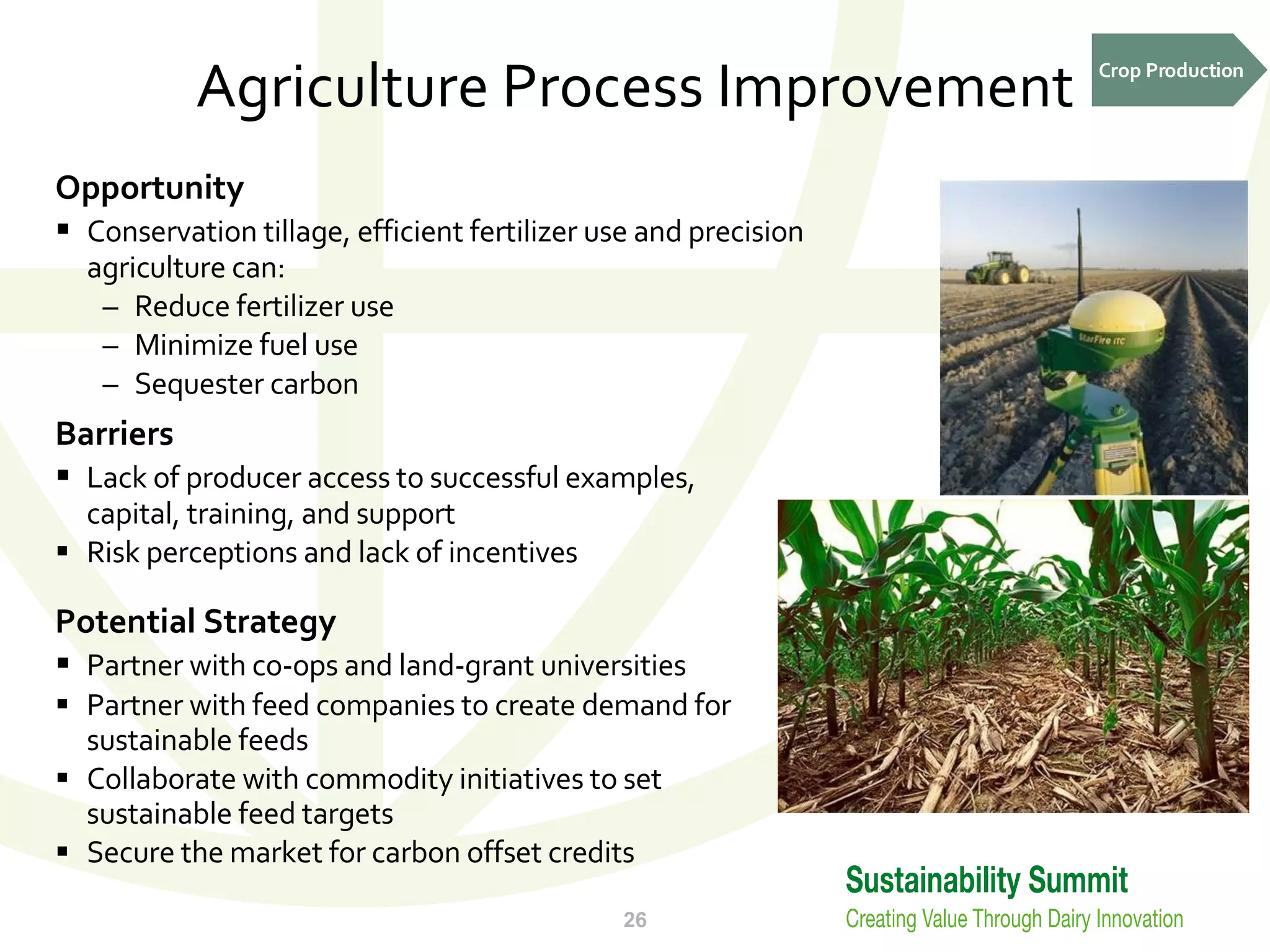
Agriculture Process Improvement Opportunity Conservation tillage, efficient fertilizer use and precision agriculture can: Reduce fertilizer use Minimize fuel use Sequester carbon Barriers Lack of producer access to successful examples, capital, training, and support  Risk perceptions and lack of incentives Potential Strategy Partner with co-ops and land-grant universities Partner with feed companies to create demand for sustainable feeds Collaborate with commodity initiatives to set sustainable feed targets Secure the market for carbon offset credits Crop Production
Manure & Nutrient Management Opportunity Manure nutrient use offsets use of commercial fertilizers and associated emissions and costs Barriers Storage and transportation constraints Ease of use Access to necessary information and demonstration cases Potential Strategy Leverage co-ops and land grant universities to spread best practices and identify effective and economic solutions Develop third party service providers models and create demand for manure nutrients Ensure appropriate carbon offset credits are available to producers Crop Production
Pastured Dairy Opportunity Pastures sequester carbon and can reduce net emissions from the farm and can lower production costs for small farms Barriers Lack of access to information to implement or improve pastured dairy practices Infrastructure development costs Land availability Potential Strategy Drive outreach through academic institutions, co-ops, processors and NGOs Use industry leverage to prioritize competitive funding for pasture enhancement projects Enable carbon credit creation and commercialization Crop Production
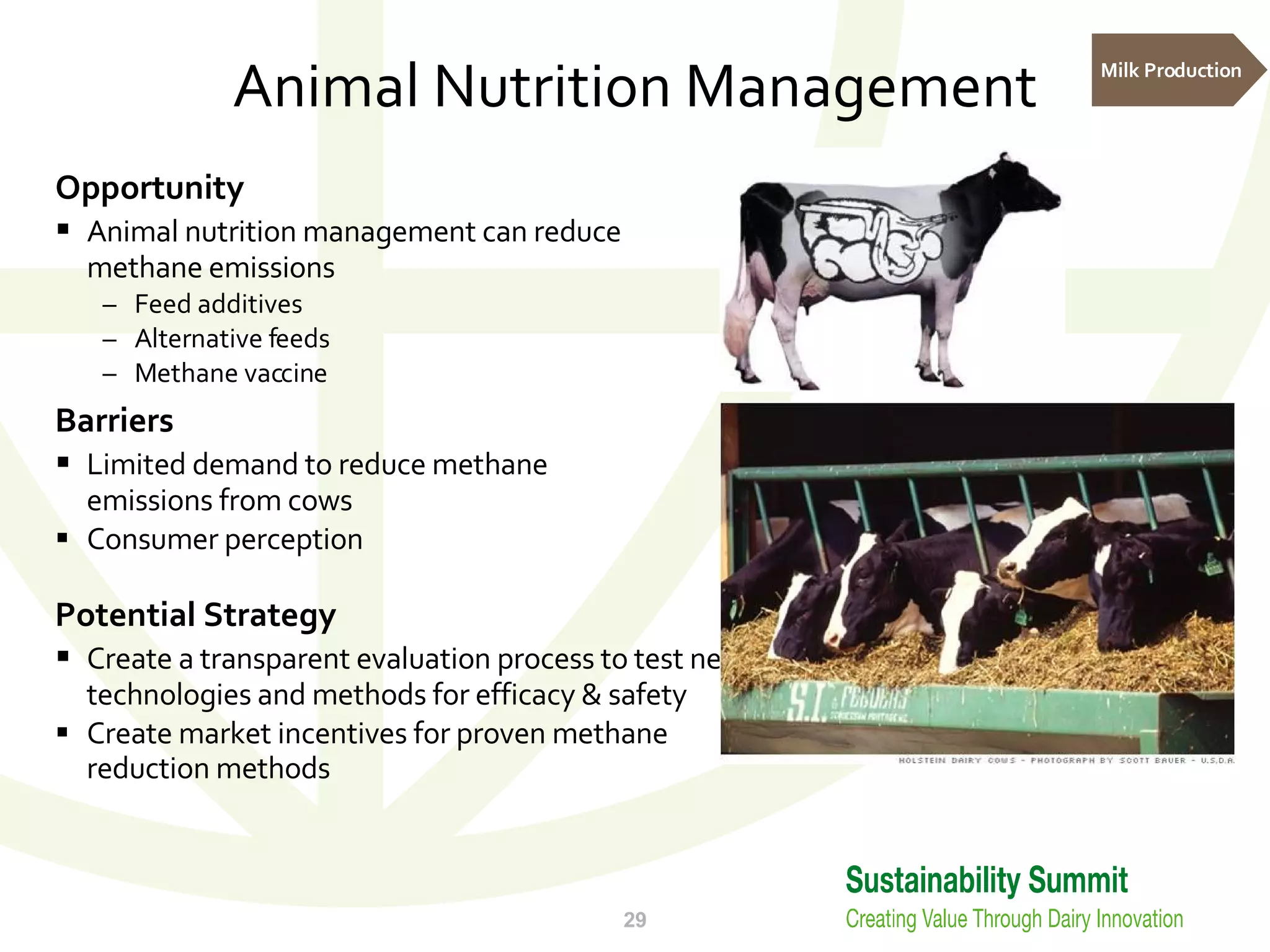
Animal Nutrition Management Opportunity Animal nutrition management can reduce  methane emissions Feed additives Alternative feeds Methane vaccine Barriers Limited demand to reduce methane emissions from cows Consumer perception Potential Strategy Create a transparent evaluation process to test new technologies and methods for efficacy & safety Create market incentives for proven methane reduction methods Milk Production
Processing Efficiencies Opportunity Profitably reduce emissions: More efficient systems (steam, refrigeration, compressed air, motors and lighting) Energy production  technologies (cogeneration, waste-to-energy) Barriers Capital budgeting Lack of technical assistance and training Time and human resources Accurate baseline measures  Potential Strategy Executive commitment and industry-wide targets Pool resources to develop technical expertise Encourage alternative financing models Pilot demonstration projects Processing
Low Carbon Packaging Opportunity Reduce packaging material inputs and costs Reduce energy use to mold and form packaging Barriers Industry has already pushed the envelope in reducing material Limited examples of energy efficient equipment Consumer acceptance Maintain properties important for product quality, sterility and durability Potential Strategy Launch a dairy-focused effort to accelerate a broad set of sustainable packaging innovation opportunities, including: Best practices and new products for each package size Targets for energy efficient equipment Packaging
Truck and Route Efficiency Opportunity Advancements in heavy duty vehicle technology can: Save money  Reduce carbon emissions Barriers Lack of capital to make efficiency improvements  Difficulty of changing behaviors Potential Strategy Collaborate with fleet efficiency leaders to improve: Fuel economy Route optimization Refrigerant management Join EPA’s SmartWay Program Work with Small Business Administration (SBA) approved lenders, etc., to help owner-operators and small trucking companies Transport & Distribution
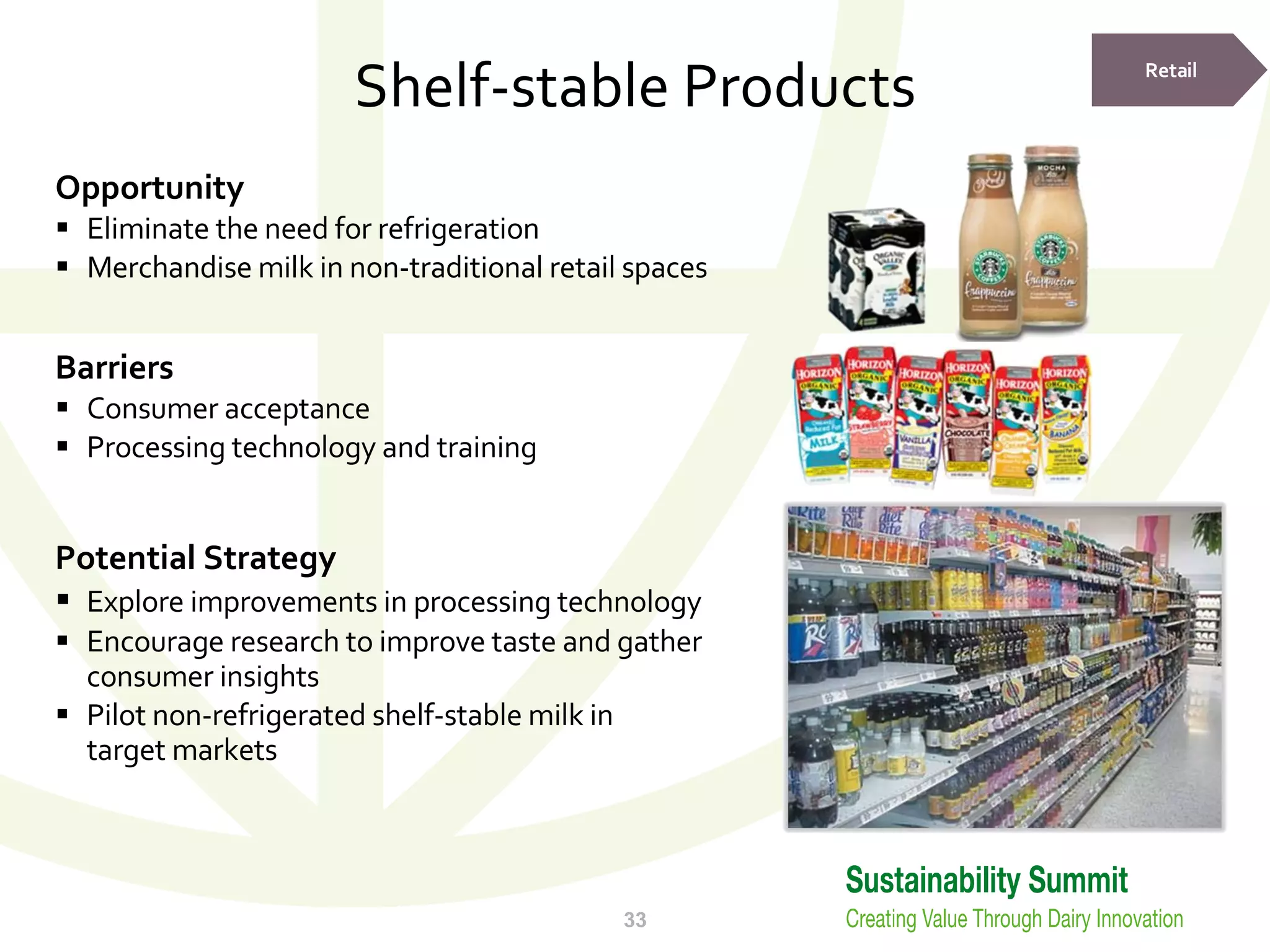
Shelf-stable Products Opportunity Eliminate the need for refrigeration Merchandise milk in non-traditional retail spaces Barriers Consumer acceptance Processing technology and training Potential Strategy Explore improvements in processing technology Encourage research to improve taste and gather consumer insights Pilot non-refrigerated shelf-stable milk in target markets Retail
4-D Cycle  & Summit Task DISCOVER Strengths Innovations & Insights Positive Core DREAM Opportunities Images of a Better World Dairy Innovation DESIGN Aspirations Brainstorm  Possibilities Rapid Prototyping DEPLOY Results Initiatives and Pilots Momentum & Learning Create breakthrough approaches to reduce greenhouse gas emissions and increase business value in the dairy industry
Leveraging the Power of Associations  To Create a New Magnitude of Sustainable Value   Three Essential Success Factors
#1. Avoid the “Temptation to Do Good” Embrace the Opportunity to Create Sustainable Value Make it Part of Association and Industry/Profession Strategy
Creating Business Value Through the “Lens” of Sustainability Today’s Business Practices Sustainable Business Practices A “bigger win” for business and a “win” for society Focused on a “win” for business Unintended negative consequences for society Sustainable Pathway Quick Wins Use existing technology and business models Value of industry collaboration Innovation Projects Require technology and/ or business innovations System Changers Require “changing the rules of the game”
#2. Embrace and Play to Your Strengths Strength to Convene Strength to Accelerate Spread of Innovation Strength to Scale Up
#3. Don’t Misread the Management Trends Sustainability is  the  business opportunity of the 21 st  century.  It is an innovation engine unlike anything we have ever seen in management-- and it’s a lens which will dominate the management agenda for the next generation of thirty or more years.  Even more important, the outcomes will define the next episode in creative capitalism and, ultimately, will determine the well-being of our imperiled planet. Association management may be the most important piece of the puzzle—associations offer the possibilities speed, spread and scale—exactly what we need.
A Vision…How Might We? Let’s Do 50 Association Catalyzed  “ Sustainable Value Creation Summits” Across 50 Professions and Industries Using the Strengths-Based Appreciative Inquiry Approach [email_address]

Asae Online Summit Cooperrider Slides

  • 1.
    Leveraging the Powerof Associations To Create a New Magnitude of Sustainable Value David Cooperrider, Fairmount Minerals Professor and Chair Center for Business as an Agent of World Benefit Case Western Reserve University
  • 2.
    Opening Excitement &Today’s Session: It’s Great to Re-connect With You What do associations uniquely bring to the world of social responsibility and sustainability? Is this arena of sustainable value creation truly the biggest business opportunity of the 21 st Century? Are there emerging examples—associations helping whole industries—and do these stories show how “doing good and doing well” can help the world, the industry, and strengthen the association as a leader? Why is the “temptation to do good” less effective than the goal to create sustainable value? How fast is all this happening?
  • 3.
    A Story: TheMost Exciting Project I Have Ever Worked On
  • 4.
    Business as anAgent of World Benefit --More Than 2,000 Interviews --100s of Published Profiles “Positive Institutions” --s ee www.worldinquiry.org “Awe is What Moves Us Forward”
  • 5.
    Sustainable Value —FromObligation to Design Mindset Stake- holder Value¹ Shareholder Value Unsustainable (Value Transfer) Unsustainable (Value Transfer) Unsustainable (Lose/Lose) Sustainable Value ¹ absolute standards or relative to competitors Clean energy vehicles Fossil fuel ICE
  • 6.
    Is Sustainability aPassing Fad?
  • 7.
    My “Peter DruckerMoment” two threads—DNA of today’s exploration “ Every social and global issue of our day is a business opportunity in disguise” ****************************** “ The task of leadership is to create an alignment of strengths…making a system’s weaknesses irrelevant”
  • 8.
    Appreciative Inquiry Involves a Shift “ No problem can be solved from the same level of consciousness that created it. We must learn to see the world anew.” “ There are only two ways to live your life. One is as though nothing is a miracle. The other is as though everything is a miracle.” – Albert Einstein
  • 9.
    Why conventional changeapproaches don’t work Small groups of experts working in a series of meetings Focus is on technical/science challenges Planning teams hand solutions to implementation teams Typical results: A Few Try to Convince Many That Change is Needed Change is Perceived as a Disruption of “Real Work”
  • 10.
    Fairmount Minerals StoryBirth of the “Sustainable Design Factory”
  • 11.
    Multi-stakeholder Large GroupDesigning External Stakeholders: Customers Suppliers NGO’s Neighbors/Communities Board of Directors Imagine 300—Three days Stakeholders—designing new products, services. Internal Stakeholders Operations Administration & Corporate Services Customer Service Engineering Logistics Quality Sales Technical Support / R&D Sustainable Designing
  • 12.
    Highlights 40% AnnualGrowth in Earnings Past Two Years 2007 US Chamber of Commerce’s #1 Corporate Citizenship Award A Culture of Community Partnership and Innovation New Employee Owned Businesses, New Markets Emerging as Top Rated Star in the Industry Industrial Minerals Association & Fairmount Minerals Associations Helping Make Members Successful
  • 13.
    Fairmount Started withAppreciative Inquiry in 1990 With a Focus on Empowerment 40% CAGR Past Four Years
  • 14.
    Sources of BusinessValue Levels of Design Focus Business & World Context Brand/ Culture Market Product Process Risk Business and society value created Anticipating regulations, going beyond legal requirements Reducing energy, waste & process costs—future of totally renewable energy Sustainable-value, green products New stakeholder relationships, new markets Brand story, promise, customer experiences Designing industries, policy contexts, better world
  • 15.
    In June, dairyleaders met in Rogers, Arkansas for the inaugural Sustainability Summit: Creating Value Through Dairy Innovation. The Summit was an unprecedented gathering of 250 leaders representing producers, processors, non-governmental organizations, university researchers and government agencies. Together, these stakeholders generated action steps and made an industry-wide commitment to reduce fluid milk’s carbon footprint while increasing business value, from farm to consumer.
  • 16.
    Sustainability Summit: CreatingValue Through Dairy Innovation The Call to Reduce Greenhouse Gas Emissions At the University of Arkansas Center for Applied Sustainability Dairy Management Inc International Dairy Foods Association (IDFA) and Others
  • 17.
    Summit Goal Goals: Reduce greenhouse gas emissions in the fluid milk value chain AND Increase business value in the fluid milk category Outcomes: Launch a set of initiatives that leverages industry collaboration
  • 18.
    Appreciative Inquiry System-in-the-Room:Broad Enrollment: Special Configuration of People Whole system represented; innovation inspired by collaboration and co-creation Leverages strengths and maintains continuity with the best of the past Full voice Success Factors for Innovation and System Change Success requires: right conditions for engagement right people in the room Big Change Fast Accomplishes months of work in 2-3 days Action focus around clear task Creates momentum for implementation Breakthrough Results Lens of sustainability opens new possibilities Design “Rapid Prototypes” Honoring differences & common ground
  • 19.
    Sustainability in theDairy Industry OUR DEFINITION: Providing consumers with the nutritious dairy products they want in a way that makes the industry, people and the earth economically, environmentally and socially better – now and for future generations.
  • 20.
    Why Lead? OPPORTUNITY – PART OF THE SOLUTION “ Waste” to revenue (energy from cows) More efficient operations Farming practices that reduce emissions Carbon credits Innovative products Dairy seen as green RISKS – NOT AT TABLE TO SHAPE THE NEW ENVIRONMENT Greenhouse gas legislation does not provide farmers and processors with offset opportunities Utilities not required to purchase clean energy from farmers Consumers could see dairy as part of the problem
  • 21.
    Sustainability Requires a Life Cycle Perspective v Waste & Pollution Resources &Energy Consumer/ End of Life
  • 22.
    4-D Cycle & Summit Task DISCOVER Strengths Innovations & Insights Positive Core DREAM Opportunities Images of a Better World Dairy Innovation DESIGN Aspirations Brainstorm Possibilities Rapid Prototyping DEPLOY Results Initiatives and Pilots Momentum & Learning Create breakthrough approaches to reduce greenhouse gas emissions and increase business value in the dairy industry
  • 23.
    Dairy Industry Today2.7 million U.S. passenger vehicle emissions per year Emissions today: 30 million metric tons per year Identified potential reductions: 15 million metric tons per year
  • 24.
    Review Preliminary Opportunities,Identify New Opportunities 47 Vision statement and guiding principles Truck & Route Efficiency + Renewable Fuels blank Pastured Dairy/Seasonal Milk Production Product Innovation blank blank Carbon Markets Energy efficiencies Renewable Energy Infrastructure Industry Infrastructure Branding, Communication, Training Production Efficiencies Alternative Fuels Human Resources, Education, Awareness, Acceptance Funding and alliances Enteric Methane capture
  • 25.
    Methane Digesters OpportunityTransform manure into renewable energy Create revenue source and air/water quality benefits for producers Barriers Challenging for individual farmers to finance, permit, build, operate and maintain Lack of appropriate technology Utility pricing structures Potential Strategy Develop third-party owner/financer model to scale Lobby for regulations on utility incentives, carbon offsets and RECs Pilot models in states with favorable regulatory environments Milk Production
  • 26.
    Agriculture Process ImprovementOpportunity Conservation tillage, efficient fertilizer use and precision agriculture can: Reduce fertilizer use Minimize fuel use Sequester carbon Barriers Lack of producer access to successful examples, capital, training, and support Risk perceptions and lack of incentives Potential Strategy Partner with co-ops and land-grant universities Partner with feed companies to create demand for sustainable feeds Collaborate with commodity initiatives to set sustainable feed targets Secure the market for carbon offset credits Crop Production
  • 27.
    Manure & NutrientManagement Opportunity Manure nutrient use offsets use of commercial fertilizers and associated emissions and costs Barriers Storage and transportation constraints Ease of use Access to necessary information and demonstration cases Potential Strategy Leverage co-ops and land grant universities to spread best practices and identify effective and economic solutions Develop third party service providers models and create demand for manure nutrients Ensure appropriate carbon offset credits are available to producers Crop Production
  • 28.
    Pastured Dairy OpportunityPastures sequester carbon and can reduce net emissions from the farm and can lower production costs for small farms Barriers Lack of access to information to implement or improve pastured dairy practices Infrastructure development costs Land availability Potential Strategy Drive outreach through academic institutions, co-ops, processors and NGOs Use industry leverage to prioritize competitive funding for pasture enhancement projects Enable carbon credit creation and commercialization Crop Production
  • 29.
    Animal Nutrition ManagementOpportunity Animal nutrition management can reduce methane emissions Feed additives Alternative feeds Methane vaccine Barriers Limited demand to reduce methane emissions from cows Consumer perception Potential Strategy Create a transparent evaluation process to test new technologies and methods for efficacy & safety Create market incentives for proven methane reduction methods Milk Production
  • 30.
    Processing Efficiencies OpportunityProfitably reduce emissions: More efficient systems (steam, refrigeration, compressed air, motors and lighting) Energy production technologies (cogeneration, waste-to-energy) Barriers Capital budgeting Lack of technical assistance and training Time and human resources Accurate baseline measures Potential Strategy Executive commitment and industry-wide targets Pool resources to develop technical expertise Encourage alternative financing models Pilot demonstration projects Processing
  • 31.
    Low Carbon PackagingOpportunity Reduce packaging material inputs and costs Reduce energy use to mold and form packaging Barriers Industry has already pushed the envelope in reducing material Limited examples of energy efficient equipment Consumer acceptance Maintain properties important for product quality, sterility and durability Potential Strategy Launch a dairy-focused effort to accelerate a broad set of sustainable packaging innovation opportunities, including: Best practices and new products for each package size Targets for energy efficient equipment Packaging
  • 32.
    Truck and RouteEfficiency Opportunity Advancements in heavy duty vehicle technology can: Save money Reduce carbon emissions Barriers Lack of capital to make efficiency improvements Difficulty of changing behaviors Potential Strategy Collaborate with fleet efficiency leaders to improve: Fuel economy Route optimization Refrigerant management Join EPA’s SmartWay Program Work with Small Business Administration (SBA) approved lenders, etc., to help owner-operators and small trucking companies Transport & Distribution
  • 33.
    Shelf-stable Products OpportunityEliminate the need for refrigeration Merchandise milk in non-traditional retail spaces Barriers Consumer acceptance Processing technology and training Potential Strategy Explore improvements in processing technology Encourage research to improve taste and gather consumer insights Pilot non-refrigerated shelf-stable milk in target markets Retail
  • 34.
    4-D Cycle & Summit Task DISCOVER Strengths Innovations & Insights Positive Core DREAM Opportunities Images of a Better World Dairy Innovation DESIGN Aspirations Brainstorm Possibilities Rapid Prototyping DEPLOY Results Initiatives and Pilots Momentum & Learning Create breakthrough approaches to reduce greenhouse gas emissions and increase business value in the dairy industry
  • 35.
    Leveraging the Powerof Associations To Create a New Magnitude of Sustainable Value Three Essential Success Factors
  • 36.
    #1. Avoid the“Temptation to Do Good” Embrace the Opportunity to Create Sustainable Value Make it Part of Association and Industry/Profession Strategy
  • 37.
    Creating Business ValueThrough the “Lens” of Sustainability Today’s Business Practices Sustainable Business Practices A “bigger win” for business and a “win” for society Focused on a “win” for business Unintended negative consequences for society Sustainable Pathway Quick Wins Use existing technology and business models Value of industry collaboration Innovation Projects Require technology and/ or business innovations System Changers Require “changing the rules of the game”
  • 38.
    #2. Embrace andPlay to Your Strengths Strength to Convene Strength to Accelerate Spread of Innovation Strength to Scale Up
  • 39.
    #3. Don’t Misreadthe Management Trends Sustainability is the business opportunity of the 21 st century. It is an innovation engine unlike anything we have ever seen in management-- and it’s a lens which will dominate the management agenda for the next generation of thirty or more years. Even more important, the outcomes will define the next episode in creative capitalism and, ultimately, will determine the well-being of our imperiled planet. Association management may be the most important piece of the puzzle—associations offer the possibilities speed, spread and scale—exactly what we need.
  • 40.
    A Vision…How MightWe? Let’s Do 50 Association Catalyzed “ Sustainable Value Creation Summits” Across 50 Professions and Industries Using the Strengths-Based Appreciative Inquiry Approach [email_address]