ARTISTIC GYMNASTICS
  Jacinta Bonaddio 6P        21/07/2012

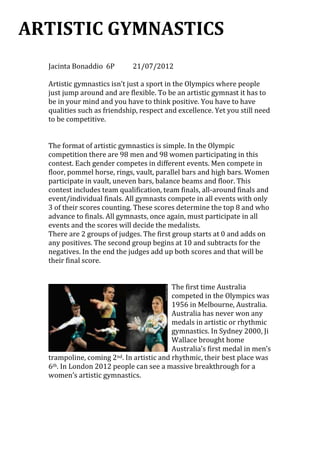
  Artistic gymnastics isn’t just a sport in the Olympics where people
  just jump around and are flexible. To be an artistic gymnast it has to
  be in your mind and you have to think positive. You have to have
  qualities such as friendship, respect and excellence. Yet you still need
  to be competitive.


  The format of artistic gymnastics is simple. In the Olympic
  competition there are 98 men and 98 women participating in this
  contest. Each gender competes in different events. Men compete in
  floor, pommel horse, rings, vault, parallel bars and high bars. Women
  participate in vault, uneven bars, balance beams and floor. This
  contest includes team qualification, team finals, all-around finals and
  event/individual finals. All gymnasts compete in all events with only
  3 of their scores counting. These scores determine the top 8 and who
  advance to finals. All gymnasts, once again, must participate in all
  events and the scores will decide the medalists.
  There are 2 groups of judges. The first group starts at 0 and adds on
  any positives. The second group begins at 10 and subtracts for the
  negatives. In the end the judges add up both scores and that will be
  their final score.


                                           The first time Australia
                                           competed in the Olympics was
                                           1956 in Melbourne, Australia.
                                           Australia has never won any
                                           medals in artistic or rhythmic
                                           gymnastics. In Sydney 2000, Ji
                                           Wallace brought home
                                           Australia’s first medal in men’s
  trampoline, coming 2 nd. In artistic and rhythmic, their best place was

  6th. In London 2012 people can see a massive breakthrough for a
  women’s artistic gymnastics.
Gymnastics was introduced in the 1st modern Olympics in Greece,
Athens 1896. The sport has been continuous ever since. Men were
only allowed to compete in gymnastics until 1928 in Amsterdam
when women finally had the chance. Soon in 1984, rhythmic
gymnastics appeared. Then in Sydney 2000 trampoline was
introduced.


Australia’s favourite memory was when Ji Wallace brought home
Australia’s first medal in gymnastics.


In London 2012, hopefully Australia can bring home a medal in
rhythmic and artistic gymnastics. Good Luck Australia!

Artistic gymnastics report

  • 1.
    ARTISTIC GYMNASTICS Jacinta Bonaddio 6P 21/07/2012 Artistic gymnastics isn’t just a sport in the Olympics where people just jump around and are flexible. To be an artistic gymnast it has to be in your mind and you have to think positive. You have to have qualities such as friendship, respect and excellence. Yet you still need to be competitive. The format of artistic gymnastics is simple. In the Olympic competition there are 98 men and 98 women participating in this contest. Each gender competes in different events. Men compete in floor, pommel horse, rings, vault, parallel bars and high bars. Women participate in vault, uneven bars, balance beams and floor. This contest includes team qualification, team finals, all-around finals and event/individual finals. All gymnasts compete in all events with only 3 of their scores counting. These scores determine the top 8 and who advance to finals. All gymnasts, once again, must participate in all events and the scores will decide the medalists. There are 2 groups of judges. The first group starts at 0 and adds on any positives. The second group begins at 10 and subtracts for the negatives. In the end the judges add up both scores and that will be their final score. The first time Australia competed in the Olympics was 1956 in Melbourne, Australia. Australia has never won any medals in artistic or rhythmic gymnastics. In Sydney 2000, Ji Wallace brought home Australia’s first medal in men’s trampoline, coming 2 nd. In artistic and rhythmic, their best place was 6th. In London 2012 people can see a massive breakthrough for a women’s artistic gymnastics.
  • 2.
    Gymnastics was introducedin the 1st modern Olympics in Greece, Athens 1896. The sport has been continuous ever since. Men were only allowed to compete in gymnastics until 1928 in Amsterdam when women finally had the chance. Soon in 1984, rhythmic gymnastics appeared. Then in Sydney 2000 trampoline was introduced. Australia’s favourite memory was when Ji Wallace brought home Australia’s first medal in gymnastics. In London 2012, hopefully Australia can bring home a medal in rhythmic and artistic gymnastics. Good Luck Australia!