How Artificial Intelligence will
change the future?
A
rtificial Intelligence (AI) is poised to revolutionise the future as
we know it. With its ability to analyse vast amounts of data and
make decisions faster and more accurately than humans, AI is set to
transform industries from healthcare to finance, transportation to
retail. As AI technology continues to advance, we can expect to see
increased automation, more efficient systems, and even the creation
of new products and services. It’s an exciting time to be alive as AI
will shape the world in ways we can only imagine.
AI will transform the future through its ability to analyze data and
make decisions faster and more accurately than humans. This will
lead to increased automation, improved systems, and new products
and services. Get ready for a world shaped by AI.
Online Social Media Jobs That Pay $25 - $50 Per
Hour. No Experience Required. Work At Home.
“How Artificial Intelligence Will Change the
World?”
As
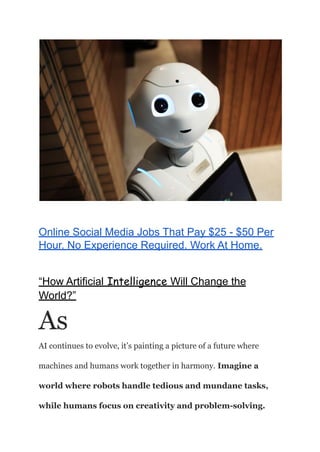
AI continues to evolve, it’s painting a picture of a future where
machines and humans work together in harmony. Imagine a
world where robots handle tedious and mundane tasks,
while humans focus on creativity and problem-solving.
Industries like healthcare, finance, transportation, and
retail will see a significant boost in efficiency, accuracy
and innovation.
Another change we can expect is the creation of new products and
services. AI has the potential to generate new ideas and solutions
that were previously unimaginable, leading to innovation and
progress.
Moreover, AI will also play a crucial role in solving some of the
world’s biggest challenges, such as climate change and global
health. By analysing data and predicting outcomes, AI can help
governments and organisations make informed decisions that can
positively impact the world.
“The EVOLUTION of AI”
Artificial Intelligence (AI) has come a long way since its inception.
The field of AI began in 1956 when a group of researchers gathered
at Dartmouth College for a conference and coined the term
“Artificial Intelligence.” The early days of AI were marked by
optimism and a belief that machines would soon be able to perform
any intellectual task that a human can.
However, the development of AI was slow and marked by several
setbacks, including a lack of funding and a lack of progress in
creating intelligent machines. It wasn’t until the late 1990s and
early 2000s that AI began to experience a resurgence. The growth of
the internet and the availability of massive amounts of data enabled
AI to make significant progress.
Today, AI has advanced to the point where it is capable of
performing complex tasks and decision-making, and it is already
having a significant impact on many industries. AI is being used in a
variety of applications, including natural language processing,
computer vision, and self-driving cars.
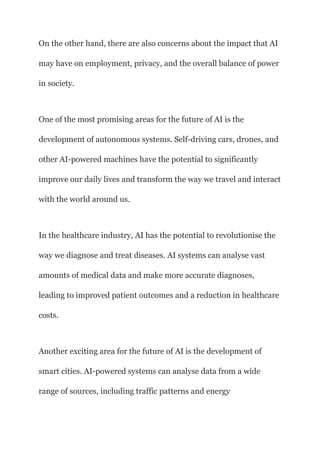
The future of AI is incredibly exciting, with the potential for even
more advancements in the years to come. As AI continues to evolve,
we can expect to see it play an increasingly important role in our
lives, transforming the way we work, live, and interact with the
world around us.
“Artificial Intelligence Future”
The future of Artificial Intelligence (AI) is both exciting and
uncertain. On one hand, AI has the potential to revolutionise the
way we live and work, leading to increased efficiency and
productivity, and even the creation of new products and services.
On the other hand, there are also concerns about the impact that AI
may have on employment, privacy, and the overall balance of power
in society.
One of the most promising areas for the future of AI is the
development of autonomous systems. Self-driving cars, drones, and
other AI-powered machines have the potential to significantly
improve our daily lives and transform the way we travel and interact
with the world around us.
In the healthcare industry, AI has the potential to revolutionise the
way we diagnose and treat diseases. AI systems can analyse vast
amounts of medical data and make more accurate diagnoses,
leading to improved patient outcomes and a reduction in healthcare
costs.
Another exciting area for the future of AI is the development of
smart cities. AI-powered systems can analyse data from a wide
range of sources, including traffic patterns and energy
consumption, to optimize the functioning of cities and improve the
quality of life for residents.
Online Social Media Jobs That Pay $25 - $50 Per
Hour. No Experience Required. Work At Home.
“How will AI change work?”
Artificial Intelligence (AI) is poised to have a profound impact on
the way we work. From automation to augmenting human abilities,
AI has the potential to transform the workforce in a variety of ways.
One of the most significant changes that AI will bring is increased
automation. AI-powered systems and robots will be able to perform
a wide range of tasks more efficiently and accurately than humans,
freeing up time for other, more complex and creative tasks. This
shift could lead to job loss in certain industries, but it will also
create new job opportunities in fields such as data analysis and AI
development.
Another change we can expect is the enhancement of human
abilities through AI. AI has the potential to augment the skills of
employees in a wide range of industries, allowing them to work
more efficiently and effectively. For example, AI-powered tools can
help sales teams to identify the best leads and close deals more
quickly, or assist doctors in diagnosing diseases more accurately.
Moreover, AI will also play a crucial role in making work more
flexible and personal. AI-powered tools can provide real-time
feedback and support to employees, allowing them to work more
effectively and efficiently. AI can also help to match employees with
the right job, reducing turnover and improving job satisfaction.
“What industries will AI change?”
Artificial Intelligence (AI) has the potential to disrupt a wide range
of industries, bringing about significant changes in the way that
businesses operate and the services that they offer. Here are a few
examples of industries that are already being transformed by AI:
1.
Healthcare: AI has the potential to revolutionise the way that
medical professionals diagnose and treat diseases. AI-powered
systems can analyze vast amounts of medical data, leading to more
accurate diagnoses and improved patient outcomes.
2.
Transportation: Self-driving cars, drones, and other AI-powered
systems have the potential to transform the transportation industry.
These systems will make transportation safer, more efficient, and
more accessible to everyone.
3.
Retail: AI is changing the way that retailers interact with their
customers. AI-powered systems can analyse customer data to
personalise recommendations and improve the shopping
experience.
4.
Finance: AI is being used in a variety of applications in the finance
industry, from fraud detection to investment analysis. By
automating routine tasks and providing real-time insights, AI is
making the finance industry more efficient and accessible.
5.
Manufacturing: AI is being used in the manufacturing industry
to optimise production processes, improve product quality, and
reduce waste. AI-powered systems can also assist with predictive
maintenance, reducing downtime and increasing efficiency.
These are just a few examples of the many industries that are being
transformed by AI. The potential for AI to disrupt and improve a
wide range of industries is limitless, and the impact of AI on the
global economy will only continue to grow in the years to come.
“AI in the near future”
Artificial Intelligence (AI) is rapidly advancing and its impact on
our lives and the world around us is becoming increasingly
significant. Here are a few ways in which AI is destined to change
the near future:
1.
Personalised Services: AI will increasingly be used to provide
personalised services to consumers, such as personalised
recommendations, personalised health and wellness advice, and
personalised financial services.
2.
Smart Cities: AI will play a crucial role in creating smart cities,
allowing for more efficient and sustainable urban planning, traffic
management, and public safety.
3.
Improved Healthcare: AI will revolutionise healthcare by
improving disease diagnosis, reducing medical errors, and
optimising patient outcomes.
4.
Automated Workforce: AI will continue to automate routine
and repetitive tasks, freeing up time for employees to focus on more
complex and creative tasks.
5.
Enhanced Human Capabilities: AI will enhance human
abilities by providing real-time feedback, support, and
decision-making tools.
Conclusion
As
we look towards the future, it’s clear that Artificial Intelligence will
play a massive role in shaping our world. Imagine a world where
personalised services cater to your every need, smart cities
efficiently address urban challenges, healthcare becomes more
precise and effective, the workforce becomes more automated and
human capabilities are amplified. The possibilities are truly endless.
It’s an exhilarating time to be alive as we witness the limitless
potential of AI unfold before our eyes.

artificial intelligence.pdf

  • 1.
    How Artificial Intelligencewill change the future? A rtificial Intelligence (AI) is poised to revolutionise the future as we know it. With its ability to analyse vast amounts of data and make decisions faster and more accurately than humans, AI is set to transform industries from healthcare to finance, transportation to retail. As AI technology continues to advance, we can expect to see increased automation, more efficient systems, and even the creation of new products and services. It’s an exciting time to be alive as AI will shape the world in ways we can only imagine. AI will transform the future through its ability to analyze data and make decisions faster and more accurately than humans. This will lead to increased automation, improved systems, and new products and services. Get ready for a world shaped by AI.
  • 2.
    Online Social MediaJobs That Pay $25 - $50 Per Hour. No Experience Required. Work At Home. “How Artificial Intelligence Will Change the World?” As AI continues to evolve, it’s painting a picture of a future where machines and humans work together in harmony. Imagine a world where robots handle tedious and mundane tasks, while humans focus on creativity and problem-solving.
  • 3.
    Industries like healthcare,finance, transportation, and retail will see a significant boost in efficiency, accuracy and innovation. Another change we can expect is the creation of new products and services. AI has the potential to generate new ideas and solutions that were previously unimaginable, leading to innovation and progress. Moreover, AI will also play a crucial role in solving some of the world’s biggest challenges, such as climate change and global health. By analysing data and predicting outcomes, AI can help governments and organisations make informed decisions that can positively impact the world. “The EVOLUTION of AI” Artificial Intelligence (AI) has come a long way since its inception. The field of AI began in 1956 when a group of researchers gathered at Dartmouth College for a conference and coined the term “Artificial Intelligence.” The early days of AI were marked by
  • 4.
    optimism and abelief that machines would soon be able to perform any intellectual task that a human can. However, the development of AI was slow and marked by several setbacks, including a lack of funding and a lack of progress in creating intelligent machines. It wasn’t until the late 1990s and early 2000s that AI began to experience a resurgence. The growth of the internet and the availability of massive amounts of data enabled AI to make significant progress. Today, AI has advanced to the point where it is capable of performing complex tasks and decision-making, and it is already having a significant impact on many industries. AI is being used in a variety of applications, including natural language processing, computer vision, and self-driving cars. The future of AI is incredibly exciting, with the potential for even more advancements in the years to come. As AI continues to evolve, we can expect to see it play an increasingly important role in our
  • 5.
    lives, transforming theway we work, live, and interact with the world around us. “Artificial Intelligence Future” The future of Artificial Intelligence (AI) is both exciting and uncertain. On one hand, AI has the potential to revolutionise the way we live and work, leading to increased efficiency and productivity, and even the creation of new products and services.
  • 6.
    On the otherhand, there are also concerns about the impact that AI may have on employment, privacy, and the overall balance of power in society. One of the most promising areas for the future of AI is the development of autonomous systems. Self-driving cars, drones, and other AI-powered machines have the potential to significantly improve our daily lives and transform the way we travel and interact with the world around us. In the healthcare industry, AI has the potential to revolutionise the way we diagnose and treat diseases. AI systems can analyse vast amounts of medical data and make more accurate diagnoses, leading to improved patient outcomes and a reduction in healthcare costs. Another exciting area for the future of AI is the development of smart cities. AI-powered systems can analyse data from a wide range of sources, including traffic patterns and energy
  • 7.
    consumption, to optimizethe functioning of cities and improve the quality of life for residents. Online Social Media Jobs That Pay $25 - $50 Per Hour. No Experience Required. Work At Home. “How will AI change work?” Artificial Intelligence (AI) is poised to have a profound impact on the way we work. From automation to augmenting human abilities, AI has the potential to transform the workforce in a variety of ways. One of the most significant changes that AI will bring is increased automation. AI-powered systems and robots will be able to perform a wide range of tasks more efficiently and accurately than humans, freeing up time for other, more complex and creative tasks. This shift could lead to job loss in certain industries, but it will also create new job opportunities in fields such as data analysis and AI development.
  • 8.
    Another change wecan expect is the enhancement of human abilities through AI. AI has the potential to augment the skills of employees in a wide range of industries, allowing them to work more efficiently and effectively. For example, AI-powered tools can help sales teams to identify the best leads and close deals more quickly, or assist doctors in diagnosing diseases more accurately. Moreover, AI will also play a crucial role in making work more flexible and personal. AI-powered tools can provide real-time feedback and support to employees, allowing them to work more effectively and efficiently. AI can also help to match employees with the right job, reducing turnover and improving job satisfaction. “What industries will AI change?” Artificial Intelligence (AI) has the potential to disrupt a wide range of industries, bringing about significant changes in the way that businesses operate and the services that they offer. Here are a few examples of industries that are already being transformed by AI:
  • 9.
    1. Healthcare: AI hasthe potential to revolutionise the way that medical professionals diagnose and treat diseases. AI-powered systems can analyze vast amounts of medical data, leading to more accurate diagnoses and improved patient outcomes. 2. Transportation: Self-driving cars, drones, and other AI-powered systems have the potential to transform the transportation industry. These systems will make transportation safer, more efficient, and more accessible to everyone.
  • 10.
    3. Retail: AI ischanging the way that retailers interact with their customers. AI-powered systems can analyse customer data to personalise recommendations and improve the shopping experience. 4.
  • 11.
    Finance: AI isbeing used in a variety of applications in the finance industry, from fraud detection to investment analysis. By automating routine tasks and providing real-time insights, AI is making the finance industry more efficient and accessible. 5. Manufacturing: AI is being used in the manufacturing industry to optimise production processes, improve product quality, and reduce waste. AI-powered systems can also assist with predictive maintenance, reducing downtime and increasing efficiency. These are just a few examples of the many industries that are being transformed by AI. The potential for AI to disrupt and improve a wide range of industries is limitless, and the impact of AI on the global economy will only continue to grow in the years to come. “AI in the near future”
  • 12.
    Artificial Intelligence (AI)is rapidly advancing and its impact on our lives and the world around us is becoming increasingly significant. Here are a few ways in which AI is destined to change the near future: 1. Personalised Services: AI will increasingly be used to provide personalised services to consumers, such as personalised recommendations, personalised health and wellness advice, and personalised financial services. 2. Smart Cities: AI will play a crucial role in creating smart cities, allowing for more efficient and sustainable urban planning, traffic management, and public safety.
  • 13.
    3. Improved Healthcare: AIwill revolutionise healthcare by improving disease diagnosis, reducing medical errors, and optimising patient outcomes. 4. Automated Workforce: AI will continue to automate routine and repetitive tasks, freeing up time for employees to focus on more complex and creative tasks. 5. Enhanced Human Capabilities: AI will enhance human abilities by providing real-time feedback, support, and decision-making tools.
  • 14.
    Conclusion As we look towardsthe future, it’s clear that Artificial Intelligence will play a massive role in shaping our world. Imagine a world where personalised services cater to your every need, smart cities efficiently address urban challenges, healthcare becomes more precise and effective, the workforce becomes more automated and human capabilities are amplified. The possibilities are truly endless. It’s an exhilarating time to be alive as we witness the limitless potential of AI unfold before our eyes.