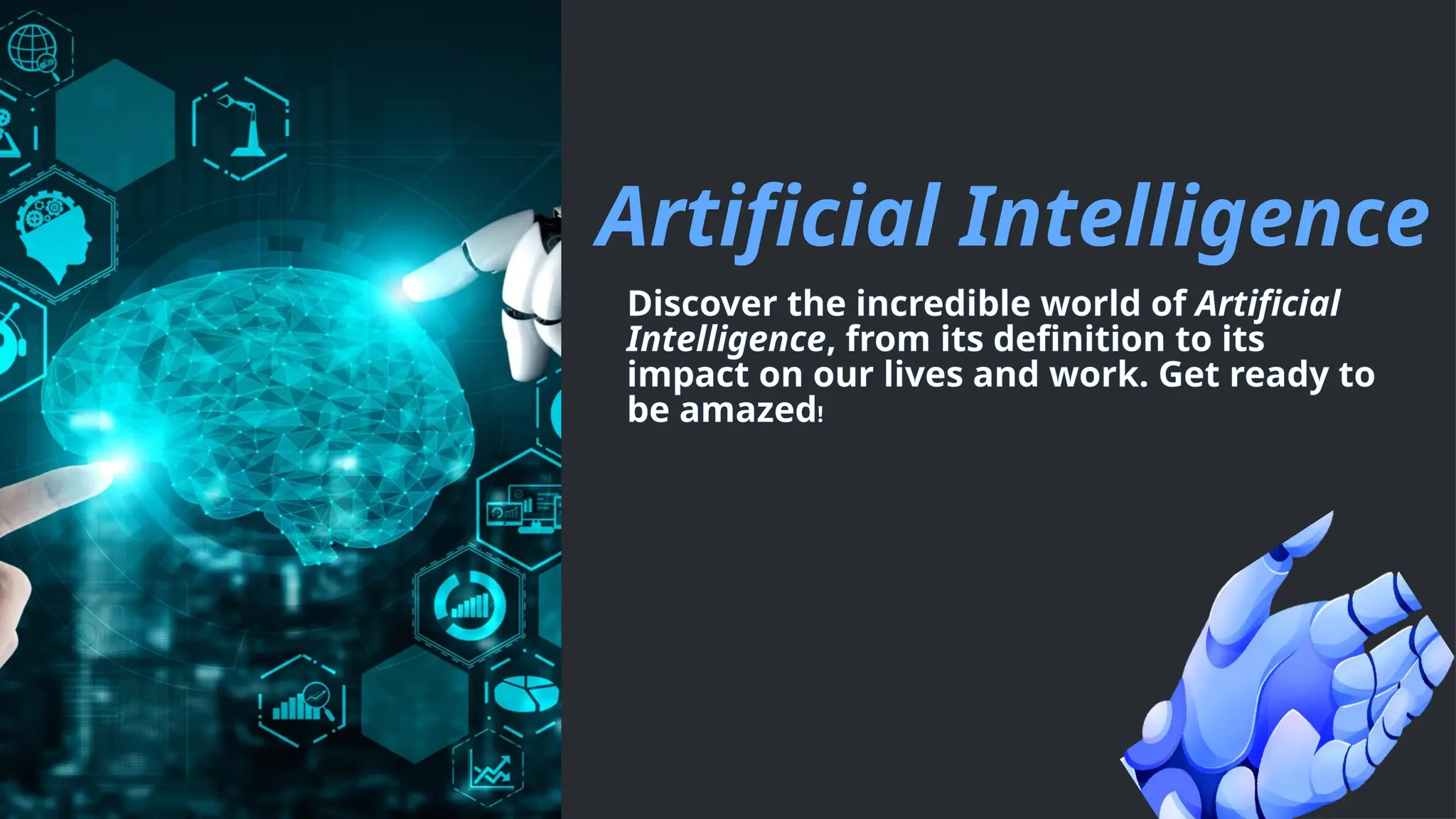
Artificial Intelligence
Discover theincredible world of Artificial
Intelligence, from its definition to its
impact on our lives and work. Get ready to
be amazed!
2.
What is ArtificialIntelligence
Definition
It is a system or machine, but it is programmed to adapts ,
think and learn an like a human
Types of AI
There are two types: Narrow AI, which is focused on specific
tasks, and General AI, which has the ability to understand
and learn any intellectual task that a human can do.
3.
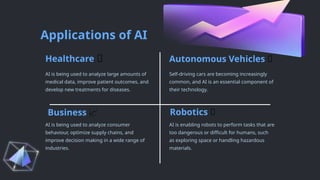
Applications of AI
Healthcare🏥
AI is being used to analyze large amounts of
medical data, improve patient outcomes, and
develop new treatments for diseases.
Autonomous Vehicles 🚗
Self-driving cars are becoming increasingly
common, and AI is an essential component of
their technology.
Business 📈
AI is being used to analyze consumer
behaviour, optimize supply chains, and
improve decision making in a wide range of
industries.
Robotics 🤖
AI is enabling robots to perform tasks that are
too dangerous or difficult for humans, such
as exploring space or handling hazardous
materials.
4.
History of Artificial
Intelligence
Inthe past, AI was around in the 1950s and 1960s,
but it existed as a concept, but since the beginning
of 2010, it has started to be implemented , and AI
now continues to develop day by day.
Follow the evolution of AI through the centuries and
see how it has gradually transformed from a concept
into a reality.
5.
Advantage of AI:
1
2
Automation :
Precision :
Artificial intelligence can save time and effort by completing
repetitive tasks such as It also analyzes images and classifies
them automatically.
AI can analyze large amounts of data and make precise
predictions and decisions, reducing errors and improving
outcomes.
6.
Disadvantages of AI:
1
2
Job displacement :
Don't always rely on it :
Many jobs have been replaced, leading to unemployment and
to avoid this you need to acquire new skills .
Artificial intelligence can make mistakes, such as causing
accidents in self-driving, and this sometimes requires
human intervention
7.
e
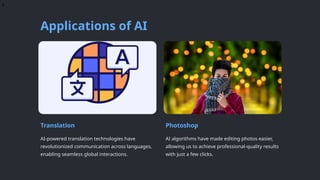
Applications of AI
Translation
AI-poweredtranslation technologies have
revolutionized communication across languages,
enabling seamless global interactions.
Photoshop
AI algorithms have made editing photos easier,
allowing us to achieve professional-quality results
with just a few clicks.
8.
The Future ofAI
1 Advancements in Machine Learning
Machine learning algorithms are becoming more complex and
capable of processing larger amounts of data.
2 New Applications for AI
AI is being developed for a wide range of applications, including
education, entertainment, and even creative industries like art and
music.
3 The Ethics of AI
As AI becomes more powerful, there are concerns around issues like
bias, privacy, and the impact on employment and society as a whole.
4 The Singularity
The Singularity is a hypothetical future event in which AI becomes
capable of recursive self-improvement, leading to an exponential
increase in intelligence.
9.
Conclusion
1 The Potentialof AI
AI has the potential to revolutionize the world as we know it, from
healthcare to education to entertainment.
2 The Importance of Ethics
As the technology develops, it is essential that we prioritize the ethical
considerations surrounding AI.
3 The Need for Continued Research
There is still much to be learned about AI, and continued research is
essential for unlocking its full potential while minimizing its risks.




![Wondershare TunesGo 9.8.3.47 Full Crack [Latest]](https://cdn.slidesharecdn.com/ss_thumbnails/artificialintelligence19-250528093525-e8ad6671-thumbnail.jpg?width=640&height=640&fit=bounds)
![Infix PDF Editor Pro 7.5.2 with Crack Free Download [Latest]](https://cdn.slidesharecdn.com/ss_thumbnails/artificialintelligence19-250602161908-1b83c4dd-thumbnail.jpg?width=640&height=640&fit=bounds)
![Free YouTube Download 4.3.37.1221 Premium with Crack [Latest]](https://cdn.slidesharecdn.com/ss_thumbnails/artificialintelligence19-250529071127-2df17853-thumbnail.jpg?width=640&height=640&fit=bounds)


