ARTIFICIAL INTELLIGENCE (AI)
ArTIFICIAL
INTELLIGENCE (AI)
PROJECT PROPOSAL
Here is where your presentation begins
By-kunal yadav
WHAT IS ARTIFICIAL INTELLIGENCE
Artificial Intelligence is by far one of the most
fascinating and astounding creations ever made in
the history of mankind. With the advent of its
invention, there is still a large domain that is yet
to be explored. In fact, its real-world application
to date is probably the tip of the iceberg. In the
past few years, there has been rapid growth in the
domain of AI, making it one of the most lucrative
industries.
ARTIFICIAL INTELLIGENCE (AI)
Here you could describe
the topic of the section
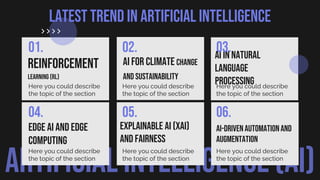
Reinforcement
Learning (RL)
01.
AI for Climate Change
and Sustainability:
02.
Here you could describe
the topic of the section
AI in Natural
Language
Processing
03.
Here you could describe
the topic of the section
Edge AI and Edge
Computing
04.
Here you could describe
the topic of the section
Explainable AI (XAI)
and Fairness
05.
Here you could describe
the topic of the section
AI-DrivenAutomationand
Augmentation
06.
Here you could describe
the topic of the section
Latest trend in artificial intelligence
ARTIFICIAL
INTELLIGENCE
(AI)
Latest trend in artificial intelligence
•RL for Robotics: Advances in RL algorithms have facilitated the
training of robots to perform complex tasks, such as grasping
objects, navigating environments, and even dexterous
manipulation.
•RL in Healthcare: RL has been utilized to optimize treatment
plans, personalized medicine, and medical decision-making,
leading to more efficient and effective healthcare delivery.
- ReinforcementLearning (RL)
/(AI)
AI for Climate Change and
Sustainability:
02.
• Climate Modeling: AI techniques, including deep learning, are
being applied to climate modeling, improving accuracy and
predicting long-term climate patterns to support climate
change mitigation and adaptation strategies.
• Sustainable Energy Optimization: AI is used for optimizing
energy consumption, smart grids, and renewable energy
integration, reducing environmental impact and enabling
more efficient energy management.
AI in Natural Language Processing
03.
.
•Contextual Word Embeddings: Pretrained language models like
GPT-3 and BERT have revolutionized NLP tasks by capturing
contextual dependencies and improving performance in areas
such as text classification, sentiment analysis, and question
answering.
•Multilingual NLP: Advances in multilingual models enable
natural language understanding and generation in multiple
languages, facilitating cross-lingual information retrieval,
translation, and sentiment analysis.
/(AI)
Edge AI and Edge
Computing
04.
• Edge AI: Deploying AI models directly on edge devices,
such as smartphones, IoT devices, and edge servers,
enables real-time, low-latency inference, enhancing
privacy, security, and efficient data processing.
• Edge Computing Infrastructure: Edge computing
architectures are being developed to support AI
workloads at the edge, reducing network congestion,
enhancing responsiveness, and enabling offline
capabilities.
/(AI)
Explainable AI (XAI) and Fairness
05.
• Explainability Techniques: XAI methods, such as rule-based
models, attention mechanisms, and interpretability
frameworks, aim to make AI models' decisions more
transparent and interpretable, boosting trust and
accountability.
• Fairness in AI: Addressing biases and ensuring fairness in AI
decision-making is a growing focus. Research and practices
aim to mitigate biases in datasets, algorithms, and decision
processes to avoid discriminatory outcomes.
AI-Driven Automation and
Augmentation
06.
• Intelligent Process Automation (IPA): Combining AI
with robotic process automation (RPA) and
workflow systems, IPA automates repetitive and
rule-based tasks, streamlining business operations
and enhancing productivity.
• Augmented Intelligence: AI is being used to
enhance human capabilities, assisting professionals
in decision-making, data analysis, and creative tasks
across various industries, including healthcare,
finance, and research.
ARTIFICIAL INTELLIGENCE (AI)
● Inconclusion, artificial intelligence(AI)hasbeenexperiencingseveralsignificant trendsthatare shaping its landscape anddriving innovation across various domains.
Here are thekeytakeaways fromtherecenttrendsinAI:
1.) Advancementsin ReinforcementLearning(RL)haveenabledreal-worldapplications inrobotics andhealthcare,revolutionizing howtasks areautomatedandoptimizing
decision-making processes.
2.) Theapplication of AIin climate changeand sustainability effortsis making a positive impact by improving climate modelingaccuracy andoptimizing energyconsumption,
supporting effortsto mitigate environmentalchallenges.
3.) Explainable AI(XAI)methodsandfairness considerations are gaining traction tomake AIsystems more transparent,interpretable,and accountable, while mitigating biases in
decision-making processes.
4.) Natural Language Processing (NLP)has seensignificant progress with thedevelopmentof contextualword embeddingsand multilingual models, enhancinglanguage
understanding, translation, sentimentanalysis, and more.
5.) Therise of AI-drivenautomation andaugmentation, including IntelligentProcess Automation (IPA)andaugmentedintelligence,is revolutionizing industries by automating
repetitivetasks andaugmenting humancapabilities.
6.) Edge AIand Edge Computing are emergingtrendsthatbring AIcapabilities closerto thesource ofdata generation,enablingreal-time,low-latencyinference,enhancing
privacy, and supporting offline capabilities.
● Overall, recenttrendsin AIemphasize theimportance ofethicalconsiderations, suchas privacy, fairness, and explainability, as wellas thepotentialfor AIto drive positive
changein various sectors, including healthcare,climate change mitigation, and automation. AsAIcontinuesto advance, it is essentialto prioritize responsible
developmentandensurethatthesetechnologiesbenefitsociety as a whole.
conclusion
THANK YOU

Artificial Intelligence (AI) kunal yadav.pptx

  • 1.
    ARTIFICIAL INTELLIGENCE (AI) ARTIFICIALINTELLIGENCE (AI) ARTIFICIAL INTELLIGENCE (AI) ARTIFICIAL INTELLIGENCE (AI) ArTIFICIAL INTELLIGENCE (AI) PROJECT PROPOSAL Here is where your presentation begins By-kunal yadav
  • 2.
    WHAT IS ARTIFICIALINTELLIGENCE Artificial Intelligence is by far one of the most fascinating and astounding creations ever made in the history of mankind. With the advent of its invention, there is still a large domain that is yet to be explored. In fact, its real-world application to date is probably the tip of the iceberg. In the past few years, there has been rapid growth in the domain of AI, making it one of the most lucrative industries.
  • 3.
    ARTIFICIAL INTELLIGENCE (AI) Hereyou could describe the topic of the section Reinforcement Learning (RL) 01. AI for Climate Change and Sustainability: 02. Here you could describe the topic of the section AI in Natural Language Processing 03. Here you could describe the topic of the section Edge AI and Edge Computing 04. Here you could describe the topic of the section Explainable AI (XAI) and Fairness 05. Here you could describe the topic of the section AI-DrivenAutomationand Augmentation 06. Here you could describe the topic of the section Latest trend in artificial intelligence
  • 4.
    ARTIFICIAL INTELLIGENCE (AI) Latest trend inartificial intelligence •RL for Robotics: Advances in RL algorithms have facilitated the training of robots to perform complex tasks, such as grasping objects, navigating environments, and even dexterous manipulation. •RL in Healthcare: RL has been utilized to optimize treatment plans, personalized medicine, and medical decision-making, leading to more efficient and effective healthcare delivery. - ReinforcementLearning (RL)
  • 5.
    /(AI) AI for ClimateChange and Sustainability: 02. • Climate Modeling: AI techniques, including deep learning, are being applied to climate modeling, improving accuracy and predicting long-term climate patterns to support climate change mitigation and adaptation strategies. • Sustainable Energy Optimization: AI is used for optimizing energy consumption, smart grids, and renewable energy integration, reducing environmental impact and enabling more efficient energy management.
  • 6.
    AI in NaturalLanguage Processing 03. . •Contextual Word Embeddings: Pretrained language models like GPT-3 and BERT have revolutionized NLP tasks by capturing contextual dependencies and improving performance in areas such as text classification, sentiment analysis, and question answering. •Multilingual NLP: Advances in multilingual models enable natural language understanding and generation in multiple languages, facilitating cross-lingual information retrieval, translation, and sentiment analysis.
  • 7.
    /(AI) Edge AI andEdge Computing 04. • Edge AI: Deploying AI models directly on edge devices, such as smartphones, IoT devices, and edge servers, enables real-time, low-latency inference, enhancing privacy, security, and efficient data processing. • Edge Computing Infrastructure: Edge computing architectures are being developed to support AI workloads at the edge, reducing network congestion, enhancing responsiveness, and enabling offline capabilities.
  • 8.
    /(AI) Explainable AI (XAI)and Fairness 05. • Explainability Techniques: XAI methods, such as rule-based models, attention mechanisms, and interpretability frameworks, aim to make AI models' decisions more transparent and interpretable, boosting trust and accountability. • Fairness in AI: Addressing biases and ensuring fairness in AI decision-making is a growing focus. Research and practices aim to mitigate biases in datasets, algorithms, and decision processes to avoid discriminatory outcomes.
  • 9.
    AI-Driven Automation and Augmentation 06. •Intelligent Process Automation (IPA): Combining AI with robotic process automation (RPA) and workflow systems, IPA automates repetitive and rule-based tasks, streamlining business operations and enhancing productivity. • Augmented Intelligence: AI is being used to enhance human capabilities, assisting professionals in decision-making, data analysis, and creative tasks across various industries, including healthcare, finance, and research.
  • 10.
    ARTIFICIAL INTELLIGENCE (AI) ●Inconclusion, artificial intelligence(AI)hasbeenexperiencingseveralsignificant trendsthatare shaping its landscape anddriving innovation across various domains. Here are thekeytakeaways fromtherecenttrendsinAI: 1.) Advancementsin ReinforcementLearning(RL)haveenabledreal-worldapplications inrobotics andhealthcare,revolutionizing howtasks areautomatedandoptimizing decision-making processes. 2.) Theapplication of AIin climate changeand sustainability effortsis making a positive impact by improving climate modelingaccuracy andoptimizing energyconsumption, supporting effortsto mitigate environmentalchallenges. 3.) Explainable AI(XAI)methodsandfairness considerations are gaining traction tomake AIsystems more transparent,interpretable,and accountable, while mitigating biases in decision-making processes. 4.) Natural Language Processing (NLP)has seensignificant progress with thedevelopmentof contextualword embeddingsand multilingual models, enhancinglanguage understanding, translation, sentimentanalysis, and more. 5.) Therise of AI-drivenautomation andaugmentation, including IntelligentProcess Automation (IPA)andaugmentedintelligence,is revolutionizing industries by automating repetitivetasks andaugmenting humancapabilities. 6.) Edge AIand Edge Computing are emergingtrendsthatbring AIcapabilities closerto thesource ofdata generation,enablingreal-time,low-latencyinference,enhancing privacy, and supporting offline capabilities. ● Overall, recenttrendsin AIemphasize theimportance ofethicalconsiderations, suchas privacy, fairness, and explainability, as wellas thepotentialfor AIto drive positive changein various sectors, including healthcare,climate change mitigation, and automation. AsAIcontinuesto advance, it is essentialto prioritize responsible developmentandensurethatthesetechnologiesbenefitsociety as a whole. conclusion
  • 11.