

Artificial Intelligence
A Brief History of AI
   5th century BC
    Aristotle invents syllogistic logic, the first
    formal deductive reasoning system.

   16th century AD
    Rabbi Loew supposedly invents the
    Golem, an artificial man made out of clay
   17th century
    Descartes proposes animals are
    machines and founds a scientific
    paradigm that will dominate for 250
    years.
    Pascal creates the first mechanical
    calculator in 1642

   18th century
    Wolfgang von Kempelen “invents” fake
    chess-playing machine, The Turk.
   19th century
    George Boole creates a binary algebra to
    represent “laws of thought”

    Charles Babbage and Lady Lovelace
    develop sophisticated programmable
    mechanical computers, precursor to
    modern electronic computers.
   20th century
    Karel Kapek writes “Rossum’s Universal
    Robots”, coining the English word “robot”

    Warren McCulloch and Walter Pitts lay
    partial groundwork for neural networks

    Turing writes “Computing Machinery and
    Intelligence” – proposal of Turing test
   1956: John McCarthy coins phrase
    “artificial intelligence”

   1952-62: Arthur Samuel writes the first AI
    game program to challenge a world
    champion, in part due to learning.

   1950’s-60’s: Masterman et. al at
    Cambridge create semantic nets that do
    machine translation.
   1961: James Slagle writes first symbolic
    integrator, SAINT, to solve calculus
    problems.

   1963: Thomas Evan’s writes ANALOGY,
    which solves analogy problems like the
    ones on IQ tests.

   1965: J. A. Robinson invents Resolution
    Method using formal logic as its
    representation language.
   1965: Joseph Weizenbaum creates
    ELIZA, one of the earliest “chatterbots”

   1967: Feigenbaum et. al create Dendral,
    the first useful knowledge-based agent
    that interpreted mass spectrographs.

   1969: Shakey the robot combines
    movement, perception and problem
    solving.
   1971: Terry Winograd demonstrates a
    program that can understand English
    commands in the word of blocks.

   1972: Alain Colmerauer writes Prolog

   1974: Ted Shortliffe creates MYCIN, the
    first expert system which showed the
    effectiveness of rule-based knowledge
    representation for medical diagnosis.
   1978: Herb Simon wins Nobel Prize for
    theory of bounded rationality

   1983: James Allen creates Interval
    Calculus as a formal representation for
    events in time.

   1980’s: Backpropagation (invented 1974)
    rediscovered and sees wide use in neural
    networks
   1985: ALVINN, “an autonomous land
    vehicle in a neural network” navigates
    across the country (2800 miles).

   Early 1990’s: Gerry Tesauro creates TD-
    Gammon, a learning backgammon agent
    that vies with championship players

   1997: Deep Blue defeats Garry Kasparov
ETHICAL
        CONSIDERATIONS
Utilitarianism supports the development of AI, but only because of the Christian
    value of dominion over the environment. AI promises to increase control
    over life, thus suffering can be reduced. Yet, if AI is developed and not
    forced into particular tasks, Utilitarianism may not apply.

Artificial life may be viewed as more expendable than human life, so AI will be
    used as cheap labor, or perhaps slaves, thus increasing profits for
    corporations.

We do have to take responsibility for our creations, so if the risks associated
  with creating a form of AI are too great, then we should not pursue that
  development.

We do have to take responsibility for our creations, so if the risks associated
  with creating a form of AI are too great, then we should not pursue that
  development.
Modern Times
      (post-Cartesian )
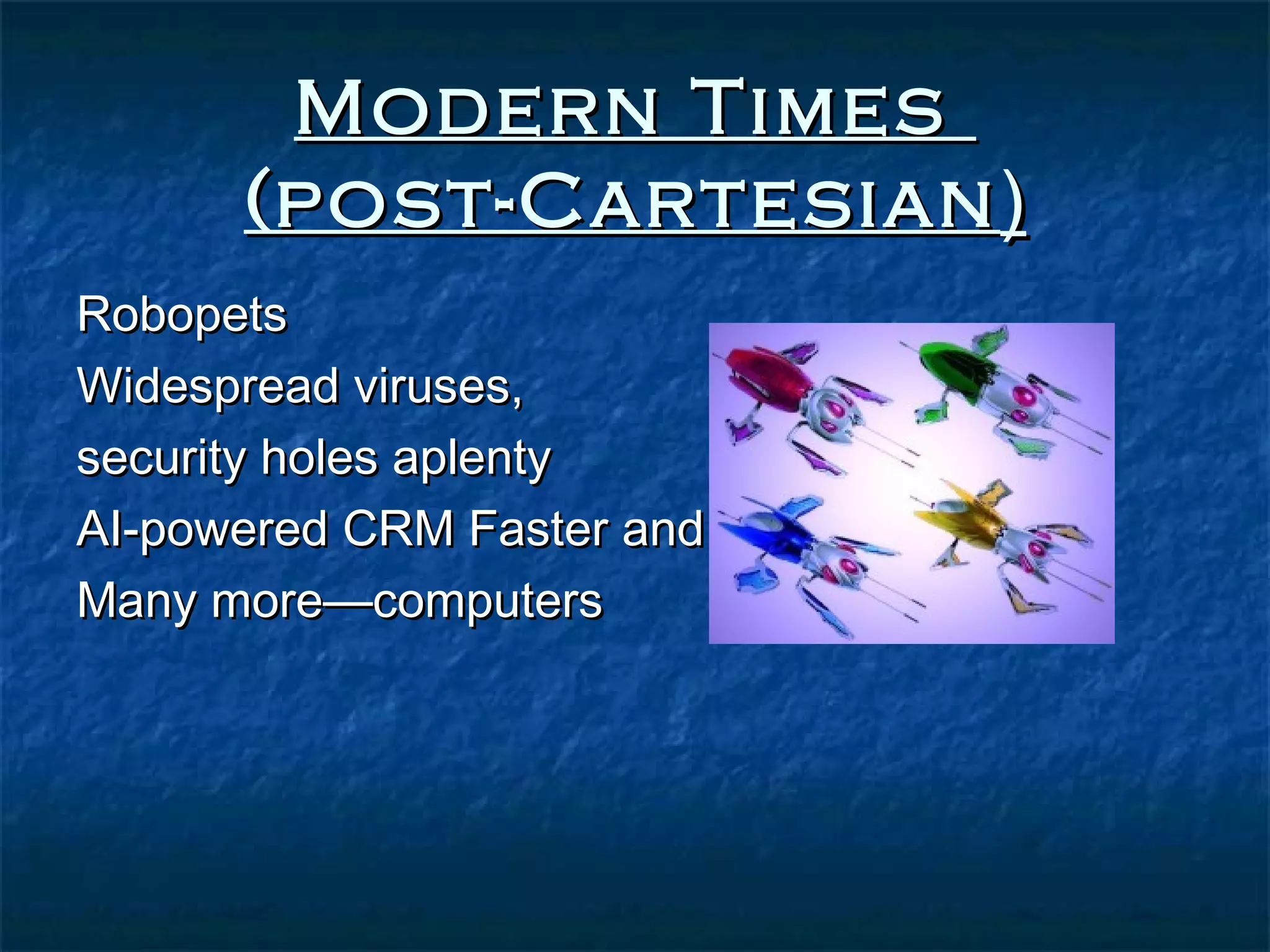
Robopets
Widespread viruses,
security holes aplenty
AI-powered CRM Faster and
Many more—computers
    A word about paradigms…
   AI will force a dualistic view of life to change because the
    environment will be inseparable from it. Axiological shifts will occur
    in defining life, causing society to expand current definitions of life
    (e.g. requirement of a body). Also, the connectedness of the local
    environment to AI will force science away from a reductionist view
    of this new life and into a more complex view of interactions
    causing life to arise.

   On the other hand, most scientists would be happy to view the
    brain as a vast but complex machine. As such it should then be
    possible to purely replicate the brain using artificial neurons. This
    has already been done for very simple life forms such as insects
    which only have a few thousand neurons in their brains. In
    principle, it would not be necessary to have a full scientific
    understanding of how the brain works. One would just build a copy
    of one using artificial materials and see how it behaves.
 Rights Based Ethics
   Once AI programs achieve
    a modicum of sentience,
    should they be given rights
    on par with other animals?
   Two sides of the argument:
   1) No, because sentience is
    impossible to determine.
   2) Yes, because sentience
    can be proven beyond a
    reasonable doubt.
Duty ethics
   Consequence of developing AI is not at issue. What
    obligations do we have to our biological children? Once
    AL is created, are they to be a Frankenstein’s monster
    and cast off without help, or are they to be guided by
    their creator, like Adam & Eve in Eden.

   We do have to take responsibility for our creations, so if
    the risks associated with creating a form of AI are too
    great, then we should not pursue that development.

   Do we have a responsibility to our biological children
    similar to AI? Are the two exactly the same?

   What rules should we use as categorical imperatives? AI
    should contain a set of rules that most people share, like
    “do not kill, unless in self-defense” or “do not lie, unless
    the suffering caused by honesty is large”.
Confucianism
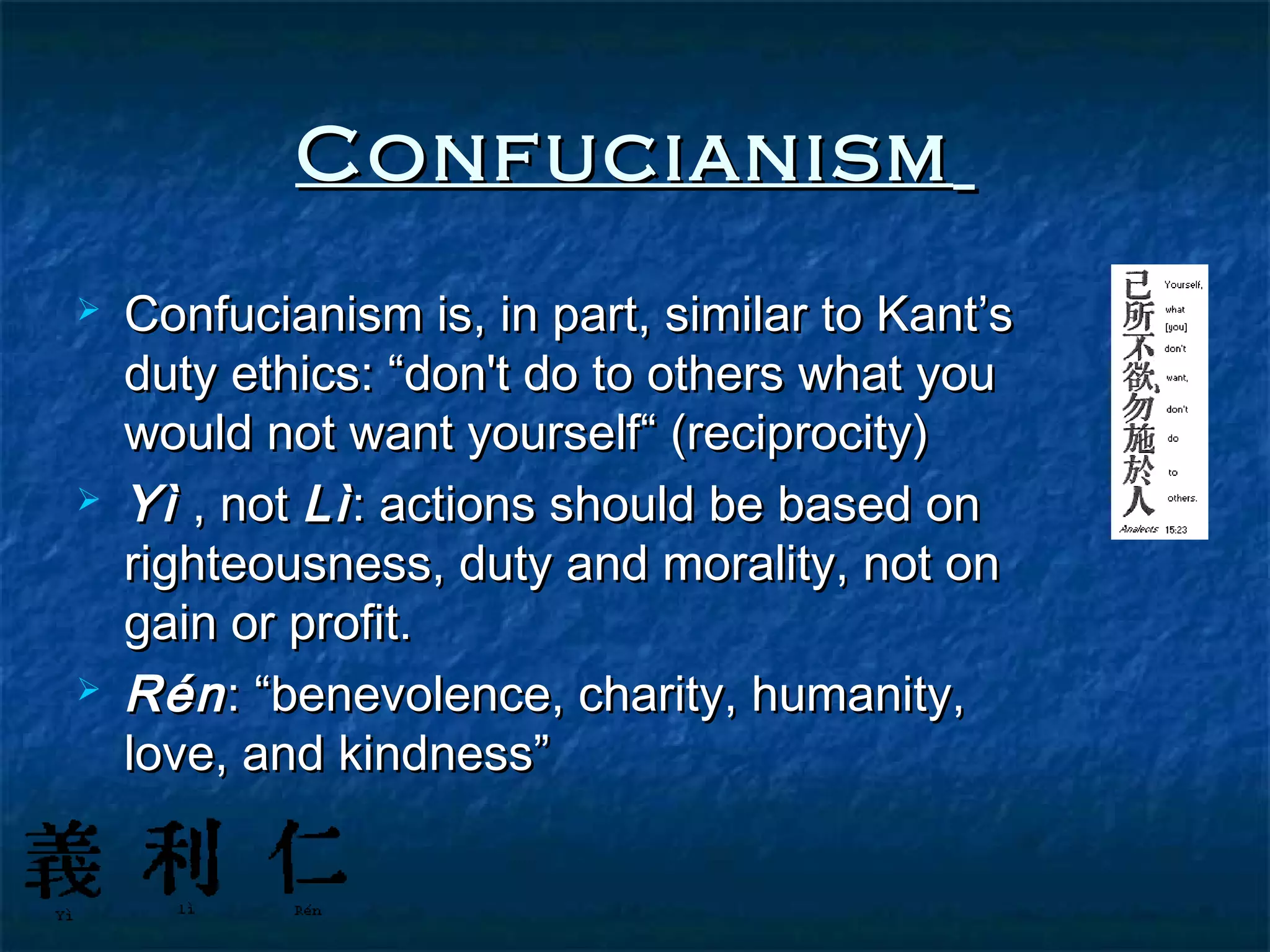
   Confucianism is, in part, similar to Kant’s
    duty ethics: “don't do to others what you
    would not want yourself“ (reciprocity)
   Yì , not Lì : actions should be based on
    righteousness, duty and morality, not on
    gain or profit.
   Rén : “benevolence, charity, humanity,
    love, and kindness”
   But AI is also an advance in civilization; it makes it
    possible for everyone to live more comfortable lives
   Thus, Confucianism seems to encourage development
    and application of (non-sentient) AI, so long as it does
    not endanger others
   If the AI is sentient, however, it would have to be treated
    humanely without exploitation, and could not be created
    out of individual or corporate greed.
   Though Confucianism can be seen as a religion, it is also
    a code of ethics, which suggests that it would be more
    open to considering AI to be alive and deserving rights
    than other spiritual mythologies.
Virtue ethics
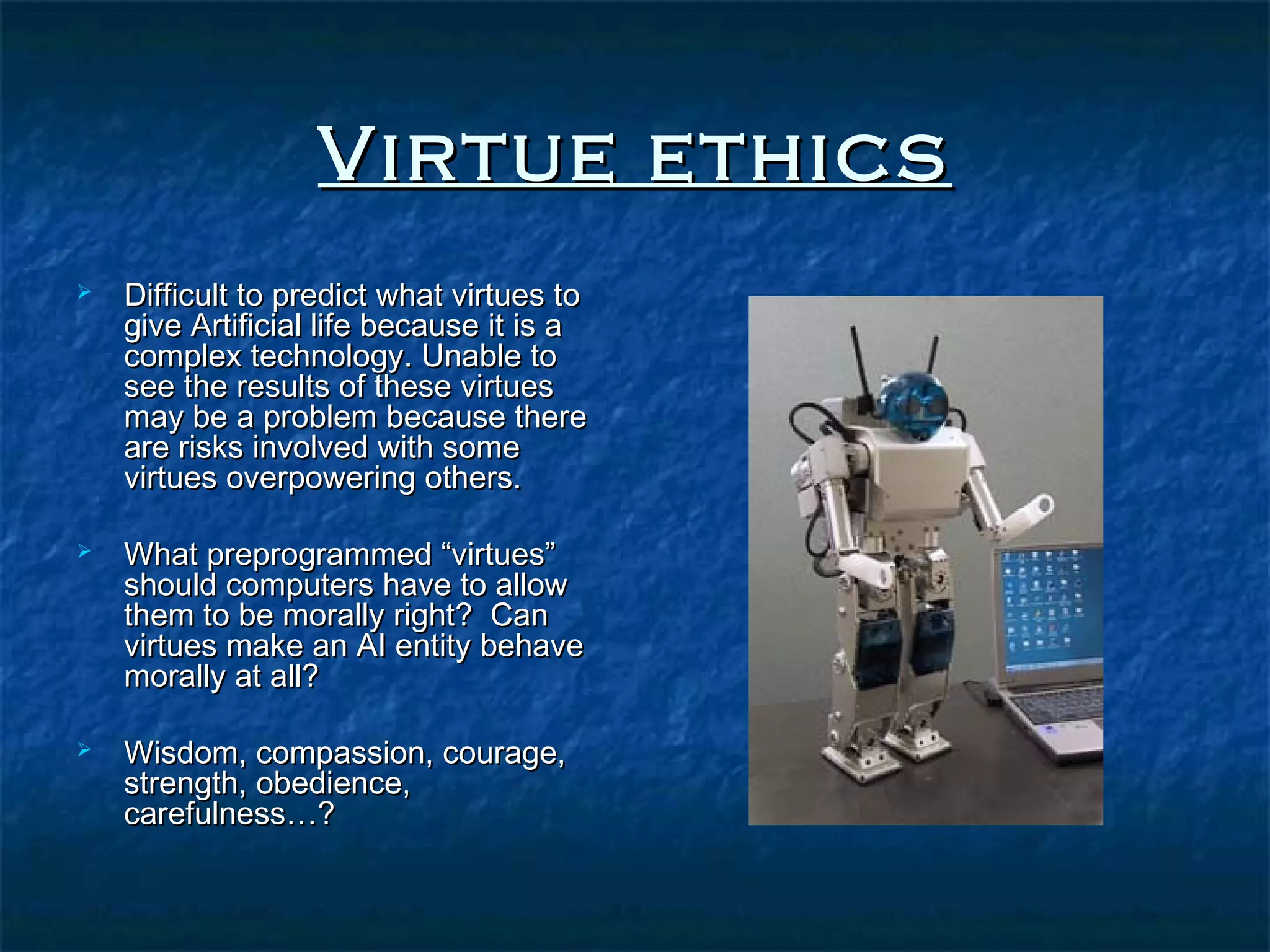
   Difficult to predict what virtues to
    give Artificial life because it is a
    complex technology. Unable to
    see the results of these virtues
    may be a problem because there
    are risks involved with some
    virtues overpowering others.

   What preprogrammed “virtues”
    should computers have to allow
    them to be morally right? Can
    virtues make an AI entity behave
    morally at all?

   Wisdom, compassion, courage,
    strength, obedience,
    carefulness…?
ADVANTAGES
       (Factual Changes )
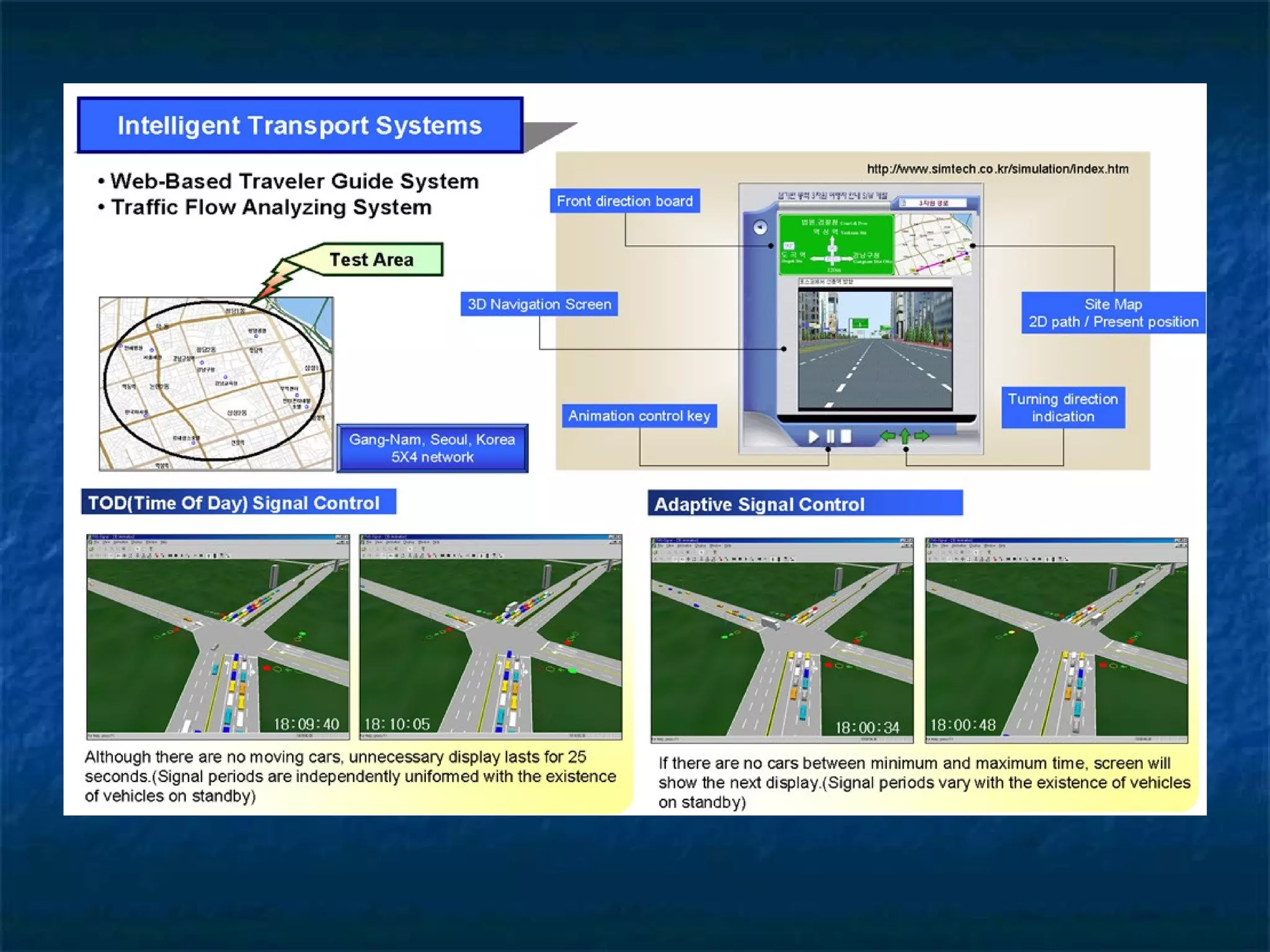
   Smarter artificial intelligence promises to replace human jobs,
    freeing people for other pursuits by automating manufacturing and
    transportations.

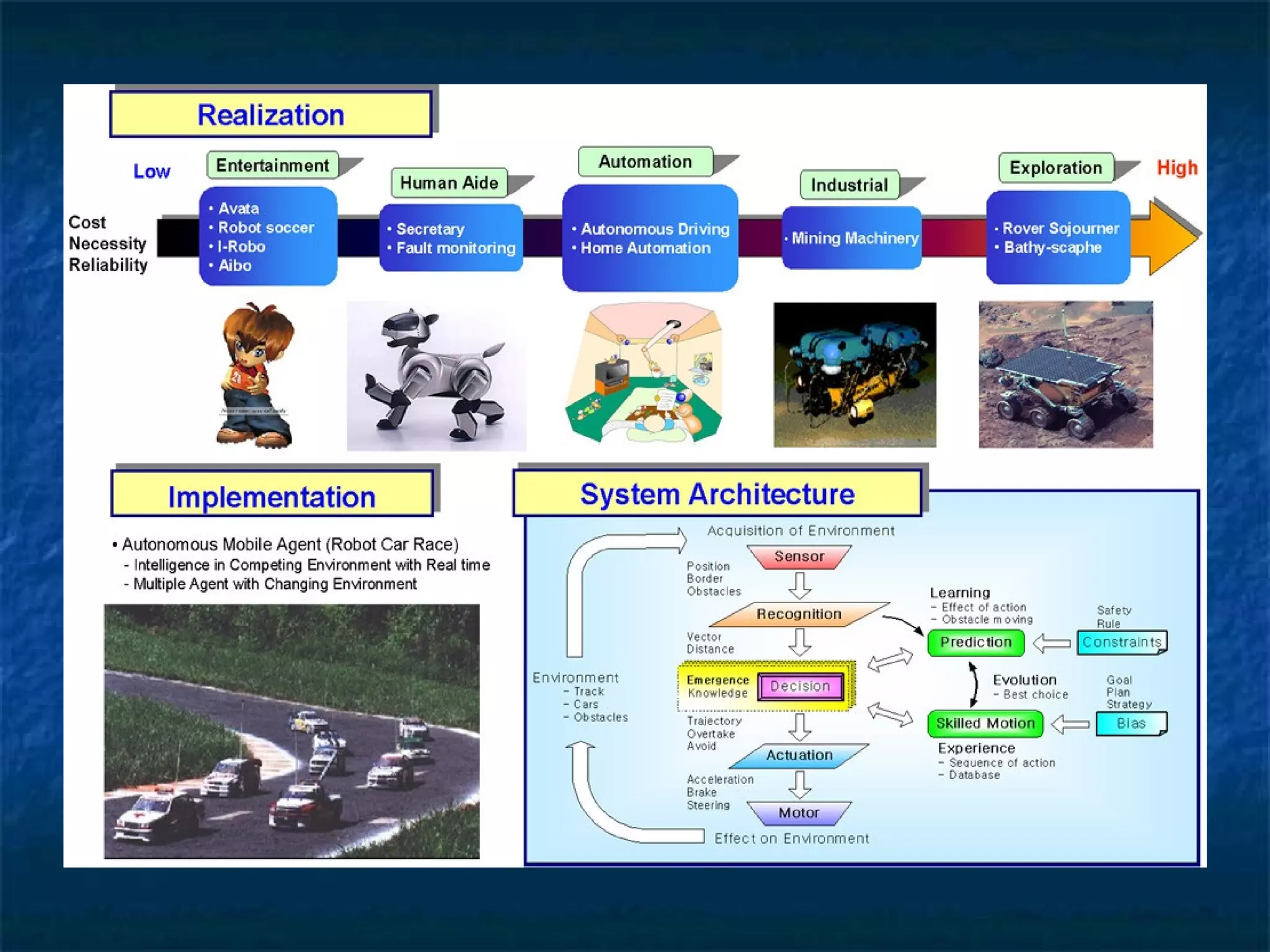
   Self-modifying, self-writing, and learning software relieves
    programmers of the burdensome task of specifying the whole of a
    program’s functionality—now we can just create the framework and
    have the program itself fill in the rest (example: real-time strategy
    game artificial intelligence run by a neural network that acts based
    on experience instead of an explicit decision tree).

   Self-replicating applications can make deployment easier and less
    resource-intensive.

   AI can see relationships in enormous or diverse bodies of data that
    a human could not
Disadvantag
 es (Risks)

Potential for
Malevolentprograms, Cold-
war between two countries
unforseen impacts
because it is Complex
Technology,
consequences will most
likely be minimal.
   Self-modifying, when combined with self-
    replicating, can lead to dangerous, unexpected
    results, such as a new and frequently mutating
    computer virus.
   As computers get faster and more numerous, the
    possibility of randomly creating an artificial
    intelligence becomes real.
   Military robots may make it possible for a country
    to indiscriminately attack less-advanced countries
    with few, if any, human casualties.
   Rapid advances in AI could mean massive
    structural unemployment
   AI utilizing non-transparent learning (i.e. neural
    networks) is never completely predictable
Mythological
          Considerations
   Do sentient programs have a soul?
   Christianity says no because a soul is imparted
    by God alone, and not by Computer Scientists,
    yet Christianity does dictate that we control the
    environment around us, thus if cyberspace is
    part of our environment, would AI allow us to
    control it?
   Buddhism and Taoism take a different stance.
 Buddhism                  and Taoism
   The Hua-Yen school of Buddhism offers as the metaphor
    for the world an infinite net, at each intersection of which
    lies a jewel in which exists every other jewel and where
    every part of the net depends for its existence on
    dynamic awareness of every other part. This is in line
    with the axiological shift that would likely result from
    developing Artificial Life; environment and individual life
    are one.

   Buddhism and Taoism value life above all else, so AI
    would be valued just as highly as all other life, once
    developed. Creation of AI would be opposed because AI
    does not share the tenets of the 8-fold path.
 Christianity,             Islam,
                          Judaism
   Christianity, Islam, and Judaism are (at least in relation
    to AI) very similar: they all state God created man in his
    own image
   So:
       How can man create artificial life if God is the creator of life?
        (“Say unto them, O Muhammad: Allah gives life to you, then
        causes you to die, then gathers you unto the day of
        resurrection...”)
       If AI programs are sentient and as smart or smarter than
        humans, is man still the highest of worldly life?
       Does sentient AI have a soul? Does it ascend to heaven when it
        is deleted? Or when it stops running temporarily (and then is
        reborn)? How do you baptize software? And so on…
   Because they will not accept AI as life,
    Judaism, Christianity and Islam do not care
    about the rights and treatment of any AI.
   Instead, they will focus on the dangers to
    humans.
   Christianity concerned with orthodoxy
    (correct belief), while Islam and Judaism
    concerned with orthopraxy (correct action)
   Should you release (potentially dangerous)
    AI software if you have tested it to your
    satisfaction or if you have applied a set
    testing protocol?
   Judaism and Christianity hold that man has free will;
    however, Islam is more slanted toward predestination (“By
    no means can anything befall us but what God has
    destined for us”).
   Digital AI doesn’t appear to have free will: all inputs and
    outputs to an AI program are discreet and reproducible, as
    are the AI program’s state and execution (its “memory” and
    “thought”). Given the same conditions and the same input,
    digital AI software will always produce the same output.
   Notice, however, that this could be true for humans as well,
    but is unverifiable because our inputs, outputs, memories
    and thoughts are not easily accessible or reproducible.

   Bottom line: in most ways, sentient AI doesn’t make sense
    in the context of these religions, and, in some cases, is
    contrary to their beliefs.
   And thus Christianity, Islam, and Judaism would not accept
    any AI as sentient, and probably not even as life.
 Applied         Ethicist’s
                  Stance
 Macroethics-current societal values is dominated
    by Utilitarianism, thus AI is likely to continue.

   Microethics-depending on a person’s spirituality,
    this may influence the codes of conduct
    designed into artificial life.

   Mesoethics-if a company develops AI, it will
    produce a utilitarian creature. If research
    institutes develop AI, then it may contain various
    ethical standpoints depending on who is doing
    the research and development.
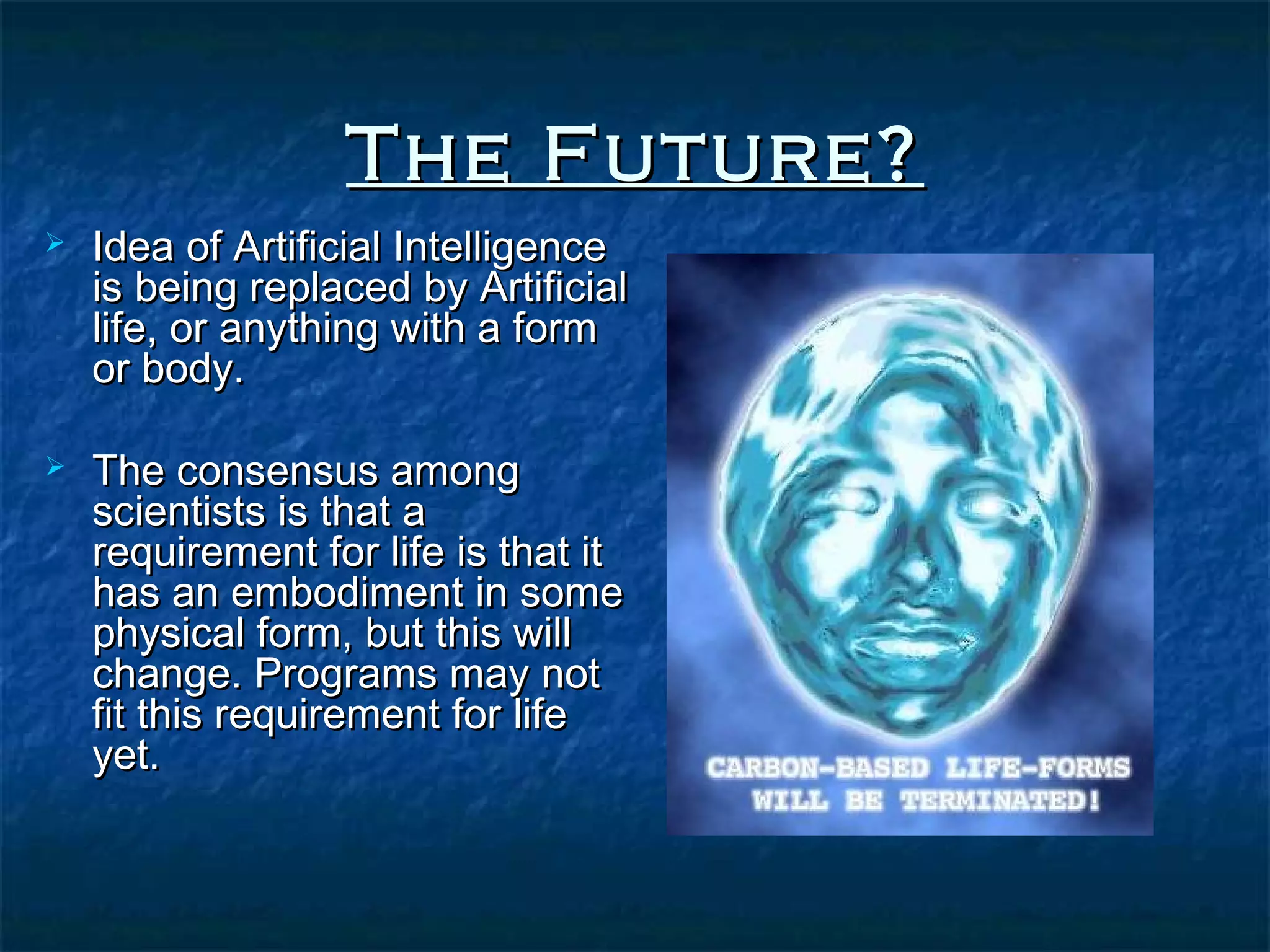
The Future?
   Idea of Artificial Intelligence
    is being replaced by Artificial
    life, or anything with a form
    or body.

   The consensus among
    scientists is that a
    requirement for life is that it
    has an embodiment in some
    physical form, but this will
    change. Programs may not
    fit this requirement for life
    yet.
Should we start caring
        yet?
   Very sophisticated—perhaps even
    sentient—AI may not be far off; with
    sufficient computation power (such as that
    offered by quantum computers) it is
    possible to “evolve” AI without much
    programming effort.
   Today, concerns include mutating viruses
    and the reliability of AI (you don’t want
    software directing your car into a tree).
What should happen
   When programs that appear to demonstrate sentience
    appear (intelligence and awareness), a panel of
    scientists could be assembled to determine if a particular
    program is sentient or not.
   If sentient, it will be given rights, so, in general,
    companies will try to avoid developing sentient AI since
    they would not be able to indiscriminately exploit it.
   Software companies should be made legally responsible
    for failings of software that result in damage to third
    parties despite good-faith attempts at control by the user.
   AI and robotics have the potentially to truly revolutionize
    the economy by replacing labor with capital, allowing
    greater production—it deserves a corresponding share
    of research funding!
And what is going to
         happen…
   Most people are willing to torture and kill intelligent
    animals like cows just for a tastier lunch—why would
    they hesitate to exploit artificial life?
   This is further compounded mainstream religious beliefs
   Even with laws, any individual with sufficient computing
    power could “evolve” AI without much programming.
   Licensing agreements will continue to allow careless
    companies to often escape responsibility for faulty
    software.
   Bottom line: ethical considerations will be ignored;
    reform—if it happens—will only take place when the
    economic costs become too high.
Thank U…
Queries???

Artficial intelligence

  • 1.
  • 2.
    A Brief Historyof AI  5th century BC Aristotle invents syllogistic logic, the first formal deductive reasoning system.  16th century AD Rabbi Loew supposedly invents the Golem, an artificial man made out of clay
  • 3.
    17th century Descartes proposes animals are machines and founds a scientific paradigm that will dominate for 250 years. Pascal creates the first mechanical calculator in 1642  18th century Wolfgang von Kempelen “invents” fake chess-playing machine, The Turk.
  • 4.
    19th century George Boole creates a binary algebra to represent “laws of thought” Charles Babbage and Lady Lovelace develop sophisticated programmable mechanical computers, precursor to modern electronic computers.
  • 5.
    20th century Karel Kapek writes “Rossum’s Universal Robots”, coining the English word “robot” Warren McCulloch and Walter Pitts lay partial groundwork for neural networks Turing writes “Computing Machinery and Intelligence” – proposal of Turing test
  • 6.
    1956: John McCarthy coins phrase “artificial intelligence”  1952-62: Arthur Samuel writes the first AI game program to challenge a world champion, in part due to learning.  1950’s-60’s: Masterman et. al at Cambridge create semantic nets that do machine translation.
  • 7.
    1961: James Slagle writes first symbolic integrator, SAINT, to solve calculus problems.  1963: Thomas Evan’s writes ANALOGY, which solves analogy problems like the ones on IQ tests.  1965: J. A. Robinson invents Resolution Method using formal logic as its representation language.
  • 8.
    1965: Joseph Weizenbaum creates ELIZA, one of the earliest “chatterbots”  1967: Feigenbaum et. al create Dendral, the first useful knowledge-based agent that interpreted mass spectrographs.  1969: Shakey the robot combines movement, perception and problem solving.
  • 9.
    1971: Terry Winograd demonstrates a program that can understand English commands in the word of blocks.  1972: Alain Colmerauer writes Prolog  1974: Ted Shortliffe creates MYCIN, the first expert system which showed the effectiveness of rule-based knowledge representation for medical diagnosis.
  • 10.
    1978: Herb Simon wins Nobel Prize for theory of bounded rationality  1983: James Allen creates Interval Calculus as a formal representation for events in time.  1980’s: Backpropagation (invented 1974) rediscovered and sees wide use in neural networks
  • 11.
    1985: ALVINN, “an autonomous land vehicle in a neural network” navigates across the country (2800 miles).  Early 1990’s: Gerry Tesauro creates TD- Gammon, a learning backgammon agent that vies with championship players  1997: Deep Blue defeats Garry Kasparov
  • 12.
    ETHICAL CONSIDERATIONS Utilitarianism supports the development of AI, but only because of the Christian value of dominion over the environment. AI promises to increase control over life, thus suffering can be reduced. Yet, if AI is developed and not forced into particular tasks, Utilitarianism may not apply. Artificial life may be viewed as more expendable than human life, so AI will be used as cheap labor, or perhaps slaves, thus increasing profits for corporations. We do have to take responsibility for our creations, so if the risks associated with creating a form of AI are too great, then we should not pursue that development. We do have to take responsibility for our creations, so if the risks associated with creating a form of AI are too great, then we should not pursue that development.
  • 13.
    Modern Times (post-Cartesian ) Robopets Widespread viruses, security holes aplenty AI-powered CRM Faster and Many more—computers
  • 14.
    A word about paradigms…  AI will force a dualistic view of life to change because the environment will be inseparable from it. Axiological shifts will occur in defining life, causing society to expand current definitions of life (e.g. requirement of a body). Also, the connectedness of the local environment to AI will force science away from a reductionist view of this new life and into a more complex view of interactions causing life to arise.  On the other hand, most scientists would be happy to view the brain as a vast but complex machine. As such it should then be possible to purely replicate the brain using artificial neurons. This has already been done for very simple life forms such as insects which only have a few thousand neurons in their brains. In principle, it would not be necessary to have a full scientific understanding of how the brain works. One would just build a copy of one using artificial materials and see how it behaves.
  • 15.
     Rights BasedEthics  Once AI programs achieve a modicum of sentience, should they be given rights on par with other animals?  Two sides of the argument:  1) No, because sentience is impossible to determine.  2) Yes, because sentience can be proven beyond a reasonable doubt.
  • 16.
    Duty ethics  Consequence of developing AI is not at issue. What obligations do we have to our biological children? Once AL is created, are they to be a Frankenstein’s monster and cast off without help, or are they to be guided by their creator, like Adam & Eve in Eden.  We do have to take responsibility for our creations, so if the risks associated with creating a form of AI are too great, then we should not pursue that development.  Do we have a responsibility to our biological children similar to AI? Are the two exactly the same?  What rules should we use as categorical imperatives? AI should contain a set of rules that most people share, like “do not kill, unless in self-defense” or “do not lie, unless the suffering caused by honesty is large”.
  • 17.
    Confucianism  Confucianism is, in part, similar to Kant’s duty ethics: “don't do to others what you would not want yourself“ (reciprocity)  Yì , not Lì : actions should be based on righteousness, duty and morality, not on gain or profit.  Rén : “benevolence, charity, humanity, love, and kindness”
  • 18.
    But AI is also an advance in civilization; it makes it possible for everyone to live more comfortable lives  Thus, Confucianism seems to encourage development and application of (non-sentient) AI, so long as it does not endanger others  If the AI is sentient, however, it would have to be treated humanely without exploitation, and could not be created out of individual or corporate greed.  Though Confucianism can be seen as a religion, it is also a code of ethics, which suggests that it would be more open to considering AI to be alive and deserving rights than other spiritual mythologies.
  • 19.
    Virtue ethics  Difficult to predict what virtues to give Artificial life because it is a complex technology. Unable to see the results of these virtues may be a problem because there are risks involved with some virtues overpowering others.  What preprogrammed “virtues” should computers have to allow them to be morally right? Can virtues make an AI entity behave morally at all?  Wisdom, compassion, courage, strength, obedience, carefulness…?
  • 21.
    ADVANTAGES (Factual Changes )  Smarter artificial intelligence promises to replace human jobs, freeing people for other pursuits by automating manufacturing and transportations.  Self-modifying, self-writing, and learning software relieves programmers of the burdensome task of specifying the whole of a program’s functionality—now we can just create the framework and have the program itself fill in the rest (example: real-time strategy game artificial intelligence run by a neural network that acts based on experience instead of an explicit decision tree).  Self-replicating applications can make deployment easier and less resource-intensive.  AI can see relationships in enormous or diverse bodies of data that a human could not
  • 24.
    Disadvantag es (Risks) Potentialfor Malevolentprograms, Cold- war between two countries unforseen impacts because it is Complex Technology, consequences will most likely be minimal.
  • 25.
    Self-modifying, when combined with self- replicating, can lead to dangerous, unexpected results, such as a new and frequently mutating computer virus.  As computers get faster and more numerous, the possibility of randomly creating an artificial intelligence becomes real.  Military robots may make it possible for a country to indiscriminately attack less-advanced countries with few, if any, human casualties.  Rapid advances in AI could mean massive structural unemployment  AI utilizing non-transparent learning (i.e. neural networks) is never completely predictable
  • 26.
    Mythological Considerations  Do sentient programs have a soul?  Christianity says no because a soul is imparted by God alone, and not by Computer Scientists, yet Christianity does dictate that we control the environment around us, thus if cyberspace is part of our environment, would AI allow us to control it?  Buddhism and Taoism take a different stance.
  • 27.
     Buddhism and Taoism  The Hua-Yen school of Buddhism offers as the metaphor for the world an infinite net, at each intersection of which lies a jewel in which exists every other jewel and where every part of the net depends for its existence on dynamic awareness of every other part. This is in line with the axiological shift that would likely result from developing Artificial Life; environment and individual life are one.  Buddhism and Taoism value life above all else, so AI would be valued just as highly as all other life, once developed. Creation of AI would be opposed because AI does not share the tenets of the 8-fold path.
  • 28.
     Christianity, Islam, Judaism  Christianity, Islam, and Judaism are (at least in relation to AI) very similar: they all state God created man in his own image  So:  How can man create artificial life if God is the creator of life? (“Say unto them, O Muhammad: Allah gives life to you, then causes you to die, then gathers you unto the day of resurrection...”)  If AI programs are sentient and as smart or smarter than humans, is man still the highest of worldly life?  Does sentient AI have a soul? Does it ascend to heaven when it is deleted? Or when it stops running temporarily (and then is reborn)? How do you baptize software? And so on…
  • 29.
    Because they will not accept AI as life, Judaism, Christianity and Islam do not care about the rights and treatment of any AI.  Instead, they will focus on the dangers to humans.  Christianity concerned with orthodoxy (correct belief), while Islam and Judaism concerned with orthopraxy (correct action)  Should you release (potentially dangerous) AI software if you have tested it to your satisfaction or if you have applied a set testing protocol?
  • 30.
    Judaism and Christianity hold that man has free will; however, Islam is more slanted toward predestination (“By no means can anything befall us but what God has destined for us”).  Digital AI doesn’t appear to have free will: all inputs and outputs to an AI program are discreet and reproducible, as are the AI program’s state and execution (its “memory” and “thought”). Given the same conditions and the same input, digital AI software will always produce the same output.  Notice, however, that this could be true for humans as well, but is unverifiable because our inputs, outputs, memories and thoughts are not easily accessible or reproducible.  Bottom line: in most ways, sentient AI doesn’t make sense in the context of these religions, and, in some cases, is contrary to their beliefs.  And thus Christianity, Islam, and Judaism would not accept any AI as sentient, and probably not even as life.
  • 31.
     Applied Ethicist’s Stance  Macroethics-current societal values is dominated by Utilitarianism, thus AI is likely to continue.  Microethics-depending on a person’s spirituality, this may influence the codes of conduct designed into artificial life.  Mesoethics-if a company develops AI, it will produce a utilitarian creature. If research institutes develop AI, then it may contain various ethical standpoints depending on who is doing the research and development.
  • 32.
    The Future?  Idea of Artificial Intelligence is being replaced by Artificial life, or anything with a form or body.  The consensus among scientists is that a requirement for life is that it has an embodiment in some physical form, but this will change. Programs may not fit this requirement for life yet.
  • 33.
    Should we startcaring yet?  Very sophisticated—perhaps even sentient—AI may not be far off; with sufficient computation power (such as that offered by quantum computers) it is possible to “evolve” AI without much programming effort.  Today, concerns include mutating viruses and the reliability of AI (you don’t want software directing your car into a tree).
  • 34.
    What should happen  When programs that appear to demonstrate sentience appear (intelligence and awareness), a panel of scientists could be assembled to determine if a particular program is sentient or not.  If sentient, it will be given rights, so, in general, companies will try to avoid developing sentient AI since they would not be able to indiscriminately exploit it.  Software companies should be made legally responsible for failings of software that result in damage to third parties despite good-faith attempts at control by the user.  AI and robotics have the potentially to truly revolutionize the economy by replacing labor with capital, allowing greater production—it deserves a corresponding share of research funding!
  • 35.
    And what isgoing to happen…  Most people are willing to torture and kill intelligent animals like cows just for a tastier lunch—why would they hesitate to exploit artificial life?  This is further compounded mainstream religious beliefs  Even with laws, any individual with sufficient computing power could “evolve” AI without much programming.  Licensing agreements will continue to allow careless companies to often escape responsibility for faulty software.  Bottom line: ethical considerations will be ignored; reform—if it happens—will only take place when the economic costs become too high.
  • 36.
  • 37.