Lecture 01: DS & Algorithms:2013 
DATA STRUCTURES & 
ALGORITHMS 
Iftikhar Muhammad 
1 
Iftikhar 1
Lecture 01: DS & Algorithms:2013 
Iftikhar 
Arrays Operations 
• Traversal 
• Inserting 
• Deletion 
• Search 
• Sorting 
2
Lecture 01: DS & Algorithms:2013 
Iftikhar 
Traversal 
• Traversing: 
• In traversing operation, each element of an array is accessed 
exactly once for processing. This is called visiting of the array. 
• To compute the sum of values of each element of an array. 
• Display values of each element of an array. 
• Algorithm: 
• 1. Set k=LB 
• 2. Repeat Step 3 and Step 4 while k<=UB 
• 3. Apply PROCESS to LA[K] 
• 4. Set K=K+1 
• 5. [End of Step 2 loop] 
• 6. Exit 
3
Lecture 01: DS & Algorithms:2013 
Iftikhar 
Traversal Algo 
• Find the Number NUM of years during which 
more than 300 automobiles were sold. 
• 1. Set NUM=0 
• 2. Repeat for K=1932 to 1984 
• 3. If AUTO[K]>300, then: Set NUM=NUM +1. 
• 4. [End of Loop] 
• 5. Return 
4
Lecture 01: DS & Algorithms:2013 
Iftikhar 
Inserting 
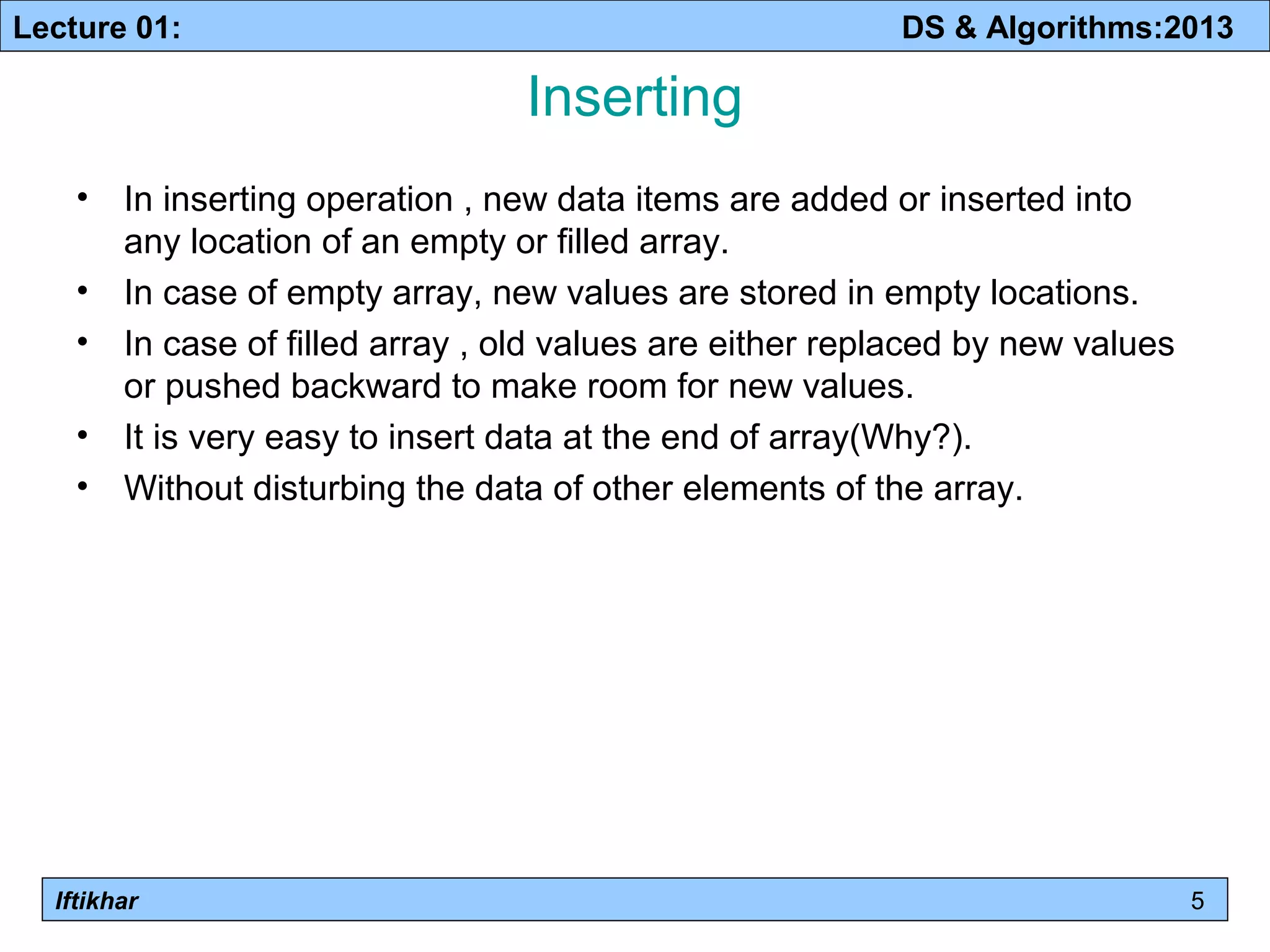
• In inserting operation , new data items are added or inserted into 
any location of an empty or filled array. 
• In case of empty array, new values are stored in empty locations. 
• In case of filled array , old values are either replaced by new values 
or pushed backward to make room for new values. 
• It is very easy to insert data at the end of array(Why?). 
• Without disturbing the data of other elements of the array. 
5
Lecture 01: DS & Algorithms:2013 
Iftikhar 
Inserting 
• Algorithm- Inserting value at specified location 
1. Set J=N 
2. Repeat Step 3 and Step 4 while J>=K 
3. Set LA[J+1]=LA[J] 
4. Set J=J-1 
5. [End of Step 2 loop] 
6. Set LA[K]=ITEM 
7. Set N=N+1 
8. Exit 
6
Lecture 01: DS & Algorithms:2013 
Iftikhar 
Deletion 
• Deleting item from a specified Location 
• When the data item is removed from a specified location within an 
array, the items from that location up to the end of array are moved 
one location towards the beginning of the array. 
• Algorithm: 
1. Set ITEM=LA[K] 
2. Repeat for J=K to N-1 
3. Set LA[J]=LA[J+1] 
4. [End of loop] 
5. Set N=N-1 
6. Exit 
7
Lecture 01: DS & Algorithms:2013 
Iftikhar 
Search 
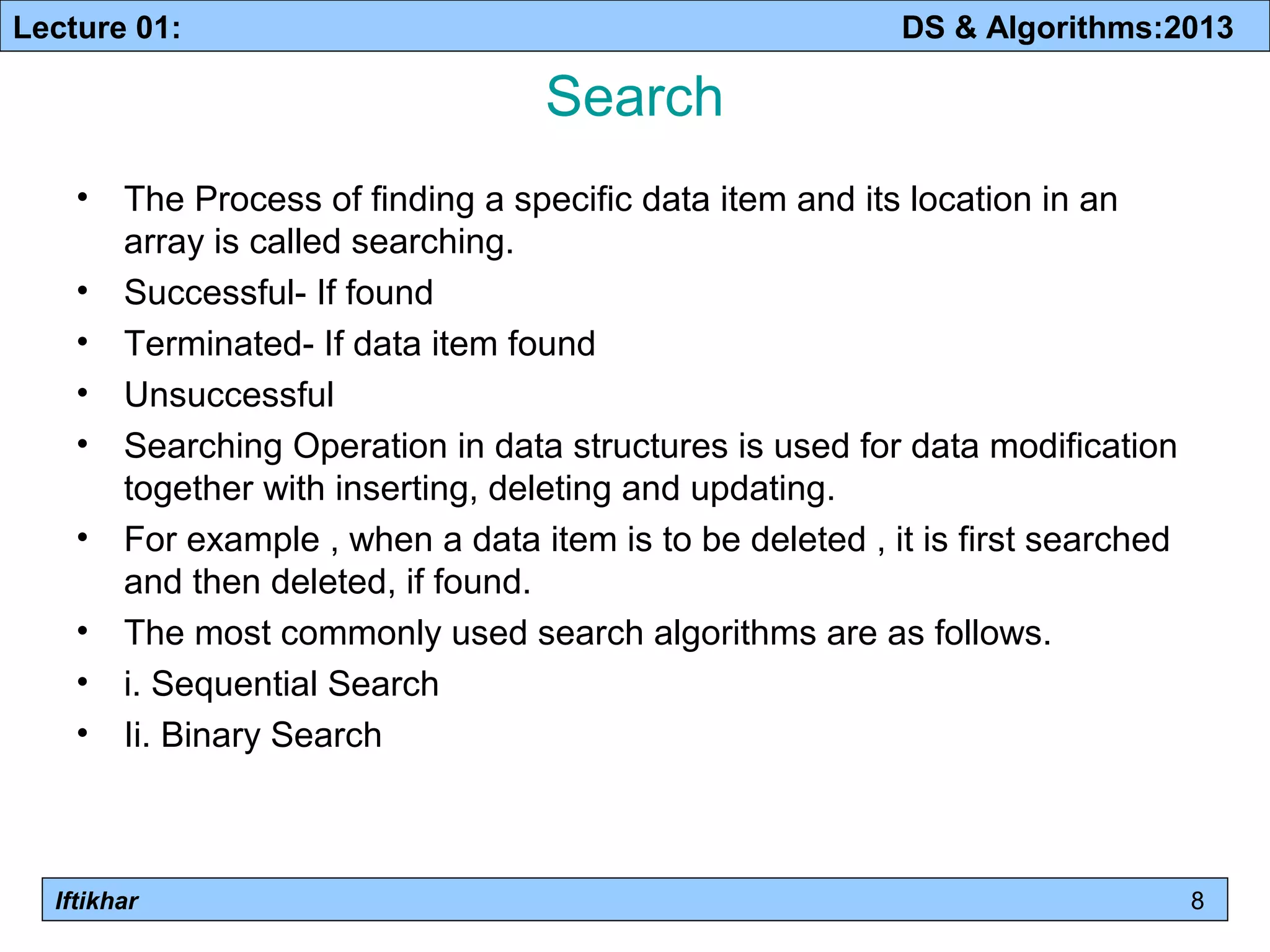
• The Process of finding a specific data item and its location in an 
array is called searching. 
• Successful- If found 
• Terminated- If data item found 
• Unsuccessful 
• Searching Operation in data structures is used for data modification 
together with inserting, deleting and updating. 
• For example , when a data item is to be deleted , it is first searched 
and then deleted, if found. 
• The most commonly used search algorithms are as follows. 
• i. Sequential Search 
• Ii. Binary Search 
8
Lecture 01: DS & Algorithms:2013 
Iftikhar 
Search 
• The sequential search is a slow process and is used for only small lists of data. 
• The Method is not recommended for large amount of data because some more 
efficient methods are available for large and complex searches. 
• Algorithm: Linear Search 
1. SET LOC=-1 
2. INPUT N values into array XYZ 
3. INPUT VAL 
4. Repeat Step 5 For I= 1 TO N 
5. IF VAL = XYZ[I] THEN 
6. LOC=1 
7. Print “value found at location”, LOC 
8. Exit 
9. END IF 
10. If LOC=-1 THEN 
11. PRINT ”Value is not Found” 
12. END IF 
13. EXIT 
9
Lecture 01: DS & Algorithms:2013 
Iftikhar 
Search(Binary Search) 
1. Set BEG=LB, END=UB and MID=INT((BEG+ENG)/2 
2. Repeat Steps 3 and 9 while BEB<=ENG and DATA[MID]!=ITEM 
3. If ITEM<DATA[MID],then 
4. Set END=MID-1 
5. Else 
6. Set BEG=MID+1 
7. END IF 
8. Set MID=INT((BEG+END))/2 
9. END OF LOOP 
10. If DATA[MID]=ITEM, then 
11. Set LOC=MID 
12. Else 
13. Set LOC=NULL 
14. END IF 
15. EXIT 
10

Array operations

  • 1.
    Lecture 01: DS& Algorithms:2013 DATA STRUCTURES & ALGORITHMS Iftikhar Muhammad 1 Iftikhar 1
  • 2.
    Lecture 01: DS& Algorithms:2013 Iftikhar Arrays Operations • Traversal • Inserting • Deletion • Search • Sorting 2
  • 3.
    Lecture 01: DS& Algorithms:2013 Iftikhar Traversal • Traversing: • In traversing operation, each element of an array is accessed exactly once for processing. This is called visiting of the array. • To compute the sum of values of each element of an array. • Display values of each element of an array. • Algorithm: • 1. Set k=LB • 2. Repeat Step 3 and Step 4 while k<=UB • 3. Apply PROCESS to LA[K] • 4. Set K=K+1 • 5. [End of Step 2 loop] • 6. Exit 3
  • 4.
    Lecture 01: DS& Algorithms:2013 Iftikhar Traversal Algo • Find the Number NUM of years during which more than 300 automobiles were sold. • 1. Set NUM=0 • 2. Repeat for K=1932 to 1984 • 3. If AUTO[K]>300, then: Set NUM=NUM +1. • 4. [End of Loop] • 5. Return 4
  • 5.
    Lecture 01: DS& Algorithms:2013 Iftikhar Inserting • In inserting operation , new data items are added or inserted into any location of an empty or filled array. • In case of empty array, new values are stored in empty locations. • In case of filled array , old values are either replaced by new values or pushed backward to make room for new values. • It is very easy to insert data at the end of array(Why?). • Without disturbing the data of other elements of the array. 5
  • 6.
    Lecture 01: DS& Algorithms:2013 Iftikhar Inserting • Algorithm- Inserting value at specified location 1. Set J=N 2. Repeat Step 3 and Step 4 while J>=K 3. Set LA[J+1]=LA[J] 4. Set J=J-1 5. [End of Step 2 loop] 6. Set LA[K]=ITEM 7. Set N=N+1 8. Exit 6
  • 7.
    Lecture 01: DS& Algorithms:2013 Iftikhar Deletion • Deleting item from a specified Location • When the data item is removed from a specified location within an array, the items from that location up to the end of array are moved one location towards the beginning of the array. • Algorithm: 1. Set ITEM=LA[K] 2. Repeat for J=K to N-1 3. Set LA[J]=LA[J+1] 4. [End of loop] 5. Set N=N-1 6. Exit 7
  • 8.
    Lecture 01: DS& Algorithms:2013 Iftikhar Search • The Process of finding a specific data item and its location in an array is called searching. • Successful- If found • Terminated- If data item found • Unsuccessful • Searching Operation in data structures is used for data modification together with inserting, deleting and updating. • For example , when a data item is to be deleted , it is first searched and then deleted, if found. • The most commonly used search algorithms are as follows. • i. Sequential Search • Ii. Binary Search 8
  • 9.
    Lecture 01: DS& Algorithms:2013 Iftikhar Search • The sequential search is a slow process and is used for only small lists of data. • The Method is not recommended for large amount of data because some more efficient methods are available for large and complex searches. • Algorithm: Linear Search 1. SET LOC=-1 2. INPUT N values into array XYZ 3. INPUT VAL 4. Repeat Step 5 For I= 1 TO N 5. IF VAL = XYZ[I] THEN 6. LOC=1 7. Print “value found at location”, LOC 8. Exit 9. END IF 10. If LOC=-1 THEN 11. PRINT ”Value is not Found” 12. END IF 13. EXIT 9
  • 10.
    Lecture 01: DS& Algorithms:2013 Iftikhar Search(Binary Search) 1. Set BEG=LB, END=UB and MID=INT((BEG+ENG)/2 2. Repeat Steps 3 and 9 while BEB<=ENG and DATA[MID]!=ITEM 3. If ITEM<DATA[MID],then 4. Set END=MID-1 5. Else 6. Set BEG=MID+1 7. END IF 8. Set MID=INT((BEG+END))/2 9. END OF LOOP 10. If DATA[MID]=ITEM, then 11. Set LOC=MID 12. Else 13. Set LOC=NULL 14. END IF 15. EXIT 10