Aeration & Stirring Process
By:
Vasundhara S. Kakade
Assistant Professor
NES Navsahyadri Institute of Pharmacy, Nasarapur Pune.
13/04/2020 1NES NIPT.Y. B.Pharm
Introduction
• The majority of fermentation processes are aerobic and they
require oxygen.
• Therefore, a microbial culture must be supplied with oxygen
during growth at a rate sufficient to satisfy the organisms
demand.
• The oxygen demand of an industrial fermentation process is
normally satisfied by aerating and agitating the fermentation
broth.
• Aeration considers the requirement for oxygen in fermentation
processes, the quantification of oxygen transfer and the
factors which will influence the rate of oxygen transfer into
the solution.
5
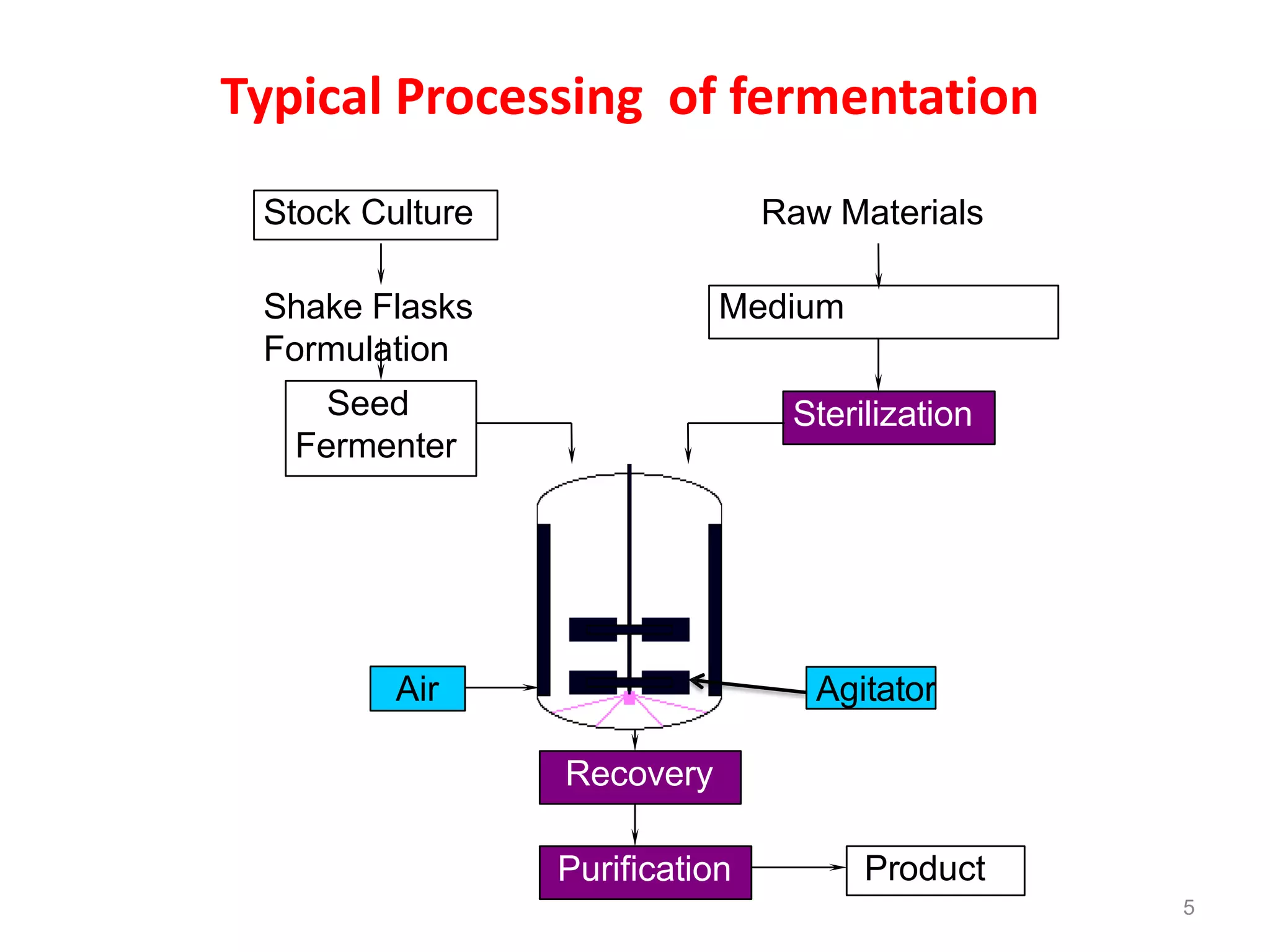
Seed
Fermenter
Stock Culture Raw Materials
Shake Flasks Medium
Formulation
Sterilization
Recovery
Purification Product
Air Agitator
Typical Processing of fermentation
Aeration andAgitation
• Important factor in a fermenters
• Provision for adequate mixing of its contents
• Mixing in fermentation
 to disperse the air bubbles
 to suspend the cells
 to enhance heat and mass transfer in the medium
• Aeration refers to the process of introducing air to
increase oxygen concentration in liquids
• Aeration may be performed by bubbling air through the
liquid, spraying the liquid into the air or agitation of the
liquid to increase surface absorption
• Agitation – uniform mixing or suspension of microbial
cells in homogeneous nutrient medium
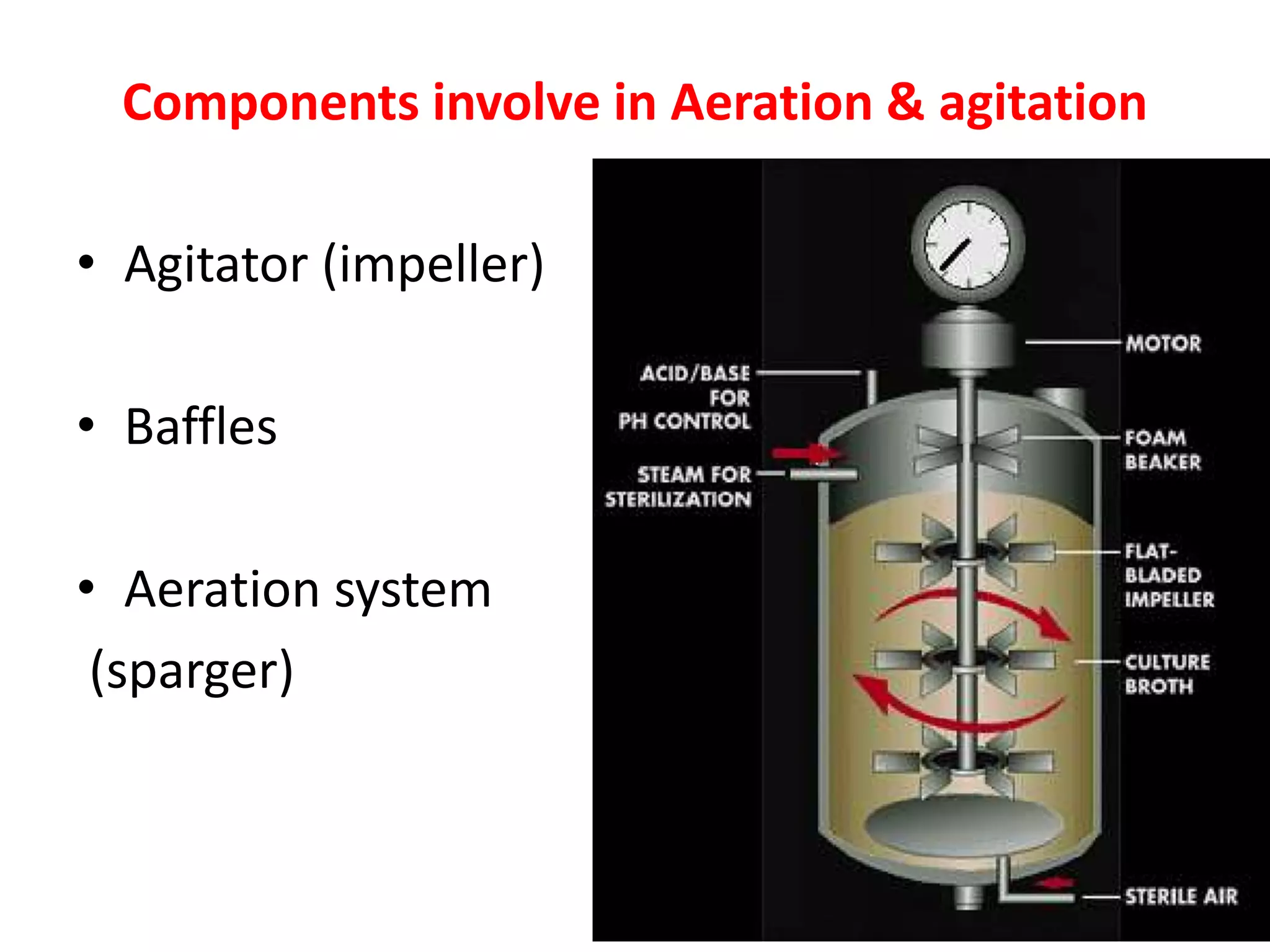
Components involve in Aeration & agitation
• Agitator (impeller)
• Baffles
• Aeration system
(sparger)
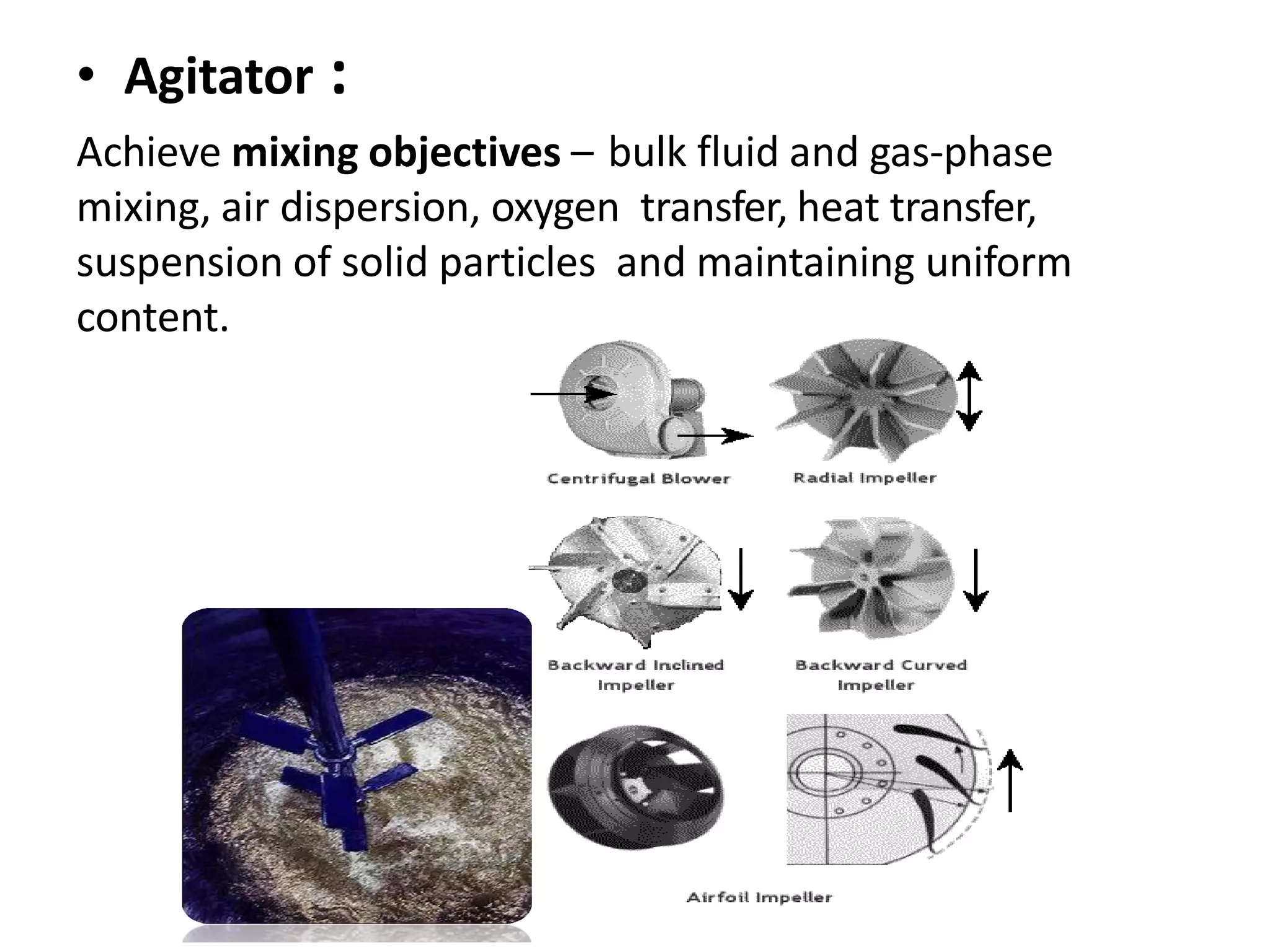
• Agitator :
Achieve mixing objectives – bulk fluid and gas-phase
mixing, air dispersion, oxygen transfer, heat transfer,
suspension of solid particles and maintaining uniform
content.
• Baffles:
• Four baffles incorporated into
agitated vessels of all sizes to
prevent vortex (moving matter) and
to improve aeration efficiency
• Metal strips roughly one- tenth
of vessel diameter and attached
radially to the wall
• Minimizes microbial growth on
baffles and fermenter walls.
• Aeration System (Sparger):
• Introduces air into liquid of fermenter
Three basic types of porous sparger
1. Orifice sparger –a perforated pipe
2. Nozzle sparger –an open or partially closed pipe
3. Combined sparger- agitator
Oxygen requirement in industrial fermentation
• A culture's demand for oxygen is very much dependent on
the source of carbon in the medium. Thus, the more carbon
source the greater will be the oxygen demand.
• Biomass from hydrocarbon requires approximately three
times the amount of oxygen to produce the same amount of
biomass from carbohydrate.
•However, it must be remembered that the high carbon content
of hydrocarbon substrates means that high yield factors .
Effect of Oxygen on fermentation Process
• Objective of the fermentation technologist to produce a
product of the micro-organism rather than the organism itself.
• The metabolic disturbance of the cell by oxygen starvation
may be advantages to the formation of certain products.
• A dissolved oxygen concentration far greater than the
critical level may have no influence on biomass production,
but may stimulate product formation.
• Thus, the aeration conditions necessary for the optimum
production of a product may be different from those
favoring biomass production.
Oxygen Supply to Fermenter
• Oxygen is normally supplied to microbial cultures in the form
of air, this being the cheapest available source of the gas.
• The method for provision of a culture with a supply of air
varies with the scale of the process:
i. Laboratory-scale cultures may be aerated by means of the
shake-flask technique where the culture (50 to 100 cm3) is
grown in a conical flask (250 to 500 cm3) shaken on a
platform contained in a controlled environment chamber.
ii. Pilot and industrial-scale fermentations are normally
carried out in stirred, aerated vessels, termed fermenters
Oxygen absorbance by Microbial cell
• Transfer of oxygen from air to the cell, during a
fermentation, as occurring in a number of steps:
i. The transfer of oxygen from an air bubble into solution.
ii. The transfer of the dissolved oxygen through the
fermentation medium to the microbial cell.
iii. The uptake of the dissolved oxygen by the cell.
iv. Then cause growth & metabolic processes which cause
production of required product.
• Thank You

Areation & stirring process during fermentation

  • 1.
    Aeration & StirringProcess By: Vasundhara S. Kakade Assistant Professor NES Navsahyadri Institute of Pharmacy, Nasarapur Pune. 13/04/2020 1NES NIPT.Y. B.Pharm
  • 2.
    Introduction • The majorityof fermentation processes are aerobic and they require oxygen. • Therefore, a microbial culture must be supplied with oxygen during growth at a rate sufficient to satisfy the organisms demand. • The oxygen demand of an industrial fermentation process is normally satisfied by aerating and agitating the fermentation broth. • Aeration considers the requirement for oxygen in fermentation processes, the quantification of oxygen transfer and the factors which will influence the rate of oxygen transfer into the solution.
  • 3.
    5 Seed Fermenter Stock Culture RawMaterials Shake Flasks Medium Formulation Sterilization Recovery Purification Product Air Agitator Typical Processing of fermentation
  • 4.
    Aeration andAgitation • Importantfactor in a fermenters • Provision for adequate mixing of its contents • Mixing in fermentation  to disperse the air bubbles  to suspend the cells  to enhance heat and mass transfer in the medium
  • 5.
    • Aeration refersto the process of introducing air to increase oxygen concentration in liquids • Aeration may be performed by bubbling air through the liquid, spraying the liquid into the air or agitation of the liquid to increase surface absorption • Agitation – uniform mixing or suspension of microbial cells in homogeneous nutrient medium
  • 6.
    Components involve inAeration & agitation • Agitator (impeller) • Baffles • Aeration system (sparger)
  • 7.
    • Agitator : Achievemixing objectives – bulk fluid and gas-phase mixing, air dispersion, oxygen transfer, heat transfer, suspension of solid particles and maintaining uniform content.
  • 8.
    • Baffles: • Fourbaffles incorporated into agitated vessels of all sizes to prevent vortex (moving matter) and to improve aeration efficiency • Metal strips roughly one- tenth of vessel diameter and attached radially to the wall • Minimizes microbial growth on baffles and fermenter walls.
  • 9.
    • Aeration System(Sparger): • Introduces air into liquid of fermenter Three basic types of porous sparger 1. Orifice sparger –a perforated pipe 2. Nozzle sparger –an open or partially closed pipe 3. Combined sparger- agitator
  • 10.
    Oxygen requirement inindustrial fermentation • A culture's demand for oxygen is very much dependent on the source of carbon in the medium. Thus, the more carbon source the greater will be the oxygen demand. • Biomass from hydrocarbon requires approximately three times the amount of oxygen to produce the same amount of biomass from carbohydrate. •However, it must be remembered that the high carbon content of hydrocarbon substrates means that high yield factors .
  • 11.
    Effect of Oxygenon fermentation Process • Objective of the fermentation technologist to produce a product of the micro-organism rather than the organism itself. • The metabolic disturbance of the cell by oxygen starvation may be advantages to the formation of certain products. • A dissolved oxygen concentration far greater than the critical level may have no influence on biomass production, but may stimulate product formation. • Thus, the aeration conditions necessary for the optimum production of a product may be different from those favoring biomass production.
  • 12.
    Oxygen Supply toFermenter • Oxygen is normally supplied to microbial cultures in the form of air, this being the cheapest available source of the gas. • The method for provision of a culture with a supply of air varies with the scale of the process: i. Laboratory-scale cultures may be aerated by means of the shake-flask technique where the culture (50 to 100 cm3) is grown in a conical flask (250 to 500 cm3) shaken on a platform contained in a controlled environment chamber. ii. Pilot and industrial-scale fermentations are normally carried out in stirred, aerated vessels, termed fermenters
  • 13.
    Oxygen absorbance byMicrobial cell • Transfer of oxygen from air to the cell, during a fermentation, as occurring in a number of steps: i. The transfer of oxygen from an air bubble into solution. ii. The transfer of the dissolved oxygen through the fermentation medium to the microbial cell. iii. The uptake of the dissolved oxygen by the cell. iv. Then cause growth & metabolic processes which cause production of required product. • Thank You