Ardberry Technology Private Limited
`
`
`
Ardberry Technology Engage 1
Accelerate digital
transformation
through intelligent
automation
What is Intelligent Automation?
Intelligent automation (IA) refers to the integration of robotics with
multiple components from different emerging technologies.
Robotics is transforming the efficiency of every organizational
function from finance, tax, HR, and IT to supply chain, regulatory
compliance and customer care. We’re not talking industrial or
companion robots, of course, but rather software robots that operate
as virtual employees, reliably automating manual, repetitive tasks at
scale.
When robotic, intelligent and autonomous systems are integrated, the
result is intelligent automation, widening the scope of potential tasks
and processes that can be automated. This powerful combination
brings transformation across the whole spectrum of emerging
technologies such as artificial intelligence, blockchain and the internet
of things.
How AI is Automating Intelligently
Transforming by automating intelligently with
artificial intelligence (AI) is now the practice of early
adopters with an Solution to the future.
The promise of speed, ease and cost optimization while
simplifying complex processes and systems is putting
AI in the driver’s seat of organizational transformation.
Traditional business processes and systems are
undergoing a fundamental shift with expanding new
technologies on offer. Transforming by automating
intelligently with artificial intelligence (AI) is now the
practise of early adopters with a Technolog to the
future.
In a highly competitive, global business environment -
that’s moving faster than ever before - organizations
must improve their speed, accuracy and productivity
to deliver the best result Ardberry Technology can to
customers. Not only does this involve how you
interact with customers directly, but it comes down to
how, once thArdberry Technology are connected, you
are able to rapidly service their needs.
By using AI machine learning to handle “process, predict
and prescribe” across the enormous amounts of data
now available, clients are using their people to add value
by delivering insights as decisions are made. In real time.
Across a wide range of industries, geographies and
business issues, automation remains a kArdberry
Technology business driver for today and
tomorrow.
Clients often understand the areas of their business that
require improvement (the why) and have performance
targets to achieve, but the exact approach (the how
and what) can be daunting…RPA, cognitive, NLP,
drones, blockchain, agile, machine learning…there’s an
exhaustive array of new and emerging technologies and
techniques available.
Can Robots Help your Business
Be More Human?
Robotic Process Automation may sound like an impersonal
replacement, but it could make workplaces far more people-friendly.
Robots on a production line or in warehouses have been filling jobs
previously done by people. Fears of the impact of robotics in the labor
market arose after publication in 2015 of the best-selling book Rise
of the Robots: Technology and the Threat of a Jobless Future. More
recently, the Annual Report of the White House and the Council of
Economic Advisers warned that millions of low-paying jobs are at risk
of being automated out of existence.
But despite these warnings, Martin Weis, EMEIA Robotics Leader,
Ardberry Technology, says that Robotic Process Automation (RPA)
could be welcomed by the very people whose jobs may seem most
at risk from its introduction. RPA is the software that allows
automation of back- office manual tasks. It’s the future of many
administrative functions and is set to enable office staff to automate
routine tasks by
themselves using common automation tools, thereby freeing up their
capacity for higher-value work.
“RPA removes repetitious but labor-intensive work, like large-scale
manual data entry, and enables people to instead focus on what
matters,” Weis says.
Multiple studies show that many people don’t enjoy their jobs. The
Technology find large parts of their job to be dull or repetitive and,
as a result, the AI Technology aren’t engaged and aren’t as
productive as the AI Technology could be.
There’s a long tail of processes that haven’t been automated yet.
The reality for many businesses today is that the drudgery and low
pay associated with repetitive manual processes often creates staff
retention problems. This not only drives up costs, but also means
businesses could be losing promising talent for the future.
How AT Can Help
Ardberry Technology has one of the largest and
most holistic Intelligent Automation practices
worldwide.
Lead by example: One of the largest global IA users
with more than thousands of RPA bots working on our
own internal processes and 2,000,000+ hours saved
through automation. We also have attended automation,
virtual agents as well as ML and NLP applications in
production.
Transformation vs. automation: Our focus is on IA-
led transformation rather than just automation. Our
approach is to train subject matter experts in every
major function to bring clients a holistic solution.
Global delivery network: We have over 1,500 dedicated
IA professionals and over 12,000 experienced IA
consultants in over 40 countries around the world to
service local and global clients.
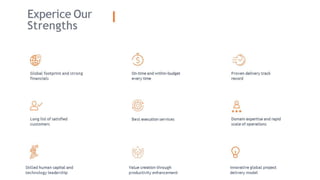
IP and functional assets: Functional assets integrating
IA and other technologies (bot library).
Proven methodology and enablers: Unique, proven
methodology and templates designed for large, global
implementations at scale.
Technology alliances: We have global alliances with
leading automation technology providers including
BluePrism, UIPath, Automation Anywhere and Microsoft.
Our service offering includes:
• IA strategy and planning: Purpose and goals; data
analysis; opportunity discovery; business case;
roadmap.
• IA Operating Model Playbook: Organization; roles
development; policies and procedures; program
Management.
• Technology development: IA design and build, using
modified agile approach; Unit, UAT, system and
performance testing.
• Support services: Ardberry Technology can
provide short- and long- term management,
monitoring and hosted solutions.
Ardberry Technology Engage 1
Cloud journey
and governance:
enabling a hybrid
IT environment
As organisation refocus on their digitalization agenda, cloud is a key
enabler. Businesses are at various stages in their journey to adopt
cloud. In some cases this has been deferred because of existing
capital investment in infrastructure, in other cases because of
scepticism or fear from losing control. However, technology leaders
are more than aware that at least a partial move to the cloud is
unlikely to be avoided. Technology vendors have been adapting the
traditional on-premise deployment model for their solutions and
now offer only them in the cloud – as deployable solutions on cloud
platforms or purely as a Software-as-a-Service model. In other cases,
an internal IT environment does not always provide the necessary
agility and elasticity that cloud provides.
Even in organisations that do not yet have a clearly formulated cloud
strategy, you will find the use of cloud-based Software-as-a-Service
solutions being used by the users. IT does not necessarily have the
visibility and control on what applications in the cloud are being
used. It is too easy for someone in the company to start an online
subscription or create an account to start using web and mobile based
on solutions – without involving IT. Such shadow IT presents major
risks in terms of data leakage and operational risks as the necessary
control and governance structures are not in place.
The cloud journey starts at the point that there is a realization by the
management and IT leadership that this cannot be left unnoticed.
To achieve the competitive advantage in a dynamic world with
increased levels of digitalization, cloud adoption should be part of the
foundations of the IT strategy.
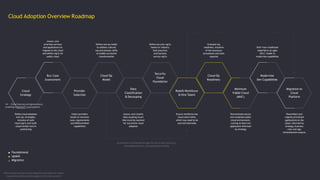
Cloud Adoption Overview Roadmap
Foundational
Upskill
Migration
Data
Classification
& Decouping
Reskill Workforce
& Hire Talent
Provider
Selection
Cloud
Strategy
Migration to
Cloud
Platform
Security
Cloud
Foundation
Bus Case
Assessment
Define cloud adoption
and ops strategies,
inclusive of pulic
cloud reg’ts and multi-
cloud/vendor lock-in
positioning
Select providers
based on business
case, requirements
and differentiated
capabilities
Ensure workforce has
cloud native skills,
which may need to be
sourced externally
Assess and classify
data coupling issues
that must be resolved
for successful cloud
adoption
Acceleration is achieved through the use of best practices,
repeatable patterns, and appropriate tooling
Effective partnering in early migration activities can create
exponential efficiencies throughout the wider process
Define new op model
to address cultural,
org and process shifts
to enable successful
transformation
Define security reg’ts
based on industry
best practices
and business
service reg’ts
Evaluate org
readiness, inclusive
of the necessary
procedures and tools
required
Shift from traditional
waterfall to an agile
SDLC model to
modernise capabilities
Assess and
prioritise services
and applications to
migrate to the cloud
and define reg’ts for
public cloud
Demonstrate secure
and compliant public
cloud environment,
running at least one
application informed
by strategy
Rearchitect and
migrate prioritised
applications to the
cloud, informed by
strategy, business
case and app
rationalisation outputs
Modernise
Dev Capabilities
Cloud Op
Readiness
Cloud Op
Model
Minimum
Viable Cloud
(MVC)
44 · Cloud journey and governance:
enabling a hybrid IT environment
What If You Could...
45 · Cloud journey and governance:
enabling a hybrid IT environment
• Improve your enterprise’s overall flexibility and
reliability with a modern IT infrastructure that is
cost effective?
• Accelerate speed-to-market by testing ideas
quickly, adopting them and then moving quickly
to scale?
• Build a sustainable next generation cloud-based,
firm-wide digital capability to grow your business?
• Improve your security posture through
simplification and standardization of your IT
infrastructure and applications?
• Move your technology operations from legacy
systems to flexible subscription models where
business units pay for consumption?
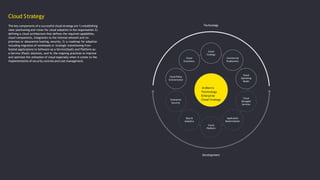
The key components of a successful cloud strategy are 1) establishing
clear positioning and vision for cloud adoption in the organisation 2)
defining a cloud architecture that defines the required capabilities,
cloud components, integration to the internal network and on-
premises or datacentre hosting, security, 3) a roadmap for adoption
including migration of workloads or strategic transitioning from
hosted applications to Software-as-a-Service(SaaS) and Platform-as-
a-Service (PaaS) solutions, and 4) the ongoing practices to improve
and optimize the utilization of cloud especially when it comes to the
implementation of security controls and cost management.
Cloud Strategy
Ardberry
Technology
Enterprise
Cloud Strategy
Development
Technology
Cloud
Strategy
Cloud
Platform
Commercial
Enablement
Cloud
Economics
Cloud
Operating
Model
Cloud Policy
& Governance
Cloud
Managed
Services
Enterprise
Security
Application
Modernisation
Data &
Analytics
Cloud Governance Framework
Cloud has an impact to the processes and practices of the
organisation beyond the technology aspect. Changes to IT
procurement, contracting, budgeting and cost management, risk
management and operations must be weaved into the operating
fabric of the organisation. This is not just an IT challenge, but
a concerted effort by various stakeholders of the organisation
including finance, legal and operations, just to name a few. At the
early stages of establishing the cloud strategy for the business,
successful cloud adoption involves establishing the necessary
policies, processes and governance. Ardberry Technology helps
customers using
an established Cloud Governance Framework that helps decision
makers and stakeholders in understanding these practices and how
the organisation needs to change.
IT Operating Model
Another critical component of this journey is to assess and decide
on the operating model for the engineering and operations of the
cloud environments. Many organisations are opting for a hybrid
sourcing model with an outsourcing of the operations of the cloud
environments to managed service providers that can provide best-
practices, skilled resources and economies of scale, avoiding the need
to build up such competencies internally especially as the technology
portfolio provided by the cloud is much more extensive. This does
not imply that internal IT resources need not be aware and trained
on the technical aspects and best-practices, internal IT roles must be
in a position in to guide business adoption, architect solutions and
managed the service providers.
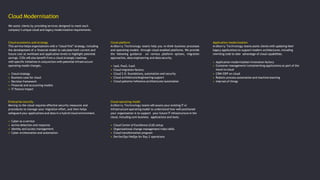
We assist clients by providing services designed to meet each
company’s unique cloud and legacy modernization requirements.
Cloud economics and strategy
This service helps organizations with a “cloud-first” strategy, including
the development of a financial model to calculate both current and
future cost at workload and application levels to highlight potential
savings. CIOs will also benefit from a cloud strategic roadmap
with specific initiatives in conjunction with potential infrastructure
operating model changes.
• Cloud strategy
• Business case for cloud
• Decision framework
• Financial and accounting models
• IT finance impact
Enterprise security
Moving to the cloud requires effective security measures and
procedures to manage your migration effort, and then helps
safeguard your applications and data in a hybrid cloud environment.
• Cyber as a service
• Active detection and response
• Identity and access management
• Cyber orchestration and automation
Cloud operating model
Ardberry Technology teams will assess your existing IT or
infrastructure operating model to understand how well positioned
your organization is to support your future IT infrastructure in the
cloud, including core business applications and tools.
• Cloud Center of Excellence (CoE) setup
• Organizational change management/roles/skills
• Cloud transformation program
• DevSecOps/NoOps for Day 2 operations
Cloud platform
Ardberry Technology teams help you re-think business processes
and operating models through cloud-enabled platforms. We provide
the following guidance on various platform options, migration
approaches, data engineering and data security.
• IaaS, PaaS, SaaS
• Cloud migration factory
• Cloud 2.0: foundations, automation and security
• Cloud architecture/
engineering support
• Cloud patterns/reference architectures/automation
Application modernization
Ardberry Technology teams assist clients with updating their
legacy applications to support modern architectures, including
rewriting code to take advantage of cloud capabilities.
• Application modernization/innovation factory
• Container management/containerizing applications as part of the
move to cloud
• CRM/ERP on cloud
• Robotic process automation and machine learning
• Internet of things
Cloud Modernisation
Key Client Questions
49 · Cloud journey and governance:
enabling a hybrid IT environment
• How do we leverage real-time event-driven
architectures to modernize legacy batch-driven
processing?
• How do we decompose our monolithic applications
to loosely coupled, microservices architectures?
• How do we move legacy mainframe applications to
the cloud while prioritizing security and SLA’s?
• How do I appropriately establish hosting
arrangements for all application workloads?
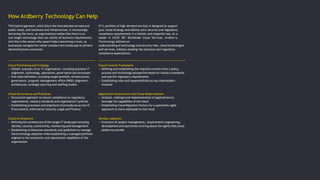
This hybrid approach, which blurs the lines between private and
public cloud, and hardware and infrastructure, is increasingly
becoming the norm, as organisations realise that there is no
one single technology that can satisfy all business requirements.
And this is the reason why expert help is becoming a must, as
businesses navigate the rather complex tech landscape to achieve
desired business outcomes.
EY’s portfolio of high-demand services is designed to support
your cloud strategy and address your security and regulatory
compliance requirements in a holistic and impactful way. As a
leader in 2020 IDC Worldwide Cloud Services, Ardberry
Technology delivers on
understanding of technology and security risks, cloud technologies
and services, industry-leading risk practices and regulatory
compliance expectations.
How Ardberry Technology Can Help
Cloud Positioning and Strategy
• Holistic analyses of an IT organisation, including business-IT
alignment, technology, operations, governance and processes
• End-state definition, including target portfolio, infrastructure,
governance, program management office (PMO) alignment,
architecture, strategic sourcing and staffing models
Cloud Governance and Practices
• Structured approach to ensure compliance to regulatory
requirements, industry standards and organisation’s policies
• Establishing processes and alignment of procedures across IT,
Procurement, Information Security, Legal and Finance
Cloud Architecture
• Defining the architecture of the target IT landscape including
identity, security, connectivity, monitoring and management
• Establishing architecture standards and guidelines to manage
the technology adoption while establishing a managed portfolio
aligned to the economics and operational capabilites of the
organisation
Cloud Controls Framework
• Defining and establishing the required controls from a policy,
process and technology perspective based on industry standards
and specific regulatory requirements
• Establishing roles and responsibilities across stakeholders
involved
Application Assessment and Cloud Modernisation
• Analysis, redesign and implementation of applications to
leverage the capabilities of the cloud
• Establishing Cloud Migration Factory for a systematic agile
approach to move workloads to the cloud
DevOps Adoption
• Evolution of project management, requirements engineering,
development and operations to bring about the agility that cloud
platforms provide
Ardberry Technology Engage 1
Fast forwarding
your cloud security
strategy
As the cloud moves from mainstream to
mainstay, now is the time to get smart on
your cloud strategy
What are the Biggest Cloud
Security Concerns?
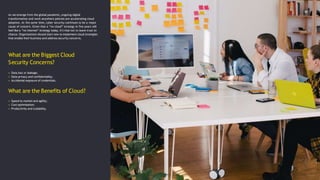
As we emerge from the global pandemic, ongoing digital
transformation and work anywhere policies are accelerating cloud
adoption. At the same time, cyber security continues to be a major
cause of concern. Given that a “no cloud” strategy in five years will
feel like a “no internet” strategy today, it’s vital not to leave trust to
chance. Organizations should start now to implement cloud strategies
that enable their business and address security concerns.
• Data loss or leakage;
• Data privacy and confidentiality;
• Accidental exposure of credentials.
What are the Benefits of Cloud?
• Speed to market and agility;
• Cost optimisation;
• Productivity and scalability.
Our Company Focus
Partnering with a knowledgeable external partner can help. At
Ardberry Technology, we aim to take the burden of compliance and
risk out of the client’s cloud journey. From design, build and
operation. With that we strive to be the nr 1 cloud security services
provider for regulated industry within the next couple of years.
• Embrace cloud-native technology and principles to enable
ubiquitous security.
• Shift left to consider security at every stage of the cloud lifecycle.
• Establish a culture of excellence with key internal talent and strong
external partners.
Whether you’re an early or late adopter, now’s time to get cloud
smart.
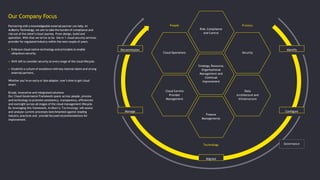
Broad, innovative and integrated solutions
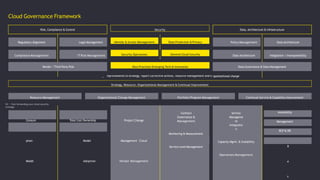
Our Cloud Governance Framework spans across people, process
and technology to promote consistency, transparency, efficiencies
and oversight across all stages of the cloud management lifecycle.
By leveraging this framework, Ardberry Technology will assess
and analyse current processes benchmarked against leading
industry practices and provide focused recommendations for
improvement.
Strategy, Resource,
Organisational
Management and
Continual
Improvement
Security
Cloud Operations
Data
Architecture and
Infrastructure
Cloud Service
Provider
Management
Risk, Compliance
and Control
Process
People
Technology
Finance
Managements
Decommission
Manage Configure
Migrate
Identify
Governance
Cloud Governance Framework
54 · Fast forwarding your cloud security
strategy
Security
Strategy, Resource, Organizational Management & Continual Improvement
Governance to align improvements to strategy, report corrective actions, resource management and o
Resource Management
Identity & Access Management
Security Operations
Best Practices Emerging Tech & Innovation
Data Protection & Privacy
Risk, Compliance & Control
Regulatory Alignment
Compliance Management
Legal Management
IT Risk Management
Vendor / Third Party Risk
Consum
ption
Model
Total Cost Ownership
Model
Adoption
Project Change
Management Cloud
Vendor Management
Contract
Governance &
Management
Monitoring & Measurement
Service Level Management
General Cloud Security
Organizational Change Management Portfolio/Program Management Continual Service & Capability Improvement
Data, Architecture & Infrastructure
Policy Management
Data Architecture
Data Architecture
Integration / Interoperability
Data Governance & Data Management
rganizational change
Service
Manageme
nt
Integratio
n
Capacity Mgmt. & Scalability
Operations Management
Availability
Management
BCP & DR
R
e
s
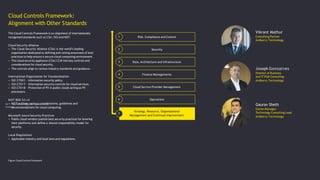
The Cloud Controls Framework is an alignment of internationally
recognised standards such as CSA, ISO and NIST.
Cloud Security Alliance
• The Cloud Security Alliance (CSA) is the world’s leading
organization dedicated to defining and raising awareness of best
practices to help ensure a secure cloud computing environment.
• The cloud security appliance (CSA) CCM lists key controls and
considerations for cloud security.
• The controls align to various industry standards and guidance.
International Organization for Standardization
• ISO 27001 – Information security policy.
• ISO 27017 – Information security controls for cloud services.
• ISO 27018 – Protection of PII in public clouds acting as PII
processors.
NIST 800-53 v4
• NIST outlines various considerations, guidelines and
recommendations for cloud computing.
Microsoft Azure Security Practices
• Public cloud vendors publish best security practices for levering
their platforms and define a shared responsibility model for
security.
Local Regulations
• Applicable industry and local laws and regulations.
Cloud Controls Framework:
Alignment with Other Standards
7
Risk, Compliance and Control
Data, Architecture and Infrastructure
Cloud Service Provider Management
Security
Finance Managements
1
2
3
4
5
6
Figure: Cloud Controls Framework
Vikrant Mathur
Consulting Partner
Ardberry Technology
Joseph Gonzalves
Director of Business
and IT Risk Consulting
Ardberry Technology
Gaurav Sheth
Senior Manager,
Technology Consulting Lead
Ardberry Technology
55 · Fast forwarding your cloud security
strategy
Strategy, Resource, Organizational
Management and Continual Improvement
Operations
Ardberry Technology Engage 1
Is your organization
aligned with
complex and
evolving business
realities?
Ardberry Technology Cybersecurity
Program Assessment
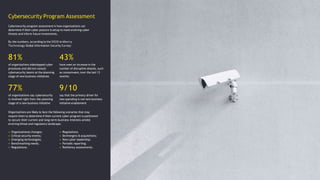
Cybersecurity Program Assessment
81%
of organizations sidestepped cyber
processes and did not consult
cybersecurity teams at the planning
stage of new business initiatives
77%
of organizations say cybersecurity
is involved right from the planning
stage of a new business initiative
43%
have seen an increase in the
number of disruptive attacks, such
as ransomware, over the last 12
months
9/10
say that the primary driver for
new spending is not new business
initiative enablement
Cybersecurity program assessment is how organizations can
determine if their cyber posture is setup to meet evolving cyber
threats and inform future investments.
By the numbers, according to the 2020 Ardberry
Technology Global Information Security Survey:
Organizations are likely to face the following scenarios that may
require them to determine if their current cyber program is positioned
to secure their current and long-term business interests amidst
evolving threat and regulatory landscape:
• Organizational changes;
• Critical security events;
• Emerging technologies;
• Benchmarking needs;
• Regulations;
• Regulations;
• De/mergers & acquisitions;
• New cyber leadership;
• Periodic reporting;
• Resiliency assessments.
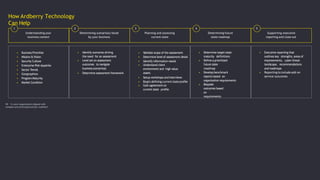
How Ardberry Technology
Can Help
Understanding your
business context
Planning and assessing
current state
Determining scenario(s) faced
by your business
Determining future
state roadmap
Supporting executive
reporting and close out
1
58 · Is your organization aligned with
complex and evolving business realities?
2 3 4 5
• Business Priorities
• Mission & Vision
• Security Culture
• Enterprise Risk Appetite
• Sector Trends
• Geographies
• Program Maturity
• Market Condition
• Identify scenarios driving
the need for an assessment
• Level set on assessment
outcomes to navigate
business scenario(s)
• Determine assessment framework
• Validate scope of the assessment
• Determine level of assessment detail
• Identify information needs
• Understand client
environment and high value
assets
• Setup workshops and interviews
• Begin defining current state profile
• Gain agreement on
current state profile
• Determine target-state
maturity definitions
• Define a prioritized
future state
roadmap
• Develop benchmark
reports based on
organization requirements
• Bespoke
outcomes based
on
requirements
• Executive reporting that
outlines key strengths, areas of
improvements, cyber threat
landscape, recommendations
and roadmaps
• Reporting to include add-on
service outcomes
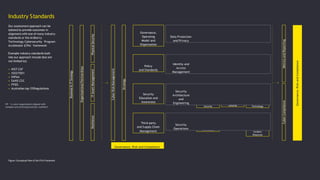
Industry Standards
Our assessment approach can be
tailored to provide outcomes in
alignment with one of many industry
standards or the Ardberry
Technology Cybersecurity Program
Accelerator (CPA) framework
Example industry standards built
into our approach include (but are
not limited to):
• NIST CSF
• ISO27001
• HIPAA
• SANS CSC
• FFIEC
• Australian top 35Regulations
Figure: Conceptual View of the CPA Framework
Business
&
IT
Strategy
Strategy
Cyber
Risk
Management
Metrics
and
Reporting
Cyber
Compliance
Organisational
Partnerships
Resilience
IT
Asset
Management
Physical
Security
Secure Software
Development and
Management
Security
Monitoring
Security
Infrastructure
Threat
Intelligence
Insider
Threat
Privacy
Security
Architecture and
Engineering
Vulnerability
Identification and
Remediation
Identity
and Access
Management
Data Protection
Operational
Technology
Incident
Response
Cloud
Security
Product
Security
Security
Architecture
and
Engineering
59 · Is your organization aligned with
complex and evolving business realities?
Security
Operations
Identity and
Access
Management
Data Protection
and Privacy
Governance,
Operating
Model and
Organisation
Policy
and Standards
Security
Education and
Awareness
Third-party
and Supply Chain
Management
Governance,
Risk
and
Compliance
Governance, Risk and Compliance
Joseph
Gonzalves
Director of Business
and IT Risk Consulting
Ardberry Technology
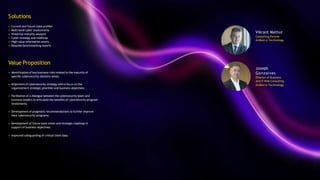
Solutions
• Current and future state profiles
• Multi-level cyber assessments
• Historical maturity analysis
• Cyber strategy and roadmap
• High value information assets
• Bespoke benchmarking reports
Value Proposition
• Identification of key business risks related to the maturity of
specific cybersecurity domains areas;
• Alignment of cybersecurity strategy with a focus on the
organization’s strategic priorities and business objectives;
• Facilitation of a dialogue between the cybersecurity team and
business leaders to articulate the benefits of cybersecurity program
investments;
• Development of pragmatic recommendations to further improve
their cybersecurity programs;
• Development of future state vision and strategic roadmap in
support of business objectives;
• Improved safeguarding of critical client data.
Vikrant Mathur
Consulting Partner
Ardberry Technology
OUR
PROJECTS
Ardberry Technology Private Limited IT Profile.pdf

Ardberry Technology Private Limited IT Profile.pdf

  • 1.
  • 22.
  • 24.
  • 29.
  • 37.
    Ardberry Technology Engage1 Accelerate digital transformation through intelligent automation
  • 38.
    What is IntelligentAutomation? Intelligent automation (IA) refers to the integration of robotics with multiple components from different emerging technologies. Robotics is transforming the efficiency of every organizational function from finance, tax, HR, and IT to supply chain, regulatory compliance and customer care. We’re not talking industrial or companion robots, of course, but rather software robots that operate as virtual employees, reliably automating manual, repetitive tasks at scale. When robotic, intelligent and autonomous systems are integrated, the result is intelligent automation, widening the scope of potential tasks and processes that can be automated. This powerful combination brings transformation across the whole spectrum of emerging technologies such as artificial intelligence, blockchain and the internet of things.
  • 39.
    How AI isAutomating Intelligently Transforming by automating intelligently with artificial intelligence (AI) is now the practice of early adopters with an Solution to the future. The promise of speed, ease and cost optimization while simplifying complex processes and systems is putting AI in the driver’s seat of organizational transformation. Traditional business processes and systems are undergoing a fundamental shift with expanding new technologies on offer. Transforming by automating intelligently with artificial intelligence (AI) is now the practise of early adopters with a Technolog to the future. In a highly competitive, global business environment - that’s moving faster than ever before - organizations must improve their speed, accuracy and productivity to deliver the best result Ardberry Technology can to customers. Not only does this involve how you interact with customers directly, but it comes down to how, once thArdberry Technology are connected, you are able to rapidly service their needs. By using AI machine learning to handle “process, predict and prescribe” across the enormous amounts of data now available, clients are using their people to add value by delivering insights as decisions are made. In real time. Across a wide range of industries, geographies and business issues, automation remains a kArdberry Technology business driver for today and tomorrow. Clients often understand the areas of their business that require improvement (the why) and have performance targets to achieve, but the exact approach (the how and what) can be daunting…RPA, cognitive, NLP, drones, blockchain, agile, machine learning…there’s an exhaustive array of new and emerging technologies and techniques available.
  • 40.
    Can Robots Helpyour Business Be More Human? Robotic Process Automation may sound like an impersonal replacement, but it could make workplaces far more people-friendly. Robots on a production line or in warehouses have been filling jobs previously done by people. Fears of the impact of robotics in the labor market arose after publication in 2015 of the best-selling book Rise of the Robots: Technology and the Threat of a Jobless Future. More recently, the Annual Report of the White House and the Council of Economic Advisers warned that millions of low-paying jobs are at risk of being automated out of existence. But despite these warnings, Martin Weis, EMEIA Robotics Leader, Ardberry Technology, says that Robotic Process Automation (RPA) could be welcomed by the very people whose jobs may seem most at risk from its introduction. RPA is the software that allows automation of back- office manual tasks. It’s the future of many administrative functions and is set to enable office staff to automate routine tasks by themselves using common automation tools, thereby freeing up their capacity for higher-value work. “RPA removes repetitious but labor-intensive work, like large-scale manual data entry, and enables people to instead focus on what matters,” Weis says. Multiple studies show that many people don’t enjoy their jobs. The Technology find large parts of their job to be dull or repetitive and, as a result, the AI Technology aren’t engaged and aren’t as productive as the AI Technology could be. There’s a long tail of processes that haven’t been automated yet. The reality for many businesses today is that the drudgery and low pay associated with repetitive manual processes often creates staff retention problems. This not only drives up costs, but also means businesses could be losing promising talent for the future.
  • 41.
    How AT CanHelp Ardberry Technology has one of the largest and most holistic Intelligent Automation practices worldwide. Lead by example: One of the largest global IA users with more than thousands of RPA bots working on our own internal processes and 2,000,000+ hours saved through automation. We also have attended automation, virtual agents as well as ML and NLP applications in production. Transformation vs. automation: Our focus is on IA- led transformation rather than just automation. Our approach is to train subject matter experts in every major function to bring clients a holistic solution. Global delivery network: We have over 1,500 dedicated IA professionals and over 12,000 experienced IA consultants in over 40 countries around the world to service local and global clients. IP and functional assets: Functional assets integrating IA and other technologies (bot library). Proven methodology and enablers: Unique, proven methodology and templates designed for large, global implementations at scale. Technology alliances: We have global alliances with leading automation technology providers including BluePrism, UIPath, Automation Anywhere and Microsoft. Our service offering includes: • IA strategy and planning: Purpose and goals; data analysis; opportunity discovery; business case; roadmap. • IA Operating Model Playbook: Organization; roles development; policies and procedures; program Management. • Technology development: IA design and build, using modified agile approach; Unit, UAT, system and performance testing. • Support services: Ardberry Technology can provide short- and long- term management, monitoring and hosted solutions.

  • 42.
    Ardberry Technology Engage1 Cloud journey and governance: enabling a hybrid IT environment
  • 43.
    As organisation refocuson their digitalization agenda, cloud is a key enabler. Businesses are at various stages in their journey to adopt cloud. In some cases this has been deferred because of existing capital investment in infrastructure, in other cases because of scepticism or fear from losing control. However, technology leaders are more than aware that at least a partial move to the cloud is unlikely to be avoided. Technology vendors have been adapting the traditional on-premise deployment model for their solutions and now offer only them in the cloud – as deployable solutions on cloud platforms or purely as a Software-as-a-Service model. In other cases, an internal IT environment does not always provide the necessary agility and elasticity that cloud provides. Even in organisations that do not yet have a clearly formulated cloud strategy, you will find the use of cloud-based Software-as-a-Service solutions being used by the users. IT does not necessarily have the visibility and control on what applications in the cloud are being used. It is too easy for someone in the company to start an online subscription or create an account to start using web and mobile based on solutions – without involving IT. Such shadow IT presents major risks in terms of data leakage and operational risks as the necessary control and governance structures are not in place. The cloud journey starts at the point that there is a realization by the management and IT leadership that this cannot be left unnoticed. To achieve the competitive advantage in a dynamic world with increased levels of digitalization, cloud adoption should be part of the foundations of the IT strategy.
  • 44.
    Cloud Adoption OverviewRoadmap Foundational Upskill Migration Data Classification & Decouping Reskill Workforce & Hire Talent Provider Selection Cloud Strategy Migration to Cloud Platform Security Cloud Foundation Bus Case Assessment Define cloud adoption and ops strategies, inclusive of pulic cloud reg’ts and multi- cloud/vendor lock-in positioning Select providers based on business case, requirements and differentiated capabilities Ensure workforce has cloud native skills, which may need to be sourced externally Assess and classify data coupling issues that must be resolved for successful cloud adoption Acceleration is achieved through the use of best practices, repeatable patterns, and appropriate tooling Effective partnering in early migration activities can create exponential efficiencies throughout the wider process Define new op model to address cultural, org and process shifts to enable successful transformation Define security reg’ts based on industry best practices and business service reg’ts Evaluate org readiness, inclusive of the necessary procedures and tools required Shift from traditional waterfall to an agile SDLC model to modernise capabilities Assess and prioritise services and applications to migrate to the cloud and define reg’ts for public cloud Demonstrate secure and compliant public cloud environment, running at least one application informed by strategy Rearchitect and migrate prioritised applications to the cloud, informed by strategy, business case and app rationalisation outputs Modernise Dev Capabilities Cloud Op Readiness Cloud Op Model Minimum Viable Cloud (MVC) 44 · Cloud journey and governance: enabling a hybrid IT environment
  • 45.
    What If YouCould... 45 · Cloud journey and governance: enabling a hybrid IT environment • Improve your enterprise’s overall flexibility and reliability with a modern IT infrastructure that is cost effective? • Accelerate speed-to-market by testing ideas quickly, adopting them and then moving quickly to scale? • Build a sustainable next generation cloud-based, firm-wide digital capability to grow your business? • Improve your security posture through simplification and standardization of your IT infrastructure and applications? • Move your technology operations from legacy systems to flexible subscription models where business units pay for consumption?
  • 46.
    The key componentsof a successful cloud strategy are 1) establishing clear positioning and vision for cloud adoption in the organisation 2) defining a cloud architecture that defines the required capabilities, cloud components, integration to the internal network and on- premises or datacentre hosting, security, 3) a roadmap for adoption including migration of workloads or strategic transitioning from hosted applications to Software-as-a-Service(SaaS) and Platform-as- a-Service (PaaS) solutions, and 4) the ongoing practices to improve and optimize the utilization of cloud especially when it comes to the implementation of security controls and cost management. Cloud Strategy Ardberry Technology Enterprise Cloud Strategy Development Technology Cloud Strategy Cloud Platform Commercial Enablement Cloud Economics Cloud Operating Model Cloud Policy & Governance Cloud Managed Services Enterprise Security Application Modernisation Data & Analytics
  • 47.
    Cloud Governance Framework Cloudhas an impact to the processes and practices of the organisation beyond the technology aspect. Changes to IT procurement, contracting, budgeting and cost management, risk management and operations must be weaved into the operating fabric of the organisation. This is not just an IT challenge, but a concerted effort by various stakeholders of the organisation including finance, legal and operations, just to name a few. At the early stages of establishing the cloud strategy for the business, successful cloud adoption involves establishing the necessary policies, processes and governance. Ardberry Technology helps customers using an established Cloud Governance Framework that helps decision makers and stakeholders in understanding these practices and how the organisation needs to change. IT Operating Model Another critical component of this journey is to assess and decide on the operating model for the engineering and operations of the cloud environments. Many organisations are opting for a hybrid sourcing model with an outsourcing of the operations of the cloud environments to managed service providers that can provide best- practices, skilled resources and economies of scale, avoiding the need to build up such competencies internally especially as the technology portfolio provided by the cloud is much more extensive. This does not imply that internal IT resources need not be aware and trained on the technical aspects and best-practices, internal IT roles must be in a position in to guide business adoption, architect solutions and managed the service providers.

  • 48.
    We assist clientsby providing services designed to meet each company’s unique cloud and legacy modernization requirements. Cloud economics and strategy This service helps organizations with a “cloud-first” strategy, including the development of a financial model to calculate both current and future cost at workload and application levels to highlight potential savings. CIOs will also benefit from a cloud strategic roadmap with specific initiatives in conjunction with potential infrastructure operating model changes. • Cloud strategy • Business case for cloud • Decision framework • Financial and accounting models • IT finance impact Enterprise security Moving to the cloud requires effective security measures and procedures to manage your migration effort, and then helps safeguard your applications and data in a hybrid cloud environment. • Cyber as a service • Active detection and response • Identity and access management • Cyber orchestration and automation Cloud operating model Ardberry Technology teams will assess your existing IT or infrastructure operating model to understand how well positioned your organization is to support your future IT infrastructure in the cloud, including core business applications and tools. • Cloud Center of Excellence (CoE) setup • Organizational change management/roles/skills • Cloud transformation program • DevSecOps/NoOps for Day 2 operations Cloud platform Ardberry Technology teams help you re-think business processes and operating models through cloud-enabled platforms. We provide the following guidance on various platform options, migration approaches, data engineering and data security. • IaaS, PaaS, SaaS • Cloud migration factory • Cloud 2.0: foundations, automation and security • Cloud architecture/ engineering support • Cloud patterns/reference architectures/automation Application modernization Ardberry Technology teams assist clients with updating their legacy applications to support modern architectures, including rewriting code to take advantage of cloud capabilities. • Application modernization/innovation factory • Container management/containerizing applications as part of the move to cloud • CRM/ERP on cloud • Robotic process automation and machine learning • Internet of things Cloud Modernisation

  • 49.
    Key Client Questions 49· Cloud journey and governance: enabling a hybrid IT environment • How do we leverage real-time event-driven architectures to modernize legacy batch-driven processing? • How do we decompose our monolithic applications to loosely coupled, microservices architectures? • How do we move legacy mainframe applications to the cloud while prioritizing security and SLA’s? • How do I appropriately establish hosting arrangements for all application workloads?
  • 50.
    This hybrid approach,which blurs the lines between private and public cloud, and hardware and infrastructure, is increasingly becoming the norm, as organisations realise that there is no one single technology that can satisfy all business requirements. And this is the reason why expert help is becoming a must, as businesses navigate the rather complex tech landscape to achieve desired business outcomes. EY’s portfolio of high-demand services is designed to support your cloud strategy and address your security and regulatory compliance requirements in a holistic and impactful way. As a leader in 2020 IDC Worldwide Cloud Services, Ardberry Technology delivers on understanding of technology and security risks, cloud technologies and services, industry-leading risk practices and regulatory compliance expectations. How Ardberry Technology Can Help Cloud Positioning and Strategy • Holistic analyses of an IT organisation, including business-IT alignment, technology, operations, governance and processes • End-state definition, including target portfolio, infrastructure, governance, program management office (PMO) alignment, architecture, strategic sourcing and staffing models Cloud Governance and Practices • Structured approach to ensure compliance to regulatory requirements, industry standards and organisation’s policies • Establishing processes and alignment of procedures across IT, Procurement, Information Security, Legal and Finance Cloud Architecture • Defining the architecture of the target IT landscape including identity, security, connectivity, monitoring and management • Establishing architecture standards and guidelines to manage the technology adoption while establishing a managed portfolio aligned to the economics and operational capabilites of the organisation Cloud Controls Framework • Defining and establishing the required controls from a policy, process and technology perspective based on industry standards and specific regulatory requirements • Establishing roles and responsibilities across stakeholders involved Application Assessment and Cloud Modernisation • Analysis, redesign and implementation of applications to leverage the capabilities of the cloud • Establishing Cloud Migration Factory for a systematic agile approach to move workloads to the cloud DevOps Adoption • Evolution of project management, requirements engineering, development and operations to bring about the agility that cloud platforms provide



  • 51.
    Ardberry Technology Engage1 Fast forwarding your cloud security strategy As the cloud moves from mainstream to mainstay, now is the time to get smart on your cloud strategy
  • 52.
    What are theBiggest Cloud Security Concerns? As we emerge from the global pandemic, ongoing digital transformation and work anywhere policies are accelerating cloud adoption. At the same time, cyber security continues to be a major cause of concern. Given that a “no cloud” strategy in five years will feel like a “no internet” strategy today, it’s vital not to leave trust to chance. Organizations should start now to implement cloud strategies that enable their business and address security concerns. • Data loss or leakage; • Data privacy and confidentiality; • Accidental exposure of credentials. What are the Benefits of Cloud? • Speed to market and agility; • Cost optimisation; • Productivity and scalability.
  • 53.
    Our Company Focus Partneringwith a knowledgeable external partner can help. At Ardberry Technology, we aim to take the burden of compliance and risk out of the client’s cloud journey. From design, build and operation. With that we strive to be the nr 1 cloud security services provider for regulated industry within the next couple of years. • Embrace cloud-native technology and principles to enable ubiquitous security. • Shift left to consider security at every stage of the cloud lifecycle. • Establish a culture of excellence with key internal talent and strong external partners. Whether you’re an early or late adopter, now’s time to get cloud smart. Broad, innovative and integrated solutions Our Cloud Governance Framework spans across people, process and technology to promote consistency, transparency, efficiencies and oversight across all stages of the cloud management lifecycle. By leveraging this framework, Ardberry Technology will assess and analyse current processes benchmarked against leading industry practices and provide focused recommendations for improvement. Strategy, Resource, Organisational Management and Continual Improvement Security Cloud Operations Data Architecture and Infrastructure Cloud Service Provider Management Risk, Compliance and Control Process People Technology Finance Managements Decommission Manage Configure Migrate Identify Governance
  • 54.
    Cloud Governance Framework 54· Fast forwarding your cloud security strategy Security Strategy, Resource, Organizational Management & Continual Improvement Governance to align improvements to strategy, report corrective actions, resource management and o Resource Management Identity & Access Management Security Operations Best Practices Emerging Tech & Innovation Data Protection & Privacy Risk, Compliance & Control Regulatory Alignment Compliance Management Legal Management IT Risk Management Vendor / Third Party Risk Consum ption Model Total Cost Ownership Model Adoption Project Change Management Cloud Vendor Management Contract Governance & Management Monitoring & Measurement Service Level Management General Cloud Security Organizational Change Management Portfolio/Program Management Continual Service & Capability Improvement Data, Architecture & Infrastructure Policy Management Data Architecture Data Architecture Integration / Interoperability Data Governance & Data Management rganizational change Service Manageme nt Integratio n Capacity Mgmt. & Scalability Operations Management Availability Management BCP & DR R e s
  • 55.
    The Cloud ControlsFramework is an alignment of internationally recognised standards such as CSA, ISO and NIST. Cloud Security Alliance • The Cloud Security Alliance (CSA) is the world’s leading organization dedicated to defining and raising awareness of best practices to help ensure a secure cloud computing environment. • The cloud security appliance (CSA) CCM lists key controls and considerations for cloud security. • The controls align to various industry standards and guidance. International Organization for Standardization • ISO 27001 – Information security policy. • ISO 27017 – Information security controls for cloud services. • ISO 27018 – Protection of PII in public clouds acting as PII processors. NIST 800-53 v4 • NIST outlines various considerations, guidelines and recommendations for cloud computing. Microsoft Azure Security Practices • Public cloud vendors publish best security practices for levering their platforms and define a shared responsibility model for security. Local Regulations • Applicable industry and local laws and regulations. Cloud Controls Framework: Alignment with Other Standards 7 Risk, Compliance and Control Data, Architecture and Infrastructure Cloud Service Provider Management Security Finance Managements 1 2 3 4 5 6 Figure: Cloud Controls Framework Vikrant Mathur Consulting Partner Ardberry Technology Joseph Gonzalves Director of Business and IT Risk Consulting Ardberry Technology Gaurav Sheth Senior Manager, Technology Consulting Lead Ardberry Technology 55 · Fast forwarding your cloud security strategy Strategy, Resource, Organizational Management and Continual Improvement Operations
  • 56.
    Ardberry Technology Engage1 Is your organization aligned with complex and evolving business realities? Ardberry Technology Cybersecurity Program Assessment
  • 57.
    Cybersecurity Program Assessment 81% oforganizations sidestepped cyber processes and did not consult cybersecurity teams at the planning stage of new business initiatives 77% of organizations say cybersecurity is involved right from the planning stage of a new business initiative 43% have seen an increase in the number of disruptive attacks, such as ransomware, over the last 12 months 9/10 say that the primary driver for new spending is not new business initiative enablement Cybersecurity program assessment is how organizations can determine if their cyber posture is setup to meet evolving cyber threats and inform future investments. By the numbers, according to the 2020 Ardberry Technology Global Information Security Survey: Organizations are likely to face the following scenarios that may require them to determine if their current cyber program is positioned to secure their current and long-term business interests amidst evolving threat and regulatory landscape: • Organizational changes; • Critical security events; • Emerging technologies; • Benchmarking needs; • Regulations; • Regulations; • De/mergers & acquisitions; • New cyber leadership; • Periodic reporting; • Resiliency assessments.
  • 58.
    How Ardberry Technology CanHelp Understanding your business context Planning and assessing current state Determining scenario(s) faced by your business Determining future state roadmap Supporting executive reporting and close out 1 58 · Is your organization aligned with complex and evolving business realities? 2 3 4 5 • Business Priorities • Mission & Vision • Security Culture • Enterprise Risk Appetite • Sector Trends • Geographies • Program Maturity • Market Condition • Identify scenarios driving the need for an assessment • Level set on assessment outcomes to navigate business scenario(s) • Determine assessment framework • Validate scope of the assessment • Determine level of assessment detail • Identify information needs • Understand client environment and high value assets • Setup workshops and interviews • Begin defining current state profile • Gain agreement on current state profile • Determine target-state maturity definitions • Define a prioritized future state roadmap • Develop benchmark reports based on organization requirements • Bespoke outcomes based on requirements • Executive reporting that outlines key strengths, areas of improvements, cyber threat landscape, recommendations and roadmaps • Reporting to include add-on service outcomes
  • 59.
    Industry Standards Our assessmentapproach can be tailored to provide outcomes in alignment with one of many industry standards or the Ardberry Technology Cybersecurity Program Accelerator (CPA) framework Example industry standards built into our approach include (but are not limited to): • NIST CSF • ISO27001 • HIPAA • SANS CSC • FFIEC • Australian top 35Regulations Figure: Conceptual View of the CPA Framework Business & IT Strategy Strategy Cyber Risk Management Metrics and Reporting Cyber Compliance Organisational Partnerships Resilience IT Asset Management Physical Security Secure Software Development and Management Security Monitoring Security Infrastructure Threat Intelligence Insider Threat Privacy Security Architecture and Engineering Vulnerability Identification and Remediation Identity and Access Management Data Protection Operational Technology Incident Response Cloud Security Product Security Security Architecture and Engineering 59 · Is your organization aligned with complex and evolving business realities? Security Operations Identity and Access Management Data Protection and Privacy Governance, Operating Model and Organisation Policy and Standards Security Education and Awareness Third-party and Supply Chain Management Governance, Risk and Compliance Governance, Risk and Compliance
  • 60.
    Joseph Gonzalves Director of Business andIT Risk Consulting Ardberry Technology Solutions • Current and future state profiles • Multi-level cyber assessments • Historical maturity analysis • Cyber strategy and roadmap • High value information assets • Bespoke benchmarking reports Value Proposition • Identification of key business risks related to the maturity of specific cybersecurity domains areas; • Alignment of cybersecurity strategy with a focus on the organization’s strategic priorities and business objectives; • Facilitation of a dialogue between the cybersecurity team and business leaders to articulate the benefits of cybersecurity program investments; • Development of pragmatic recommendations to further improve their cybersecurity programs; • Development of future state vision and strategic roadmap in support of business objectives; • Improved safeguarding of critical client data. Vikrant Mathur Consulting Partner Ardberry Technology
  • 61.