Biomes: Aquatic Communities
Biomes: Aquatic CommunitiesFreshwater Communities:Freshwater habitats; lakes, ponds, steams and rivers, are very limited in area. Lakes cover only about 1.8 percent of the earth’s surface and rivers only .3 percent.All freshwater habitats are strongly interconnected to terrestrial (land) habitats.
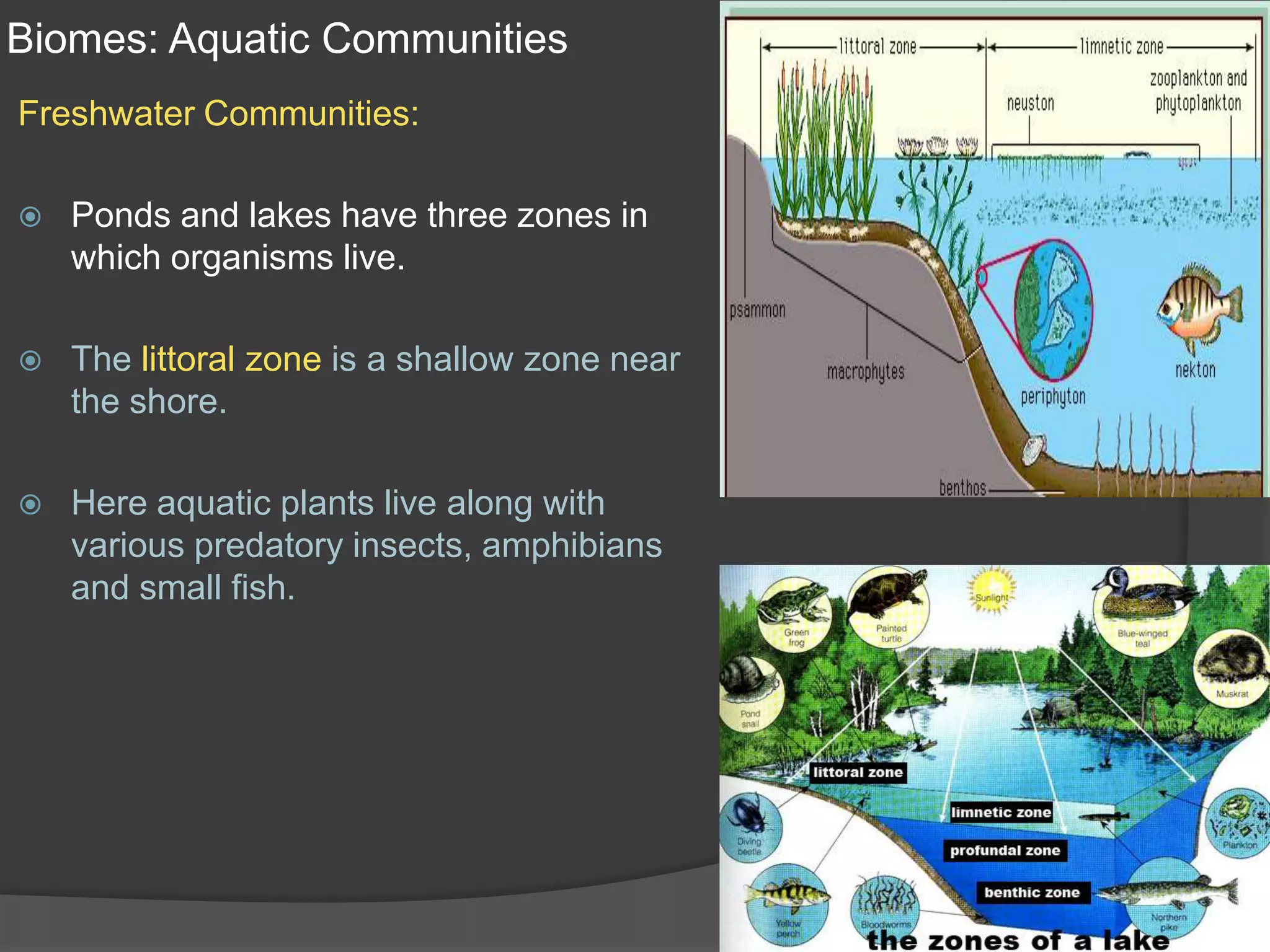
Biomes: Aquatic CommunitiesFreshwater Communities:Many kinds of organisms are restricted to freshwater habitats; including plants, fish, and a variety of arthropods, mollusks, and other invertebrates too small to be seen by the naked eye.Food web showing overlapof aquatic and terrestrial communities
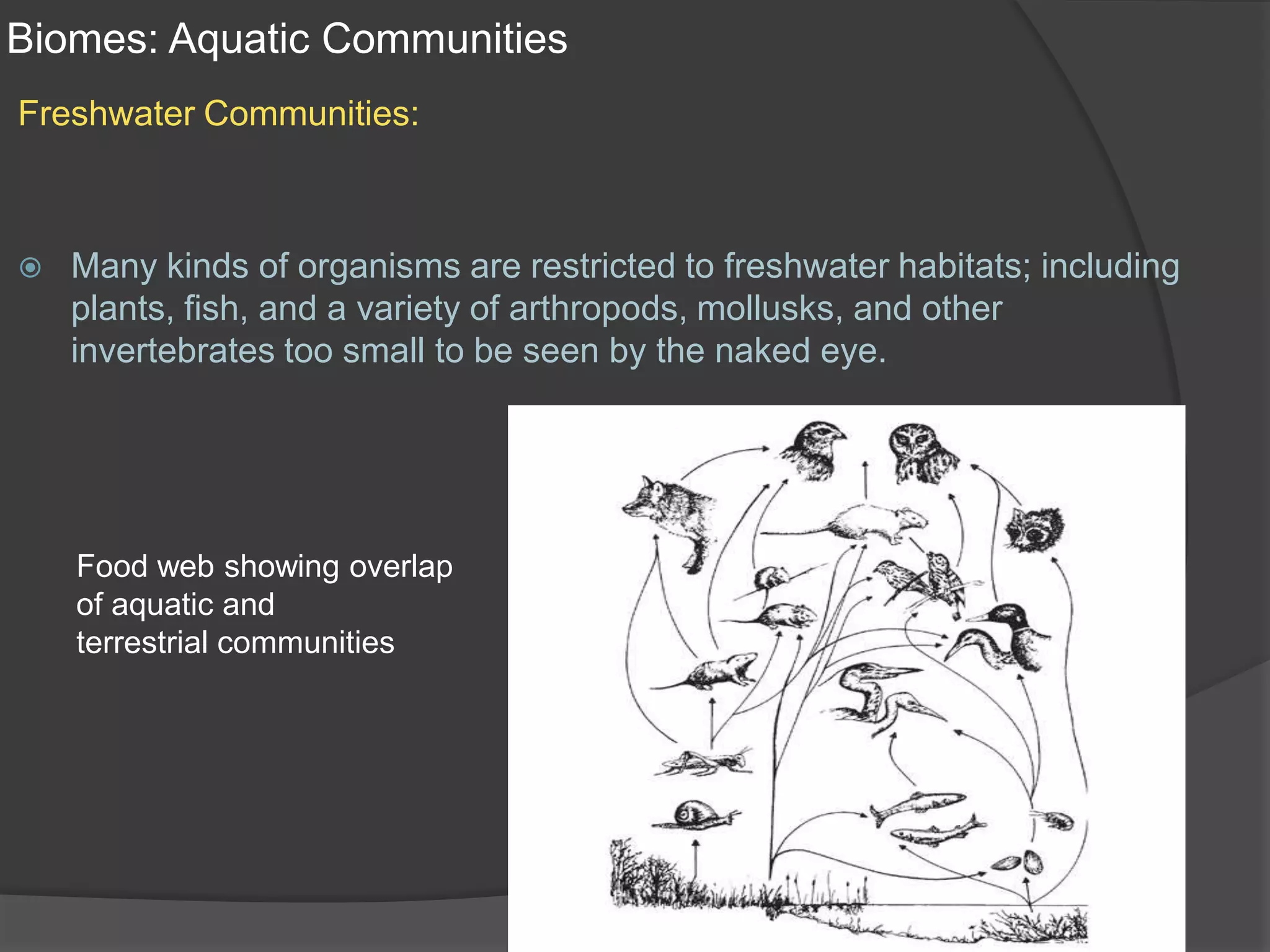
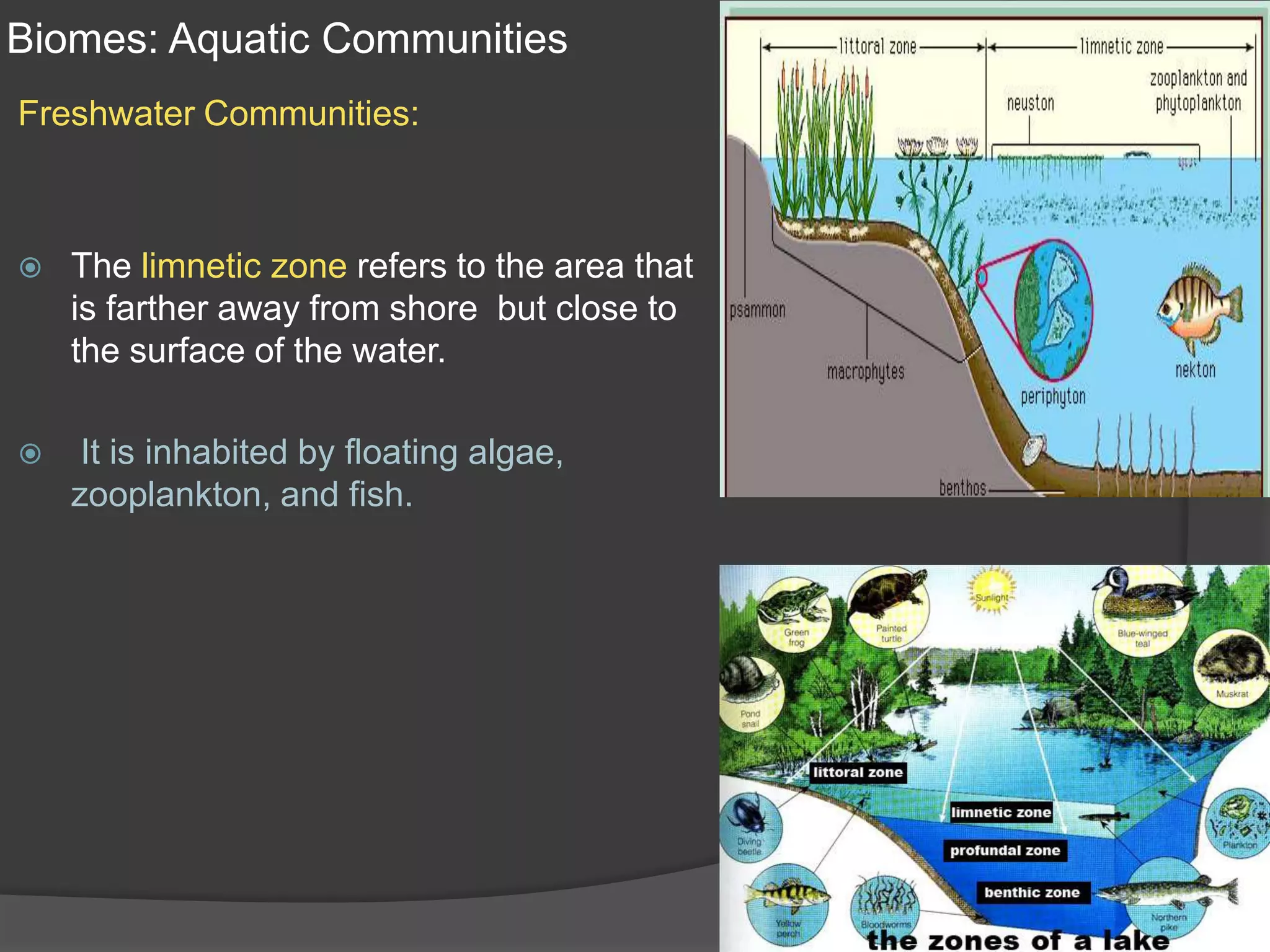
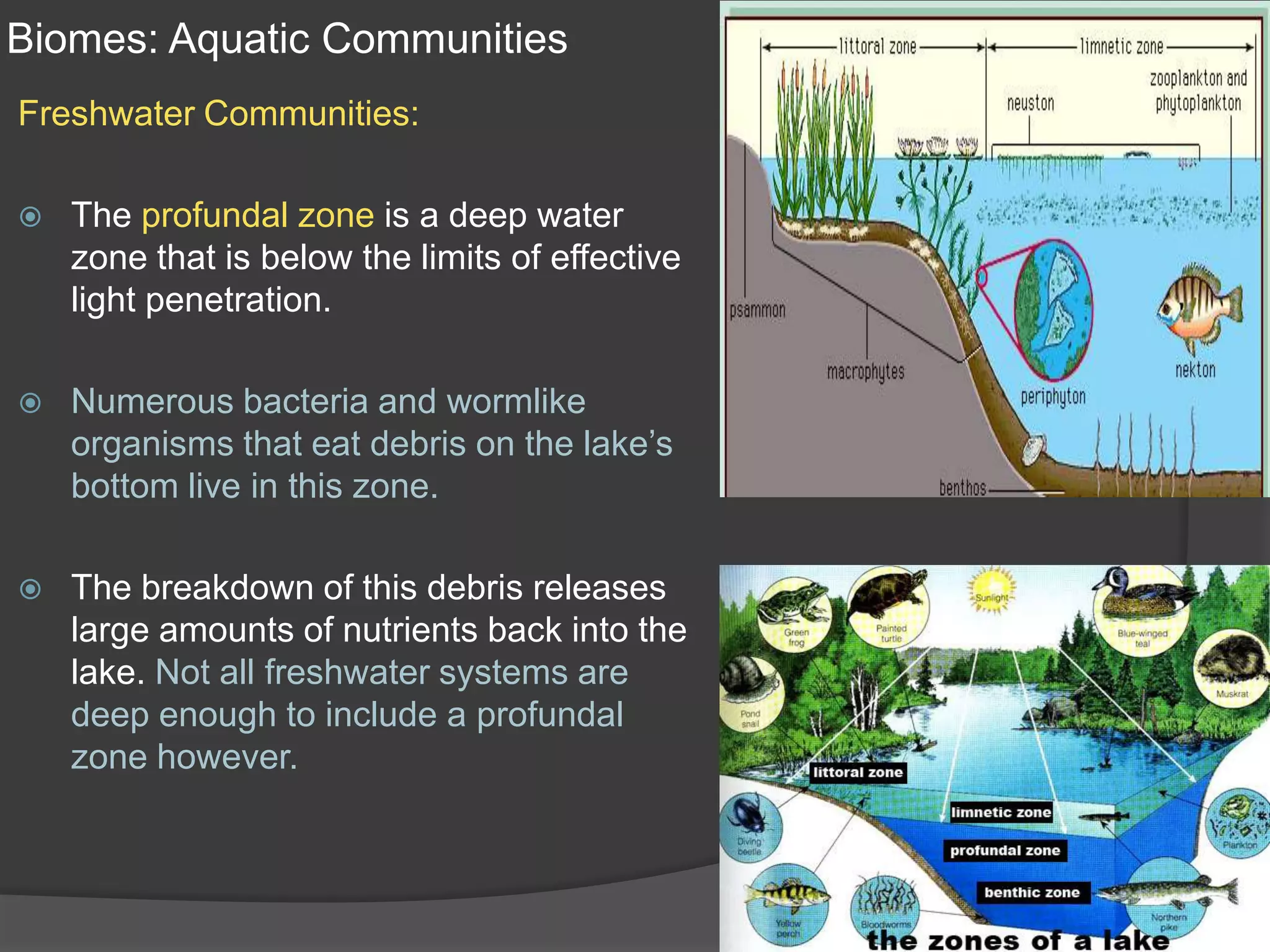
Biomes: Aquatic CommunitiesFreshwater Communities:Ponds and lakes have three zones in which organisms live.The littoral zone is a shallow zone near the shore. Here aquatic plants live along with various predatory insects, amphibians and small fish.
Biomes: Aquatic CommunitiesFreshwater Communities:The limnetic zone refers to the area that is farther away from shore  but close to the surface of the water. It is inhabited by floating algae, zooplankton, and fish.
Biomes: Aquatic CommunitiesFreshwater Communities:The profundal zone is a deep water zone that is below the limits of effective light penetration.Numerous bacteria and wormlike organisms that eat debris on the lake’s bottom live in this zone.The breakdown of this debris releases large amounts of nutrients back into the lake. Not all freshwater systems are deep enough to include a profundal zone however.
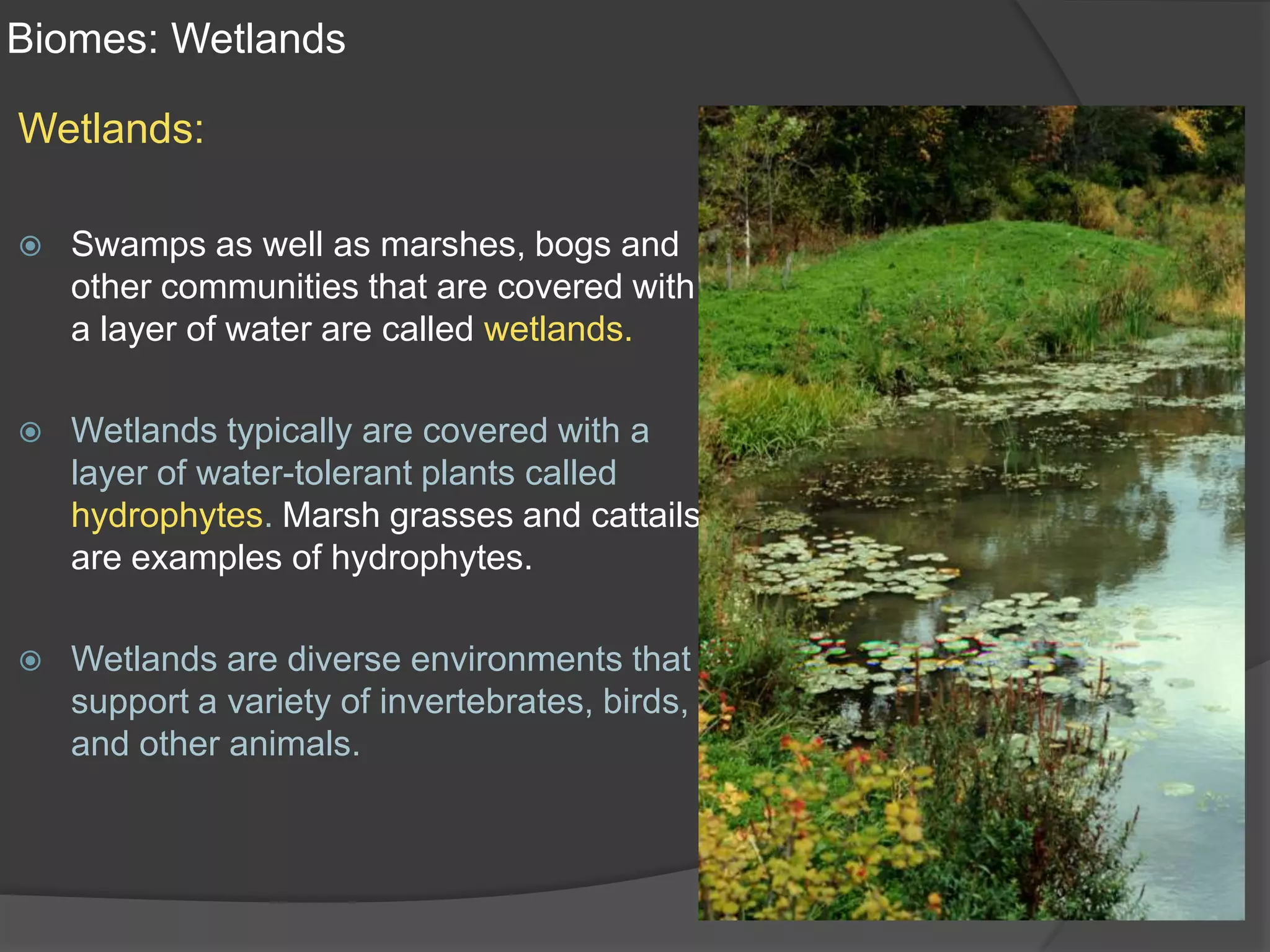
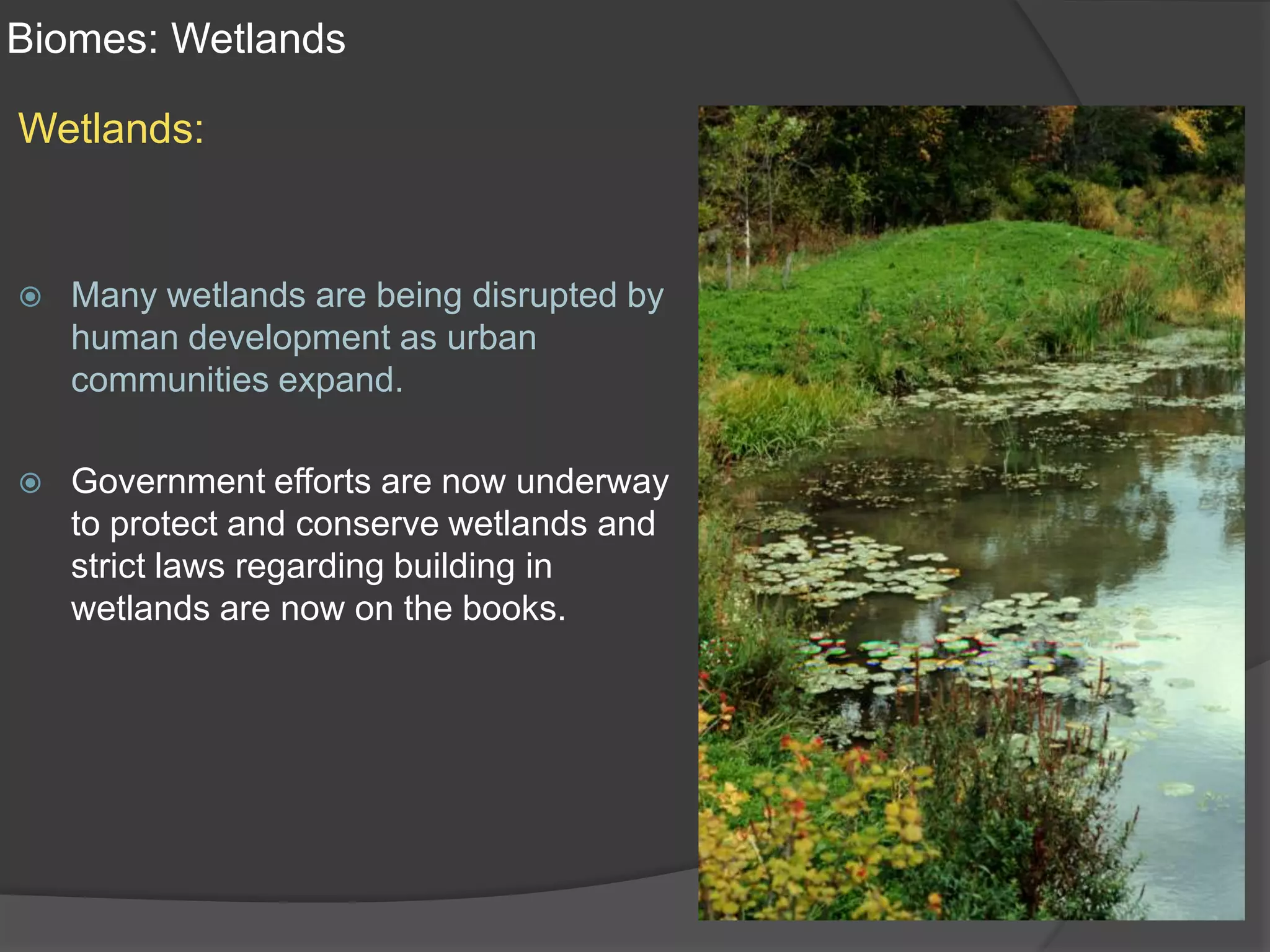
Biomes: WetlandsWetlands:Swamps as well as marshes, bogs and other communities that are covered with a layer of water are called wetlands.Wetlands typically are covered with a layer of water-tolerant plants called hydrophytes. Marsh grasses and cattails are examples of hydrophytes.Wetlands are diverse environments that support a variety of invertebrates, birds, and other animals.
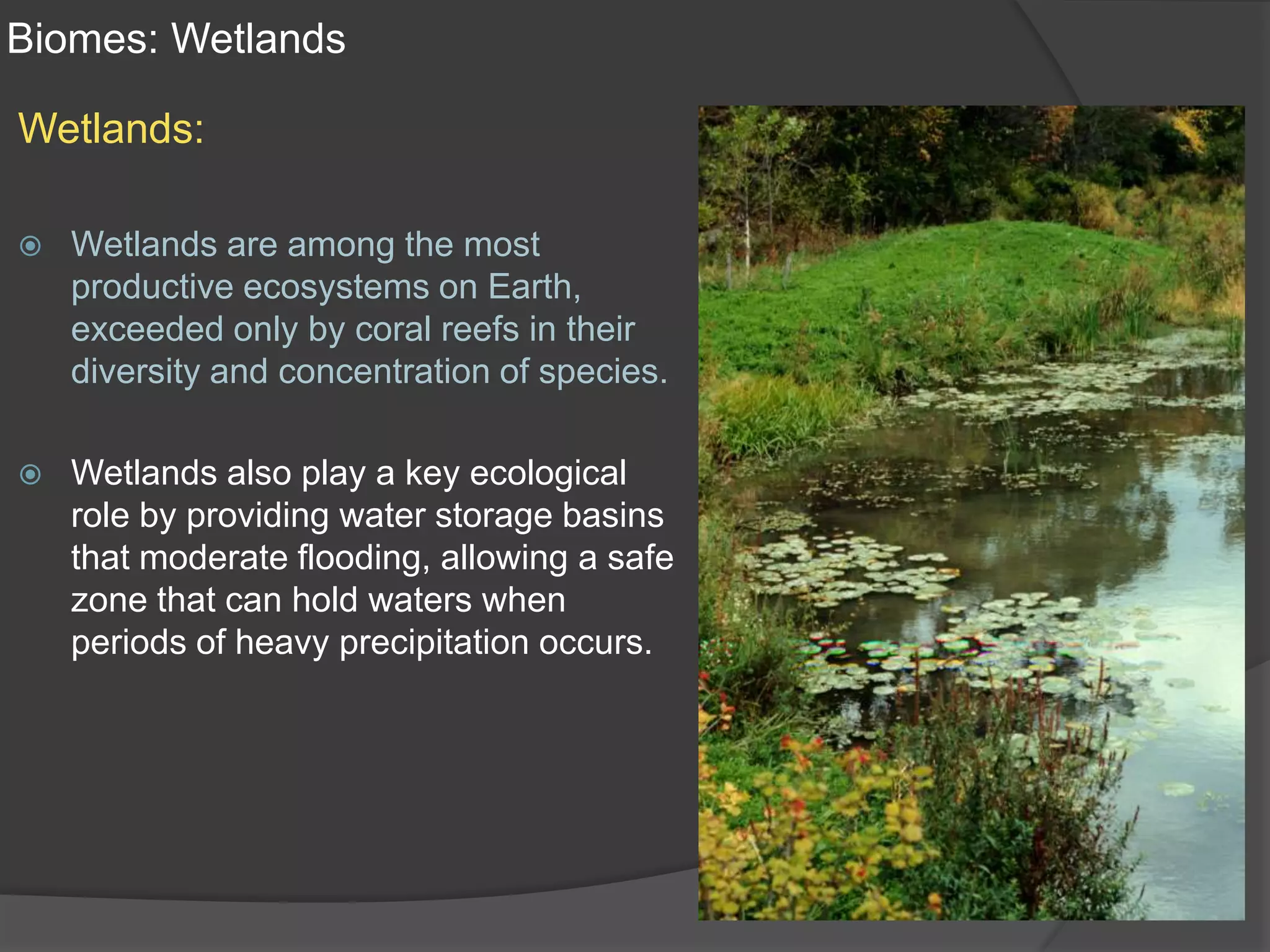
Biomes: WetlandsWetlands:Wetlands are among the most productive ecosystems on Earth, exceeded only by coral reefs in their diversity and concentration of species.Wetlands also play a key ecological role by providing water storage basins that moderate flooding, allowing a safe zone that can hold waters when periods of heavy precipitation occurs.
Biomes: WetlandsWetlands:Many wetlands are being disrupted by human development as urban communities expand. Government efforts are now underway to protect and conserve wetlands and strict laws regarding building in wetlands are now on the books.
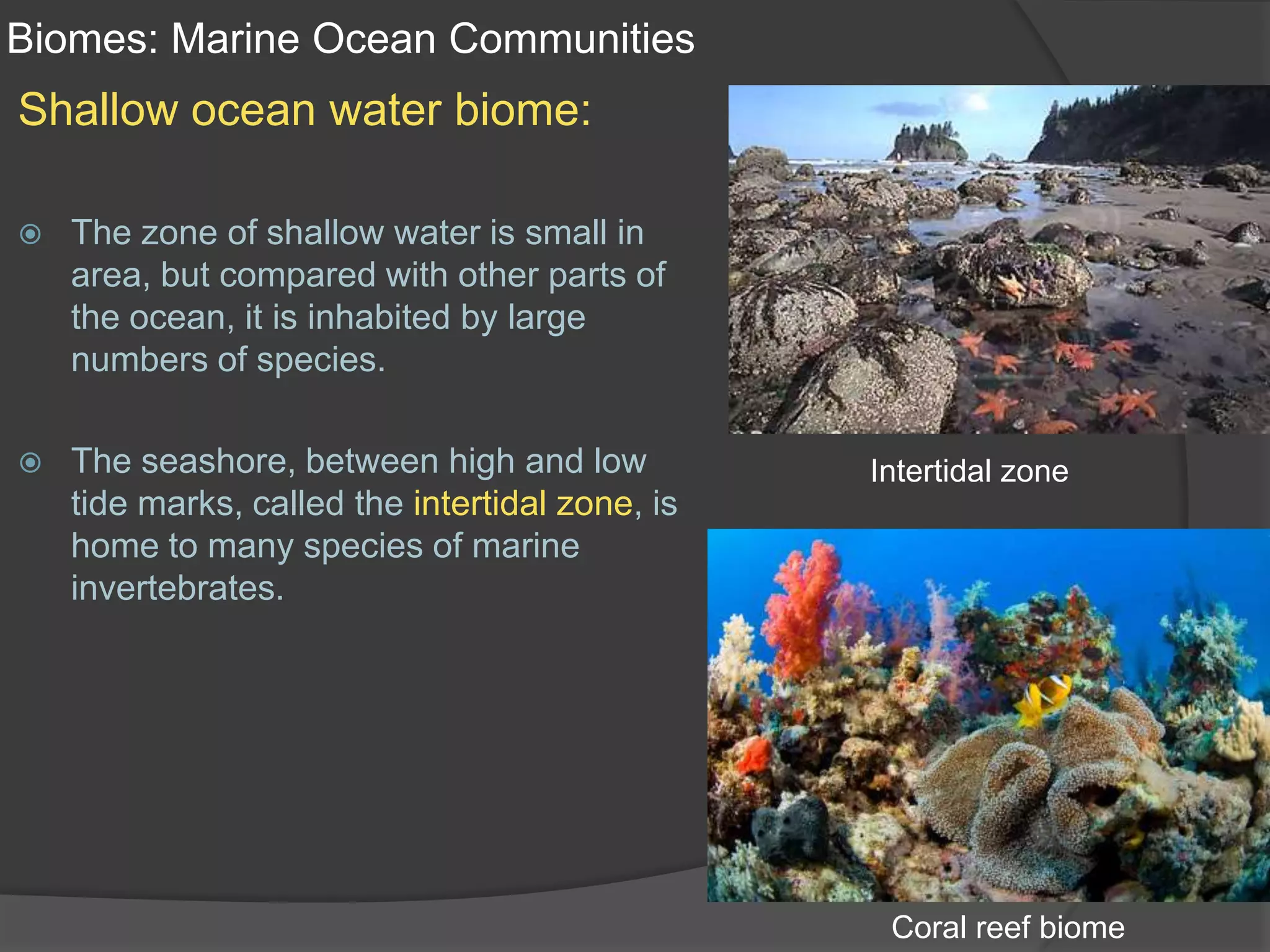
Biomes: Marine Ocean CommunitiesShallow ocean water biome: The zone of shallow water is small in area, but compared with other parts of the ocean, it is inhabited by large numbers of species.The seashore, between high and low tide marks, called the intertidal zone, is home to many species of marine invertebrates.Intertidal zoneCoral reef biome
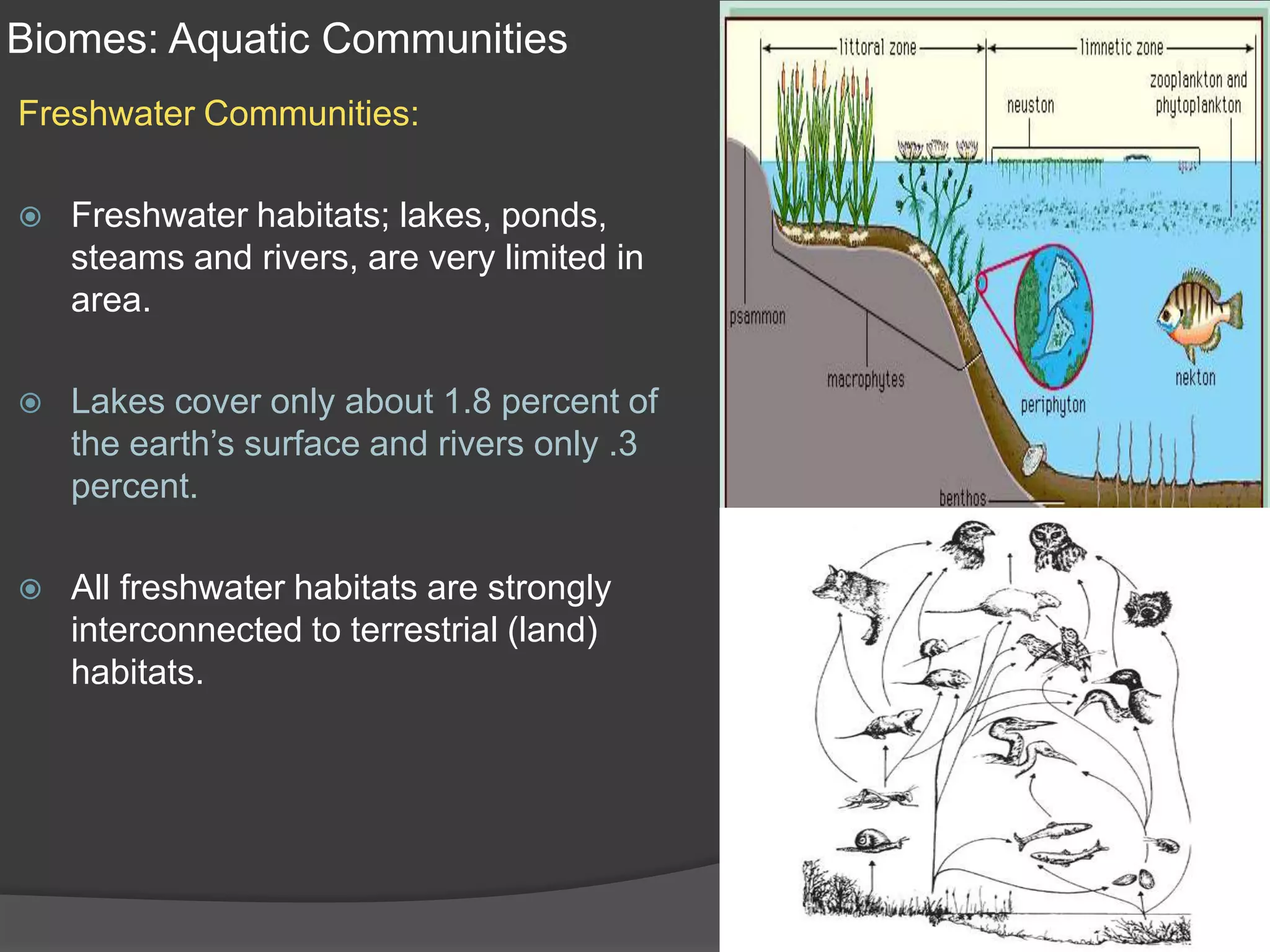
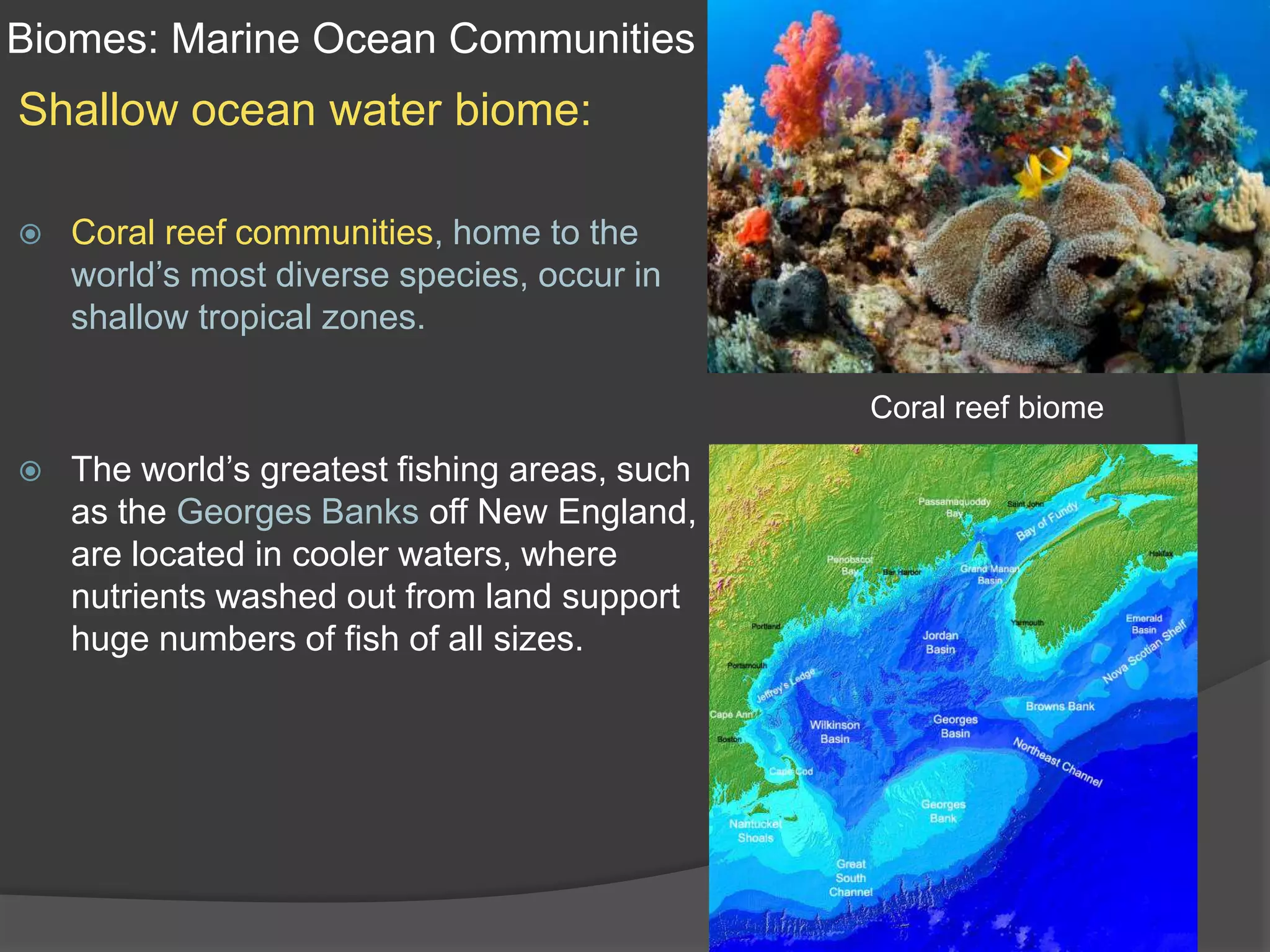
Biomes: Marine Ocean CommunitiesShallow ocean water biome:Coral reef communities, home to the world’s most diverse species, occur in shallow tropical zones.The world’s greatest fishing areas, such as the Georges Banks off New England, are located in cooler waters, where nutrients washed out from land support huge numbers of fish of all sizes.Coral reef biome
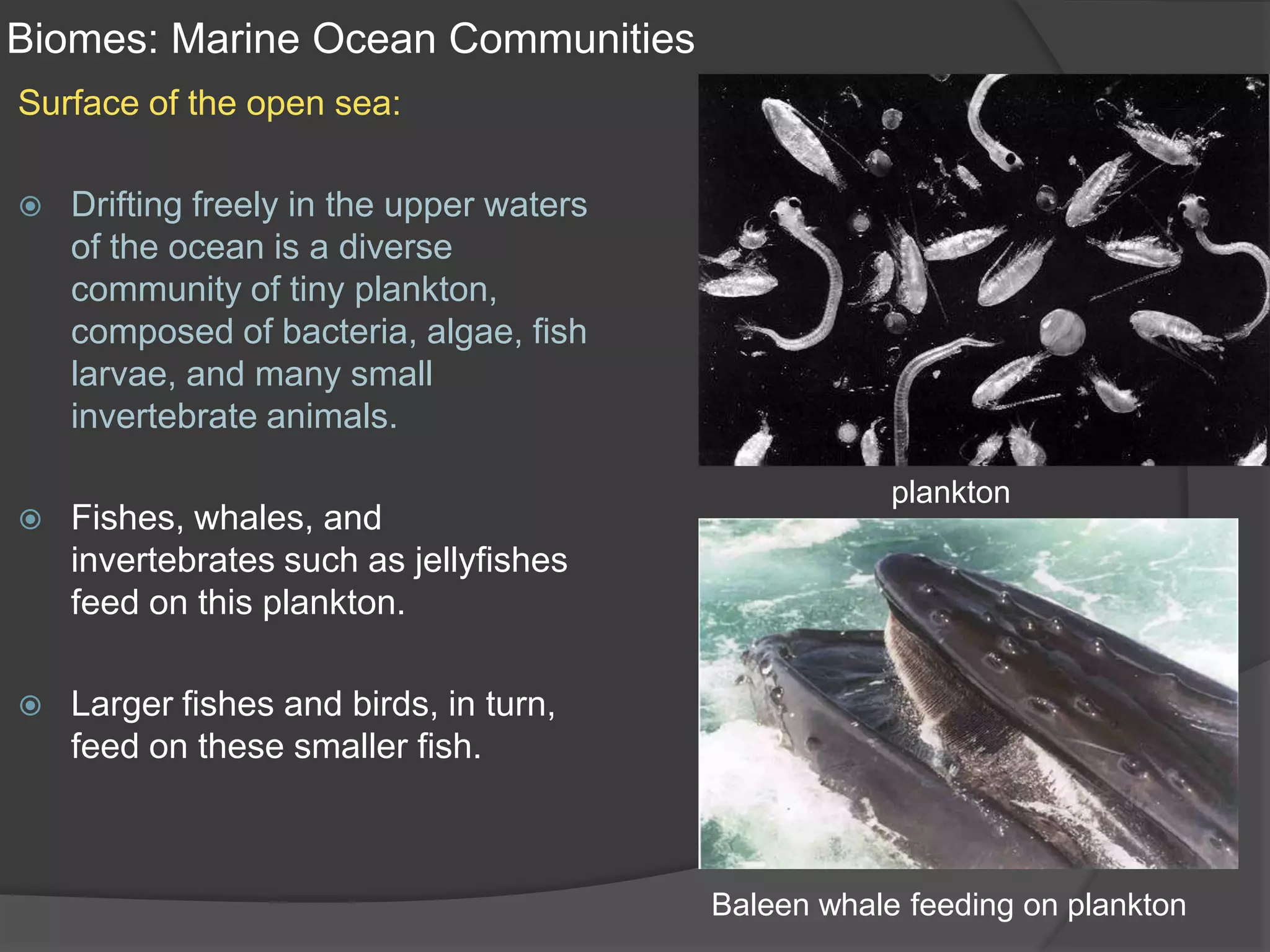
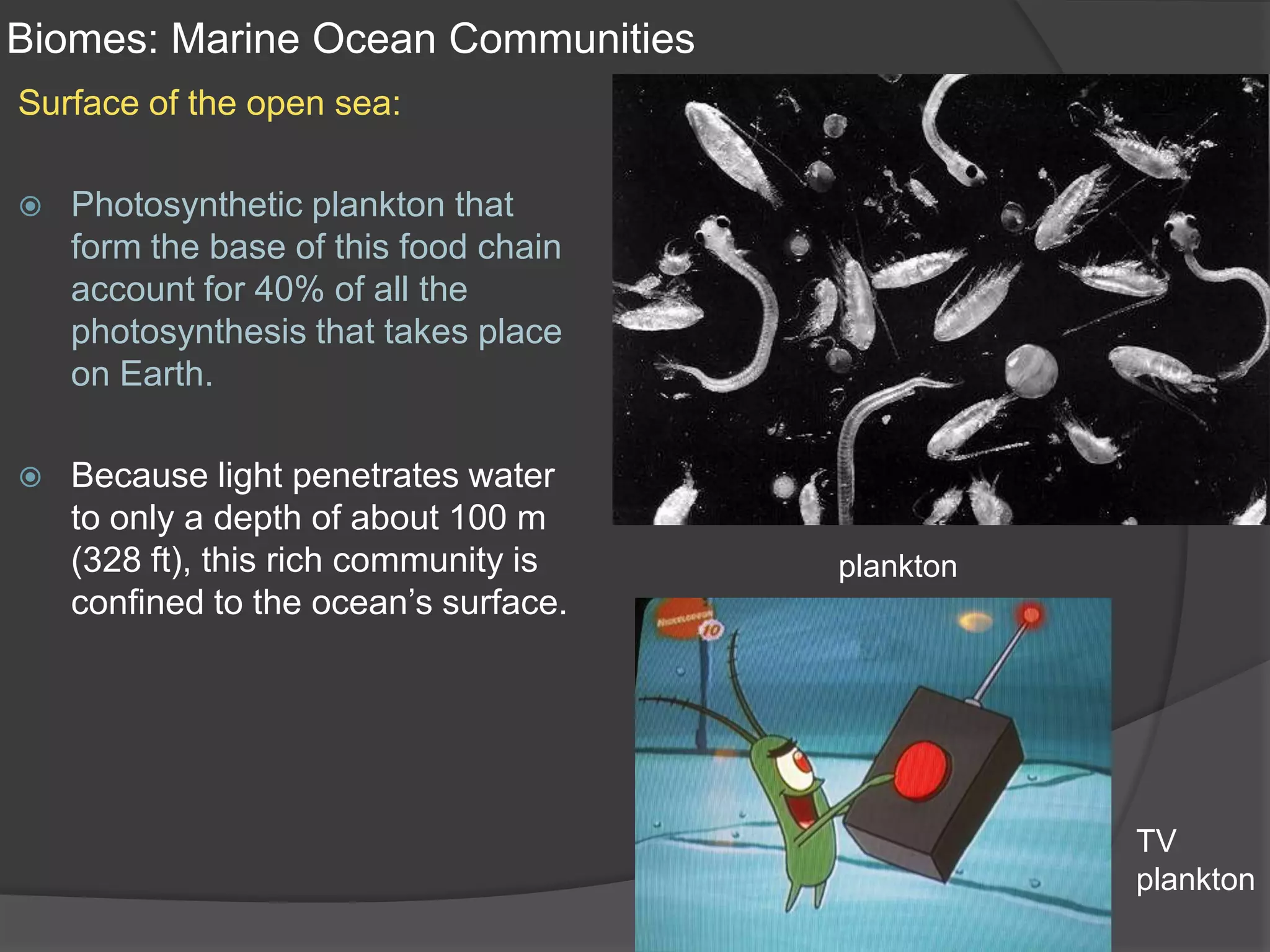
Biomes: Marine Ocean CommunitiesSurface of the open sea:Drifting freely in the upper waters of the ocean is a diverse community of tiny plankton, composed of bacteria, algae, fish larvae, and many small invertebrate animals.Fishes, whales, and invertebrates such as jellyfishes feed on this plankton. Larger fishes and birds, in turn, feed on these smaller fish.planktonBaleen whale feeding on plankton
Biomes: Marine Ocean CommunitiesSurface of the open sea:Photosynthetic plankton that form the base of this food chain account for 40% of all the photosynthesis that takes place on Earth.Because light penetrates water to only a depth of about 100 m (328 ft), this rich community is confined to the ocean’s surface.planktonTVplankton
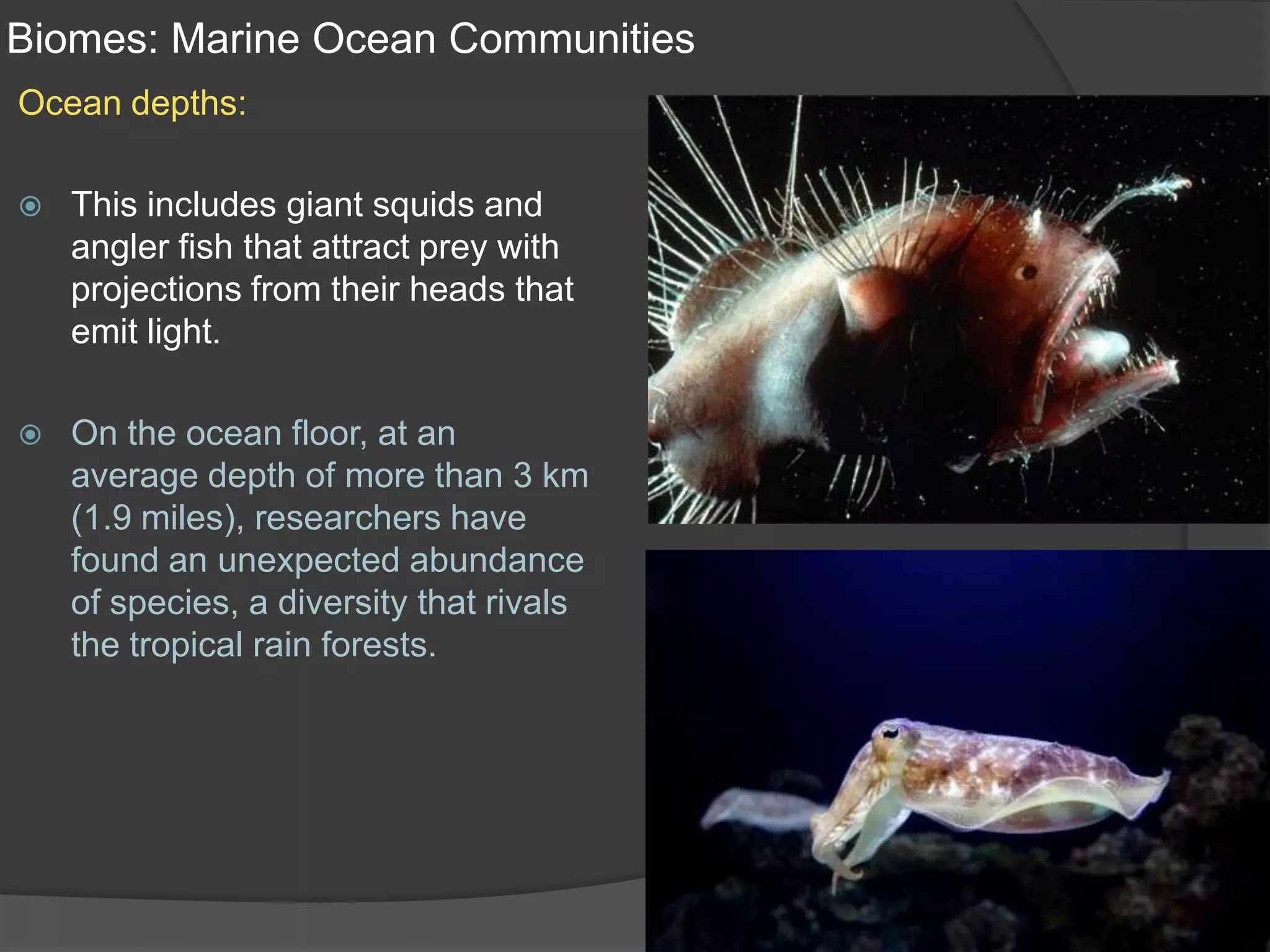
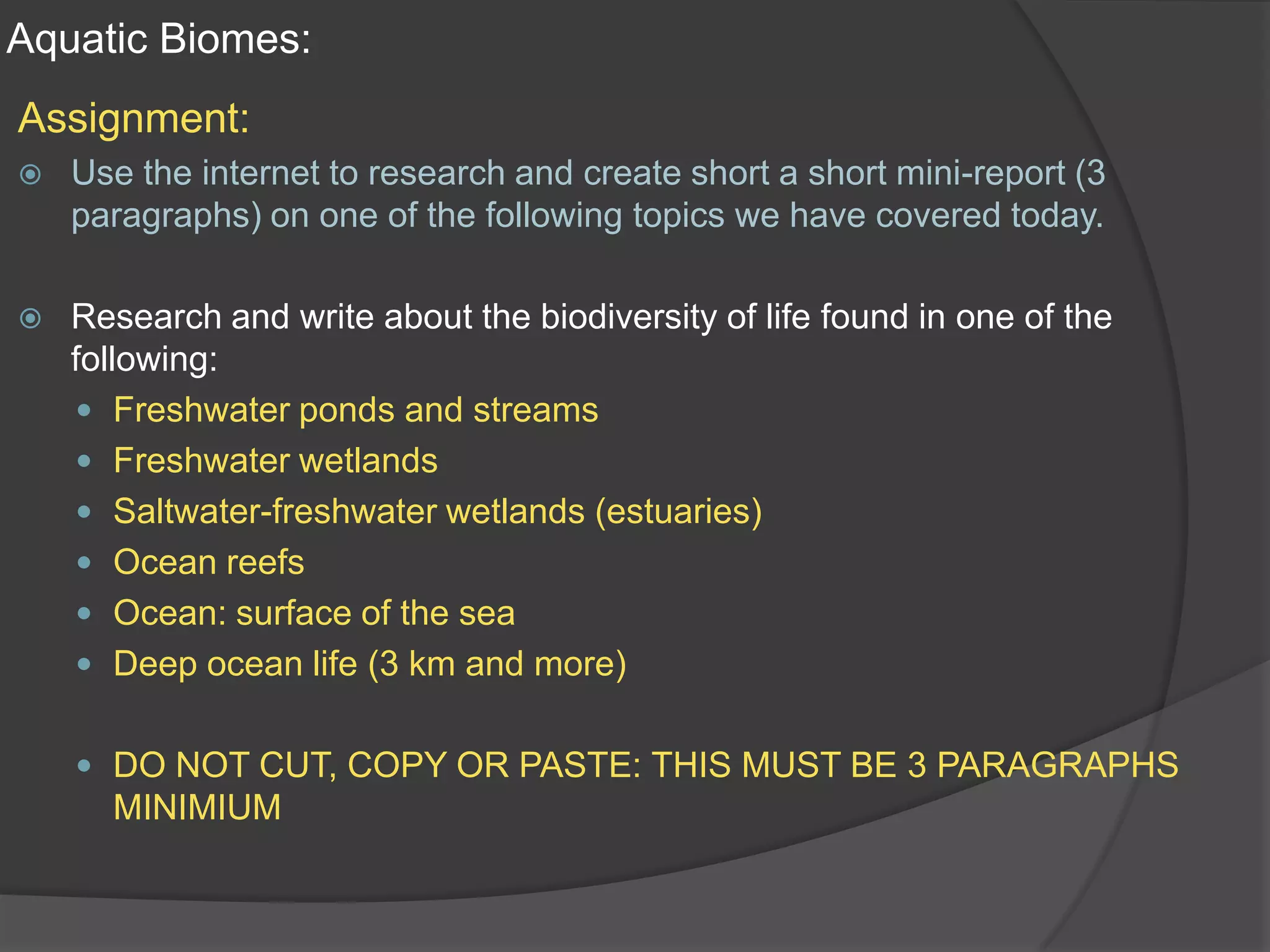
Biomes: Marine Ocean CommunitiesOcean depths:In the deepest waters of the oceans, the marine community lives in total darkness, in deep cold, and under tremendous pressures. Despite these hostile conditions; the deep ocean supports a diverse community of bizarre and unique invertebrates and fishes.
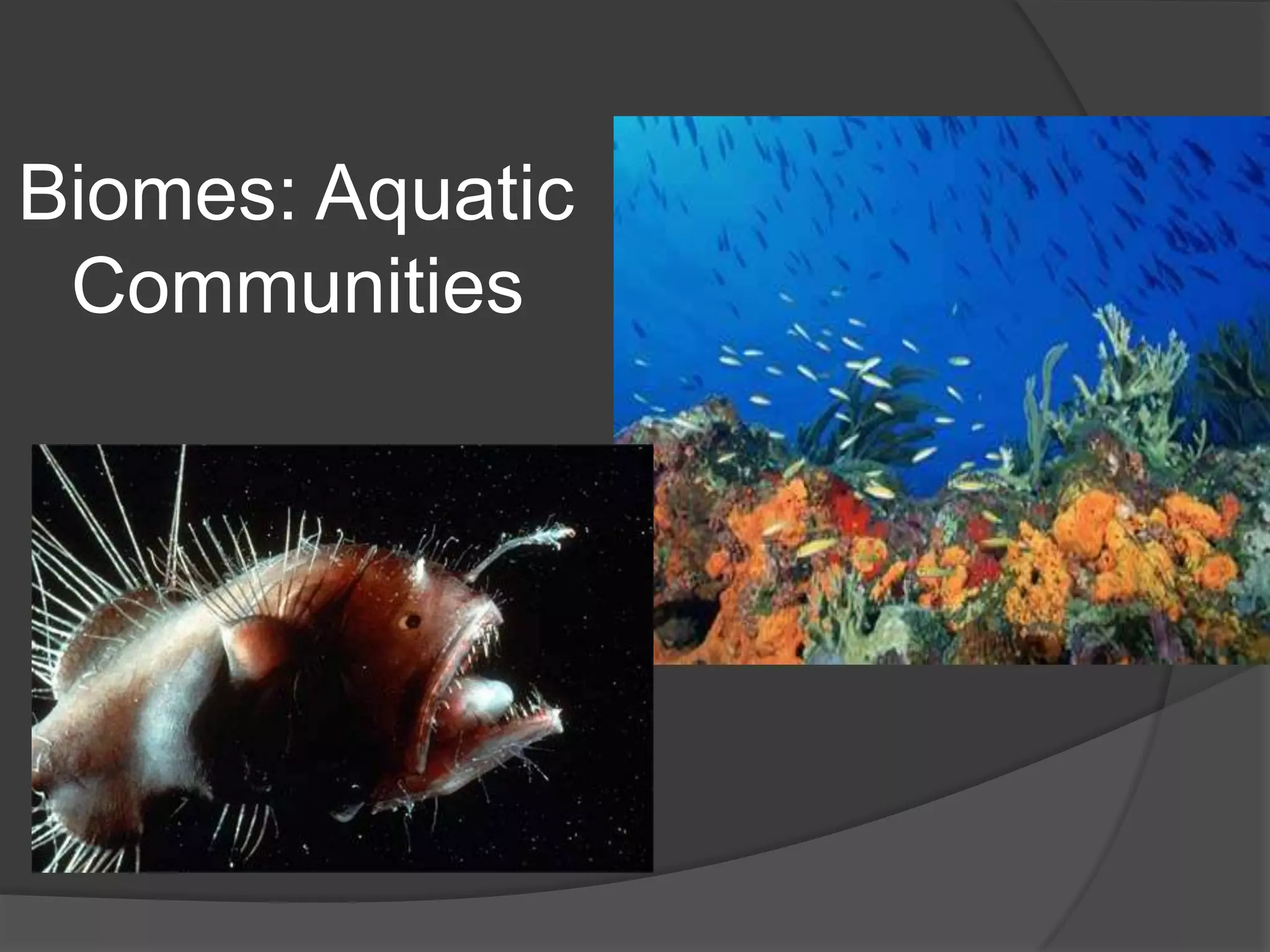
Biomes: Marine Ocean CommunitiesOcean depths:This includes giant squids and angler fish that attract prey with projections from their heads that emit light.On the ocean floor, at an average depth of more than 3 km (1.9 miles), researchers have found an unexpected abundance of species, a diversity that rivals the tropical rain forests.
Aquatic Biomes:Assignment:Use the internet to research and create short a short mini-report (3 paragraphs) on one of the following topics we have covered today.Research and write about the biodiversity of life found in one of the following:Freshwater ponds and streamsFreshwater wetlandsSaltwater-freshwater wetlands (estuaries)Ocean reefsOcean: surface of the seaDeep ocean life (3 km and more)DO NOT CUT, COPY OR PASTE: THIS MUST BE 3 PARAGRAPHS MINIMIUM

Aquatic communities

  • 1.
  • 2.
    Biomes: Aquatic CommunitiesFreshwaterCommunities:Freshwater habitats; lakes, ponds, steams and rivers, are very limited in area. Lakes cover only about 1.8 percent of the earth’s surface and rivers only .3 percent.All freshwater habitats are strongly interconnected to terrestrial (land) habitats.
  • 3.
    Biomes: Aquatic CommunitiesFreshwaterCommunities:Many kinds of organisms are restricted to freshwater habitats; including plants, fish, and a variety of arthropods, mollusks, and other invertebrates too small to be seen by the naked eye.Food web showing overlapof aquatic and terrestrial communities
  • 4.
    Biomes: Aquatic CommunitiesFreshwaterCommunities:Ponds and lakes have three zones in which organisms live.The littoral zone is a shallow zone near the shore. Here aquatic plants live along with various predatory insects, amphibians and small fish.
  • 5.
    Biomes: Aquatic CommunitiesFreshwaterCommunities:The limnetic zone refers to the area that is farther away from shore but close to the surface of the water. It is inhabited by floating algae, zooplankton, and fish.
  • 6.
    Biomes: Aquatic CommunitiesFreshwaterCommunities:The profundal zone is a deep water zone that is below the limits of effective light penetration.Numerous bacteria and wormlike organisms that eat debris on the lake’s bottom live in this zone.The breakdown of this debris releases large amounts of nutrients back into the lake. Not all freshwater systems are deep enough to include a profundal zone however.
  • 7.
    Biomes: WetlandsWetlands:Swamps aswell as marshes, bogs and other communities that are covered with a layer of water are called wetlands.Wetlands typically are covered with a layer of water-tolerant plants called hydrophytes. Marsh grasses and cattails are examples of hydrophytes.Wetlands are diverse environments that support a variety of invertebrates, birds, and other animals.
  • 8.
    Biomes: WetlandsWetlands:Wetlands areamong the most productive ecosystems on Earth, exceeded only by coral reefs in their diversity and concentration of species.Wetlands also play a key ecological role by providing water storage basins that moderate flooding, allowing a safe zone that can hold waters when periods of heavy precipitation occurs.
  • 9.
    Biomes: WetlandsWetlands:Many wetlandsare being disrupted by human development as urban communities expand. Government efforts are now underway to protect and conserve wetlands and strict laws regarding building in wetlands are now on the books.
  • 10.
    Biomes: Marine OceanCommunitiesShallow ocean water biome: The zone of shallow water is small in area, but compared with other parts of the ocean, it is inhabited by large numbers of species.The seashore, between high and low tide marks, called the intertidal zone, is home to many species of marine invertebrates.Intertidal zoneCoral reef biome
  • 11.
    Biomes: Marine OceanCommunitiesShallow ocean water biome:Coral reef communities, home to the world’s most diverse species, occur in shallow tropical zones.The world’s greatest fishing areas, such as the Georges Banks off New England, are located in cooler waters, where nutrients washed out from land support huge numbers of fish of all sizes.Coral reef biome
  • 12.
    Biomes: Marine OceanCommunitiesSurface of the open sea:Drifting freely in the upper waters of the ocean is a diverse community of tiny plankton, composed of bacteria, algae, fish larvae, and many small invertebrate animals.Fishes, whales, and invertebrates such as jellyfishes feed on this plankton. Larger fishes and birds, in turn, feed on these smaller fish.planktonBaleen whale feeding on plankton
  • 13.
    Biomes: Marine OceanCommunitiesSurface of the open sea:Photosynthetic plankton that form the base of this food chain account for 40% of all the photosynthesis that takes place on Earth.Because light penetrates water to only a depth of about 100 m (328 ft), this rich community is confined to the ocean’s surface.planktonTVplankton
  • 14.
    Biomes: Marine OceanCommunitiesOcean depths:In the deepest waters of the oceans, the marine community lives in total darkness, in deep cold, and under tremendous pressures. Despite these hostile conditions; the deep ocean supports a diverse community of bizarre and unique invertebrates and fishes.
  • 15.
    Biomes: Marine OceanCommunitiesOcean depths:This includes giant squids and angler fish that attract prey with projections from their heads that emit light.On the ocean floor, at an average depth of more than 3 km (1.9 miles), researchers have found an unexpected abundance of species, a diversity that rivals the tropical rain forests.
  • 16.
    Aquatic Biomes:Assignment:Use theinternet to research and create short a short mini-report (3 paragraphs) on one of the following topics we have covered today.Research and write about the biodiversity of life found in one of the following:Freshwater ponds and streamsFreshwater wetlandsSaltwater-freshwater wetlands (estuaries)Ocean reefsOcean: surface of the seaDeep ocean life (3 km and more)DO NOT CUT, COPY OR PASTE: THIS MUST BE 3 PARAGRAPHS MINIMIUM