A.Dhivya M.Sc.,M.Phil.,
Assistant Professor
Apriori Algorithm
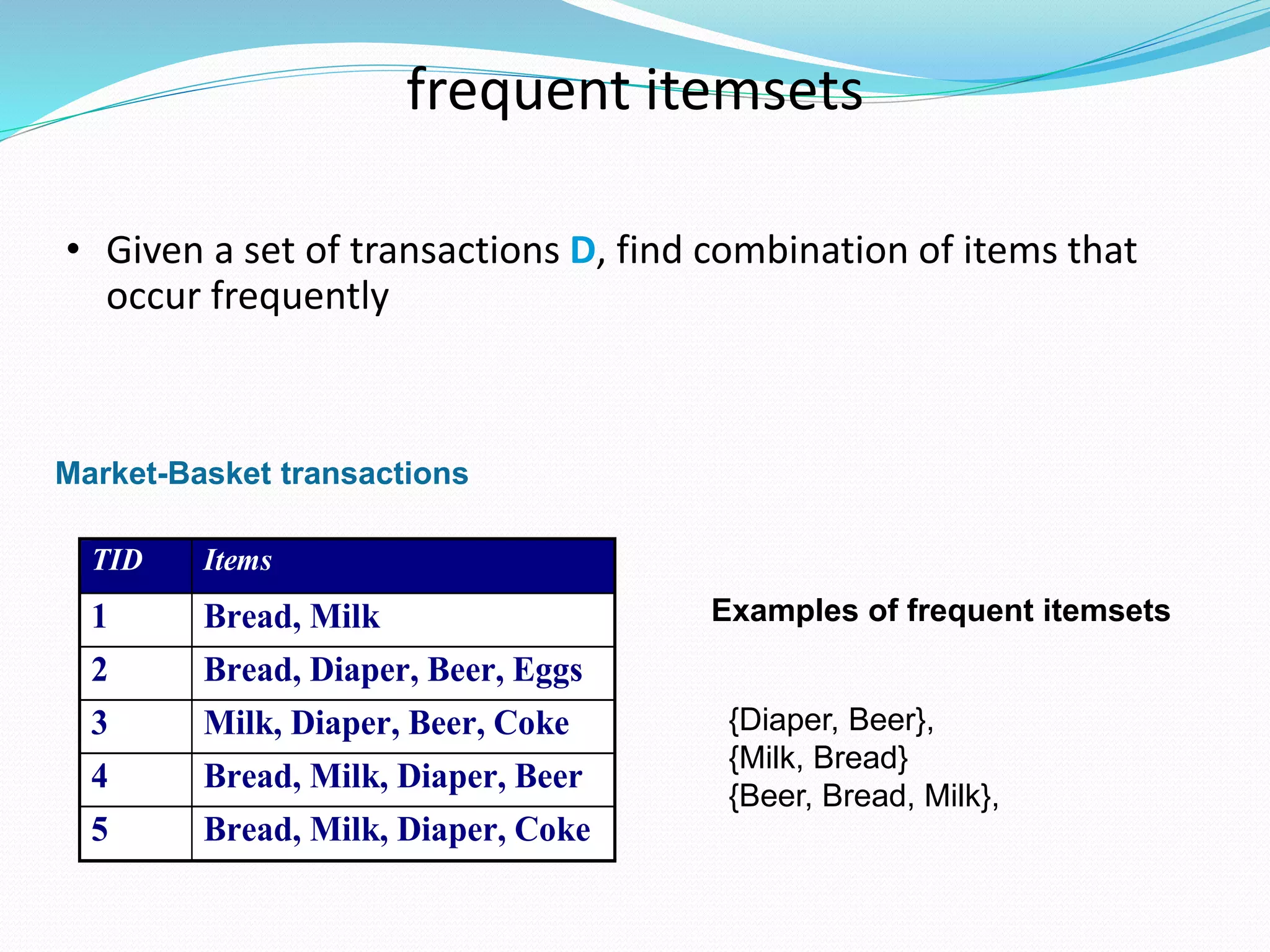
frequent itemsets
• Given a set of transactions D, find combination of items that
occur frequently
Market-Basket transactions
TID Items
1 Bread, Milk
2 Bread, Diaper, Beer, Eggs
3 Milk, Diaper, Beer, Coke
4 Bread, Milk, Diaper, Beer
5 Bread, Milk, Diaper, Coke
Examples of frequent itemsets
{Diaper, Beer},
{Milk, Bread}
{Beer, Bread, Milk},
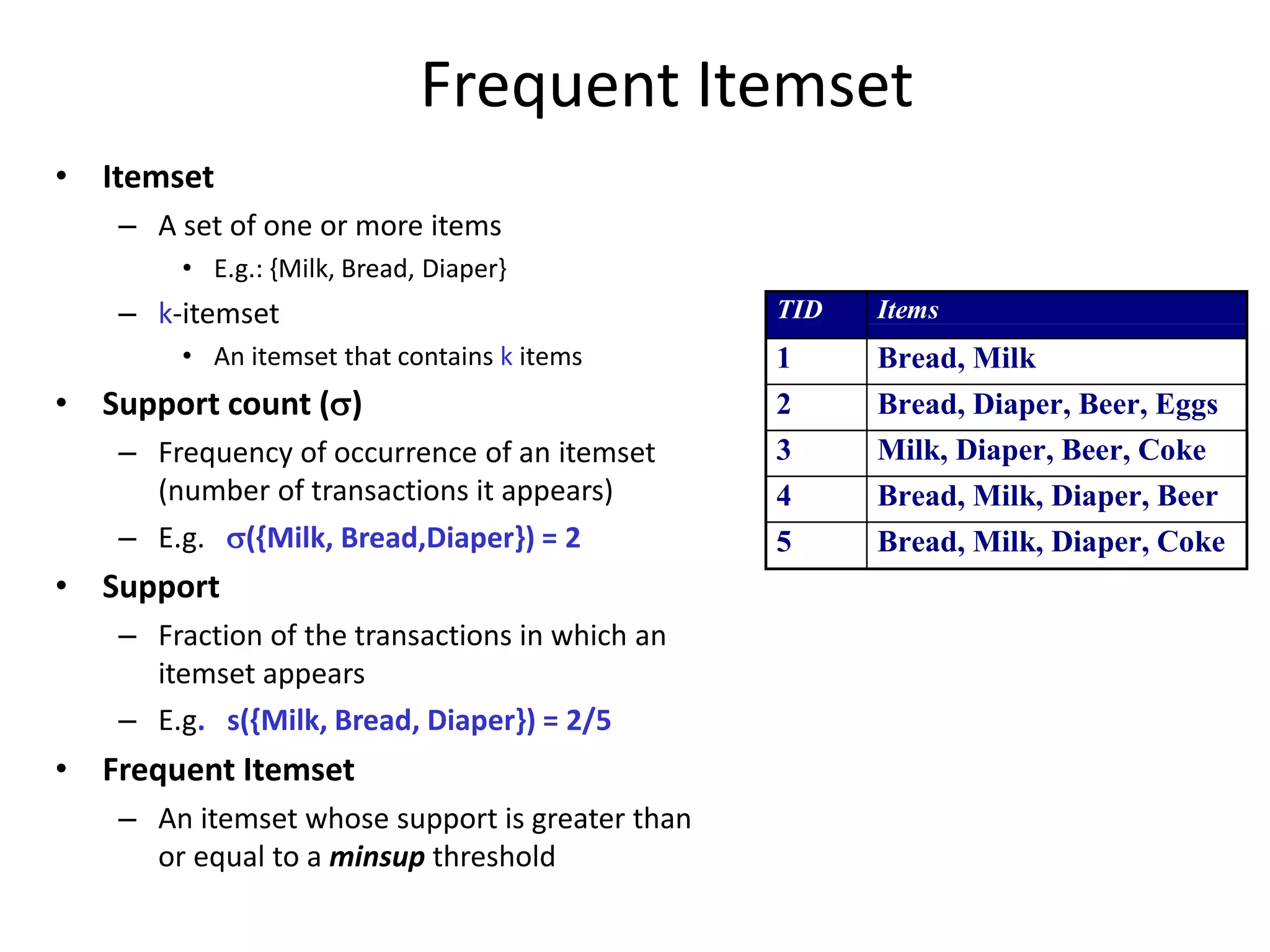
Frequent Itemset
• Itemset
– A set of one or more items
• E.g.: {Milk, Bread, Diaper}
– k-itemset
• An itemset that contains k items
• Support count ()
– Frequency of occurrence of an itemset
(number of transactions it appears)
– E.g. ({Milk, Bread,Diaper}) = 2
• Support
– Fraction of the transactions in which an
itemset appears
– E.g. s({Milk, Bread, Diaper}) = 2/5
• Frequent Itemset
– An itemset whose support is greater than
or equal to a minsup threshold
TID Items
1 Bread, Milk
2 Bread, Diaper, Beer, Eggs
3 Milk, Diaper, Beer, Coke
4 Bread, Milk, Diaper, Beer
5 Bread, Milk, Diaper, Coke
Finding frequent sets
• Given a transaction database D and a minsup threshold find all
frequent itemsets and the frequency of each set in this
collection
• Count the number of times combinations of attributes occur in
the data. If the count of a combination is above minsup report
it.
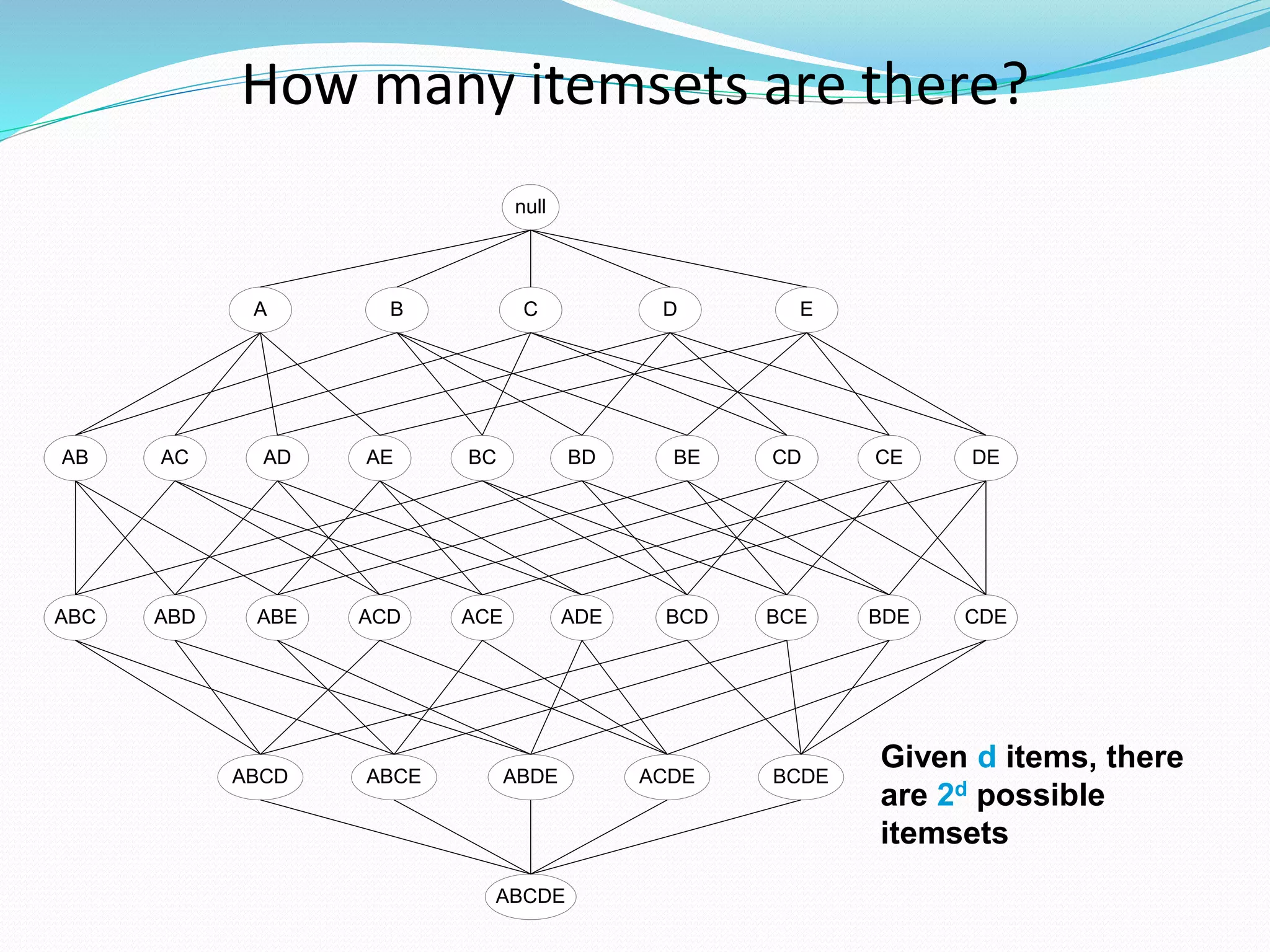
How many itemsets are there?
null
AB AC AD AE BC BD BE CD CE DE
A B C D E
ABC ABD ABE ACD ACE ADE BCD BCE BDE CDE
ABCD ABCE ABDE ACDE BCDE
ABCDE
Given d items, there
are 2d possible
itemsets
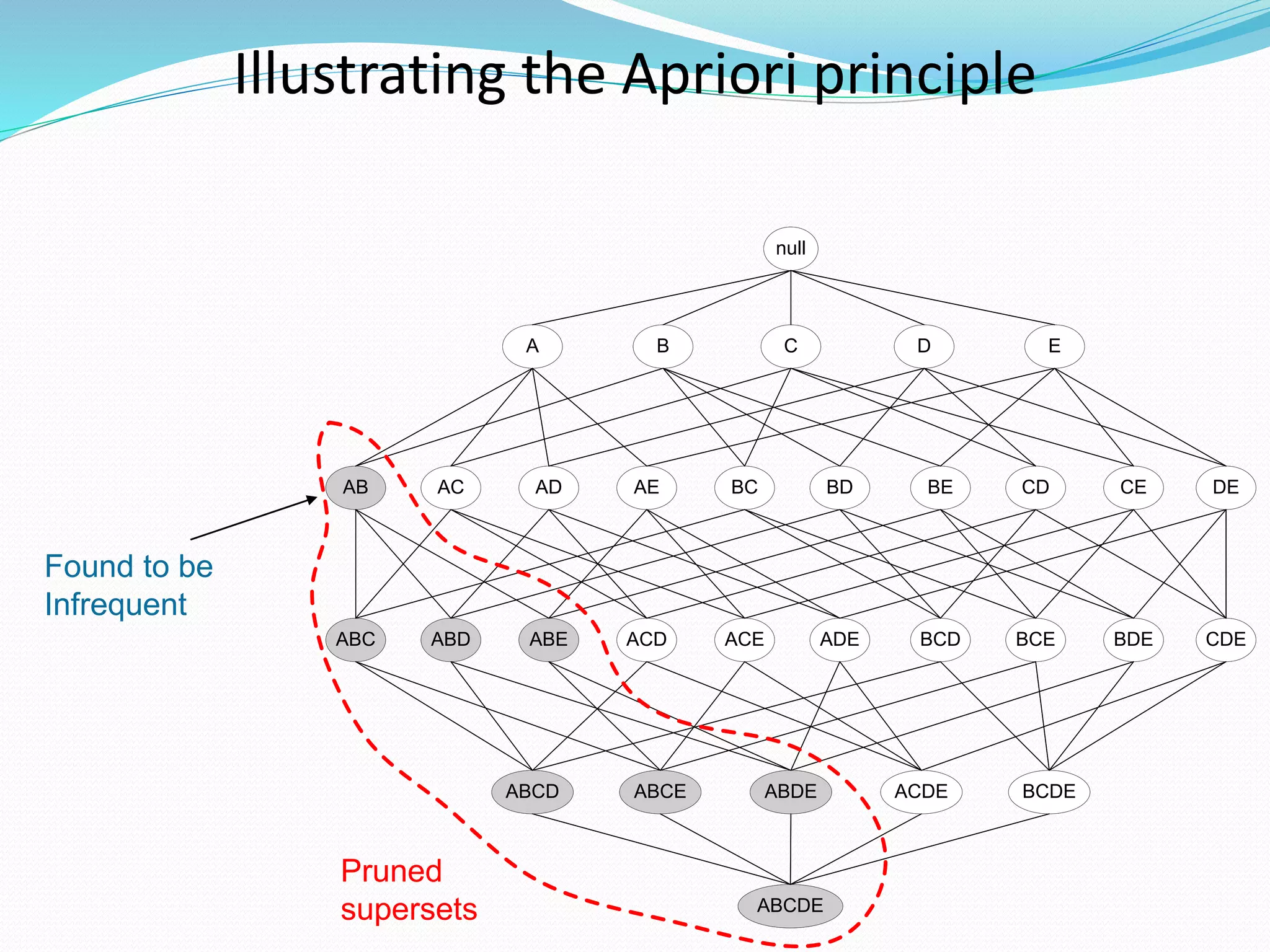
Found to be
Infrequent
null
AB AC AD AE BC BD BE CD CE DE
A B C D E
ABC ABD ABE ACD ACE ADE BCD BCE BDE CDE
ABCD ABCE ABDE ACDE BCDE
ABCDE
Illustrating the Apriori principle
null
AB AC AD AE BC BD BE CD CE DE
A B C D E
ABC ABD ABE ACD ACE ADE BCD BCE BDE CDE
ABCD ABCE ABDE ACDE BCDE
ABCDE
Pruned
supersets
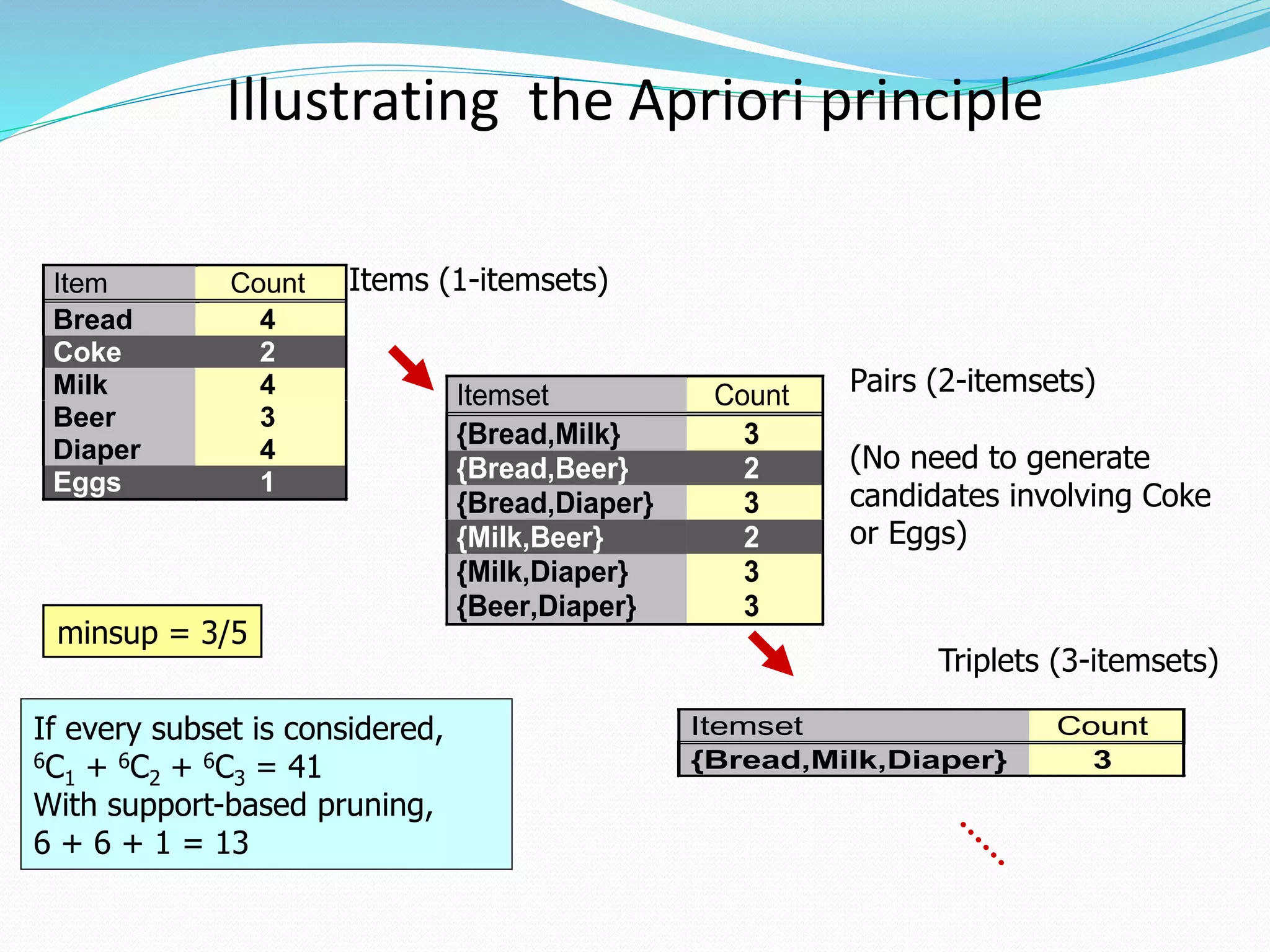
Illustrating the Apriori principle
Item Count
Bread 4
Coke 2
Milk 4
Beer 3
Diaper 4
Eggs 1
Itemset Count
{Bread,Milk} 3
{Bread,Beer} 2
{Bread,Diaper} 3
{Milk,Beer} 2
{Milk,Diaper} 3
{Beer,Diaper} 3
Itemset Count
{Bread,Milk,Diaper} 3
Items (1-itemsets)
Pairs (2-itemsets)
(No need to generate
candidates involving Coke
or Eggs)
Triplets (3-itemsets)
minsup = 3/5
If every subset is considered,
6C1 + 6C2 + 6C3 = 41
With support-based pruning,
6 + 6 + 1 = 13
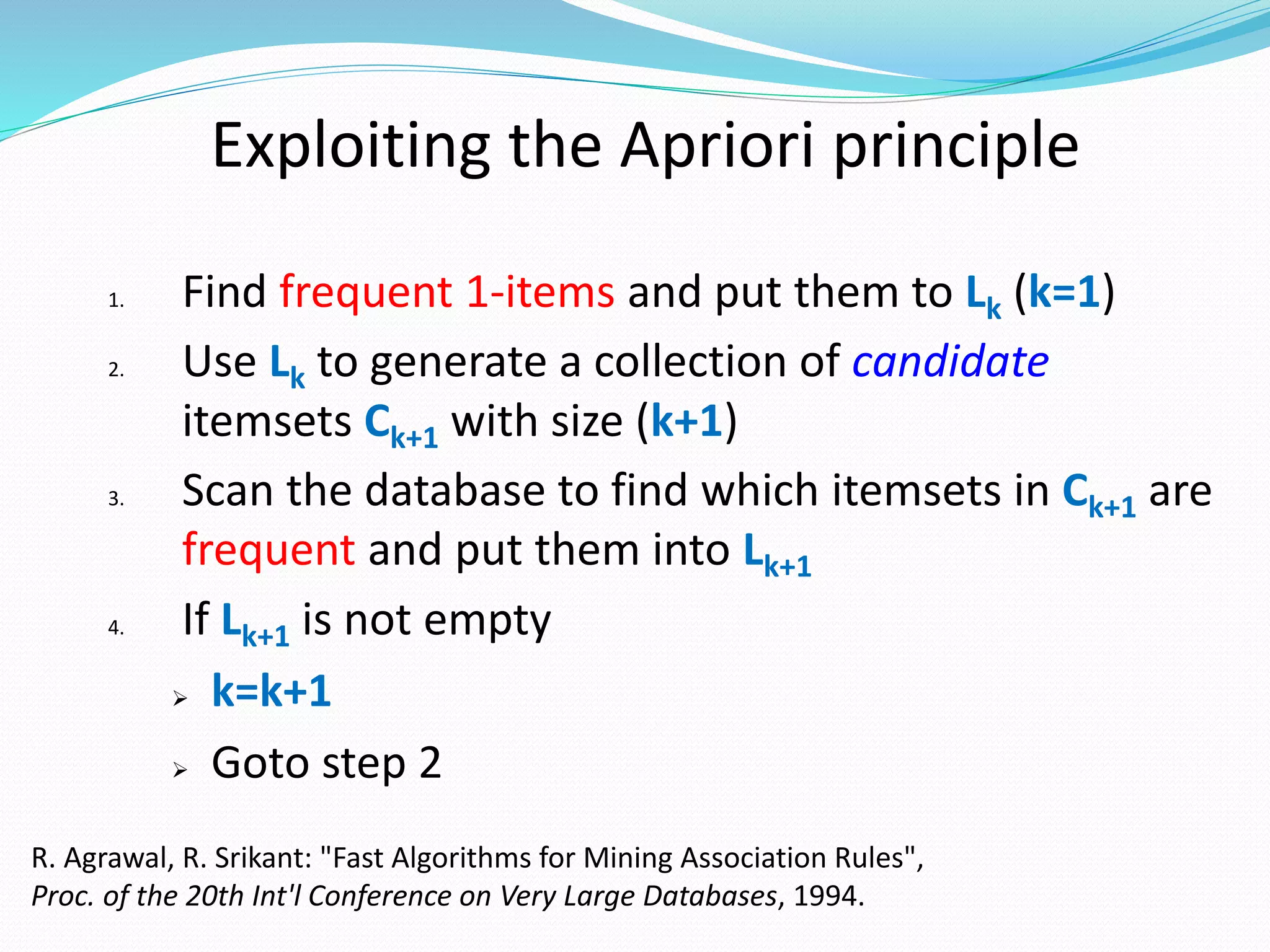
Exploiting the Apriori principle
1. Find frequent 1-items and put them to Lk (k=1)
2. Use Lk to generate a collection of candidate
itemsets Ck+1 with size (k+1)
3. Scan the database to find which itemsets in Ck+1 are
frequent and put them into Lk+1
4. If Lk+1 is not empty
 k=k+1
 Goto step 2
R. Agrawal, R. Srikant: "Fast Algorithms for Mining Association Rules",
Proc. of the 20th Int'l Conference on Very Large Databases, 1994.
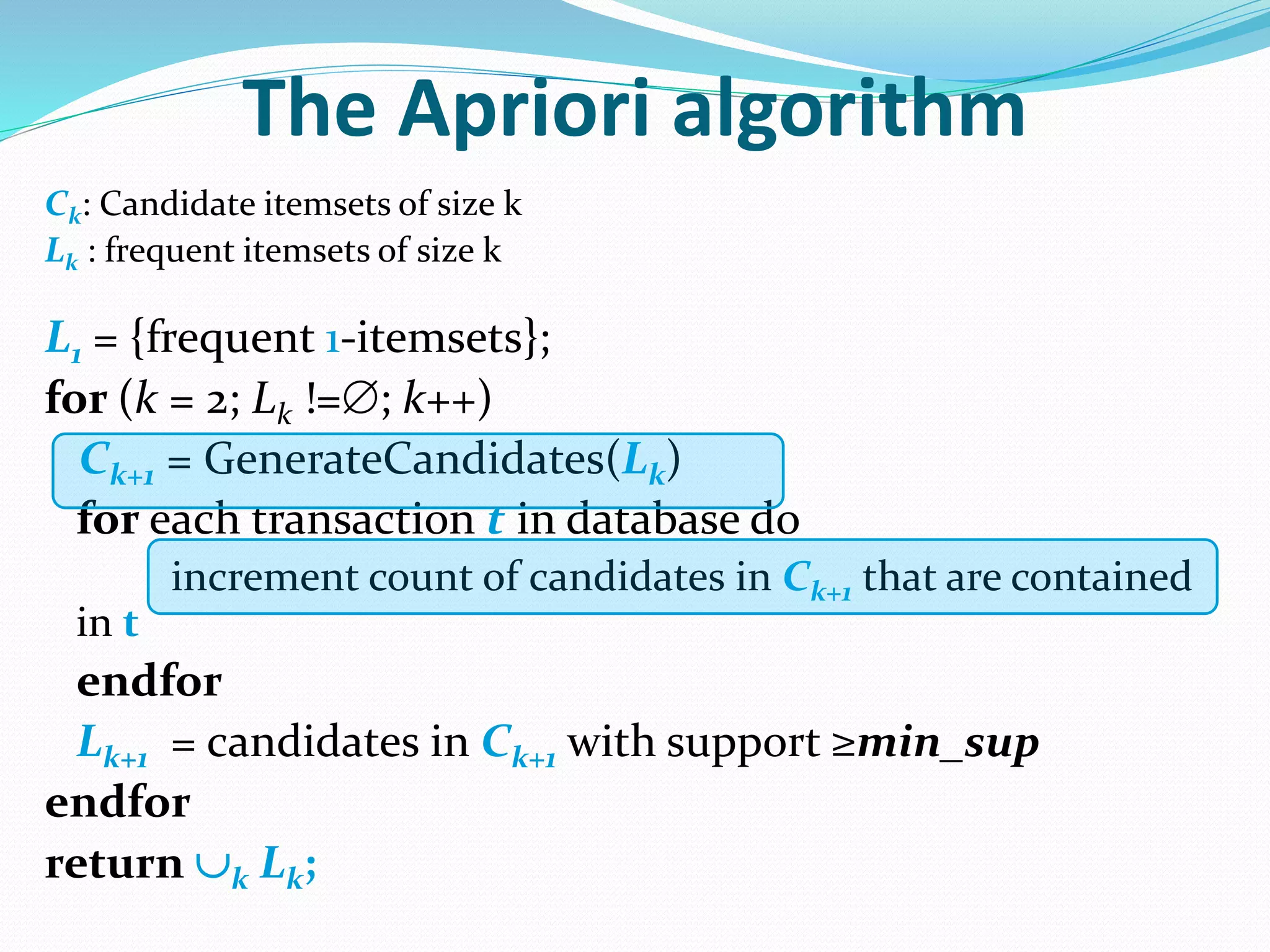
The Apriori algorithm
Ck: Candidate itemsets of size k
Lk : frequent itemsets of size k
L1 = {frequent 1-itemsets};
for (k = 2; Lk !=; k++)
Ck+1 = GenerateCandidates(Lk)
for each transaction t in database do
increment count of candidates in Ck+1 that are contained
in t
endfor
Lk+1 = candidates in Ck+1 with support ≥min_sup
endfor
return k Lk;
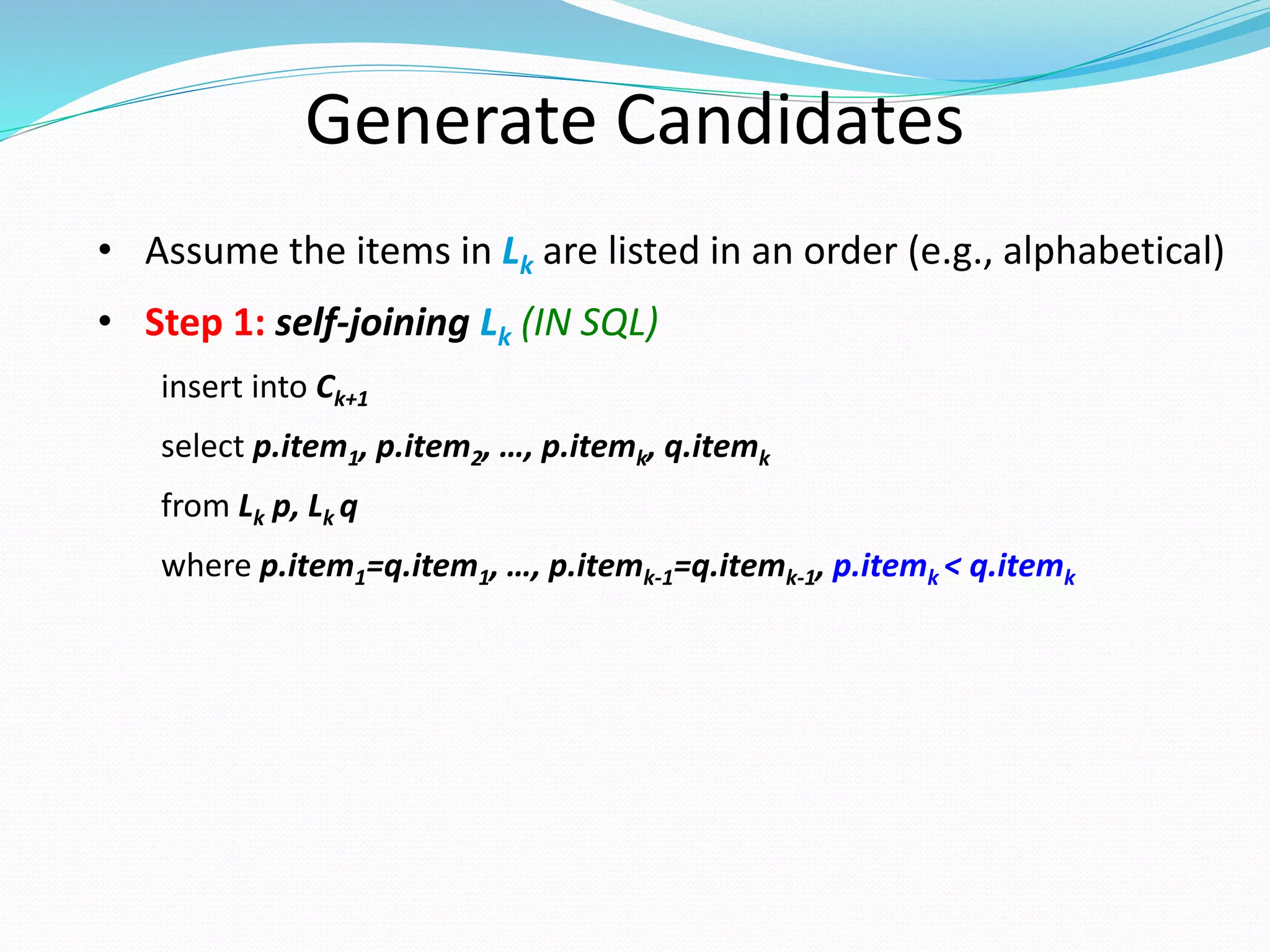
Generate Candidates
• Assume the items in Lk are listed in an order (e.g., alphabetical)
• Step 1: self-joining Lk (IN SQL)
insert into Ck+1
select p.item1, p.item2, …, p.itemk, q.itemk
from Lk p, Lk q
where p.item1=q.item1, …, p.itemk-1=q.itemk-1, p.itemk < q.itemk
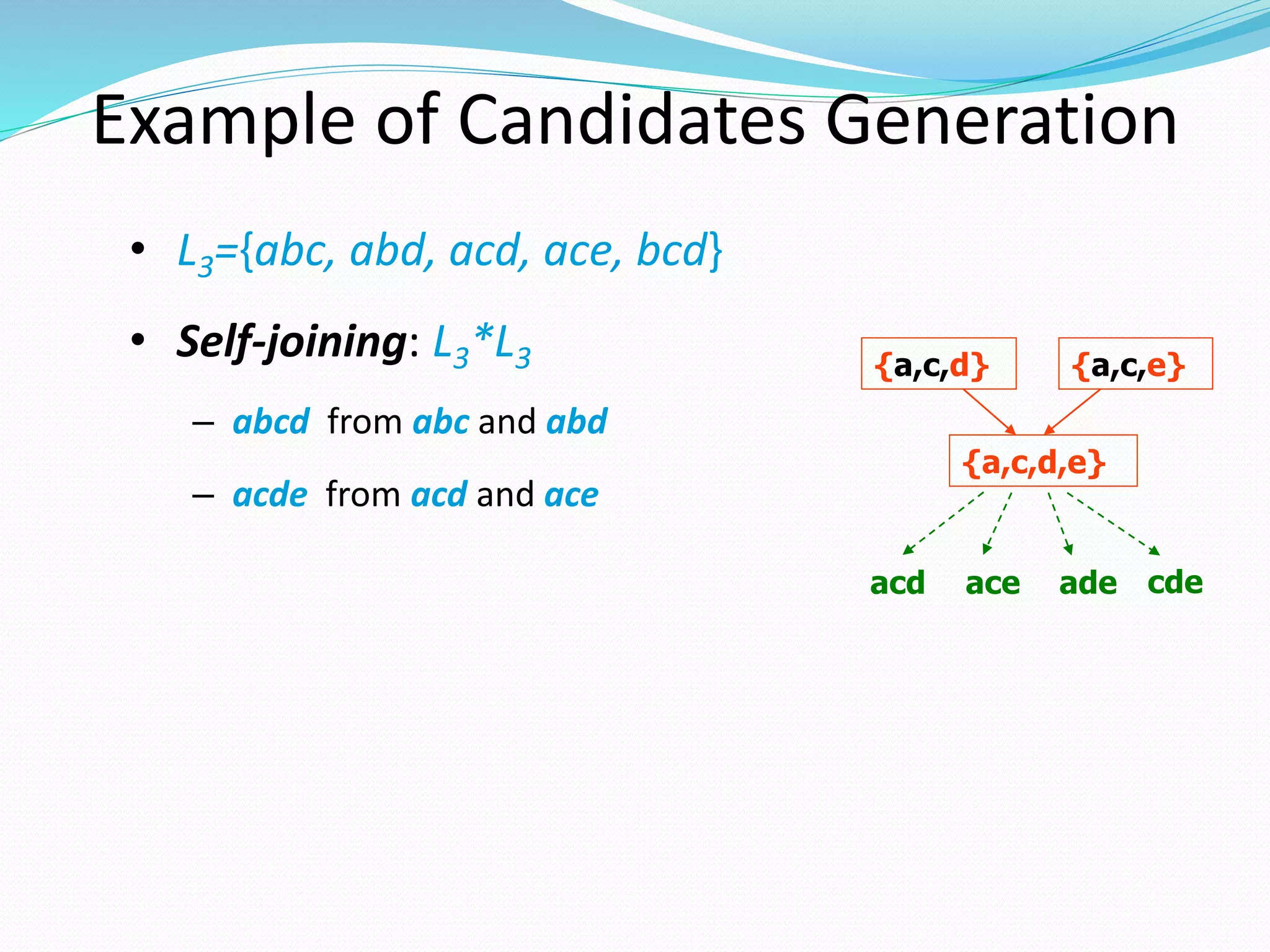
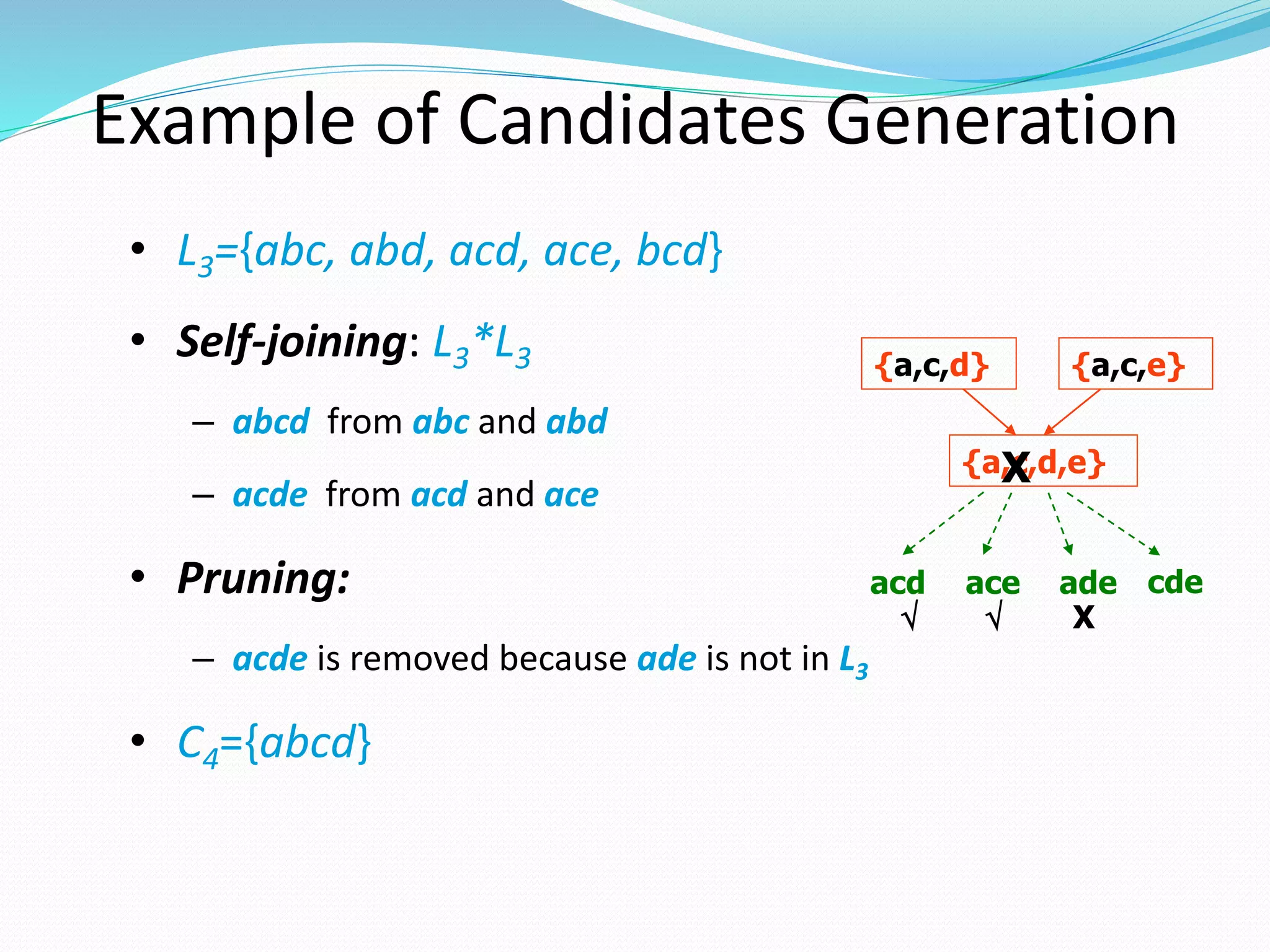
Example of Candidates Generation
• L3={abc, abd, acd, ace, bcd}
• Self-joining: L3*L3
– abcd from abc and abd
– acde from acd and ace
{a,c,d} {a,c,e}
{a,c,d,e}
acd ace ade cde
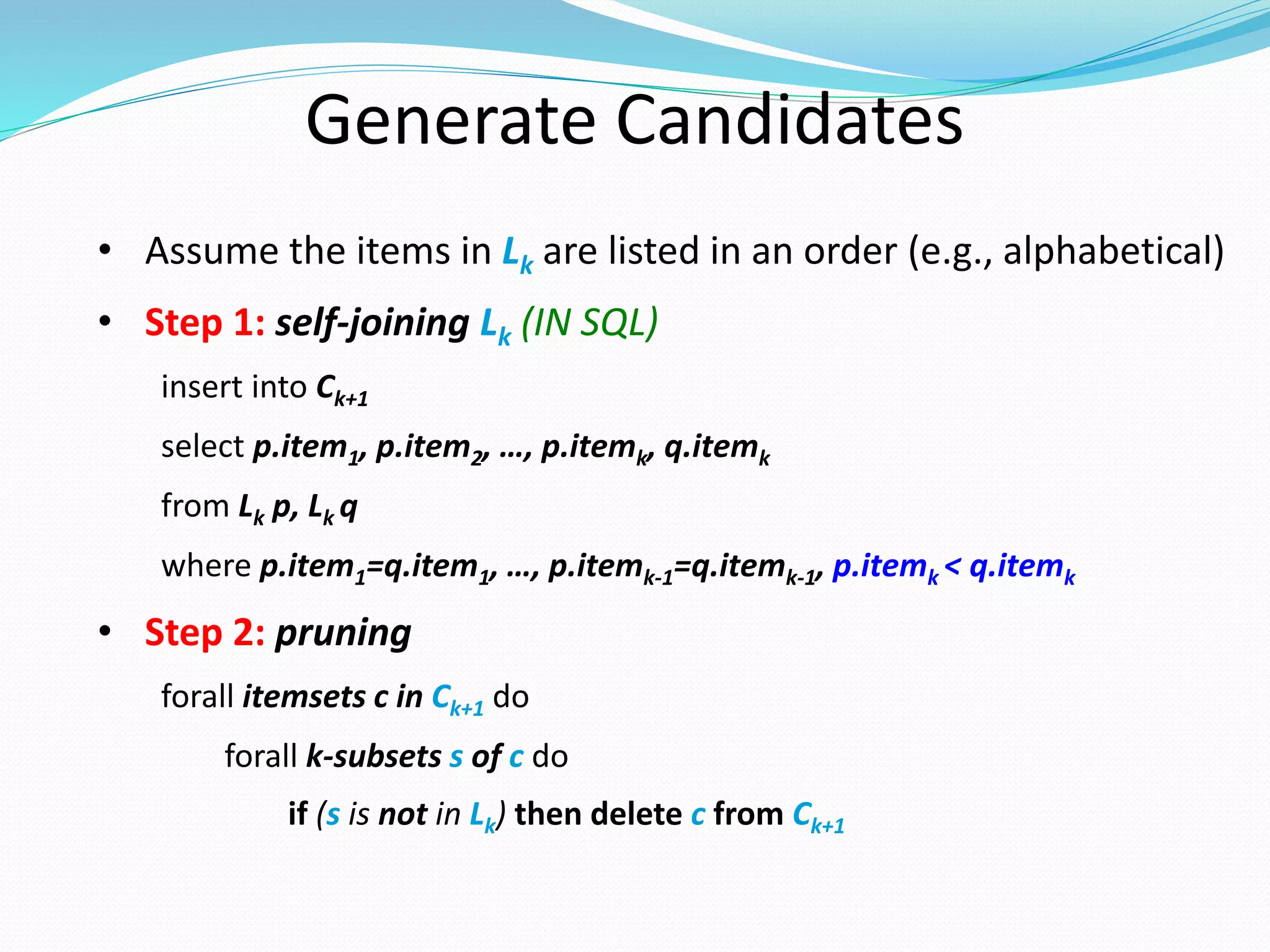
Generate Candidates
• Assume the items in Lk are listed in an order (e.g., alphabetical)
• Step 1: self-joining Lk (IN SQL)
insert into Ck+1
select p.item1, p.item2, …, p.itemk, q.itemk
from Lk p, Lk q
where p.item1=q.item1, …, p.itemk-1=q.itemk-1, p.itemk < q.itemk
• Step 2: pruning
forall itemsets c in Ck+1 do
forall k-subsets s of c do
if (s is not in Lk) then delete c from Ck+1
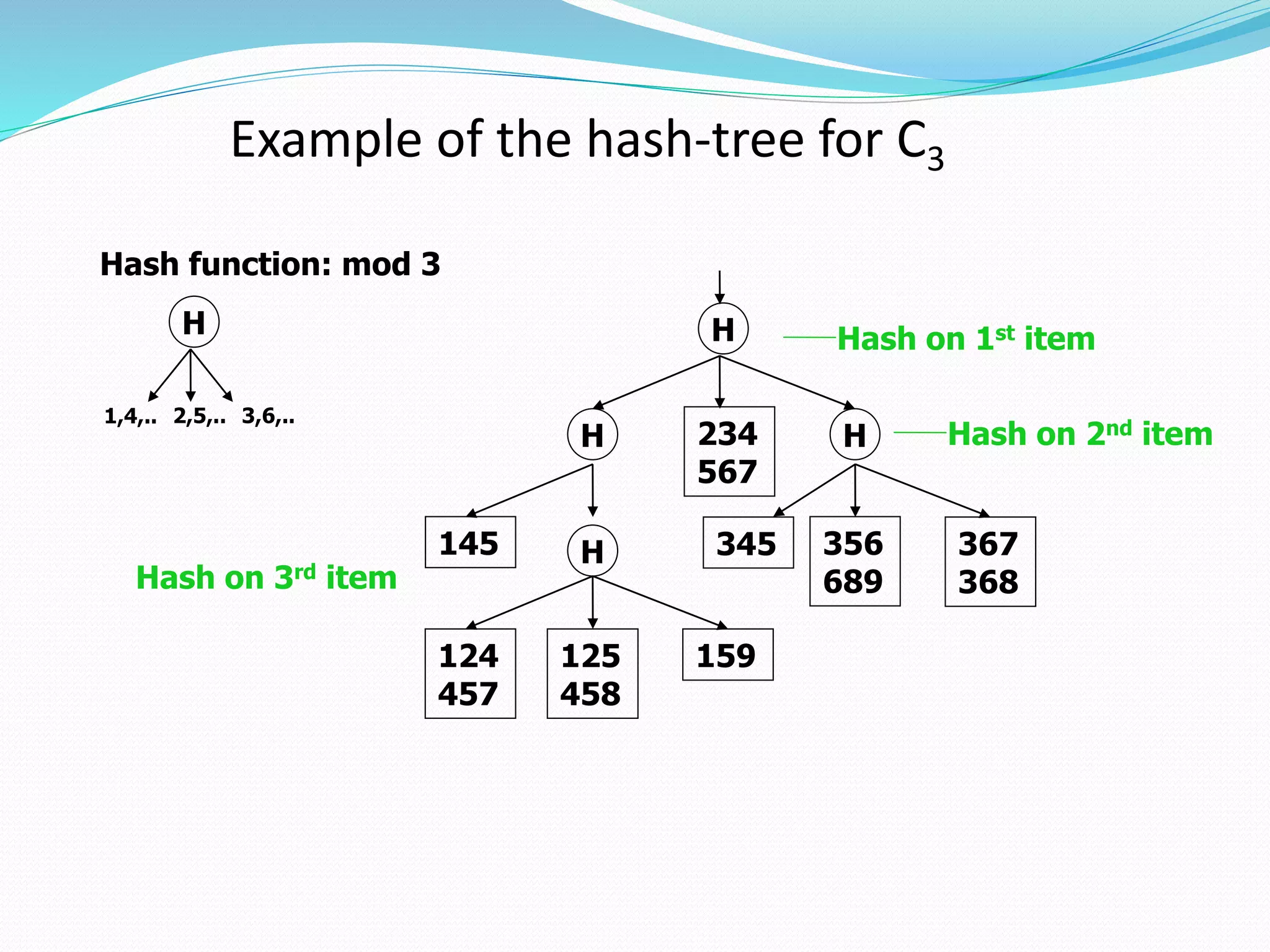
Example of Candidates Generation
• L3={abc, abd, acd, ace, bcd}
• Self-joining: L3*L3
– abcd from abc and abd
– acde from acd and ace
• Pruning:
– acde is removed because ade is not in L3
• C4={abcd}
{a,c,d} {a,c,e}
{a,c,d,e}
acd ace ade cde
  X
X
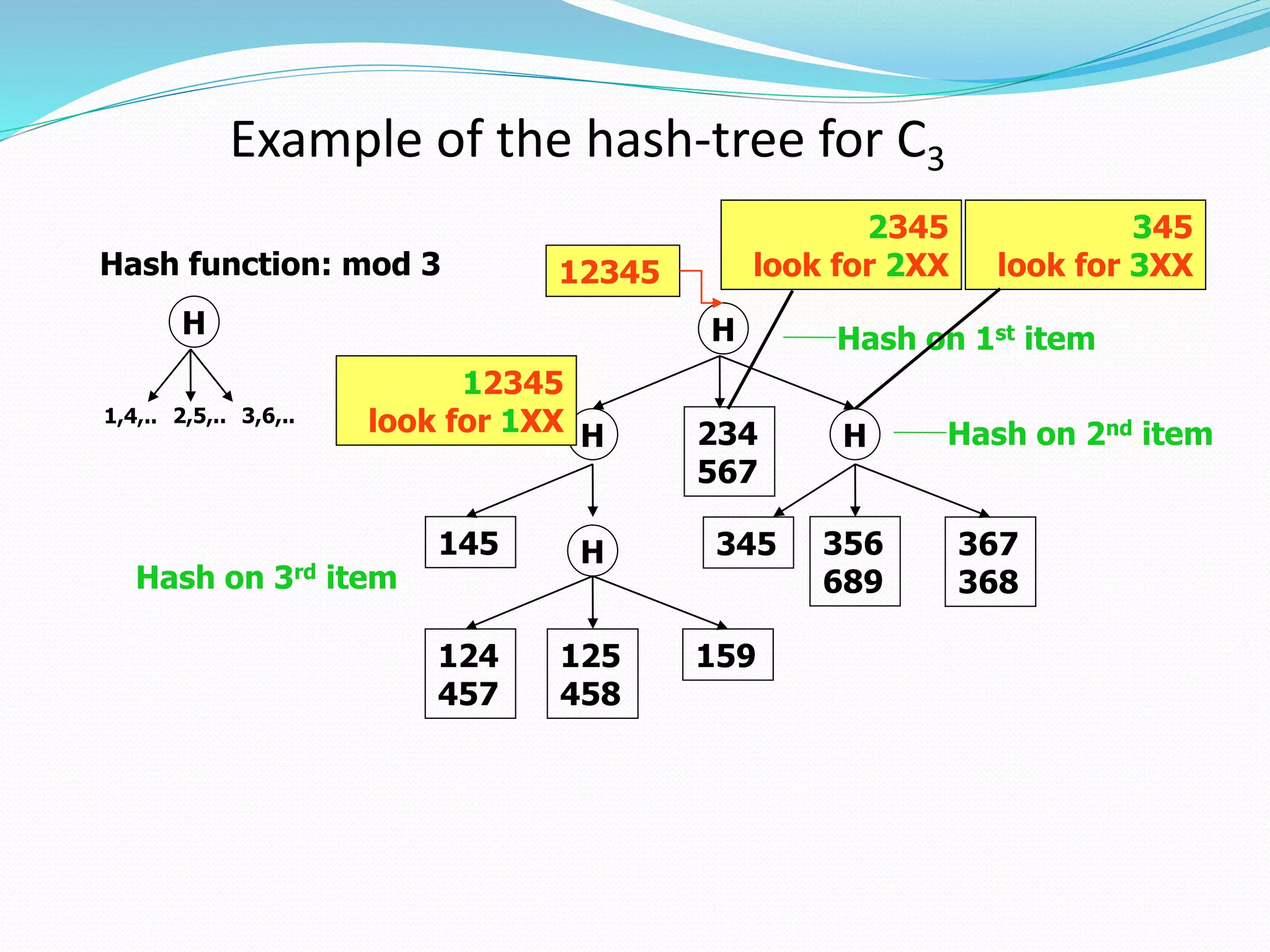
Example of the hash-tree for C3
Hash function: mod 3
H
1,4,.. 2,5,.. 3,6,..
H Hash on 1st item
H H234
567
H145
124
457
125
458
159
345 356
689
367
368
Hash on 2nd item
Hash on 3rd item
Example of the hash-tree for C3
Hash function: mod 3
H
1,4,.. 2,5,.. 3,6,..
H Hash on 1st item
H H234
567
H145
124
457
125
458
159
345 356
689
367
368
Hash on 2nd item
Hash on 3rd item
12345
12345
look for 1XX
2345
look for 2XX
345
look for 3XX
Example of the hash-tree for C3
Hash function: mod 3
H
1,4,.. 2,5,.. 3,6,..
H Hash on 1st item
H H234
567
H145
124
457
125
458
159
345 356
689
367
368
Hash on 2nd item
12345
12345
look for 1XX
2345
look for 2XX
345
look for 3XX
12345
look for 12X
12345
look for 13X (null)
12345
look for 14X

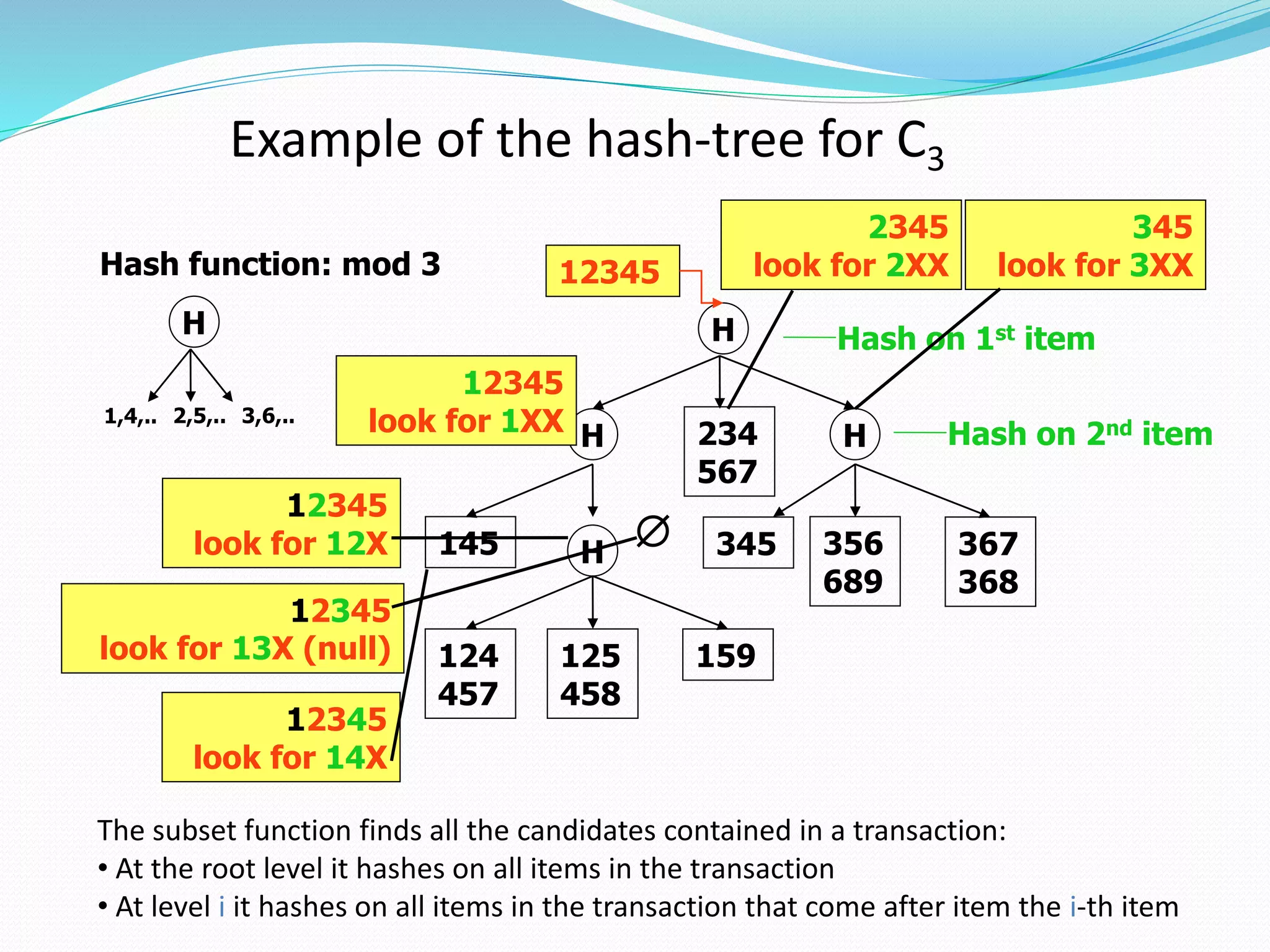
The subset function finds all the candidates contained in a transaction:
• At the root level it hashes on all items in the transaction
• At level i it hashes on all items in the transaction that come after item the i-th item
Apriori algorithm
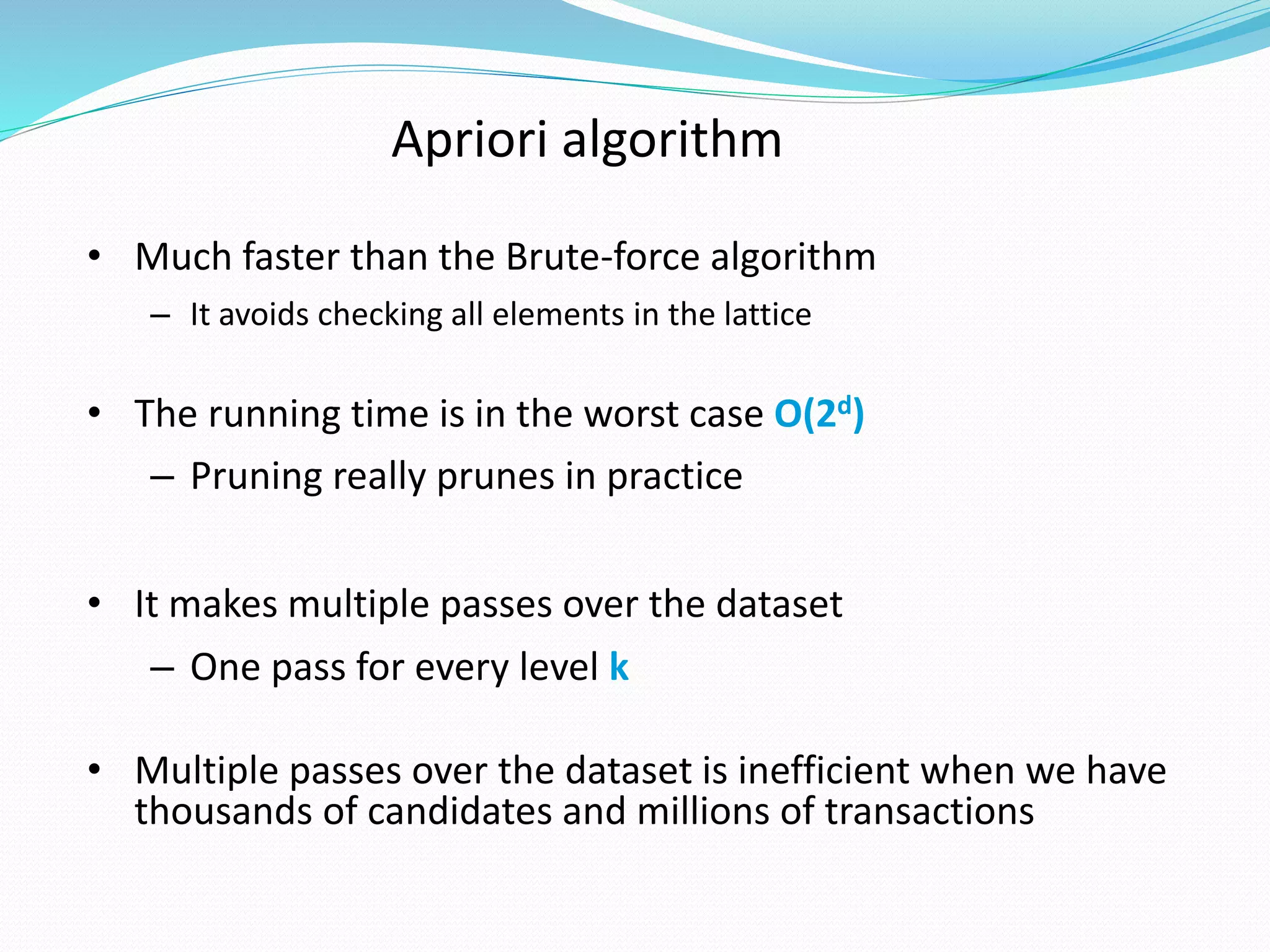
• Much faster than the Brute-force algorithm
– It avoids checking all elements in the lattice
• The running time is in the worst case O(2d)
– Pruning really prunes in practice
• It makes multiple passes over the dataset
– One pass for every level k
• Multiple passes over the dataset is inefficient when we have
thousands of candidates and millions of transactions
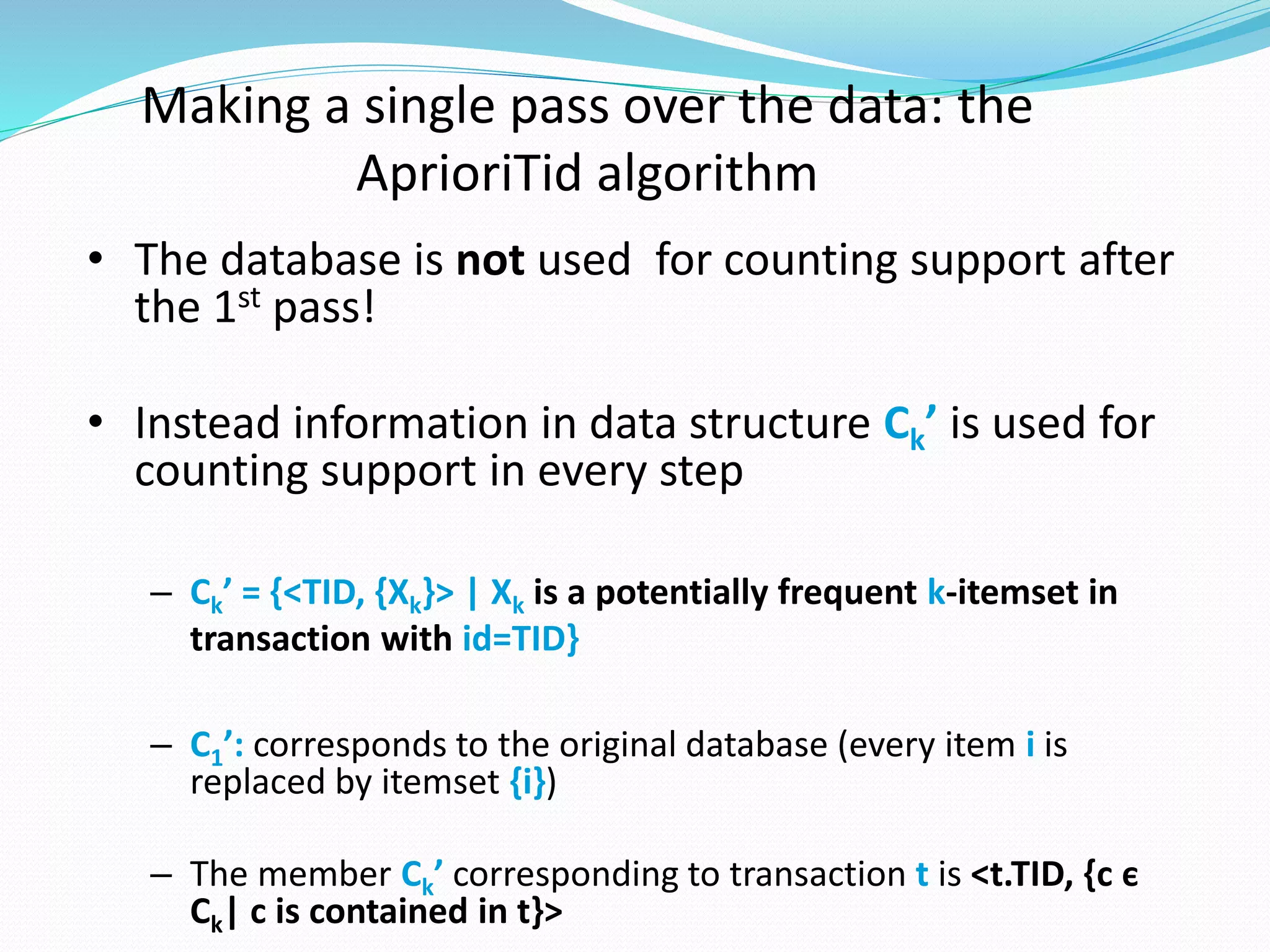
Making a single pass over the data: the
AprioriTid algorithm
• The database is not used for counting support after
the 1st pass!
• Instead information in data structure Ck’ is used for
counting support in every step
– Ck’ = {<TID, {Xk}> | Xk is a potentially frequent k-itemset in
transaction with id=TID}
– C1’: corresponds to the original database (every item i is
replaced by itemset {i})
– The member Ck’ corresponding to transaction t is <t.TID, {c є
Ck| c is contained in t}>
The AprioriTID algorithm
• L1 = {frequent 1-itemsets}
• C1’ = database D
• for (k=2, Lk-1’≠ empty; k++)
Ck = GenerateCandidates(Lk-1)
Ck’ = {}
for all entries t є Ck-1’
Ct= {cє Ck|t[c-c[k]]=1 and t[c-c[k-1]]=1}
for all cє Ct {c.count++}
if (Ct≠ {})
append Ct to Ck’
endif
endfor
Lk= {cє Ck|c.count >= minsup}
endfor
• return Uk Lk
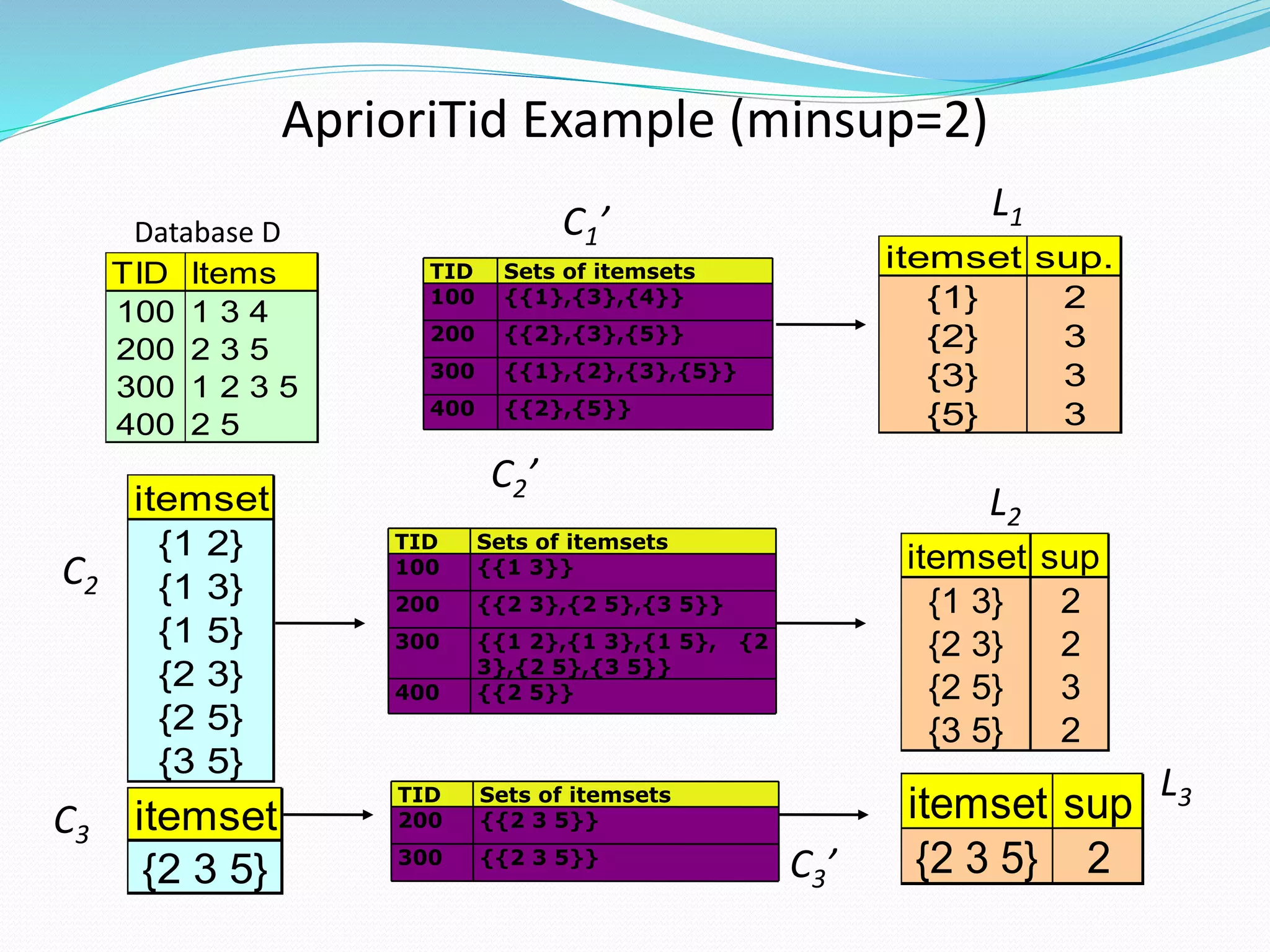
AprioriTid Example (minsup=2)
TID Items
100 1 3 4
200 2 3 5
300 1 2 3 5
400 2 5
Database D
itemset sup.
{1} 2
{2} 3
{3} 3
{5} 3
L1
itemset
{1 2}
{1 3}
{1 5}
{2 3}
{2 5}
{3 5}
itemset sup
{1 3} 2
{2 3} 2
{2 5} 3
{3 5} 2
L2
C2
C3’
itemset
{2 3 5}
itemset sup
{2 3 5} 2
TID Sets of itemsets
100 {{1},{3},{4}}
200 {{2},{3},{5}}
300 {{1},{2},{3},{5}}
400 {{2},{5}}
C1’
TID Sets of itemsets
100 {{1 3}}
200 {{2 3},{2 5},{3 5}}
300 {{1 2},{1 3},{1 5}, {2
3},{2 5},{3 5}}
400 {{2 5}}
C2’
C3
TID Sets of itemsets
200 {{2 3 5}}
300 {{2 3 5}}
L3
Discussion on the AprioriTID
algorithm
 L1 = {frequent 1-itemsets}
 C1’ = database D
 for (k=2, Lk-1’≠ empty; k++)
Ck = GenerateCandidates(Lk-1)
Ck’ = {}
for all entries t є Ck-1’
Ct= {cє Ck|t[c-c[k]]=1 and t[c-c[k-
1]]=1}
for all cє Ct {c.count++}
if (Ct≠ {})
append Ct to Ck’
endif
endfor
Lk= {cє Ck|c.count >= minsup}
endfor
 return Uk Lk
 One single pass over the
data
 Ck’ is generated from Ck-1’
 For small values of k, Ck’
could be larger than the
database!
 For large values of k, Ck’
can be very small
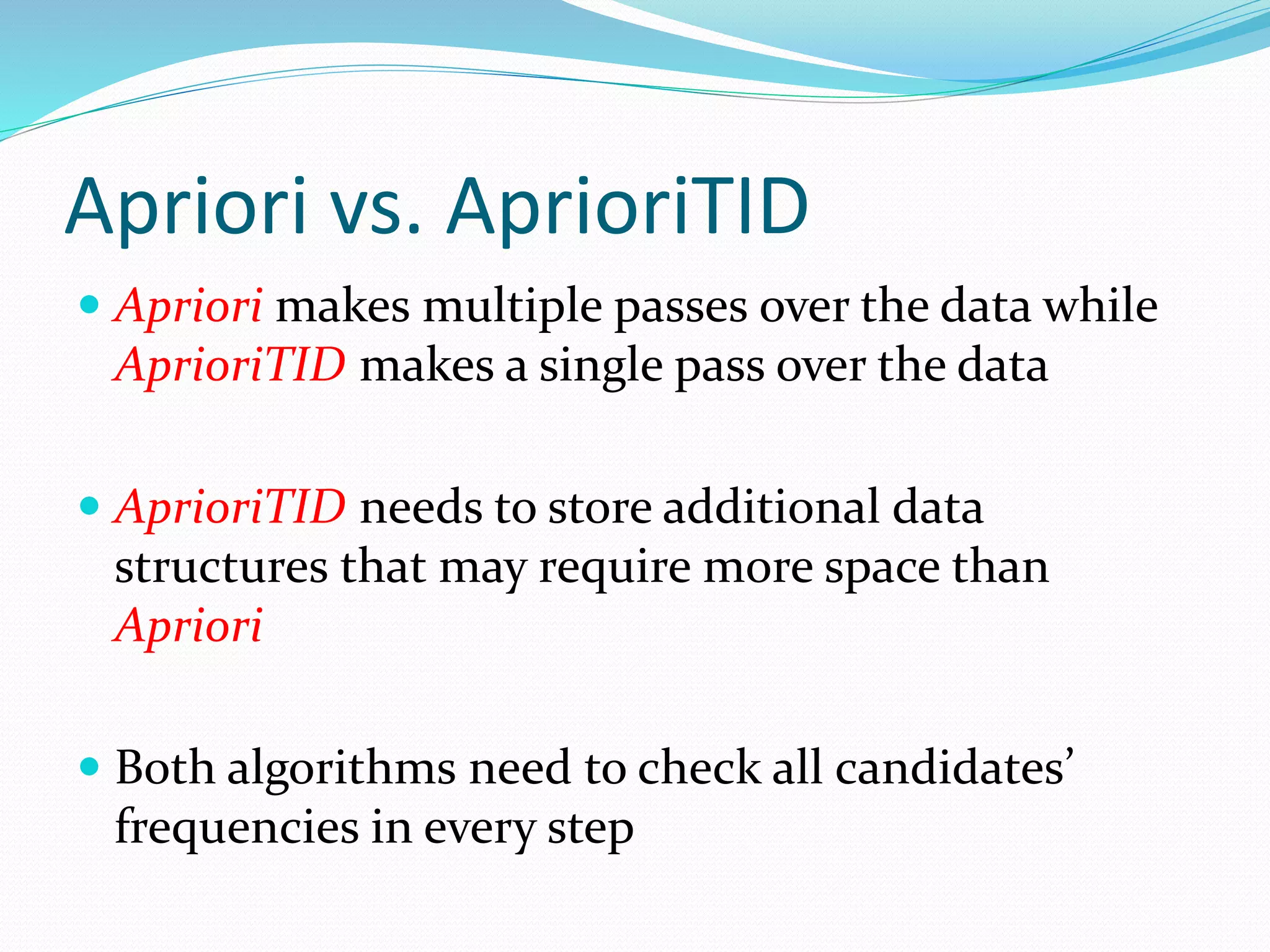
Apriori vs. AprioriTID
 Apriori makes multiple passes over the data while
AprioriTID makes a single pass over the data
 AprioriTID needs to store additional data
structures that may require more space than
Apriori
 Both algorithms need to check all candidates’
frequencies in every step

Apriori algorithm

  • 1.
  • 2.
    frequent itemsets • Givena set of transactions D, find combination of items that occur frequently Market-Basket transactions TID Items 1 Bread, Milk 2 Bread, Diaper, Beer, Eggs 3 Milk, Diaper, Beer, Coke 4 Bread, Milk, Diaper, Beer 5 Bread, Milk, Diaper, Coke Examples of frequent itemsets {Diaper, Beer}, {Milk, Bread} {Beer, Bread, Milk},
  • 3.
    Frequent Itemset • Itemset –A set of one or more items • E.g.: {Milk, Bread, Diaper} – k-itemset • An itemset that contains k items • Support count () – Frequency of occurrence of an itemset (number of transactions it appears) – E.g. ({Milk, Bread,Diaper}) = 2 • Support – Fraction of the transactions in which an itemset appears – E.g. s({Milk, Bread, Diaper}) = 2/5 • Frequent Itemset – An itemset whose support is greater than or equal to a minsup threshold TID Items 1 Bread, Milk 2 Bread, Diaper, Beer, Eggs 3 Milk, Diaper, Beer, Coke 4 Bread, Milk, Diaper, Beer 5 Bread, Milk, Diaper, Coke
  • 4.
    Finding frequent sets •Given a transaction database D and a minsup threshold find all frequent itemsets and the frequency of each set in this collection • Count the number of times combinations of attributes occur in the data. If the count of a combination is above minsup report it.
  • 5.
    How many itemsetsare there? null AB AC AD AE BC BD BE CD CE DE A B C D E ABC ABD ABE ACD ACE ADE BCD BCE BDE CDE ABCD ABCE ABDE ACDE BCDE ABCDE Given d items, there are 2d possible itemsets
  • 6.
    Found to be Infrequent null ABAC AD AE BC BD BE CD CE DE A B C D E ABC ABD ABE ACD ACE ADE BCD BCE BDE CDE ABCD ABCE ABDE ACDE BCDE ABCDE Illustrating the Apriori principle null AB AC AD AE BC BD BE CD CE DE A B C D E ABC ABD ABE ACD ACE ADE BCD BCE BDE CDE ABCD ABCE ABDE ACDE BCDE ABCDE Pruned supersets
  • 7.
    Illustrating the Aprioriprinciple Item Count Bread 4 Coke 2 Milk 4 Beer 3 Diaper 4 Eggs 1 Itemset Count {Bread,Milk} 3 {Bread,Beer} 2 {Bread,Diaper} 3 {Milk,Beer} 2 {Milk,Diaper} 3 {Beer,Diaper} 3 Itemset Count {Bread,Milk,Diaper} 3 Items (1-itemsets) Pairs (2-itemsets) (No need to generate candidates involving Coke or Eggs) Triplets (3-itemsets) minsup = 3/5 If every subset is considered, 6C1 + 6C2 + 6C3 = 41 With support-based pruning, 6 + 6 + 1 = 13
  • 8.
    Exploiting the Aprioriprinciple 1. Find frequent 1-items and put them to Lk (k=1) 2. Use Lk to generate a collection of candidate itemsets Ck+1 with size (k+1) 3. Scan the database to find which itemsets in Ck+1 are frequent and put them into Lk+1 4. If Lk+1 is not empty  k=k+1  Goto step 2 R. Agrawal, R. Srikant: "Fast Algorithms for Mining Association Rules", Proc. of the 20th Int'l Conference on Very Large Databases, 1994.
  • 9.
    The Apriori algorithm Ck:Candidate itemsets of size k Lk : frequent itemsets of size k L1 = {frequent 1-itemsets}; for (k = 2; Lk !=; k++) Ck+1 = GenerateCandidates(Lk) for each transaction t in database do increment count of candidates in Ck+1 that are contained in t endfor Lk+1 = candidates in Ck+1 with support ≥min_sup endfor return k Lk;
  • 10.
    Generate Candidates • Assumethe items in Lk are listed in an order (e.g., alphabetical) • Step 1: self-joining Lk (IN SQL) insert into Ck+1 select p.item1, p.item2, …, p.itemk, q.itemk from Lk p, Lk q where p.item1=q.item1, …, p.itemk-1=q.itemk-1, p.itemk < q.itemk
  • 11.
    Example of CandidatesGeneration • L3={abc, abd, acd, ace, bcd} • Self-joining: L3*L3 – abcd from abc and abd – acde from acd and ace {a,c,d} {a,c,e} {a,c,d,e} acd ace ade cde
  • 12.
    Generate Candidates • Assumethe items in Lk are listed in an order (e.g., alphabetical) • Step 1: self-joining Lk (IN SQL) insert into Ck+1 select p.item1, p.item2, …, p.itemk, q.itemk from Lk p, Lk q where p.item1=q.item1, …, p.itemk-1=q.itemk-1, p.itemk < q.itemk • Step 2: pruning forall itemsets c in Ck+1 do forall k-subsets s of c do if (s is not in Lk) then delete c from Ck+1
  • 13.
    Example of CandidatesGeneration • L3={abc, abd, acd, ace, bcd} • Self-joining: L3*L3 – abcd from abc and abd – acde from acd and ace • Pruning: – acde is removed because ade is not in L3 • C4={abcd} {a,c,d} {a,c,e} {a,c,d,e} acd ace ade cde   X X
  • 14.
    Example of thehash-tree for C3 Hash function: mod 3 H 1,4,.. 2,5,.. 3,6,.. H Hash on 1st item H H234 567 H145 124 457 125 458 159 345 356 689 367 368 Hash on 2nd item Hash on 3rd item
  • 15.
    Example of thehash-tree for C3 Hash function: mod 3 H 1,4,.. 2,5,.. 3,6,.. H Hash on 1st item H H234 567 H145 124 457 125 458 159 345 356 689 367 368 Hash on 2nd item Hash on 3rd item 12345 12345 look for 1XX 2345 look for 2XX 345 look for 3XX
  • 16.
    Example of thehash-tree for C3 Hash function: mod 3 H 1,4,.. 2,5,.. 3,6,.. H Hash on 1st item H H234 567 H145 124 457 125 458 159 345 356 689 367 368 Hash on 2nd item 12345 12345 look for 1XX 2345 look for 2XX 345 look for 3XX 12345 look for 12X 12345 look for 13X (null) 12345 look for 14X  The subset function finds all the candidates contained in a transaction: • At the root level it hashes on all items in the transaction • At level i it hashes on all items in the transaction that come after item the i-th item
  • 17.
    Apriori algorithm • Muchfaster than the Brute-force algorithm – It avoids checking all elements in the lattice • The running time is in the worst case O(2d) – Pruning really prunes in practice • It makes multiple passes over the dataset – One pass for every level k • Multiple passes over the dataset is inefficient when we have thousands of candidates and millions of transactions
  • 18.
    Making a singlepass over the data: the AprioriTid algorithm • The database is not used for counting support after the 1st pass! • Instead information in data structure Ck’ is used for counting support in every step – Ck’ = {<TID, {Xk}> | Xk is a potentially frequent k-itemset in transaction with id=TID} – C1’: corresponds to the original database (every item i is replaced by itemset {i}) – The member Ck’ corresponding to transaction t is <t.TID, {c є Ck| c is contained in t}>
  • 19.
    The AprioriTID algorithm •L1 = {frequent 1-itemsets} • C1’ = database D • for (k=2, Lk-1’≠ empty; k++) Ck = GenerateCandidates(Lk-1) Ck’ = {} for all entries t є Ck-1’ Ct= {cє Ck|t[c-c[k]]=1 and t[c-c[k-1]]=1} for all cє Ct {c.count++} if (Ct≠ {}) append Ct to Ck’ endif endfor Lk= {cє Ck|c.count >= minsup} endfor • return Uk Lk
  • 20.
    AprioriTid Example (minsup=2) TIDItems 100 1 3 4 200 2 3 5 300 1 2 3 5 400 2 5 Database D itemset sup. {1} 2 {2} 3 {3} 3 {5} 3 L1 itemset {1 2} {1 3} {1 5} {2 3} {2 5} {3 5} itemset sup {1 3} 2 {2 3} 2 {2 5} 3 {3 5} 2 L2 C2 C3’ itemset {2 3 5} itemset sup {2 3 5} 2 TID Sets of itemsets 100 {{1},{3},{4}} 200 {{2},{3},{5}} 300 {{1},{2},{3},{5}} 400 {{2},{5}} C1’ TID Sets of itemsets 100 {{1 3}} 200 {{2 3},{2 5},{3 5}} 300 {{1 2},{1 3},{1 5}, {2 3},{2 5},{3 5}} 400 {{2 5}} C2’ C3 TID Sets of itemsets 200 {{2 3 5}} 300 {{2 3 5}} L3
  • 21.
    Discussion on theAprioriTID algorithm  L1 = {frequent 1-itemsets}  C1’ = database D  for (k=2, Lk-1’≠ empty; k++) Ck = GenerateCandidates(Lk-1) Ck’ = {} for all entries t є Ck-1’ Ct= {cє Ck|t[c-c[k]]=1 and t[c-c[k- 1]]=1} for all cє Ct {c.count++} if (Ct≠ {}) append Ct to Ck’ endif endfor Lk= {cє Ck|c.count >= minsup} endfor  return Uk Lk  One single pass over the data  Ck’ is generated from Ck-1’  For small values of k, Ck’ could be larger than the database!  For large values of k, Ck’ can be very small
  • 22.
    Apriori vs. AprioriTID Apriori makes multiple passes over the data while AprioriTID makes a single pass over the data  AprioriTID needs to store additional data structures that may require more space than Apriori  Both algorithms need to check all candidates’ frequencies in every step