2/16/2017 Applying “Survival Analysis” to Instructional Design Project Data
http://scalar.usc.edu/works/c2c­digital­magazine­fall­2016­­winter­2017/applying­survival­analysis­to­instructional­design­project­data­?path=index&t=148725… 1/12
Shalin Hai-Jew  Sign out
You have Author privileges
Dashboard | Index | Guide
C2C Digital Magazine (Fall 2016 / Winter 2017)
Colleague 2 Colleague, Author
C2C Digital Magazine
(Fall 2016 / Winter 2017)
1. Cover
2. Issue Navigation
3. Letter from the
Chair: Dr. Anna J.
Catterson
4. Announcing 2016
SIDLIT Award
Winners!
5. Creating Social-
Ready Graphics on
the iPad or Web with
Adobe Spark Post
6. Tiger Range: Real
Uses of Virtual
Technologies at the
Institute for New
Media Studies
7. Making a Simple
Ticket Board using
Qualtrics and Trello
8. Digital Timelines
for Illustration and
Education
9. Shiny App: An
Ef cient and
Creative
Communicator of Big
Data
10. Telling Data
Stories
11. Introduction to
Big Data
12. Dim Screens:
Fighting Burnout in
Online Instruction
13. Facilitating
Online Collaboration
with VoiceThread
14. Interpreting
Creative Common
Licenses in Open
Educational
Resources
15. Taking an
Internet-of-Things
Approach to
Cybersecurity using
Quantum Teams
16. Cluster Analyses
and Related Data
Visualizations in
NVivo 11 Plus
17. Drawing a 2D
Informational
Graphic with
Microsoft Visio
Standard 2016
18. Extracting
Linguistic Patterns
Other paths that intersect here:
Cover, page 20 of 26 Previous page on path     Next page on path
Applying “Survival Analysis” to Instructional Design Project Data
By Shalin Hai­Jew, Kansas State University  
 
Traditionally, “survival analysis” is a statistical representation of the speed of human decline, under varying
health and other conditions.  This representation is based on empirically observed data, and from this data, a
regression curve is extracted­­from which data generalizations may be made (about similar populations in
similar contexts). This data can reveal times of heightened risk, and in that sense, it could indicate possible
critical times for extended surveillance and possible interventions.  
 
Simply, at the beginning of the research (Time Zero), there is a population of individuals who are fully present.
 Over time, members fail to survive and drop out.  At any particular time, there is a survival rate or S(t) which is
known as “survival at time t”.  Survival is conceptualized in part as a factor of time, and it is a factor of “hazard”
or the risk of non­survival.  The higher the hazard rate, the lower the survival rate; the converse is also true:
 the lower the hazard rate, the higher the survival one (these rates have a negative correlation).  
 
As noted earlier, these observations may be applied to other similar populations for deeper understandings.
They may be applied to different populations to see if there are differences in survival rates:  for example, one
group may serve as a control, and another may be the group that receives some intervention to prolong
survival.  The comparisons made are between population curves to observe differences.  With sufficiently large
population sets, there may be an underlying assumption of a normal survival distribution (a Gaussian
distribution), but there is no such assumption for smaller population sets which may be convenient data sets
and which are not particularly random (and therefore not representative of a full normal distribution and not
broadly generalizable). With sufficiently large populations, though, z­scores may be extrapolated, and
statistical significance of findings may be applied.  Also, in terms of data, the longer the time period studied,
the more data that may be included.  


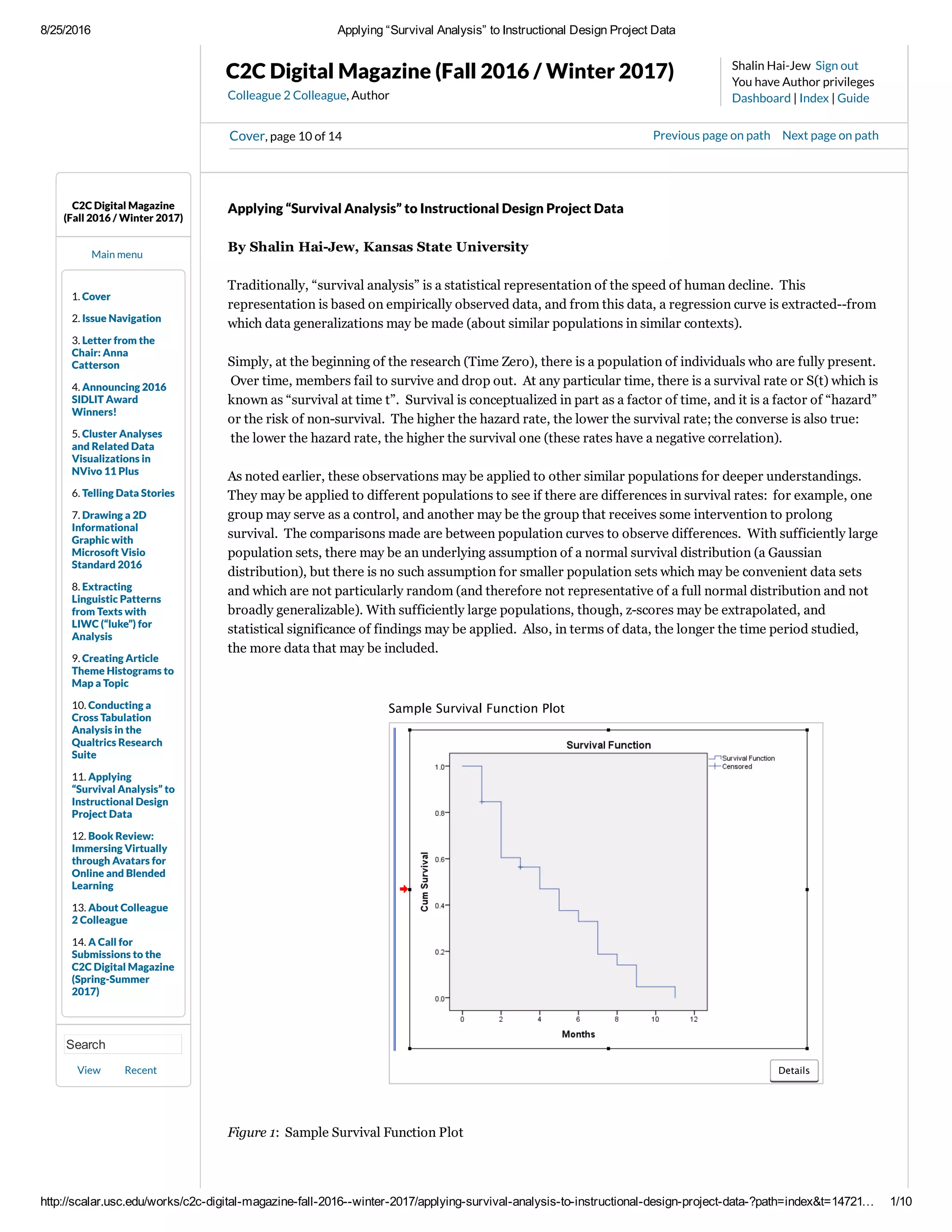
Figure 1:  Sample Survival Function Plot  
Main menu
 
Sample Survival Function Plot Annotations
Details
2/16/2017 Applying “Survival Analysis” to Instructional Design Project Data
http://scalar.usc.edu/works/c2c­digital­magazine­fall­2016­­winter­2017/applying­survival­analysis­to­instructional­design­project­data­?path=index&t=148725… 2/12
from Texts with
LIWC (“luke”) for
Analysis
19. Creating Article
Theme Histograms to
Map a Topic
20. Conducting a
Cross Tabulation
Analysis in the
Qualtrics Research
Suite
21. Applying
“Survival Analysis” to
Instructional Design
Project Data
22. Free Licenses for
all RapidMiner
Products: Machine
Learning without
Coding
23. Book Review:
Immersing Virtually
through Avatars for
Online and Blended
Learning
24. Book Review:
Harnessing Social
Media for Teaching
Composition
25. About Colleague
2 Colleague
26. A Call for
Submissions to the
C2C Digital Magazine
(Spring-Summer
2017)
Search
 
 
What a simple survival analysis graph shows, simply, is the time­to­event of death in a non­increasing line
graph.  (The reason why the line is not described as decreasing is because there are times of plateaus or non­
loss of a member from the original population.)  Another way to think about this is as a measure of attrition
from a particular population over time.  Time may be measured as a continuous set of values or as discrete
ones.  In this example, time is treated as discrete and measured in monthly units (more granularly measured
time is not necessary in this example).  
 
The hazard function is seen to be non­decreasing and will trend up with cumulative hazard over time.  The
“hazard” concept is something like “risk” based on empirical observations of events.  In a simple survival
analysis model, hazard is a constant over time.  In real world contexts and more sensitive models, the hazard
function changes over time and may increase or decrease.  (A classic example of a hazard curve is the "bathtub
curve," which is intuitive and worth a look.)   
 
"Censoring"
 
So why don’t statisticians just use a normal linear regression to capture such changes over time?  The thinking
is that survival analyses include "censored" data in the time­series analysis.  Data censoring refers to the
dropout rate of persons in a survival analysis—due to the ending of the research period or a lack of follow­
through of research participants with researchers; such normal random censoring is beyond the control of
researchers.  Including censored data in a survival analysis helps mitigate "survivorship bias" in statistical
analysis­­or overweighting the effects of the data points that "survive" the research period and come to
researcher attention but not counting or acknowledging the data that drops out of the study or is not
considered or seen by the researcher. (Mitigating "survivorship bias" requires researchers to ask themselves to
consider what data they're not seeing and not including when they design their research.)  
 
In this case, it helps to conceptualize a timeline with the past to the left and the future to the right.  Here, “left
censoring” refers to the lack of knowledge of researchers of what has happened with participants before they
were included in a study, and “right censoring” refers to the completion of the research before the individuals
experience the event (non­survival in some cases).  After the research is complete, researchers will not be
following up with the remaining or surviving participants and so do not know what happens to them (although
they may be able to infer what will happen given the captured data from others in that particular cohort).
 Research observations are censored when the data about their survival time is undetermined or incomplete.
 This censoring information, even though it is a data limitation, provides richer real­world information for
analysis.    
 
In the same way that all the population is alive at Time 0, there is a point in the future when the entire
population is no longer present.  It is in the in­between time that there is research interest.  For example, there
may be periods of intensification of non­survival ("critical phases")…or long periods of survival and non­
events…or spates of censoring due to in­environment events or other factors.  
 
There are a variety of variations to these basics.  Besides censoring, research projects may have individuals
enter at different times in what is known as staggered entry.  There are statistical methods to enable study of
multiple events…in a survival analysis, and other insights. For this work, a very basic survival analysis will be
explored but with real­world and original data.  
 
Basic Data Elements of a Survival Analysis
 
To operationalize a survival analysis, researchers have to be able to define a few important elements.  So what
basic data is needed in a survival analysis?  A researcher needs the following:  
 
•  a particular population (or phenomenon or object) to study,  
•  defined units of time (at what level of granularity), and 
•  what an “event” (non­survival, in the classic survival analysis sense) looks like (objectively).   
 
Time is the independent variable, and time­to­event is the random (outcome) variable.  There may be variables
(called "covariates" in survival analysis) that affect survival outcomes:  positively or negatively, and to varying
degrees. Some of these covariates may contribute to hazard, which decreases the time­to­event (or "non­
View Recent
2/16/2017 Applying “Survival Analysis” to Instructional Design Project Data
http://scalar.usc.edu/works/c2c­digital­magazine­fall­2016­­winter­2017/applying­survival­analysis­to­instructional­design­project­data­?path=index&t=148725… 3/12
survival").  Some covariates such as health interventions may lower hazard and increase the time­to­event (or
"non­survival").  
 
Now that the basic elements have been explained, it is important to conceptualize “survival analysis” in other
ways.  For example, it may be thought of as time­to­event.  
 
 
Various Applications of “Survival Analyses”
A “survival analysis” may be applied to many more contexts than people passing on from a population.  Other
forms of survival analysis are also known as “time­to­event” analysis, event history analysis, reliability
analysis, and duration analysis, and variations on this method are applied in engineering, economics, sociology,
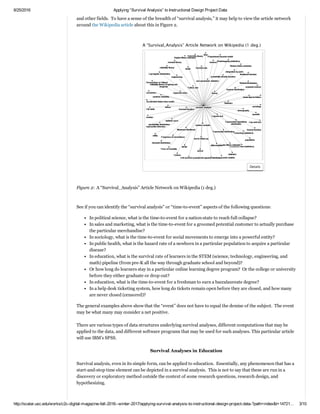
and other fields.  To have a sense of the breadth of “survival analysis,” it may help to view the article network
around the Wikipedia article about this in Figure 2.  


Figure 2:  A “Survival_Analysis” Article Network on Wikipedia (1 deg.)  
 
 
See if you can identify the “survival analysis” or “time­to­event” aspects of the following questions:  
In political science, what is the time­to­event for a nation­state to reach full collapse?   
In sales and marketing, what is the time­to­event for a groomed potential customer to actually purchase
the particular merchandise?   
In sociology, what is the time­to­event for social movements to emerge into a powerful entity?   
In public health, what is the hazard rate of a newborn in a particular population to acquire a particular
disease?   
In education, what is the survival rate of learners in the STEM (science, technology, engineering, and
math) pipeline (from pre­K all the way through graduate school and beyond)?   
Or how long do learners stay in a particular online learning degree program?  Or the college or university
before they either graduate or drop out?   
In education, what is the time­to­event for a freshman to earn a baccalaureate degree?   
In a help desk ticketing system, how long do tickets remain open before they are closed, and how many
are never closed (censored)?  
The general examples above show that the “event” does not have to equal the demise of the subject.  The event
may be what many may consider a net positive.   
 
A “Survival_Analysis” Article Network on Wikipedia (1 deg.) Annotations
Details
2/16/2017 Applying “Survival Analysis” to Instructional Design Project Data
http://scalar.usc.edu/works/c2c­digital­magazine­fall­2016­­winter­2017/applying­survival­analysis­to­instructional­design­project­data­?path=index&t=148725… 4/12
There are various types of data structures underlying survival analyses, different computations that may be
applied to the data, and different software programs that may be used for such analyses. This particular article
will use IBM’s SPSS.  
 
Survival Analyses in Education
 
Survival analysis, even in its simple form, can be applied to education.  Essentially, any phenomenon that has a
start­and­stop time element can be depicted in a survival analysis.  This is not to say that these are run in a
discovery or exploratory method outside the context of some research questions, research design, and
hypothesizing.  
 
To see how this might work, survival analysis was run on instructional design (ID) projects from 2010 – 2016.
 The original set of objects are the projects, and the “events” are completion with bills sent to the principal
investigators (PIs) / faculty owners of the instructional design projects.  The start date is artificial since there
are data from prior (to 2006), but the billing for prior projects were purchases of half­a­year of instructional
designer time...for multiple projects...and those are somewhat beyond the focus of this example (pre­bought
time guarantees the project unless the instructional designer fails spectacularly in follow­through on the work).
 
 
Censored projects are those for which no paid work was done—so in these cases, there were early discussions
of work and initial recording of hours, but nothing ultimately came of the work for various reasons. One way to
conceptualize censoring is of somewhat incomplete work, something that has not been taken to its full
actualization.  (Left out entirely from this research are the thousands of consultations and works for which no
pay was ever expected because the projects did not rise to the design and development level of funded work.
 Also left out are the many in­depth multi­year projects which occurred as part of the higher education
ecosystem…but for which no funds were directly moved between university units.  And finally, there is the
grant­chasing work done on various projects.  In many cases, no funds are directly acquired.  In other cases,
grant funds are attained but are distributed more locally to the respective colleges and departments, but no
payments were made to the instructional designer.)  While the underlying data here are real, the specifics have
been removed because these are not important to the method and would not contribute to deeper
understandings in this context.   
 
It is thought that such “time­to­event” studies may improve the management of instructional design projects,
so that these move from the stages of light talk to actual work and actual completion of paid work.  The paying
for work often is correctly conflated with the use of the learning objects.  Unpaid projects are often not
political priorities and garner much less administrative protection over time.  While there are many ways to
complete instructional design work successfully and to help the university attain a “win,” those projects will not
be discussed here. 
 
Hazarding Educated Guesses (“Hypothesizing”)
Understanding which ID projects thrive may shed light on the “hazards” that make a project sufficiently
successful (based on the prior terms).  As such, this set may be split into two:  those that make to "event" and
those which "censor" out. Then the respective characteristics of the respective instructional design projects in
each grouping may be compared.  Another built­in way to break apart the groups into categories is by length of
project.  Yet another is to cluster projects by high­cost vs. low­cost (with various bounds for each).  These
categories may be defined already with the given data.  The topics of the respective projects may be analyzed,
too, based on the redacted data (which is known to the researcher and may be coded in future work).  
 
Beyond those features mentioned earlier, it would help to identify other attribute features of the respective
instructional design projects.  These may include the following variables:  
 
types of deliverables 
existence of pre­defined designs 
standards for the instructional build 
defined technical platforms 
requirements to use proprietary technical platforms 
size of development team 
complexity of the targeted learner population
2/16/2017 Applying “Survival Analysis” to Instructional Design Project Data
http://scalar.usc.edu/works/c2c­digital­magazine­fall­2016­­winter­2017/applying­survival­analysis­to­instructional­design­project­data­?path=index&t=148725… 5/12
whether there is need to collaborate with other institutions, and others  
Once the respective features are defined and the individual projects are duly coded, it will be possible to
analyze survival analysis of the respective sub­clusters of instructional design projects for time­pattern
differences.  For survival analyses involving multivariate data, researchers go to the Cox Regression survival
analysis (which is one of four survival analysis types in SPSS).  
 
From the above, there will be a list of "askable questions" based on data queries and data visualizations.    
 
For example, of the set of ID projects which achieve to “event,” how does that set differ from those that
end up “censored”?  Is it possible to anticipate what sort of ID project may be in one category or the
other?   
How do types of required project deliverables affect survival, "event," and censoring?  
Are pre­defined designs a net positive or a net negative in terms of project attainment of "event" /
completion?
Do collaborations with off­campus entities mean projects take longer periods or shorter periods to
complete?  Or are such off­campus collaborations not a factor?  
and so on...    
 
Real­world debriefing.  From experience, projects that are pre­funded with a federal grant tend to proceed
to funded work.  Those ID projects with required and defined online course or learning objects will generally
result in successful instructional design and project completion and payment to the unit.  In part, those projects
have to meet stringent legal requirements on a number of fronts:  intellectual property protections,
accessibility, and so on.  These also have to survive project assessment by a third­party entity, and these have
to show learning gains.  Projects that have strong leadership, a line­up of talent, a clear plan, and sufficient
resourcing tend to do well and achieve “event” instead of being “censored”.
 
Censoring does not always occur due to limitations of the project PI.  An instructional designer may have to
decline a project because the project requirements are not attainable given local skills and local resources.  In
that case, IDs have to self­censor projects.  If PI expectations are too high in terms of what the technologies can
achieve, that is another scenario in which self­censoring of projects occurs. Early and clear communications are
critical to help identify projects which are a mismatch with ID capabilities and skills (which vary greatly
depending on units).  
Instructional Design on a University Campus
It may help to describe the instructional design context on this particular university campus.  For some years,
instructional design was generally provided as a service to all faculty who requested the service.  However, as
time passed, it became clear that some clients were those who had federal grant dollars who needed intensive
builds (whole online courses or learning sequences, sophisticated websites, and other objects).  An official
university rate card was created to address these types of projects that required more than the complimentary
initial 10 hours.  While some long­term instructional design projects were created for free—given the political
horse trading on campuses—these tend to be outliers…maybe only a half­dozen in a decade of ID work at this
institution, at least based on the experiences of one instructional designer.  
 
Billing for such projects requires approvals by the principal investigators (of grants) / faculty members.  Some
projects extend over a budget year and may require multiple bills.  In general bills are finalized at the ends of
projects within budget years but occasionally, a few projects may extend over a fiscal year.  The average bill for
an instructional design project between 2010 – 2016 was $2,488.85, with this average skewed by several
projects paying in the five digits.  The period of research was seven years (or 84 ­ 4 = 80 months since this was
done at the end of August 2016).  The projects were entered in a staggered entry, and the length of project time
would be the months of work spent on the project.  Twenty­six projects were identified, with a min­max cost
range of $400 to $34,000.  
 
On this campus, because of the sparsity of funds, the idea is to get any ID service gratis and move on without
any bill if possible, so it’s important for an instructional designer to discuss the rate card and expectations early
on.  
 
2/16/2017 Applying “Survival Analysis” to Instructional Design Project Data
http://scalar.usc.edu/works/c2c­digital­magazine­fall­2016­­winter­2017/applying­survival­analysis­to­instructional­design­project­data­?path=index&t=148725… 6/12
The average length of time from the start of a project to the end is four months.  Rarely, talks will start on a
project many months before actual start of project because the funding has not come in until then.  The start of
a project begins with the first contact with the recording of the gratis hours.  For many projects, if it seems that
the work will only be consultation without full design and development, those hours are only recorded on a
work calendar, and no bill is even started.  Bills are only started if there is discussion of more extensive paid
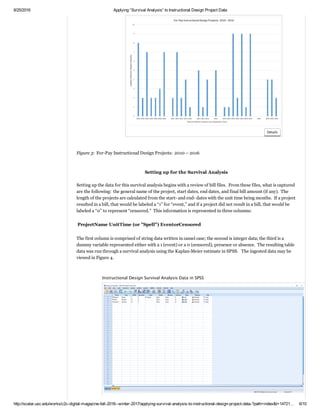
work.  In Figure 3, the various ID projects with bills are listed. That said, there are sometimes periods of
drought for paid work on a campus.  Also, the years here are calendar years, not fiscal years (which start in July
and end at the end of June the next year). 


Figure 3:  For­Pay Instructional Design Projects:  2010 – 2016 
 
 
Setting up for the Survival Analysis
Setting up the data for this survival analysis begins with a review of bill files.  From these files, what is captured
are the following:  the general name of the project, start dates, end dates, and final bill amount (if any).  The
length of the projects are calculated from the start­ and end­ dates with the unit time being months.  If a project
resulted in a bill, that would be labeled a “1” for “event,” and if a project did not result in a bill, that would be
labeled a “0” to represent “censored.”  This information is represented in three columns:  
 
ProjectName UnitTime (or "Spell") EventorCensored
 
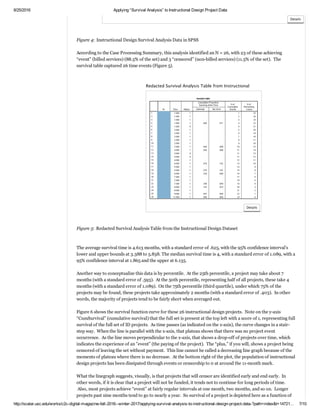
The first column is comprised of string data written in camel case; the second is integer data; the third is a
dummy variable represented either with a 1 (event) or a 0 (censored), presence or absence.  The resulting table
data was run through a survival analysis using the Kaplan­Meier estimate in SPSS. The Kaplan­Meier method
originated in 1958 and is known as "the product limit estimator".  The ingested data may be viewed in Figure 4.


For-Pay Instructional Design Projects through the Years Annotations
Details
Instructional Design Survival Analysis Data in SPSS Annotatio
2/16/2017 Applying “Survival Analysis” to Instructional Design Project Data
http://scalar.usc.edu/works/c2c­digital­magazine­fall­2016­­winter­2017/applying­survival­analysis­to­instructional­design­project­data­?path=index&t=148725… 7/12
 
 
Figure 4:  Instructional Design Survival Analysis Data in SPSS
 
According to the Case Processing Summary, this analysis identified an N = 26, with 23 of these achieving
“event” (billed services) (88.5% of the set) and 3 “censored” (non­billed services) (11.5% of the set).  The
survival table captured 26 time events (Figure 5).  


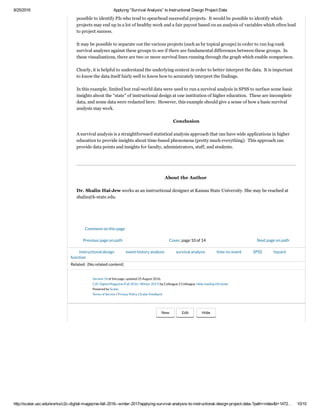
Figure 5:  Redacted Survival Analysis Table from the Instructional Design Dataset  
 
 
By the first month in, 19% of the instructional design projects have reach event.  By the end of the second
month,  42% of projects have achieved event or been censored, and only 58% survive. By the fifth month, there
is only 35% of projects are still in limbo­­without either a determination of whether they will be a paid project
or will censor out of the study. None of the projects exist in the unbilled or censored categories by the 11th
month, so a decision for whether a project will continue as a billed one or not is decided within a calendar year
of the start of the project.  
Details
Redacted Survival Analysis Table from Instructional Annotations
Details
2/16/2017 Applying “Survival Analysis” to Instructional Design Project Data
http://scalar.usc.edu/works/c2c­digital­magazine­fall­2016­­winter­2017/applying­survival­analysis­to­instructional­design­project­data­?path=index&t=148725… 8/12
 
The average survival time is 4.613 months, with a standard error of .625, with the 95% confidence interval’s
lower and upper bounds at 3.388 to 5.838. The median survival time is 4, with a standard error of 1.089, with a
95% confidence interval at 1.865 and the upper at 6.135.  (The confidence bounds assume an underlying normal
curve, which may be an inaccurate assumption.  In all likelihood, the underlying distribution is non­normal,
given the topic.)
 
Another way to conceptualize this data is by percentile.  At the 25th percentile, a project may take about 7
months (with a standard error of .593).  At the 50th percentile, representing half of all projects, these take 4
months (with a standard error of 1.089).  On the 75th percentile (third quartile), under which 75% of the
projects may be found, these projects take approximately 2 months (with a standard error of .403). All of the
quartile values of the K­M estimate are within the ranges and so are defined values).  In other words, the
majority of projects tend to be fairly short; said another way, rarer projects may be longer.  
 
Figure 6 shows the survival function curve for these 26 instructional design projects.  Note on the y­axis
“CumSurvival” (cumulative survival) that the full set is present at the top left with a score of 1, representing full
survival of the full set of ID projects.  As time passes (as indicated on the x­axis), the curve changes in a stair­
step way.  When the line is parallel with the x­axis, that plateau shows that there was no project event
occurrence.  As the line moves perpendicular to the x­axis, that shows a drop­off of projects over time, which
indicates the experience of an ”event” (the paying of the project).  The “plus,” if you will, shows a project being
censored of leaving the set without payment.  Note that the censoring does not result in a change to the curve
(whether up or down).  This line cannot be called a decreasing line graph because of the moments of plateau
where there is no decrease.  At the bottom right of the plot, the population of instructional design projects has
been dissipated through events or censorship to 0 at around the 11­month mark.  
 
What the linegraph suggests, visually, is that projects that will censor are identified early and end early.  In
other words, if it is clear that a project will not be funded, it tends not to continue for long periods of time.
 Also, most projects achieve “event” at fairly regular intervals at one month, two months, and so on.  Longer
projects past nine months tend to go to nearly a year.  So survival of a project is depicted here as a function of
time.  The S(t) [the “s” of “t”] or survival at time t may be understood from the linegraph.  The more time that
passes, the more likelihood that a project will result in pay as long as the project hasn’t ended by being
censored out.  


Figure 6:  “Survival Function” Applied to Instructional Design Projects 
 
'Survival Function' of Instructional Design Projects Annotations
Details
2/16/2017 Applying “Survival Analysis” to Instructional Design Project Data
http://scalar.usc.edu/works/c2c­digital­magazine­fall­2016­­winter­2017/applying­survival­analysis­to­instructional­design­project­data­?path=index&t=148725… 9/12
This same data may be visualized as a hazard function.  In Figure 8, the line of the graph starts at the bottom
left.  At (0,0), the origin of the graph, the hazard function is the same for all the instructional design projects.
 Over time (expressed in the horizontal x­axis), the hazard rate starts to manifest.  One sign of that is in month
one when the line moves vertically, indicating an event (based on the hazard).  And so, it all stair­steps upwards
cumulatively.  The hazards seem to occur earlier in the lifespan of an instructional design project and actually
seems to lessen once Month 9 has been reached.  


Figure 7:  “Hazard Function” Applied to Instructional Design Projects  
 
 
In the instructional design context, it helps to know whether a project formalizes into a paying one.  It helps to
have the hypothesizing around the desirable “hazards” to ensure that a project makes it to successful fruition
and mutual benefits for the respective university units involved.  
 
This same data may be plotted in a One Minus Survival Function (Figure 8).  This shows a line that grows over
time.  At any point in the line, an individual may capture the cumulative incidence rate at that particular point
in time. The “one minus” part works because both survival and hazard are plotted on a range from 0 – 1 (for
normalized probability data).  One minus survival [1­S] equals the cumulative hazard rate and also equals the
rising incidence of non­survival (event) as seen in time (or time segments).  
 
 
'Hazard Function' of Instructional Design Projects Annotations
Details
Accumulating Incidence of ID Projects Achieving Event in the One Annotations
2/16/2017 Applying “Survival Analysis” to Instructional Design Project Data
http://scalar.usc.edu/works/c2c­digital­magazine­fall­2016­­winter­2017/applying­survival­analysis­to­instructional­design­project­data­?path=index&t=14872… 10/12
 
 
Figure 8:  Accumulating Incidence of ID Projects Achieving Event in the One Minus Survival Function Plot
 
 
Debriefing
 
First, it is important to mention that a naive interpretive approach will be unhelpful.  Some naive assertions
from these "survival analysis" findings may go as follows:  
 
If I stretch out the time of a project, I will achieve completion and payday.
If a project censors early on, it will not be recoverable and may never achieve "event."    
And based on the early interpretations, some naive assertions may continue:  
 
A PI with access to federal funds will always be a paying client (most are super frugal, which is good for
the institution of higher education overall, but which guarantees a small payday, if any).  
 
What are some more sophisticated insights from these graphs?  These may suggest which types of projects to
target. A cursory analysis of the underlying data shows that the projects that are generally funded tend to be
from the health sciences and agriculture because those are priorities for federal grant funding agencies.  Also,
federal compliance trainings sometimes result in some project payment (but would more likely result in gratis
work because these benefit the campus broadly and are politically justifiable in the work unit).  It would be
possible to identify PIs who tend to spearhead successful projects.  It would be possible to identify which
projects may end up in a lot of healthy work and a fair payout based on an analysis of variables which often lead
to project success.   
 
It may be possible to separate out the various projects (such as by topical groups) in order to run log­rank
survival analyses against these groups to see if there are fundamental differences between these groups.  In
these visualizations, there are two or more survival lines running through the graph which enable comparison.  
 
Clearly, it is helpful to understand the underlying context in order to better interpret the data.  It is important
to know the data itself fairly well to know how to accurately interpret the findings.  
 
In this example, limited but real­world data were used to run a survival analysis in SPSS to surface some basic
insights about the “state” of instructional design at one institution of higher education.  These are incomplete
data, and some data were redacted here.  However, this example should give a sense of how a basic survival
analysis may work.  
 
Details
2/16/2017 Applying “Survival Analysis” to Instructional Design Project Data
http://scalar.usc.edu/works/c2c­digital­magazine­fall­2016­­winter­2017/applying­survival­analysis­to­instructional­design­project­data­?path=index&t=14872… 11/12
Comment on this page
Conclusion
 
"Survival analyses" may be used not only to describe time­to­event data in a descriptive way (to enable
hypothesizing and analysis), but they may be used as models to understand other similarly situated data and to
even enable predictions of out­of­sample data.  These predictions may inform expectations of future events,
with varying levels of confidence. Certainly, as new data is available, it is possible to integrate more data to the
survival analyses for the prior applications.   
 
A survival analysis is a straightforward statistical analysis approach that can have wide applications in higher
education to provide insights about time­based phenomena (pretty much everything).  This approach can
provide data points and insights for faculty, administrators, staff, and students.  
A Data Visualization Addendum
 
 
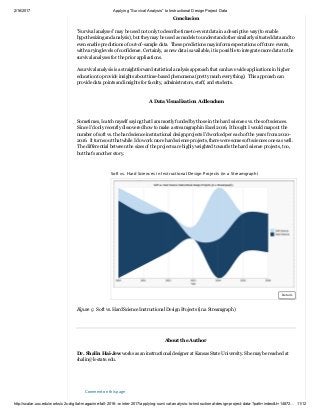
Sometimes, I catch myself saying that I am mostly funded by those in the hard sciences vs. the soft sciences.
 Since I'd only recently discovered how to make a streamgraph in Excel 2016, I thought I would map out the
number of soft vs. the hard science instructional design projects I'd worked per each of the years from 2010 ­
2016.  It turns out that while I do work more hard science projects, there were some soft sciences ones as well.
 The differential between the sizes of the projects are highly weighted towards the hard science projects, too,
but that's another story.  


Figure 9:  Soft vs. Hard Science Instructional Design Projects (in a Streamgraph) 


About the Author 
 
Dr. Shalin Hai­Jew works as an instructional designer at Kansas State University. She may be reached at
shalin@k­state.edu.  


Soft vs. Hard Sciences in Instructional Design Projects (in a Streamgraph) Annotations
Details
2/16/2017 Applying “Survival Analysis” to Instructional Design Project Data
http://scalar.usc.edu/works/c2c­digital­magazine­fall­2016­­winter­2017/applying­survival­analysis­to­instructional­design­project­data­?path=index&t=14872… 12/12
• More
Version 33 of this page, updated 16 February 2017.
C2C Digital Magazine (Fall 2016 / Winter 2017) by Colleague 2 Colleague. Help reading this book.
Powered by Scalar.
Terms of Service | Privacy Policy | Scalar Feedback
New    Edit    Hide
Previous page on path Cover, page 20 of 26 Next page on path
Related:  Issue Navigation
instructional design    event history analysis    One Minus Survival Function    data censoring    survival
analysis    time-to-event    SPSS    hazard function

Applying “Survival Analysis” to Instructional Design Project Data