Applications of salts
Done by:
Sneha jain
Akshyaa roshini
Deepthi
Haripriya
Shanmuga priya
Definition
• In chemistry, salts are ionic compounds that result
from the neutralization reaction of an acid and
a base. They are composed of related numbers
of cations (positively charged ions)
and anions (negative ions) so that the product is
electrically neutral (without a net charge).
List of Salts
• Potassium sulphate
• Sodium sulphate
• Calcium sulphate
• Magnesium sulphate
• Copper sulphate
• Sodium chloride
• Sodium nitrate
• Sodium carbonate
• Ammonium chloride
• Potassium nitrate
• Aluminium chloride
• Zinc sulphate
• Sodium acetate
• Sodium hydrogencarbonate
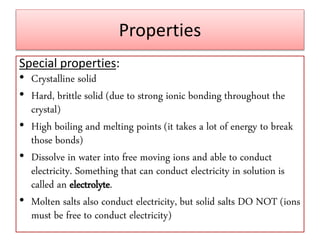
Properties
Special properties:
• Crystalline solid
• Hard, brittle solid (due to strong ionic bonding throughout the
crystal)
• High boiling and melting points (it takes a lot of energy to break
those bonds)
• Dissolve in water into free moving ions and able to conduct
electricity. Something that can conduct electricity in solution is
called an electrolyte.
• Molten salts also conduct electricity, but solid salts DO NOT (ions
must be free to conduct electricity)
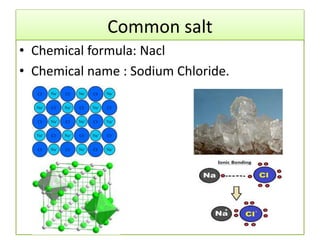
Common salt
• Chemical formula: Nacl
• Chemical name : Sodium Chloride.
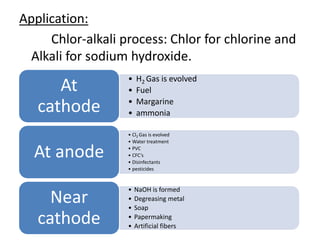
Application:
Chlor-alkali process: Chlor for chlorine and
Alkali for sodium hydroxide.
• H2 Gas is evolved
• Fuel
• Margarine
• ammonia
At
cathode
• Cl2 Gas is evolved
• Water treatment
• PVC
• CFC’s
• Disinfectants
• pesticides
At anode
• NaOH is formed
• Degreasing metal
• Soap
• Papermaking
• Artificial fibers
Near
cathode
Application:
• pulp and paper industry
• Processing aluminium, beryllium, copper, steel
and vanadium.
• Food industry.
• medicine
• Water softening
• Soda ash industry
• Optical instrument
• Cleanser
• Firefighting
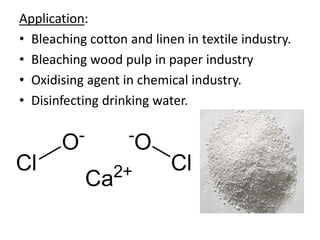
Bleaching Power
Chemical Name: Calcium oxychloride
Chemical Formula: CaOCl2
Process:
• Electrolysis of aqueous sodium chloride(Brine);
• Chloride on dry slake lime [Ca(OH)2] gives
bleaching power [CaOCl2]
Reaction:
Ca(OH)2+Cl2→CaOCl2+H2O
Application:
• Bleaching cotton and linen in textile industry.
• Bleaching wood pulp in paper industry
• Oxidising agent in chemical industry.
• Disinfecting drinking water.
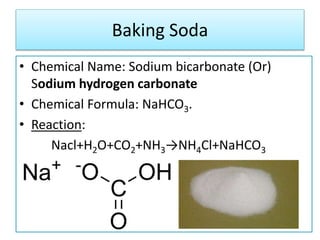
Baking Soda
• Chemical Name: Sodium bicarbonate (Or)
Sodium hydrogen carbonate
• Chemical Formula: NaHCO3.
• Reaction:
Nacl+H2O+CO2+NH3→NH4Cl+NaHCO3
Application:
• Baking Powder:
NaHCO3+H+→CO2+H2O+sodium salt of acid
Carbon dioxide produced during this reaction causes bread or
cake to rise making them soft and spongy.
• Ingredient in antacids, being alkaline. It neutralises excess acid in the
stomach
• Soda acid fire extinguisher
• Pest Control
• Paint and Corrosion Removal
• pH Balancer
• As a bio pesticide
• Cattle feed supplements
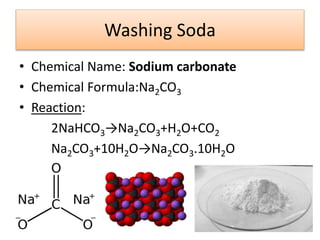
Washing Soda
• Chemical Name: Sodium carbonate
• Chemical Formula:Na2CO3
• Reaction:
2NaHCO3→Na2CO3+H2O+CO2
Na2CO3+10H2O→Na2CO3.10H2O
Application:
• It is used in making glass, soap and paper.
• It is used to manufacture Borax.
• Cleaning agent – Domestic purpose.
• Used to remove permanent hardness of water.
• Sodium carbonate test.
• neutralize the corrosive effects of chlorine.
• Salt based Electrolytes.
Crystals of salt
• Water of crystallization is the fixed number of
water molecules present in one formula unit
of a salt.
• Example: CuSo4.5H2O
Na2CO3.10H2O
CaSO4.2H2O
copper(II) sulfate
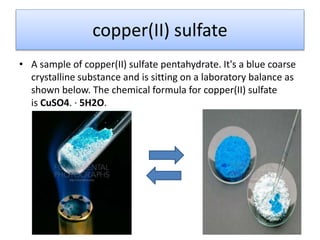
• A sample of copper(II) sulfate pentahydrate. It's a blue coarse
crystalline substance and is sitting on a laboratory balance as
shown below. The chemical formula for copper(II) sulfate
is CuSO4. · 5H2O.
Plaster of Paris
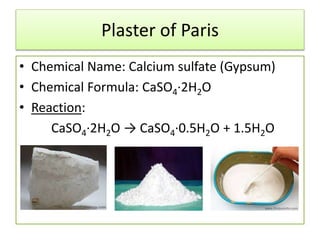
• Chemical Name: Calcium sulfate (Gypsum)
• Chemical Formula: CaSO4·2H2O
• Reaction:
CaSO4·2H2O → CaSO4·0.5H2O + 1.5H2O
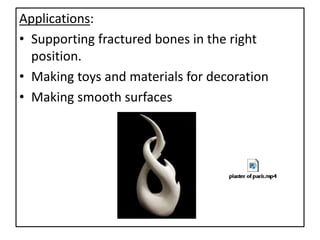
Applications:
• Supporting fractured bones in the right
position.
• Making toys and materials for decoration
• Making smooth surfaces

Applications of salts

  • 1.
    Applications of salts Doneby: Sneha jain Akshyaa roshini Deepthi Haripriya Shanmuga priya
  • 2.
    Definition • In chemistry,salts are ionic compounds that result from the neutralization reaction of an acid and a base. They are composed of related numbers of cations (positively charged ions) and anions (negative ions) so that the product is electrically neutral (without a net charge).
  • 3.
    List of Salts •Potassium sulphate • Sodium sulphate • Calcium sulphate • Magnesium sulphate • Copper sulphate • Sodium chloride • Sodium nitrate • Sodium carbonate • Ammonium chloride • Potassium nitrate • Aluminium chloride • Zinc sulphate • Sodium acetate • Sodium hydrogencarbonate
  • 4.
    Properties Special properties: • Crystallinesolid • Hard, brittle solid (due to strong ionic bonding throughout the crystal) • High boiling and melting points (it takes a lot of energy to break those bonds) • Dissolve in water into free moving ions and able to conduct electricity. Something that can conduct electricity in solution is called an electrolyte. • Molten salts also conduct electricity, but solid salts DO NOT (ions must be free to conduct electricity)
  • 5.
    Common salt • Chemicalformula: Nacl • Chemical name : Sodium Chloride.
  • 6.
    Application: Chlor-alkali process: Chlorfor chlorine and Alkali for sodium hydroxide. • H2 Gas is evolved • Fuel • Margarine • ammonia At cathode • Cl2 Gas is evolved • Water treatment • PVC • CFC’s • Disinfectants • pesticides At anode • NaOH is formed • Degreasing metal • Soap • Papermaking • Artificial fibers Near cathode
  • 7.
    Application: • pulp andpaper industry • Processing aluminium, beryllium, copper, steel and vanadium. • Food industry. • medicine • Water softening • Soda ash industry • Optical instrument • Cleanser • Firefighting
  • 8.
    Bleaching Power Chemical Name:Calcium oxychloride Chemical Formula: CaOCl2 Process: • Electrolysis of aqueous sodium chloride(Brine); • Chloride on dry slake lime [Ca(OH)2] gives bleaching power [CaOCl2] Reaction: Ca(OH)2+Cl2→CaOCl2+H2O
  • 9.
    Application: • Bleaching cottonand linen in textile industry. • Bleaching wood pulp in paper industry • Oxidising agent in chemical industry. • Disinfecting drinking water.
  • 10.
    Baking Soda • ChemicalName: Sodium bicarbonate (Or) Sodium hydrogen carbonate • Chemical Formula: NaHCO3. • Reaction: Nacl+H2O+CO2+NH3→NH4Cl+NaHCO3
  • 11.
    Application: • Baking Powder: NaHCO3+H+→CO2+H2O+sodiumsalt of acid Carbon dioxide produced during this reaction causes bread or cake to rise making them soft and spongy. • Ingredient in antacids, being alkaline. It neutralises excess acid in the stomach • Soda acid fire extinguisher • Pest Control • Paint and Corrosion Removal • pH Balancer • As a bio pesticide • Cattle feed supplements
  • 12.
    Washing Soda • ChemicalName: Sodium carbonate • Chemical Formula:Na2CO3 • Reaction: 2NaHCO3→Na2CO3+H2O+CO2 Na2CO3+10H2O→Na2CO3.10H2O
  • 13.
    Application: • It isused in making glass, soap and paper. • It is used to manufacture Borax. • Cleaning agent – Domestic purpose. • Used to remove permanent hardness of water. • Sodium carbonate test. • neutralize the corrosive effects of chlorine. • Salt based Electrolytes.
  • 14.
    Crystals of salt •Water of crystallization is the fixed number of water molecules present in one formula unit of a salt. • Example: CuSo4.5H2O Na2CO3.10H2O CaSO4.2H2O
  • 15.
    copper(II) sulfate • Asample of copper(II) sulfate pentahydrate. It's a blue coarse crystalline substance and is sitting on a laboratory balance as shown below. The chemical formula for copper(II) sulfate is CuSO4. · 5H2O.
  • 16.
    Plaster of Paris •Chemical Name: Calcium sulfate (Gypsum) • Chemical Formula: CaSO4·2H2O • Reaction: CaSO4·2H2O → CaSO4·0.5H2O + 1.5H2O
  • 17.
    Applications: • Supporting fracturedbones in the right position. • Making toys and materials for decoration • Making smooth surfaces