How Do We Select Students?
   Michele Brown, Senior Assistant Director
    ◦ The Ohio State University


   Rae Ann DiBaggio, Senior Associate Director
    ◦ Case Western Reserve University
What’s the hype with the
college admission process?
◦ Media Attention
  Headlines “Toughest Year Ever in College Admissions”

◦ What does “Holistic Review” really mean?

◦ Confusion between “Best Schools” and “Most
  Selective”

◦ We’re here to give the insider’s view on admissions
  at selective colleges!
   Open Admission
    ◦ HS diploma, accept on first-come first-served basis


   More Selective
    ◦ More selective than open enrollment
    ◦ Look at a variety of factors


   Very Selective
    ◦ Small number of schools
    ◦ Receive 10-15 apps per slot
    ◦ Tough review process for admission
   Admission and Application Process
   Types of admission:
    ◦ Early Decision (ED)
        ED admit/deny
        ED defer
    ◦ Early Action (EA)
        EA single choice – restrictive EA
        EA defer
    ◦ Regular Decision
    ◦ Deadlines vs. Rolling Admission
    ◦ Final grades do matter
   What are we looking for?
    ◦ strong record of academic performance
    ◦ enthusiasm for learning
    ◦ academic promise in part by standardized testing
    ◦ distinctive achievements or talents
    ◦ knowledge of self & appreciation for individual
      differences
    ◦ demonstrated interest
    ◦ institutional needs/goals

   Bottom Line: We want students who will be
    successful and who will contribute to our
    community
Review Process
   First Read:
    ◦ Typically - counselor assigned to high school
    ◦ Make admission/scholarship recommendations

   Second/Final Read:
    ◦ Another admission counselor – adds another dimension
    ◦ Approaches review from a non-familiar look at app

    ◦ Committee:
    ◦ Some files – borderline cases
    ◦ All files – some schools may review every app in a discussion
      environment
   Key factors on the transcript
    ◦ Course selection
      what is available at your school, and what did the
       student take?
    ◦ Grade trends
      Upward or downward trends
      Strength or weakness in a subject area
    ◦ Level of rigor
      Did the student challenge him or herself?
      Did the student take the minimum requirements or go
       above and beyond?
   What do admission offices need from high
    schools?
    ◦ Grading Scale
    ◦ Description of rigor
      Is this an honors or accelerated class?
      Is it included in the GPA?
    ◦ School profile
        Demographic information about your school
        Course offerings
        College bound rate of your students
        Performance on standardized tests
   An essay that grabs our attention
    ◦ Students should be willing to take a risk and talk about
      something unique
   An essay that doesn’t just retell information that is
    already included in the application
    ◦ Too many essays just list activities and other information
      that can be found on the transcripts
   An essay with appropriate topic/subject/language.
    ◦ Students should consider if they really want the
      committee to know about this particular topic
    ◦ Students need to use appropriate format and grammar.
      We do judge on how the essay is written!
    ◦ Students should ask - What image is left with the reader?
    ◦ PROOF READ
   Recommendation letters can carry a lot of weight
    ◦ Tell us information about the student beyond the
      information in the application
    ◦ What type of student is this individual? Are there special
      talents we should know about?

   Enlist others to help
    ◦ Ask parents to submit a “brag sheet” to give you a better
      picture of the student

   Help other faculty and staff
    ◦ Develop writing guidelines for teachers and other staff
      who might write letters of recommendations
   Extra-Curricular Activities
   Leadership
   Work
   Race/Ethnicity
   First Generation Status
   Socio-Economic Status
   Geographic Diversity
   Special talents
   College Admission decisions do not happen
    in a vacuum
   The institution will have set goals that will
    affect who is offered admission that can
    include:
    ◦ Number of students
    ◦ Diversity of student body
    ◦ Types of majors available
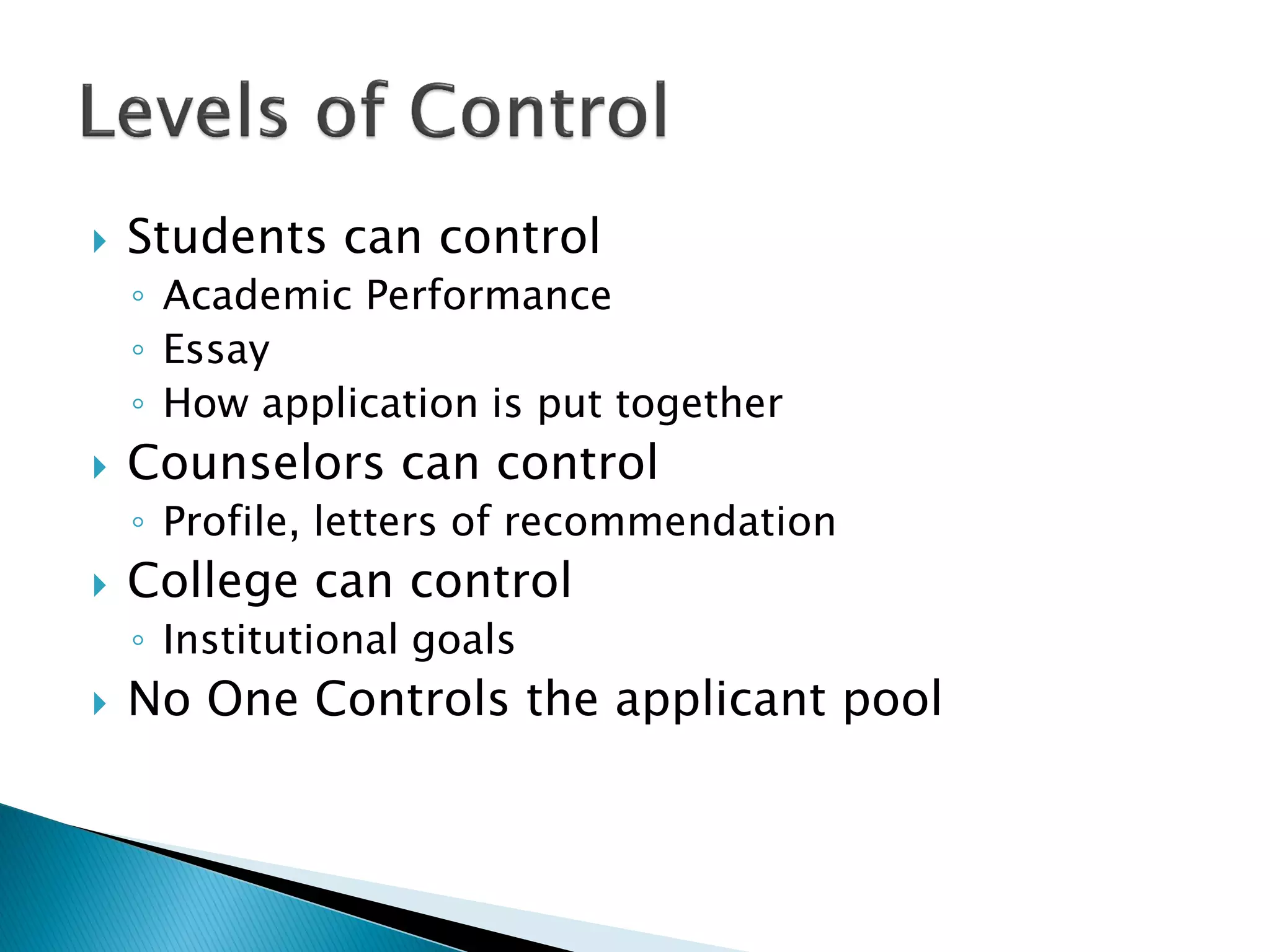
   Students can control
    ◦ Academic Performance
    ◦ Essay
    ◦ How application is put together
   Counselors can control
    ◦ Profile, letters of recommendation
   College can control
    ◦ Institutional goals
   No One Controls the applicant pool
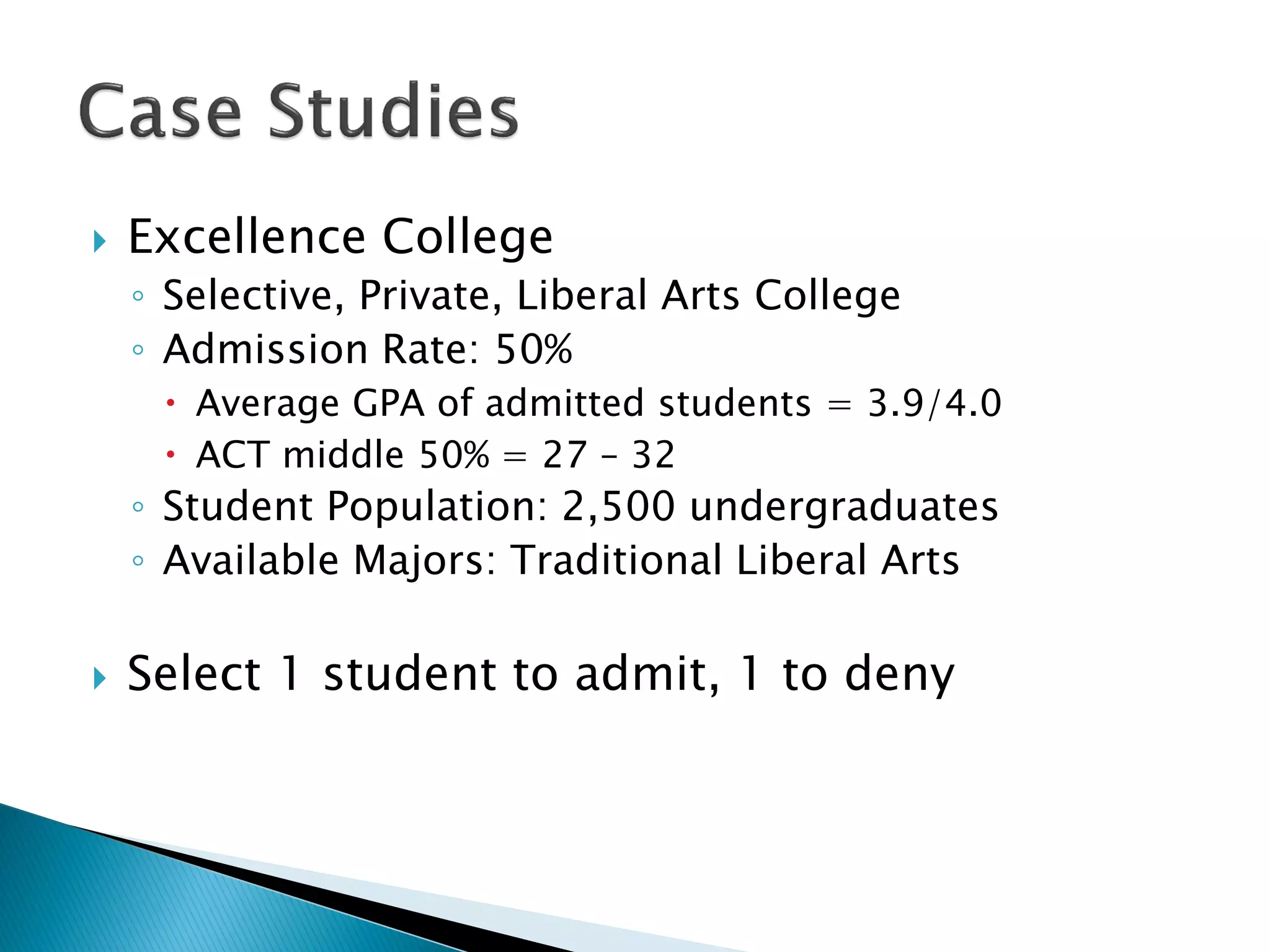
   Excellence College
    ◦ Selective, Private, Liberal Arts College
    ◦ Admission Rate: 50%
      Average GPA of admitted students = 3.9/4.0
      ACT middle 50% = 27 – 32
    ◦ Student Population: 2,500 undergraduates
    ◦ Available Majors: Traditional Liberal Arts

   Select 1 student to admit, 1 to deny
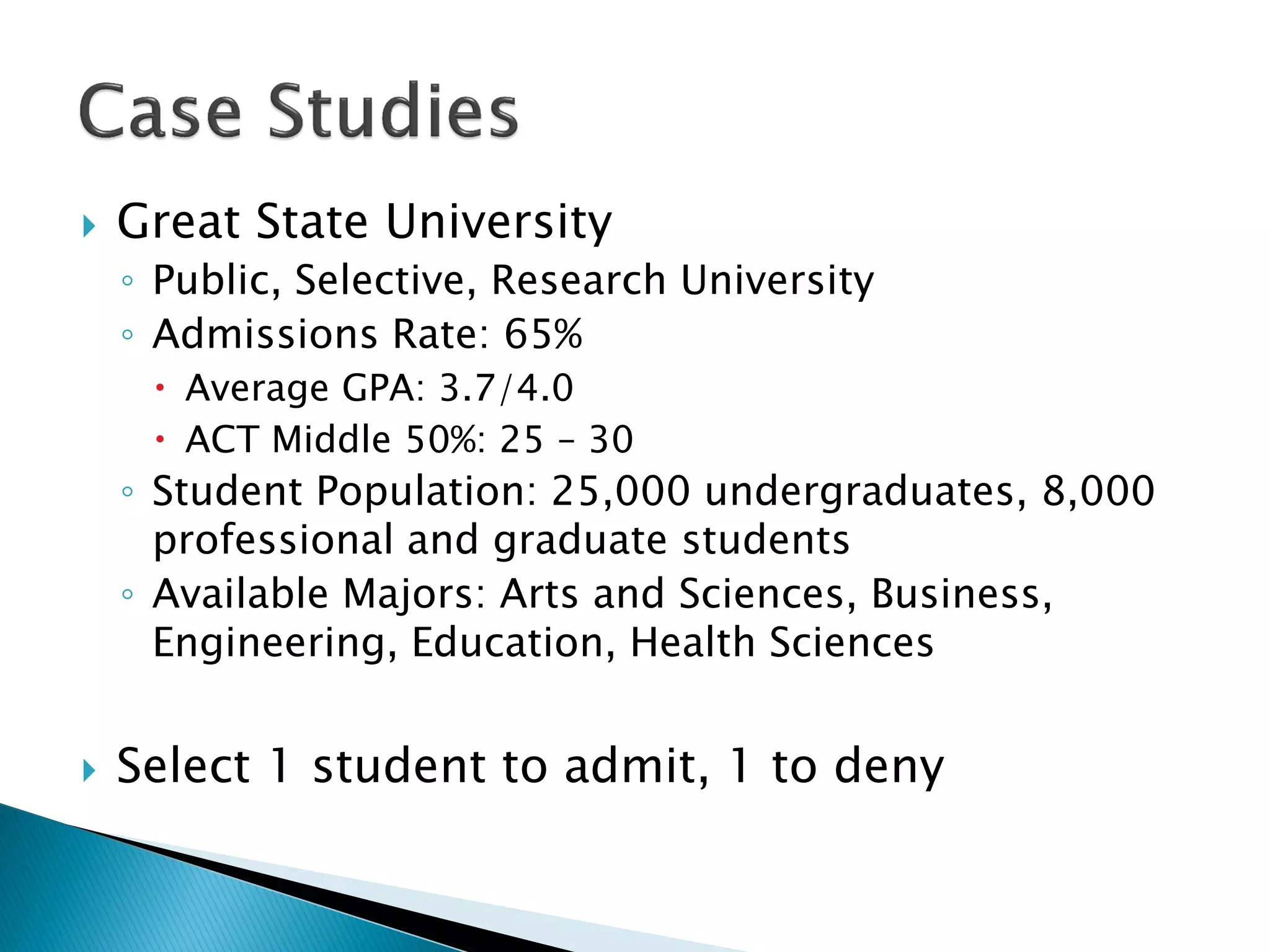
   Great State University
    ◦ Public, Selective, Research University
    ◦ Admissions Rate: 65%
      Average GPA: 3.7/4.0
      ACT Middle 50%: 25 – 30
    ◦ Student Population: 25,000 undergraduates, 8,000
      professional and graduate students
    ◦ Available Majors: Arts and Sciences, Business,
      Engineering, Education, Health Sciences


   Select 1 student to admit, 1 to deny
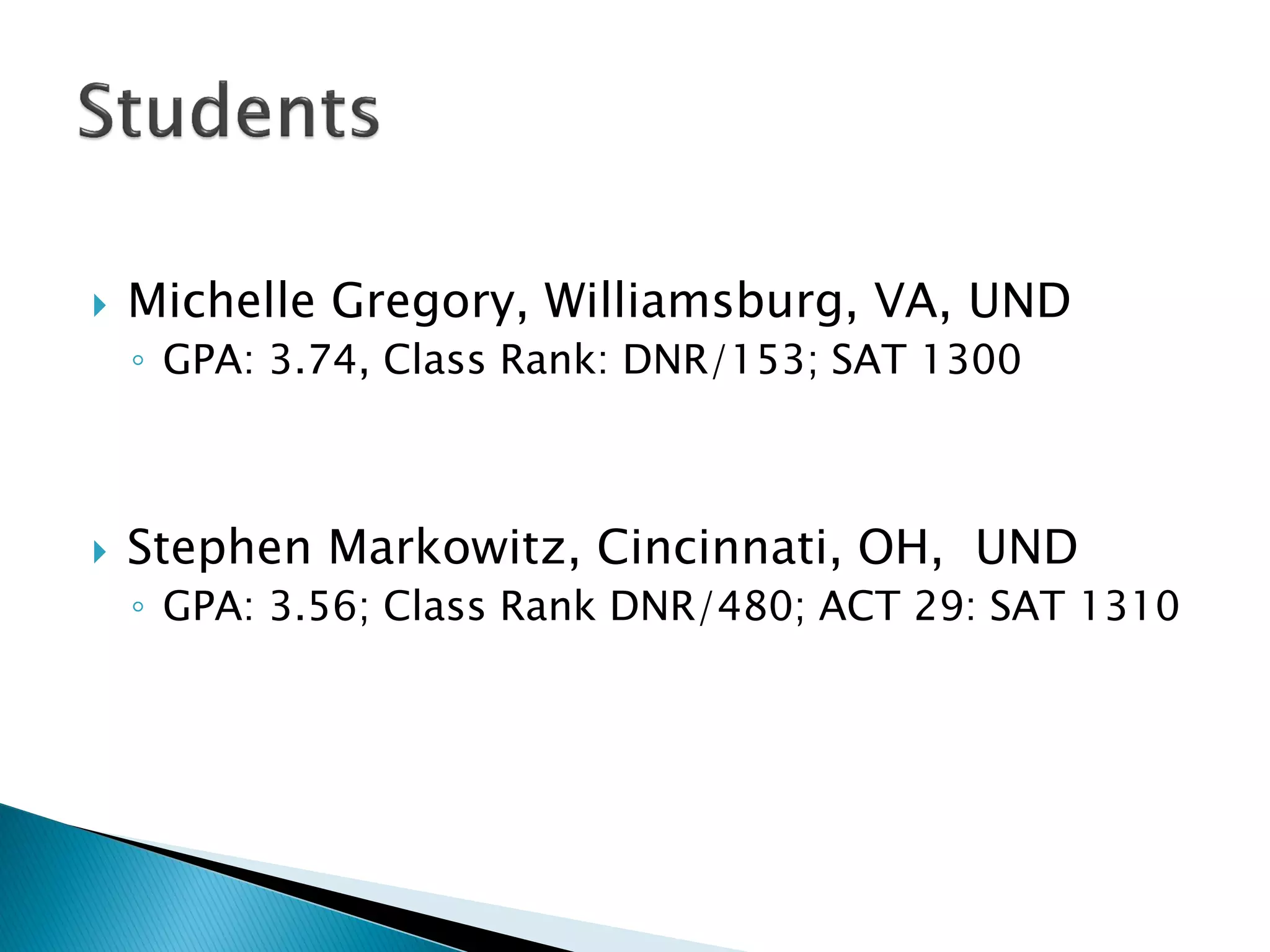
   Michelle Gregory, Williamsburg, VA, UND
    ◦ GPA: 3.74, Class Rank: DNR/153; SAT 1300


   Stephen Markowitz, Cincinnati, OH, UND
    ◦ GPA: 3.56; Class Rank DNR/480; ACT 29: SAT 1310
Application review at selective institutions

Application review at selective institutions

  • 1.
    How Do WeSelect Students?
  • 2.
    Michele Brown, Senior Assistant Director ◦ The Ohio State University  Rae Ann DiBaggio, Senior Associate Director ◦ Case Western Reserve University
  • 3.
    What’s the hypewith the college admission process? ◦ Media Attention  Headlines “Toughest Year Ever in College Admissions” ◦ What does “Holistic Review” really mean? ◦ Confusion between “Best Schools” and “Most Selective” ◦ We’re here to give the insider’s view on admissions at selective colleges!
  • 4.
    Open Admission ◦ HS diploma, accept on first-come first-served basis  More Selective ◦ More selective than open enrollment ◦ Look at a variety of factors  Very Selective ◦ Small number of schools ◦ Receive 10-15 apps per slot ◦ Tough review process for admission
  • 5.
    Admission and Application Process  Types of admission: ◦ Early Decision (ED)  ED admit/deny  ED defer ◦ Early Action (EA)  EA single choice – restrictive EA  EA defer ◦ Regular Decision ◦ Deadlines vs. Rolling Admission ◦ Final grades do matter
  • 6.
    What are we looking for? ◦ strong record of academic performance ◦ enthusiasm for learning ◦ academic promise in part by standardized testing ◦ distinctive achievements or talents ◦ knowledge of self & appreciation for individual differences ◦ demonstrated interest ◦ institutional needs/goals  Bottom Line: We want students who will be successful and who will contribute to our community
  • 7.
    Review Process  First Read: ◦ Typically - counselor assigned to high school ◦ Make admission/scholarship recommendations  Second/Final Read: ◦ Another admission counselor – adds another dimension ◦ Approaches review from a non-familiar look at app ◦ Committee: ◦ Some files – borderline cases ◦ All files – some schools may review every app in a discussion environment
  • 8.
    Key factors on the transcript ◦ Course selection  what is available at your school, and what did the student take? ◦ Grade trends  Upward or downward trends  Strength or weakness in a subject area ◦ Level of rigor  Did the student challenge him or herself?  Did the student take the minimum requirements or go above and beyond?
  • 9.
    What do admission offices need from high schools? ◦ Grading Scale ◦ Description of rigor  Is this an honors or accelerated class?  Is it included in the GPA? ◦ School profile  Demographic information about your school  Course offerings  College bound rate of your students  Performance on standardized tests
  • 10.
    An essay that grabs our attention ◦ Students should be willing to take a risk and talk about something unique  An essay that doesn’t just retell information that is already included in the application ◦ Too many essays just list activities and other information that can be found on the transcripts  An essay with appropriate topic/subject/language. ◦ Students should consider if they really want the committee to know about this particular topic ◦ Students need to use appropriate format and grammar. We do judge on how the essay is written! ◦ Students should ask - What image is left with the reader? ◦ PROOF READ
  • 11.
    Recommendation letters can carry a lot of weight ◦ Tell us information about the student beyond the information in the application ◦ What type of student is this individual? Are there special talents we should know about?  Enlist others to help ◦ Ask parents to submit a “brag sheet” to give you a better picture of the student  Help other faculty and staff ◦ Develop writing guidelines for teachers and other staff who might write letters of recommendations
  • 12.
    Extra-Curricular Activities  Leadership  Work  Race/Ethnicity  First Generation Status  Socio-Economic Status  Geographic Diversity  Special talents
  • 13.
    College Admission decisions do not happen in a vacuum  The institution will have set goals that will affect who is offered admission that can include: ◦ Number of students ◦ Diversity of student body ◦ Types of majors available
  • 14.
    Students can control ◦ Academic Performance ◦ Essay ◦ How application is put together  Counselors can control ◦ Profile, letters of recommendation  College can control ◦ Institutional goals  No One Controls the applicant pool
  • 16.
    Excellence College ◦ Selective, Private, Liberal Arts College ◦ Admission Rate: 50%  Average GPA of admitted students = 3.9/4.0  ACT middle 50% = 27 – 32 ◦ Student Population: 2,500 undergraduates ◦ Available Majors: Traditional Liberal Arts  Select 1 student to admit, 1 to deny
  • 17.
    Great State University ◦ Public, Selective, Research University ◦ Admissions Rate: 65%  Average GPA: 3.7/4.0  ACT Middle 50%: 25 – 30 ◦ Student Population: 25,000 undergraduates, 8,000 professional and graduate students ◦ Available Majors: Arts and Sciences, Business, Engineering, Education, Health Sciences  Select 1 student to admit, 1 to deny
  • 19.
    Michelle Gregory, Williamsburg, VA, UND ◦ GPA: 3.74, Class Rank: DNR/153; SAT 1300  Stephen Markowitz, Cincinnati, OH, UND ◦ GPA: 3.56; Class Rank DNR/480; ACT 29: SAT 1310