Case Study
on
Transformation of Apollo Tyres
Presented By:
Shubham Singhal
80303120053
NMIMS, Hyderabad
Background of the Case
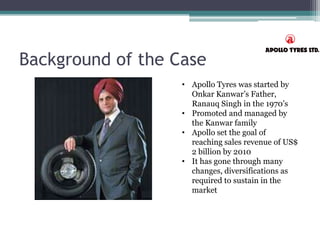
• Apollo Tyres was started by
Onkar Kanwar’s Father,
Ranauq Singh in the 1970’s
• Promoted and managed by
the Kanwar family
• Apollo set the goal of
reaching sales revenue of US$
2 billion by 2010
• It has gone through many
changes, diversifications as
required to sustain in the
market
Vision and Values
• “A significant player in the
global tyre industry and a
brand of choice, providing
customer delight and
continuously enhancing
stakeholder value”
• C: Care for customer
• R: Respect for associates
• E: Excellence through
teamwork
• A: Always learning
• T: Trust mutually
• E: Ethical practices
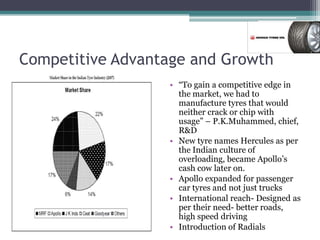
Competitive Advantage and Growth
• “To gain a competitive edge in
the market, we had to
manufacture tyres that would
neither crack or chip with
usage” – P.K.Muhammed, chief,
R&D
• New tyre names Hercules as per
the Indian culture of
overloading, became Apollo’s
cash cow later on.
• Apollo expanded for passenger
car tyres and not just trucks
• International reach- Designed as
per their need- better roads,
high speed driving
• Introduction of Radials
Words of the Chief of Human Resources
• “Apollo is a performance-
focused company with huge
ambitions and global plans.
The challenge is to build
internal capabilities and make
Apollo a preferred employer.”
- Tapan Mitra, Chief of Human
Resources
The Problems
• Until the late 1980’s, the HR
department at the head office
was small
• No proper communication
channel between the sales,
marketing and corporate
employees and top
management
• Critical decisions were based
on likes and dislikes of top
management
• There was no systematic
people development process in
place
• Job rotation and promotion
structures were haphazard
• Being a sales and marketing
focused organization, there
were limitations on growth
prospects for technical
employees.
• Compensation of managerial
employees required
restructuring.
• The corporate office, Gurgaon
was overstaffed, reduction was
to be made, while the average
quality should come up.
Changes
• With Onkar Kanwar’s arrival,
recruiting managers/officers
and creating a contented
workforce became the focus
• Initiatives were top driven
• HR department was
established for sales &
marketing functions separate
from corporate & plant HR
setups
• All HR setups were
systematized
• IT systems were introduced in
HR
Performance Management System
• Mercer suggested online PMS to
aid the communication
• First 2 runs of PMS to be
manual, online later on
• Decision: By 1, April, 2006
everyone would be on PMS
system titled PACE
• Recognition schemes: Roll of
Honour, employee of the year,
annual conferences of
sales/manufacturing,
International holidays awarded
as prizes.
• Poor performers after giving
chance and support of
improvement were removed
after every 2 or 3 years
PMS (contd.)
• Machine operators:
▫ If score is
 = 85%: Diamond Achiever
 = 75%: Green Builder
 < 75%: Red Builder
• Assessment is displayed where
it is visible to peers
• Result:
▫ Operators remained
conscious about their work
quality
Apollo Laureate Academy
• Introduction:
▫ Launched in April, 2007
▫ Innovative step by HR to
strengthen developmental efforts
• Aim:
▫ To build strong leadership
pipeline, provide value proposition
to employees & prepare managers
for future leadership roles
• Offered leadership, management
development, functional
programmes in collaboration with
IIMA, XLRI, MDI, Grow Talent
• ELDP- Senior Managers
• ALDP- Middle Managers
• Supervisory Development
programmes- Junior Managers
Apollo Tyres case study analysis - HR perspective

Apollo Tyres case study analysis - HR perspective

  • 1.
    Case Study on Transformation ofApollo Tyres Presented By: Shubham Singhal 80303120053 NMIMS, Hyderabad
  • 2.
    Background of theCase • Apollo Tyres was started by Onkar Kanwar’s Father, Ranauq Singh in the 1970’s • Promoted and managed by the Kanwar family • Apollo set the goal of reaching sales revenue of US$ 2 billion by 2010 • It has gone through many changes, diversifications as required to sustain in the market
  • 3.
    Vision and Values •“A significant player in the global tyre industry and a brand of choice, providing customer delight and continuously enhancing stakeholder value” • C: Care for customer • R: Respect for associates • E: Excellence through teamwork • A: Always learning • T: Trust mutually • E: Ethical practices
  • 4.
    Competitive Advantage andGrowth • “To gain a competitive edge in the market, we had to manufacture tyres that would neither crack or chip with usage” – P.K.Muhammed, chief, R&D • New tyre names Hercules as per the Indian culture of overloading, became Apollo’s cash cow later on. • Apollo expanded for passenger car tyres and not just trucks • International reach- Designed as per their need- better roads, high speed driving • Introduction of Radials
  • 6.
    Words of theChief of Human Resources • “Apollo is a performance- focused company with huge ambitions and global plans. The challenge is to build internal capabilities and make Apollo a preferred employer.” - Tapan Mitra, Chief of Human Resources
  • 7.
    The Problems • Untilthe late 1980’s, the HR department at the head office was small • No proper communication channel between the sales, marketing and corporate employees and top management • Critical decisions were based on likes and dislikes of top management • There was no systematic people development process in place • Job rotation and promotion structures were haphazard • Being a sales and marketing focused organization, there were limitations on growth prospects for technical employees. • Compensation of managerial employees required restructuring. • The corporate office, Gurgaon was overstaffed, reduction was to be made, while the average quality should come up.
  • 8.
    Changes • With OnkarKanwar’s arrival, recruiting managers/officers and creating a contented workforce became the focus • Initiatives were top driven • HR department was established for sales & marketing functions separate from corporate & plant HR setups • All HR setups were systematized • IT systems were introduced in HR
  • 9.
    Performance Management System •Mercer suggested online PMS to aid the communication • First 2 runs of PMS to be manual, online later on • Decision: By 1, April, 2006 everyone would be on PMS system titled PACE • Recognition schemes: Roll of Honour, employee of the year, annual conferences of sales/manufacturing, International holidays awarded as prizes. • Poor performers after giving chance and support of improvement were removed after every 2 or 3 years
  • 10.
    PMS (contd.) • Machineoperators: ▫ If score is  = 85%: Diamond Achiever  = 75%: Green Builder  < 75%: Red Builder • Assessment is displayed where it is visible to peers • Result: ▫ Operators remained conscious about their work quality
  • 11.
    Apollo Laureate Academy •Introduction: ▫ Launched in April, 2007 ▫ Innovative step by HR to strengthen developmental efforts • Aim: ▫ To build strong leadership pipeline, provide value proposition to employees & prepare managers for future leadership roles • Offered leadership, management development, functional programmes in collaboration with IIMA, XLRI, MDI, Grow Talent • ELDP- Senior Managers • ALDP- Middle Managers • Supervisory Development programmes- Junior Managers