APM1532-HOME HEMODIALYSIS CLINICAL EVIDENCE PART 1_ASSOCIATION BETWEEN CARDIAC INJURY AND DIALYSIS PPT - US ONLY.pptx
1.
Page 1
Home HemodialysisClinical
Evidence PART 1: CARDIAC INJURY AND
DIALYSIS
Presented by:
<name>
2.
The AssociationBetween Cardiac Injury and
Dialysis
Current Dialysis Situation by Modality in the US
Dialysis Induced Stress on the Heart by Modality
– Blood Pressure Control
– Left Ventricular Hypertrophy
– Myocardial Stunning
Frequency and Duration Matter
Page 2
Agenda
3.
Cardiovascular Disease isMore Prevalent in Chronic
Kidney Disease Patients1
No CKD CKD
Page 3
1USRDS 2013 ADR: Figure 4.1 (Volume 1). December 31, 2011 point prevalent Medicare enrollees with
CVD,
age 66 & older, with fee-for-service coverage for the entire calendar year.
4.
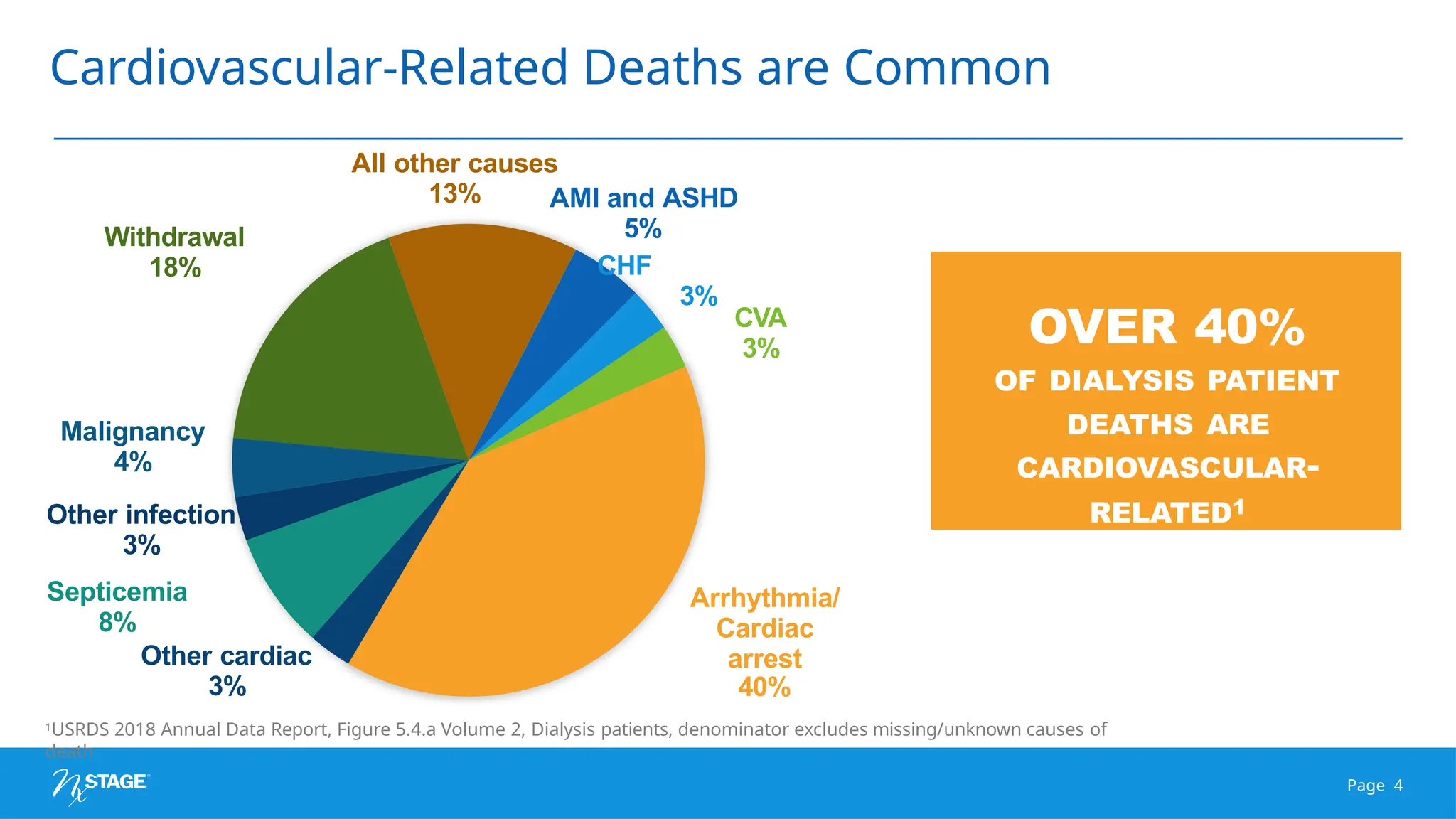
Cardiovascular-Related Deaths areCommon
OVER 40%
OF DIALYSIS PATIENT
DEATHS ARE
CARDIOVASCULAR-
RELATED1
AMI and ASHD
5%
CHF
1USRDS 2018 Annual Data Report, Figure 5.4.a Volume 2, Dialysis patients, denominator excludes missing/unknown causes of
death
Page 4
3%
CVA
3%
Arrhythmia/
Cardiac
arrest
40%
Malignancy
4%
Other infection
3%
Septicemia
8%
Other cardiac
3%
Withdrawal
18%
All other causes
13%
96%
97%
97%
99%
Side effects
50%
60%
70%
% ofPatients Surveyed
80% 90% 100%
Survival data
Bodily impact
Quality of life
implications
Most surveyed patients want to know...2
Current Dialysis Situation by Modality1
1Data source: 2013 Census Data by MAC and State, 2013 ESRD Network Annual Report 2Fine A, et al. Nephrologists should
voluntarily
divulge survival data to potential dialysis patients: a questionnaire study. Perit Dial Int. 2005;25:269-273
88% | In-center dialysis
treatment
10% | Peritoneal
dialysis
2% | Home
hemodialysis
Page 6
Dialysis Induced Stresson the Heart Varies by Modality
VOLUME
OVERLOA
D
PRESSURE
OVERLOA
D
INTRADIAL
YTIC
MYOCARDIAL
STUNNING
CARDIOMYOPATHY
CARDIOVASCULAR
RELA
TED DEATH
Page 8
9.
Cardiovascular Improvement isa
Hallmark Benefit of More Frequent Therapy
Frequent Nocturnal Hemodialysis (5+x/week), Frequent Hemodialysis (5-6x/week), In-Center Hemodialysis (3x/week)
1Rocco,et al., The effects of frequent nocturnal home hemodialysis: the Frequent Hemodialysis Network Nocturnal Trial. Interna tional Society of Nephrology,
2011. 2FHN
Trial Group. In-center hemodialysis six times per week versus three times per week. N Engl J Med. 2010;363(24):2287-2300. 3Foley, et al., Long-term evolution of
cardio
myopathy in dialysis patients. Kidney International, Vol. 54 (1998), pp. 1720–1725. 4Jefferies et.al. Frequent hemodialysis schedules are associated with reduced
levels
of dialysis-induced cardiac injury (Myocardial stunning). Clin J Am Soc Neprhol 2011 June, 6(6); 1326-1332. 5Culleton BF, et al., Effect of frequent nocturnal
hemodialysis vs conventional hemodialysis on left ventricular mass and quality of life. JAMA. September 2007; Vol 298, No. 11, 1291 – 1299.
Frequent
Nocturnal
Frequent
Hemodialysis
Peritoneal
Dialysis
In-center
Hemodialysis
Hypertensive /
Blood Pressure
Control
5%▼
Systolic BP1
7%▼
Systolic BP2
3%▲
Systolic BP3
≤1%▼
Systolic BP1,2
Occurrence of
Myocardial Stunning
50%
Patients4
75%
Patients4
-
Not studied
100%
Patients4
Regional Wall
Motion
Abnormalities
38%▼
RWMAs4
31%▼
RWMAs4
-
Not studied
Index
RWMAs
Left Ventricular Mass Index 8%▼
LV Mass5
11%▼
LV Mass2
14%▲
LV Mass3
2%▼
LV Mass2
Page 9
What Nephrologists Would
Choosefor Themselves Should be Considered
A significant majority of
nephrologists
agree…
– Home dialysis therapies are an
effective alternative to in-center
treatments1
– Home hemodialysis is the most
under- utilized modality2
Broader access to home therapies
is essential
– 26% of ESRD providers offer home
hemodialysis3
– 49% are certified to offer PD3
1Schiller B, Neitzer A, Doss S. Perceptions about renal replacement therapy among nephrology professionals. Nephrol News Issues. 2010;
24(10):36-44.
2Mendelssohn DC, et al. What do American Nephrologists think about dialysis modality selection? Am J Kidney Dis. 2001;37(1):22 -29.
3Dialysis Facility Compare Website provided by the Centers for Medicare & Medicaid Services. Updated July 14, 2014.
90% would
choose home
dialysis
Schiller
Nephrolog
y News
Issues1
Mendelssohn
American
Journal of
Kidney
Disease2
Nephrologist rated HHD
4.3 - MOST UNDER-
UTILIZED
4.5 SCALE
600
Nephrologist
s
Home Dialysis Preference
Page 11
12.
Frequency and DurationMatters
Duration matters, even with more frequent therapy
SHORTER LONGE
R
Lower Risk of Death
Performing more frequent nocturnal hemodialysis has shown similar 5-year survivability as deceased donor transplantation.1
Better Cardiovascular Outcomes
Patients performing more frequent hemodialysis with lower UF volumes resulted in a mean reduction of Regional Wall
Motion Abnormalities (RWMAs), which are associated with elevated mortality risk, per patient as compared to conventional,
thrice -weekly therapy with higher UF volumes.2
Improved Phosphorus Control and Middle Molecule Clearance
Compared to conventional thrice weekly in-center hemodialysis, more frequent hemodialysis is associated with improved control
of hyperphosphatemia.3 Nocturnal therapy is associated with greater clinical benefits with significantly higher total cleared
volume both of Phosphorus and ẞ2-microglobulin.4
More Energy and Vitality
More frequent dialysis, during the day or overnight, provides significant and wide-reaching therapeutic benefits. Quicker
time to recovery.5 Less dietary restriction.6-7 Better blood pressure control with fewer medications.8-9
References: slide 15
Page 12
The reported benefitsof home hemodialysis (HHD) may not be experienced by all patients.
The NxStage System is a prescription device and, like all medical devices, involves some risks. The risks associated with
hemodialysis treatments in any environment include, but are not limited to, high blood pressure, fluid overload, low blood
pressure, heart-related issues, and vascular access complications. When vascular access is exposed to more frequent use,
infection of the site, and other access related complications may also be potential risks. The medical devices used in
hemodialysis therapies may add additional risks including air entering the bloodstream, and blood loss due to clotting or
accidental disconnection of the blood tubing set.
Home hemodialysis with the NxStage System during waking hours may not require a care partner, provided a physician and a
qualified patient agree that solo home hemodialysis is appropriate. Patients performing nocturnal treatments are required to
have a care partner. Care partners are trained on proper operation and how to get medical or technical help if needed.
Certain risks associated with hemodialysis treatment are increased when performing solo HHD because no one is present to
help the patient respond to health emergencies. If patients experience needles coming out, blood loss, or very low blood
pressure during solo HHD, they may lose consciousness or become physically unable to correct the health emergency. Losing
consciousness or otherwise becoming impaired during any health emergency while alone could result in significant injury or
death. Additional ancillary devices and training are required when performing solo HHD
Certain risks associated with hemodialysis treatment are increased when performing nocturnal therapy due to the length of
treatment time and because therapy is performed while the patient and care partner are sleeping. These risks include, but are
not limited to, blood access disconnects and blood loss during sleep, blood clotting due to slower blood flow and/or increased
treatment time, and delayed response to alarms when waking from sleep.
Patients should consult their doctor to understand the risks and responsibilities of performing these therapies using the
NxStage System.
Page 14
Risks and Responsibilities
15.
1Pauly RP, GillJS, Rose CL, Asad RA, Chery A, Pierratos A, Chan CT. Survival among nocturnal home haemodialysis
patients compared to kidney transplant recipients. Nephrol Dial Transplant. 2009;24:2915-2919.
2Jefferies et.al. Frequent hemodialysis schedules are associated with reduced levels of dialysis-induced cardiac injury
(Myocardial stunning). Clin J Am Soc Neprhol 2011 June, 6(6); 1326-1332.
3FHN Trial Group. Effects of Frequent Hemodialysis on Measures of CKD Mineral and Bone Disorder. J Am Soc Nephrol. 23:727–
738, 2012.
4Eloot S, Van Biesen W, Dhondt A, Van de Wynkele H, Glorieux G, Verdonck P, Vanholder R. Impact of hemodialysis duration
on the removal of uremic retention solutes. Kidney International. 2008, 73, 765-770.
5Heidenheim PA, Muirhead N, Moist L, Lindsay RM. Patient quality of life on quotidian hemodialysis. Am J
Kidney Dis. 2003;42(S1)(S1):S36-S41.
6Charra B, Charzot C. The neglect of sodium restriction in dialysis patients: a short review. Hemodial Int
2003;7(4):342-347.
7Pierratos A. Daily nocturnal home hemodialysis. Kidney Int 2004;65(5)1975-1986.
8Culleton BF, Walsh M, Klarenbach SW, Mortis G, Scott-Douglas N, Quinn RR, Tonelli M, Donnelly S, Friedrich MG, Kumar A,
Mahallati H, Hemmelgarn BR, Manns BJ. Effect of frequent nocturnal hemodialysis vs conventional hemodialysis on left
ventricular mass and quality of life. JAMA. September 2007; Vol 298, No. 11, 1291 – 1299.
9Chan C, et al. Regression of left ventricular hypertrophy after conversion to nocturnal hemodialsys. Kidney International,
2002;61:2235- 2239.
Page 15
Frequency and Duration
Matter
References
16.
A Question of
Balance
Page16
REFERENCES
1Rivara MB et al. Extended-hours hemodialysis is associated with lower mortality risk in patients with end-stage renal disease.
Kidney Int. 2016 Dec;90(6):1312-1320.
2FHN Trial Group, Chertow, G.M., Levin, N.W., Beck, G.J. et al. In-center hemodialysis six times per week versus three times per
week. N Engl J Med. 2010; 363: 2287–2300.
3Morfin, J.A., Fluck, R.J., Weinhandl, E.D., Kansal, S., McCullough, P.A., and Komenda, P. Intensive hemodialysis and
treatment complications and tolerability. Am J Kidney Dis. 2016; 68: S43–S50.
4Bakris, G.L., Burkart, J.M., Weinhandl, E.D., McCullough, P.A., and Kraus, M.A. Intensive hemodialysis, blood pressure,
and antihypertensive medication use. Am J Kidney Dis. 2016; 68: S15–S23.
5Weinhandl ED, Gilbertson DT, Collins AJ. Mortality, Hospitalization, and Technique Failure in Daily Home Hemodialysis and
Matched Peritoneal Dialysis Patients: A Matched Cohort Study. Am J Kidney Dis. 2016;67(1):98-110.
6Weinhandl, E.D., Liu, J., Gilbertson, D.T., Arneson, T.J., Collins, A.J. Survival in daily home hemodialysis and matched thrice-
weekly in-center hemodialysis patients. J Am Soc Nephrol. 2012;23:895–904.
7McCullough, P.A., Chan, C.T., Weinhandl, E.D., Burkart, J.M., and Bakris, G.L. Intensive hemodialysis, left ventricular hypertrophy,
and cardiovascular disease. Am J Kidney Dis. 2016; 68: S5–S14.
8Raimann, J.G., et al. The Effect of Increased Frequency of Hemodialysis on Volume-Related Outcomes: A Secondary Analysis
of the Frequent Hemodialysis Network Trials. Blood Purif 2016;41:277–286.
9Weinhandl, Collins, Kraus. Ultrafiltration Rates with More Frequent Home Hemodialysis. Oral Presentation. 2017 ADC.
10Stefánsson, B.V., Brunelli, S.M., Cabrera, C. et al. Intradialytic hypotension and risk of cardiovascular disease. Clin J Am Soc
Nephrol. 2014; 9: 2124–2132.
17.
A Question of
Balance
Page17
REFERENCES
11Jefferies, H.J., et al. Frequent Hemodialysis Schedules Are Associated with Reduced Levels of Dialysis-induced Cardiac
Injury (Myocardial Stunning). Clin J Am Soc Nephrol. 2011 June; 6(6): 1326–1332.
12Jaber BL, Lee Y, Collins AJ, et al. Effect of daily hemodialysis on depressive symptoms and postdialysis recovery time: interim
report from the FREEDOM (Following Rehabilitation, Economics and Everyday-Dialysis Outcome Measurements) Study. Am J
Kidney Dis.
2010;56(3):531-539.
13Lindsay RM, Heidenheim PA, Nesrallah G, Garg AX, Suri R, Daily Hemodialysis Study Group London Health Sciences Centre.
Minutes to recovery after a hemodialysis session: a simple health-related quality of life question that is reliable, valid, and
sensitive to change. CJASN. 2006;1(5):952-959.
14Finkelstien FO, et al. At-home short daily hemodialysis improves the long-term health-related quality of life. Kidney
International (2012) 82, 561–569.
15Jaber BL, et al. Impact of Short Daily Hemodialysis on Restless Legs Symptoms and Sleep Disturbances. CJASN May 2011 vol. 6
no. 5 1049-1056.
16Kraus, Michael A. et al. Intensive Hemodialysis and Health-Related Quality of Life. Am J of Kidney Dis. 2016;68:S33-S42.
17Suri RS, et al. Risk of Vascular Access Complications with Frequent Hemodialysis. J Am Soc Nephrol 24: 498–505, 2013.
18Spry LA, Burkart JM, Holcroft C, Mortier L, and Glickman JD. Survey of home hemodialysis patients and nursing staff
regarding vascular access use and care. Hemodialysis International. 2015 April;19(2), 225-234.
19Weinhandl EW, et al. Hospitalization in Daily Home Hemodialysis and Matched Thrice-Weekly In-Center Hemodialysis
Patients. Am J Kidney Dis. 65(1):98-108.
More Frequent Hemodialysis
Associatedwith Better Blood Pressure Control
The FHN Trial Group. In-Center Hemodialysis Six Times per Week versus Three Times
per
Week. N Engl J Med. 2010 December 9; 363(24): 2287–2300
MORE FREQUENT
HEMODIALYSIS ASSOCIATED
WITH A 7% DECREASE IN
SYSTOLIC BLOOD
PRESSURE
Back to
Hallmark Benefits
Page 20
21.
More Frequent NocturnalHemodialysis
Associated with Better Blood Pressure
Control
Culleton BF, Walsh M, Klarenbach SW, Mortis G, Scott-Douglas N, Quinn RR, Tonelli M,
Donnelly S, Friedrich MG, Kumar A, Mahallati H, Hemmelgarn BR, Manns BJ. Effect of
frequent nocturnal hemodialysis vs conventional hemodialysis on left ventricular mass and
quality of life. JAMA. September 2007; Vol 298, No. 11, 1291 – 1299.
MORE FREQUENT
HEMODIALYSIS ASSOCIATED
WITH A 7% DECREASE IN
SYSTOLIC BLOOD PRESSURE
Back to
Hallmark Benefits
Page 21
Clinical Consequences of
IncreasedLeft Ventricular
Mass
Back to
Hallmark Benefits
Page 23
The impaired ventricular
function present in Left
Ventricular Hypertrophy
can actually simulate a
vicious cycle
May cause LVH
progression
Complicated by ESRD
uremic risk factors.
24.
Left VentricularHypertrophy (LVH) represents a major predictor
of the development of cardiovascular complications
70-90% of patients exhibit LVH of varying degrees of severity prior
to the initiation of renal replacement therapy3,4
Many patients continue to exhibit LVH despite initiating dialysis5
Persistence of vascular volume increase due to inadequate
ultrafiltration has been reported as a major factor in the failure of LVH
to regress5
More Frequent Hemodialysis Reduced Left Ventricular
Mass1,2
1Culleton BF, Walsh M, Klarenbach SW, Mortis G, Scott-Douglas N, Quinn RR, Tonelli M, Donnelly S, Friedrich MG, Kumar A, Mahallati H,
Hemmelgarn BR, Manns BJ. Effect of frequent nocturnal hemodialysis vs conventional hemodialysis on left ventricular mass and quality
of life. JAMA. September 2007; Vol 298, No. 11, 1291 – 1299.
2Ayus JC, Mizani MR, Achinger SG, et al. Effects of short daily versus conventional hemodialysis on left ventricular hypertrophy and
inflammatory markers: a prospective, controlled study. J Am Soc Nephrol. 2005;16(9):2778-2388.
3Zoccali C, et al.,Prognostic impact of the indexation of left ventricular mass in patients undergoing dialysis. J Am Soc Nephrol. 2001;12:2768-
2774. 4McMahon LP, Roger SD, Levin A. Development, prevention, and potential reversal of left ventricular hypertrophy in chronic kidney
disease. J Am Soc Nephrol. 2004;15:1640-1647.
5Richard J. Glassock, Roberto Pecoits-Filho, Silvio Barbareto, Increased Left Ventricular Mass in Chronic Kidney Disease and End-Stage
Renal Disease: What Are the Implications? Dialysis & Transplantation . January 2010: 1-4.
Back to
Hallmark Benefits
Page 24
25.
FHN Daily Trial:
SignificantReduction in Left Ventricular Mass
Mean Change:
11%
DECREASE IN
LV MASS
During study
period
The FHN Trial Group. In-Center Hemodialysis Six Times per Week versus Three Times per Week. The New
England
Journal of Medicine. 010:363;2287-2300.
Back to
Hallmark Benefits
Page 25
26.
Canadian Nocturnal HemodialysisTrial:
Significant Reduction in Left Ventricular
Mass
Back to
Hallmark Benefits
Page 26
Culleton BF, et al. Effect of frequent nocturnal hemodialysis vs conventional hemodialysis
on left
ventricular mass and quality of life. JAMA. September 2007; Vol 298, No. 11, 1291 – 1299.
CONVENTIONAL HD SHOWED
INSIGNIFICANT
LEFT VENTRICULAR MASS
REGRESSION
Although the short daily FHN trial
showed a 2% improvement in LV
mass, the Canadian nocturnal trial
reported no
significant improvement
MORE FREQUENT HOME NOCTURNAL HD
ASSOCIATED WITH AN 8% DECREASE IN LV
MASS
Similar LV mass regression observed in HHD
patients
with benefits attributable to better fluid
management
TOTAL BODY MASS:
MedicalEducation Institute, Inc. in cooperation with the National Association
of Nephrology Technicians/Technologists (NANT) with review and approval
by Jim Curtis, CHT, CCHT, nationally recognized dialysis technician trainer
and consultant.
Compartment
s– Intracellular:
2/3
– Extracellular:
1/3
• Plasma: 20%
• Interstitial: 80%
Hemodialysis only directly cleans the
blood
Blood is only about 15% of total body
mass
The majority of the excess fluid must
shift from the other compartments into
the blood to be removed
Fluid Dynamics in the Body
Back to
Hallmark Benefits
Page 28
29.
Frequent Hemodialysis areAssociated with Reduced
Levels of Dialysis-Induced Cardiac Injury (Myocardial
Stunning)1
Back to
Hallmark Benefits
Page 29
Study Design
– Cross-sectional, observation
study
Patient Population
– 18+ years of age, on
current therapy for 3
months
– Patients with severe LV or
heart transplant were
excluded
Location:
– Satellite Dialysis and
WellBound, Mountain View, CA
Enrollment Size
46 well-matched hemodialysis
(HD)
patients
– 12 Conventional HD (not studied
on the day after 2 day intradialytic
interval)
– 12 More frequent in-center
HD (5+/week)
– 12 More frequent home
HD (5+/week)
– 10 More frequent home
nocturnal
HD (5+/week)
1Jefferies HJ, Virk B, Schiller B, Moran J, McIntyre CW. Frequent Hemodialysis
Schedules Are Associated with Reduced Levels of Dialysis-induced Cardiac
Injury (Myocardial Stunning). CJASN. 2011 June; 6(6): 1326–1332.
30.
Method
s
Pre-dialysis BPmeasurements after 5
minutes of rest
Subsequent BP measurement taken 15
minutes before the end of treatment
(“peak stress”)
Results
Strong correlation between
ultrafiltration
volume and intradialytic hypotension
Intradialytic Hypotension:
Increased with Conventional Hemodialysis1
-41.7
±28.1
-18.5
±28.4
-1.5
±23.2
17.1
±24.6
CHD3=Conventional In-Center HD
(3x/week) CSD=Center Short Daily
(5+x/week) HSD=Home Short Daily
(5+x/week) HN=Home Nocturnal
(5+x/week)
1Jefferies HJ, Virk B, Schiller B, Moran J, McIntyre CW. Frequent Hemodialysis Schedules
Are Associated with Reduced Levels of Dialysis-induced Cardiac Injury (Myocardial
Stunning). CJASN. 2011 June; 6(6): 1326–1332
Back to
Hallmark Benefits
Page 30
31.
Regional WallMotion
Abnormalities (RWMAs) have been
associated with Myocardial
Stunning or Cardiac Injury
Repeated occurrences of myocardial
stunning may result in permanent injury
and lead to heart failure
Back to
Hallmark Benefits
Page 31
Regional Wall Motion Abnormalities:
Increased with Higher Ultrafiltration
Rate1
1Jefferies HJ, Virk B, Schiller B, Moran J, McIntyre CW. Frequent Hemodialysis Schedules Are Associated
with Reduced Levels of Dialysis-induced Cardiac Injury (Myocardial Stunning). CJASN. 2011 June; 6(6):
1326–1332
CHD3=Conventional In-Center HD
(3x/week) CSD=Center Short Daily
(5+x/week) HSD=Home Short Daily
(5+x/week) HN=Home Nocturnal
(5+x/week)
32.
LVEF atrest had significantly deteriorated
in patients with RWMAs but remained
unchanged in those patients without
– (62.1, 11.4% versus 54.7, 10.1%,
P
0.0008)
– With HD-induced RWMAs: 13
– Without HD-induced RWMAs:
1
Regional Wall Motion
Abnormalities: Patient Survival
After 12 Months1
1Burton, JO et al., Hemodialysis-Induced Cardiac Injury: Determinants and Associated
Outcomes.
The presence of HD-induced RWMAs was
associated with increased relative mortality
at 12 months (P 0.019)
Patient Deaths
Death resulted
overwhelmingly from
cardiovascular causes.
Clin J Am Soc Nephrol 4: 914–920, 2009
Back to
Hallmark Benefits
Page 32
33.
Intravascular volumecontraction may begin to occur during HD if
fluid
is removed at a rate >5–6 mL/kg/hr
Reduced organ perfusion is risked if fluid is removed during HD at
a
rate >10 mL/kg/hr
Reduced organ perfusion will likely result if fluid is removed
during HD
at a rate >13 mL/kg/hr
Myocardial Stunning:
May be Due to the Treatment Itself1
1Burton, JO et al., Hemodialysis-Induced Cardiac Injury: Determinants and Associated Outcomes. Clin J Am Soc Nephrol 4: 914–920,
2009
Back to
Hallmark Benefits
Page 33
34.
2/3 ofpatients
suffer from
recurrent HD-
induced
ischemic injury
The way that
the heart moves
changes as
parts of the
heart die
Ultrafiltration Rate Implications for Patient Care1
1Assimon MM, Flythe JE. Rapid ultrafiltration rates and outcomes among hemodialysis patients: re -examining the evidence base. Curr
Opin Nephrol
Hypertens. 2015 November ; 24(6): 525–
530.
Back to
Hallmark Benefits
Page 34
35.
“Although patients maylook comfortable during hemodialysis, in reality this innocuous-appearing procedure
has
much more stunning effect than meets the eye.”
Dr. Joel Glickman
Facts
Not studied in PD patients
Much less prevalent in more frequent HHD patients than IHD patients and correlated
with ultrafiltration rates
Conclusion
High ultrafiltration rates were associated with increased all-cause and
cardiovascular mortality
– Rates greater than 10 - 13 mL/kg/hr were associated with congestive
heart failure
1Joel D. Glickman. Stunning Consequences of Thrice-Weekly In-center Dialysis. Medscape. Apr 27,
2012
Back to
Hallmark Benefits
Page 35
Stunning Consequences of
Thrice-Weekly In-Center Hemodialysis1