Use cases & real-world deployments
Yashesh A. Shroff, Ph.D.
Commercial ISV Enabling PM
Intel Corp.
Applications for Machine
Learning in IoT
Software Services Group – Developer Relations Division
1. IDC
2. MC/EDC: The Digital Universe of Opportunities
3. Goldman Sachs
4. IMS Research
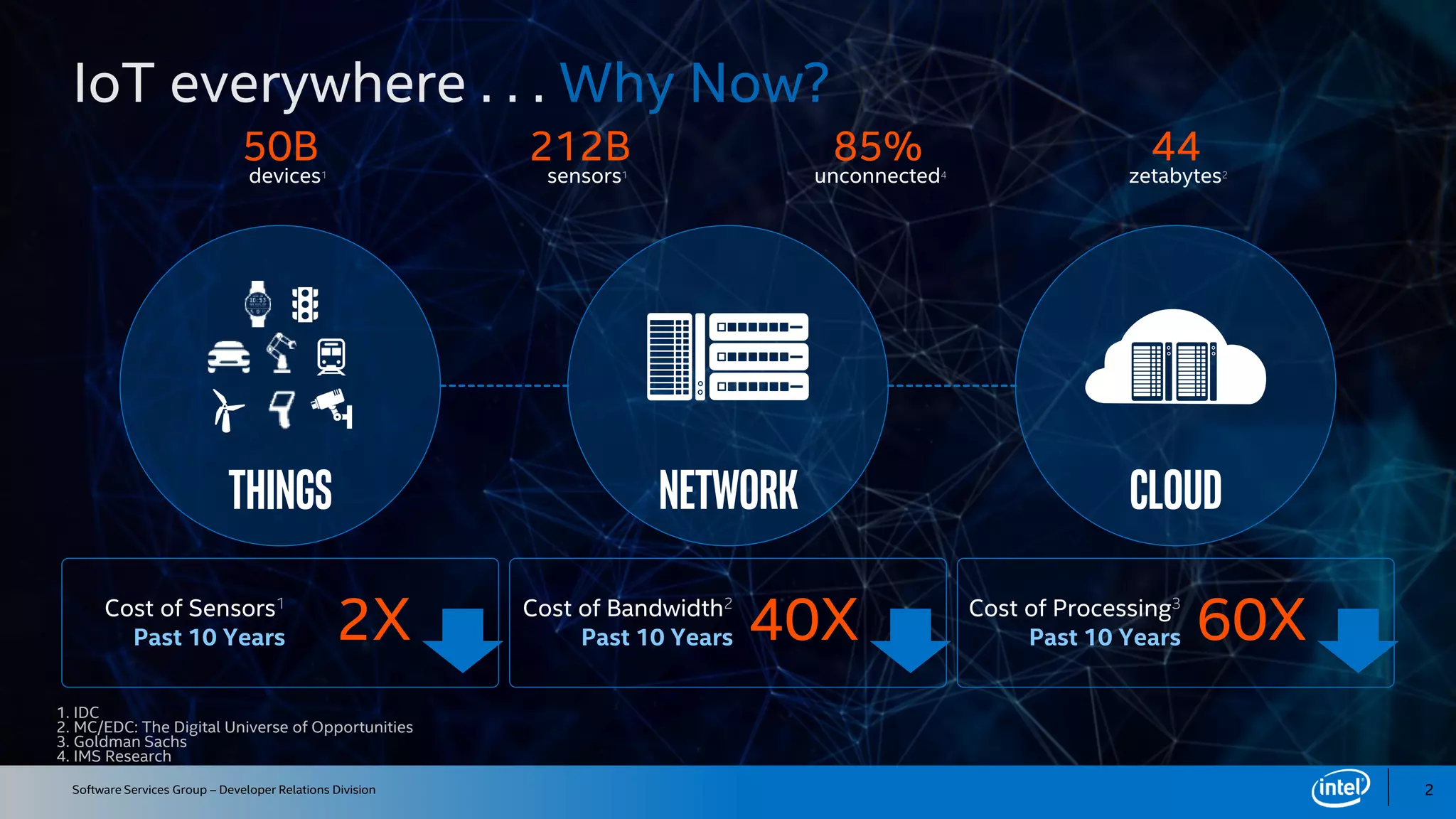
Things network cloud
50B
devices1
44
zetabytes2
212B
sensors1
85%
unconnected4
Cost of Sensors1
Past 10 Years
Cost of Bandwidth2
Past 10 Years
Cost of Processing3
Past 10 Years2X 40X 60X
2
Software Services Group – Developer Relations Division
A brief intro about me: Yashesh Shroff
@yashroff
/in/yashroff
• National Instruments, IBM: early years
• Ph.D. (EECS), UC Berkeley
• Statistics optics, patterning technologies
• Developed MEMS micro-mirrors based
imaging models
• Succession of roles in R&D, Corp Dev, &
IoT/DL commercial enabling at Intel
• >20 Publications and 5 patents in imaging
analytics, compression, design for
manufacturing
• MBA (2013) Haas / Columbia GSB
- Karl Steinbuch, German computer science pioneer, 1966
“In a few decades time,
computers will be
interwoven into almost
every industrial product.”
[Ref: https://en.wikipedia.org/wiki/Karl_Steinbuch]
My current focus…
IoT Software App Enabling
Software Services Group – Developer Relations Division
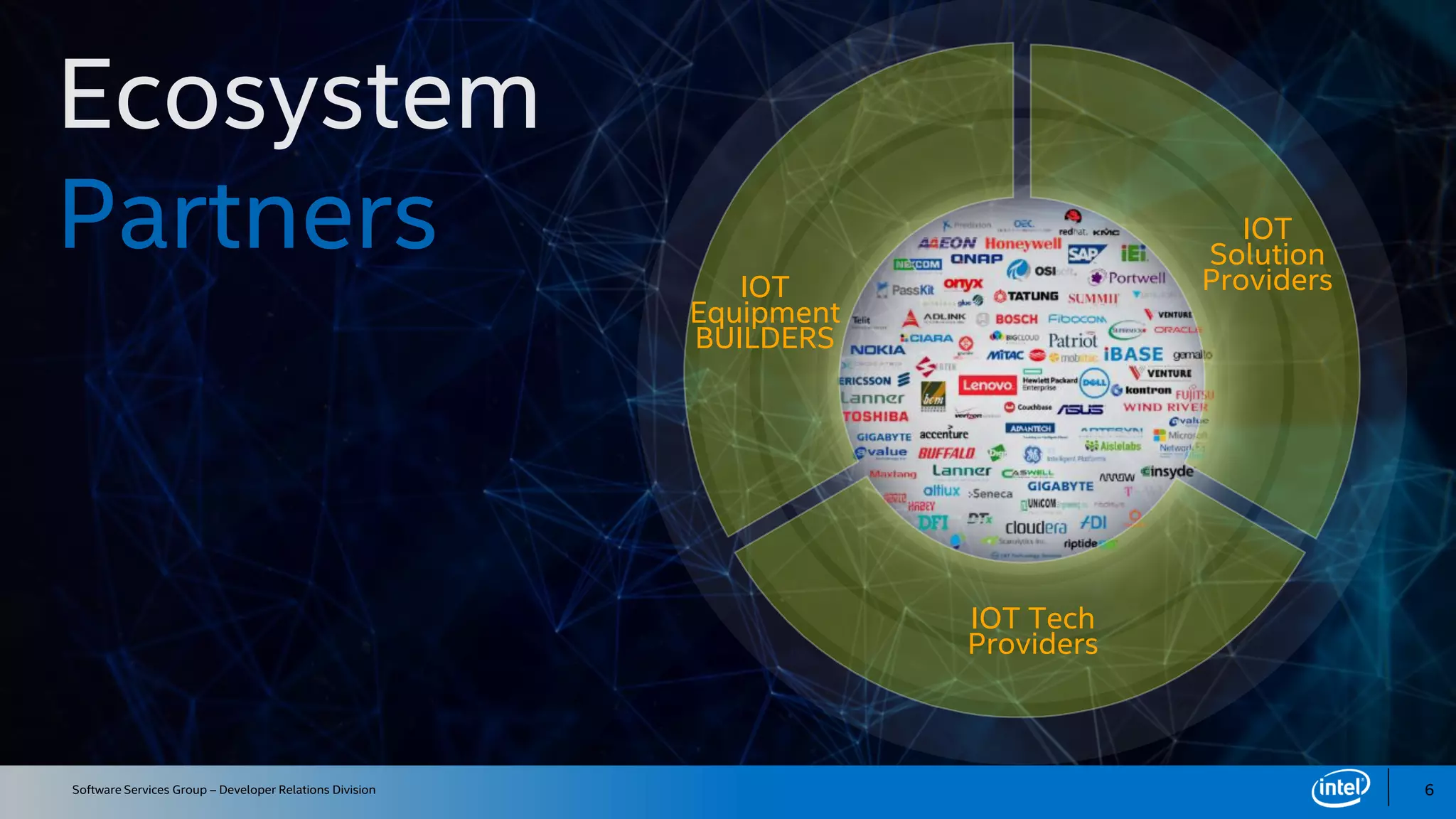
IOT
Equipment
BUILDERS
IOT Tech
Providers
IOT
Solution
Providers
6
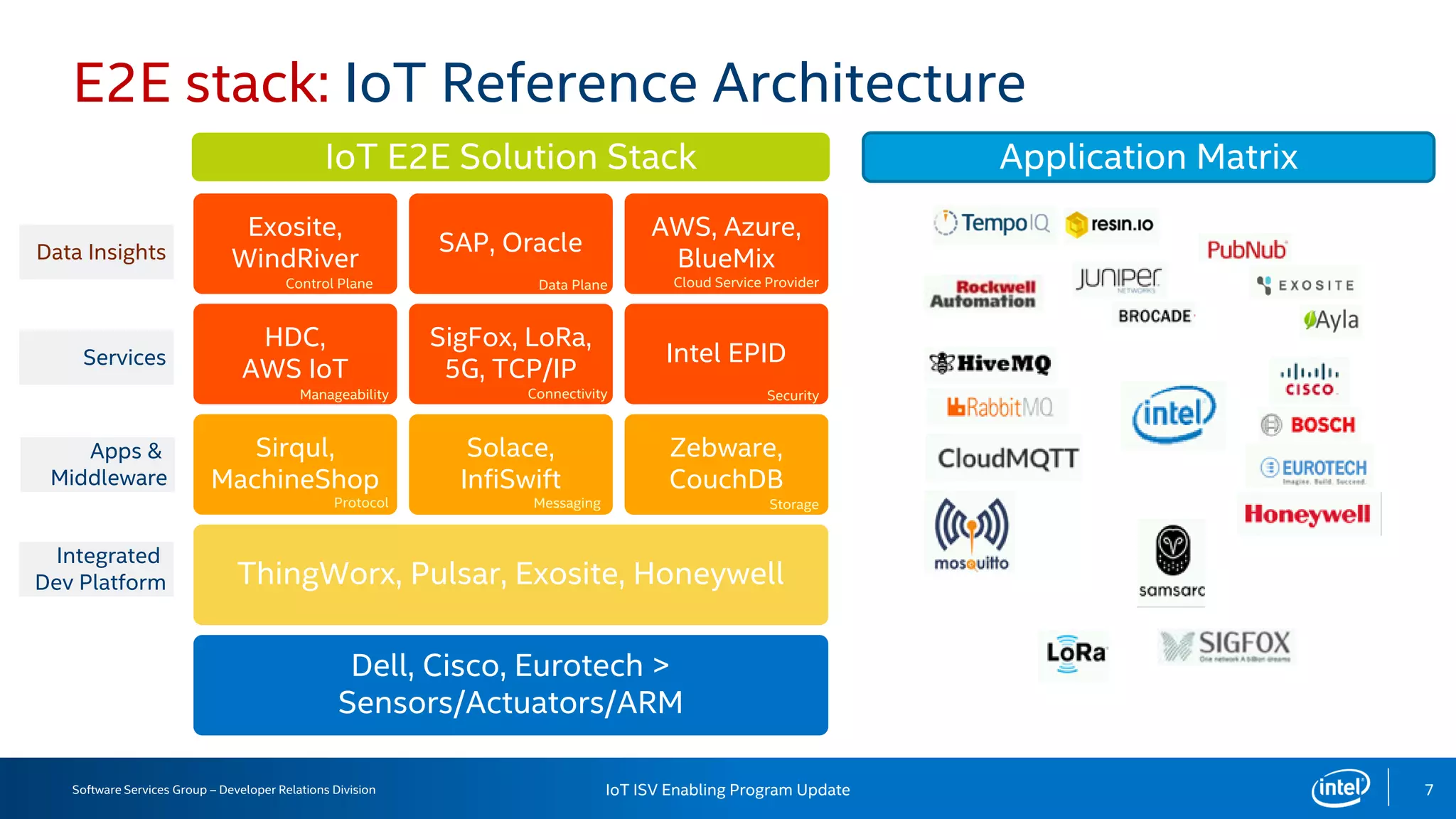
Software Services Group – Developer Relations Division IoT ISV Enabling Program Update 7
Dell, Cisco, Eurotech >
Sensors/Actuators/ARM
ThingWorx, Pulsar, Exosite, Honeywell
Sirqul,
MachineShop
HDC,
AWS IoT
Exosite,
WindRiver
Solace,
InfiSwift
SigFox, LoRa,
5G, TCP/IP
SAP, Oracle
Zebware,
CouchDB
Intel EPID
AWS, Azure,
BlueMix
E2E stack: IoT Reference Architecture
Data Insights
Services
Apps &
Middleware
Integrated
Dev Platform
IoT E2E Solution Stack Application Matrix
Manageability
Protocol
Security
Storage
Connectivity
Data Plane Cloud Service ProviderControl Plane
Messaging
Software Services Group – Developer Relations Division
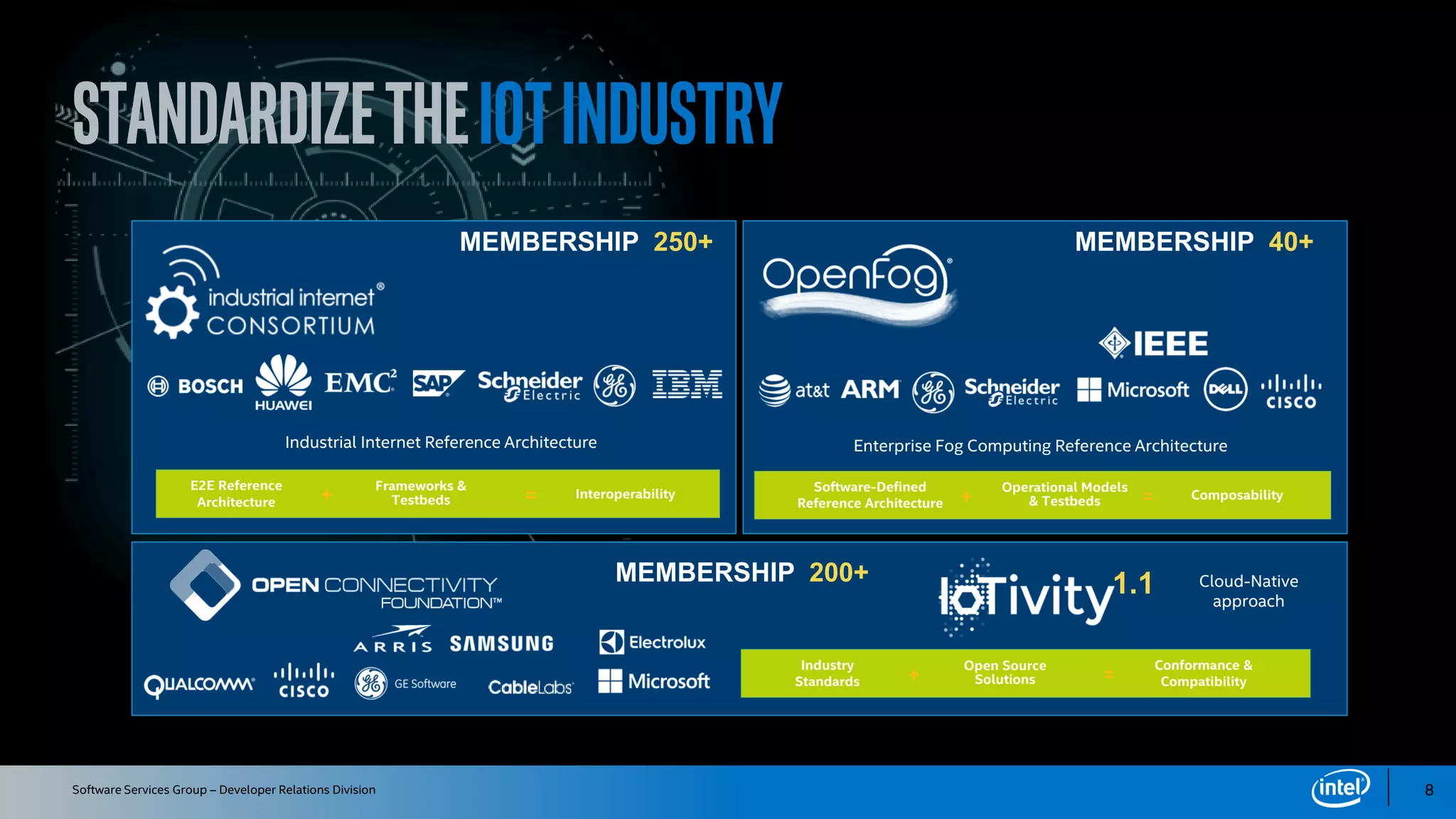
E2E Reference
Architecture
Frameworks &
Testbeds Interoperability+ =
MEMBERSHIP 250+
Industrial Internet Reference Architecture
Software-Defined
Reference Architecture
Operational Models
& Testbeds Composability+ =
MEMBERSHIP 40+
Enterprise Fog Computing Reference Architecture
Industry
Standards
Open Source
Solutions
Conformance &
Compatibility+ =
MEMBERSHIP 200+ Cloud-Native
approach
1.1
Standardizetheiotindustry
8
Software Services Group – Developer Relations Division
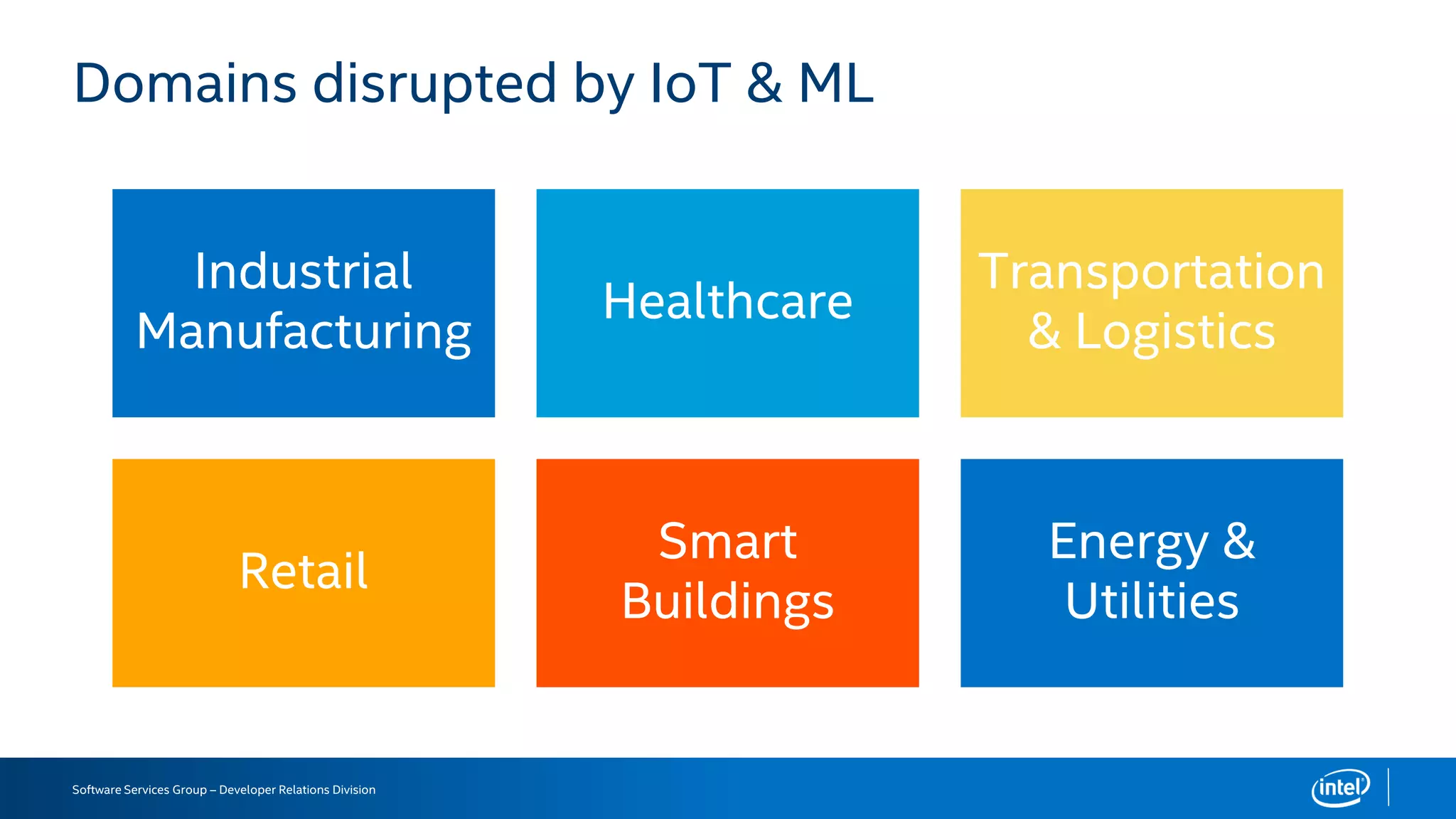
Domains disrupted by IoT & ML
Industrial
Manufacturing
Healthcare
Transportation
& Logistics
Retail
Smart
Buildings
Energy &
Utilities
Software Services Group – Developer Relations Division
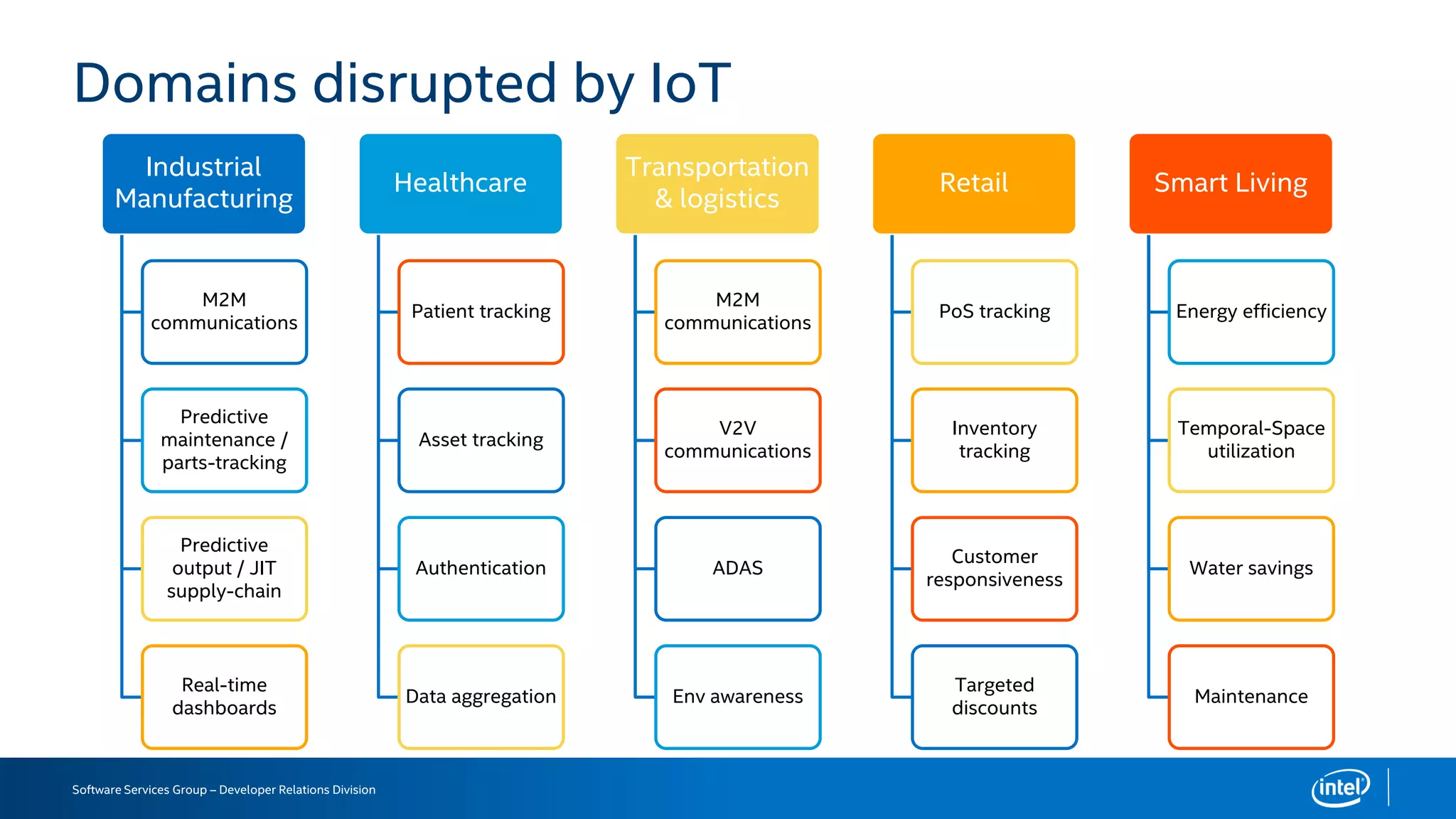
Domains disrupted by IoT
Industrial
Manufacturing
M2M
communications
Predictive
maintenance /
parts-tracking
Predictive
output / JIT
supply-chain
Real-time
dashboards
Healthcare
Patient tracking
Asset tracking
Authentication
Data aggregation
Transportation
& logistics
M2M
communications
V2V
communications
ADAS
Env awareness
Retail
PoS tracking
Inventory
tracking
Customer
responsiveness
Targeted
discounts
Smart Living
Energy efficiency
Temporal-Space
utilization
Water savings
Maintenance
Software Services Group – Developer Relations Division
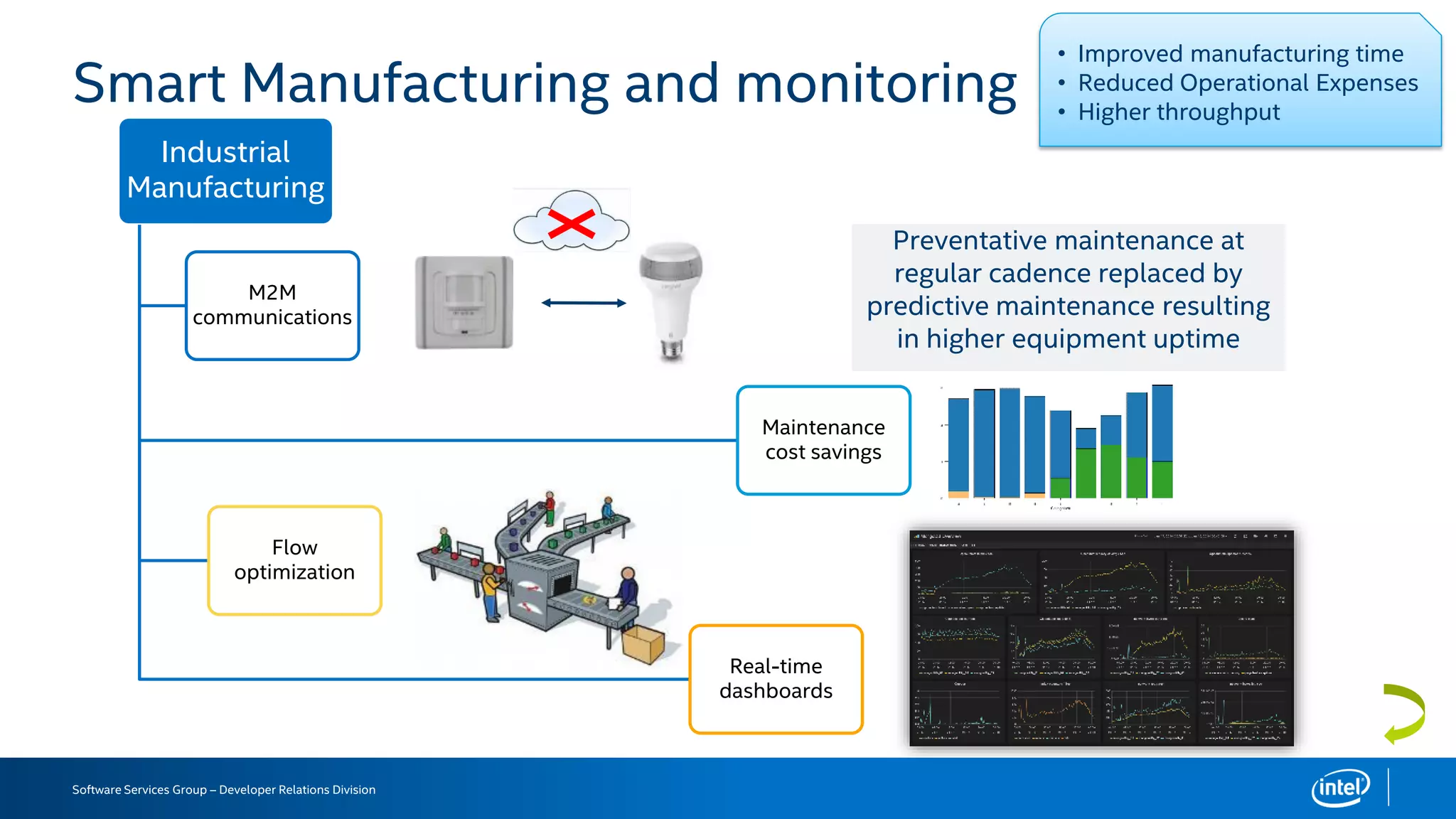
Smart Manufacturing and monitoring
Industrial
Manufacturing
M2M
communications
Maintenance
cost savings
Flow
optimization
Real-time
dashboards
Preventative maintenance at
regular cadence replaced by
predictive maintenance resulting
in higher equipment uptime
• Improved manufacturing time
• Reduced Operational Expenses
• Higher throughput
Software Services Group – Developer Relations Division
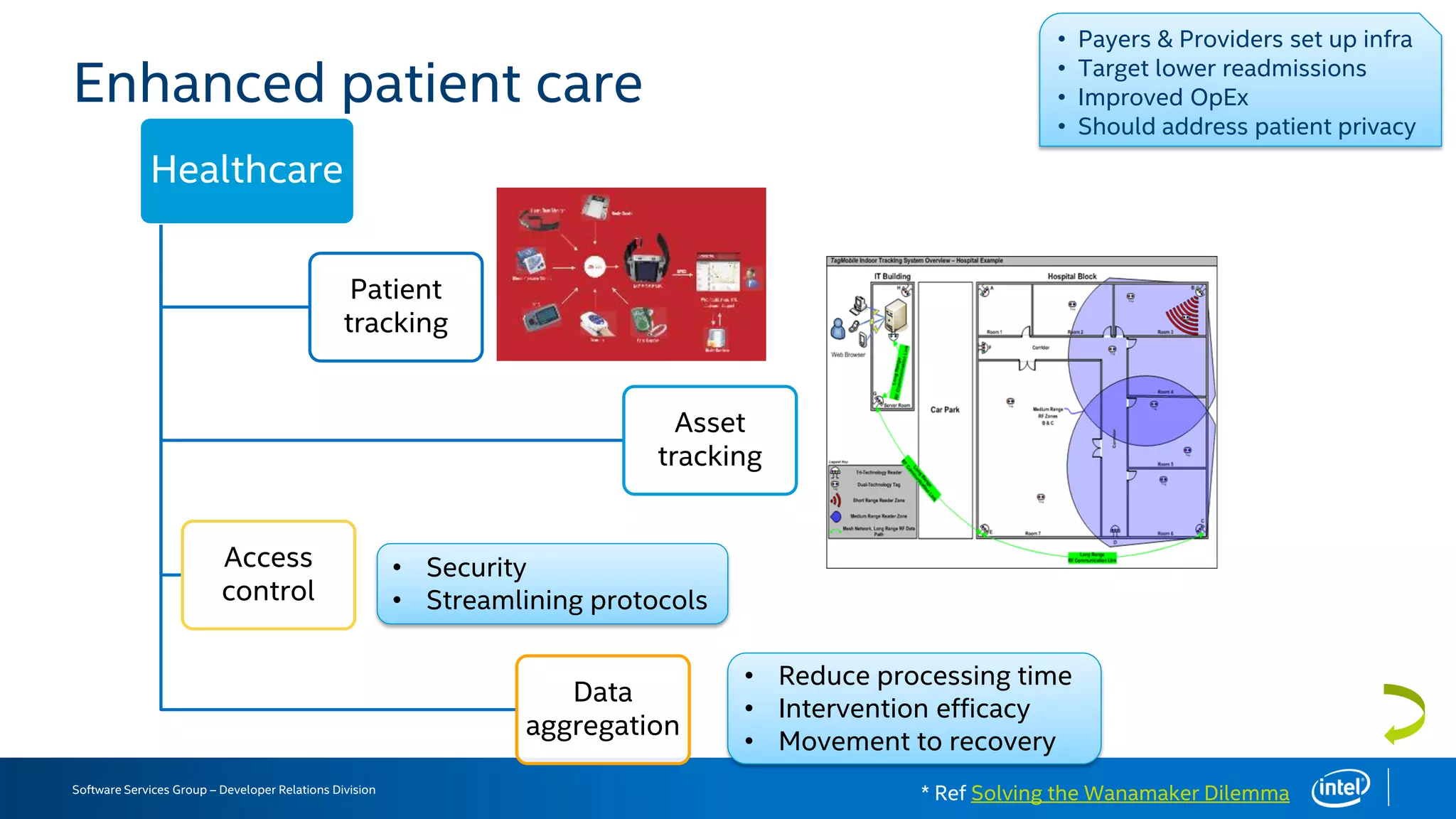
Enhanced patient care
Healthcare
Patient
tracking
Asset
tracking
Access
control
Data
aggregation
* Ref Solving the Wanamaker Dilemma
• Payers & Providers set up infra
• Target lower readmissions
• Improved OpEx
• Should address patient privacy
• Reduce processing time
• Intervention efficacy
• Movement to recovery
• Security
• Streamlining protocols
Software Services Group – Developer Relations Division
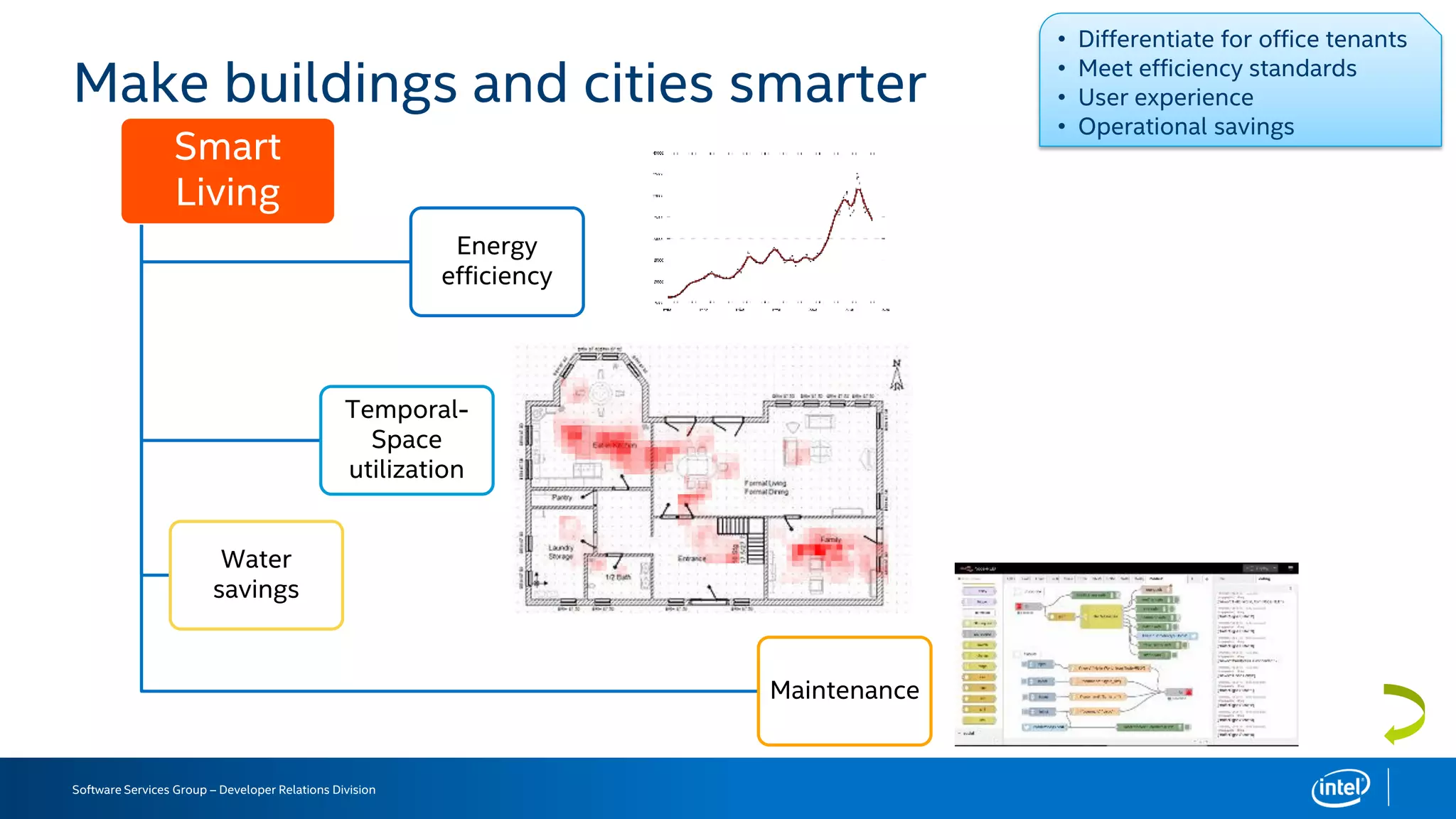
Make buildings and cities smarter
Smart
Living
Energy
efficiency
Temporal-
Space
utilization
Water
savings
Maintenance
• Differentiate for office tenants
• Meet efficiency standards
• User experience
• Operational savings
Software Services Group – Developer Relations Division
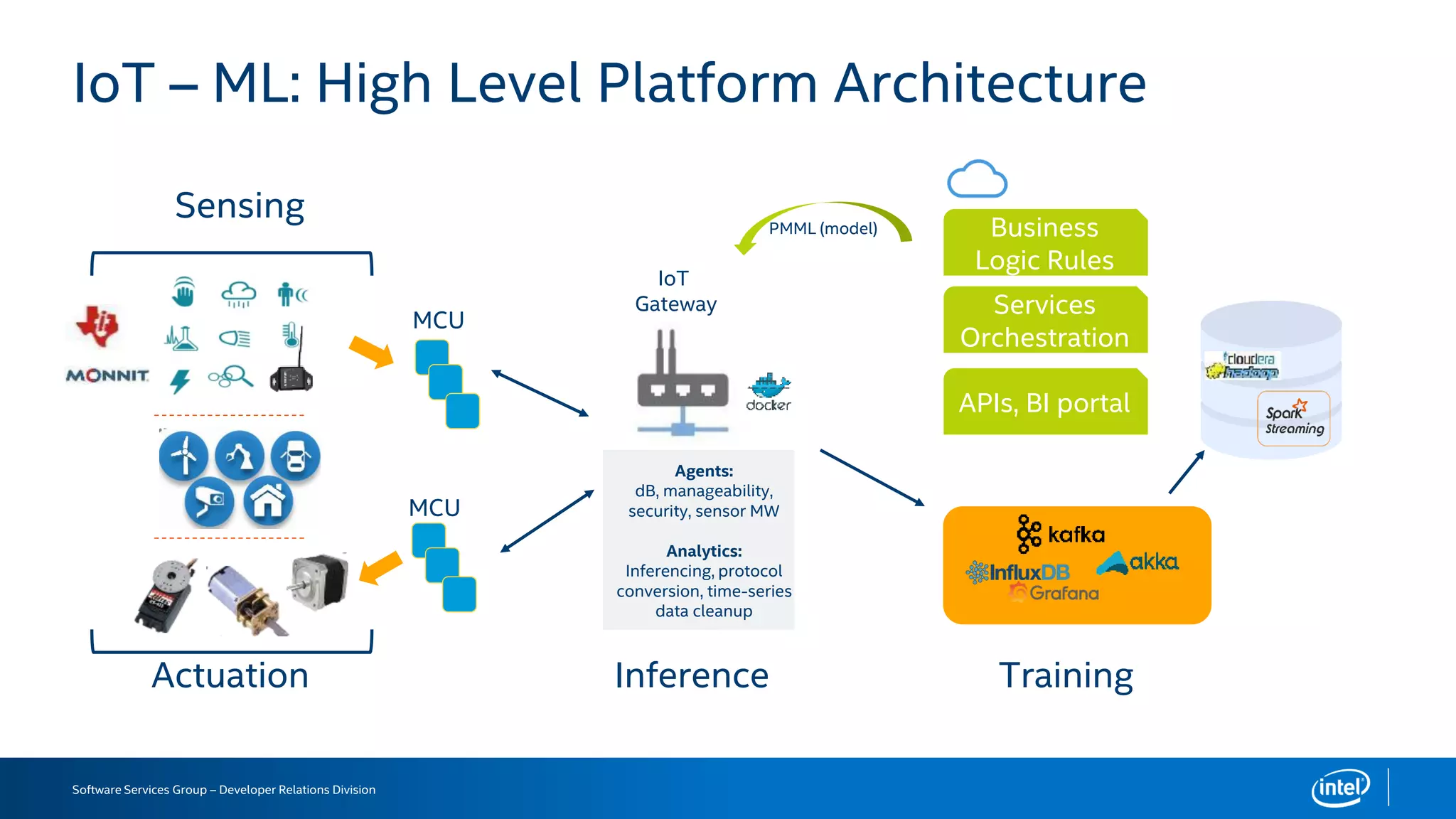
IoT – ML: High Level Platform Architecture
Sensing
Actuation
IoT
Gateway
MCU
MCU
Agents:
dB, manageability,
security, sensor MW
Analytics:
Inferencing, protocol
conversion, time-series
data cleanup
Business
Logic Rules
Services
Orchestration
APIs, BI portal
PMML (model)
TrainingInference
Making sense of IoT data for insights
Time-Series Analysis
Software Services Group – Developer Relations Division
Real-time, low latency reaction
 Stream computing
 Edge computing
Cloud latency is often ~1msec
 Round-trip time
Cost Concerns
 Savings in bandwidth cost
 Savings in MCU transmission energy
Classification Models
 Automatic or manual based on training
data
Windowing on incremental time-series
data (last ‘n’ seconds)
Data analytics requirements for IoT applications
Software Services Group – Developer Relations Division
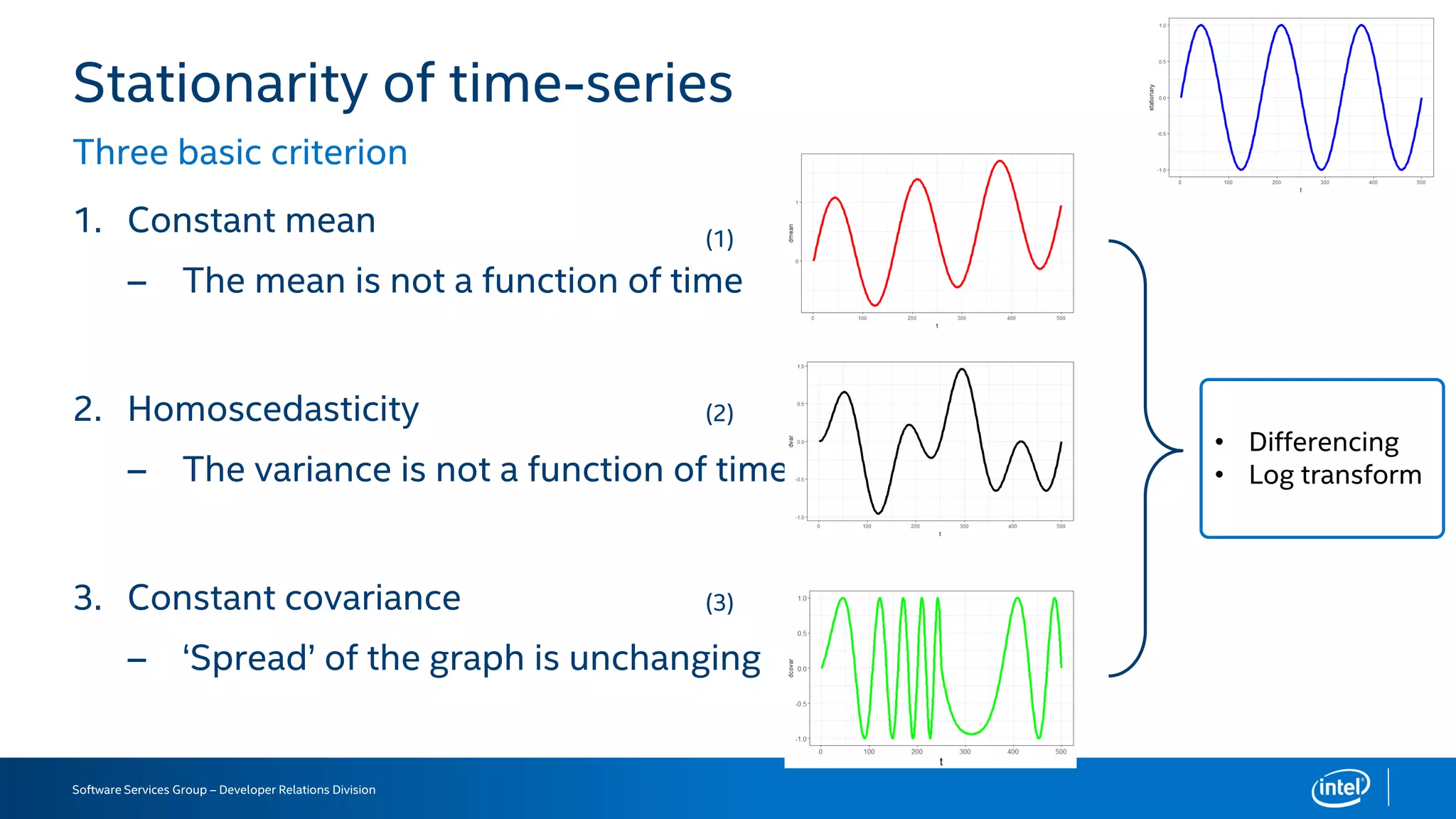
Stationarity of time-series
Three basic criterion
1. Constant mean
– The mean is not a function of time
2. Homoscedasticity
– The variance is not a function of time
3. Constant covariance
– ‘Spread’ of the graph is unchanging
(1)
(2)
(3)
• Differencing
• Log transform
Software Services Group – Developer Relations Division
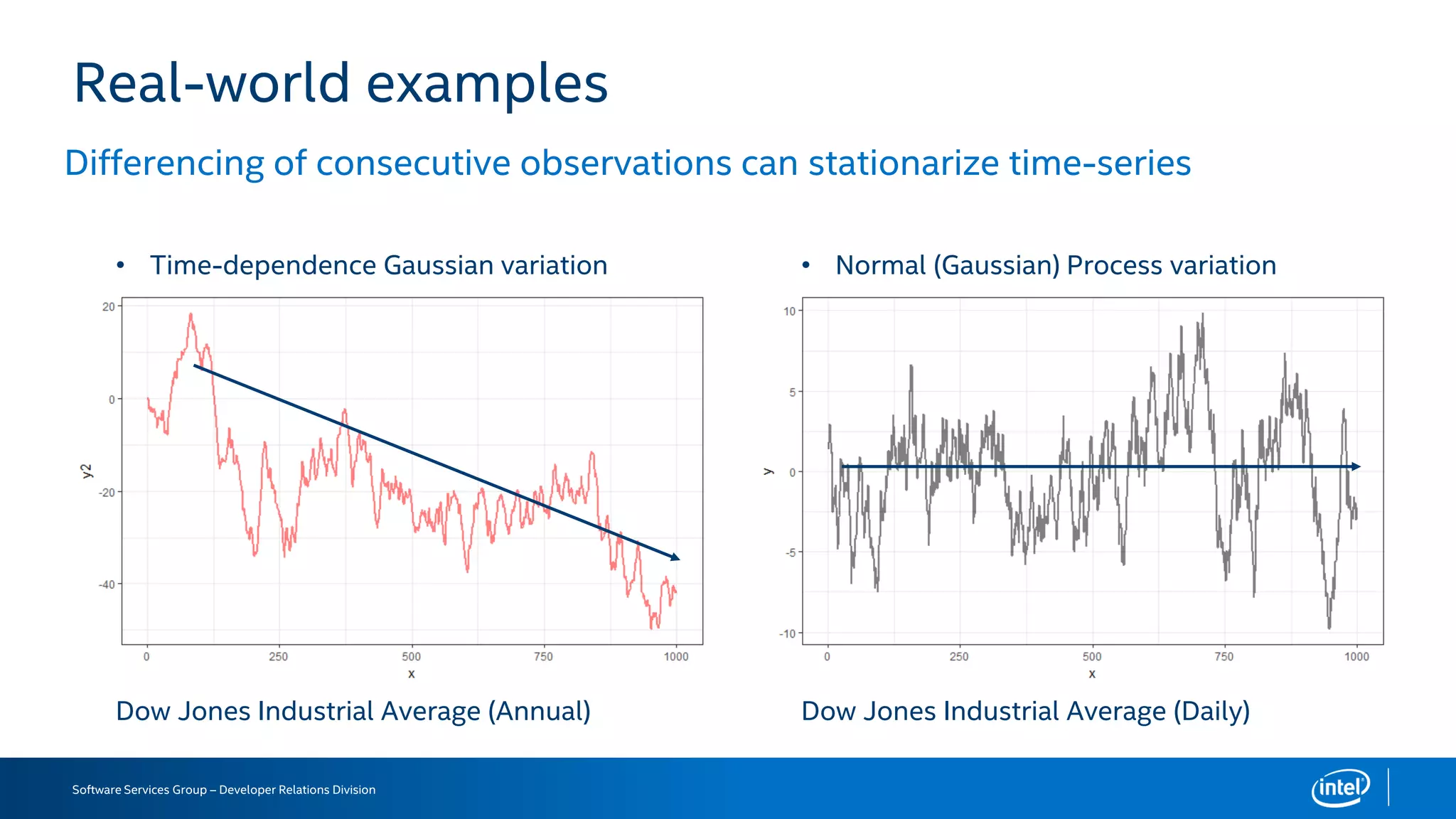
Real-world examples
Differencing of consecutive observations can stationarize time-series
• Normal (Gaussian) Process variation• Time-dependence Gaussian variation
Dow Jones Industrial Average (Annual) Dow Jones Industrial Average (Daily)
Software Services Group – Developer Relations Division
Time-series data is not domain-specific
Economic: Financial indexes, Exchange-rate, spread, stock prices, CPI
Marketing: Sales activity, customer churn, CTR, web-logs.
Industry: electric load, power consumption, voltage, sensors.
Meteorology: weather variables, like temperature, pressure, wind.
Biomedicine: physiological signals (ECG, EEG), heart-rate, body temperature.
Genomics: time series of gene expression during cell cycle.
Software Services Group – Developer Relations Division
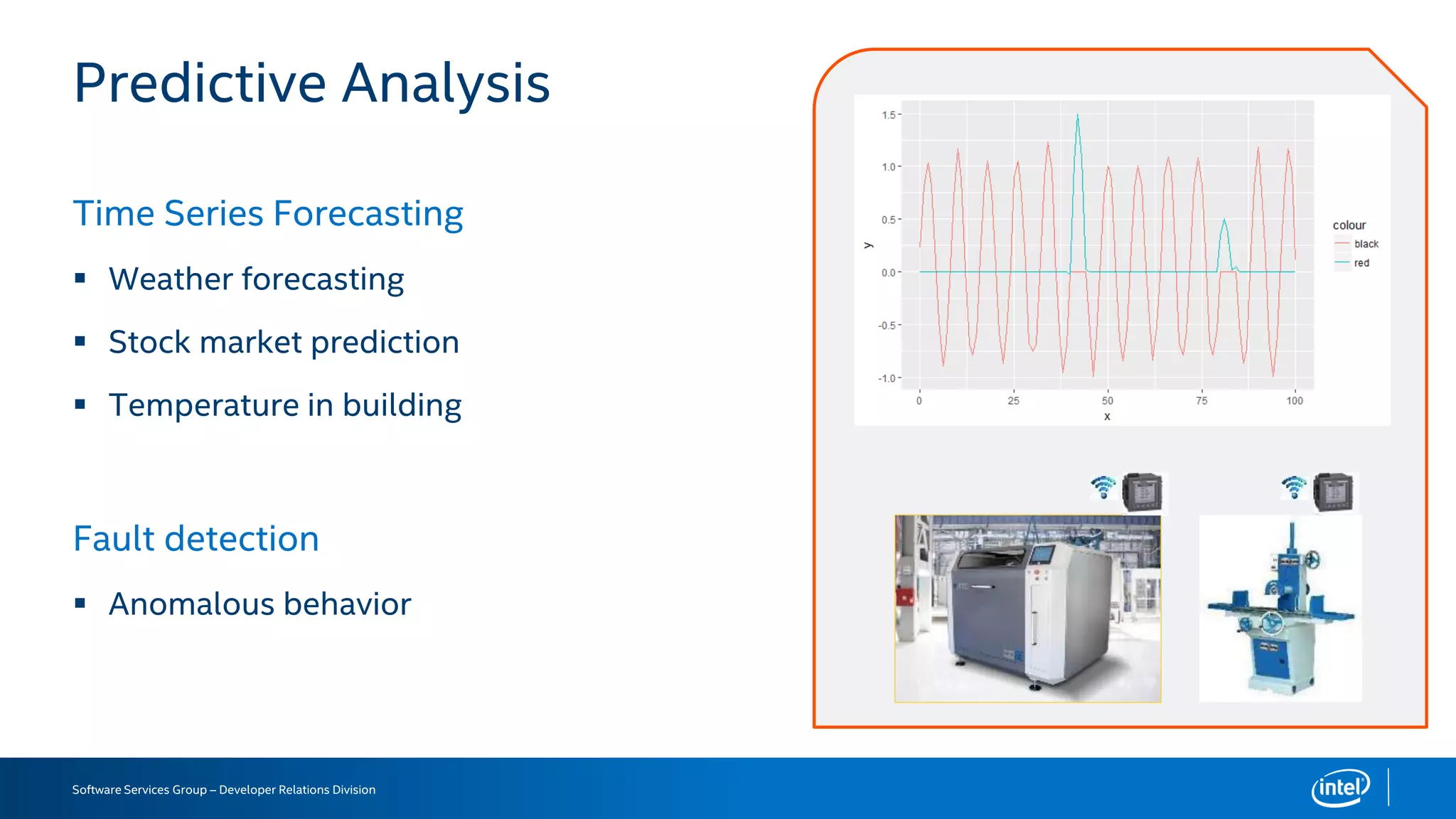
Time Series Forecasting
 Weather forecasting
 Stock market prediction
 Temperature in building
Fault detection
 Anomalous behavior
Predictive Analysis
Software Services Group – Developer Relations Division
Time-series models
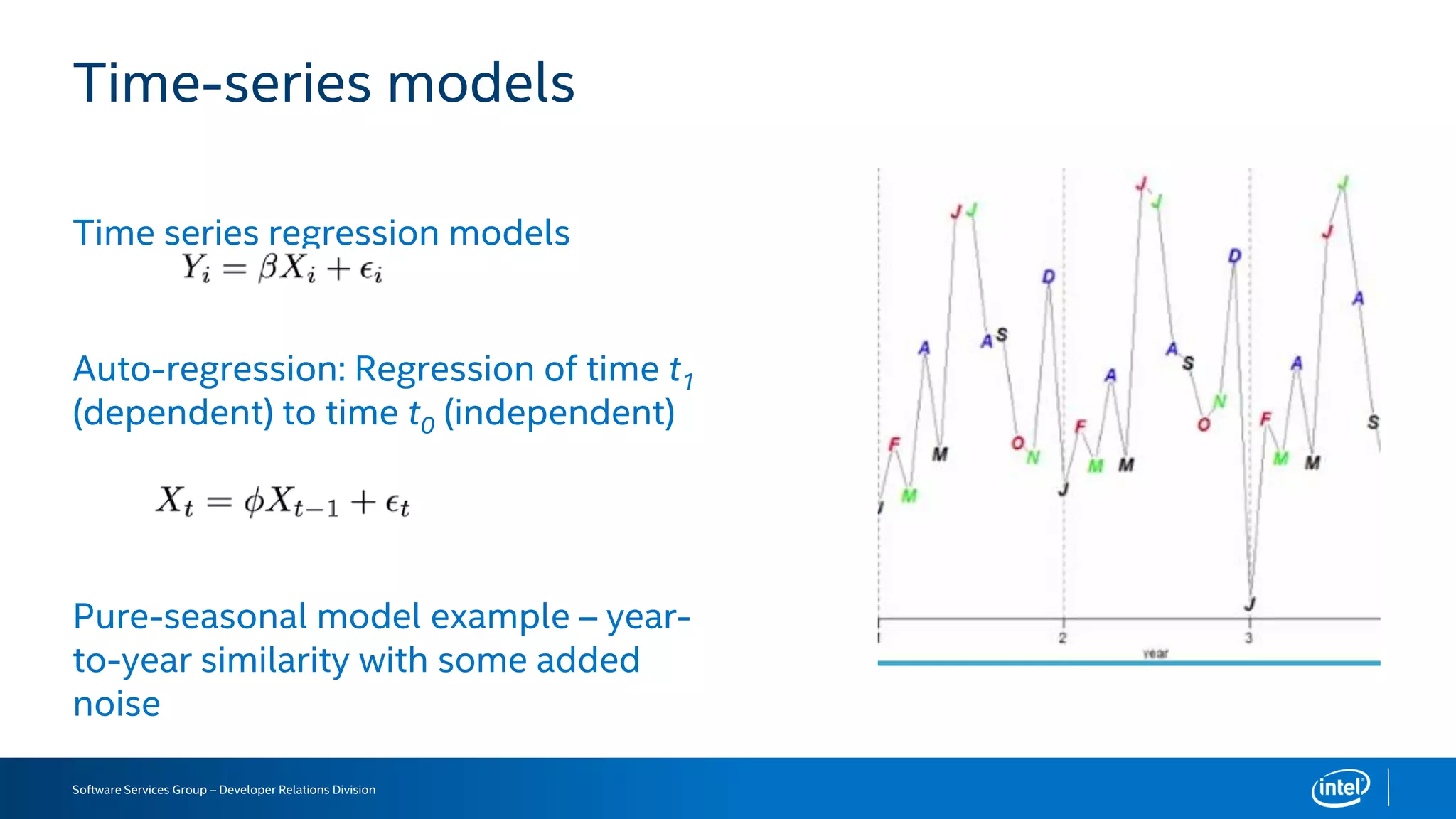
Time series regression models
Auto-regression: Regression of time t1
(dependent) to time t0 (independent)
Pure-seasonal model example – year-
to-year similarity with some added
noise
Software Services Group – Developer Relations Division
Time-series analytics workflow
 http://www.ics.uci.edu/~mlearn/MLRepository.html
– Sonar database from UCI (available via R package mlbench)
 https://www.kaggle.com/c/global-energy-forecasting-competition-2012-
load-forecasting/ (Kaggle competition data on energy forecasting)
Cross-validation, train / test split
 Combination of Kafka / Spark with R, Scala, Java, or Python
 Generate PMML (model) as XML
Transfer model to edge compute device (Intel Gateway / Edison)
 Perform inference on streaming data
Software Solutions
Intel Software Solutions
Software Services Group – Developer Relations Division
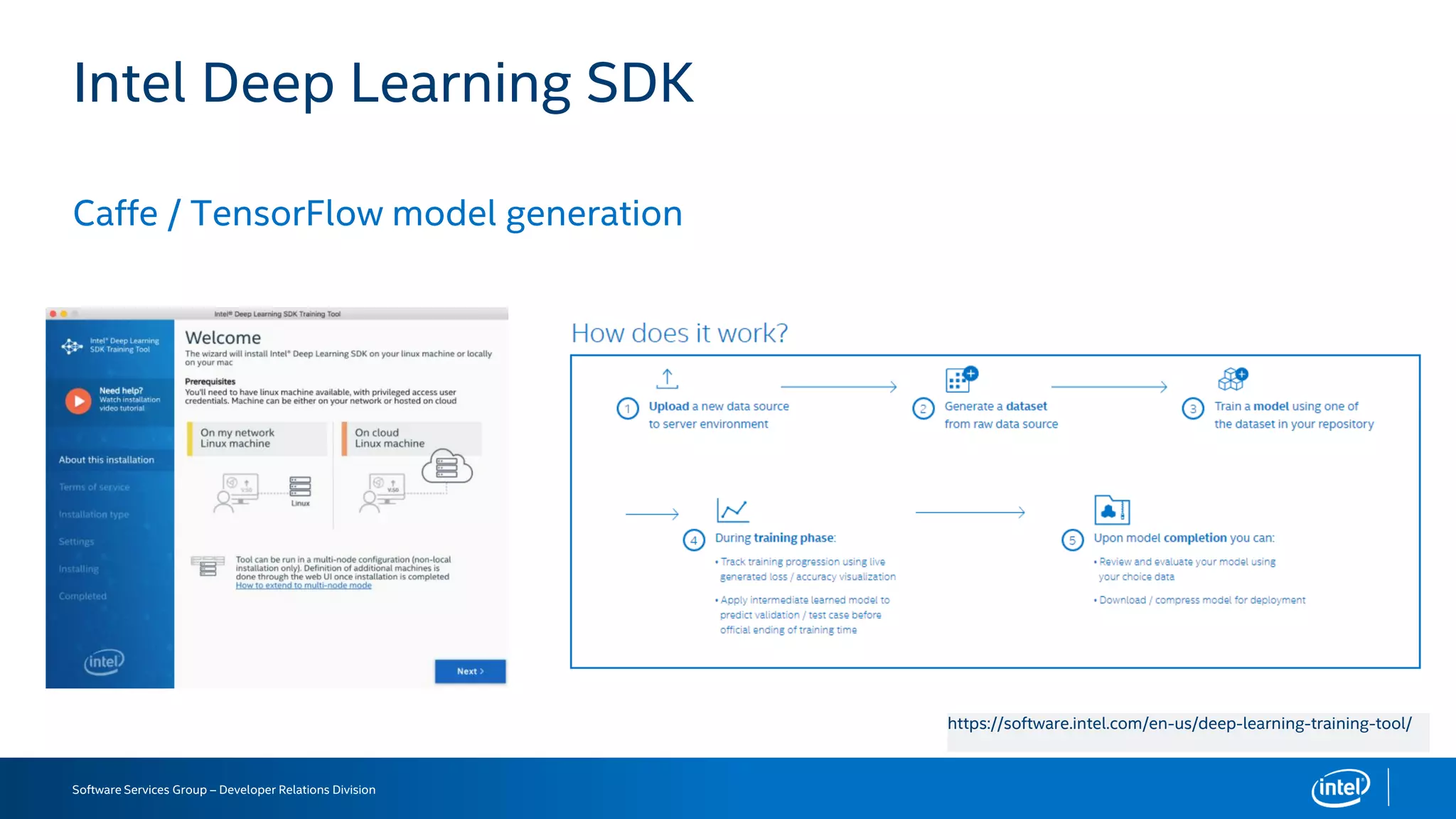
Caffe / TensorFlow model generation
Intel Deep Learning SDK
https://software.intel.com/en-us/deep-learning-training-tool/
Software Services Group – Developer Relations Division
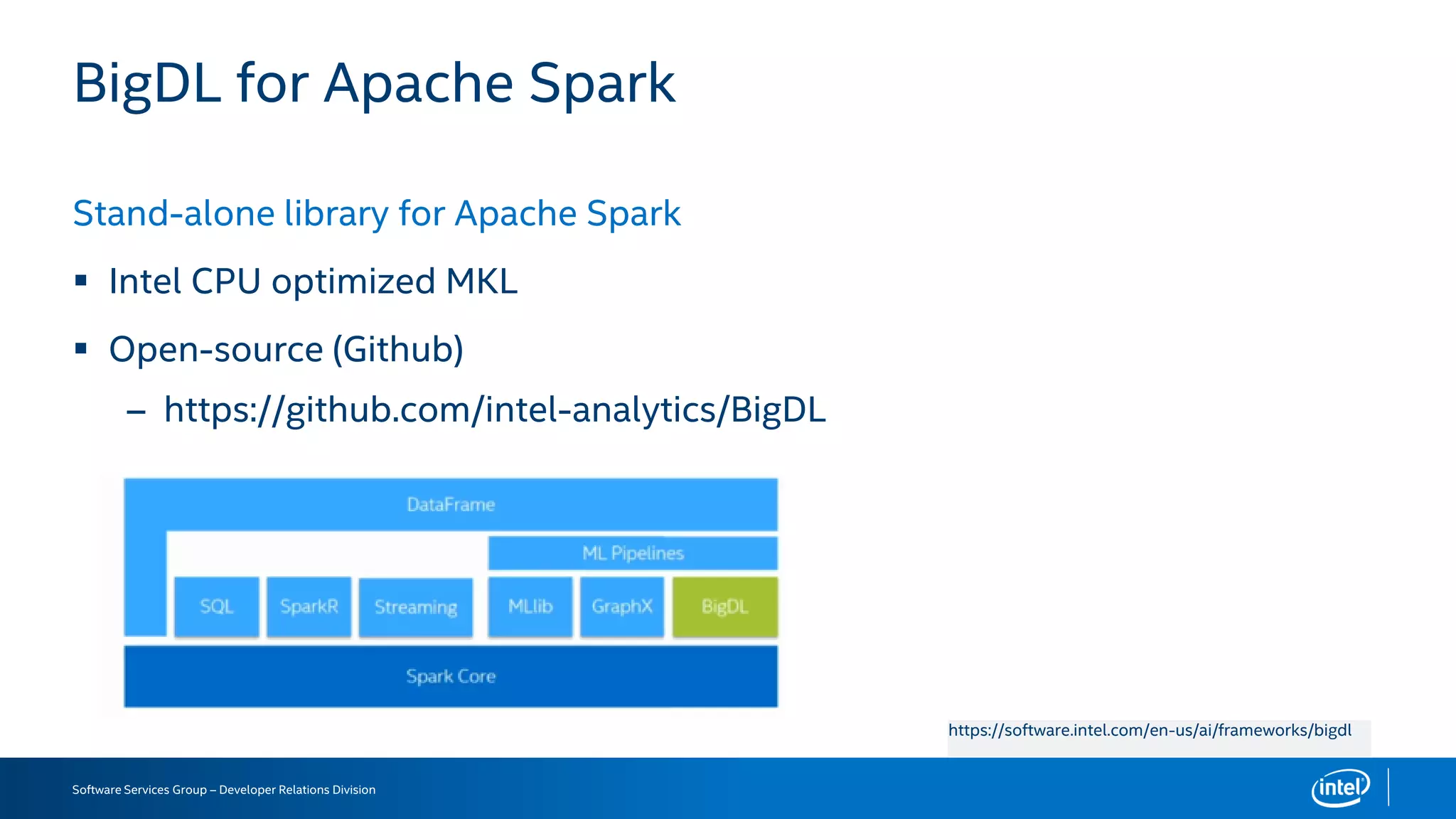
BigDL for Apache Spark
Stand-alone library for Apache Spark
 Intel CPU optimized MKL
 Open-source (Github)
– https://github.com/intel-analytics/BigDL
https://software.intel.com/en-us/ai/frameworks/bigdl
Building a Neural Model
A historical detour (an AI story)
Software Services Group – Developer Relations Division
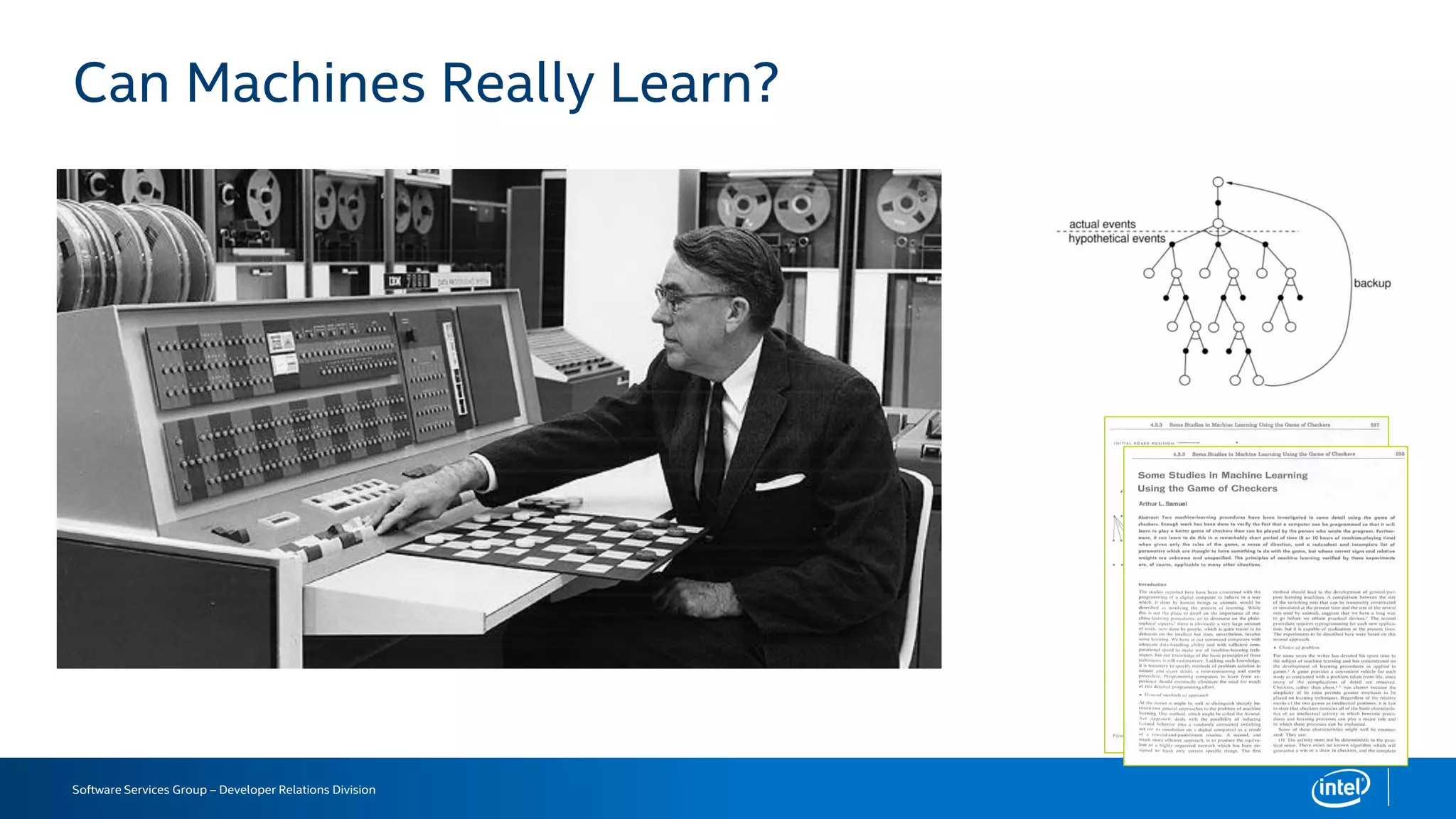
Can Machines Really Learn?
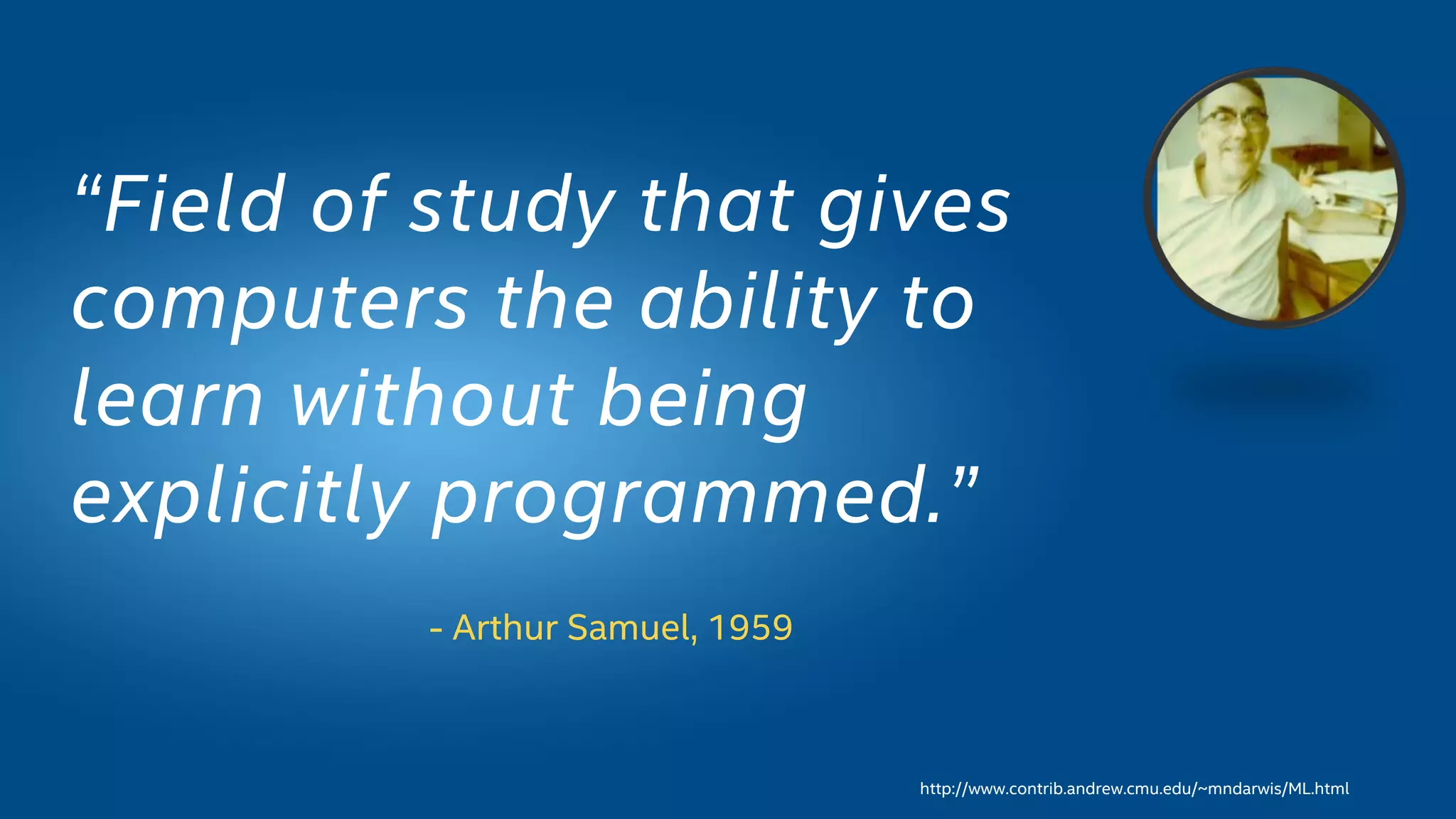
- Arthur Samuel, 1959
“Field of study that gives
computers the ability to
learn without being
explicitly programmed.”
http://www.contrib.andrew.cmu.edu/~mndarwis/ML.html
Software Services Group – Developer Relations Division
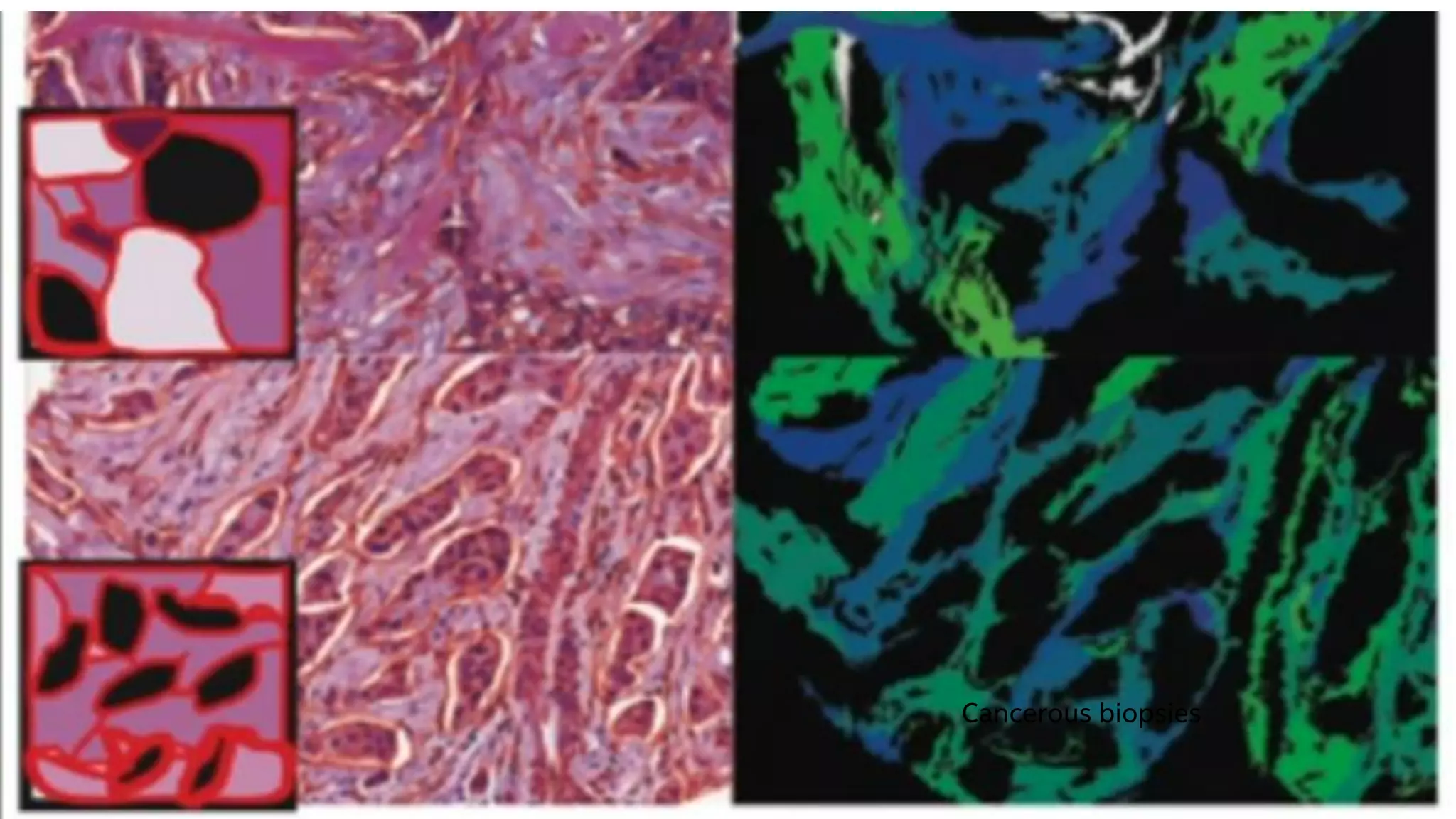
Cancerous biopsies
Software Services Group – Developer Relations Division
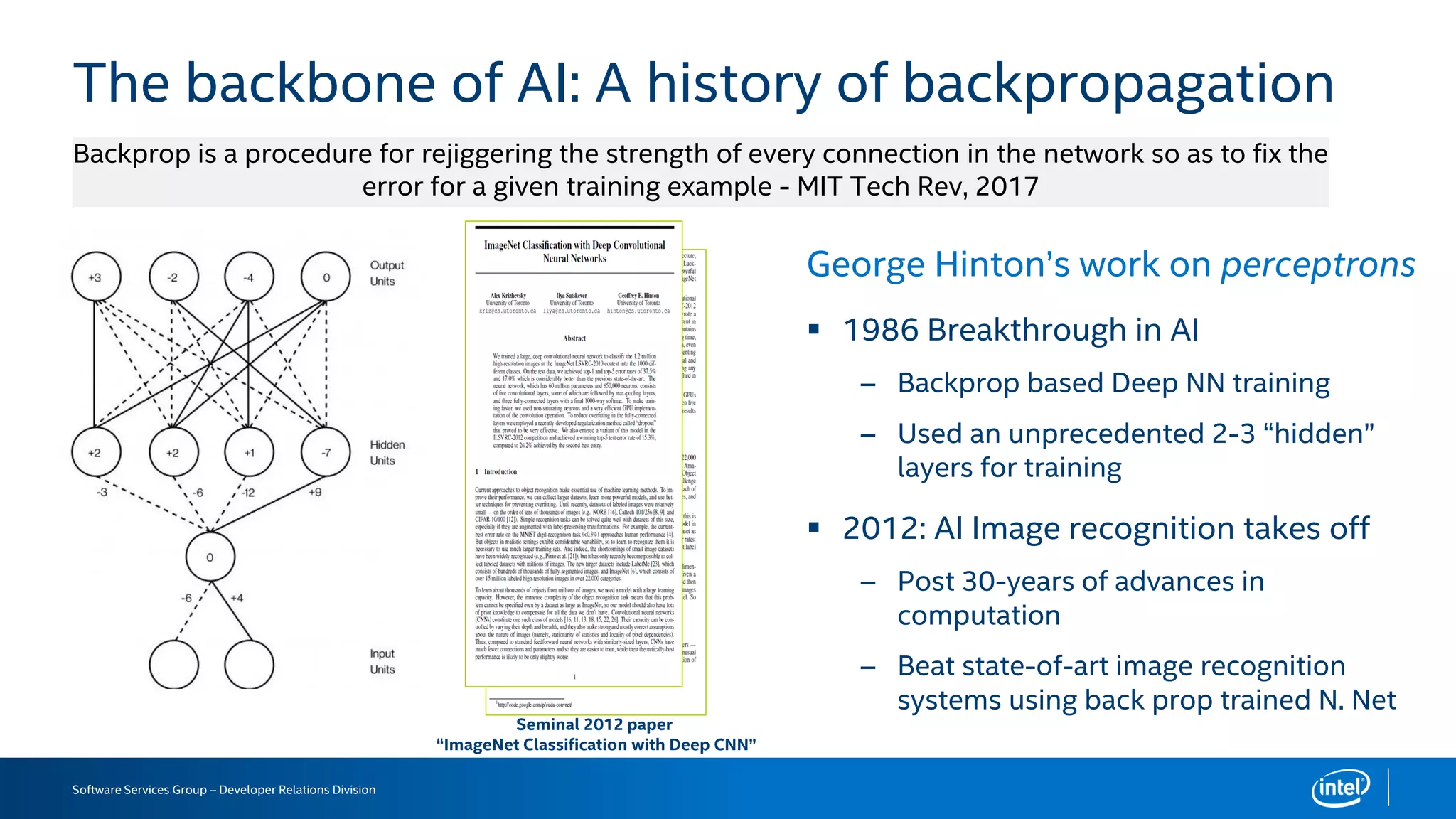
George Hinton’s work on perceptrons
 1986 Breakthrough in AI
– Backprop based Deep NN training
– Used an unprecedented 2-3 “hidden”
layers for training
 2012: AI Image recognition takes off
– Post 30-years of advances in
computation
– Beat state-of-art image recognition
systems using back prop trained N. Net
The backbone of AI: A history of backpropagation
Backprop is a procedure for rejiggering the strength of every connection in the network so as to fix the
error for a given training example - MIT Tech Rev, 2017
Seminal 2012 paper
“ImageNet Classification with Deep CNN”
Software Services Group – Developer Relations Division
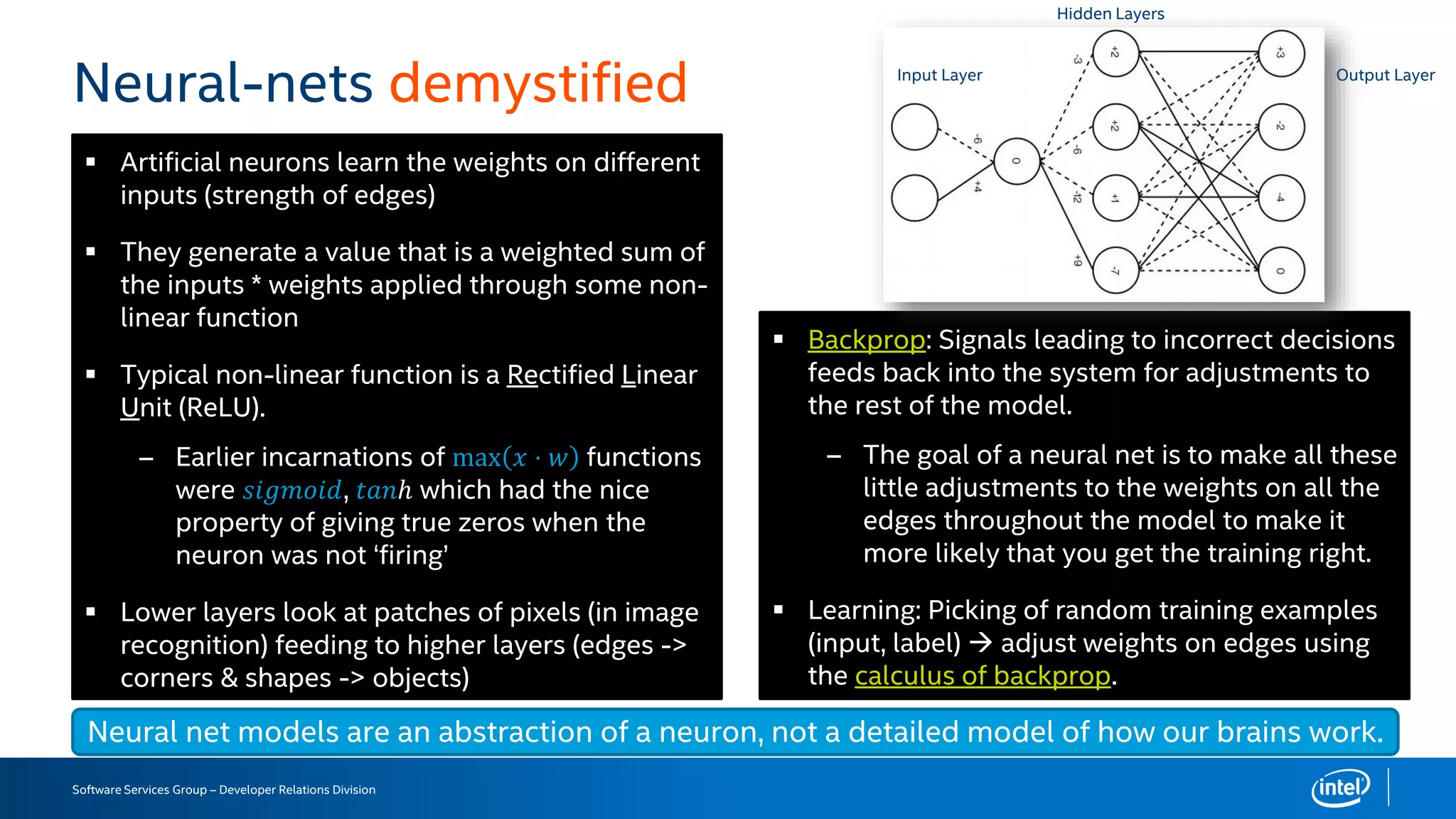
Neural-nets demystified
 Artificial neurons learn the weights on different
inputs (strength of edges)
 They generate a value that is a weighted sum of
the inputs * weights applied through some non-
linear function
 Typical non-linear function is a Rectified Linear
Unit (ReLU).
– Earlier incarnations of max 𝑥 ⋅ 𝑤 functions
were 𝑠𝑖𝑔𝑚𝑜𝑖𝑑, 𝑡𝑎𝑛ℎ which had the nice
property of giving true zeros when the
neuron was not ‘firing’
 Lower layers look at patches of pixels (in image
recognition) feeding to higher layers (edges ->
corners & shapes -> objects)
Neural net models are an abstraction of a neuron, not a detailed model of how our brains work.
 Backprop: Signals leading to incorrect decisions
feeds back into the system for adjustments to
the rest of the model.
– The goal of a neural net is to make all these
little adjustments to the weights on all the
edges throughout the model to make it
more likely that you get the training right.
 Learning: Picking of random training examples
(input, label)  adjust weights on edges using
the calculus of backprop.
Input Layer
Hidden Layers
Output Layer
Software Services Group – Developer Relations Division
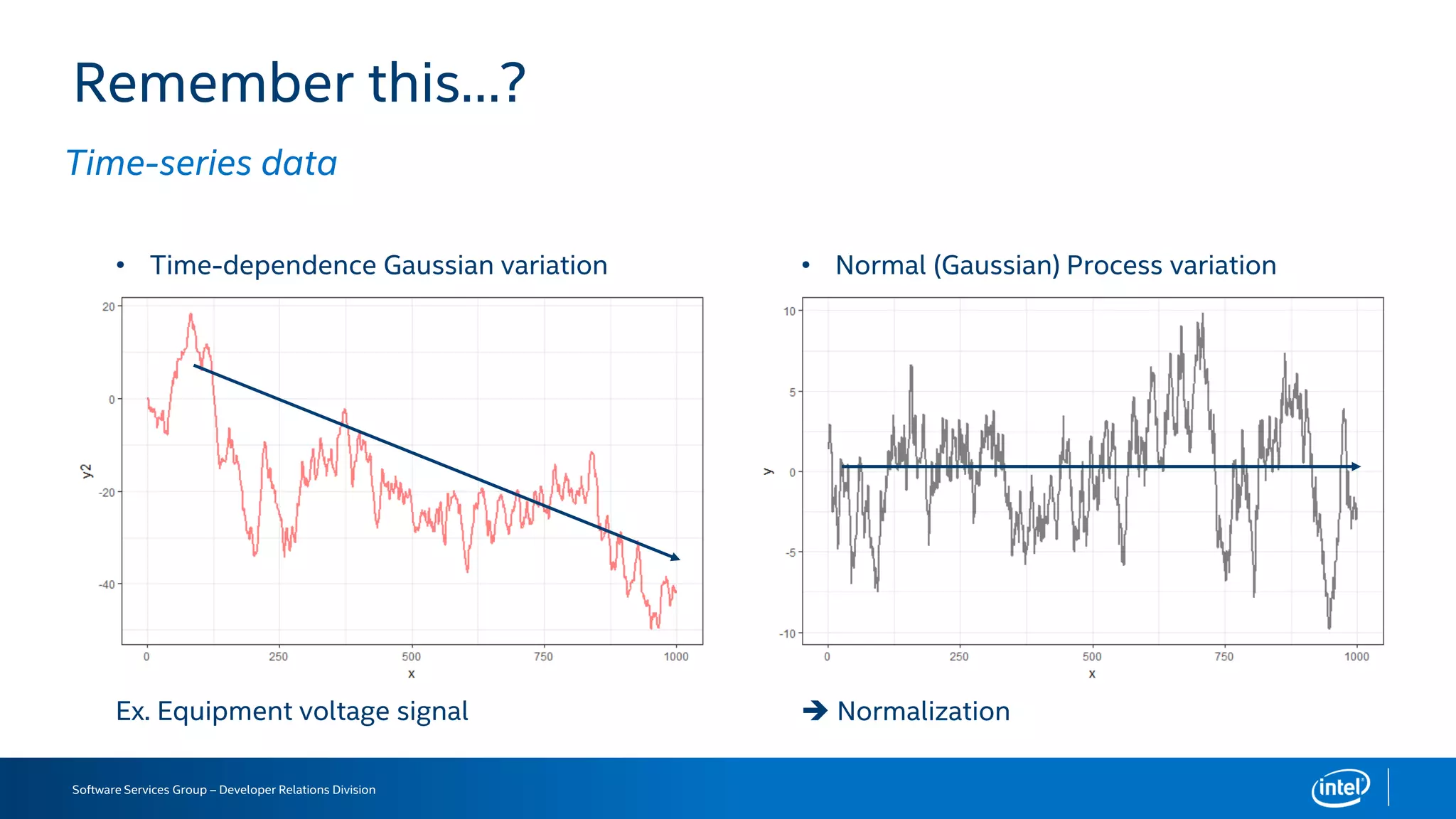
Remember this…?
Time-series data
• Normal (Gaussian) Process variation• Time-dependence Gaussian variation
Ex. Equipment voltage signal  Normalization
Building a Neural Model
Training DL model in the cloud
Software Services Group – Developer Relations Division
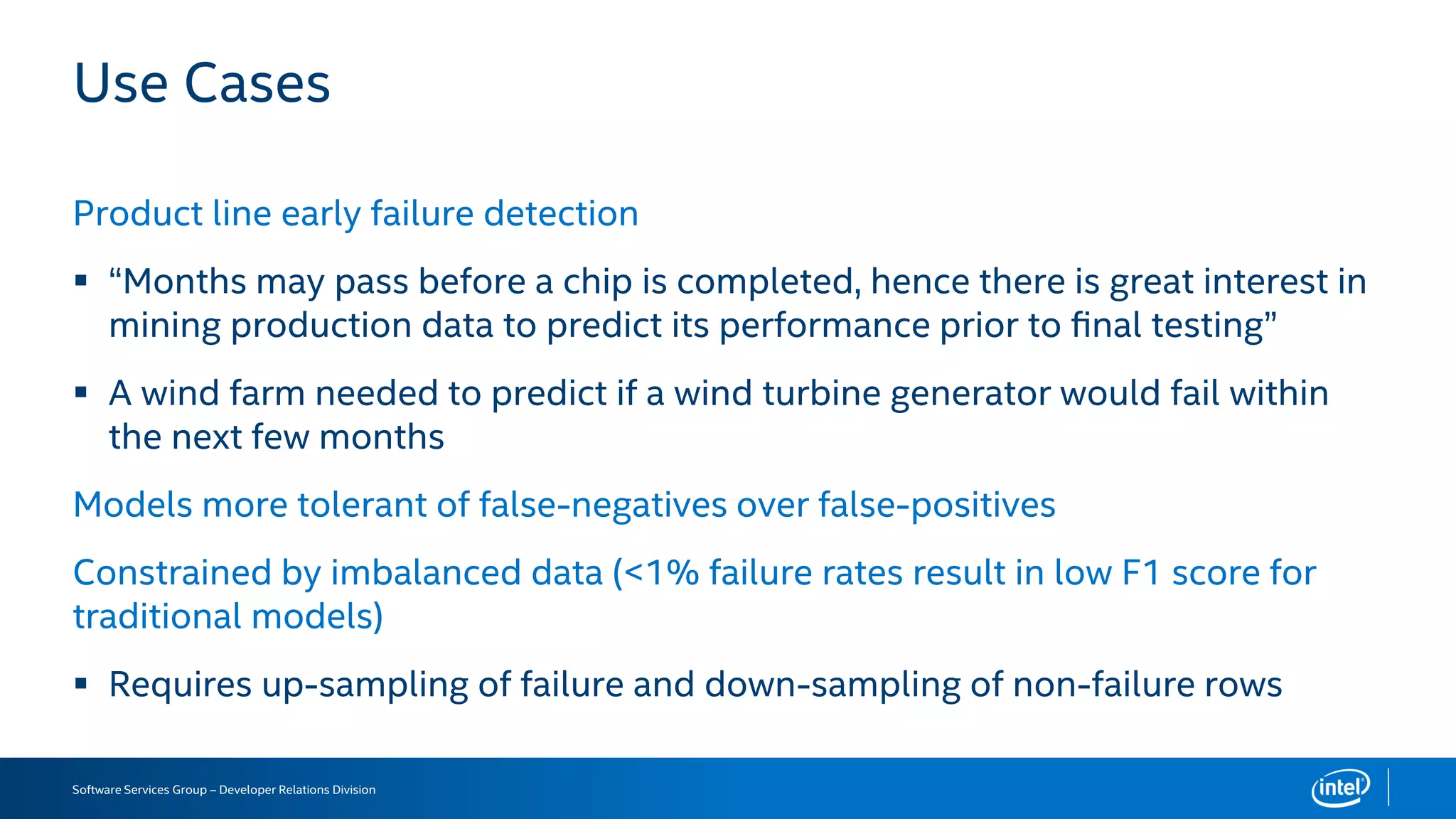
Use Cases
Product line early failure detection
 “Months may pass before a chip is completed, hence there is great interest in
mining production data to predict its performance prior to final testing”
 A wind farm needed to predict if a wind turbine generator would fail within
the next few months
Models more tolerant of false-negatives over false-positives
Constrained by imbalanced data (<1% failure rates result in low F1 score for
traditional models)
 Requires up-sampling of failure and down-sampling of non-failure rows
Software Services Group – Developer Relations Division
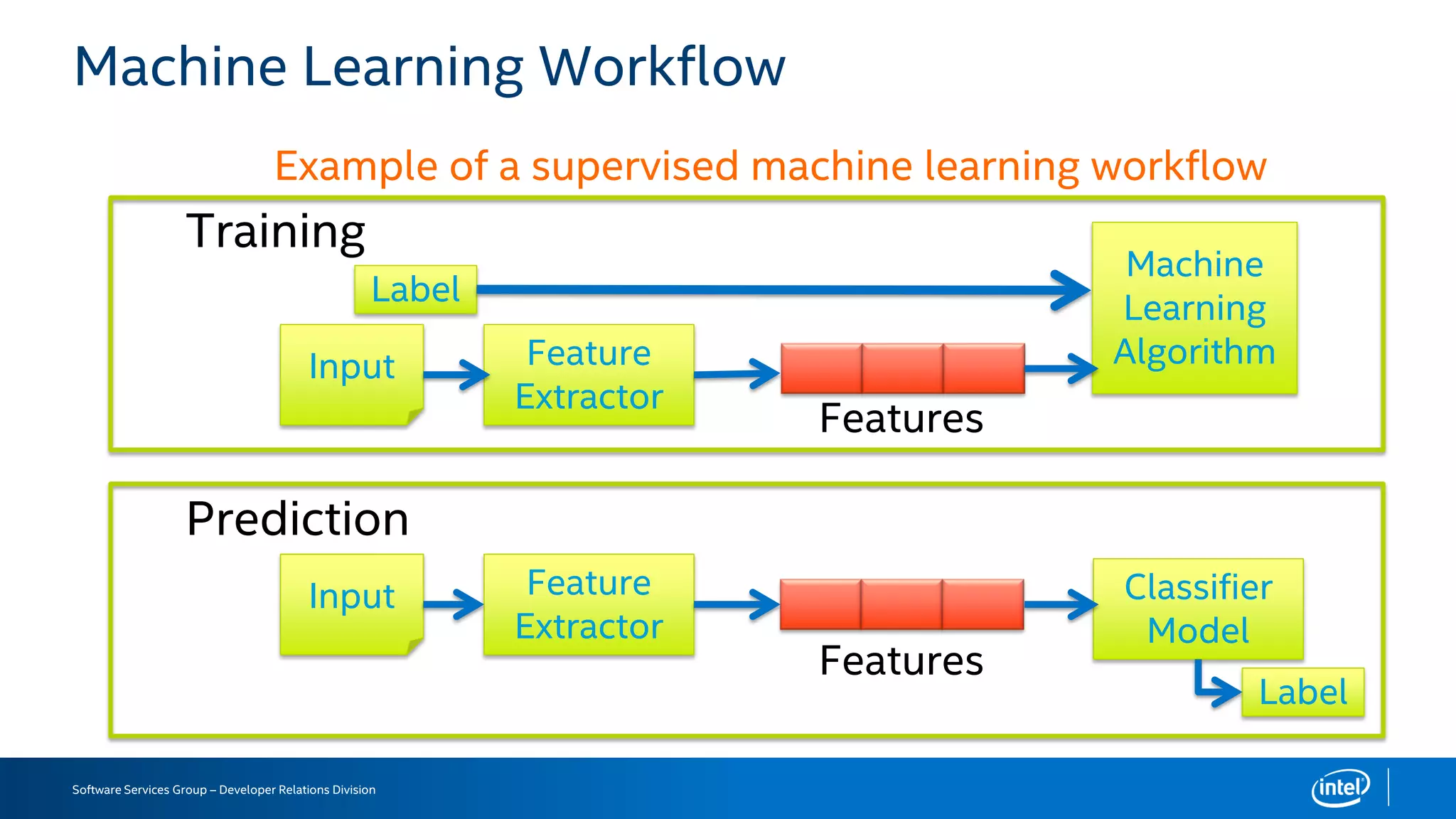
Machine Learning Workflow
Training
Label
Machine
Learning
AlgorithmInput Feature
Extractor
Features
Prediction
Input Feature
Extractor
Features
Classifier
Model
Label
Example of a supervised machine learning workflow
Software Services Group – Developer Relations Division
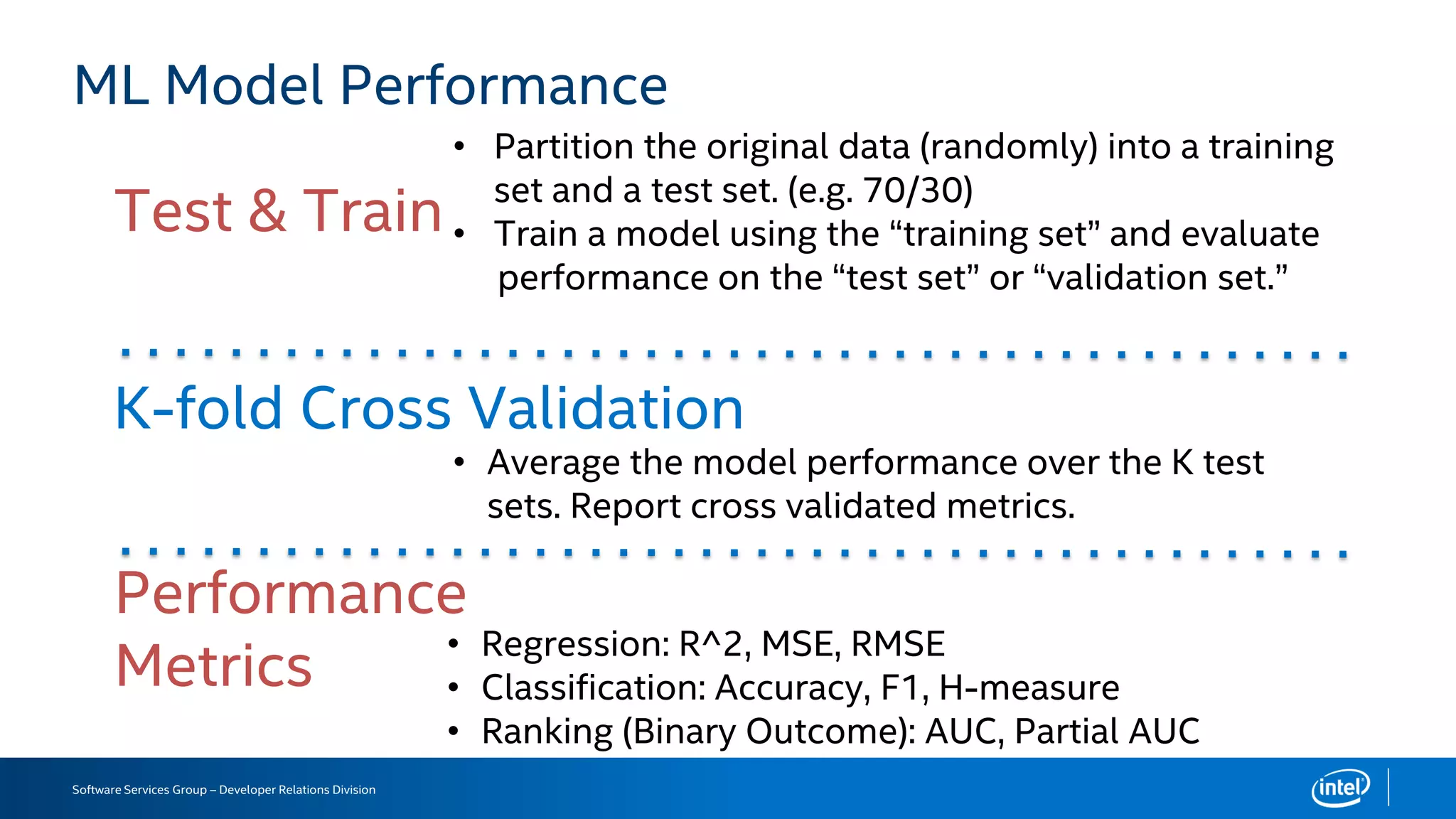
ML Model Performance
Test & Train
K-fold Cross Validation
• Partition the original data (randomly) into a training
set and a test set. (e.g. 70/30)
• Train a model using the “training set” and evaluate
performance on the “test set” or “validation set.”
• Average the model performance over the K test
sets. Report cross validated metrics.
Performance
Metrics • Regression: R^2, MSE, RMSE
• Classification: Accuracy, F1, H-measure
• Ranking (Binary Outcome): AUC, Partial AUC
Software Services Group – Developer Relations Division
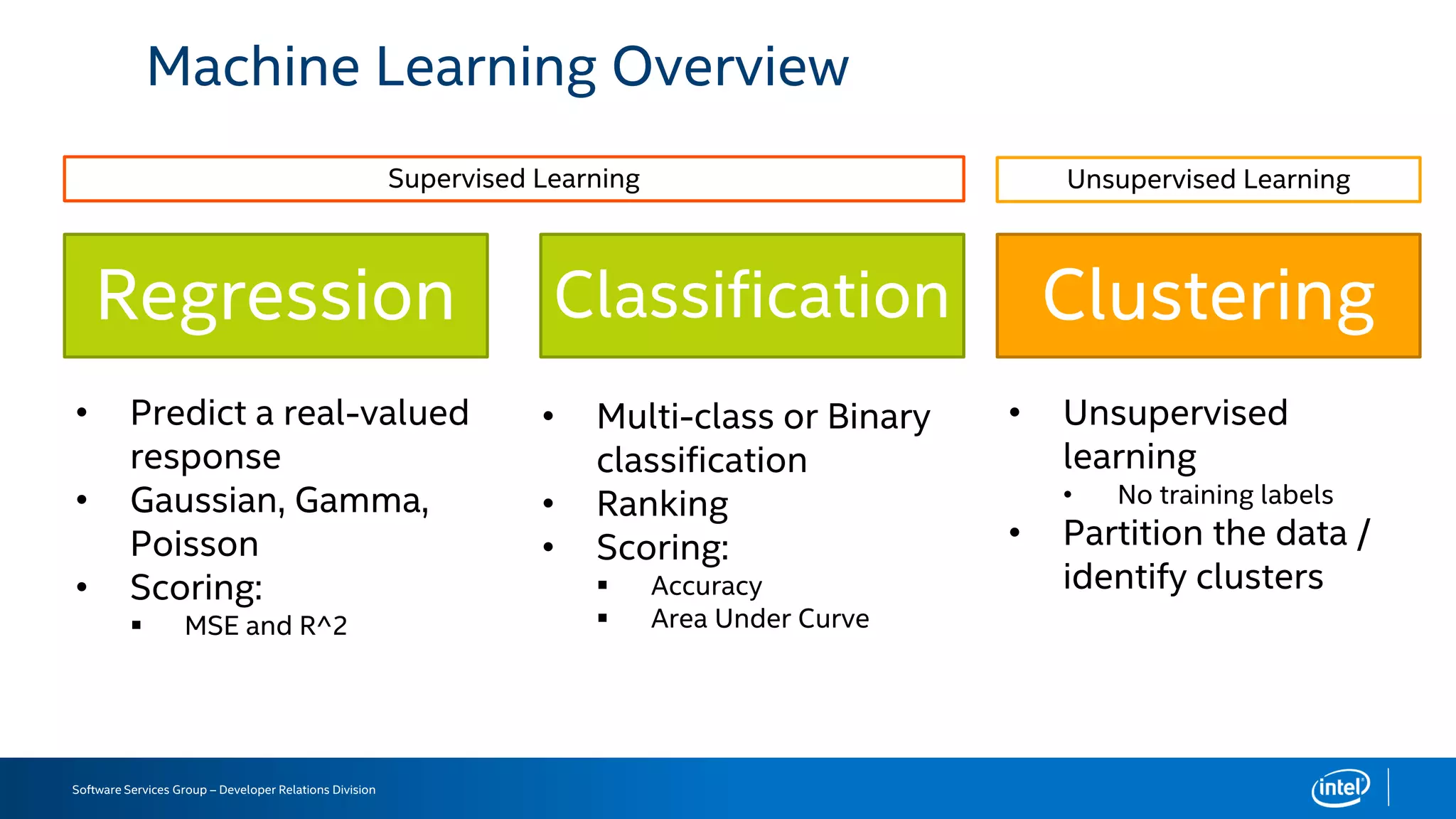
Machine Learning Overview
Regression
• Predict a real-valued
response
• Gaussian, Gamma,
Poisson
• Scoring:
 MSE and R^2
Classification Clustering
• Multi-class or Binary
classification
• Ranking
• Scoring:
 Accuracy
 Area Under Curve
• Unsupervised
learning
• No training labels
• Partition the data /
identify clusters
Supervised Learning Unsupervised Learning
Software Services Group – Developer Relations Division
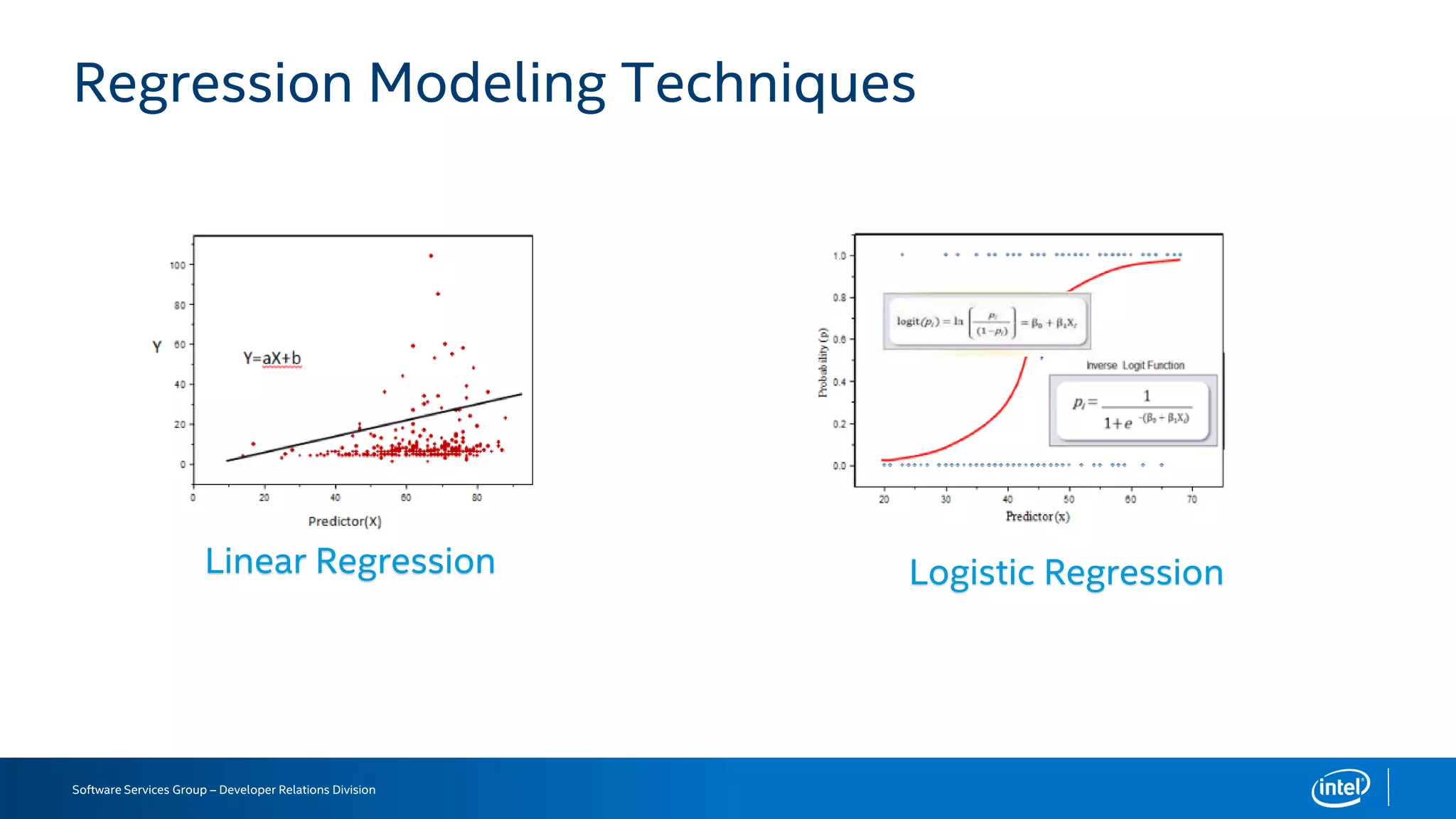
Regression Modeling Techniques
Linear Regression Logistic Regression
Software Services Group – Developer Relations Division
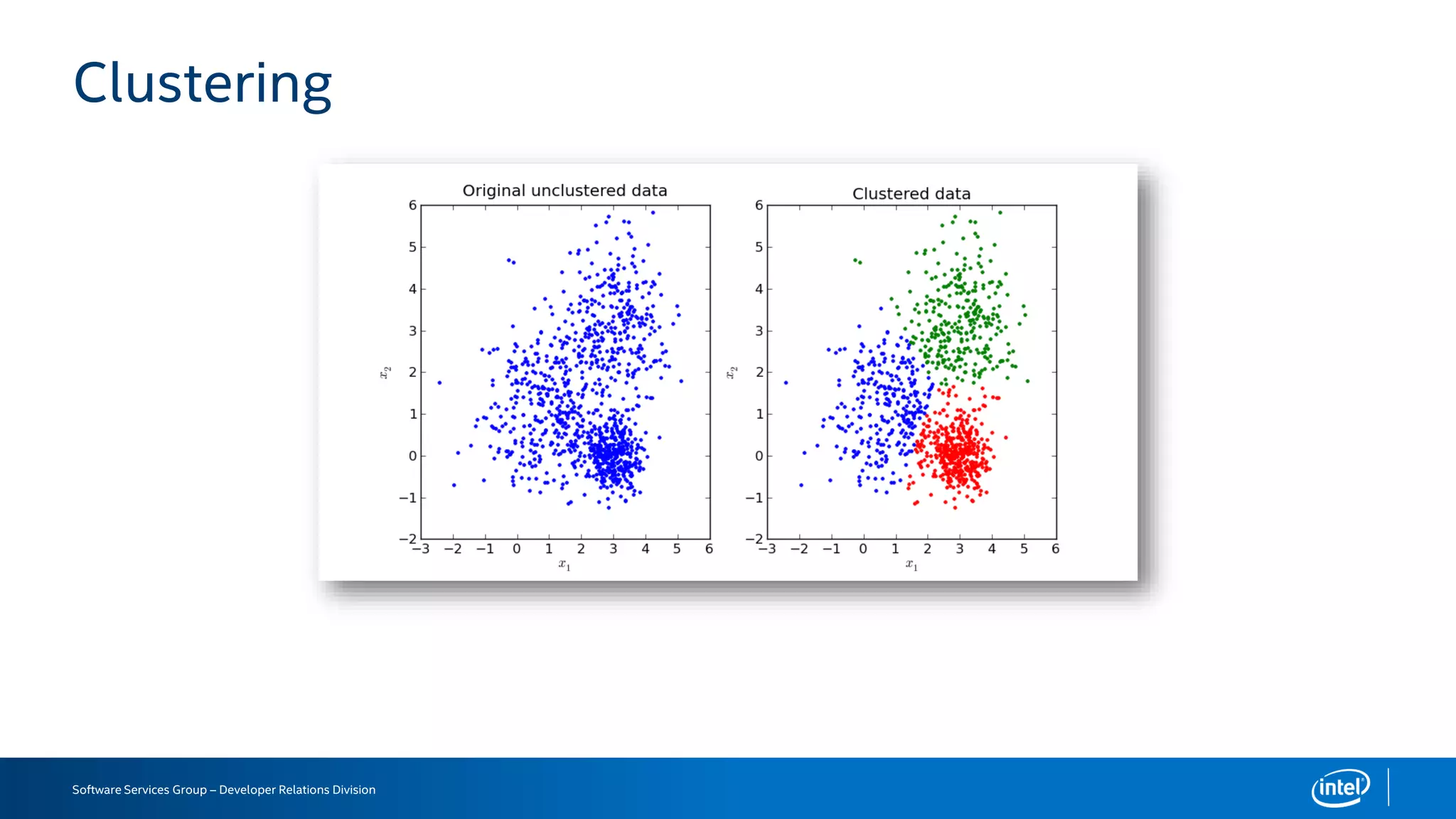
Clustering
Software Services Group – Developer Relations Division
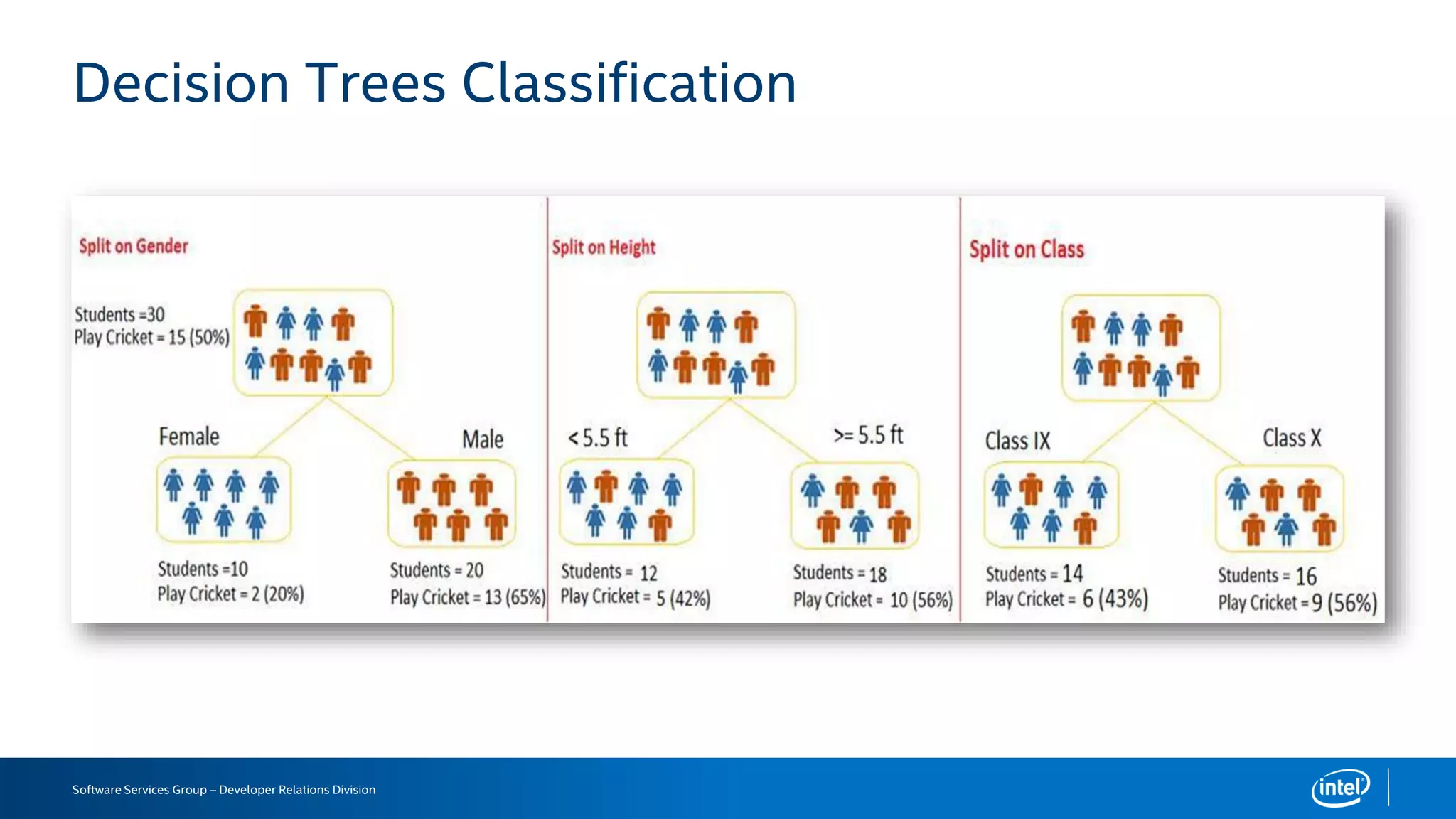
Decision Trees Classification
Software Services Group – Developer Relations Division
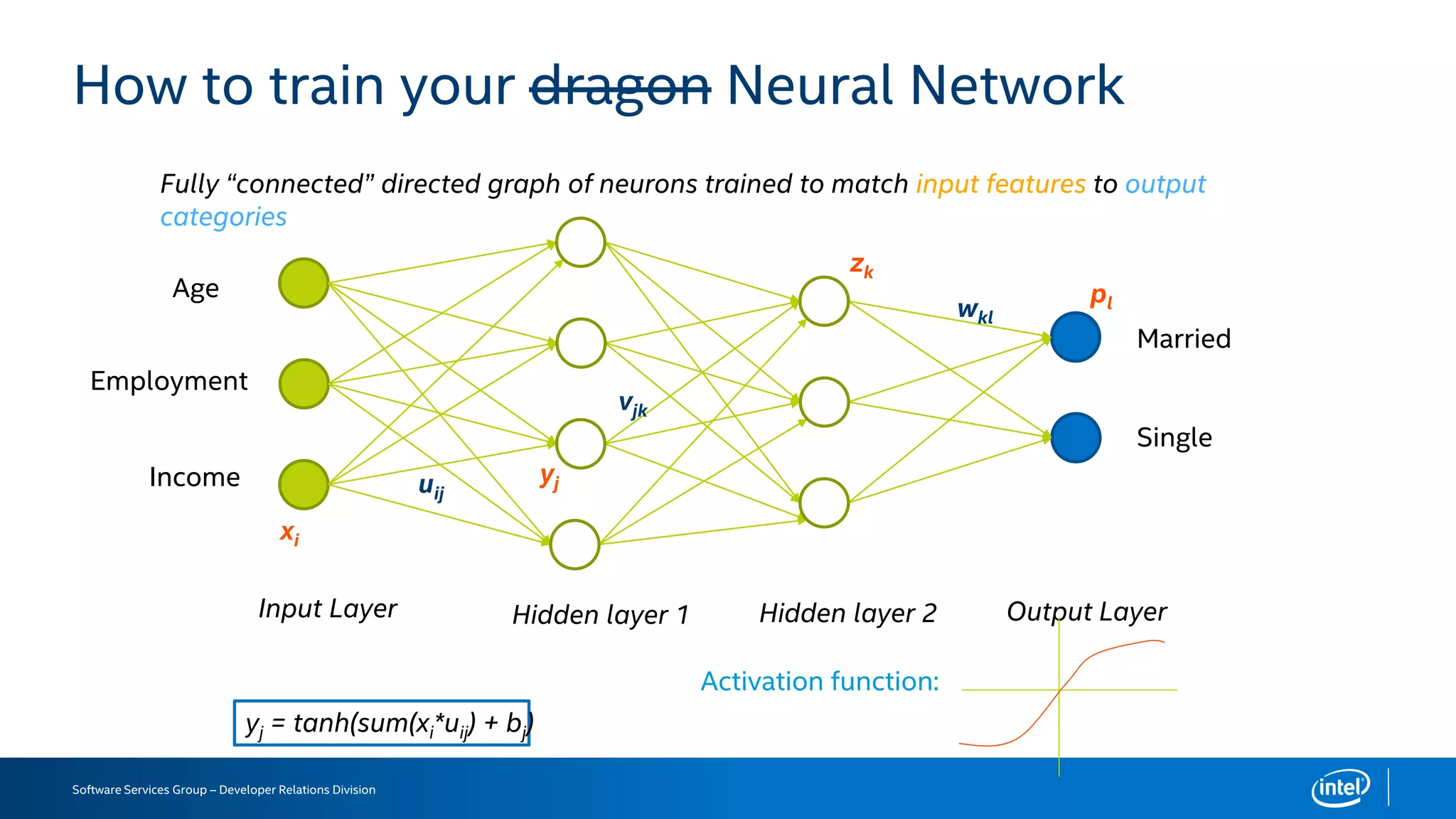
How to train your dragon Neural Network
Married
Single
Age
Employment
Income
Fully “connected” directed graph of neurons trained to match input features to output
categories
Input Layer Output LayerHidden layer 1 Hidden layer 2
xi
yj
zk
pl
uij
vjk
wkl
yj = tanh(sum(xi*uij) + bj)
Activation function:
Software Services Group – Developer Relations Division
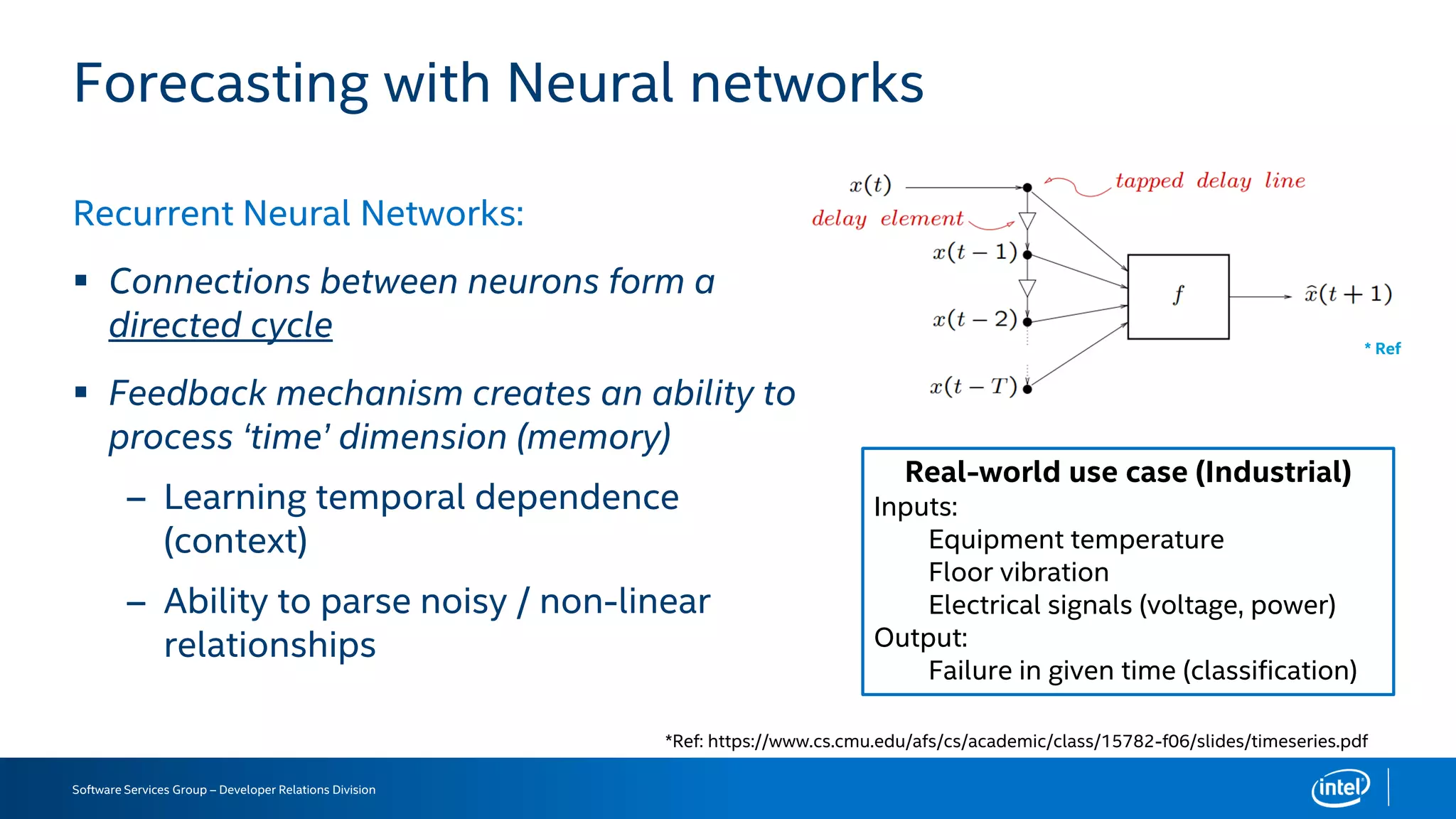
Forecasting with Neural networks
Recurrent Neural Networks:
 Connections between neurons form a
directed cycle
 Feedback mechanism creates an ability to
process ‘time’ dimension (memory)
– Learning temporal dependence
(context)
– Ability to parse noisy / non-linear
relationships
*Ref: https://www.cs.cmu.edu/afs/cs/academic/class/15782-f06/slides/timeseries.pdf
* Ref
Real-world use case (Industrial)
Inputs:
Equipment temperature
Floor vibration
Electrical signals (voltage, power)
Output:
Failure in given time (classification)
Software Services Group – Developer Relations Division
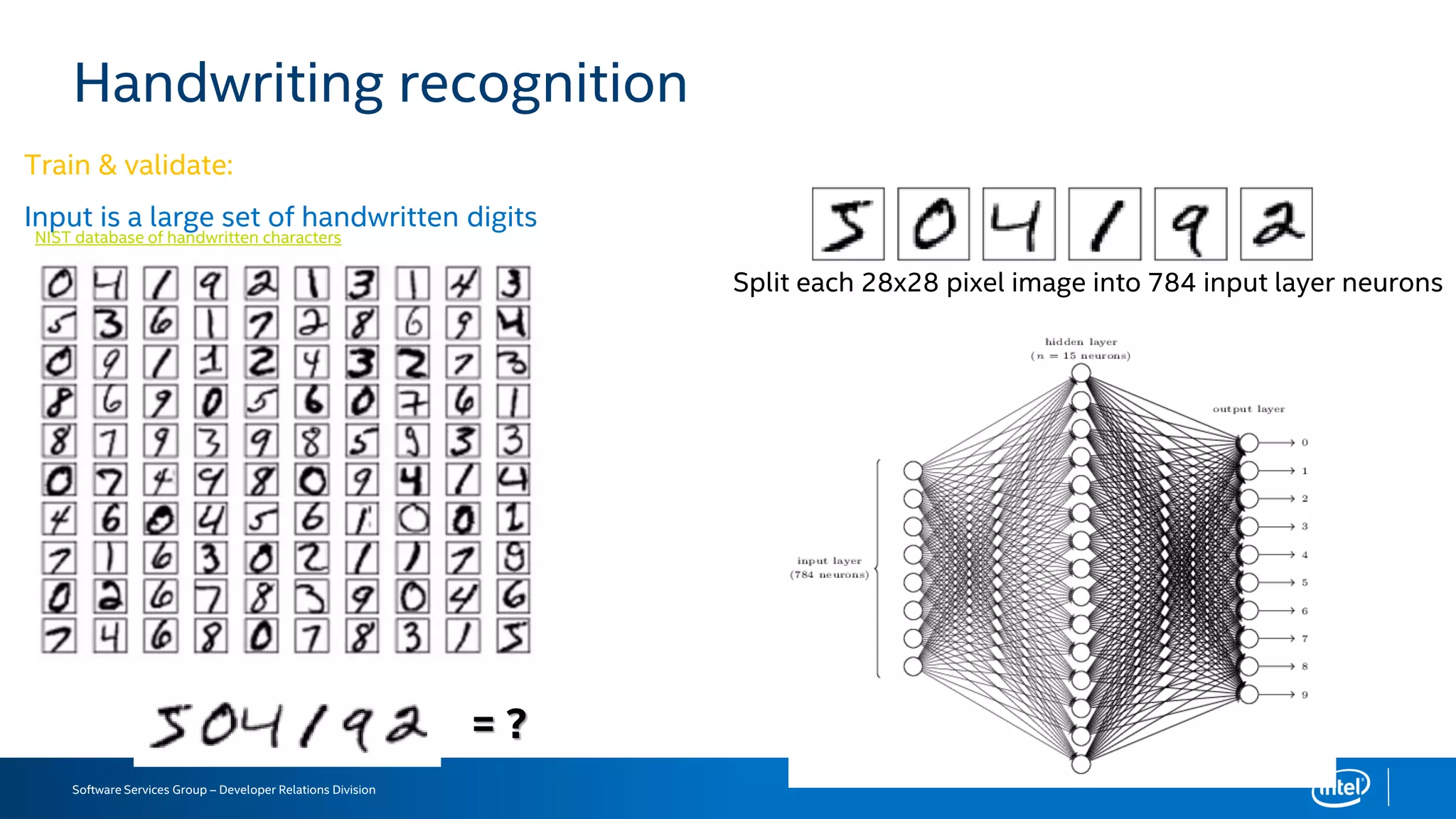
Train & validate:
Input is a large set of handwritten digits
Handwriting recognition
= ?
Split each 28x28 pixel image into 784 input layer neurons
NIST database of handwritten characters
Software Services Group – Developer Relations Division
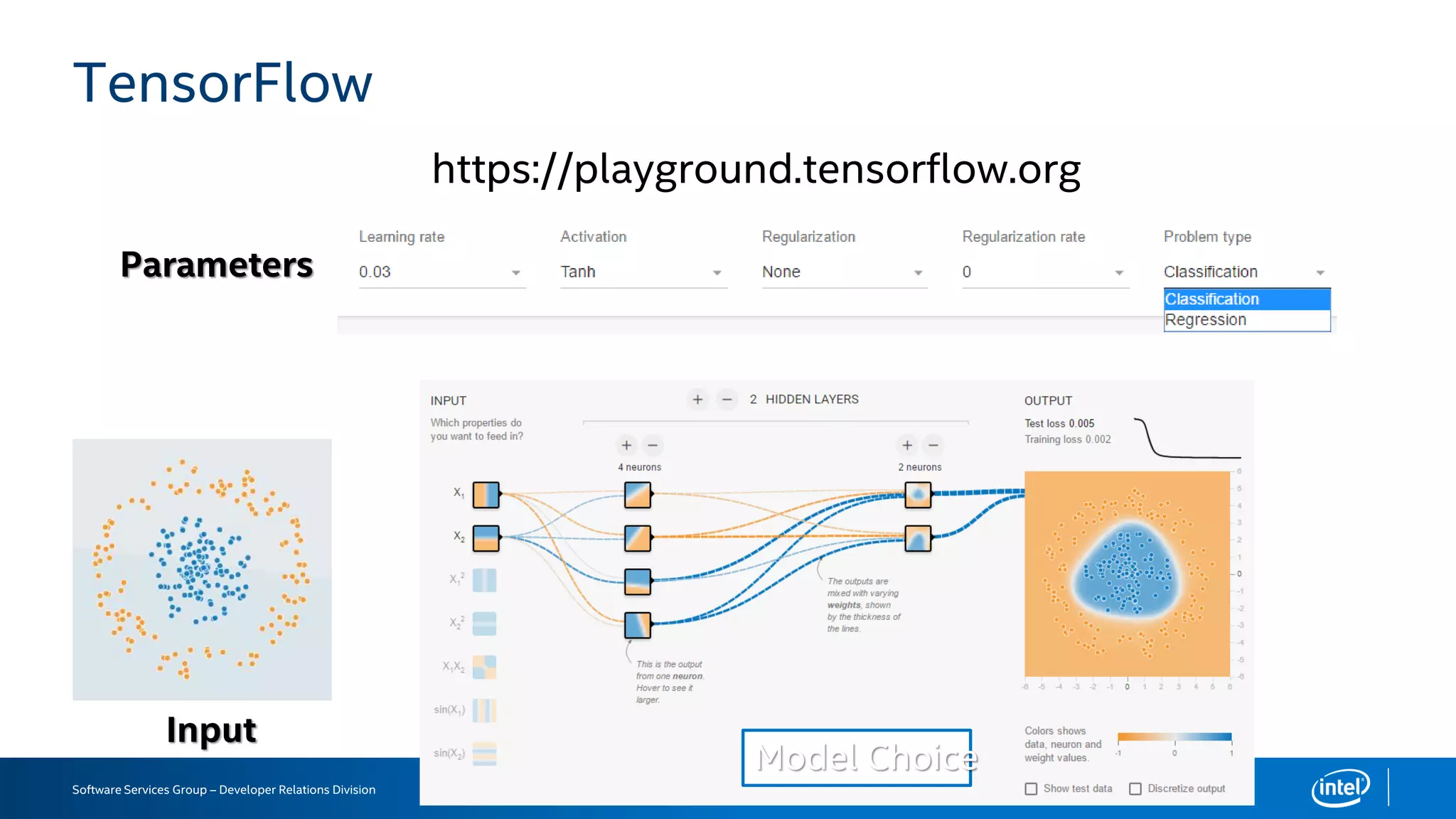
TensorFlow
https://playground.tensorflow.org
Input
Parameters
Model Choice
Enterprise deployments
Tools & Assets
Software Services Group – Developer Relations Division 46
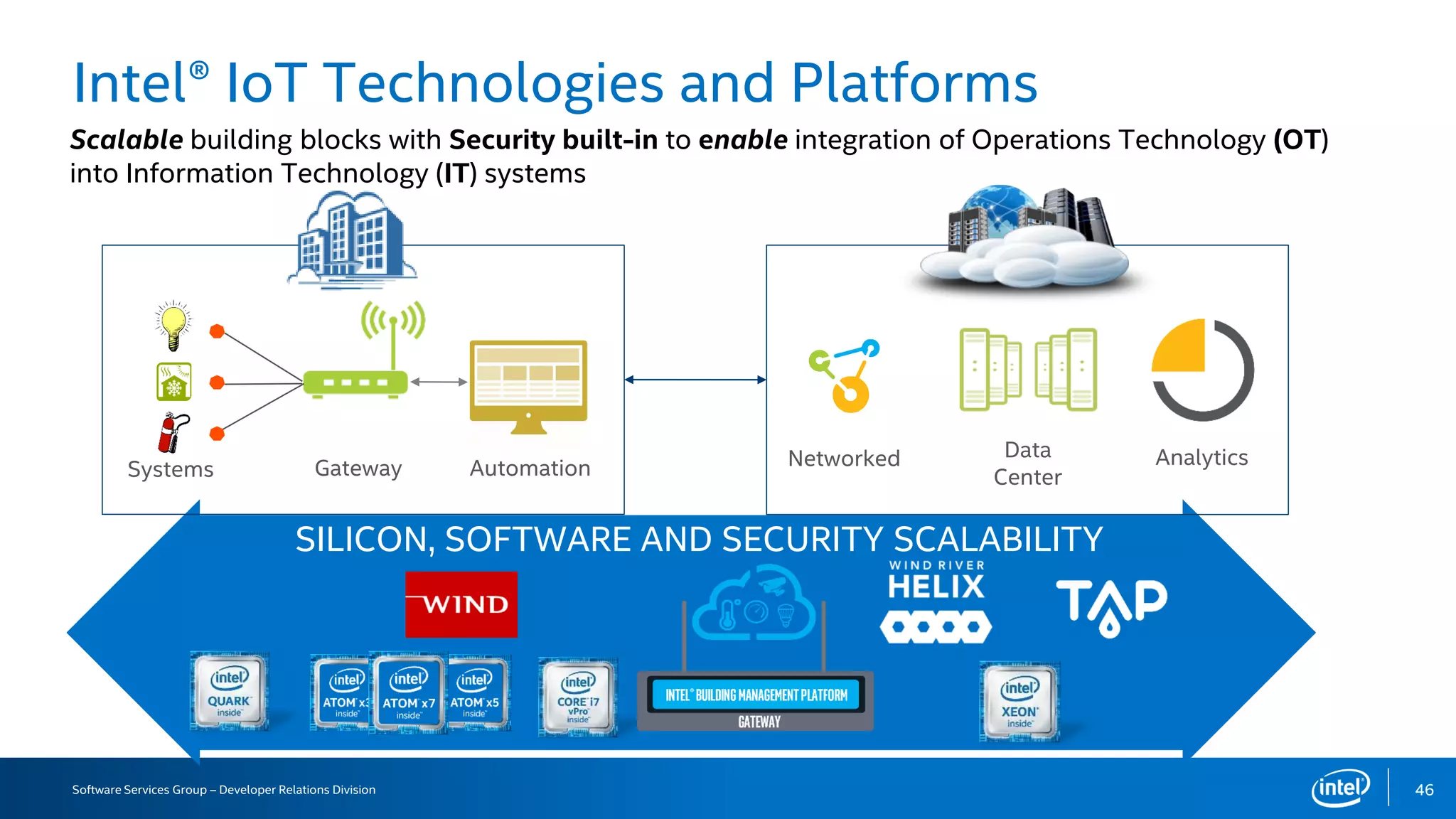
Intel® IoT Technologies and Platforms
Scalable building blocks with Security built-in to enable integration of Operations Technology (OT)
into Information Technology (IT) systems
Gateway
Data
Center
AnalyticsNetworkedSystems
S
Automation
SILICON, SOFTWARE AND SECURITY SCALABILITY
Software Services Group – Developer Relations Division
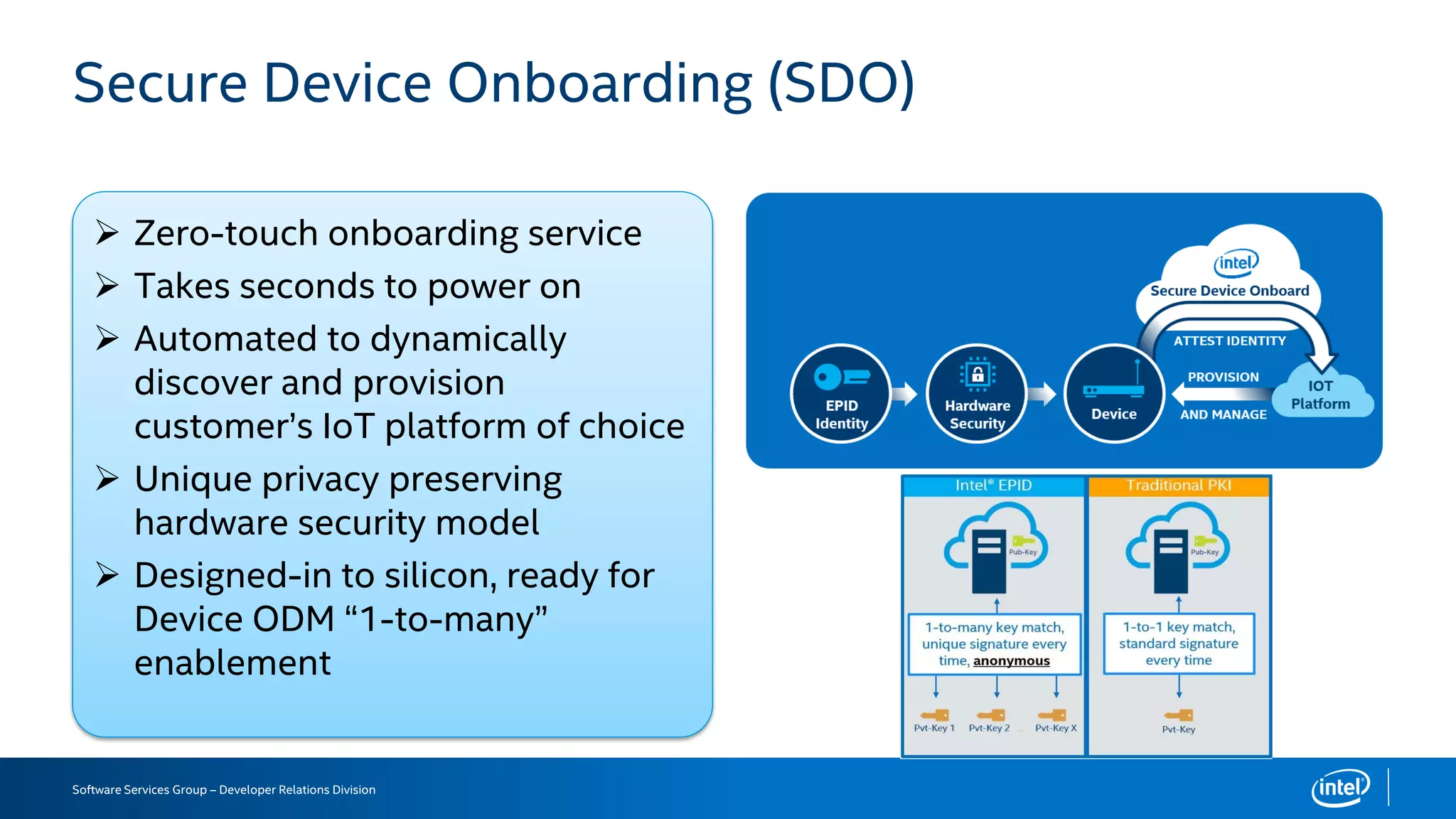
Secure Device Onboarding (SDO)
 Zero-touch onboarding service
 Takes seconds to power on
 Automated to dynamically
discover and provision
customer’s IoT platform of choice
 Unique privacy preserving
hardware security model
 Designed-in to silicon, ready for
Device ODM “1-to-many”
enablement
Software Services Group – Developer Relations Division 48
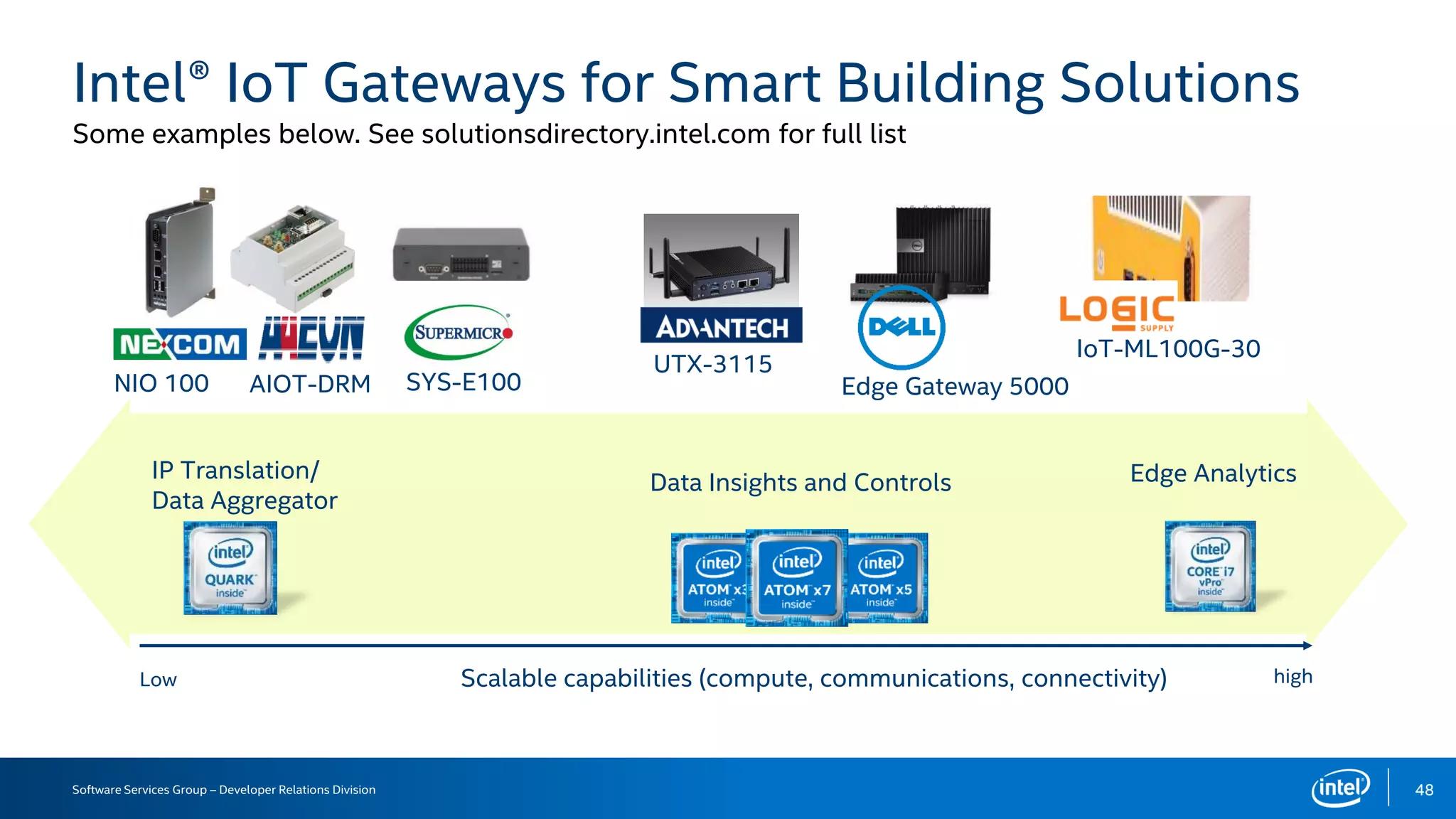
Intel® IoT Gateways for Smart Building Solutions
Some examples below. See solutionsdirectory.intel.com for full list
Scalable capabilities (compute, communications, connectivity) highLow
IP Translation/
Data Aggregator
Data Insights and Controls Edge Analytics
NIO 100 AIOT-DRM SYS-E100
UTX-3115
IoT-ML100G-30
Edge Gateway 5000
Software Services Group – Developer Relations Division
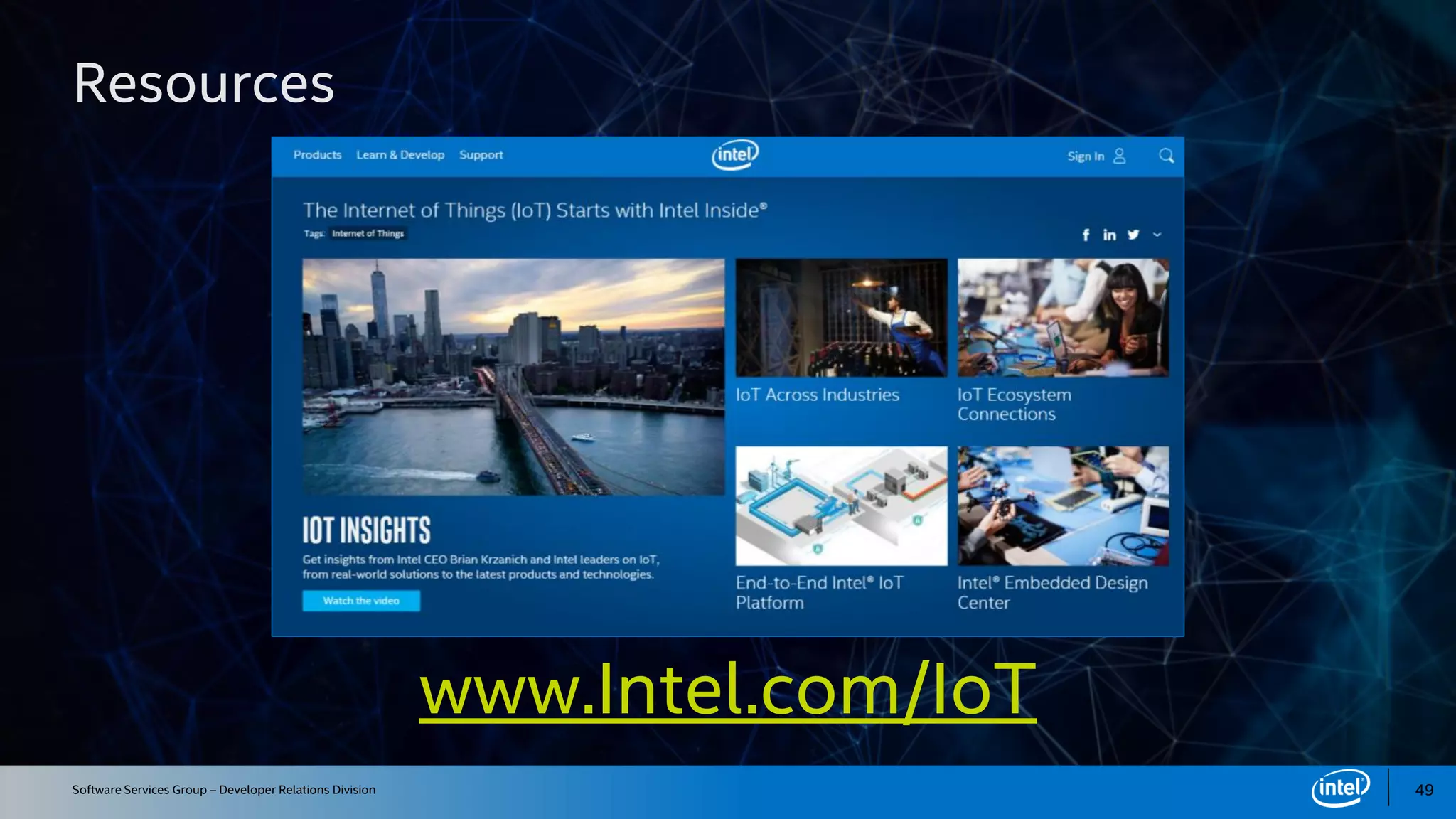
www.Intel.com/IoT
49
Software Services Group – Developer Relations Division 50
Q & A

Aplications for machine learning in IoT

  • 1.
    Use cases &real-world deployments Yashesh A. Shroff, Ph.D. Commercial ISV Enabling PM Intel Corp. Applications for Machine Learning in IoT
  • 2.
    Software Services Group– Developer Relations Division 1. IDC 2. MC/EDC: The Digital Universe of Opportunities 3. Goldman Sachs 4. IMS Research Things network cloud 50B devices1 44 zetabytes2 212B sensors1 85% unconnected4 Cost of Sensors1 Past 10 Years Cost of Bandwidth2 Past 10 Years Cost of Processing3 Past 10 Years2X 40X 60X 2
  • 3.
    Software Services Group– Developer Relations Division A brief intro about me: Yashesh Shroff @yashroff /in/yashroff • National Instruments, IBM: early years • Ph.D. (EECS), UC Berkeley • Statistics optics, patterning technologies • Developed MEMS micro-mirrors based imaging models • Succession of roles in R&D, Corp Dev, & IoT/DL commercial enabling at Intel • >20 Publications and 5 patents in imaging analytics, compression, design for manufacturing • MBA (2013) Haas / Columbia GSB
  • 4.
    - Karl Steinbuch,German computer science pioneer, 1966 “In a few decades time, computers will be interwoven into almost every industrial product.” [Ref: https://en.wikipedia.org/wiki/Karl_Steinbuch]
  • 5.
    My current focus… IoTSoftware App Enabling
  • 6.
    Software Services Group– Developer Relations Division IOT Equipment BUILDERS IOT Tech Providers IOT Solution Providers 6
  • 7.
    Software Services Group– Developer Relations Division IoT ISV Enabling Program Update 7 Dell, Cisco, Eurotech > Sensors/Actuators/ARM ThingWorx, Pulsar, Exosite, Honeywell Sirqul, MachineShop HDC, AWS IoT Exosite, WindRiver Solace, InfiSwift SigFox, LoRa, 5G, TCP/IP SAP, Oracle Zebware, CouchDB Intel EPID AWS, Azure, BlueMix E2E stack: IoT Reference Architecture Data Insights Services Apps & Middleware Integrated Dev Platform IoT E2E Solution Stack Application Matrix Manageability Protocol Security Storage Connectivity Data Plane Cloud Service ProviderControl Plane Messaging
  • 8.
    Software Services Group– Developer Relations Division E2E Reference Architecture Frameworks & Testbeds Interoperability+ = MEMBERSHIP 250+ Industrial Internet Reference Architecture Software-Defined Reference Architecture Operational Models & Testbeds Composability+ = MEMBERSHIP 40+ Enterprise Fog Computing Reference Architecture Industry Standards Open Source Solutions Conformance & Compatibility+ = MEMBERSHIP 200+ Cloud-Native approach 1.1 Standardizetheiotindustry 8
  • 9.
    Software Services Group– Developer Relations Division Domains disrupted by IoT & ML Industrial Manufacturing Healthcare Transportation & Logistics Retail Smart Buildings Energy & Utilities
  • 10.
    Software Services Group– Developer Relations Division Domains disrupted by IoT Industrial Manufacturing M2M communications Predictive maintenance / parts-tracking Predictive output / JIT supply-chain Real-time dashboards Healthcare Patient tracking Asset tracking Authentication Data aggregation Transportation & logistics M2M communications V2V communications ADAS Env awareness Retail PoS tracking Inventory tracking Customer responsiveness Targeted discounts Smart Living Energy efficiency Temporal-Space utilization Water savings Maintenance
  • 11.
    Software Services Group– Developer Relations Division Smart Manufacturing and monitoring Industrial Manufacturing M2M communications Maintenance cost savings Flow optimization Real-time dashboards Preventative maintenance at regular cadence replaced by predictive maintenance resulting in higher equipment uptime • Improved manufacturing time • Reduced Operational Expenses • Higher throughput
  • 12.
    Software Services Group– Developer Relations Division Enhanced patient care Healthcare Patient tracking Asset tracking Access control Data aggregation * Ref Solving the Wanamaker Dilemma • Payers & Providers set up infra • Target lower readmissions • Improved OpEx • Should address patient privacy • Reduce processing time • Intervention efficacy • Movement to recovery • Security • Streamlining protocols
  • 13.
    Software Services Group– Developer Relations Division Make buildings and cities smarter Smart Living Energy efficiency Temporal- Space utilization Water savings Maintenance • Differentiate for office tenants • Meet efficiency standards • User experience • Operational savings
  • 14.
    Software Services Group– Developer Relations Division IoT – ML: High Level Platform Architecture Sensing Actuation IoT Gateway MCU MCU Agents: dB, manageability, security, sensor MW Analytics: Inferencing, protocol conversion, time-series data cleanup Business Logic Rules Services Orchestration APIs, BI portal PMML (model) TrainingInference
  • 15.
    Making sense ofIoT data for insights Time-Series Analysis
  • 16.
    Software Services Group– Developer Relations Division Real-time, low latency reaction  Stream computing  Edge computing Cloud latency is often ~1msec  Round-trip time Cost Concerns  Savings in bandwidth cost  Savings in MCU transmission energy Classification Models  Automatic or manual based on training data Windowing on incremental time-series data (last ‘n’ seconds) Data analytics requirements for IoT applications
  • 17.
    Software Services Group– Developer Relations Division Stationarity of time-series Three basic criterion 1. Constant mean – The mean is not a function of time 2. Homoscedasticity – The variance is not a function of time 3. Constant covariance – ‘Spread’ of the graph is unchanging (1) (2) (3) • Differencing • Log transform
  • 18.
    Software Services Group– Developer Relations Division Real-world examples Differencing of consecutive observations can stationarize time-series • Normal (Gaussian) Process variation• Time-dependence Gaussian variation Dow Jones Industrial Average (Annual) Dow Jones Industrial Average (Daily)
  • 19.
    Software Services Group– Developer Relations Division Time-series data is not domain-specific Economic: Financial indexes, Exchange-rate, spread, stock prices, CPI Marketing: Sales activity, customer churn, CTR, web-logs. Industry: electric load, power consumption, voltage, sensors. Meteorology: weather variables, like temperature, pressure, wind. Biomedicine: physiological signals (ECG, EEG), heart-rate, body temperature. Genomics: time series of gene expression during cell cycle.
  • 20.
    Software Services Group– Developer Relations Division Time Series Forecasting  Weather forecasting  Stock market prediction  Temperature in building Fault detection  Anomalous behavior Predictive Analysis
  • 21.
    Software Services Group– Developer Relations Division Time-series models Time series regression models Auto-regression: Regression of time t1 (dependent) to time t0 (independent) Pure-seasonal model example – year- to-year similarity with some added noise
  • 22.
    Software Services Group– Developer Relations Division Time-series analytics workflow  http://www.ics.uci.edu/~mlearn/MLRepository.html – Sonar database from UCI (available via R package mlbench)  https://www.kaggle.com/c/global-energy-forecasting-competition-2012- load-forecasting/ (Kaggle competition data on energy forecasting) Cross-validation, train / test split  Combination of Kafka / Spark with R, Scala, Java, or Python  Generate PMML (model) as XML Transfer model to edge compute device (Intel Gateway / Edison)  Perform inference on streaming data
  • 23.
  • 24.
    Software Services Group– Developer Relations Division Caffe / TensorFlow model generation Intel Deep Learning SDK https://software.intel.com/en-us/deep-learning-training-tool/
  • 25.
    Software Services Group– Developer Relations Division BigDL for Apache Spark Stand-alone library for Apache Spark  Intel CPU optimized MKL  Open-source (Github) – https://github.com/intel-analytics/BigDL https://software.intel.com/en-us/ai/frameworks/bigdl
  • 26.
    Building a NeuralModel A historical detour (an AI story)
  • 27.
    Software Services Group– Developer Relations Division Can Machines Really Learn?
  • 28.
    - Arthur Samuel,1959 “Field of study that gives computers the ability to learn without being explicitly programmed.” http://www.contrib.andrew.cmu.edu/~mndarwis/ML.html
  • 29.
    Software Services Group– Developer Relations Division Cancerous biopsies
  • 30.
    Software Services Group– Developer Relations Division George Hinton’s work on perceptrons  1986 Breakthrough in AI – Backprop based Deep NN training – Used an unprecedented 2-3 “hidden” layers for training  2012: AI Image recognition takes off – Post 30-years of advances in computation – Beat state-of-art image recognition systems using back prop trained N. Net The backbone of AI: A history of backpropagation Backprop is a procedure for rejiggering the strength of every connection in the network so as to fix the error for a given training example - MIT Tech Rev, 2017 Seminal 2012 paper “ImageNet Classification with Deep CNN”
  • 31.
    Software Services Group– Developer Relations Division Neural-nets demystified  Artificial neurons learn the weights on different inputs (strength of edges)  They generate a value that is a weighted sum of the inputs * weights applied through some non- linear function  Typical non-linear function is a Rectified Linear Unit (ReLU). – Earlier incarnations of max 𝑥 ⋅ 𝑤 functions were 𝑠𝑖𝑔𝑚𝑜𝑖𝑑, 𝑡𝑎𝑛ℎ which had the nice property of giving true zeros when the neuron was not ‘firing’  Lower layers look at patches of pixels (in image recognition) feeding to higher layers (edges -> corners & shapes -> objects) Neural net models are an abstraction of a neuron, not a detailed model of how our brains work.  Backprop: Signals leading to incorrect decisions feeds back into the system for adjustments to the rest of the model. – The goal of a neural net is to make all these little adjustments to the weights on all the edges throughout the model to make it more likely that you get the training right.  Learning: Picking of random training examples (input, label)  adjust weights on edges using the calculus of backprop. Input Layer Hidden Layers Output Layer
  • 32.
    Software Services Group– Developer Relations Division Remember this…? Time-series data • Normal (Gaussian) Process variation• Time-dependence Gaussian variation Ex. Equipment voltage signal  Normalization
  • 33.
    Building a NeuralModel Training DL model in the cloud
  • 34.
    Software Services Group– Developer Relations Division Use Cases Product line early failure detection  “Months may pass before a chip is completed, hence there is great interest in mining production data to predict its performance prior to final testing”  A wind farm needed to predict if a wind turbine generator would fail within the next few months Models more tolerant of false-negatives over false-positives Constrained by imbalanced data (<1% failure rates result in low F1 score for traditional models)  Requires up-sampling of failure and down-sampling of non-failure rows
  • 35.
    Software Services Group– Developer Relations Division Machine Learning Workflow Training Label Machine Learning AlgorithmInput Feature Extractor Features Prediction Input Feature Extractor Features Classifier Model Label Example of a supervised machine learning workflow
  • 36.
    Software Services Group– Developer Relations Division ML Model Performance Test & Train K-fold Cross Validation • Partition the original data (randomly) into a training set and a test set. (e.g. 70/30) • Train a model using the “training set” and evaluate performance on the “test set” or “validation set.” • Average the model performance over the K test sets. Report cross validated metrics. Performance Metrics • Regression: R^2, MSE, RMSE • Classification: Accuracy, F1, H-measure • Ranking (Binary Outcome): AUC, Partial AUC
  • 37.
    Software Services Group– Developer Relations Division Machine Learning Overview Regression • Predict a real-valued response • Gaussian, Gamma, Poisson • Scoring:  MSE and R^2 Classification Clustering • Multi-class or Binary classification • Ranking • Scoring:  Accuracy  Area Under Curve • Unsupervised learning • No training labels • Partition the data / identify clusters Supervised Learning Unsupervised Learning
  • 38.
    Software Services Group– Developer Relations Division Regression Modeling Techniques Linear Regression Logistic Regression
  • 39.
    Software Services Group– Developer Relations Division Clustering
  • 40.
    Software Services Group– Developer Relations Division Decision Trees Classification
  • 41.
    Software Services Group– Developer Relations Division How to train your dragon Neural Network Married Single Age Employment Income Fully “connected” directed graph of neurons trained to match input features to output categories Input Layer Output LayerHidden layer 1 Hidden layer 2 xi yj zk pl uij vjk wkl yj = tanh(sum(xi*uij) + bj) Activation function:
  • 42.
    Software Services Group– Developer Relations Division Forecasting with Neural networks Recurrent Neural Networks:  Connections between neurons form a directed cycle  Feedback mechanism creates an ability to process ‘time’ dimension (memory) – Learning temporal dependence (context) – Ability to parse noisy / non-linear relationships *Ref: https://www.cs.cmu.edu/afs/cs/academic/class/15782-f06/slides/timeseries.pdf * Ref Real-world use case (Industrial) Inputs: Equipment temperature Floor vibration Electrical signals (voltage, power) Output: Failure in given time (classification)
  • 43.
    Software Services Group– Developer Relations Division Train & validate: Input is a large set of handwritten digits Handwriting recognition = ? Split each 28x28 pixel image into 784 input layer neurons NIST database of handwritten characters
  • 44.
    Software Services Group– Developer Relations Division TensorFlow https://playground.tensorflow.org Input Parameters Model Choice
  • 45.
  • 46.
    Software Services Group– Developer Relations Division 46 Intel® IoT Technologies and Platforms Scalable building blocks with Security built-in to enable integration of Operations Technology (OT) into Information Technology (IT) systems Gateway Data Center AnalyticsNetworkedSystems S Automation SILICON, SOFTWARE AND SECURITY SCALABILITY
  • 47.
    Software Services Group– Developer Relations Division Secure Device Onboarding (SDO)  Zero-touch onboarding service  Takes seconds to power on  Automated to dynamically discover and provision customer’s IoT platform of choice  Unique privacy preserving hardware security model  Designed-in to silicon, ready for Device ODM “1-to-many” enablement
  • 48.
    Software Services Group– Developer Relations Division 48 Intel® IoT Gateways for Smart Building Solutions Some examples below. See solutionsdirectory.intel.com for full list Scalable capabilities (compute, communications, connectivity) highLow IP Translation/ Data Aggregator Data Insights and Controls Edge Analytics NIO 100 AIOT-DRM SYS-E100 UTX-3115 IoT-ML100G-30 Edge Gateway 5000
  • 49.
    Software Services Group– Developer Relations Division www.Intel.com/IoT 49
  • 50.
    Software Services Group– Developer Relations Division 50 Q & A