1
Schemas are not contracts
1
Contract testing in the age of gRPC , Kafka and GraphQL .
Matt Fellows
API Days Melbourne, Sep ‘22
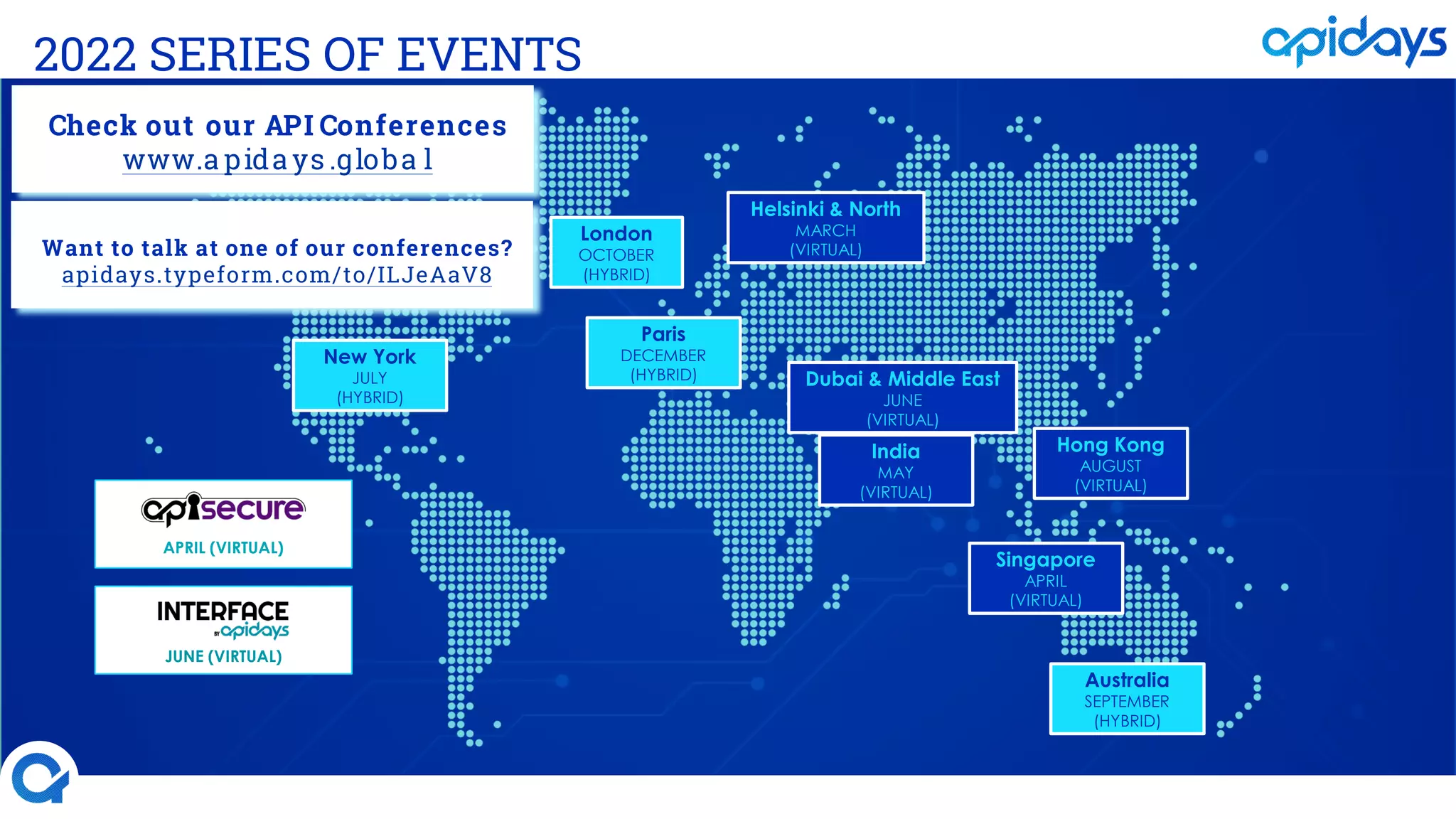
2022 SERIES OF EVENTS
New York
JULY
(HYBRID)
Australia
SEPTEMBER
(HYBRID)
Singapore
APRIL
(VIRTUAL)
Helsinki & North
MARCH
(VIRTUAL)
Paris
DECEMBER
(HYBRID)
London
OCTOBER
(HYBRID)
Hong Kong
AUGUST
(VIRTUAL)
JUNE (VIRTUAL)
India
MAY
(VIRTUAL)
APRIL (VIRTUAL)
Dubai & Middle East
JUNE
(VIRTUAL)
Check out our API Conferences
www.a pida ys .globa l
Want to talk at one of our conferences?
apidays.typeform.com/to/ILJeAaV8
2
Matt Fellows - Principal Product Manager @ SmartBear
– Co-Founder, Pactflow
– Core Maintainer, Pact (Go, JS)
@matthewfellows
Presented
by
If I got a penny every time…
(a story)
4
“If we just used <insert some new tech>
then we wouldn’t need contract testing”
5
Modern architecture
The challenges facing today’s engineering leaders
Customer
quote
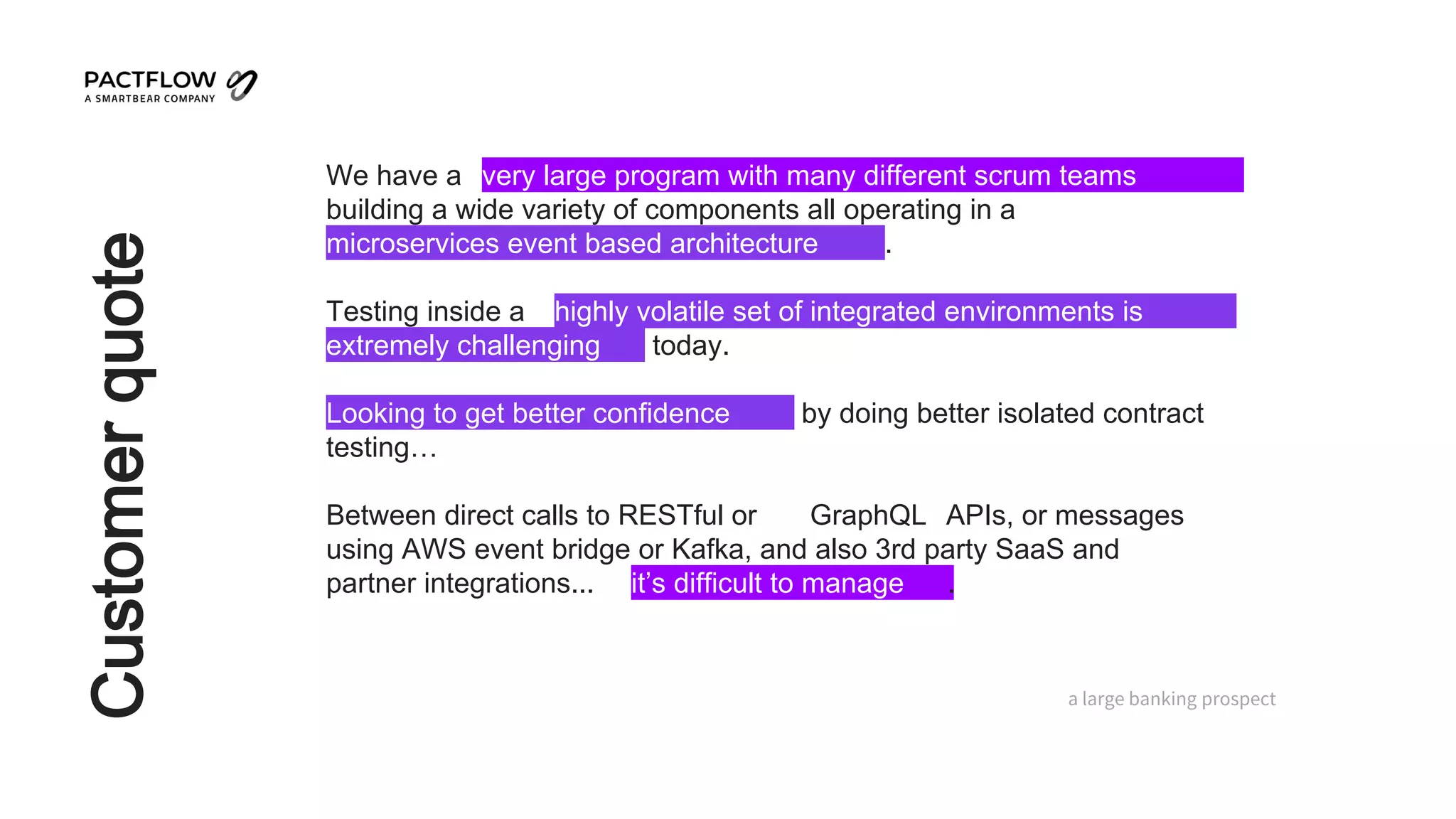
We have a very large program with many different scrum teams
building a wide variety of components all operating in a
microservices event based architecture .
Testing inside a highly volatile set of integrated environments is
extremely challenging today.
Looking to get better confidence by doing better isolated contract
testing…
Between direct calls to RESTful or GraphQL APIs, or messages
using AWS event bridge or Kafka, and also 3rd party SaaS and
partner integrations... it’s difficult to manage .
a large banking prospect
More microservices, more protocols
Industry insights
https://smartbear.com/state-of-software-quality/api/
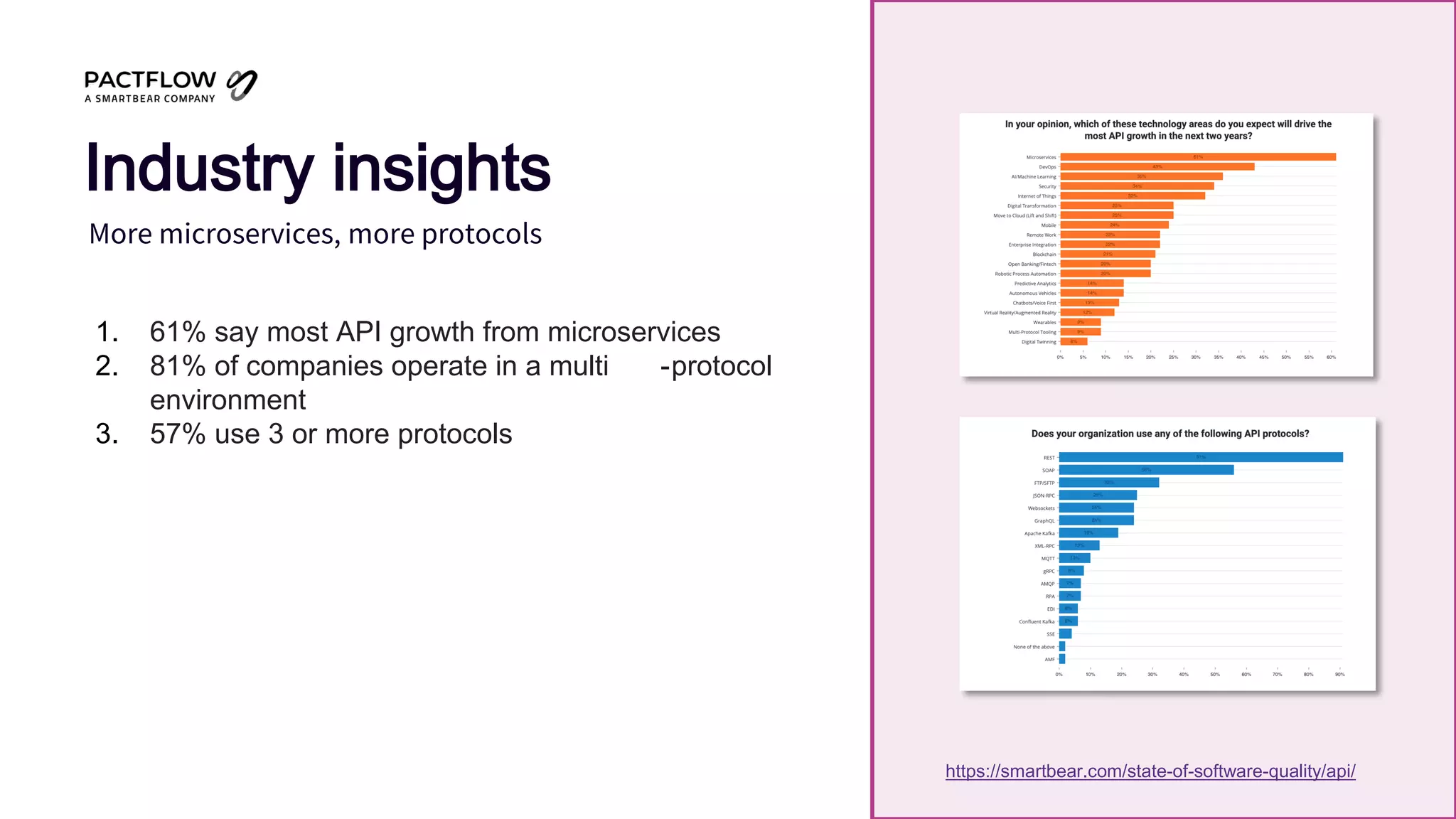
1. 61% say most API growth from microservices
2. 81% of companies operate in a multi -protocol
environment
3. 57% use 3 or more protocols
More microservices, more protocols
Industry insights
https://www.postman.com/state-of-api/
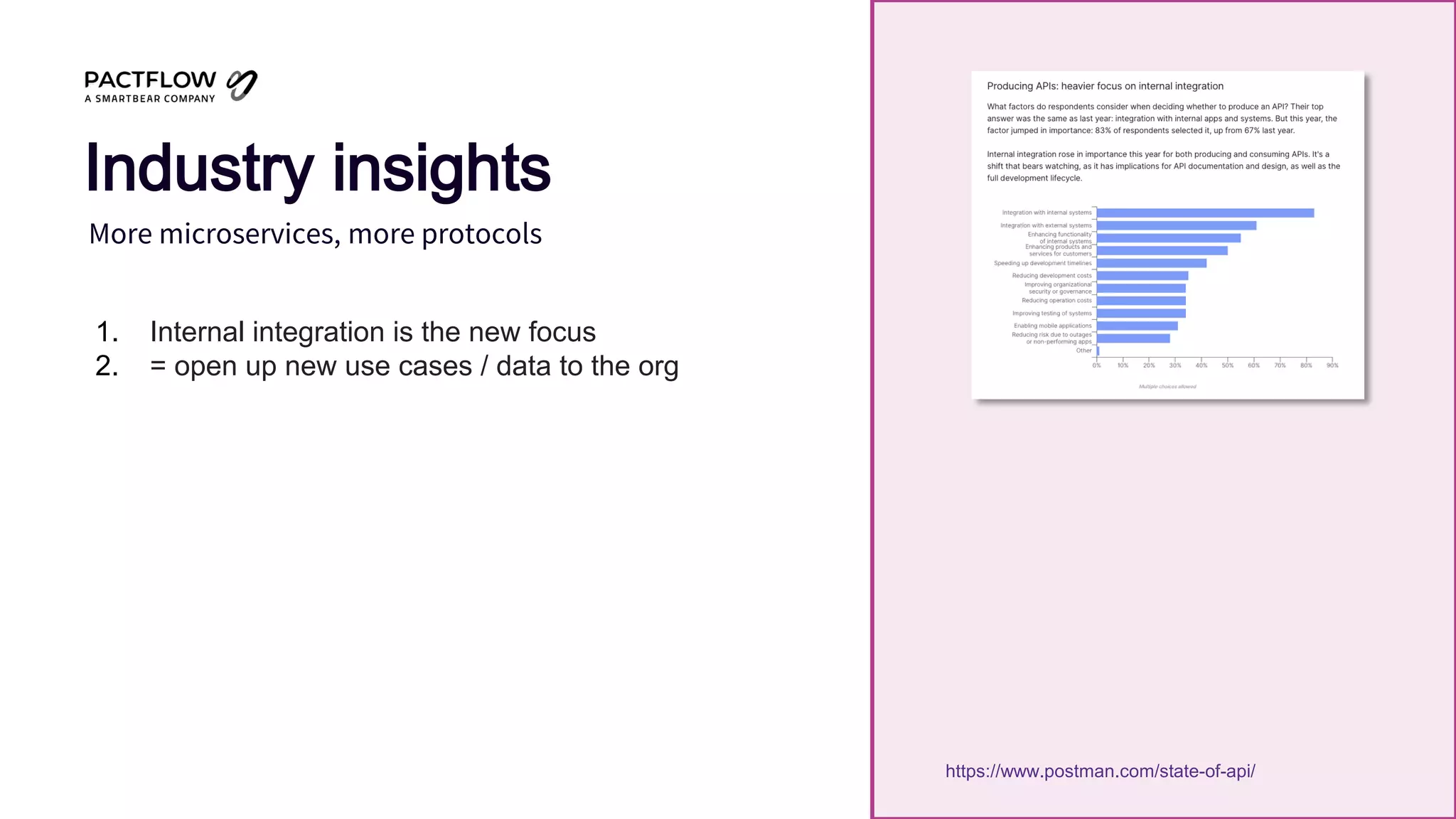
1. Internal integration is the new focus
2. = open up new use cases / data to the org
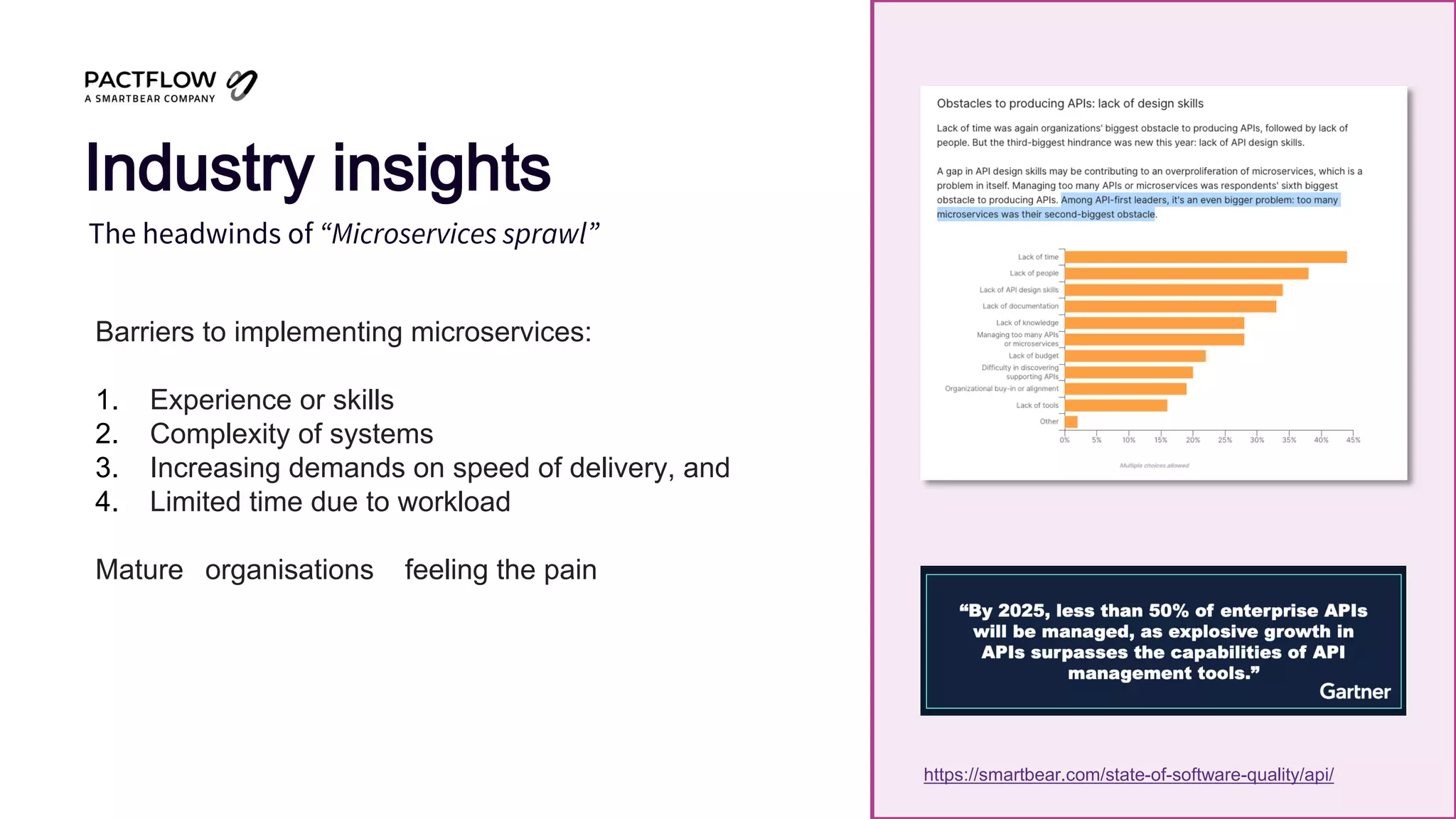
The headwinds of “Microservices sprawl”
Industry insights
https://smartbear.com/state-of-software-quality/api/
Barriers to implementing microservices:
1. Experience or skills
2. Complexity of systems
3. Increasing demands on speed of delivery, and
4. Limited time due to workload
Mature organisations feeling the pain
1
0
How we test microservices now
And why it doesn’t scale
11
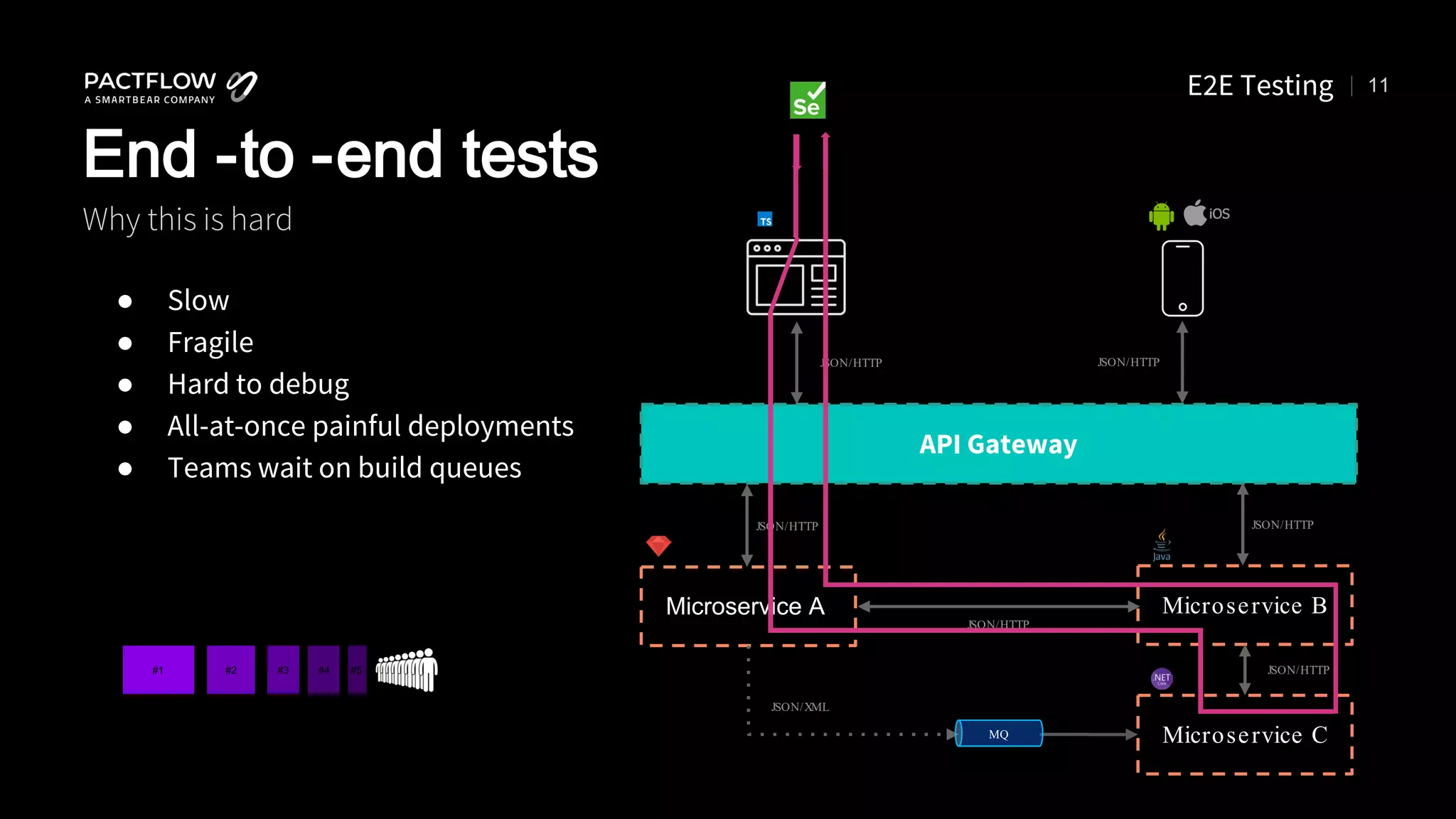
● Slow
● Fragile
● Hard to debug
● All-at-once painful deployments
● Teams wait on build queues
Microservice A
API Gateway
Microservice B
JSON/HTTP
JSON/HTTP JSON/HTTP
JSON/HTTP
Microservice C
JSON/XML
MQ
JSON/HTTP
JSON/HTTP
End -to -end tests
Why this is hard
#1 #2 #3 #4 #5
E2E Testing
12
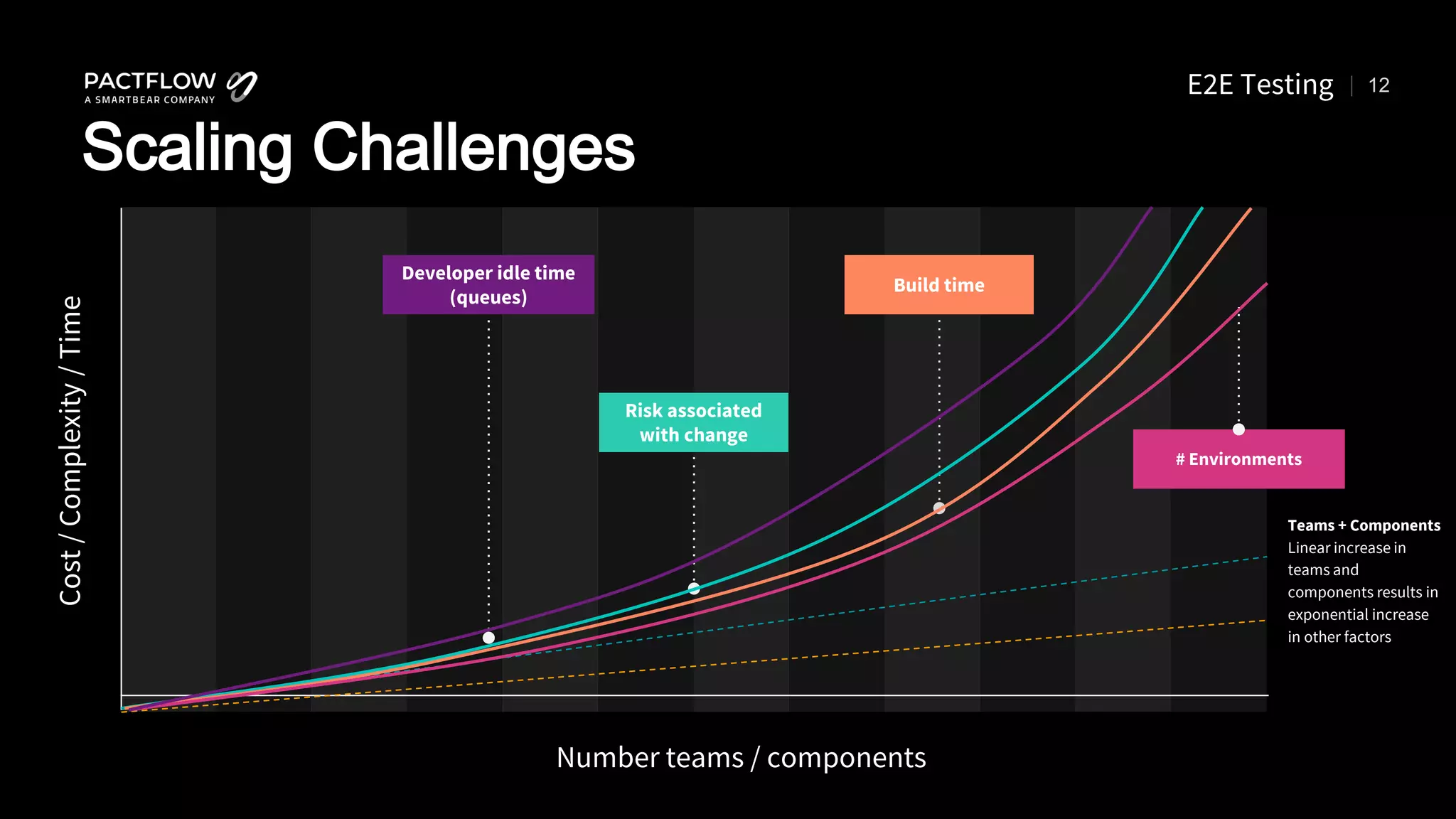
Scaling Challenges
Cost
/
Complexity
/
Time
Number teams / components
Build time
# Environments
Risk associated
with change
Teams + Components
Linear increase in
teams and
components results in
exponential increase
in other factors
Developer idle time
(queues)
E2E Testing
13
The solution?
Consumer Driven Contract testing
14
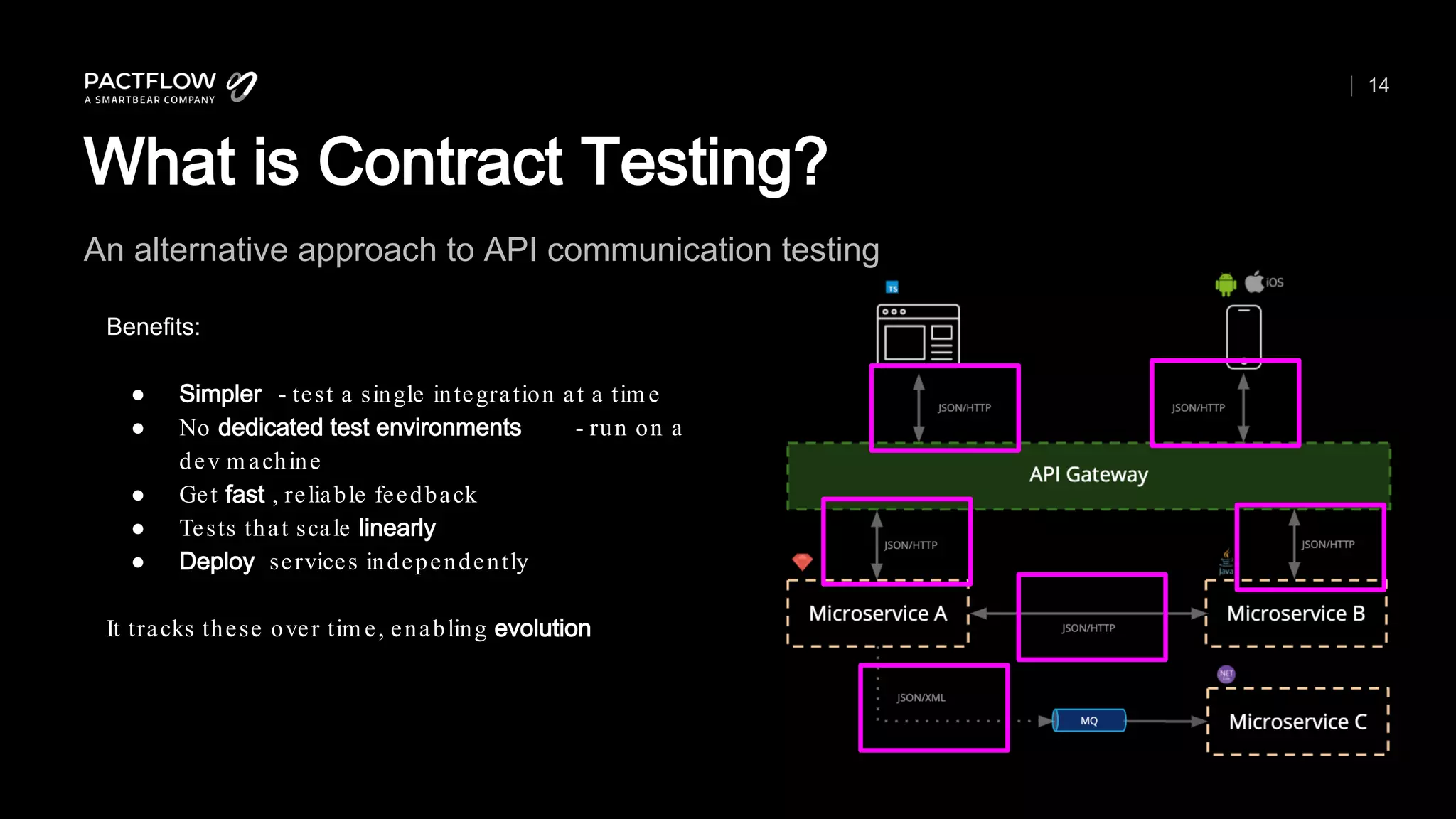
What is Contract Testing?
Benefits:
● Simpler - test a single integration at a tim e
● No dedicated test environments - run on a
dev m achine
● Get fast , reliable feedback
● Tests that scale linearly
● Deploy services independently
It tracks these over tim e, enabling evolution
An alternative approach to API communication testing
15
New protocols to
the rescue!
Can OpenAPI/AsyncAPI, gRPC, GraphQL or others dig us out of this hole?
1
6
API Specifications
Then, we wouldn’t need contract testing
If we just used
17
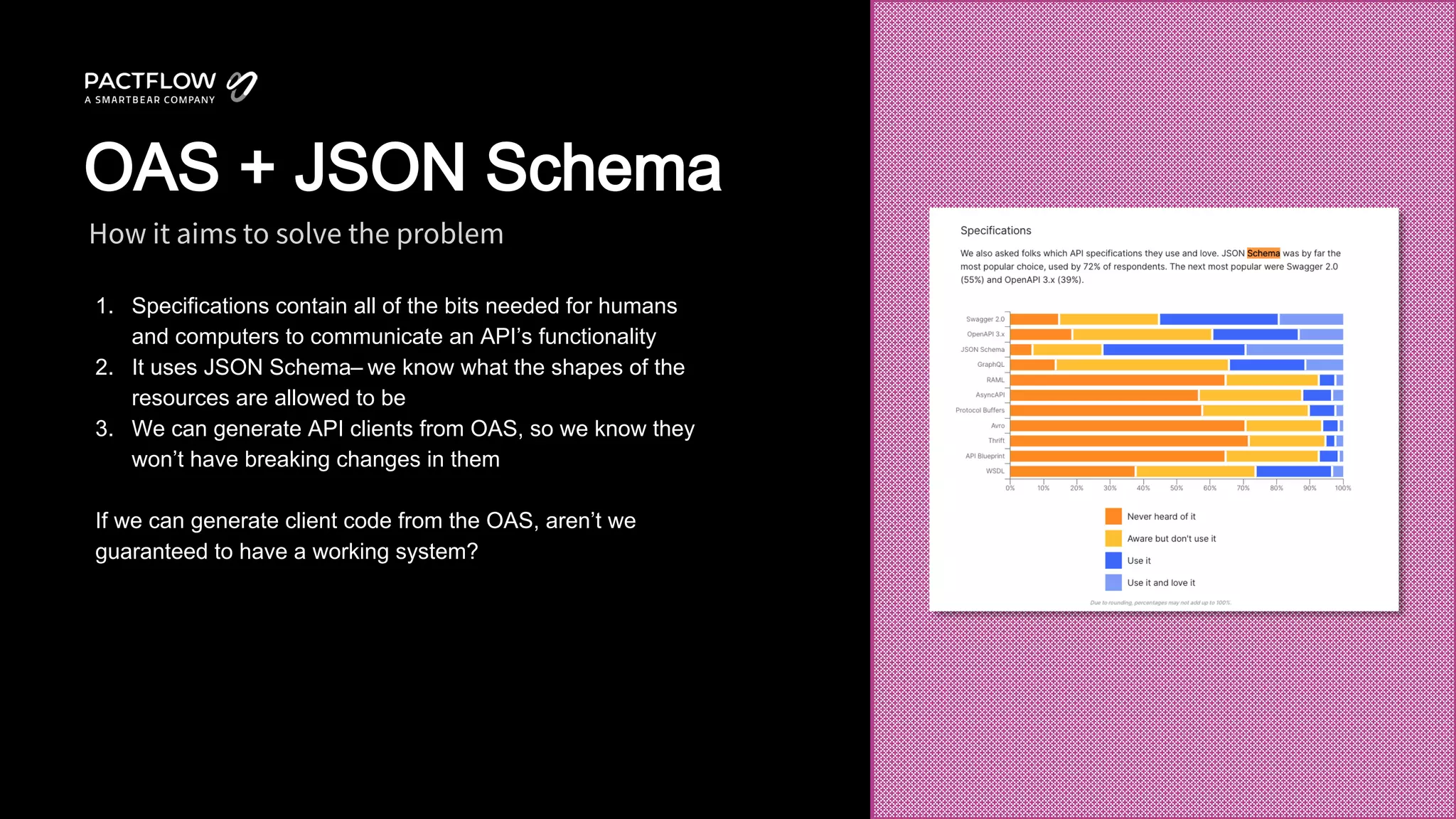
1. Specifications contain all of the bits needed for humans
and computers to communicate an API’s functionality
2. It uses JSON Schema– we know what the shapes of the
resources are allowed to be
3. We can generate API clients from OAS, so we know they
won’t have breaking changes in them
If we can generate client code from the OAS, aren’t we
guaranteed to have a working system?
How it aims to solve the problem
OAS + JSON Schema
18
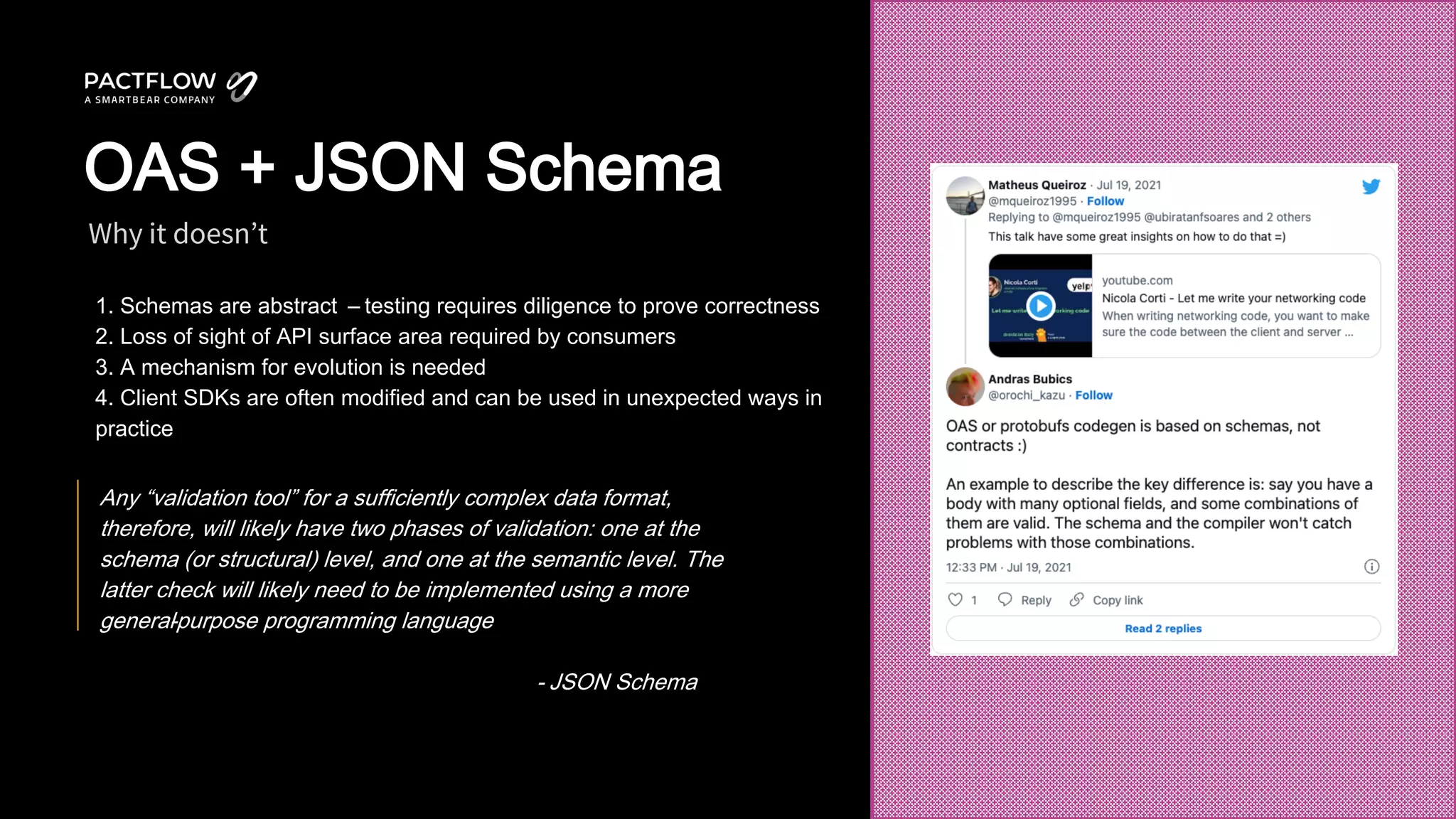
1. Schemas are abstract – testing requires diligence to prove correctness
2. Loss of sight of API surface area required by consumers
3. A mechanism for evolution is needed
4. Client SDKs are often modified and can be used in unexpected ways in
practice
Why it doesn’t
OAS + JSON Schema
Any “validation tool” for a sufficiently complex data format,
therefore, will likely have two phases of validation: one at the
schema (or structural) level, and one at the semantic level. The
latter check will likely need to be implemented using a more
general-purpose programming language
- JSON Schema
19
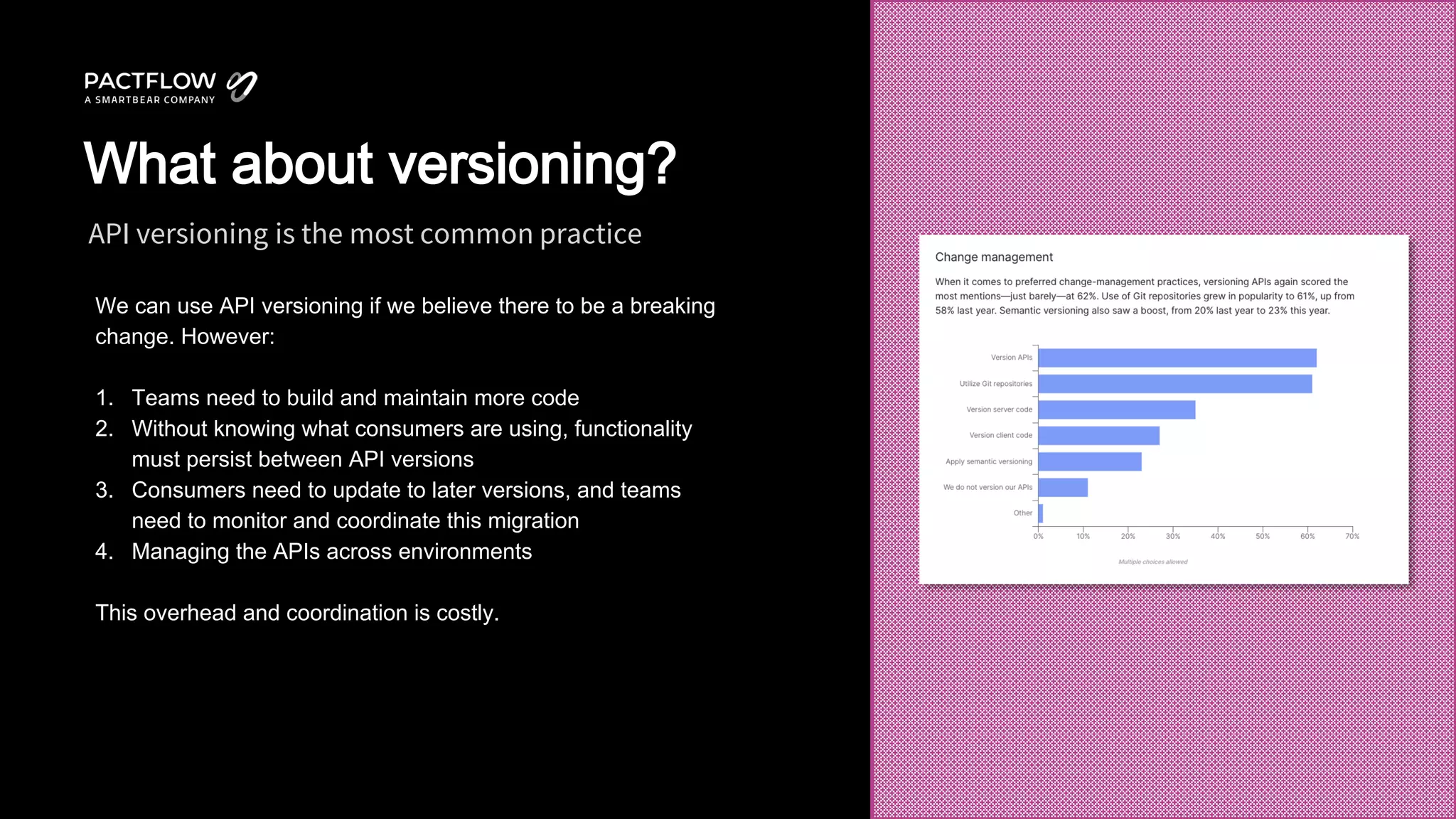
API versioning is the most common practice
What about versioning?
We can use API versioning if we believe there to be a breaking
change. However:
1. Teams need to build and maintain more code
2. Without knowing what consumers are using, functionality
must persist between API versions
3. Consumers need to update to later versions, and teams
need to monitor and coordinate this migration
4. Managing the APIs across environments
This overhead and coordination is costly.
2
0
Interface Definition Languages
Then, we wouldn’t need contract testing
If we just used
21
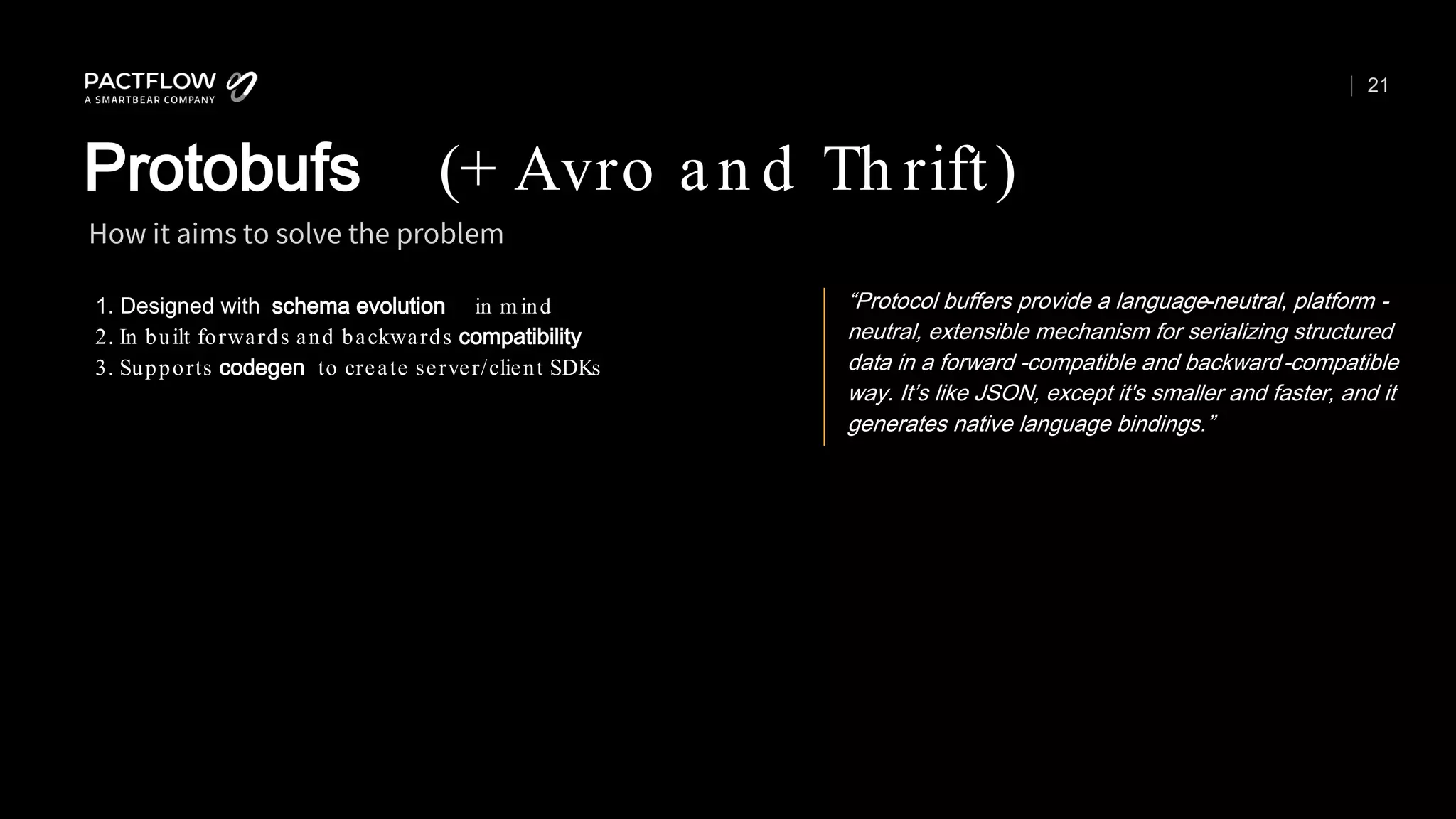
1. Designed with schema evolution in m ind
2. In built forwards and backwards compatibility
3. Supports codegen to create server/client SDKs
How it aims to solve the problem
Protobufs (+ Avro an d Th rift)
“Protocol buffers provide a language-neutral, platform -
neutral, extensible mechanism for serializing structured
data in a forward -compatible and backward-compatible
way. It’s like JSON, except it's smaller and faster, and it
generates native language bindings.”
22
Colourlessgreen ideas sleep furiously
Why it doesn’t
Protobufs (+ Avro an d Th rift)
23
The curious case of missing merchant payments
Why it doesn’t
Protobufs (+ Avro an d Th rift)
I lost count of how many bugs we had at <redacted> because
people where unaware of the default value behaviour
- Poor soul responsible for finding the bug
24
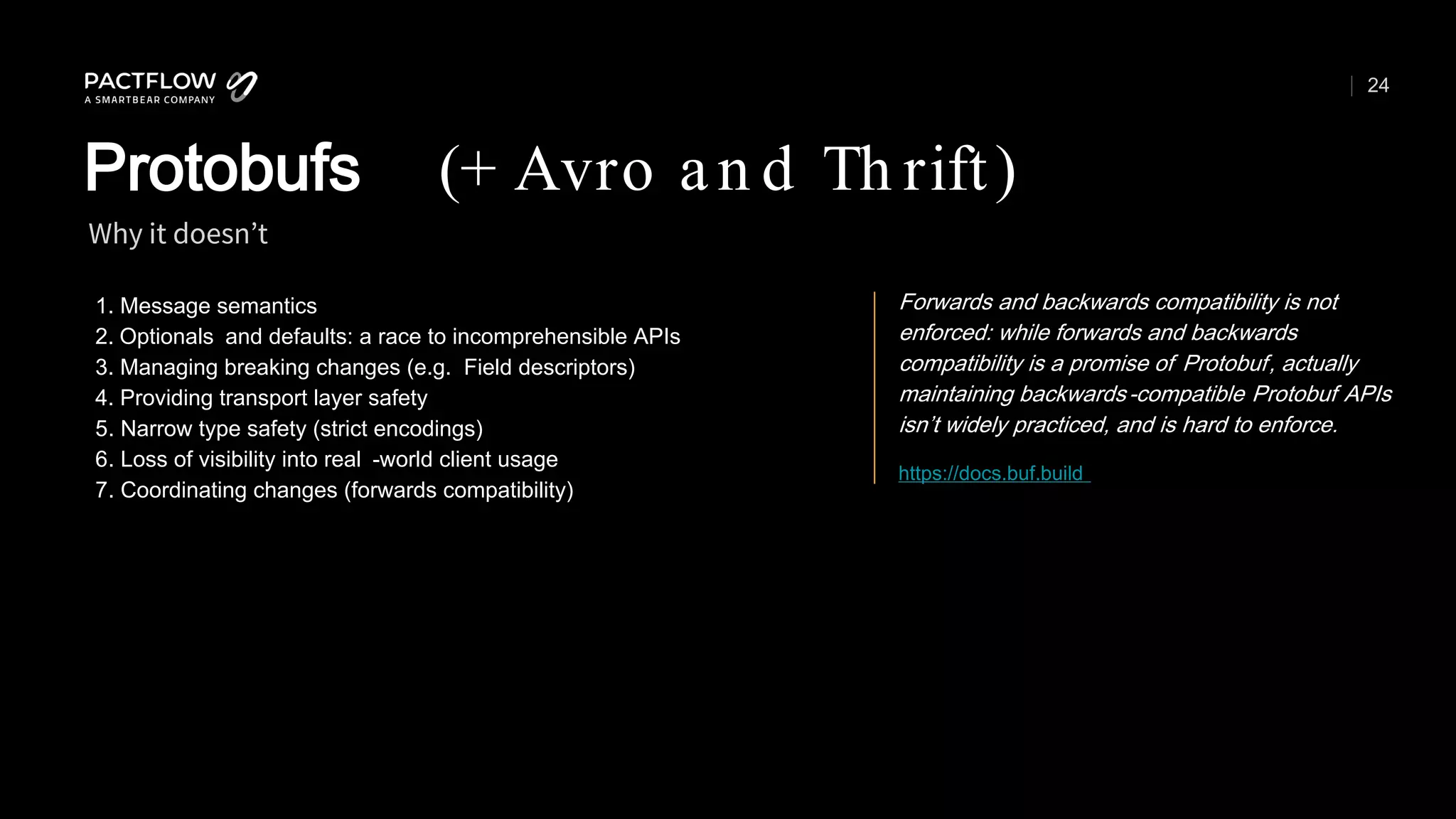
1. Message semantics
2. Optionals and defaults: a race to incomprehensible APIs
3. Managing breaking changes (e.g. Field descriptors)
4. Providing transport layer safety
5. Narrow type safety (strict encodings)
6. Loss of visibility into real -world client usage
7. Coordinating changes (forwards compatibility)
Why it doesn’t
Protobufs (+ Avro an d Th rift)
https://docs.buf.build
Forwards and backwards compatibility is not
enforced: while forwards and backwards
compatibility is a promise of Protobuf, actually
maintaining backwards-compatible Protobuf APIs
isn’t widely practiced, and is hard to enforce.
25
Contract Testing
How it can help
26
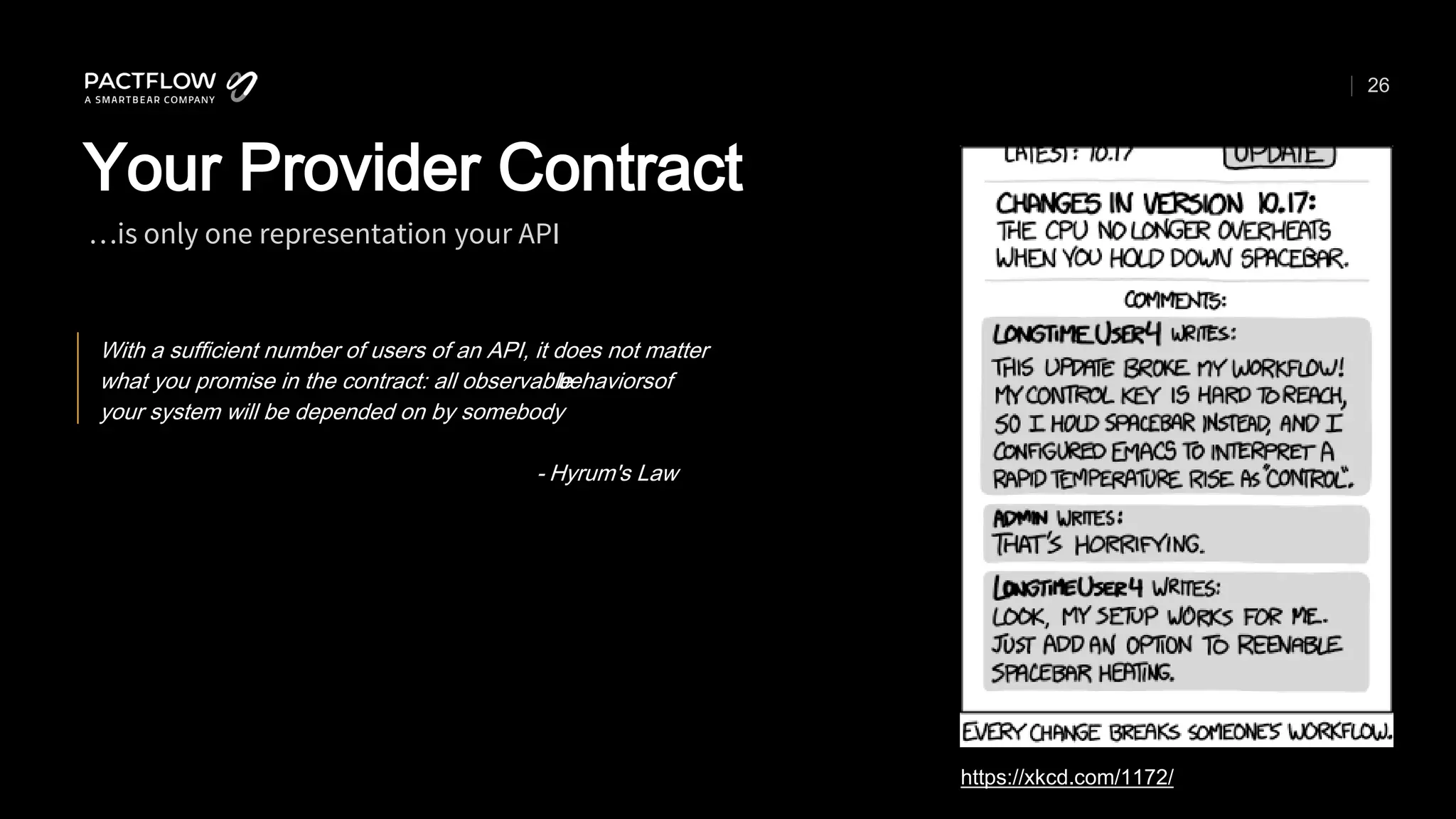
…is only one representation your API
Your Provider Contract
https://xkcd.com/1172/
With a sufficient number of users of an API, it does not matter
what you promise in the contract: all observable
behaviorsof
your system will be depended on by somebody
- Hyrum's Law
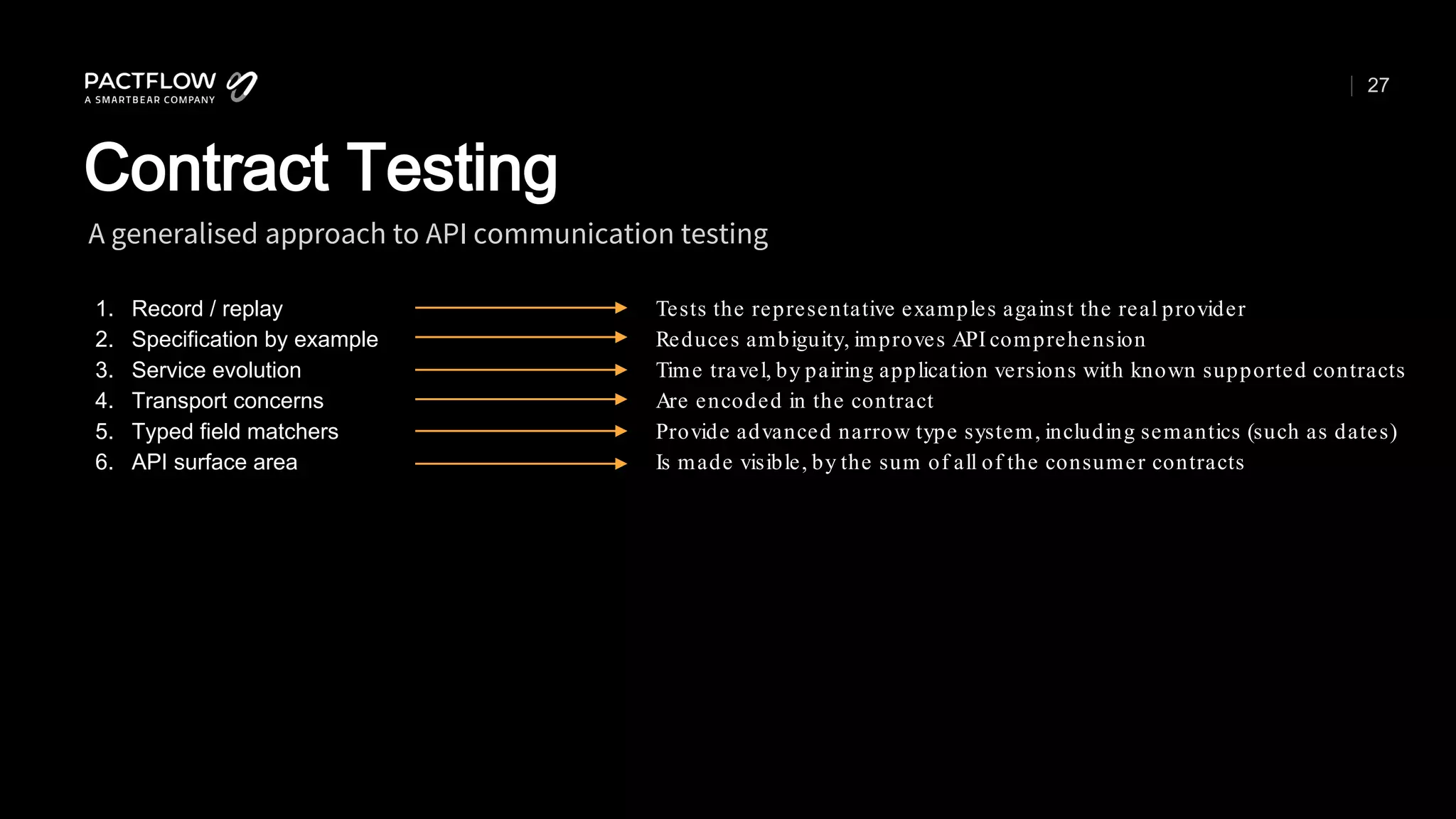
27
1. Record / replay
2. Specification by example
3. Service evolution
4. Transport concerns
5. Typed field matchers
6. API surface area
A generalised approach to API communication testing
Contract Testing
Tests the representative examples against the real provider
Reduces ambiguity, improves API comprehension
Time travel, by pairing application versions with known supported contracts
Are encoded in the contract
Provide advanced narrow type system, including semantics (such as dates)
Is made visible, by the sum of all of the consumer contracts
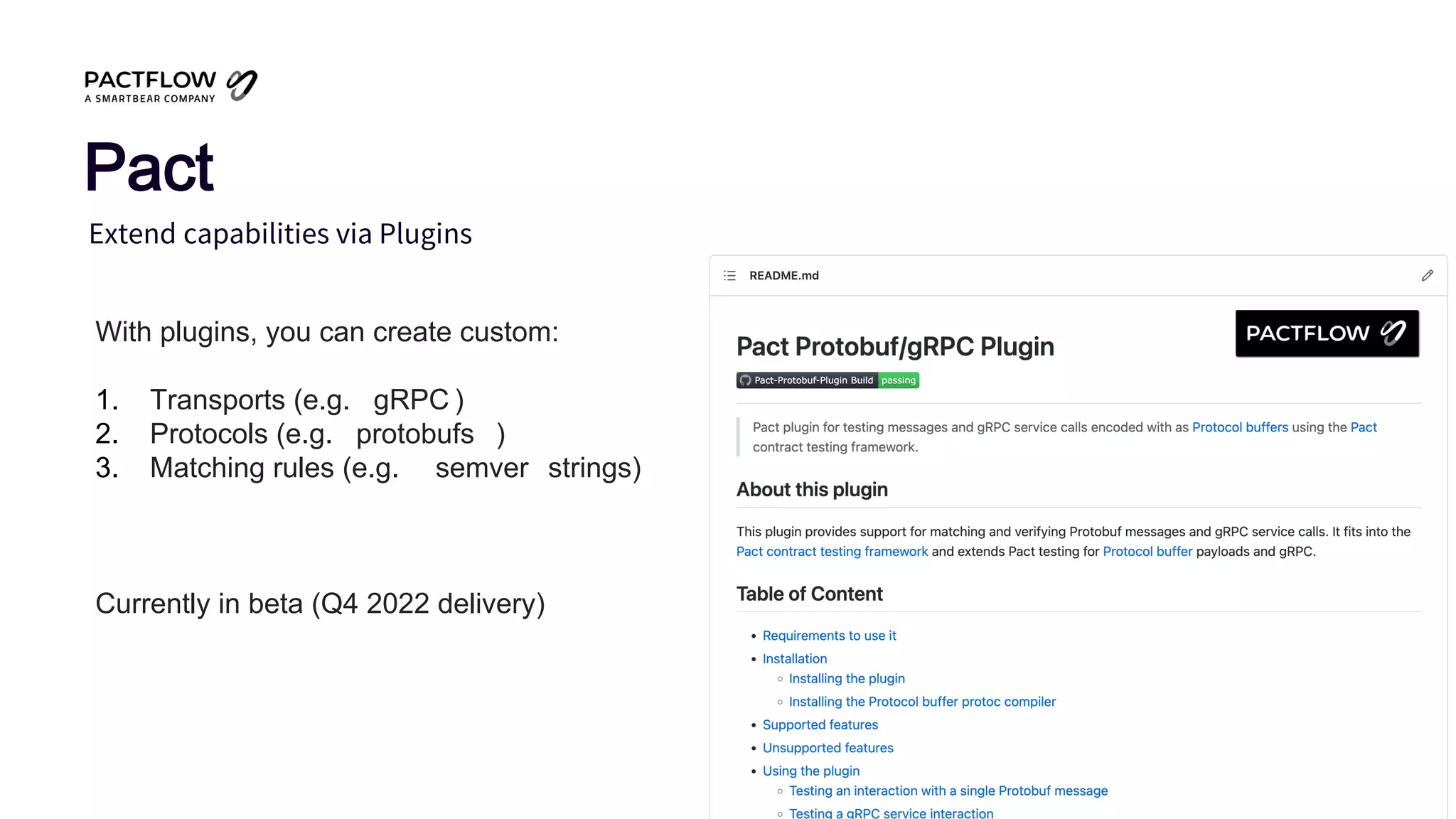
Extend capabilities via Plugins
Pact
With plugins, you can create custom:
1. Transports (e.g. gRPC )
2. Protocols (e.g. protobufs )
3. Matching rules (e.g. semver strings)
Currently in beta (Q4 2022 delivery)
29
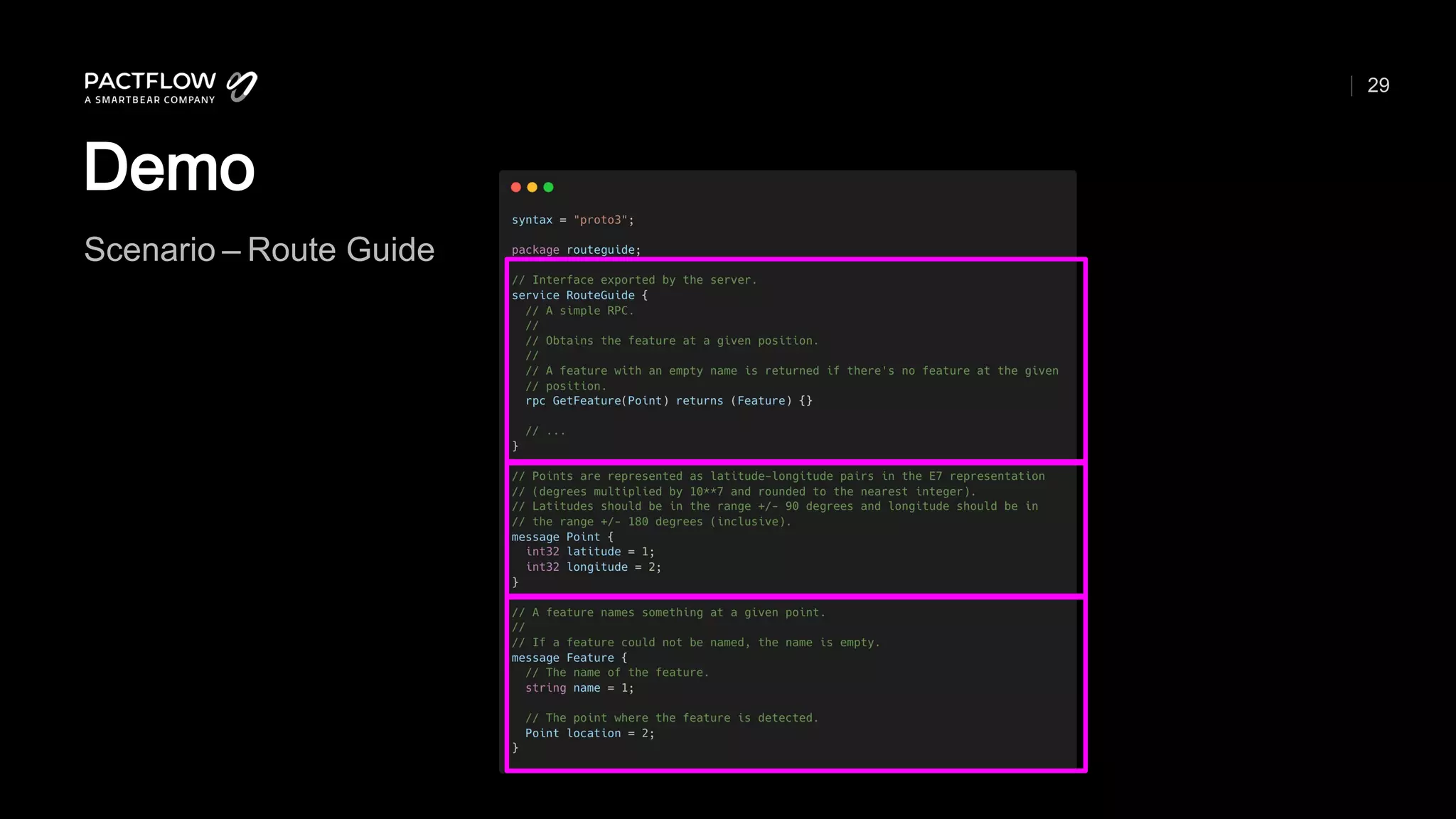
Demo
Scenario – Route Guide
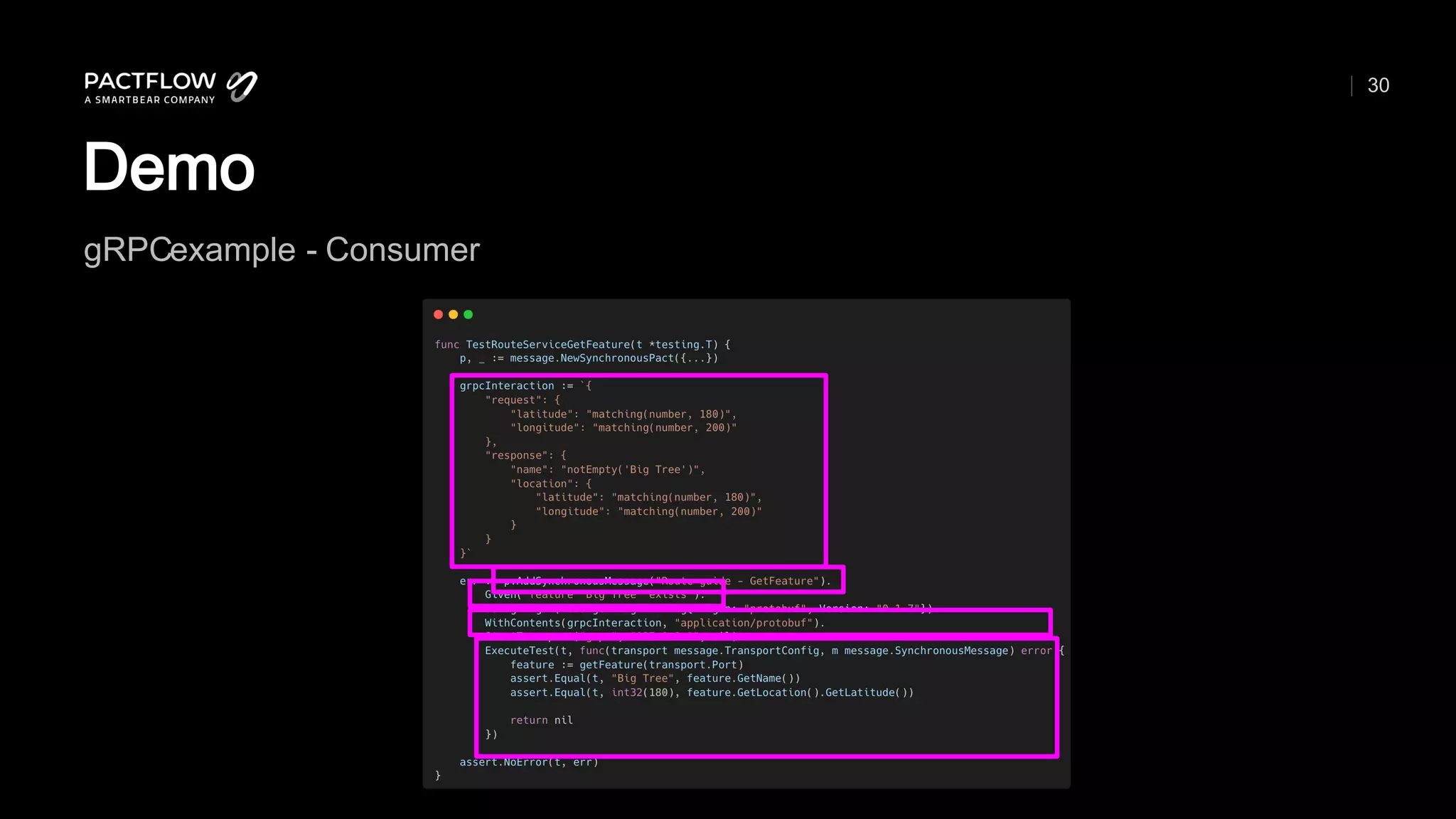
30
Demo
gRPCexample - Consumer
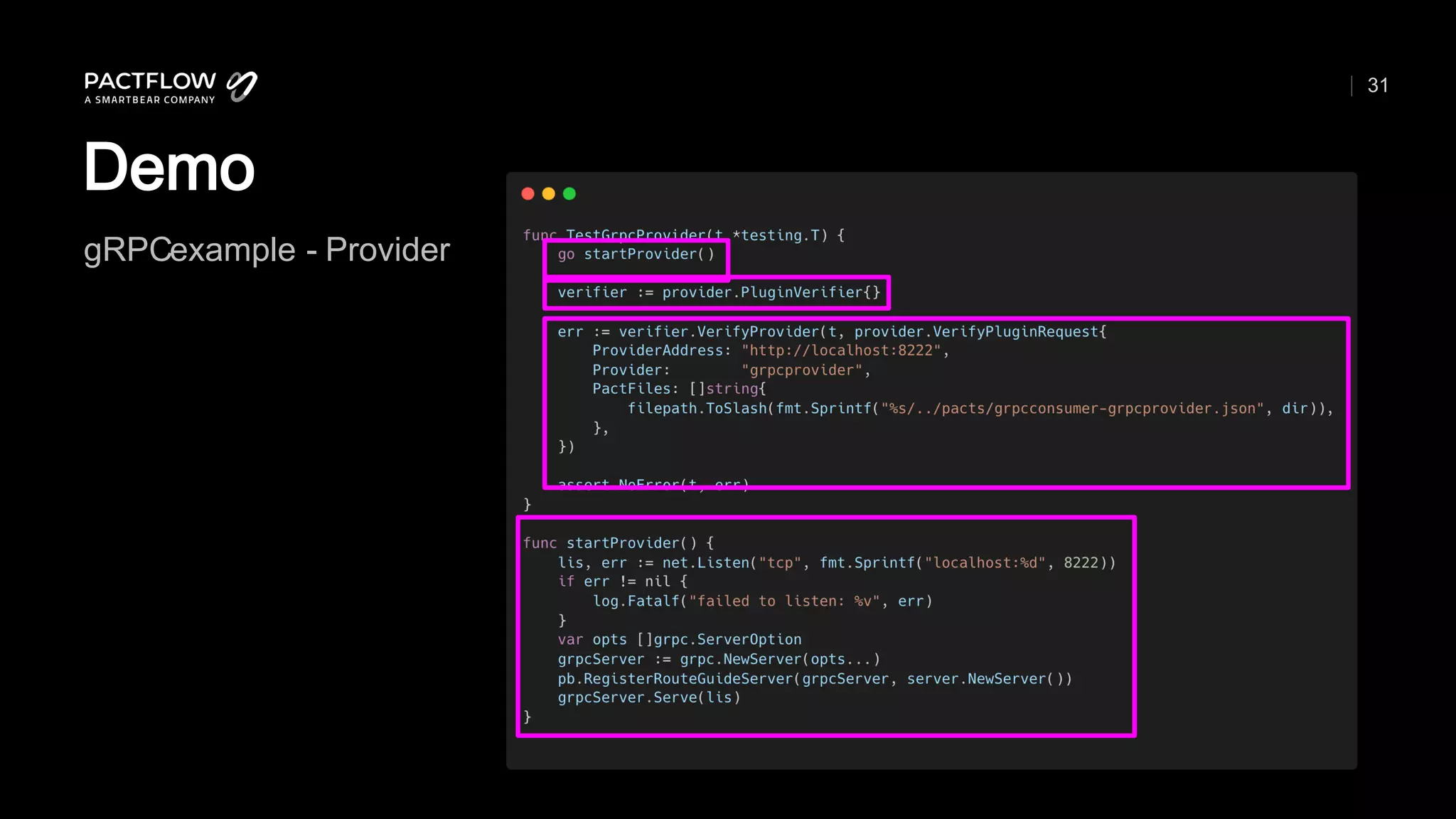
31
Demo
gRPCexample - Provider
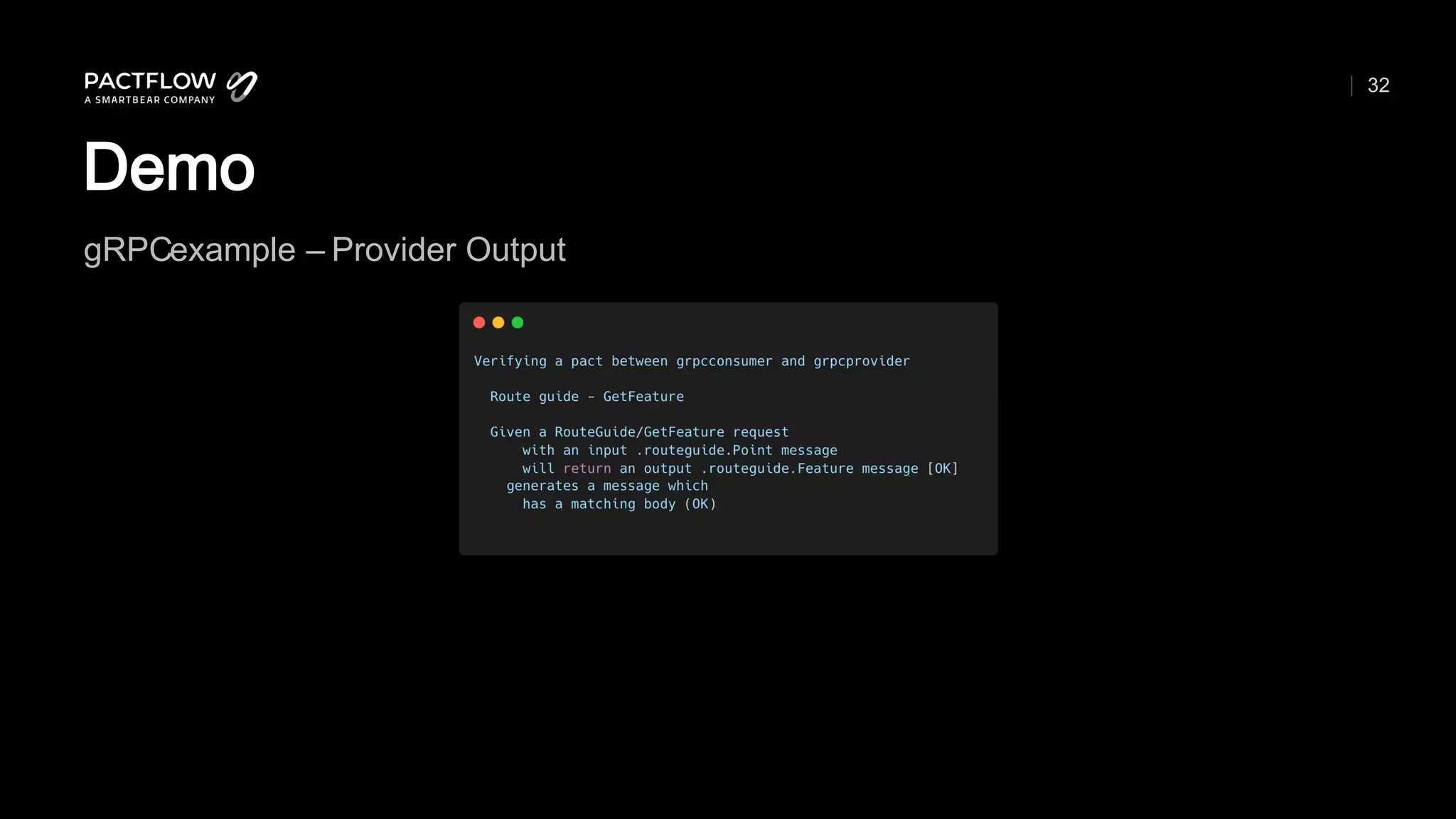
32
Demo
gRPCexample – Provider Output
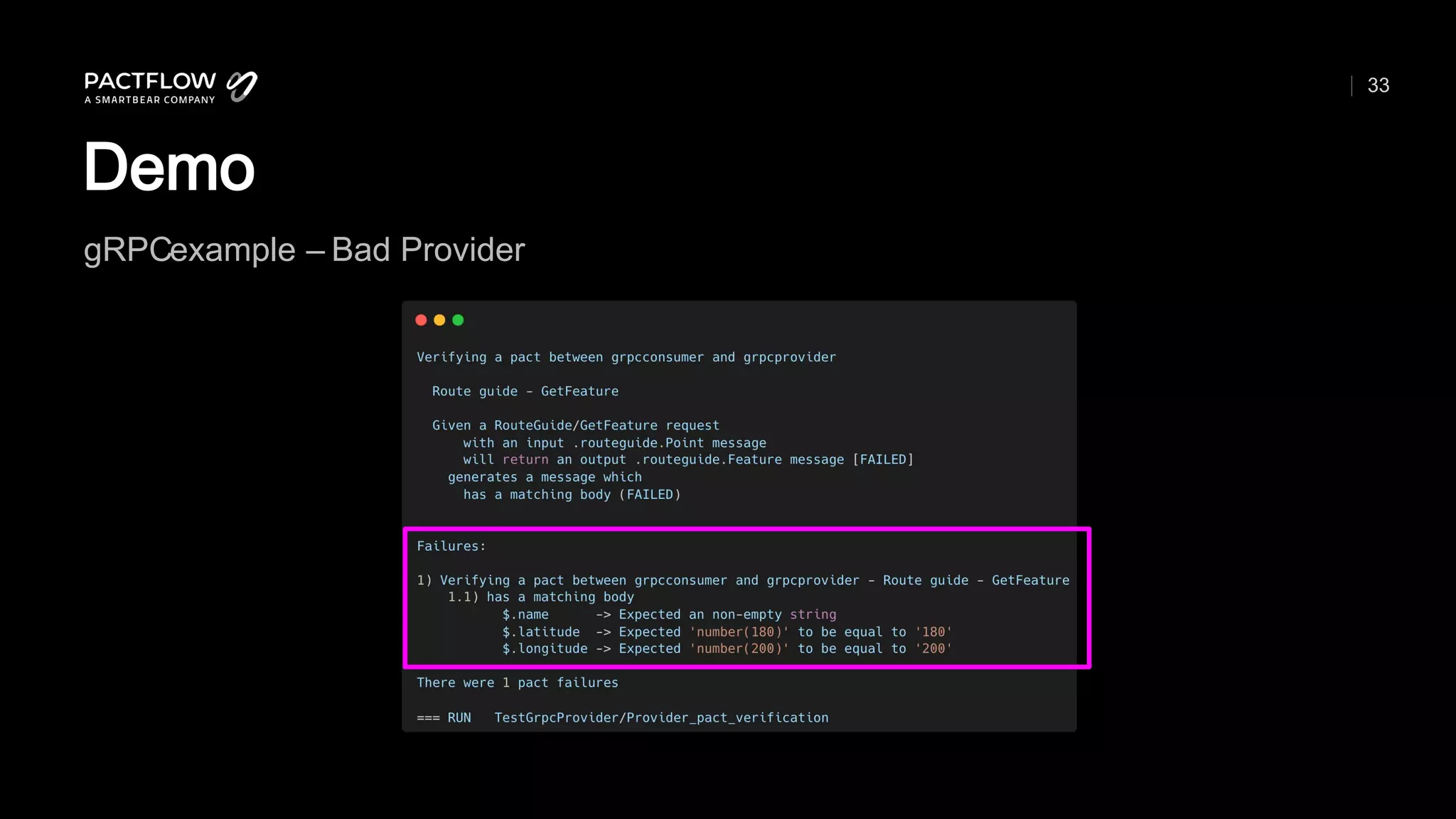
33
Demo
gRPCexample – Bad Provider
1. Multi-protocol internal microservice adoption is accelerating
2. Lack of standardization for design and test is contributing to
the challenges of “microservices sprawl”
3. Hyrum’s law – need to reduce ambiguity
4. Contract testing is an approach that can reduce the complexity
of API testing and the ambiguity inherent in all API
specifications
5. Pact is a contract testing tool that can be used to standardise
the API communication testing across languages, transports
and protocols
Key takeaways
Summary
Read the blog
35
THANK YOU
Get in touch
@matthewfellows
pactflow.io
Visit the Pact docs

apidays Australia 2022 - Schemas are not contracts!, Matt Fellows, Pactflow

  • 1.
    1 Schemas are notcontracts 1 Contract testing in the age of gRPC , Kafka and GraphQL . Matt Fellows API Days Melbourne, Sep ‘22
  • 2.
    2022 SERIES OFEVENTS New York JULY (HYBRID) Australia SEPTEMBER (HYBRID) Singapore APRIL (VIRTUAL) Helsinki & North MARCH (VIRTUAL) Paris DECEMBER (HYBRID) London OCTOBER (HYBRID) Hong Kong AUGUST (VIRTUAL) JUNE (VIRTUAL) India MAY (VIRTUAL) APRIL (VIRTUAL) Dubai & Middle East JUNE (VIRTUAL) Check out our API Conferences www.a pida ys .globa l Want to talk at one of our conferences? apidays.typeform.com/to/ILJeAaV8
  • 3.
    2 Matt Fellows -Principal Product Manager @ SmartBear – Co-Founder, Pactflow – Core Maintainer, Pact (Go, JS) @matthewfellows Presented by
  • 4.
    If I gota penny every time… (a story)
  • 5.
    4 “If we justused <insert some new tech> then we wouldn’t need contract testing”
  • 6.
    5 Modern architecture The challengesfacing today’s engineering leaders
  • 7.
    Customer quote We have avery large program with many different scrum teams building a wide variety of components all operating in a microservices event based architecture . Testing inside a highly volatile set of integrated environments is extremely challenging today. Looking to get better confidence by doing better isolated contract testing… Between direct calls to RESTful or GraphQL APIs, or messages using AWS event bridge or Kafka, and also 3rd party SaaS and partner integrations... it’s difficult to manage . a large banking prospect
  • 8.
    More microservices, moreprotocols Industry insights https://smartbear.com/state-of-software-quality/api/ 1. 61% say most API growth from microservices 2. 81% of companies operate in a multi -protocol environment 3. 57% use 3 or more protocols
  • 9.
    More microservices, moreprotocols Industry insights https://www.postman.com/state-of-api/ 1. Internal integration is the new focus 2. = open up new use cases / data to the org
  • 10.
    The headwinds of“Microservices sprawl” Industry insights https://smartbear.com/state-of-software-quality/api/ Barriers to implementing microservices: 1. Experience or skills 2. Complexity of systems 3. Increasing demands on speed of delivery, and 4. Limited time due to workload Mature organisations feeling the pain
  • 11.
    1 0 How we testmicroservices now And why it doesn’t scale
  • 12.
    11 ● Slow ● Fragile ●Hard to debug ● All-at-once painful deployments ● Teams wait on build queues Microservice A API Gateway Microservice B JSON/HTTP JSON/HTTP JSON/HTTP JSON/HTTP Microservice C JSON/XML MQ JSON/HTTP JSON/HTTP End -to -end tests Why this is hard #1 #2 #3 #4 #5 E2E Testing
  • 13.
    12 Scaling Challenges Cost / Complexity / Time Number teams/ components Build time # Environments Risk associated with change Teams + Components Linear increase in teams and components results in exponential increase in other factors Developer idle time (queues) E2E Testing
  • 14.
  • 15.
    14 What is ContractTesting? Benefits: ● Simpler - test a single integration at a tim e ● No dedicated test environments - run on a dev m achine ● Get fast , reliable feedback ● Tests that scale linearly ● Deploy services independently It tracks these over tim e, enabling evolution An alternative approach to API communication testing
  • 16.
    15 New protocols to therescue! Can OpenAPI/AsyncAPI, gRPC, GraphQL or others dig us out of this hole?
  • 17.
    1 6 API Specifications Then, wewouldn’t need contract testing If we just used
  • 18.
    17 1. Specifications containall of the bits needed for humans and computers to communicate an API’s functionality 2. It uses JSON Schema– we know what the shapes of the resources are allowed to be 3. We can generate API clients from OAS, so we know they won’t have breaking changes in them If we can generate client code from the OAS, aren’t we guaranteed to have a working system? How it aims to solve the problem OAS + JSON Schema
  • 19.
    18 1. Schemas areabstract – testing requires diligence to prove correctness 2. Loss of sight of API surface area required by consumers 3. A mechanism for evolution is needed 4. Client SDKs are often modified and can be used in unexpected ways in practice Why it doesn’t OAS + JSON Schema Any “validation tool” for a sufficiently complex data format, therefore, will likely have two phases of validation: one at the schema (or structural) level, and one at the semantic level. The latter check will likely need to be implemented using a more general-purpose programming language - JSON Schema
  • 20.
    19 API versioning isthe most common practice What about versioning? We can use API versioning if we believe there to be a breaking change. However: 1. Teams need to build and maintain more code 2. Without knowing what consumers are using, functionality must persist between API versions 3. Consumers need to update to later versions, and teams need to monitor and coordinate this migration 4. Managing the APIs across environments This overhead and coordination is costly.
  • 21.
    2 0 Interface Definition Languages Then,we wouldn’t need contract testing If we just used
  • 22.
    21 1. Designed withschema evolution in m ind 2. In built forwards and backwards compatibility 3. Supports codegen to create server/client SDKs How it aims to solve the problem Protobufs (+ Avro an d Th rift) “Protocol buffers provide a language-neutral, platform - neutral, extensible mechanism for serializing structured data in a forward -compatible and backward-compatible way. It’s like JSON, except it's smaller and faster, and it generates native language bindings.”
  • 23.
    22 Colourlessgreen ideas sleepfuriously Why it doesn’t Protobufs (+ Avro an d Th rift)
  • 24.
    23 The curious caseof missing merchant payments Why it doesn’t Protobufs (+ Avro an d Th rift) I lost count of how many bugs we had at <redacted> because people where unaware of the default value behaviour - Poor soul responsible for finding the bug
  • 25.
    24 1. Message semantics 2.Optionals and defaults: a race to incomprehensible APIs 3. Managing breaking changes (e.g. Field descriptors) 4. Providing transport layer safety 5. Narrow type safety (strict encodings) 6. Loss of visibility into real -world client usage 7. Coordinating changes (forwards compatibility) Why it doesn’t Protobufs (+ Avro an d Th rift) https://docs.buf.build Forwards and backwards compatibility is not enforced: while forwards and backwards compatibility is a promise of Protobuf, actually maintaining backwards-compatible Protobuf APIs isn’t widely practiced, and is hard to enforce.
  • 26.
  • 27.
    26 …is only onerepresentation your API Your Provider Contract https://xkcd.com/1172/ With a sufficient number of users of an API, it does not matter what you promise in the contract: all observable behaviorsof your system will be depended on by somebody - Hyrum's Law
  • 28.
    27 1. Record /replay 2. Specification by example 3. Service evolution 4. Transport concerns 5. Typed field matchers 6. API surface area A generalised approach to API communication testing Contract Testing Tests the representative examples against the real provider Reduces ambiguity, improves API comprehension Time travel, by pairing application versions with known supported contracts Are encoded in the contract Provide advanced narrow type system, including semantics (such as dates) Is made visible, by the sum of all of the consumer contracts
  • 29.
    Extend capabilities viaPlugins Pact With plugins, you can create custom: 1. Transports (e.g. gRPC ) 2. Protocols (e.g. protobufs ) 3. Matching rules (e.g. semver strings) Currently in beta (Q4 2022 delivery)
  • 30.
  • 31.
  • 32.
  • 33.
  • 34.
  • 35.
    1. Multi-protocol internalmicroservice adoption is accelerating 2. Lack of standardization for design and test is contributing to the challenges of “microservices sprawl” 3. Hyrum’s law – need to reduce ambiguity 4. Contract testing is an approach that can reduce the complexity of API testing and the ambiguity inherent in all API specifications 5. Pact is a contract testing tool that can be used to standardise the API communication testing across languages, transports and protocols Key takeaways Summary Read the blog
  • 36.
    35 THANK YOU Get intouch @matthewfellows pactflow.io Visit the Pact docs