ADVANCE PRICING AGREEMENT (APA)
PROGRAM
GOVERNMENT OF INDIA
MINISTRY OF FINANCE
What is an APA?
• APA was introduced in 2012 to bring down tax litigation significantly and
provide tax certainty to foreign investors
• Provides ‘certainty’ and ‘unanimity’ of approach in determining Arm’s
Length Price (ALP) of ‘international transactions’ of goods or services
between related parties
• To reduce tax litigation on account of Transfer Pricing
• APA - An agreement between ‘tax payer’ and CBDT determining ALP or
manner of determination of ALP.
• Unilateral APA - It is an agreement with only Indian taxpayer and the CBDT.
• Bilateral APA - Both the countries sign the agreement with their respective
taxpayer entities.
• Multilateral APA - more than two countries are involved.
Types of APA
Year Milestones
Finance Act 2012 Advance Pricing Agreement provisions introduced
30 August 2012 Advance Pricing Agreement Scheme notified
March 2013 First round of applications: 146 received
May 2013 Advance Pricing Agreement FAQs issued
March 2014 First unilateral APA signed
December 2014 First bilateral APA signed
Finance Act 2014 Rollback provisions in APA scheme introduced
March 2015 Rollback Rules notified
June 2015 Circular no. 10/2015 on clarifications on rollback provisions
issued
August 2015 First APA with rollback signed
September 2016 100 APAs signing mark crossed
As on date More than 428 APAs signed
KEY MILESTONES OF THE APA PROGRAM
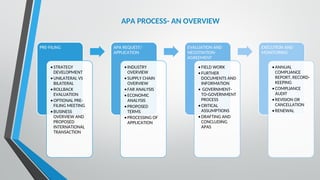
APA PROCESS- AN OVERVIEW
PRE-FILING
•STRATEGY
DEVELOPMENT
•UNILATERAL VS
BILATERAL
•ROLLBACK
EVALUATION
•OPTIONAL PRE-
FILING MEETING
•BUSINESS
OVERVIEW AND
PROPOSED
INTERNATIONAL
TRANSACTION
APA REQUEST/
APPLICATION
•INDUSTRY
OVERVIEW
•SUPPLY CHAIN
OVERVIEW
•FAR ANALYSIS
•ECONOMIC
ANALYSIS
•PROPOSED
TERMS
•PROCESSING OF
APPLICATION
EVALUATION AND
NEGOTIATION-
AGREEMENT
•FIELD WORK
•FURTHER
DOCUMENTS AND
INFORMATION
• GOVERNMENT-
TO-GOVERNMENT
PROCESS
•CRITICAL
ASSUMPTIONS
•DRAFTING AND
CONCLUDING
APAS
EXECUTION AND
MONITORING
•ANNUAL
COMPLIANCE
REPORT, RECORD-
KEEPING
•COMPLIANCE
AUDIT
•REVISION OR
CANCELLATION
•RENEWAL
Some areas of Transfer Pricing disputes where APAs are
highly effective
• Business restructuring transactions
• Captive intra-group services
• Payments for use in intellectual
property
• Agency services or commission agents
• Sales supply chain structures
• Procurement services and sales support
services
• Limited risk distributors
• Allocation of headquarter and management
fee
• Financial transactions such as loans and
guarantees
• Commodity trading
• Low margin companies with significant inter-
company transactions
• Contract manufacturing
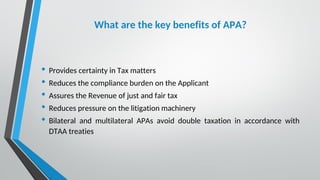
What are the key benefits of APA?
• Provides certainty in Tax matters
• Reduces the compliance burden on the Applicant
• Assures the Revenue of just and fair tax
• Reduces pressure on the litigation machinery
• Bilateral and multilateral APAs avoid double taxation in accordance with
DTAA treaties
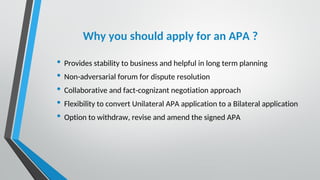
Why you should apply for an APA ?
• Provides stability to business and helpful in long term planning
• Non-adversarial forum for dispute resolution
• Collaborative and fact-cognizant negotiation approach
• Flexibility to convert Unilateral APA application to a Bilateral application
• Option to withdraw, revise and amend the signed APA

APA Presentation

  • 1.
    ADVANCE PRICING AGREEMENT(APA) PROGRAM GOVERNMENT OF INDIA MINISTRY OF FINANCE
  • 2.
    What is anAPA? • APA was introduced in 2012 to bring down tax litigation significantly and provide tax certainty to foreign investors • Provides ‘certainty’ and ‘unanimity’ of approach in determining Arm’s Length Price (ALP) of ‘international transactions’ of goods or services between related parties • To reduce tax litigation on account of Transfer Pricing • APA - An agreement between ‘tax payer’ and CBDT determining ALP or manner of determination of ALP.
  • 3.
    • Unilateral APA- It is an agreement with only Indian taxpayer and the CBDT. • Bilateral APA - Both the countries sign the agreement with their respective taxpayer entities. • Multilateral APA - more than two countries are involved. Types of APA
  • 4.
    Year Milestones Finance Act2012 Advance Pricing Agreement provisions introduced 30 August 2012 Advance Pricing Agreement Scheme notified March 2013 First round of applications: 146 received May 2013 Advance Pricing Agreement FAQs issued March 2014 First unilateral APA signed December 2014 First bilateral APA signed Finance Act 2014 Rollback provisions in APA scheme introduced March 2015 Rollback Rules notified June 2015 Circular no. 10/2015 on clarifications on rollback provisions issued August 2015 First APA with rollback signed September 2016 100 APAs signing mark crossed As on date More than 428 APAs signed KEY MILESTONES OF THE APA PROGRAM
  • 5.
    APA PROCESS- ANOVERVIEW PRE-FILING •STRATEGY DEVELOPMENT •UNILATERAL VS BILATERAL •ROLLBACK EVALUATION •OPTIONAL PRE- FILING MEETING •BUSINESS OVERVIEW AND PROPOSED INTERNATIONAL TRANSACTION APA REQUEST/ APPLICATION •INDUSTRY OVERVIEW •SUPPLY CHAIN OVERVIEW •FAR ANALYSIS •ECONOMIC ANALYSIS •PROPOSED TERMS •PROCESSING OF APPLICATION EVALUATION AND NEGOTIATION- AGREEMENT •FIELD WORK •FURTHER DOCUMENTS AND INFORMATION • GOVERNMENT- TO-GOVERNMENT PROCESS •CRITICAL ASSUMPTIONS •DRAFTING AND CONCLUDING APAS EXECUTION AND MONITORING •ANNUAL COMPLIANCE REPORT, RECORD- KEEPING •COMPLIANCE AUDIT •REVISION OR CANCELLATION •RENEWAL
  • 6.
    Some areas ofTransfer Pricing disputes where APAs are highly effective • Business restructuring transactions • Captive intra-group services • Payments for use in intellectual property • Agency services or commission agents • Sales supply chain structures • Procurement services and sales support services • Limited risk distributors • Allocation of headquarter and management fee • Financial transactions such as loans and guarantees • Commodity trading • Low margin companies with significant inter- company transactions • Contract manufacturing
  • 7.
    What are thekey benefits of APA? • Provides certainty in Tax matters • Reduces the compliance burden on the Applicant • Assures the Revenue of just and fair tax • Reduces pressure on the litigation machinery • Bilateral and multilateral APAs avoid double taxation in accordance with DTAA treaties
  • 8.
    Why you shouldapply for an APA ? • Provides stability to business and helpful in long term planning • Non-adversarial forum for dispute resolution • Collaborative and fact-cognizant negotiation approach • Flexibility to convert Unilateral APA application to a Bilateral application • Option to withdraw, revise and amend the signed APA