07.2016
NEWS
Shareholder Baoneng seeks
to oust board in battle for
the future of China Vanke
analysis
Amid the uncertainty, Brexit also
offers investment opportunities
in UK, roundtable panel concurs
profile
Global asset management giant
TH Real Estate plans to become
a top Asia Pacific player too
survey: malaysia
Supply spike in office and retail
sectors puts brake on market in
Kuala Lumpur and beyond
survey: residential
China struggles to keep lid on
prices, while Japan’s multi-
family sector attracts investors
research
Key data on Asia’s
occupational, non-listed
and listed property markets
22
33
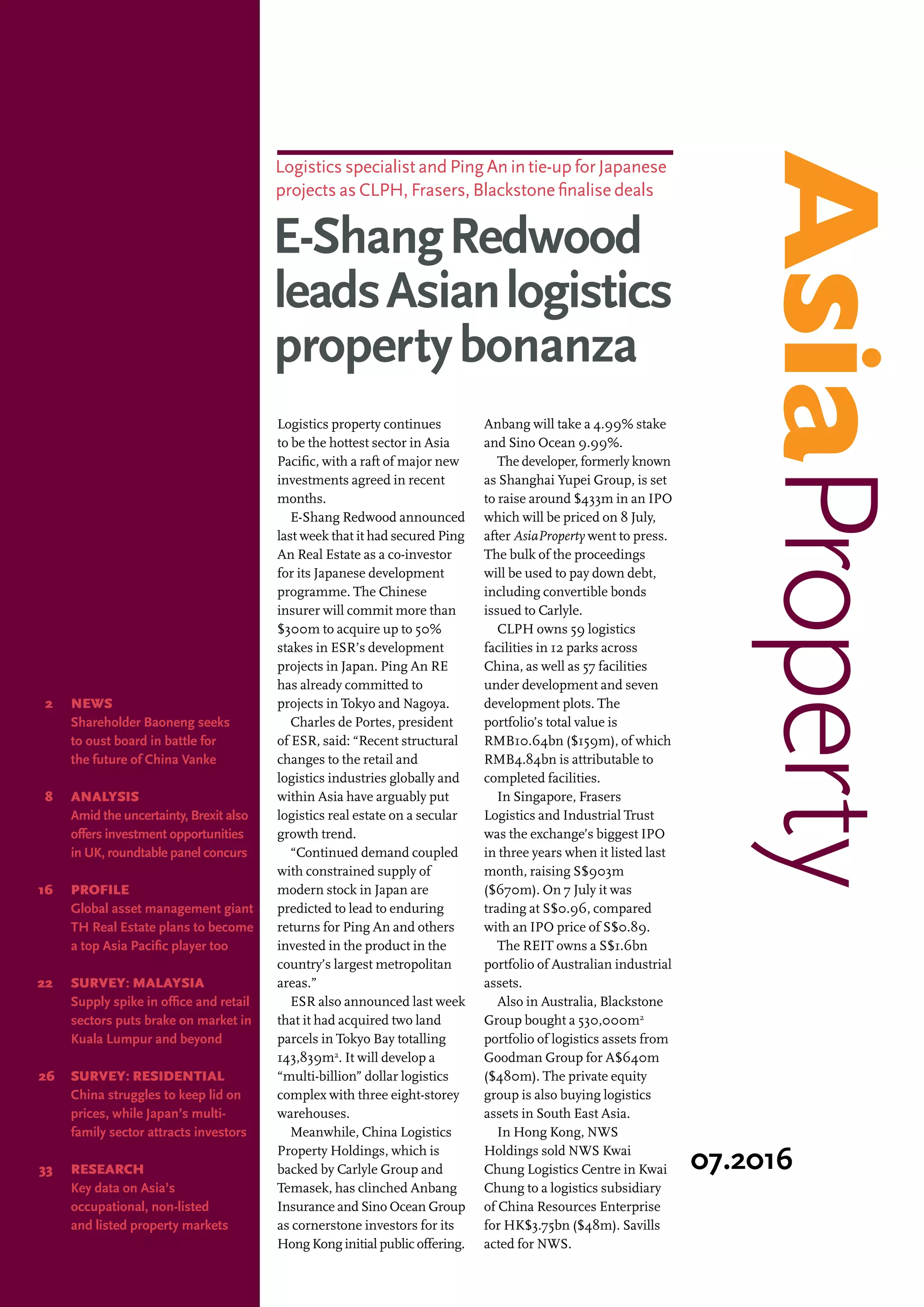
Logistics specialist and Ping An in tie-up for Japanese
projects as CLPH, Frasers, Blackstone finalise deals
E-ShangRedwood
leadsAsianlogistics
propertybonanza
Logistics property continues
to be the hottest sector in Asia
Pacific, with a raft of major new
investments agreed in recent
months.
E-Shang Redwood announced
last week that it had secured Ping
An Real Estate as a co-investor
for its Japanese development
programme. The Chinese
insurer will commit more than
$300m to acquire up to 50%
stakes in ESR’s development
projects in Japan. Ping An RE
has already committed to
projects in Tokyo and Nagoya.
Charles de Portes, president
of ESR, said: “Recent structural
changes to the retail and
logistics industries globally and
within Asia have arguably put
logistics real estate on a secular
growth trend.
“Continued demand coupled
with constrained supply of
modern stock in Japan are
predicted to lead to enduring
returns for Ping An and others
invested in the product in the
country’s largest metropolitan
areas.”
ESR also announced last week
that it had acquired two land
parcels in Tokyo Bay totalling
143,839m2
. It will develop a
“multi-billion” dollar logistics
complex with three eight-storey
warehouses.
Meanwhile, China Logistics
Property Holdings, which is
backed by Carlyle Group and
Temasek, has clinched Anbang
Insurance and Sino Ocean Group
as cornerstone investors for its
Hong Kong initial public offering.
Anbang will take a 4.99% stake
and Sino Ocean 9.99%.
The developer, formerly known
as Shanghai Yupei Group, is set
to raise around $433m in an IPO
which will be priced on 8 July,
after AsiaProperty went to press.
The bulk of the proceedings
will be used to pay down debt,
including convertible bonds
issued to Carlyle.
CLPH owns 59 logistics
facilities in 12 parks across
China, as well as 57 facilities
under development and seven
development plots. The
portfolio’s total value is
RMB10.64bn ($159m), of which
RMB4.84bn is attributable to
completed facilities.
In Singapore, Frasers
Logistics and Industrial Trust
was the exchange’s biggest IPO
in three years when it listed last
month, raising S$903m
($670m). On 7 July it was
trading at S$0.96, compared
with an IPO price of S$0.89.
The REIT owns a S$1.6bn
portfolio of Australian industrial
assets.
Also in Australia, Blackstone
Group bought a 530,000m2
portfolio of logistics assets from
Goodman Group for A$640m
($480m). The private equity
group is also buying logistics
assets in South East Asia.
In Hong Kong, NWS
Holdings sold NWS Kwai
Chung Logistics Centre in Kwai
Chung to a logistics subsidiary
of China Resources Enterprise
for HK$3.75bn ($48m). Savills
acted for NWS.
16
8
2
26
2 | AsiaProperty July 2016
News
MitsubishibuysLondonstake
Mitsubishi Estate has bought a
50% stake in a £275m ($357m)
London office development
from Legal & General Property
(LGP). The partners will
speculatively develop a
250,000 sq ft office scheme in
Hammersmith, west London.
Philippines office for Partners
Partners Group plans to
expand its Asian presence
by opening an office in the
Philippines in September.
The office will be located in
Manila’s Bonifacio Global
City business district.
Hysan chief exec to step down
Hysan Development chief
executive Lau Siu-chuen is to
step down from his post in
August but will remain as a
non-executive director.
He said he planned to devote
more time to personal
commitments. Chairman Irene
Lee will lead the company while
it searches for Lau’s successor.
Greentown raises HK$1.55bn
Greentown Service Group, a
property management spin-off
from Hangzhou developer
Greentown Holdings, has
raised HK$1.55bn ($200m) in
an initial public offering in Hong
Kong. Several Mainland China
developers are understood
to be seeking listings for
property management arms
in Hong Kong.
Logistics parks planned in India
India’s government plans to
create 15 logistics parks around
major cities to lower the cost
and improve the efficiency of
transporting goods. In its paper
Logistics Efficiency Enhancement
Programme, the road transport
ministry identified cities
including Delhi, Mumbai and
Chennai as potential locations.
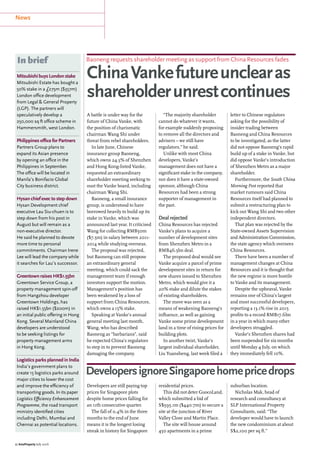
Baoneng requests shareholder meeting as support from China Resources fades
ChinaVankefutureunclearas
shareholderunrestcontinues
DevelopersignoreSingaporehomepricedrops
In brief
A battle is under way for the
future of China Vanke, with
the position of charismatic
chairman Wang Shi under
threat from rebel shareholders.
In late June, Chinese
insurance group Baoneng,
which owns 24.5% of Shenzhen
and Hong Kong-listed Vanke,
requested an extraordinary
shareholder meeting seeking to
oust the Vanke board, including
chairman Wang Shi.
Baoneng, a small insurance
group, is understood to have
borrowed heavily to build up its
stake in Vanke, which was
announced last year. It criticised
Wang for collecting RMB50m
($7.5m) in salary between 2011-
2014 while studying overseas.
The proposal was rejected,
but Baoneng can still propose
an extraordinary general
meeting, which could sack the
management team if enough
investors support the motion.
Management’s position has
been weakened by a loss of
support from China Resources,
which owns a 15% stake.
Speaking at Vanke’s annual
general meeting last month,
Wang, who has described
Baoneng as “barbarians”, said
he expected China’s regulators
to step in to prevent Baoneng
damaging the company.
“The majority shareholder
cannot do whatever it wants,
for example suddenly proposing
to remove all the directors and
advisers – we still have
regulators,” he said.
Unlike with most China
developers, Vanke’s
management does not have a
significant stake in the company,
nor does it have a state-owned
sponsor, although China
Resources had been a strong
supporter of management in
the past.
Deal rejected
China Resources has rejected
Vanke’s plans to acquire a
number of development sites
from Shenzhen Metro in a
RMB46.5bn deal.
The proposed deal would see
Vanke acquire a parcel of prime
development sites in return for
new shares issued to Shenzhen
Metro, which would give it a
20% stake and dilute the stakes
of existing shareholders.
The move was seen as a
means of weakening Baoneng’s
influence, as well as gaining
Vanke some prime development
land in a time of rising prices for
building plots.
In another twist, Vanke’s
largest individual shareholder,
Liu Yuansheng, last week filed a
letter to Chinese regulators
asking for the possibility of
insider trading between
Baoneng and China Resources
to be investigated, as the latter
did not oppose Baoneng’s rapid
build up of a stake in Vanke, but
did oppose Vanke’s introduction
of Shenzhen Metro as a major
shareholder.
Furthermore, the South China
Morning Post reported that
market rumours said China
Resources itself had planned to
submit a restructuring plan to
kick out Wang Shi and two other
independent directors.
That plan was rejected by the
State-owned Assets Supervision
and Administration Commission,
the state agency which oversees
China Resources.
There have been a number of
management changes at China
Resources and it is thought that
the new regime is more hostile
to Vanke and its management.
Despite the upheaval, Vanke
remains one of China’s largest
and most successful developers,
reporting a 13.1% rise in 2015
profits to a record RMB17.6bn
in a year in which many other
developers struggled.
Vanke’s Shenzhen shares had
been suspended for six months
until Monday 4 July, on which
they immediately fell 10%.
Developers are still paying top
prices for Singapore plots
despite home prices falling for
an 11th consecutive quarter.
The fall of 0.4% in the three
months to the end of June
means it is the longest losing
streak in history for Singapore
residential prices.
This did not deter GuocoLand,
which submitted a bid of
S$595.1m ($440.7m) to secure a
site at the junction of River
Valley Close and Martin Place.
The site will house around
450 apartments in a prime
suburban location.
Nicholas Mak, head of
research and consultancy at
SLP International Property
Consultants, said: “The
developer would have to launch
the new condominium at about
S$2,100 per sq ft.”
News
July 2016 AsiaProperty | 3
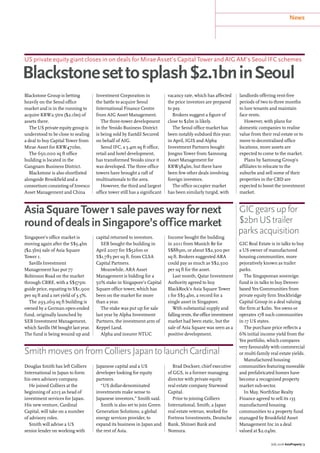
US private equity giant closes in on deals for Mirae Asset’s Capital Tower and AIG AM’s Seoul IFC schemes
Blackstonesettosplash$2.1bninSeoul
AsiaSquareTower1salepaveswayfornext
roundofdealsinSingapore’sofficemarket
SmithmovesonfromColliersJapantolaunchCardinal
GICgearsupfor
$2bnUStrailer
parksacquisition
Blackstone Group is betting
heavily on the Seoul office
market and is in the running to
acquire KRW2.5trn ($2.1bn) of
assets there.
The US private equity group is
understood to be close to sealing
a deal to buy Capital Tower from
Mirae Asset for KRW470bn.
The 650,000 sq ft office
building is located in the
Gangnam Business District.
Blackstone is also shortlisted
alongside Brookfield and a
consortium consisting of Invesco
Asset Management and China
Investment Corporation in
the battle to acquire Seoul
International Finance Centre
from AIG Asset Management.
The three-tower development
in the Yeoido Business District
is being sold by Eastdil Secured
on behalf of AIG.
Seoul IFC, a 5.4m sq ft office,
retail and hotel development,
has transformed Yeoido since it
was developed. The three office
towers have brought a raft of
multinationals to the area.
However, the third and largest
office tower still has a significant
vacancy rate, which has affected
the price investors are prepared
to pay.
Brokers suggest a figure of
close to $2bn is likely.
The Seoul office market has
been notably subdued this year;
in April, IGIS and Alpha
Investment Partners bought
Jongno Tower from Samsung
Asset Management for
KRW384bn, but there have
been few other deals involving
foreign investors.
The office occupier market
has been similarly turgid, with
landlords offering rent-free
periods of two to three months
to lure tenants and maintain
face rents.
However, with plans for
domestic companies to realise
value from their real estate or to
move to decentralised office
locations, more assets are
expected to come to the market.
Plans by Samsung Group’s
affiliates to relocate to the
suburbs and sell some of their
properties in the CBD are
expected to boost the investment
market.
Singapore’s office market is
moving again after the S$3.4bn
($2.5bn) sale of Asia Square
Tower 1.
Savills Investment
Management has put 77
Robinson Road on the market
through CBRE, with a S$575m
guide price, equating to S$1,900
per sq ft and a net yield of 3.5%.
The 293,269 sq ft building is
owned by a German open-ended
fund, originally launched by
SEB Investment Management,
which Savills IM bought last year.
The fund is being wound up and
capital returned to investors.
SEB bought the building in
April 2007 for S$526m or
S$1,783 per sq ft, from CLSA
Capital Partners.
Meanwhile, ARA Asset
Management is bidding for a
50% stake in Singapore’s Capital
Square office tower, which has
been on the market for more
than a year.
The stake was put up for sale
last year by Alpha Investment
Partners, the investment arm of
Keppel Land.
Alpha and insurer NTUC
Income bought the building
in 2011 from Munich Re for
S$889m, or about S$2,300 per
sq ft. Brokers suggested ARA
could pay as much as S$2,500
per sq ft for the asset.
Last month, Qatar Investment
Authority agreed to buy
BlackRock’s Asia Square Tower
1 for S$3.4bn, a record for a
single asset in Singapore.
With substantial supply and
fallingrents,theofficeinvestment
market had been static, but the
sale of Asia Square was seen as a
positive development.
GIC Real Estate is in talks to buy
a US owner of manufactured
housing communities, more
pejoratively known as trailer
parks.
The Singaporean sovereign
fund is in talks to buy Denver-
based Yes Communities from
private equity firm Stockbridge
Capital Group in a deal valuing
the firm at $2bn. Yes owns or
operates 178 such communities
in 17 US states.
The purchase price reflects a
6% initial income yield from the
Yes portfolio, which compares
very favourably with commercial
or multi-family real estate yields.
Manufactured housing
communities featuring moveable
and prefabricated homes have
become a recognised property
market sub-sector.
In May, NorthStar Realty
Finance agreed to sell its 135
manufactured housing
communities to a property fund
managed by Brookfield Asset
Management Inc in a deal
valued at $2.04bn.
Douglas Smith has left Colliers
International in Japan to form
his own advisory company.
He joined Colliers at the
beginning of 2015 as head of
investment services for Japan.
His new venture, Cardinal
Capital, will take on a number
of advisory roles.
Smith will advise a US
senior lender on working with
Japanese capital and a US
developer looking for equity
partners.
“US dollar-denominated
investments make sense to
Japanese investors,” Smith said.
Smith is also set to join Green
Generation Solutions, a global
energy services provider, to
expand its business in Japan and
the rest of Asia.
Brad Dockser, chief executive
of GGS, is a former managing
director with private equity
real estate company Starwood
Capital.
Prior to joining Colliers
International, Smith, a Japan
real estate veteran, worked for
Fortress Investments, Deutsche
Bank, Shinsei Bank and
Nomura.
4 | AsiaProperty July 2016
News
AscendastobuyOne@Changi
Ascendas Real Estate
Investment Trust said it will
buy One@Changi business
park in Singapore for S$420m
($311m). The REIT will acquire
the property from a joint
venture between Ascendas
Development and Frasers
Centrepoint. One@Changi City
is a nine-storey, multi-tenanted
business park property, which
is 97.1% occupied.
Kougellis heads Savills Victoria
Savills has appointed Jason
Kougellis as managing director
of Savills Victoria. Kougellis
spent 15 years at GE Capital
Real Estate, where he was
managing director, Australia,
New Zealand and South East
Asia. He has also previously
worked for Fosun International,
Paladin Funds Management,
GIO Asset Management and
in CBA’s property valuation
services division.
Propertylink promotes Dawes
Australian investment manager
Propertylink has promoted
chief operating officer Stuart
Dawes to chief executive, with
founder Stephen Day shifting
to become vice-chairman of the
group. It is planning a A$900m
($672m) listing on the
Australian Securities Exchange
later this year.
The Center top floor gets $64m
Cheung Kong Property has
sold the top floor at The Center
in Hong Kong to a Chinese
company for HK$500m
($64m) or HK$37,800 per
sq ft. Analysts at DBS said,
assuming an average value of
HK$30,000 per sq ft for the
floors still held by Cheung
Kong, it could net HK$36bn
from selling the remaining
1.2m sq ft of office space in
the strata-titled building.
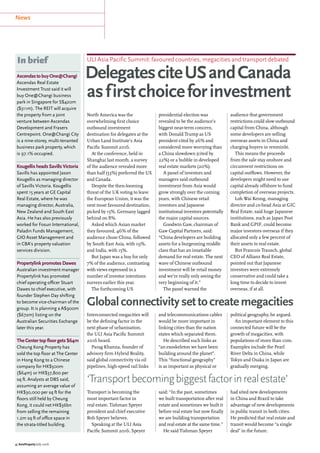
ULI Asia Pacific Summit: favoured countries, megacities and transport debated
DelegatesciteUSandCanada
asfirstchoiceforinvestment
Globalconnectivitysettocreatemegacities
In brief
North America was the
overwhelming first choice
outbound investment
destination for delegates at the
Urban Land Institute’s Asia
Pacific Summit 2016.
At the conference, held in
Shanghai last month, a survey
of the audience revealed more
than half (53%) preferred the US
and Canada.
Despite the then-looming
threat of the UK voting to leave
the European Union, it was the
next most favoured destination,
picked by 15%. Germany lagged
behind on 8%.
Asked which Asian market
they favoured, 46% of the
audience chose China, followed
by South East Asia, with 19%,
and India, with 15%.
But Japan was a buy for only
7% of the audience, contrasting
with views expressed in a
number of investor intentions
surveys earlier this year.
The forthcoming US
presidential election was
revealed to be the audience’s
biggest near-term concern,
with Donald Trump as US
president cited by 26% and
considered more worrying than
a China slowdown (cited by
22%) or a bubble in developed
real estate markets (20%).
A panel of investors and
managers said outbound
investment from Asia would
grow strongly over the coming
years, with Chinese retail
investors and Japanese
institutional investors potentially
the major capital sources.
Goodwin Gaw, chairman of
Gaw Capital Partners, said:
“China developers are building
assets for a burgeoning middle
class that has an insatiable
demand for real estate. The next
wave of Chinese outbound
investment will be retail money
and we’re really only seeing the
very beginning of it.”
The panel warned the
audience that government
restrictions could slow outbound
capital from China, although
some developers are selling
overseas assets in China and
charging buyers in renminbi.
This means the proceeds
from the sale stay onshore and
circumvent restrictions on
capital outflows. However, the
developers might need to use
capital already offshore to fund
completion of overseas projects.
Loh Wai Keong, managing
director and co-head Asia at GIC
Real Estate, said huge Japanese
institutions, such as Japan Post
Bank and GPIF, could become
major investors overseas if they
allocated only a few percent of
their assets to real estate.
But Francois Trausch, global
CEO of Allianz Real Estate,
pointed out that Japanese
investors were extremely
conservative and could take a
long time to decide to invest
overseas, if at all.
Interconnected megacities will
be the defining factor in the
next phase of urbanisation,
the ULI Asia Pacific Summit
2016 heard.
Parag Khanna, founder of
advisory firm Hybrid Reality,
said global connectivity via oil
pipelines, high-speed rail links
and telecommunications cables
would be more important in
linking cities than the nation
states which separated them.
He described such links as
“an exoskeleton we have been
building around the planet”.
This “functional geography”
is as important as physical or
political geography, he argued.
An important element to this
connected future will be the
growth of megacities, with
populations of more than 10m.
Examples include the Pearl
River Delta in China, while
Tokyo and Osaka in Japan are
gradually merging.
Transport is becoming the
most important factor in
real estate, Tishman Speyer
president and chief executive
Rob Speyer believes.
Speaking at the ULI Asia
Pacific Summit 2016, Speyer
said: “In the past, sometimes
we built transportation after real
estate and sometimes we built it
before real estate but now finally
we are building transportation
and real estate at the same time.”
He said Tishman Speyer
had sited new developments
in China and Brazil to take
advantage of new developments
in public transit in both cities.
He predicted that real estate and
transit would become “a single
deal” in the future.
‘Transportbecomingbiggestfactorinrealestate’
News
July 2016 AsiaProperty | 5
Former Prudential Asia Pacific chief is asset manager’s latest senior appointment
SharpetoheadAsiaPacific
divisionforDeutscheAM
Deutsche Asset Management
has appointed Victoria Sharpe to
run its Asia Pacific real estate
business.
The former Prudential Real
Estate Investors Asia Pacific
CEO has joined DeAm in
Singapore as managing director
and head of real estate Asia
Pacific. She will report to head
of alternatives Pierre Cherki.
A 30-year real estate veteran,
Sharpe was most recently head
of the global client capital group
at TH Real Estate, based in New
York.
Prior to this role she was
based in Singapore with PREI.
DeAm, the asset management
COFCO Property Investment
Co has paid a premium of 235%
for a residential plot of land in
Shanghai’s Pudong New Area.
The real estate arm of state-
owned China National Cereals,
Oils and Foodstuffs Corp beat
more than 20 rivals when it paid
RMB2.44bn ($370m) for the
56,886m2
site in Xinchang.
COFCO’s bid was equivalent
to about RMB35,744 per m2
of
gross floor area. On 1 June,
Cinda Real Estate Co paid the
city’s highest premium this year
– 303% – for a housing plot in
Gucun in Baoshan.
“Tight supply of parcels
should be the major reason
behind the city’s overheated
land market,” Zhang Hongwei,
director of research at Tospur, a
Shanghai-based real estate
consultancy service firm, told
local media. “As housing
demand is expected to remain
robust in the next three to five
years, developers’ appetite for
residential plots will continue to
be strong.”
Other investors said China’s
state-owned developers were
keen to grow their businesses,
even at low margins, to have a
stronger position in an expected
wave of consolidation.
Queensland Investment
Corporation is set to sell its stake
in a UK shopping mall for more
than £400m ($518m).
The Australian fund is in talks
with UK real estate investment
trust Intu to sell a 50% stake in
Merry Hill shopping centre near
Birmingham for around £410m.
Intu already owns the other 50%
of the mall.
QIC bought its 50% interest
from Westfield for £524m in
2007 and appointed CBRE last
year to sell its stake. Merry Hill
is located 10 miles west of
Birmingham and has more than
1.6m sq ft of retail space.
Intu, previously known as
Capital Shopping Centres, has a
£4.2bn portfolio of British malls.
Greenland Group and Amare
Investment Management Group
have added to the pipeline of
hotels for their forthcoming
Singapore REIT in an effort to
attract investors.
The partners have added
Greenland’s Chinese five-star
Primus Hotel on Pitt Street,
Sydney, and its Metropolis
project under construction in
Los Angeles, to a list of 19 hotels
which could be acquired by the
REIT.
However, the REIT will
launch with the acquisition of
six hotels in China valued at
$1.3bn-$1.5bn.
Market rumours suggest
investors have not been keen
on a China-only portfolio and
the overseas properties are
intended as a sweetener.
Amare chief executive Alvin
Cheng said the six hotels slated
for the REIT launch were all
profitable and had average
occupancy of 70%. They include
properties managed by groups
such as Marriott International,
InterContinental Hotels Group
and Starwood Hotels and
Resorts Worldwide.
PAG has announced a further
closing for its pan-Asian real
estate fund, which has now
raised a total of $1.3bn in capital
commitments.
Hong Kong-based PAG said
PAG Real Estate Partners Fund
(PREP), had targeted a $1bn
closing, but exceeded fund-
raising expectations thanks
to support from investors
including Allianz and PGGM.
“We enjoy strong ongoing
support from our investors,”
said Broderick Storie, partner at
PAG. “Our focus remains to
ensure we continue to drive
and maximise investment
performance and maintain best-
in-class fiduciary standards.”
PREP aims to generate
income-driven returns from
core-plus assets in nine gateway
cities in Japan, China, Australia,
South Korea and Hong Kong.
The fund is already nearly 50%
invested.
GreenlandandAmareaddhotelstonewREIT
COFCOpays235%premiumforShanghailand
QICtosell50%
MerryHillstake
PAG’sfundraising
continuesafter
hitting$1bntarget
arm of Deutsche Bank, has also
promoted Rahul Ghai to head of
transactions, Asia Pacific, after
fulfilling a similar role for South
East Asia.
The German investment
manager has made a number of
senior appointments in the past
two years, including Christopher
Kimm, who joined as head of
real estate, Korea, from Orion
Partners, first reported in
AsiaProperty in April, and
Koichiro Maeda, who joined
from PREI as head of real estate,
Japan, in 2000.
The senior team also includes
Koichiro Obu, head of alternatives
research, Asia Pacific; and Ronet
Vanatta, chief operating officer,
alternatives, Asia Pacific.
The investment manager is
one of a number of Asian
managers in the process of
raising a pan-Asian core fund.
DeAm’s Asia Pacific real
estate business had $2.6bn in
assets under management as of
March 2016, out of a worldwide
total of $54bn.
Sharpe:
heading to
Singapore
to lead Asia
Pacific real
estate arm
for DeAm
World News
6 | AsiaProperty July 2016
SocGen is in frame to buy Hotel particulier de Suez,
as Singapore fund continues to sell Parisian assets
GICpoisedtomake
twinofficecomplex
nextParisdisposal
Singapore’s sovereign wealth
fund is in talks with Société
Générale’s insurance business
to sell Hôtel particulier de Suez,
which consists of two adjacent
properties on Rue d’Astorg, for
€503m ($559m).
The 215,000 sq ft complex
houses law firm Clifford
Chance’s French headquarters.
GIC is also in the process of
seeking buyers for the Westin
Paris hotel, which could fetch
more than €600m.
The sovereign investor has
been selling assets in Paris in
recent years.
Last year, as part of a
consortium with APG and Host
Hotels and Resorts, it sold a
$470m portfolio of hotels,
including a Paris asset, to a joint
venture between Benson Elliot,
Walton Street Capital and
Algonquin.
Investors’ interest in Paris has
been growing. Last year a total of
€18.8bn of commercial property
was sold in the city, up 7% from
2014 and making it the busiest
year since 2007, according to
JLL research.
Investment sales figures for
the first quarter of this year were
weaker than in the same period
last year, but JLL said it expected
total sales volumes this year to
be €15bn-18bn.
JLL said: “The Parisian
investment market still depends
heavily on the level of product
available on the market.
“At this time, there is a good
level of renewal of investment
opportunities in the major
transactions segment, whereas
we are seeing fewer products
in the intermediate segment
[€50m-100m].”
The broker expects office
rents to be fairly flat across
Paris’s major districts this year.
China’sAnbangInsuranceconsidersluxuryapartments
planfortrophyWaldorfAstoriaHotelinNewYorkCity
Chinese insurance company
Anbang Insurance is planning
to convert much of the Waldorf
Astoria Hotel in New York to
luxury apartments.
The company may be
planning to convert as many as
1,000 of the 1,400 hotel rooms
in the iconic Manhattan hotel to
luxury apartments, local media
reported.
Anbang bought the hotel
from Blackstone in early 2015
for $1.95bn.
The acquisition was the first
major real estate transaction for
Anbang.
The insurance company filed
papers reserving 70% of the
hotel’s space for residential use
last year.
However, a spokesman for
Anbang said the filing was a part
of the purchase process and the
large scale conversion wasn’t a
certainty.
“We continue to explore all
options and no definitive plans
have been finalised at this time.”
For Anbang to convert the
majority of the hotel into condos
it would have to file plans with
the state attorney general’s
office.
Last year New York City
Council banned hotels with
more than 150 rooms from
converting more than 20% of
their space to residential use.
However, some deals, such as
the Waldorf acquisition, were
granted exemption.
Britain’s departure from the
European Union will be positive
for US real estate, analysts claim.
A CBRE research report said:
“During the short term, US
gateway markets are likely to be
viewed with enhanced status as
havens for global capital, but
heightened uncertainty will
carry risks for both investor
sentiment and the real economy.
“Uncertainty surrounding the
timescale and mechanics of
Brexit will encourage investors,
particularly Asian high-net-
worth buyers, to plump for New
York over London.”
Edward Mermelstein, a lawyer
advising Asian investors, said:
“In the very high end of the
market in New York City we’re
seeing a spill off from individuals
and companies who were
previously looking to move to
London as a change of residence.
Many have reconsidered over
the past several months.”
David Scherer, principal of
Origin Investments, said:
“There is now going to be more
pressure on people to enter the
US. We’re just not as risky as
other economies.”
See Analysis, p8
Hong Kong tycoon William
Cheng has bought a London
hotel for £70.3m ($94.8m).
A group of three companies
controlled by Cheng announced
the acquisition of the Travelodge
Royal Scot Hotel a few days
after the UK voted to leave the
European Union.
The property, in King’s Cross,
has 408 rooms.
Cheng already owns hotels
with more than 2,300 rooms
in Hong Kong and Shanghai,
including three Best Western
and two Ramada hotels in Hong
Kong.
Cheng said the transaction
allowed him “to expand
and diversify into property
investment in the UK, which is
one of the world’s biggest tourist
destinations”.
He also said the acquisition,
which was financed from his
companies’ balance sheets,
could be potentially expanded
or refurbished.
Brokers suggested Cheng
will already have benefitted
from a fall of around 10% in the
value of Sterling in the run-up
to Britain’s referendum on UK
membership.
UK’sEuropean
exitoffersboost
toUSmarkets...
London’s Royal
Scot is Cheng’s
latest hotel buy
Malaysian developer SP Setia
said the UK’s vote to leave the
European Union would be
no more than an “accounting
effect” for its Battersea Power
Station project in London.
SP Setia, which is developing
the 39-acre site with Employees
Provident Fund and the Sime
Darby Group, told Bursa
Malaysia that the joint venture
partners had sold around 85%
of the 1,661 units launched for
Battersea in three phases so far.
...butnothreatto
Batterseaproject
CBRE knows Singapore. Through our industry leading perspectives, scale and local
connectivity, we deliver outcomes that drive business and bottom-line performance
for every client we serve in Singapore. How can we help transform your real estate
into real advantage?
LOCAL
ADVANTAGE.
www.cbre.com/BuildOnAdvantage
Build on
Advantage
Analysis
Roundtable: Brexit
Analysis
Roundtable: Brexit
July 2016 AsiaProperty | 98 | AsiaProperty July 2016
Opportunistsset
toenterviaBrexit
While caution following the UK’s vote to quit the EU is likely to put the
market on hold, in the longer term, Asian and dollar-based players
stand to cash in on a fall in values, our panel of investors concurred
The UK leaving the European Union will
create big investment opportunities in London
and Europe for Asian and dollar-based
investors – but only after an adjustment period
during which vendors face up to a new reality.
That was one of several conclusions drawn
by a group of senior global and European
real estate investors at a round table event
hosted by AsiaProperty less than a week after
the UK voted in a referendum to leave the EU.
The event, in partnership with Colliers
International, brought together value-added
and opportunistic investors and examined
the opportunities created by “Brexit”, as well
as the threats, both explicit and subtle.
Government bond yields have hit record
lows, real estate share prices have tumbled
and property values face a sharp correction of
4.9% on average next year and up to 14.5%
in the London office market, if UK research
house Real Estate Strategies is correct.
UK investment volumes fell significantly
in Q1 and Q2 2016, after record years in 2014
and 2015. Momentum slowed in the second
half of last year, carrying on into 2016 and
further affected by the referendum.
Sterling has depreciated by around 10%
against most global currencies since the vote,
providing an immediate discount to pricing
for international buyers, regardless of yield.
AsiaProperty spoke to several Asian
investors active in the UK and London. None
would comment publicly, but most expressed
caution and said they would wait to see what
happened in the coming months before they
made UK and European investment decisions.
But private investors are expected to be less
cautious and may see a buying opportunity.
The roundtable participants agreed that
for investors with a long-term view, assets
bought during the likely upcoming period of
volatility should represent significant value,
even in London, which will be hit hard by
the decision in the short term.
The problem with the execution of this
strategy will be that vendors will need longer
to adjust to the new reality, even if the market’s
psychology is already being altered.
Open-ended fund manages are likely to be
the first sellers out of the blocks. Six of these
funds, with combined assets of £12bn
($15.5bn), have now closed their doors to
investors looking to pull out cash.
The panel felt these funds would be a good
source of sales, but not in the short term –
the process of selling assets to raise liquidity
can take months. And as the past fortnight
has shown, when investors pull money out,
they do so quickly and in large volumes.
A boost for Germany, Paris and Dublin
Germany, Paris and Dublin are likely to
benefit most directly from the UK’s decision
and with less money chasing riskier assets,
opportunities to find value outside of safe
havens will increase for the best investors.
The flip side is the fact that it is now
virtually impossible to say what constitutes
a safe haven, while liquidity in the debt
markets is likely to be severely affected.
In terms of Asian investors’ attitude to the
vote, there was a feeling that views were
mixed, with plenty of caution, but London
and Europe by no means off the agenda.
Richard Divall, Colliers International’s
head of cross-border capital markets, EMEA
said: “In the UK, we are seeing an immediate
pause in the market. But we are receiving
many enquiries to look at opportunities and
even new entrants who perhaps felt priced out
of the market are now investigating the UK.
“There is continued interest in core
Western European markets, although many
APAC and North American investors are
pausing until there is more certainty about
the political situation and whether there
could be a second referendum.
“On our listings and particularly in
Germany, there is evidence of encouraging
demand from global investors wanting to
continue to diversify portfolios and invest out
of domestic markets. Long secure income still
appeals to investors in the current volatility.”
Richard Choi, HSBC’s head of real estate
and hospitality, EMEA and Americas, added:
“We’ve had some overseas clients cancelling
meetings saying they want to pause until
there is more clarity, but some are seeing
this as a moment to be opportunistic.”
There was a consensus that the uncertainty
caused by Brexit could be positive for dollar-
denominated investors, with sterling assets
cheaper as the pound fell against the dollar.
“We see this as a potential opportunity for
our business,” said Brian Niles, European
head of Morgan Stanley Real Estate Investing.
“In the US, it is harder to make opportunistic
returns relative to Europe because of where
that market is in the cycle and there is
concern about some Asian economies,
given some of the uncertainty in China.
“While pricing in certain European
markets had made it more difficult to make
opportunistic returns, we think this should
take a bit of froth off the market and create
more opportunities.”
Laurent Luccioni, PIMCO’s head of
European commercial real estate, provided
a counterpoint. “It will still be very hard to
generate opportunistic returns in Europe,”
he said. “Banks are well capitalised so this
won’t create more distressed sales, but it will
push up debt costs, so you won’t get that
momentum from debt becoming cheaper
and more freely available. It will postpone
growth, which you need to make good returns
once distress is gone from the market.”
Any opportunities that arise as a result of
dislocation from the Brexit vote will not be
immediate. “As a rule buyers can quickly
figure at what level they are willing to buy an
asset, but it often takes sellers a lot longer to
arrive at that point,” said Cameron Spry, head
of investment at Tristan Capital Partners,
while Noel Manns, founder and principal at
Europa Capital added: “People are not as
leveraged as they were last time around.”
Niles added: “The only people who would
choose to sell during this period of
uncertainty in the UK are those with a very
negative view of the consequences, who
want to get ahead of the curve. But I don’t
see many people thinking that way today.”
Sellers become more realistic
But while sellers are unlikely to accept for
some time that the market has fallen or will
fall, there is a growing acceptance that the
market will no longer rise. “What changes is
the psychology,” said Zsolt Kohalmi, Starwood
Capital partner and head of European
acquisitions. “Before, people were holding
on for a better price, knowing that things
were going up; now, we are unlikely to see
that, with people becoming more realistic.”
Pete Reilly, head of European real estate at
JP Morgan Asset Management, said: “The
possible outcomes are so wide ranging – it
could be completely benign or cataclysmic.
That makes it hard to navigate, so investors
will turn away from risk and go back to buying
“We’ve had some overseas
clients cancelling meetings
saying they want to pause until
there is more clarity, but some
are seeing this as a moment to
be opportunistic”
Richard Choi, HSBC
“In the UK, we are seeing an
immediate pause in the market.
But we are receiving enquiries to
look at opportunities and even
new entrants who perhaps felt
priced out of the market are now
investigating the UK”
Richard Divall, Colliers
“While pricing in certain
European markets had made
it more difficult to make
opportunistic returns, we think
this should take a bit of froth
off the market and create more
opportunities”
Brian Niles, Morgan Stanley
Real Estate Investing
“Before, people were holding
on for a better price, knowing
that things were going up; now,
we are unlikely to see that, with
people becoming more realistic’”
Zsolt Kohalmi, Starwood Capital
“” “buyers can
quickly figure at
what level they are
willing to buy an
asset,butitoften
takes sellers a lot
longer to arrive at
that point”
Cameron Spry, Tristan
Capital Partners
“many apac and
north american
investors are
pausing until
there is more
certainty about
the political
situation”
Richard Divall,
Colliers International
brexitleavesUKin
unchartedwaters
On June 23, the UK held a referendum on
whether it should remain a member of the
European Union or leave; by a margin of 52%
to 48%, the vote was to leave.
At the time of going to press, nothing had
changed; the UK remained a member of the
EU and the UK government had not declared
under Article 50 of the Lisbon Treaty that it
intends to formally leave the EU.
There are legal arguments about whether
formal notice to leave the EU requires the
British parliament, members of which were
overwhelmingly in favour of the status quo,
to vote through a bill to quit. However,
government lawyers have said this is not
required.
Prime minister David Cameron has
resigned and a leadership election is taking
place among the ruling Conservative Party.
The next prime minister will be expected to
formally give notice of the UK’s intent to
leave the EU, which will trigger a two-year
process of negotiation.
It remains to be seen whether the UK will
retain full access to the EU ‘single market’.
Some EU governments, such as Germany,
have appeared conciliatory and wish to retain
good relations with the UK, especially over
matters such as defence.
Other nations, such as France and
Belgium, seem keen to strike a tough deal.
French politicians have declared an intent
to woo international financial services
businesses from London to Paris.
Stock markets worldwide fell on the news
but most have recovered some if not all of
the early losses. However, Sterling remains
weak against the major world currencies and
the euro has fallen against the dollar.
A number of UK open-ended real estate
funds catering to retail investors have been
forced to close to redemptions, due to demand
from investors seeking to withdraw capital.
Brokers report that a number of real estate
deals have been abandoned or put on hold.
Analysis
Roundtable: Brexit
10 | AsiaProperty July 2016
there is an election there next year. I could
buy a core building in Madrid, but you have
elections there and the government changes.
You have to spend a lot of time figuring out
what you think about the macro situation.”
Benson Elliot senior partner Joeseph de
Leo added: “The question of how you play
Germany is a really difficult one if more
capital is going to flow there, given how high
prices are already. Across Europe the question
becomes, if Brexit affects the outlook for
growth, the challenge will be to keep buildings
occupied and how long will it take to let vacant
space in the assets they’ve bought? It could
trigger sales by geared players down the line.”
Many of the panellists felt that increased
uncertainty would lead to reduced debt
availability for investors. Choi said: “There
will be less appetite for high LTV ratios,
margins will be higher and anything with a
development angle will be in the spotlight.
That said, we’re still open for business.”
However, Lee pointed out: “For alternative
lenders there will be opportunities. We had
already seen a pullback from lenders in the
past few months. For a business like ours,
we may have somewhat higher-cost capital,
but we are in the market, have appetite for
higher LTV ratios and are able to execute.
Some investors are already putting us ahead
of banks in their list of preferred lenders for
more challenging situations.”
Manns added: “We recently had a meeting
with our mezzanine fund investors and there
is a lot of interest in credit/debt strategies.”
However, Zac Vaughan, senior vice-
president at Brookfield Property, said credit
was still available for the best sponsors, even
for London office projects. “We are finalising
a financing for a major London office property,
which has not slowed down despite the vote,
so the idea that there is no liquidity in the
banking market doesn’t seem to be the case.”
Spry summed up the panel’s attitude, and
a good mantra for all investors in uncertain
times: “Everyone should be trying to separate
the cyclical effects from the structural.”
Those who can do that are likely to profit
handsomely in the next few years.
“The possible outcomes are
so wide ranging – it could
be completely benign or
cataclysmic. That makes it hard
to navigate, so investors will turn
away from risk and go back into
buying super-core assets”
Peter Reilly, JP Morgan AM
“Across Europe the question
becomes, if Brexit affects the
outlook for growth, the challenge
will be to keep buildings
occupied and how long will it
take to let vacant space in the
assets they’ve bought? It could
trigger sales by geared players
down the line”
Joeseph de Leo, Benson Elliot
“We are finalising a financing for
a major London office property
which has not slowed down
despite the vote, so the idea
that there is no liquidity in the
banking market doesn’t seem to
be the case”
Zac Vaughan, Brookfield Property
“”
Event sponsored by:
“we recently had
a meeting with
investors in our
mezzanine fund
and there is a
lot of interest
in credit/debt
strategies”
Noel Manns,
Europa Capital
super-core assets. For opportunity funds,
that’s good, as there will be less capital
chasing the more risky assets we typically buy.”
The debate turned to whether London is
still a safe haven and the impact on the city
of the Brexit vote. “I think London will still
be a safe haven for investors because of the
potential repricing,” said Wilson Lee,
founding partner at Cale Street Partners.
“If you’re looking to invest for 10 or 15 years,
then prime yields in London moving from
3.5% to 5% make it very attractive.”
Reilly added: “I think London offices had
already repriced by 10% before Brexit. If it
goes down another 10%, combined with the
currency decline, you would be able to find
10 buyers for a good-quality asset. If it stays at
the level it is at now, there are still buyers. The
trouble is, at the moment, nothing is for sale.”
In terms of the impact on both values and
occupancy levels, Choi said: “The listed
markets are implying that London office
values will fall about 20% – you have to work
out whether that is overdone. On the
occupancy side, negotiations on financial
passporting are crucial, as that will determine
how many jobs are moved from London.”
Office market looks resilient
It was agreed that while there would be
short-term pressure on office occupancy
levels, in the longer term it would remain
resilient. “You are already hearing rumours
of spec office development schemes being
mothballed,” said John Ruane, Partner at
Ares Management’s Real Estate Group.
“This comes at a time when you might
expect some drop-off in demand, but the
fundamentals in Greater London remain
strong since there has not been overbuilding
and the supply side, as well as London’s
infrastructure, continue to look good. By
infrastructure I don’t just mean real estate
and transport, but the human capital that is
already settled in this city, which is incredible.”
Tristan Capital Partners’ Spry added: “You
could have a situation [in London] where
when the demand side recovers you are in
an undersupplied market.”
In terms of where will do well out of a
Brexit vote in terms of increased occupier
demand, on top of the obvious choices of
Frankfurt and Paris, Dublin was cited as an
English speaking city within the Eurozone.
But the participants in the event were less
sure about what now represents a safe haven
in the volatile European political climate.
“You have to ask what is safety today,”
Kohalmi said. “Everyone says Germany, but
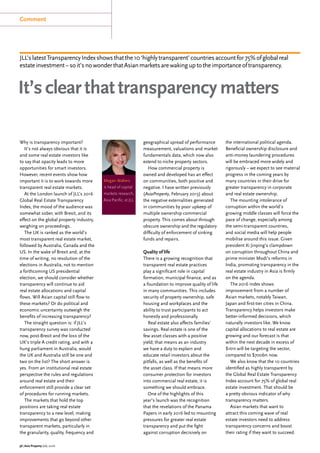
JLL’s Global Real Estate Transparency Index
2016 shows improvements across the board
in Asia Pacific, often driven by the demands
of cross-border investors. This comes at a
time when market information and
transparency are becoming increasingly
important.
The index scores nations on a number of
categories including market fundamentals
such as availability of data, governance of
listed vehicles, performance measurement,
the transaction process and the legal and
regulatory environment.
“There is widening recognition of the
crucial role that a transparent real estate
sector plays, not only as a facilitator of new
investment and business activity but also,
significantly, in community well-being and
inclusiveness,” JLL says. “As capital
allocations to real estate grow, investors are
demanding further improvements in
transparency, even among the world’s most
transparent real estate markets.”
The report also notes that technology is
driving the availability of information.
Databases tracking buildings, investment
transactions, tenants, leases and values
continue to expand, providing more
frequently updated and real-time
information than ever before.
Australia (second behind the UK, the
world’s most transparent market) and
New Zealand (sixth) remain the most
transparent markets in the region and
the only markets in the global “Highly
Transparent” category, which also includes
the US, Canada, Germany and France.
Taiwan (23rd) features in the global top 10
improvers, while several other key markets –
including the top-tier cities in China (33rd)
and India (36th), as well as Japan (19th) and
South Korea (40th) – have seen “moderate
progress”, JLL says.
Taiwan is the region’s biggest improver –
there has been marked progress on market
fundamentals and the transaction process.
“A more competitive landscape has elevated
occupier service offerings, while policy
changes, both new and old, are flowing
July 2016 AsiaProperty | 11
Analysis
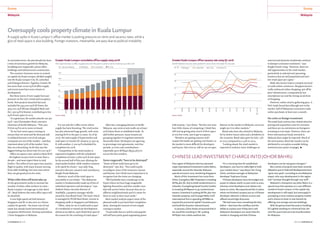
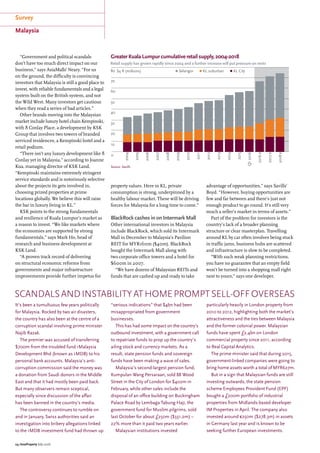
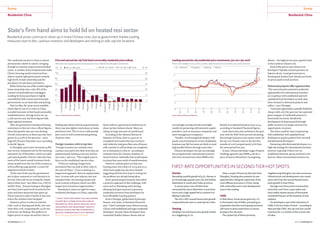
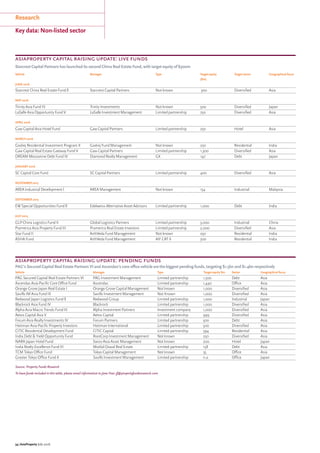
Transparency Index
Cross-border investors drive clear improvements in
the transparency of Asia Pacific real estate markets
As demand for accurate data grows, Asia Pacific is becoming more transparent, with its developed
markets now on a par with similar markets elsewhere, according to JLL’s latest transparency index.
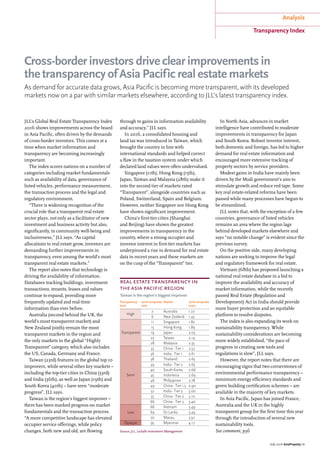
Transparency
level
2016 composite
rank
Market 2016 composite
score
High
2 Australia 1.27
6 New Zealand 1.45
Transparent
11 Singapore 1.82
15 Hong Kong 1.89
19 Japan 2.03
23 Taiwan 2.14
28 Malaysia 2.35
Semi
33 China - Tier 1 2.52
36 India - Tier 1 2.61
38 Thailand 2.65
39 India - Tier 2 2.65
40 South Korea 2.66
45 Indonesia 2.69
46 Philippines 2.78
49 China - Tier 1.5 2.90
52 India - Tier 3 3.00
55 China - Tier 2 3.10
66 China - Tier 3 3.40
Low
68 Vietnam 3.49
69 Sri Lanka 3.49
70 Macau 3.52
Opaque 95 Myanmar 4.17
Source: JLL, LaSalle Investment Management
real estate transparency in
the asia pacific region
Taiwan is the region’s biggest improver
through to gains in information availability
and accuracy,” JLL says.
In 2016, a consolidated housing and
land tax was introduced in Taiwan, which
brought the country in line with
international standards and helped correct
a flaw in the taxation system under which
declared land values were often undervalued.
Singapore (11th), Hong Kong (15th),
Japan, Taiwan and Malaysia (28th) make it
into the second tier of markets rated
“Transparent”, alongside countries such as
Poland, Switzerland, Spain and Belgium.
However, neither Singapore nor Hong Kong
have shown significant improvement.
China’s first-tier cities (Shanghai
and Beijing) have shown the greatest
improvements in transparency in the
country, where a strong occupier and
investor interest in first-tier markets has
underpinned a rise in demand for real estate
data in recent years and these markets are
on the cusp of the “Transparent” tier.
In North Asia, advances in market
intelligence have contributed to moderate
improvements in transparency for Japan
and South Korea. Robust investor interest,
both domestic and foreign, has led to higher
demand for real estate information and
encouraged more extensive tracking of
property sectors by service providers.
Modest gains in India have mainly been
driven by the Modi government’s aim to
stimulate growth and reduce red tape. Some
key real estate-related reforms have been
passed while many processes have begun to
be streamlined.
JLL notes that, with the exception of a few
countries, governance of listed vehicles
remains an area where the region lags
behind developed markets elsewhere and
says “no notable change” is evident since the
previous survey.
On the positive side, many developing
nations are seeking to improve the legal
and regulatory framework for real estate.
Vietnam (68th) has proposed launching a
national real estate database in a bid to
improve the availability and accuracy of
market information, while the recently
passed Real Estate (Regulation and
Development) Act in India should provide
more buyer protection and an equitable
platform to resolve disputes.
The index is also expanding its work on
sustainability transparency. While
sustainability considerations are becoming
more widely established, “the pace of
progress in creating new tools and
regulations is slow”, JLL says.
However, the report notes that there are
encouraging signs that two cornerstones of
environmental performance transparency –
minimum energy efficiency standards and
green building certification schemes – are
available in the majority of key markets.
In Asia Pacific, Japan has joined France,
Australia and the UK in the highly
transparent group for the first time this year
through the introduction of several new
sustainability tools.
See comment, p36
Heitman is a global investment management firm
specializing in real estate. We integrate research
and investment in real time across continents. Our
multidisciplinary teams are informed, in tune, and
committed to your present and future success,
not just as financial experts but as partners.
Discover what makes us different.
50Years
INVESTING DIFFERENTLY
Heitman.com
Comment
July 2016 AsiaProperty | 13
Risks abound after Brexit, but don’t write off UK
What does “Brexit” mean for Asian investors in the UK
and Europe?
London has been perhaps the most favoured
investment destination for Asian capital in the past five
years. For a number of institutions and private investors,
London was the first port of call.
And why not? London is the most transparent real
estate market in the world, one of the largest and most
liquid with a huge number of highly professional
developers, investment managers and advisers. It is also
one of the world’s most dynamic cities, boasting an
incredible range of cultural and business opportunities.
The question is, was all this dependent on the UK’s
membership of the European Union? To argue that was
the case begs the question: if it was all about the EU, why
didn’t investors plump for Paris, a similar-sized city that
has the advantage of being in the euro?
A panel of European real estate experts discussed this
with AsiaProperty recently (see p8-10). They broadly agreed
that Brexit amplifies the risks for investors, but also the
opportunities, which have been sweetened by sterling’s
weakness against the dollar and other major currencies.
We also spoke to a number of Asian investors, none of
whom were prepared to be quoted. However, they were
rather more cautious about the long-term prospects and
seemed determined to do nothing for the time being –
which seems eminently sensible.
In a Preqin survey of more than 90 institutional
investors with exposure to UK real estate, 57% stated
that they were likely to invest less in the UK over the next
12 months, with just 11% expecting to invest more.
At present the UK is awaiting a new prime minister,
has not formally declared it wishes to leave the EU and
negotiations on the terms of withdrawal have not started.
Whether the UK will be damaged as an investment
destination depends on those terms of withdrawal.
Ideally, a sensible arrangement could be made to suit
both the EU and the UK, which is a major trading and
security partner of most EU nations. However, political
decisions are rarely rational or even sensible – the front
runner to be prime minister is refusing to confirm the
right to remain for EU citizens currently living in
Britain, while some EU politicians seem determined to
punish the UK, even if it hurts their own nation.
Finally, it would be unwise to imagine that capital
earmarked for the UK will now go to the EU. With the
exception of Germany and a few smaller nations, most
EU economies are fragile and are being hurt by Brexit
more than the UK. And no EU city offers the scale and
depth of investment and living opportunities as London.
Asian investment is more likely to head to the US,
where gateway cities offer most of London’s advantages,
in many cases higher yields (for now) and the security of
dollar-denominated investments.
Mark Cooper, editor
AsiaProperty Editor: Mark Cooper
+852 9727 0158
mark.cooper@asiapropertypublishing.com
Commercial director: Stefan Didora
+46 854 546 913
Stefan.didora@asiapropertypublishing.com
Contributors: Mike Philips, Helen Roxburgh,
Lauren Parr
Production editor: Phil Petty
Art editor: David Harkness
Printed by: Elegance Financial Printing Services
8/F, 2 Exchange Square
Central
Hong Kong
Tel: +852 2297 2285
Fax +852 2297 2289
Moves
14 | AsiaProperty July 2016
companies & people
Shu in at TH Real Estate in Singapore
TH Real Estate has appointed Shusaku (Shu)
Watanabe as director of capital transactions,
Asia.
Shu joins from JP Morgan Asset
Management’s Singapore office, where he
was fund manager for its Tokyo Recovery
Fund. He will be based in TH Real Estate’s
Singapore office, reporting to Chris Reilly,
managing director, Asia Pacific.
Shu has previously worked for Aviva
Investors, Macquarie Capital Securities and
Morgan Stanley Japan Securities.
Reilly said: “I am delighted to welcome
Shu to our team. We are particularly excited
about leveraging his experience across
Japan, a region that we believe holds strong
investment potential.”
Shu’s arrival follows other recent
appointments including Harry Tan as
head of research, Asia Pacific, and William
Keaveney, senior analyst, based in TH Real
Estate’s Sydney office.
Hawkins takes helm of Logos
Logos Property has appointed Stephen
Hawkins as managing director of Logos
Southeast Asia, based in Singapore.
He was development director at Boustead
Singapore until February this year and was
chief executive of Macquarie Goodman Asia
from 2005 to 2007, after which he was head
of real estate for Guidance Investments.
Logos has bought two logistics facilities in
Singapore and said it will expand in South
East Asia.
Colliers bolsters Hong Kong retail team
Colliers International has recruited four
new staff to its Hong Kong retail team, with
Cynthia Ng joining from CBRE as director,
retail services Hong Kong, reporting to
Sebastian Skiff, who joined Colliers last year
as director of retail development and asset
management.
Colliers also hired Colly Tu from CBRE
China, as well as retail research analyst
Mervin Ling from DTZ Cushman &
Wakefield and Kinson Wong from Savills.
Klebes heads GreenOak’s Japan branch
GreenOak Real Estate has appointed
Daniel Klebes as representative director
and president of its Japanese business,
GreenOak Investment Management.
He joins from GTO Capital Management,
a consulting firm he set up in 2010. He was
also an adviser to TPG Capital. From 2004
to 2010 he was chief investment officer
for Aetos Japan and previously worked for
Goldman Sachs.
Former GreenOak Japan head Fred
Schmidt is now chairman of GreenOak
Investment Management, while also
maintaining a representative director role.
Carrier takes international role at CPPIB
Canada Pension Plan Investment Board has
made a number of senior appointments.
Alain Carrier has been appointed international
head, responsible for CPPIB’s international
investment activities, and will also continue
as head of Europe.
Suyi Kim has been promoted to head of
Asia, having previously run CPPIB’s private
equity investments in the region. He will
be replaced as head of private equity for the
region by Deborah Orida, who has been with
CPPIB since 2009.
Seek takes Asia Pacific chair at ULI
Dr Seek Ngee Huat, chairman of Global
Logistic Properties and former president
of GIC Real Estate, has been named Asia
Pacific chairman for the Urban Land
Institute.
The ULI recently opted to appoint a global
chairman and regional chairmen for the first
time. Seek will serve a two-year term.
Low moves on from Mapletree
Jean Low Su-Im has resigned as chief
financial officer of Mapletree Greater China
Commercial Trust Management with effect
from August 19, to “pursue personal
interests”, the Singapore REIT said.
Lawrence Ng Tzu Ann, a vice president in
the REIT’s finance department, will take over
Low’s duties until a replacement is found.
Edmund Tie & Co buys out C&W
stake to regain independence
Edmund Tie & Co has emerged as an
independent real estate adviser after
management bought out majority
stakeholder Cushman & Wakefield.
The management of DTZ Debenham Tie
Leung (SEA) bought out the majority stake of
over 60% held by Cushman & Wakefield for
an undisclosed sum and relaunched the firm
with its original name.
A total of 500 staff in Singapore, Thailand
and Malaysia will move to the newly
independent firm. Edmund Tie continues to
lead the company as chairman, supported by
chief executive Ong Choon Fah, who also
heads the research and consulting arms.
“The strategic decision to again operate
under the Edmund Tie & Company brand is
motivated by our longstanding commitment
to form a firm driven by a distinctly Asian
business philosophy, yet offering international
standards of expertise,” Tie said.
Tie joined forces with DTZ, then a UK-listed
company, 16 years ago. But DTZ has been
through a number owners in recent years,
culminating in last year’s merger with C&W.
Following the sale, C&W will continue its
Singapore operations under the leadership of
managing director Stephen Saul.
Asia Pacific CEO Stuart Roberts said:
“Singapore is a key market for many of our
core services and remains a critical regional
hub for our Asia Pacific and global business.”
C&W did not reply to a request for details of
Singapore staff numbers following the deal.
Dutt leads Ascendas-Singbridge in India
Ascendas-Singbridge has appointed former
Cushman & Wakefield executive Sanjay Dutt
as its new CEO for India.
Dutt was head of Cushman & Wakefield
India until the merger with DTZ last year.
He will join on August 1, taking over
from Lee Fu Nyap, who is returning to the
company’s Singapore head office to assume
a new role as executive vice-president for
real estate investment and funds.
Comment
DIARY Tokyo expats will use jingle mail
if resi investments don’t deliver
Our survey this month includes
a look at Japanese residential
investment, which offers better
opportunities than you might
think – and even better ones for
the unscrupulous.
Some Tokyo expats have
taken advantage of the very
favourable borrowing
environment to buy high-
yielding apartments in
secondary cities with 100% debt.
This offers a nice ‘free’ cash
return and the expats have a
plan B in the case of problems
reletting or selling properties.
That plan is to have returned
home by then and to send the
bank some “jingle mail”.
Virtual sales techniques get a
reality check at ULI summit
The audience at the ULI Asia
Pacific Summit, held in
Shanghai last month, heard
that virtual reality headsets and
“augmented reality”, where VR
users interact with a physical
space, will be increasingly used
to sell real estate.
A cynic in the audience was
heard to comment: “This just
increases the scope for brokers
and developers to lie to their
customers…”
Great Eagle takes flight of fancy
with its Central attraction in HK
Hong Kong’s Champion REIT
has rebranded its flagship
Citibank Plaza property as
Three Garden Road Central,
as the naming rights to the
building were due to expire
next year.
A release trumpeting the
change says: “We created the
whole identity system around
the actual address of the
building, reinforcing its
location as being firmly
Central.”
Hmm… We feel obliged to
point out that the location is
in fact rather on the Admiralty
side of Central and indeed
wonder if the sponsor of the
development, Great Eagle
Holdings, would have been so
keen to spin the asset off into
a REIT if it is was as central as
it claimed.
“Inthepast,notmany
players inthemarket
couldwrite abig
chequefor$1bn. Now
there are alotmore
pensionfunds,even
privateequityfunds,
whichcanwrite a
multi-billion dollar
cheque”
LohWaiKeong ,co-head
ofAsiaat GICReal Estate,
bemoansincreased
competition
Market talk: ULI
summit special
“Thetimemaybecoming
whentransportation
hasagreatereffect
onrealestatethan
interestrates.Somove
overbanks,herecomes
thebus!”
RobSpeyer, CEOofTishman
Speyer,demonstratesmore
realestateacuitybutperhaps
lesscatchphrasesavvy…
“Look at how Chinese
cities have developed
over the past 30 years
and apply that to
the belt and road
emerging cities”
Vincent Lo, Chairman of
Shui On Land, said China’s
“One Belt, One Road” policy
to encourage development
along old Silk Road trade
routes could create significant
real estate opportunities
“Democracy is India’s
AchillesHeel.In1990
China andIndia were
within5%of each
other in termsof
GDP;nowChina’sGDP
is five timesthat of
India”
GoodwinGaw,chairman
ofGawCapital,blames
democracyforIndia’spoor
performancerelativetoChina
”
July 2016 AsiaProperty | 15
Company profilesCompany profiles
16 | AsiaProperty July 2016 July 2016 AsiaProperty | 17
www.threalestate.com
th real estate
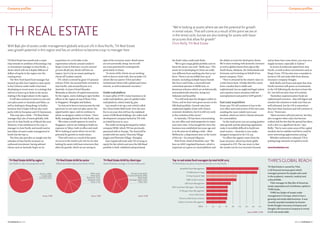
With $96.3bn of assets under management globally and just 2% in Asia Pacific, TH Real Estate
sees growth potential in this region and has an ambition to become a top 10 manager here
TH Real Estate last month took a major
step towards its ambition of becoming a top
10 investment manager in Asia Pacific, a
desire which will see it deploy billions of
dollars of equity in the region over the
coming years.
The New York-based fund manager has
teamed up with Gaw Capital to raise equity
to buy Chinese outlet malls it has been
developing in recent years, in a strategy that
will see it invest up to $2bn in the sector,
making it the largest player in the region.
It will also continue to invest in core and
core-plus assets in Australia and Tokyo, as
well as looking to Hong Kong, to build a
business that it hopes will one day reach
parity with its European and US businesses.
That may take a while – TH Real Estate
manages $96.3bn of assets globally, with
just 2% in Asia Pacific as of March this year.
However, it has ambitions to be a top 10
manager in Asia Pacific and would need at
least $5bn of assets under management to
break into the top 10.
The firm also provides an insight into the
attitudes of Asia Pacific investors on
outbound investment, having advised
clients such as Australia Super on its
THRE’sglobalreach
TH Real Estate is owned by TIAA,
a US financial services giant which
manages pensions for people who work
in the academic, research, medical and
cultural fields.
TIAA manages its $65.6bn of Americas
assets separately and contributes capital to
THRE funds.
THRE has $29bn of assets under
management in Europe, where it has a
growing real estate debt business. It was
recently awarded mandates by Korean
funds Dongbu Insurance Company and
Dongbu Life Insurance Company to invest
in UK real estate debt.
acquisition of a 20% stake in the
regeneration scheme around London’s
King’s Cross in February 2015 for around
£200m ($258.5m). Brexit will have an
impact, but it is by no means putting its
clients off London entirely.
TH, which is owned by giant US pension
scheme TIAA, has around $2bn invested in
Asia Pacific, and around $750m is in
Australia. In June it hired Shusaku
Watanabe as director of capital transactions
for the region, and is looking to open further
offices in the region on top of those it has
in Singapore, Shanghai and Sydney.
“In Asia we’re keen to invest across the risk
spectrum in core and core-plus assets, the
opportunistic space, and we continue to
advise on designer outlets in China,” Chris
Reilly, managing director for Asia Pacific, says.
“We retain a small exposure to retail in
Singapore, and we are looking to build our
exposure to Tokyo, both in office and retail.
We’re looking at assets where we see the
potential for growth in rental values.
“That will come as a result of the point
we are at in the rental cycle, but we are also
looking for assets with lease structures that
allow for growth, which we are seeing in
spite of the economic stasis. Retail assets
are not universally cheap, but we still
see some potential for rental growth,
particularly in Ginza.
“In terms of the clients we are working
with or keen to work with, this includes US
clients like our parent TIAA and other
institutional clients with a global and Asian
interest, as well as domestic investors.”
Outlet mall platform
A major pillar of TH’s Asian business is its
outlet mall platform, part of a global outlet
mall platform, which totals $4.4bn.
Last month it set up a new vehicle called
the China Outlet Mall Fund. Over the next
five to six years this will buy the stabilised
assets of Silk Road Holdings, the outlet mall
development company backed by TH with
an initial $200m in 2012.
The malls are being developed by Italian
company RDM, which TH has previously
partnered with in Europe. The fund will be
seeded with two assets: Florentia Village
Jingjin and Florentia Village, Shanghai
Gaw Capital will work with TH to bring in
equity for the vehicle and once the Silk Road
portfolio is built, stabilised and purchased,
the fund’s value could reach $2bn.
“We’ve got a large global portfolio and we
know the sector very well,” Reilly says. “The
assets we’re developing in China are really
very different from anything else that is out
there. There is an incredible line up of
tenants, including multiple luxury brands
like Gucci and Prada, a successful and
committed operator in RDM Asia, in
dominant schemes which are architecturally
and aesthetically attractive, being very
Italianate and beautiful.
“It is still early days for designer outlets in
China, and we have seen great success in the
Silk Road portfolio. Growth rates have
moderated slightly of late with China’s
economic slowdown, but it is still very early
in the evolution of the sector.”
In Australia, TH has been concentrating
on core office and retail properties in major
east coast cities. It has bought five since the
business was established two years ago and
is in the process of adding a sixth – Myer
Melbourne, a department store in the centre
of the city – for around A$450m.
Nick Evans, head of Australia, says: “We
have an ASIC-regulated business, which is
important as it gives us a local platform and
the ability to invest for third-party clients.
We’ve been working with domestic investors
as well as global clients from places like
South Korea, Malaysia, the Netherlands and
Germany, and investing on behalf of our
parent company, TIAA.
“They’re attracted by the relative value on
a total return basis. It helps that this comes
from a market that is stable and
sophisticated, has an anglicised legal system
and a positive macro situation with low
unemployment and positive GDP growth.”
East coast acquisitions
Evans says TH will continue to buy in the
core office and retail sectors of the east coast,
avoiding the more volatile west coast
markets, which are tied to Chinese demand
for commodities.
“In the retail sector you are seeing positive
sales growth and the planning regulations
make it incredibly difficult to build new
retail centres – Australia is very under-
shopped compared to the US, say.
“In offices the appeal comes from the
lease structure, which has fixed uplifts
compared to CPI. The one worry is that
the market can be very incentive focused,
and as these have come down, you may see a
supply increase, especially in Sydney.”
In terms of outbound capital from Asia
Pacific, as well as direct investments such as
King’s Cross, TH has also won a mandate to
invest in UK real estate debt from Korean
insurance company Dongbu.
Both Reilly and Evans anticipate that Asia-
Pacific investors will pause on investments
in the UK following the decision to leave the
EU, but will not steer clear of it entirely.
“Australian superannuation funds are
sophisticated investors – they will digest and
monitor the situation to make sure they are
well-informed, but the UK is somewhere
they have done business and will continue to
do so,” Evans says.
“Most investors will wait and see, but they
also recognise when value has become
evident and the fact that the pound has taken
such a dive is a significant factor,” says
Reilly. “You’ve seen some areas of the capital
markets start to stabilise and there could be
some interesting opportunities arising.”
Whether outbound or inbound, TH is
putting huge amounts of capital to work.
Pension funds (39%)
Insurance/financial (26%)
Retail (19%)
Sovereign wealth (14%)
Other (2%)
TH Real Estate AUM by client type
Retail will feature strongly in its Asia Pacific push
“We’re looking at assets where we see the potential for growth
in rental values. That will come as a result of the point we are at
in the rental cycle, but we are also looking for assets with lease
structures that allow for growth”
Chris Reilly, TH Real Estate
Source: THRE
Americas (68%)
Europe (30%)
Asia Pacific (2%)
TH Real Estate AUM by region
Asia Pacific is only a tiny proportion so far
Office (34%)
Retail (33%)
Residential (12%)
Industrial (10%)
Other (11%)
TH Real Estate AUM by sector
Offices and retail make up two thirds of total
Source: THRE Source: THRE
0 20 40 60 80 100 120 140 160$(bn)
Brookfield Asset Management
The Blackstone Group
TH Real Estate & TIAA
CBRE Global Investors
UBS Asset Management
AXA Investment Managers - Real Assets
JP Morgan Asset Management
Invesco Real Estate
Pramerica Real Estate Investors
LaSalle Investment Management
Top 10 real estate fund managers by total AUM 2015
TH Real Estate now plans to break into the top 10 in Asia Pacific
Source: ANREV, THRE
Save the date for the 2017
ULI Asia Pacific Summit
Join us in Singapore on 6–8 June, 2017, for the Asia Pacific region’s
premier real estate event. Connect with the world of real estate
to make connections and gain new insights in one of Asia’s
most dynamic cities.
apacsummit.uli.org
Survey
July 2016 AsiaProperty | 21
malaysia
The next few years promise great change for
Malaysia.
The South East Asian country’s government
has implemented an economic transition
plan that outlines proposals to make it a
high-income nation by 2020, targeting high-
value industries. By that date, the aspiration
is to no longer be a developing nation, but
an international financial centre and key
Asian base.
The plan has come amid troubling times
for South-East Asia’s third-largest economy.
The country has been facing depreciating
currency, falling oil prices, a slowing Chinese
economy and a series of political scandals.
Central to this is the highly controversial
1Malaysia Development (known as 1MDB),
and negative impressions of the country’s
economy.
Malaysian stocks have performed poorly
so far this year, in comparison to its
neighbours in South-East Asia. The FTSE
KLCI index has already lost 4%, compared
with a 10% gain in neighbouring Thailand, a
5% gain in Indonesia and a 4.3% gain in the
MSCI South East Asia index overall.
On top of this, the Malaysian Ringgit was
Asia’s worst-performing currency in 2015,
falling 19% against the US dollar this year.
Overseas investors pulled more than
MYR19.2bn ($4.8bn) from local stocks in
2015, more than double the MYR6.9bn of
outflows for all of 2014. Concerns remain
about the effect of higher US interest rates
on Malaysia and other emerging markets.
But Prime Minister Najib Razak insists
that investor confidence in Malaysia is high,
with foreign direct investment up 22%
annually and plenty of opportunity for growth.
He told political leaders who gathered in
Kuala Lumpur for the World Economic
Forum on ASEAN 2016 that “noise levels”
were to blame for a negative perception of
the country. Malaysia’s fans argue strong
market fundamentals mean there are still
huge economic potentials.
A depreciating currency and political scandals have shaken the
economy, but plans to target high-value industries and become a
major Asian financial centre could create real estate opportunities
Introduction
residential
Rising prices have led to new cooling measures in China’s housing
market, making investors cautious and some developers distressed,
while in Japan, the multi-family housing market is attracting investors
A roller coaster ride is the standard means
or carriage for China’s residential market,
where rising overall prices mask a wide
range of circumstances across the country.
In May, the most recent month for which
data are available, 60 out of 70 major cities
in China recorded increases in first-hand
commodity residential prices, while average
prices are up 5.15% year-on-year.
Prices have risen sharply in first-tier
cities despite slowing economic growth
and market-cooling measures have been
introduced once more.
Foreign investors’ interest in the sector is
muted and selective; many are put off by
high land prices, but also see those prices
leading to future opportunities as developers
become over stretched.
State-owned developers are set for a wave
of enforced consolidation at some point in
the near future, so are keen to grow
wherever possible, even if this means
margins are squeezed. Larger firms are
expected to be the winners.
Japan, meanwhile, has a unique residential
market, which makes it attractive despite an
ageing and shrinking population. Unlike the
rest of Asia, the multi-family residential
investment market is significant in Japan.
Tokyo is the largest market in the world
outside of the US, with transaction volumes
exceeding ¥2.1trn ($20bn) in total over the
2010-2014 period, according to JLL data.
Tokyo’s multi-family housing sector is also
unique in Asia Pacific in that yield pricing is
at a premium relative to grade A offices.
A number of private equity investors are
targeting the sector, which is also popular
with domestic REITs – something else that
is unique to Japan in Asia.
September
Logistics
October
asianoutbound
November
Retail
August
hongkong
September
vietnam
October
ThePhilippines
Survey Survey
22 | AsiaProperty July 2016 July 2016 AsiaProperty | 23
In real estate terms, the past decade has been
a time of enormous growth for Malaysia,
heralding new megamalls, prime office
buildings and infrastructure construction.
The country’s business sector is centred
on capital city Kuala Lumpur, divided roughly
into the Kuala Lumpur City, KL suburban
and Selangor districts. Together, Greater KL
has more than 100m sq ft of office supply
and recent years have seen a boom in
development.
But these waves of new supply have put
pressure on the city’s rental and occupancy
levels. New projects launched last year
included the 394,000 sq ft IB Tower, the
464,000 sq ft Menara Bangkok Bank and
the 1.5m sq ft Q Sentral, contributing to 6m
sq ft of new space in 2015.
“In a good year, the market absorbs 2m-3m
sq ft,” says Christopher Boyd, executive
chairman of Savills Malaysia. “This year,
8.67m sq ft is set to come on board.
“So we have more space coming on
stream than we need and the demand side
is subdued because a lot of oil and gas
companies are out of the market – and they
represent about 50% of the market. Now,
they are retrenching. So far this year the
biggest letting was about only 60,000 sq ft.”
Office occupancy rates stand at about 80%
– the highest vacancy level in more than a
decade – and most expect them to sink
further. The influx of new space has caused a
flight to quality, with many tenants moving
from older buildings into new ones where
they can get good prices for rents.
White collar drive will boost take-up
As the government works to increase the
number of white collar workers in cities –
Kuala Lumpur’s average age is only about
28 – Boyd believes this extra office space will
be absorbed.
A new high-speed rail link between
Singapore and KL is also seen as a future
catalyst for growth – the lower cost of real
estate has already lured international oil
companies McDermott, Technip and Subsea
7 from Singapore to Malaysia.
It is not only KL’s office sector where
supply has been booming. The retail sector
has also witnessed huge growth, with rents
soaring 80% in the past 10 years. As of Q1
2016, the total supply of hypermarket and
mall space in Greater KL stood at 57.53m sq
ft, with another 17.2m sq ft scheduled for
completion by 2018.
“Competition in the retail market is
expected to heighten with the scheduled
completion of some 3.36m sq ft of new space
by the second half of this year, diluting the
retail market further, while retailers continue
to be spoilt for choice,” says Judy Ong,
executive director, research and consultancy,
Knight Frank Malaysia.
However, much of the retail space is
unsuitable or out of date. “The Malaysian
market is fundamentally made up of lots of
individual operators and developers,” says
Andrew Neary, executive director of
AsiaMalls, a property manager wholly-
owned by Asia Retail Fund. The fund, which
is managed by PGIM Real Estate, invests in
shopping malls in Singapore and Malaysia.
“Often, what we see is malls built as part
of a residential or mixed-use development,
almost as an add-on, and I think that’s part of
the reason for the overhang of retail space.”
with tenants,” says Neary. “But the new ones
have little chance of competing; I think they
will end up giving away much of their space
at very low rents, just to get occupancy.
“Retailers are getting smarter and I
suspect the banks are getting a lot fussier, so
the market is more difficult for developers
and buyers. But even so, still we see no open
MalaysiaMalaysia
Oversupply cools property climate in Kuala Lumpur
A supply spike in Kuala Lumpur’s office market is putting pressure on rents and vacancy rates, while a
glut of retail space is also building. Foreign investors, meanwhile, are wary due to political instability
Allan Soo, managing director at Savills
Malaysia, says rents at new malls are at least
30% below those at established malls. To
add further pressure, many tenants are
grouping together to negotiate extremely
favourable deals. Developers are agreeing
to percentage rent agreements, rent-free
periods, or even cash contributions –
reportedly up to MYR4m ($993,567) to
secure the best retailers.
Some megamalls “have to be destroyed”
“Some of these malls have got to be
destroyed,” says Soo. “You could maybe
reconfigure some of the tenancies, layouts
and themes, but I think more important is to
recognise how the times are changing.
“We’ll probably have a landscape in the
future where we have huge megamalls
fighting themselves and then smaller ones
that will survive better, because they are in
affluent neighbourhoods and it’s easier for
them to cater to their local needs.”
Most market analysts expect some of the
planned malls to put back their completion
dates, slowing the amount of new supply
coming to market.
“Good malls that are well let and popular
will still have pretty good negotiating power
Greater Kuala Lumpur office vacancy rate 2005-Q1 2016
Savills believes vacancy rates peaked in most areas of Greater KL last year
-Selangor
-KL suburban
-KL City
-Greater KL30
25
20
15
10
5
0
%
2005
2006
2007
2008
2009
2010
2011
2012
2013
2014
2015
Q12016
Source: Savills
One region of Malaysia that has attracted
major international investment is Johor Bahru,
especially around the Iskandar Malaysia
special economic zone, bordering Singapore.
Much of this investment has come from
China. Guangzhou R&F Properties is investing
MYR4.5bn ($1.1bn) to build condominiums in
Iskandar; Guangdong-based Country Garden
is investing MYR900m in 45 condominium
towers; Greenland is putting MYR2.4bn into
Iskandar property; and Guangxi Beibu Gulf
International Port is spending MYR8bn to
expand the provincial capital’s Kuantan port
and build the Kuantan industrial park.
In January, China Vanke announced that it
too would be investing in ‘JB’, putting
MYR4bn into a 60ha seafront site.
“It’s a worrying time for established
developers, you have to really fight to hold
your market share,” says Royce Tan Tiong
Ghim, assistant manager at Malaysian
developer Tropicana Group.
“Chinese developers have the budget and
power to release nearly 10,000 units at once,
whereas most developers just release one
tower at a time. We experienced this in Johor,
where we finished a project just as a Chinese
developer released 10 blocks at once and
offered record-high discounts.
“We had never seen something like that
before – they have the cashflow and the
ability to sustain even if they don’t sell.
Malaysian developers are aware that the
market is changing and that Chinese
developers can be real game changers.”
But a series of projects have been recently
delayed or put on hold and developments have
“gone very quiet”, according to one Malaysian
expert, who says development in the region
had “not been thought through very well”.
Malaysia’s champions say Johor Bahru is a
special case that operates as a very different
market to Kuala Lumpur. In the capital city,
development is still rapid, but oversupply is
prompting a more cautious property market
and a chance to draw in new tenants by
offering cost savings and new buildings.
With the government focused on building
KL’s global standing as a financial hub, the
next five years look set to be transformative
for Malaysia.
ChineseleadinvestmentchargeintoJohorbahru
distress in the market in Malaysia, not as we
might see it in other markets.”
Retail sales have also slowed in Malaysia,
hit by slower luxury sales and a slowdown in
the economy. Retail sales grew by only 1.4%
in 2015 compared to a 3.4% in 2014.
“Looking ahead, the retail market is
expected to embrace more challenges as
external and domestic headwinds continue
to dampen consumer sentiment,” says
Knight Frank’s Ong. “However, there are
still opportunities in the retail market,
particularly in selected and upcoming
locations that are well populated and have
low retail space per capita.”
Malls also haven’t had to compete too hard
yet with online commerce. Shoppers haven’t
really embraced online shopping, put off by
poor infrastructure, comparatively low
smartphone use and the strong social draw
of shopping.
However, online retail is gathering pace. A
PwC study found that although new to the
market, half of Malaysian consumers make
online purchases at least once a month.
No curbs on foreign investment
The weak local currency has created attractive
pricing and acquisition costs for investors
and there are no restrictions on foreigners
investing in real estate. However, there are
fewer international funds invested in
Malaysia than might be expected. Much of
the nervousness about the market can be
attributed to corruption scandals hitting
sentiment (see panel overpage).
Greater Kuala Lumpur cumulative office supply 2005-2018
The rapid increase in office supply seen over the past 10 years is set to continue up until 2018
•Selangor •KL suburban •KL City140
120
100
80
60
40
20
0
Sq ft (millions)
2005
2006
2007
2008
2009
2010
2011
2012
2013
2014
2015
Q12016
2016e
2017e
2018e
Source: Savills

24 | AsiaProperty July 2016
Survey
Malaysia
property values. Here in KL, private
consumption is strong, underpinned by a
healthy labour market. These will be driving
forces for Malaysia for a long time to come.”
BlackRock cashes in on Intermark Mall
Other international investors in Malaysia
include BlackRock, which sold its Intermark
Mall in December to Malaysia’s Pavilion
REIT for MYR160m ($40m). BlackRock
bought the Intermark Mall along with
two corporate office towers and a hotel for
$600m in 2007.
“We have dozens of Malaysian REITs and
funds that are cashed up and ready to take
advantage of opportunities,” says Savills’
Boyd. “However, buying opportunities are
few and far between and there’s just not
enough product to go round. It’s still very
much a seller’s market in terms of assets.”
Part of the problem for investors is the
country’s lack of a broader planning
structure or clear masterplan. Travelling
around KL by car often involves being stuck
in traffic jams, business hubs are scattered
and infrastructure is slow to be completed.
“With such weak planning restrictions,
you have no guarantee that an empty field
won’t be turned into a shopping mall right
next to yours,” says one developer.
“Government and political scandals
don’t have too much direct impact on our
business,” says AsiaMalls’ Neary. “For us
on the ground, the difficulty is convincing
investors that Malaysia is still a good place to
invest, with reliable fundamentals and a legal
system built on the British system, and not
the Wild West. Many investors get cautious
when they read a series of bad articles.”
Other brands moving into the Malaysian
market include luxury hotel chain Kempinski,
with 8 Conlay Place, a development by KSK
Group that involves two towers of branded
serviced residences, a Kempinski hotel and a
retail podium.
“There isn’t any luxury development like 8
Conlay yet in Malaysia,” according to Joanne
Kua, managing director of KSK Land.
“Kempinski maintains extremely stringent
service standards and is notoriously selective
about the projects its gets involved in,
choosing prized properties at prime
locations globally. We believe this will raise
the bar in luxury living in KL.”
KSK points to the strong fundamentals
and resilience of Kuala Lumpur’s market as
a reason to invest. “We like markets where
the economies are supported by strong
fundamentals,” says Mark Ho, head of
research and business development at
KSK Land.
“A proven track record of delivering
on structural economic reforms from
governments and major infrastructure
improvements provide further impetus for
It’s been a tumultuous few years politically
for Malaysia. Rocked by two air disasters,
the country has also been at the centre of a
corruption scandal involving prime minister
Najib Razak.
The premier was accused of transferring
$700m from the troubled fund 1Malaysia
Development Bhd (known as 1MDB) to his
personal bank accounts. Malaysia’s anti-
corruption commission said the money was
a donation from Saudi donors in the Middle
East and that it had mostly been paid back.
But many observers remain sceptical,
especially since discussion of the affair
has been banned in the country’s media.
The controversy continues to rumble on
and in January, Swiss authorities said an
investigation into bribery allegations linked
to the 1MDB investment fund had thrown up
“serious indications” that $4bn had been
misappropriated from government
businesses.
This has had some impact on the country’s
outbound investment, with a government call
to repatriate funds to prop up the country’s
ailing stock and currency markets. As a
result, state pension funds and sovereign
funds have been making a wave of sales.
Malaysia’s second-largest pension fund,
Kumpulan Wang Persaraan, sold 88 Wood
Street in the City of London for $402m in
February, while other sales include the
disposal of an office building on Buckingham
Palace Road by Lembaga Tabung Haji, the
government fund for Muslim pilgrims, sold
last October for about £250m ($331.2m) –
22% more than it paid two years earlier.
Malaysian institutions invested
particularly heavily in London property from
2010 to 2012, highlighting both the market’s
attractiveness and the ties between Malaysia
and the former colonial power. Malaysian
funds have spent £2.4bn on London
commercial property since 2011, according
to Real Capital Analytics.
The prime minister said that during 2015,
government-linked companies were going to
bring home assets worth a total of MYR627m.
But in a sign that Malaysian funds are still
investing outwards, the state pension
scheme Employees Provident Fund (EPF)
bought a £200m portfolio of industrial
properties from Midlands-based developer
IM Properties in April. The company also
invested around €250m ($278.3m) in assets
in Germany last year and is known to be
seeking further European investments.
Greater Kuala Lumpur cumulative retail supply, 2004-2018
Retail supply has grown rapidly since 2004 and a further increase will put pressure on rents
80
70
60
50
40
30
20
10
0
Sq ft (millions)
2004
2005
2006
2007
2008
2009
2010
2011
2012
2013
2014
2015
Q12016
2016e
2017e
2018e
•Selangor •KL suburban •KL City
Source: Savills
scandalsandinstabilityathomepromptsell-offoverseas
New Name. Same Legacy.
Our new name builds on a legacy of investment innovation more
than 45 years in the making. As Pramerica Real Estate Investors, we
created the first open-end commingled real estate fund in the U.S.,
one of the largest open-end real estate funds in Asia, and one of the
first dedicated high-yield real estate debt fund platforms in Europe.
Today, with more than $65 billion in gross assets under management,*
PGIM Real Estate continues that tradition of innovation, driven by
more than 650 professionals working in 18 major markets worldwide,
all striving to deliver the best risk-adjusted returns for our investors.
Learn more at pgimrealestate.com
We are PGIM Real Estate.
© 2016 PGIM is the primary asset management business of Prudential Financial, Inc. (PFI). PGIM Real Estate is PGIM’s real estate investment advisory business and
operates through PGIM, Inc., a registered investment advisor. Prudential, Pramerica, PGIM, their respective logos as well as the Rock symbol are service marks of PFI and its
related entities, registered in many jurisdictions worldwide. PFI of the United States is not affiliated with Prudential plc, a company headquartered in the United Kingdom.
*As of 3/31/2016, total net assets under management equal $48.3 billion. KESW-A9DREQ
REAL E
Survey Survey
July 2016 AsiaProperty | 2726 | AsiaProperty July 2016
The residential market in China is almost
permanently volatile in nature, swinging
through an extreme of government-fuelled
cycles. A number of key fundamentals make
China’s housing market stand out from
others; namely tight government controls,
high levels of state ownership and the
prevalence of cash-heavy purchasers.
While China has one of the world’s highest
home ownership rates, only 18% of the
country’s households have mortgages.
Lending for home purchases is tightly
controlled by both central and municipal
governments, as are land sales and pricing.
Data for May, the most recent available,
shows that 60 out of 70 cities in China
recorded increases in first-hand commodity
residential prices. Average prices are up
5.15% year-on-year, but these figures hide
huge regional variations.
After the government introduced buying
restrictions in first-tier cities, official figures
show that growth rates are now slowing.
Overall, house prices in these top cities have
grown by 32.05% in the past year – and a
huge 68.7% since December 2010, according
to Savills’ figures.
In Shanghai, prices have increased 33.8%
year on year, surpassed only by the booming
industrial city of Shenzhen, which recorded
54% annual growth. First-tier cities also have
some of the lowest unsold inventory levels,
attract wealth from the rest of the country, as
well as offering wage growth, a centre for
migration and job creation.
“At the start of the year the government
put in place measures to curb the prices in
tier-one cities and we are seeing the impact
start to show now,” says Albert Lau, CEO of
Savills China. “Anyone buying in Shanghai
now has to have paid social security for five
years and down payments have gone up.
These measures make it harder to buy now
and so the numbers have dropped.”
However, prices in select second-tier
cities, such as Nanjing and Hefei, also rose
more than 20%, surpassing the 19.5% rise
in first-tier city Beijing. The spillover of
higher prices to major second-tier cities is
fuelling speculation that local governments
there may also tighten restrictions on home
purchases soon. This in turn could prompt
price rises in well-connected and growing
third-tier cities.
Foreign investors stick to top tiers
“Foreign investors are certainly more
cautious now and in the short term they are
predominantly looking at tier-one and tier-
two cities,” says Lau. “They largely want to
focus on the established, top-tier cities.
“If they are making a longer-term
investment they can look at other cities in
the west of China – if you’re looking at a
longer-term approach, there are opportunities
here. In areas with new industry and new
transport links, the housing market and
local economy will grow, which can offer
longer-term investment opportunities.”
Nonetheless, times are tight for many
residential developers in China, especially
increasingly moving towards asset-light
models by partnering with domestic capital
providers, such as insurance companies and
asset management companies.
“Smaller, over-leveraged developers with
poorly conceived projects in less established
locations may fail, but many are likely to avoid
high-profile failures through asset sales.”
Chinese developers are also increasingly
favouring domestic institutional investors,
who have invested more than RMB100bn
“i don’t anticipate many failures among
china’s well-established and larger
residential developers, because these
developers have reasonably healthy
balance sheets and are increasingly
moving towards asset-light models”
Brian Chinappi, Standard Chartered
Residential: ChinaResidential: China
State’s firm hand aims to hold lid on heated resi sector
Residential prices continue to shoot up in many Chinese cities, but as government market-cooling
measures start to bite, cautious investors and developers are sticking to safe, top-tier locations
those without a government-backed arm to
shore up their balance sheets. Many are
sitting on large amounts of unsold stock.
According to the National Bureau of
Statistics of China, there is 441m m2
in
completed new homes that have not been
sold, while the total gross floor area of homes
with a permit to sell but deals not completed
yet is estimated at 3.6bn m2
, according to
estimates from the Chinese Academy of
Social Sciences. Nationally, that would equate
to at least four years worth of unsold inventory.
However, analysts point out that new
housing starts were down in 2014 and 2015,
while land supply has also been limited,
suggesting that the first steps to sorting out
the problems are already being taken.
Some provincial governments have taken
a proactive approach to this challenge, with
areas such as Shandong and Liaoning
allowing local governments to purchase
residential inventory from developers for
local affordable housing projects.
Brian Chinappi, global head of principal
finance, real estate, at Standard Chartered
says: “I don’t anticipate many failures among
China’s well-established and larger residential
developers, because these developers have
reasonably healthy balance sheets and are
First and second-tier city first-hand commodity residential price indices
Shenzhen has experienced the sharpest price rises, followed by Shanghai and Xiamen
%
Guangzhou
Beijing
Shanghai
Shenzhen
Xiamen
Nanjing
Hangzhou
Tianjin
Wuhan
Wuxi
Zhangzhou
Ningbo
Qingdao
Changaha
Xi’an
Chongjing
Shenyang
Dallian
Changdu
•Dec 10 (left axis)
140
120
100
80
60
40
20
0
70
60
50
40
30
20
10
0
-Month on month -Year on year (right axis) %
Source: National Bureau of Statistics
($15bn) in residential projects since 2014,
according to Standard Chartered figures.
Land values have also rocketed in the past
year, with the Wall Street Journal calculating
that average land prices per square metre for
the top 100 Chinese cities in the first five
months of 2016 jumped nearly 50% from
the same period last year.
In June, Chinese developer Logan Property
Holdings agreed to pay RMB14.1bn for a
piece of land in Shenzhen’s Guangming
district – the highest-ever price paid for land
in the southern Chinese city.
Such frothy prices raise alarms over
developers’ liquidity and put pressure on
balance sheets. Local governments in
Nanjing and Suzhou have already put limits
on prices paid in land auctions.
Distressed projects offer opportunities
“The most attractive potential residential
opportunities for international investors
are to partner with established and well-
capitalised local developers to seek value
from stressed or distressed projects and
sellers,” says Chinappi.
“Land price appreciation, partially fuelled by
cheap credit, over the past year has squeezed
gross margins of residential projects to
historically low levels. Residential
development on land acquired through
public auction is no longer attractive for
opportunistic investors.
“But there could be value in partnering
with established, well-capitalised local
developers to acquire projects from stressed
and distressed developers.”
Partnering with distressed developers is a
high-risk strategy for international investors,
however, especially if there isn’t an
established domestic group involved in the
deal too. Many international investors are
Leading second-tier city residential price movements, Jan 2011-Jan 2016
Prices rose steadily in 2015, with a sudden spike towards the end of they year, led by Xiamen
%
Jan11
Jul11
Jan12
Jul12
Jan13
Jul13
Jan14
Jul14
Jan15
Jul15
Jan16
-Xiamen -Hangzhou -Nanjing -Wuhan6
4
2
0
-2
-4
-6
Source: National Bureau of Statistics
Xiamen
Recording monthly growth of 5.5%, Xiamen is
an increasingly popular port city and holiday
destination in south-east Fujian province.
In recent years, new rail links have
connected the city to Shenzhen in just three
hours and a high-speed link to connect it to
Beijing is planned.
The city’s 28% annual house price growth
surpassed levels seen in most top-tier cities.
Nanjing
Nanjing’s annual house price growth stands
at a staggering 27.1%.
Only a couple of hours by fast train from
Shanghai, Nanjing also presents its own
opportunities, being the capital city of the
most affluent provinces in China, along
with universities and a new development
zone in the making.
Hefei
In May alone, house prices grew by 5.1%
in the eastern city of Hefei, prompting an
expectation that the municipal government
will move to place restrictions on house
buying in the city soon.
The capital city of Anhui province,
neighbouring Shanghai, has seen enormous
infrastructure and development over recent
years and it has the second fastest house
price growth in East China.
Average new home prices increased by
more than 20% from a year earlier and
local media reports queues of thousands
of potential buyers at the launches of new
projects.
For developers, part of the attraction of
Hefei is the low levels of stock – according to
data provider CRIC, the city only has unsold
inventory for 2.3 months at the current rate
of sales.
first-rateopportunitiesinsecond-tierhotspots
28 | AsiaProperty July 2016
Survey
Residential: China
understood to be looking into these types of
distressed deals, but none have yet gone
public with details.
Collaborations are an emerging trend; for
example, a “strategic partnership” was
agreed between Chinese real estate giants
Vanke and Dalian Wanda last year.
Critics said the move was a response to
slowing sales growth and reduced profit
margins in China’s property sector over the
past two years. However, Dalian Wanda
founder Wang Jianlin said in a statement
that with demand slowing, Chinese
developers needed a “new line of thinking
and a new model.”
While this team-up isn’t a merger, it is
understood that the two developers may
bring some existing projects together.
Vanke is also working on proposals to
acquire Shenzhen Metro’s property projects,
a deal that is proving divisive among its
shareholders, but would give it access to land
above subway stations in the tier-one city.
“We think the collaboration with
Shenzhen Metro, if successful, would
provide Vanke with a new acquisition
channel of land in a prime location at a
lower price than the public auction market,
due to more limited competition,” said
Morgan Stanley in a research note.
Developers avoid third-tier cities
As auction prices continue to soar, more
developers are looking at more creative ways
to access land. Savills’ Lau says: “Developers
are still quite keen to buy land but are more
selective now; they are not going to third-
tier cities to invest, they are focussing their
capital on tier one, where the economy is
still moving and people still have jobs.
“However, in these cities, getting land is
very difficult – it’s like fighting a war. It’s
hard for foreign developers to get in, but
they do have some advantages, as they often
have more expertise and that might give
them an advantage in competing for land.”
The changing market and tightening
margins on residential property have
prompted many foreign investors to seek
acquisitions in other, non-residential
sectors, particularly logistics.
“We noticed that many international
developers, or even private ones, are leaving
the market, with the highest-priced land
auctioned entirely by state owned enterprises,”
says Zhu Ning, professor of finance at
Shanghai Advanced Institute of Finance.
“This is a bit concerning, as it reminds
one of the ‘kiertsu’ [groups of interlinked
companies] during the Japanese bubble,
when enterprises and banks pretty much
created a ‘colluded’ land market to push up
land prices and property prices.
“It is primarily the subsidiaries of the
large national state-owned enterprises that
are still very bullish and pushing the market
further up. Because of their bank and
government backing, such companies can
still keep playing the game, maybe even for
some protracted period.”
New rail links have become a central
indicator in understanding where prices
will rise. In Shanghai, for example, where
demand is high and prices even higher,
many buyers are looking to nearby cities with
excellent high-speed rail links to the city.
“There are three primary challenges
facing China’s residential market,” Zhu
concludes. “Firstly, there is a lot of over-
supply in many parts of the country, which
would take years, if not decades to sell.
Secondly, the market has turned into a
complex, panicky, expectation-driven
market. Investors only buy apartments
feverishly when prices rise and when they
expect the prices to rise again.
“And thirdly, housing prices have become
so high that they are not relevant to new
migrants anymore, whereas urbanisation
has been used as the major force for future
housing market development. When prices
reach a tipping point, all bets are off and we
really do not know what will happen.”
Shenzhen house price increase, March 2011-Mar 2016
Prices in Shenzhen have bounced back from a fall in 2014 to rocket again since June 2015
Mar2011
Jun2011
Sep2011
Dec2011
Mar2012
Jun2012
Sep2012
Dec2012
Mar2013
Jun2013
Sep2013
Dec2013
Mar2014
Jun2014
Sep2014
Dec2014
Mar2015
Jun2015
Sep2015
Dec2015
Mar2016
60
50
40
30
20
10
0
-10
%
Source: Bloomberg
House price changes in 70 major Chinese cities, May 2011- May 2016
Prices have been rising since mid 2015 and this May increased in 60 out of the 70 cities tracked
%
May2011
Aug2011
Nov2011
Feb2012
May2012
Aug2012
Nov2012
Feb2013
May2013
Aug2013
Nov2013
Feb2014
May2014
Aug2014
Nov2014
Feb2015
May2015
Aug2015
Nov2015
Feb2016
May2016
•MoM decrease
•MoM no change
•MoM increase100
80
60
40
20
0
Source: National Bureau of Statistics
WWW.MIPIMJAPAN.COM
THE REAL ESTATE EXHIBITION
FOR ASIA PACIFIC
8-9 September
KNOWLEDGE CAPITAL
Congrès Convention Center
GRAND FRONT OSAKA
2,500 PARTICIPANTS / 80 EXHIBITING COMPANIES / 30+ CONFERENCES
REGISTER EARLY AND SAVE 30% ON THE FINAL PRICE!
During 2 days of expert-led conferences, exhibition and high-level
transactional networking, MIPIM Japan offers the ideal setting to
initiate in-and-outbound investment and create business opportunities
with japan’s leading property companies.
Survey Survey
July 2016 AsiaProperty | 3130 | AsiaProperty July 2016
Residential investment in a nation with a
shrinking population seems counter-
intuitive, but Japan offers a number of
opportunities in the housing sector.
Residential assets are already popular
with Japanese REITs and a small number
of foreign investors have dipped a toe in the
sector. Blackstone Group has been the major
overseas player in the market so far.
Koichiru Obu, head of alternatives research,
Asia Pacific, at Deutsche Asset Management,
says: “Japan’s residential sector is unique in
Asia in a number of ways. It is the only
country to have an active multi-family
investment sector, with a number of active
REITs, which gives investors a potential exit
and encourages liquidity.
“Multi-family residential assets also tend
to be higher-yielding than commercial ones,
which contrasts with the circumstances in
other major global cities.”
JLL data show that prime Tokyo multi-
family housing assets trade at 4.5%, a 120bps
premium over grade A offices, while multi-
family/residential assets elsewhere offer a
yield spread to offices ranging from +25bps
in New York to -239bps in Shanghai.
Japan’s residential market is not volatile:
JLL says the 10-year standard deviation of
rents is just 2.7%, compared with 7.7% for
offices. Thanks to the sector’s ‘safe haven’
reputation, rental growth expectations,
expected wage increases and cheap debt
costs, JLL predicts investor interest to
continue and claims yields could fall to 4%.
Tokyo is also the world’s largest residential
market outside of the US, with transaction
volumes exceeding ¥2.1trn ($20.7bn) over
the 2010-2014 period, JLL says.
Japan’s ageing and shrinking population
is a negative factor for the nation’s residential
market overall; the 127m population is
predicted to shrink to 87m by 2060, although
the government hopes to be able to stabilise
the population at 90-100m.
Population still growing in key cities
But Obu says: “Despite Japan’s overall
demographic picture, Tokyo and a few other
major cities are seeing population growth,
which will support the residential market.”
Statistics from Tokyo Metropolitan
Government show the population of Tokyo
Prefecture as of March 2016 was 13.5m, up
12% since 2000. Notably, the population of
Tokyo’s 23 wards was 9.3m, or about 68% of
the total population in the prefecture. This
reflects a 14% rise over the past 16 years.
Urbanisation is one of the largest factors
contributing to this trend. The population in
the central five wards grew to 1m in March,
up around 34% over the past 16 years.
Savills has analysed how rents in different
Tokyo districts compare with the city average.
have much scope to improve the leasing
profile of their properties.”
A significant factor in the sector’s
popularity is the cost and availability of debt.
Private equity buyers such as Blackstone
have been able to borrow 80% of asset value
at a low all-in cost compared with other
markets, leading to an attractive cash on
cash yield for their investment.
Blackstone made its big splash into Japan
residential in 2014, first reported in
AsiaProperty, buying GE Japan Corporation’s
100% owned residential real estate business
for more than ¥190bn. The business owned
and operated more than 200 residential
properties, consisting of over 10,000 units
mainly in Tokyo, Osaka, Nagoya and Fukuoka.
Blackstone a strong believer in resi
“We continue to believe strongly in the
residential sector’s fundamentals, especially
in Japan’s major cities,” Alan Miyasaki,
senior managing director at Blackstone, said
at the time of the deal.
The private equity firm followed the GE
deal in 2015 with the $450m acquisition of
Japan Residential Investment Company, a
fund listed on the London AIM market.
JRIC owned 59 residential properties worth
¥46bn in Tokyo, Osaka and Nagoya.
It has been rumoured that Blackstone plans
to exit its Japanese residential investments
Residential: JapanResidential: Japan
Investors adhere to Japan’s strong multi-family values
Overseas players are being drawn to invest in Japanese apartment blocks by yields that, In Tokyo,
outstrip those offered by offices, with urbanisation and cheap debt underpinning the sector’s appeal
In Q1 206, the central five wards had the
highest premium rate, at 15.2%.
The South and the Inner North recorded
4.4% and 1.8% premiums respectively. The
outer areas, meanwhile, had the lowest
premiums, the lowest figure being in the
Outer East, at -22.0%, followed by the Outer
North, at -13.3%, and West, at -7.4%.
Tetsuya Kaneko, head of research and
consultancy, says: “Notably, the Inner East,
consisting of Koto, Sumida and Taito Ward,
has a low premium of around 5.1%, but [this]
is gradually increasing and is projected to
keep improving, amid expectations with
regard to several plans to transform the area
before the Olympic Games in 2020.
“We expect further urbanisation to drive
strong demand in Tokyo’s central five wards,
especially for smaller household sizes. The
residential sector should remain stable for the
foreseeable future. We expect occupancy
rates to continue their strong trend, driving
stable rent revenues in this core sector.”
Landlords need to note that the leasing
market is weighed very heavily to tenants.
Most Japanese people who have lived in the
same apartment for a decade would have not
experienced a rent rise, although this is in
the context of an economy battling deflation.
Rent increases come from new tenancies.
Obu says: “Tenancy terms are very
favourable to the tenant, so investors do not
Japanese urbanisation rate
The rate is expected to near 75% by 2030
%
1980
1985
1990
1995
2000
2005
2010
2015e
2020e
2025e
2030e
50
75
70
65
60
55
Source: Statistics Japan, Demographia, Deutsche Asset Man.
Tokyo rent index v Tokyo condo price index, Jan 2010-Jan 2016
Condominium price rises have outpaced a more steady increase in Tokyo rents
Jan 2001 = 100
Jan2010
Jul2010
Jan2011
Jul2011
Jan2012
Jul2012
Jan2013
Jul20103
Jan20104
Jul2014
Jan2015
Jul2015
Jan2016
90
120
120
120
-Rent index in Tokyo 5 ku -Condo price index in Tokyo (12m rolling)
Source: Real Estate Economic Institute, LMC, Deutsche Asset Management
Migration inflow to key Japanese cities
Migration has peaked in Osaka, Nagoya and
Fukuoka but has continued in the capital
0000s
•Tokyo (l axis) -Osaka -Nagoya -Fukuoka (r axis)
0000s
2004
2005
2006
2007
2008
2009
2010
2011
2012
2013
2014
0
80
60
40
20
0
12
9
6
3
Source: Statistics Japan, Demographia, Deutsche Asset Man.
through a J-REIT flotation. However, the
firm has begun to sell some of its residential
holdings. For example, it recently agreed a
deal with Comforia Residential REIT to sell
a 42-unit block in Sapporo for ¥1.25bn.
In October, Lone Star Funds bought
Singapore REIT Saizen for S$517m ($383.3m)
and with it acquired a portfolio of 136
Japanese residential assets. Other private
equity players are understood to have picked
up individual multi-family buildings for
highly-leveraged opportunistic strategies.
Last month Singapore’s Straits Trading
bought an Osaka apartments portfolio from
Chinju for ¥6.2bn – the listed group’s first
investment in Japanese residential property.
“The acquisition will complement Straits
Real Estate’s existing investments in Asia
Pacific and is in line with its strategy of
tapping into higher-returning real estate
investment opportunities,” says Desmond
Tang, CEO of Straits Real Estate.
“We are very pleased to enter the Japan
residential market and will look to add
similar assets in Tokyo and Osaka to the
portfolio. The strategy takes advantage of
continuing urbanisation led by young workers
and professionals. We expect this trend to
continue in the foreseeable future, sustaining
demand for good-quality, affordable rental
housing at convenient city-centre locations.”
Hong Kong-based Look’s Asset
Management is taking a different approach
to Tokyo residential investment, hoping to
capitalise on rising residential prices and
increased tourism in what might be termed
a hybrid hospitality/residential strategy. It
plans to raise $50m-100m to invest in Tokyo
residential properties to be rented out on a
short-term basis up until the 2020 Tokyo
Olympics, after which the assets will be sold.
Grosvenor backs “the London of Asia”
UK private real estate group Grosvenor
has been a long-term investor in Japanese
residential and believes Tokyo will become
“the London of Asia” due to its status as a
centre of both business and culture.
Its latest Tokyo residential project, The
Westminster Nanpeidai, a 52-unit refurbished
apartment building in Shibuya, was recently
launched for sale in international markets
including Hong Kong, Taiwan and Singapore
– cities where wealthy investors are keen to
acquire Japanese residential assets due to a
favourable exchange rate and the popularity
of Japan as a tourist destination. Grosvenor
has also developed high-end residential
properties for rent.
Japan has also become more popular with
wealthy Chinese private investors, which is
expected to provide a further outlet for sellers
of residential in major cities, particularly
Tokyo and Osaka.
Japanese REITs’ residential assets
under management by region
Tokyo accounts for around two thirds of J-REITs’
investments in the domestic residential sector
Tokyo 5-ku (32.3%)
Tokyo 23-ku (36.1%)
Greater Tokyo (9.5%)
Greater Osaka (8.9%)
Greater Nagoya (5.1%)
Others (8.1%)
Japanese REITs’ assets under
management by sector
Japanese REITs have invested strongly in the
country’s multi-family housing sector
Retail (18.5%)
Apartment (16.1%)
Industrial (10.7%)
Hotel (3.6%)
Other (0.5%)
Office (50.6%)
Source: Association for Real Estate Securitizaton in Japan,
Deutsche Asset Management
Source: Association for Real Estate Securitizaton in Japan,
Deutsche Asset Management
14-15 SEPTEMBER
PARIS
The 19th Annual
Connecting European & Global Real Estate Leaders
PARTICIPANTS INCLUDE:
GRI EUROPE
SUMMIT2016
GRI EUROPE
SUMMIT2016
FRANCEGRI
2016INCORPORATING...
GOLDMAN SACHS • LASALLE INVESTMENT MANAGEMENT • PATRIZIA • PROLOGIS • BLACKSTONE
HEITMAN • QATAR INVESTMENT AUTHORITY • EMERIGE • DEUTSCHE PFANDBRIEFBANK • ROUND HILL CAPITAL
DISCOVER ALL GRI EVENTS Africa Summit • Asia • Brazil • British • CEE • Colombia • Deutsche • Deutsche Wohnen
East Africa • España • Europe Summit • France • India • Italy • Mexico • Retail • Russia • West Africa
Since 1998, GRI meetings provide a forum for the world’s leading real estate players to develop
valuable relationships, find new business partners, and strengthen their global networks.
+44 20 7121 5093 | eli.georgieva@globalrealestate.org | www.europegri.com
VISIT OUR WEBSITE TO SEE MORE PARTICIPANTS
INDUSTRIAL & LOGISTICSCROWD-FUNDINGSECTORS; RETAIL, OFFICES, HOTELS
RESI DEVELOPMENTMIGRATION CRISIS OVERPRICING & COMPETITION
DAVID BRUSH
CIO
MERLIN PROPERTIES SOCIMI, Spain
RICHARD CROFT
CEO
M7 REAL ESTATE, UK
AREF LAHHAM
Managing Director
ORION CAPITAL MANAGERS, UK
FRÉDÉRIC BÔL
Head of Real Estate France
SWISS LIFE REIM, France
HENRIE KÖTTER
CIO & MD Development
ECE PROJEKTMANAGEMENT,
Germany
July 2016 AsiaProperty | 33
Research
Key data: occupiers
Fintech firms drive demand for flexible workspace in Hong Kong Tianjin’s logistics sector grows rapidly
HongKongofficeswillridefintechwave
The growth of the financial
technology (fintech) industry
will create opportunities for
both core and secondary office
locations in Hong Kong, Colliers
International claims.
Its Fintech: Strategies for the
Surge report also suggests fintech
firms will be more inclined to
seek flexible workspace rather
than conventional offices.
Fintech has emerged as a
way of using technological
innovations to enhance or
replace traditional banking
operations. The industry is
growing rapidly with increasing
interest from private investors
and established financial
institutions.
Hong Kong lags behind in
financial technology innovation
compared to other global
financial hubs; only 11 of the
top 20 fintech companies have
offices in Hong Kong. Singapore
has 15 such offices, while
London and New York have
19 offices each.
However, Hong Kong’s
government is taking significant
steps to increase Hong Kong’s
fintech competitiveness. Last
year it outlined a plan to establish
an Innovation and Technological
Bureau and set up a HK$2bn
($257.7m) fund to encourage
technology and innovation.
Yasas Wickramasinghe, a
Colliers analyst, research and
advisory, said: “The rise of
fintech companies will create
demand for office space in core
and fringe central business
district (CBD) areas and
decentralised locations.
“While we expect companies
that mainly service Hong Kong’s
finance industry to attempt to
locate in the core or fringe CBD,
the demand for decentralised
locations is likely to come from
regional operators.
“Fintech start-ups rely mainly
on flexible workspace and other
low-cost office solutions.
“Therefore, with growing
interest in promoting fintech
innovations, fintech start-ups
could well become a primary
demand driver for coworking
spaces and non-prime buildings
in the core and fringe CBD in
coming years.”
Jonathan Wright, associate
director, office services added:
“We certainly expect fintech
companies to drive some of the
demand for flexible workspace
and serviced offices, which are
growing exponentially in
footprint in Hong Kong.”
OFFICE RETAIL
City Currency Measurement/period Rent Yield (%) City Currency Measurement/period Rent Yield (%)
Sydney A$ m2
/year 1,091 5.13 Sydney (high-street shops) A$ m2
/year 13,975 4.75
Hong Kong (core Central) HK$ sq ft/month 166.00 2.80 Hong Kong (high-street shops) HK$ m2
/month 1,200.00 3.30
New Delhi (CBD) INR sq ft/month 400.00 8.23 Delhi (shopping centre) INR sq ft/month 1,250.00 10.50
Mumbai (BKC) INR sq ft/month 308.00 9.43 Mumbai (shopping centre) INR sq ft/month 700.00 12.50
Singapore (Raffles Place) S$ sq ft/month 11.00 3.50 Singapore (shopping centre) S$ sq ft/month 52.00 4.95
Kuala Lumpur MYR sq ft/month 14 6.00 Kuala Lumpur MYR sq ft/month 150.00 6.00
Beijing (CBD) RMB m2
/month 700.00 4.80 Beijing (shopping centre) RMB m2
/month 4,100.00 4.75
Shanghai (Puxi) RMB m2
/month 395.00 4.25 Shanghai (shopping centre) RMB m2
/month 2,890.00 4.45
Shanghai (Pudong) RMB m2
/month 510.00 4.25 Tokyo (high-street shops) ¥ tsubo/month 400,000 3.00
Tokyo ¥ tsubo/month 45,100.00 3.25 Taipei (high-street shops) NTD ping/month 11,338 2.90
Taipei (XinYi) TW$ ping/month 3,350.00 2.35
prime asian rents and yields, q1 2016
Office rents rose quarter on quarter in Hong Kong Central and Sydney, with the latter also seeing an increase in high-street shop rents
Source: CBRE
GrowingTianjinlogisticsmarketnowChina’ssecondbiggest
E-commerce is driving Tianjin’s
logistics market, which is now
the second largest in China.
JLL research shows Tianjin, a
major seaport, has moved up the
rankings as a modern logistics
hub in recent years. In 2015, the
city increased its supply by more
than half of the 2014 level to
reach 2.9m m2
of total stock,
making it the nation’s second-
largest logistics market, behind
Shanghai.
A steady stream of new supply
will enable it to retain its place.
“The huge amount of new
supply caused Tianjin’s vacancy
rate to jump to 21.3% at the end
of 2015 and subsequently 20.6%
by the end of Q1 2016, but a
sizeable proportion of the supply
was in emerging Wuqing,
doubling the stock total for
the city’s most strategic and
promising logistics submarket,”
said Chelsea Cai, JLL’s head of
Tianjin research.
Wuqing, 80km from Beijing,
has been hugely popular with
e-commerce firms and
traditional retailers, Cai added.
“While traditional manufacturing
demand remains a significant
part of the market, the
e-commerce boom has been a
boon for Tianjin logistics.
“E-commerce firms, retailers
and third-party logistics service
providers have eagerly entered
warehouses, using the city as a
base to streamline distribution
channels, and move goods to
and from factories and retail
stores across the region and
country, or even abroad.
“Online sales for Tianjin and
Beijing together totalled
RMB226bn [$33.9bn] in 2015,
40%-plus higher than in 2014.”
She said a growing middle
class – half the 40m population
of Beijing and Tianjin earn more
than RMB30,000 a year – would
support future growth.
Fashion retailer Bestseller and
Chinese supermarket Renrenle
were among the latest to set up
North China distribution centres
in Tianjin, joining earlier arrivals
such as Amazon and Alibaba.
34 | AsiaProperty July 2016
Research
Key data: Non-listed sector
asiaproperty capital raising update: live funds
Starcrest Capital Partners has launched its second China Real Estate Fund, with target equity of $300m
Vehicle Manager Type Target equity
($m)
Target sector Geographical focus
JUNE 2016
Starcrest China Real Estate Fund ll Starcrest Capital Partners Not known 300 Diversified Asia
MAY 2016
Trinity Asia Fund III Trinity Investments Not known 500 Diversified Japan
LaSalle Asia Opportunity Fund V LaSalle Investment Management Limited partnership 750 Diversified Asia
APRIL 2016
Gaw Capital Asia Hotel Fund Gaw Capital Partners Limited partnership 250 Hotel Asia
MARCH 2016
Godrej Residential Investment Program II Godrej Fund Management Not known 250 Residential India
Gaw Capital Real Estate Gateway Fund V Gaw Capital Partners Limited partnership 1,300 Diversified Asia
DREAM Mezzanine Debt Fund IV Diamond Realty Management GK 147 Debt Japan
JANUARY 2016
SC Capital Core Fund SC Capital Partners Limited partnership 400 Diversified Asia
NOVEMBER 2015
AREA Industrial Development l AREA Management Not known 154 Industrial Malaysia
SEPTEMBER 2015
EW Special Opportunities Fund ll Edelweiss Alternative Asset Advisors Limited partnership 1,000 Debt India
JULY 2015
GLP China Logistics Fund II Global Logistics Partners Limited partnership 3,000 Industrial China
Pramerica Asia Property Fund III Pramerica Real Estate Investors Limited partnership 2,000 Diversified Asia
Star Fund II ArthVeda Fund Management Not known 250 Residential India
ASHA Fund ArthVeda Fund Management AIF CAT II 300 Residential India
Source: Property Funds Research
To have funds included in this table, please email information to Jane Fear: jf@propertyfundsresearch.com
asiaproperty capital raising update: pending funds
PAG’s Secured Capital Real Estate Partners VI and Ascendas’s core office vehicle are the biggest pending funds, targeting $1.5bn and $1.4bn respectively
Vehicle Manager Type Target equity $m Sector Geographical focus
PAG Secured Capital Real Estate Partners VI PAG Investment Management Limited partnership 1,500 Debt Asia
Ascendas Asia-Pacific Core Office Fund Ascendas Limited partnership 1,440 Office Asia
Orange Grove Japan Real Estate I Orange Grove Capital Management Not known 1,000 Diversified Asia
Savills IM Asia Fund III Savills Investment Management Not Known 1,000 Diversified Asia
Redwood Japan Logistics Fund ll Redwood Group Limited partnership 1,000 Industrial Japan
Blackrock Asia Fund IV Blackrock Limited partnership 1,000 Diversified Asia
Alpha Asia Macro Trends Fund III Alpha Investment Partners Investment company 1,000 Diversified Asia
Aetos Capital Asia V Aetos Capital Limited partnership 999 Diversified Asia
Forum Asia Realty Investments IV Forum Partners Limited partnership 500 Debt Asia
Heitman Asia-Pacific Property Investors Heitman International Limited partnership 500 Diversified Asia
CITIC Residential Development Fund CITIC Capital Limited partnership 394 Residential Asia
India Debt & Yield Opportunity Fund RootCorp Investment Management Not known 250 Diversified Asia
NARA Japan Hotel Fund Swiss-Asia Asset Management Not known 200 Hotel Japan
India Realty Excellence Fund III Motilal Oswal Real Estate Limited partnership 158 Debt Asia
TCM Tokyo Office Fund Tokyo Capital Management Not known 35 Office Asia
Greater Tokyo Office Fund II Savills Investment Management Limited partnership n.a. Office Japan
Research
July 2016 AsiaProperty | 35
Asia outpaced Europe but lagged behind N America last month Japan led in local currency terms
• The FTSE EPRA/NAREIT
Developed Asia Index rose 3.6%
in June, overshadowed by the
North American index’s strong
7.1% rise but way ahead of the
Europe index, which fell 6%.
• Japan was the top regional
performer in local currency
terms, rising 6.7%. The Hong
Kong Index rose 4.3%, while the
Australia Index added 3.7% and
Singapore increased 2.7%.
• Japan Real Estate Investment
Corp plans to draw down loans
of ¥5bn ($48.7m) each from
Mizuho Bank, The Bank of Tokyo-
Mitsubishi UFH, Sumitomo
Mitsui Trust Bank and Mitsubishi
UFJ Trust and Banking Corp. Some
of the funds will repay ¥24bn of
loans from 2011 and due this
December, with a one-month
Libor plus 0.04% interest rate.
• Australia’s Scentre Group has
agreed to redeem around A$600m
($451.8m) of A$1.2bn Property
Linked Notes held by Dutch fund
PGGM Private Real Estate Fund.
The notes give income and capital
returns based on shopping malls’
economic performance. Notes
linked to Westfield Tea Tree Plaza,
Belconnen, Burwood and
Hornsby will be redeemed on
December 31, increasing Scentre’s
interest by 25% for the first three
malls and 5% for Hornsby.
• Stockland is buying 95ha of land
with potential for 1,500 homes
next to its 198ha Elara community
at Marsden Park in North West
Sydney, from Winten Property
Group, for A$290m ($218.2m).
• Following its June quarterly
review, FTSE EPRA/NAREIT
indices have added Singapore’s
City Developments, with a 65%
free float percentage and 9.09m
shares, and Japan’s Kenedix Retail
REIT, with a free float percentage
of 98% and 419,250 units in issue.
Source: EPRA Monthly Statistical Bulletin
0
1000
2000
3000
4000
5000
6000
7000 Asia N America Global Europe
Dec
99
Jun
00
Dec
00
Jun
01
Dec
01
Jun
02
Dec
02
Jun
03
Dec
03
Jun
04
Dec
04
Jun
05
Dec
05
Jun
06
Dec
06
Jun
07
Dec
07
Jun
08
Dec
08
Jun
09
Dec
09
Jun
10
Dec
10
Jun
11
Dec
11
Jun
12
Dec
12
Jun
13
Dec
13
Jun
14
Dec
14
Jun
15
Dec
15
Jun
16
50
70
90
110
130
150
170
EPRA Asia FTSE Asia JP Morgan Bonds
Feb
06
Jun
06
Oct
06
Feb
07
Jun
07
Oct
07
Feb
08
Jun
08
Oct
08
Feb
09
Jun
09
Oct
09
Feb
10
Jun
10
Oct
10
Feb
11
Jun
11
Oct
11
Feb
12
Jun
12
Oct
12
Feb
13
Jun
13
Oct
13
Feb
14
Jun
14
Oct
14
Feb
15
Jun
15
Oct
15
Jun
16
Asia property performance v equities and bonds
EPRA Asia’s June gains defied a downturn for the FTSE Asia index
Source:EPRA Monthly Statistical Bulletin
EPRA global real estate performance
The Asia index rose last month but underperformed the N. America index
Source: EPRA, FTSE, JP Morgan
36 months 36 months 36 months
Property (%) Equities (%) Bonds (%) Property (%) Property Equities Equities Bonds Bonds
June 2016 June 2016 June 2016 YTD Volatility (%) YTD (%) Volatility (%) YTD (%) Volatility (%)
Australia 3.66 -2.47 1.75 16.72 11.38 0.81 12.96 6.07 3.15
New Zealand 0.34 -1.73 0.82 13.06 10.64 10.84 11.01 6.05 2.62
Hong Kong 4.34 0.76 1.44 3.02 18.08 0.56 15.45 2.51 2.39
Singapore 2.66 1.71 2.09 5.54 12.84 0.15 12.92 5.16 4.04
Japan -6.67 -9.82 1.59 -7.32 15.01 -19.46 18.61 7.74 2.08
Asia 3.61 -3.23 n.a. 7.03 12.82 -3.93 11.51 n.a. n.a.
listed property performance v bonds and equities, june 2016
Australia topped the table in June, although Japan performed best in local currency terms
Top five
Stock Country Sector Total return (%) June 2016
Wharf Holdings Hong Kong Diversified 13.27
Link REIT Hong Kong Retail 12.70
Champion REIT Hong Kong Diversified 9.23
Sino Land Hong Kong Diversified 8.02
Fortune Real Estate Investment Trust Hong Kong Retail 7.93
Bottom five
Stock Country Sector Total return (%) June 2016
AEON REIT Investment Japan Retail -16.84
Mitsui Fudosan Japan Diversified -12.15
Invincible Investment Corporation Japan Diversified -11.85
Mitsubishi Estate Company Japan Diversified -10.51
Sumitomo Realty & Development Japan Diversified -9.63
top and bottom five asian stocks, june 2016
Hong Kong companies filled the top five while all the bottom five stocks were Japanese
Source: EPRA Monthly Statistical Bulletin
It’sclearthattransparencymatters
Comment
Why is transparency important?
It’s not always obvious that it is
and some real estate investors like
to say that opacity leads to more
opportunities for smart investors.
However, recent events show how
important it is to work towards more
transparent real estate markets.
At the London launch of JLL’s 2016
Global Real Estate Transparency
Index, the mood of the audience was
somewhat sober, with Brexit, and its
effect on the global property industry,
weighing on proceedings.
The UK is ranked as the world’s
most transparent real estate market,
followed by Australia, Canada and the
US. In the wake of Brexit and, at the
time of writing, no resolution of the
elections in Australia, not to mention
a forthcoming US presidential
election, we should consider whether
transparency will continue to aid
real estate allocations and capital
flows. Will Asian capital still flow to
these markets? Or do political and
economic uncertainty outweigh the
benefits of increasing transparency?
The straight question is: if JLL’s
transparency survey was conducted
now, post-Brexit and the loss of the
UK’s triple A credit rating, and with a
hung parliament in Australia, would
the UK and Australia still be one and
two on the list? The short answer is
yes. From an institutional real estate
perspective the rules and regulations
around real estate and their
enforcement still provide a clear set
of procedures for running markets.
The markets that hold the top
positions are taking real estate
transparency to a new level, making
improvements that go beyond other
transparent markets, particularly in
the granularity, quality, frequency and
Megan Walters
is head of capital
markets research,
Asia Pacific, at JLL
geographical spread of performance
measurement, valuations and market
fundamentals data, which now also
extend to niche property sectors.
How commercial property is
owned and developed has an effect
on communities, both positive and
negative. I have written previously
(AsiaProperty, February 2013) about
the negative externalities generated
in communities by poor upkeep of
multiple ownership commercial
property. This comes about through
obscure ownership and the regulatory
difficulty of enforcement of sinking
funds and repairs.
Quality of life
There is a growing recognition that
transparent real estate practices
play a significant role in capital
formation, municipal finance, and as
a foundation to improve quality of life
in many communities. This includes
security of property ownership, safe
housing and workplaces and the
ability to trust participants to act
honestly and professionally.
Real estate also affects families’
savings. Real estate is one of the
few asset classes with a positive
yield; that means as an industry
we have a duty to explain and
educate retail investors about the
pitfalls, as well as the benefits of
the asset class. If that means more
consumer protection for investors
into commercial real estate, it is
something we should embrace.
One of the highlights of this
year’s launch was the recognition
that the revelations of the Panama
Papers in early 2016 led to mounting
pressures for greater real estate
transparency and put the fight
against corruption decisively on
the international political agenda.
Beneficial ownership disclosure and
anti-money laundering procedures
will be embraced more widely and
rigorously – we expect to see material
progress in the coming years by
many countries in their drive for
greater transparency in corporate
and real estate ownership.
The mounting intolerance of
corruption within the world’s
growing middle classes will force the
pace of change, especially among
the semi-transparent countries,
and social media will help people
mobilise around this issue. Given
president Xi Jinping’s clampdown
on corruption throughout China and
prime minister Modi’s reforms in
India, promoting transparency in the
real estate industry in Asia is firmly
on the agenda.
The 2016 index shows
improvement from a number of
Asian markets, notably Taiwan,
Japan and first-tier cities in China.
Transparency helps investors make
better-informed decisions, which
naturally investors like. We know
capital allocations to real estate are
growing and our forecast is that
within the next decade in excess of
$1trn will be targeting the sector,
compared to $700bn now.
We also know that the 10 countries
identified as highly transparent by
the Global Real Estate Transparency
Index account for 75% of global real
estate investment. That should be
a pretty obvious indicator of why
transparency matters.
Asian markets that want to
attract this coming wave of real
estate investors need to address
transparency concerns and boost
their rating if they want to succeed.
36 | Asia Property July 2016
JLL’slatestTransparencyIndexshowsthatthe10‘highlytransparent’countriesaccountfor75%ofglobalreal
estateinvestment–soit’snowonderthatAsianmarketsarewakinguptotheimportanceoftransparency.

AP 07.16 ISSUE LOW RES

  • 1.
    07.2016 NEWS Shareholder Baoneng seeks tooust board in battle for the future of China Vanke analysis Amid the uncertainty, Brexit also offers investment opportunities in UK, roundtable panel concurs profile Global asset management giant TH Real Estate plans to become a top Asia Pacific player too survey: malaysia Supply spike in office and retail sectors puts brake on market in Kuala Lumpur and beyond survey: residential China struggles to keep lid on prices, while Japan’s multi- family sector attracts investors research Key data on Asia’s occupational, non-listed and listed property markets 22 33 Logistics specialist and Ping An in tie-up for Japanese projects as CLPH, Frasers, Blackstone finalise deals E-ShangRedwood leadsAsianlogistics propertybonanza Logistics property continues to be the hottest sector in Asia Pacific, with a raft of major new investments agreed in recent months. E-Shang Redwood announced last week that it had secured Ping An Real Estate as a co-investor for its Japanese development programme. The Chinese insurer will commit more than $300m to acquire up to 50% stakes in ESR’s development projects in Japan. Ping An RE has already committed to projects in Tokyo and Nagoya. Charles de Portes, president of ESR, said: “Recent structural changes to the retail and logistics industries globally and within Asia have arguably put logistics real estate on a secular growth trend. “Continued demand coupled with constrained supply of modern stock in Japan are predicted to lead to enduring returns for Ping An and others invested in the product in the country’s largest metropolitan areas.” ESR also announced last week that it had acquired two land parcels in Tokyo Bay totalling 143,839m2 . It will develop a “multi-billion” dollar logistics complex with three eight-storey warehouses. Meanwhile, China Logistics Property Holdings, which is backed by Carlyle Group and Temasek, has clinched Anbang Insurance and Sino Ocean Group as cornerstone investors for its Hong Kong initial public offering. Anbang will take a 4.99% stake and Sino Ocean 9.99%. The developer, formerly known as Shanghai Yupei Group, is set to raise around $433m in an IPO which will be priced on 8 July, after AsiaProperty went to press. The bulk of the proceedings will be used to pay down debt, including convertible bonds issued to Carlyle. CLPH owns 59 logistics facilities in 12 parks across China, as well as 57 facilities under development and seven development plots. The portfolio’s total value is RMB10.64bn ($159m), of which RMB4.84bn is attributable to completed facilities. In Singapore, Frasers Logistics and Industrial Trust was the exchange’s biggest IPO in three years when it listed last month, raising S$903m ($670m). On 7 July it was trading at S$0.96, compared with an IPO price of S$0.89. The REIT owns a S$1.6bn portfolio of Australian industrial assets. Also in Australia, Blackstone Group bought a 530,000m2 portfolio of logistics assets from Goodman Group for A$640m ($480m). The private equity group is also buying logistics assets in South East Asia. In Hong Kong, NWS Holdings sold NWS Kwai Chung Logistics Centre in Kwai Chung to a logistics subsidiary of China Resources Enterprise for HK$3.75bn ($48m). Savills acted for NWS. 16 8 2 26
  • 2.
    2 | AsiaPropertyJuly 2016 News MitsubishibuysLondonstake Mitsubishi Estate has bought a 50% stake in a £275m ($357m) London office development from Legal & General Property (LGP). The partners will speculatively develop a 250,000 sq ft office scheme in Hammersmith, west London. Philippines office for Partners Partners Group plans to expand its Asian presence by opening an office in the Philippines in September. The office will be located in Manila’s Bonifacio Global City business district. Hysan chief exec to step down Hysan Development chief executive Lau Siu-chuen is to step down from his post in August but will remain as a non-executive director. He said he planned to devote more time to personal commitments. Chairman Irene Lee will lead the company while it searches for Lau’s successor. Greentown raises HK$1.55bn Greentown Service Group, a property management spin-off from Hangzhou developer Greentown Holdings, has raised HK$1.55bn ($200m) in an initial public offering in Hong Kong. Several Mainland China developers are understood to be seeking listings for property management arms in Hong Kong. Logistics parks planned in India India’s government plans to create 15 logistics parks around major cities to lower the cost and improve the efficiency of transporting goods. In its paper Logistics Efficiency Enhancement Programme, the road transport ministry identified cities including Delhi, Mumbai and Chennai as potential locations. Baoneng requests shareholder meeting as support from China Resources fades ChinaVankefutureunclearas shareholderunrestcontinues DevelopersignoreSingaporehomepricedrops In brief A battle is under way for the future of China Vanke, with the position of charismatic chairman Wang Shi under threat from rebel shareholders. In late June, Chinese insurance group Baoneng, which owns 24.5% of Shenzhen and Hong Kong-listed Vanke, requested an extraordinary shareholder meeting seeking to oust the Vanke board, including chairman Wang Shi. Baoneng, a small insurance group, is understood to have borrowed heavily to build up its stake in Vanke, which was announced last year. It criticised Wang for collecting RMB50m ($7.5m) in salary between 2011- 2014 while studying overseas. The proposal was rejected, but Baoneng can still propose an extraordinary general meeting, which could sack the management team if enough investors support the motion. Management’s position has been weakened by a loss of support from China Resources, which owns a 15% stake. Speaking at Vanke’s annual general meeting last month, Wang, who has described Baoneng as “barbarians”, said he expected China’s regulators to step in to prevent Baoneng damaging the company. “The majority shareholder cannot do whatever it wants, for example suddenly proposing to remove all the directors and advisers – we still have regulators,” he said. Unlike with most China developers, Vanke’s management does not have a significant stake in the company, nor does it have a state-owned sponsor, although China Resources had been a strong supporter of management in the past. Deal rejected China Resources has rejected Vanke’s plans to acquire a number of development sites from Shenzhen Metro in a RMB46.5bn deal. The proposed deal would see Vanke acquire a parcel of prime development sites in return for new shares issued to Shenzhen Metro, which would give it a 20% stake and dilute the stakes of existing shareholders. The move was seen as a means of weakening Baoneng’s influence, as well as gaining Vanke some prime development land in a time of rising prices for building plots. In another twist, Vanke’s largest individual shareholder, Liu Yuansheng, last week filed a letter to Chinese regulators asking for the possibility of insider trading between Baoneng and China Resources to be investigated, as the latter did not oppose Baoneng’s rapid build up of a stake in Vanke, but did oppose Vanke’s introduction of Shenzhen Metro as a major shareholder. Furthermore, the South China Morning Post reported that market rumours said China Resources itself had planned to submit a restructuring plan to kick out Wang Shi and two other independent directors. That plan was rejected by the State-owned Assets Supervision and Administration Commission, the state agency which oversees China Resources. There have been a number of management changes at China Resources and it is thought that the new regime is more hostile to Vanke and its management. Despite the upheaval, Vanke remains one of China’s largest and most successful developers, reporting a 13.1% rise in 2015 profits to a record RMB17.6bn in a year in which many other developers struggled. Vanke’s Shenzhen shares had been suspended for six months until Monday 4 July, on which they immediately fell 10%. Developers are still paying top prices for Singapore plots despite home prices falling for an 11th consecutive quarter. The fall of 0.4% in the three months to the end of June means it is the longest losing streak in history for Singapore residential prices. This did not deter GuocoLand, which submitted a bid of S$595.1m ($440.7m) to secure a site at the junction of River Valley Close and Martin Place. The site will house around 450 apartments in a prime suburban location. Nicholas Mak, head of research and consultancy at SLP International Property Consultants, said: “The developer would have to launch the new condominium at about S$2,100 per sq ft.”
  • 3.
    News July 2016 AsiaProperty| 3 US private equity giant closes in on deals for Mirae Asset’s Capital Tower and AIG AM’s Seoul IFC schemes Blackstonesettosplash$2.1bninSeoul AsiaSquareTower1salepaveswayfornext roundofdealsinSingapore’sofficemarket SmithmovesonfromColliersJapantolaunchCardinal GICgearsupfor $2bnUStrailer parksacquisition Blackstone Group is betting heavily on the Seoul office market and is in the running to acquire KRW2.5trn ($2.1bn) of assets there. The US private equity group is understood to be close to sealing a deal to buy Capital Tower from Mirae Asset for KRW470bn. The 650,000 sq ft office building is located in the Gangnam Business District. Blackstone is also shortlisted alongside Brookfield and a consortium consisting of Invesco Asset Management and China Investment Corporation in the battle to acquire Seoul International Finance Centre from AIG Asset Management. The three-tower development in the Yeoido Business District is being sold by Eastdil Secured on behalf of AIG. Seoul IFC, a 5.4m sq ft office, retail and hotel development, has transformed Yeoido since it was developed. The three office towers have brought a raft of multinationals to the area. However, the third and largest office tower still has a significant vacancy rate, which has affected the price investors are prepared to pay. Brokers suggest a figure of close to $2bn is likely. The Seoul office market has been notably subdued this year; in April, IGIS and Alpha Investment Partners bought Jongno Tower from Samsung Asset Management for KRW384bn, but there have been few other deals involving foreign investors. The office occupier market has been similarly turgid, with landlords offering rent-free periods of two to three months to lure tenants and maintain face rents. However, with plans for domestic companies to realise value from their real estate or to move to decentralised office locations, more assets are expected to come to the market. Plans by Samsung Group’s affiliates to relocate to the suburbs and sell some of their properties in the CBD are expected to boost the investment market. Singapore’s office market is moving again after the S$3.4bn ($2.5bn) sale of Asia Square Tower 1. Savills Investment Management has put 77 Robinson Road on the market through CBRE, with a S$575m guide price, equating to S$1,900 per sq ft and a net yield of 3.5%. The 293,269 sq ft building is owned by a German open-ended fund, originally launched by SEB Investment Management, which Savills IM bought last year. The fund is being wound up and capital returned to investors. SEB bought the building in April 2007 for S$526m or S$1,783 per sq ft, from CLSA Capital Partners. Meanwhile, ARA Asset Management is bidding for a 50% stake in Singapore’s Capital Square office tower, which has been on the market for more than a year. The stake was put up for sale last year by Alpha Investment Partners, the investment arm of Keppel Land. Alpha and insurer NTUC Income bought the building in 2011 from Munich Re for S$889m, or about S$2,300 per sq ft. Brokers suggested ARA could pay as much as S$2,500 per sq ft for the asset. Last month, Qatar Investment Authority agreed to buy BlackRock’s Asia Square Tower 1 for S$3.4bn, a record for a single asset in Singapore. With substantial supply and fallingrents,theofficeinvestment market had been static, but the sale of Asia Square was seen as a positive development. GIC Real Estate is in talks to buy a US owner of manufactured housing communities, more pejoratively known as trailer parks. The Singaporean sovereign fund is in talks to buy Denver- based Yes Communities from private equity firm Stockbridge Capital Group in a deal valuing the firm at $2bn. Yes owns or operates 178 such communities in 17 US states. The purchase price reflects a 6% initial income yield from the Yes portfolio, which compares very favourably with commercial or multi-family real estate yields. Manufactured housing communities featuring moveable and prefabricated homes have become a recognised property market sub-sector. In May, NorthStar Realty Finance agreed to sell its 135 manufactured housing communities to a property fund managed by Brookfield Asset Management Inc in a deal valued at $2.04bn. Douglas Smith has left Colliers International in Japan to form his own advisory company. He joined Colliers at the beginning of 2015 as head of investment services for Japan. His new venture, Cardinal Capital, will take on a number of advisory roles. Smith will advise a US senior lender on working with Japanese capital and a US developer looking for equity partners. “US dollar-denominated investments make sense to Japanese investors,” Smith said. Smith is also set to join Green Generation Solutions, a global energy services provider, to expand its business in Japan and the rest of Asia. Brad Dockser, chief executive of GGS, is a former managing director with private equity real estate company Starwood Capital. Prior to joining Colliers International, Smith, a Japan real estate veteran, worked for Fortress Investments, Deutsche Bank, Shinsei Bank and Nomura.
  • 4.
    4 | AsiaPropertyJuly 2016 News AscendastobuyOne@Changi Ascendas Real Estate Investment Trust said it will buy One@Changi business park in Singapore for S$420m ($311m). The REIT will acquire the property from a joint venture between Ascendas Development and Frasers Centrepoint. One@Changi City is a nine-storey, multi-tenanted business park property, which is 97.1% occupied. Kougellis heads Savills Victoria Savills has appointed Jason Kougellis as managing director of Savills Victoria. Kougellis spent 15 years at GE Capital Real Estate, where he was managing director, Australia, New Zealand and South East Asia. He has also previously worked for Fosun International, Paladin Funds Management, GIO Asset Management and in CBA’s property valuation services division. Propertylink promotes Dawes Australian investment manager Propertylink has promoted chief operating officer Stuart Dawes to chief executive, with founder Stephen Day shifting to become vice-chairman of the group. It is planning a A$900m ($672m) listing on the Australian Securities Exchange later this year. The Center top floor gets $64m Cheung Kong Property has sold the top floor at The Center in Hong Kong to a Chinese company for HK$500m ($64m) or HK$37,800 per sq ft. Analysts at DBS said, assuming an average value of HK$30,000 per sq ft for the floors still held by Cheung Kong, it could net HK$36bn from selling the remaining 1.2m sq ft of office space in the strata-titled building. ULI Asia Pacific Summit: favoured countries, megacities and transport debated DelegatesciteUSandCanada asfirstchoiceforinvestment Globalconnectivitysettocreatemegacities In brief North America was the overwhelming first choice outbound investment destination for delegates at the Urban Land Institute’s Asia Pacific Summit 2016. At the conference, held in Shanghai last month, a survey of the audience revealed more than half (53%) preferred the US and Canada. Despite the then-looming threat of the UK voting to leave the European Union, it was the next most favoured destination, picked by 15%. Germany lagged behind on 8%. Asked which Asian market they favoured, 46% of the audience chose China, followed by South East Asia, with 19%, and India, with 15%. But Japan was a buy for only 7% of the audience, contrasting with views expressed in a number of investor intentions surveys earlier this year. The forthcoming US presidential election was revealed to be the audience’s biggest near-term concern, with Donald Trump as US president cited by 26% and considered more worrying than a China slowdown (cited by 22%) or a bubble in developed real estate markets (20%). A panel of investors and managers said outbound investment from Asia would grow strongly over the coming years, with Chinese retail investors and Japanese institutional investors potentially the major capital sources. Goodwin Gaw, chairman of Gaw Capital Partners, said: “China developers are building assets for a burgeoning middle class that has an insatiable demand for real estate. The next wave of Chinese outbound investment will be retail money and we’re really only seeing the very beginning of it.” The panel warned the audience that government restrictions could slow outbound capital from China, although some developers are selling overseas assets in China and charging buyers in renminbi. This means the proceeds from the sale stay onshore and circumvent restrictions on capital outflows. However, the developers might need to use capital already offshore to fund completion of overseas projects. Loh Wai Keong, managing director and co-head Asia at GIC Real Estate, said huge Japanese institutions, such as Japan Post Bank and GPIF, could become major investors overseas if they allocated only a few percent of their assets to real estate. But Francois Trausch, global CEO of Allianz Real Estate, pointed out that Japanese investors were extremely conservative and could take a long time to decide to invest overseas, if at all. Interconnected megacities will be the defining factor in the next phase of urbanisation, the ULI Asia Pacific Summit 2016 heard. Parag Khanna, founder of advisory firm Hybrid Reality, said global connectivity via oil pipelines, high-speed rail links and telecommunications cables would be more important in linking cities than the nation states which separated them. He described such links as “an exoskeleton we have been building around the planet”. This “functional geography” is as important as physical or political geography, he argued. An important element to this connected future will be the growth of megacities, with populations of more than 10m. Examples include the Pearl River Delta in China, while Tokyo and Osaka in Japan are gradually merging. Transport is becoming the most important factor in real estate, Tishman Speyer president and chief executive Rob Speyer believes. Speaking at the ULI Asia Pacific Summit 2016, Speyer said: “In the past, sometimes we built transportation after real estate and sometimes we built it before real estate but now finally we are building transportation and real estate at the same time.” He said Tishman Speyer had sited new developments in China and Brazil to take advantage of new developments in public transit in both cities. He predicted that real estate and transit would become “a single deal” in the future. ‘Transportbecomingbiggestfactorinrealestate’
  • 5.
    News July 2016 AsiaProperty| 5 Former Prudential Asia Pacific chief is asset manager’s latest senior appointment SharpetoheadAsiaPacific divisionforDeutscheAM Deutsche Asset Management has appointed Victoria Sharpe to run its Asia Pacific real estate business. The former Prudential Real Estate Investors Asia Pacific CEO has joined DeAm in Singapore as managing director and head of real estate Asia Pacific. She will report to head of alternatives Pierre Cherki. A 30-year real estate veteran, Sharpe was most recently head of the global client capital group at TH Real Estate, based in New York. Prior to this role she was based in Singapore with PREI. DeAm, the asset management COFCO Property Investment Co has paid a premium of 235% for a residential plot of land in Shanghai’s Pudong New Area. The real estate arm of state- owned China National Cereals, Oils and Foodstuffs Corp beat more than 20 rivals when it paid RMB2.44bn ($370m) for the 56,886m2 site in Xinchang. COFCO’s bid was equivalent to about RMB35,744 per m2 of gross floor area. On 1 June, Cinda Real Estate Co paid the city’s highest premium this year – 303% – for a housing plot in Gucun in Baoshan. “Tight supply of parcels should be the major reason behind the city’s overheated land market,” Zhang Hongwei, director of research at Tospur, a Shanghai-based real estate consultancy service firm, told local media. “As housing demand is expected to remain robust in the next three to five years, developers’ appetite for residential plots will continue to be strong.” Other investors said China’s state-owned developers were keen to grow their businesses, even at low margins, to have a stronger position in an expected wave of consolidation. Queensland Investment Corporation is set to sell its stake in a UK shopping mall for more than £400m ($518m). The Australian fund is in talks with UK real estate investment trust Intu to sell a 50% stake in Merry Hill shopping centre near Birmingham for around £410m. Intu already owns the other 50% of the mall. QIC bought its 50% interest from Westfield for £524m in 2007 and appointed CBRE last year to sell its stake. Merry Hill is located 10 miles west of Birmingham and has more than 1.6m sq ft of retail space. Intu, previously known as Capital Shopping Centres, has a £4.2bn portfolio of British malls. Greenland Group and Amare Investment Management Group have added to the pipeline of hotels for their forthcoming Singapore REIT in an effort to attract investors. The partners have added Greenland’s Chinese five-star Primus Hotel on Pitt Street, Sydney, and its Metropolis project under construction in Los Angeles, to a list of 19 hotels which could be acquired by the REIT. However, the REIT will launch with the acquisition of six hotels in China valued at $1.3bn-$1.5bn. Market rumours suggest investors have not been keen on a China-only portfolio and the overseas properties are intended as a sweetener. Amare chief executive Alvin Cheng said the six hotels slated for the REIT launch were all profitable and had average occupancy of 70%. They include properties managed by groups such as Marriott International, InterContinental Hotels Group and Starwood Hotels and Resorts Worldwide. PAG has announced a further closing for its pan-Asian real estate fund, which has now raised a total of $1.3bn in capital commitments. Hong Kong-based PAG said PAG Real Estate Partners Fund (PREP), had targeted a $1bn closing, but exceeded fund- raising expectations thanks to support from investors including Allianz and PGGM. “We enjoy strong ongoing support from our investors,” said Broderick Storie, partner at PAG. “Our focus remains to ensure we continue to drive and maximise investment performance and maintain best- in-class fiduciary standards.” PREP aims to generate income-driven returns from core-plus assets in nine gateway cities in Japan, China, Australia, South Korea and Hong Kong. The fund is already nearly 50% invested. GreenlandandAmareaddhotelstonewREIT COFCOpays235%premiumforShanghailand QICtosell50% MerryHillstake PAG’sfundraising continuesafter hitting$1bntarget arm of Deutsche Bank, has also promoted Rahul Ghai to head of transactions, Asia Pacific, after fulfilling a similar role for South East Asia. The German investment manager has made a number of senior appointments in the past two years, including Christopher Kimm, who joined as head of real estate, Korea, from Orion Partners, first reported in AsiaProperty in April, and Koichiro Maeda, who joined from PREI as head of real estate, Japan, in 2000. The senior team also includes Koichiro Obu, head of alternatives research, Asia Pacific; and Ronet Vanatta, chief operating officer, alternatives, Asia Pacific. The investment manager is one of a number of Asian managers in the process of raising a pan-Asian core fund. DeAm’s Asia Pacific real estate business had $2.6bn in assets under management as of March 2016, out of a worldwide total of $54bn. Sharpe: heading to Singapore to lead Asia Pacific real estate arm for DeAm
  • 6.
    World News 6 |AsiaProperty July 2016 SocGen is in frame to buy Hotel particulier de Suez, as Singapore fund continues to sell Parisian assets GICpoisedtomake twinofficecomplex nextParisdisposal Singapore’s sovereign wealth fund is in talks with Société Générale’s insurance business to sell Hôtel particulier de Suez, which consists of two adjacent properties on Rue d’Astorg, for €503m ($559m). The 215,000 sq ft complex houses law firm Clifford Chance’s French headquarters. GIC is also in the process of seeking buyers for the Westin Paris hotel, which could fetch more than €600m. The sovereign investor has been selling assets in Paris in recent years. Last year, as part of a consortium with APG and Host Hotels and Resorts, it sold a $470m portfolio of hotels, including a Paris asset, to a joint venture between Benson Elliot, Walton Street Capital and Algonquin. Investors’ interest in Paris has been growing. Last year a total of €18.8bn of commercial property was sold in the city, up 7% from 2014 and making it the busiest year since 2007, according to JLL research. Investment sales figures for the first quarter of this year were weaker than in the same period last year, but JLL said it expected total sales volumes this year to be €15bn-18bn. JLL said: “The Parisian investment market still depends heavily on the level of product available on the market. “At this time, there is a good level of renewal of investment opportunities in the major transactions segment, whereas we are seeing fewer products in the intermediate segment [€50m-100m].” The broker expects office rents to be fairly flat across Paris’s major districts this year. China’sAnbangInsuranceconsidersluxuryapartments planfortrophyWaldorfAstoriaHotelinNewYorkCity Chinese insurance company Anbang Insurance is planning to convert much of the Waldorf Astoria Hotel in New York to luxury apartments. The company may be planning to convert as many as 1,000 of the 1,400 hotel rooms in the iconic Manhattan hotel to luxury apartments, local media reported. Anbang bought the hotel from Blackstone in early 2015 for $1.95bn. The acquisition was the first major real estate transaction for Anbang. The insurance company filed papers reserving 70% of the hotel’s space for residential use last year. However, a spokesman for Anbang said the filing was a part of the purchase process and the large scale conversion wasn’t a certainty. “We continue to explore all options and no definitive plans have been finalised at this time.” For Anbang to convert the majority of the hotel into condos it would have to file plans with the state attorney general’s office. Last year New York City Council banned hotels with more than 150 rooms from converting more than 20% of their space to residential use. However, some deals, such as the Waldorf acquisition, were granted exemption. Britain’s departure from the European Union will be positive for US real estate, analysts claim. A CBRE research report said: “During the short term, US gateway markets are likely to be viewed with enhanced status as havens for global capital, but heightened uncertainty will carry risks for both investor sentiment and the real economy. “Uncertainty surrounding the timescale and mechanics of Brexit will encourage investors, particularly Asian high-net- worth buyers, to plump for New York over London.” Edward Mermelstein, a lawyer advising Asian investors, said: “In the very high end of the market in New York City we’re seeing a spill off from individuals and companies who were previously looking to move to London as a change of residence. Many have reconsidered over the past several months.” David Scherer, principal of Origin Investments, said: “There is now going to be more pressure on people to enter the US. We’re just not as risky as other economies.” See Analysis, p8 Hong Kong tycoon William Cheng has bought a London hotel for £70.3m ($94.8m). A group of three companies controlled by Cheng announced the acquisition of the Travelodge Royal Scot Hotel a few days after the UK voted to leave the European Union. The property, in King’s Cross, has 408 rooms. Cheng already owns hotels with more than 2,300 rooms in Hong Kong and Shanghai, including three Best Western and two Ramada hotels in Hong Kong. Cheng said the transaction allowed him “to expand and diversify into property investment in the UK, which is one of the world’s biggest tourist destinations”. He also said the acquisition, which was financed from his companies’ balance sheets, could be potentially expanded or refurbished. Brokers suggested Cheng will already have benefitted from a fall of around 10% in the value of Sterling in the run-up to Britain’s referendum on UK membership. UK’sEuropean exitoffersboost toUSmarkets... London’s Royal Scot is Cheng’s latest hotel buy Malaysian developer SP Setia said the UK’s vote to leave the European Union would be no more than an “accounting effect” for its Battersea Power Station project in London. SP Setia, which is developing the 39-acre site with Employees Provident Fund and the Sime Darby Group, told Bursa Malaysia that the joint venture partners had sold around 85% of the 1,661 units launched for Battersea in three phases so far. ...butnothreatto Batterseaproject
  • 7.
    CBRE knows Singapore.Through our industry leading perspectives, scale and local connectivity, we deliver outcomes that drive business and bottom-line performance for every client we serve in Singapore. How can we help transform your real estate into real advantage? LOCAL ADVANTAGE. www.cbre.com/BuildOnAdvantage Build on Advantage
  • 8.
    Analysis Roundtable: Brexit Analysis Roundtable: Brexit July2016 AsiaProperty | 98 | AsiaProperty July 2016 Opportunistsset toenterviaBrexit While caution following the UK’s vote to quit the EU is likely to put the market on hold, in the longer term, Asian and dollar-based players stand to cash in on a fall in values, our panel of investors concurred The UK leaving the European Union will create big investment opportunities in London and Europe for Asian and dollar-based investors – but only after an adjustment period during which vendors face up to a new reality. That was one of several conclusions drawn by a group of senior global and European real estate investors at a round table event hosted by AsiaProperty less than a week after the UK voted in a referendum to leave the EU. The event, in partnership with Colliers International, brought together value-added and opportunistic investors and examined the opportunities created by “Brexit”, as well as the threats, both explicit and subtle. Government bond yields have hit record lows, real estate share prices have tumbled and property values face a sharp correction of 4.9% on average next year and up to 14.5% in the London office market, if UK research house Real Estate Strategies is correct. UK investment volumes fell significantly in Q1 and Q2 2016, after record years in 2014 and 2015. Momentum slowed in the second half of last year, carrying on into 2016 and further affected by the referendum. Sterling has depreciated by around 10% against most global currencies since the vote, providing an immediate discount to pricing for international buyers, regardless of yield. AsiaProperty spoke to several Asian investors active in the UK and London. None would comment publicly, but most expressed caution and said they would wait to see what happened in the coming months before they made UK and European investment decisions. But private investors are expected to be less cautious and may see a buying opportunity. The roundtable participants agreed that for investors with a long-term view, assets bought during the likely upcoming period of volatility should represent significant value, even in London, which will be hit hard by the decision in the short term. The problem with the execution of this strategy will be that vendors will need longer to adjust to the new reality, even if the market’s psychology is already being altered. Open-ended fund manages are likely to be the first sellers out of the blocks. Six of these funds, with combined assets of £12bn ($15.5bn), have now closed their doors to investors looking to pull out cash. The panel felt these funds would be a good source of sales, but not in the short term – the process of selling assets to raise liquidity can take months. And as the past fortnight has shown, when investors pull money out, they do so quickly and in large volumes. A boost for Germany, Paris and Dublin Germany, Paris and Dublin are likely to benefit most directly from the UK’s decision and with less money chasing riskier assets, opportunities to find value outside of safe havens will increase for the best investors. The flip side is the fact that it is now virtually impossible to say what constitutes a safe haven, while liquidity in the debt markets is likely to be severely affected. In terms of Asian investors’ attitude to the vote, there was a feeling that views were mixed, with plenty of caution, but London and Europe by no means off the agenda. Richard Divall, Colliers International’s head of cross-border capital markets, EMEA said: “In the UK, we are seeing an immediate pause in the market. But we are receiving many enquiries to look at opportunities and even new entrants who perhaps felt priced out of the market are now investigating the UK. “There is continued interest in core Western European markets, although many APAC and North American investors are pausing until there is more certainty about the political situation and whether there could be a second referendum. “On our listings and particularly in Germany, there is evidence of encouraging demand from global investors wanting to continue to diversify portfolios and invest out of domestic markets. Long secure income still appeals to investors in the current volatility.” Richard Choi, HSBC’s head of real estate and hospitality, EMEA and Americas, added: “We’ve had some overseas clients cancelling meetings saying they want to pause until there is more clarity, but some are seeing this as a moment to be opportunistic.” There was a consensus that the uncertainty caused by Brexit could be positive for dollar- denominated investors, with sterling assets cheaper as the pound fell against the dollar. “We see this as a potential opportunity for our business,” said Brian Niles, European head of Morgan Stanley Real Estate Investing. “In the US, it is harder to make opportunistic returns relative to Europe because of where that market is in the cycle and there is concern about some Asian economies, given some of the uncertainty in China. “While pricing in certain European markets had made it more difficult to make opportunistic returns, we think this should take a bit of froth off the market and create more opportunities.” Laurent Luccioni, PIMCO’s head of European commercial real estate, provided a counterpoint. “It will still be very hard to generate opportunistic returns in Europe,” he said. “Banks are well capitalised so this won’t create more distressed sales, but it will push up debt costs, so you won’t get that momentum from debt becoming cheaper and more freely available. It will postpone growth, which you need to make good returns once distress is gone from the market.” Any opportunities that arise as a result of dislocation from the Brexit vote will not be immediate. “As a rule buyers can quickly figure at what level they are willing to buy an asset, but it often takes sellers a lot longer to arrive at that point,” said Cameron Spry, head of investment at Tristan Capital Partners, while Noel Manns, founder and principal at Europa Capital added: “People are not as leveraged as they were last time around.” Niles added: “The only people who would choose to sell during this period of uncertainty in the UK are those with a very negative view of the consequences, who want to get ahead of the curve. But I don’t see many people thinking that way today.” Sellers become more realistic But while sellers are unlikely to accept for some time that the market has fallen or will fall, there is a growing acceptance that the market will no longer rise. “What changes is the psychology,” said Zsolt Kohalmi, Starwood Capital partner and head of European acquisitions. “Before, people were holding on for a better price, knowing that things were going up; now, we are unlikely to see that, with people becoming more realistic.” Pete Reilly, head of European real estate at JP Morgan Asset Management, said: “The possible outcomes are so wide ranging – it could be completely benign or cataclysmic. That makes it hard to navigate, so investors will turn away from risk and go back to buying “We’ve had some overseas clients cancelling meetings saying they want to pause until there is more clarity, but some are seeing this as a moment to be opportunistic” Richard Choi, HSBC “In the UK, we are seeing an immediate pause in the market. But we are receiving enquiries to look at opportunities and even new entrants who perhaps felt priced out of the market are now investigating the UK” Richard Divall, Colliers “While pricing in certain European markets had made it more difficult to make opportunistic returns, we think this should take a bit of froth off the market and create more opportunities” Brian Niles, Morgan Stanley Real Estate Investing “Before, people were holding on for a better price, knowing that things were going up; now, we are unlikely to see that, with people becoming more realistic’” Zsolt Kohalmi, Starwood Capital “” “buyers can quickly figure at what level they are willing to buy an asset,butitoften takes sellers a lot longer to arrive at that point” Cameron Spry, Tristan Capital Partners “many apac and north american investors are pausing until there is more certainty about the political situation” Richard Divall, Colliers International brexitleavesUKin unchartedwaters On June 23, the UK held a referendum on whether it should remain a member of the European Union or leave; by a margin of 52% to 48%, the vote was to leave. At the time of going to press, nothing had changed; the UK remained a member of the EU and the UK government had not declared under Article 50 of the Lisbon Treaty that it intends to formally leave the EU. There are legal arguments about whether formal notice to leave the EU requires the British parliament, members of which were overwhelmingly in favour of the status quo, to vote through a bill to quit. However, government lawyers have said this is not required. Prime minister David Cameron has resigned and a leadership election is taking place among the ruling Conservative Party. The next prime minister will be expected to formally give notice of the UK’s intent to leave the EU, which will trigger a two-year process of negotiation. It remains to be seen whether the UK will retain full access to the EU ‘single market’. Some EU governments, such as Germany, have appeared conciliatory and wish to retain good relations with the UK, especially over matters such as defence. Other nations, such as France and Belgium, seem keen to strike a tough deal. French politicians have declared an intent to woo international financial services businesses from London to Paris. Stock markets worldwide fell on the news but most have recovered some if not all of the early losses. However, Sterling remains weak against the major world currencies and the euro has fallen against the dollar. A number of UK open-ended real estate funds catering to retail investors have been forced to close to redemptions, due to demand from investors seeking to withdraw capital. Brokers report that a number of real estate deals have been abandoned or put on hold.
  • 9.
    Analysis Roundtable: Brexit 10 |AsiaProperty July 2016 there is an election there next year. I could buy a core building in Madrid, but you have elections there and the government changes. You have to spend a lot of time figuring out what you think about the macro situation.” Benson Elliot senior partner Joeseph de Leo added: “The question of how you play Germany is a really difficult one if more capital is going to flow there, given how high prices are already. Across Europe the question becomes, if Brexit affects the outlook for growth, the challenge will be to keep buildings occupied and how long will it take to let vacant space in the assets they’ve bought? It could trigger sales by geared players down the line.” Many of the panellists felt that increased uncertainty would lead to reduced debt availability for investors. Choi said: “There will be less appetite for high LTV ratios, margins will be higher and anything with a development angle will be in the spotlight. That said, we’re still open for business.” However, Lee pointed out: “For alternative lenders there will be opportunities. We had already seen a pullback from lenders in the past few months. For a business like ours, we may have somewhat higher-cost capital, but we are in the market, have appetite for higher LTV ratios and are able to execute. Some investors are already putting us ahead of banks in their list of preferred lenders for more challenging situations.” Manns added: “We recently had a meeting with our mezzanine fund investors and there is a lot of interest in credit/debt strategies.” However, Zac Vaughan, senior vice- president at Brookfield Property, said credit was still available for the best sponsors, even for London office projects. “We are finalising a financing for a major London office property, which has not slowed down despite the vote, so the idea that there is no liquidity in the banking market doesn’t seem to be the case.” Spry summed up the panel’s attitude, and a good mantra for all investors in uncertain times: “Everyone should be trying to separate the cyclical effects from the structural.” Those who can do that are likely to profit handsomely in the next few years. “The possible outcomes are so wide ranging – it could be completely benign or cataclysmic. That makes it hard to navigate, so investors will turn away from risk and go back into buying super-core assets” Peter Reilly, JP Morgan AM “Across Europe the question becomes, if Brexit affects the outlook for growth, the challenge will be to keep buildings occupied and how long will it take to let vacant space in the assets they’ve bought? It could trigger sales by geared players down the line” Joeseph de Leo, Benson Elliot “We are finalising a financing for a major London office property which has not slowed down despite the vote, so the idea that there is no liquidity in the banking market doesn’t seem to be the case” Zac Vaughan, Brookfield Property “” Event sponsored by: “we recently had a meeting with investors in our mezzanine fund and there is a lot of interest in credit/debt strategies” Noel Manns, Europa Capital super-core assets. For opportunity funds, that’s good, as there will be less capital chasing the more risky assets we typically buy.” The debate turned to whether London is still a safe haven and the impact on the city of the Brexit vote. “I think London will still be a safe haven for investors because of the potential repricing,” said Wilson Lee, founding partner at Cale Street Partners. “If you’re looking to invest for 10 or 15 years, then prime yields in London moving from 3.5% to 5% make it very attractive.” Reilly added: “I think London offices had already repriced by 10% before Brexit. If it goes down another 10%, combined with the currency decline, you would be able to find 10 buyers for a good-quality asset. If it stays at the level it is at now, there are still buyers. The trouble is, at the moment, nothing is for sale.” In terms of the impact on both values and occupancy levels, Choi said: “The listed markets are implying that London office values will fall about 20% – you have to work out whether that is overdone. On the occupancy side, negotiations on financial passporting are crucial, as that will determine how many jobs are moved from London.” Office market looks resilient It was agreed that while there would be short-term pressure on office occupancy levels, in the longer term it would remain resilient. “You are already hearing rumours of spec office development schemes being mothballed,” said John Ruane, Partner at Ares Management’s Real Estate Group. “This comes at a time when you might expect some drop-off in demand, but the fundamentals in Greater London remain strong since there has not been overbuilding and the supply side, as well as London’s infrastructure, continue to look good. By infrastructure I don’t just mean real estate and transport, but the human capital that is already settled in this city, which is incredible.” Tristan Capital Partners’ Spry added: “You could have a situation [in London] where when the demand side recovers you are in an undersupplied market.” In terms of where will do well out of a Brexit vote in terms of increased occupier demand, on top of the obvious choices of Frankfurt and Paris, Dublin was cited as an English speaking city within the Eurozone. But the participants in the event were less sure about what now represents a safe haven in the volatile European political climate. “You have to ask what is safety today,” Kohalmi said. “Everyone says Germany, but
  • 10.
    JLL’s Global RealEstate Transparency Index 2016 shows improvements across the board in Asia Pacific, often driven by the demands of cross-border investors. This comes at a time when market information and transparency are becoming increasingly important. The index scores nations on a number of categories including market fundamentals such as availability of data, governance of listed vehicles, performance measurement, the transaction process and the legal and regulatory environment. “There is widening recognition of the crucial role that a transparent real estate sector plays, not only as a facilitator of new investment and business activity but also, significantly, in community well-being and inclusiveness,” JLL says. “As capital allocations to real estate grow, investors are demanding further improvements in transparency, even among the world’s most transparent real estate markets.” The report also notes that technology is driving the availability of information. Databases tracking buildings, investment transactions, tenants, leases and values continue to expand, providing more frequently updated and real-time information than ever before. Australia (second behind the UK, the world’s most transparent market) and New Zealand (sixth) remain the most transparent markets in the region and the only markets in the global “Highly Transparent” category, which also includes the US, Canada, Germany and France. Taiwan (23rd) features in the global top 10 improvers, while several other key markets – including the top-tier cities in China (33rd) and India (36th), as well as Japan (19th) and South Korea (40th) – have seen “moderate progress”, JLL says. Taiwan is the region’s biggest improver – there has been marked progress on market fundamentals and the transaction process. “A more competitive landscape has elevated occupier service offerings, while policy changes, both new and old, are flowing July 2016 AsiaProperty | 11 Analysis Transparency Index Cross-border investors drive clear improvements in the transparency of Asia Pacific real estate markets As demand for accurate data grows, Asia Pacific is becoming more transparent, with its developed markets now on a par with similar markets elsewhere, according to JLL’s latest transparency index. Transparency level 2016 composite rank Market 2016 composite score High 2 Australia 1.27 6 New Zealand 1.45 Transparent 11 Singapore 1.82 15 Hong Kong 1.89 19 Japan 2.03 23 Taiwan 2.14 28 Malaysia 2.35 Semi 33 China - Tier 1 2.52 36 India - Tier 1 2.61 38 Thailand 2.65 39 India - Tier 2 2.65 40 South Korea 2.66 45 Indonesia 2.69 46 Philippines 2.78 49 China - Tier 1.5 2.90 52 India - Tier 3 3.00 55 China - Tier 2 3.10 66 China - Tier 3 3.40 Low 68 Vietnam 3.49 69 Sri Lanka 3.49 70 Macau 3.52 Opaque 95 Myanmar 4.17 Source: JLL, LaSalle Investment Management real estate transparency in the asia pacific region Taiwan is the region’s biggest improver through to gains in information availability and accuracy,” JLL says. In 2016, a consolidated housing and land tax was introduced in Taiwan, which brought the country in line with international standards and helped correct a flaw in the taxation system under which declared land values were often undervalued. Singapore (11th), Hong Kong (15th), Japan, Taiwan and Malaysia (28th) make it into the second tier of markets rated “Transparent”, alongside countries such as Poland, Switzerland, Spain and Belgium. However, neither Singapore nor Hong Kong have shown significant improvement. China’s first-tier cities (Shanghai and Beijing) have shown the greatest improvements in transparency in the country, where a strong occupier and investor interest in first-tier markets has underpinned a rise in demand for real estate data in recent years and these markets are on the cusp of the “Transparent” tier. In North Asia, advances in market intelligence have contributed to moderate improvements in transparency for Japan and South Korea. Robust investor interest, both domestic and foreign, has led to higher demand for real estate information and encouraged more extensive tracking of property sectors by service providers. Modest gains in India have mainly been driven by the Modi government’s aim to stimulate growth and reduce red tape. Some key real estate-related reforms have been passed while many processes have begun to be streamlined. JLL notes that, with the exception of a few countries, governance of listed vehicles remains an area where the region lags behind developed markets elsewhere and says “no notable change” is evident since the previous survey. On the positive side, many developing nations are seeking to improve the legal and regulatory framework for real estate. Vietnam (68th) has proposed launching a national real estate database in a bid to improve the availability and accuracy of market information, while the recently passed Real Estate (Regulation and Development) Act in India should provide more buyer protection and an equitable platform to resolve disputes. The index is also expanding its work on sustainability transparency. While sustainability considerations are becoming more widely established, “the pace of progress in creating new tools and regulations is slow”, JLL says. However, the report notes that there are encouraging signs that two cornerstones of environmental performance transparency – minimum energy efficiency standards and green building certification schemes – are available in the majority of key markets. In Asia Pacific, Japan has joined France, Australia and the UK in the highly transparent group for the first time this year through the introduction of several new sustainability tools. See comment, p36
  • 11.
    Heitman is aglobal investment management firm specializing in real estate. We integrate research and investment in real time across continents. Our multidisciplinary teams are informed, in tune, and committed to your present and future success, not just as financial experts but as partners. Discover what makes us different. 50Years INVESTING DIFFERENTLY Heitman.com
  • 12.
    Comment July 2016 AsiaProperty| 13 Risks abound after Brexit, but don’t write off UK What does “Brexit” mean for Asian investors in the UK and Europe? London has been perhaps the most favoured investment destination for Asian capital in the past five years. For a number of institutions and private investors, London was the first port of call. And why not? London is the most transparent real estate market in the world, one of the largest and most liquid with a huge number of highly professional developers, investment managers and advisers. It is also one of the world’s most dynamic cities, boasting an incredible range of cultural and business opportunities. The question is, was all this dependent on the UK’s membership of the European Union? To argue that was the case begs the question: if it was all about the EU, why didn’t investors plump for Paris, a similar-sized city that has the advantage of being in the euro? A panel of European real estate experts discussed this with AsiaProperty recently (see p8-10). They broadly agreed that Brexit amplifies the risks for investors, but also the opportunities, which have been sweetened by sterling’s weakness against the dollar and other major currencies. We also spoke to a number of Asian investors, none of whom were prepared to be quoted. However, they were rather more cautious about the long-term prospects and seemed determined to do nothing for the time being – which seems eminently sensible. In a Preqin survey of more than 90 institutional investors with exposure to UK real estate, 57% stated that they were likely to invest less in the UK over the next 12 months, with just 11% expecting to invest more. At present the UK is awaiting a new prime minister, has not formally declared it wishes to leave the EU and negotiations on the terms of withdrawal have not started. Whether the UK will be damaged as an investment destination depends on those terms of withdrawal. Ideally, a sensible arrangement could be made to suit both the EU and the UK, which is a major trading and security partner of most EU nations. However, political decisions are rarely rational or even sensible – the front runner to be prime minister is refusing to confirm the right to remain for EU citizens currently living in Britain, while some EU politicians seem determined to punish the UK, even if it hurts their own nation. Finally, it would be unwise to imagine that capital earmarked for the UK will now go to the EU. With the exception of Germany and a few smaller nations, most EU economies are fragile and are being hurt by Brexit more than the UK. And no EU city offers the scale and depth of investment and living opportunities as London. Asian investment is more likely to head to the US, where gateway cities offer most of London’s advantages, in many cases higher yields (for now) and the security of dollar-denominated investments. Mark Cooper, editor AsiaProperty Editor: Mark Cooper +852 9727 0158 mark.cooper@asiapropertypublishing.com Commercial director: Stefan Didora +46 854 546 913 Stefan.didora@asiapropertypublishing.com Contributors: Mike Philips, Helen Roxburgh, Lauren Parr Production editor: Phil Petty Art editor: David Harkness Printed by: Elegance Financial Printing Services 8/F, 2 Exchange Square Central Hong Kong Tel: +852 2297 2285 Fax +852 2297 2289
  • 13.
    Moves 14 | AsiaPropertyJuly 2016 companies & people Shu in at TH Real Estate in Singapore TH Real Estate has appointed Shusaku (Shu) Watanabe as director of capital transactions, Asia. Shu joins from JP Morgan Asset Management’s Singapore office, where he was fund manager for its Tokyo Recovery Fund. He will be based in TH Real Estate’s Singapore office, reporting to Chris Reilly, managing director, Asia Pacific. Shu has previously worked for Aviva Investors, Macquarie Capital Securities and Morgan Stanley Japan Securities. Reilly said: “I am delighted to welcome Shu to our team. We are particularly excited about leveraging his experience across Japan, a region that we believe holds strong investment potential.” Shu’s arrival follows other recent appointments including Harry Tan as head of research, Asia Pacific, and William Keaveney, senior analyst, based in TH Real Estate’s Sydney office. Hawkins takes helm of Logos Logos Property has appointed Stephen Hawkins as managing director of Logos Southeast Asia, based in Singapore. He was development director at Boustead Singapore until February this year and was chief executive of Macquarie Goodman Asia from 2005 to 2007, after which he was head of real estate for Guidance Investments. Logos has bought two logistics facilities in Singapore and said it will expand in South East Asia. Colliers bolsters Hong Kong retail team Colliers International has recruited four new staff to its Hong Kong retail team, with Cynthia Ng joining from CBRE as director, retail services Hong Kong, reporting to Sebastian Skiff, who joined Colliers last year as director of retail development and asset management. Colliers also hired Colly Tu from CBRE China, as well as retail research analyst Mervin Ling from DTZ Cushman & Wakefield and Kinson Wong from Savills. Klebes heads GreenOak’s Japan branch GreenOak Real Estate has appointed Daniel Klebes as representative director and president of its Japanese business, GreenOak Investment Management. He joins from GTO Capital Management, a consulting firm he set up in 2010. He was also an adviser to TPG Capital. From 2004 to 2010 he was chief investment officer for Aetos Japan and previously worked for Goldman Sachs. Former GreenOak Japan head Fred Schmidt is now chairman of GreenOak Investment Management, while also maintaining a representative director role. Carrier takes international role at CPPIB Canada Pension Plan Investment Board has made a number of senior appointments. Alain Carrier has been appointed international head, responsible for CPPIB’s international investment activities, and will also continue as head of Europe. Suyi Kim has been promoted to head of Asia, having previously run CPPIB’s private equity investments in the region. He will be replaced as head of private equity for the region by Deborah Orida, who has been with CPPIB since 2009. Seek takes Asia Pacific chair at ULI Dr Seek Ngee Huat, chairman of Global Logistic Properties and former president of GIC Real Estate, has been named Asia Pacific chairman for the Urban Land Institute. The ULI recently opted to appoint a global chairman and regional chairmen for the first time. Seek will serve a two-year term. Low moves on from Mapletree Jean Low Su-Im has resigned as chief financial officer of Mapletree Greater China Commercial Trust Management with effect from August 19, to “pursue personal interests”, the Singapore REIT said. Lawrence Ng Tzu Ann, a vice president in the REIT’s finance department, will take over Low’s duties until a replacement is found. Edmund Tie & Co buys out C&W stake to regain independence Edmund Tie & Co has emerged as an independent real estate adviser after management bought out majority stakeholder Cushman & Wakefield. The management of DTZ Debenham Tie Leung (SEA) bought out the majority stake of over 60% held by Cushman & Wakefield for an undisclosed sum and relaunched the firm with its original name. A total of 500 staff in Singapore, Thailand and Malaysia will move to the newly independent firm. Edmund Tie continues to lead the company as chairman, supported by chief executive Ong Choon Fah, who also heads the research and consulting arms. “The strategic decision to again operate under the Edmund Tie & Company brand is motivated by our longstanding commitment to form a firm driven by a distinctly Asian business philosophy, yet offering international standards of expertise,” Tie said. Tie joined forces with DTZ, then a UK-listed company, 16 years ago. But DTZ has been through a number owners in recent years, culminating in last year’s merger with C&W. Following the sale, C&W will continue its Singapore operations under the leadership of managing director Stephen Saul. Asia Pacific CEO Stuart Roberts said: “Singapore is a key market for many of our core services and remains a critical regional hub for our Asia Pacific and global business.” C&W did not reply to a request for details of Singapore staff numbers following the deal. Dutt leads Ascendas-Singbridge in India Ascendas-Singbridge has appointed former Cushman & Wakefield executive Sanjay Dutt as its new CEO for India. Dutt was head of Cushman & Wakefield India until the merger with DTZ last year. He will join on August 1, taking over from Lee Fu Nyap, who is returning to the company’s Singapore head office to assume a new role as executive vice-president for real estate investment and funds.
  • 14.
    Comment DIARY Tokyo expatswill use jingle mail if resi investments don’t deliver Our survey this month includes a look at Japanese residential investment, which offers better opportunities than you might think – and even better ones for the unscrupulous. Some Tokyo expats have taken advantage of the very favourable borrowing environment to buy high- yielding apartments in secondary cities with 100% debt. This offers a nice ‘free’ cash return and the expats have a plan B in the case of problems reletting or selling properties. That plan is to have returned home by then and to send the bank some “jingle mail”. Virtual sales techniques get a reality check at ULI summit The audience at the ULI Asia Pacific Summit, held in Shanghai last month, heard that virtual reality headsets and “augmented reality”, where VR users interact with a physical space, will be increasingly used to sell real estate. A cynic in the audience was heard to comment: “This just increases the scope for brokers and developers to lie to their customers…” Great Eagle takes flight of fancy with its Central attraction in HK Hong Kong’s Champion REIT has rebranded its flagship Citibank Plaza property as Three Garden Road Central, as the naming rights to the building were due to expire next year. A release trumpeting the change says: “We created the whole identity system around the actual address of the building, reinforcing its location as being firmly Central.” Hmm… We feel obliged to point out that the location is in fact rather on the Admiralty side of Central and indeed wonder if the sponsor of the development, Great Eagle Holdings, would have been so keen to spin the asset off into a REIT if it is was as central as it claimed. “Inthepast,notmany players inthemarket couldwrite abig chequefor$1bn. Now there are alotmore pensionfunds,even privateequityfunds, whichcanwrite a multi-billion dollar cheque” LohWaiKeong ,co-head ofAsiaat GICReal Estate, bemoansincreased competition Market talk: ULI summit special “Thetimemaybecoming whentransportation hasagreatereffect onrealestatethan interestrates.Somove overbanks,herecomes thebus!” RobSpeyer, CEOofTishman Speyer,demonstratesmore realestateacuitybutperhaps lesscatchphrasesavvy… “Look at how Chinese cities have developed over the past 30 years and apply that to the belt and road emerging cities” Vincent Lo, Chairman of Shui On Land, said China’s “One Belt, One Road” policy to encourage development along old Silk Road trade routes could create significant real estate opportunities “Democracy is India’s AchillesHeel.In1990 China andIndia were within5%of each other in termsof GDP;nowChina’sGDP is five timesthat of India” GoodwinGaw,chairman ofGawCapital,blames democracyforIndia’spoor performancerelativetoChina ” July 2016 AsiaProperty | 15
  • 15.
    Company profilesCompany profiles 16| AsiaProperty July 2016 July 2016 AsiaProperty | 17 www.threalestate.com th real estate With $96.3bn of assets under management globally and just 2% in Asia Pacific, TH Real Estate sees growth potential in this region and has an ambition to become a top 10 manager here TH Real Estate last month took a major step towards its ambition of becoming a top 10 investment manager in Asia Pacific, a desire which will see it deploy billions of dollars of equity in the region over the coming years. The New York-based fund manager has teamed up with Gaw Capital to raise equity to buy Chinese outlet malls it has been developing in recent years, in a strategy that will see it invest up to $2bn in the sector, making it the largest player in the region. It will also continue to invest in core and core-plus assets in Australia and Tokyo, as well as looking to Hong Kong, to build a business that it hopes will one day reach parity with its European and US businesses. That may take a while – TH Real Estate manages $96.3bn of assets globally, with just 2% in Asia Pacific as of March this year. However, it has ambitions to be a top 10 manager in Asia Pacific and would need at least $5bn of assets under management to break into the top 10. The firm also provides an insight into the attitudes of Asia Pacific investors on outbound investment, having advised clients such as Australia Super on its THRE’sglobalreach TH Real Estate is owned by TIAA, a US financial services giant which manages pensions for people who work in the academic, research, medical and cultural fields. TIAA manages its $65.6bn of Americas assets separately and contributes capital to THRE funds. THRE has $29bn of assets under management in Europe, where it has a growing real estate debt business. It was recently awarded mandates by Korean funds Dongbu Insurance Company and Dongbu Life Insurance Company to invest in UK real estate debt. acquisition of a 20% stake in the regeneration scheme around London’s King’s Cross in February 2015 for around £200m ($258.5m). Brexit will have an impact, but it is by no means putting its clients off London entirely. TH, which is owned by giant US pension scheme TIAA, has around $2bn invested in Asia Pacific, and around $750m is in Australia. In June it hired Shusaku Watanabe as director of capital transactions for the region, and is looking to open further offices in the region on top of those it has in Singapore, Shanghai and Sydney. “In Asia we’re keen to invest across the risk spectrum in core and core-plus assets, the opportunistic space, and we continue to advise on designer outlets in China,” Chris Reilly, managing director for Asia Pacific, says. “We retain a small exposure to retail in Singapore, and we are looking to build our exposure to Tokyo, both in office and retail. We’re looking at assets where we see the potential for growth in rental values. “That will come as a result of the point we are at in the rental cycle, but we are also looking for assets with lease structures that allow for growth, which we are seeing in spite of the economic stasis. Retail assets are not universally cheap, but we still see some potential for rental growth, particularly in Ginza. “In terms of the clients we are working with or keen to work with, this includes US clients like our parent TIAA and other institutional clients with a global and Asian interest, as well as domestic investors.” Outlet mall platform A major pillar of TH’s Asian business is its outlet mall platform, part of a global outlet mall platform, which totals $4.4bn. Last month it set up a new vehicle called the China Outlet Mall Fund. Over the next five to six years this will buy the stabilised assets of Silk Road Holdings, the outlet mall development company backed by TH with an initial $200m in 2012. The malls are being developed by Italian company RDM, which TH has previously partnered with in Europe. The fund will be seeded with two assets: Florentia Village Jingjin and Florentia Village, Shanghai Gaw Capital will work with TH to bring in equity for the vehicle and once the Silk Road portfolio is built, stabilised and purchased, the fund’s value could reach $2bn. “We’ve got a large global portfolio and we know the sector very well,” Reilly says. “The assets we’re developing in China are really very different from anything else that is out there. There is an incredible line up of tenants, including multiple luxury brands like Gucci and Prada, a successful and committed operator in RDM Asia, in dominant schemes which are architecturally and aesthetically attractive, being very Italianate and beautiful. “It is still early days for designer outlets in China, and we have seen great success in the Silk Road portfolio. Growth rates have moderated slightly of late with China’s economic slowdown, but it is still very early in the evolution of the sector.” In Australia, TH has been concentrating on core office and retail properties in major east coast cities. It has bought five since the business was established two years ago and is in the process of adding a sixth – Myer Melbourne, a department store in the centre of the city – for around A$450m. Nick Evans, head of Australia, says: “We have an ASIC-regulated business, which is important as it gives us a local platform and the ability to invest for third-party clients. We’ve been working with domestic investors as well as global clients from places like South Korea, Malaysia, the Netherlands and Germany, and investing on behalf of our parent company, TIAA. “They’re attracted by the relative value on a total return basis. It helps that this comes from a market that is stable and sophisticated, has an anglicised legal system and a positive macro situation with low unemployment and positive GDP growth.” East coast acquisitions Evans says TH will continue to buy in the core office and retail sectors of the east coast, avoiding the more volatile west coast markets, which are tied to Chinese demand for commodities. “In the retail sector you are seeing positive sales growth and the planning regulations make it incredibly difficult to build new retail centres – Australia is very under- shopped compared to the US, say. “In offices the appeal comes from the lease structure, which has fixed uplifts compared to CPI. The one worry is that the market can be very incentive focused, and as these have come down, you may see a supply increase, especially in Sydney.” In terms of outbound capital from Asia Pacific, as well as direct investments such as King’s Cross, TH has also won a mandate to invest in UK real estate debt from Korean insurance company Dongbu. Both Reilly and Evans anticipate that Asia- Pacific investors will pause on investments in the UK following the decision to leave the EU, but will not steer clear of it entirely. “Australian superannuation funds are sophisticated investors – they will digest and monitor the situation to make sure they are well-informed, but the UK is somewhere they have done business and will continue to do so,” Evans says. “Most investors will wait and see, but they also recognise when value has become evident and the fact that the pound has taken such a dive is a significant factor,” says Reilly. “You’ve seen some areas of the capital markets start to stabilise and there could be some interesting opportunities arising.” Whether outbound or inbound, TH is putting huge amounts of capital to work. Pension funds (39%) Insurance/financial (26%) Retail (19%) Sovereign wealth (14%) Other (2%) TH Real Estate AUM by client type Retail will feature strongly in its Asia Pacific push “We’re looking at assets where we see the potential for growth in rental values. That will come as a result of the point we are at in the rental cycle, but we are also looking for assets with lease structures that allow for growth” Chris Reilly, TH Real Estate Source: THRE Americas (68%) Europe (30%) Asia Pacific (2%) TH Real Estate AUM by region Asia Pacific is only a tiny proportion so far Office (34%) Retail (33%) Residential (12%) Industrial (10%) Other (11%) TH Real Estate AUM by sector Offices and retail make up two thirds of total Source: THRE Source: THRE 0 20 40 60 80 100 120 140 160$(bn) Brookfield Asset Management The Blackstone Group TH Real Estate & TIAA CBRE Global Investors UBS Asset Management AXA Investment Managers - Real Assets JP Morgan Asset Management Invesco Real Estate Pramerica Real Estate Investors LaSalle Investment Management Top 10 real estate fund managers by total AUM 2015 TH Real Estate now plans to break into the top 10 in Asia Pacific Source: ANREV, THRE
  • 17.
    Save the datefor the 2017 ULI Asia Pacific Summit Join us in Singapore on 6–8 June, 2017, for the Asia Pacific region’s premier real estate event. Connect with the world of real estate to make connections and gain new insights in one of Asia’s most dynamic cities. apacsummit.uli.org
  • 18.
    Survey July 2016 AsiaProperty| 21 malaysia The next few years promise great change for Malaysia. The South East Asian country’s government has implemented an economic transition plan that outlines proposals to make it a high-income nation by 2020, targeting high- value industries. By that date, the aspiration is to no longer be a developing nation, but an international financial centre and key Asian base. The plan has come amid troubling times for South-East Asia’s third-largest economy. The country has been facing depreciating currency, falling oil prices, a slowing Chinese economy and a series of political scandals. Central to this is the highly controversial 1Malaysia Development (known as 1MDB), and negative impressions of the country’s economy. Malaysian stocks have performed poorly so far this year, in comparison to its neighbours in South-East Asia. The FTSE KLCI index has already lost 4%, compared with a 10% gain in neighbouring Thailand, a 5% gain in Indonesia and a 4.3% gain in the MSCI South East Asia index overall. On top of this, the Malaysian Ringgit was Asia’s worst-performing currency in 2015, falling 19% against the US dollar this year. Overseas investors pulled more than MYR19.2bn ($4.8bn) from local stocks in 2015, more than double the MYR6.9bn of outflows for all of 2014. Concerns remain about the effect of higher US interest rates on Malaysia and other emerging markets. But Prime Minister Najib Razak insists that investor confidence in Malaysia is high, with foreign direct investment up 22% annually and plenty of opportunity for growth. He told political leaders who gathered in Kuala Lumpur for the World Economic Forum on ASEAN 2016 that “noise levels” were to blame for a negative perception of the country. Malaysia’s fans argue strong market fundamentals mean there are still huge economic potentials. A depreciating currency and political scandals have shaken the economy, but plans to target high-value industries and become a major Asian financial centre could create real estate opportunities Introduction residential Rising prices have led to new cooling measures in China’s housing market, making investors cautious and some developers distressed, while in Japan, the multi-family housing market is attracting investors A roller coaster ride is the standard means or carriage for China’s residential market, where rising overall prices mask a wide range of circumstances across the country. In May, the most recent month for which data are available, 60 out of 70 major cities in China recorded increases in first-hand commodity residential prices, while average prices are up 5.15% year-on-year. Prices have risen sharply in first-tier cities despite slowing economic growth and market-cooling measures have been introduced once more. Foreign investors’ interest in the sector is muted and selective; many are put off by high land prices, but also see those prices leading to future opportunities as developers become over stretched. State-owned developers are set for a wave of enforced consolidation at some point in the near future, so are keen to grow wherever possible, even if this means margins are squeezed. Larger firms are expected to be the winners. Japan, meanwhile, has a unique residential market, which makes it attractive despite an ageing and shrinking population. Unlike the rest of Asia, the multi-family residential investment market is significant in Japan. Tokyo is the largest market in the world outside of the US, with transaction volumes exceeding ¥2.1trn ($20bn) in total over the 2010-2014 period, according to JLL data. Tokyo’s multi-family housing sector is also unique in Asia Pacific in that yield pricing is at a premium relative to grade A offices. A number of private equity investors are targeting the sector, which is also popular with domestic REITs – something else that is unique to Japan in Asia. September Logistics October asianoutbound November Retail August hongkong September vietnam October ThePhilippines
  • 19.
    Survey Survey 22 |AsiaProperty July 2016 July 2016 AsiaProperty | 23 In real estate terms, the past decade has been a time of enormous growth for Malaysia, heralding new megamalls, prime office buildings and infrastructure construction. The country’s business sector is centred on capital city Kuala Lumpur, divided roughly into the Kuala Lumpur City, KL suburban and Selangor districts. Together, Greater KL has more than 100m sq ft of office supply and recent years have seen a boom in development. But these waves of new supply have put pressure on the city’s rental and occupancy levels. New projects launched last year included the 394,000 sq ft IB Tower, the 464,000 sq ft Menara Bangkok Bank and the 1.5m sq ft Q Sentral, contributing to 6m sq ft of new space in 2015. “In a good year, the market absorbs 2m-3m sq ft,” says Christopher Boyd, executive chairman of Savills Malaysia. “This year, 8.67m sq ft is set to come on board. “So we have more space coming on stream than we need and the demand side is subdued because a lot of oil and gas companies are out of the market – and they represent about 50% of the market. Now, they are retrenching. So far this year the biggest letting was about only 60,000 sq ft.” Office occupancy rates stand at about 80% – the highest vacancy level in more than a decade – and most expect them to sink further. The influx of new space has caused a flight to quality, with many tenants moving from older buildings into new ones where they can get good prices for rents. White collar drive will boost take-up As the government works to increase the number of white collar workers in cities – Kuala Lumpur’s average age is only about 28 – Boyd believes this extra office space will be absorbed. A new high-speed rail link between Singapore and KL is also seen as a future catalyst for growth – the lower cost of real estate has already lured international oil companies McDermott, Technip and Subsea 7 from Singapore to Malaysia. It is not only KL’s office sector where supply has been booming. The retail sector has also witnessed huge growth, with rents soaring 80% in the past 10 years. As of Q1 2016, the total supply of hypermarket and mall space in Greater KL stood at 57.53m sq ft, with another 17.2m sq ft scheduled for completion by 2018. “Competition in the retail market is expected to heighten with the scheduled completion of some 3.36m sq ft of new space by the second half of this year, diluting the retail market further, while retailers continue to be spoilt for choice,” says Judy Ong, executive director, research and consultancy, Knight Frank Malaysia. However, much of the retail space is unsuitable or out of date. “The Malaysian market is fundamentally made up of lots of individual operators and developers,” says Andrew Neary, executive director of AsiaMalls, a property manager wholly- owned by Asia Retail Fund. The fund, which is managed by PGIM Real Estate, invests in shopping malls in Singapore and Malaysia. “Often, what we see is malls built as part of a residential or mixed-use development, almost as an add-on, and I think that’s part of the reason for the overhang of retail space.” with tenants,” says Neary. “But the new ones have little chance of competing; I think they will end up giving away much of their space at very low rents, just to get occupancy. “Retailers are getting smarter and I suspect the banks are getting a lot fussier, so the market is more difficult for developers and buyers. But even so, still we see no open MalaysiaMalaysia Oversupply cools property climate in Kuala Lumpur A supply spike in Kuala Lumpur’s office market is putting pressure on rents and vacancy rates, while a glut of retail space is also building. Foreign investors, meanwhile, are wary due to political instability Allan Soo, managing director at Savills Malaysia, says rents at new malls are at least 30% below those at established malls. To add further pressure, many tenants are grouping together to negotiate extremely favourable deals. Developers are agreeing to percentage rent agreements, rent-free periods, or even cash contributions – reportedly up to MYR4m ($993,567) to secure the best retailers. Some megamalls “have to be destroyed” “Some of these malls have got to be destroyed,” says Soo. “You could maybe reconfigure some of the tenancies, layouts and themes, but I think more important is to recognise how the times are changing. “We’ll probably have a landscape in the future where we have huge megamalls fighting themselves and then smaller ones that will survive better, because they are in affluent neighbourhoods and it’s easier for them to cater to their local needs.” Most market analysts expect some of the planned malls to put back their completion dates, slowing the amount of new supply coming to market. “Good malls that are well let and popular will still have pretty good negotiating power Greater Kuala Lumpur office vacancy rate 2005-Q1 2016 Savills believes vacancy rates peaked in most areas of Greater KL last year -Selangor -KL suburban -KL City -Greater KL30 25 20 15 10 5 0 % 2005 2006 2007 2008 2009 2010 2011 2012 2013 2014 2015 Q12016 Source: Savills One region of Malaysia that has attracted major international investment is Johor Bahru, especially around the Iskandar Malaysia special economic zone, bordering Singapore. Much of this investment has come from China. Guangzhou R&F Properties is investing MYR4.5bn ($1.1bn) to build condominiums in Iskandar; Guangdong-based Country Garden is investing MYR900m in 45 condominium towers; Greenland is putting MYR2.4bn into Iskandar property; and Guangxi Beibu Gulf International Port is spending MYR8bn to expand the provincial capital’s Kuantan port and build the Kuantan industrial park. In January, China Vanke announced that it too would be investing in ‘JB’, putting MYR4bn into a 60ha seafront site. “It’s a worrying time for established developers, you have to really fight to hold your market share,” says Royce Tan Tiong Ghim, assistant manager at Malaysian developer Tropicana Group. “Chinese developers have the budget and power to release nearly 10,000 units at once, whereas most developers just release one tower at a time. We experienced this in Johor, where we finished a project just as a Chinese developer released 10 blocks at once and offered record-high discounts. “We had never seen something like that before – they have the cashflow and the ability to sustain even if they don’t sell. Malaysian developers are aware that the market is changing and that Chinese developers can be real game changers.” But a series of projects have been recently delayed or put on hold and developments have “gone very quiet”, according to one Malaysian expert, who says development in the region had “not been thought through very well”. Malaysia’s champions say Johor Bahru is a special case that operates as a very different market to Kuala Lumpur. In the capital city, development is still rapid, but oversupply is prompting a more cautious property market and a chance to draw in new tenants by offering cost savings and new buildings. With the government focused on building KL’s global standing as a financial hub, the next five years look set to be transformative for Malaysia. ChineseleadinvestmentchargeintoJohorbahru distress in the market in Malaysia, not as we might see it in other markets.” Retail sales have also slowed in Malaysia, hit by slower luxury sales and a slowdown in the economy. Retail sales grew by only 1.4% in 2015 compared to a 3.4% in 2014. “Looking ahead, the retail market is expected to embrace more challenges as external and domestic headwinds continue to dampen consumer sentiment,” says Knight Frank’s Ong. “However, there are still opportunities in the retail market, particularly in selected and upcoming locations that are well populated and have low retail space per capita.” Malls also haven’t had to compete too hard yet with online commerce. Shoppers haven’t really embraced online shopping, put off by poor infrastructure, comparatively low smartphone use and the strong social draw of shopping. However, online retail is gathering pace. A PwC study found that although new to the market, half of Malaysian consumers make online purchases at least once a month. No curbs on foreign investment The weak local currency has created attractive pricing and acquisition costs for investors and there are no restrictions on foreigners investing in real estate. However, there are fewer international funds invested in Malaysia than might be expected. Much of the nervousness about the market can be attributed to corruption scandals hitting sentiment (see panel overpage). Greater Kuala Lumpur cumulative office supply 2005-2018 The rapid increase in office supply seen over the past 10 years is set to continue up until 2018 •Selangor •KL suburban •KL City140 120 100 80 60 40 20 0 Sq ft (millions) 2005 2006 2007 2008 2009 2010 2011 2012 2013 2014 2015 Q12016 2016e 2017e 2018e Source: Savills 
  • 20.
    24 | AsiaPropertyJuly 2016 Survey Malaysia property values. Here in KL, private consumption is strong, underpinned by a healthy labour market. These will be driving forces for Malaysia for a long time to come.” BlackRock cashes in on Intermark Mall Other international investors in Malaysia include BlackRock, which sold its Intermark Mall in December to Malaysia’s Pavilion REIT for MYR160m ($40m). BlackRock bought the Intermark Mall along with two corporate office towers and a hotel for $600m in 2007. “We have dozens of Malaysian REITs and funds that are cashed up and ready to take advantage of opportunities,” says Savills’ Boyd. “However, buying opportunities are few and far between and there’s just not enough product to go round. It’s still very much a seller’s market in terms of assets.” Part of the problem for investors is the country’s lack of a broader planning structure or clear masterplan. Travelling around KL by car often involves being stuck in traffic jams, business hubs are scattered and infrastructure is slow to be completed. “With such weak planning restrictions, you have no guarantee that an empty field won’t be turned into a shopping mall right next to yours,” says one developer. “Government and political scandals don’t have too much direct impact on our business,” says AsiaMalls’ Neary. “For us on the ground, the difficulty is convincing investors that Malaysia is still a good place to invest, with reliable fundamentals and a legal system built on the British system, and not the Wild West. Many investors get cautious when they read a series of bad articles.” Other brands moving into the Malaysian market include luxury hotel chain Kempinski, with 8 Conlay Place, a development by KSK Group that involves two towers of branded serviced residences, a Kempinski hotel and a retail podium. “There isn’t any luxury development like 8 Conlay yet in Malaysia,” according to Joanne Kua, managing director of KSK Land. “Kempinski maintains extremely stringent service standards and is notoriously selective about the projects its gets involved in, choosing prized properties at prime locations globally. We believe this will raise the bar in luxury living in KL.” KSK points to the strong fundamentals and resilience of Kuala Lumpur’s market as a reason to invest. “We like markets where the economies are supported by strong fundamentals,” says Mark Ho, head of research and business development at KSK Land. “A proven track record of delivering on structural economic reforms from governments and major infrastructure improvements provide further impetus for It’s been a tumultuous few years politically for Malaysia. Rocked by two air disasters, the country has also been at the centre of a corruption scandal involving prime minister Najib Razak. The premier was accused of transferring $700m from the troubled fund 1Malaysia Development Bhd (known as 1MDB) to his personal bank accounts. Malaysia’s anti- corruption commission said the money was a donation from Saudi donors in the Middle East and that it had mostly been paid back. But many observers remain sceptical, especially since discussion of the affair has been banned in the country’s media. The controversy continues to rumble on and in January, Swiss authorities said an investigation into bribery allegations linked to the 1MDB investment fund had thrown up “serious indications” that $4bn had been misappropriated from government businesses. This has had some impact on the country’s outbound investment, with a government call to repatriate funds to prop up the country’s ailing stock and currency markets. As a result, state pension funds and sovereign funds have been making a wave of sales. Malaysia’s second-largest pension fund, Kumpulan Wang Persaraan, sold 88 Wood Street in the City of London for $402m in February, while other sales include the disposal of an office building on Buckingham Palace Road by Lembaga Tabung Haji, the government fund for Muslim pilgrims, sold last October for about £250m ($331.2m) – 22% more than it paid two years earlier. Malaysian institutions invested particularly heavily in London property from 2010 to 2012, highlighting both the market’s attractiveness and the ties between Malaysia and the former colonial power. Malaysian funds have spent £2.4bn on London commercial property since 2011, according to Real Capital Analytics. The prime minister said that during 2015, government-linked companies were going to bring home assets worth a total of MYR627m. But in a sign that Malaysian funds are still investing outwards, the state pension scheme Employees Provident Fund (EPF) bought a £200m portfolio of industrial properties from Midlands-based developer IM Properties in April. The company also invested around €250m ($278.3m) in assets in Germany last year and is known to be seeking further European investments. Greater Kuala Lumpur cumulative retail supply, 2004-2018 Retail supply has grown rapidly since 2004 and a further increase will put pressure on rents 80 70 60 50 40 30 20 10 0 Sq ft (millions) 2004 2005 2006 2007 2008 2009 2010 2011 2012 2013 2014 2015 Q12016 2016e 2017e 2018e •Selangor •KL suburban •KL City Source: Savills scandalsandinstabilityathomepromptsell-offoverseas
  • 21.
    New Name. SameLegacy. Our new name builds on a legacy of investment innovation more than 45 years in the making. As Pramerica Real Estate Investors, we created the first open-end commingled real estate fund in the U.S., one of the largest open-end real estate funds in Asia, and one of the first dedicated high-yield real estate debt fund platforms in Europe. Today, with more than $65 billion in gross assets under management,* PGIM Real Estate continues that tradition of innovation, driven by more than 650 professionals working in 18 major markets worldwide, all striving to deliver the best risk-adjusted returns for our investors. Learn more at pgimrealestate.com We are PGIM Real Estate. © 2016 PGIM is the primary asset management business of Prudential Financial, Inc. (PFI). PGIM Real Estate is PGIM’s real estate investment advisory business and operates through PGIM, Inc., a registered investment advisor. Prudential, Pramerica, PGIM, their respective logos as well as the Rock symbol are service marks of PFI and its related entities, registered in many jurisdictions worldwide. PFI of the United States is not affiliated with Prudential plc, a company headquartered in the United Kingdom. *As of 3/31/2016, total net assets under management equal $48.3 billion. KESW-A9DREQ REAL E
  • 22.
    Survey Survey July 2016AsiaProperty | 2726 | AsiaProperty July 2016 The residential market in China is almost permanently volatile in nature, swinging through an extreme of government-fuelled cycles. A number of key fundamentals make China’s housing market stand out from others; namely tight government controls, high levels of state ownership and the prevalence of cash-heavy purchasers. While China has one of the world’s highest home ownership rates, only 18% of the country’s households have mortgages. Lending for home purchases is tightly controlled by both central and municipal governments, as are land sales and pricing. Data for May, the most recent available, shows that 60 out of 70 cities in China recorded increases in first-hand commodity residential prices. Average prices are up 5.15% year-on-year, but these figures hide huge regional variations. After the government introduced buying restrictions in first-tier cities, official figures show that growth rates are now slowing. Overall, house prices in these top cities have grown by 32.05% in the past year – and a huge 68.7% since December 2010, according to Savills’ figures. In Shanghai, prices have increased 33.8% year on year, surpassed only by the booming industrial city of Shenzhen, which recorded 54% annual growth. First-tier cities also have some of the lowest unsold inventory levels, attract wealth from the rest of the country, as well as offering wage growth, a centre for migration and job creation. “At the start of the year the government put in place measures to curb the prices in tier-one cities and we are seeing the impact start to show now,” says Albert Lau, CEO of Savills China. “Anyone buying in Shanghai now has to have paid social security for five years and down payments have gone up. These measures make it harder to buy now and so the numbers have dropped.” However, prices in select second-tier cities, such as Nanjing and Hefei, also rose more than 20%, surpassing the 19.5% rise in first-tier city Beijing. The spillover of higher prices to major second-tier cities is fuelling speculation that local governments there may also tighten restrictions on home purchases soon. This in turn could prompt price rises in well-connected and growing third-tier cities. Foreign investors stick to top tiers “Foreign investors are certainly more cautious now and in the short term they are predominantly looking at tier-one and tier- two cities,” says Lau. “They largely want to focus on the established, top-tier cities. “If they are making a longer-term investment they can look at other cities in the west of China – if you’re looking at a longer-term approach, there are opportunities here. In areas with new industry and new transport links, the housing market and local economy will grow, which can offer longer-term investment opportunities.” Nonetheless, times are tight for many residential developers in China, especially increasingly moving towards asset-light models by partnering with domestic capital providers, such as insurance companies and asset management companies. “Smaller, over-leveraged developers with poorly conceived projects in less established locations may fail, but many are likely to avoid high-profile failures through asset sales.” Chinese developers are also increasingly favouring domestic institutional investors, who have invested more than RMB100bn “i don’t anticipate many failures among china’s well-established and larger residential developers, because these developers have reasonably healthy balance sheets and are increasingly moving towards asset-light models” Brian Chinappi, Standard Chartered Residential: ChinaResidential: China State’s firm hand aims to hold lid on heated resi sector Residential prices continue to shoot up in many Chinese cities, but as government market-cooling measures start to bite, cautious investors and developers are sticking to safe, top-tier locations those without a government-backed arm to shore up their balance sheets. Many are sitting on large amounts of unsold stock. According to the National Bureau of Statistics of China, there is 441m m2 in completed new homes that have not been sold, while the total gross floor area of homes with a permit to sell but deals not completed yet is estimated at 3.6bn m2 , according to estimates from the Chinese Academy of Social Sciences. Nationally, that would equate to at least four years worth of unsold inventory. However, analysts point out that new housing starts were down in 2014 and 2015, while land supply has also been limited, suggesting that the first steps to sorting out the problems are already being taken. Some provincial governments have taken a proactive approach to this challenge, with areas such as Shandong and Liaoning allowing local governments to purchase residential inventory from developers for local affordable housing projects. Brian Chinappi, global head of principal finance, real estate, at Standard Chartered says: “I don’t anticipate many failures among China’s well-established and larger residential developers, because these developers have reasonably healthy balance sheets and are First and second-tier city first-hand commodity residential price indices Shenzhen has experienced the sharpest price rises, followed by Shanghai and Xiamen % Guangzhou Beijing Shanghai Shenzhen Xiamen Nanjing Hangzhou Tianjin Wuhan Wuxi Zhangzhou Ningbo Qingdao Changaha Xi’an Chongjing Shenyang Dallian Changdu •Dec 10 (left axis) 140 120 100 80 60 40 20 0 70 60 50 40 30 20 10 0 -Month on month -Year on year (right axis) % Source: National Bureau of Statistics ($15bn) in residential projects since 2014, according to Standard Chartered figures. Land values have also rocketed in the past year, with the Wall Street Journal calculating that average land prices per square metre for the top 100 Chinese cities in the first five months of 2016 jumped nearly 50% from the same period last year. In June, Chinese developer Logan Property Holdings agreed to pay RMB14.1bn for a piece of land in Shenzhen’s Guangming district – the highest-ever price paid for land in the southern Chinese city. Such frothy prices raise alarms over developers’ liquidity and put pressure on balance sheets. Local governments in Nanjing and Suzhou have already put limits on prices paid in land auctions. Distressed projects offer opportunities “The most attractive potential residential opportunities for international investors are to partner with established and well- capitalised local developers to seek value from stressed or distressed projects and sellers,” says Chinappi. “Land price appreciation, partially fuelled by cheap credit, over the past year has squeezed gross margins of residential projects to historically low levels. Residential development on land acquired through public auction is no longer attractive for opportunistic investors. “But there could be value in partnering with established, well-capitalised local developers to acquire projects from stressed and distressed developers.” Partnering with distressed developers is a high-risk strategy for international investors, however, especially if there isn’t an established domestic group involved in the deal too. Many international investors are Leading second-tier city residential price movements, Jan 2011-Jan 2016 Prices rose steadily in 2015, with a sudden spike towards the end of they year, led by Xiamen % Jan11 Jul11 Jan12 Jul12 Jan13 Jul13 Jan14 Jul14 Jan15 Jul15 Jan16 -Xiamen -Hangzhou -Nanjing -Wuhan6 4 2 0 -2 -4 -6 Source: National Bureau of Statistics Xiamen Recording monthly growth of 5.5%, Xiamen is an increasingly popular port city and holiday destination in south-east Fujian province. In recent years, new rail links have connected the city to Shenzhen in just three hours and a high-speed link to connect it to Beijing is planned. The city’s 28% annual house price growth surpassed levels seen in most top-tier cities. Nanjing Nanjing’s annual house price growth stands at a staggering 27.1%. Only a couple of hours by fast train from Shanghai, Nanjing also presents its own opportunities, being the capital city of the most affluent provinces in China, along with universities and a new development zone in the making. Hefei In May alone, house prices grew by 5.1% in the eastern city of Hefei, prompting an expectation that the municipal government will move to place restrictions on house buying in the city soon. The capital city of Anhui province, neighbouring Shanghai, has seen enormous infrastructure and development over recent years and it has the second fastest house price growth in East China. Average new home prices increased by more than 20% from a year earlier and local media reports queues of thousands of potential buyers at the launches of new projects. For developers, part of the attraction of Hefei is the low levels of stock – according to data provider CRIC, the city only has unsold inventory for 2.3 months at the current rate of sales. first-rateopportunitiesinsecond-tierhotspots
  • 23.
    28 | AsiaPropertyJuly 2016 Survey Residential: China understood to be looking into these types of distressed deals, but none have yet gone public with details. Collaborations are an emerging trend; for example, a “strategic partnership” was agreed between Chinese real estate giants Vanke and Dalian Wanda last year. Critics said the move was a response to slowing sales growth and reduced profit margins in China’s property sector over the past two years. However, Dalian Wanda founder Wang Jianlin said in a statement that with demand slowing, Chinese developers needed a “new line of thinking and a new model.” While this team-up isn’t a merger, it is understood that the two developers may bring some existing projects together. Vanke is also working on proposals to acquire Shenzhen Metro’s property projects, a deal that is proving divisive among its shareholders, but would give it access to land above subway stations in the tier-one city. “We think the collaboration with Shenzhen Metro, if successful, would provide Vanke with a new acquisition channel of land in a prime location at a lower price than the public auction market, due to more limited competition,” said Morgan Stanley in a research note. Developers avoid third-tier cities As auction prices continue to soar, more developers are looking at more creative ways to access land. Savills’ Lau says: “Developers are still quite keen to buy land but are more selective now; they are not going to third- tier cities to invest, they are focussing their capital on tier one, where the economy is still moving and people still have jobs. “However, in these cities, getting land is very difficult – it’s like fighting a war. It’s hard for foreign developers to get in, but they do have some advantages, as they often have more expertise and that might give them an advantage in competing for land.” The changing market and tightening margins on residential property have prompted many foreign investors to seek acquisitions in other, non-residential sectors, particularly logistics. “We noticed that many international developers, or even private ones, are leaving the market, with the highest-priced land auctioned entirely by state owned enterprises,” says Zhu Ning, professor of finance at Shanghai Advanced Institute of Finance. “This is a bit concerning, as it reminds one of the ‘kiertsu’ [groups of interlinked companies] during the Japanese bubble, when enterprises and banks pretty much created a ‘colluded’ land market to push up land prices and property prices. “It is primarily the subsidiaries of the large national state-owned enterprises that are still very bullish and pushing the market further up. Because of their bank and government backing, such companies can still keep playing the game, maybe even for some protracted period.” New rail links have become a central indicator in understanding where prices will rise. In Shanghai, for example, where demand is high and prices even higher, many buyers are looking to nearby cities with excellent high-speed rail links to the city. “There are three primary challenges facing China’s residential market,” Zhu concludes. “Firstly, there is a lot of over- supply in many parts of the country, which would take years, if not decades to sell. Secondly, the market has turned into a complex, panicky, expectation-driven market. Investors only buy apartments feverishly when prices rise and when they expect the prices to rise again. “And thirdly, housing prices have become so high that they are not relevant to new migrants anymore, whereas urbanisation has been used as the major force for future housing market development. When prices reach a tipping point, all bets are off and we really do not know what will happen.” Shenzhen house price increase, March 2011-Mar 2016 Prices in Shenzhen have bounced back from a fall in 2014 to rocket again since June 2015 Mar2011 Jun2011 Sep2011 Dec2011 Mar2012 Jun2012 Sep2012 Dec2012 Mar2013 Jun2013 Sep2013 Dec2013 Mar2014 Jun2014 Sep2014 Dec2014 Mar2015 Jun2015 Sep2015 Dec2015 Mar2016 60 50 40 30 20 10 0 -10 % Source: Bloomberg House price changes in 70 major Chinese cities, May 2011- May 2016 Prices have been rising since mid 2015 and this May increased in 60 out of the 70 cities tracked % May2011 Aug2011 Nov2011 Feb2012 May2012 Aug2012 Nov2012 Feb2013 May2013 Aug2013 Nov2013 Feb2014 May2014 Aug2014 Nov2014 Feb2015 May2015 Aug2015 Nov2015 Feb2016 May2016 •MoM decrease •MoM no change •MoM increase100 80 60 40 20 0 Source: National Bureau of Statistics
  • 24.
    WWW.MIPIMJAPAN.COM THE REAL ESTATEEXHIBITION FOR ASIA PACIFIC 8-9 September KNOWLEDGE CAPITAL Congrès Convention Center GRAND FRONT OSAKA 2,500 PARTICIPANTS / 80 EXHIBITING COMPANIES / 30+ CONFERENCES REGISTER EARLY AND SAVE 30% ON THE FINAL PRICE! During 2 days of expert-led conferences, exhibition and high-level transactional networking, MIPIM Japan offers the ideal setting to initiate in-and-outbound investment and create business opportunities with japan’s leading property companies.
  • 25.
    Survey Survey July 2016AsiaProperty | 3130 | AsiaProperty July 2016 Residential investment in a nation with a shrinking population seems counter- intuitive, but Japan offers a number of opportunities in the housing sector. Residential assets are already popular with Japanese REITs and a small number of foreign investors have dipped a toe in the sector. Blackstone Group has been the major overseas player in the market so far. Koichiru Obu, head of alternatives research, Asia Pacific, at Deutsche Asset Management, says: “Japan’s residential sector is unique in Asia in a number of ways. It is the only country to have an active multi-family investment sector, with a number of active REITs, which gives investors a potential exit and encourages liquidity. “Multi-family residential assets also tend to be higher-yielding than commercial ones, which contrasts with the circumstances in other major global cities.” JLL data show that prime Tokyo multi- family housing assets trade at 4.5%, a 120bps premium over grade A offices, while multi- family/residential assets elsewhere offer a yield spread to offices ranging from +25bps in New York to -239bps in Shanghai. Japan’s residential market is not volatile: JLL says the 10-year standard deviation of rents is just 2.7%, compared with 7.7% for offices. Thanks to the sector’s ‘safe haven’ reputation, rental growth expectations, expected wage increases and cheap debt costs, JLL predicts investor interest to continue and claims yields could fall to 4%. Tokyo is also the world’s largest residential market outside of the US, with transaction volumes exceeding ¥2.1trn ($20.7bn) over the 2010-2014 period, JLL says. Japan’s ageing and shrinking population is a negative factor for the nation’s residential market overall; the 127m population is predicted to shrink to 87m by 2060, although the government hopes to be able to stabilise the population at 90-100m. Population still growing in key cities But Obu says: “Despite Japan’s overall demographic picture, Tokyo and a few other major cities are seeing population growth, which will support the residential market.” Statistics from Tokyo Metropolitan Government show the population of Tokyo Prefecture as of March 2016 was 13.5m, up 12% since 2000. Notably, the population of Tokyo’s 23 wards was 9.3m, or about 68% of the total population in the prefecture. This reflects a 14% rise over the past 16 years. Urbanisation is one of the largest factors contributing to this trend. The population in the central five wards grew to 1m in March, up around 34% over the past 16 years. Savills has analysed how rents in different Tokyo districts compare with the city average. have much scope to improve the leasing profile of their properties.” A significant factor in the sector’s popularity is the cost and availability of debt. Private equity buyers such as Blackstone have been able to borrow 80% of asset value at a low all-in cost compared with other markets, leading to an attractive cash on cash yield for their investment. Blackstone made its big splash into Japan residential in 2014, first reported in AsiaProperty, buying GE Japan Corporation’s 100% owned residential real estate business for more than ¥190bn. The business owned and operated more than 200 residential properties, consisting of over 10,000 units mainly in Tokyo, Osaka, Nagoya and Fukuoka. Blackstone a strong believer in resi “We continue to believe strongly in the residential sector’s fundamentals, especially in Japan’s major cities,” Alan Miyasaki, senior managing director at Blackstone, said at the time of the deal. The private equity firm followed the GE deal in 2015 with the $450m acquisition of Japan Residential Investment Company, a fund listed on the London AIM market. JRIC owned 59 residential properties worth ¥46bn in Tokyo, Osaka and Nagoya. It has been rumoured that Blackstone plans to exit its Japanese residential investments Residential: JapanResidential: Japan Investors adhere to Japan’s strong multi-family values Overseas players are being drawn to invest in Japanese apartment blocks by yields that, In Tokyo, outstrip those offered by offices, with urbanisation and cheap debt underpinning the sector’s appeal In Q1 206, the central five wards had the highest premium rate, at 15.2%. The South and the Inner North recorded 4.4% and 1.8% premiums respectively. The outer areas, meanwhile, had the lowest premiums, the lowest figure being in the Outer East, at -22.0%, followed by the Outer North, at -13.3%, and West, at -7.4%. Tetsuya Kaneko, head of research and consultancy, says: “Notably, the Inner East, consisting of Koto, Sumida and Taito Ward, has a low premium of around 5.1%, but [this] is gradually increasing and is projected to keep improving, amid expectations with regard to several plans to transform the area before the Olympic Games in 2020. “We expect further urbanisation to drive strong demand in Tokyo’s central five wards, especially for smaller household sizes. The residential sector should remain stable for the foreseeable future. We expect occupancy rates to continue their strong trend, driving stable rent revenues in this core sector.” Landlords need to note that the leasing market is weighed very heavily to tenants. Most Japanese people who have lived in the same apartment for a decade would have not experienced a rent rise, although this is in the context of an economy battling deflation. Rent increases come from new tenancies. Obu says: “Tenancy terms are very favourable to the tenant, so investors do not Japanese urbanisation rate The rate is expected to near 75% by 2030 % 1980 1985 1990 1995 2000 2005 2010 2015e 2020e 2025e 2030e 50 75 70 65 60 55 Source: Statistics Japan, Demographia, Deutsche Asset Man. Tokyo rent index v Tokyo condo price index, Jan 2010-Jan 2016 Condominium price rises have outpaced a more steady increase in Tokyo rents Jan 2001 = 100 Jan2010 Jul2010 Jan2011 Jul2011 Jan2012 Jul2012 Jan2013 Jul20103 Jan20104 Jul2014 Jan2015 Jul2015 Jan2016 90 120 120 120 -Rent index in Tokyo 5 ku -Condo price index in Tokyo (12m rolling) Source: Real Estate Economic Institute, LMC, Deutsche Asset Management Migration inflow to key Japanese cities Migration has peaked in Osaka, Nagoya and Fukuoka but has continued in the capital 0000s •Tokyo (l axis) -Osaka -Nagoya -Fukuoka (r axis) 0000s 2004 2005 2006 2007 2008 2009 2010 2011 2012 2013 2014 0 80 60 40 20 0 12 9 6 3 Source: Statistics Japan, Demographia, Deutsche Asset Man. through a J-REIT flotation. However, the firm has begun to sell some of its residential holdings. For example, it recently agreed a deal with Comforia Residential REIT to sell a 42-unit block in Sapporo for ¥1.25bn. In October, Lone Star Funds bought Singapore REIT Saizen for S$517m ($383.3m) and with it acquired a portfolio of 136 Japanese residential assets. Other private equity players are understood to have picked up individual multi-family buildings for highly-leveraged opportunistic strategies. Last month Singapore’s Straits Trading bought an Osaka apartments portfolio from Chinju for ¥6.2bn – the listed group’s first investment in Japanese residential property. “The acquisition will complement Straits Real Estate’s existing investments in Asia Pacific and is in line with its strategy of tapping into higher-returning real estate investment opportunities,” says Desmond Tang, CEO of Straits Real Estate. “We are very pleased to enter the Japan residential market and will look to add similar assets in Tokyo and Osaka to the portfolio. The strategy takes advantage of continuing urbanisation led by young workers and professionals. We expect this trend to continue in the foreseeable future, sustaining demand for good-quality, affordable rental housing at convenient city-centre locations.” Hong Kong-based Look’s Asset Management is taking a different approach to Tokyo residential investment, hoping to capitalise on rising residential prices and increased tourism in what might be termed a hybrid hospitality/residential strategy. It plans to raise $50m-100m to invest in Tokyo residential properties to be rented out on a short-term basis up until the 2020 Tokyo Olympics, after which the assets will be sold. Grosvenor backs “the London of Asia” UK private real estate group Grosvenor has been a long-term investor in Japanese residential and believes Tokyo will become “the London of Asia” due to its status as a centre of both business and culture. Its latest Tokyo residential project, The Westminster Nanpeidai, a 52-unit refurbished apartment building in Shibuya, was recently launched for sale in international markets including Hong Kong, Taiwan and Singapore – cities where wealthy investors are keen to acquire Japanese residential assets due to a favourable exchange rate and the popularity of Japan as a tourist destination. Grosvenor has also developed high-end residential properties for rent. Japan has also become more popular with wealthy Chinese private investors, which is expected to provide a further outlet for sellers of residential in major cities, particularly Tokyo and Osaka. Japanese REITs’ residential assets under management by region Tokyo accounts for around two thirds of J-REITs’ investments in the domestic residential sector Tokyo 5-ku (32.3%) Tokyo 23-ku (36.1%) Greater Tokyo (9.5%) Greater Osaka (8.9%) Greater Nagoya (5.1%) Others (8.1%) Japanese REITs’ assets under management by sector Japanese REITs have invested strongly in the country’s multi-family housing sector Retail (18.5%) Apartment (16.1%) Industrial (10.7%) Hotel (3.6%) Other (0.5%) Office (50.6%) Source: Association for Real Estate Securitizaton in Japan, Deutsche Asset Management Source: Association for Real Estate Securitizaton in Japan, Deutsche Asset Management
  • 26.
    14-15 SEPTEMBER PARIS The 19thAnnual Connecting European & Global Real Estate Leaders PARTICIPANTS INCLUDE: GRI EUROPE SUMMIT2016 GRI EUROPE SUMMIT2016 FRANCEGRI 2016INCORPORATING... GOLDMAN SACHS • LASALLE INVESTMENT MANAGEMENT • PATRIZIA • PROLOGIS • BLACKSTONE HEITMAN • QATAR INVESTMENT AUTHORITY • EMERIGE • DEUTSCHE PFANDBRIEFBANK • ROUND HILL CAPITAL DISCOVER ALL GRI EVENTS Africa Summit • Asia • Brazil • British • CEE • Colombia • Deutsche • Deutsche Wohnen East Africa • España • Europe Summit • France • India • Italy • Mexico • Retail • Russia • West Africa Since 1998, GRI meetings provide a forum for the world’s leading real estate players to develop valuable relationships, find new business partners, and strengthen their global networks. +44 20 7121 5093 | eli.georgieva@globalrealestate.org | www.europegri.com VISIT OUR WEBSITE TO SEE MORE PARTICIPANTS INDUSTRIAL & LOGISTICSCROWD-FUNDINGSECTORS; RETAIL, OFFICES, HOTELS RESI DEVELOPMENTMIGRATION CRISIS OVERPRICING & COMPETITION DAVID BRUSH CIO MERLIN PROPERTIES SOCIMI, Spain RICHARD CROFT CEO M7 REAL ESTATE, UK AREF LAHHAM Managing Director ORION CAPITAL MANAGERS, UK FRÉDÉRIC BÔL Head of Real Estate France SWISS LIFE REIM, France HENRIE KÖTTER CIO & MD Development ECE PROJEKTMANAGEMENT, Germany
  • 27.
    July 2016 AsiaProperty| 33 Research Key data: occupiers Fintech firms drive demand for flexible workspace in Hong Kong Tianjin’s logistics sector grows rapidly HongKongofficeswillridefintechwave The growth of the financial technology (fintech) industry will create opportunities for both core and secondary office locations in Hong Kong, Colliers International claims. Its Fintech: Strategies for the Surge report also suggests fintech firms will be more inclined to seek flexible workspace rather than conventional offices. Fintech has emerged as a way of using technological innovations to enhance or replace traditional banking operations. The industry is growing rapidly with increasing interest from private investors and established financial institutions. Hong Kong lags behind in financial technology innovation compared to other global financial hubs; only 11 of the top 20 fintech companies have offices in Hong Kong. Singapore has 15 such offices, while London and New York have 19 offices each. However, Hong Kong’s government is taking significant steps to increase Hong Kong’s fintech competitiveness. Last year it outlined a plan to establish an Innovation and Technological Bureau and set up a HK$2bn ($257.7m) fund to encourage technology and innovation. Yasas Wickramasinghe, a Colliers analyst, research and advisory, said: “The rise of fintech companies will create demand for office space in core and fringe central business district (CBD) areas and decentralised locations. “While we expect companies that mainly service Hong Kong’s finance industry to attempt to locate in the core or fringe CBD, the demand for decentralised locations is likely to come from regional operators. “Fintech start-ups rely mainly on flexible workspace and other low-cost office solutions. “Therefore, with growing interest in promoting fintech innovations, fintech start-ups could well become a primary demand driver for coworking spaces and non-prime buildings in the core and fringe CBD in coming years.” Jonathan Wright, associate director, office services added: “We certainly expect fintech companies to drive some of the demand for flexible workspace and serviced offices, which are growing exponentially in footprint in Hong Kong.” OFFICE RETAIL City Currency Measurement/period Rent Yield (%) City Currency Measurement/period Rent Yield (%) Sydney A$ m2 /year 1,091 5.13 Sydney (high-street shops) A$ m2 /year 13,975 4.75 Hong Kong (core Central) HK$ sq ft/month 166.00 2.80 Hong Kong (high-street shops) HK$ m2 /month 1,200.00 3.30 New Delhi (CBD) INR sq ft/month 400.00 8.23 Delhi (shopping centre) INR sq ft/month 1,250.00 10.50 Mumbai (BKC) INR sq ft/month 308.00 9.43 Mumbai (shopping centre) INR sq ft/month 700.00 12.50 Singapore (Raffles Place) S$ sq ft/month 11.00 3.50 Singapore (shopping centre) S$ sq ft/month 52.00 4.95 Kuala Lumpur MYR sq ft/month 14 6.00 Kuala Lumpur MYR sq ft/month 150.00 6.00 Beijing (CBD) RMB m2 /month 700.00 4.80 Beijing (shopping centre) RMB m2 /month 4,100.00 4.75 Shanghai (Puxi) RMB m2 /month 395.00 4.25 Shanghai (shopping centre) RMB m2 /month 2,890.00 4.45 Shanghai (Pudong) RMB m2 /month 510.00 4.25 Tokyo (high-street shops) ¥ tsubo/month 400,000 3.00 Tokyo ¥ tsubo/month 45,100.00 3.25 Taipei (high-street shops) NTD ping/month 11,338 2.90 Taipei (XinYi) TW$ ping/month 3,350.00 2.35 prime asian rents and yields, q1 2016 Office rents rose quarter on quarter in Hong Kong Central and Sydney, with the latter also seeing an increase in high-street shop rents Source: CBRE GrowingTianjinlogisticsmarketnowChina’ssecondbiggest E-commerce is driving Tianjin’s logistics market, which is now the second largest in China. JLL research shows Tianjin, a major seaport, has moved up the rankings as a modern logistics hub in recent years. In 2015, the city increased its supply by more than half of the 2014 level to reach 2.9m m2 of total stock, making it the nation’s second- largest logistics market, behind Shanghai. A steady stream of new supply will enable it to retain its place. “The huge amount of new supply caused Tianjin’s vacancy rate to jump to 21.3% at the end of 2015 and subsequently 20.6% by the end of Q1 2016, but a sizeable proportion of the supply was in emerging Wuqing, doubling the stock total for the city’s most strategic and promising logistics submarket,” said Chelsea Cai, JLL’s head of Tianjin research. Wuqing, 80km from Beijing, has been hugely popular with e-commerce firms and traditional retailers, Cai added. “While traditional manufacturing demand remains a significant part of the market, the e-commerce boom has been a boon for Tianjin logistics. “E-commerce firms, retailers and third-party logistics service providers have eagerly entered warehouses, using the city as a base to streamline distribution channels, and move goods to and from factories and retail stores across the region and country, or even abroad. “Online sales for Tianjin and Beijing together totalled RMB226bn [$33.9bn] in 2015, 40%-plus higher than in 2014.” She said a growing middle class – half the 40m population of Beijing and Tianjin earn more than RMB30,000 a year – would support future growth. Fashion retailer Bestseller and Chinese supermarket Renrenle were among the latest to set up North China distribution centres in Tianjin, joining earlier arrivals such as Amazon and Alibaba.
  • 28.
    34 | AsiaPropertyJuly 2016 Research Key data: Non-listed sector asiaproperty capital raising update: live funds Starcrest Capital Partners has launched its second China Real Estate Fund, with target equity of $300m Vehicle Manager Type Target equity ($m) Target sector Geographical focus JUNE 2016 Starcrest China Real Estate Fund ll Starcrest Capital Partners Not known 300 Diversified Asia MAY 2016 Trinity Asia Fund III Trinity Investments Not known 500 Diversified Japan LaSalle Asia Opportunity Fund V LaSalle Investment Management Limited partnership 750 Diversified Asia APRIL 2016 Gaw Capital Asia Hotel Fund Gaw Capital Partners Limited partnership 250 Hotel Asia MARCH 2016 Godrej Residential Investment Program II Godrej Fund Management Not known 250 Residential India Gaw Capital Real Estate Gateway Fund V Gaw Capital Partners Limited partnership 1,300 Diversified Asia DREAM Mezzanine Debt Fund IV Diamond Realty Management GK 147 Debt Japan JANUARY 2016 SC Capital Core Fund SC Capital Partners Limited partnership 400 Diversified Asia NOVEMBER 2015 AREA Industrial Development l AREA Management Not known 154 Industrial Malaysia SEPTEMBER 2015 EW Special Opportunities Fund ll Edelweiss Alternative Asset Advisors Limited partnership 1,000 Debt India JULY 2015 GLP China Logistics Fund II Global Logistics Partners Limited partnership 3,000 Industrial China Pramerica Asia Property Fund III Pramerica Real Estate Investors Limited partnership 2,000 Diversified Asia Star Fund II ArthVeda Fund Management Not known 250 Residential India ASHA Fund ArthVeda Fund Management AIF CAT II 300 Residential India Source: Property Funds Research To have funds included in this table, please email information to Jane Fear: jf@propertyfundsresearch.com asiaproperty capital raising update: pending funds PAG’s Secured Capital Real Estate Partners VI and Ascendas’s core office vehicle are the biggest pending funds, targeting $1.5bn and $1.4bn respectively Vehicle Manager Type Target equity $m Sector Geographical focus PAG Secured Capital Real Estate Partners VI PAG Investment Management Limited partnership 1,500 Debt Asia Ascendas Asia-Pacific Core Office Fund Ascendas Limited partnership 1,440 Office Asia Orange Grove Japan Real Estate I Orange Grove Capital Management Not known 1,000 Diversified Asia Savills IM Asia Fund III Savills Investment Management Not Known 1,000 Diversified Asia Redwood Japan Logistics Fund ll Redwood Group Limited partnership 1,000 Industrial Japan Blackrock Asia Fund IV Blackrock Limited partnership 1,000 Diversified Asia Alpha Asia Macro Trends Fund III Alpha Investment Partners Investment company 1,000 Diversified Asia Aetos Capital Asia V Aetos Capital Limited partnership 999 Diversified Asia Forum Asia Realty Investments IV Forum Partners Limited partnership 500 Debt Asia Heitman Asia-Pacific Property Investors Heitman International Limited partnership 500 Diversified Asia CITIC Residential Development Fund CITIC Capital Limited partnership 394 Residential Asia India Debt & Yield Opportunity Fund RootCorp Investment Management Not known 250 Diversified Asia NARA Japan Hotel Fund Swiss-Asia Asset Management Not known 200 Hotel Japan India Realty Excellence Fund III Motilal Oswal Real Estate Limited partnership 158 Debt Asia TCM Tokyo Office Fund Tokyo Capital Management Not known 35 Office Asia Greater Tokyo Office Fund II Savills Investment Management Limited partnership n.a. Office Japan
  • 29.
    Research July 2016 AsiaProperty| 35 Asia outpaced Europe but lagged behind N America last month Japan led in local currency terms • The FTSE EPRA/NAREIT Developed Asia Index rose 3.6% in June, overshadowed by the North American index’s strong 7.1% rise but way ahead of the Europe index, which fell 6%. • Japan was the top regional performer in local currency terms, rising 6.7%. The Hong Kong Index rose 4.3%, while the Australia Index added 3.7% and Singapore increased 2.7%. • Japan Real Estate Investment Corp plans to draw down loans of ¥5bn ($48.7m) each from Mizuho Bank, The Bank of Tokyo- Mitsubishi UFH, Sumitomo Mitsui Trust Bank and Mitsubishi UFJ Trust and Banking Corp. Some of the funds will repay ¥24bn of loans from 2011 and due this December, with a one-month Libor plus 0.04% interest rate. • Australia’s Scentre Group has agreed to redeem around A$600m ($451.8m) of A$1.2bn Property Linked Notes held by Dutch fund PGGM Private Real Estate Fund. The notes give income and capital returns based on shopping malls’ economic performance. Notes linked to Westfield Tea Tree Plaza, Belconnen, Burwood and Hornsby will be redeemed on December 31, increasing Scentre’s interest by 25% for the first three malls and 5% for Hornsby. • Stockland is buying 95ha of land with potential for 1,500 homes next to its 198ha Elara community at Marsden Park in North West Sydney, from Winten Property Group, for A$290m ($218.2m). • Following its June quarterly review, FTSE EPRA/NAREIT indices have added Singapore’s City Developments, with a 65% free float percentage and 9.09m shares, and Japan’s Kenedix Retail REIT, with a free float percentage of 98% and 419,250 units in issue. Source: EPRA Monthly Statistical Bulletin 0 1000 2000 3000 4000 5000 6000 7000 Asia N America Global Europe Dec 99 Jun 00 Dec 00 Jun 01 Dec 01 Jun 02 Dec 02 Jun 03 Dec 03 Jun 04 Dec 04 Jun 05 Dec 05 Jun 06 Dec 06 Jun 07 Dec 07 Jun 08 Dec 08 Jun 09 Dec 09 Jun 10 Dec 10 Jun 11 Dec 11 Jun 12 Dec 12 Jun 13 Dec 13 Jun 14 Dec 14 Jun 15 Dec 15 Jun 16 50 70 90 110 130 150 170 EPRA Asia FTSE Asia JP Morgan Bonds Feb 06 Jun 06 Oct 06 Feb 07 Jun 07 Oct 07 Feb 08 Jun 08 Oct 08 Feb 09 Jun 09 Oct 09 Feb 10 Jun 10 Oct 10 Feb 11 Jun 11 Oct 11 Feb 12 Jun 12 Oct 12 Feb 13 Jun 13 Oct 13 Feb 14 Jun 14 Oct 14 Feb 15 Jun 15 Oct 15 Jun 16 Asia property performance v equities and bonds EPRA Asia’s June gains defied a downturn for the FTSE Asia index Source:EPRA Monthly Statistical Bulletin EPRA global real estate performance The Asia index rose last month but underperformed the N. America index Source: EPRA, FTSE, JP Morgan 36 months 36 months 36 months Property (%) Equities (%) Bonds (%) Property (%) Property Equities Equities Bonds Bonds June 2016 June 2016 June 2016 YTD Volatility (%) YTD (%) Volatility (%) YTD (%) Volatility (%) Australia 3.66 -2.47 1.75 16.72 11.38 0.81 12.96 6.07 3.15 New Zealand 0.34 -1.73 0.82 13.06 10.64 10.84 11.01 6.05 2.62 Hong Kong 4.34 0.76 1.44 3.02 18.08 0.56 15.45 2.51 2.39 Singapore 2.66 1.71 2.09 5.54 12.84 0.15 12.92 5.16 4.04 Japan -6.67 -9.82 1.59 -7.32 15.01 -19.46 18.61 7.74 2.08 Asia 3.61 -3.23 n.a. 7.03 12.82 -3.93 11.51 n.a. n.a. listed property performance v bonds and equities, june 2016 Australia topped the table in June, although Japan performed best in local currency terms Top five Stock Country Sector Total return (%) June 2016 Wharf Holdings Hong Kong Diversified 13.27 Link REIT Hong Kong Retail 12.70 Champion REIT Hong Kong Diversified 9.23 Sino Land Hong Kong Diversified 8.02 Fortune Real Estate Investment Trust Hong Kong Retail 7.93 Bottom five Stock Country Sector Total return (%) June 2016 AEON REIT Investment Japan Retail -16.84 Mitsui Fudosan Japan Diversified -12.15 Invincible Investment Corporation Japan Diversified -11.85 Mitsubishi Estate Company Japan Diversified -10.51 Sumitomo Realty & Development Japan Diversified -9.63 top and bottom five asian stocks, june 2016 Hong Kong companies filled the top five while all the bottom five stocks were Japanese Source: EPRA Monthly Statistical Bulletin
  • 30.
    It’sclearthattransparencymatters Comment Why is transparencyimportant? It’s not always obvious that it is and some real estate investors like to say that opacity leads to more opportunities for smart investors. However, recent events show how important it is to work towards more transparent real estate markets. At the London launch of JLL’s 2016 Global Real Estate Transparency Index, the mood of the audience was somewhat sober, with Brexit, and its effect on the global property industry, weighing on proceedings. The UK is ranked as the world’s most transparent real estate market, followed by Australia, Canada and the US. In the wake of Brexit and, at the time of writing, no resolution of the elections in Australia, not to mention a forthcoming US presidential election, we should consider whether transparency will continue to aid real estate allocations and capital flows. Will Asian capital still flow to these markets? Or do political and economic uncertainty outweigh the benefits of increasing transparency? The straight question is: if JLL’s transparency survey was conducted now, post-Brexit and the loss of the UK’s triple A credit rating, and with a hung parliament in Australia, would the UK and Australia still be one and two on the list? The short answer is yes. From an institutional real estate perspective the rules and regulations around real estate and their enforcement still provide a clear set of procedures for running markets. The markets that hold the top positions are taking real estate transparency to a new level, making improvements that go beyond other transparent markets, particularly in the granularity, quality, frequency and Megan Walters is head of capital markets research, Asia Pacific, at JLL geographical spread of performance measurement, valuations and market fundamentals data, which now also extend to niche property sectors. How commercial property is owned and developed has an effect on communities, both positive and negative. I have written previously (AsiaProperty, February 2013) about the negative externalities generated in communities by poor upkeep of multiple ownership commercial property. This comes about through obscure ownership and the regulatory difficulty of enforcement of sinking funds and repairs. Quality of life There is a growing recognition that transparent real estate practices play a significant role in capital formation, municipal finance, and as a foundation to improve quality of life in many communities. This includes security of property ownership, safe housing and workplaces and the ability to trust participants to act honestly and professionally. Real estate also affects families’ savings. Real estate is one of the few asset classes with a positive yield; that means as an industry we have a duty to explain and educate retail investors about the pitfalls, as well as the benefits of the asset class. If that means more consumer protection for investors into commercial real estate, it is something we should embrace. One of the highlights of this year’s launch was the recognition that the revelations of the Panama Papers in early 2016 led to mounting pressures for greater real estate transparency and put the fight against corruption decisively on the international political agenda. Beneficial ownership disclosure and anti-money laundering procedures will be embraced more widely and rigorously – we expect to see material progress in the coming years by many countries in their drive for greater transparency in corporate and real estate ownership. The mounting intolerance of corruption within the world’s growing middle classes will force the pace of change, especially among the semi-transparent countries, and social media will help people mobilise around this issue. Given president Xi Jinping’s clampdown on corruption throughout China and prime minister Modi’s reforms in India, promoting transparency in the real estate industry in Asia is firmly on the agenda. The 2016 index shows improvement from a number of Asian markets, notably Taiwan, Japan and first-tier cities in China. Transparency helps investors make better-informed decisions, which naturally investors like. We know capital allocations to real estate are growing and our forecast is that within the next decade in excess of $1trn will be targeting the sector, compared to $700bn now. We also know that the 10 countries identified as highly transparent by the Global Real Estate Transparency Index account for 75% of global real estate investment. That should be a pretty obvious indicator of why transparency matters. Asian markets that want to attract this coming wave of real estate investors need to address transparency concerns and boost their rating if they want to succeed. 36 | Asia Property July 2016 JLL’slatestTransparencyIndexshowsthatthe10‘highlytransparent’countriesaccountfor75%ofglobalreal estateinvestment–soit’snowonderthatAsianmarketsarewakinguptotheimportanceoftransparency.