1
ANANDAGRICULTURAL UNIVERSITY
ANAND
Aonla BREEDING
SUBJECT:FSC.506
(BREEDING OF FRUIT CRPPS)
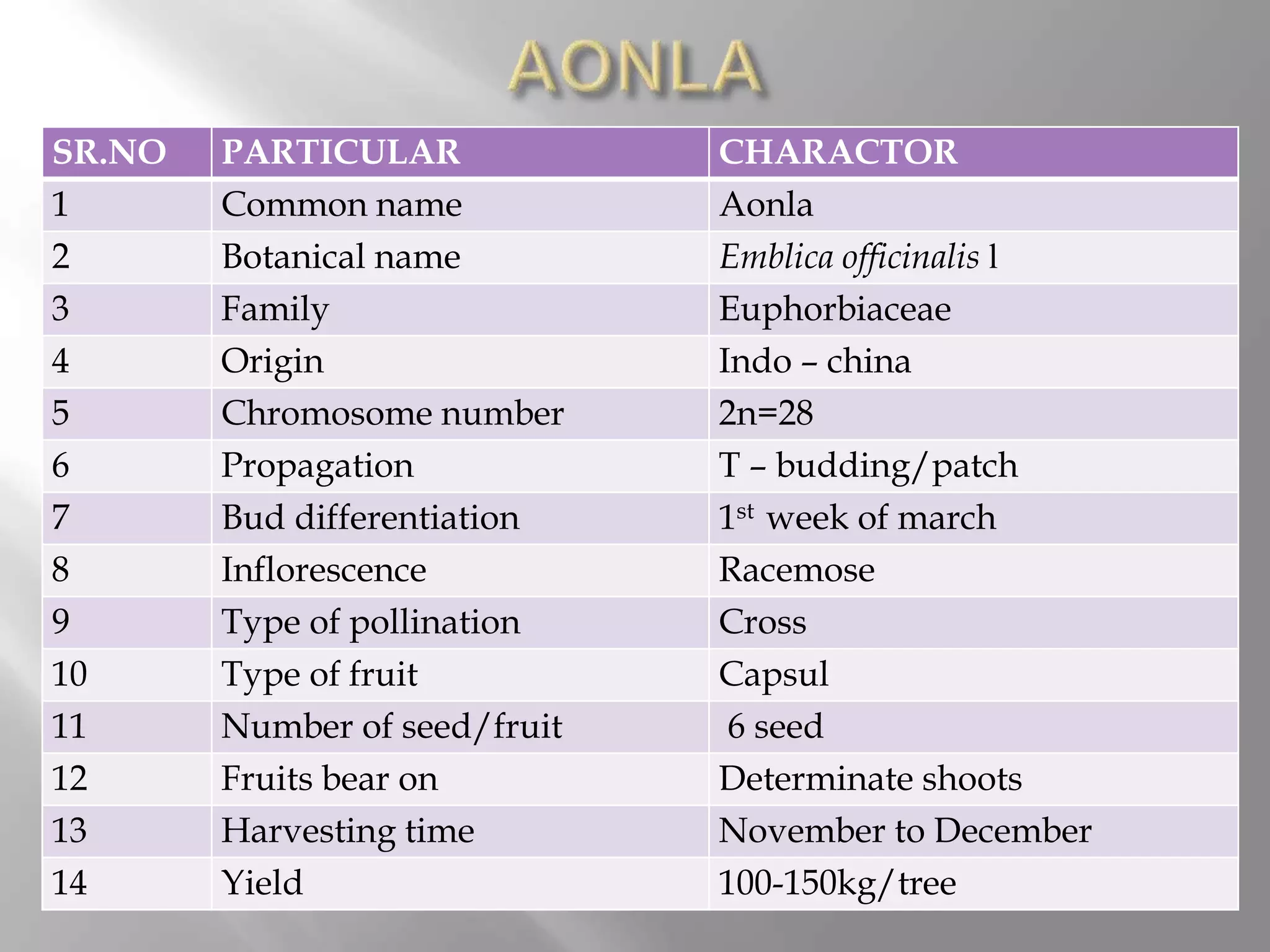
SR.NO PARTICULAR CHARACTOR
1 Common name Aonla
2 Botanical name Emblica officinalis l
3 Family Euphorbiaceae
4 Origin Indo – china
5 Chromosome number 2n=28
6 Propagation T – budding/patch
7 Bud differentiation 1st week of march
8 Inflorescence Racemose
9 Type of pollination Cross
10 Type of fruit Capsul
11 Number of seed/fruit 6 seed
12 Fruits bear on Determinate shoots
13 Harvesting time November to December
14 Yield 100-150kg/tree
 It's mineral and vitamin contents
include calcium, phosphorus, iron,
carotene, thiamine, riboflavin and
to vitamin C. Its calorific value is 58.
 100 g of fruit provides 470 to 680 mg of vitamin C.
 The dehydrated berry provides 2428 to 3470 mg
of vitamin C per 100 g.
 It is largely cultivated in Uttar Pradesh Gujarat,
Maharashtra and Karnataka.
 It has very good demand for the industries for the
preparation of various health care products also
like hair oils, dye, shampoo, face creams and
tooth powders.
Centre of Diversity
 Grown in various agroedaphic situation.
 Indigenous to tropical South –Eastern Asia
particularly Central and Southern India.
 Wild and cultivated species available in the
region extending from the base of Himalayan to
sri lanka and from Malasia to South China.
 In India, it is widely grown in UP, Gujarat,
Rajasthan, MP and TN.
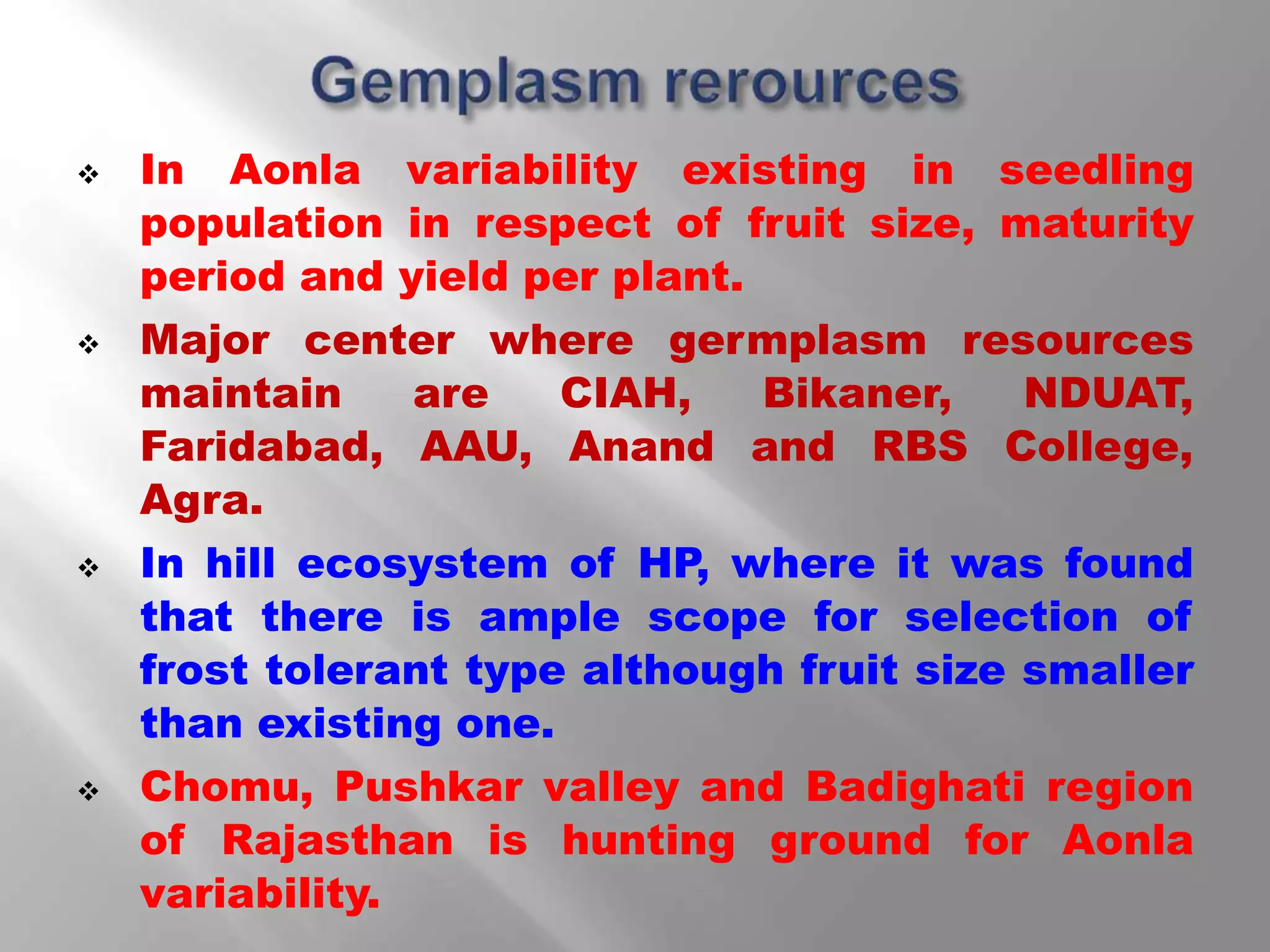
 In Aonla variability existing in seedling
population in respect of fruit size, maturity
period and yield per plant.
 Major center where germplasm resources
maintain are CIAH, Bikaner, NDUAT,
Faridabad, AAU, Anand and RBS College,
Agra.
 In hill ecosystem of HP, where it was found
that there is ample scope for selection of
frost tolerant type although fruit size smaller
than existing one.
 Chomu, Pushkar valley and Badighati region
of Rajasthan is hunting ground for Aonla
variability.
 Aonla belongs family Euphorbiaceae and scientifically is
Emblica officinalis (formerly known as phyllanthus emblica ).
 The genus includes a large number of sp. And other edible
ones are phylenthus acidus (star gooseberry or otaheite goose
berry) and p.longiflorus .
 The chromosome number in aonla is 2n=28 and wide
variation from 2n=98 to 104 is reported.
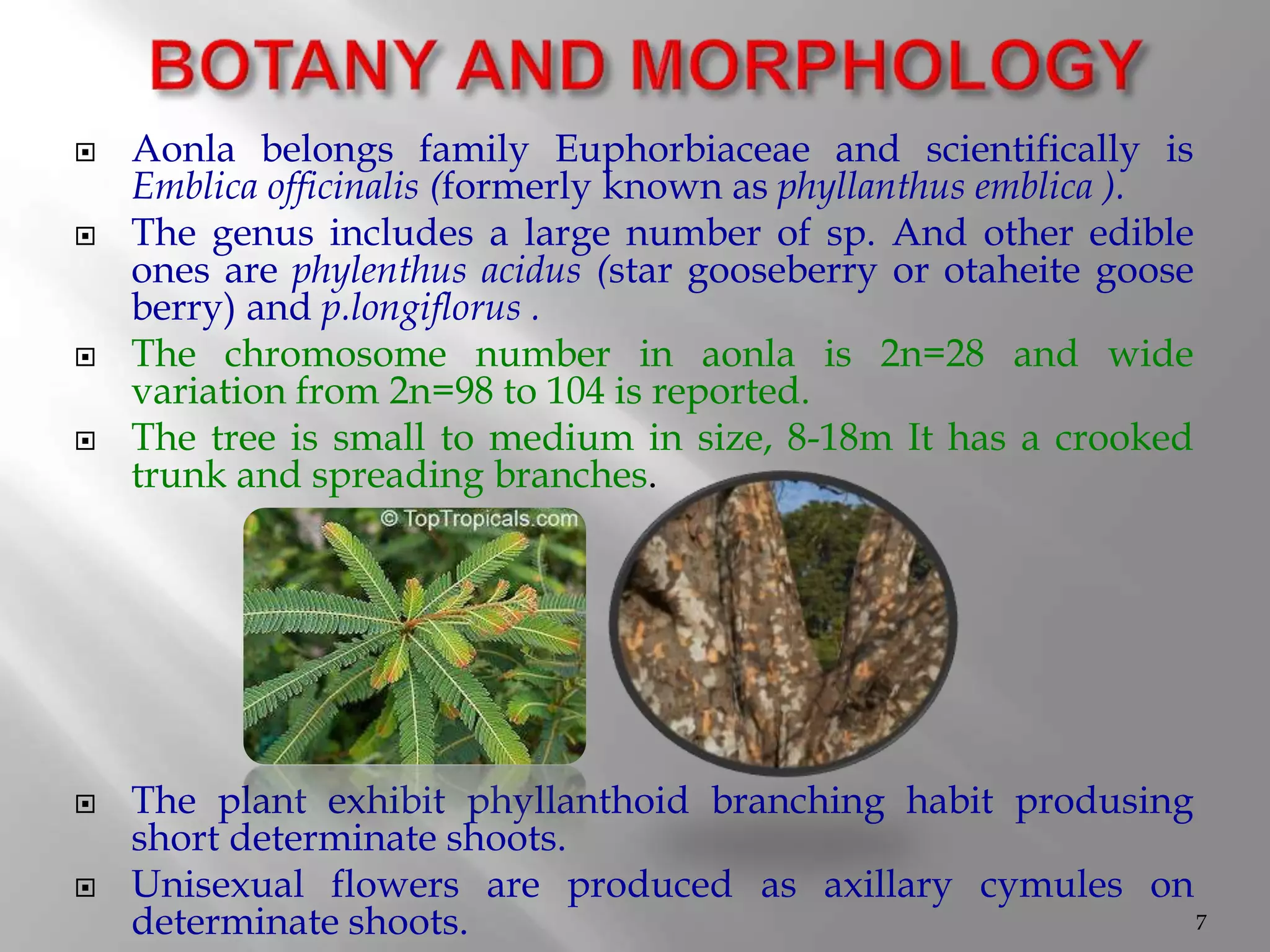
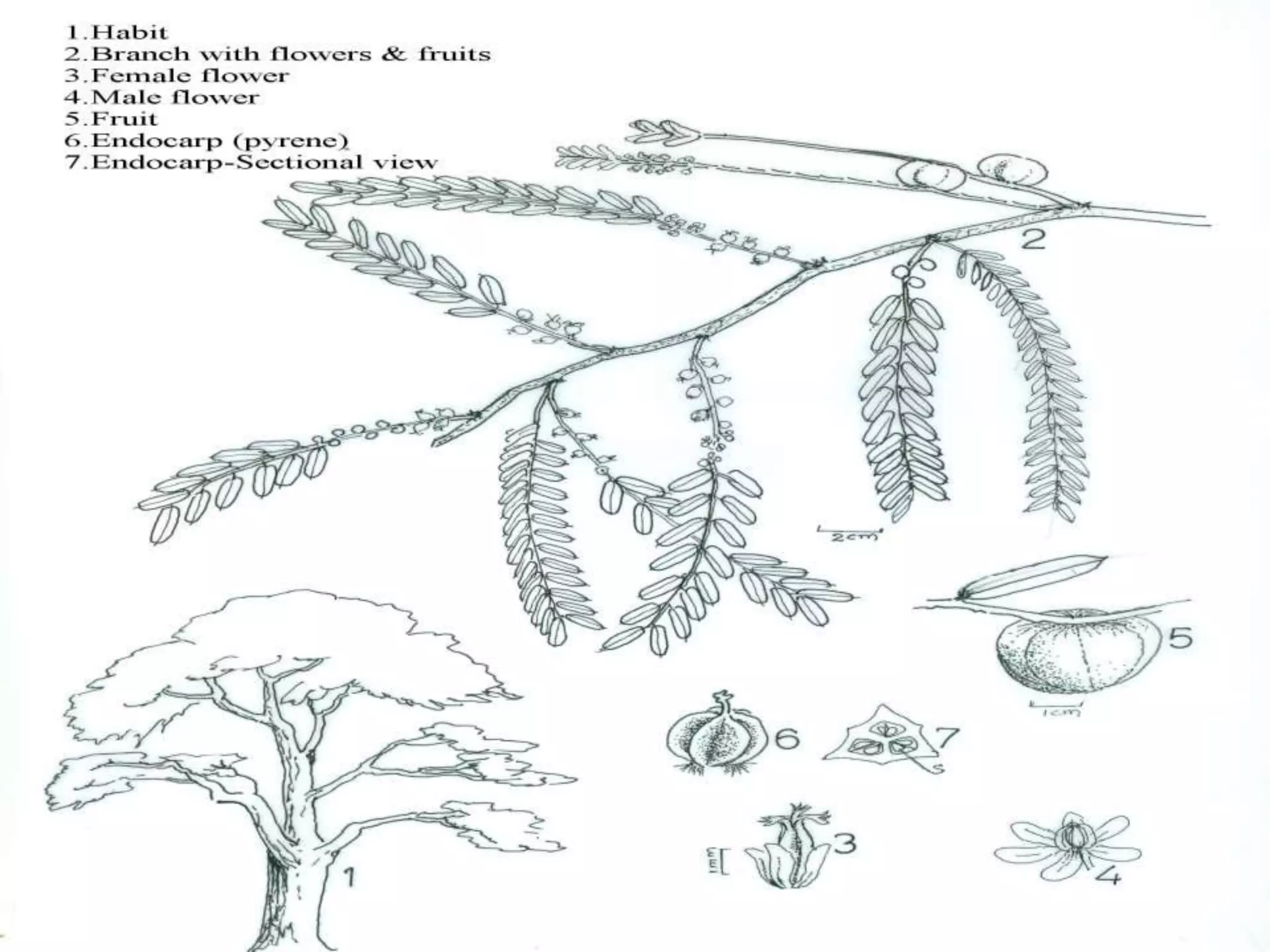
 The tree is small to medium in size, 8-18m It has a crooked
trunk and spreading branches.
 The plant exhibit phyllanthoid branching habit produsing
short determinate shoots.
 Unisexual flowers are produced as axillary cymules on
determinate shoots. 7
8
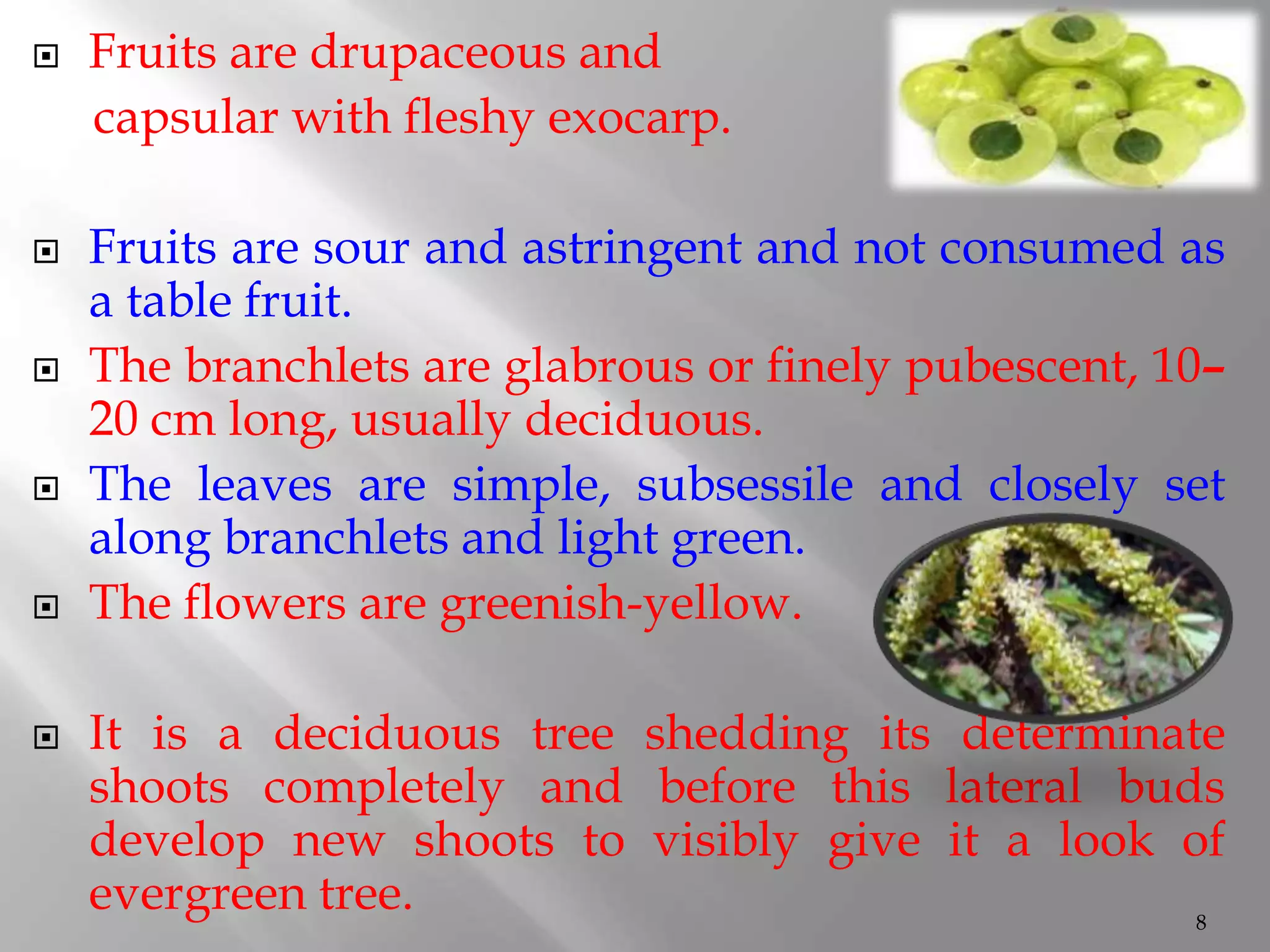
 Fruits are drupaceous and
capsular with fleshy exocarp.
 Fruits are sour and astringent and not consumed as
a table fruit.
 The branchlets are glabrous or finely pubescent, 10–
20 cm long, usually deciduous.
 The leaves are simple, subsessile and closely set
along branchlets and light green.
 The flowers are greenish-yellow.
 It is a deciduous tree shedding its determinate
shoots completely and before this lateral buds
develop new shoots to visibly give it a look of
evergreen tree.
9
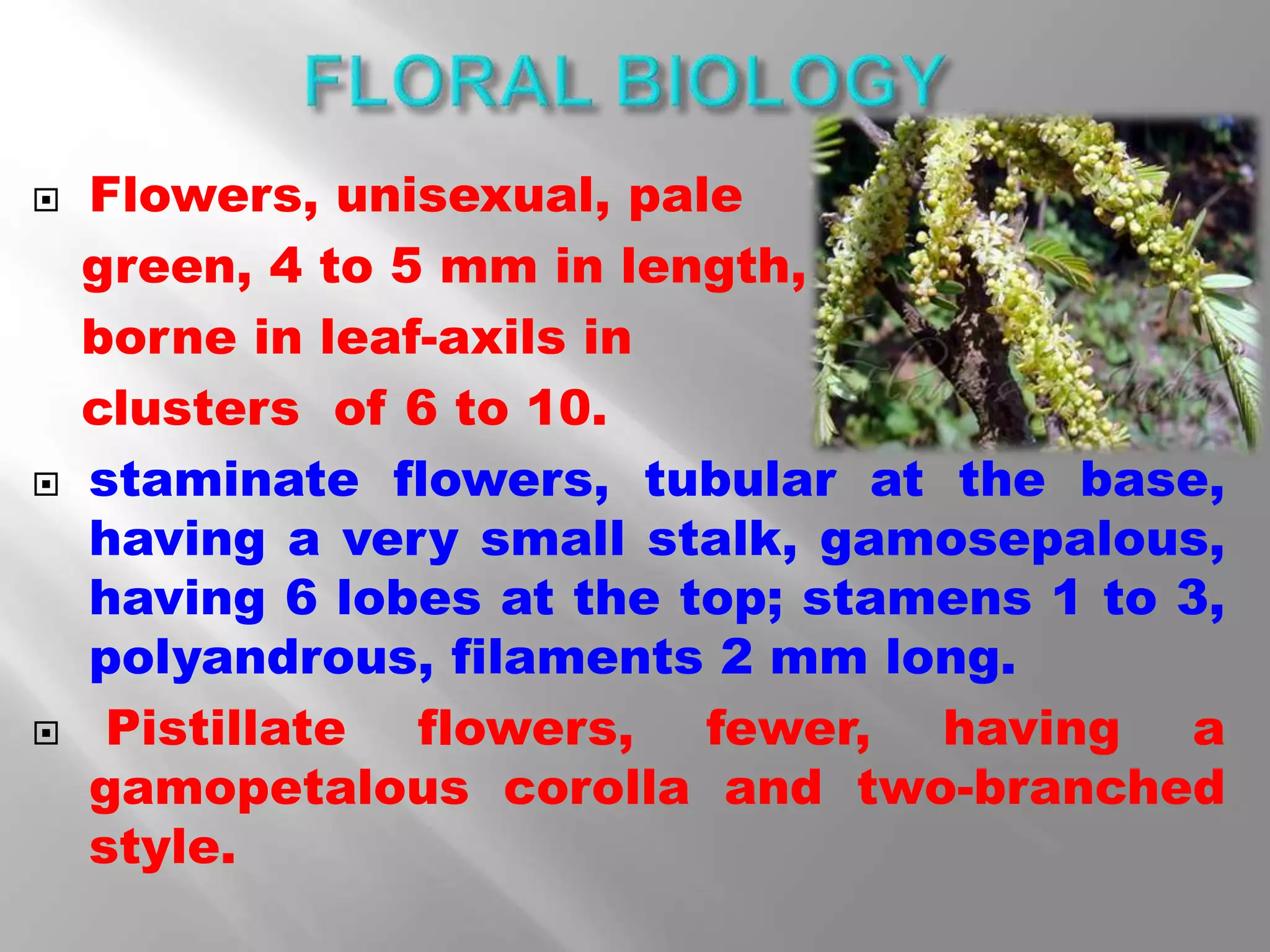
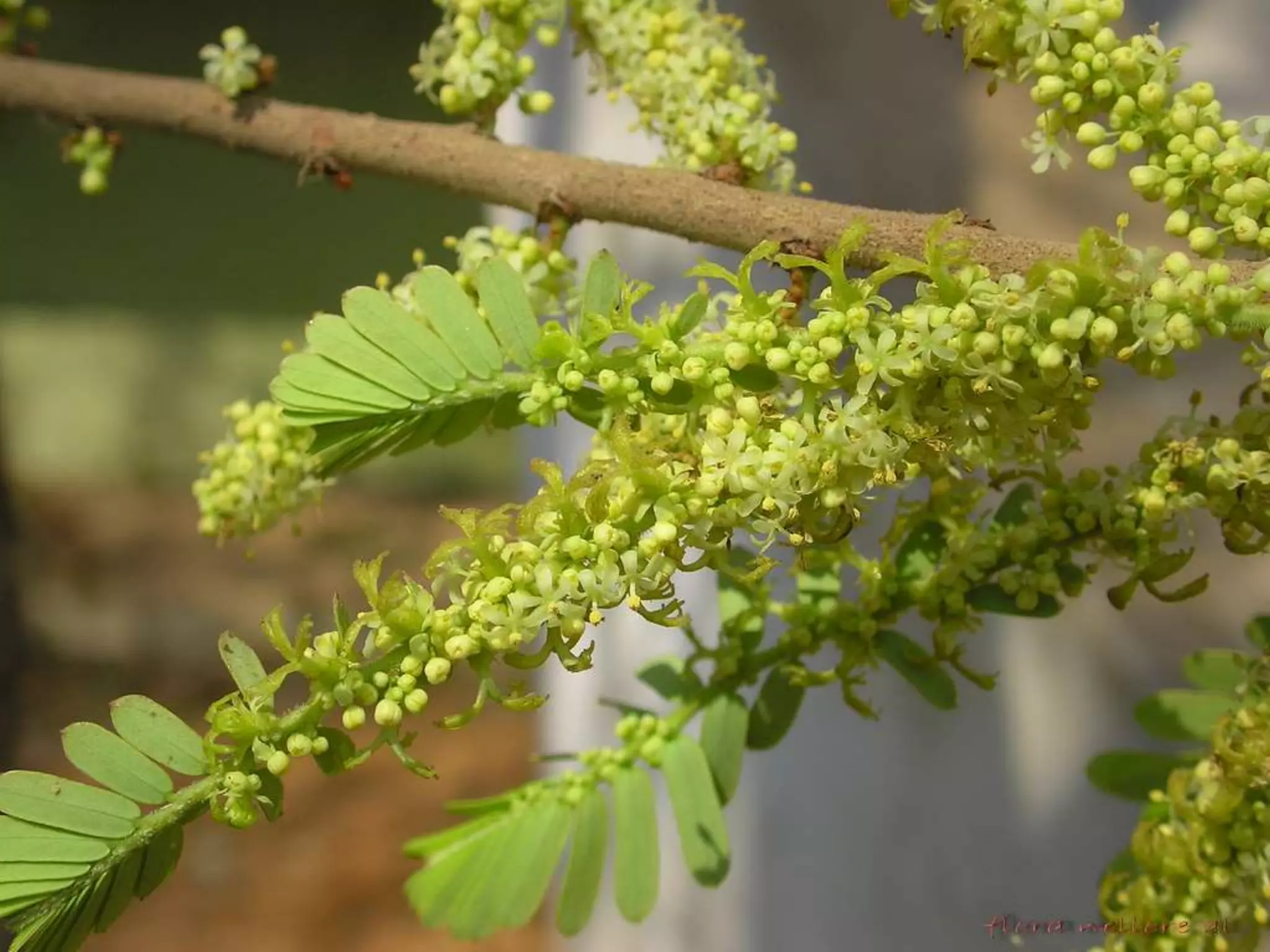
 Flowers, unisexual, pale
green, 4 to 5 mm in length,
borne in leaf-axils in
clusters of 6 to 10.
 staminate flowers, tubular at the base,
having a very small stalk, gamosepalous,
having 6 lobes at the top; stamens 1 to 3,
polyandrous, filaments 2 mm long.
 Pistillate flowers, fewer, having a
gamopetalous corolla and two-branched
style.
 Bearing Behavior: both staminate
and pistillate flowers are borne on
the same branch, but the staminate
flowers occur towards the apices
of small branches.
 Female flowers take about 72 hours
to open fully. Pedicel is very short.
 Disc is a lanceolate cup with 3 carpels.
Style is short, connate, twice bifid and
distally dilated.
 The new shoot emerge out during first week of April.
The flowering period varied in different varieties from
17-26 days. Flowering period twice in a year February-
March and June-July.
 The percentage of female flower varies
from 1.12 to 8.33 depending upon varieties.
 According to Dhar (1979) the ratio of female
to male flowers may vary from 1:109 to
1:501 depending upon the cultivars.
 Genetically: Cultivated forms of Emblica
officinalis have variable numbers ranging
from 2n=98 to 2n=104. The vitamin C
content was found to be directly
proportional to the size of the fruit and
size of the fruit is directly related to
chromosome number.
 Fruit Dormancy: After successful
pollination and fertilization, the set fruits
do not show any external symptom of
fruit growth for about four months
because the zygote and the endosperm
nucleus rest for this period of time.
 Main period of anthesis in aonla have been
recorded between 6 AM to 4 PM with a
peak period between 6 AM to 8 AM and
minimum between 4-6 PM .
 Just after the anthesis, either dehiscence
starts immediately or after 10-15 minutes of
anthesis .
 The dehiscence of anthers started just after
opening of flower. The anther lobes started
bursting longitudinally.
 All the anthers of flower did not dehisce
synchronously, some of these start to
dehisced just after opening of flower
whereas others did so later in the day, it
took about 10 to 15 minute for complete
dehiscence.
I. To breed var. having wider geographic
adaptability.
II. To develop var. suitable for export.
III. To evolve colored var. based on market demand.
IV. To breed var. resistant to frost.
V. To breed var. resistant to biotic and abiotic
stresses.
VI. Exploitation of available hybrid vigour (heterosis)
for yield and quality.
VII. To breed var. having high yield with good quality
fruits.
VIII. Varieties with less fibre content.
IX. Good pollinating var.
X. Var. with hight sex ratio with more number of
female flowers.
1. Introduction
2. Selection
3. Polyploidy
4. Mutation
5. Biotechnological tools
6. Hybridization
 It is one of the oldest method for
improvement of fruit crops. It is bringing or
exchange of germplasm / genetic material
from one place where it is not known
previously.
 Presently, germplasm exchange is being
done in different crop through NBPGR, new
delhi.
 This method may be an important tool to
bring exotic materials from foreign country
for further evaluation and incorporation of
specific gene lacking in indigenous aonla.
 While selecting new ideotypes, plant height, vigour,
growth habit, precocity, fruiting intensity, fruit size etc
are kept in mind.
 There are sufficient variation in fruit size and number
of fruit / determinate shoots, which directly affect the
fruit yield and provide ample scope for selecting
superior type.
 Major work done at
NDUAT, Faridabad (NA-4, 5, 6 ,7 10)
GAU (Anand-1, 2 and 3)
RBS, college, Agra (Balwant)
 Recently some coloured and cluster bearing
genotypes have been identified through exploitation
in Rajasthan, which will be further evaluated at
national repository of aonla at CIAH, Bikaner.
 Exact ploidy level is not known in aonla but
it is realized by the scientists that aonla is
characterized by polyploidy behavior in
composition of chromosome.
 The structural and numerical changes in
chromosome can be made through
application of colchicines, which is found to
be useful for getting small seeded fruit or
seedlessness.
 Keeping in view the usefulness of polypoidy
breeding, these principles may be applied in
aonla to obtain desirable economic
attributes.
 Mutation is sudden heritable change in a
character of plant.
 In India, research work related to
application of mutation in aonla is almost
negligible but there is greater prospects to
develop coloured varieties through induced
mutation and selection from bud sport.
 Incorporation of desirable gene in aonla is
possible only with the application
biotechnological approach.
 In fact, there is absolute dearth of information
on biotechnological approaches.
 Tissue culture, cell culture and genetic
manipulation through molecular technique may
be useful to get early result in varietal
improvement programme.
 This technique can also be helpful to modify
particular traits and in turn provide new
avenue for improving both the colour and
quality of the fruit available for industrial and
domestic uses.
 Hybridization is crossing of two parents
which are genetically dissimilar. Not a single
variety has been bred so far through this
method.
 Occurance of xenia effect between
Chakaiya x Krishna, Banarasi x NA-9,
Francis x NA-7, kanchan x NA-6 and NA-6 x
NA-9 for fruit size and weight were reported
from crosses.
 Since, aonla is highly heterozygous plant,
therefore, large size of population is required
for selection.
 It has long generation cycle i.e. 2-8 years,
depending upon sp. and var.
 Lack of recombination.
 Long juvenile phase prohibiting early
assessment of strain.
 Precedence of self incompatibility.
 Frost susceptibility.
 Lack of knowledge on inheritance pattern.
Aonla

Aonla

  • 1.
  • 2.
    SR.NO PARTICULAR CHARACTOR 1Common name Aonla 2 Botanical name Emblica officinalis l 3 Family Euphorbiaceae 4 Origin Indo – china 5 Chromosome number 2n=28 6 Propagation T – budding/patch 7 Bud differentiation 1st week of march 8 Inflorescence Racemose 9 Type of pollination Cross 10 Type of fruit Capsul 11 Number of seed/fruit 6 seed 12 Fruits bear on Determinate shoots 13 Harvesting time November to December 14 Yield 100-150kg/tree
  • 4.
     It's mineraland vitamin contents include calcium, phosphorus, iron, carotene, thiamine, riboflavin and to vitamin C. Its calorific value is 58.  100 g of fruit provides 470 to 680 mg of vitamin C.  The dehydrated berry provides 2428 to 3470 mg of vitamin C per 100 g.  It is largely cultivated in Uttar Pradesh Gujarat, Maharashtra and Karnataka.  It has very good demand for the industries for the preparation of various health care products also like hair oils, dye, shampoo, face creams and tooth powders.
  • 5.
    Centre of Diversity Grown in various agroedaphic situation.  Indigenous to tropical South –Eastern Asia particularly Central and Southern India.  Wild and cultivated species available in the region extending from the base of Himalayan to sri lanka and from Malasia to South China.  In India, it is widely grown in UP, Gujarat, Rajasthan, MP and TN.
  • 6.
     In Aonlavariability existing in seedling population in respect of fruit size, maturity period and yield per plant.  Major center where germplasm resources maintain are CIAH, Bikaner, NDUAT, Faridabad, AAU, Anand and RBS College, Agra.  In hill ecosystem of HP, where it was found that there is ample scope for selection of frost tolerant type although fruit size smaller than existing one.  Chomu, Pushkar valley and Badighati region of Rajasthan is hunting ground for Aonla variability.
  • 7.
     Aonla belongsfamily Euphorbiaceae and scientifically is Emblica officinalis (formerly known as phyllanthus emblica ).  The genus includes a large number of sp. And other edible ones are phylenthus acidus (star gooseberry or otaheite goose berry) and p.longiflorus .  The chromosome number in aonla is 2n=28 and wide variation from 2n=98 to 104 is reported.  The tree is small to medium in size, 8-18m It has a crooked trunk and spreading branches.  The plant exhibit phyllanthoid branching habit produsing short determinate shoots.  Unisexual flowers are produced as axillary cymules on determinate shoots. 7
  • 8.
    8  Fruits aredrupaceous and capsular with fleshy exocarp.  Fruits are sour and astringent and not consumed as a table fruit.  The branchlets are glabrous or finely pubescent, 10– 20 cm long, usually deciduous.  The leaves are simple, subsessile and closely set along branchlets and light green.  The flowers are greenish-yellow.  It is a deciduous tree shedding its determinate shoots completely and before this lateral buds develop new shoots to visibly give it a look of evergreen tree.
  • 9.
  • 10.
     Flowers, unisexual,pale green, 4 to 5 mm in length, borne in leaf-axils in clusters of 6 to 10.  staminate flowers, tubular at the base, having a very small stalk, gamosepalous, having 6 lobes at the top; stamens 1 to 3, polyandrous, filaments 2 mm long.  Pistillate flowers, fewer, having a gamopetalous corolla and two-branched style.
  • 11.
     Bearing Behavior:both staminate and pistillate flowers are borne on the same branch, but the staminate flowers occur towards the apices of small branches.  Female flowers take about 72 hours to open fully. Pedicel is very short.  Disc is a lanceolate cup with 3 carpels. Style is short, connate, twice bifid and distally dilated.  The new shoot emerge out during first week of April. The flowering period varied in different varieties from 17-26 days. Flowering period twice in a year February- March and June-July.
  • 14.
     The percentageof female flower varies from 1.12 to 8.33 depending upon varieties.  According to Dhar (1979) the ratio of female to male flowers may vary from 1:109 to 1:501 depending upon the cultivars.
  • 15.
     Genetically: Cultivatedforms of Emblica officinalis have variable numbers ranging from 2n=98 to 2n=104. The vitamin C content was found to be directly proportional to the size of the fruit and size of the fruit is directly related to chromosome number.  Fruit Dormancy: After successful pollination and fertilization, the set fruits do not show any external symptom of fruit growth for about four months because the zygote and the endosperm nucleus rest for this period of time.
  • 16.
     Main periodof anthesis in aonla have been recorded between 6 AM to 4 PM with a peak period between 6 AM to 8 AM and minimum between 4-6 PM .  Just after the anthesis, either dehiscence starts immediately or after 10-15 minutes of anthesis .
  • 17.
     The dehiscenceof anthers started just after opening of flower. The anther lobes started bursting longitudinally.  All the anthers of flower did not dehisce synchronously, some of these start to dehisced just after opening of flower whereas others did so later in the day, it took about 10 to 15 minute for complete dehiscence.
  • 18.
    I. To breedvar. having wider geographic adaptability. II. To develop var. suitable for export. III. To evolve colored var. based on market demand. IV. To breed var. resistant to frost. V. To breed var. resistant to biotic and abiotic stresses. VI. Exploitation of available hybrid vigour (heterosis) for yield and quality. VII. To breed var. having high yield with good quality fruits. VIII. Varieties with less fibre content. IX. Good pollinating var. X. Var. with hight sex ratio with more number of female flowers.
  • 19.
    1. Introduction 2. Selection 3.Polyploidy 4. Mutation 5. Biotechnological tools 6. Hybridization
  • 20.
     It isone of the oldest method for improvement of fruit crops. It is bringing or exchange of germplasm / genetic material from one place where it is not known previously.  Presently, germplasm exchange is being done in different crop through NBPGR, new delhi.  This method may be an important tool to bring exotic materials from foreign country for further evaluation and incorporation of specific gene lacking in indigenous aonla.
  • 21.
     While selectingnew ideotypes, plant height, vigour, growth habit, precocity, fruiting intensity, fruit size etc are kept in mind.  There are sufficient variation in fruit size and number of fruit / determinate shoots, which directly affect the fruit yield and provide ample scope for selecting superior type.  Major work done at NDUAT, Faridabad (NA-4, 5, 6 ,7 10) GAU (Anand-1, 2 and 3) RBS, college, Agra (Balwant)  Recently some coloured and cluster bearing genotypes have been identified through exploitation in Rajasthan, which will be further evaluated at national repository of aonla at CIAH, Bikaner.
  • 22.
     Exact ploidylevel is not known in aonla but it is realized by the scientists that aonla is characterized by polyploidy behavior in composition of chromosome.  The structural and numerical changes in chromosome can be made through application of colchicines, which is found to be useful for getting small seeded fruit or seedlessness.  Keeping in view the usefulness of polypoidy breeding, these principles may be applied in aonla to obtain desirable economic attributes.
  • 23.
     Mutation issudden heritable change in a character of plant.  In India, research work related to application of mutation in aonla is almost negligible but there is greater prospects to develop coloured varieties through induced mutation and selection from bud sport.
  • 24.
     Incorporation ofdesirable gene in aonla is possible only with the application biotechnological approach.  In fact, there is absolute dearth of information on biotechnological approaches.  Tissue culture, cell culture and genetic manipulation through molecular technique may be useful to get early result in varietal improvement programme.  This technique can also be helpful to modify particular traits and in turn provide new avenue for improving both the colour and quality of the fruit available for industrial and domestic uses.
  • 25.
     Hybridization iscrossing of two parents which are genetically dissimilar. Not a single variety has been bred so far through this method.  Occurance of xenia effect between Chakaiya x Krishna, Banarasi x NA-9, Francis x NA-7, kanchan x NA-6 and NA-6 x NA-9 for fruit size and weight were reported from crosses.
  • 26.
     Since, aonlais highly heterozygous plant, therefore, large size of population is required for selection.  It has long generation cycle i.e. 2-8 years, depending upon sp. and var.  Lack of recombination.  Long juvenile phase prohibiting early assessment of strain.  Precedence of self incompatibility.  Frost susceptibility.  Lack of knowledge on inheritance pattern.