✅ Click here to seek help👉; https://getbrainful.com
NU673 Units 2 and 8 PMHNP Journal
The purpose of this video is self-reflection regarding the therapeutic process and one’s own role in that process as a PMHNP provider. Through
reflective practice, you will evaluate your own emotional intelligence as defined as the capacity to recognize one’s own feelings as well as others’
and one’s ability to monitor and manage those feelings. The point of the exercise is to learn about yourself, your triggers, the types of cases you end
up getting overly involved with, and those you would rather refer to someone else. The idea is to be able to step back personally and analyze your
behaviors/thoughts/decisions and how those impact both you and your clients.
Your video should be 3–5 minutes in length.
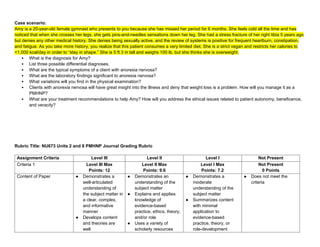
Case scenario:
Amy is a 20-year-old female gymnast who presents to you because she has missed her period for 6 months. She feels cold all the time and has
noticed that when she crosses her legs, she gets pins-and-needles sensations down her leg. She had a stress fracture of her right tibia 5 years ago
but denies any other medical history. She denies being sexually active, and the review of systems is positive for frequent heartburn, constipation,
and fatigue. As you take more history, you realize that this patient consumes a very limited diet. She is a strict vegan and restricts her calories to
<1,000 kcal/day in order to “stay in shape.” She is 5 ft 3 in tall and weighs 100 lb, but she thinks she is overweight.
 What is the diagnosis for Amy?
 List three possible differential diagnoses.
 What are the typical symptoms of a client with anorexia nervosa?
 What are the laboratory findings significant to anorexia nervosa?
 What variations will you find in the physical examination?
 Clients with anorexia nervosa will have great insight into the illness and deny that weight loss is a problem. How will you manage it as a
PMHNP?
 What are your treatment recommendations to help Amy? How will you address the ethical issues related to patient autonomy, beneficence,
and veracity?
Rubric Title: NU673 Units 2 and 8 PMHNP Journal Grading Rubric
Assignment Criteria Level III Level II Level I Not Present
Criteria 1 Level III Max
Points: 12
Level II Max
Points: 9.6
Level I Max
Points: 7.2
Not Present
0 Points
Content of Paper ● Demonstrates a
well-articulated
understanding of
the subject matter in
a clear, complex,
and informative
manner
● Develops content
and theories are
well
● Demonstrates an
understanding of the
subject matter
● Explains and applies
knowledge of
evidence-based
practice, ethics, theory,
and/or role
● Uses a variety of
scholarly resources
● Demonstrates a
moderate
understanding of the
subject matter
● Summarizes content
with minimal
application to
evidence-based
practice, theory, or
role-development
● Does not meet the
criteria
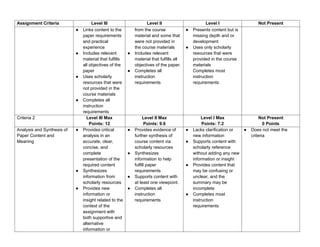
Assignment Criteria Level III Level II Level I Not Present
● Links content to the
paper requirements
and practical
experience
● Includes relevant
material that fulfills
all objectives of the
paper
● Uses scholarly
resources that were
not provided in the
course materials
● Completes all
instruction
requirements
from the course
material and some that
were not provided in
the course materials
● Includes relevant
material that fulfills all
objectives of the paper.
● Completes all
instruction
requirements
● Presents content but is
missing depth and or
development
● Uses only scholarly
resources that were
provided in the course
materials
Completes most
instruction
requirements
Criteria 2 Level III Max
Points: 12
Level II Max
Points: 9.6
Level I Max
Points: 7.2
Not Present
0 Points
Analysis and Synthesis of
Paper Content and
Meaning
● Provides critical
analysis in an
accurate, clear,
concise, and
complete
presentation of the
required content
● Synthesizes
information from
scholarly resources
● Provides new
information or
insight related to the
context of the
assignment with
both supportive and
alternative
information or
● Provides evidence of
further synthesis of
course content via
scholarly resources
● Synthesizes
information to help
fulfill paper
requirements
● Supports content with
at least one viewpoint.
● Completes all
instruction
requirements
● Lacks clarification or
new information
● Supports content with
scholarly reference
without adding any new
information or insight
● Provides content that
may be confusing or
unclear, and the
summary may be
incomplete
● Completes most
instruction
requirements
● Does not meet the
criteria
Assignment Criteria Level III Level II Level I Not Present
viewpoints
● Completes all
instruction
requirements
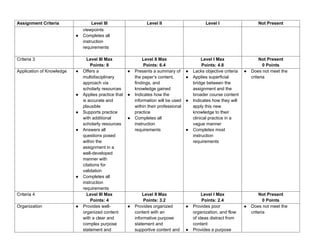
Criteria 3 Level III Max
Points: 8
Level II Max
Points: 6.4
Level I Max
Points: 4.8
Not Present
0 Points
Application of Knowledge ● Offers a
multidisciplinary
approach via
scholarly resources
● Applies practice that
is accurate and
plausible
● Supports practice
with additional
scholarly resources
● Answers all
questions posed
within the
assignment in a
well-developed
manner with
citations for
validation
● Completes all
instruction
requirements
● Presents a summary of
the paper’s content,
findings, and
knowledge gained
● Indicates how the
information will be used
within their professional
practice
● Completes all
instruction
requirements
● Lacks objective criteria
● Applies superficial
bridge between the
assignment and the
broader course content
● Indicates how they will
apply this new
knowledge to their
clinical practice in a
vague manner
● Completes most
instruction
requirements
● Does not meet the
criteria
Criteria 4 Level III Max
Points: 4
Level II Max
Points: 3.2
Level I Max
Points: 2.4
Not Present
0 Points
Organization ● Provides well-
organized content
with a clear and
complex purpose
statement and
● Provides organized
content with an
informative purpose
statement and
supportive content and
● Provides poor
organization, and flow
of ideas distract from
content
● Provides a purpose
● Does not meet the
criteria
Assignment Criteria Level III Level II Level I Not Present
content argument
● Provides concise
writing with a logical
flow of ideas
summary statement
● Provides argument
content with minimal
issues in content flow
statement
● Provides narrative that
is difficult to follow and
frequently causes
reader to reread work
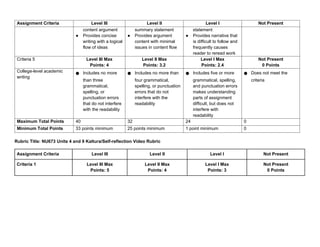
Criteria 5 Level III Max
Points: 4
Level II Max
Points: 3.2
Level I Max
Points: 2.4
Not Present
0 Points
College-level academic
writing
● Includes no more
than three
grammatical,
spelling, or
punctuation errors
that do not interfere
with the readability
● Includes no more than
four grammatical,
spelling, or punctuation
errors that do not
interfere with the
readability
● Includes five or more
grammatical, spelling,
and punctuation errors
makes understanding
parts of assignment
difficult, but does not
interfere with
readability
● Does not meet the
criteria
Maximum Total Points 40 32 24 0
Minimum Total Points 33 points minimum 25 points minimum 1 point minimum 0
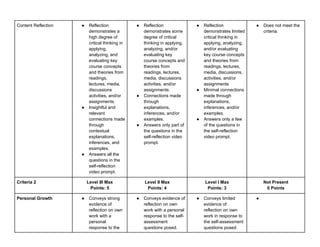
Rubric Title: NU673 Units 4 and 9 Kaltura/Self-reflection Video Rubric
Assignment Criteria Level III Level II Level I Not Present
Criteria 1 Level III Max
Points: 5
Level II Max
Points: 4
Level I Max
Points: 3
Not Present
0 Points
Content Reflection ● Reflection
demonstrates a
high degree of
critical thinking in
applying,
analyzing, and
evaluating key
course concepts
and theories from
readings,
lectures, media,
discussions
activities, and/or
assignments.
● Insightful and
relevant
connections made
through
contextual
explanations,
inferences, and
examples.
● Answers all the
questions in the
self-reflection
video prompt.
● Reflection
demonstrates some
degree of critical
thinking in applying,
analyzing, and/or
evaluating key
course concepts and
theories from
readings, lectures,
media, discussions
activities, and/or
assignments.
● Connections made
through
explanations,
inferences, and/or
examples.
● Answers only part of
the questions in the
self-reflection video
prompt.
● Reflection
demonstrates limited
critical thinking in
applying, analyzing,
and/or evaluating
key course concepts
and theories from
readings, lectures,
media, discussions,
activities, and/or
assignments
● Minimal connections
made through
explanations,
inferences, and/or
examples.
● Answers only a few
of the questions in
the self-reflection
video prompt.
● Does not meet the
criteria.
Criteria 2 Level III Max
Points: 5
Level II Max
Points: 4
Level I Max
Points: 3
Not Present
0 Points
Personal Growth ● Conveys strong
evidence of
reflection on own
work with a
personal
response to the
● Conveys evidence of
reflection on own
work with a personal
response to the self-
assessment
questions posed.
● Conveys limited
evidence of
reflection on own
work in response to
the self-assessment
questions posed.
●
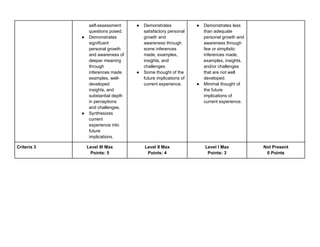
self-assessment
questions posed.
● Demonstrates
significant
personal growth
and awareness of
deeper meaning
through
inferences made
examples, well-
developed
insights, and
substantial depth
in perceptions
and challenges.
● Synthesizes
current
experience into
future
implications.
● Demonstrates
satisfactory personal
growth and
awareness through
some inferences
made, examples,
insights, and
challenges.
● Some thought of the
future implications of
current experience.
● Demonstrates less
than adequate
personal growth and
awareness through
few or simplistic
inferences made,
examples, insights,
and/or challenges
that are not well
developed.
● Minimal thought of
the future
implications of
current experience.
Criteria 3 Level III Max
Points: 5
Level II Max
Points: 4
Level I Max
Points: 3
Not Present
0 Points
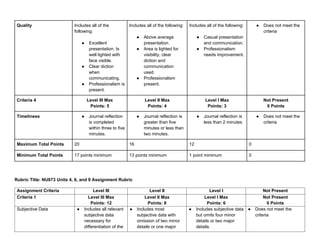
Quality Includes all of the
following:
● Excellent
presentation. Is
well lighted with
face visible.
● Clear diction
when
communicating.
● Professionalism is
present.
Includes all of the following:
● Above average
presentation.
● Area is lighted for
visibility, clear
diction and
communication
used.
● Professionalism
present.
Includes all of the following:
● Casual presentation
and communication.
● Professionalism
needs improvement.
● Does not meet the
criteria
Criteria 4 Level III Max
Points: 5
Level II Max
Points: 4
Level I Max
Points: 3
Not Present
0 Points
Timeliness ● Journal reflection
is completed
within three to five
minutes.
● Journal reflection is
greater than five
minutes or less than
two minutes.
● Journal reflection is
less than 2 minutes
● Does not meet the
criteria
Maximum Total Points 20 16 12 0
Minimum Total Points 17 points minimum 13 points minimum 1 point minimum 0
Rubric Title: NU673 Units 4, 6, and 9 Assignment Rubric
Assignment Criteria Level III Level II Level I Not Present
Criteria 1 Level III Max
Points: 12
Level II Max
Points: 8
Level I Max
Points: 6
Not Present
0 Points
Subjective Data ● Includes all relevant
subjective data
necessary for
differentiation of the
● Includes most
subjective data with
omission of two minor
details or one major
● Includes subjective data
but omits four minor
details or two major
details.
● Does not meet the
criteria
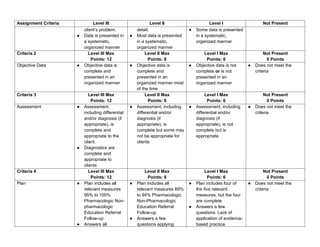
Assignment Criteria Level III Level II Level I Not Present
client’s problem.
● Data is presented in
a systematic,
organized manner
detail.
● Most data is presented
in a systematic,
organized manner
● Some data is presented
in a systematic,
organized manner
Criteria 2 Level III Max
Points: 12
Level II Max
Points: 8
Level I Max
Points: 6
Not Present
0 Points
Objective Data ● Objective data is
complete and
presented in an
organized manner
● Objective data is
complete and
presented in an
organized manner most
of the time
● Objective data is not
complete or is not
presented in an
organized manner
● Does not meet the
criteria
Criteria 3 Level III Max
Points: 12
Level II Max
Points: 8
Level I Max
Points: 6
Not Present
0 Points
Assessment ● Assessment,
including differential
and/or diagnosis (if
appropriate), is
complete and
appropriate to the
client.
● Diagnostics are
complete and
appropriate to
clients
● Assessment, including
differential and/or
diagnosis (if
appropriate), is
complete but some may
not be appropriate for
clients
● Assessment, including
differential and/or
diagnosis (if
appropriate), is not
complete but is
appropriate
● Does not meet the
criteria
Criteria 4 Level III Max
Points: 12
Level II Max
Points: 8
Level I Max
Points: 6
Not Present
0 Points
Plan ● Plan includes all
relevant measures
95% to 100%
Pharmacologic Non-
pharmacologic
Education Referral
Follow-up
● Answers all
● Plan includes all
relevant measures 89%
to 94% Pharmacologic
Non-Pharmacologic
Education Referral
Follow-up
● Answers a few
questions applying
● Plan includes four of
the five relevant
measures, but the four
are complete.
● Answers a few
questions. Lack of
application of evidence-
based practice
● Does not meet the
criteria
Assignment Criteria Level III Level II Level I Not Present
questions applying
evidence-based
practice guidelines.
evidence-based
practice guidelines.
guidelines.
Criteria 5 Level III Max
Points: 6
Level II Max
Points: 4
Level I Max
Points: 3
Not Present
0 Points
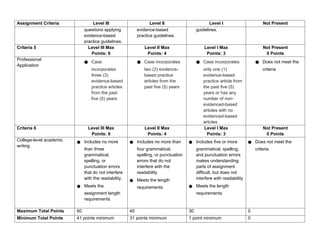
Professional
Application
● Case
incorporates
three (3)
evidence-based
practice articles
from the past
five (5) years
● Case incorporates
two (2) evidence-
based practice
articles from the
past five (5) years
● Case incorporates
only one (1)
evidence-based
practice article from
the past five (5)
years or has any
number of non-
evidenced-based
articles with no
evidenced-based
articles
● Does not meet the
criteria
Criteria 6 Level III Max
Points: 6
Level II Max
Points: 4
Level I Max
Points: 3
Not Present
0 Points
College-level academic
writing
● Includes no more
than three
grammatical,
spelling, or
punctuation errors
that do not interfere
with the readability.
● Meets the
assignment length
requirements
● Includes no more than
four grammatical,
spelling, or punctuation
errors that do not
interfere with the
readability
● Meets the length
requirements
● Includes five or more
grammatical, spelling,
and punctuation errors
makes understanding
parts of assignment
difficult, but does not
interfere with readability
● Meets the length
requirements
● Does not meet the
criteria
Maximum Total Points 60 40 30 0
Minimum Total Points 41 points minimum 31 points minimum 1 point minimum 0
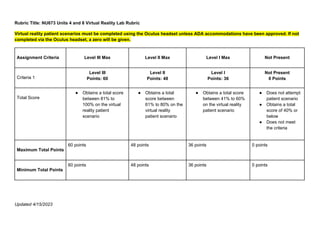
Rubric Title: NU673 Units 4 and 8 Virtual Reality Lab Rubric
Virtual reality patient scenarios must be completed using the Oculus headset unless ADA accommodations have been approved. If not
completed via the Oculus headset, a zero will be given.
Assignment Criteria Level III Max Level II Max Level I Max Not Present
Criteria 1
Level III
Points: 60
Level II
Points: 48
Level I
Points: 36
Not Present
0 Points
Total Score
● Obtains a total score
between 81% to
100% on the virtual
reality patient
scenario
● Obtains a total
score between
61% to 80% on the
virtual reality
patient scenario
● Obtains a total score
between 41% to 60%
on the virtual reality
patient scenario
● Does not attempt
patient scenario
● Obtains a total
score of 40% or
below
● Does not meet
the criteria
Maximum Total Points
60 points 48 points 36 points 0 points
Minimum Total Points
60 points 48 points 36 points 0 points
Updated 4/15/2023

ANSWER-NU673 Units 2 and 8 PMHNP Journal

  • 1.
    ✅ Click hereto seek help👉; https://getbrainful.com NU673 Units 2 and 8 PMHNP Journal The purpose of this video is self-reflection regarding the therapeutic process and one’s own role in that process as a PMHNP provider. Through reflective practice, you will evaluate your own emotional intelligence as defined as the capacity to recognize one’s own feelings as well as others’ and one’s ability to monitor and manage those feelings. The point of the exercise is to learn about yourself, your triggers, the types of cases you end up getting overly involved with, and those you would rather refer to someone else. The idea is to be able to step back personally and analyze your behaviors/thoughts/decisions and how those impact both you and your clients. Your video should be 3–5 minutes in length.
  • 2.
    Case scenario: Amy isa 20-year-old female gymnast who presents to you because she has missed her period for 6 months. She feels cold all the time and has noticed that when she crosses her legs, she gets pins-and-needles sensations down her leg. She had a stress fracture of her right tibia 5 years ago but denies any other medical history. She denies being sexually active, and the review of systems is positive for frequent heartburn, constipation, and fatigue. As you take more history, you realize that this patient consumes a very limited diet. She is a strict vegan and restricts her calories to <1,000 kcal/day in order to “stay in shape.” She is 5 ft 3 in tall and weighs 100 lb, but she thinks she is overweight.  What is the diagnosis for Amy?  List three possible differential diagnoses.  What are the typical symptoms of a client with anorexia nervosa?  What are the laboratory findings significant to anorexia nervosa?  What variations will you find in the physical examination?  Clients with anorexia nervosa will have great insight into the illness and deny that weight loss is a problem. How will you manage it as a PMHNP?  What are your treatment recommendations to help Amy? How will you address the ethical issues related to patient autonomy, beneficence, and veracity? Rubric Title: NU673 Units 2 and 8 PMHNP Journal Grading Rubric Assignment Criteria Level III Level II Level I Not Present Criteria 1 Level III Max Points: 12 Level II Max Points: 9.6 Level I Max Points: 7.2 Not Present 0 Points Content of Paper ● Demonstrates a well-articulated understanding of the subject matter in a clear, complex, and informative manner ● Develops content and theories are well ● Demonstrates an understanding of the subject matter ● Explains and applies knowledge of evidence-based practice, ethics, theory, and/or role ● Uses a variety of scholarly resources ● Demonstrates a moderate understanding of the subject matter ● Summarizes content with minimal application to evidence-based practice, theory, or role-development ● Does not meet the criteria
  • 3.
    Assignment Criteria LevelIII Level II Level I Not Present ● Links content to the paper requirements and practical experience ● Includes relevant material that fulfills all objectives of the paper ● Uses scholarly resources that were not provided in the course materials ● Completes all instruction requirements from the course material and some that were not provided in the course materials ● Includes relevant material that fulfills all objectives of the paper. ● Completes all instruction requirements ● Presents content but is missing depth and or development ● Uses only scholarly resources that were provided in the course materials Completes most instruction requirements Criteria 2 Level III Max Points: 12 Level II Max Points: 9.6 Level I Max Points: 7.2 Not Present 0 Points Analysis and Synthesis of Paper Content and Meaning ● Provides critical analysis in an accurate, clear, concise, and complete presentation of the required content ● Synthesizes information from scholarly resources ● Provides new information or insight related to the context of the assignment with both supportive and alternative information or ● Provides evidence of further synthesis of course content via scholarly resources ● Synthesizes information to help fulfill paper requirements ● Supports content with at least one viewpoint. ● Completes all instruction requirements ● Lacks clarification or new information ● Supports content with scholarly reference without adding any new information or insight ● Provides content that may be confusing or unclear, and the summary may be incomplete ● Completes most instruction requirements ● Does not meet the criteria
  • 4.
    Assignment Criteria LevelIII Level II Level I Not Present viewpoints ● Completes all instruction requirements Criteria 3 Level III Max Points: 8 Level II Max Points: 6.4 Level I Max Points: 4.8 Not Present 0 Points Application of Knowledge ● Offers a multidisciplinary approach via scholarly resources ● Applies practice that is accurate and plausible ● Supports practice with additional scholarly resources ● Answers all questions posed within the assignment in a well-developed manner with citations for validation ● Completes all instruction requirements ● Presents a summary of the paper’s content, findings, and knowledge gained ● Indicates how the information will be used within their professional practice ● Completes all instruction requirements ● Lacks objective criteria ● Applies superficial bridge between the assignment and the broader course content ● Indicates how they will apply this new knowledge to their clinical practice in a vague manner ● Completes most instruction requirements ● Does not meet the criteria Criteria 4 Level III Max Points: 4 Level II Max Points: 3.2 Level I Max Points: 2.4 Not Present 0 Points Organization ● Provides well- organized content with a clear and complex purpose statement and ● Provides organized content with an informative purpose statement and supportive content and ● Provides poor organization, and flow of ideas distract from content ● Provides a purpose ● Does not meet the criteria
  • 5.
    Assignment Criteria LevelIII Level II Level I Not Present content argument ● Provides concise writing with a logical flow of ideas summary statement ● Provides argument content with minimal issues in content flow statement ● Provides narrative that is difficult to follow and frequently causes reader to reread work Criteria 5 Level III Max Points: 4 Level II Max Points: 3.2 Level I Max Points: 2.4 Not Present 0 Points College-level academic writing ● Includes no more than three grammatical, spelling, or punctuation errors that do not interfere with the readability ● Includes no more than four grammatical, spelling, or punctuation errors that do not interfere with the readability ● Includes five or more grammatical, spelling, and punctuation errors makes understanding parts of assignment difficult, but does not interfere with readability ● Does not meet the criteria Maximum Total Points 40 32 24 0 Minimum Total Points 33 points minimum 25 points minimum 1 point minimum 0 Rubric Title: NU673 Units 4 and 9 Kaltura/Self-reflection Video Rubric Assignment Criteria Level III Level II Level I Not Present Criteria 1 Level III Max Points: 5 Level II Max Points: 4 Level I Max Points: 3 Not Present 0 Points
  • 6.
    Content Reflection ●Reflection demonstrates a high degree of critical thinking in applying, analyzing, and evaluating key course concepts and theories from readings, lectures, media, discussions activities, and/or assignments. ● Insightful and relevant connections made through contextual explanations, inferences, and examples. ● Answers all the questions in the self-reflection video prompt. ● Reflection demonstrates some degree of critical thinking in applying, analyzing, and/or evaluating key course concepts and theories from readings, lectures, media, discussions activities, and/or assignments. ● Connections made through explanations, inferences, and/or examples. ● Answers only part of the questions in the self-reflection video prompt. ● Reflection demonstrates limited critical thinking in applying, analyzing, and/or evaluating key course concepts and theories from readings, lectures, media, discussions, activities, and/or assignments ● Minimal connections made through explanations, inferences, and/or examples. ● Answers only a few of the questions in the self-reflection video prompt. ● Does not meet the criteria. Criteria 2 Level III Max Points: 5 Level II Max Points: 4 Level I Max Points: 3 Not Present 0 Points Personal Growth ● Conveys strong evidence of reflection on own work with a personal response to the ● Conveys evidence of reflection on own work with a personal response to the self- assessment questions posed. ● Conveys limited evidence of reflection on own work in response to the self-assessment questions posed. ●
  • 7.
    self-assessment questions posed. ● Demonstrates significant personalgrowth and awareness of deeper meaning through inferences made examples, well- developed insights, and substantial depth in perceptions and challenges. ● Synthesizes current experience into future implications. ● Demonstrates satisfactory personal growth and awareness through some inferences made, examples, insights, and challenges. ● Some thought of the future implications of current experience. ● Demonstrates less than adequate personal growth and awareness through few or simplistic inferences made, examples, insights, and/or challenges that are not well developed. ● Minimal thought of the future implications of current experience. Criteria 3 Level III Max Points: 5 Level II Max Points: 4 Level I Max Points: 3 Not Present 0 Points
  • 8.
    Quality Includes allof the following: ● Excellent presentation. Is well lighted with face visible. ● Clear diction when communicating. ● Professionalism is present. Includes all of the following: ● Above average presentation. ● Area is lighted for visibility, clear diction and communication used. ● Professionalism present. Includes all of the following: ● Casual presentation and communication. ● Professionalism needs improvement. ● Does not meet the criteria Criteria 4 Level III Max Points: 5 Level II Max Points: 4 Level I Max Points: 3 Not Present 0 Points Timeliness ● Journal reflection is completed within three to five minutes. ● Journal reflection is greater than five minutes or less than two minutes. ● Journal reflection is less than 2 minutes ● Does not meet the criteria Maximum Total Points 20 16 12 0 Minimum Total Points 17 points minimum 13 points minimum 1 point minimum 0 Rubric Title: NU673 Units 4, 6, and 9 Assignment Rubric Assignment Criteria Level III Level II Level I Not Present Criteria 1 Level III Max Points: 12 Level II Max Points: 8 Level I Max Points: 6 Not Present 0 Points Subjective Data ● Includes all relevant subjective data necessary for differentiation of the ● Includes most subjective data with omission of two minor details or one major ● Includes subjective data but omits four minor details or two major details. ● Does not meet the criteria
  • 9.
    Assignment Criteria LevelIII Level II Level I Not Present client’s problem. ● Data is presented in a systematic, organized manner detail. ● Most data is presented in a systematic, organized manner ● Some data is presented in a systematic, organized manner Criteria 2 Level III Max Points: 12 Level II Max Points: 8 Level I Max Points: 6 Not Present 0 Points Objective Data ● Objective data is complete and presented in an organized manner ● Objective data is complete and presented in an organized manner most of the time ● Objective data is not complete or is not presented in an organized manner ● Does not meet the criteria Criteria 3 Level III Max Points: 12 Level II Max Points: 8 Level I Max Points: 6 Not Present 0 Points Assessment ● Assessment, including differential and/or diagnosis (if appropriate), is complete and appropriate to the client. ● Diagnostics are complete and appropriate to clients ● Assessment, including differential and/or diagnosis (if appropriate), is complete but some may not be appropriate for clients ● Assessment, including differential and/or diagnosis (if appropriate), is not complete but is appropriate ● Does not meet the criteria Criteria 4 Level III Max Points: 12 Level II Max Points: 8 Level I Max Points: 6 Not Present 0 Points Plan ● Plan includes all relevant measures 95% to 100% Pharmacologic Non- pharmacologic Education Referral Follow-up ● Answers all ● Plan includes all relevant measures 89% to 94% Pharmacologic Non-Pharmacologic Education Referral Follow-up ● Answers a few questions applying ● Plan includes four of the five relevant measures, but the four are complete. ● Answers a few questions. Lack of application of evidence- based practice ● Does not meet the criteria
  • 10.
    Assignment Criteria LevelIII Level II Level I Not Present questions applying evidence-based practice guidelines. evidence-based practice guidelines. guidelines. Criteria 5 Level III Max Points: 6 Level II Max Points: 4 Level I Max Points: 3 Not Present 0 Points Professional Application ● Case incorporates three (3) evidence-based practice articles from the past five (5) years ● Case incorporates two (2) evidence- based practice articles from the past five (5) years ● Case incorporates only one (1) evidence-based practice article from the past five (5) years or has any number of non- evidenced-based articles with no evidenced-based articles ● Does not meet the criteria Criteria 6 Level III Max Points: 6 Level II Max Points: 4 Level I Max Points: 3 Not Present 0 Points College-level academic writing ● Includes no more than three grammatical, spelling, or punctuation errors that do not interfere with the readability. ● Meets the assignment length requirements ● Includes no more than four grammatical, spelling, or punctuation errors that do not interfere with the readability ● Meets the length requirements ● Includes five or more grammatical, spelling, and punctuation errors makes understanding parts of assignment difficult, but does not interfere with readability ● Meets the length requirements ● Does not meet the criteria Maximum Total Points 60 40 30 0 Minimum Total Points 41 points minimum 31 points minimum 1 point minimum 0
  • 11.
    Rubric Title: NU673Units 4 and 8 Virtual Reality Lab Rubric Virtual reality patient scenarios must be completed using the Oculus headset unless ADA accommodations have been approved. If not completed via the Oculus headset, a zero will be given. Assignment Criteria Level III Max Level II Max Level I Max Not Present Criteria 1 Level III Points: 60 Level II Points: 48 Level I Points: 36 Not Present 0 Points Total Score ● Obtains a total score between 81% to 100% on the virtual reality patient scenario ● Obtains a total score between 61% to 80% on the virtual reality patient scenario ● Obtains a total score between 41% to 60% on the virtual reality patient scenario ● Does not attempt patient scenario ● Obtains a total score of 40% or below ● Does not meet the criteria Maximum Total Points 60 points 48 points 36 points 0 points Minimum Total Points 60 points 48 points 36 points 0 points Updated 4/15/2023