Download to read offline



![@NotNull String array1 [][];
String array2 @NotNull [][];
String array3 [] @NotNull[];
String @NotNull[][] array4;
String @NotNull [] @NotNull[] array5;
@NotNull String @NotNull[] @NotNull[] array6;](https://image.slidesharecdn.com/annotations-151001144438-lva1-app6892/85/Annotations-4-320.jpg)





![@ThisWouldBeOneLineIn(
language = "haskell"
toWit = "product [1..n]")
public int factorial(int n) {
int fac = 1;
for (int i = 1; i <= n; i++) {
fac *= i;
}
return fac;
}](https://image.slidesharecdn.com/annotations-151001144438-lva1-app6892/85/Annotations-18-320.jpg)


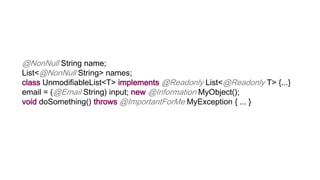
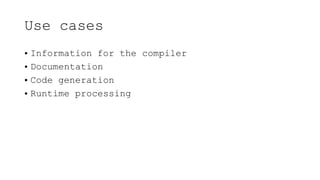
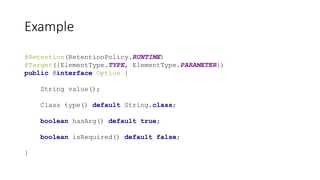
This document discusses Java annotations and provides examples of their use. It explains that annotations can be used on classes, fields, methods, packages, variables, and types to provide information to compilers, for documentation purposes, code generation, and runtime processing. It also describes the @Target and @Retention meta-annotations that specify where annotations can be applied and whether they are available at compile time, class time, or runtime. The document gives examples of built-in annotations like @Deprecated and @Override as well as custom annotations.


