
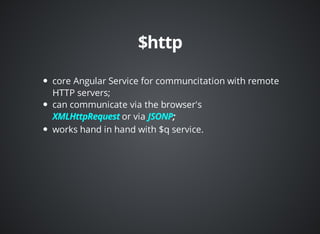

core Angular Service for communcitation with remote 
HTTP servers; 
can communicate via the browser's 
or via 
works hand in hand with $q service.
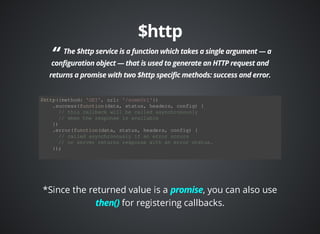
$http({method: 'GET', url: '/someUrl'}) 
.success(function(data, status, headers, config) { 
// this callback will be called asynchronously 
// when the response is available 
}) 
.error(function(data, status, headers, config) { 
// called asynchronously if an error occurs 
// or server returns response with an error status. 
}); 
*Since the returned value is a , you can also use 
for registering callbacks.
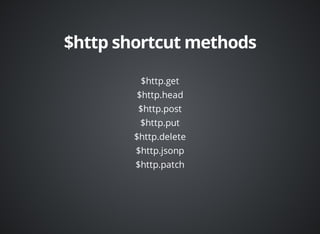
$http.get 
$http.head 
$http.post 
$http.put 
$http.delete 
$http.jsonp 
$http.patch
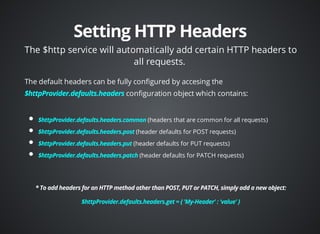
The $http service will automatically add certain HTTP headers to 
all requests. 
The default headers can be fully configured by accesing the 
configuration object which contains: 
(headers that are common for all requests) 
(header defaults for POST requests) 
(header defaults for PUT requests) 
(header defaults for PATCH requests)
//Add a new function at the end of chain 
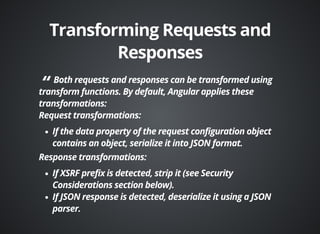
$httpProvider.defaults.transformResponse.push(function(data, headersGetter){ 
//data it's already converted from an angular default transformer 
data.total = headersGetter('X-Total-Count'); 
return data; 
}); 
//Replace the entire chain 
$httpProvider.defaults.transformResponse = [function(data, headersGetter){ 
//assume the data is a JSON string 
var tranformedData = angular.fromJson(data); 
tranformedData.total = headersGetter('X-Total-Count'); 
return tranformedData; 
}];
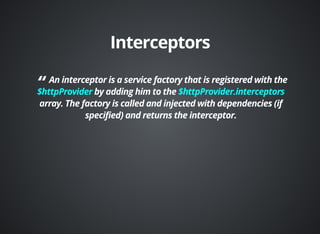
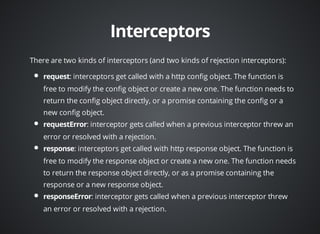
There are two kinds of interceptors (and two kinds of rejection interceptors): 
: interceptors get called with a http config object. The function is 
free to modify the config object or create a new one. The function needs to 
return the config object directly, or a promise containing the config or a 
new config object. 
: interceptor gets called when a previous interceptor threw an 
error or resolved with a rejection. 
: interceptors get called with http response object. The function is 
free to modify the response object or create a new one. The function needs 
to return the response object directly, or as a promise containing the 
response or a new response object. 
: interceptor gets called when a previous interceptor threw 
an error or resolved with a rejection.
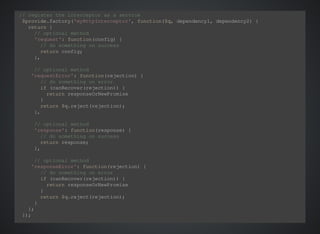
// register the interceptor as a service 
$provide.factory('myHttpInterceptor', function($q, dependency1, dependency2) { 
return { 
// optional method 
'request': function(config) { 
// do something on success 
return config; 
}, 
// optional method 
'requestError': function(rejection) { 
// do something on error 
if (canRecover(rejection)) { 
return responseOrNewPromise 
} 
return $q.reject(rejection); 
}, 
// optional method 
'response': function(response) { 
// do something on success 
return response; 
}, 
// optional method 
'responseError': function(rejection) { 
// do something on error 
if (canRecover(rejection)) { 
return responseOrNewPromise 
} 
return $q.reject(rejection); 
} 
}; 
}); 
$httpProvider.interceptors.push('myHttpInterceptor');
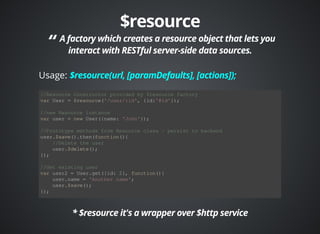
Usage: 
//Resource Constructor provided by $resource factory 
var User = $resource('/user/:id', {id:'@id'}); 
//new Resource instance 
var user = new User({name: 'John'}); 
//Prototype methods from Resource class - persist to backend 
user.$save().then(function(){ 
//Delete the user 
user.$delete(); 
}); 
//Get existing user 
var user2 = User.get({id: 2}, function(){ 
user.name = 'Another name'; 
user.$save(); 
});
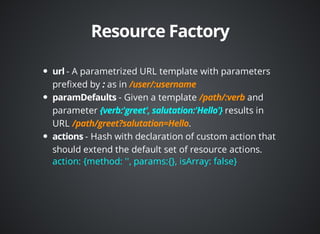
- A parametrized URL template with parameters 
prefixed by as in 
- Given a template and 
parameter results in 
URL . 
- Hash with declaration of custom action that 
should extend the default set of resource actions. 
action: {method: '', params:{}, isArray: false}
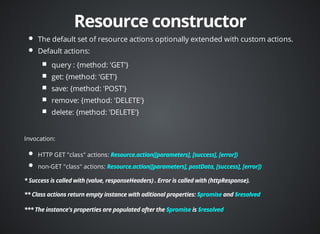
The default set of resource actions optionally extended with custom actions. 
Default actions: 
query : {method: 'GET'} 
get: {method: 'GET'} 
save: {method: 'POST'} 
remove: {method: 'DELETE'} 
delete: {method: 'DELETE'} 
Invocation: 
HTTP GET "class" actions: 
non-GET "class" actions:
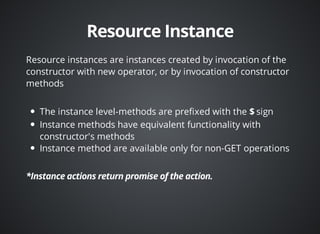
Resource instances are instances created by invocation of the 
constructor with new operator, or by invocation of constructor 
methods 
The instance level-methods are prefixed with the sign 
Instance methods have equivalent functionality with 
constructor's methods 
Instance method are available only for non-GET operations
Plunker Example
Angular Api Reference

Angular server-side communication

  • 3.
    core Angular Servicefor communcitation with remote HTTP servers; can communicate via the browser's or via works hand in hand with $q service.
  • 4.
    $http({method: 'GET', url:'/someUrl'}) .success(function(data, status, headers, config) { // this callback will be called asynchronously // when the response is available }) .error(function(data, status, headers, config) { // called asynchronously if an error occurs // or server returns response with an error status. }); *Since the returned value is a , you can also use for registering callbacks.
  • 5.
    $http.get $http.head $http.post $http.put $http.delete $http.jsonp $http.patch
  • 9.
    The $http servicewill automatically add certain HTTP headers to all requests. The default headers can be fully configured by accesing the configuration object which contains: (headers that are common for all requests) (header defaults for POST requests) (header defaults for PUT requests) (header defaults for PATCH requests)
  • 11.
    //Add a newfunction at the end of chain $httpProvider.defaults.transformResponse.push(function(data, headersGetter){ //data it's already converted from an angular default transformer data.total = headersGetter('X-Total-Count'); return data; }); //Replace the entire chain $httpProvider.defaults.transformResponse = [function(data, headersGetter){ //assume the data is a JSON string var tranformedData = angular.fromJson(data); tranformedData.total = headersGetter('X-Total-Count'); return tranformedData; }];
  • 14.
    There are twokinds of interceptors (and two kinds of rejection interceptors): : interceptors get called with a http config object. The function is free to modify the config object or create a new one. The function needs to return the config object directly, or a promise containing the config or a new config object. : interceptor gets called when a previous interceptor threw an error or resolved with a rejection. : interceptors get called with http response object. The function is free to modify the response object or create a new one. The function needs to return the response object directly, or as a promise containing the response or a new response object. : interceptor gets called when a previous interceptor threw an error or resolved with a rejection.
  • 15.
    // register theinterceptor as a service $provide.factory('myHttpInterceptor', function($q, dependency1, dependency2) { return { // optional method 'request': function(config) { // do something on success return config; }, // optional method 'requestError': function(rejection) { // do something on error if (canRecover(rejection)) { return responseOrNewPromise } return $q.reject(rejection); }, // optional method 'response': function(response) { // do something on success return response; }, // optional method 'responseError': function(rejection) { // do something on error if (canRecover(rejection)) { return responseOrNewPromise } return $q.reject(rejection); } }; }); $httpProvider.interceptors.push('myHttpInterceptor');
  • 17.
    Usage: //Resource Constructorprovided by $resource factory var User = $resource('/user/:id', {id:'@id'}); //new Resource instance var user = new User({name: 'John'}); //Prototype methods from Resource class - persist to backend user.$save().then(function(){ //Delete the user user.$delete(); }); //Get existing user var user2 = User.get({id: 2}, function(){ user.name = 'Another name'; user.$save(); });
  • 18.
    - A parametrizedURL template with parameters prefixed by as in - Given a template and parameter results in URL . - Hash with declaration of custom action that should extend the default set of resource actions. action: {method: '', params:{}, isArray: false}
  • 20.
    The default setof resource actions optionally extended with custom actions. Default actions: query : {method: 'GET'} get: {method: 'GET'} save: {method: 'POST'} remove: {method: 'DELETE'} delete: {method: 'DELETE'} Invocation: HTTP GET "class" actions: non-GET "class" actions:
  • 21.
    Resource instances areinstances created by invocation of the constructor with new operator, or by invocation of constructor methods The instance level-methods are prefixed with the sign Instance methods have equivalent functionality with constructor's methods Instance method are available only for non-GET operations
  • 22.
  • 23.