ANALYZING THE PROCESS OF READING
Reading and Writing
At the end of this module, you are expected to:
o define reading;
o understand the process of
reading;
o identify different elements in
the process of reading; and
o explain reading as
comprehension through the
different levels of reading
ESSENTIAL QUESTIONS 1
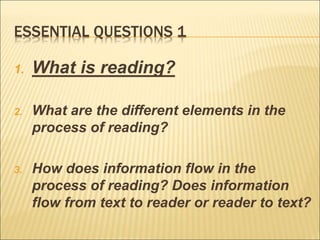
1. What is reading?
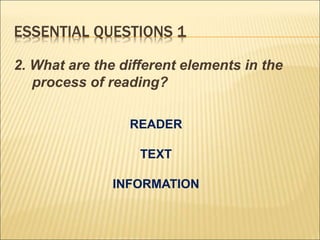
2. What are the different elements in the
process of reading?
3. How does information flow in the
process of reading? Does information
flow from text to reader or reader to text?
TASK 1. READ THE FOLLOWING TEXTS AND PICTURES
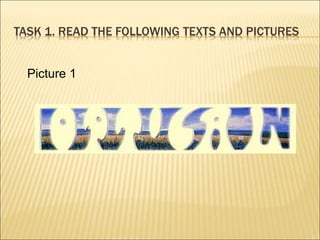
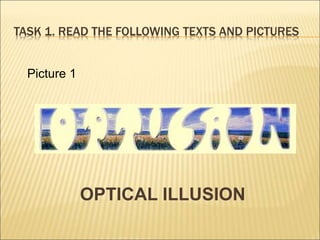
Picture 1
TASK 1. READ THE FOLLOWING TEXTS AND PICTURES
OPTICAL ILLUSION
Picture 1
TASK 1. READ THE FOLLOWING TEXTS AND PICTURES
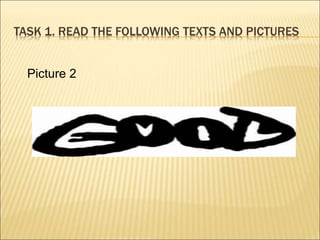
Picture 2
TASK 1. READ THE FOLLOWING TEXTS AND PICTURES
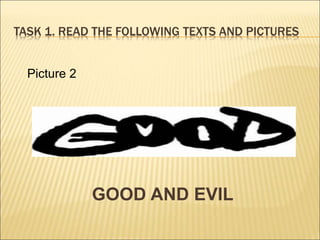
GOOD AND EVIL
Picture 2
TASK 1. READ THE FOLLOWING TEXTS AND PICTURES
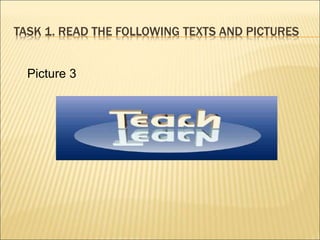
Picture 3
TASK 1. READ THE FOLLOWING TEXTS AND PICTURES
TEACH AND LEARN
Picture 3
TASK 1. READ THE FOLLOWING TEXTS AND PICTURES
Text 1
7H15 M3554G3 53RV35 7O PR0V3 H0W 0UR
M1ND5 C4N D0 4M4Z1NG 7H1NG5!
1MPR3551V3 7H1NG5! 1N 7H3 B3G1NN1NG
17 WA5 H4RD BU7 N0W, 0N 7H15 LIN3 Y0UR
M1ND 1S R34D1NG 17 4U70M471C4LLY W17H
0U7 3V3N 7H1NK1NG 4B0U7 17, B3 PROUD!
0NLY C3R741N P30PL3 C4N R3AD 7H15.
PL3453 F0RW4RD 1F U C4N R34D 7H15.
(Source: http://didyouknow.org/numbers-as-letters/)
TASK 1. READ THE FOLLOWING TEXTS AND PICTURES
Text 1
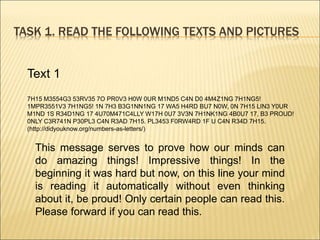
7H15 M3554G3 53RV35 7O PR0V3 H0W 0UR M1ND5 C4N D0 4M4Z1NG 7H1NG5!
1MPR3551V3 7H1NG5! 1N 7H3 B3G1NN1NG 17 WA5 H4RD BU7 N0W, 0N 7H15 LIN3 Y0UR
M1ND 1S R34D1NG 17 4U70M471C4LLY W17H 0U7 3V3N 7H1NK1NG 4B0U7 17, B3 PROUD!
0NLY C3R741N P30PL3 C4N R3AD 7H15. PL3453 F0RW4RD 1F U C4N R34D 7H15.
(http://didyouknow.org/numbers-as-letters/)
This message serves to prove how our minds can
do amazing things! Impressive things! In the
beginning it was hard but now, on this line your mind
is reading it automatically without even thinking
about it, be proud! Only certain people can read this.
Please forward if you can read this.
TASK 1. READ THE FOLLOWING TEXTS AND PICTURES
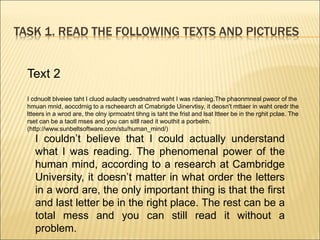
Text 2
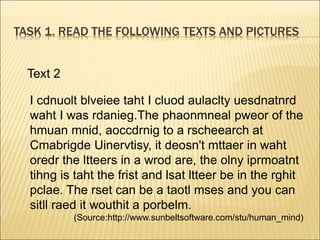
I cdnuolt blveiee taht I cluod aulaclty uesdnatnrd
waht I was rdanieg.The phaonmneal pweor of the
hmuan mnid, aoccdrnig to a rscheearch at
Cmabrigde Uinervtisy, it deosn't mttaer in waht
oredr the ltteers in a wrod are, the olny iprmoatnt
tihng is taht the frist and lsat ltteer be in the rghit
pclae. The rset can be a taotl mses and you can
sitll raed it wouthit a porbelm.
(Source:http://www.sunbeltsoftware.com/stu/human_mind)
TASK 1. READ THE FOLLOWING TEXTS AND PICTURES
Text 2
I cdnuolt blveiee taht I cluod aulaclty uesdnatnrd waht I was rdanieg.The phaonmneal pweor of the
hmuan mnid, aoccdrnig to a rscheearch at Cmabrigde Uinervtisy, it deosn't mttaer in waht oredr the
ltteers in a wrod are, the olny iprmoatnt tihng is taht the frist and lsat ltteer be in the rghit pclae. The
rset can be a taotl mses and you can sitll raed it wouthit a porbelm.
(http://www.sunbeltsoftware.com/stu/human_mind/)
I couldn’t believe that I could actually understand
what I was reading. The phenomenal power of the
human mind, according to a research at Cambridge
University, it doesn’t matter in what order the letters
in a word are, the only important thing is that the first
and last letter be in the right place. The rest can be a
total mess and you can still read it without a
problem.
REFLECTION QUESTIONS
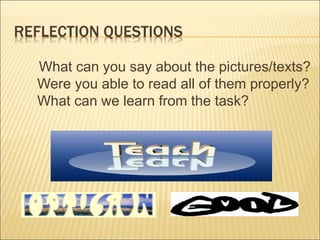
What can you say about the pictures/texts?
Were you able to read all of them properly?
What can we learn from the task?
ESSENTIAL QUESTIONS 1
1. What is reading?
2. What are the different elements in the
process of reading?
3. How does information flow in the
process of reading? Does information
flow from text to reader or reader to text?
ESSENTIAL QUESTIONS 1
1. What is reading?
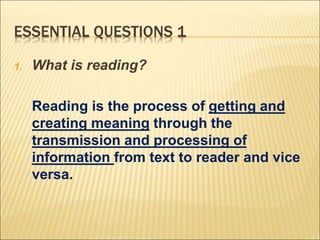
Reading is the process of getting and
creating meaning through the
transmission and processing of
information from text to reader and vice
versa.
ESSENTIAL QUESTIONS 1
1. What is reading?
2. What are the different elements
in the process of reading?
3. How does information flow in the
process of reading? Does information
flow from text to reader or reader to text?
ESSENTIAL QUESTIONS 1
2. What are the different elements in the
process of reading?
READER
TEXT
INFORMATION
ESSENTIAL QUESTIONS 1
1. What is reading?
2. What are the different elements in the
process of reading?
3. How does information flow in the
process of reading? Does
information flow from text to
reader or reader to text?
ESSENTIAL QUESTIONS 1
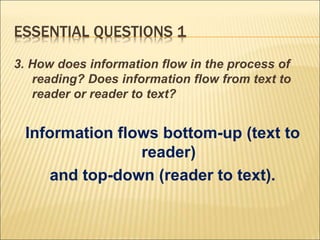
3. How does information flow in the process of
reading? Does information flow from text to
reader or reader to text?
Information flows bottom-up (text to
reader)
and top-down (reader to text).
ESSENTIAL QUESTIONS 2
1. In the process of reading, what is
schema?
2. What is the significance of schema
in the process of reading?
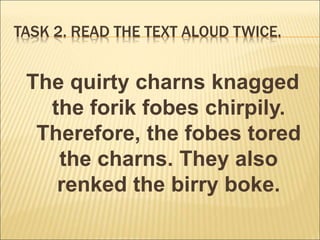
TASK 2. READ THE TEXT ALOUD TWICE.
The quirty charns knagged
the forik fobes chirpily.
Therefore, the fobes tored
the charns. They also
renked the birry boke.
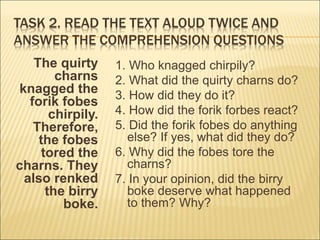
TASK 2. READ THE TEXT ALOUD TWICE AND
ANSWER THE COMPREHENSION QUESTIONS
The quirty
charns
knagged the
forik fobes
chirpily.
Therefore,
the fobes
tored the
charns. They
also renked
the birry
boke.
1. Who knagged chirpily?
2. What did the quirty charns do?
3. How did they do it?
4. How did the forik forbes react?
5. Did the forik fobes do anything
else? If yes, what did they do?
6. Why did the fobes tore the
charns?
7. In your opinion, did the birry
boke deserve what happened
to them? Why?
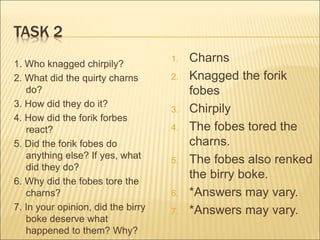
TASK 2
1. Who knagged chirpily?
2. What did the quirty charns
do?
3. How did they do it?
4. How did the forik forbes
react?
5. Did the forik fobes do
anything else? If yes, what
did they do?
6. Why did the fobes tore the
charns?
7. In your opinion, did the birry
boke deserve what
happened to them? Why?
1. Charns
2. Knagged the forik
fobes
3. Chirpily
4. The fobes tored the
charns.
5. The fobes also renked
the birry boke.
6. *Answers may vary.
7. *Answers may vary.
REFLECTION QUESTIONS
1. How many questions were you able to
answer? How were you able to
answer the comprehension
questions?
2. How many real English words are
there?
3. What does the activity tell us about
reading and comprehension?
ESSENTIAL QUESTIONS 2
1. In the process of reading,
what is schema?
2. What is the significance of schema
in the process of reading?
ESSENTIAL QUESTIONS 2
1. In the process of reading, what is
schema?
Schemata, schema, or background
knowledge - - everything that we have
learned, acquired and experienced since the
day we were born.
ESSENTIAL QUESTIONS 2
1. In the process of reading,
what is schema?
2. What is the significance of schema
in the process of reading?
ESSENTIAL QUESTIONS 2
2. What is the significance of schema in the
process of reading?
Problems in comprehension can sometimes be
traced back to insufficient background
knowledge on the part of the reader. This is a
common experience among students studying
a new topic. Often times, insufficient
background knowledge on a specific topic
may result in poor comprehension of a reading
material.
OTHER REASONS FOR POOR COMPREHENSION
1. Failure to understand a word
2. Failure to understand a sentence
3. Failure to understand how sentences relate to
one another
4. Failure to understand how the information fits
together in a meaningful way (organization)
5. Lack of interest or concentration
(Twining, 1991 in Bandura)
EVALUATION
ENGL101
EVALUATION
1. In one sentence, define reading as a
process.
2. What are the different elements in the
process of reading?
3. In the process of reading, does information
flow from text to reader or reader to text?
4. What are the different levels of
comprehension?
5. What is the importance of knowing more
about the reading process?
ADDITIONAL READING TASK:
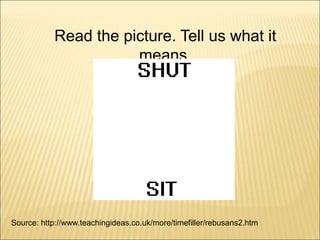
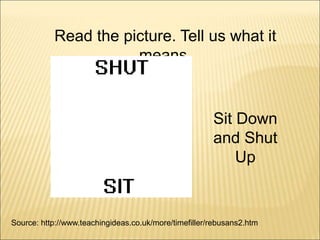
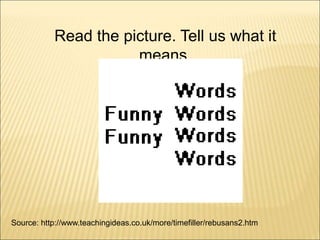
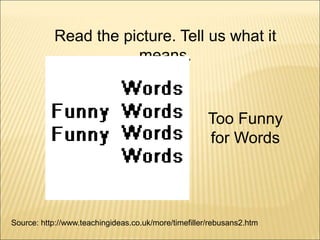
READING REBUS*
WHAT’S A REBUS?
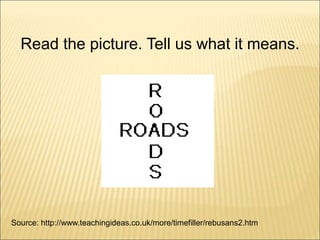
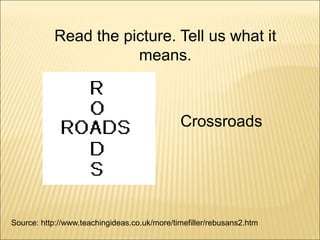
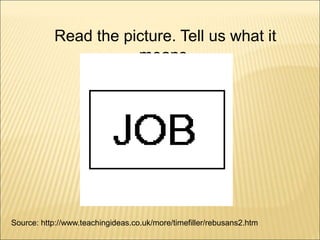
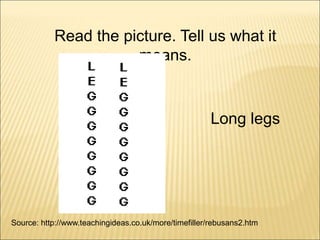
 A rebus is an allusional device that uses
pictures to represent words or parts of words.
 It was a favourite form of heraldic expression
used in the Middle Ages to denote surnames,
for example in its basic form
three salmon fish to denote the name
"Salmon".
.
http://en.wikipedia.org/wiki/Rebus
Source: http://www.teachingideas.co.uk/more/timefiller/rebusans2.htm
Read the picture. Tell us what it means.
Source: http://www.teachingideas.co.uk/more/timefiller/rebusans2.htm
Crossroads
Read the picture. Tell us what it
means.
Source: http://www.teachingideas.co.uk/more/timefiller/rebusans2.htm
Read the picture. Tell us what it
means.
Source: http://www.teachingideas.co.uk/more/timefiller/rebusans2.htm
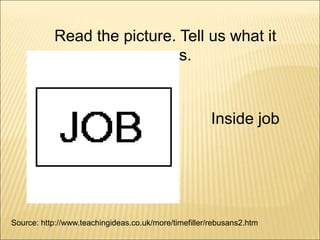
Inside job
Read the picture. Tell us what it
means.
Source: http://www.teachingideas.co.uk/more/timefiller/rebusans2.htm
Read the picture. Tell us what it
means.
Source: http://www.teachingideas.co.uk/more/timefiller/rebusans2.htm
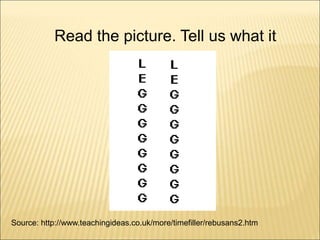
Long legs
Read the picture. Tell us what it
means.
Source: http://www.teachingideas.co.uk/more/timefiller/rebusans2.htm
Read the picture. Tell us what it
means.
Source: http://www.teachingideas.co.uk/more/timefiller/rebusans2.htm
Sit Down
and Shut
Up
Read the picture. Tell us what it
means.
Source: http://www.teachingideas.co.uk/more/timefiller/rebusans2.htm
Read the picture. Tell us what it
means.
Source: http://www.teachingideas.co.uk/more/timefiller/rebusans2.htm
Too Funny
for Words
Read the picture. Tell us what it
means.

ANALYZING THE PROCESS OF READING ING.pptx

  • 1.
    ANALYZING THE PROCESSOF READING Reading and Writing
  • 2.
    At the endof this module, you are expected to: o define reading; o understand the process of reading; o identify different elements in the process of reading; and o explain reading as comprehension through the different levels of reading
  • 3.
    ESSENTIAL QUESTIONS 1 1.What is reading? 2. What are the different elements in the process of reading? 3. How does information flow in the process of reading? Does information flow from text to reader or reader to text?
  • 4.
    TASK 1. READTHE FOLLOWING TEXTS AND PICTURES Picture 1
  • 5.
    TASK 1. READTHE FOLLOWING TEXTS AND PICTURES OPTICAL ILLUSION Picture 1
  • 6.
    TASK 1. READTHE FOLLOWING TEXTS AND PICTURES Picture 2
  • 7.
    TASK 1. READTHE FOLLOWING TEXTS AND PICTURES GOOD AND EVIL Picture 2
  • 8.
    TASK 1. READTHE FOLLOWING TEXTS AND PICTURES Picture 3
  • 9.
    TASK 1. READTHE FOLLOWING TEXTS AND PICTURES TEACH AND LEARN Picture 3
  • 10.
    TASK 1. READTHE FOLLOWING TEXTS AND PICTURES Text 1 7H15 M3554G3 53RV35 7O PR0V3 H0W 0UR M1ND5 C4N D0 4M4Z1NG 7H1NG5! 1MPR3551V3 7H1NG5! 1N 7H3 B3G1NN1NG 17 WA5 H4RD BU7 N0W, 0N 7H15 LIN3 Y0UR M1ND 1S R34D1NG 17 4U70M471C4LLY W17H 0U7 3V3N 7H1NK1NG 4B0U7 17, B3 PROUD! 0NLY C3R741N P30PL3 C4N R3AD 7H15. PL3453 F0RW4RD 1F U C4N R34D 7H15. (Source: http://didyouknow.org/numbers-as-letters/)
  • 11.
    TASK 1. READTHE FOLLOWING TEXTS AND PICTURES Text 1 7H15 M3554G3 53RV35 7O PR0V3 H0W 0UR M1ND5 C4N D0 4M4Z1NG 7H1NG5! 1MPR3551V3 7H1NG5! 1N 7H3 B3G1NN1NG 17 WA5 H4RD BU7 N0W, 0N 7H15 LIN3 Y0UR M1ND 1S R34D1NG 17 4U70M471C4LLY W17H 0U7 3V3N 7H1NK1NG 4B0U7 17, B3 PROUD! 0NLY C3R741N P30PL3 C4N R3AD 7H15. PL3453 F0RW4RD 1F U C4N R34D 7H15. (http://didyouknow.org/numbers-as-letters/) This message serves to prove how our minds can do amazing things! Impressive things! In the beginning it was hard but now, on this line your mind is reading it automatically without even thinking about it, be proud! Only certain people can read this. Please forward if you can read this.
  • 12.
    TASK 1. READTHE FOLLOWING TEXTS AND PICTURES Text 2 I cdnuolt blveiee taht I cluod aulaclty uesdnatnrd waht I was rdanieg.The phaonmneal pweor of the hmuan mnid, aoccdrnig to a rscheearch at Cmabrigde Uinervtisy, it deosn't mttaer in waht oredr the ltteers in a wrod are, the olny iprmoatnt tihng is taht the frist and lsat ltteer be in the rghit pclae. The rset can be a taotl mses and you can sitll raed it wouthit a porbelm. (Source:http://www.sunbeltsoftware.com/stu/human_mind)
  • 13.
    TASK 1. READTHE FOLLOWING TEXTS AND PICTURES Text 2 I cdnuolt blveiee taht I cluod aulaclty uesdnatnrd waht I was rdanieg.The phaonmneal pweor of the hmuan mnid, aoccdrnig to a rscheearch at Cmabrigde Uinervtisy, it deosn't mttaer in waht oredr the ltteers in a wrod are, the olny iprmoatnt tihng is taht the frist and lsat ltteer be in the rghit pclae. The rset can be a taotl mses and you can sitll raed it wouthit a porbelm. (http://www.sunbeltsoftware.com/stu/human_mind/) I couldn’t believe that I could actually understand what I was reading. The phenomenal power of the human mind, according to a research at Cambridge University, it doesn’t matter in what order the letters in a word are, the only important thing is that the first and last letter be in the right place. The rest can be a total mess and you can still read it without a problem.
  • 14.
    REFLECTION QUESTIONS What canyou say about the pictures/texts? Were you able to read all of them properly? What can we learn from the task?
  • 15.
    ESSENTIAL QUESTIONS 1 1.What is reading? 2. What are the different elements in the process of reading? 3. How does information flow in the process of reading? Does information flow from text to reader or reader to text?
  • 16.
    ESSENTIAL QUESTIONS 1 1.What is reading? Reading is the process of getting and creating meaning through the transmission and processing of information from text to reader and vice versa.
  • 17.
    ESSENTIAL QUESTIONS 1 1.What is reading? 2. What are the different elements in the process of reading? 3. How does information flow in the process of reading? Does information flow from text to reader or reader to text?
  • 18.
    ESSENTIAL QUESTIONS 1 2.What are the different elements in the process of reading? READER TEXT INFORMATION
  • 19.
    ESSENTIAL QUESTIONS 1 1.What is reading? 2. What are the different elements in the process of reading? 3. How does information flow in the process of reading? Does information flow from text to reader or reader to text?
  • 20.
    ESSENTIAL QUESTIONS 1 3.How does information flow in the process of reading? Does information flow from text to reader or reader to text? Information flows bottom-up (text to reader) and top-down (reader to text).
  • 21.
    ESSENTIAL QUESTIONS 2 1.In the process of reading, what is schema? 2. What is the significance of schema in the process of reading?
  • 22.
    TASK 2. READTHE TEXT ALOUD TWICE. The quirty charns knagged the forik fobes chirpily. Therefore, the fobes tored the charns. They also renked the birry boke.
  • 23.
    TASK 2. READTHE TEXT ALOUD TWICE AND ANSWER THE COMPREHENSION QUESTIONS The quirty charns knagged the forik fobes chirpily. Therefore, the fobes tored the charns. They also renked the birry boke. 1. Who knagged chirpily? 2. What did the quirty charns do? 3. How did they do it? 4. How did the forik forbes react? 5. Did the forik fobes do anything else? If yes, what did they do? 6. Why did the fobes tore the charns? 7. In your opinion, did the birry boke deserve what happened to them? Why?
  • 24.
    TASK 2 1. Whoknagged chirpily? 2. What did the quirty charns do? 3. How did they do it? 4. How did the forik forbes react? 5. Did the forik fobes do anything else? If yes, what did they do? 6. Why did the fobes tore the charns? 7. In your opinion, did the birry boke deserve what happened to them? Why? 1. Charns 2. Knagged the forik fobes 3. Chirpily 4. The fobes tored the charns. 5. The fobes also renked the birry boke. 6. *Answers may vary. 7. *Answers may vary.
  • 25.
    REFLECTION QUESTIONS 1. Howmany questions were you able to answer? How were you able to answer the comprehension questions? 2. How many real English words are there? 3. What does the activity tell us about reading and comprehension?
  • 26.
    ESSENTIAL QUESTIONS 2 1.In the process of reading, what is schema? 2. What is the significance of schema in the process of reading?
  • 27.
    ESSENTIAL QUESTIONS 2 1.In the process of reading, what is schema? Schemata, schema, or background knowledge - - everything that we have learned, acquired and experienced since the day we were born.
  • 28.
    ESSENTIAL QUESTIONS 2 1.In the process of reading, what is schema? 2. What is the significance of schema in the process of reading?
  • 29.
    ESSENTIAL QUESTIONS 2 2.What is the significance of schema in the process of reading? Problems in comprehension can sometimes be traced back to insufficient background knowledge on the part of the reader. This is a common experience among students studying a new topic. Often times, insufficient background knowledge on a specific topic may result in poor comprehension of a reading material.
  • 30.
    OTHER REASONS FORPOOR COMPREHENSION 1. Failure to understand a word 2. Failure to understand a sentence 3. Failure to understand how sentences relate to one another 4. Failure to understand how the information fits together in a meaningful way (organization) 5. Lack of interest or concentration (Twining, 1991 in Bandura)
  • 31.
  • 32.
    EVALUATION 1. In onesentence, define reading as a process. 2. What are the different elements in the process of reading? 3. In the process of reading, does information flow from text to reader or reader to text? 4. What are the different levels of comprehension? 5. What is the importance of knowing more about the reading process?
  • 33.
  • 34.
    WHAT’S A REBUS? A rebus is an allusional device that uses pictures to represent words or parts of words.  It was a favourite form of heraldic expression used in the Middle Ages to denote surnames, for example in its basic form three salmon fish to denote the name "Salmon". . http://en.wikipedia.org/wiki/Rebus
  • 35.
  • 36.
  • 37.
  • 38.
  • 39.
  • 40.
  • 41.
  • 42.
  • 43.
  • 44.

Editor's Notes

  • #34 *As time-filler, for fun, and further proof that reading is getting and giving information.
  • #35 In linguistics, the rebus principle means using existing symbols, such as pictograms, purely for their sounds regardless of their meaning, to represent new words. Many ancient writing systems used the rebus principle to represent abstract words, which otherwise would be hard to be represented by pictograms. http://en.wikipedia.org/wiki/Rebus