Vijaykumar H.K et al Int. Journal of Engineering Research and Applications www.ijera.com 
ISSN : 2248-9622, Vol. 4, Issue 7( Version 1), July 2014, pp.41-48 
www.ijera.com 41 | P a g e 
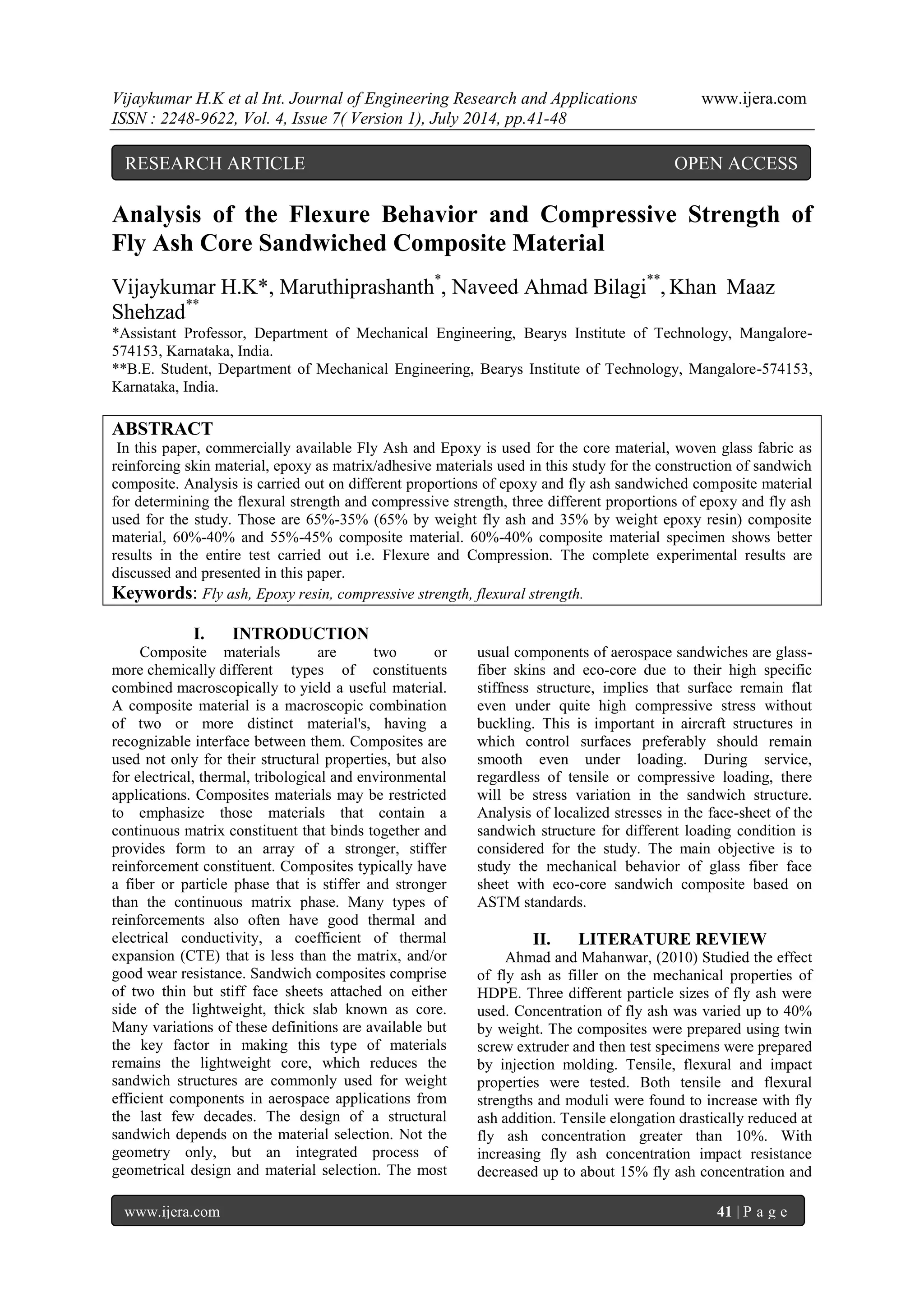
Analysis of the Flexure Behavior and Compressive Strength of Fly Ash Core Sandwiched Composite Material Vijaykumar H.K*, Maruthiprashanth*, Naveed Ahmad Bilagi**, Khan Maaz Shehzad** *Assistant Professor, Department of Mechanical Engineering, Bearys Institute of Technology, Mangalore- 574153, Karnataka, India. **B.E. Student, Department of Mechanical Engineering, Bearys Institute of Technology, Mangalore-574153, Karnataka, India. ABSTRACT In this paper, commercially available Fly Ash and Epoxy is used for the core material, woven glass fabric as reinforcing skin material, epoxy as matrix/adhesive materials used in this study for the construction of sandwich composite. Analysis is carried out on different proportions of epoxy and fly ash sandwiched composite material for determining the flexural strength and compressive strength, three different proportions of epoxy and fly ash used for the study. Those are 65%-35% (65% by weight fly ash and 35% by weight epoxy resin) composite material, 60%-40% and 55%-45% composite material. 60%-40% composite material specimen shows better results in the entire test carried out i.e. Flexure and Compression. The complete experimental results are discussed and presented in this paper. Keywords: Fly ash, Epoxy resin, compressive strength, flexural strength. 
I. INTRODUCTION 
Composite materials are two or more chemically different types of constituents combined macroscopically to yield a useful material. A composite material is a macroscopic combination of two or more distinct material's, having a recognizable interface between them. Composites are used not only for their structural properties, but also for electrical, thermal, tribological and environmental applications. Composites materials may be restricted to emphasize those materials that contain a continuous matrix constituent that binds together and provides form to an array of a stronger, stiffer reinforcement constituent. Composites typically have a fiber or particle phase that is stiffer and stronger than the continuous matrix phase. Many types of reinforcements also often have good thermal and electrical conductivity, a coefficient of thermal expansion (CTE) that is less than the matrix, and/or good wear resistance. Sandwich composites comprise of two thin but stiff face sheets attached on either side of the lightweight, thick slab known as core. Many variations of these definitions are available but the key factor in making this type of materials remains the lightweight core, which reduces the sandwich structures are commonly used for weight efficient components in aerospace applications from the last few decades. The design of a structural sandwich depends on the material selection. Not the geometry only, but an integrated process of geometrical design and material selection. The most usual components of aerospace sandwiches are glass- fiber skins and eco-core due to their high specific stiffness structure, implies that surface remain flat even under quite high compressive stress without buckling. This is important in aircraft structures in which control surfaces preferably should remain smooth even under loading. During service, regardless of tensile or compressive loading, there will be stress variation in the sandwich structure. Analysis of localized stresses in the face-sheet of the sandwich structure for different loading condition is considered for the study. The main objective is to study the mechanical behavior of glass fiber face sheet with eco-core sandwich composite based on ASTM standards. 
II. LITERATURE REVIEW 
Ahmad and Mahanwar, (2010) Studied the effect of fly ash as filler on the mechanical properties of HDPE. Three different particle sizes of fly ash were used. Concentration of fly ash was varied up to 40% by weight. The composites were prepared using twin screw extruder and then test specimens were prepared by injection molding. Tensile, flexural and impact properties were tested. Both tensile and flexural strengths and moduli were found to increase with fly ash addition. Tensile elongation drastically reduced at fly ash concentration greater than 10%. With increasing fly ash concentration impact resistance decreased up to about 15% fly ash concentration and 
RESEARCH ARTICLE OPEN ACCESS
Vijaykumar H.K et al Int. Journal of Engineering Research and Applications www.ijera.com 
ISSN : 2248-9622, Vol. 4, Issue 7( Version 1), July 2014, pp.41-48 
www.ijera.com 42 | P a g e 
then did not reduce significantly on further addition. Composites with smallest size fly ash particles proved to be better in enhancing strength and relative elongation [1].Kurt Feichtinger, (2006)focused on to compare the properties of identical laminate builds comprising two piles of 1808 E-glass fabric on each side of nominal ½”(12.5mm) thick core materials produced by vacuum-infusion and hand-layup processing. Core materials investigated included pre- coated/decay-resistant end-grain balsa, two densities and two suppliers of cross linked PVC foams, two extruded PET foams variants, an extruded polypropylene honey-comb core, one density of an SAN foam, three densities of polyurethane foam, and a special core comprised of an assembly of low- density polyurethane foam planks filament wound with E-glass roving, bound on both sides with scrim. All the core materials with the exception of the last two types were scrim med and had either knife-cut or saw-cut kerfs. The polyurethane foam cores were not scrim med, but instead were double cut. Characterizations included initial core density, laminated weight per unit area, average thickness and strength and stiffness for both flexural as well as “flat-wise” tensile testing. Significant among the findings of this study were a substantial reduction in overall panel thickness and aerial weight, subtle difference in flexural strength, a significantly lower flexure stiffness, slightly greater flat wise tensile strength, and significantly greater flat wise tensile moduli, for vacuum-infusion processing in comparison to hand lay-up [2].K.N. Shivakumar, (2000) focused on two composite laminated panels and one composite sandwich panel was fabricated using Vacuum Assisted Resin Transfer Molding (VARTM). One laminated panel was fabricated from woven E-glass and vinyl-ester resin, the other two from woven carbon and vinyl-ester resin. The sandwich panel was fabricated from woven E-glass, vinyl-ester resin and PVC foam. The measured fiber volume of the E-glass panel is 42%. The calculated fiber volume of the carbon panel is 50%. Tension, compression and shear test were performed to evaluate the mechanical properties of the composite panels. The measured tensile modulus, ultimate tensile strength and Poisson’s ratio of E-glass panel are 23.03 GPa, 325 MPa and 0.11 respectively. The measured shear modulus of E-glass panel is 3.86 GPa. The measured tensile modulus, ultimate strength and Poisson’s ratio of the carbon panel are 47.51 GPa, 436 MPa, and 0.04 respectively. The measured shear modulus of carbon panel was measured as 2.81 GPa. Three-point and four-point bending test were conducted on sandwich beams machined from the sandwich panel. Predicted beam deflection based on the properties calculated from face-sheet and core properties were in close agreement with the measured values for four points bending, but they were not for three point bending [3].Enrico Papa, (2001) focused on experimental investigation into the mechanical behavior of a composite sandwich conceived as a lightweight material for naval engineering applications. The sandwich structure is formed by a three dimensional glass fiber/polymer matrix fabric with transverse pile interconnecting the skins, the core filled with polymer matrix/glass microspheres syntactic foam; additional glass fiber Reinforced Plastics extra skins are laminated on the external facing of the filled fabric.. This work is part of a broader research investigation aimed at a complete characterization, both experimental and numerical, of the complex mechanical behavior of this composite sandwich [4].Kunigal Shivakumar, (2007) focused on the mechanical and fire resistant properties of a commercial material, U.S Gypsum’s Type X SHEETROCK, commonly used for these types of applications was compared with that type of Eco- Core. The results of this study have initiated that the mechanical properties of the Eco-Core are superior in all aspects, for example the compression strength was about 4x greater, the tension strength 3x greater, and the flexural strength was 8x greater. In addition, the fire resistance is comparable and the density is about 40% less. The details of this research are provided in the paper [5].S K Acharya, P Mishra & S C Mishra, (2008) aimed at processing a composite using fly ash, jute with epoxy resin and to study its weathering behavior on mechanical properties such as flexural strength. The fracture surfaces of the specimen are examined under scanning electron microscope. From the study, it appeared that fiber pullout is the predominant mode of failure. The cracking of the fiber structure was avoided due to adherence of fly ash particles which indicated the increase in strength of interfacial bonding. It concluded that this composite can be successfully used as a structural material in household and automobile application and as low cost building material [6].Kulkarni SM, Kishore, (2002) Compressive properties of epoxy composites reinforced with fly ash and fibers, which have differing aspect ratios, are studied. Retention of strength and modulus are observed for a greater range of fiber volume fractions following fly ash introduction into the system. A slight decrease in density was also observed when fly ash content was higher, making these composites with materials of differing aspect ratio bearing reinforcement systems suitable in weight specific applications. The investigations showed that strength decrease is larger in fiber-bearing samples compared with only ash- bearing samples. This decrease was ascribed to the tendency of fibers to bunch. When the ash filler was introduced, this tendency of fibers to cluster appears to be reduced, resulting in increased strength and modulus. Further attempts are made to analyze these
Vijaykumar H.K et al Int. Journal of Engineering Research and Applications www.ijera.com 
ISSN : 2248-9622, Vol. 4, Issue 7( Version 1), July 2014, pp.41-48 
www.ijera.com 43 | P a g e 
interactions of fibers and fillers through observations made on the surfaces of failed samples by scanning electron microscopy [7] .Thomsons J L, (2000) effect of fibre strength and diameter on the balance of mechanical properties of glass reinforced polyamide 6,6. The results show that the elastic properties of injection molded short glass fiber reinforced polyamide 6,6 are not strongly influenced by fiber diameter in the 10-17 micron range. The ultimate properties of these composites (strength and Izod impact) showed a clear dependence on fiber diameter and the presence of high strength S-2 glass® fibers. Tensile elongation, tensile and flexural strength, and unnotched Izod impact all decreased significantly over the 10-17 micron diameter range. Notched Izod impact showed a small but significant increase over the same range. Addition of 20% w/w of S-2 glass® to the 17 micron E-glass resulted in an 8% improvement in the fiber contribution to composite strength [8] Shah Khan M.Z. 2000 use of glass reinforced polymeric (GRP) composites as structural materials in naval mine countermeasure surface ships. Sea mines when detonated emit underwater shock waves, which could impart severe loading to a naval ship structure, and there are attempts to model the response of a ship structure to this loading.. An experimental program was therefore undertaken to determine the response to increasing strain rates of a number of GRP composites analogous to the actual structural materials. Compressively applied strain rates ranging from 10/s to 101/s and loading rates ranging from 2 to 1000 kN/s were achieved using a servo-hydraulic test machine. Specimens in the form of solid cylinders and cubes having dimensions of 10 mm by 10 mm were used and results are presented showing the effect of strain rate on the maximum strain, maximum strength and elastic modulus. The effect of loading rate on the fracture toughness of the composites was determined using notched three- point-bend specimens [9]. III. METHODOLOGY 
3.1 Preparation of core As per ASTM standard rule C271, the manufacturing technique is carried out. The technique used here is HAND LAYUP technique A mild steel square frame of dimension (304mm*304mm*12.5mm) is first fabricated. Aluminum foil is wrapped to it, so that the core can be easily removed after curing as shown in Fig.1 
Figure 1: Wrapping of Aluminum foil to the Frame Some amount of fly ash is taken & measured as per requirement. Similarly, resin & hardener are measured for the required quantity. The measured fly ash is mixed with the measured hardener & resin as shown in Fig.2 Figure2: Mixing of Measured Fly Ash, Resin and Hardener After mixing, the mixture of fly ash, resin & hardener are put into the frame Fig.3 Figure 3: Filling the mixture into the Aluminium covered Frame Next step is to allow the added up mixture to cure for 8-12 hours. After curing, the final product is obtained. Different proportions of fly ash and epoxy resins are carried out, namely 
 65% by wt. of Fly ash and 35% by wt. of Epoxy resin 
(I.e. 1.027 kg of Fly Ash and 331.8g Resin and 221.2g Hardener) 
 60% by wt. of Fly ash and 40% by wt. of Epoxy resin 
(I.e. 1.050kg of Fly Ash and 330g Resin and 220g Hardener) 
 55% by wt. of Fly ash and 45% by wt. of Epoxy resin
Vijaykumar H.K et al Int. Journal of Engineering Research and Applications www.ijera.com 
ISSN : 2248-9622, Vol. 4, Issue 7( Version 1), July 2014, pp.41-48 
www.ijera.com 44 | P a g e 
(I.e. .891kg of Fly Ash and 437.4g Resin and 291.6g Hardener) 
3.2 Bonding of Face Sheet to Core 
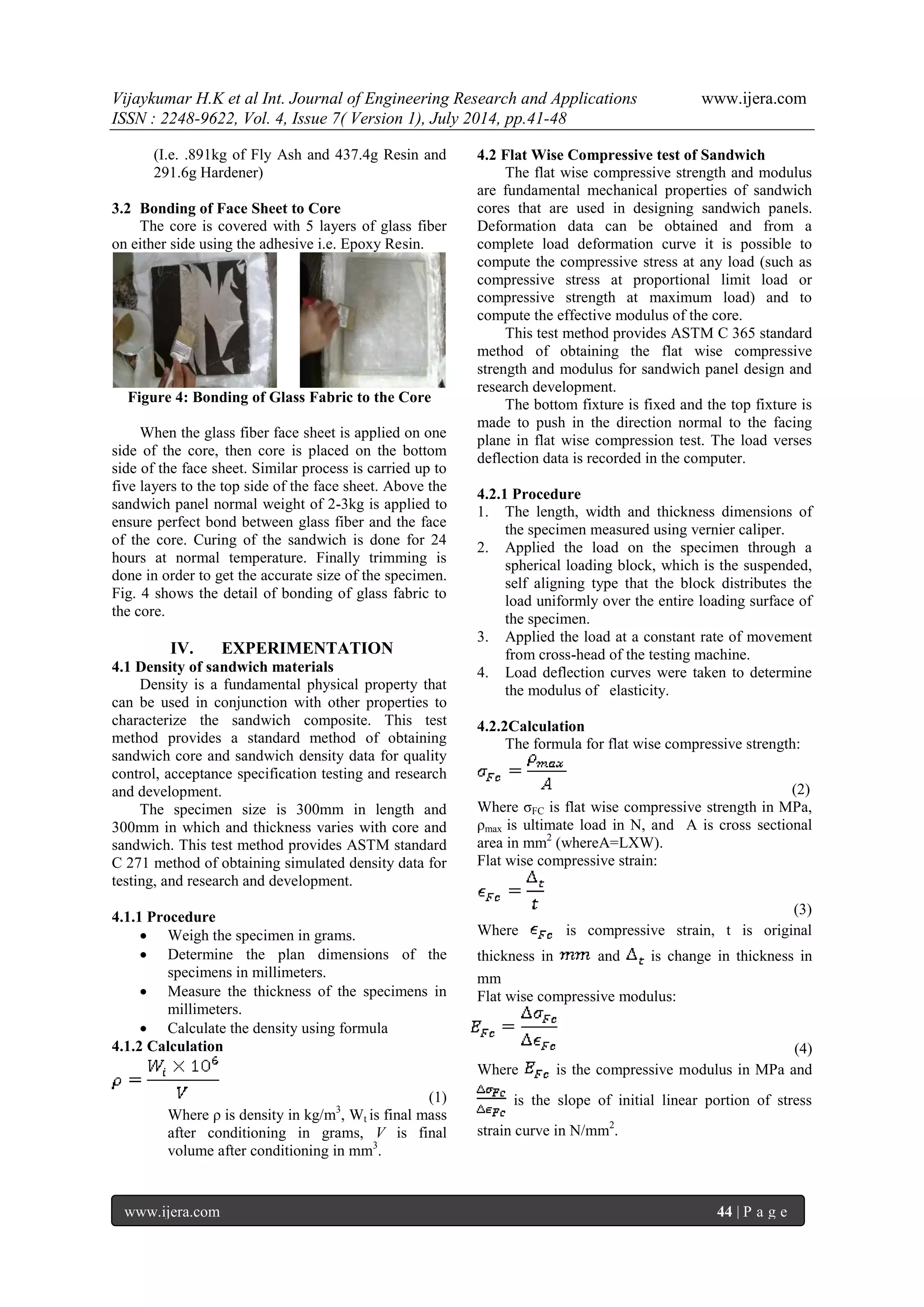
The core is covered with 5 layers of glass fiber on either side using the adhesive i.e. Epoxy Resin. Figure 4: Bonding of Glass Fabric to the Core When the glass fiber face sheet is applied on one side of the core, then core is placed on the bottom side of the face sheet. Similar process is carried up to five layers to the top side of the face sheet. Above the sandwich panel normal weight of 2-3kg is applied to ensure perfect bond between glass fiber and the face of the core. Curing of the sandwich is done for 24 hours at normal temperature. Finally trimming is done in order to get the accurate size of the specimen. Fig. 4 shows the detail of bonding of glass fabric to the core. 
IV. EXPERIMENTATION 
4.1 Density of sandwich materials Density is a fundamental physical property that can be used in conjunction with other properties to characterize the sandwich composite. This test method provides a standard method of obtaining sandwich core and sandwich density data for quality control, acceptance specification testing and research and development. The specimen size is 300mm in length and 300mm in which and thickness varies with core and sandwich. This test method provides ASTM standard C 271 method of obtaining simulated density data for testing, and research and development. 4.1.1 Procedure 
 Weigh the specimen in grams. 
 Determine the plan dimensions of the specimens in millimeters. 
 Measure the thickness of the specimens in millimeters. 
 Calculate the density using formula 
4.1.2 Calculation (1) Where ρ is density in kg/m3, Wt is final mass after conditioning in grams, V is final volume after conditioning in mm3. 
4.2 Flat Wise Compressive test of Sandwich 
The flat wise compressive strength and modulus are fundamental mechanical properties of sandwich cores that are used in designing sandwich panels. Deformation data can be obtained and from a complete load deformation curve it is possible to compute the compressive stress at any load (such as compressive stress at proportional limit load or compressive strength at maximum load) and to compute the effective modulus of the core. This test method provides ASTM C 365 standard method of obtaining the flat wise compressive strength and modulus for sandwich panel design and research development. The bottom fixture is fixed and the top fixture is made to push in the direction normal to the facing plane in flat wise compression test. The load verses deflection data is recorded in the computer. 4.2.1 Procedure 1. The length, width and thickness dimensions of the specimen measured using vernier caliper. 2. Applied the load on the specimen through a spherical loading block, which is the suspended, self aligning type that the block distributes the load uniformly over the entire loading surface of the specimen. 3. Applied the load at a constant rate of movement from cross-head of the testing machine. 4. Load deflection curves were taken to determine the modulus of elasticity. 4.2.2Calculation The formula for flat wise compressive strength: (2) Where σFC is flat wise compressive strength in MPa, ρmax is ultimate load in N, and A is cross sectional area in mm2 (whereA=LXW). Flat wise compressive strain: (3) Where is compressive strain, t is original thickness in and is change in thickness in mm Flat wise compressive modulus: (4) Where is the compressive modulus in MPa and is the slope of initial linear portion of stress strain curve in N/mm2.
Vijaykumar H.K et al Int. Journal of Engineering Research and Applications www.ijera.com 
ISSN : 2248-9622, Vol. 4, Issue 7( Version 1), July 2014, pp.41-48 
www.ijera.com 45 | P a g e 
4.3 Flexural test of Sandwich Composite 
Flexure tests on flat sandwich construction may 
be conducted to determine the sandwich flexural 
stiffness, the core shear strength and shear modulus 
or the facings compressive or tensile strengths. 
This test method provides ASTM C 393 
standard method of obtaining sandwich flexure 
properties for panel design and research and 
development. 
4.3.1 Procedure 
1. The length, width, thickness and span length 
dimensions of the specimen measured using vernier 
calliper. 
2. The load is applied at a constant rate on the mid 
span. 
3. Load-deflection curves can be taken to determine 
the sandwich stiffness and core shear modulus. 
4.3.2 Calculation 
Core shear stress: 
(5) 
Where core shear stress in MPa is, is 
maximum load in N, t is sandwich thickness in mm. 
Facing Bending Stress: 
(6) 
Where, is facing bending stress on MPa, tf is 
facing thickness in mm and L is span length in mm. 
V. RESULTS AND DISCUSSION 
5.1 Density results of sandwich composite 
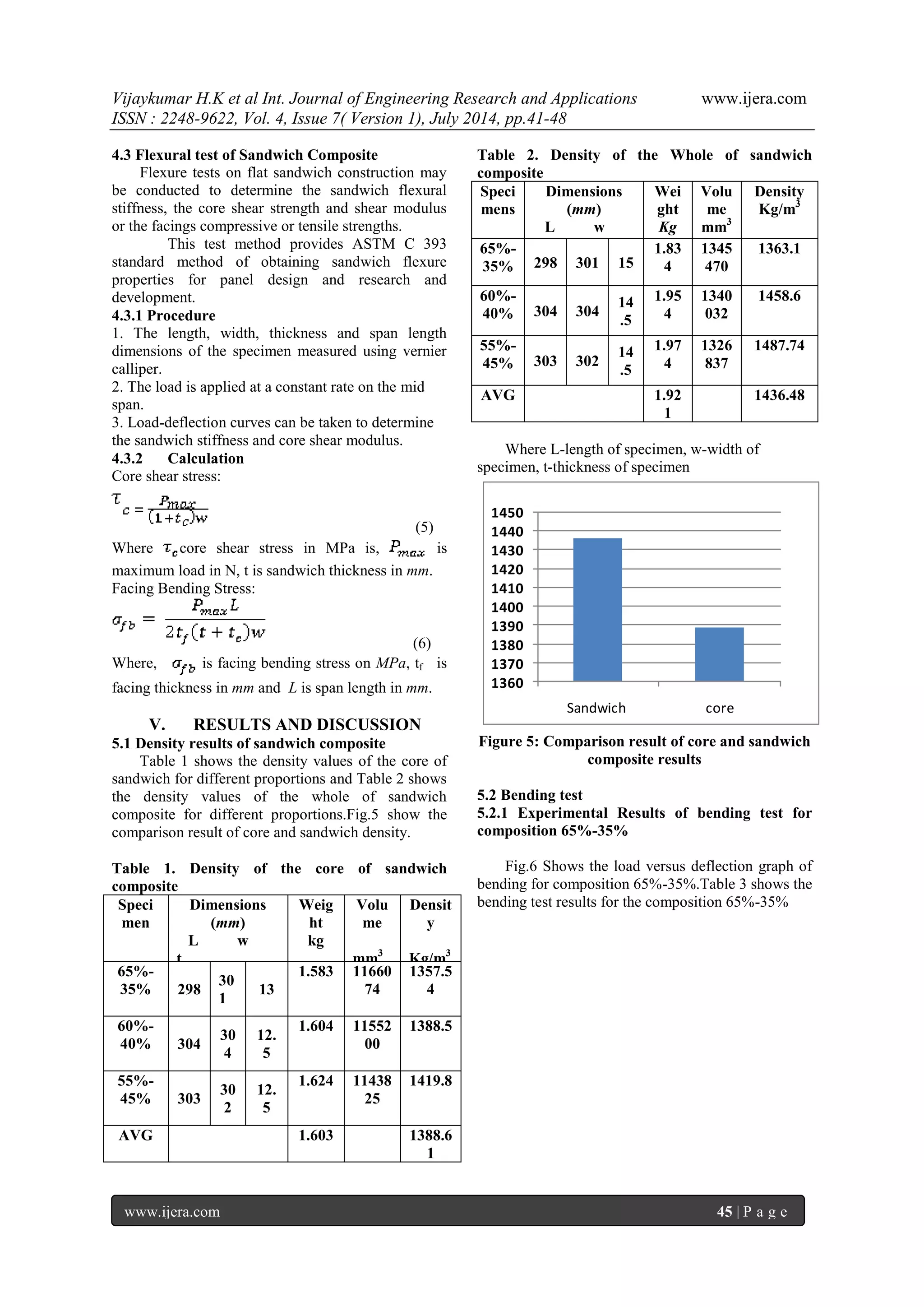
Table 1 shows the density values of the core of 
sandwich for different proportions and Table 2 shows 
the density values of the whole of sandwich 
composite for different proportions.Fig.5 show the 
comparison result of core and sandwich density. 
Table 1. Density of the core of sandwich 
composite 
Speci 
men 
Dimensions 
(mm) 
L w 
t 
Weig 
ht 
kg 
Volu 
me 
mm3 
Densit 
y 
Kg/m3 
65%- 
35% 298 
30 
1 
13 
1.583 11660 
74 
1357.5 
4 
60%- 
40% 304 
30 
4 
12. 
5 
1.604 11552 
00 
1388.5 
55%- 
45% 303 
30 
2 
12. 
5 
1.624 11438 
25 
1419.8 
AVG 
1.603 1388.6 
1 
Table 2. Density of the Whole of sandwich 
composite 
Speci 
mens 
Dimensions 
(mm) 
L w 
t 
Wei 
ght 
Kg 
Volu 
me 
mm3 
Density 
Kg/m3 
65%- 
35% 298 301 15 
1.83 
4 
1345 
470 
1363.1 
60%- 
40% 304 304 
14 
.5 
1.95 
4 
1340 
032 
1458.6 
55%- 
45% 303 302 
14 
.5 
1.97 
4 
1326 
837 
1487.74 
AVG 
1.92 
1 
1436.48 
Where L-length of specimen, w-width of 
specimen, t-thickness of specimen 
1360 
1370 
1380 
1390 
1400 
1410 
1420 
1430 
1440 
1450 
Sandwich core 
Figure 5: Comparison result of core and sandwich 
composite results 
5.2 Bending test 
5.2.1 Experimental Results of bending test for 
composition 65%-35% 
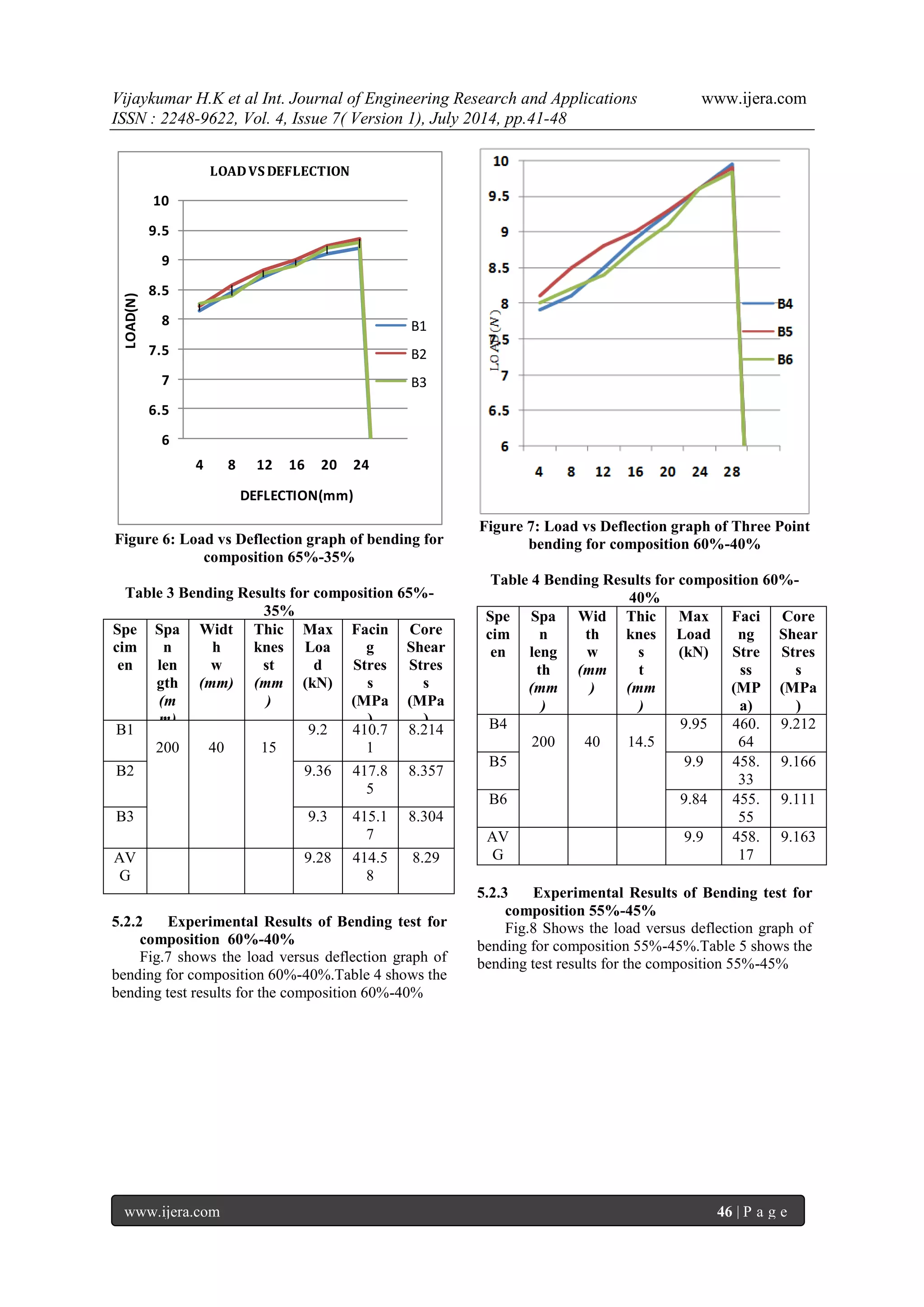
Fig.6 Shows the load versus deflection graph of 
bending for composition 65%-35%.Table 3 shows the 
bending test results for the composition 65%-35%
Vijaykumar H.K et al Int. Journal of Engineering Research and Applications www.ijera.com 
ISSN : 2248-9622, Vol. 4, Issue 7( Version 1), July 2014, pp.41-48 
www.ijera.com 46 | P a g e 
6 
6.5 
7 
7.5 
8 
8.5 
9 
9.5 
10 
4 8 12 16 20 24 
LOAD(N) 
DEFLECTION(mm) 
LOAD VS DEFLECTION 
B1 
B2 
B3 
Figure 6: Load vs Deflection graph of bending for 
composition 65%-35% 
Table 3 Bending Results for composition 65%- 
35% 
Spe 
cim 
en 
Spa 
n 
len 
gth 
(m 
m) 
Widt 
h 
w 
(mm) 
Thic 
knes 
st 
(mm 
) 
Max 
Loa 
d 
(kN) 
Facin 
g 
Stres 
s 
(MPa 
) 
Core 
Shear 
Stres 
s 
(MPa 
) 
B1 
200 
40 
15 
9.2 410.7 
1 
8.214 
B2 9.36 417.8 
5 
8.357 
B3 9.3 415.1 
7 
8.304 
AV 
G 
9.28 414.5 
8 
8.29 
5.2.2 Experimental Results of Bending test for 
composition 60%-40% 
Fig.7 shows the load versus deflection graph of 
bending for composition 60%-40%.Table 4 shows the 
bending test results for the composition 60%-40% 
Figure 7: Load vs Deflection graph of Three Point 
bending for composition 60%-40% 
Table 4 Bending Results for composition 60%- 
40% 
Spe 
cim 
en 
Spa 
n 
leng 
th 
(mm 
) 
Wid 
th 
w 
(mm 
) 
Thic 
knes 
s 
t 
(mm 
) 
Max 
Load 
(kN) 
Faci 
ng 
Stre 
ss 
(MP 
a) 
Core 
Shear 
Stres 
s 
(MPa 
) 
B4 
200 
40 
14.5 
9.95 460. 
64 
9.212 
B5 9.9 458. 
33 
9.166 
B6 9.84 455. 
55 
9.111 
AV 
G 
9.9 458. 
17 
9.163 
5.2.3 Experimental Results of Bending test for 
composition 55%-45% 
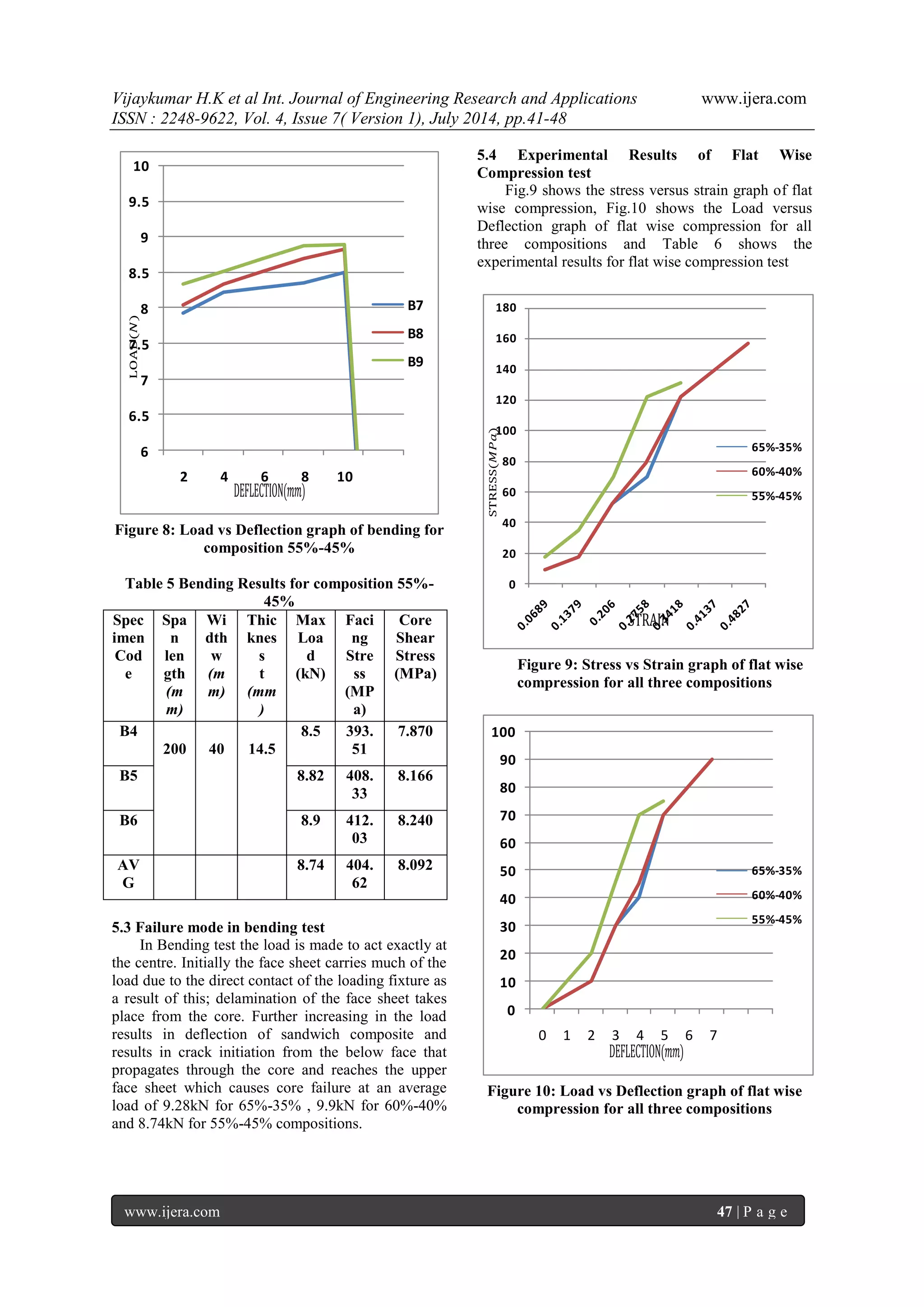
Fig.8 Shows the load versus deflection graph of 
bending for composition 55%-45%.Table 5 shows the 
bending test results for the composition 55%-45%
Vijaykumar H.K et al Int. Journal of Engineering Research and Applications www.ijera.com 
ISSN : 2248-9622, Vol. 4, Issue 7( Version 1), July 2014, pp.41-48 
www.ijera.com 47 | P a g e 
6 
6.5 
7 
7.5 
8 
8.5 
9 
9.5 
10 
2 4 6 8 10 
B7 
B8 
B9 
DEFLECTION(푚푚) 
LOAD(푁) 
Figure 8: Load vs Deflection graph of bending for 
composition 55%-45% 
Table 5 Bending Results for composition 55%- 
45% 
Spec 
imen 
Cod 
e 
Spa 
n 
len 
gth 
(m 
m) 
Wi 
dth 
w 
(m 
m) 
Thic 
knes 
s 
t 
(mm 
) 
Max 
Loa 
d 
(kN) 
Faci 
ng 
Stre 
ss 
(MP 
a) 
Core 
Shear 
Stress 
(MPa) 
B4 
200 
40 
14.5 
8.5 393. 
51 
7.870 
B5 8.82 408. 
33 
8.166 
B6 8.9 412. 
03 
8.240 
AV 
G 
8.74 404. 
62 
8.092 
5.3 Failure mode in bending test 
In Bending test the load is made to act exactly at 
the centre. Initially the face sheet carries much of the 
load due to the direct contact of the loading fixture as 
a result of this; delamination of the face sheet takes 
place from the core. Further increasing in the load 
results in deflection of sandwich composite and 
results in crack initiation from the below face that 
propagates through the core and reaches the upper 
face sheet which causes core failure at an average 
load of 9.28kN for 65%-35% , 9.9kN for 60%-40% 
and 8.74kN for 55%-45% compositions. 
5.4 Experimental Results of Flat Wise 
Compression test 
Fig.9 shows the stress versus strain graph of flat 
wise compression, Fig.10 shows the Load versus 
Deflection graph of flat wise compression for all 
three compositions and Table 6 shows the 
experimental results for flat wise compression test 
0 
20 
40 
60 
80 
100 
120 
140 
160 
180 
65%-35% 
60%-40% 
55%-45% 
STRAIN 
STRESS(푀푃푎) 
Figure 9: Stress vs Strain graph of flat wise 
compression for all three compositions 
0 
10 
20 
30 
40 
50 
60 
70 
80 
90 
100 
0 1 2 3 4 5 6 7 
65%-35% 
60%-40% 
55%-45% 
DEFLECTION(푚푚) 
Figure 10: Load vs Deflection graph of flat wise 
compression for all three compositions
Vijaykumar H.K et al Int. Journal of Engineering Research and Applications www.ijera.com 
ISSN : 2248-9622, Vol. 4, Issue 7( Version 1), July 2014, pp.41-48 
www.ijera.com 48 | P a g e 
Table 6 Experimental Results Flat Wise Compression test 
Specimen 
Dimension (mm) L w t 
Max Load (kN) 
Max Stress (MPa) 
Max Strain (%) 
Modulus of Elasticity (MPa) 
65%- 35% 
75 
75 
15 
784.8 
139.52 
40 
399.12 
60%- 40% 
75 
75 
14.5 
882.9 
156.96 
48.3 
562.40 
55%- 45% 
75 
75 
14.5 
735.75 
130.8 
34 
580.55 
5.5 Failure mode in flat wise compression test Failure occurs in flat wise compression causes the crack propagation at the center of the core that will result in crushing of the core resulting in bulging at the edges of the sandwich. Similar type of failure is observed in all the specimens. As the load increases the sandwich thickness will reduces. The max average load which can withstand the sandwich composite under flat wise compression is 784.8kN, 882.9kN and 735.75kN for 65%-35%, 60%-40% and 55%-45% by wt. of fly ash and epoxy resin respectively. 
VI. CONCLUSION 
A process for core made from fly ash a waste product of combustion from thermal power plants has been developed using epoxy resin and binder and set of two facing of glass fiber face sheet were bonded above and below of the Epoxy- fly Ash core. The experimental investigations carried by conducting different test for 65%-35%, 60%-40% and 55%-45% by wt. of fly ash and epoxy resin sandwich composite specimen respectively. 60%-40% specimen shows better results in the entire test carried out i.e. Bending and Compression test. With the addition of fly-ash in epoxy resin –fly-ash composite the compressive strength has been found to increase with increase in fly ash particles. This increase is attributed to hollowness of fly-ash particles & strong interfacial energy between resin & fly-ash. After reinforcing glass fiber both compressive & impact strength has been increased due to energy absorbed in fiber pull out. Finally, we came to know that the material has a high compressive strength, high impact strength and these can be applied and replaced to such areas where it needs a good compressive strength like wood applications, flooring, ceiling and other constructions. 
REFERENCES [1] Ahmad and Mahanwar, “The effect of fly ash as filler on the mechanical properties of HDPE”, Int J. Adv. Manuf. Technol., vol. 41 2010 [2] Kurt Feichtinger, “The properties of identical laminate builds comprising two piles of 1808 E-glass fabric”, Journal of Mechanical Engineering 2006. [3] K.N. Shivakumar, “Fabrication of two composite laminated panels and one composite sandwich using Vacuum Assisted Resin Transfer Molding (VARTM)”, Int J. Adv. Manuf. Technol., vol. 22, 2000. [4] Enrico Papa, “Experimental investigation into the mechanical behavior of a composite sandwich”, Journal of Mechanical Engineering 2001. [5] Kunigal Shivakumar, “The mechanical and fire resistant properties of a commercial material”, Journal of Materials Processing Technology, 137, 2007 [6] S K Acharya, P Mishra and S C Mishra, “Effect of environment on the mechanical properties of fly ash-jute polymer composite”, International Journal of composites,vol17 ,December 2008. [7] Kulkarni SM, Kishore, “Compressive properties of epoxy composites reinforced with fly ash and fibers”, Journal of Materials Processing Technology, 129, 2002. [8] Thomsons J L, “Effect of fibre strength and diameter on the balance of mechanical properties of glass reinforced polyamide”, Journal of Mechanical Engineering 2000. [9] Shah Khan M.Z, “Use of glass reinforced polymeric (GRP) composites”, Journal of ITU, vol. 3, no. 6, 2000.

Analysis of the Flexure Behavior and Compressive Strength of Fly Ash Core Sandwiched Composite Material

  • 1.
    Vijaykumar H.K etal Int. Journal of Engineering Research and Applications www.ijera.com ISSN : 2248-9622, Vol. 4, Issue 7( Version 1), July 2014, pp.41-48 www.ijera.com 41 | P a g e Analysis of the Flexure Behavior and Compressive Strength of Fly Ash Core Sandwiched Composite Material Vijaykumar H.K*, Maruthiprashanth*, Naveed Ahmad Bilagi**, Khan Maaz Shehzad** *Assistant Professor, Department of Mechanical Engineering, Bearys Institute of Technology, Mangalore- 574153, Karnataka, India. **B.E. Student, Department of Mechanical Engineering, Bearys Institute of Technology, Mangalore-574153, Karnataka, India. ABSTRACT In this paper, commercially available Fly Ash and Epoxy is used for the core material, woven glass fabric as reinforcing skin material, epoxy as matrix/adhesive materials used in this study for the construction of sandwich composite. Analysis is carried out on different proportions of epoxy and fly ash sandwiched composite material for determining the flexural strength and compressive strength, three different proportions of epoxy and fly ash used for the study. Those are 65%-35% (65% by weight fly ash and 35% by weight epoxy resin) composite material, 60%-40% and 55%-45% composite material. 60%-40% composite material specimen shows better results in the entire test carried out i.e. Flexure and Compression. The complete experimental results are discussed and presented in this paper. Keywords: Fly ash, Epoxy resin, compressive strength, flexural strength. I. INTRODUCTION Composite materials are two or more chemically different types of constituents combined macroscopically to yield a useful material. A composite material is a macroscopic combination of two or more distinct material's, having a recognizable interface between them. Composites are used not only for their structural properties, but also for electrical, thermal, tribological and environmental applications. Composites materials may be restricted to emphasize those materials that contain a continuous matrix constituent that binds together and provides form to an array of a stronger, stiffer reinforcement constituent. Composites typically have a fiber or particle phase that is stiffer and stronger than the continuous matrix phase. Many types of reinforcements also often have good thermal and electrical conductivity, a coefficient of thermal expansion (CTE) that is less than the matrix, and/or good wear resistance. Sandwich composites comprise of two thin but stiff face sheets attached on either side of the lightweight, thick slab known as core. Many variations of these definitions are available but the key factor in making this type of materials remains the lightweight core, which reduces the sandwich structures are commonly used for weight efficient components in aerospace applications from the last few decades. The design of a structural sandwich depends on the material selection. Not the geometry only, but an integrated process of geometrical design and material selection. The most usual components of aerospace sandwiches are glass- fiber skins and eco-core due to their high specific stiffness structure, implies that surface remain flat even under quite high compressive stress without buckling. This is important in aircraft structures in which control surfaces preferably should remain smooth even under loading. During service, regardless of tensile or compressive loading, there will be stress variation in the sandwich structure. Analysis of localized stresses in the face-sheet of the sandwich structure for different loading condition is considered for the study. The main objective is to study the mechanical behavior of glass fiber face sheet with eco-core sandwich composite based on ASTM standards. II. LITERATURE REVIEW Ahmad and Mahanwar, (2010) Studied the effect of fly ash as filler on the mechanical properties of HDPE. Three different particle sizes of fly ash were used. Concentration of fly ash was varied up to 40% by weight. The composites were prepared using twin screw extruder and then test specimens were prepared by injection molding. Tensile, flexural and impact properties were tested. Both tensile and flexural strengths and moduli were found to increase with fly ash addition. Tensile elongation drastically reduced at fly ash concentration greater than 10%. With increasing fly ash concentration impact resistance decreased up to about 15% fly ash concentration and RESEARCH ARTICLE OPEN ACCESS
  • 2.
    Vijaykumar H.K etal Int. Journal of Engineering Research and Applications www.ijera.com ISSN : 2248-9622, Vol. 4, Issue 7( Version 1), July 2014, pp.41-48 www.ijera.com 42 | P a g e then did not reduce significantly on further addition. Composites with smallest size fly ash particles proved to be better in enhancing strength and relative elongation [1].Kurt Feichtinger, (2006)focused on to compare the properties of identical laminate builds comprising two piles of 1808 E-glass fabric on each side of nominal ½”(12.5mm) thick core materials produced by vacuum-infusion and hand-layup processing. Core materials investigated included pre- coated/decay-resistant end-grain balsa, two densities and two suppliers of cross linked PVC foams, two extruded PET foams variants, an extruded polypropylene honey-comb core, one density of an SAN foam, three densities of polyurethane foam, and a special core comprised of an assembly of low- density polyurethane foam planks filament wound with E-glass roving, bound on both sides with scrim. All the core materials with the exception of the last two types were scrim med and had either knife-cut or saw-cut kerfs. The polyurethane foam cores were not scrim med, but instead were double cut. Characterizations included initial core density, laminated weight per unit area, average thickness and strength and stiffness for both flexural as well as “flat-wise” tensile testing. Significant among the findings of this study were a substantial reduction in overall panel thickness and aerial weight, subtle difference in flexural strength, a significantly lower flexure stiffness, slightly greater flat wise tensile strength, and significantly greater flat wise tensile moduli, for vacuum-infusion processing in comparison to hand lay-up [2].K.N. Shivakumar, (2000) focused on two composite laminated panels and one composite sandwich panel was fabricated using Vacuum Assisted Resin Transfer Molding (VARTM). One laminated panel was fabricated from woven E-glass and vinyl-ester resin, the other two from woven carbon and vinyl-ester resin. The sandwich panel was fabricated from woven E-glass, vinyl-ester resin and PVC foam. The measured fiber volume of the E-glass panel is 42%. The calculated fiber volume of the carbon panel is 50%. Tension, compression and shear test were performed to evaluate the mechanical properties of the composite panels. The measured tensile modulus, ultimate tensile strength and Poisson’s ratio of E-glass panel are 23.03 GPa, 325 MPa and 0.11 respectively. The measured shear modulus of E-glass panel is 3.86 GPa. The measured tensile modulus, ultimate strength and Poisson’s ratio of the carbon panel are 47.51 GPa, 436 MPa, and 0.04 respectively. The measured shear modulus of carbon panel was measured as 2.81 GPa. Three-point and four-point bending test were conducted on sandwich beams machined from the sandwich panel. Predicted beam deflection based on the properties calculated from face-sheet and core properties were in close agreement with the measured values for four points bending, but they were not for three point bending [3].Enrico Papa, (2001) focused on experimental investigation into the mechanical behavior of a composite sandwich conceived as a lightweight material for naval engineering applications. The sandwich structure is formed by a three dimensional glass fiber/polymer matrix fabric with transverse pile interconnecting the skins, the core filled with polymer matrix/glass microspheres syntactic foam; additional glass fiber Reinforced Plastics extra skins are laminated on the external facing of the filled fabric.. This work is part of a broader research investigation aimed at a complete characterization, both experimental and numerical, of the complex mechanical behavior of this composite sandwich [4].Kunigal Shivakumar, (2007) focused on the mechanical and fire resistant properties of a commercial material, U.S Gypsum’s Type X SHEETROCK, commonly used for these types of applications was compared with that type of Eco- Core. The results of this study have initiated that the mechanical properties of the Eco-Core are superior in all aspects, for example the compression strength was about 4x greater, the tension strength 3x greater, and the flexural strength was 8x greater. In addition, the fire resistance is comparable and the density is about 40% less. The details of this research are provided in the paper [5].S K Acharya, P Mishra & S C Mishra, (2008) aimed at processing a composite using fly ash, jute with epoxy resin and to study its weathering behavior on mechanical properties such as flexural strength. The fracture surfaces of the specimen are examined under scanning electron microscope. From the study, it appeared that fiber pullout is the predominant mode of failure. The cracking of the fiber structure was avoided due to adherence of fly ash particles which indicated the increase in strength of interfacial bonding. It concluded that this composite can be successfully used as a structural material in household and automobile application and as low cost building material [6].Kulkarni SM, Kishore, (2002) Compressive properties of epoxy composites reinforced with fly ash and fibers, which have differing aspect ratios, are studied. Retention of strength and modulus are observed for a greater range of fiber volume fractions following fly ash introduction into the system. A slight decrease in density was also observed when fly ash content was higher, making these composites with materials of differing aspect ratio bearing reinforcement systems suitable in weight specific applications. The investigations showed that strength decrease is larger in fiber-bearing samples compared with only ash- bearing samples. This decrease was ascribed to the tendency of fibers to bunch. When the ash filler was introduced, this tendency of fibers to cluster appears to be reduced, resulting in increased strength and modulus. Further attempts are made to analyze these
  • 3.
    Vijaykumar H.K etal Int. Journal of Engineering Research and Applications www.ijera.com ISSN : 2248-9622, Vol. 4, Issue 7( Version 1), July 2014, pp.41-48 www.ijera.com 43 | P a g e interactions of fibers and fillers through observations made on the surfaces of failed samples by scanning electron microscopy [7] .Thomsons J L, (2000) effect of fibre strength and diameter on the balance of mechanical properties of glass reinforced polyamide 6,6. The results show that the elastic properties of injection molded short glass fiber reinforced polyamide 6,6 are not strongly influenced by fiber diameter in the 10-17 micron range. The ultimate properties of these composites (strength and Izod impact) showed a clear dependence on fiber diameter and the presence of high strength S-2 glass® fibers. Tensile elongation, tensile and flexural strength, and unnotched Izod impact all decreased significantly over the 10-17 micron diameter range. Notched Izod impact showed a small but significant increase over the same range. Addition of 20% w/w of S-2 glass® to the 17 micron E-glass resulted in an 8% improvement in the fiber contribution to composite strength [8] Shah Khan M.Z. 2000 use of glass reinforced polymeric (GRP) composites as structural materials in naval mine countermeasure surface ships. Sea mines when detonated emit underwater shock waves, which could impart severe loading to a naval ship structure, and there are attempts to model the response of a ship structure to this loading.. An experimental program was therefore undertaken to determine the response to increasing strain rates of a number of GRP composites analogous to the actual structural materials. Compressively applied strain rates ranging from 10/s to 101/s and loading rates ranging from 2 to 1000 kN/s were achieved using a servo-hydraulic test machine. Specimens in the form of solid cylinders and cubes having dimensions of 10 mm by 10 mm were used and results are presented showing the effect of strain rate on the maximum strain, maximum strength and elastic modulus. The effect of loading rate on the fracture toughness of the composites was determined using notched three- point-bend specimens [9]. III. METHODOLOGY 3.1 Preparation of core As per ASTM standard rule C271, the manufacturing technique is carried out. The technique used here is HAND LAYUP technique A mild steel square frame of dimension (304mm*304mm*12.5mm) is first fabricated. Aluminum foil is wrapped to it, so that the core can be easily removed after curing as shown in Fig.1 Figure 1: Wrapping of Aluminum foil to the Frame Some amount of fly ash is taken & measured as per requirement. Similarly, resin & hardener are measured for the required quantity. The measured fly ash is mixed with the measured hardener & resin as shown in Fig.2 Figure2: Mixing of Measured Fly Ash, Resin and Hardener After mixing, the mixture of fly ash, resin & hardener are put into the frame Fig.3 Figure 3: Filling the mixture into the Aluminium covered Frame Next step is to allow the added up mixture to cure for 8-12 hours. After curing, the final product is obtained. Different proportions of fly ash and epoxy resins are carried out, namely  65% by wt. of Fly ash and 35% by wt. of Epoxy resin (I.e. 1.027 kg of Fly Ash and 331.8g Resin and 221.2g Hardener)  60% by wt. of Fly ash and 40% by wt. of Epoxy resin (I.e. 1.050kg of Fly Ash and 330g Resin and 220g Hardener)  55% by wt. of Fly ash and 45% by wt. of Epoxy resin
  • 4.
    Vijaykumar H.K etal Int. Journal of Engineering Research and Applications www.ijera.com ISSN : 2248-9622, Vol. 4, Issue 7( Version 1), July 2014, pp.41-48 www.ijera.com 44 | P a g e (I.e. .891kg of Fly Ash and 437.4g Resin and 291.6g Hardener) 3.2 Bonding of Face Sheet to Core The core is covered with 5 layers of glass fiber on either side using the adhesive i.e. Epoxy Resin. Figure 4: Bonding of Glass Fabric to the Core When the glass fiber face sheet is applied on one side of the core, then core is placed on the bottom side of the face sheet. Similar process is carried up to five layers to the top side of the face sheet. Above the sandwich panel normal weight of 2-3kg is applied to ensure perfect bond between glass fiber and the face of the core. Curing of the sandwich is done for 24 hours at normal temperature. Finally trimming is done in order to get the accurate size of the specimen. Fig. 4 shows the detail of bonding of glass fabric to the core. IV. EXPERIMENTATION 4.1 Density of sandwich materials Density is a fundamental physical property that can be used in conjunction with other properties to characterize the sandwich composite. This test method provides a standard method of obtaining sandwich core and sandwich density data for quality control, acceptance specification testing and research and development. The specimen size is 300mm in length and 300mm in which and thickness varies with core and sandwich. This test method provides ASTM standard C 271 method of obtaining simulated density data for testing, and research and development. 4.1.1 Procedure  Weigh the specimen in grams.  Determine the plan dimensions of the specimens in millimeters.  Measure the thickness of the specimens in millimeters.  Calculate the density using formula 4.1.2 Calculation (1) Where ρ is density in kg/m3, Wt is final mass after conditioning in grams, V is final volume after conditioning in mm3. 4.2 Flat Wise Compressive test of Sandwich The flat wise compressive strength and modulus are fundamental mechanical properties of sandwich cores that are used in designing sandwich panels. Deformation data can be obtained and from a complete load deformation curve it is possible to compute the compressive stress at any load (such as compressive stress at proportional limit load or compressive strength at maximum load) and to compute the effective modulus of the core. This test method provides ASTM C 365 standard method of obtaining the flat wise compressive strength and modulus for sandwich panel design and research development. The bottom fixture is fixed and the top fixture is made to push in the direction normal to the facing plane in flat wise compression test. The load verses deflection data is recorded in the computer. 4.2.1 Procedure 1. The length, width and thickness dimensions of the specimen measured using vernier caliper. 2. Applied the load on the specimen through a spherical loading block, which is the suspended, self aligning type that the block distributes the load uniformly over the entire loading surface of the specimen. 3. Applied the load at a constant rate of movement from cross-head of the testing machine. 4. Load deflection curves were taken to determine the modulus of elasticity. 4.2.2Calculation The formula for flat wise compressive strength: (2) Where σFC is flat wise compressive strength in MPa, ρmax is ultimate load in N, and A is cross sectional area in mm2 (whereA=LXW). Flat wise compressive strain: (3) Where is compressive strain, t is original thickness in and is change in thickness in mm Flat wise compressive modulus: (4) Where is the compressive modulus in MPa and is the slope of initial linear portion of stress strain curve in N/mm2.
  • 5.
    Vijaykumar H.K etal Int. Journal of Engineering Research and Applications www.ijera.com ISSN : 2248-9622, Vol. 4, Issue 7( Version 1), July 2014, pp.41-48 www.ijera.com 45 | P a g e 4.3 Flexural test of Sandwich Composite Flexure tests on flat sandwich construction may be conducted to determine the sandwich flexural stiffness, the core shear strength and shear modulus or the facings compressive or tensile strengths. This test method provides ASTM C 393 standard method of obtaining sandwich flexure properties for panel design and research and development. 4.3.1 Procedure 1. The length, width, thickness and span length dimensions of the specimen measured using vernier calliper. 2. The load is applied at a constant rate on the mid span. 3. Load-deflection curves can be taken to determine the sandwich stiffness and core shear modulus. 4.3.2 Calculation Core shear stress: (5) Where core shear stress in MPa is, is maximum load in N, t is sandwich thickness in mm. Facing Bending Stress: (6) Where, is facing bending stress on MPa, tf is facing thickness in mm and L is span length in mm. V. RESULTS AND DISCUSSION 5.1 Density results of sandwich composite Table 1 shows the density values of the core of sandwich for different proportions and Table 2 shows the density values of the whole of sandwich composite for different proportions.Fig.5 show the comparison result of core and sandwich density. Table 1. Density of the core of sandwich composite Speci men Dimensions (mm) L w t Weig ht kg Volu me mm3 Densit y Kg/m3 65%- 35% 298 30 1 13 1.583 11660 74 1357.5 4 60%- 40% 304 30 4 12. 5 1.604 11552 00 1388.5 55%- 45% 303 30 2 12. 5 1.624 11438 25 1419.8 AVG 1.603 1388.6 1 Table 2. Density of the Whole of sandwich composite Speci mens Dimensions (mm) L w t Wei ght Kg Volu me mm3 Density Kg/m3 65%- 35% 298 301 15 1.83 4 1345 470 1363.1 60%- 40% 304 304 14 .5 1.95 4 1340 032 1458.6 55%- 45% 303 302 14 .5 1.97 4 1326 837 1487.74 AVG 1.92 1 1436.48 Where L-length of specimen, w-width of specimen, t-thickness of specimen 1360 1370 1380 1390 1400 1410 1420 1430 1440 1450 Sandwich core Figure 5: Comparison result of core and sandwich composite results 5.2 Bending test 5.2.1 Experimental Results of bending test for composition 65%-35% Fig.6 Shows the load versus deflection graph of bending for composition 65%-35%.Table 3 shows the bending test results for the composition 65%-35%
  • 6.
    Vijaykumar H.K etal Int. Journal of Engineering Research and Applications www.ijera.com ISSN : 2248-9622, Vol. 4, Issue 7( Version 1), July 2014, pp.41-48 www.ijera.com 46 | P a g e 6 6.5 7 7.5 8 8.5 9 9.5 10 4 8 12 16 20 24 LOAD(N) DEFLECTION(mm) LOAD VS DEFLECTION B1 B2 B3 Figure 6: Load vs Deflection graph of bending for composition 65%-35% Table 3 Bending Results for composition 65%- 35% Spe cim en Spa n len gth (m m) Widt h w (mm) Thic knes st (mm ) Max Loa d (kN) Facin g Stres s (MPa ) Core Shear Stres s (MPa ) B1 200 40 15 9.2 410.7 1 8.214 B2 9.36 417.8 5 8.357 B3 9.3 415.1 7 8.304 AV G 9.28 414.5 8 8.29 5.2.2 Experimental Results of Bending test for composition 60%-40% Fig.7 shows the load versus deflection graph of bending for composition 60%-40%.Table 4 shows the bending test results for the composition 60%-40% Figure 7: Load vs Deflection graph of Three Point bending for composition 60%-40% Table 4 Bending Results for composition 60%- 40% Spe cim en Spa n leng th (mm ) Wid th w (mm ) Thic knes s t (mm ) Max Load (kN) Faci ng Stre ss (MP a) Core Shear Stres s (MPa ) B4 200 40 14.5 9.95 460. 64 9.212 B5 9.9 458. 33 9.166 B6 9.84 455. 55 9.111 AV G 9.9 458. 17 9.163 5.2.3 Experimental Results of Bending test for composition 55%-45% Fig.8 Shows the load versus deflection graph of bending for composition 55%-45%.Table 5 shows the bending test results for the composition 55%-45%
  • 7.
    Vijaykumar H.K etal Int. Journal of Engineering Research and Applications www.ijera.com ISSN : 2248-9622, Vol. 4, Issue 7( Version 1), July 2014, pp.41-48 www.ijera.com 47 | P a g e 6 6.5 7 7.5 8 8.5 9 9.5 10 2 4 6 8 10 B7 B8 B9 DEFLECTION(푚푚) LOAD(푁) Figure 8: Load vs Deflection graph of bending for composition 55%-45% Table 5 Bending Results for composition 55%- 45% Spec imen Cod e Spa n len gth (m m) Wi dth w (m m) Thic knes s t (mm ) Max Loa d (kN) Faci ng Stre ss (MP a) Core Shear Stress (MPa) B4 200 40 14.5 8.5 393. 51 7.870 B5 8.82 408. 33 8.166 B6 8.9 412. 03 8.240 AV G 8.74 404. 62 8.092 5.3 Failure mode in bending test In Bending test the load is made to act exactly at the centre. Initially the face sheet carries much of the load due to the direct contact of the loading fixture as a result of this; delamination of the face sheet takes place from the core. Further increasing in the load results in deflection of sandwich composite and results in crack initiation from the below face that propagates through the core and reaches the upper face sheet which causes core failure at an average load of 9.28kN for 65%-35% , 9.9kN for 60%-40% and 8.74kN for 55%-45% compositions. 5.4 Experimental Results of Flat Wise Compression test Fig.9 shows the stress versus strain graph of flat wise compression, Fig.10 shows the Load versus Deflection graph of flat wise compression for all three compositions and Table 6 shows the experimental results for flat wise compression test 0 20 40 60 80 100 120 140 160 180 65%-35% 60%-40% 55%-45% STRAIN STRESS(푀푃푎) Figure 9: Stress vs Strain graph of flat wise compression for all three compositions 0 10 20 30 40 50 60 70 80 90 100 0 1 2 3 4 5 6 7 65%-35% 60%-40% 55%-45% DEFLECTION(푚푚) Figure 10: Load vs Deflection graph of flat wise compression for all three compositions
  • 8.
    Vijaykumar H.K etal Int. Journal of Engineering Research and Applications www.ijera.com ISSN : 2248-9622, Vol. 4, Issue 7( Version 1), July 2014, pp.41-48 www.ijera.com 48 | P a g e Table 6 Experimental Results Flat Wise Compression test Specimen Dimension (mm) L w t Max Load (kN) Max Stress (MPa) Max Strain (%) Modulus of Elasticity (MPa) 65%- 35% 75 75 15 784.8 139.52 40 399.12 60%- 40% 75 75 14.5 882.9 156.96 48.3 562.40 55%- 45% 75 75 14.5 735.75 130.8 34 580.55 5.5 Failure mode in flat wise compression test Failure occurs in flat wise compression causes the crack propagation at the center of the core that will result in crushing of the core resulting in bulging at the edges of the sandwich. Similar type of failure is observed in all the specimens. As the load increases the sandwich thickness will reduces. The max average load which can withstand the sandwich composite under flat wise compression is 784.8kN, 882.9kN and 735.75kN for 65%-35%, 60%-40% and 55%-45% by wt. of fly ash and epoxy resin respectively. VI. CONCLUSION A process for core made from fly ash a waste product of combustion from thermal power plants has been developed using epoxy resin and binder and set of two facing of glass fiber face sheet were bonded above and below of the Epoxy- fly Ash core. The experimental investigations carried by conducting different test for 65%-35%, 60%-40% and 55%-45% by wt. of fly ash and epoxy resin sandwich composite specimen respectively. 60%-40% specimen shows better results in the entire test carried out i.e. Bending and Compression test. With the addition of fly-ash in epoxy resin –fly-ash composite the compressive strength has been found to increase with increase in fly ash particles. This increase is attributed to hollowness of fly-ash particles & strong interfacial energy between resin & fly-ash. After reinforcing glass fiber both compressive & impact strength has been increased due to energy absorbed in fiber pull out. Finally, we came to know that the material has a high compressive strength, high impact strength and these can be applied and replaced to such areas where it needs a good compressive strength like wood applications, flooring, ceiling and other constructions. REFERENCES [1] Ahmad and Mahanwar, “The effect of fly ash as filler on the mechanical properties of HDPE”, Int J. Adv. Manuf. Technol., vol. 41 2010 [2] Kurt Feichtinger, “The properties of identical laminate builds comprising two piles of 1808 E-glass fabric”, Journal of Mechanical Engineering 2006. [3] K.N. Shivakumar, “Fabrication of two composite laminated panels and one composite sandwich using Vacuum Assisted Resin Transfer Molding (VARTM)”, Int J. Adv. Manuf. Technol., vol. 22, 2000. [4] Enrico Papa, “Experimental investigation into the mechanical behavior of a composite sandwich”, Journal of Mechanical Engineering 2001. [5] Kunigal Shivakumar, “The mechanical and fire resistant properties of a commercial material”, Journal of Materials Processing Technology, 137, 2007 [6] S K Acharya, P Mishra and S C Mishra, “Effect of environment on the mechanical properties of fly ash-jute polymer composite”, International Journal of composites,vol17 ,December 2008. [7] Kulkarni SM, Kishore, “Compressive properties of epoxy composites reinforced with fly ash and fibers”, Journal of Materials Processing Technology, 129, 2002. [8] Thomsons J L, “Effect of fibre strength and diameter on the balance of mechanical properties of glass reinforced polyamide”, Journal of Mechanical Engineering 2000. [9] Shah Khan M.Z, “Use of glass reinforced polymeric (GRP) composites”, Journal of ITU, vol. 3, no. 6, 2000.