7
4. ANALYSIS
4.1 PROPOSED SOLUTION
In this Proposed System, Secure and efficient DATA transmission is along these lines
particularly vital and is requested in numerous such viable WSNs. Thus, we propose
two Secure and Efficient information Transmission (SET) conventions for CWSNs,
called SET-IBS and SET-IBOOS, by utilizing the Identity-Based computerized
Signature (IBS) scheme.
4.2 ADVANTAGES OF PROPOSED SYSTEM
1) It has been proposed with a specific end goal to decrease the calculation and
capacity expenses to confirm the scrambled detected information, by applying
advanced marks to message bundles, which are efficient in correspondence and
applying the key administration for security.
2) In the proposed conventions blending parameters are appropriated and preloaded in
all sensor hubs by the BS at initially
4.3 SOFTWARE REQUIRMENTS SPECIFICATION
Software requirements specification plays a vital role in creating quality
software solutions. Basically, specification is a representation process. Requirements
which are considered should be represented in a manner that ultimately leads to
successful software implementation.
Requirements may be specified in a variety of ways. However there are some
guidelines worth following:
1) The representation format and content should be related to the problem
2) The contained information in the specification should be nested
3) Diagrams, Notational forms etc., should be restricted in number and consistent in
use
4) Representation should be revisable.
8
The system requirement specification which is produced is helpful at the
culmination of the analysis task. The function and performance allocated to software
as part of system engineering are refined by establishing a complete information
description as functional representation, a representation of system behavior, an
indication of performance requirements and design constraints, appropriate validation
criteria.
4.3.1 USER REQUIRMENTS
Hypertext Markup Language (HTML):
HTML stands for "Hypertext Markup Language". HTML is a SGML
(Standard Generalized Markup Language) application widely used to create web
pages. It is basically a formatting language and not a programming language.HTML is
a language that is easy to write, easy to understand and highly portable. HTML is not
a compiled language and is directly interpreted by a browser.HTML is the set of
instructions. Each instruction is called as an element or Markup. It is used to structure
and format documents for presentation on the web. HTML enhances ASCII files with
markup tags that permit the display of a variety of fonts, images, and highlighting
options. It also designates structural elements such as headers, lists, and paragraphs,
and provides hypertext links to other documents on the Internet.
In plain English, for those of us who are not programming wizards, it is the
language our web browser understands, so that it can display what the author of the
page wanted us to see... and we can do some really neat stuff with it.
JAVA
Java programming dialect was initially created by Sun Microsystems which was
started by James Gosling and discharged in 1995 as center segment of Sun
Microsystems' Java stage (Java 1.0 [J2SE]).
The most recent arrival of the Java Standard Edition is Java SE 8. With the headway
of Java and its broad ubiquity, numerous setups were constructed to suite different
sorts of stages. Ex: J2EE for Enterprise Applications, J2ME for Mobile Applications.
The new J2 versions were renamed as Java SE, Java EE and Java ME individually.
Java is ensured to be Write Once, Run Anywhere.
9
Java features
 Object oriented: In Java, everything is an Object. Java can be effortlessly
reached out since it depends on the Object model
 Platform independent: Not at all like numerous other programming languages
including C and C++, when Java is ordered, it is not assembled into stage
particular machine, rather into stage free byte code. This byte code is conveyed
over the web and translated by virtual Machine (JVM) on whichever stage it is
being run.
 Simple: Java is intended to be anything but difficult to learn. In the event that you
comprehend the fundamental idea of OOP Java would be anything but difficult to
ace.
 Dynamic: Java is thought to be more dynamic than C or C++ since it is intended
to adjust to a developing domain. Java projects can convey broad measure of run-
time data that can be utilized to confirm and resolve gets to questions on run-time.
 Interpreted: Java byte code is made an interpretation of on the fly to local
machine guidelines and is not put away anyplace. The improvement procedure is
faster and diagnostic since the connecting is an incremental and light weight
process.
 Multithreaded: With Java's multithreaded highlight it is conceivable to compose
programs that can do numerous errands at the same time. This configuration
highlight permits designers to develop easily running intelligent applications..
 High performance: With the utilization of Just-In-Time compilers, Java
empowers superior.
 Portable: Being engineering nonpartisan and having no execution subordinate
parts of the determination makes Java compact. Compiler in Java is composed in
ANSI C with a spotless compactness limit which is a POSIX subset.
History of Java:
James Gosling started the Java dialect venture in June 1991 for use in one of his
numerous set-top box ventures. The dialect, at first called Oak after an oak tree that
remained outside Gosling's office, additionally passed by the name Green and wound
up later being renamed as Java, from a rundown of arbitrary words.
10
Sun discharged the first open execution as Java 1.0 in 1995. It guaranteed Write Once,
Run Anywhere (WORA), giving no-expense run-times on famous stages.
On 13 November 2006, Sun discharged a lot of Java as free and open source
programming under the terms of the GNU General Public License (GPL).
On 8 May 2007, Sun completed the procedure, making the greater part of Java's
center code free and open-source, beside a little divide of code to which Sun did not
hold the copyright.
JAVA SERVER PAGES:
Introduction:
In the time of Information Technology, rather the solid, primitive application one
dependably likes to have arranged, segment based, multithread customer server
application. Thus improvement in disjoin side writing computer programs is presently
a need of web innovation. Because of this parcel of server side innovations, for
example, JSP Servelts, ASP, and PHP are utilized.
Java server pages (JSP). JSP is a sort of scripting dialect in which we can insert JAVA
code alongside HTML components.
Advantages of JSP:
Following are some advantages of Java Server Pages:-
1) JSP is useful for server side programming
2) JSP can be used along with servlets. Hence business logic for any application can
be developed using JSP.
3) Dynamic contents can be handled using JSP because JSP allows scripting and
element based programming
4) JSP allows creating and using our own custom tag libraries. Hence any application
specific requirements can be satisfied using custom tag libraries. This helps the
developer to develop any kind of application.
5) JSP is a specification and not a product. Hence developers can develop variety of
applications and add up to performance and quality of software products. Due to
this many companies are ready to invest in JSP technology
11
JAVA SCRIPT:
Java Script is Netscape's cross–platform, object-based scripting dialect for customer
server application. JavaScript is mostly utilized as a customer side scripting dialect.
This implies JavaScript code is built into a HTML page. At the point when a client
demands a HTML page with JavaScript in it, the script is sent to the program and it's
up to the program to accomplish something with it. JavaScript can be utilized as a part
of different settings than a Web program. Netscape made server-side JavaScript as a
CGI-dialect that can do generally the same as Perl or ASP.
Luckily most programs can deal with JavaScript these days; obviously a few
programs don't bolster a few bits of scrip
Types of Java Script:
a. Navigator Java Script also called client-side Java Script.
b. Live Wire Java Script also called server-side Java Script.
Using Java Script, dynamic HTML pages can be created that process user input and
maintain persistent data using special objects, files and relational databases. Browser
interprets JavaScript statements embedded in an HTML page. Netscape Navigator 2.0
and Internet Explorer 3.0 versions and later recognize Java Script. Through JavaScript
Live Connect functionally, application can access Java and CORBA distributed-object
applications. Navigator 3.0 and later versions supports Live Connect.
Features ofJavaScript(JS):
a) Browser interprets JavaScript.
b) JavaScript is objects based and uses built-in, extensible objects and have no classes
or inheritance
c) JavaScript is loosely typed language
d) In JavaScript object reference are checked at runtime
e) JavaScript is designed to supplement the capabilities of HTML with script that are
capable of responding to web pages events. JSP has access to some extent of aspects
of the web browser window.
f) JavaScript control browser and content but cannot draw graphics or perform
networking.
12
APHACHE TOMCAT SERVER:
Apache Tomcat is an open source Web server gadget made by the Apache Software
Foundation (ASF). It is one of various Apache-related open source things used by IT
specialists for diverse errands and destinations.
Apache Tomcat allows the utilization of Java Servlets and Java Server Pages (JSP) to
propel an effective Java server environment. Customers can in like manner get to
resources for configuration and use extensible markup lingo (XML) to orchestrate
wanders. Dynamic variations of Apache Tomcat have handled assorted issues by
applying programming patches and diverse game plans. A couple of pros depict
Apache Tomcat as a thing offering a runtime shell for Java Servlets. Customers can in
like manner set up Java virtual machines (JVM) to mastermind virtual encouraging.
JDBC
JDBC remains for Java Database Connectivity, which is a standard Java API for
database-autonomous network between the Java programming dialect and an
extensive variety of databases.
The JDBC library incorporates APIs for each of the assignments specified underneath
that are usually connected with database use.
 Making an association with a database.
 Making SQL or MySQL articulations.
 Executing SQL or MySQL inquiries in the database.
 Seeing and modifying the subsequent records.
On a very basic level, JDBC is a particular that gives a complete arrangement of
interfaces that takes into account compact access to a hidden database. Java can be
utilized to compose distinctive sorts of executables, for example, −
 Java Applications
 Java Applets
 Java Servlets
 Java ServerPages (JSPs)
 Endeavor JavaBeans (EJBs).
13
These distinctive executables can utilize a JDBC driver to get to a database, and
exploit the put away information.
JDBC gives the same capacities as ODBC, permitting Java projects to contain
database-autonomous code.
JDBC ARCHITECTURE
The JDBC API underpins both two-level and three-level preparing models for
database get to yet by and large, JDBC Architecture comprises of two layers −
JDBC API: This gives the application-to-JDBC Manager association.
JDBC Driver API: These backings the JDBC Manager-to-Driver Connection.
The JDBC API utilizes a driver supervisor and database-particular drivers to give
straightforward availability to heterogeneous databases.
The JDBC driver administrator guarantees that the right driver is utilized to get to
every information source. The driver administrator is fit for supporting various
simultaneous drivers associated with different heterogeneous databases.
Taking after is the design chart, which demonstrates the area of the driver
administrator regarding the JDBC drivers and the Java application
14
Fig 4.3.1 : JDBC ARCHITECTURE
ODBC:
Microsoft Open Database Connectivity (ODBC) is a standard programming interface
for application fashioners and database structures suppliers. Before ODBC
transformed into a genuine standard for Windows activities to interface with database
systems, designers expected to use prohibitive lingos for each database they expected
to connect with. Right away, ODBC has settled on the choice of the database structure
for all intents and purposes insignificant from a coding perspective, which is as it
should be. Application originators have extensively more vital things to stretch over
than the accentuation that is relied upon to port their framework beginning with one
database then onto the following when business needs suddenly change. Through the
ODBC Administrator in Control Panel, you can decide the particular database that is
15
associated with a data source that an ODBC application framework is formed to use.
Consider an ODBC data source as a passage with a name on it. Each passage will lead
you to a particular database. Case in point, the data source named Sales Figures might
be a SQL Server database; however the Accounts Payable data source could insinuate
an Access database. The physical database suggested by a data source can live
wherever on the LAN.
The ODBC system records are not presented on your structure by Windows 95.
Perhaps, they are presented when you setup an alternate database application, for
instance, SQL Server Client or Visual Basic 4.0. Exactly when the ODBC image is
presented in Control Panel, it uses a report called ODBCINST.DLL. It is also possible
to deal with your ODBC data sources through a stand-alone program called
ODBCADM.EXE. There is a 16-bit and a 32-bit variation of this framework and
every keeps up an alternate once-over of From a programming perspective, the
fabulousness of ODBC is that the application can be made to use the same plan of
limit calls to interface with any data source, paying little regard to the database dealer.
The source code of the application doesn't change whether it talks with Oracle or SQL
Server. We simply determine these two as delineation. There are ODBC drivers open
for a couple of dozen common database structures. To be sure, even Excel
spreadsheets and plain substance records can be changed into data sources. The
working system uses the Registry information made by ODBC Administrator to make
sense of which low-level ODBC drivers are relied upon to speak with the data source,
(for instance, the interface to Oracle or SQL Server). The stacking of the ODBC
drivers is direct to the ODBC application program. In a client/server environment, the
ODBC API even handles a substantial bit of the framework issues for the application
programming engineer.
The upsides of this arrangement are various to the point that you are probably
thinking there must be some catch. The principle disadvantage of ODBC is that it isn't
as viable as talking direct to the nearby database interface. ODBC has had various
spoilers make the charge that it is excessively direct. Microsoft has reliably ensured
that the essential segment in execution is the way of the driver programming that is
used. As we would see it, this is legitimate. The availability of good ODBC drivers
has upgraded an unprecedented course of action starting late. Additionally, at any
rate, the input about execution is to some degree nearly taking after the people who
16
said that compilers would never organize the pace of unadulterated low level
processing develop. Maybe not, yet rather the compiler (or ODBC) allows you to
form cleaner ventures, which suggests you finish sooner. At that point, PCs get
speedier reliably.
My SQL DATABASE:
What is data base?
A database is a different application that stores an accumulation of
information. Every database has one or more unmistakable APIs for making, getting
to, overseeing, seeking and repeating the information it holds. Different sorts of
information stores can be utilized, for example, documents on the record framework
or extensive hash tables in memory, yet information bringing and composing would
not be so quick and simple with those sorts of frameworks. So these days, we utilize
social database administration frameworks (RDBMS) to store and oversee gigantic
volume of information. This is called social database in light of the fact that all the
information is put away into diverse tables and relations are set up utilizing essential
keys or different keys known as remote keys.
RDBMS TERMINOLOGY:
A Relational Database Management System (RDBMS) is a product that:
1) Database: A database is a gathering of tables, with related information.
2) Table: A table is a lattice with information. A table in a database resembles a
basic spreadsheet
3) Column: One segment (information component) contains information of one and
the same kind, for instance the segment postcode
4) Row: A column (= tuple, passage or record) is a gathering of related information.
For instance the information of one membership.
5) Redundancy: Storing information twice, needlessly to make the framework
happen twice in one table. With a key, you can discover at most one line.
6) Foreign Key: A remote key is the connecting pin between two
17
7) Compound Key: A compound key (composite key) is a key that comprises of
numerous sections, in light of the fact that one segment is not adequately one of a
kind
8) Index: A list in a database looks like a file at the back of a book.
9) Eferential Integrity: Referential Integrity ensures that a remote key esteem
dependably indicates a current row.
My SQL is a quick, simple to-utilize RDBMS being utilized for some little and huge
organizations. My SQL is produced, promoted, and bolstered by My SQL AB, which
is a Swedish organization. My SQL is turning out to be so well known in light of
numerous great reasons
1) My SQL is discharged under an open-source permit. So you don't have anything
to pay to utilize it.
2) My SQL is a capable system in its own privilege. It handles a substantial subset of
the usefulness of the most costly and intense database bundles
3) My SQL utilizes a standard type of the surely understood SQL information
dialect.
4) My SQL chips away at numerous working frameworks and with numerous
dialects including PHP, PERL, C, C++, JAVA, and so on
5) My SQL works rapidly and functions admirably even with huge information sets
6) My SQL is inviting to PHP, the most refreshing dialect for web improvement.
7) My SQL bolsters vast databases, up to 50 million columns or more in a table. The
default record size breaking point for a table is 4GB, however you can build this
(if you're working framework can deal with it) to a hypothetical utmost of 8
million terabytes (TB)
8) My SQL is adjustable. The open-source GPL permit permits developers to alter
the My SQL programming to fit their own particular
18
Networking:
TCP/IP stacks:
The TCP/IP stack is shorter than the OSI one:
TCP is a connection-oriented protocol; UDP (User Datagram Protocol) is a
connectionless protocol.
IP datagram’s:
The IP layer gives a connectionless and problematic conveyance framework. It
considers each datagram autonomously of the others. Any relationship between
datagram must be supplied by the higher layers. The IP layer supplies a checksum that
incorporates its own header. The header incorporates the source and destination
addresses. The IP layer handles steering through an Internet. It is additionally in
charge of separating substantial datagram into littler ones for transmission and
reassembling them at the flip side.
UDP
UDP is likewise connectionless and questionable. What it adds to IP is a checksum
for the substance of the datagram and port numbers. These are utilized to give a
customer/server model - see later.
TCP
TCP supplies rationale to give a dependable association arranged convention above
IP. It gives a virtual circuit that two procedures can use to convey.
19
INTERNET ADDRESSES
With a specific end goal to utilize an administration, you should have the capacity to
discover it. The Internet utilizes a location plan for machines with the goal that they
can be found. The location is a 32 bit number which gives the IP address. This
encodes a system ID and all the more tending to. The system ID falls into different
classes as indicated by the measure of the system address
NETWORKADDRESS
Class utilizations 8 bits for the system address with 24 bits left over for other tending
to. Class B utilizes 16 bit system tending to. Class C utilizes 24 bit system tending to
and class D utilizes every one of the 32.
SUBNET ADDRESS
Inside, the UNIX system is partitioned into sub systems. Building 11 is as of now on
one sub organized and utilizes 10-bit tending to, permitting 1024 distinct hosts.
HOST ADDRESS
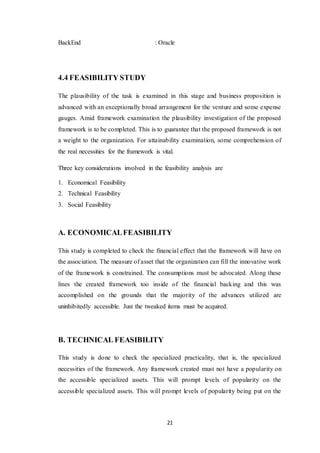
There is a 8 bits are at long last utilized for host addresses inside of our subnet. This
places a breaking point of 256 machines that can be on the subnet.
TOTAL ADDRESS
The 32 bit location is normally composed as 4 whole numbers isolated by dabs.
PORT LOCATIONS
An administration exists on a host, and is recognized by its port. This is a 16 bit
number. To make an impression on a server, you send it to the port for that
20
administration of the host that it is running on. This is not area straightforwardness!
Sure of these ports are "understood".
ATTACHMENTS
An attachment is an information structure kept up by the framework to handle system
associations. An attachment is made utilizing the call attachment. It gives back a
whole number that is similar to a document descriptor. Actually, under Windows, this
handle can be utilized with Read File and Write File capacities.
#include <sys/types.h>
#include <sys/socket.h>
int socket(int family, int sort, int convention);
Here "family" will be AF_INET for IP correspondences, convention will be zero, and
sort will rely on upon whether TCP or UDP is utilized. Two procedures wishing to
impart over a system make an attachment each. These are like two finishes of a
channel - yet the genuine funnel does not yet exist.
4.3.2 HARDWARE REQUIREMENTS:
 Processor - Intel I5
 Speed - 1ghz or higher
 RAM - 1gb or higher
 Storage Disk - 300 gb higher
4.3.3 SOFTWARE REQUIREMENTS
 Platform : Windows 7
 Programming Environment : JAVA
 Http Server : Tomcat
 Design : HTML, Jsp, JavaScript.
 Server side Script :JavaServerPages
21
BackEnd : Oracle
4.4 FEASIBILITY STUDY
The plausibility of the task is examined in this stage and business proposition is
advanced with an exceptionally broad arrangement for the venture and some expense
gauges. Amid framework examination the plausibility investigation of the proposed
framework is to be completed. This is to guarantee that the proposed framework is not
a weight to the organization. For attainability examination, some comprehension of
the real necessities for the framework is vital.
Three key considerations involved in the feasibility analysis are
1. Economical Feasibility
2. Technical Feasibility
3. Social Feasibility
A. ECONOMICALFEASIBILITY
This study is completed to check the financial effect that the framework will have on
the association. The measure of asset that the organization can fill the innovative work
of the framework is constrained. The consumptions must be advocated. Along these
lines the created framework too inside of the financial backing and this was
accomplished on the grounds that the majority of the advances utilized are
uninhibitedly accessible. Just the tweaked items must be acquired.
B. TECHNICAL FEASIBILITY
This study is done to check the specialized practicality, that is, the specialized
necessities of the framework. Any framework created must not have a popularity on
the accessible specialized assets. This will prompt levels of popularity on the
accessible specialized assets. This will prompt levels of popularity being put on the
22
customer. The created framework must have an unobtrusive necessity, as just
negligible or invalid changes are required for actualizing this framework
C. SOCIAL FEASIBILITY
The part of study is to check the level of acknowledgment of the framework by the
client. This incorporates the procedure of preparing the client to utilize the framework
productively. The client must not feel undermined by the framework, rather should
acknowledge it as a need. The level of acknowledgment by the clients exclusively
relies on upon the techniques that are utilized to instruct the client about the
framework and to make him acquainted with it. His level of certainty must be raised
with the goal that he is likewise ready to make some valuable feedback, which is
invited, as he is the last client of the framework
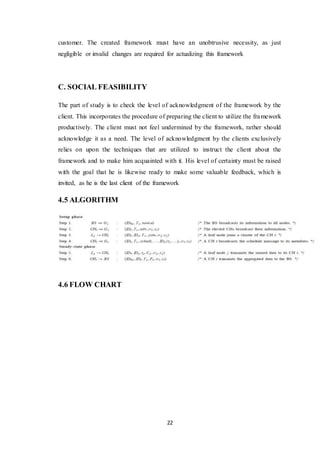
4.5 ALGORITHM
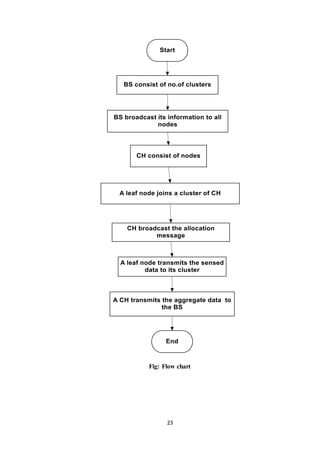
4.6 FLOW CHART
23
Fig: Flow chart

Analysis

  • 1.
    7 4. ANALYSIS 4.1 PROPOSEDSOLUTION In this Proposed System, Secure and efficient DATA transmission is along these lines particularly vital and is requested in numerous such viable WSNs. Thus, we propose two Secure and Efficient information Transmission (SET) conventions for CWSNs, called SET-IBS and SET-IBOOS, by utilizing the Identity-Based computerized Signature (IBS) scheme. 4.2 ADVANTAGES OF PROPOSED SYSTEM 1) It has been proposed with a specific end goal to decrease the calculation and capacity expenses to confirm the scrambled detected information, by applying advanced marks to message bundles, which are efficient in correspondence and applying the key administration for security. 2) In the proposed conventions blending parameters are appropriated and preloaded in all sensor hubs by the BS at initially 4.3 SOFTWARE REQUIRMENTS SPECIFICATION Software requirements specification plays a vital role in creating quality software solutions. Basically, specification is a representation process. Requirements which are considered should be represented in a manner that ultimately leads to successful software implementation. Requirements may be specified in a variety of ways. However there are some guidelines worth following: 1) The representation format and content should be related to the problem 2) The contained information in the specification should be nested 3) Diagrams, Notational forms etc., should be restricted in number and consistent in use 4) Representation should be revisable.
  • 2.
    8 The system requirementspecification which is produced is helpful at the culmination of the analysis task. The function and performance allocated to software as part of system engineering are refined by establishing a complete information description as functional representation, a representation of system behavior, an indication of performance requirements and design constraints, appropriate validation criteria. 4.3.1 USER REQUIRMENTS Hypertext Markup Language (HTML): HTML stands for "Hypertext Markup Language". HTML is a SGML (Standard Generalized Markup Language) application widely used to create web pages. It is basically a formatting language and not a programming language.HTML is a language that is easy to write, easy to understand and highly portable. HTML is not a compiled language and is directly interpreted by a browser.HTML is the set of instructions. Each instruction is called as an element or Markup. It is used to structure and format documents for presentation on the web. HTML enhances ASCII files with markup tags that permit the display of a variety of fonts, images, and highlighting options. It also designates structural elements such as headers, lists, and paragraphs, and provides hypertext links to other documents on the Internet. In plain English, for those of us who are not programming wizards, it is the language our web browser understands, so that it can display what the author of the page wanted us to see... and we can do some really neat stuff with it. JAVA Java programming dialect was initially created by Sun Microsystems which was started by James Gosling and discharged in 1995 as center segment of Sun Microsystems' Java stage (Java 1.0 [J2SE]). The most recent arrival of the Java Standard Edition is Java SE 8. With the headway of Java and its broad ubiquity, numerous setups were constructed to suite different sorts of stages. Ex: J2EE for Enterprise Applications, J2ME for Mobile Applications. The new J2 versions were renamed as Java SE, Java EE and Java ME individually. Java is ensured to be Write Once, Run Anywhere.
  • 3.
    9 Java features  Objectoriented: In Java, everything is an Object. Java can be effortlessly reached out since it depends on the Object model  Platform independent: Not at all like numerous other programming languages including C and C++, when Java is ordered, it is not assembled into stage particular machine, rather into stage free byte code. This byte code is conveyed over the web and translated by virtual Machine (JVM) on whichever stage it is being run.  Simple: Java is intended to be anything but difficult to learn. In the event that you comprehend the fundamental idea of OOP Java would be anything but difficult to ace.  Dynamic: Java is thought to be more dynamic than C or C++ since it is intended to adjust to a developing domain. Java projects can convey broad measure of run- time data that can be utilized to confirm and resolve gets to questions on run-time.  Interpreted: Java byte code is made an interpretation of on the fly to local machine guidelines and is not put away anyplace. The improvement procedure is faster and diagnostic since the connecting is an incremental and light weight process.  Multithreaded: With Java's multithreaded highlight it is conceivable to compose programs that can do numerous errands at the same time. This configuration highlight permits designers to develop easily running intelligent applications..  High performance: With the utilization of Just-In-Time compilers, Java empowers superior.  Portable: Being engineering nonpartisan and having no execution subordinate parts of the determination makes Java compact. Compiler in Java is composed in ANSI C with a spotless compactness limit which is a POSIX subset. History of Java: James Gosling started the Java dialect venture in June 1991 for use in one of his numerous set-top box ventures. The dialect, at first called Oak after an oak tree that remained outside Gosling's office, additionally passed by the name Green and wound up later being renamed as Java, from a rundown of arbitrary words.
  • 4.
    10 Sun discharged thefirst open execution as Java 1.0 in 1995. It guaranteed Write Once, Run Anywhere (WORA), giving no-expense run-times on famous stages. On 13 November 2006, Sun discharged a lot of Java as free and open source programming under the terms of the GNU General Public License (GPL). On 8 May 2007, Sun completed the procedure, making the greater part of Java's center code free and open-source, beside a little divide of code to which Sun did not hold the copyright. JAVA SERVER PAGES: Introduction: In the time of Information Technology, rather the solid, primitive application one dependably likes to have arranged, segment based, multithread customer server application. Thus improvement in disjoin side writing computer programs is presently a need of web innovation. Because of this parcel of server side innovations, for example, JSP Servelts, ASP, and PHP are utilized. Java server pages (JSP). JSP is a sort of scripting dialect in which we can insert JAVA code alongside HTML components. Advantages of JSP: Following are some advantages of Java Server Pages:- 1) JSP is useful for server side programming 2) JSP can be used along with servlets. Hence business logic for any application can be developed using JSP. 3) Dynamic contents can be handled using JSP because JSP allows scripting and element based programming 4) JSP allows creating and using our own custom tag libraries. Hence any application specific requirements can be satisfied using custom tag libraries. This helps the developer to develop any kind of application. 5) JSP is a specification and not a product. Hence developers can develop variety of applications and add up to performance and quality of software products. Due to this many companies are ready to invest in JSP technology
  • 5.
    11 JAVA SCRIPT: Java Scriptis Netscape's cross–platform, object-based scripting dialect for customer server application. JavaScript is mostly utilized as a customer side scripting dialect. This implies JavaScript code is built into a HTML page. At the point when a client demands a HTML page with JavaScript in it, the script is sent to the program and it's up to the program to accomplish something with it. JavaScript can be utilized as a part of different settings than a Web program. Netscape made server-side JavaScript as a CGI-dialect that can do generally the same as Perl or ASP. Luckily most programs can deal with JavaScript these days; obviously a few programs don't bolster a few bits of scrip Types of Java Script: a. Navigator Java Script also called client-side Java Script. b. Live Wire Java Script also called server-side Java Script. Using Java Script, dynamic HTML pages can be created that process user input and maintain persistent data using special objects, files and relational databases. Browser interprets JavaScript statements embedded in an HTML page. Netscape Navigator 2.0 and Internet Explorer 3.0 versions and later recognize Java Script. Through JavaScript Live Connect functionally, application can access Java and CORBA distributed-object applications. Navigator 3.0 and later versions supports Live Connect. Features ofJavaScript(JS): a) Browser interprets JavaScript. b) JavaScript is objects based and uses built-in, extensible objects and have no classes or inheritance c) JavaScript is loosely typed language d) In JavaScript object reference are checked at runtime e) JavaScript is designed to supplement the capabilities of HTML with script that are capable of responding to web pages events. JSP has access to some extent of aspects of the web browser window. f) JavaScript control browser and content but cannot draw graphics or perform networking.
  • 6.
    12 APHACHE TOMCAT SERVER: ApacheTomcat is an open source Web server gadget made by the Apache Software Foundation (ASF). It is one of various Apache-related open source things used by IT specialists for diverse errands and destinations. Apache Tomcat allows the utilization of Java Servlets and Java Server Pages (JSP) to propel an effective Java server environment. Customers can in like manner get to resources for configuration and use extensible markup lingo (XML) to orchestrate wanders. Dynamic variations of Apache Tomcat have handled assorted issues by applying programming patches and diverse game plans. A couple of pros depict Apache Tomcat as a thing offering a runtime shell for Java Servlets. Customers can in like manner set up Java virtual machines (JVM) to mastermind virtual encouraging. JDBC JDBC remains for Java Database Connectivity, which is a standard Java API for database-autonomous network between the Java programming dialect and an extensive variety of databases. The JDBC library incorporates APIs for each of the assignments specified underneath that are usually connected with database use.  Making an association with a database.  Making SQL or MySQL articulations.  Executing SQL or MySQL inquiries in the database.  Seeing and modifying the subsequent records. On a very basic level, JDBC is a particular that gives a complete arrangement of interfaces that takes into account compact access to a hidden database. Java can be utilized to compose distinctive sorts of executables, for example, −  Java Applications  Java Applets  Java Servlets  Java ServerPages (JSPs)  Endeavor JavaBeans (EJBs).
  • 7.
    13 These distinctive executablescan utilize a JDBC driver to get to a database, and exploit the put away information. JDBC gives the same capacities as ODBC, permitting Java projects to contain database-autonomous code. JDBC ARCHITECTURE The JDBC API underpins both two-level and three-level preparing models for database get to yet by and large, JDBC Architecture comprises of two layers − JDBC API: This gives the application-to-JDBC Manager association. JDBC Driver API: These backings the JDBC Manager-to-Driver Connection. The JDBC API utilizes a driver supervisor and database-particular drivers to give straightforward availability to heterogeneous databases. The JDBC driver administrator guarantees that the right driver is utilized to get to every information source. The driver administrator is fit for supporting various simultaneous drivers associated with different heterogeneous databases. Taking after is the design chart, which demonstrates the area of the driver administrator regarding the JDBC drivers and the Java application
  • 8.
    14 Fig 4.3.1 :JDBC ARCHITECTURE ODBC: Microsoft Open Database Connectivity (ODBC) is a standard programming interface for application fashioners and database structures suppliers. Before ODBC transformed into a genuine standard for Windows activities to interface with database systems, designers expected to use prohibitive lingos for each database they expected to connect with. Right away, ODBC has settled on the choice of the database structure for all intents and purposes insignificant from a coding perspective, which is as it should be. Application originators have extensively more vital things to stretch over than the accentuation that is relied upon to port their framework beginning with one database then onto the following when business needs suddenly change. Through the ODBC Administrator in Control Panel, you can decide the particular database that is
  • 9.
    15 associated with adata source that an ODBC application framework is formed to use. Consider an ODBC data source as a passage with a name on it. Each passage will lead you to a particular database. Case in point, the data source named Sales Figures might be a SQL Server database; however the Accounts Payable data source could insinuate an Access database. The physical database suggested by a data source can live wherever on the LAN. The ODBC system records are not presented on your structure by Windows 95. Perhaps, they are presented when you setup an alternate database application, for instance, SQL Server Client or Visual Basic 4.0. Exactly when the ODBC image is presented in Control Panel, it uses a report called ODBCINST.DLL. It is also possible to deal with your ODBC data sources through a stand-alone program called ODBCADM.EXE. There is a 16-bit and a 32-bit variation of this framework and every keeps up an alternate once-over of From a programming perspective, the fabulousness of ODBC is that the application can be made to use the same plan of limit calls to interface with any data source, paying little regard to the database dealer. The source code of the application doesn't change whether it talks with Oracle or SQL Server. We simply determine these two as delineation. There are ODBC drivers open for a couple of dozen common database structures. To be sure, even Excel spreadsheets and plain substance records can be changed into data sources. The working system uses the Registry information made by ODBC Administrator to make sense of which low-level ODBC drivers are relied upon to speak with the data source, (for instance, the interface to Oracle or SQL Server). The stacking of the ODBC drivers is direct to the ODBC application program. In a client/server environment, the ODBC API even handles a substantial bit of the framework issues for the application programming engineer. The upsides of this arrangement are various to the point that you are probably thinking there must be some catch. The principle disadvantage of ODBC is that it isn't as viable as talking direct to the nearby database interface. ODBC has had various spoilers make the charge that it is excessively direct. Microsoft has reliably ensured that the essential segment in execution is the way of the driver programming that is used. As we would see it, this is legitimate. The availability of good ODBC drivers has upgraded an unprecedented course of action starting late. Additionally, at any rate, the input about execution is to some degree nearly taking after the people who
  • 10.
    16 said that compilerswould never organize the pace of unadulterated low level processing develop. Maybe not, yet rather the compiler (or ODBC) allows you to form cleaner ventures, which suggests you finish sooner. At that point, PCs get speedier reliably. My SQL DATABASE: What is data base? A database is a different application that stores an accumulation of information. Every database has one or more unmistakable APIs for making, getting to, overseeing, seeking and repeating the information it holds. Different sorts of information stores can be utilized, for example, documents on the record framework or extensive hash tables in memory, yet information bringing and composing would not be so quick and simple with those sorts of frameworks. So these days, we utilize social database administration frameworks (RDBMS) to store and oversee gigantic volume of information. This is called social database in light of the fact that all the information is put away into diverse tables and relations are set up utilizing essential keys or different keys known as remote keys. RDBMS TERMINOLOGY: A Relational Database Management System (RDBMS) is a product that: 1) Database: A database is a gathering of tables, with related information. 2) Table: A table is a lattice with information. A table in a database resembles a basic spreadsheet 3) Column: One segment (information component) contains information of one and the same kind, for instance the segment postcode 4) Row: A column (= tuple, passage or record) is a gathering of related information. For instance the information of one membership. 5) Redundancy: Storing information twice, needlessly to make the framework happen twice in one table. With a key, you can discover at most one line. 6) Foreign Key: A remote key is the connecting pin between two
  • 11.
    17 7) Compound Key:A compound key (composite key) is a key that comprises of numerous sections, in light of the fact that one segment is not adequately one of a kind 8) Index: A list in a database looks like a file at the back of a book. 9) Eferential Integrity: Referential Integrity ensures that a remote key esteem dependably indicates a current row. My SQL is a quick, simple to-utilize RDBMS being utilized for some little and huge organizations. My SQL is produced, promoted, and bolstered by My SQL AB, which is a Swedish organization. My SQL is turning out to be so well known in light of numerous great reasons 1) My SQL is discharged under an open-source permit. So you don't have anything to pay to utilize it. 2) My SQL is a capable system in its own privilege. It handles a substantial subset of the usefulness of the most costly and intense database bundles 3) My SQL utilizes a standard type of the surely understood SQL information dialect. 4) My SQL chips away at numerous working frameworks and with numerous dialects including PHP, PERL, C, C++, JAVA, and so on 5) My SQL works rapidly and functions admirably even with huge information sets 6) My SQL is inviting to PHP, the most refreshing dialect for web improvement. 7) My SQL bolsters vast databases, up to 50 million columns or more in a table. The default record size breaking point for a table is 4GB, however you can build this (if you're working framework can deal with it) to a hypothetical utmost of 8 million terabytes (TB) 8) My SQL is adjustable. The open-source GPL permit permits developers to alter the My SQL programming to fit their own particular
  • 12.
    18 Networking: TCP/IP stacks: The TCP/IPstack is shorter than the OSI one: TCP is a connection-oriented protocol; UDP (User Datagram Protocol) is a connectionless protocol. IP datagram’s: The IP layer gives a connectionless and problematic conveyance framework. It considers each datagram autonomously of the others. Any relationship between datagram must be supplied by the higher layers. The IP layer supplies a checksum that incorporates its own header. The header incorporates the source and destination addresses. The IP layer handles steering through an Internet. It is additionally in charge of separating substantial datagram into littler ones for transmission and reassembling them at the flip side. UDP UDP is likewise connectionless and questionable. What it adds to IP is a checksum for the substance of the datagram and port numbers. These are utilized to give a customer/server model - see later. TCP TCP supplies rationale to give a dependable association arranged convention above IP. It gives a virtual circuit that two procedures can use to convey.
  • 13.
    19 INTERNET ADDRESSES With aspecific end goal to utilize an administration, you should have the capacity to discover it. The Internet utilizes a location plan for machines with the goal that they can be found. The location is a 32 bit number which gives the IP address. This encodes a system ID and all the more tending to. The system ID falls into different classes as indicated by the measure of the system address NETWORKADDRESS Class utilizations 8 bits for the system address with 24 bits left over for other tending to. Class B utilizes 16 bit system tending to. Class C utilizes 24 bit system tending to and class D utilizes every one of the 32. SUBNET ADDRESS Inside, the UNIX system is partitioned into sub systems. Building 11 is as of now on one sub organized and utilizes 10-bit tending to, permitting 1024 distinct hosts. HOST ADDRESS There is a 8 bits are at long last utilized for host addresses inside of our subnet. This places a breaking point of 256 machines that can be on the subnet. TOTAL ADDRESS The 32 bit location is normally composed as 4 whole numbers isolated by dabs. PORT LOCATIONS An administration exists on a host, and is recognized by its port. This is a 16 bit number. To make an impression on a server, you send it to the port for that
  • 14.
    20 administration of thehost that it is running on. This is not area straightforwardness! Sure of these ports are "understood". ATTACHMENTS An attachment is an information structure kept up by the framework to handle system associations. An attachment is made utilizing the call attachment. It gives back a whole number that is similar to a document descriptor. Actually, under Windows, this handle can be utilized with Read File and Write File capacities. #include <sys/types.h> #include <sys/socket.h> int socket(int family, int sort, int convention); Here "family" will be AF_INET for IP correspondences, convention will be zero, and sort will rely on upon whether TCP or UDP is utilized. Two procedures wishing to impart over a system make an attachment each. These are like two finishes of a channel - yet the genuine funnel does not yet exist. 4.3.2 HARDWARE REQUIREMENTS:  Processor - Intel I5  Speed - 1ghz or higher  RAM - 1gb or higher  Storage Disk - 300 gb higher 4.3.3 SOFTWARE REQUIREMENTS  Platform : Windows 7  Programming Environment : JAVA  Http Server : Tomcat  Design : HTML, Jsp, JavaScript.  Server side Script :JavaServerPages
  • 15.
    21 BackEnd : Oracle 4.4FEASIBILITY STUDY The plausibility of the task is examined in this stage and business proposition is advanced with an exceptionally broad arrangement for the venture and some expense gauges. Amid framework examination the plausibility investigation of the proposed framework is to be completed. This is to guarantee that the proposed framework is not a weight to the organization. For attainability examination, some comprehension of the real necessities for the framework is vital. Three key considerations involved in the feasibility analysis are 1. Economical Feasibility 2. Technical Feasibility 3. Social Feasibility A. ECONOMICALFEASIBILITY This study is completed to check the financial effect that the framework will have on the association. The measure of asset that the organization can fill the innovative work of the framework is constrained. The consumptions must be advocated. Along these lines the created framework too inside of the financial backing and this was accomplished on the grounds that the majority of the advances utilized are uninhibitedly accessible. Just the tweaked items must be acquired. B. TECHNICAL FEASIBILITY This study is done to check the specialized practicality, that is, the specialized necessities of the framework. Any framework created must not have a popularity on the accessible specialized assets. This will prompt levels of popularity on the accessible specialized assets. This will prompt levels of popularity being put on the
  • 16.
    22 customer. The createdframework must have an unobtrusive necessity, as just negligible or invalid changes are required for actualizing this framework C. SOCIAL FEASIBILITY The part of study is to check the level of acknowledgment of the framework by the client. This incorporates the procedure of preparing the client to utilize the framework productively. The client must not feel undermined by the framework, rather should acknowledge it as a need. The level of acknowledgment by the clients exclusively relies on upon the techniques that are utilized to instruct the client about the framework and to make him acquainted with it. His level of certainty must be raised with the goal that he is likewise ready to make some valuable feedback, which is invited, as he is the last client of the framework 4.5 ALGORITHM 4.6 FLOW CHART
  • 17.