An introduction to Action Learning
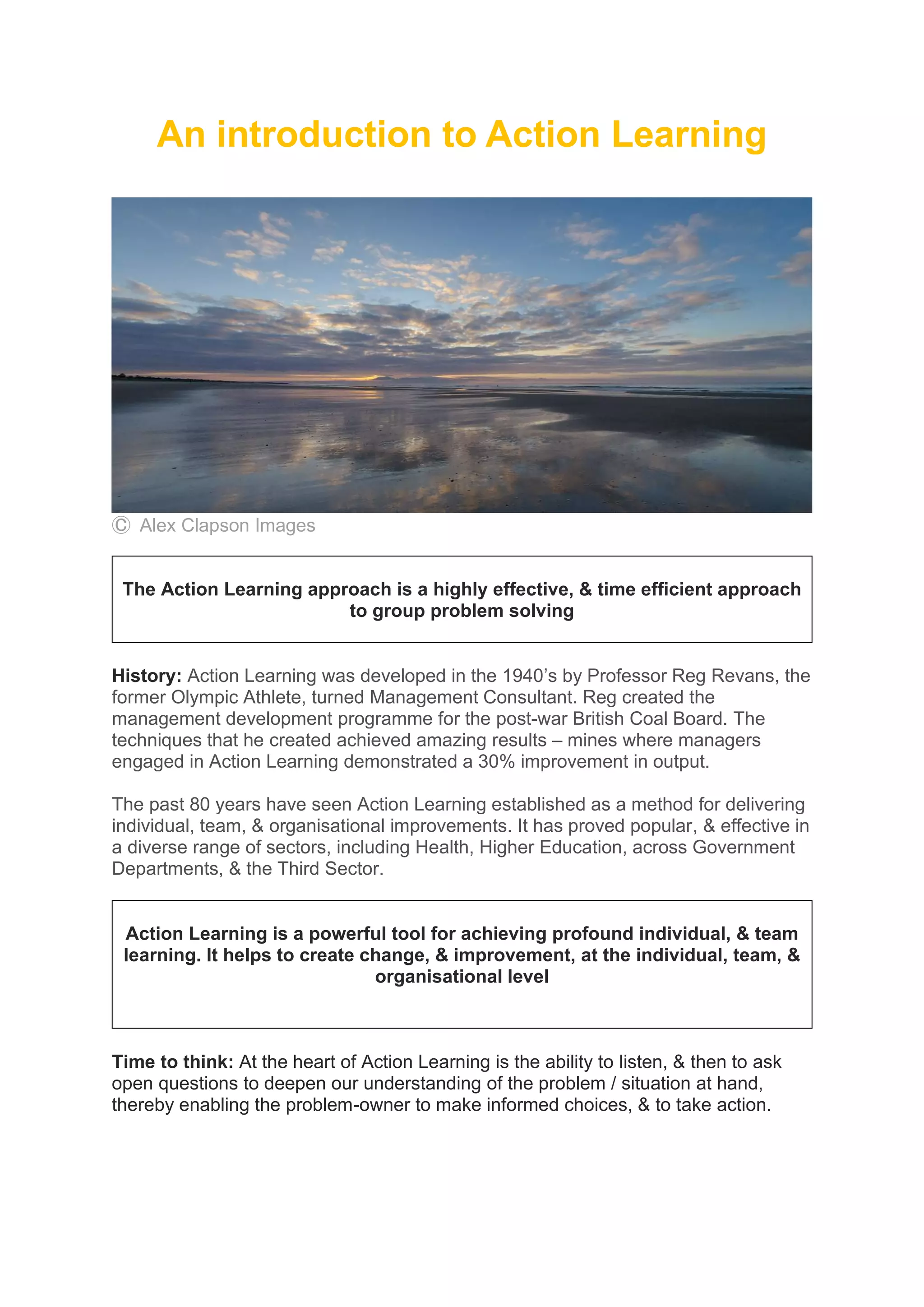
Ⓒ Alex Clapson Images
The Action Learning approach is a highly effective, & time efficient approach
to group problem solving
History: Action Learning was developed in the 1940’s by Professor Reg Revans, the
former Olympic Athlete, turned Management Consultant. Reg created the
management development programme for the post-war British Coal Board. The
techniques that he created achieved amazing results – mines where managers
engaged in Action Learning demonstrated a 30% improvement in output.
The past 80 years have seen Action Learning established as a method for delivering
individual, team, & organisational improvements. It has proved popular, & effective in
a diverse range of sectors, including Health, Higher Education, across Government
Departments, & the Third Sector.
Action Learning is a powerful tool for achieving profound individual, & team
learning. It helps to create change, & improvement, at the individual, team, &
organisational level
Time to think: At the heart of Action Learning is the ability to listen, & then to ask
open questions to deepen our understanding of the problem / situation at hand,
thereby enabling the problem-owner to make informed choices, & to take action.
It is the development of deeper insights into a problem, or situation through
constructive challenge that helps create new learning, & innovative, & powerful
solutions.
Added Benefits of Action Learning:
It is inclusive
It helps to develop decision-making skills
It is collaborative
It enhances appreciation
It develops listening skills
It develops reflective practice
It encourages participation
The knowledge that is written down in books, theories, & concepts is termed
‘programmed knowledge’. This is vital for learning, but it’s not enough; only
when we use that knowledge in challenging enquiry, & then apply it, can it
become true, valuable, & impactful learning
How Action Learning differs from other forms of learning: Action Learning
focuses on the experience, feelings, & insights of the individual. Rather than jumping
to solve a problem as quickly as possible, Action Learning enables deeper enquiry, &
results in deeper understanding.
This approach encourages the problem-owner to reach the best solution, not just
adopt the first one that comes to mind. It also encourages all whom participate to
gain greater insights about themselves, & others which will enable future challenges
to be met with more confidence, & success.

An introduction to Action Learning

  • 1.
    An introduction toAction Learning Ⓒ Alex Clapson Images The Action Learning approach is a highly effective, & time efficient approach to group problem solving History: Action Learning was developed in the 1940’s by Professor Reg Revans, the former Olympic Athlete, turned Management Consultant. Reg created the management development programme for the post-war British Coal Board. The techniques that he created achieved amazing results – mines where managers engaged in Action Learning demonstrated a 30% improvement in output. The past 80 years have seen Action Learning established as a method for delivering individual, team, & organisational improvements. It has proved popular, & effective in a diverse range of sectors, including Health, Higher Education, across Government Departments, & the Third Sector. Action Learning is a powerful tool for achieving profound individual, & team learning. It helps to create change, & improvement, at the individual, team, & organisational level Time to think: At the heart of Action Learning is the ability to listen, & then to ask open questions to deepen our understanding of the problem / situation at hand, thereby enabling the problem-owner to make informed choices, & to take action.
  • 2.
    It is thedevelopment of deeper insights into a problem, or situation through constructive challenge that helps create new learning, & innovative, & powerful solutions. Added Benefits of Action Learning: It is inclusive It helps to develop decision-making skills It is collaborative It enhances appreciation It develops listening skills It develops reflective practice It encourages participation The knowledge that is written down in books, theories, & concepts is termed ‘programmed knowledge’. This is vital for learning, but it’s not enough; only when we use that knowledge in challenging enquiry, & then apply it, can it become true, valuable, & impactful learning How Action Learning differs from other forms of learning: Action Learning focuses on the experience, feelings, & insights of the individual. Rather than jumping to solve a problem as quickly as possible, Action Learning enables deeper enquiry, & results in deeper understanding. This approach encourages the problem-owner to reach the best solution, not just adopt the first one that comes to mind. It also encourages all whom participate to gain greater insights about themselves, & others which will enable future challenges to be met with more confidence, & success.