Action Learning Lena Arena Project Coordinator - DER NSW Sydney Region Ph: 9582 2851 [email_address]
Acknowledgement of Country I would like to show my respect and Acknowledge the Traditional Custodians of the Land, of Elders past and present, on which this meeting takes place.
What is Action Learning?
What is action learning (action research)?
Action learning approach is…
Then…
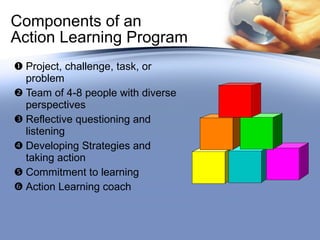
Components of an  Action Learning Program Project, challenge, task, or problem Team of 4-8 people with diverse perspectives Reflective questioning and listening Developing Strategies and taking action  Commitment to learning Action Learning coach
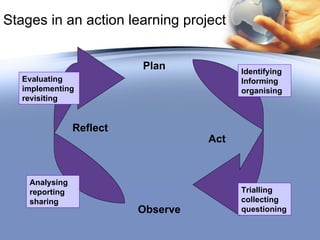
Stages in an action learning project Plan Act Reflect Observe Identifying Informing organising Trialling collecting questioning Analysing reporting sharing Evaluating implementing revisiting
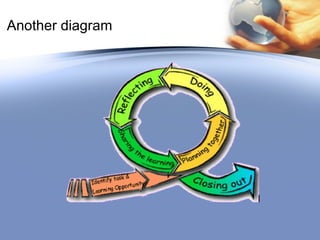
Another diagram
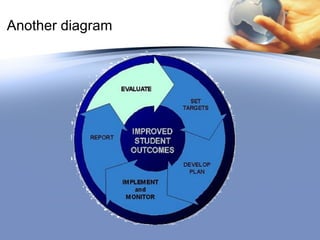
Another diagram
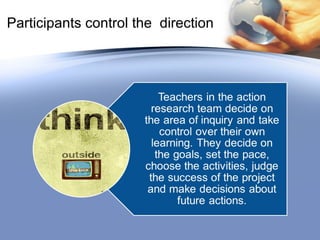
Participants control the  direction
Learning partnerships
Problem Identification :  Identify the issue to be examined/changed Look elsewhere for information Develop the questions and methods to be used Develop a plan Is the problem stated clearly and in the form of a question?   Is it broad enough to allow for a range of insights and findings?   Is it narrow enough to be manageable within the timeframe?  What resources exist and what information from others might be useful in helping you to frame your question, decide on types of data to collect, or to help you in interpreting your findings?  Stage I – Planning
Stage 1 -  Planning Planning  the project requires team members to: identify one or two educational challenges or opportunities to be addressed by the project team, and perhaps at least one individual challenge (e.g. developing competence in relation to one or more elements of the  Quality teaching  framework) for each team member to pursue determine measurable and/or observable project team and individual outcomes that are achievable within the established timeline for the project
Stage 2  Acting Trial the change following your plan Collect and compile evidence Question the process and make changes as required Be clear about each step you take, ensure your timeframe is manageable. Taking action is about implementing the action plan. It may include teaching, assessing, team meetings and discussions, workshops, in-class support and peer observations, input from external sources (such as an academic partner or a regional consultant), reflection and sharing of expertise, ideas, experiences, thoughts and feelings.
Stage 3 - Observing Analysis of Data -describe, record, discuss and reflect upon the action Analyse the evidence.  Collate the findings What can you learn from the data?  What patterns, insights, and new understandings can you find?  What meaning do these patterns, insights, and new understandings have for your practice? for your students?  Share your findings with participants and colleagues Action research teams use a variety of strategies to gather evidence and describe action. This may include discussions between team members and support personnel to clarify and share observations, thoughts and ideas, interviews, focus group discussions, journals or learning logs, portfolios, video scenarios, photographs, and annotated student work samples.
Stage 4 - Reflecting Involves teachers in considering not only  what  they are doing in the classroom … but also  why  they are doing it. Teacher knowledge of educational theories and research can assist teachers to reflect critically on their current practice. When they become conscious of the theories implicit in their practice, they are better able to determine whether there is a need for fundamental change,  e.g.  Given the benefits to be obtained by students engaging in cooperative learning, to what extent do I provide for cooperative learning in my classroom?
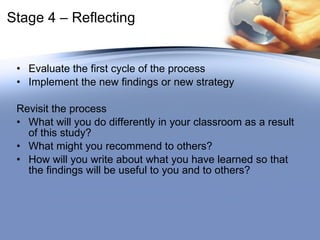
Stage 4 – Reflecting Evaluate the first cycle of the process Implement the new findings or new strategy Revisit the process What will you do differently in your classroom as a result of this study?  What might you recommend to others?  How will you write about what you have learned so that the findings will be useful to you and to others?
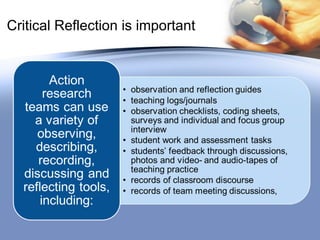
Critical Reflection is important
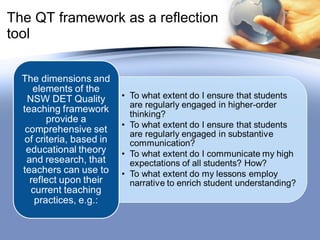
The QT framework as a reflection tool
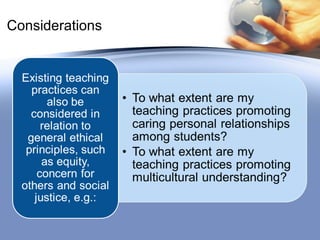
Considerations
Power and Benefits of Action Learning Solves complex problems and challenges in a systems-thinking approach Promotes holistic thinking Builds powerful teams Enables individuals and teams to learn while working Creates a culture that can handle change and learns Develops leadership competencies Develops systems thinking and creativity
Additional Benefits of Action Learning Learning how to learn New knowledge and information Improve relevant skills and competencies Reasoning and behaving differently Alters beliefs, values and basic assumptions Self-awareness
Your Action Learning Project Happens in the workplace  Tackles the issues facing  you  in  your   school or classroom Is the c entre of the learning process
Some advice Reg Revans suggest you ask yourself… What are you doing? Why are you doing it? What will happen next?
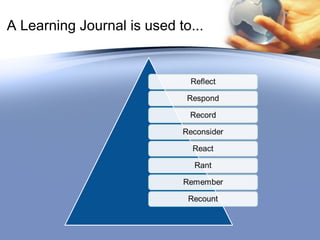
A Learning Journal is used to...
To remember...
Final Thoughts
Quotes for thought…
Resources http://www.scu.edu.au/schools/gcm/ar/arhome.html http://www.learningplace.com.au/deliver/content.asp?pid=19632 http://www.qtp.nsw.edu.au/   https://www.det.nsw.edu.au/proflearn/research/actres.htm   http://www.curriculumsupport.education.nsw.gov.au/ict/index.htm
Questions?

Action Learning

  • 1.
    Action Learning LenaArena Project Coordinator - DER NSW Sydney Region Ph: 9582 2851 [email_address]
  • 2.
    Acknowledgement of CountryI would like to show my respect and Acknowledge the Traditional Custodians of the Land, of Elders past and present, on which this meeting takes place.
  • 3.
    What is ActionLearning?
  • 4.
    What is actionlearning (action research)?
  • 5.
  • 6.
  • 7.
    Components of an Action Learning Program Project, challenge, task, or problem Team of 4-8 people with diverse perspectives Reflective questioning and listening Developing Strategies and taking action Commitment to learning Action Learning coach
  • 8.
    Stages in anaction learning project Plan Act Reflect Observe Identifying Informing organising Trialling collecting questioning Analysing reporting sharing Evaluating implementing revisiting
  • 9.
  • 10.
  • 11.
  • 12.
  • 13.
    Problem Identification : Identify the issue to be examined/changed Look elsewhere for information Develop the questions and methods to be used Develop a plan Is the problem stated clearly and in the form of a question?   Is it broad enough to allow for a range of insights and findings?   Is it narrow enough to be manageable within the timeframe? What resources exist and what information from others might be useful in helping you to frame your question, decide on types of data to collect, or to help you in interpreting your findings? Stage I – Planning
  • 14.
    Stage 1 - Planning Planning the project requires team members to: identify one or two educational challenges or opportunities to be addressed by the project team, and perhaps at least one individual challenge (e.g. developing competence in relation to one or more elements of the Quality teaching framework) for each team member to pursue determine measurable and/or observable project team and individual outcomes that are achievable within the established timeline for the project
  • 15.
    Stage 2 Acting Trial the change following your plan Collect and compile evidence Question the process and make changes as required Be clear about each step you take, ensure your timeframe is manageable. Taking action is about implementing the action plan. It may include teaching, assessing, team meetings and discussions, workshops, in-class support and peer observations, input from external sources (such as an academic partner or a regional consultant), reflection and sharing of expertise, ideas, experiences, thoughts and feelings.
  • 16.
    Stage 3 -Observing Analysis of Data -describe, record, discuss and reflect upon the action Analyse the evidence. Collate the findings What can you learn from the data?  What patterns, insights, and new understandings can you find? What meaning do these patterns, insights, and new understandings have for your practice? for your students? Share your findings with participants and colleagues Action research teams use a variety of strategies to gather evidence and describe action. This may include discussions between team members and support personnel to clarify and share observations, thoughts and ideas, interviews, focus group discussions, journals or learning logs, portfolios, video scenarios, photographs, and annotated student work samples.
  • 17.
    Stage 4 -Reflecting Involves teachers in considering not only what they are doing in the classroom … but also why they are doing it. Teacher knowledge of educational theories and research can assist teachers to reflect critically on their current practice. When they become conscious of the theories implicit in their practice, they are better able to determine whether there is a need for fundamental change, e.g. Given the benefits to be obtained by students engaging in cooperative learning, to what extent do I provide for cooperative learning in my classroom?
  • 18.
    Stage 4 –Reflecting Evaluate the first cycle of the process Implement the new findings or new strategy Revisit the process What will you do differently in your classroom as a result of this study? What might you recommend to others? How will you write about what you have learned so that the findings will be useful to you and to others?
  • 19.
  • 20.
    The QT frameworkas a reflection tool
  • 21.
  • 22.
    Power and Benefitsof Action Learning Solves complex problems and challenges in a systems-thinking approach Promotes holistic thinking Builds powerful teams Enables individuals and teams to learn while working Creates a culture that can handle change and learns Develops leadership competencies Develops systems thinking and creativity
  • 23.
    Additional Benefits ofAction Learning Learning how to learn New knowledge and information Improve relevant skills and competencies Reasoning and behaving differently Alters beliefs, values and basic assumptions Self-awareness
  • 24.
    Your Action LearningProject Happens in the workplace Tackles the issues facing you in your school or classroom Is the c entre of the learning process
  • 25.
    Some advice RegRevans suggest you ask yourself… What are you doing? Why are you doing it? What will happen next?
  • 26.
    A Learning Journalis used to...
  • 27.
  • 28.
  • 29.
  • 30.
    Resources http://www.scu.edu.au/schools/gcm/ar/arhome.html http://www.learningplace.com.au/deliver/content.asp?pid=19632http://www.qtp.nsw.edu.au/ https://www.det.nsw.edu.au/proflearn/research/actres.htm http://www.curriculumsupport.education.nsw.gov.au/ict/index.htm
  • 31.

Editor's Notes

  • #7 They have long been applied in the contexts of schools’ and teachers’ work. It focuses on the teacher as learner within schools characterised as professional learning communities. Teachers are valued as both sources of knowledge and users of this knowledge to generate new knowledge, new ideas and new practices. action research involves research, but the emphasis is not on researching other people’s practices. action research emphasises research into a teacher’s own work practices with and for others. Improvement in practice is achieved by teachers reflecting on their work and asking, with the help of colleagues, in what ways they might do it more effectively