International Journal of Trend in Scientific Research and Development (IJTSRD)
Volume: 3 | Issue: 4 | May-Jun 2019 Available Online: www.ijtsrd.com e-ISSN: 2456 - 6470
@ IJTSRD | Unique Paper ID – IJTSRD25195 | Volume – 3 | Issue – 4 | May-Jun 2019 Page: 1523
An Experimental Study on Properties of Concrete
using Waste Plastic Scrap Materials as Partial
Replacement of Coarse Aggregate
Mahendra Yadav1, Pratiksha Malviya2
1M.Tech. Scholar, 2Professor
1,2Department of Civil Engineering, Millennium Institute of Technology, Bhopal, Madhya Pradesh, India
How to cite this paper: Mahendra
Yadav | Pratiksha Malviya "An
Experimental Study on Properties of
Concrete using Waste Plastic Scrap
Materials as Partial Replacement of
Coarse Aggregate" Published in
International Journal of Trend in
Scientific Research and Development
(ijtsrd), ISSN: 2456-
6470, Volume-3 |
Issue-4, June 2019,
pp.1523-1526, URL:
https://www.ijtsrd.c
om/papers/ijtsrd25
195.pdf
Copyright © 2019 by author(s) and
International Journal of Trend in
Scientific Research and Development
Journal. This is an Open Access article
distributed under
the terms of the
Creative Commons
Attribution License (CC BY 4.0)
(http://creativecommons.org/licenses/
by/4.0)
ABSTRACT
Investigations were done on M-30grade concrete by replacing coarse
aggregate partially by plastic fiber to get maximum strength.
This work presents the Strength and workability results of waste plastic
fiber reinforced concrete (WPFRC). The different percentages of waste
plastic fiber reinforced concrete used in the experimentation are 0%, 0.5%,
1%, and 2 % by partial replacement of coarse aggregate using plastic fiber
This Study presents the satisfactory results on various strength tests of
concrete containing plasticfiber asa partial replacement of coarseaggregate
and would help to resolve solid waste disposal problem. However, further
research work is still necessary in order to have a more in-depth
understanding.
INTRODUCTION
Concrete is the most widely used construction material. Becauseofits specialtyof
being cast in any desirable shape, it has replaced stone and brick masonry. Plain
concrete is weak in tension and has limited ductility and little resistance to
cracking. Micro cracks are present in concretebecauseof itspoor tensilestrength.
The cracks propagate with the application of load, leading to brittle fracture of
concrete.
Micro cracks in concrete are formed during its hardening stage. A discontinuous
heterogeneous system exists even before the application of any external load.
When the load is applied, micro cracks start developing along the planes, which
may experience relatively low tensile strains, at about 25-30% of the ultimate
strength in compression.
Further application of the load leads to uncontrolled growth
of micro cracks. The low resistance to tensile crack
propagation in turn results in a low fracture toughness, and
limited resistance to impact and explosive loading.
The low tensile strength of concrete is beingcompensated in
several ways, and this has been achieved by the use of
reinforcing bars and also by applying pre-stressing force.
Though these methods provide tensile strength to concrete,
they do not increase the inherenttensilestrengthof concrete
itself.
Fibers in the cement based matrix acts as cracks arrester,
which restricts the growth of flaws in the matrix, preventing
these from enlarging under load, into cracks, which
eventually cause failure. Prevention of propagation of cracks
originating from internal flaws can result in improvements
in static and dynamic properties of the matrix.
Plastic Fiber Reinforced Concrete
Enhancing the tensile propertiesof plain concretenumerous
strategies have been developed. A considerable lot of the
strategies prevailing with regards to making the concrete
individuals impervious to strain, however none of them
expanded the inborn tractable properties of plain concrete.
The scattering of strands in concrete network to enhance its
ductile properties has been drilled worldwide more than 3
past decades. The expansion of little firmly separated and
consistently scattered filamentstocementwouldgo aboutas
break arrester and would considerablyenhanceitsstaticand
dynamic properties. This sort of concrete is known as fiber
reinforced concrete. Fiber strengthened concrete can be
characterized as a composite material comprising of blends
of bond, mortar, or concrete and broken, discrete,
consistently scattered appropriate strands. Consistent
lattices, woven textures and long wires or poles are not
thought to be discrete fibers.
Objectives
The objectives of the research are outlined below:
Determination of the compressive strength, splittensile
strength, and flexural strength of the concrete with and
without plastic fiber scrap material reinforcedconcrete.
IJTSRD25195
International Journal of Trend in Scientific Research and Development (IJTSRD) @ www.ijtsrd.com eISSN: 2456-6470
@ IJTSRD | Unique Paper ID – IJTSRD25195 | Volume – 3 | Issue – 4 | May-Jun 2019 Page: 1524
Workability Properties
Fresh mix characteristics are more emphasized in fiber concrete compared to the plain concrete, generally increasing
weight fraction of fibers results in further reduction of fresh concrete workability. In this study, fibers assteelfiberscraps
of different volume fractions like 0.5 %, 1 %, 2% and 3 %.
Slump Test
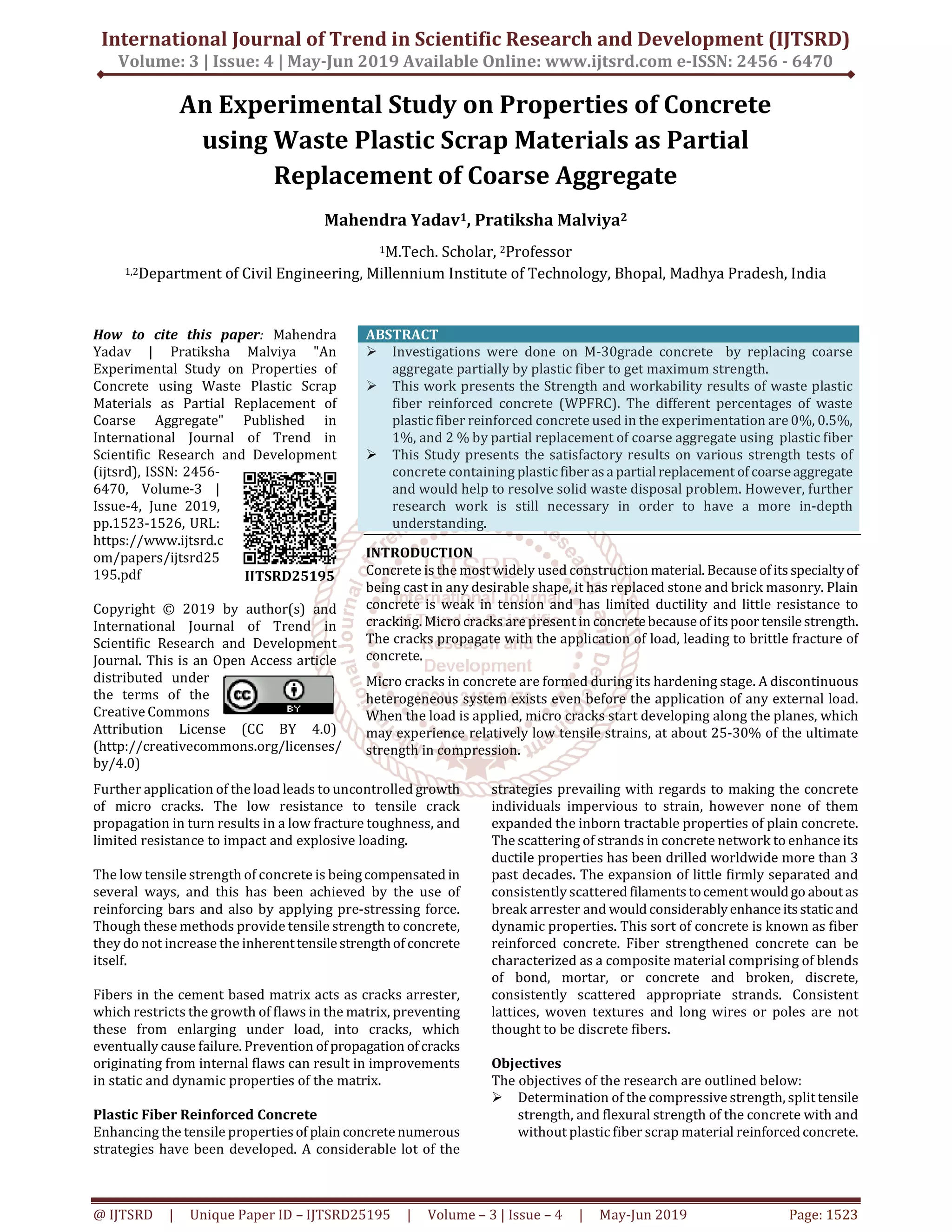
Table 1.1 Slump Test Results
S. No. % Replacement of Plastic fiber Waste Slump for M30
1 0 % 69
2 0.5 % 64
3 1 % 56
4 2% 52
5 3% 43
Figure -1.1 slump values with steel fiber (Grade M-30)
Discussion: Slump test an incentive for M-30 review of solid blend with 0%, 0.5%, 1%, 2% and 3% plastic fiber scrap blends
are appeared in table and chart. Table-5.1 demonstrates the droop estimations of M-30 review cement and plastic fiber solid
extent. Their qualities are watched vary from 69mmto 39 mm from 0% to 2% Plastic fiber Waste for M30 grade concretemix.
It is observed that with the increase in the addition of Plastic fiber Waste, workability reduces gradually for M-30 grade
concrete respectively.
Mechanical Strength
To evaluate the mechanical strength characteristics of concrete reinforced with plastic fibers scraps materials, detailed
experimental investigation was carried out and the results are discussed in the forthcoming sections.
Cube Compressive Strength
Totally 108 cube specimens of size 150 mm x150 mm x 150 mm with 3 mixes were casted and tested. Three volume fractions
were considered for steel fiber scraps (0.5%, 1% and 2% of Plastic fibers scraps).
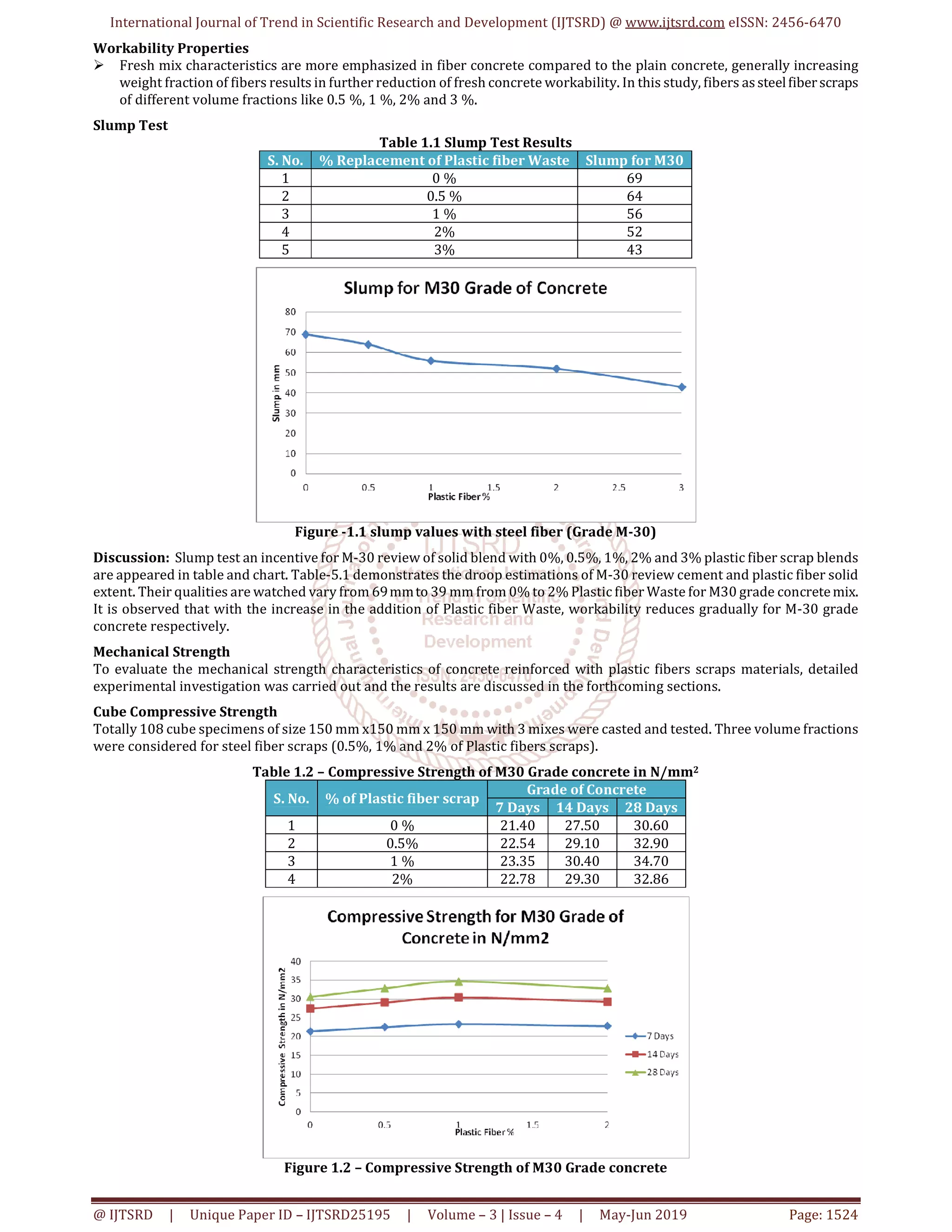
Table 1.2 – Compressive Strength of M30 Grade concrete in N/mm2
S. No. % of Plastic fiber scrap
Grade of Concrete
7 Days 14 Days 28 Days
1 0 % 21.40 27.50 30.60
2 0.5% 22.54 29.10 32.90
3 1 % 23.35 30.40 34.70
4 2% 22.78 29.30 32.86
Figure 1.2 – Compressive Strength of M30 Grade concrete
International Journal of Trend in Scientific Research and Development (IJTSRD) @ www.ijtsrd.com eISSN: 2456-6470
@ IJTSRD | Unique Paper ID – IJTSRD25195 | Volume – 3 | Issue – 4 | May-Jun 2019 Page: 1525
Discussion: The Result of compressive strength for M-30 review of cement on 3D shape example with 0%, 0.5%, 1% and 2%
Plastic fiber scrap blends are appeared in table and chart. Table-5.2 gives the compressive quality estimations of M-30 review
cement and steel fiber scrap concrete blends at 7, 14 and 28 days curing and their esteems are seen .With expansion of steel
fiber scraps, compressive quality bit by bit increments from 21.40 N/mm2 to 34.70 N/mm2 with 0 % to 2 % of plastic fiber
waste.
Split Tensile Strength
Totally 36 cylinder specimens of size 100 mm diameter and 300 mm height with 3 different % mixes were casted and tested.
Three weight fractions were considered for plastic scrap fibersofconstantlength. Resultsforsplit tensilestrengthbasedonthe
values of test data. A sample comparison Figure for plastic fibers scrap concrete is plotted to study conventional concrete
strength which is shown in Fig. 5.5.The values of the split tensile strength of different mixes are shown in Table-5.3
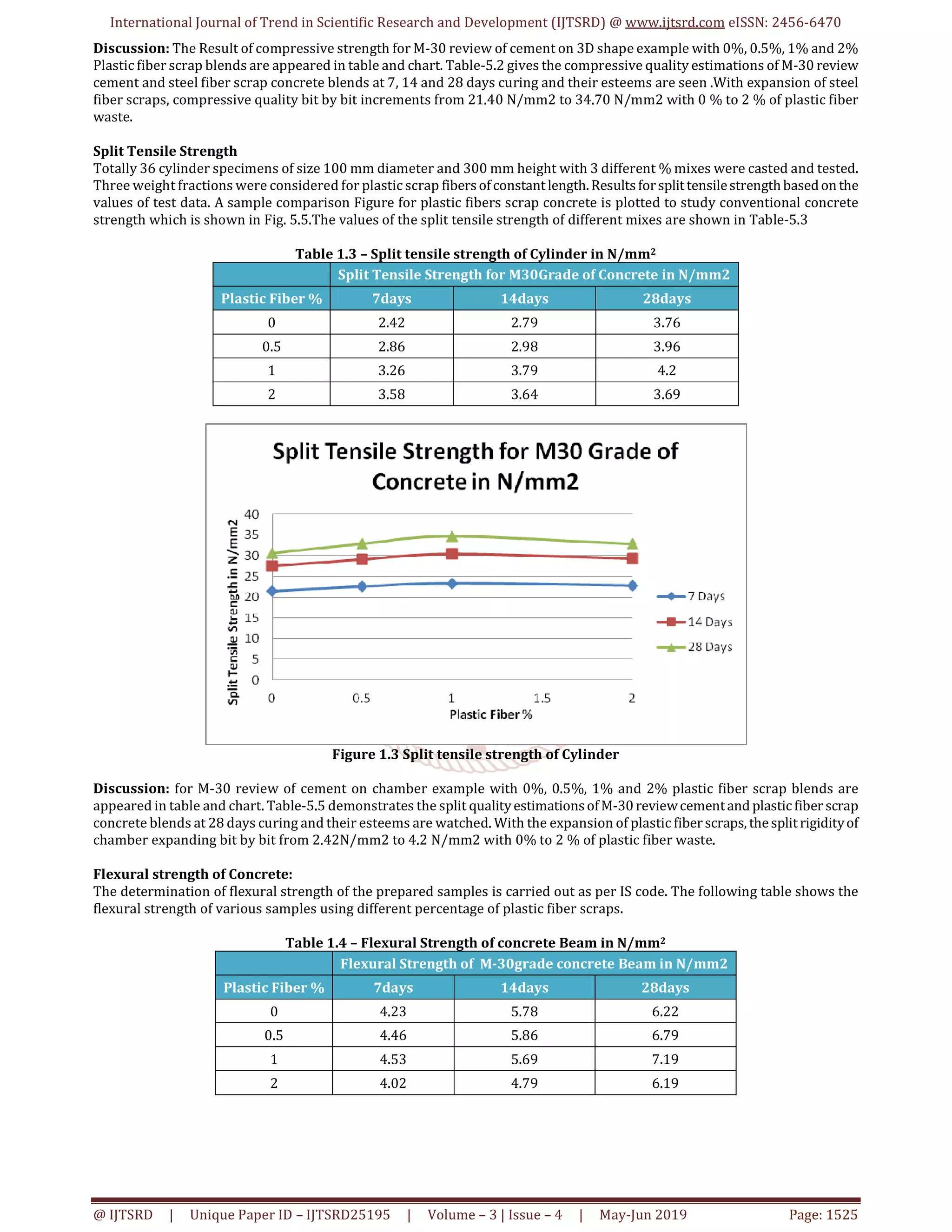
Table 1.3 – Split tensile strength of Cylinder in N/mm2
Split Tensile Strength for M30Grade of Concrete in N/mm2
Plastic Fiber % 7days 14days 28days
0 2.42 2.79 3.76
0.5 2.86 2.98 3.96
1 3.26 3.79 4.2
2 3.58 3.64 3.69
Figure 1.3 Split tensile strength of Cylinder
Discussion: for M-30 review of cement on chamber example with 0%, 0.5%, 1% and 2% plastic fiber scrap blends are
appeared in table and chart. Table-5.5 demonstrates the split qualityestimationsofM-30 reviewcementand plasticfiber scrap
concrete blends at 28 days curing and their esteems are watched. With the expansion of plastic fiberscraps, thesplitrigidityof
chamber expanding bit by bit from 2.42N/mm2 to 4.2 N/mm2 with 0% to 2 % of plastic fiber waste.
Flexural strength of Concrete:
The determination of flexural strength of the prepared samples is carried out as per IS code. The following table shows the
flexural strength of various samples using different percentage of plastic fiber scraps.
Table 1.4 – Flexural Strength of concrete Beam in N/mm2
Flexural Strength of M-30grade concrete Beam in N/mm2
Plastic Fiber % 7days 14days 28days
0 4.23 5.78 6.22
0.5 4.46 5.86 6.79
1 4.53 5.69 7.19
2 4.02 4.79 6.19
International Journal of Trend in Scientific Research and Development (IJTSRD) @ www.ijtsrd.com eISSN: 2456-6470
@ IJTSRD | Unique Paper ID – IJTSRD25195 | Volume – 3 | Issue – 4 | May-Jun 2019 Page: 1526
Figure 1.4 – Flexural Strength of concrete Beam
Discussion:
The Result of split rigidity for M-30 review of cement on
pillar example with 0%, 0.5%, 1% and 2% Plastic Fiber
Waste blends following 28 days of curing are appeared in
table and diagram. It is seen that with the expansion of
Plastic Fiber Waste flexural quality esteem expanding step
by step from 4.23N/mm2 to 7.19N/mm2 with 0% to 1 % of
plastic fiber waste.
Conclusion
Based on the experimental investigation the following
conclusion is given within the limitation of the test result.
It can be concluded that higher strengthand workability
characteristics of waste plasticfiberreinforced concrete
and conventional aggregates can be obtained with 1%
addition of fibers into it
Addition of plastic fiber waste resulted in significant
improvement on the quality properties of solid (M-30)
grade.
Future scope of work
This research was intended to find out the influence of
steel fiber as a partial replacement coarse aggregate in
concrete for M30 mix in future different grade of
concrete is investigated.
REFERENCES
[1] C. Sudha , K. Divya Krishan, P. T Ravichandran and P.R.
Kannan Rajkumar, “ Strength characteristics of High
Strength Concrete using M-sand”. Indian Journal of
Science and Technology, Vol 9(41), 2016.
[2] Mandal.S and Ghosh A., ‘Study on the Properties of
Recycled Aggregate Concrete’, Indian Concrete
Institute, Bulletin No.68 pp 21-23.
[3] Mostafa Tavakoli and Parviz Soroushian., ‘Strengths of
Recycled Aggregate Concrete Made Using Field-
Demolished Concrete as Aggregate’, ACI Materials
Journal, March-April 1996, pp 182- 190.
[4] Padmini A.K, Mathews M. S and R.K. Ramamurthy.,
‘Behavior of Recycled Aggregate Concrete’, ICI Journal
Oct-Dec2000 pp 35-39.
[5] Prakash K.B., Konnur B. A and K. T. Krishnaswamy.,
‘Effect of Super Plasticizers on the Fiber Reinforced
Concrete produced from High Grade Cements’
Published in Asia-Pacific SpecialtyConferenceonFiber
Reinforced Concrete: Singapore, August28-29, 1997.
[6] Su-Jin Lee, Jong-Il WonFlexural conduct of precast
fortified solid compositeindividualsstrengthened with
basic nano-engineered and steel strands Composite
Structures 118 (2014) 571– 579
[7] Sumanta Das an, Alyson Hendrix Flexural break
reaction of a novel iron carbonate framework – Glass
fiber composite and its correlation with Portlandbond
based composites Construction and BuildingMaterials
93 (2018) 360– 370
[8] T.Shanmugapriya and Dr. R.N. Uma, “Strength and
Durability Studies on High PerformanceConcreteWith
Manufactured Sand as Fine Aggregate”. International
Journal of Applied Engineering Research, Vol. 10, No. 2
pp 1919-1924, 2015.
[9] Tahmul Hussian, Maneeth P. D, BrijBhushanS,Rohan S
Gourav, Shreenivas Reddy Shahapur, “ Experimental
Investigation on Strength Characteristics by Partial
Replacement of Natural Sand byM-Sand &BagasseAsh
over Cement for M40 Concrete”, International Journal
for Scientific Research & Development (IJSRD)-Vol.4,
Issue 6,2016,pp. 380-384.
[10] V. S. Vairagade, KS Kene, T. R Patil “ Comparative Study
of Steel Fiber Reinforced Over Control Concrete”,
International Journal of Scientific and Technology,
2012.
[11] Y. Mohammadi, S. P. Singh and S. K Kaushik,
“Properties of Steel Fibrous ConcreteContainingMixed
Fibers in Fresh and Hardened State”, Construction and
Building Materials, May 2008, Vol. 22(5);956-965.

An Experimental Study on Properties of Concrete using Waste Plastic Scrap Materials as Partial Replacement of Coarse Aggregate

  • 1.
    International Journal ofTrend in Scientific Research and Development (IJTSRD) Volume: 3 | Issue: 4 | May-Jun 2019 Available Online: www.ijtsrd.com e-ISSN: 2456 - 6470 @ IJTSRD | Unique Paper ID – IJTSRD25195 | Volume – 3 | Issue – 4 | May-Jun 2019 Page: 1523 An Experimental Study on Properties of Concrete using Waste Plastic Scrap Materials as Partial Replacement of Coarse Aggregate Mahendra Yadav1, Pratiksha Malviya2 1M.Tech. Scholar, 2Professor 1,2Department of Civil Engineering, Millennium Institute of Technology, Bhopal, Madhya Pradesh, India How to cite this paper: Mahendra Yadav | Pratiksha Malviya "An Experimental Study on Properties of Concrete using Waste Plastic Scrap Materials as Partial Replacement of Coarse Aggregate" Published in International Journal of Trend in Scientific Research and Development (ijtsrd), ISSN: 2456- 6470, Volume-3 | Issue-4, June 2019, pp.1523-1526, URL: https://www.ijtsrd.c om/papers/ijtsrd25 195.pdf Copyright © 2019 by author(s) and International Journal of Trend in Scientific Research and Development Journal. This is an Open Access article distributed under the terms of the Creative Commons Attribution License (CC BY 4.0) (http://creativecommons.org/licenses/ by/4.0) ABSTRACT Investigations were done on M-30grade concrete by replacing coarse aggregate partially by plastic fiber to get maximum strength. This work presents the Strength and workability results of waste plastic fiber reinforced concrete (WPFRC). The different percentages of waste plastic fiber reinforced concrete used in the experimentation are 0%, 0.5%, 1%, and 2 % by partial replacement of coarse aggregate using plastic fiber This Study presents the satisfactory results on various strength tests of concrete containing plasticfiber asa partial replacement of coarseaggregate and would help to resolve solid waste disposal problem. However, further research work is still necessary in order to have a more in-depth understanding. INTRODUCTION Concrete is the most widely used construction material. Becauseofits specialtyof being cast in any desirable shape, it has replaced stone and brick masonry. Plain concrete is weak in tension and has limited ductility and little resistance to cracking. Micro cracks are present in concretebecauseof itspoor tensilestrength. The cracks propagate with the application of load, leading to brittle fracture of concrete. Micro cracks in concrete are formed during its hardening stage. A discontinuous heterogeneous system exists even before the application of any external load. When the load is applied, micro cracks start developing along the planes, which may experience relatively low tensile strains, at about 25-30% of the ultimate strength in compression. Further application of the load leads to uncontrolled growth of micro cracks. The low resistance to tensile crack propagation in turn results in a low fracture toughness, and limited resistance to impact and explosive loading. The low tensile strength of concrete is beingcompensated in several ways, and this has been achieved by the use of reinforcing bars and also by applying pre-stressing force. Though these methods provide tensile strength to concrete, they do not increase the inherenttensilestrengthof concrete itself. Fibers in the cement based matrix acts as cracks arrester, which restricts the growth of flaws in the matrix, preventing these from enlarging under load, into cracks, which eventually cause failure. Prevention of propagation of cracks originating from internal flaws can result in improvements in static and dynamic properties of the matrix. Plastic Fiber Reinforced Concrete Enhancing the tensile propertiesof plain concretenumerous strategies have been developed. A considerable lot of the strategies prevailing with regards to making the concrete individuals impervious to strain, however none of them expanded the inborn tractable properties of plain concrete. The scattering of strands in concrete network to enhance its ductile properties has been drilled worldwide more than 3 past decades. The expansion of little firmly separated and consistently scattered filamentstocementwouldgo aboutas break arrester and would considerablyenhanceitsstaticand dynamic properties. This sort of concrete is known as fiber reinforced concrete. Fiber strengthened concrete can be characterized as a composite material comprising of blends of bond, mortar, or concrete and broken, discrete, consistently scattered appropriate strands. Consistent lattices, woven textures and long wires or poles are not thought to be discrete fibers. Objectives The objectives of the research are outlined below: Determination of the compressive strength, splittensile strength, and flexural strength of the concrete with and without plastic fiber scrap material reinforcedconcrete. IJTSRD25195
  • 2.
    International Journal ofTrend in Scientific Research and Development (IJTSRD) @ www.ijtsrd.com eISSN: 2456-6470 @ IJTSRD | Unique Paper ID – IJTSRD25195 | Volume – 3 | Issue – 4 | May-Jun 2019 Page: 1524 Workability Properties Fresh mix characteristics are more emphasized in fiber concrete compared to the plain concrete, generally increasing weight fraction of fibers results in further reduction of fresh concrete workability. In this study, fibers assteelfiberscraps of different volume fractions like 0.5 %, 1 %, 2% and 3 %. Slump Test Table 1.1 Slump Test Results S. No. % Replacement of Plastic fiber Waste Slump for M30 1 0 % 69 2 0.5 % 64 3 1 % 56 4 2% 52 5 3% 43 Figure -1.1 slump values with steel fiber (Grade M-30) Discussion: Slump test an incentive for M-30 review of solid blend with 0%, 0.5%, 1%, 2% and 3% plastic fiber scrap blends are appeared in table and chart. Table-5.1 demonstrates the droop estimations of M-30 review cement and plastic fiber solid extent. Their qualities are watched vary from 69mmto 39 mm from 0% to 2% Plastic fiber Waste for M30 grade concretemix. It is observed that with the increase in the addition of Plastic fiber Waste, workability reduces gradually for M-30 grade concrete respectively. Mechanical Strength To evaluate the mechanical strength characteristics of concrete reinforced with plastic fibers scraps materials, detailed experimental investigation was carried out and the results are discussed in the forthcoming sections. Cube Compressive Strength Totally 108 cube specimens of size 150 mm x150 mm x 150 mm with 3 mixes were casted and tested. Three volume fractions were considered for steel fiber scraps (0.5%, 1% and 2% of Plastic fibers scraps). Table 1.2 – Compressive Strength of M30 Grade concrete in N/mm2 S. No. % of Plastic fiber scrap Grade of Concrete 7 Days 14 Days 28 Days 1 0 % 21.40 27.50 30.60 2 0.5% 22.54 29.10 32.90 3 1 % 23.35 30.40 34.70 4 2% 22.78 29.30 32.86 Figure 1.2 – Compressive Strength of M30 Grade concrete
  • 3.
    International Journal ofTrend in Scientific Research and Development (IJTSRD) @ www.ijtsrd.com eISSN: 2456-6470 @ IJTSRD | Unique Paper ID – IJTSRD25195 | Volume – 3 | Issue – 4 | May-Jun 2019 Page: 1525 Discussion: The Result of compressive strength for M-30 review of cement on 3D shape example with 0%, 0.5%, 1% and 2% Plastic fiber scrap blends are appeared in table and chart. Table-5.2 gives the compressive quality estimations of M-30 review cement and steel fiber scrap concrete blends at 7, 14 and 28 days curing and their esteems are seen .With expansion of steel fiber scraps, compressive quality bit by bit increments from 21.40 N/mm2 to 34.70 N/mm2 with 0 % to 2 % of plastic fiber waste. Split Tensile Strength Totally 36 cylinder specimens of size 100 mm diameter and 300 mm height with 3 different % mixes were casted and tested. Three weight fractions were considered for plastic scrap fibersofconstantlength. Resultsforsplit tensilestrengthbasedonthe values of test data. A sample comparison Figure for plastic fibers scrap concrete is plotted to study conventional concrete strength which is shown in Fig. 5.5.The values of the split tensile strength of different mixes are shown in Table-5.3 Table 1.3 – Split tensile strength of Cylinder in N/mm2 Split Tensile Strength for M30Grade of Concrete in N/mm2 Plastic Fiber % 7days 14days 28days 0 2.42 2.79 3.76 0.5 2.86 2.98 3.96 1 3.26 3.79 4.2 2 3.58 3.64 3.69 Figure 1.3 Split tensile strength of Cylinder Discussion: for M-30 review of cement on chamber example with 0%, 0.5%, 1% and 2% plastic fiber scrap blends are appeared in table and chart. Table-5.5 demonstrates the split qualityestimationsofM-30 reviewcementand plasticfiber scrap concrete blends at 28 days curing and their esteems are watched. With the expansion of plastic fiberscraps, thesplitrigidityof chamber expanding bit by bit from 2.42N/mm2 to 4.2 N/mm2 with 0% to 2 % of plastic fiber waste. Flexural strength of Concrete: The determination of flexural strength of the prepared samples is carried out as per IS code. The following table shows the flexural strength of various samples using different percentage of plastic fiber scraps. Table 1.4 – Flexural Strength of concrete Beam in N/mm2 Flexural Strength of M-30grade concrete Beam in N/mm2 Plastic Fiber % 7days 14days 28days 0 4.23 5.78 6.22 0.5 4.46 5.86 6.79 1 4.53 5.69 7.19 2 4.02 4.79 6.19
  • 4.
    International Journal ofTrend in Scientific Research and Development (IJTSRD) @ www.ijtsrd.com eISSN: 2456-6470 @ IJTSRD | Unique Paper ID – IJTSRD25195 | Volume – 3 | Issue – 4 | May-Jun 2019 Page: 1526 Figure 1.4 – Flexural Strength of concrete Beam Discussion: The Result of split rigidity for M-30 review of cement on pillar example with 0%, 0.5%, 1% and 2% Plastic Fiber Waste blends following 28 days of curing are appeared in table and diagram. It is seen that with the expansion of Plastic Fiber Waste flexural quality esteem expanding step by step from 4.23N/mm2 to 7.19N/mm2 with 0% to 1 % of plastic fiber waste. Conclusion Based on the experimental investigation the following conclusion is given within the limitation of the test result. It can be concluded that higher strengthand workability characteristics of waste plasticfiberreinforced concrete and conventional aggregates can be obtained with 1% addition of fibers into it Addition of plastic fiber waste resulted in significant improvement on the quality properties of solid (M-30) grade. Future scope of work This research was intended to find out the influence of steel fiber as a partial replacement coarse aggregate in concrete for M30 mix in future different grade of concrete is investigated. REFERENCES [1] C. Sudha , K. Divya Krishan, P. T Ravichandran and P.R. Kannan Rajkumar, “ Strength characteristics of High Strength Concrete using M-sand”. Indian Journal of Science and Technology, Vol 9(41), 2016. [2] Mandal.S and Ghosh A., ‘Study on the Properties of Recycled Aggregate Concrete’, Indian Concrete Institute, Bulletin No.68 pp 21-23. [3] Mostafa Tavakoli and Parviz Soroushian., ‘Strengths of Recycled Aggregate Concrete Made Using Field- Demolished Concrete as Aggregate’, ACI Materials Journal, March-April 1996, pp 182- 190. [4] Padmini A.K, Mathews M. S and R.K. Ramamurthy., ‘Behavior of Recycled Aggregate Concrete’, ICI Journal Oct-Dec2000 pp 35-39. [5] Prakash K.B., Konnur B. A and K. T. Krishnaswamy., ‘Effect of Super Plasticizers on the Fiber Reinforced Concrete produced from High Grade Cements’ Published in Asia-Pacific SpecialtyConferenceonFiber Reinforced Concrete: Singapore, August28-29, 1997. [6] Su-Jin Lee, Jong-Il WonFlexural conduct of precast fortified solid compositeindividualsstrengthened with basic nano-engineered and steel strands Composite Structures 118 (2014) 571– 579 [7] Sumanta Das an, Alyson Hendrix Flexural break reaction of a novel iron carbonate framework – Glass fiber composite and its correlation with Portlandbond based composites Construction and BuildingMaterials 93 (2018) 360– 370 [8] T.Shanmugapriya and Dr. R.N. Uma, “Strength and Durability Studies on High PerformanceConcreteWith Manufactured Sand as Fine Aggregate”. International Journal of Applied Engineering Research, Vol. 10, No. 2 pp 1919-1924, 2015. [9] Tahmul Hussian, Maneeth P. D, BrijBhushanS,Rohan S Gourav, Shreenivas Reddy Shahapur, “ Experimental Investigation on Strength Characteristics by Partial Replacement of Natural Sand byM-Sand &BagasseAsh over Cement for M40 Concrete”, International Journal for Scientific Research & Development (IJSRD)-Vol.4, Issue 6,2016,pp. 380-384. [10] V. S. Vairagade, KS Kene, T. R Patil “ Comparative Study of Steel Fiber Reinforced Over Control Concrete”, International Journal of Scientific and Technology, 2012. [11] Y. Mohammadi, S. P. Singh and S. K Kaushik, “Properties of Steel Fibrous ConcreteContainingMixed Fibers in Fresh and Hardened State”, Construction and Building Materials, May 2008, Vol. 22(5);956-965.