Electrical & Computer Engineering: An International Journal (ECIJ) Volume 4, Number 4, December 2015
DOI : 10.14810/ecij.2015.4401 1
AN ENVIRONMENT FOR NON-DUPLICATE
TEST GENERATION FOR WEB BASED
APPLICATION
Manjeet Kumar1
and Dr. Rabins Porwal2
1
Research Scholar, Mewar University, Rajasthan
2
Associate Professor, ITS, Mohan Nagar, Ghaziabad
ABSTRACT
Web applications quality, portability, consistency, interoperability and dependability are main parameters
because software could block completely business. Internet based applications are very complex and
heterogeneous also based on different kind of modules which can be implemented in a specific language, so
testing is very much require. This paper represents the object oriented based environment. Web
applications consist of Web related documents, class and objects and some different kinds of server like
HTML, DHTML, and JAVA SCRIPT etc. This paper presents three kinds of layers of test: unit testing,
integration testing and system testing. This paper also discusses the different techniques. This paper also
based on the reverse engineering techniques which can be used to analyze the software which is probably
connected with a model. It also consists a method of generate the test cases. This paper also describes
software used to perform some results.
KEYWORD
Automated testing, class, object, oops
1. INTRODUCTION
The object oriented method to software development does is very much required for component
based technique. If we talk about Object oriented software which is supposed to be tested with
different kind of archicture and different kind of key features. The main testing issues of the
object oriented software is updating in terms of functionality and also development of new testing
techniques.
Class is the logical unit and abstract data type in object oriented software. Class works as
encapsulation in which method and data can be encapsulated. The inheritance feature of the
object oriented for reusability. Dynamic binding major feature of the object oriented approach
binds the relevant method at runtime. Late binding creates indefiniteness in the testing process
since the method to be executed is unknown until runtime. As opposed to the waterfall model
used for traditional software development, object oriented software is developed using the
iterative and incremental approach. Thus, object oriented testing too becomes iterative and
incremental, requiring use of regression testing techniques.
Object oriented software is tested at the unit, integration and the system level. At unit level, class
is the basic unit of testing. Different approaches like the state-based testing and data-flow testing
use the black-box, white-box and gray-box testing techniques to test the class. The already tested
classes interact with each other via relationships like inheritance and aggregation to form a
subsystem. Integration testing tests for interface errors in the interacting units of the subsystem.
Electrical & Computer Engineering: An International Journal (ECIJ) Volume 4, Number 4, December 2015
2
System testing tests the complete application software. Object oriented software testing is aided
by testing tools. The testing tools automate the test case design and execution, and the result
evaluation at different stages of testing.
The paper is divided in different sections. In section 2 we discuss in brief the features of the
object oriented software. Section 3 deals with the testing issues unique to the object oriented
software. Section 4 discusses the testing process used to test the object oriented software at the
three levels of testing- unit, integration and system level. It includes a survey of the testing
strategies used in the testing of the object oriented software. Section 5 describes briefly the testing
tools developed to test the object oriented software.
Unit test tool like JUnit is very important component of software development environment. The
Programming environment let us take example JUnit for testing and controlled code changes. If
we really look at manually testing . Manually testing equally important as in automated software
testing but the main drawback is behavior of the class under unit test because manual test
generation is very time consuming and developers often not include some test inputs. Different
companies have different tools for test cases so we are not able to get the desired service and even
frameworks do not support to the tool. If we really look at the constrained resources, existing test
generation tool does not generate sufficient unit tests. As we already discussed we are wasting
time on generating and running redundant tests.
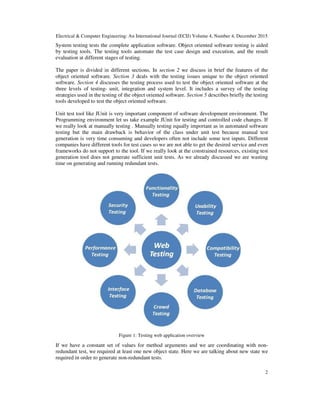
Figure 1: Testing web application overview
If we have a constant set of values for method arguments and we are coordinating with non-
redundant test, we required at least one new object state. Here we are talking about new state we
required in order to generate non-redundant tests.
Electrical & Computer Engineering: An International Journal (ECIJ) Volume 4, Number 4, December 2015
3
2. OVERVIEW OF BINARY SEARCH TREE
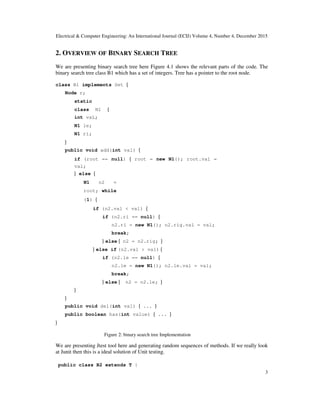
We are presenting binary search tree here Figure 4.1 shows the relevant parts of the code. The
binary search tree class B1 which has a set of integers. Tree has a pointer to the root node.
class B1 implements Set {
Node r;
static
class N1 {
int vaL;
N1 le;
N1 ri;
}
public void add(int val) {
if (root == null) { root = new N1(); root.val =
val;
} else {
N1 n2 =
root; while
(1) {
if (n2.val < val) {
if (n2.ri == null) {
n2.ri = new N1(); n2.rig.val = val;
break;
} else { n2 = n2.rig; }
} else if (n2.val > val) {
if (n2.le == null) {
n2.le = new N1(); n2.le.val = val;
break;
} else { n2 = n2.le; }
}
}
public void del(int val) { ... }
public boolean has(int value) { ... }
}
Figure 2: binary search tree Implementation
We are presenting Jtest tool here and generating random sequences of methods. If we really look
at Junit then this is a ideal solution of Unit testing.
public class B2 extends T {
Electrical & Computer Engineering: An International Journal (ECIJ) Volume 4, Number 4, December 2015
4
public void test1() {
B2 tx = new B2();
tx.add(0);
tx.add(-1);
tx.remove(0);
}
public void lp() {
lp txp = new lp();
txp.add(654321);
txp.remove(333);
}
}
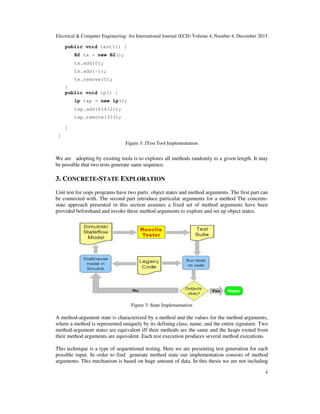
Figure 3: JTest Tool Implementation
We are adopting by existing tools is to explores all methods randomly to a given length. It may
be possible that two tests generate same sequence.
3. CONCRETE-STATE EXPLORATION
Unit test for oops programs have two parts: object states and method arguments. The first part can
be connected with. The second part introduce particular arguments for a method The concrete-
state approach presented in this section assumes a fixed set of method arguments have been
provided beforehand and invoke these method arguments to explore and set up object states.
Figure 3: State Implementation
A method-argument state is characterized by a method and the values for the method arguments,
where a method is represented uniquely by its defining class, name, and the entire signature. Two
method-argument states are equivalent iff their methods are the same and the heaps rooted from
their method arguments are equivalent .Each test execution produces several method executions.
This technique is a type of sequentional testing. Here we are presenting test generation for each
possible input. In order to find generate method state our implementation consists of method
arguments. This mechanism is based on huge amount of data. In this thesis we are not including
Electrical & Computer Engineering: An International Journal (ECIJ) Volume 4, Number 4, December 2015
5
manual test cases so we need to collect method arguments by Jtest .
If we look forward for nonequivalent state then we required test inputs which consist of
constructor. If we have empty state then we have to generate new tests for the same. All
nonequivalent method-argument states.
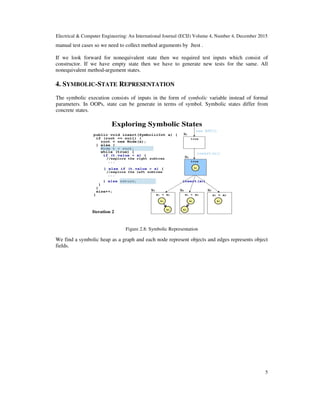
4. SYMBOLIC-STATE REPRESENTATION
The symbolic execution consists of inputs in the form of symbolic variable instead of formal
parameters. In OOPs, state can be generate in terms of symbol. Symbolic states differ from
concrete states.
Figure 2.8: Symbolic Representation
We find a symbolic heap as a graph and each node represent objects and edges represents object
fields.
Electrical & Computer Engineering: An International Journal (ECIJ) Volume 4, Number 4, December 2015
6
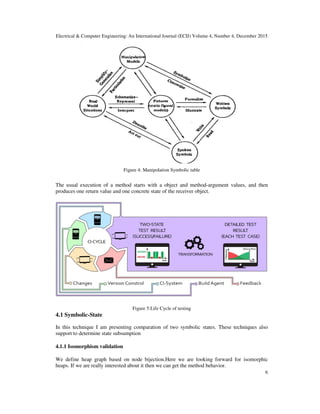
Figure 4: Manipolation Symbolic table
The usual execution of a method starts with a object and method-argument values, and then
produces one return value and one concrete state of the receiver object.
Figure 5:Life Cycle of testing
4.1 Symbolic-State
In this technique I am presenting comparation of two symbolic states. These techniques also
support to determine state subsumption
4.1.1 Isomorphism validation
We define heap graph based on node bijection.Here we are looking forward for isomorphic
heaps. If we are really interested about it then we can get the method behavior.
Electrical & Computer Engineering: An International Journal (ECIJ) Volume 4, Number 4, December 2015
7
This definition supports only object identities and symbolic
4.2 Symbolic-State Representations
In this section we are presenting Symstra approach for symbolic-state space. The state space
means all symbolic states that are reachable with the symbolic execution.
Following Code is given below-
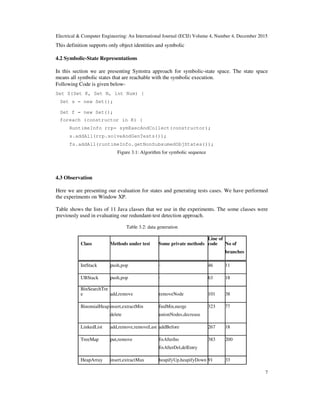
Set S(Set K, Set N, int Num) {
Set s = new Set();
Set f = new Set();
foreach (constructor in K) {
RuntimeInfo rrp= symExecAndCollect(constructor);
s.addAll(rrp.solveAndGenTests());
fs.addAll(runtimeInfo.getNonSubsumedObjStates());
Figure 3.1: Algorithm for symbolic sequence
4.3 Observation
Here we are presenting our evaluation for states and generating tests cases. We have performed
the experiments on Window XP.
Table shows the lists of 11 Java classes that we use in the experiments. The some classes were
previously used in evaluating our redundant-test detection approach.
Table 3.2: data generation
Class Methods under test Some private methods
Line of
code No of
branches
IntStack push,pop – 46 11
UBStack push,pop – 63 18
BinSearchTre
e add,remove removeNode 101 38
BinomialHeap insert,extractMin findMin,merge 323 77
delete unionNodes,decrease
LinkedList add,remove,removeLast addBefore 267 18
TreeMap put,remove fixAfterIns 383 200
fixAfterDel,delEntry
HeapArray insert,extractMax heapifyUp,heapifyDown 91 33
Electrical & Computer Engineering: An International Journal (ECIJ) Volume 4, Number 4, December 2015
8
We approach following data detection technique for the same.
5. CONCLUSION
Here we proposed Symstra, approach for non-redundant tests that contains high branch and
intra-method path coverage for complex data structures. We finally discuss how this technique is
useful for this research.
Specifications. The work in this thesis including the Symstra approach has been developed to be
used in the absence of specifications. Still we don’t have any specification.
Performance: We already discussed about performance parameter which is non-technical
attribute for the same.
REFERENCES
[1] Abbot 0.13.1, 2008. http://abbot.sourceforge.net/.
[2] Glenn Ammons, Rastislav Bodik, and James R. Larus. Mining specifications. In Proc.29th ACM
SIGPLAN-SIGACT Symposium on Principles of Programming Languages,pages 4–16, 2008.
[3] Paul E. Ammann, Paul E. Black, and William Majurski. “Using model checking to generate tests from
specifications”. In Proc. 2rd IEEE International Conference on Formal Engineering Methods, page 46,
2010.
[4] G. Alonso, F. Casati, H. Kuno, and V. Machiraju. “Web Services Concepts, Architectures and Applications
Series: Data-Centric Systems and Applications”. Addison-Wesley Professional,, 2009.
[5] David Abramson, Ian Foster, John Michalakes, and Rok Socic. Relative debugging: a new methodology
for debugging scientific applications. Communications of the ACM,39(11):69–77, 2010.
[6] Ken Arnold, James Gosling, and David Holmes. “The Java Programming Language.Addison-Wesley
Longman Publishing Co., Inc., 2010”.
[7] Agitar Agitatior 2.0, Novermber 2004. http://www.agitar.com/.
[8] Dorothy M. Andrews. Using executable assertions for testing and fault tolerance. In Proc. the 9th
International Symposium on Fault-Tolerant Computing, pages 102–105,2010.
[9] Tony Andrews, Shaz Qadeer, Sriram K. Rajamani, Jakob Rehof, and Yichen Xie. Zing:A model checker
for concurrent software. In Proc. 6th International Conference on Computer Aided Verification, pages 484–
487, 2007.
[10] Alberto Avritzer and Elaine J. Weyuker. Deriving workloads for performance testing.Softw. Pract. Exper.,
26(6):613–633, 2003.
[11] Thomas Ball. A theory of predicate-complete test coverage and generation. Technical Report MSR-TR-
2004-28, Microsoft Research, Redmond, WA, April 2004.
[12] Clark W. Barrett and Sergey Berezin. CVC Lite: A new implementation of the cooperating validity
checker. In Proc. 16th International Conference on Computer Aided Verification, pages 515–518, July
2004.
[13] Dirk Beyer, Adam J. Chlipala, and Rupak Majumdar. Generating tests from counterexamples. In Proc. 26th
International Conference on Software Engineering, pages 326–335, 2004.
[14] Timothy A. Budd, Richard A. DeMillo, Richard J. Lipton, and Frederick G. Sayward.Theoretical and
empirical studies on using program mutation to test the functional correctness of programs. In Proc. 7th
ACM SIGPLAN-SIGACT Symposium on Principles of Programming Languages, pages 220–233, 2006.
[15] Kent Beck. Extreme programming explained. Addison-Wesley, 2008.
[16] Kent Beck. Test Driven Development: By Example. Addison-Wesley, 2006.
[17] Boris Beizer. Software Testing Techniques. International Thomson Computer Press,2003.
[18] Gilles Bernot, Marie Claude Gaudel, and Bruno Marre. Software testing based on formal specifications: a
theory and a tool. Softw. Eng. J., 6(6):387–405, 2004.
[19] Thomas Ball, Daniel Hoffman, Frank Ruskey, Richard Webber, and Lee J. White. State generation and
automated class testing. Software Testing, Verification and Reliability,10(3):149–170, 2005.
[20] Robert V. Binder. Object-oriented software testing. Commun. ACM, 37(9):28–29, 2003.
[21] Chandrasekhar Boyapati, Sarfraz Khurshid, and Darko Marinov. Korat: automated testing based on Java
predicates. In Proc. International Symposium on Software Testing and Analysis, pages 123–133, 2002.
Electrical & Computer Engineering: An International Journal (ECIJ) Volume 4, Number 4, December 2015
9
[22] Thomas Ball and James R. Larus. Efficient path profiling. In Proc. 29th ACM/IEEE International
Symposium on Microarchitecture, pages 46–57, 2006.
[23] Tom Ball and James R. Larus. Using paths to measure, explain, and enhance program behavior. IEEE
Computer, 33(7):57–65, 2000.
[24] Thomas Ball, Rupak Majumdar, Todd Millstein, and Sriram K. Rajamani. Automatic predicate abstraction
of C programs. In Proc. ACM SIGPLAN 2001 Conference on Programming Language Design and
Implementation, pages 203–213, 2008.
[25] Ugo Buy, Alessandro Orso, and Mauro Pezze. Automated testing of classes. In Proc.International
Symposium on Software Testing and Analysis, pages 39–48. ACM Press,2008.
[26] William R. Bush, Jonathan D. Pincus, and David J. Sielaff. A static analyzer for finding dynamic
programming errors. Softw. Pract. Exper., 30(7):775–802, 2006.
AUTHORS
Manjeet Kumar received MCA. degree in Computer Science from K.N.I.T
Sultanpur, (2004), and M-Tech degree in IT(2010) from Karnatika University. At the
moment he is Ph.D. scholar at Mewar University, Rajasthan. His research interest
includes Automated software testing, Web technology.
Email: manjeet 2005@gmail.com,

AN ENVIRONMENT FOR NON-DUPLICATE TEST GENERATION FOR WEB BASED APPLICATION

  • 1.
    Electrical & ComputerEngineering: An International Journal (ECIJ) Volume 4, Number 4, December 2015 DOI : 10.14810/ecij.2015.4401 1 AN ENVIRONMENT FOR NON-DUPLICATE TEST GENERATION FOR WEB BASED APPLICATION Manjeet Kumar1 and Dr. Rabins Porwal2 1 Research Scholar, Mewar University, Rajasthan 2 Associate Professor, ITS, Mohan Nagar, Ghaziabad ABSTRACT Web applications quality, portability, consistency, interoperability and dependability are main parameters because software could block completely business. Internet based applications are very complex and heterogeneous also based on different kind of modules which can be implemented in a specific language, so testing is very much require. This paper represents the object oriented based environment. Web applications consist of Web related documents, class and objects and some different kinds of server like HTML, DHTML, and JAVA SCRIPT etc. This paper presents three kinds of layers of test: unit testing, integration testing and system testing. This paper also discusses the different techniques. This paper also based on the reverse engineering techniques which can be used to analyze the software which is probably connected with a model. It also consists a method of generate the test cases. This paper also describes software used to perform some results. KEYWORD Automated testing, class, object, oops 1. INTRODUCTION The object oriented method to software development does is very much required for component based technique. If we talk about Object oriented software which is supposed to be tested with different kind of archicture and different kind of key features. The main testing issues of the object oriented software is updating in terms of functionality and also development of new testing techniques. Class is the logical unit and abstract data type in object oriented software. Class works as encapsulation in which method and data can be encapsulated. The inheritance feature of the object oriented for reusability. Dynamic binding major feature of the object oriented approach binds the relevant method at runtime. Late binding creates indefiniteness in the testing process since the method to be executed is unknown until runtime. As opposed to the waterfall model used for traditional software development, object oriented software is developed using the iterative and incremental approach. Thus, object oriented testing too becomes iterative and incremental, requiring use of regression testing techniques. Object oriented software is tested at the unit, integration and the system level. At unit level, class is the basic unit of testing. Different approaches like the state-based testing and data-flow testing use the black-box, white-box and gray-box testing techniques to test the class. The already tested classes interact with each other via relationships like inheritance and aggregation to form a subsystem. Integration testing tests for interface errors in the interacting units of the subsystem.
  • 2.
    Electrical & ComputerEngineering: An International Journal (ECIJ) Volume 4, Number 4, December 2015 2 System testing tests the complete application software. Object oriented software testing is aided by testing tools. The testing tools automate the test case design and execution, and the result evaluation at different stages of testing. The paper is divided in different sections. In section 2 we discuss in brief the features of the object oriented software. Section 3 deals with the testing issues unique to the object oriented software. Section 4 discusses the testing process used to test the object oriented software at the three levels of testing- unit, integration and system level. It includes a survey of the testing strategies used in the testing of the object oriented software. Section 5 describes briefly the testing tools developed to test the object oriented software. Unit test tool like JUnit is very important component of software development environment. The Programming environment let us take example JUnit for testing and controlled code changes. If we really look at manually testing . Manually testing equally important as in automated software testing but the main drawback is behavior of the class under unit test because manual test generation is very time consuming and developers often not include some test inputs. Different companies have different tools for test cases so we are not able to get the desired service and even frameworks do not support to the tool. If we really look at the constrained resources, existing test generation tool does not generate sufficient unit tests. As we already discussed we are wasting time on generating and running redundant tests. Figure 1: Testing web application overview If we have a constant set of values for method arguments and we are coordinating with non- redundant test, we required at least one new object state. Here we are talking about new state we required in order to generate non-redundant tests.
  • 3.
    Electrical & ComputerEngineering: An International Journal (ECIJ) Volume 4, Number 4, December 2015 3 2. OVERVIEW OF BINARY SEARCH TREE We are presenting binary search tree here Figure 4.1 shows the relevant parts of the code. The binary search tree class B1 which has a set of integers. Tree has a pointer to the root node. class B1 implements Set { Node r; static class N1 { int vaL; N1 le; N1 ri; } public void add(int val) { if (root == null) { root = new N1(); root.val = val; } else { N1 n2 = root; while (1) { if (n2.val < val) { if (n2.ri == null) { n2.ri = new N1(); n2.rig.val = val; break; } else { n2 = n2.rig; } } else if (n2.val > val) { if (n2.le == null) { n2.le = new N1(); n2.le.val = val; break; } else { n2 = n2.le; } } } public void del(int val) { ... } public boolean has(int value) { ... } } Figure 2: binary search tree Implementation We are presenting Jtest tool here and generating random sequences of methods. If we really look at Junit then this is a ideal solution of Unit testing. public class B2 extends T {
  • 4.
    Electrical & ComputerEngineering: An International Journal (ECIJ) Volume 4, Number 4, December 2015 4 public void test1() { B2 tx = new B2(); tx.add(0); tx.add(-1); tx.remove(0); } public void lp() { lp txp = new lp(); txp.add(654321); txp.remove(333); } } Figure 3: JTest Tool Implementation We are adopting by existing tools is to explores all methods randomly to a given length. It may be possible that two tests generate same sequence. 3. CONCRETE-STATE EXPLORATION Unit test for oops programs have two parts: object states and method arguments. The first part can be connected with. The second part introduce particular arguments for a method The concrete- state approach presented in this section assumes a fixed set of method arguments have been provided beforehand and invoke these method arguments to explore and set up object states. Figure 3: State Implementation A method-argument state is characterized by a method and the values for the method arguments, where a method is represented uniquely by its defining class, name, and the entire signature. Two method-argument states are equivalent iff their methods are the same and the heaps rooted from their method arguments are equivalent .Each test execution produces several method executions. This technique is a type of sequentional testing. Here we are presenting test generation for each possible input. In order to find generate method state our implementation consists of method arguments. This mechanism is based on huge amount of data. In this thesis we are not including
  • 5.
    Electrical & ComputerEngineering: An International Journal (ECIJ) Volume 4, Number 4, December 2015 5 manual test cases so we need to collect method arguments by Jtest . If we look forward for nonequivalent state then we required test inputs which consist of constructor. If we have empty state then we have to generate new tests for the same. All nonequivalent method-argument states. 4. SYMBOLIC-STATE REPRESENTATION The symbolic execution consists of inputs in the form of symbolic variable instead of formal parameters. In OOPs, state can be generate in terms of symbol. Symbolic states differ from concrete states. Figure 2.8: Symbolic Representation We find a symbolic heap as a graph and each node represent objects and edges represents object fields.
  • 6.
    Electrical & ComputerEngineering: An International Journal (ECIJ) Volume 4, Number 4, December 2015 6 Figure 4: Manipolation Symbolic table The usual execution of a method starts with a object and method-argument values, and then produces one return value and one concrete state of the receiver object. Figure 5:Life Cycle of testing 4.1 Symbolic-State In this technique I am presenting comparation of two symbolic states. These techniques also support to determine state subsumption 4.1.1 Isomorphism validation We define heap graph based on node bijection.Here we are looking forward for isomorphic heaps. If we are really interested about it then we can get the method behavior.
  • 7.
    Electrical & ComputerEngineering: An International Journal (ECIJ) Volume 4, Number 4, December 2015 7 This definition supports only object identities and symbolic 4.2 Symbolic-State Representations In this section we are presenting Symstra approach for symbolic-state space. The state space means all symbolic states that are reachable with the symbolic execution. Following Code is given below- Set S(Set K, Set N, int Num) { Set s = new Set(); Set f = new Set(); foreach (constructor in K) { RuntimeInfo rrp= symExecAndCollect(constructor); s.addAll(rrp.solveAndGenTests()); fs.addAll(runtimeInfo.getNonSubsumedObjStates()); Figure 3.1: Algorithm for symbolic sequence 4.3 Observation Here we are presenting our evaluation for states and generating tests cases. We have performed the experiments on Window XP. Table shows the lists of 11 Java classes that we use in the experiments. The some classes were previously used in evaluating our redundant-test detection approach. Table 3.2: data generation Class Methods under test Some private methods Line of code No of branches IntStack push,pop – 46 11 UBStack push,pop – 63 18 BinSearchTre e add,remove removeNode 101 38 BinomialHeap insert,extractMin findMin,merge 323 77 delete unionNodes,decrease LinkedList add,remove,removeLast addBefore 267 18 TreeMap put,remove fixAfterIns 383 200 fixAfterDel,delEntry HeapArray insert,extractMax heapifyUp,heapifyDown 91 33
  • 8.
    Electrical & ComputerEngineering: An International Journal (ECIJ) Volume 4, Number 4, December 2015 8 We approach following data detection technique for the same. 5. CONCLUSION Here we proposed Symstra, approach for non-redundant tests that contains high branch and intra-method path coverage for complex data structures. We finally discuss how this technique is useful for this research. Specifications. The work in this thesis including the Symstra approach has been developed to be used in the absence of specifications. Still we don’t have any specification. Performance: We already discussed about performance parameter which is non-technical attribute for the same. REFERENCES [1] Abbot 0.13.1, 2008. http://abbot.sourceforge.net/. [2] Glenn Ammons, Rastislav Bodik, and James R. Larus. Mining specifications. In Proc.29th ACM SIGPLAN-SIGACT Symposium on Principles of Programming Languages,pages 4–16, 2008. [3] Paul E. Ammann, Paul E. Black, and William Majurski. “Using model checking to generate tests from specifications”. In Proc. 2rd IEEE International Conference on Formal Engineering Methods, page 46, 2010. [4] G. Alonso, F. Casati, H. Kuno, and V. Machiraju. “Web Services Concepts, Architectures and Applications Series: Data-Centric Systems and Applications”. Addison-Wesley Professional,, 2009. [5] David Abramson, Ian Foster, John Michalakes, and Rok Socic. Relative debugging: a new methodology for debugging scientific applications. Communications of the ACM,39(11):69–77, 2010. [6] Ken Arnold, James Gosling, and David Holmes. “The Java Programming Language.Addison-Wesley Longman Publishing Co., Inc., 2010”. [7] Agitar Agitatior 2.0, Novermber 2004. http://www.agitar.com/. [8] Dorothy M. Andrews. Using executable assertions for testing and fault tolerance. In Proc. the 9th International Symposium on Fault-Tolerant Computing, pages 102–105,2010. [9] Tony Andrews, Shaz Qadeer, Sriram K. Rajamani, Jakob Rehof, and Yichen Xie. Zing:A model checker for concurrent software. In Proc. 6th International Conference on Computer Aided Verification, pages 484– 487, 2007. [10] Alberto Avritzer and Elaine J. Weyuker. Deriving workloads for performance testing.Softw. Pract. Exper., 26(6):613–633, 2003. [11] Thomas Ball. A theory of predicate-complete test coverage and generation. Technical Report MSR-TR- 2004-28, Microsoft Research, Redmond, WA, April 2004. [12] Clark W. Barrett and Sergey Berezin. CVC Lite: A new implementation of the cooperating validity checker. In Proc. 16th International Conference on Computer Aided Verification, pages 515–518, July 2004. [13] Dirk Beyer, Adam J. Chlipala, and Rupak Majumdar. Generating tests from counterexamples. In Proc. 26th International Conference on Software Engineering, pages 326–335, 2004. [14] Timothy A. Budd, Richard A. DeMillo, Richard J. Lipton, and Frederick G. Sayward.Theoretical and empirical studies on using program mutation to test the functional correctness of programs. In Proc. 7th ACM SIGPLAN-SIGACT Symposium on Principles of Programming Languages, pages 220–233, 2006. [15] Kent Beck. Extreme programming explained. Addison-Wesley, 2008. [16] Kent Beck. Test Driven Development: By Example. Addison-Wesley, 2006. [17] Boris Beizer. Software Testing Techniques. International Thomson Computer Press,2003. [18] Gilles Bernot, Marie Claude Gaudel, and Bruno Marre. Software testing based on formal specifications: a theory and a tool. Softw. Eng. J., 6(6):387–405, 2004. [19] Thomas Ball, Daniel Hoffman, Frank Ruskey, Richard Webber, and Lee J. White. State generation and automated class testing. Software Testing, Verification and Reliability,10(3):149–170, 2005. [20] Robert V. Binder. Object-oriented software testing. Commun. ACM, 37(9):28–29, 2003. [21] Chandrasekhar Boyapati, Sarfraz Khurshid, and Darko Marinov. Korat: automated testing based on Java predicates. In Proc. International Symposium on Software Testing and Analysis, pages 123–133, 2002.
  • 9.
    Electrical & ComputerEngineering: An International Journal (ECIJ) Volume 4, Number 4, December 2015 9 [22] Thomas Ball and James R. Larus. Efficient path profiling. In Proc. 29th ACM/IEEE International Symposium on Microarchitecture, pages 46–57, 2006. [23] Tom Ball and James R. Larus. Using paths to measure, explain, and enhance program behavior. IEEE Computer, 33(7):57–65, 2000. [24] Thomas Ball, Rupak Majumdar, Todd Millstein, and Sriram K. Rajamani. Automatic predicate abstraction of C programs. In Proc. ACM SIGPLAN 2001 Conference on Programming Language Design and Implementation, pages 203–213, 2008. [25] Ugo Buy, Alessandro Orso, and Mauro Pezze. Automated testing of classes. In Proc.International Symposium on Software Testing and Analysis, pages 39–48. ACM Press,2008. [26] William R. Bush, Jonathan D. Pincus, and David J. Sielaff. A static analyzer for finding dynamic programming errors. Softw. Pract. Exper., 30(7):775–802, 2006. AUTHORS Manjeet Kumar received MCA. degree in Computer Science from K.N.I.T Sultanpur, (2004), and M-Tech degree in IT(2010) from Karnatika University. At the moment he is Ph.D. scholar at Mewar University, Rajasthan. His research interest includes Automated software testing, Web technology. Email: manjeet 2005@gmail.com,