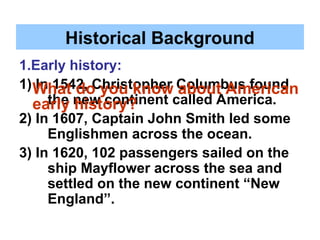
Historical Background
1.Early history:
1)In 1542, Christopher Columbus found
the new continent called America.
2) In 1607, Captain John Smith led some
Englishmen across the ocean.
3) In 1620, 102 passengers sailed on the
ship Mayflower across the sea and
settled on the new continent “New
England”.
What do you know about American
early history?
3.
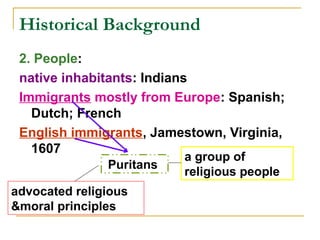
Historical Background
2. People:
nativeinhabitants: Indians
Immigrants mostly from Europe: Spanish;
Dutch; French
English immigrants, Jamestown, Virginia,
1607
Puritans
a group of
religious people
advocated religious
&moral principles
4.
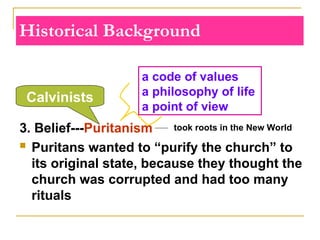
Historical Background
3. Belief---Puritanism
Puritans wanted to “purify the church” to
its original state, because they thought the
church was corrupted and had too many
rituals
a code of values
a philosophy of life
a point of view
Calvinists
took roots in the New World
5.
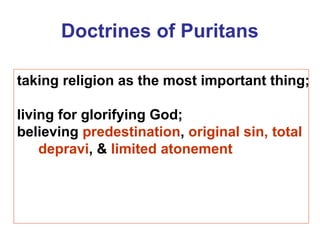
Doctrines of Puritans
takingreligion as the most important thing;
living for glorifying God;
believing predestination, original sin, total
depravi, & limited atonement
6.
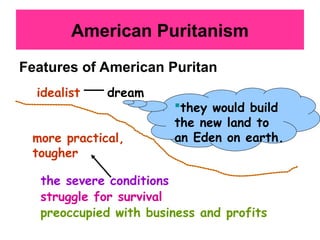
American Puritanism
Features ofAmerican Puritan
idealist dream
they would build
the new land to
an Eden on earth.
more practical,
tougher
the severe conditions
struggle for survival
preoccupied with business and profits
7.
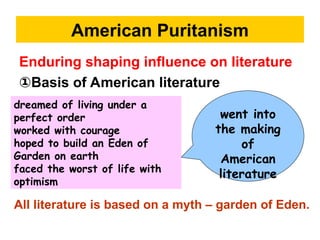
American Puritanism
Enduring shapinginfluence on literature
①Basis of American literature
went into
the making
of
American
literature
dreamed of living under a
perfect order
worked with courage
hoped to build an Eden of
Garden on earth
faced the worst of life with
optimism
All literature is based on a myth – garden of Eden.
8.
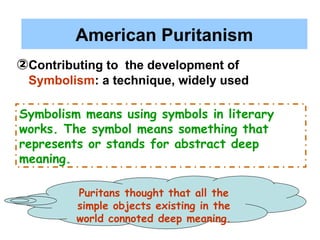
American Puritanism
②Contributing tothe development of
Symbolism: a technique, widely used
Puritans thought that all the
simple objects existing in the
world connoted deep meaning.
Symbolism means using symbols in literary
works. The symbol means something that
represents or stands for abstract deep
meaning.
9.
American Puritanism
③Influencing thestyle of literature:
simple, fresh and direct (just as the
style of the Authorized Version of
Holy Bible)
Without understanding of Puritanism, ther
e can be no good understanding of Americ
an culture and literature.
10.
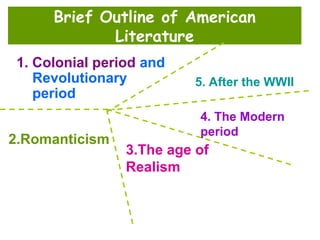
Brief Outline ofAmerican
Literature
1. Colonial period and
Revolutionary
period
2.Romanticism
3.The age of
Realism
4. The Modern
period
5. After the WWII
11.
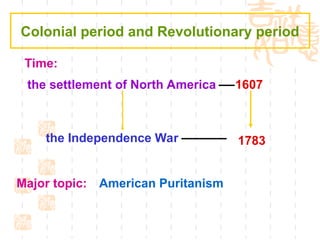
Time:
1607
the Independence War
thesettlement of North America
1783
Major topic: American Puritanism
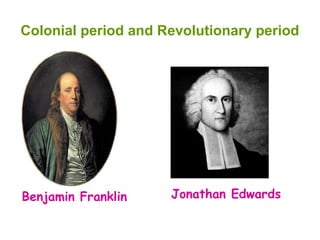
Colonial period and Revolutionary period
Romanticism
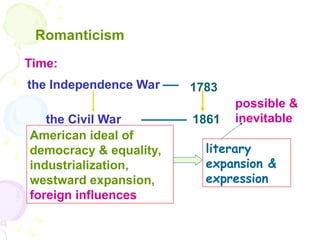
Time:
1783
the Civil War
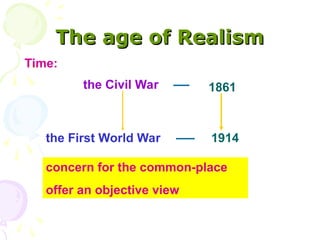
theIndependence War
1861
American ideal of
democracy & equality,
industrialization,
westward expansion,
foreign influences
literary
expansion &
expression
possible &
inevitable
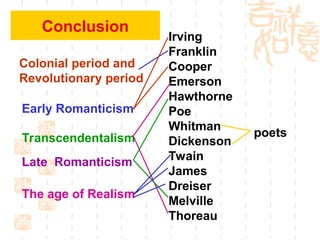
Conclusion
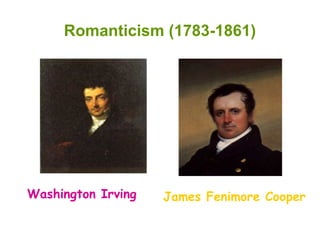
Early Romanticism
The ageof Realism
Colonial period and
Revolutionary period
Irving
Franklin
Cooper
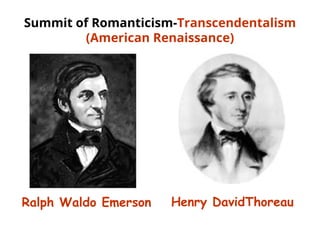
Emerson
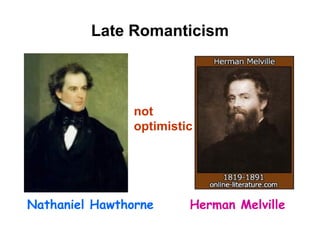
Hawthorne
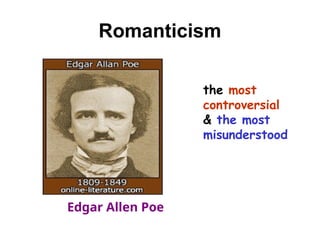
Poe
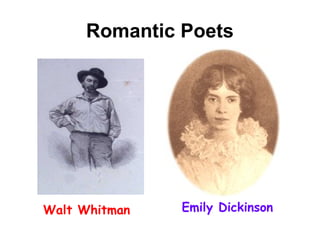
Whitman
Dickenson
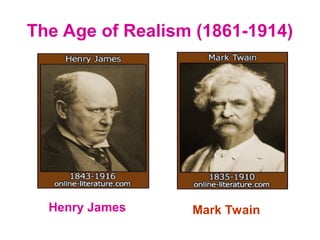
Twain
James
Dreiser
Melville
Thoreau
Transcendentalism
Late Romanticism
poets


![Realism-PPT [Autosaved].pptx111111111111](https://cdn.slidesharecdn.com/ss_thumbnails/realism-pptautosaved-250102012945-755882bf-thumbnail.jpg?width=640&height=640&fit=bounds)


