Darshan Shekhar
     Nikita Mehta
Swati Shrivastava
      Tony k Roy
  Vikrant Saraph
                    1
Index
 Company profile
 Business model
 Driver of the company
 Supply chain of amazon.com
 Distribution channel
 Partners
 Amazon technology
 Demand management

                               2
Company Overview
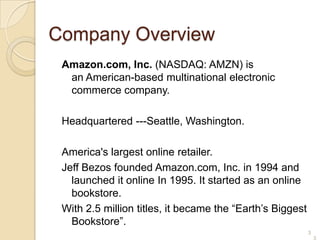
 Amazon.com, Inc. (NASDAQ: AMZN) is
  an American-based multinational electronic
  commerce company.

 Headquartered ---Seattle, Washington.

 America's largest online retailer.
 Jeff Bezos founded Amazon.com, Inc. in 1994 and
   launched it online In 1995. It started as an online
   bookstore.
 With 2.5 million titles, it became the “Earth’s Biggest
   Bookstore”.
                                                           3
                                                               3
4
Products
   Books
   Movie, Music and Games
   Digital Download
   Kindle
   Computer And Office
   Electronics
   Home and garden
   Grocery, Health and beauty
   Toys, kids and baby
   Clothing, Shoes and jewelry
   Sports and outdoors
   Tools, Auto and industrial

                                  5
Business Model
 Amazon-to-Buyer Sale Approch
 Multi level E-Commerce
• Customer Tracking
 It operates 7 websites that support
  their business operation globally and
  offers 20 million items for sale.


                                          6
Models for Web Application
There are 2 kind of web models :-

 Conceptual model
 Structural model


                                    7
There are four primary drivers for
growth:

1. Product focus
2. Customer focus
3. Technology focus
4. Distribution focus


                                     8
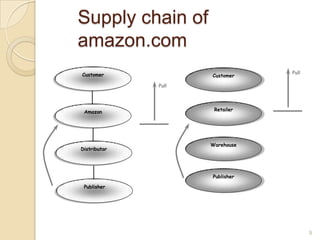
Supply chain of
amazon.com
Customer                         Pull
                     Customer

              Pull


 Amazon               Retailer


                     Warehouse
Distributor


                     Publisher

 Publisher


                                        9
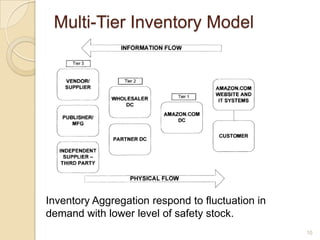
Multi-Tier Inventory Model


Inventory Aggregation respond to fluctuation in
demand with lower level of safety stock.
                                                  10
Partners
 Large Partners
 Small Partners
 Trusted Partners


                     11
Partners


           12
Technology Partners


                      13
Amazon Technology
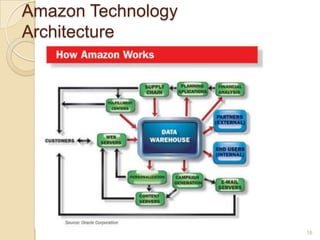
   It has world’s largest Linux Database, with a total
    capacity of 7.8 terabytes, 18.5 TB and 24.7 TB
    respectively.

   The Central Amazon Data warehouse is made up
    of 28 Hewelett Packard server, with four CPUs per
    node, running Oracle 9i database software.

   The architecture handles millions of back-end
    operations and third party seller queries.


                                                          14
Five international stores of
 Amazon.com
Amazon Canada, Amazon France, Amazon UK,
 Amazon Japan, Amazon Germany.
Reasons:
 The Mother-Tongue Issue
 The Shipping Issue
 The Currency Issue
 The Local Product Issue
 The National Pride Issue
 Proper inventory control


                                           15
Amazon Technology
Architecture


                    16
How deals the supply chains
with fluctuating demand?
Amazon.com carries high-demand title in
 inventory, whereas it purchases low-
 demand titles from distributor in
 response to a customer orders .

Reduction in various costs like ;-
- Inventory cost
- Facility cost
- Transportation costs
- Information costs

                                          17
Thank you !!!


                18

Amazon ppt

  • 1.
    Darshan Shekhar Nikita Mehta Swati Shrivastava Tony k Roy Vikrant Saraph 1
  • 2.
    Index  Company profile Business model  Driver of the company  Supply chain of amazon.com  Distribution channel  Partners  Amazon technology  Demand management 2
  • 3.
    Company Overview Amazon.com,Inc. (NASDAQ: AMZN) is an American-based multinational electronic commerce company. Headquartered ---Seattle, Washington. America's largest online retailer. Jeff Bezos founded Amazon.com, Inc. in 1994 and launched it online In 1995. It started as an online bookstore. With 2.5 million titles, it became the “Earth’s Biggest Bookstore”. 3 3
  • 4.
  • 5.
    Products  Books  Movie, Music and Games  Digital Download  Kindle  Computer And Office  Electronics  Home and garden  Grocery, Health and beauty  Toys, kids and baby  Clothing, Shoes and jewelry  Sports and outdoors  Tools, Auto and industrial 5
  • 6.
    Business Model  Amazon-to-BuyerSale Approch  Multi level E-Commerce • Customer Tracking  It operates 7 websites that support their business operation globally and offers 20 million items for sale. 6
  • 7.
    Models for WebApplication There are 2 kind of web models :-  Conceptual model  Structural model 7
  • 8.
    There are fourprimary drivers for growth: 1. Product focus 2. Customer focus 3. Technology focus 4. Distribution focus 8
  • 9.
    Supply chain of amazon.com Customer Pull Customer Pull Amazon Retailer Warehouse Distributor Publisher Publisher 9
  • 10.
    Multi-Tier Inventory Model InventoryAggregation respond to fluctuation in demand with lower level of safety stock. 10
  • 11.
    Partners  Large Partners Small Partners  Trusted Partners 11
  • 12.
  • 13.
  • 14.
    Amazon Technology  It has world’s largest Linux Database, with a total capacity of 7.8 terabytes, 18.5 TB and 24.7 TB respectively.  The Central Amazon Data warehouse is made up of 28 Hewelett Packard server, with four CPUs per node, running Oracle 9i database software.  The architecture handles millions of back-end operations and third party seller queries. 14
  • 15.
    Five international storesof Amazon.com Amazon Canada, Amazon France, Amazon UK, Amazon Japan, Amazon Germany. Reasons:  The Mother-Tongue Issue  The Shipping Issue  The Currency Issue  The Local Product Issue  The National Pride Issue  Proper inventory control 15
  • 16.
  • 17.
    How deals thesupply chains with fluctuating demand? Amazon.com carries high-demand title in inventory, whereas it purchases low- demand titles from distributor in response to a customer orders . Reduction in various costs like ;- - Inventory cost - Facility cost - Transportation costs - Information costs 17
  • 18.