A fundamental orientation on radio communication designed to equip participants with essential knowledge in amateur radio operation, proper radio etiquette, and its vital role in emergency response and disaster management.
Training Overview
1. Introductionof Amateur Radio
• What is it and why matters
• Legal Framework (Radio Control Law, MC 87-174)
2. Amateur Code and Ethics
• Operating with integrity, responsibility, and
patriotism
3. Licensing and Classification
• Different license classes (A-D) and their privileges
3.
Training Overview
4. FieldOperations and Emergency Protocols
• Proper radio usage during field deployments and
disasters
5. Radio Basic
• Anatomy of Radio
4.
Introduction of RadioBasics
Purpose
• To provide participants with the essential
knowledge and legal requirements needed
to become a licensed amateur radio
operator, and to promote responsible,
ethical, and effective use of amateur radio
for personal development and public
service.
5.
What is itand
Why
Matters?
Introduction of Amateur Radio
6.
Introduction of AmateurRadio
Why this Orientation Seminar?
• This orientation is a mandatory prerequisite set by
the NTC before individuals can qualify for the
Amateur Radio License Examination.
• To familiarize participants with the fundamentals,
purpose, and diverse activities of amateur radio as
a hobby, a learning tool, and a vital public service.
7.
Introduction of AmateurRadio
Ministry Circular No. 87-174
• This seminar is conducted in accordance with
the Radio Control Law (Act 3846), as
amended by Commonwealth Acts 571 and
546, which govern the rules and regulations of
the Amateur Radio Service in the Philippines.
8.
Introduction of AmateurRadio
What is Amateur Radio?
• The term “amateur” comes from the Latin “Amatore”,
meaning “for the love of” done for passion, not profit.
In simple terms:
• It’s a hobby and a public service.
• It’s not for commercial use, but for personal interest
and enjoyment.
•It’s about making friends, learning, helping others and
having fun!
Amateur Code andEthics
The Amateur’s Code
The Amateur is Gentlemanly
He never knowingly uses the air for his own amusement in
such a way to lessen the pleasure of others.
The Amateur is Loyal
Offering loyalty, encouragement, and support to fellow
radio amateurs, local clubs and to the Philippine Amateur
Radio Association through which Amateur Radio is
represented in the Philippines.
11.
Amateur Code andEthics
The Amateur is Progressive
He keeps his station abreast of science. It is built well
and efficiently. His operating practice is clean and
regular.
The Amateur is Friendly
Slow and patient sending when requested, giving
friendly advice and counsel to the beginner, kindly
assistance and cooperation for the broadcast listener;
these are marks of the amateur spirit.
12.
Amateur Code andEthics
The Amateur is Balanced
Radio is a hobby. He never allows it to interfere with any
of the duties he owes to his home, his job, his school,
or his community.
The Amateur in practice is Patriotic
His knowledge and his station are always ready for the
service of his country and his community
13.
Amateur Code andEthics
Amateur Radio Activities
• Amateur radio offers a wide range of hands-on
and engaging activities, including:
• Self-Training
Continuous learning in radio theory and
communication techniques.
• Homebrewing
Building or modifying your own radio equipment.
14.
Amateur Code andEthics
Amateur Radio Activities
•Radio Operations
• Voice Communication
• Data/Digital Modes
• Satellite Communication
• Earth-Moon-Earth (EME) Contacts
15.
Amateur Code andEthics
Amateur Radio Activities
• DX-ing & Awards Hunting
• Communicating with distant stations and earning
recognition.
• Contests & DX-peditions
• Competing and traveling to remote locations for radio
operations.
• Technical Experimentation
• Innovating and testing new radio techniques and
equipment.
16.
Amateur Code andEthics
Amateur Radio Activities
• Amateur Radio Emergency Services
• Providing critical communication support during
emergencies
• Camaraderie & Community
• Building friendships and sharing knowledge with fellow
amateurs, locally and globally.
Licensing and Classifications
AmateurRadio Examination
• Every amateur is expected to develop the
necessary skills to operate a radio station safely
and responsibly. The examination ensures that
each applicant is qualified for the privileges
granted by an amateur radio license or certificate.
19.
Licensing and Classifications
1.Submission of Application for Amateur
Examination
Applicants for amateur examinations must submit
the appropriate application forms to the National
Telecommunications Commission (NTC).
2. General Qualifications for Examinees
An applicant for the examination must meet the
following qualifications:
20.
Licensing and Classifications
•2.1Citizenship
The applicant must be a citizen of the
Philippines or a citizen of another country that
extends the same examination privileges to
Filipino nationals.
•2.2 Age Requirement
For Class A, B, and C examinations, the
applicant must be at least twelve (12) years old.
21.
Licensing and Classifications
ForClass D examinations, the minimum age is
nine (9) years old, provided there is an affidavit
of parental consent.
•2.3 Language Ability
The applicant must have the ability to transmit
and/or receive messages in Filipino, English, or
any Philippine language.
22.
Licensing and Classifications
AmateurRadio Examination
• The examination shall encompass the rules,
procedures, and technical knowledge necessary for
an amateur operator to properly operate a radio
station. The examination will cover the following
general subjects:
23.
Licensing and Classifications
ElementI - Morse Code
Element II - Rules and Regulations
Element III - Fundamentals of Electronics and
Electricity
Element IV - Amateur Radio Practice
Element V - Signals, Frequencies and Emission
Element VI - Circuit Components
Element VII - Operating Procedures
24.
Licensing and Classifications
ElementVIII – Practical Circuits
Element IX - Antenna and Transmission Lines
Element X - Radio Wave Propagation
Legend:
Class D - II
Class C – II, III, IV
Class B – V, VI, VII
Class A – I, VIII, IX, X
25.
Licensing and Classifications
NTCExamination for Amateurs
For Filipino Applicants
1. Photocopy of any documents such as birth certificate,
voter's I.D, passport, PRC license, driver's license which
can show proof of age and citizenship (note: to present
original)
2. Copy of any of the following for those taking the exams
directly to Amateur Class B, PRC I.D, BSECE College Diploma,
1 RTG, 2 RTG or 1 PHN NTC Certificates.
26.
Licensing and Classifications
NTCExamination for Amateurs
For Filipino Applicants
3. Proof of attendance to an orientation seminar conducted by
NTC accredited amateur club (MC No. 06-07-97 dated 30 July
1997)
4. Two (2) copies of recent (taken within six months from the
date of application) 1"x1" I.D picture
5. Two (2) pieces self-addressed stamped envelopes (long,
white)
6. Payment of examination fee - P 50.00
27.
Licensing and Classifications
NTCExamination for Amateurs
For Foreign Applicants
1. Certification of Good Moral Character from concerned
embassy
2. Two (2) copies of recent (taken within six months from date of
application) 1"x1" I.D picture
3. Two (2) pieces self-addressed stamped envelopes
4. Payment of examination fee - P 50.00
28.
Licensing and Classifications
TOPASS THE EXAM
Candidates must obtain an average rating of at least 70%,
with no less than 50% in any individual prescribed
element to pass.
Note: There is no Morse Code test required for Class B, C,
and D examinations.
29.
Licensing and Classifications
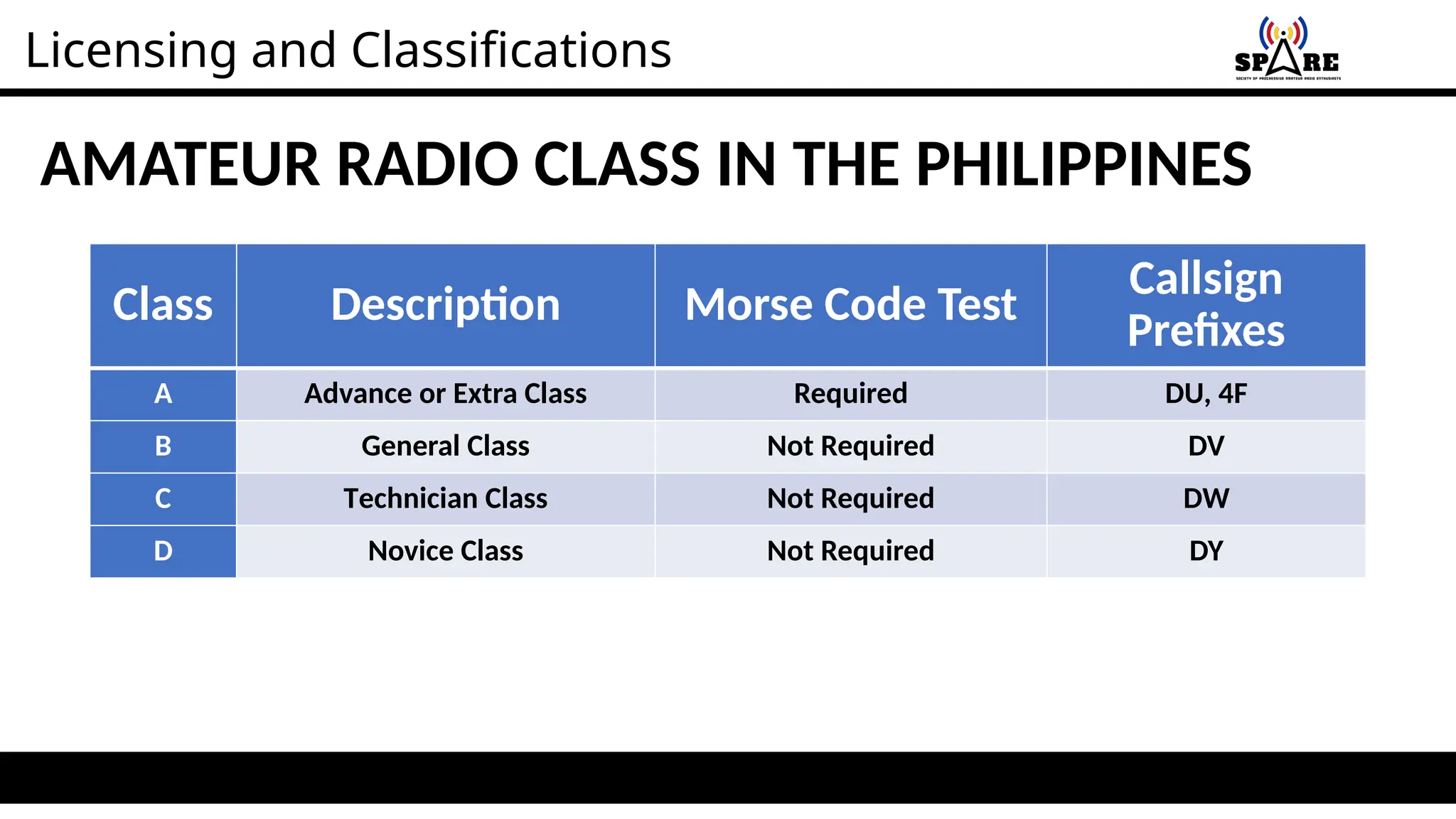
AMATEURRADIO CLASS IN THE PHILIPPINES
Class Description Morse Code Test
Callsign
Prefixes
A Advance or Extra Class Required DU, 4F
B General Class Not Required DV
C Technician Class Not Required DW
D Novice Class Not Required DY
30.
Licensing and Classifications
SpecialCandidates
1. Registered ECE
2. Commercial First/Second Class Radio Telegraph
Operator
3. Commercial First Class Radio Telephone
Operator
• Submit proof
• Take Element II Exam
• Direct Class B
31.
Licensing and Classifications
RadioStation License (RSL)
An RSL, along with a callsign, is issued to an individual
who has:
• Passed the corresponding amateur examination
administered by the National Telecommunications
Commission (NTC), and
• Owns and operates approved radio equipment.
32.
Licensing and Classifications
RadioStation License (RSL)
An RSL, along with a callsign, is issued to an individual
who has:
• Passed the corresponding amateur examination
administered by the National Telecommunications
Commission (NTC), and
• Owns and operates approved radio equipment.
Licensing and Classifications
CALLSIGN:The need to identify
•A callsign serves as the official name of an amateur radio
station. It uniquely identifies the operator and the station during
transmissions.
•Callsigns are allocated based on the International
Telecommunication Union (ITU) listings and follow
internationally recognized formats.
•Callsign Allocation for the Philippines
In the Philippines, amateur radio callsigns are assigned from the
following ITU-allocated prefix blocks: 4DA-4IZ and DUA-DZZ
35.
Licensing and Classifications
CALLSIGN:The need to identify
Denotes Class:
Class A : DU/4F/4E
Class B : DV or 4I
Class C : DW or 4G
Class D : DY or 4H
PARA Districts:
1 = NCR & Region IV
2 = Region I, Region II
3 = Region III
4 = Region V
5 = Region VII
6 = Region VI
7 = Region VII
8 = Region IX, Region XII
9 = Region X, Region XI
- 2 to 3 letter identifier
- Randomly assigned by NTC
PREFIX SUFFIX
36.
Licensing and Classifications
RFPower Output Privileges
•Power Output Limits
•Fixed Station (VHF): Maximum of 50 watts
•Mobile or Portable Station (VHF): Maximum of 10 watts
•Authorized Frequency Band
•May operate within the Two-Meter VHF Band:
144.00 MHz to 146.00 MHz
CLASS
D
37.
Licensing and Classifications
RFPower Output Privileges
CLASS
C
•High Frequency (HF) Operations – Fixed Station Only
•Maximum RF Power (CW): 100 watts
•Maximum Power (SSBSC - Single Side Band Suppressed
Carrier): 200 watts PEP (Peak Envelope Power)
•Very High Frequency (VHF) Operations
•Fixed, Mobile, or Portable Stations: Maximum of 100 watts
38.
Licensing and Classifications
RFPower Output Privileges
CLASS
B
•High Frequency (HF) Operations – Fixed Station Only
•Maximum RF Power on CW (Continuous Wave): 500 watts
•Maximum Power on SSBSC (Single Side Band Suppressed Carrier):
1 kilowatt (1,000 watts) PEP (Peak Envelope Power)
•VHF/UHF Operations – Fixed, Mobile, or Portable
•May utilize state-of-the-art equipment
•Maximum Power Output:
•Fixed, Mobile, or Portable: Up to 100 watts
39.
Licensing and Classifications
RFPower Output Privileges
CLASS
A
•High Frequency (HF) Operations – Fixed or Mobile Stations
•Maximum RF Power on CW (Continuous Wave): 1 kilowatt (1,000 watts)
•Maximum Power on SSBSC (Single Side Band Suppressed Carrier): 2 kilowatts
(2,000 watts) PEP (Peak Envelope Power)
•VHF/UHF Operations – Fixed, Mobile, or Portable
•May utilize state-of-the-art radio equipment
•Maximum Power Output: Up to 100 watts, unless otherwise specified by the
NTC
Field Operations andEmergency
Protocols
EMERGENCY FREQUENCY
145.000 MHz ± 25kHz
•Transmission Duration
All amateur radio transmissions should be kept to a minimum and
must not exceed one (1) minute in length.
•Monitoring Before Transmitting
Except in cases of distress, an amateur station must listen first for
a reasonable period to ensure that no distress traffic is currently
being transmitted on the frequency.
42.
Field Operations andEmergency
Protocols
EMERGENCY CALL
Any amateur station operating on a frequency where distress
traffic is in progress—and which cannot directly assist the station
in distress—is prohibited from transmitting on that frequency.
Such stations must remain silent until a message is received
indicating that normal operations may resume.
This protocol ensures that emergency communications are not
disrupted and that priority is given to stations handling distress
situations.
43.
Field Operations andEmergency
Protocols
EMERGENCY CALL
When a station is in distress, the following protocol must be
followed to ensure effective and immediate response:
1. Distress Signal
1.Transmit the word "MAYDAY" or "Break", spoken three (3)
times to indicate an emergency.
2. Identification
1.State the name or other identification of the mobile station in
distress.
44.
Field Operations andEmergency
Protocols
EMERGENCY CALL
3. Location
1.Provide specific details of the station's location.
4. Nature of Distress
1.Clearly describe the type of emergency and the kind of
assistance needed.
5. Additional Information
1.Share any other details that could help facilitate rescue
operations (e.g., number of people involved, weather
conditions, visibility).
45.
Field Operations andEmergency
Protocols
EMERGENCY CALL (SAMPLE)
Break Break Break
MAYDAY MAYDAY MAYDAY
This is DY7ABC
QTH is F. Llamas St., Tisa, Cebu City
There is an explosion at the main lobby, 3 persons are hurt.
Request immediate assistance. Please call the police and dispatch
an ambulance.
46.
Field Operations andEmergency
Protocols
USE OF BREAK
SIGNAL MEANING
Break
Used to join an ongoing
conversation politely.
Break Break
Indicates priority traffic or an
urgent message.
Break Break Break Signifies an extreme emergency or
a life-and-death situation.
All stations should immediately standby and listen.
47.
Field Operations andEmergency
Protocols
In Joining a Conversation
• Always listen first before calling a station or making a general
call (CQ) to avoid interrupting ongoing communications.
• To join a conversation in progress, say “Break” followed by your
call sign during a natural pause in the transmission.
• It is permissible to join by saying only “Break”, but including
your call sign is recommended as it saves time and allows other
users to identify you immediately without having to ask.
48.
Field Operations andEmergency
Protocols
Calling a station
•Limit to a maximum of three calls when trying to reach a station
to confirm if they are on standby or available.
•Wait for at least 5 minutes before attempting the next call if
there is no response.
•Keep your calls as brief as possible to respect the airwaves and
allow others to use the frequency.
•Note: Each club or group typically has its own designated calling
or working frequency. Always use the appropriate frequency
when contacting club members.
Anatomy of Radio/POWER
• Power “ON” and “OFF”
• Different styles
- Push button
- Control knob
• Turn off when changing
batteries
51.
Anatomy of Radio/PUSH-TO-TALK [PTT]
• Wait 2 seconds
• Speak in normal voice
• Incoming messages can be
received only if PTT is not pressed.
52.
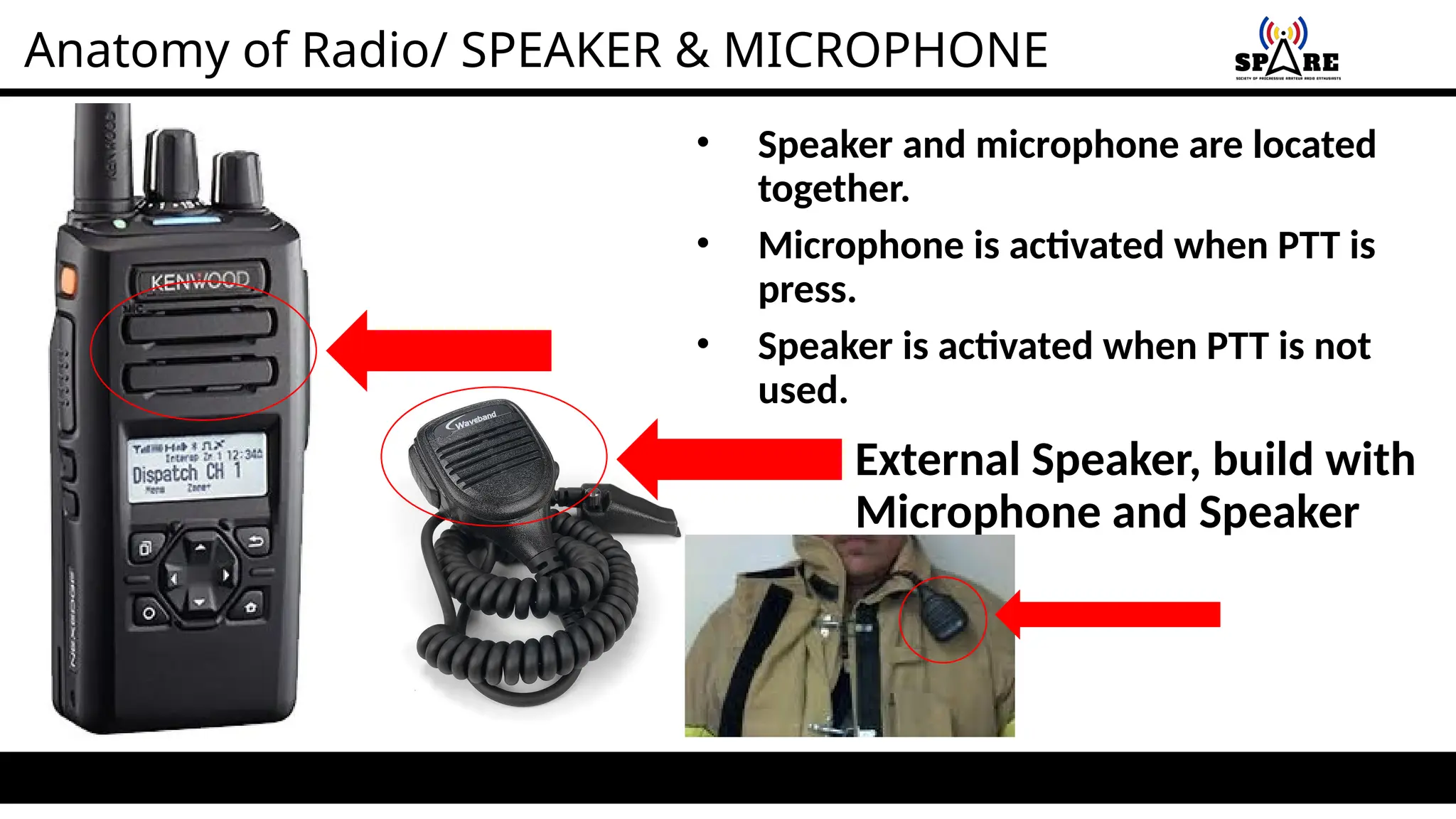
Anatomy of Radio/SPEAKER & MICROPHONE
• Speaker and microphone are located
together.
• Microphone is activated when PTT is
press.
• Speaker is activated when PTT is not
used.
External Speaker, build with
Microphone and Speaker
53.
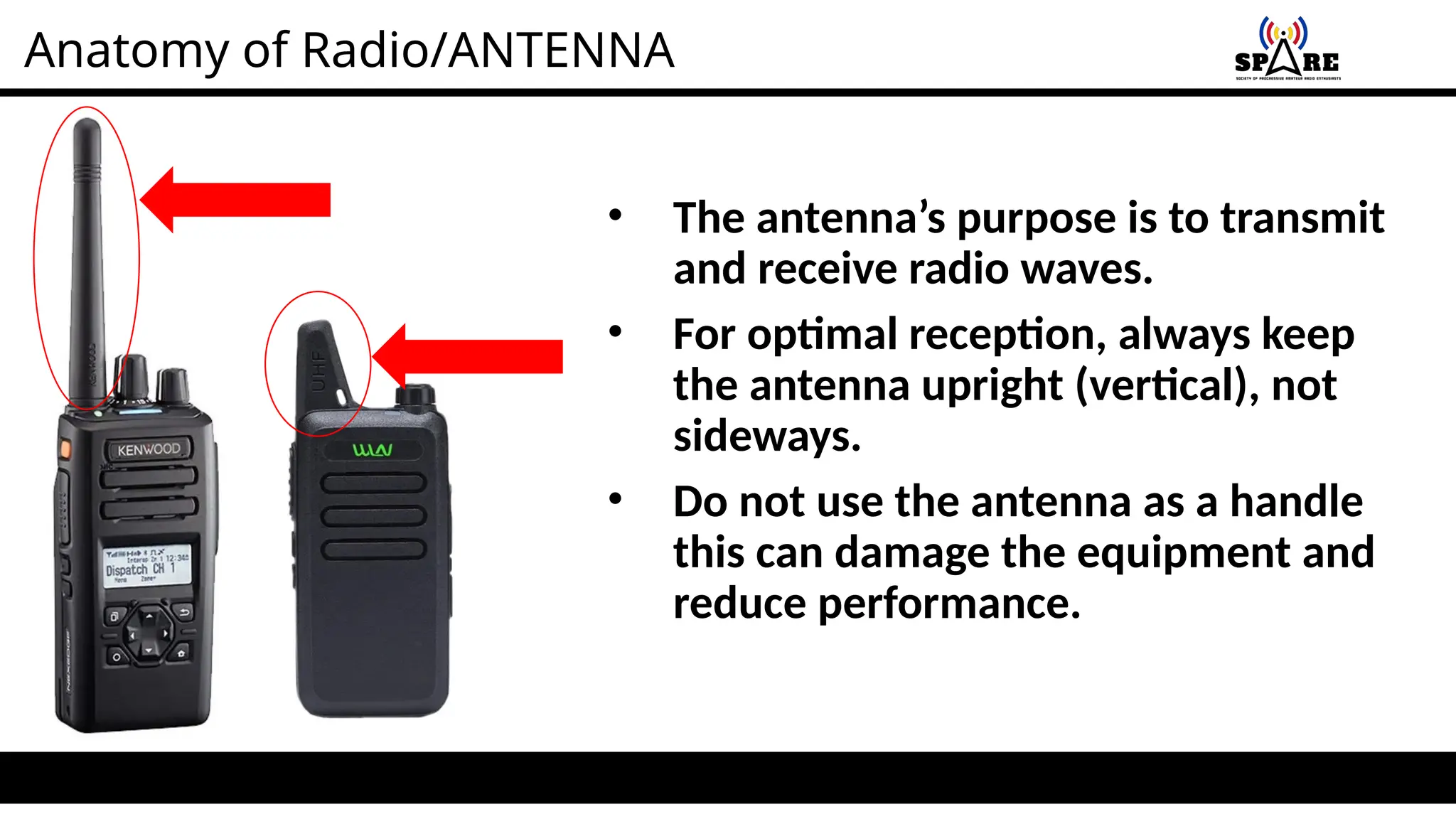
Anatomy of Radio/ANTENNA
•The antenna’s purpose is to transmit
and receive radio waves.
• For optimal reception, always keep
the antenna upright (vertical), not
sideways.
• Do not use the antenna as a handle
this can damage the equipment and
reduce performance.
54.
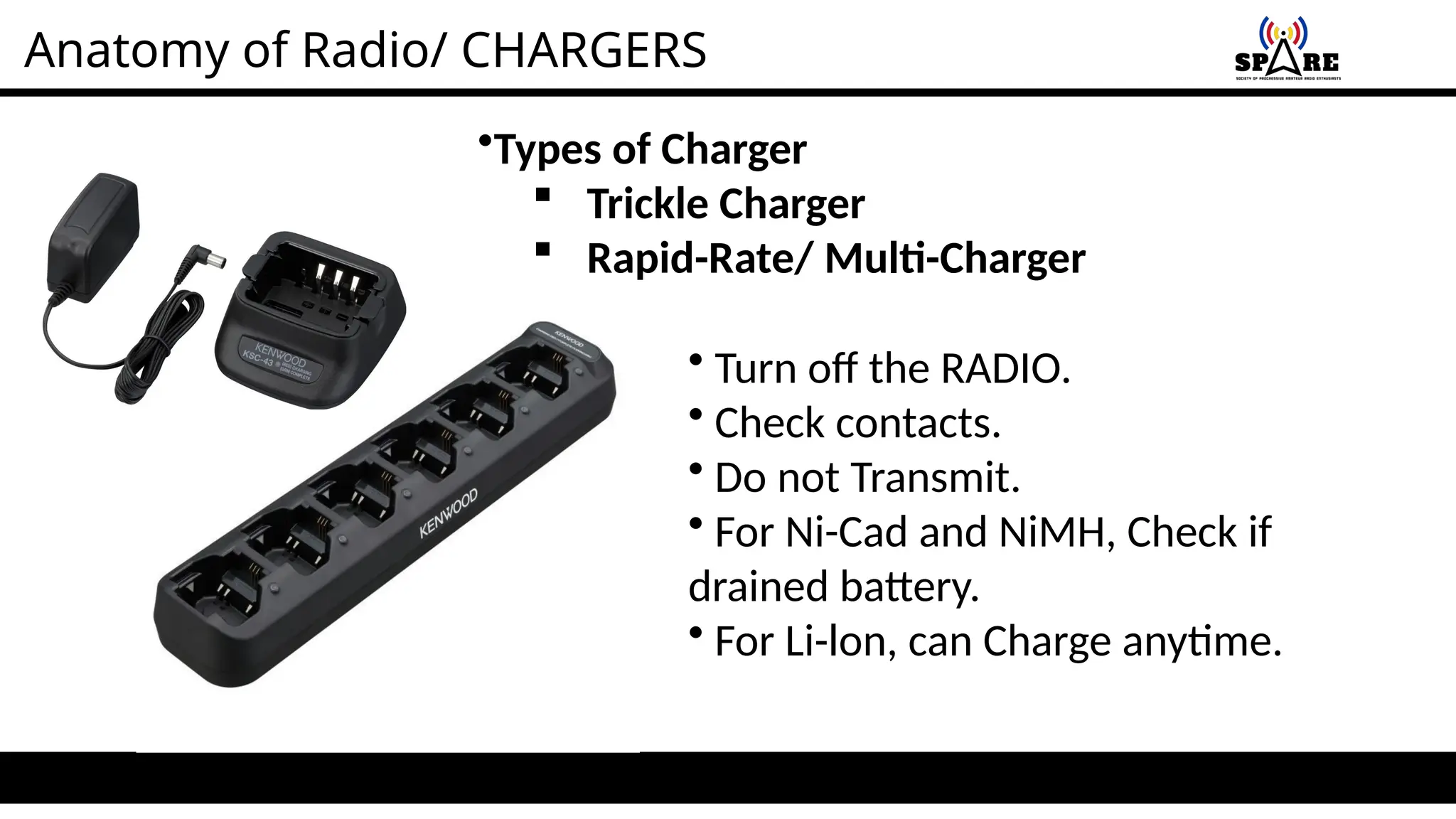
Anatomy of Radio/CHARGERS
•Types of Charger
Trickle Charger
Rapid-Rate/ Multi-Charger
• Turn off the RADIO.
• Check contacts.
• Do not Transmit.
• For Ni-Cad and NiMH, Check if
drained battery.
• For Li-lon, can Charge anytime.
55.
Best Practices &Common Errors
• PRESS PTT BUTTON
• 2 Seconds before speaking
• RELEASE PTT BUTTON
• 2 Seconds after speaking
ALWAYS REMEMBER THE 2-second
RULE!



















![Anatomy of Radio/ PUSH-TO-TALK [PTT]
• Wait 2 seconds
• Speak in normal voice
• Incoming messages can be
received only if PTT is not pressed.](https://image.slidesharecdn.com/amateurbasicradio101-251021085355-21a12d6b/75/Amateur-Basic-Radio-101-presentation-2025-51-2048.jpg)