
Maths Project
• Made By :- Aman Yadav
• Class:-Ix-A
• Roll no. :- 05


• Submitted To:- Mr. Manish Ahuja
  (Maths Teacher)
• By The Help oF Mrs.Neetu Sharma
  (Computer Teacher)
Polynomials
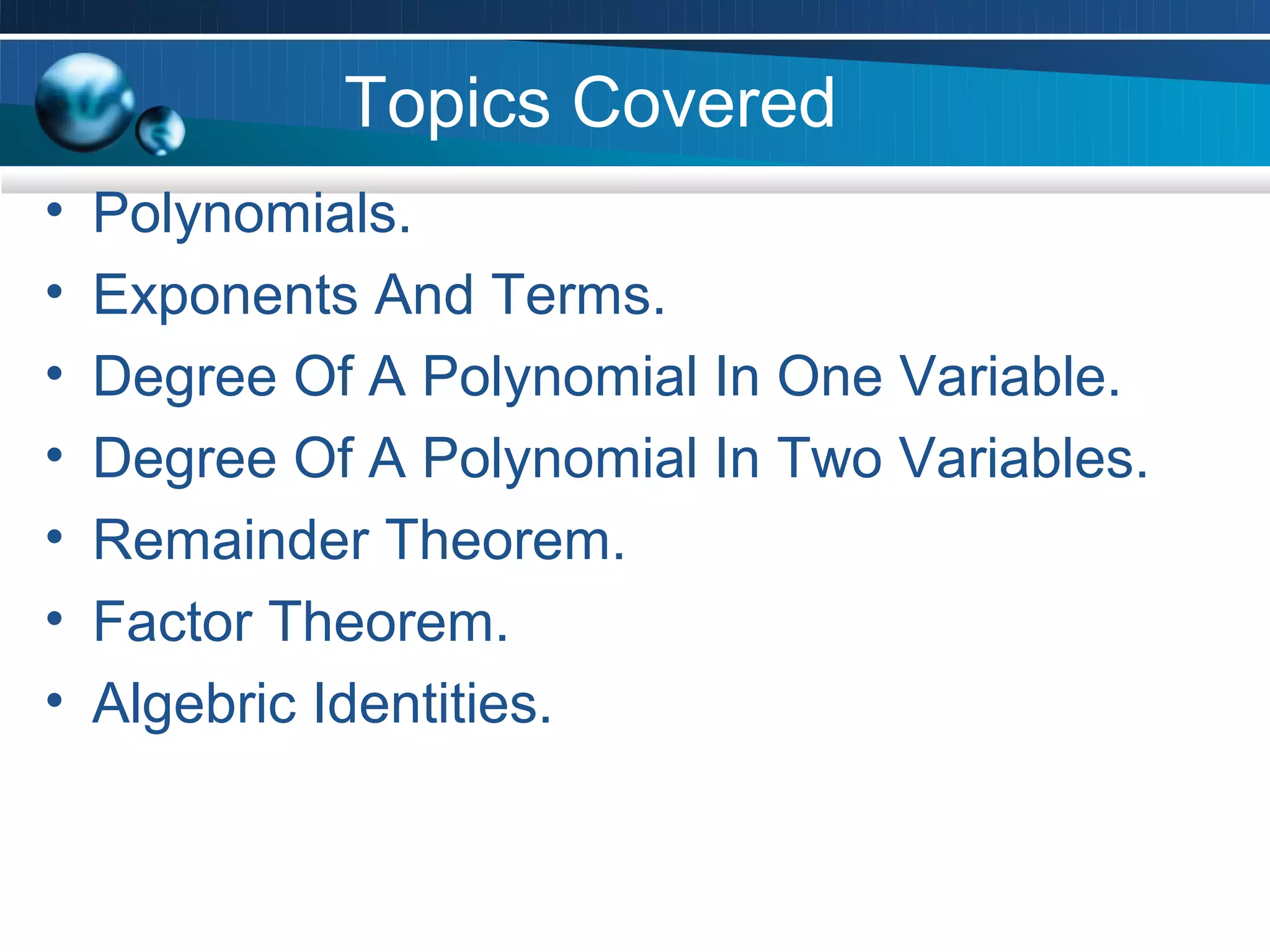
Topics Covered
•   Polynomials.
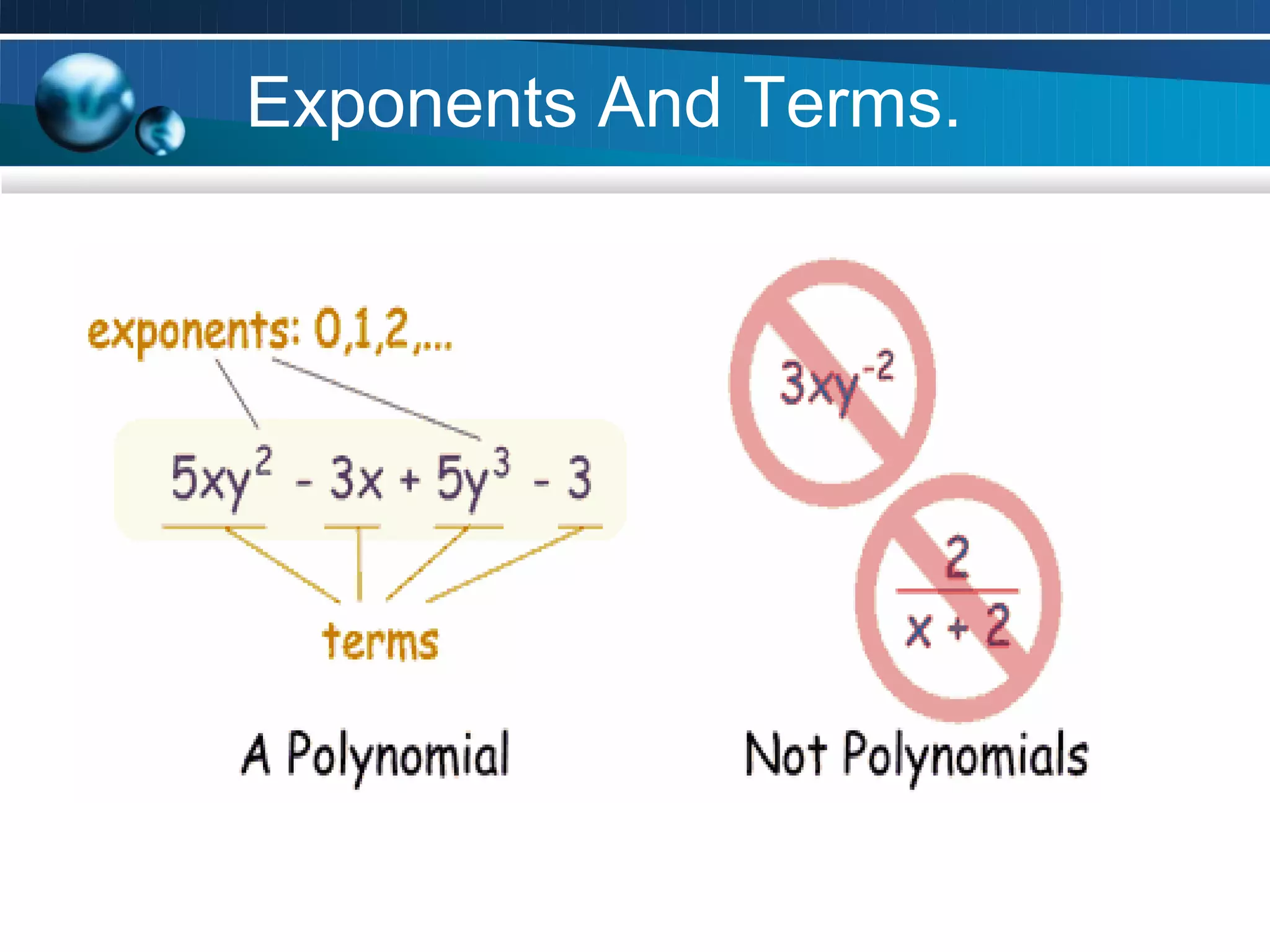
•   Exponents And Terms.
•   Degree Of A Polynomial In One Variable.
•   Degree Of A Polynomial In Two Variables.
•   Remainder Theorem.
•   Factor Theorem.
•   Algebric Identities.
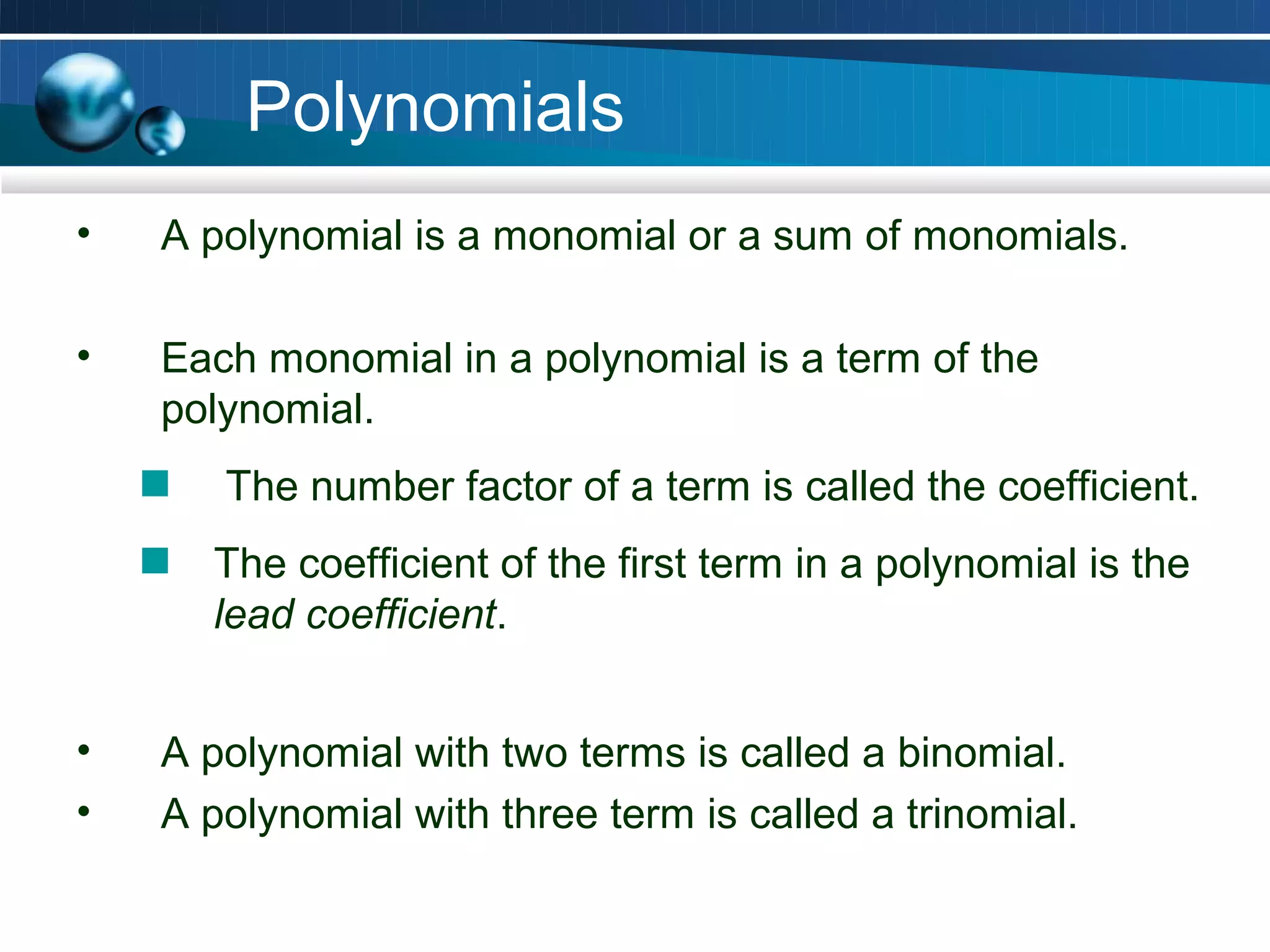
Polynomials
•   A polynomial is a monomial or a sum of monomials.

•   Each monomial in a polynomial is a term of the
    polynomial.
       The number factor of a term is called the coefficient.
      The coefficient of the first term in a polynomial is the
      lead coefficient.


•   A polynomial with two terms is called a binomial.
•   A polynomial with three term is called a trinomial.
Exponents And Terms.
Degree of a Polynomial in one
        variable:-

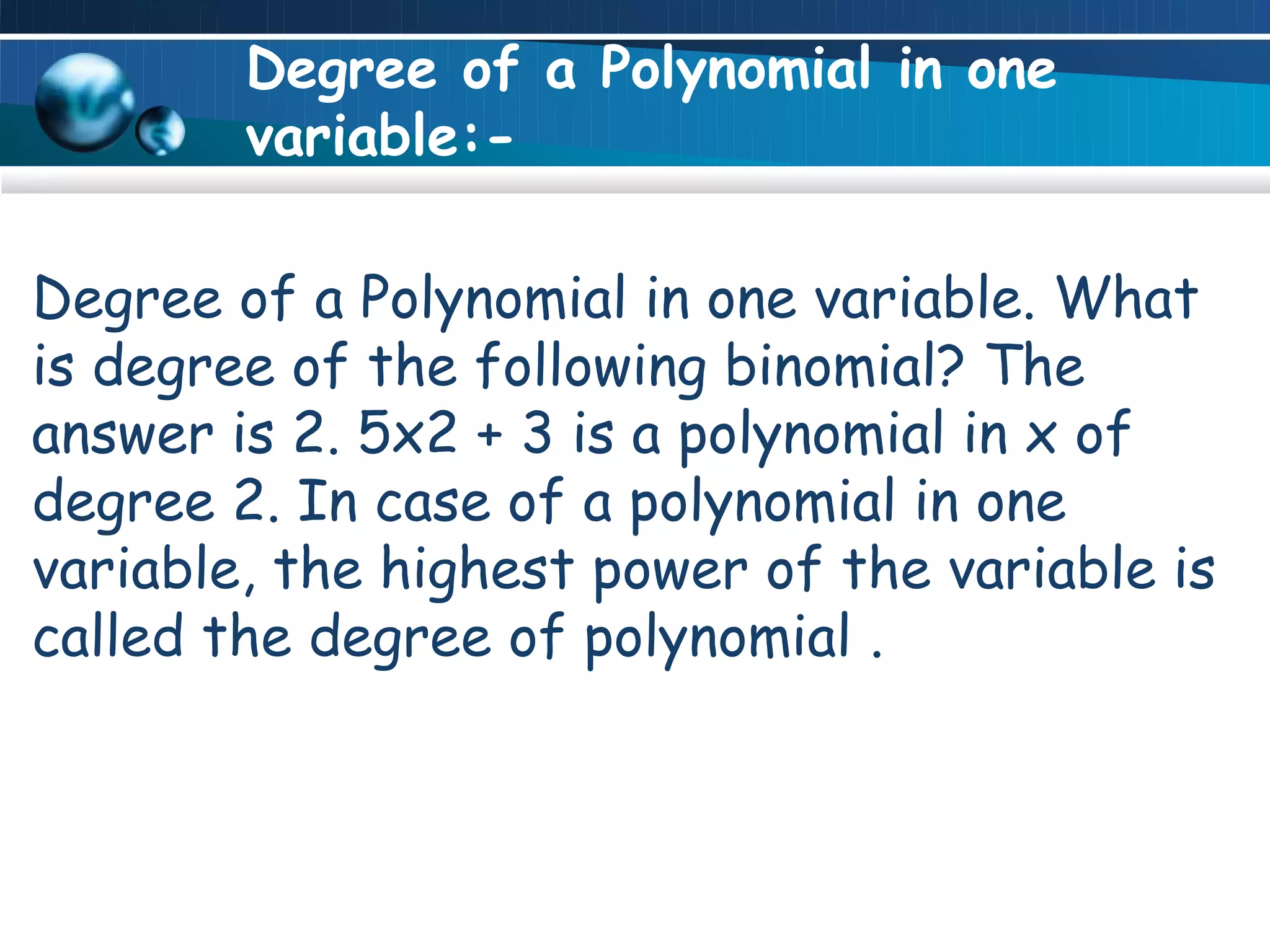
Degree of a Polynomial in one variable. What
is degree of the following binomial? The
answer is 2. 5x2 + 3 is a polynomial in x of
degree 2. In case of a polynomial in one
variable, the highest power of the variable is
called the degree of polynomial .
Degree of a Polynomial in two
            variables.
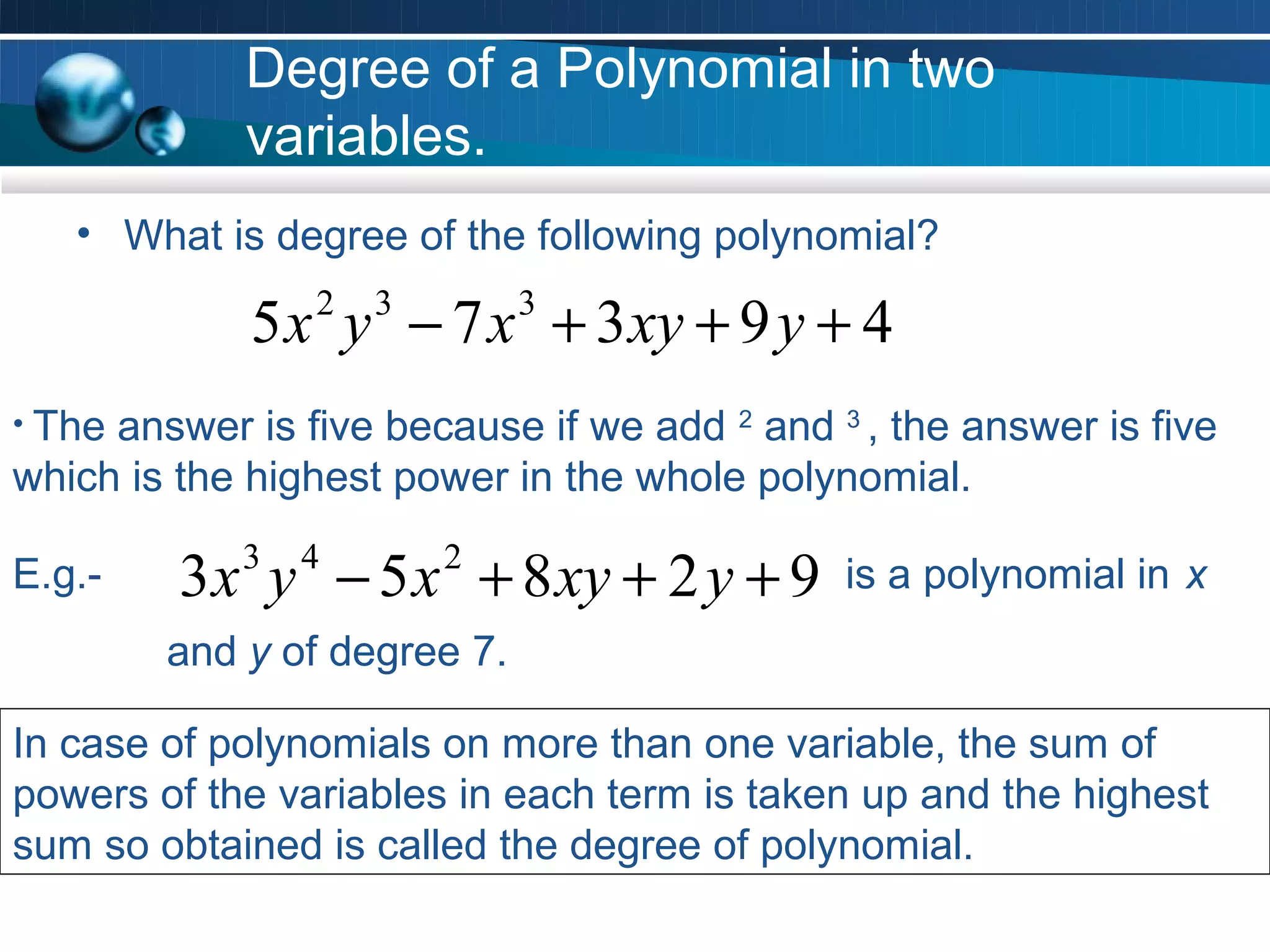
   • What is degree of the following polynomial?

             5 x y − 7 x + 3 xy + 9 y + 4
                2   3        3


• Theanswer is five because if we add 2 and 3 , the answer is five
which is the highest power in the whole polynomial.

E.g.-    3 x y − 5 x + 8 xy + 2 y + 9
            3   4       2
                                             is a polynomial in x
        and y of degree 7.

In case of polynomials on more than one variable, the sum of
powers of the variables in each term is taken up and the highest
sum so obtained is called the degree of polynomial.
Polynomials in one variable
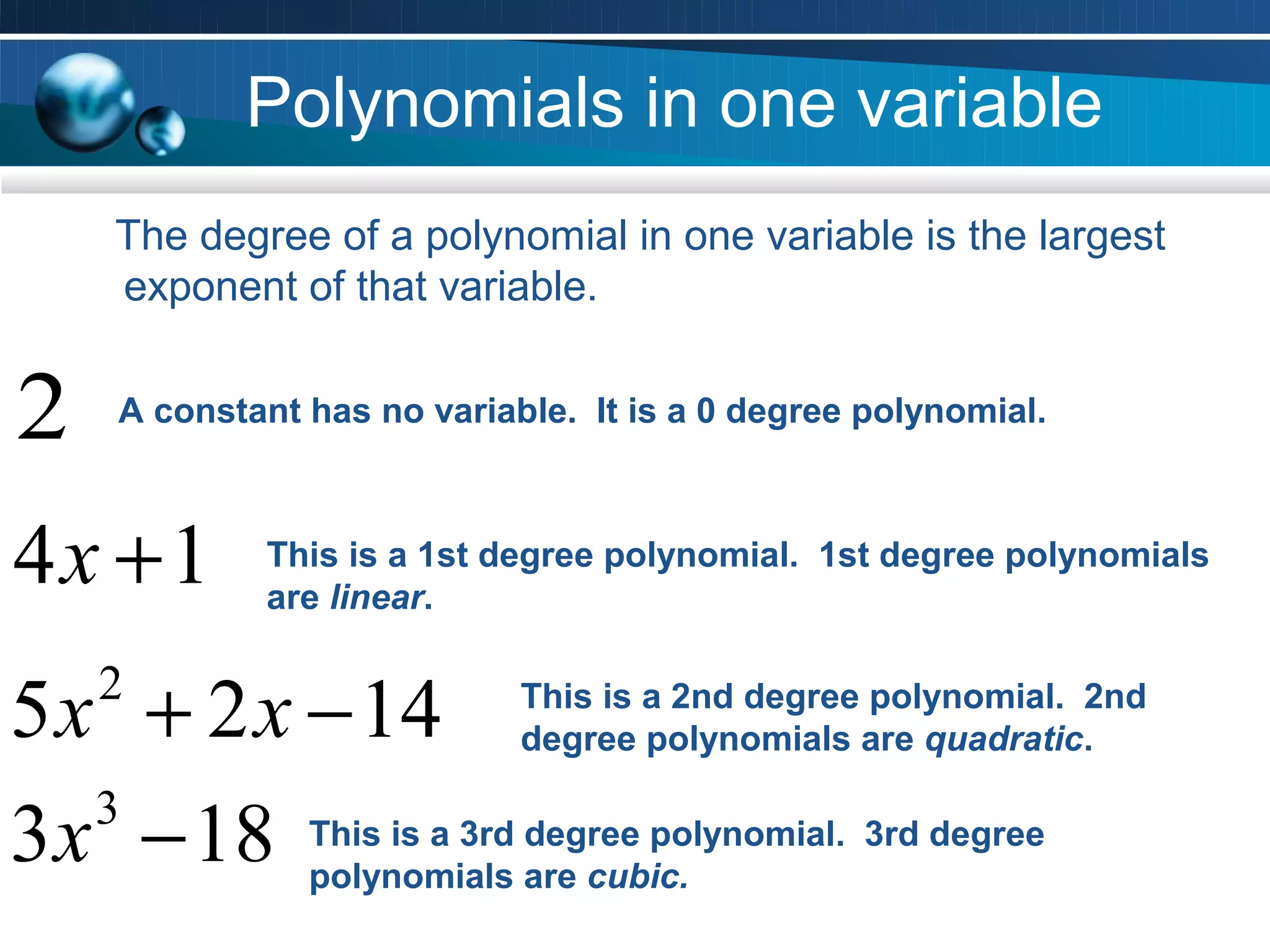
     The degree of a polynomial in one variable is the largest
     exponent of that variable.


2    A constant has no variable. It is a 0 degree polynomial.


4x +1        This is a 1st degree polynomial. 1st degree polynomials
             are linear.


5 x + 2 x − 14
    2                        This is a 2nd degree polynomial. 2nd
                             degree polynomials are quadratic.


3 x − 18 This is a 3rd are cubic.
   3
          polynomials
                       degree polynomial. 3rd degree
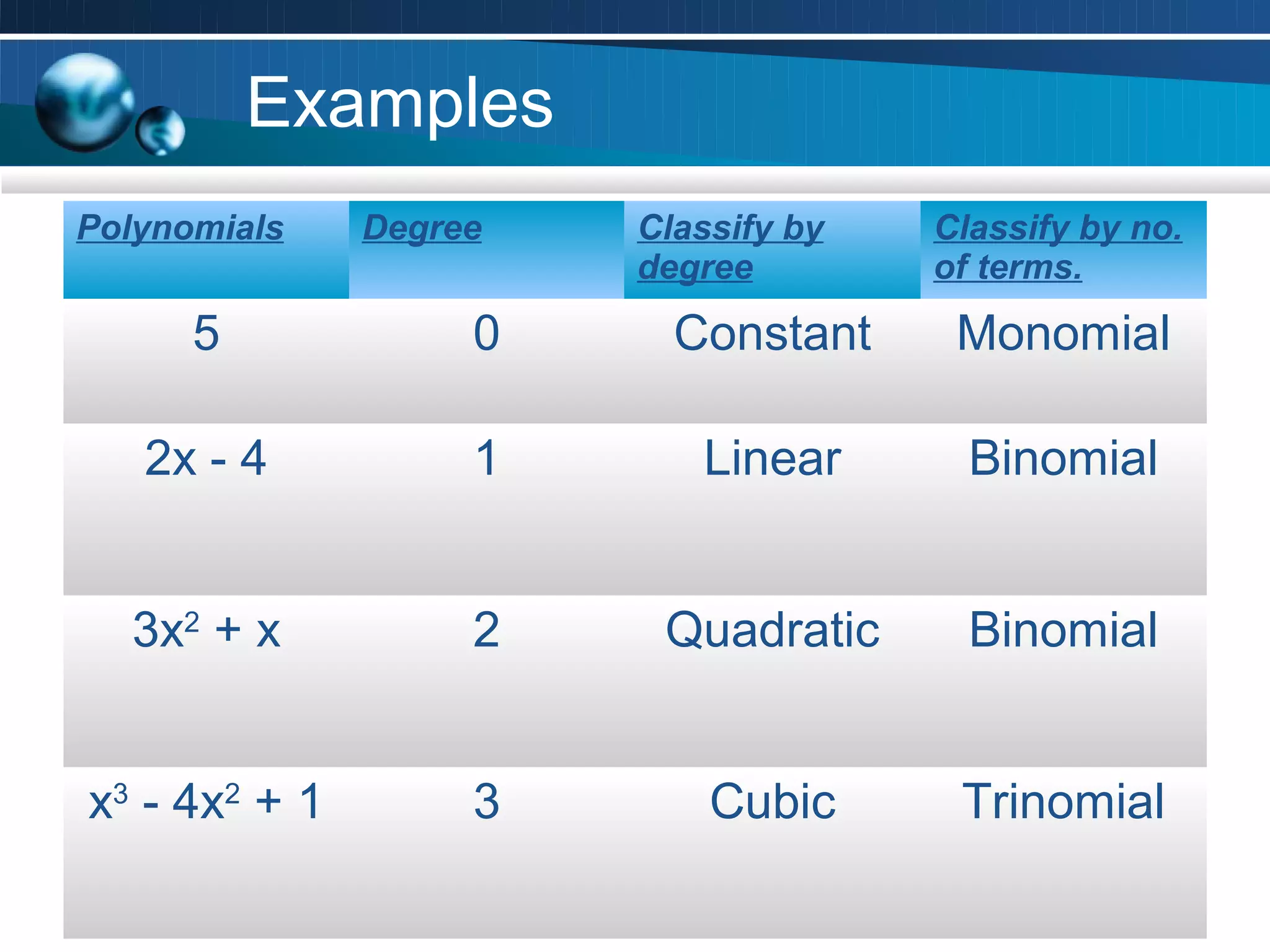
Examples
Polynomials          Degree     Classify by   Classify by no.
                                degree        of terms.
                  Text
       5                    0     Constant     Monomial
                                                Txt


     2x - 4                 1      Linear       Binomial
           Text


     3x2 + x                2    Quadratic      Binomial
                                      Text

                     Text
x - 4x + 1
 3         2
                            3       Cubic      Trinomial
Remainder Theorem

Let f(x) be a polynomial of degree n > 1 and let a be any real number.
When f(x) is divided by (x-a) , then the remainder is f(a).
              TEXT              TEXT          TEXT                     TEXT
PROOF Suppose when f(x) is divided by (x-a), the quotient is g(x) and the remainder
         is r(x).
         Then, degree r(x) < degree (x-a)
                degree r(x) < 1                          [ therefore, degree (x-a)=1]
                degree r(x) = 0
                r(x) is constant, equal to r (say)
Thus, when f(x) is divided by (x-a), then the quotient is g9x) and the remainder is r.
Therefore, f(x) = (x-a)*g(x) + r                              (i)
Putting x=a in (i), we get r = f(a)
Thus, when f(x) is divided by (x-a), then the remainder is f(a).
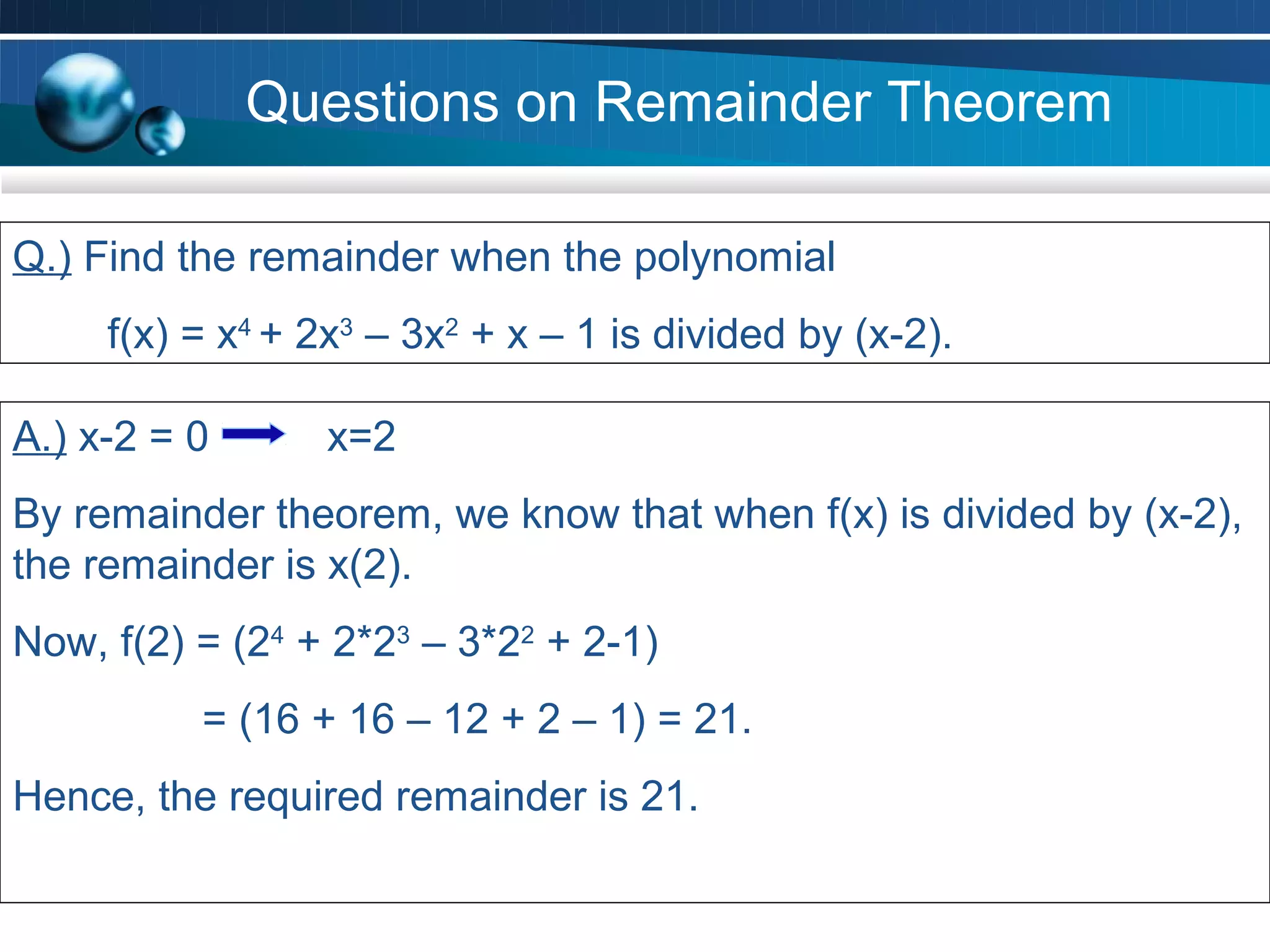
Questions on Remainder Theorem

Q.) Find the remainder when the polynomial
     f(x) = x4 + 2x3 – 3x2 + x – 1 is divided by (x-2).

A.) x-2 = 0      x=2
By remainder theorem, we know that when f(x) is divided by (x-2),
the remainder is x(2).
Now, f(2) = (24 + 2*23 – 3*22 + 2-1)
          = (16 + 16 – 12 + 2 – 1) = 21.
Hence, the required remainder is 21.
Factor Theorem
Let f(x) be a polynomial of degree n > 1 and let a be
any real number.
(i) If f(a) = 0 then (x-a) is a factor of f(x).

PROOF let f(a) = 0
     On dividing f(x) by 9x-a), let g(x) be the quotient. Also,
     by remainder theorem, when f(x) is divided by (x-a),
     then the remainder is f(a).
therefore f(x) = (x-a)*g(x) + f(a)
       f(x) = (x-a)*g(x)              [therefore f(a)=0(given]
       (x-a) is a factor of f(x).
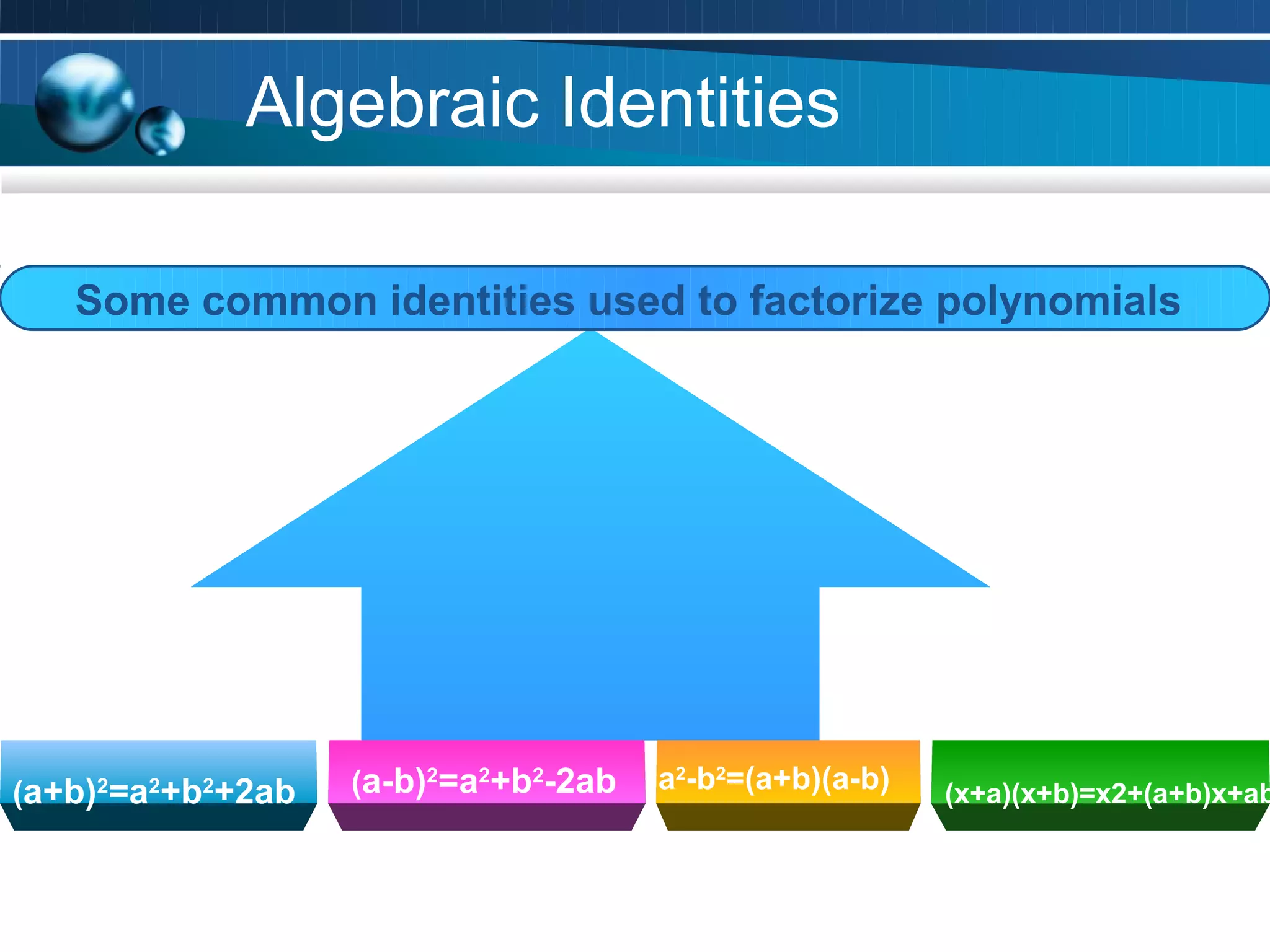
Algebraic Identities

   Some common identities used to factorize polynomials


(a+b)2=a2+b2+2ab   (a-b)2=a2+b2-2ab   a2-b2=(a+b)(a-b)   (x+a)(x+b)=x2+(a+b)x+ab
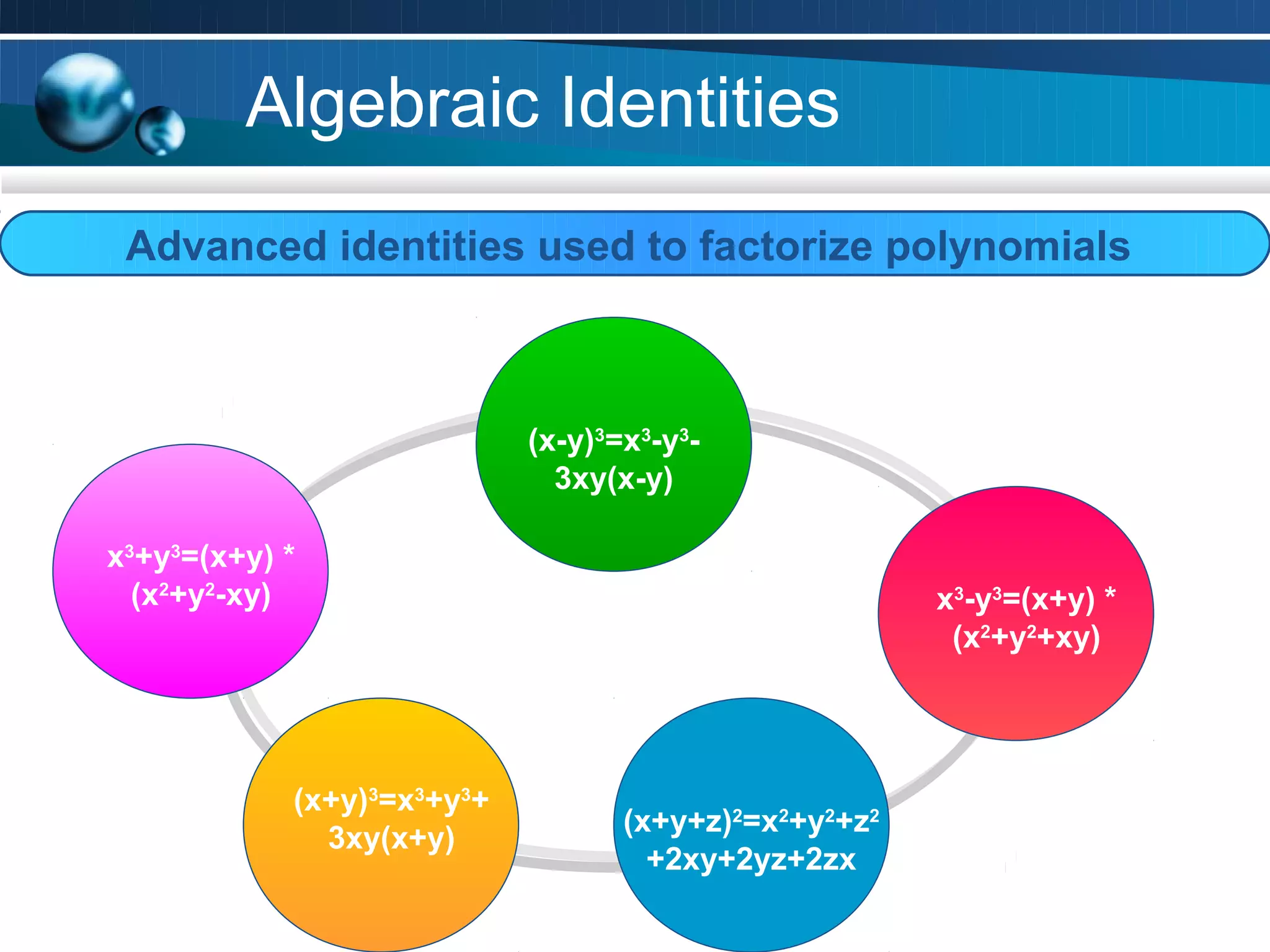
Algebraic Identities
 Advanced identities used to factorize polynomials


                            (x-y)3=x3-y3-
                              3xy(x-y)

x3+y3=(x+y) *
  (x2+y2-xy)                                           x3-y3=(x+y) *
                                                        (x2+y2+xy)


            (x+y)3=x3+y3+
                                   (x+y+z)2=x2+y2+z2
              3xy(x+y)
                                     +2xy+2yz+2zx
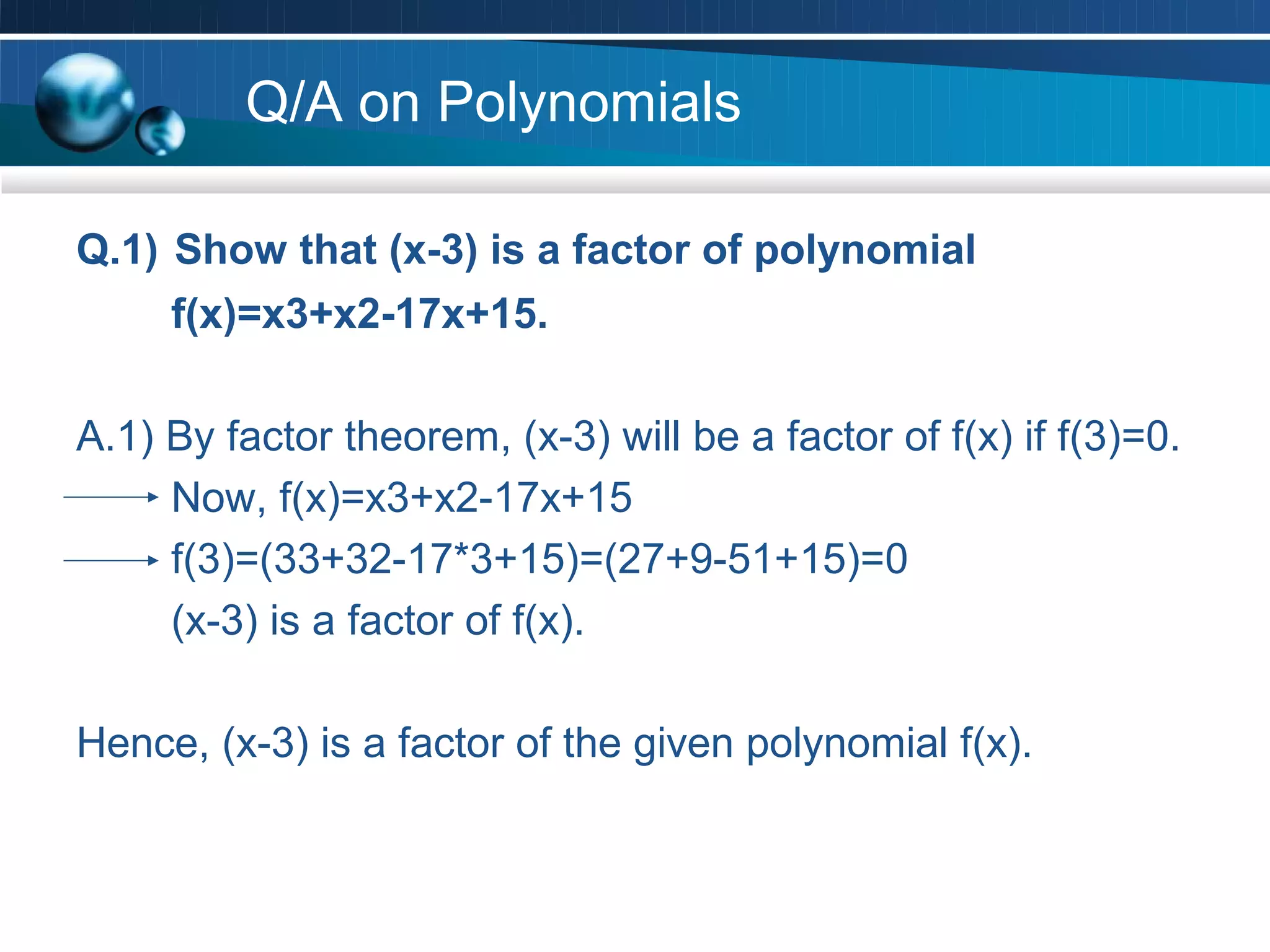
Q/A on Polynomials

Q.1) Show that (x-3) is a factor of polynomial
     f(x)=x3+x2-17x+15.

A.1) By factor theorem, (x-3) will be a factor of f(x) if f(3)=0.
     Now, f(x)=x3+x2-17x+15
     f(3)=(33+32-17*3+15)=(27+9-51+15)=0
     (x-3) is a factor of f(x).

Hence, (x-3) is a factor of the given polynomial f(x).
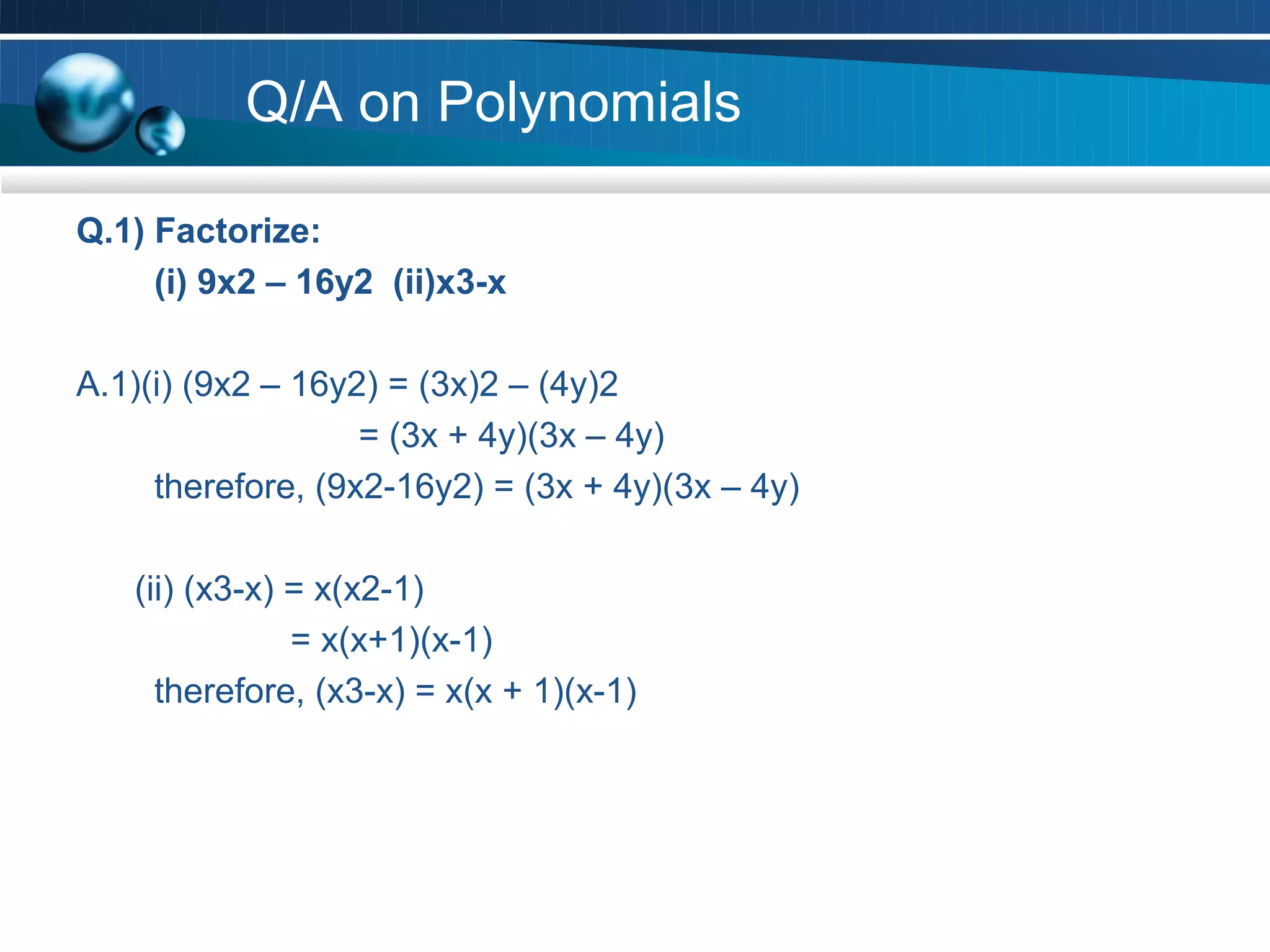
Q/A on Polynomials

Q.1) Factorize:
     (i) 9x2 – 16y2 (ii)x3-x

A.1)(i) (9x2 – 16y2) = (3x)2 – (4y)2
                   = (3x + 4y)(3x – 4y)
     therefore, (9x2-16y2) = (3x + 4y)(3x – 4y)

   (ii) (x3-x) = x(x2-1)
               = x(x+1)(x-1)
     therefore, (x3-x) = x(x + 1)(x-1)
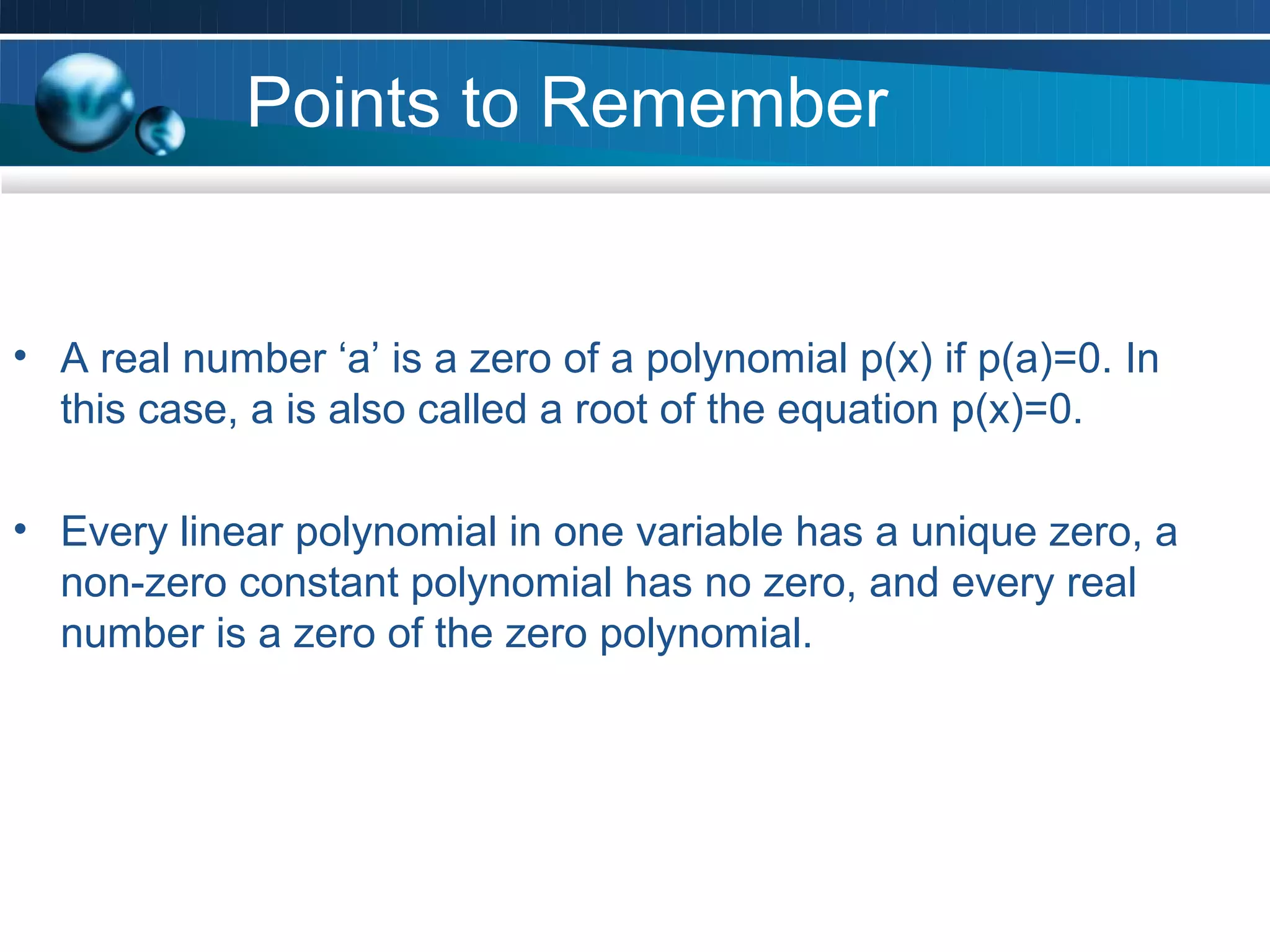
Points to Remember


• A real number ‘a’ is a zero of a polynomial p(x) if p(a)=0. In
  this case, a is also called a root of the equation p(x)=0.

• Every linear polynomial in one variable has a unique zero, a
  non-zero constant polynomial has no zero, and every real
  number is a zero of the zero polynomial.
THANK YOU


        With Regards:-
        Aman Yadav

Aman yadav

  • 1.
    Maths Project • MadeBy :- Aman Yadav • Class:-Ix-A • Roll no. :- 05 • Submitted To:- Mr. Manish Ahuja (Maths Teacher) • By The Help oF Mrs.Neetu Sharma (Computer Teacher)
  • 2.
  • 3.
    Topics Covered • Polynomials. • Exponents And Terms. • Degree Of A Polynomial In One Variable. • Degree Of A Polynomial In Two Variables. • Remainder Theorem. • Factor Theorem. • Algebric Identities.
  • 4.
    Polynomials • A polynomial is a monomial or a sum of monomials. • Each monomial in a polynomial is a term of the polynomial. The number factor of a term is called the coefficient. The coefficient of the first term in a polynomial is the lead coefficient. • A polynomial with two terms is called a binomial. • A polynomial with three term is called a trinomial.
  • 5.
  • 6.
    Degree of aPolynomial in one variable:- Degree of a Polynomial in one variable. What is degree of the following binomial? The answer is 2. 5x2 + 3 is a polynomial in x of degree 2. In case of a polynomial in one variable, the highest power of the variable is called the degree of polynomial .
  • 7.
    Degree of aPolynomial in two variables. • What is degree of the following polynomial? 5 x y − 7 x + 3 xy + 9 y + 4 2 3 3 • Theanswer is five because if we add 2 and 3 , the answer is five which is the highest power in the whole polynomial. E.g.- 3 x y − 5 x + 8 xy + 2 y + 9 3 4 2 is a polynomial in x and y of degree 7. In case of polynomials on more than one variable, the sum of powers of the variables in each term is taken up and the highest sum so obtained is called the degree of polynomial.
  • 8.
    Polynomials in onevariable The degree of a polynomial in one variable is the largest exponent of that variable. 2 A constant has no variable. It is a 0 degree polynomial. 4x +1 This is a 1st degree polynomial. 1st degree polynomials are linear. 5 x + 2 x − 14 2 This is a 2nd degree polynomial. 2nd degree polynomials are quadratic. 3 x − 18 This is a 3rd are cubic. 3 polynomials degree polynomial. 3rd degree
  • 9.
    Examples Polynomials Degree Classify by Classify by no. degree of terms. Text 5 0 Constant Monomial Txt 2x - 4 1 Linear Binomial Text 3x2 + x 2 Quadratic Binomial Text Text x - 4x + 1 3 2 3 Cubic Trinomial
  • 10.
    Remainder Theorem Let f(x)be a polynomial of degree n > 1 and let a be any real number. When f(x) is divided by (x-a) , then the remainder is f(a). TEXT TEXT TEXT TEXT PROOF Suppose when f(x) is divided by (x-a), the quotient is g(x) and the remainder is r(x). Then, degree r(x) < degree (x-a) degree r(x) < 1 [ therefore, degree (x-a)=1] degree r(x) = 0 r(x) is constant, equal to r (say) Thus, when f(x) is divided by (x-a), then the quotient is g9x) and the remainder is r. Therefore, f(x) = (x-a)*g(x) + r (i) Putting x=a in (i), we get r = f(a) Thus, when f(x) is divided by (x-a), then the remainder is f(a).
  • 11.
    Questions on RemainderTheorem Q.) Find the remainder when the polynomial f(x) = x4 + 2x3 – 3x2 + x – 1 is divided by (x-2). A.) x-2 = 0 x=2 By remainder theorem, we know that when f(x) is divided by (x-2), the remainder is x(2). Now, f(2) = (24 + 2*23 – 3*22 + 2-1) = (16 + 16 – 12 + 2 – 1) = 21. Hence, the required remainder is 21.
  • 12.
    Factor Theorem Let f(x)be a polynomial of degree n > 1 and let a be any real number. (i) If f(a) = 0 then (x-a) is a factor of f(x). PROOF let f(a) = 0 On dividing f(x) by 9x-a), let g(x) be the quotient. Also, by remainder theorem, when f(x) is divided by (x-a), then the remainder is f(a). therefore f(x) = (x-a)*g(x) + f(a) f(x) = (x-a)*g(x) [therefore f(a)=0(given] (x-a) is a factor of f(x).
  • 13.
    Algebraic Identities Some common identities used to factorize polynomials (a+b)2=a2+b2+2ab (a-b)2=a2+b2-2ab a2-b2=(a+b)(a-b) (x+a)(x+b)=x2+(a+b)x+ab
  • 14.
    Algebraic Identities Advancedidentities used to factorize polynomials (x-y)3=x3-y3- 3xy(x-y) x3+y3=(x+y) * (x2+y2-xy) x3-y3=(x+y) * (x2+y2+xy) (x+y)3=x3+y3+ (x+y+z)2=x2+y2+z2 3xy(x+y) +2xy+2yz+2zx
  • 15.
    Q/A on Polynomials Q.1)Show that (x-3) is a factor of polynomial f(x)=x3+x2-17x+15. A.1) By factor theorem, (x-3) will be a factor of f(x) if f(3)=0. Now, f(x)=x3+x2-17x+15 f(3)=(33+32-17*3+15)=(27+9-51+15)=0 (x-3) is a factor of f(x). Hence, (x-3) is a factor of the given polynomial f(x).
  • 16.
    Q/A on Polynomials Q.1)Factorize: (i) 9x2 – 16y2 (ii)x3-x A.1)(i) (9x2 – 16y2) = (3x)2 – (4y)2 = (3x + 4y)(3x – 4y) therefore, (9x2-16y2) = (3x + 4y)(3x – 4y) (ii) (x3-x) = x(x2-1) = x(x+1)(x-1) therefore, (x3-x) = x(x + 1)(x-1)
  • 17.
    Points to Remember •A real number ‘a’ is a zero of a polynomial p(x) if p(a)=0. In this case, a is also called a root of the equation p(x)=0. • Every linear polynomial in one variable has a unique zero, a non-zero constant polynomial has no zero, and every real number is a zero of the zero polynomial.
  • 18.
    THANK YOU With Regards:- Aman Yadav