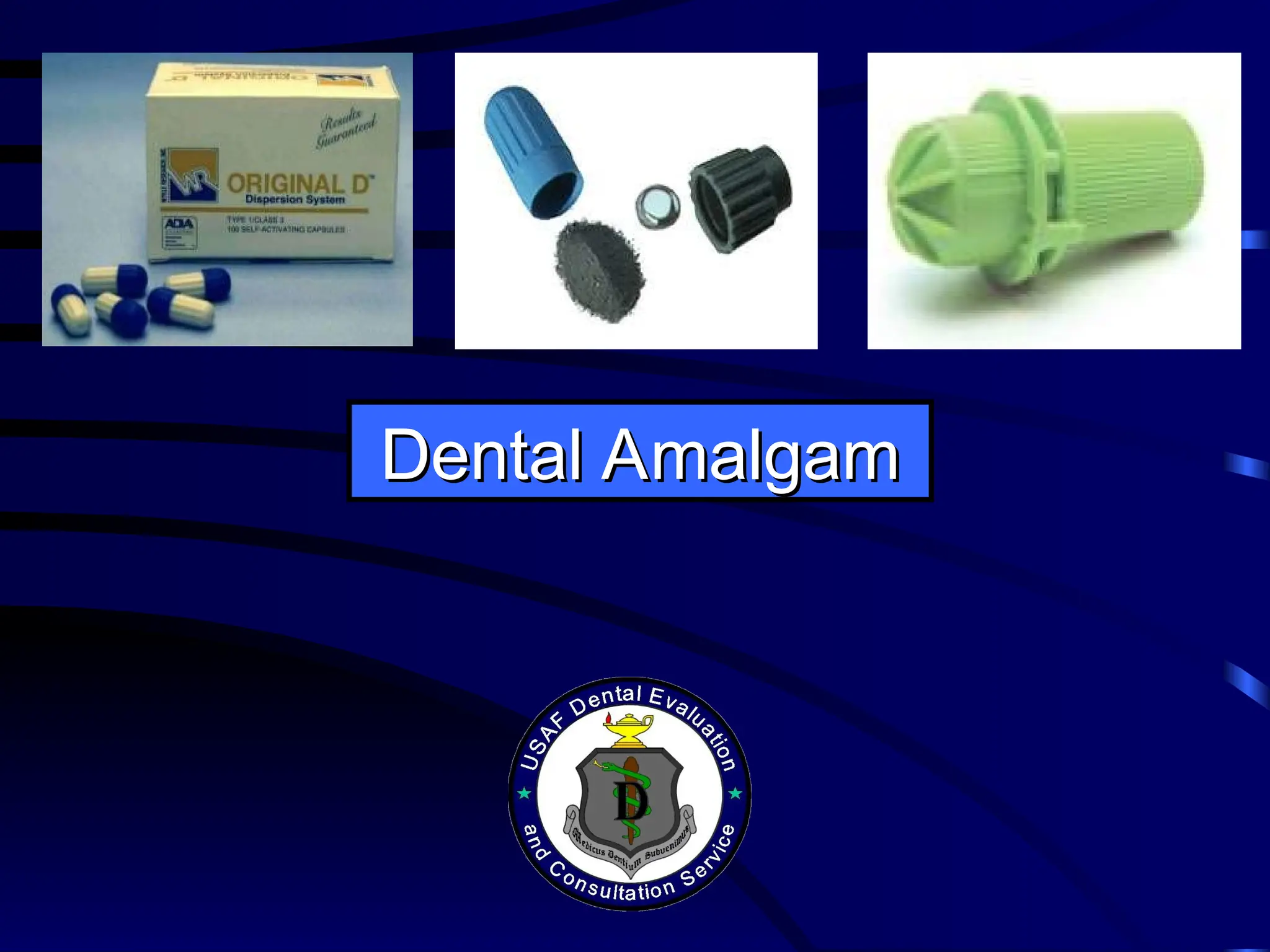
Dental Amalgam
Dental Amalgam
Official Disclaimer
• The opinions expressed in this presentation are
those of the author and do not necessarily
reflect the official position of the US Air Force or
the Department of Defense (DOD)
• Devices or materials appearing in this
presentation are used as examples of currently
available products/technologies and do not
imply an endorsement by the author and/or the
USAF/DOD
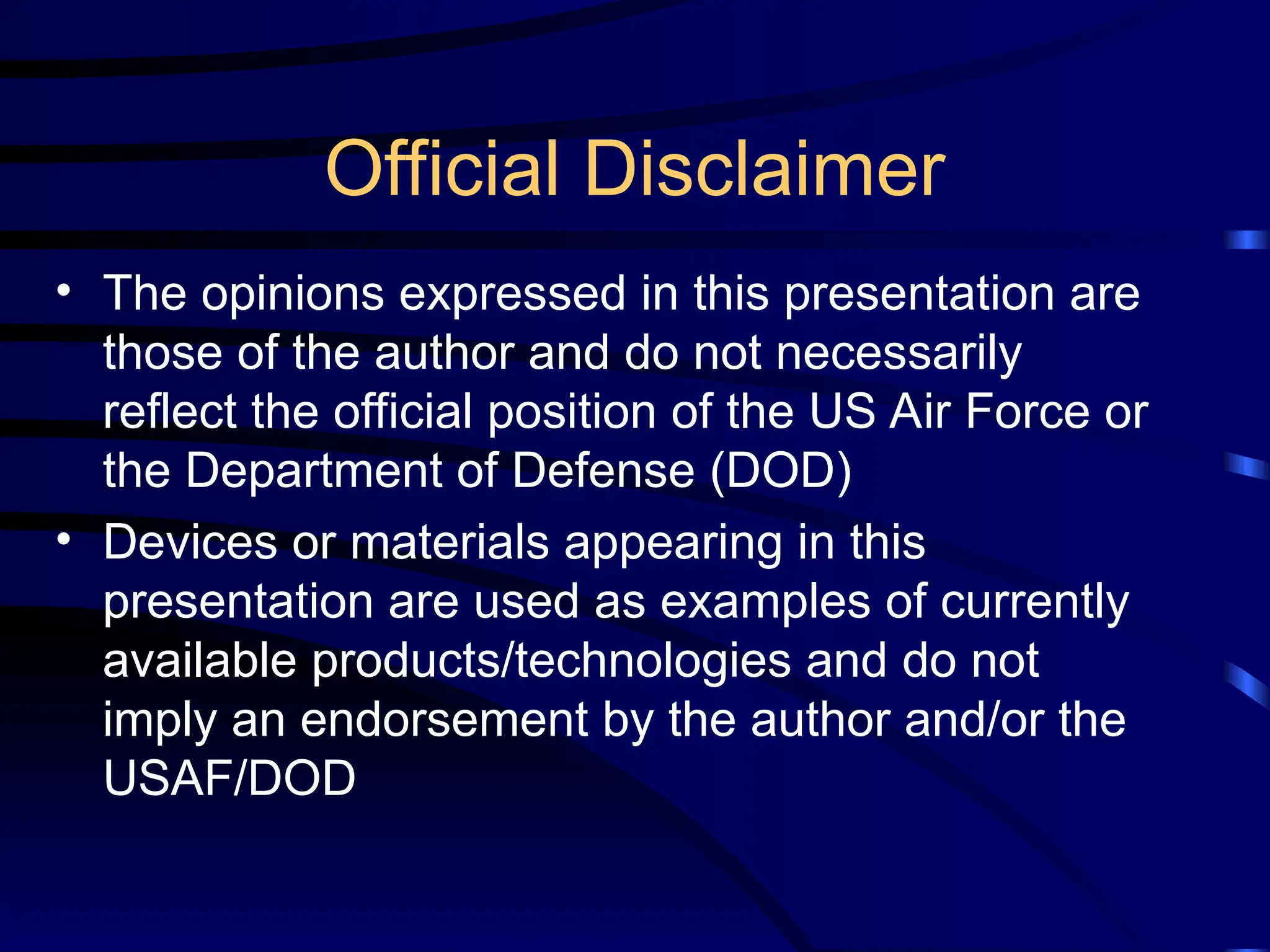
Overview
• History
• Basic composition
• Basic setting reactions
• Classifications
• Manufacturing
• Variables in amalgam
performance
Click here for briefing on dental amalgam (PDF)
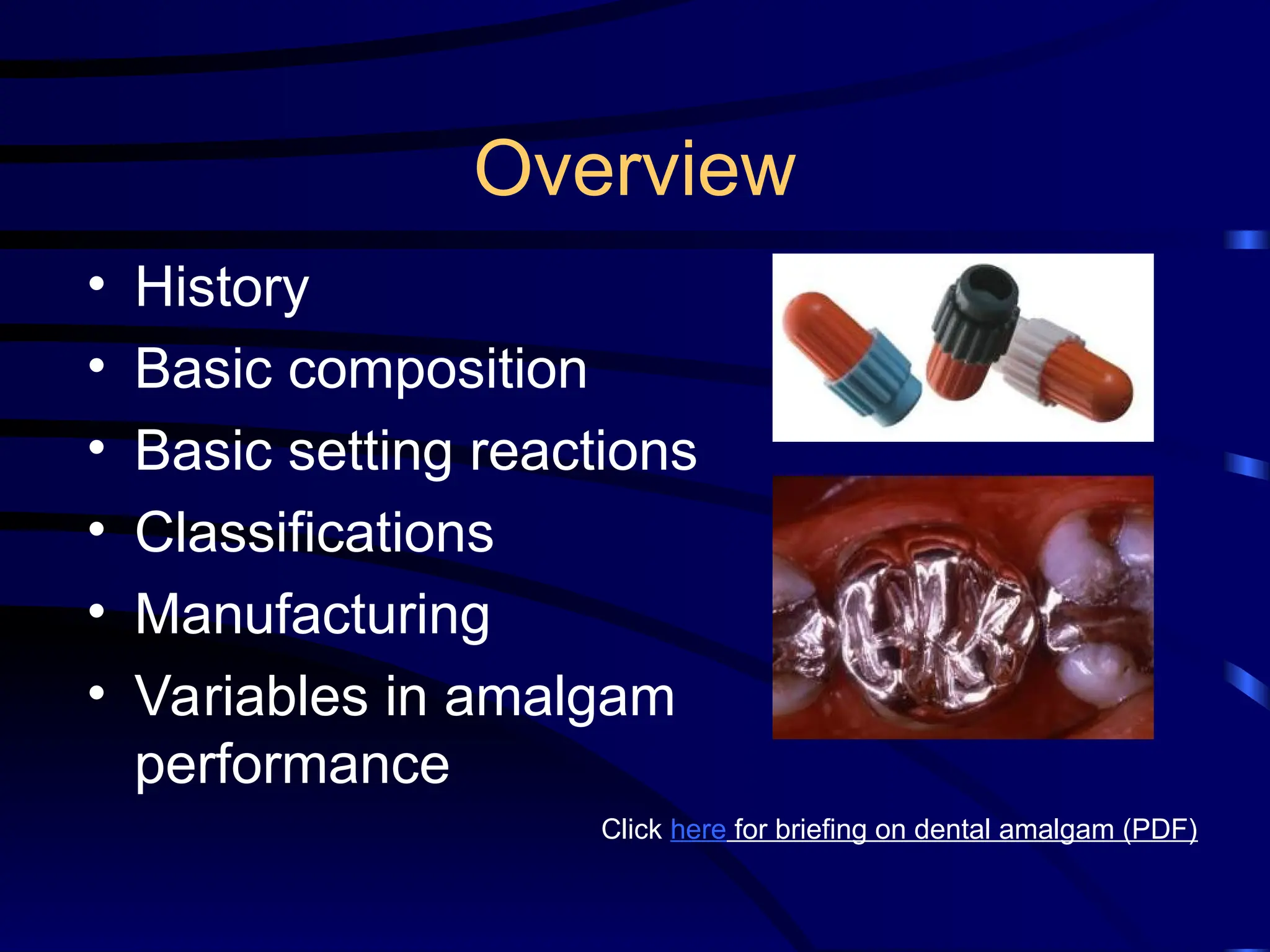
History
• 1833
– Crawcour brothers introduce
amalgam to US
• powdered silver coins mixed with mercury
– expanded on setting
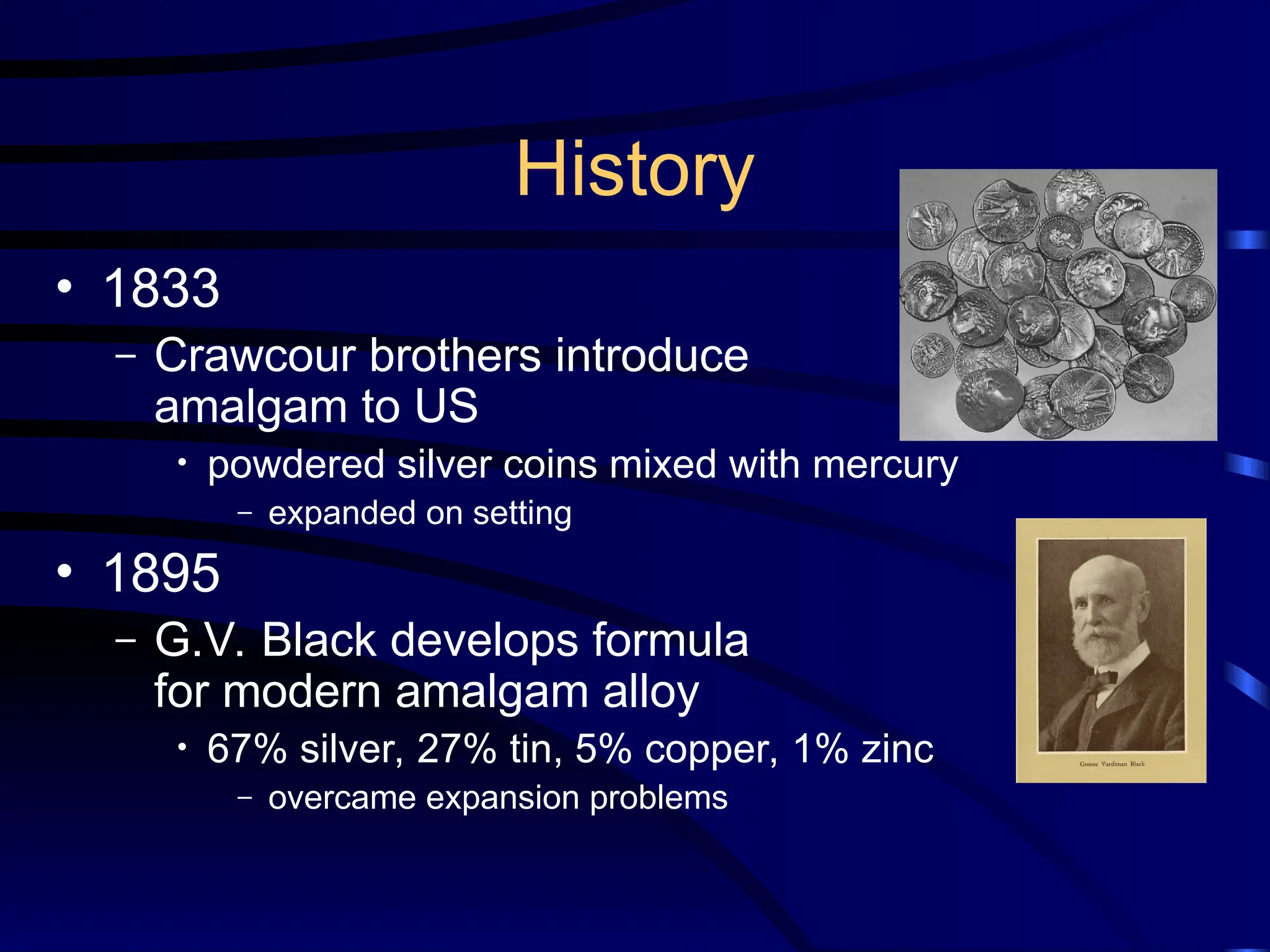
• 1895
– G.V. Black develops formula
for modern amalgam alloy
• 67% silver, 27% tin, 5% copper, 1% zinc
– overcame expansion problems
History
• 1960’s
– conventional low-copper lathe-cut alloys
• smaller particles
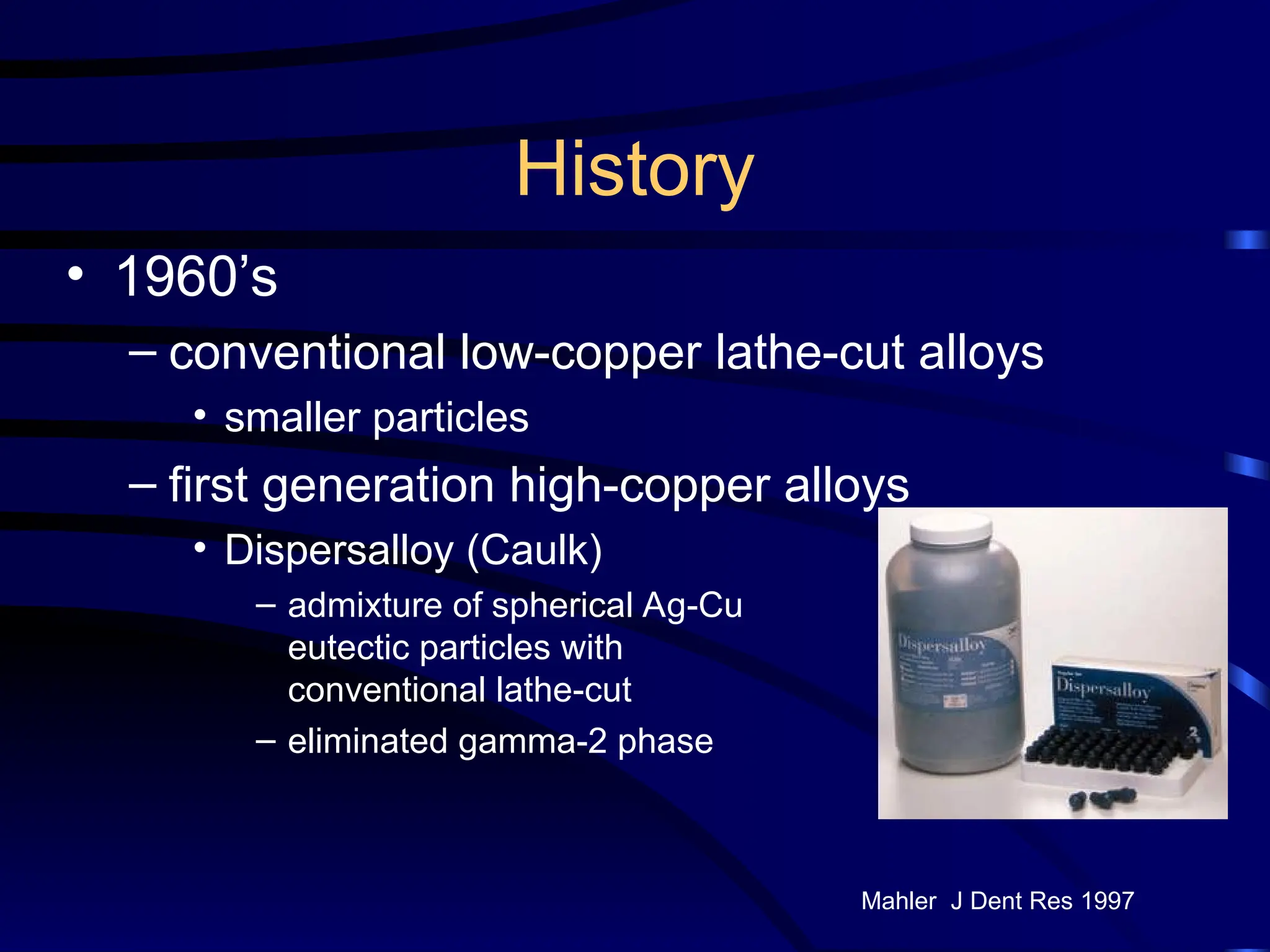
– first generation high-copper alloys
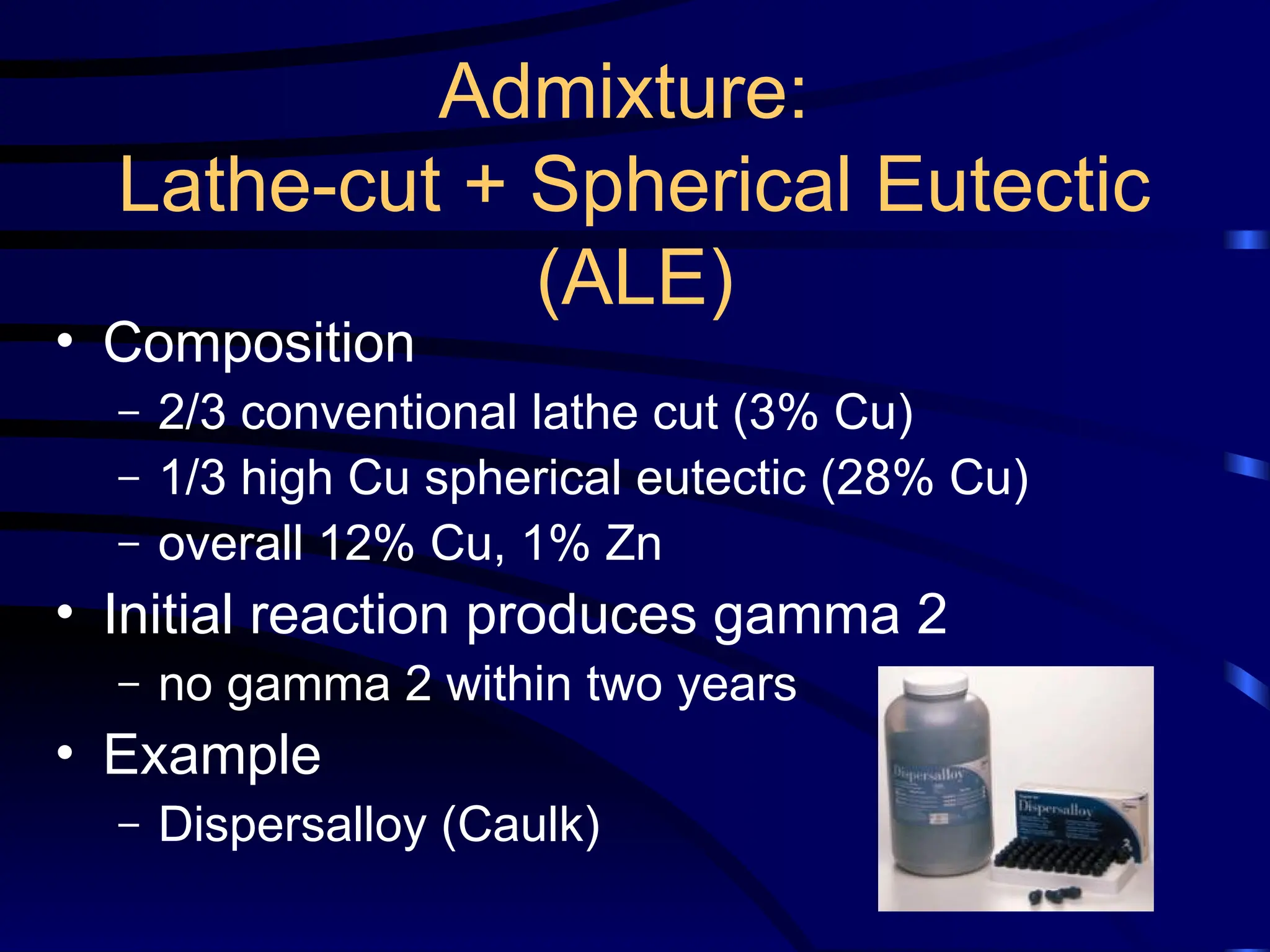
• Dispersalloy (Caulk)
– admixture of spherical Ag-Cu
eutectic particles with
conventional lathe-cut
– eliminated gamma-2 phase
Mahler J Dent Res 1997
History
• 1970’s
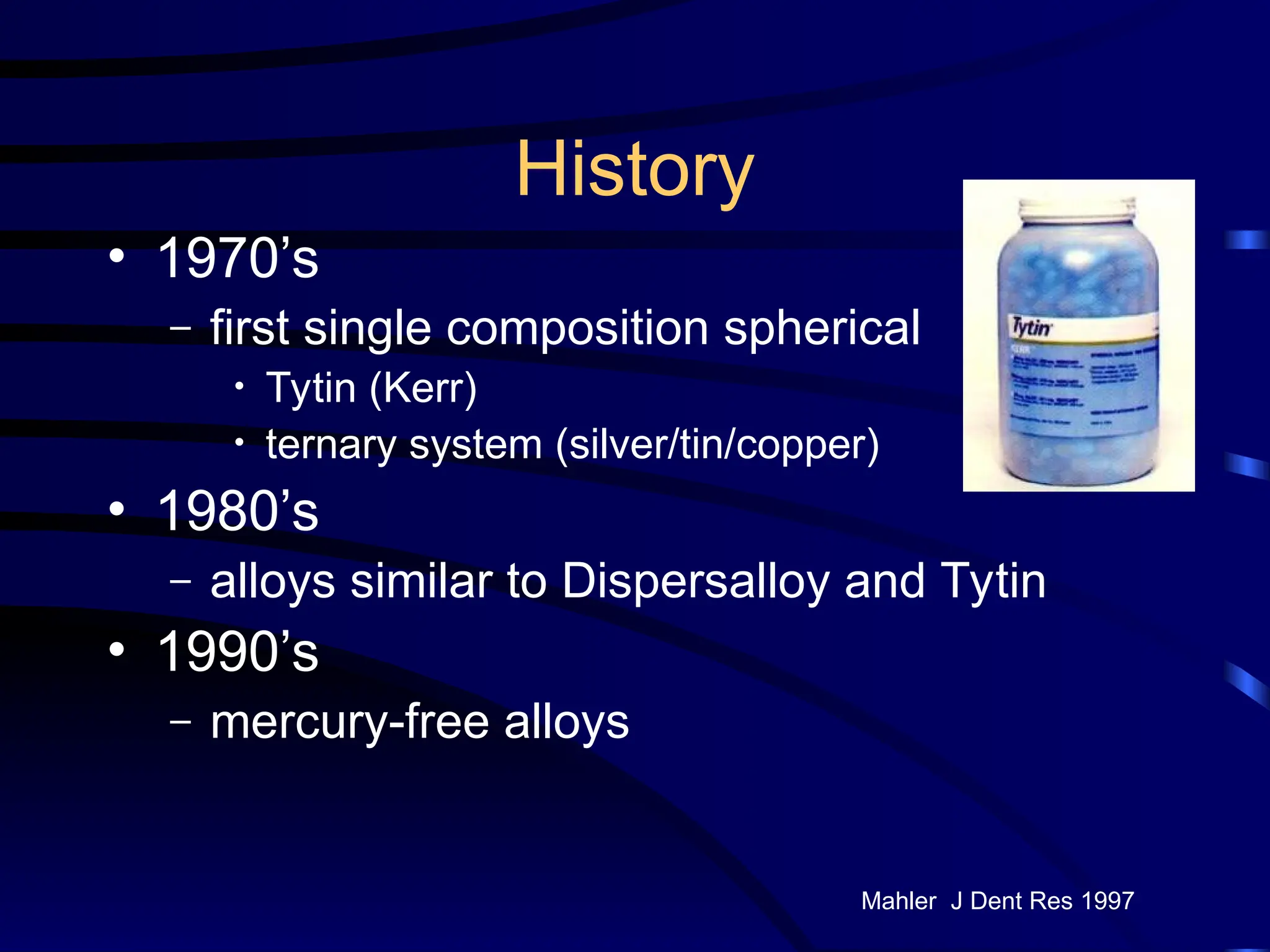
– first single composition spherical
• Tytin (Kerr)
• ternary system (silver/tin/copper)
• 1980’s
– alloys similar to Dispersalloy and Tytin
• 1990’s
– mercury-free alloys
Mahler J Dent Res 1997
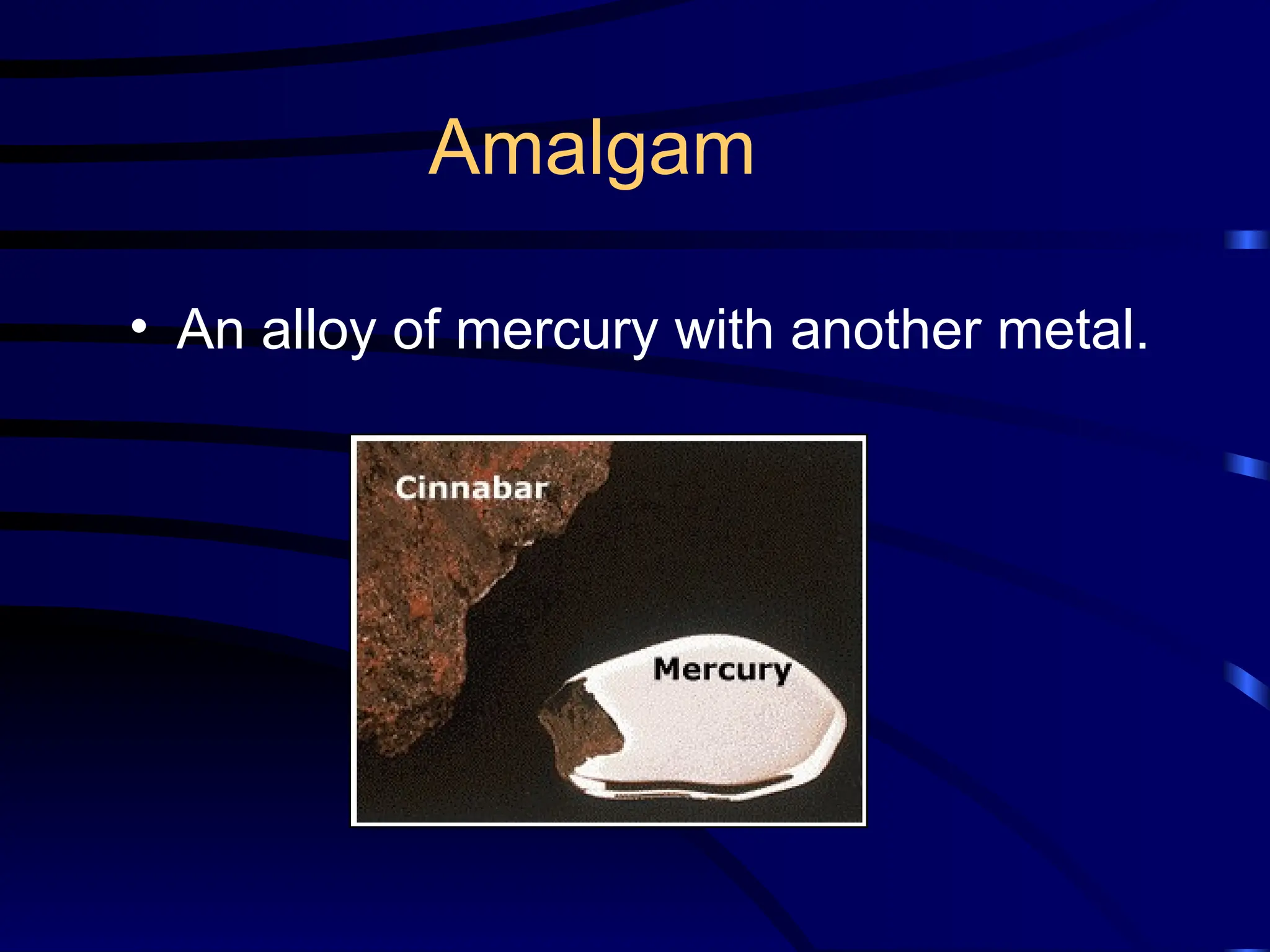
Amalgam
• An alloy of mercury with another metal.
Why Amalgam?
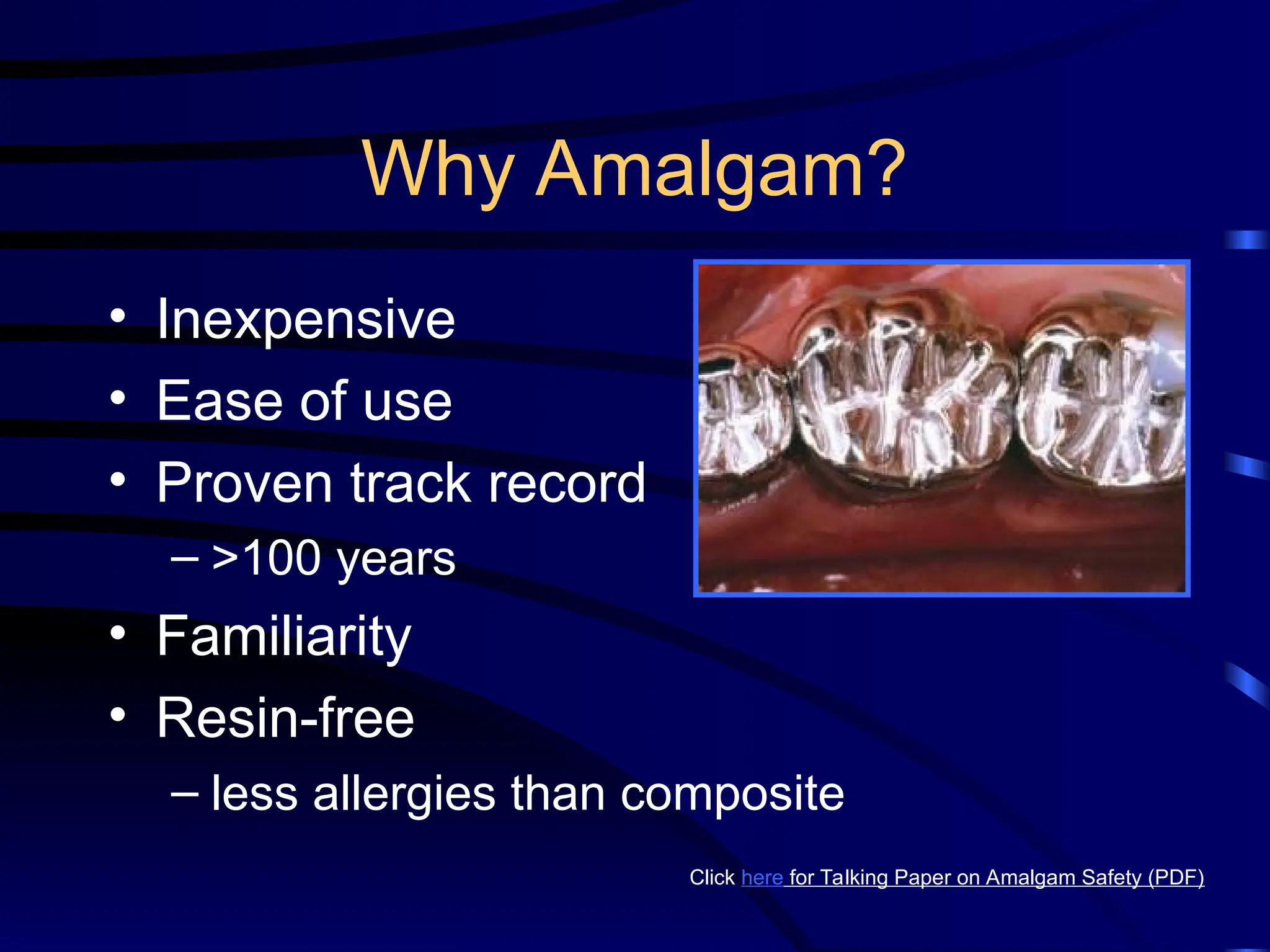
• Inexpensive
• Ease of use
• Proven track record
– >100 years
• Familiarity
• Resin-free
– less allergies than composite
Click here for Talking Paper on Amalgam Safety (PDF)
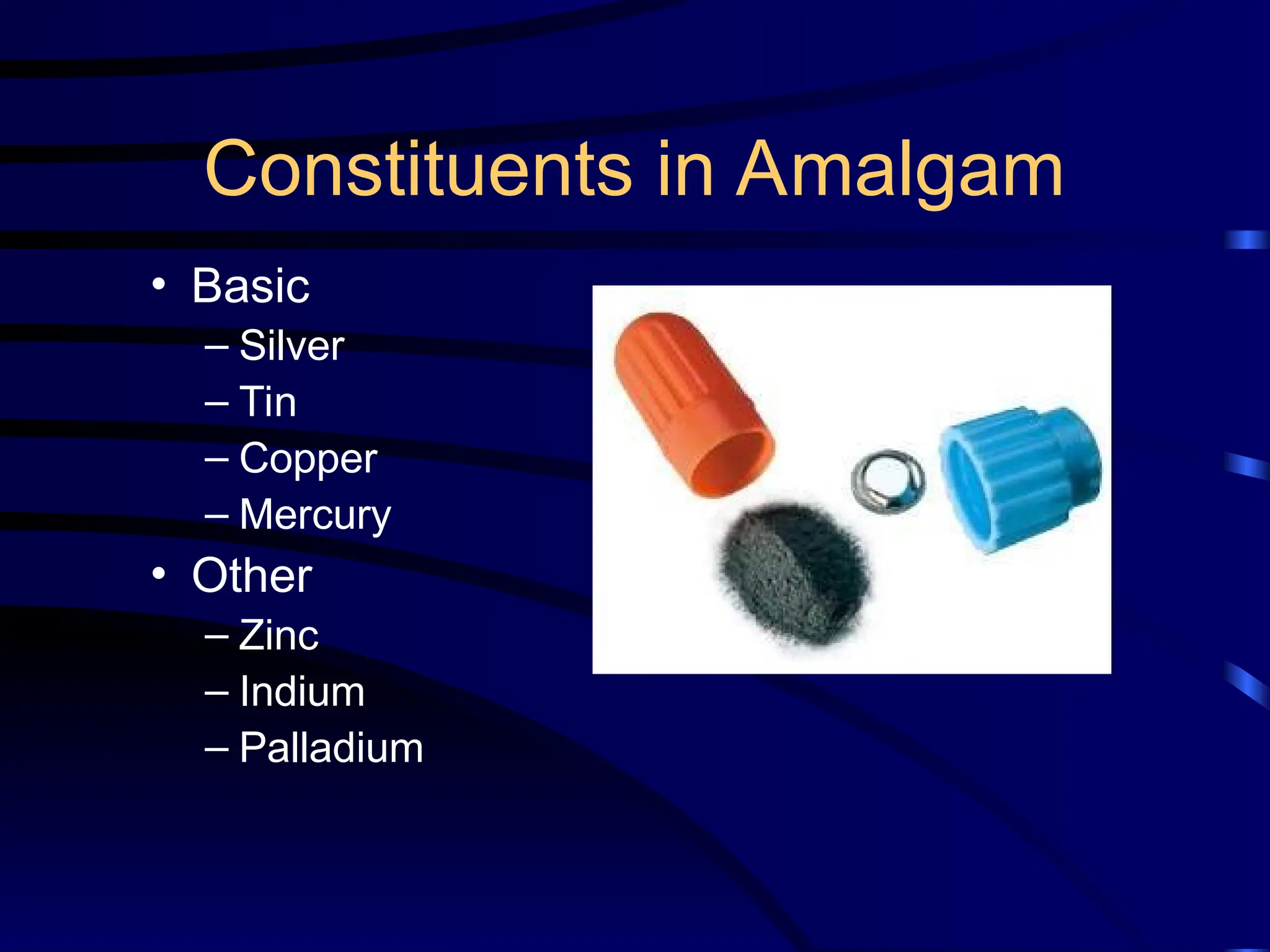
Constituents in Amalgam
• Basic
– Silver
– Tin
– Copper
– Mercury
• Other
– Zinc
– Indium
– Palladium
Basic Constituents
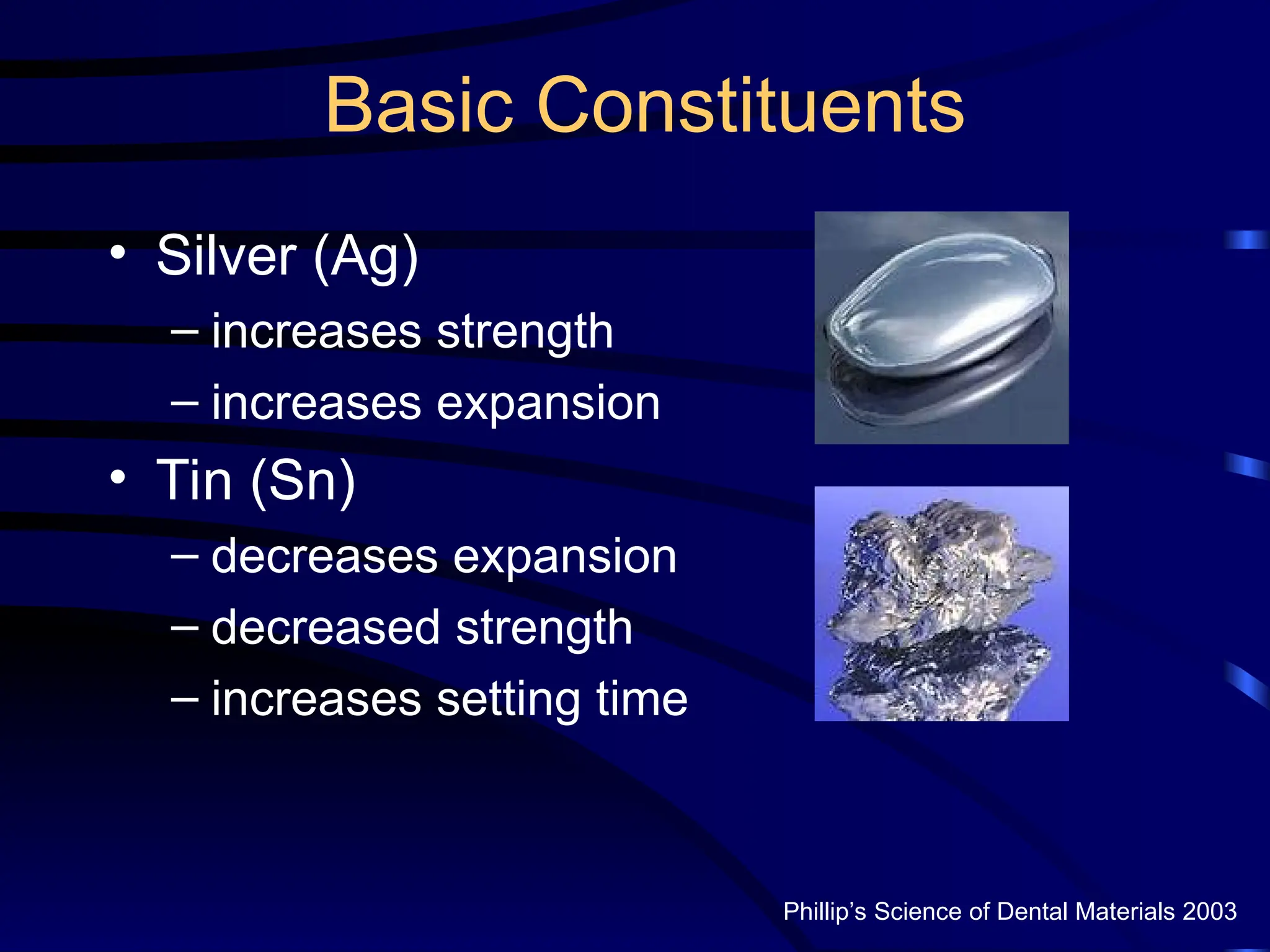
• Silver (Ag)
– increases strength
– increases expansion
• Tin (Sn)
– decreases expansion
– decreased strength
– increases setting time
Phillip’s Science of Dental Materials 2003
Basic Constituents
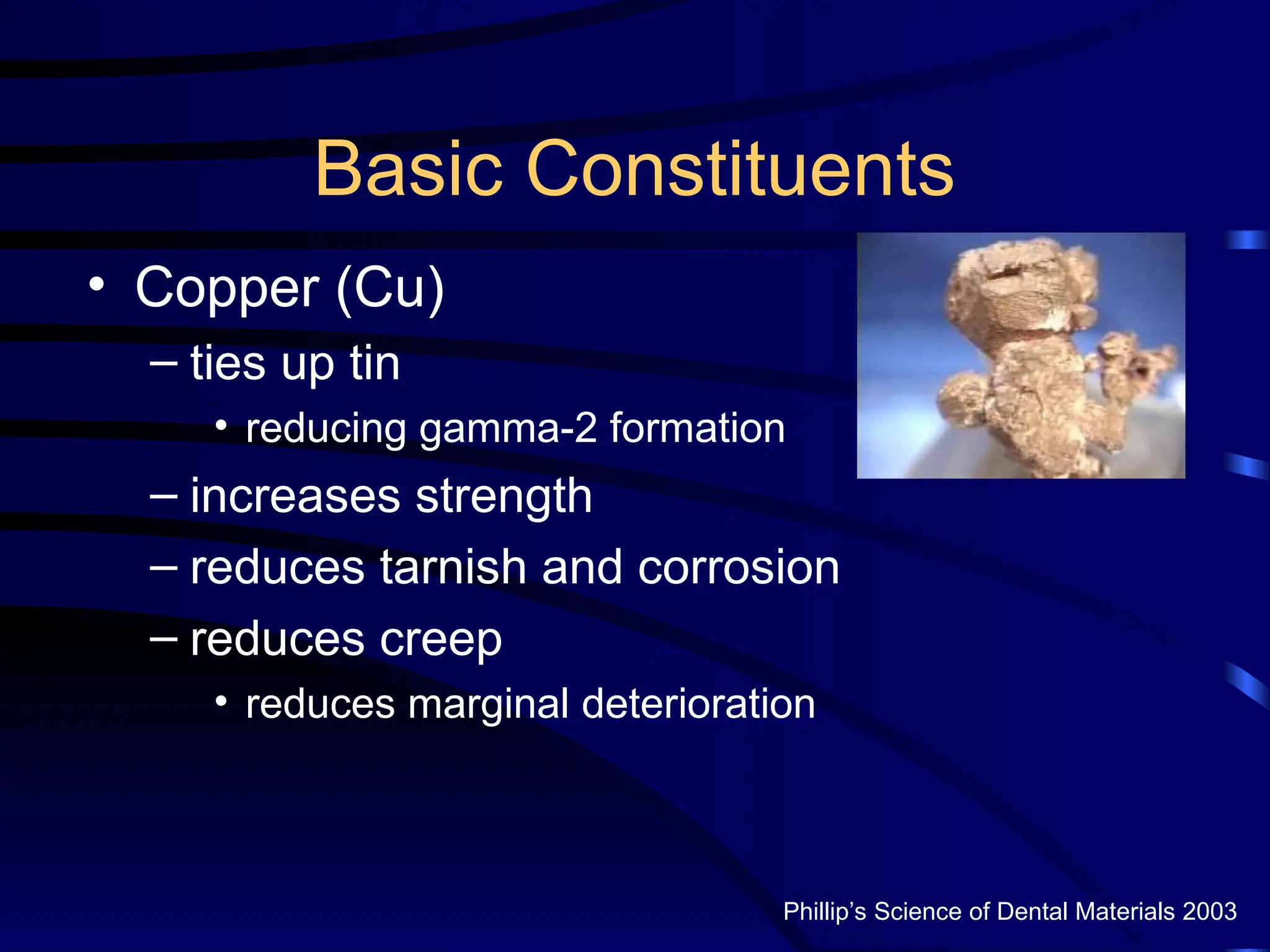
• Copper (Cu)
– ties up tin
• reducing gamma-2 formation
– increases strength
– reduces tarnish and corrosion
– reduces creep
• reduces marginal deterioration
Phillip’s Science of Dental Materials 2003
Basic Constituents
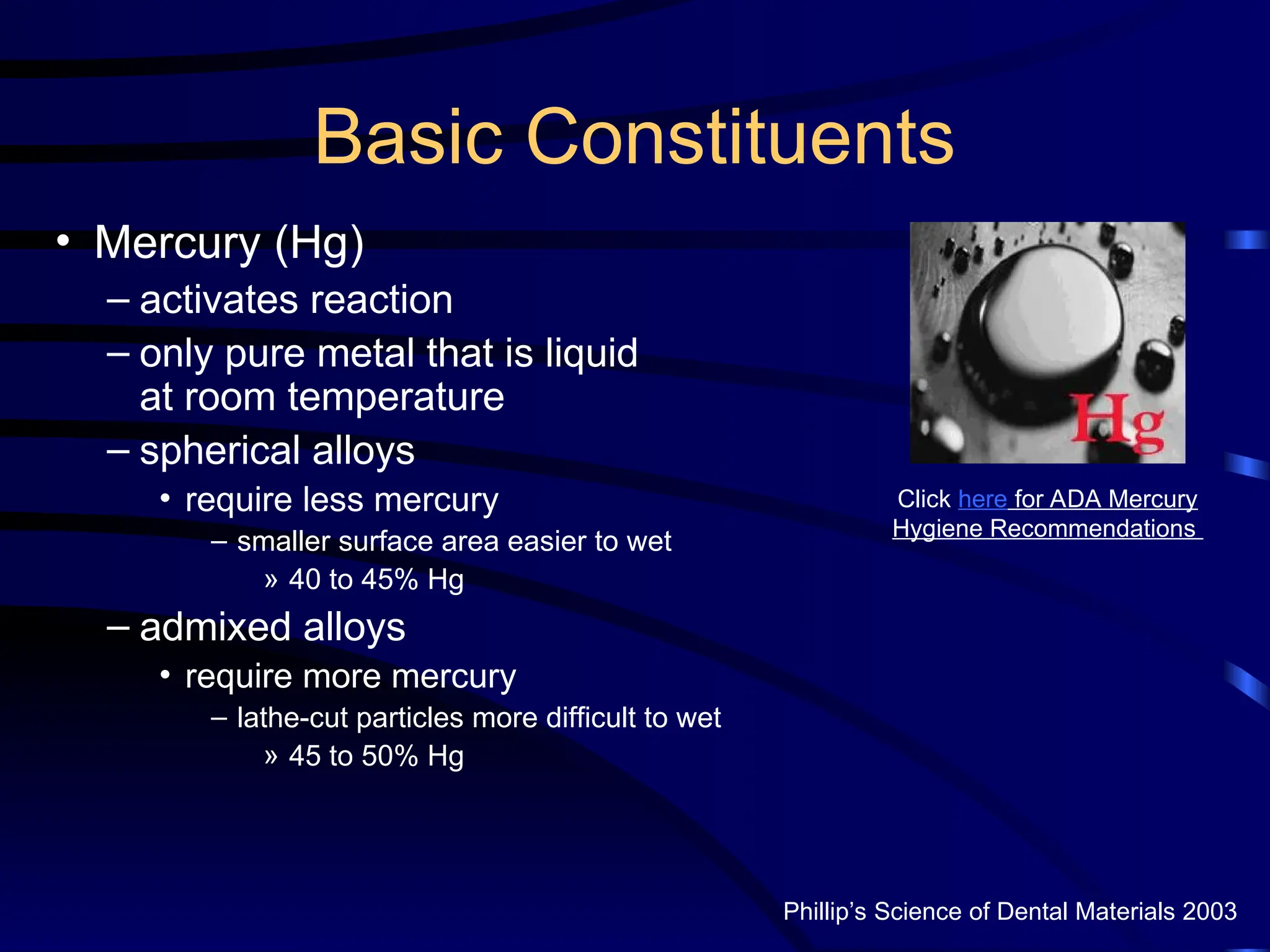
• Mercury (Hg)
– activates reaction
– only pure metal that is liquid
at room temperature
– spherical alloys
• require less mercury
– smaller surface area easier to wet
» 40 to 45% Hg
– admixed alloys
• require more mercury
– lathe-cut particles more difficult to wet
» 45 to 50% Hg
Click here for ADA Mercury
Hygiene Recommendations
Phillip’s Science of Dental Materials 2003
Other Constituents
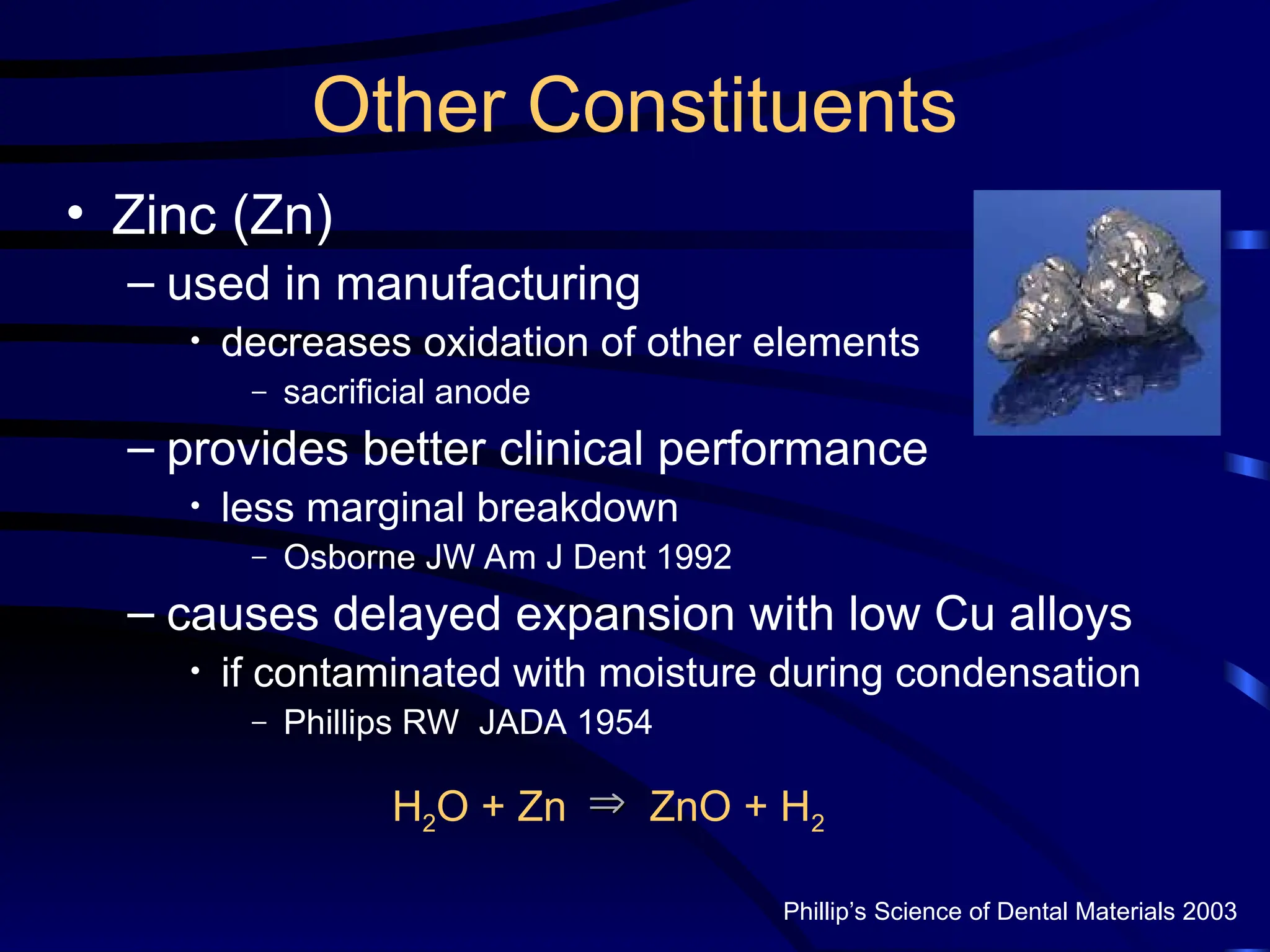
• Zinc (Zn)
– used in manufacturing
• decreases oxidation of other elements
– sacrificial anode
– provides better clinical performance
• less marginal breakdown
– Osborne JW Am J Dent 1992
– causes delayed expansion with low Cu alloys
• if contaminated with moisture during condensation
– Phillips RW JADA 1954
Phillip’s Science of Dental Materials 2003
H2O + Zn ZnO + H2



Other Constituents
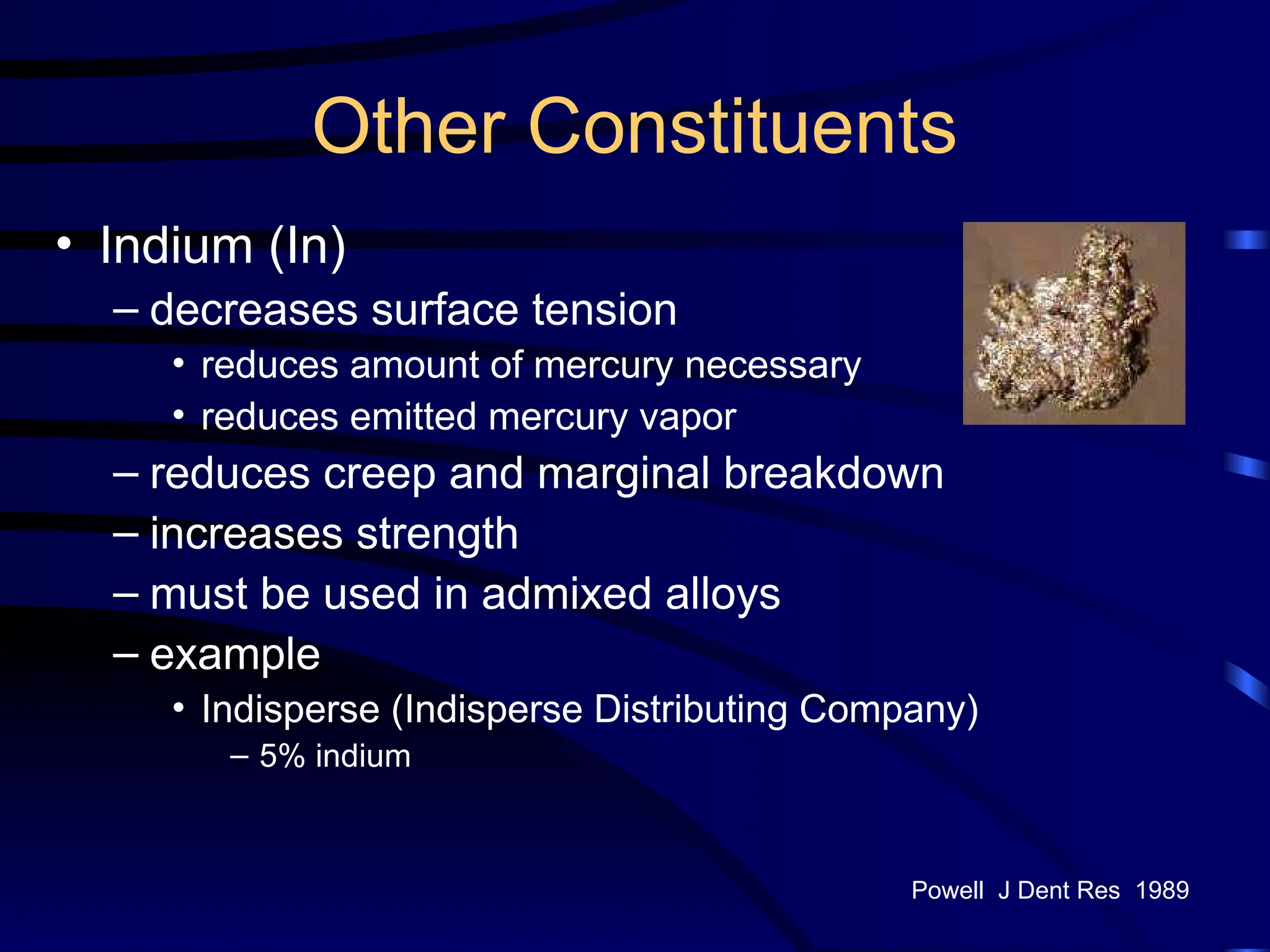
• Indium (In)
– decreases surface tension
• reduces amount of mercury necessary
• reduces emitted mercury vapor
– reduces creep and marginal breakdown
– increases strength
– must be used in admixed alloys
– example
• Indisperse (Indisperse Distributing Company)
– 5% indium
Powell J Dent Res 1989
Other Constituents
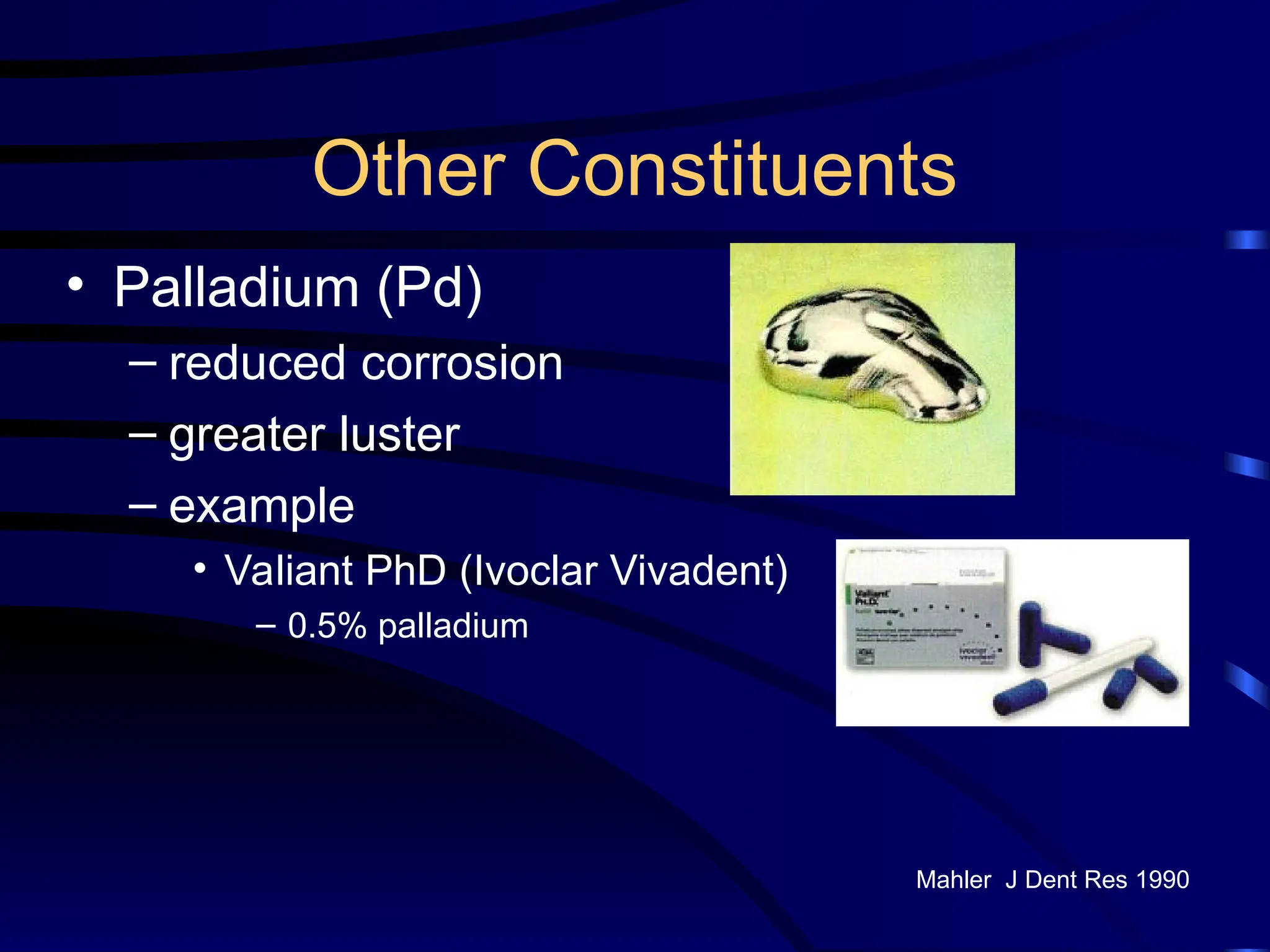
• Palladium (Pd)
– reduced corrosion
– greater luster
– example
• Valiant PhD (Ivoclar Vivadent)
– 0.5% palladium
Mahler J Dent Res 1990
Basic Composition
• A silver-mercury matrix containing filler particles of
silver-tin
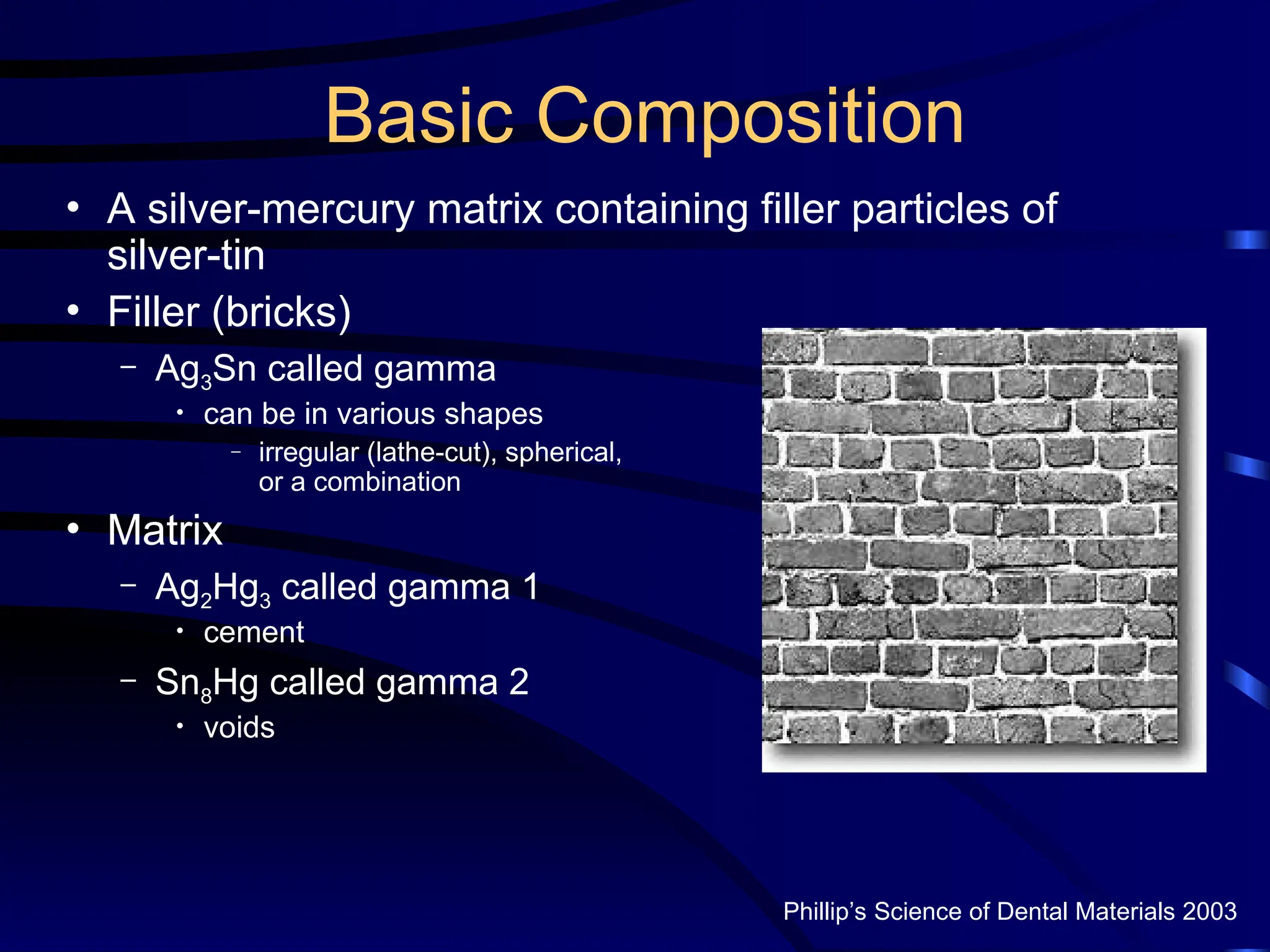
• Filler (bricks)
– Ag3Sn called gamma
• can be in various shapes
– irregular (lathe-cut), spherical,
or a combination
• Matrix
– Ag2Hg3 called gamma 1
• cement
– Sn8Hg called gamma 2
• voids
Phillip’s Science of Dental Materials 2003
Basic Setting Reactions
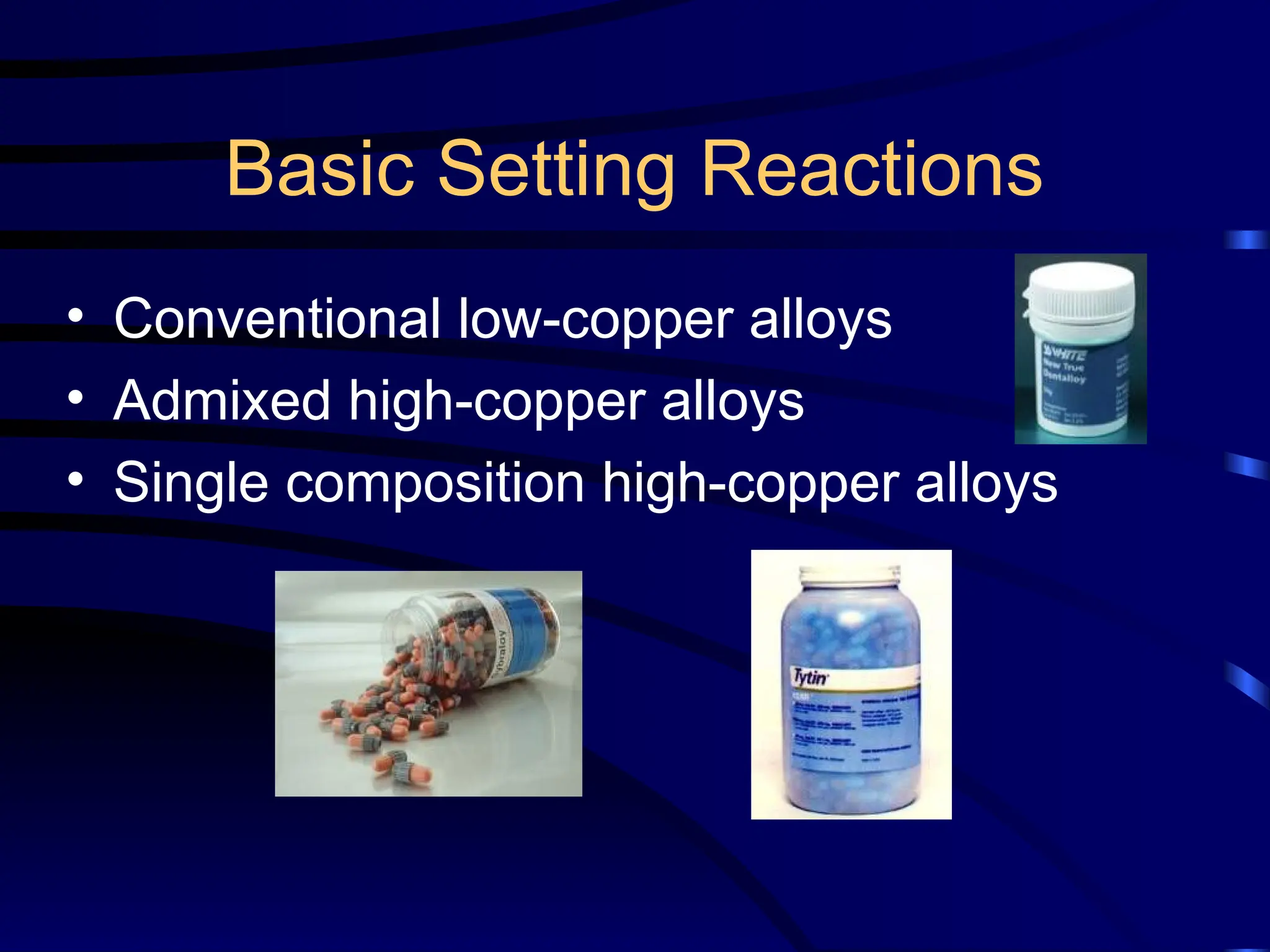
• Conventional low-copper alloys
• Admixed high-copper alloys
• Single composition high-copper alloys
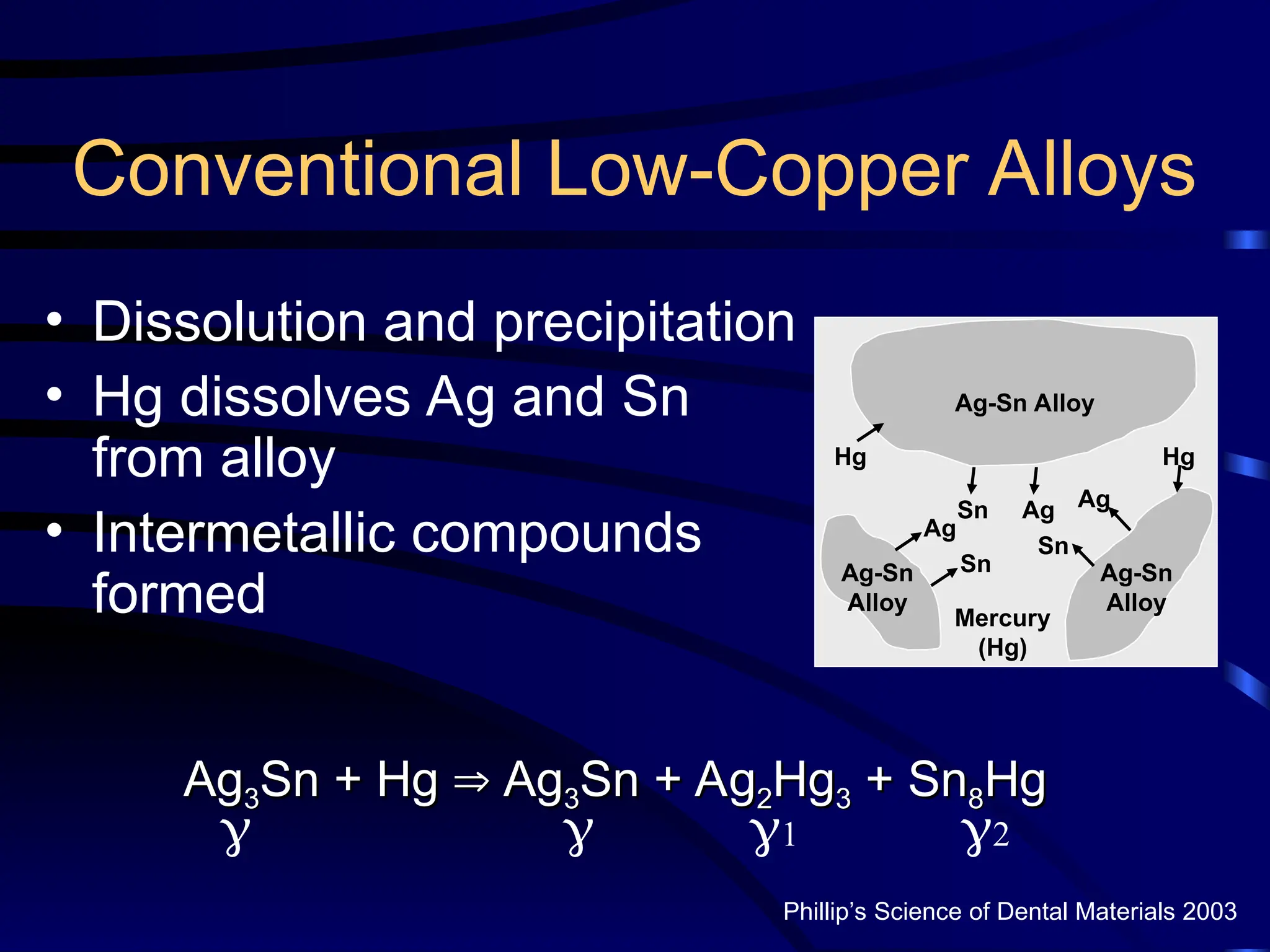
• Dissolution and precipitation
• Hg dissolves Ag and Sn
from alloy
• Intermetallic compounds
formed
Ag-Sn
Alloy
Ag-Sn
Alloy
Ag-Sn Alloy
Mercury
(Hg)
Ag
Ag
Ag
Sn
Sn
Sn
Conventional Low-Copper Alloys
Hg Hg
Ag
Ag3
3Sn + Hg
Sn + Hg 
 Ag
Ag3
3Sn + Ag
Sn + Ag2
2Hg
Hg3
3 + Sn
+ Sn8
8Hg
Hg
Phillip’s Science of Dental Materials 2003
  1 2
Conventional Low-Copper Alloys
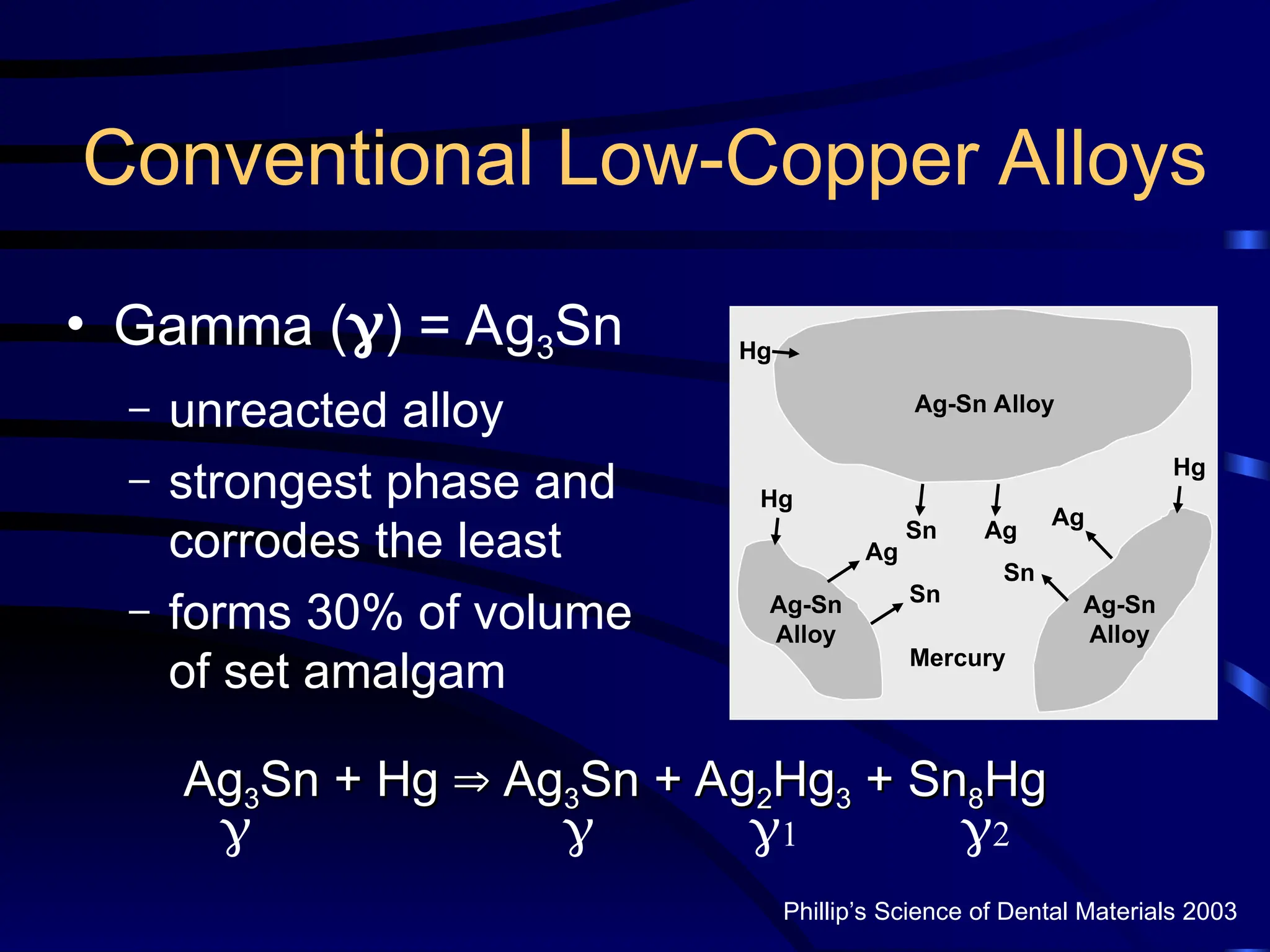
• Gamma () = Ag3Sn
– unreacted alloy
– strongest phase and
corrodes the least
– forms 30% of volume
of set amalgam
Ag-Sn
Alloy
Ag-Sn
Alloy
Ag-Sn Alloy
Mercury
Ag
Ag
Ag
Sn
Sn
Sn
Hg
Hg
Hg
Ag
Ag3
3Sn + Hg
Sn + Hg 
 Ag
Ag3
3Sn + Ag
Sn + Ag2
2Hg
Hg3
3 + Sn
+ Sn8
8Hg
Hg
Phillip’s Science of Dental Materials 2003
  1 2
Conventional Low-Copper Alloys
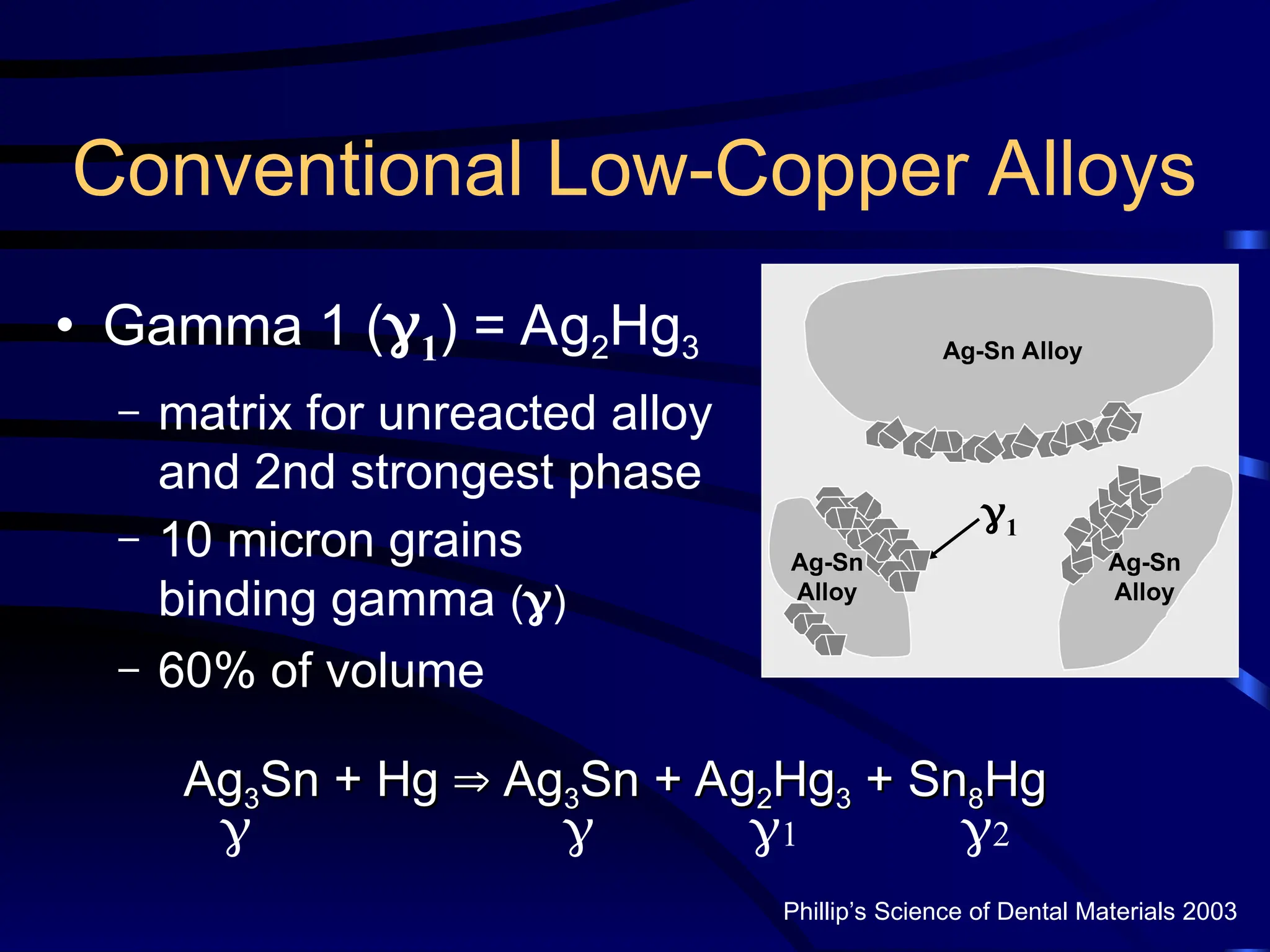
• Gamma 1 (1) = Ag2Hg3
– matrix for unreacted alloy
and 2nd strongest phase
– 10 micron grains
binding gamma ()
– 60% of volume
1
Ag
Ag3
3Sn + Hg
Sn + Hg 
 Ag
Ag3
3Sn + Ag
Sn + Ag2
2Hg
Hg3
3 + Sn
+ Sn8
8Hg
Hg
Phillip’s Science of Dental Materials 2003
  1 2
Ag-Sn Alloy
Ag-Sn
Alloy
Ag-Sn
Alloy
Conventional Low-Copper Alloys
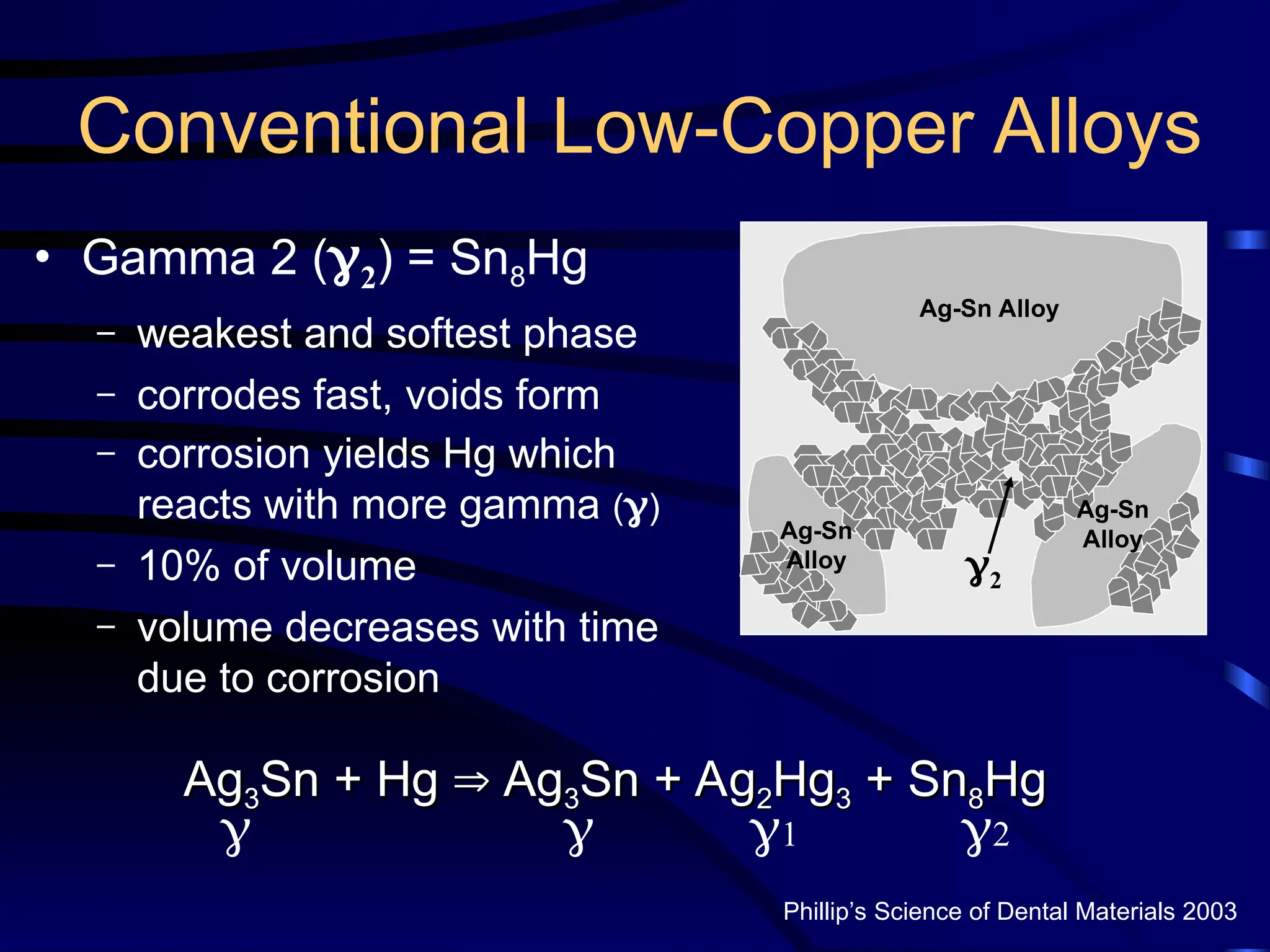
• Gamma 2 (2) = Sn8Hg
– weakest and softest phase
– corrodes fast, voids form
– corrosion yields Hg which
reacts with more gamma ()
– 10% of volume
– volume decreases with time
due to corrosion
Ag
Ag3
3Sn + Hg
Sn + Hg 
 Ag
Ag3
3Sn + Ag
Sn + Ag2
2Hg
Hg3
3 + Sn
+ Sn8
8Hg
Hg
Phillip’s Science of Dental Materials 2003
  1 2
2
Ag-Sn Alloy
Ag-Sn
Alloy
Ag-Sn
Alloy
Admixed High-Copper Alloys
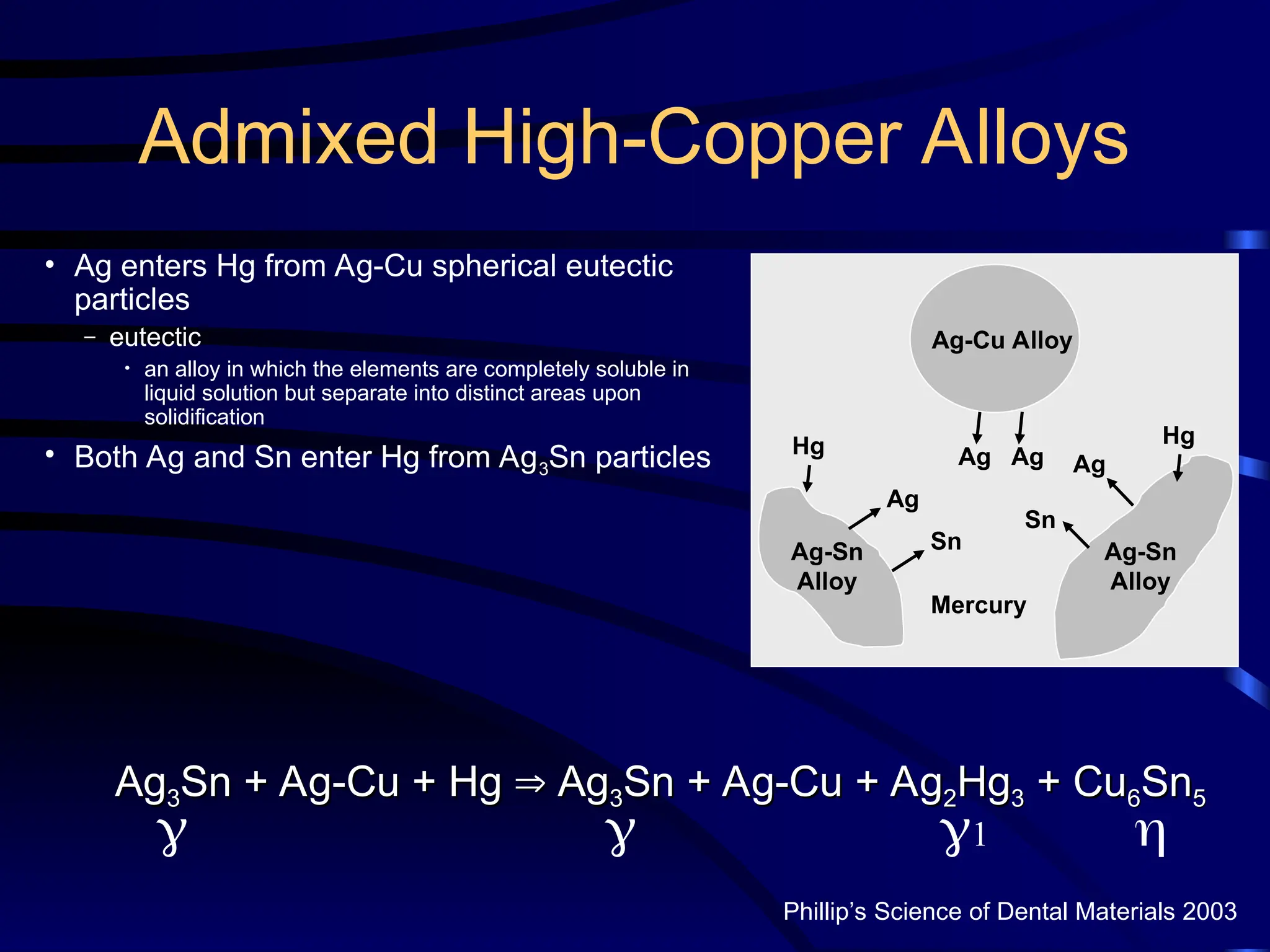
• Ag enters Hg from Ag-Cu spherical eutectic
particles
– eutectic
• an alloy in which the elements are completely soluble in
liquid solution but separate into distinct areas upon
solidification
• Both Ag and Sn enter Hg from Ag3Sn particles
Phillip’s Science of Dental Materials 2003
Ag
Ag3
3Sn + Ag-Cu + Hg
Sn + Ag-Cu + Hg 
 Ag
Ag3
3Sn + Ag-Cu + Ag
Sn + Ag-Cu + Ag2
2Hg
Hg3
3 + Cu
+ Cu6
6Sn
Sn5
5
  1 
Ag-Sn
Alloy
Ag-Sn
Alloy
Mercury
Ag
Ag
Ag
Sn
Sn
Ag-Cu Alloy
Ag
Hg
Hg
Admixed High-Copper Alloys
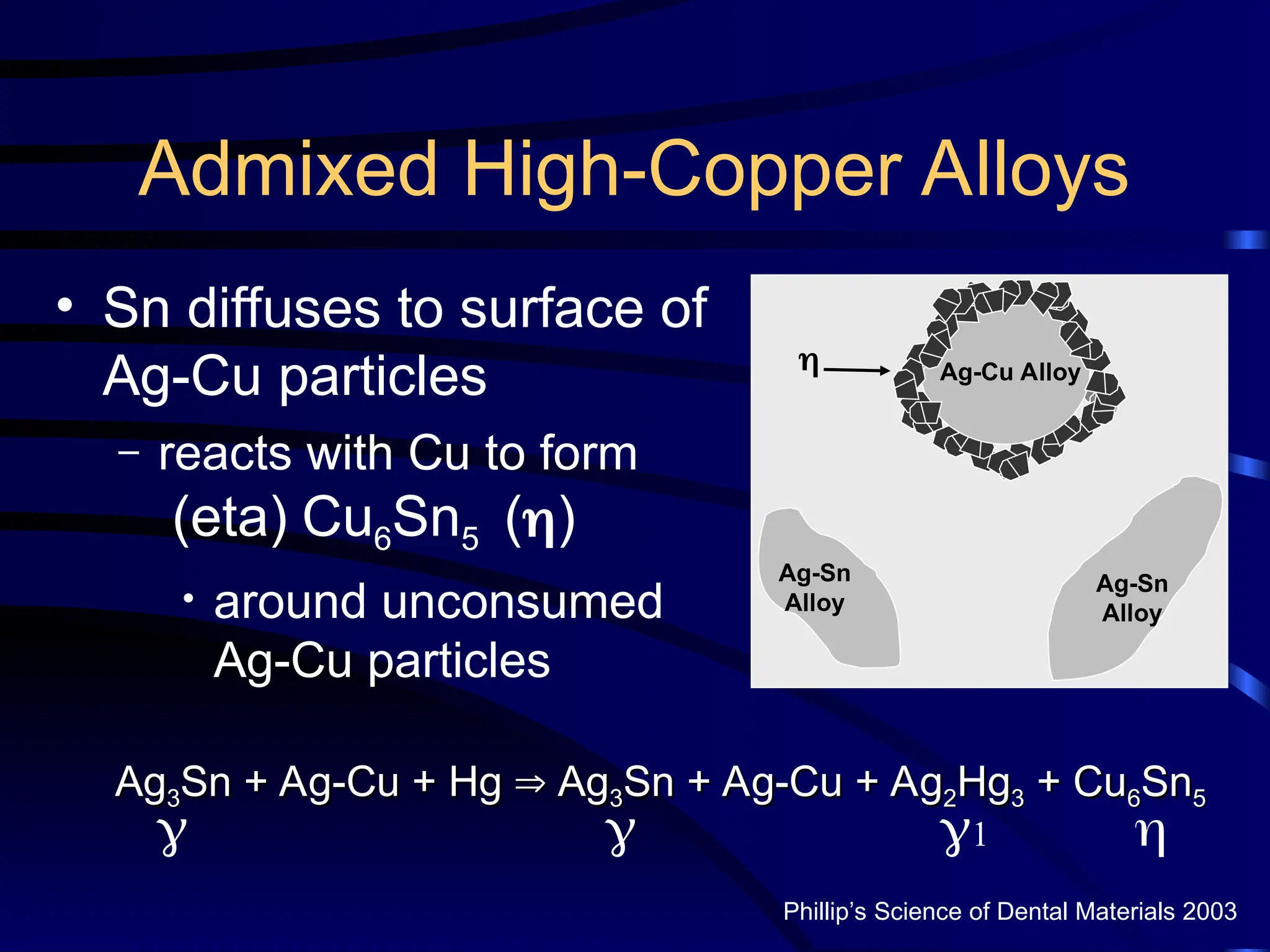
• Sn diffuses to surface of
Ag-Cu particles
– reacts with Cu to form
(eta) Cu6Sn5 ()
• around unconsumed
Ag-Cu particles
Ag-Sn
Alloy
Ag-Cu Alloy

Ag-Sn
Alloy
Phillip’s Science of Dental Materials 2003
Ag
Ag3
3Sn + Ag-Cu + Hg
Sn + Ag-Cu + Hg 
 Ag
Ag3
3Sn + Ag-Cu + Ag
Sn + Ag-Cu + Ag2
2Hg
Hg3
3 + Cu
+ Cu6
6Sn
Sn5
5
  1 
Admixed High-Copper Alloys
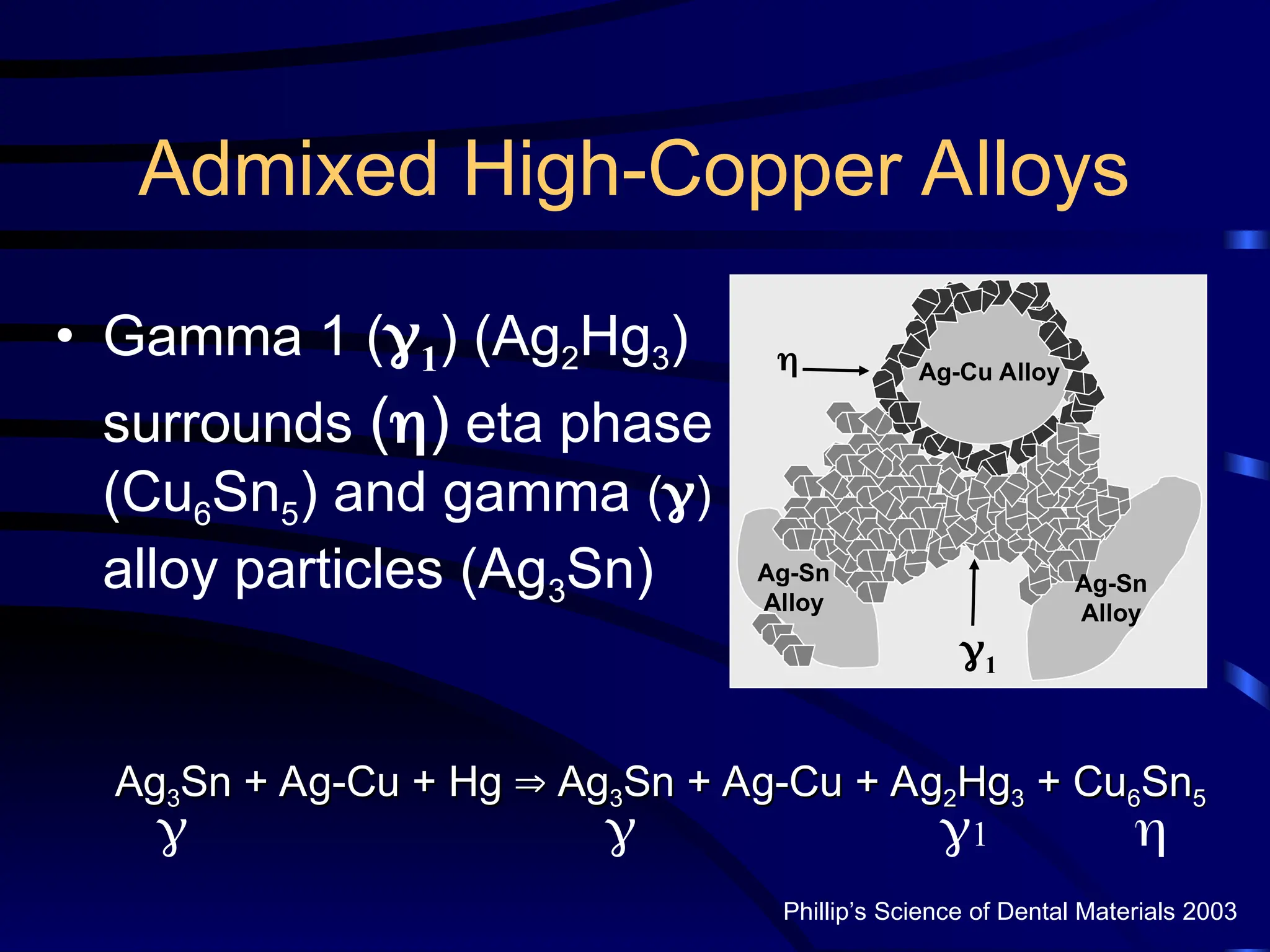
• Gamma 1 (1) (Ag2Hg3)
surrounds () eta phase
(Cu6Sn5) and gamma ()
alloy particles (Ag3Sn) Ag-Sn
Alloy
1
Ag-Cu Alloy

Ag-Sn
Alloy
Phillip’s Science of Dental Materials 2003
Ag
Ag3
3Sn + Ag-Cu + Hg
Sn + Ag-Cu + Hg 
 Ag
Ag3
3Sn + Ag-Cu + Ag
Sn + Ag-Cu + Ag2
2Hg
Hg3
3 + Cu
+ Cu6
6Sn
Sn5
5
  1 
Single Composition
High-Copper Alloys
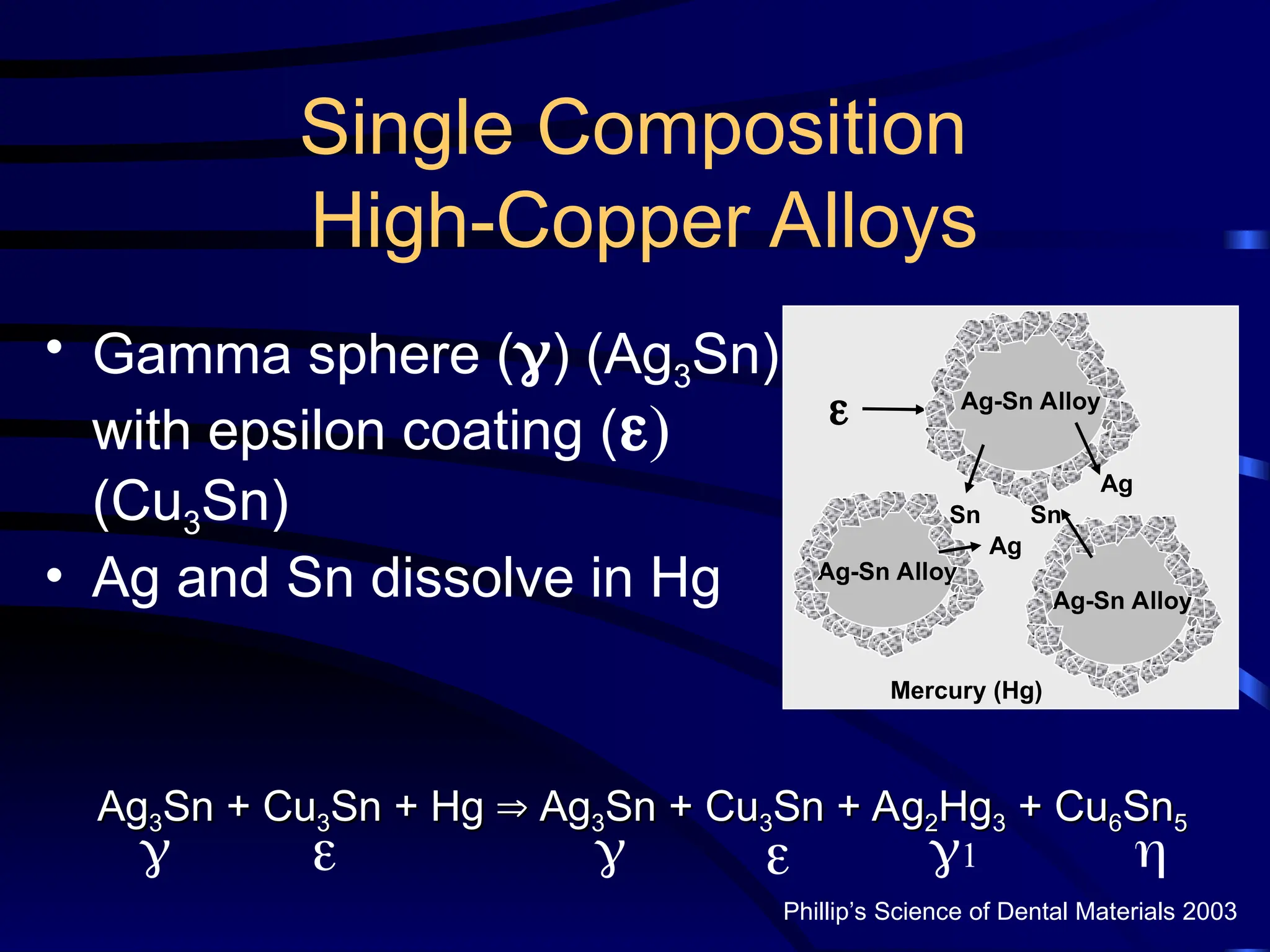
• Gamma sphere () (Ag3Sn)
with epsilon coating ()
(Cu3Sn)
• Ag and Sn dissolve in Hg
Ag-Sn Alloy
Ag-Sn Alloy
Ag-Sn Alloy
Mercury (Hg)

Ag
Sn
Ag
Sn
Ag
Ag3
3Sn + Cu
Sn + Cu3
3Sn + Hg
Sn + Hg 
 Ag
Ag3
3Sn + Cu
Sn + Cu3
3Sn + Ag
Sn + Ag2
2Hg
Hg3
3 + Cu
+ Cu6
6Sn
Sn5
5
Phillip’s Science of Dental Materials 2003
  1 
 
Single Composition
High-Copper Alloys
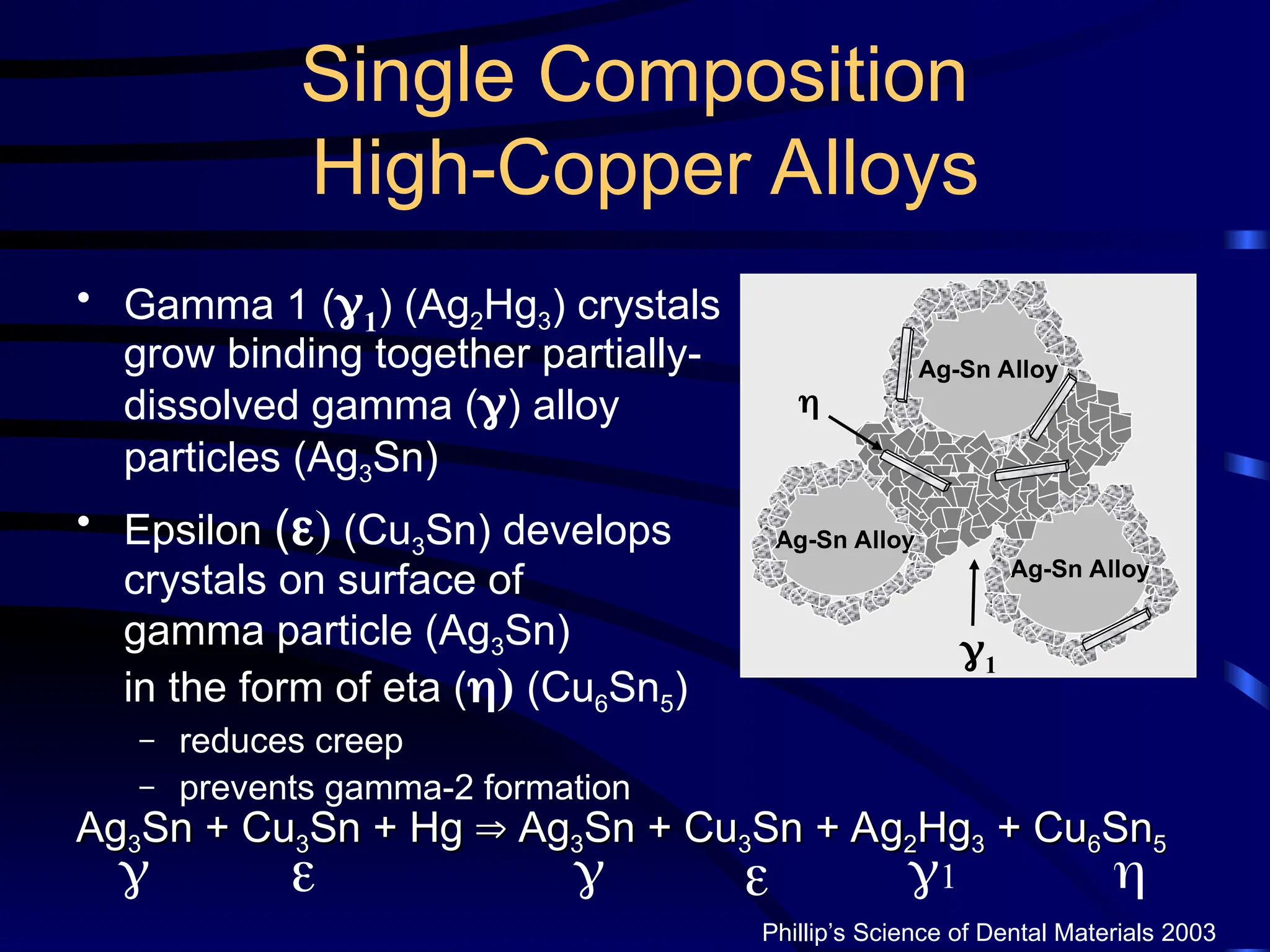
• Gamma 1 (1) (Ag2Hg3) crystals
grow binding together partially-
dissolved gamma () alloy
particles (Ag3Sn)
• Epsilon () (Cu3Sn) develops
crystals on surface of
gamma particle (Ag3Sn)
in the form of eta () (Cu6Sn5)
– reduces creep
– prevents gamma-2 formation
Ag-Sn Alloy
Ag-Sn Alloy
Ag-Sn Alloy
1

Ag
Ag3
3Sn + Cu
Sn + Cu3
3Sn + Hg
Sn + Hg 
 Ag
Ag3
3Sn + Cu
Sn + Cu3
3Sn + Ag
Sn + Ag2
2Hg
Hg3
3 + Cu
+ Cu6
6Sn
Sn5
5
Phillip’s Science of Dental Materials 2003
  1 
 
Classifications
• Based on copper content
• Based on particle shape
• Based on method of adding
copper
Copper Content
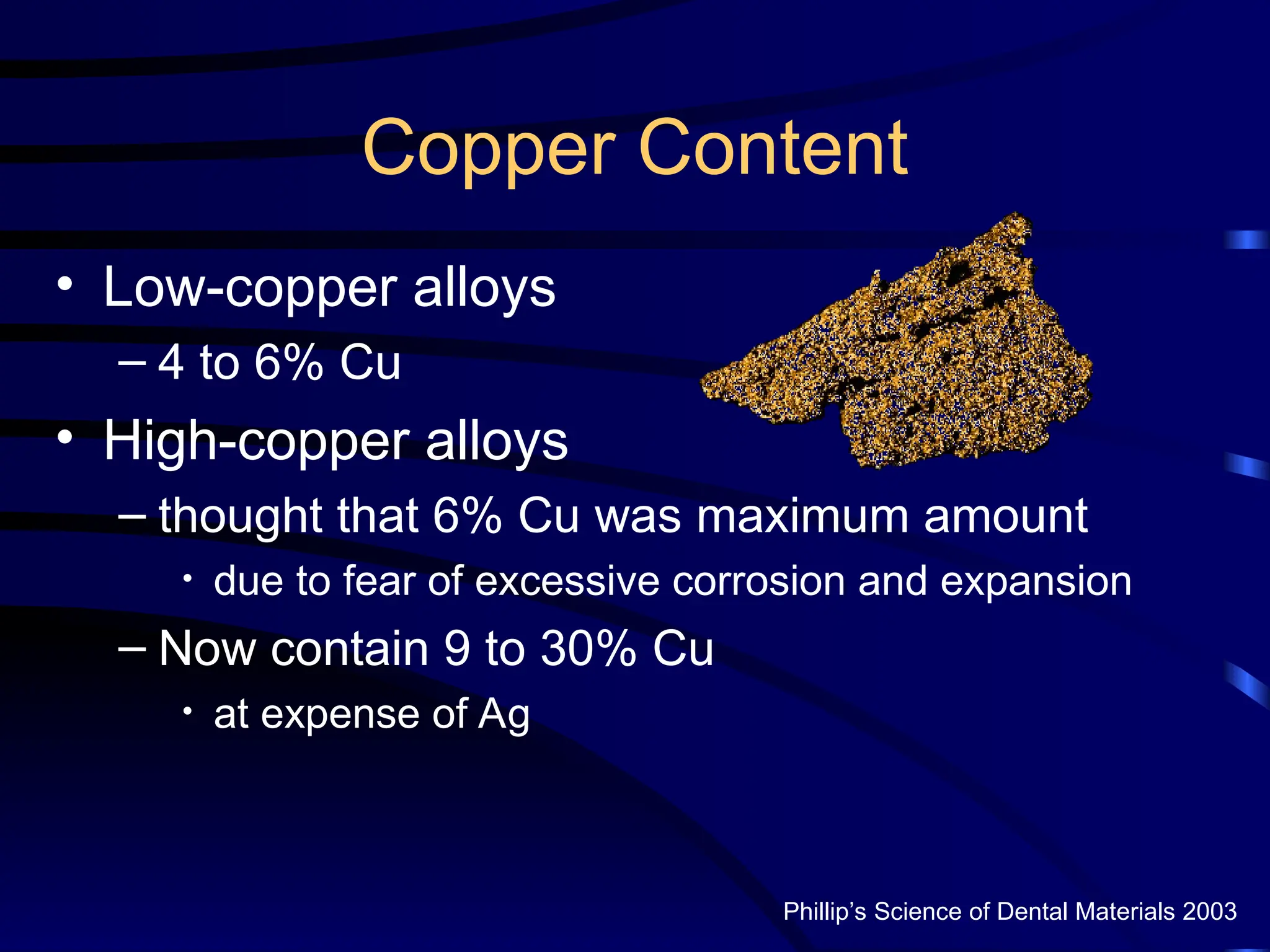
• Low-copper alloys
– 4 to 6% Cu
• High-copper alloys
– thought that 6% Cu was maximum amount
• due to fear of excessive corrosion and expansion
– Now contain 9 to 30% Cu
• at expense of Ag
Phillip’s Science of Dental Materials 2003
Particle Shape
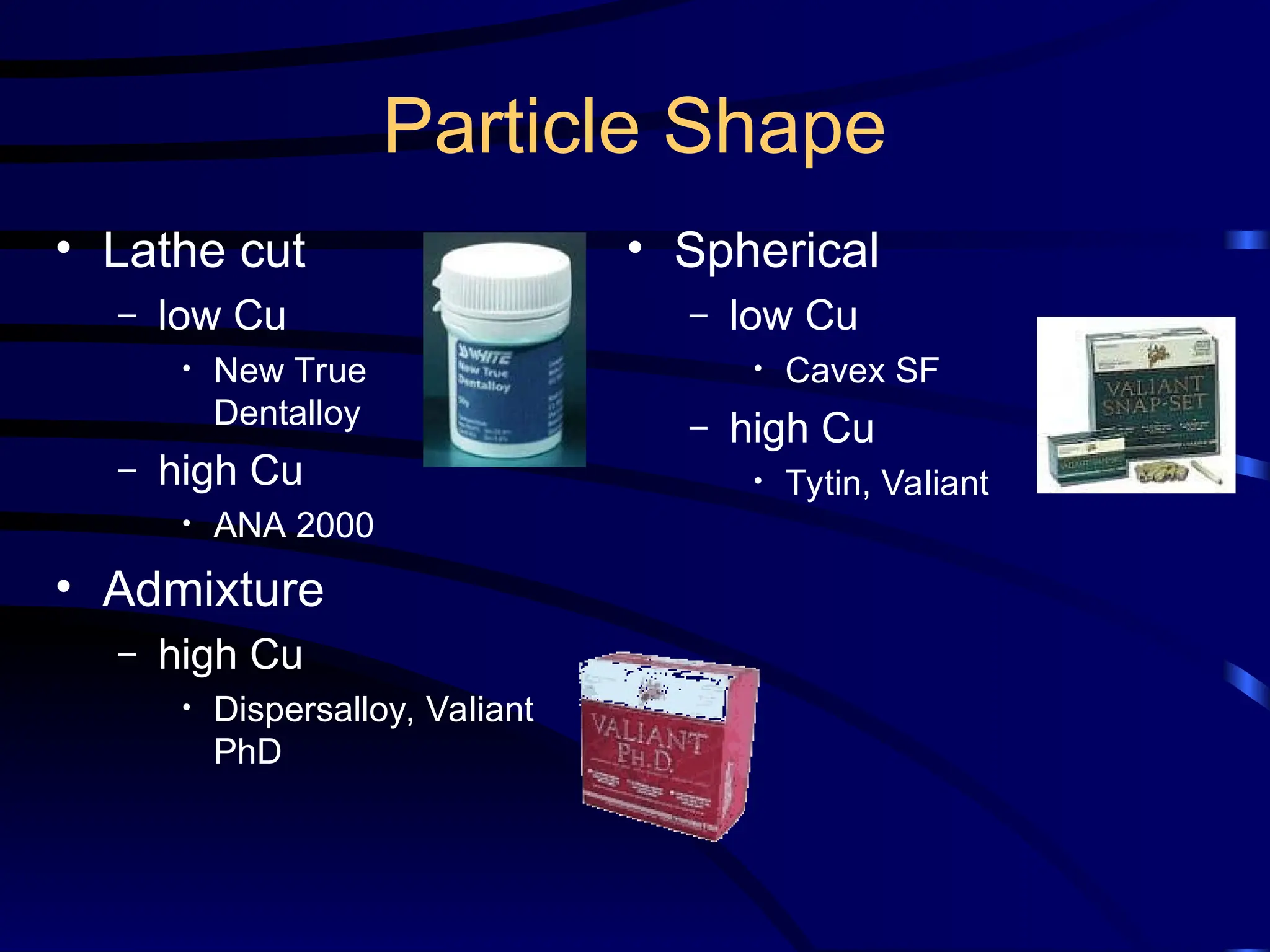
• Lathe cut
– low Cu
• New True
Dentalloy
– high Cu
• ANA 2000
• Admixture
– high Cu
• Dispersalloy, Valiant
PhD
• Spherical
– low Cu
• Cavex SF
– high Cu
• Tytin, Valiant
Method of Adding Copper
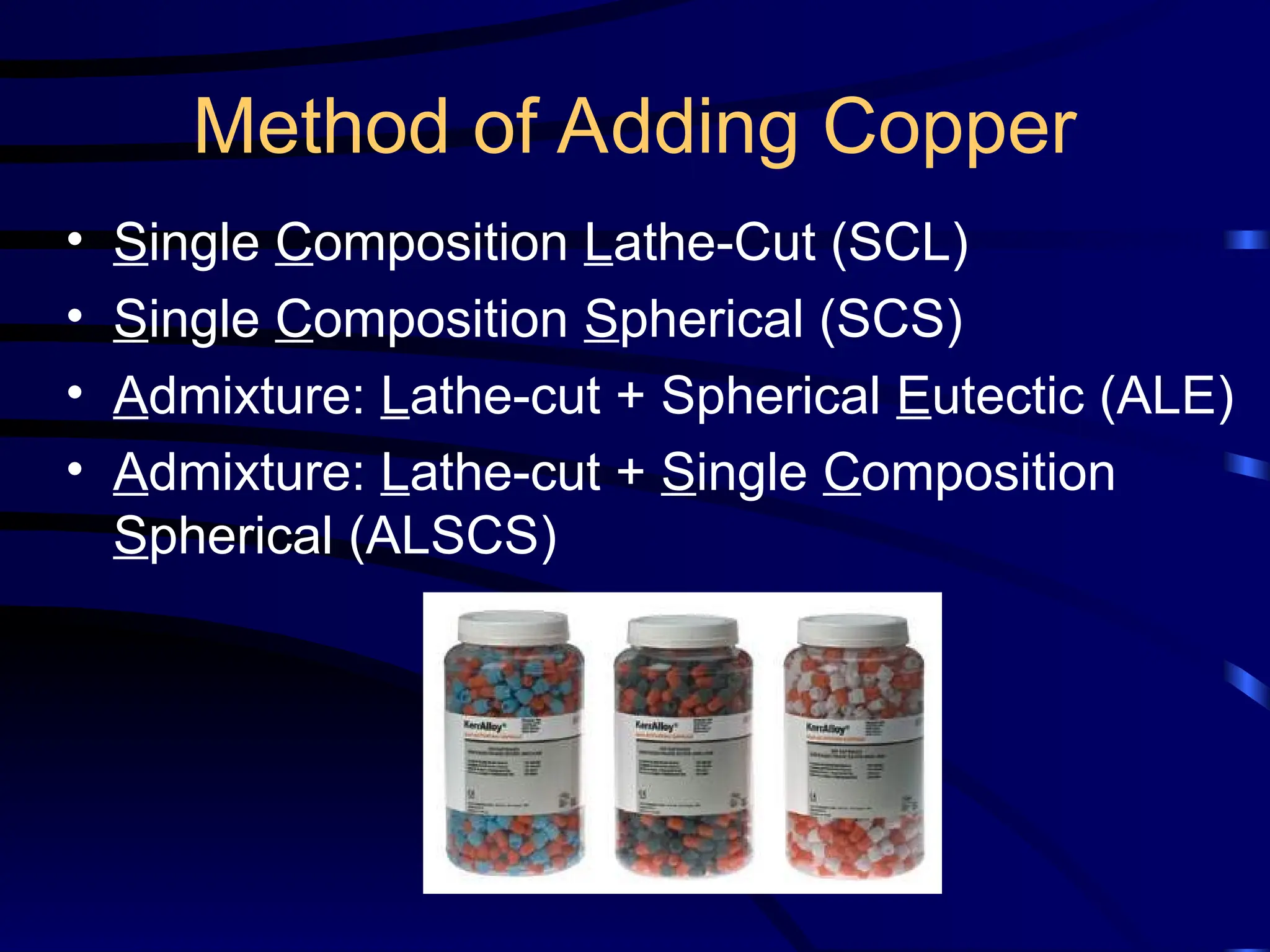
• Single Composition Lathe-Cut (SCL)
• Single Composition Spherical (SCS)
• Admixture: Lathe-cut + Spherical Eutectic (ALE)
• Admixture: Lathe-cut + Single Composition
Spherical (ALSCS)
Single Composition Lathe-Cut
(SCL)
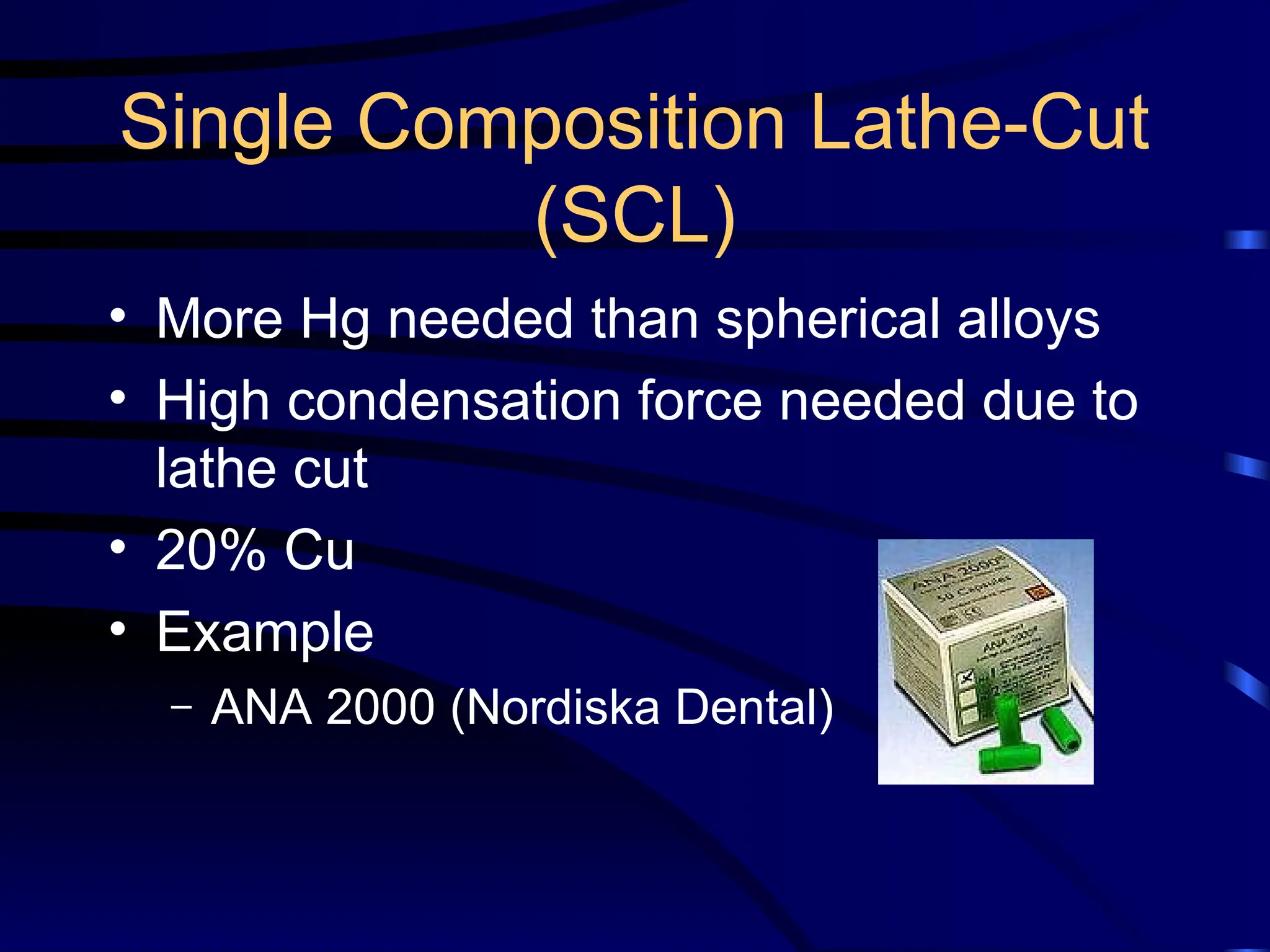
• More Hg needed than spherical alloys
• High condensation force needed due to
lathe cut
• 20% Cu
• Example
– ANA 2000 (Nordiska Dental)
Single Composition Spherical
(SCS)
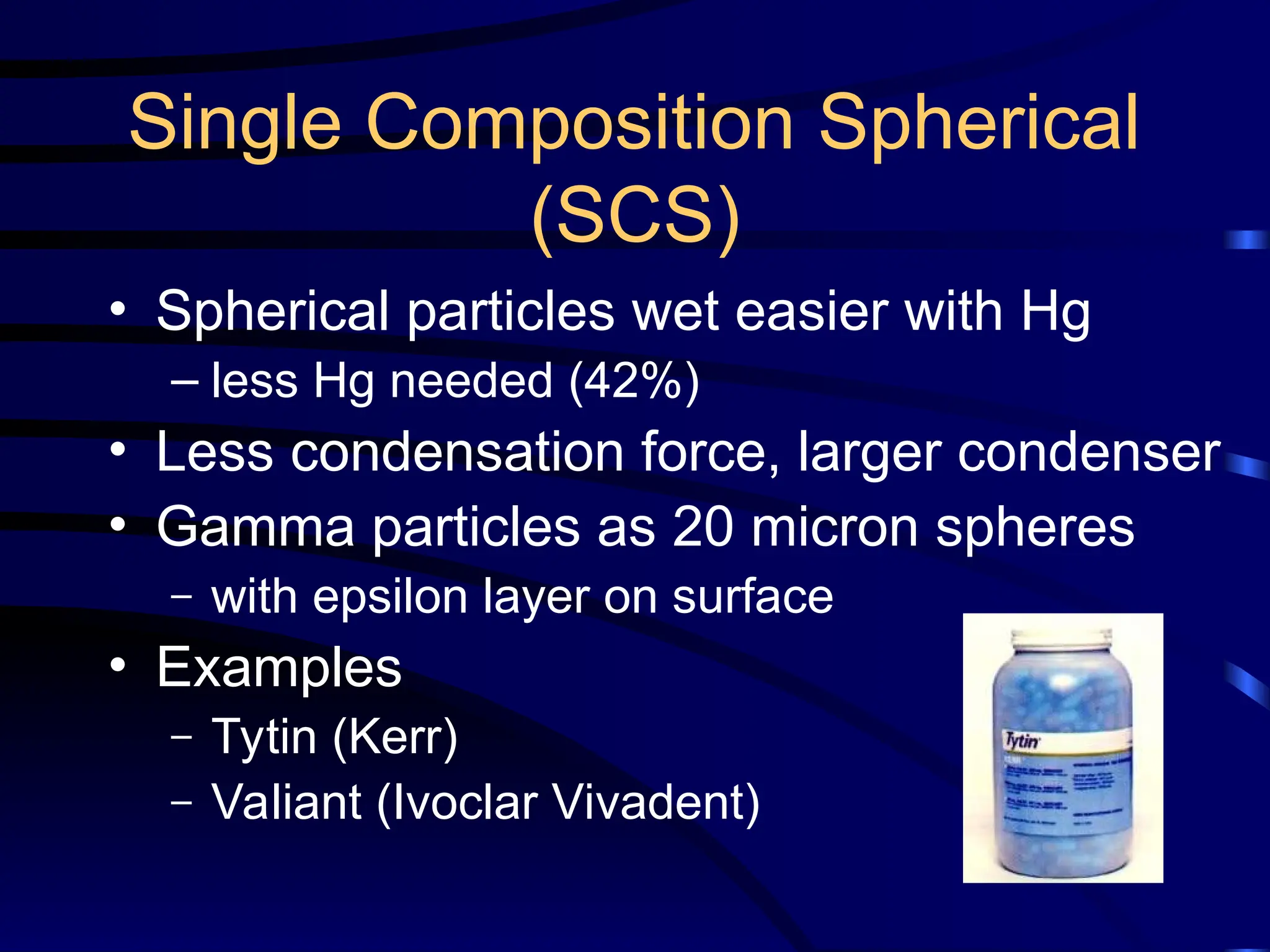
• Spherical particles wet easier with Hg
– less Hg needed (42%)
• Less condensation force, larger condenser
• Gamma particles as 20 micron spheres
– with epsilon layer on surface
• Examples
– Tytin (Kerr)
– Valiant (Ivoclar Vivadent)
Admixture:
Lathe-cut + Spherical Eutectic
(ALE)
• Composition
– 2/3 conventional lathe cut (3% Cu)
– 1/3 high Cu spherical eutectic (28% Cu)
– overall 12% Cu, 1% Zn
• Initial reaction produces gamma 2
– no gamma 2 within two years
• Example
– Dispersalloy (Caulk)
Admixture:
Lathe-cut + Single Composition
Spherical (ALSCS)
• High Cu in both lathe-cut and spherical
components
– 19% Cu
• Epsilon layer forms on both components
• 0.5% palladium added
– reinforce grain boundaries on gamma 1
• Example
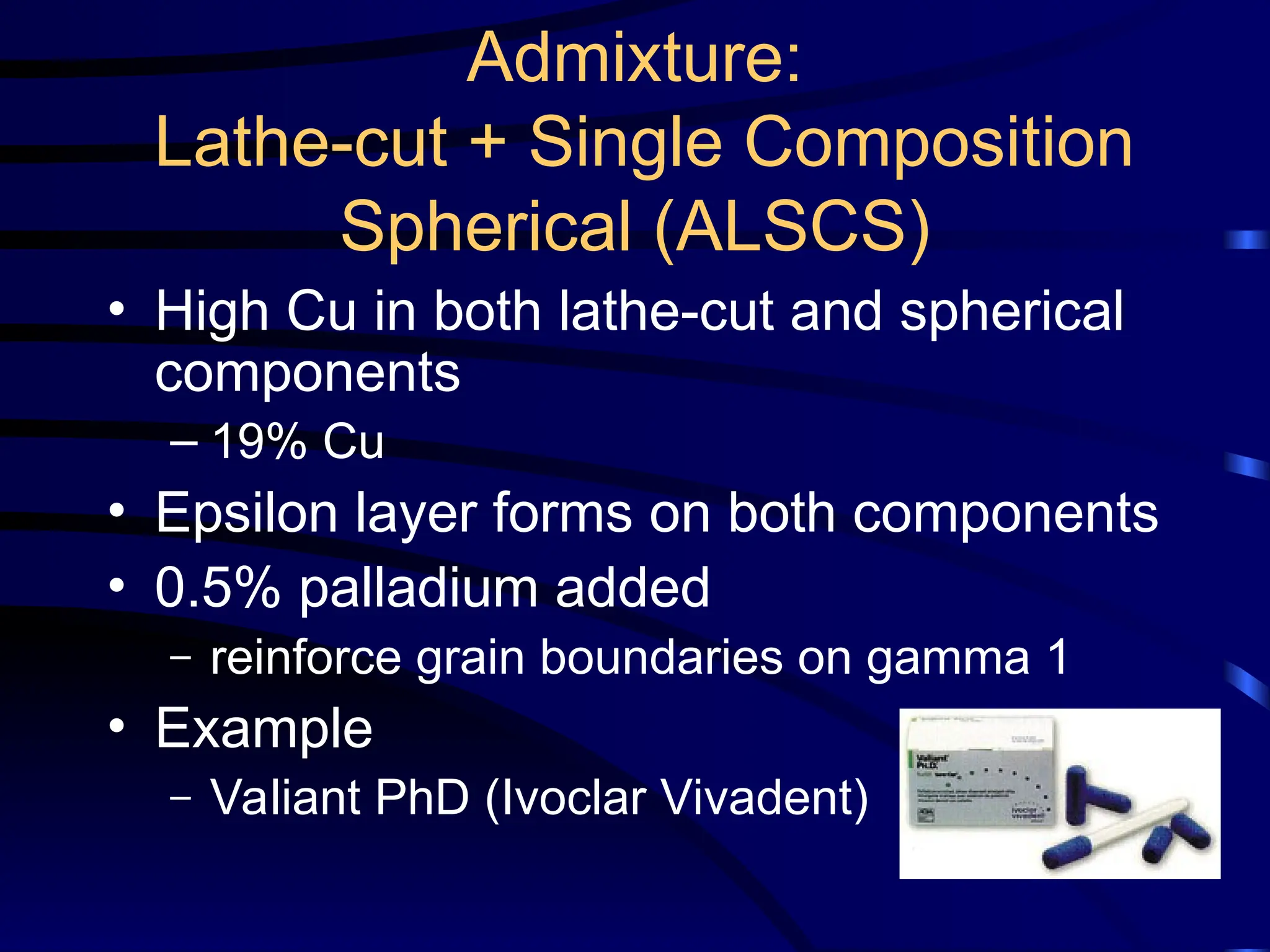
– Valiant PhD (Ivoclar Vivadent)
Manufacturing Process
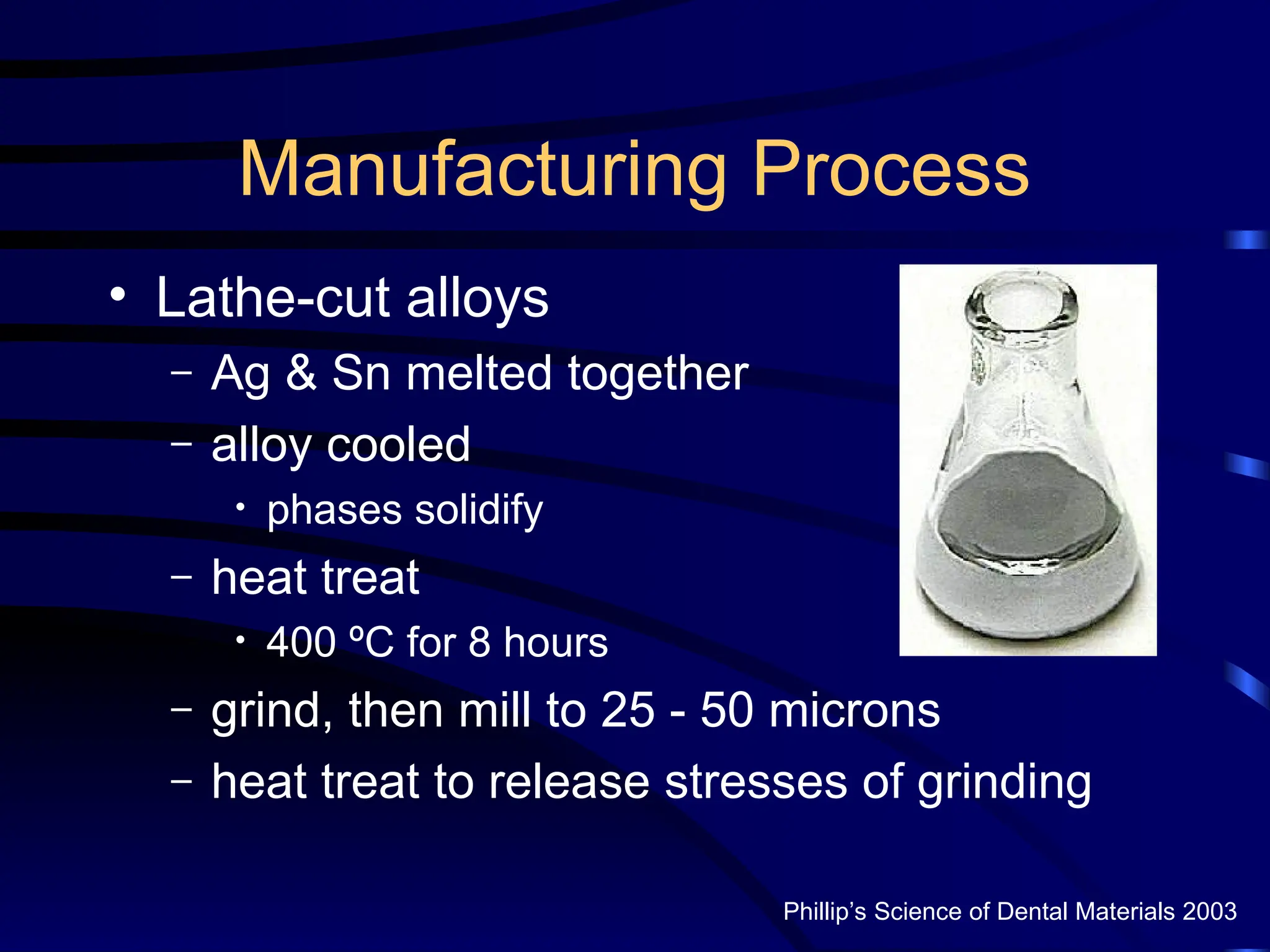
• Lathe-cut alloys
– Ag & Sn melted together
– alloy cooled
• phases solidify
– heat treat
• 400 ºC for 8 hours
– grind, then mill to 25 - 50 microns
– heat treat to release stresses of grinding
Phillip’s Science of Dental Materials 2003
Manufacturing Process
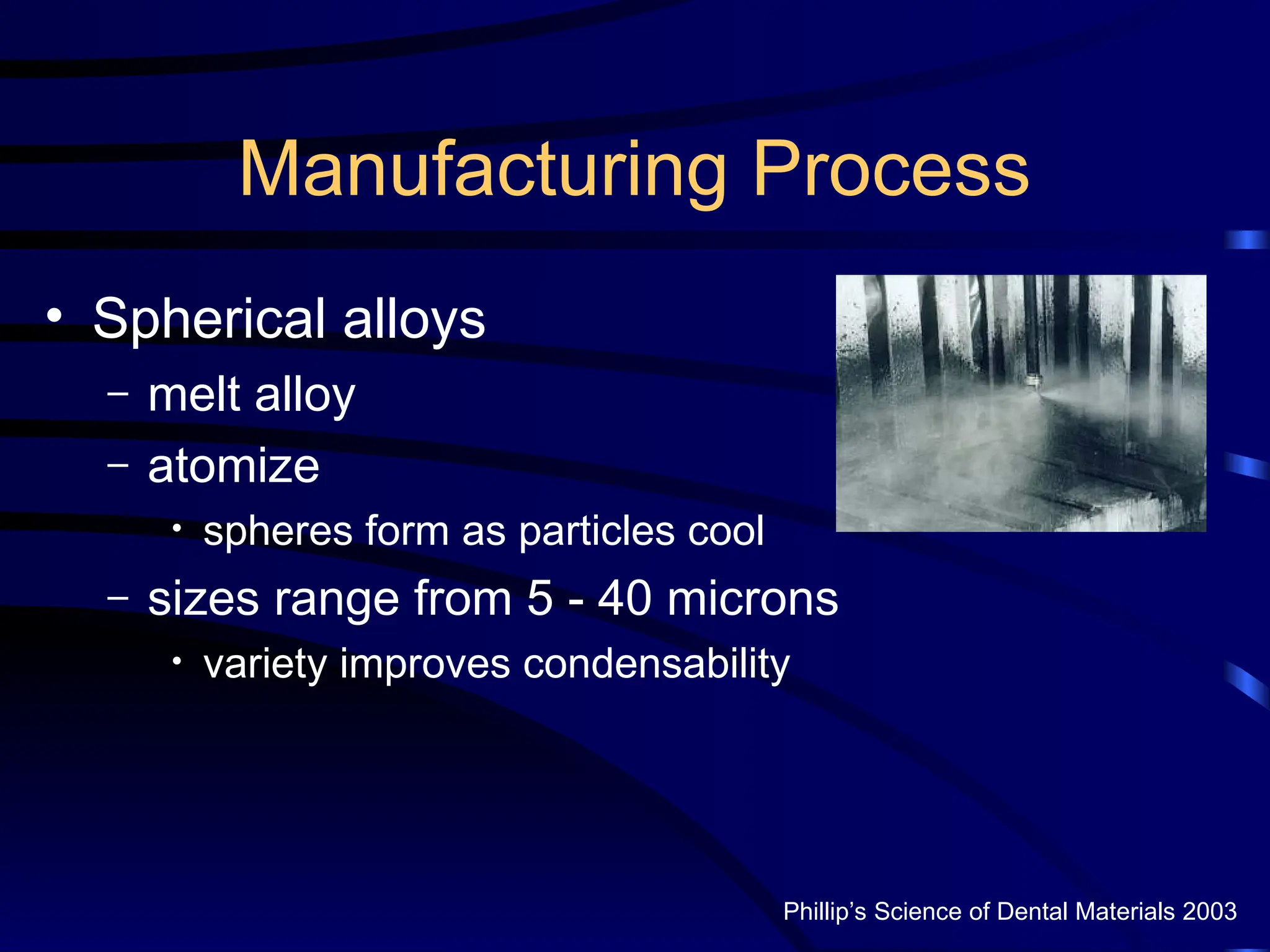
• Spherical alloys
– melt alloy
– atomize
• spheres form as particles cool
– sizes range from 5 - 40 microns
• variety improves condensability
Phillip’s Science of Dental Materials 2003
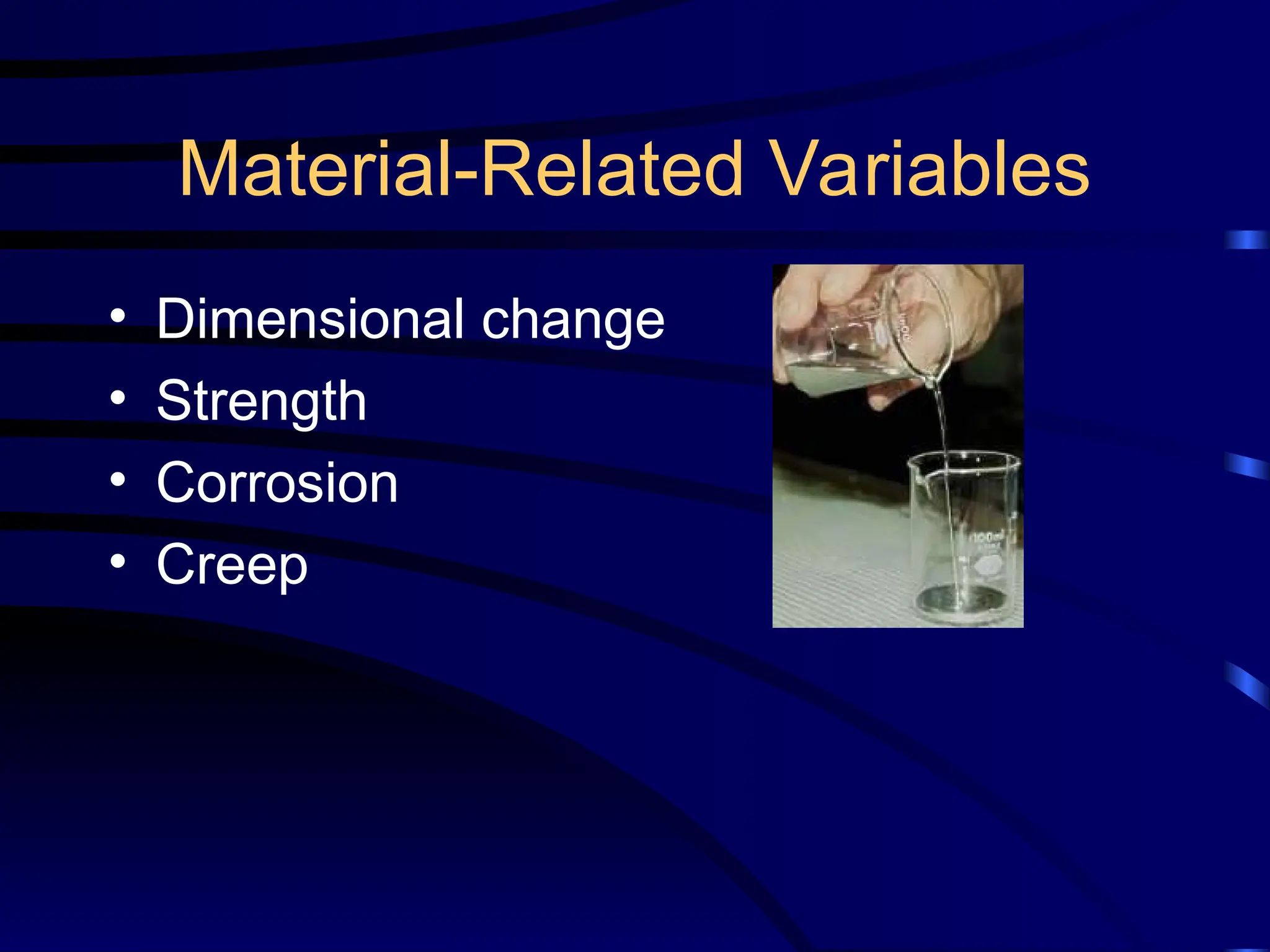
Material-Related Variables
• Dimensional change
• Strength
• Corrosion
• Creep
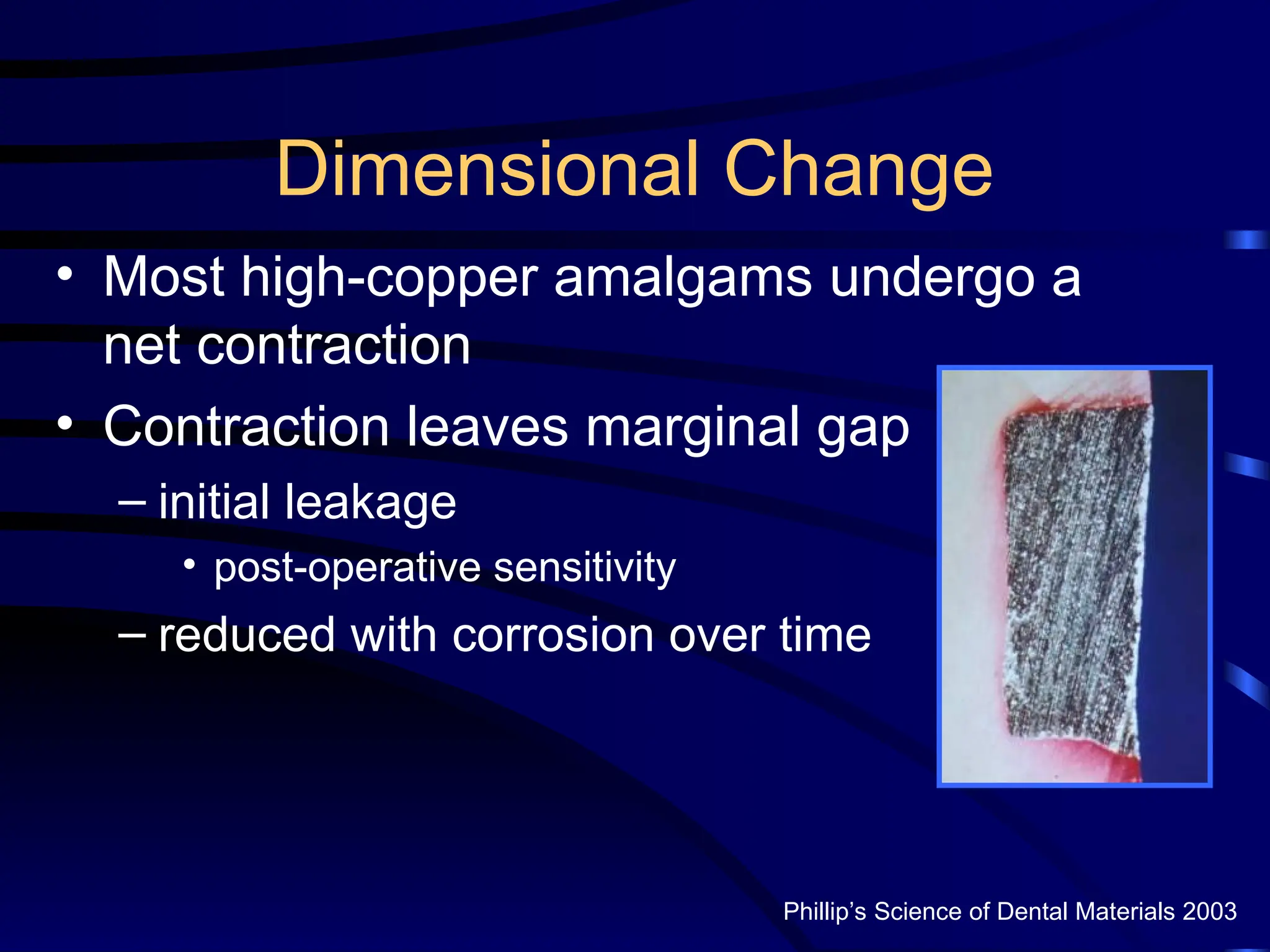
Dimensional Change
• Most high-copper amalgams undergo a
net contraction
• Contraction leaves marginal gap
– initial leakage
• post-operative sensitivity
– reduced with corrosion over time
Phillip’s Science of Dental Materials 2003
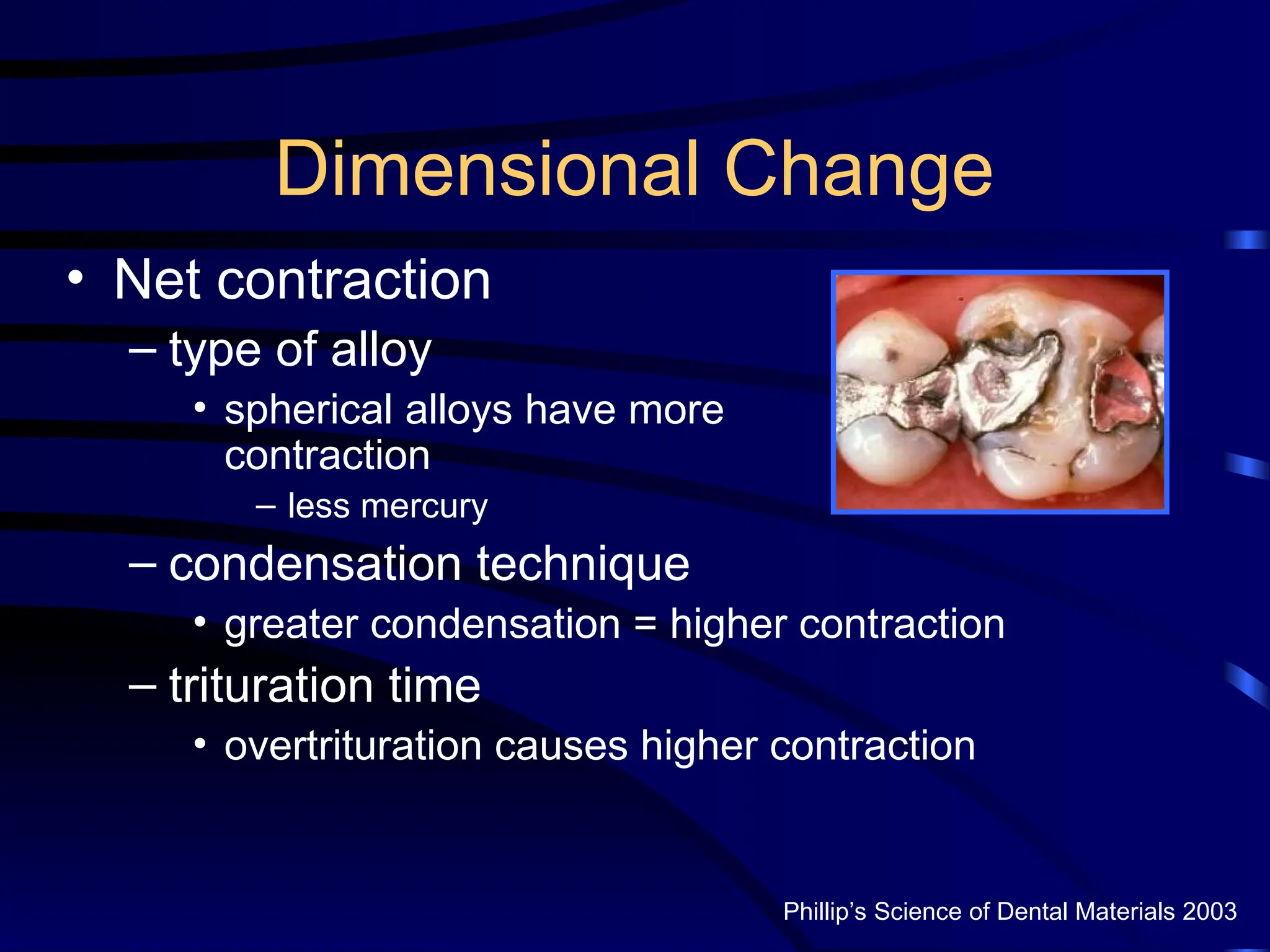
Dimensional Change
• Net contraction
– type of alloy
• spherical alloys have more
contraction
– less mercury
– condensation technique
• greater condensation = higher contraction
– trituration time
• overtrituration causes higher contraction
Phillip’s Science of Dental Materials 2003
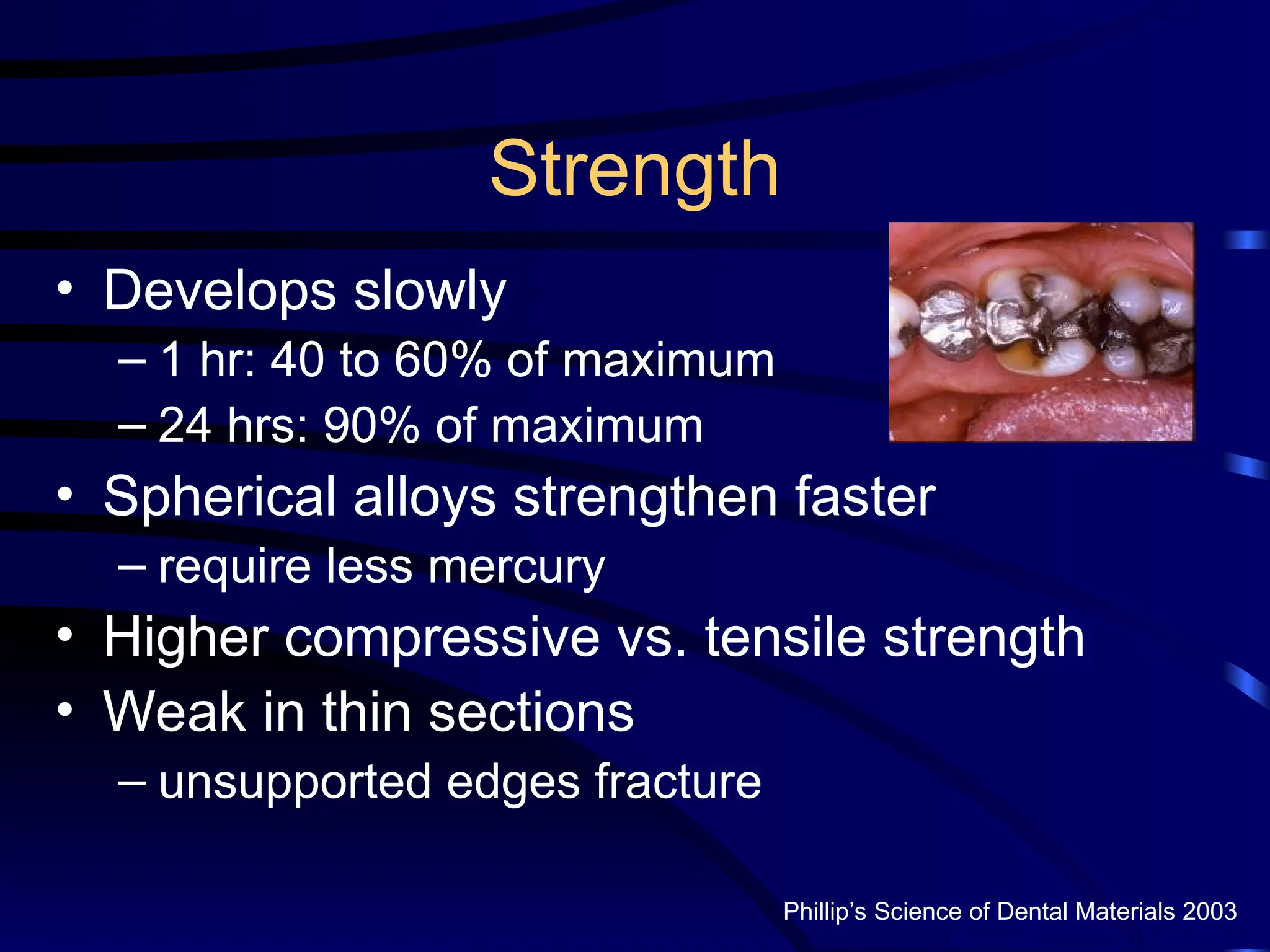
Strength
• Develops slowly
– 1 hr: 40 to 60% of maximum
– 24 hrs: 90% of maximum
• Spherical alloys strengthen faster
– require less mercury
• Higher compressive vs. tensile strength
• Weak in thin sections
– unsupported edges fracture
Phillip’s Science of Dental Materials 2003
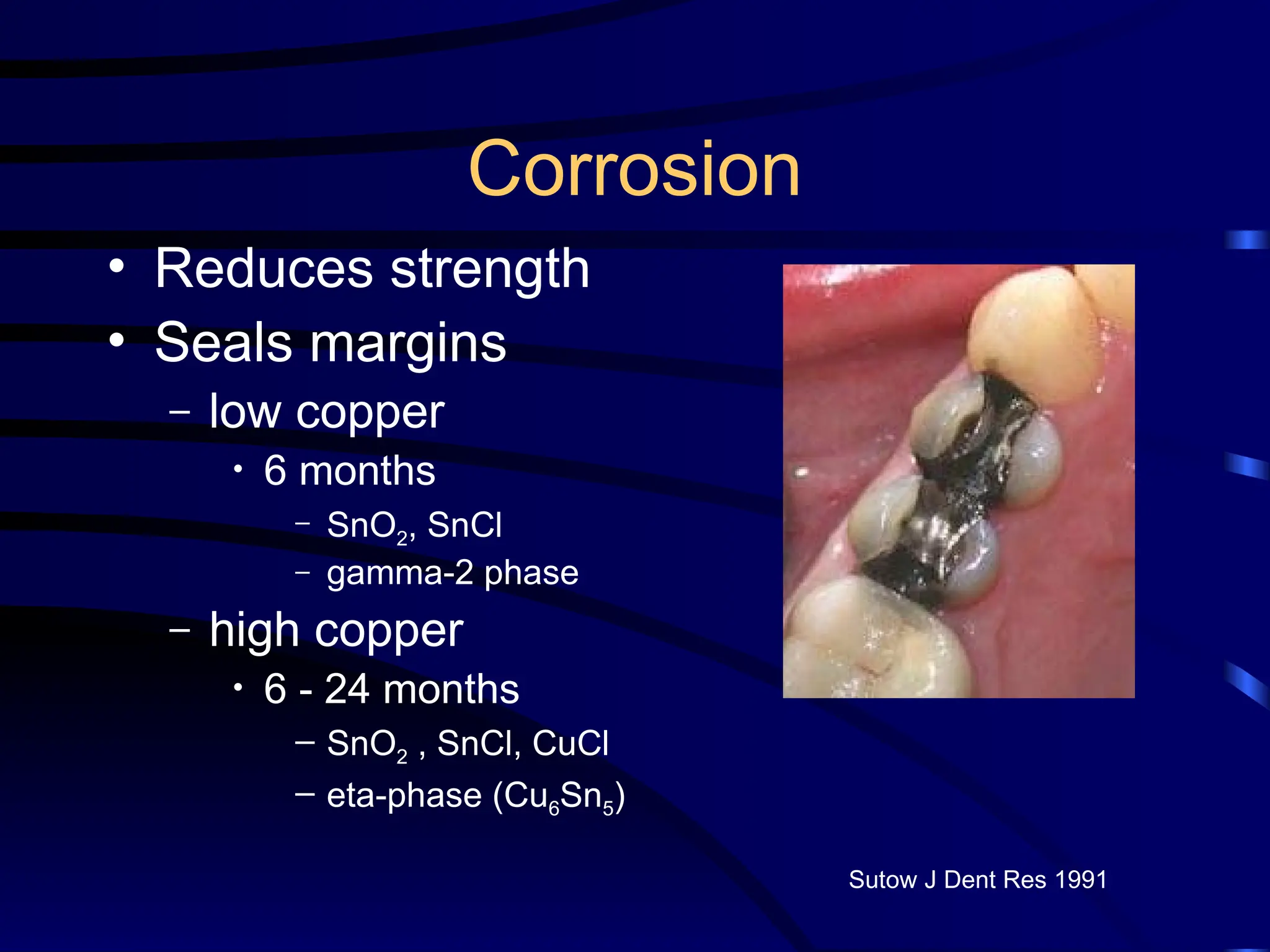
Corrosion
• Reduces strength
• Seals margins
– low copper
• 6 months
– SnO2, SnCl
– gamma-2 phase
– high copper
• 6 - 24 months
– SnO2 , SnCl, CuCl
– eta-phase (Cu6Sn5)
Sutow J Dent Res 1991
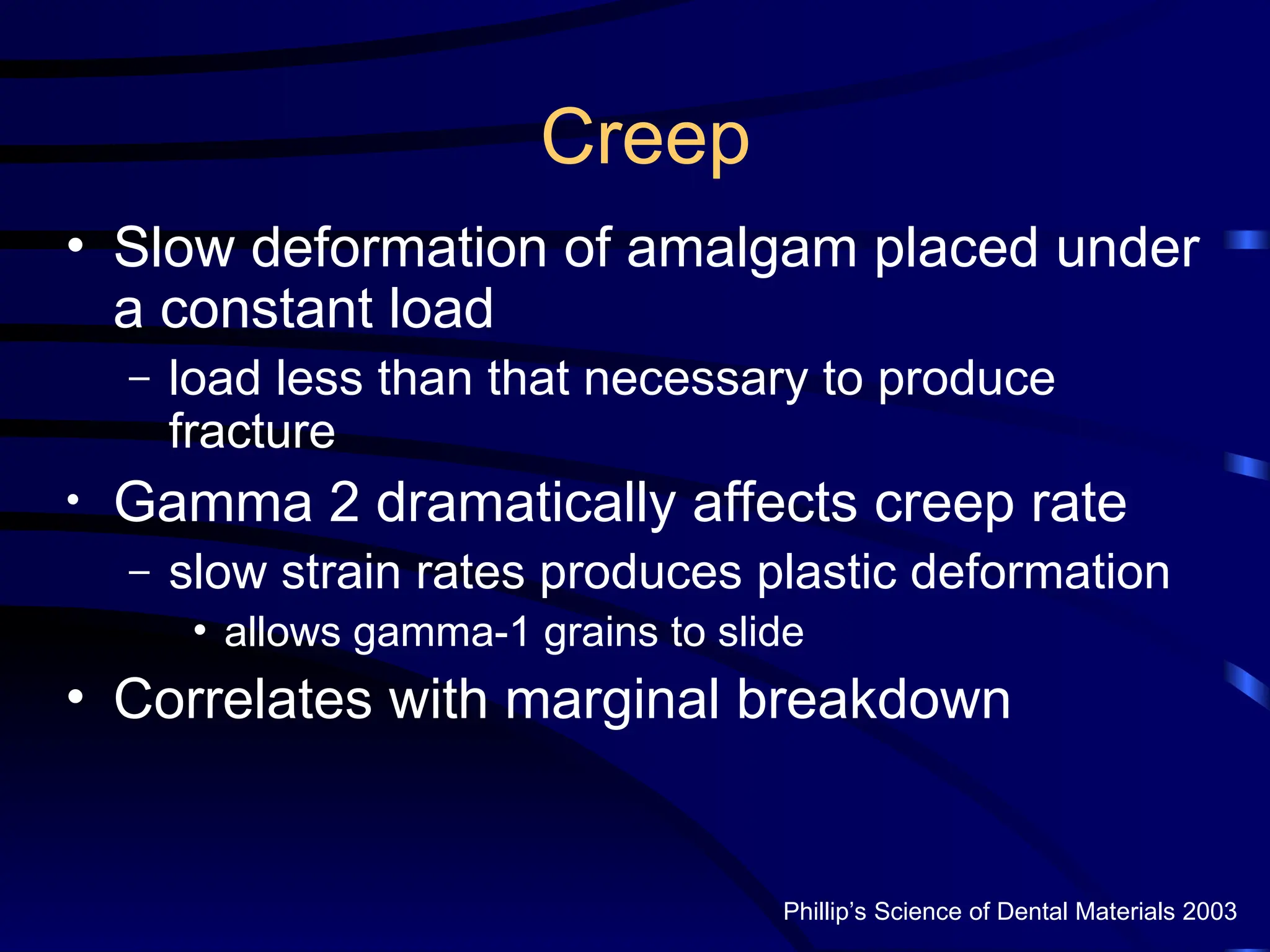
Creep
• Slow deformation of amalgam placed under
a constant load
– load less than that necessary to produce
fracture
• Gamma 2 dramatically affects creep rate
– slow strain rates produces plastic deformation
• allows gamma-1 grains to slide
• Correlates with marginal breakdown
Phillip’s Science of Dental Materials 2003
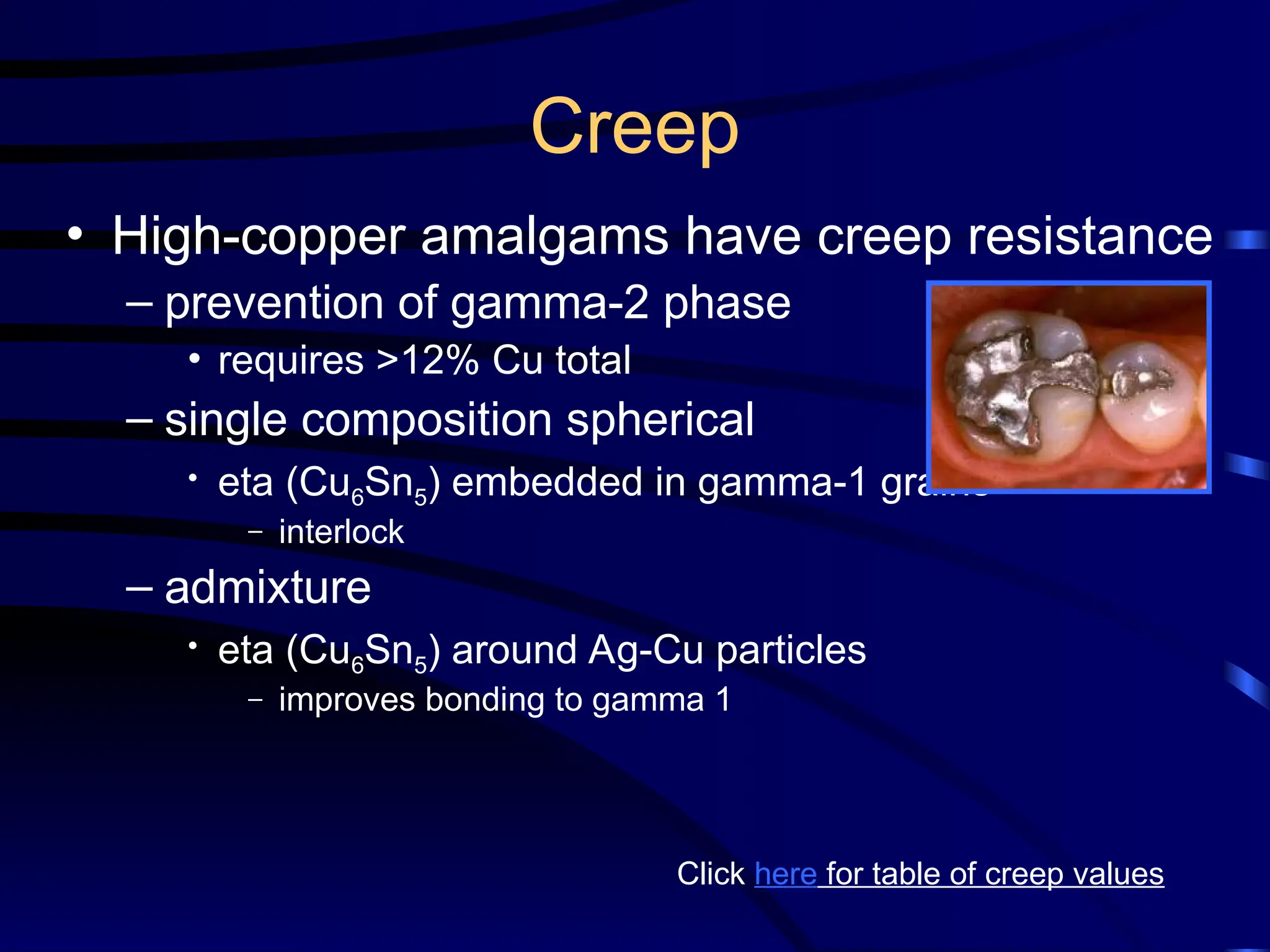
Creep
• High-copper amalgams have creep resistance
– prevention of gamma-2 phase
• requires >12% Cu total
– single composition spherical
• eta (Cu6Sn5) embedded in gamma-1 grains
– interlock
– admixture
• eta (Cu6Sn5) around Ag-Cu particles
– improves bonding to gamma 1
Click here for table of creep values
Dentist-Controlled Variables
• Manipulation
– trituration
– condensation
– burnishing
– polishing
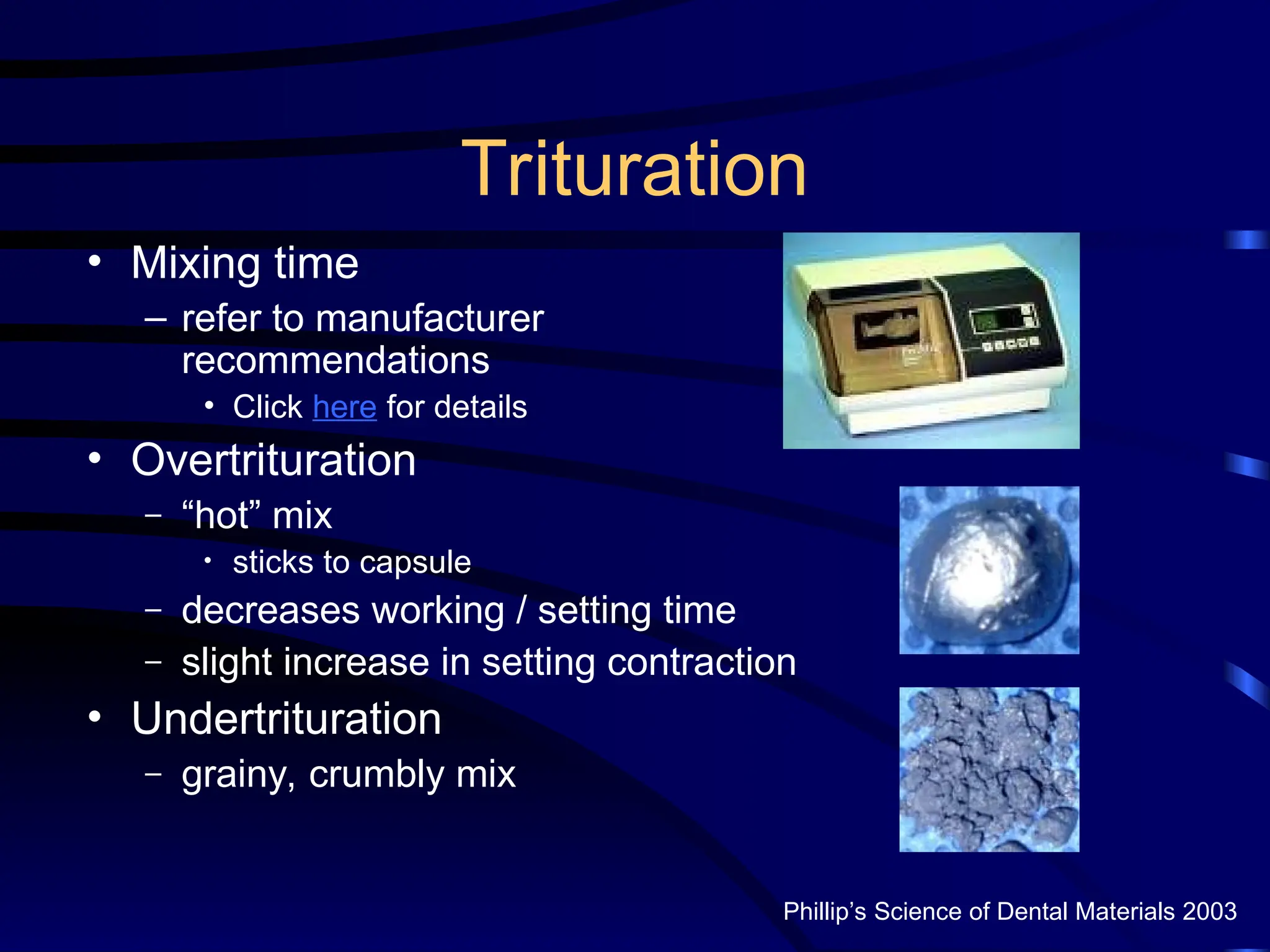
Trituration
• Mixing time
– refer to manufacturer
recommendations
• Click here for details
• Overtrituration
– “hot” mix
• sticks to capsule
– decreases working / setting time
– slight increase in setting contraction
• Undertrituration
– grainy, crumbly mix
Phillip’s Science of Dental Materials 2003
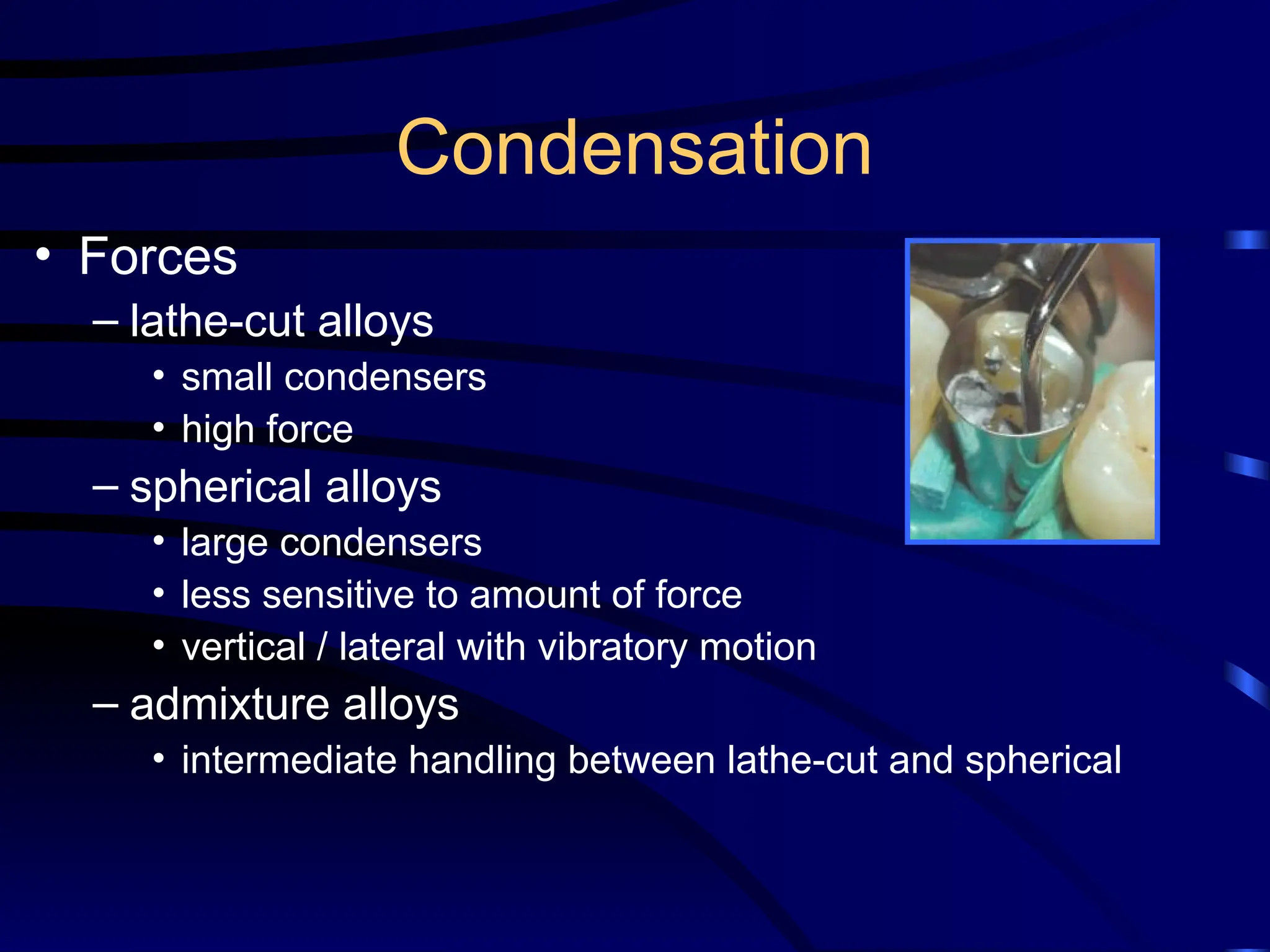
Condensation
• Forces
– lathe-cut alloys
• small condensers
• high force
– spherical alloys
• large condensers
• less sensitive to amount of force
• vertical / lateral with vibratory motion
– admixture alloys
• intermediate handling between lathe-cut and spherical
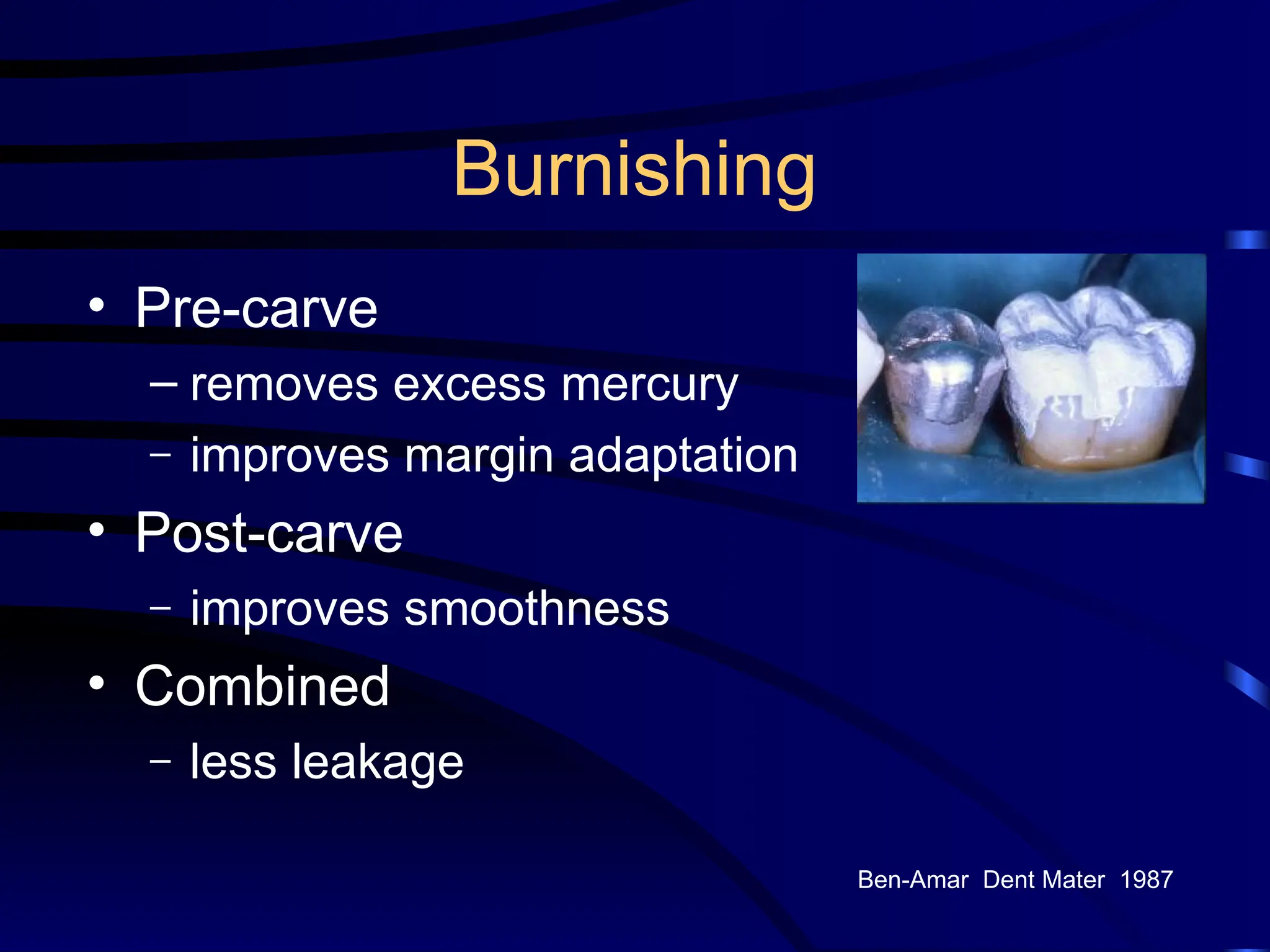
Burnishing
• Pre-carve
– removes excess mercury
– improves margin adaptation
• Post-carve
– improves smoothness
• Combined
– less leakage
Ben-Amar Dent Mater 1987
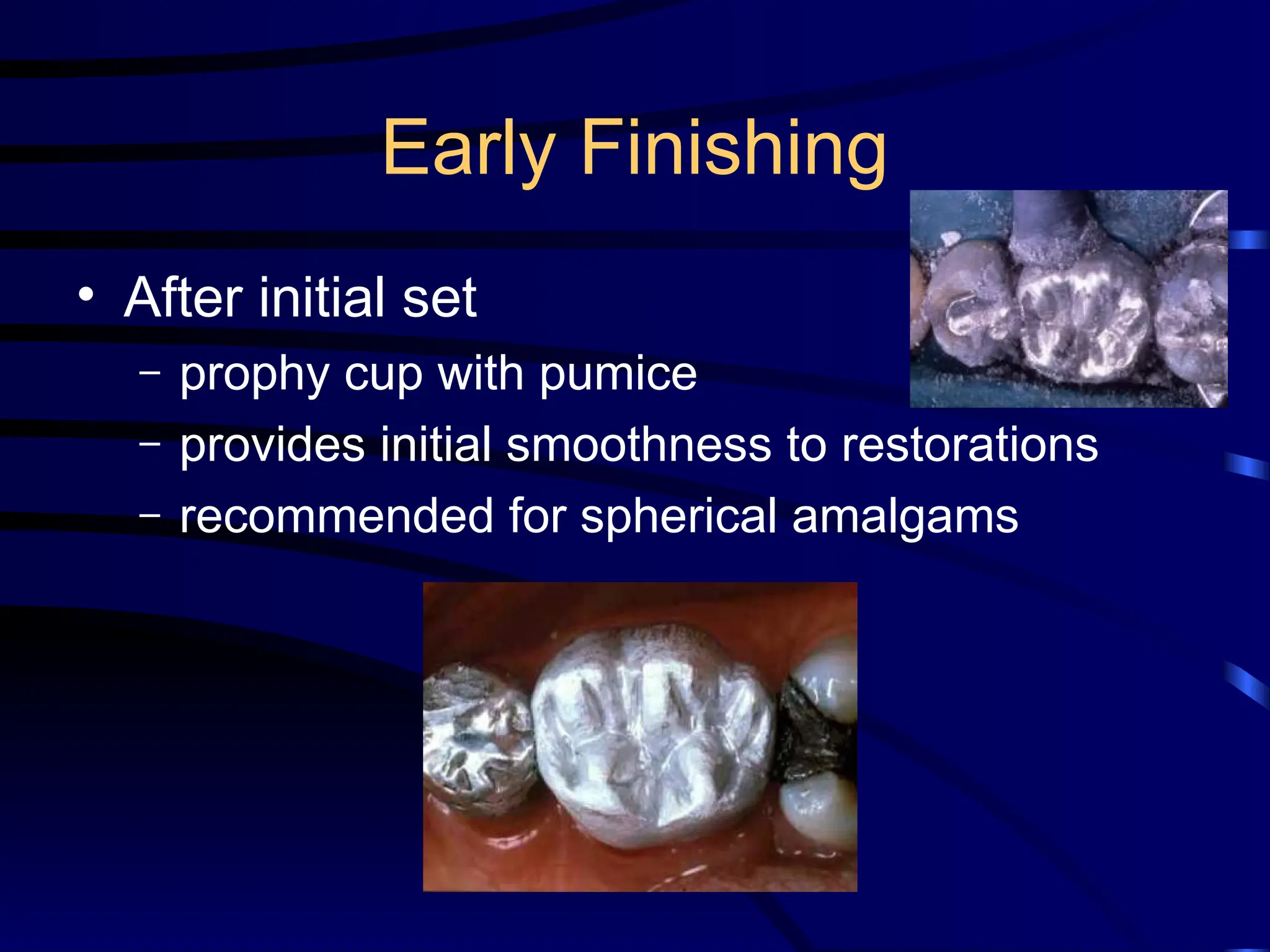
Early Finishing
• After initial set
– prophy cup with pumice
– provides initial smoothness to restorations
– recommended for spherical amalgams
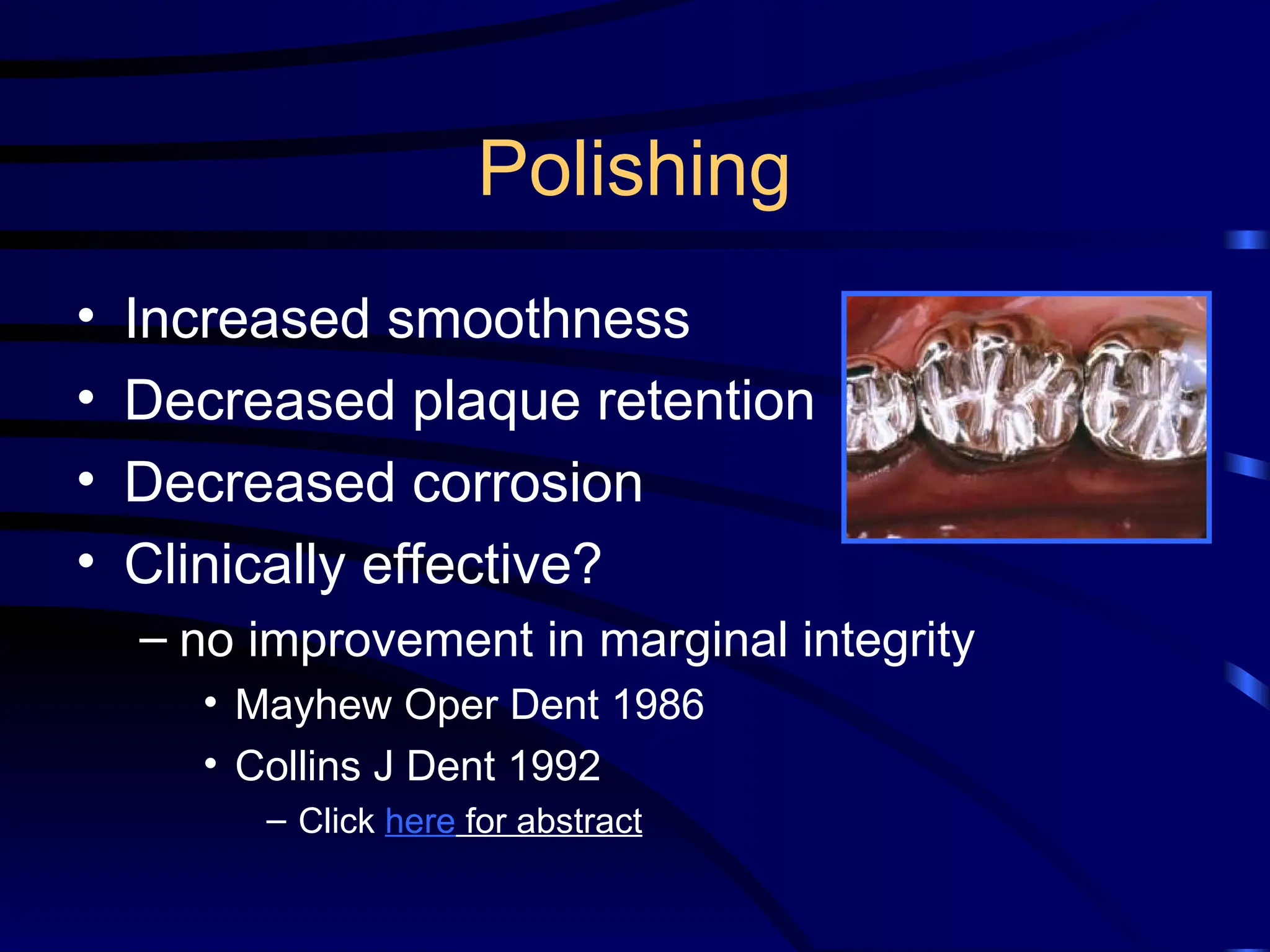
Polishing
• Increased smoothness
• Decreased plaque retention
• Decreased corrosion
• Clinically effective?
– no improvement in marginal integrity
• Mayhew Oper Dent 1986
• Collins J Dent 1992
– Click here for abstract
Alloy Selection
• Handling characteristics
• Mechanical and physical
properties
• Clinical performance
Click here for more details
Handling Characteristics
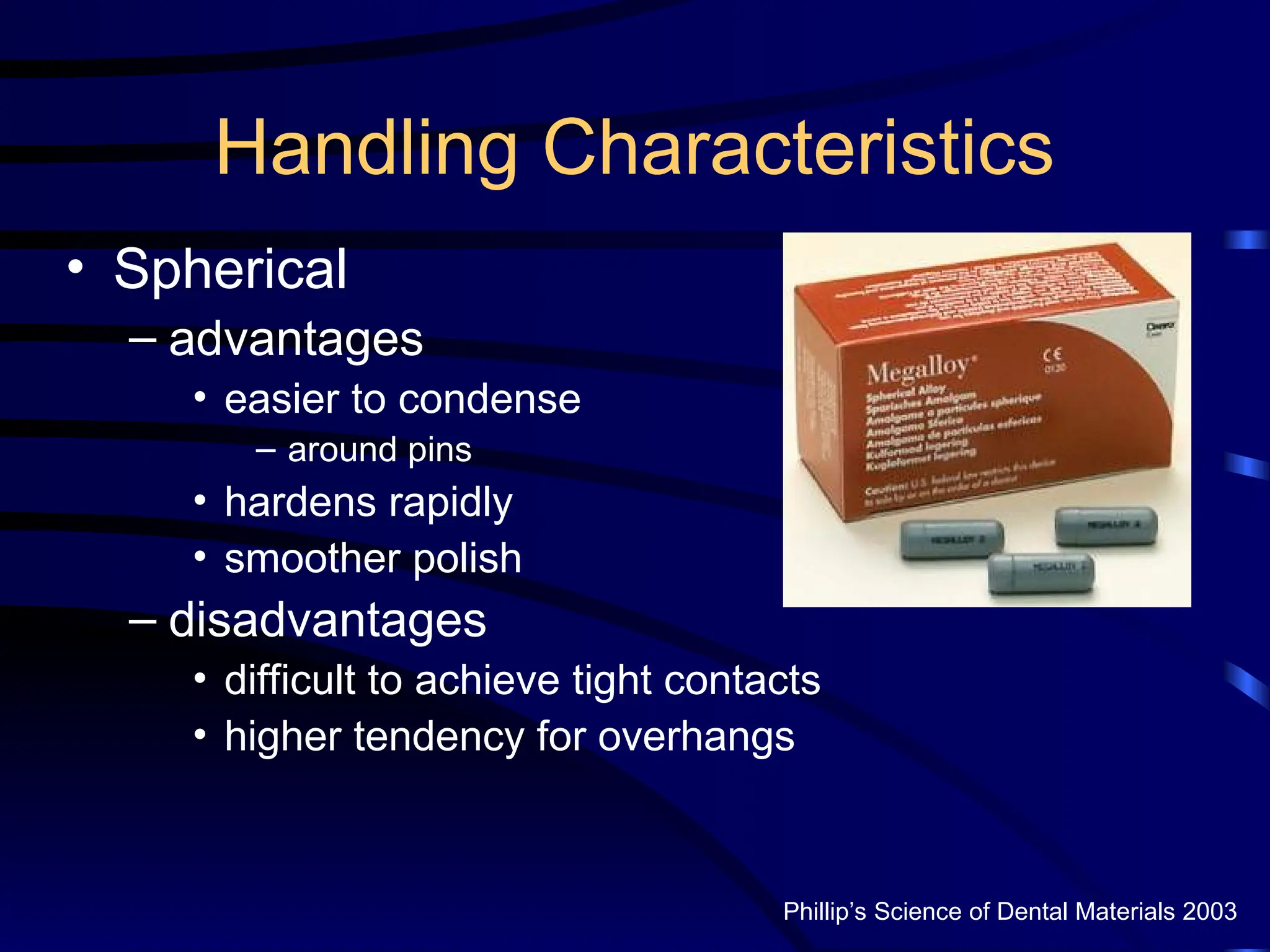
• Spherical
– advantages
• easier to condense
– around pins
• hardens rapidly
• smoother polish
– disadvantages
• difficult to achieve tight contacts
• higher tendency for overhangs
Phillip’s Science of Dental Materials 2003
Handling Characteristics
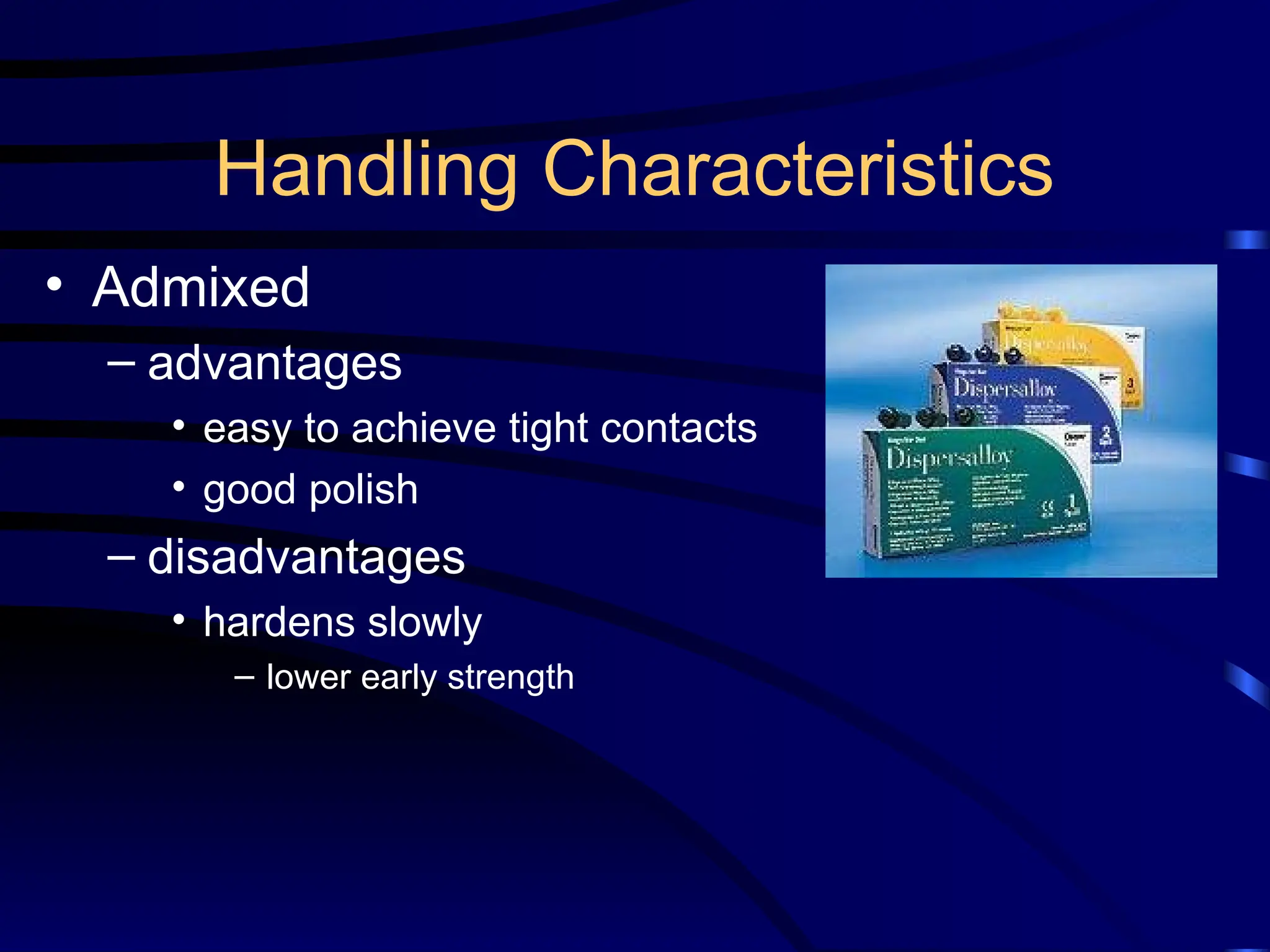
• Admixed
– advantages
• easy to achieve tight contacts
• good polish
– disadvantages
• hardens slowly
– lower early strength
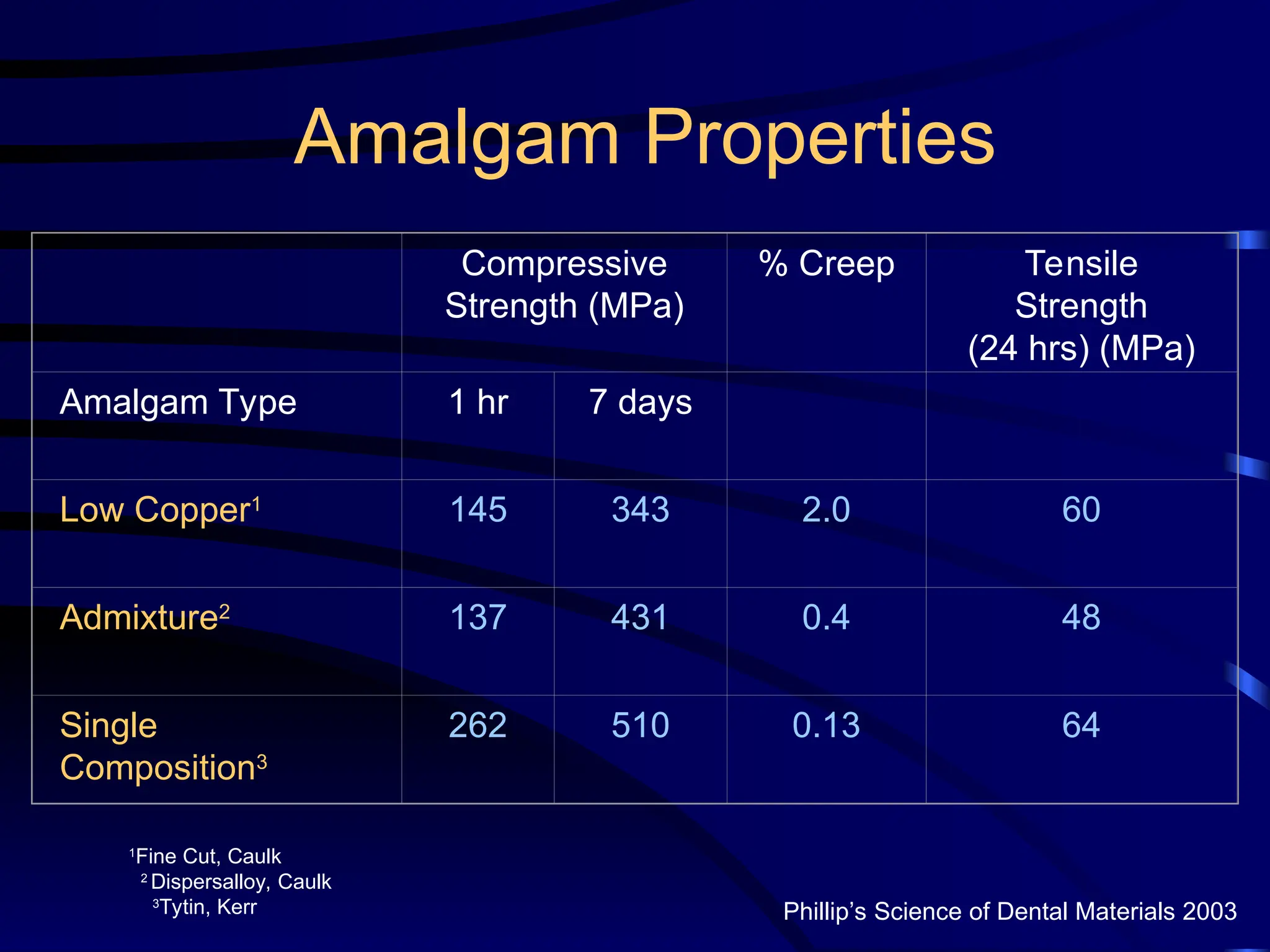
Amalgam Properties
Compressive
Strength (MPa)
% Creep Tensile
Strength
(24 hrs) (MPa)
Amalgam Type 1 hr 7 days
Low Copper1
145 343 2.0 60
Admixture2
137 431 0.4 48
Single
Composition3
262 510 0.13 64
Phillip’s Science of Dental Materials 2003
1
Fine Cut, Caulk
2
Dispersalloy, Caulk
3
Tytin, Kerr
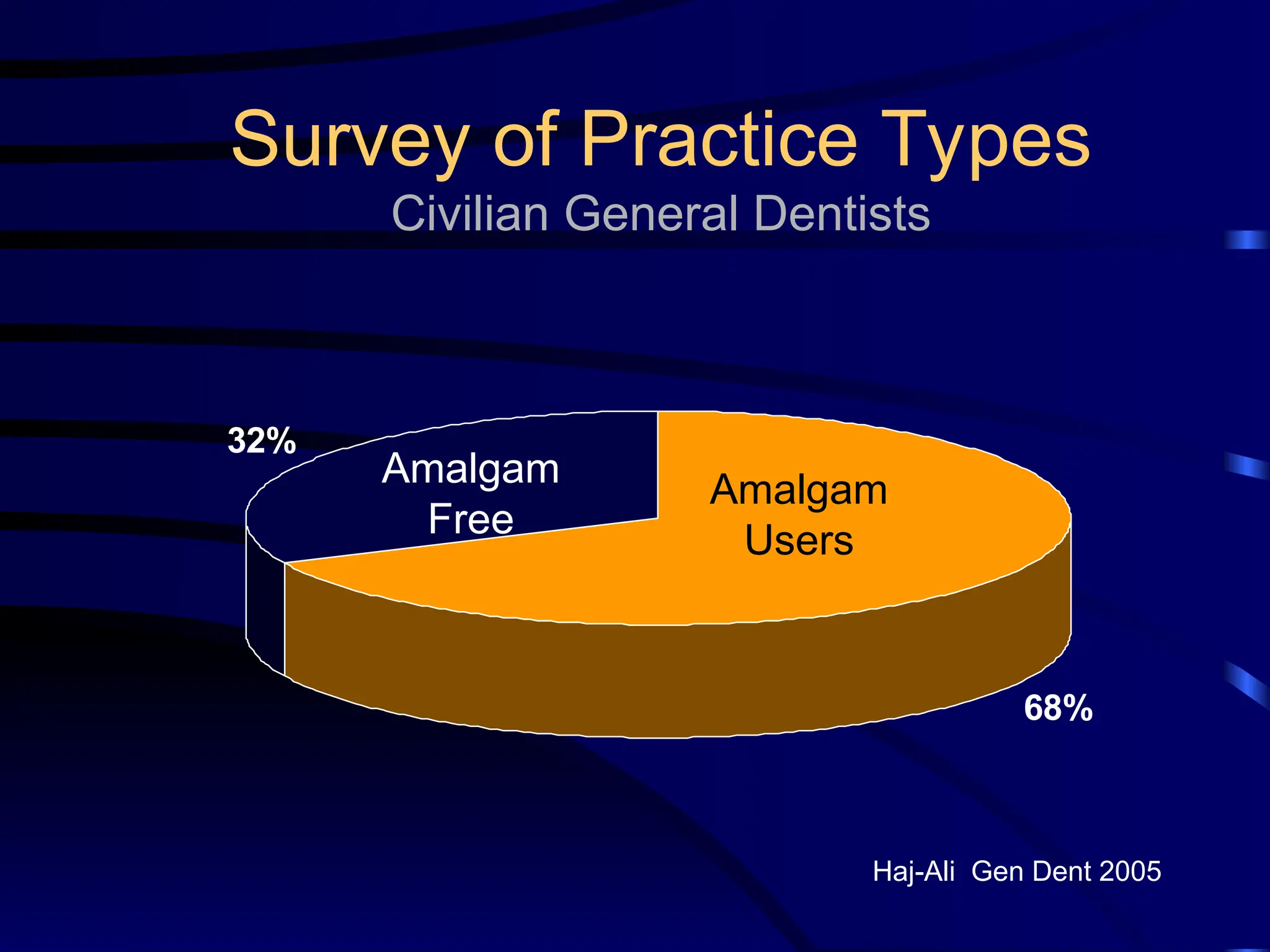
Survey of Practice Types
Civilian General Dentists
68%
32%
Amalgam
Users
Amalgam
Free
Haj-Ali Gen Dent 2005
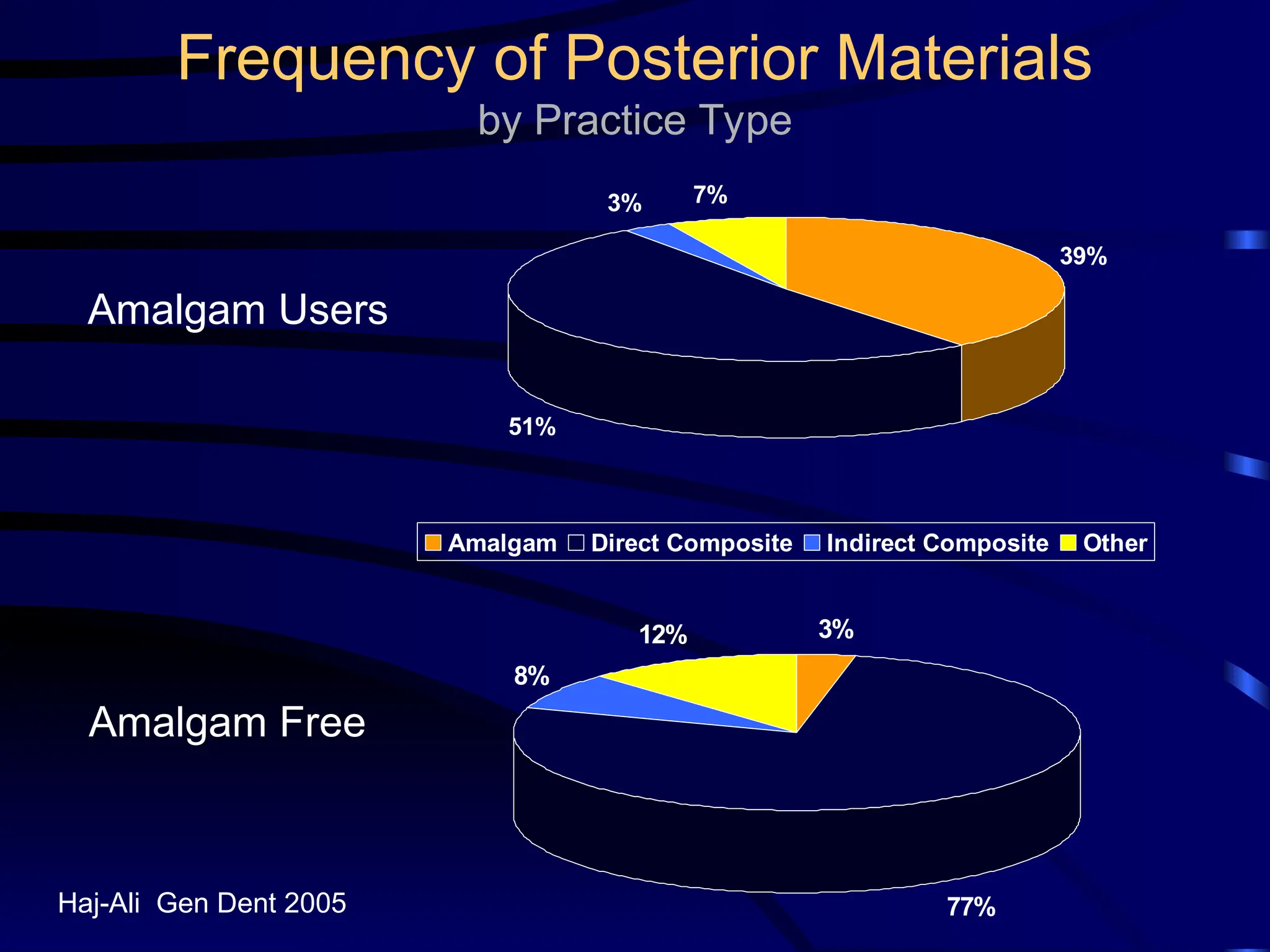
Frequency of Posterior Materials
by Practice Type
39%
51%
3% 7%
Amalgam Direct Composite Indirect Composite Other
3%
77%
8%
12%
Amalgam Users
Amalgam Free
Haj-Ali Gen Dent 2005
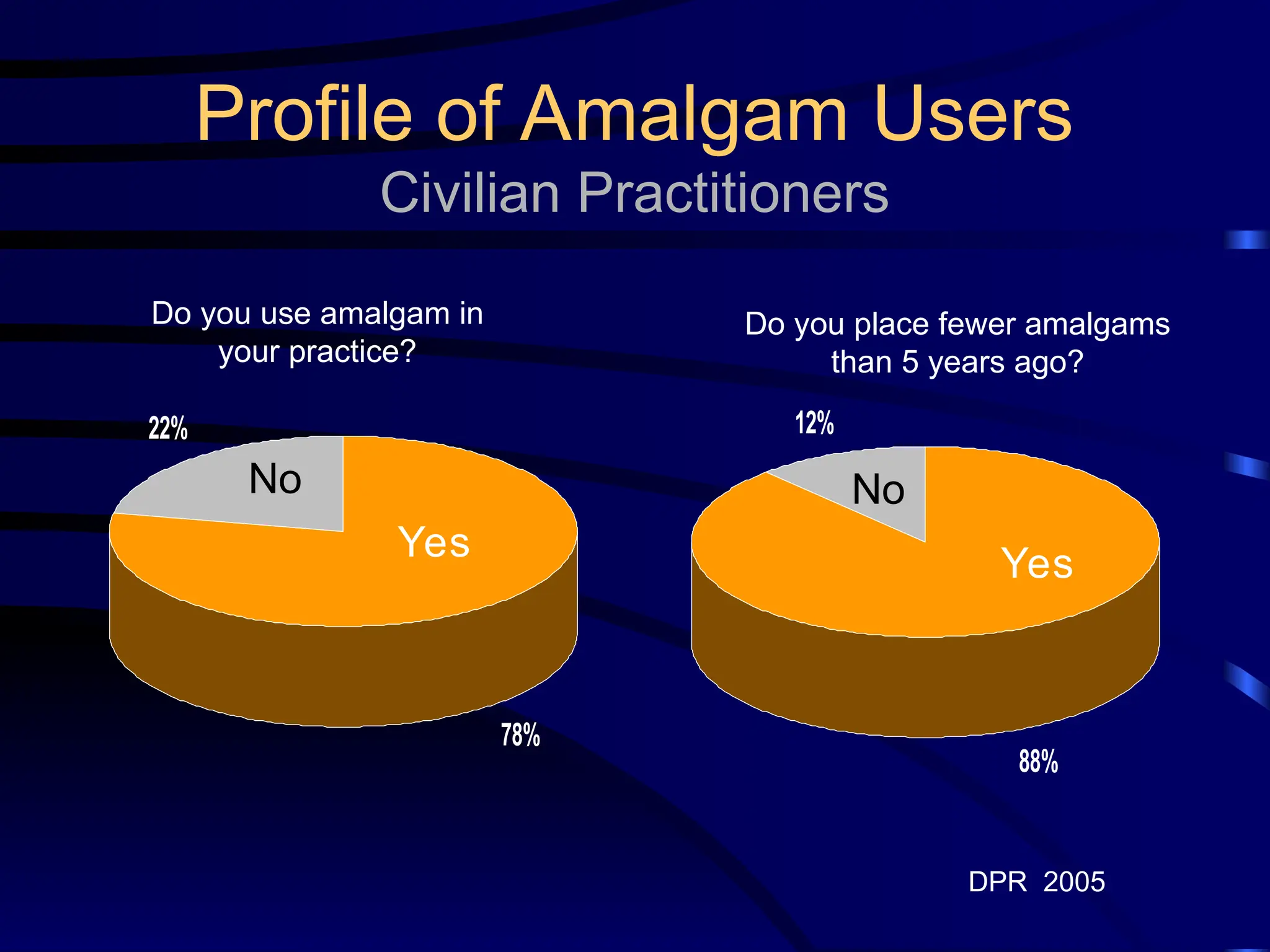
Profile of Amalgam Users
Civilian Practitioners
78%
22%
Do you use amalgam in
your practice?
Yes
No
DPR 2005
88%
12%
Do you place fewer amalgams
than 5 years ago?
Yes
No
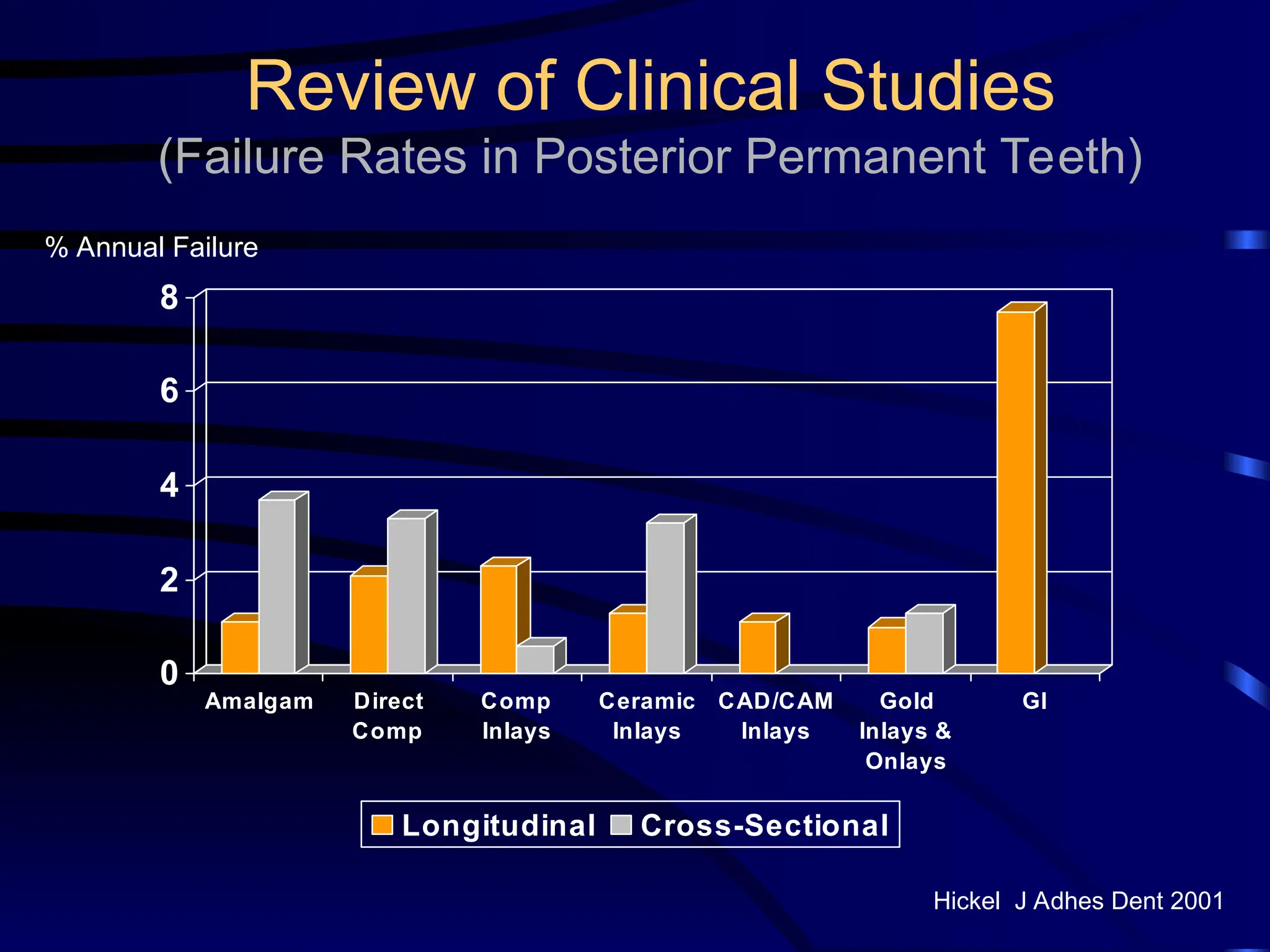
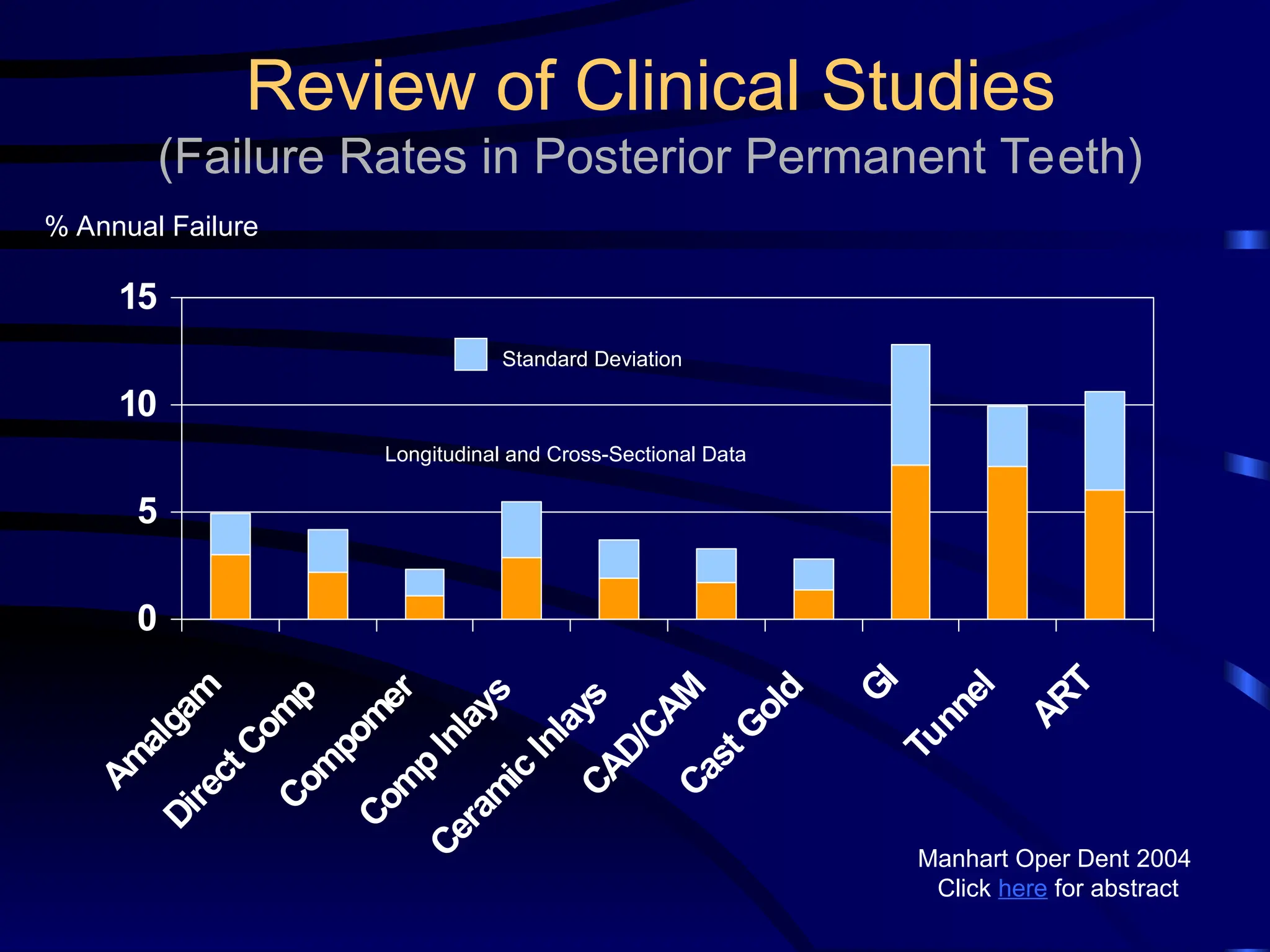
Review of Clinical Studies
(Failure Rates in Posterior Permanent Teeth)
0
2
4
6
8
Amalgam Direct
Comp
Comp
Inlays
Ceramic
Inlays
CAD/CAM
Inlays
Gold
Inlays &
Onlays
GI
Longitudinal Cross-Sectional
Hickel J Adhes Dent 2001
% Annual Failure
0
5
10
15
A
m
a
l
g
a
m
D
i
r
e
c
t
C
o
m
p
C
o
m
p
o
m
e
r
C
o
m
p
I
n
l
a
y
s
C
e
r
a
m
i
c
I
n
l
a
y
s
C
A
D
/
C
A
M
C
a
s
t
G
o
l
d
G
I
T
u
n
n
e
l
A
R
T
% Annual Failure
Manhart Oper Dent 2004
Click here for abstract
Standard Deviation
Longitudinal and Cross-Sectional Data
Review of Clinical Studies
(Failure Rates in Posterior Permanent Teeth)
Acknowledgements
• Dr. David Charlton
• Dr. Charles Hermesch
• Col Salvador Flores
Questions/Comments
Col Kraig Vandewalle
– DSN 792-7670
– ksvandewalle@nidbr.med.navy.mil

amalgam presentation conservative and ENDODONTIC

  • 1.
  • 2.
    Official Disclaimer • Theopinions expressed in this presentation are those of the author and do not necessarily reflect the official position of the US Air Force or the Department of Defense (DOD) • Devices or materials appearing in this presentation are used as examples of currently available products/technologies and do not imply an endorsement by the author and/or the USAF/DOD
  • 3.
    Overview • History • Basiccomposition • Basic setting reactions • Classifications • Manufacturing • Variables in amalgam performance Click here for briefing on dental amalgam (PDF)
  • 4.
    History • 1833 – Crawcourbrothers introduce amalgam to US • powdered silver coins mixed with mercury – expanded on setting • 1895 – G.V. Black develops formula for modern amalgam alloy • 67% silver, 27% tin, 5% copper, 1% zinc – overcame expansion problems
  • 5.
    History • 1960’s – conventionallow-copper lathe-cut alloys • smaller particles – first generation high-copper alloys • Dispersalloy (Caulk) – admixture of spherical Ag-Cu eutectic particles with conventional lathe-cut – eliminated gamma-2 phase Mahler J Dent Res 1997
  • 6.
    History • 1970’s – firstsingle composition spherical • Tytin (Kerr) • ternary system (silver/tin/copper) • 1980’s – alloys similar to Dispersalloy and Tytin • 1990’s – mercury-free alloys Mahler J Dent Res 1997
  • 7.
    Amalgam • An alloyof mercury with another metal.
  • 8.
    Why Amalgam? • Inexpensive •Ease of use • Proven track record – >100 years • Familiarity • Resin-free – less allergies than composite Click here for Talking Paper on Amalgam Safety (PDF)
  • 9.
    Constituents in Amalgam •Basic – Silver – Tin – Copper – Mercury • Other – Zinc – Indium – Palladium
  • 10.
    Basic Constituents • Silver(Ag) – increases strength – increases expansion • Tin (Sn) – decreases expansion – decreased strength – increases setting time Phillip’s Science of Dental Materials 2003
  • 11.
    Basic Constituents • Copper(Cu) – ties up tin • reducing gamma-2 formation – increases strength – reduces tarnish and corrosion – reduces creep • reduces marginal deterioration Phillip’s Science of Dental Materials 2003
  • 12.
    Basic Constituents • Mercury(Hg) – activates reaction – only pure metal that is liquid at room temperature – spherical alloys • require less mercury – smaller surface area easier to wet » 40 to 45% Hg – admixed alloys • require more mercury – lathe-cut particles more difficult to wet » 45 to 50% Hg Click here for ADA Mercury Hygiene Recommendations Phillip’s Science of Dental Materials 2003
  • 13.
    Other Constituents • Zinc(Zn) – used in manufacturing • decreases oxidation of other elements – sacrificial anode – provides better clinical performance • less marginal breakdown – Osborne JW Am J Dent 1992 – causes delayed expansion with low Cu alloys • if contaminated with moisture during condensation – Phillips RW JADA 1954 Phillip’s Science of Dental Materials 2003 H2O + Zn ZnO + H2   
  • 14.
    Other Constituents • Indium(In) – decreases surface tension • reduces amount of mercury necessary • reduces emitted mercury vapor – reduces creep and marginal breakdown – increases strength – must be used in admixed alloys – example • Indisperse (Indisperse Distributing Company) – 5% indium Powell J Dent Res 1989
  • 15.
    Other Constituents • Palladium(Pd) – reduced corrosion – greater luster – example • Valiant PhD (Ivoclar Vivadent) – 0.5% palladium Mahler J Dent Res 1990
  • 16.
    Basic Composition • Asilver-mercury matrix containing filler particles of silver-tin • Filler (bricks) – Ag3Sn called gamma • can be in various shapes – irregular (lathe-cut), spherical, or a combination • Matrix – Ag2Hg3 called gamma 1 • cement – Sn8Hg called gamma 2 • voids Phillip’s Science of Dental Materials 2003
  • 17.
    Basic Setting Reactions •Conventional low-copper alloys • Admixed high-copper alloys • Single composition high-copper alloys
  • 18.
    • Dissolution andprecipitation • Hg dissolves Ag and Sn from alloy • Intermetallic compounds formed Ag-Sn Alloy Ag-Sn Alloy Ag-Sn Alloy Mercury (Hg) Ag Ag Ag Sn Sn Sn Conventional Low-Copper Alloys Hg Hg Ag Ag3 3Sn + Hg Sn + Hg   Ag Ag3 3Sn + Ag Sn + Ag2 2Hg Hg3 3 + Sn + Sn8 8Hg Hg Phillip’s Science of Dental Materials 2003   1 2
  • 19.
    Conventional Low-Copper Alloys •Gamma () = Ag3Sn – unreacted alloy – strongest phase and corrodes the least – forms 30% of volume of set amalgam Ag-Sn Alloy Ag-Sn Alloy Ag-Sn Alloy Mercury Ag Ag Ag Sn Sn Sn Hg Hg Hg Ag Ag3 3Sn + Hg Sn + Hg   Ag Ag3 3Sn + Ag Sn + Ag2 2Hg Hg3 3 + Sn + Sn8 8Hg Hg Phillip’s Science of Dental Materials 2003   1 2
  • 20.
    Conventional Low-Copper Alloys •Gamma 1 (1) = Ag2Hg3 – matrix for unreacted alloy and 2nd strongest phase – 10 micron grains binding gamma () – 60% of volume 1 Ag Ag3 3Sn + Hg Sn + Hg   Ag Ag3 3Sn + Ag Sn + Ag2 2Hg Hg3 3 + Sn + Sn8 8Hg Hg Phillip’s Science of Dental Materials 2003   1 2 Ag-Sn Alloy Ag-Sn Alloy Ag-Sn Alloy
  • 21.
    Conventional Low-Copper Alloys •Gamma 2 (2) = Sn8Hg – weakest and softest phase – corrodes fast, voids form – corrosion yields Hg which reacts with more gamma () – 10% of volume – volume decreases with time due to corrosion Ag Ag3 3Sn + Hg Sn + Hg   Ag Ag3 3Sn + Ag Sn + Ag2 2Hg Hg3 3 + Sn + Sn8 8Hg Hg Phillip’s Science of Dental Materials 2003   1 2 2 Ag-Sn Alloy Ag-Sn Alloy Ag-Sn Alloy
  • 22.
    Admixed High-Copper Alloys •Ag enters Hg from Ag-Cu spherical eutectic particles – eutectic • an alloy in which the elements are completely soluble in liquid solution but separate into distinct areas upon solidification • Both Ag and Sn enter Hg from Ag3Sn particles Phillip’s Science of Dental Materials 2003 Ag Ag3 3Sn + Ag-Cu + Hg Sn + Ag-Cu + Hg   Ag Ag3 3Sn + Ag-Cu + Ag Sn + Ag-Cu + Ag2 2Hg Hg3 3 + Cu + Cu6 6Sn Sn5 5   1  Ag-Sn Alloy Ag-Sn Alloy Mercury Ag Ag Ag Sn Sn Ag-Cu Alloy Ag Hg Hg
  • 23.
    Admixed High-Copper Alloys •Sn diffuses to surface of Ag-Cu particles – reacts with Cu to form (eta) Cu6Sn5 () • around unconsumed Ag-Cu particles Ag-Sn Alloy Ag-Cu Alloy  Ag-Sn Alloy Phillip’s Science of Dental Materials 2003 Ag Ag3 3Sn + Ag-Cu + Hg Sn + Ag-Cu + Hg   Ag Ag3 3Sn + Ag-Cu + Ag Sn + Ag-Cu + Ag2 2Hg Hg3 3 + Cu + Cu6 6Sn Sn5 5   1 
  • 24.
    Admixed High-Copper Alloys •Gamma 1 (1) (Ag2Hg3) surrounds () eta phase (Cu6Sn5) and gamma () alloy particles (Ag3Sn) Ag-Sn Alloy 1 Ag-Cu Alloy  Ag-Sn Alloy Phillip’s Science of Dental Materials 2003 Ag Ag3 3Sn + Ag-Cu + Hg Sn + Ag-Cu + Hg   Ag Ag3 3Sn + Ag-Cu + Ag Sn + Ag-Cu + Ag2 2Hg Hg3 3 + Cu + Cu6 6Sn Sn5 5   1 
  • 25.
    Single Composition High-Copper Alloys •Gamma sphere () (Ag3Sn) with epsilon coating () (Cu3Sn) • Ag and Sn dissolve in Hg Ag-Sn Alloy Ag-Sn Alloy Ag-Sn Alloy Mercury (Hg)  Ag Sn Ag Sn Ag Ag3 3Sn + Cu Sn + Cu3 3Sn + Hg Sn + Hg   Ag Ag3 3Sn + Cu Sn + Cu3 3Sn + Ag Sn + Ag2 2Hg Hg3 3 + Cu + Cu6 6Sn Sn5 5 Phillip’s Science of Dental Materials 2003   1   
  • 26.
    Single Composition High-Copper Alloys •Gamma 1 (1) (Ag2Hg3) crystals grow binding together partially- dissolved gamma () alloy particles (Ag3Sn) • Epsilon () (Cu3Sn) develops crystals on surface of gamma particle (Ag3Sn) in the form of eta () (Cu6Sn5) – reduces creep – prevents gamma-2 formation Ag-Sn Alloy Ag-Sn Alloy Ag-Sn Alloy 1  Ag Ag3 3Sn + Cu Sn + Cu3 3Sn + Hg Sn + Hg   Ag Ag3 3Sn + Cu Sn + Cu3 3Sn + Ag Sn + Ag2 2Hg Hg3 3 + Cu + Cu6 6Sn Sn5 5 Phillip’s Science of Dental Materials 2003   1   
  • 27.
    Classifications • Based oncopper content • Based on particle shape • Based on method of adding copper
  • 28.
    Copper Content • Low-copperalloys – 4 to 6% Cu • High-copper alloys – thought that 6% Cu was maximum amount • due to fear of excessive corrosion and expansion – Now contain 9 to 30% Cu • at expense of Ag Phillip’s Science of Dental Materials 2003
  • 29.
    Particle Shape • Lathecut – low Cu • New True Dentalloy – high Cu • ANA 2000 • Admixture – high Cu • Dispersalloy, Valiant PhD • Spherical – low Cu • Cavex SF – high Cu • Tytin, Valiant
  • 30.
    Method of AddingCopper • Single Composition Lathe-Cut (SCL) • Single Composition Spherical (SCS) • Admixture: Lathe-cut + Spherical Eutectic (ALE) • Admixture: Lathe-cut + Single Composition Spherical (ALSCS)
  • 31.
    Single Composition Lathe-Cut (SCL) •More Hg needed than spherical alloys • High condensation force needed due to lathe cut • 20% Cu • Example – ANA 2000 (Nordiska Dental)
  • 32.
    Single Composition Spherical (SCS) •Spherical particles wet easier with Hg – less Hg needed (42%) • Less condensation force, larger condenser • Gamma particles as 20 micron spheres – with epsilon layer on surface • Examples – Tytin (Kerr) – Valiant (Ivoclar Vivadent)
  • 33.
    Admixture: Lathe-cut + SphericalEutectic (ALE) • Composition – 2/3 conventional lathe cut (3% Cu) – 1/3 high Cu spherical eutectic (28% Cu) – overall 12% Cu, 1% Zn • Initial reaction produces gamma 2 – no gamma 2 within two years • Example – Dispersalloy (Caulk)
  • 34.
    Admixture: Lathe-cut + SingleComposition Spherical (ALSCS) • High Cu in both lathe-cut and spherical components – 19% Cu • Epsilon layer forms on both components • 0.5% palladium added – reinforce grain boundaries on gamma 1 • Example – Valiant PhD (Ivoclar Vivadent)
  • 35.
    Manufacturing Process • Lathe-cutalloys – Ag & Sn melted together – alloy cooled • phases solidify – heat treat • 400 ºC for 8 hours – grind, then mill to 25 - 50 microns – heat treat to release stresses of grinding Phillip’s Science of Dental Materials 2003
  • 36.
    Manufacturing Process • Sphericalalloys – melt alloy – atomize • spheres form as particles cool – sizes range from 5 - 40 microns • variety improves condensability Phillip’s Science of Dental Materials 2003
  • 37.
    Material-Related Variables • Dimensionalchange • Strength • Corrosion • Creep
  • 38.
    Dimensional Change • Mosthigh-copper amalgams undergo a net contraction • Contraction leaves marginal gap – initial leakage • post-operative sensitivity – reduced with corrosion over time Phillip’s Science of Dental Materials 2003
  • 39.
    Dimensional Change • Netcontraction – type of alloy • spherical alloys have more contraction – less mercury – condensation technique • greater condensation = higher contraction – trituration time • overtrituration causes higher contraction Phillip’s Science of Dental Materials 2003
  • 40.
    Strength • Develops slowly –1 hr: 40 to 60% of maximum – 24 hrs: 90% of maximum • Spherical alloys strengthen faster – require less mercury • Higher compressive vs. tensile strength • Weak in thin sections – unsupported edges fracture Phillip’s Science of Dental Materials 2003
  • 41.
    Corrosion • Reduces strength •Seals margins – low copper • 6 months – SnO2, SnCl – gamma-2 phase – high copper • 6 - 24 months – SnO2 , SnCl, CuCl – eta-phase (Cu6Sn5) Sutow J Dent Res 1991
  • 42.
    Creep • Slow deformationof amalgam placed under a constant load – load less than that necessary to produce fracture • Gamma 2 dramatically affects creep rate – slow strain rates produces plastic deformation • allows gamma-1 grains to slide • Correlates with marginal breakdown Phillip’s Science of Dental Materials 2003
  • 43.
    Creep • High-copper amalgamshave creep resistance – prevention of gamma-2 phase • requires >12% Cu total – single composition spherical • eta (Cu6Sn5) embedded in gamma-1 grains – interlock – admixture • eta (Cu6Sn5) around Ag-Cu particles – improves bonding to gamma 1 Click here for table of creep values
  • 44.
    Dentist-Controlled Variables • Manipulation –trituration – condensation – burnishing – polishing
  • 45.
    Trituration • Mixing time –refer to manufacturer recommendations • Click here for details • Overtrituration – “hot” mix • sticks to capsule – decreases working / setting time – slight increase in setting contraction • Undertrituration – grainy, crumbly mix Phillip’s Science of Dental Materials 2003
  • 46.
    Condensation • Forces – lathe-cutalloys • small condensers • high force – spherical alloys • large condensers • less sensitive to amount of force • vertical / lateral with vibratory motion – admixture alloys • intermediate handling between lathe-cut and spherical
  • 47.
    Burnishing • Pre-carve – removesexcess mercury – improves margin adaptation • Post-carve – improves smoothness • Combined – less leakage Ben-Amar Dent Mater 1987
  • 48.
    Early Finishing • Afterinitial set – prophy cup with pumice – provides initial smoothness to restorations – recommended for spherical amalgams
  • 49.
    Polishing • Increased smoothness •Decreased plaque retention • Decreased corrosion • Clinically effective? – no improvement in marginal integrity • Mayhew Oper Dent 1986 • Collins J Dent 1992 – Click here for abstract
  • 50.
    Alloy Selection • Handlingcharacteristics • Mechanical and physical properties • Clinical performance Click here for more details
  • 51.
    Handling Characteristics • Spherical –advantages • easier to condense – around pins • hardens rapidly • smoother polish – disadvantages • difficult to achieve tight contacts • higher tendency for overhangs Phillip’s Science of Dental Materials 2003
  • 52.
    Handling Characteristics • Admixed –advantages • easy to achieve tight contacts • good polish – disadvantages • hardens slowly – lower early strength
  • 53.
    Amalgam Properties Compressive Strength (MPa) %Creep Tensile Strength (24 hrs) (MPa) Amalgam Type 1 hr 7 days Low Copper1 145 343 2.0 60 Admixture2 137 431 0.4 48 Single Composition3 262 510 0.13 64 Phillip’s Science of Dental Materials 2003 1 Fine Cut, Caulk 2 Dispersalloy, Caulk 3 Tytin, Kerr
  • 54.
    Survey of PracticeTypes Civilian General Dentists 68% 32% Amalgam Users Amalgam Free Haj-Ali Gen Dent 2005
  • 55.
    Frequency of PosteriorMaterials by Practice Type 39% 51% 3% 7% Amalgam Direct Composite Indirect Composite Other 3% 77% 8% 12% Amalgam Users Amalgam Free Haj-Ali Gen Dent 2005
  • 56.
    Profile of AmalgamUsers Civilian Practitioners 78% 22% Do you use amalgam in your practice? Yes No DPR 2005 88% 12% Do you place fewer amalgams than 5 years ago? Yes No
  • 57.
    Review of ClinicalStudies (Failure Rates in Posterior Permanent Teeth) 0 2 4 6 8 Amalgam Direct Comp Comp Inlays Ceramic Inlays CAD/CAM Inlays Gold Inlays & Onlays GI Longitudinal Cross-Sectional Hickel J Adhes Dent 2001 % Annual Failure
  • 58.
    0 5 10 15 A m a l g a m D i r e c t C o m p C o m p o m e r C o m p I n l a y s C e r a m i c I n l a y s C A D / C A M C a s t G o l d G I T u n n e l A R T % Annual Failure ManhartOper Dent 2004 Click here for abstract Standard Deviation Longitudinal and Cross-Sectional Data Review of Clinical Studies (Failure Rates in Posterior Permanent Teeth)
  • 59.
    Acknowledgements • Dr. DavidCharlton • Dr. Charles Hermesch • Col Salvador Flores Questions/Comments Col Kraig Vandewalle – DSN 792-7670 – ksvandewalle@nidbr.med.navy.mil