UNITED STATES DISTRICT COURT 
EASTERN DISTRICT OF TENNESSEE 
AT KNOXVILLE 
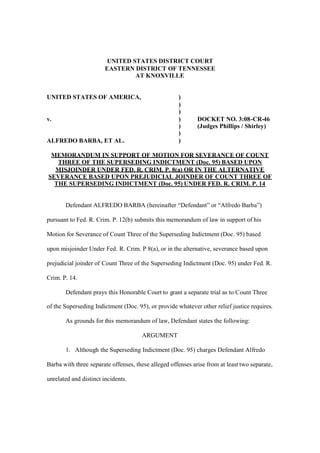
UNITED STATES OF AMERICA, ))) 
v. ) DOCKET NO. 3:08-CR-46 
) (Judges Phillips / Shirley) 
) 
ALFREDO BARBA, ET AL. ) 
MEMORANDUM IN SUPPORT OF MOTION FOR SEVERANCE OF COUNT 
THREE OF THE SUPERSEDING INDICTMENT (Doc. 95) BASED UPON 
MISJOINDER UNDER FED. R. CRIM. P. 8(a) OR IN THE ALTERNATIVE 
SEVERANCE BASED UPON PREJUDICIAL JOINDER OF COUNT THREE OF 
THE SUPERSEDING INDICTMENT (Doc. 95) UNDER FED. R. CRIM. P. 14 
Defendant ALFREDO BARBA (hereinafter “Defendant” or “Alfredo Barba”) 
pursuant to Fed. R. Crim. P. 12(b) submits this memorandum of law in support of his 
Motion for Severance of Count Three of the Superseding Indictment (Doc. 95) based 
upon misjoinder Under Fed. R. Crim. P 8(a), or in the alternative, severance based upon 
prejudicial joinder of Count Three of the Superseding Indictment (Doc. 95) under Fed. R. 
Crim. P. 14. 
Defendant prays this Honorable Court to grant a separate trial as to Count Three 
of the Superseding Indictment (Doc. 95), or provide whatever other relief justice requires. 
As grounds for this memorandum of law, Defendant states the following: 
ARGUMENT 
1. Although the Superseding Indictment (Doc. 95) charges Defendant Alfredo 
Barba with three separate offenses, these alleged offenses arise from at least two separate, 
unrelated and distinct incidents.
2. Counts One and Two charge Defendant Alfredo Barba with drug trafficking 
conspiracy andmoney laundering, arising from an alleged conspiracy occurring from 
October 2007 untilMay 11, 2008. 
3. Count Three of the Superseding Indictment charges Defendant Alfredo Barba 
with illegal re-entry – an immigration issue; an offense arising from a wholly unrelated 
and factually remote incident alleged to have occurred around February 18, 2008. 
4. The Superseding Indictment violates the spirit of Fed. R. Crim. P. 8 and 
Counts One and Two may not be properly joined with Count Three under Fed. R. Crim P. 
8 because these offenses are (1) not of the same or similar character; (2) not based on the 
same act or transaction; and (3) not connected with or constitut[ing] parts of a common 
scheme or plan. See Fed R. Crim P. 8(a). 
5. These alleged incidents shared no common purpose or evidence, and joinder 
would be inconsistent with providing the Defendant with a fair trial, and would do 
nothing toward promoting the goals of trial convenience and judicial efficiency. See 
United States v. Wirsing, 719 F.2d 859 (6th Cir. 1983); see also United States v. Diaz- 
Munoz, 632 F.2d 1330, 1335-36 (5th Cir. 1980) 
6. Nothing suggests that proof of Count Three either constituted or depended 
upon proof of the other two counts listed in the Superseding Indictment. 
7. The Superseding Indictment does not offer a discernable link between Count 
Three and the other two offenses or suggest any overlapping evidence. 
8. No effort is made in the Superseding Indictment to suggest that the three 
offenses are of the same or similar character, based on the same act or transaction, or part 
of a common scheme. 
2
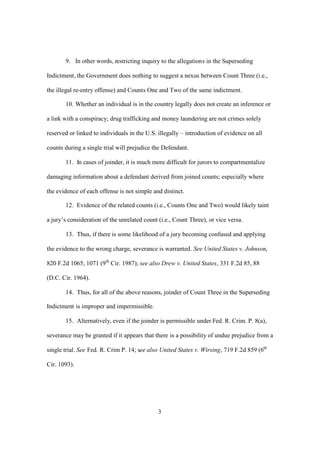
9. In other words, restricting inquiry to the allegations in the Superseding 
Indictment, the Government does nothing to suggest a nexus between Count Three (i.e., 
the illegal re-entry offense) and Counts One and Two of the same indictment. 
10. Whether an individual is in the country legally does not create an inference or 
a link with a conspiracy; drug trafficking and money laundering are not crimes solely 
reserved or linked to individuals in the U.S. illegally – introduction of evidence on all 
counts during a single trial will prejudice the Defendant. 
11. In cases of joinder, it is much more difficult for jurors to compartmentalize 
damaging information about a defendant derived from joined counts; especially where 
the evidence of each offense is not simple and distinct. 
12. Evidence of the related counts (i.e., Counts One and Two) would likely taint 
a jury’s consideration of the unrelated count (i.e., Count Three), or vice versa. 
13. Thus, if there is some likelihood of a jury becoming confused and applying 
the evidence to the wrong charge, severance is warranted. See United States v. Johnson, 
820 F.2d 1065, 1071 (9th Cir. 1987); see also Drew v. United States, 331 F.2d 85, 88 
(D.C. Cir. 1964). 
14. Thus, for all of the above reasons, joinder of Count Three in the Superseding 
3 
Indictment is improper and impermissible. 
15. Alternatively, even if the joinder is permissible under Fed. R. Crim. P. 8(a), 
severance may be granted if it appears that there is a possibility of undue prejudice from a 
single trial. See Fed. R. Crim P. 14; see also United States v. Wirsing, 719 F.2d 859 (6th 
Cir. 1093).
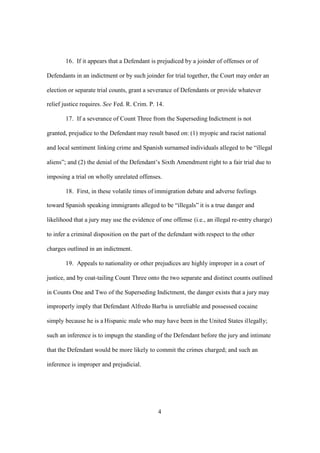
16. If it appears that a Defendant is prejudiced by a joinder of offenses or of 
Defendants in an indictment or by such joinder for trial together, the Court may order an 
election or separate trial counts, grant a severance of Defendants or provide whatever 
relief justice requires. See Fed. R. Crim. P. 14. 
17. If a severance of Count Three from the Superseding Indictment is not 
granted, prejudice to the Defendant may result based on: (1) myopic and racist national 
and local sentiment linking crime and Spanish surnamed individuals alleged to be “illegal 
aliens”; and (2) the denial of the Defendant’s Sixth Amendment right to a fair trial due to 
imposing a trial on wholly unrelated offenses. 
18. First, in these volatile times of immigration debate and adverse feelings 
toward Spanish speaking immigrants alleged to be “illegals” it is a true danger and 
likelihood that a jury may use the evidence of one offense (i.e., an illegal re-entry charge) 
to infer a criminal disposition on the part of the defendant with respect to the other 
charges outlined in an indictment. 
19. Appeals to nationality or other prejudices are highly improper in a court of 
justice, and by coat-tailing Count Three onto the two separate and distinct counts outlined 
in Counts One and Two of the Superseding Indictment, the danger exists that a jury may 
improperly imply that Defendant Alfredo Barba is unreliable and possessed cocaine 
simply because he is a Hispanic male who may have been in the United States illegally; 
such an inference is to impugn the standing of the Defendant before the jury and intimate 
that the Defendant would be more likely to commit the crimes charged; and such an 
inference is improper and prejudicial. 
4
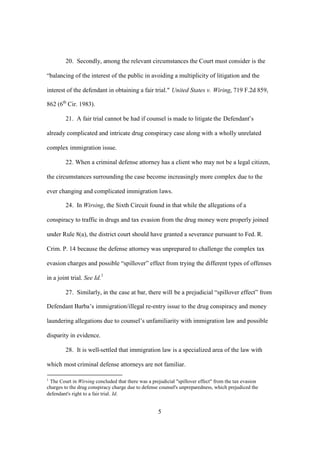
20. Secondly, among the relevant circumstances the Court must consider is the 
“balancing of the interest of the public in avoiding a multiplicity of litigation and the 
interest of the defendant in obtaining a fair trial." United States v. Wiring, 719 F.2d 859, 
862 (6th Cir. 1983). 
21. A fair trial cannot be had if counsel is made to litigate the Defendant’s 
already complicated and intricate drug conspiracy case along with a wholly unrelated 
complex immigration issue. 
22. When a criminal defense attorney has a client who may not be a legal citizen, 
the circumstances surrounding the case become increasingly more complex due to the 
ever changing and complicated immigration laws. 
24. In Wirsing, the Sixth Circuit found in that while the allegations of a 
conspiracy to traffic in drugs and tax evasion from the drug money were properly joined 
under Rule 8(a), the district court should have granted a severance pursuant to Fed. R. 
Crim. P. 14 because the defense attorney was unprepared to challenge the complex tax 
evasion charges and possible “spillover” effect from trying the different types of offenses 
in a joint trial. See Id.1 
27. Similarly, in the case at bar, there will be a prejudicial “spillover effect” from 
Defendant Barba’s immigration/illegal re-entry issue to the drug conspiracy and money 
laundering allegations due to counsel’s unfamiliarity with immigration law and possible 
disparity in evidence. 
28. It is well-settled that immigration law is a specialized area of the law with 
which most criminal defense attorneys are not familiar. 
1 The Court in Wirsing concluded that there was a prejudicial "spillover effect" from the tax evasion 
charges to the drug conspiracy charge due to defense counsel's unpreparedness, which prejudiced the 
defendant's right to a fair trial. Id. 
5
29. The Defendant has an immigration attorney in Nashville, Tennessee that has 
been handling the Defendant’s illegal re-entry charge for several months in separate 
proceedings. 
30. The conspiracy counts and the illegal re-entry count are not manifestly 
related, and introduction of evidence on all counts will substantially prejudice the 
Defendant. 
WHEREFORE, the Defendant, for all of the above reasons, respectfully moves 
for severance of Count Three fromthe Superseding Indictment, and requests a separate 
trial as to Count Three of the Superseding Indictment, or whatever relief justice requires. 
RESPECTFULLY submitted, October 21, 2008. 
s/ A. Philip Lomonaco 
BPR # 11579 
800 S. Gay Street, Suite 2610 
Knoxville, TN 37929 
865-521-7422, izyglty@usit.net 
CERTIFICATE OF SERVICE 
I do hereby certify that on October 21, 2008, a copy of the foregoing document 
was filed electronically. Notice of this filing will be sent by operation of the Court’s 
electronic filing system to all parties indicated on the electronic filing receipt. All other 
parties will be served by U.S. mail. Parties may access this filing through the Court’s 
electronic filing system. 
s/ A. Philip Lomonaco 
6

Alfredo Barba Mariscal enjuiciado en EUA por tráfico de drogas

  • 1.
    UNITED STATES DISTRICTCOURT EASTERN DISTRICT OF TENNESSEE AT KNOXVILLE UNITED STATES OF AMERICA, ))) v. ) DOCKET NO. 3:08-CR-46 ) (Judges Phillips / Shirley) ) ALFREDO BARBA, ET AL. ) MEMORANDUM IN SUPPORT OF MOTION FOR SEVERANCE OF COUNT THREE OF THE SUPERSEDING INDICTMENT (Doc. 95) BASED UPON MISJOINDER UNDER FED. R. CRIM. P. 8(a) OR IN THE ALTERNATIVE SEVERANCE BASED UPON PREJUDICIAL JOINDER OF COUNT THREE OF THE SUPERSEDING INDICTMENT (Doc. 95) UNDER FED. R. CRIM. P. 14 Defendant ALFREDO BARBA (hereinafter “Defendant” or “Alfredo Barba”) pursuant to Fed. R. Crim. P. 12(b) submits this memorandum of law in support of his Motion for Severance of Count Three of the Superseding Indictment (Doc. 95) based upon misjoinder Under Fed. R. Crim. P 8(a), or in the alternative, severance based upon prejudicial joinder of Count Three of the Superseding Indictment (Doc. 95) under Fed. R. Crim. P. 14. Defendant prays this Honorable Court to grant a separate trial as to Count Three of the Superseding Indictment (Doc. 95), or provide whatever other relief justice requires. As grounds for this memorandum of law, Defendant states the following: ARGUMENT 1. Although the Superseding Indictment (Doc. 95) charges Defendant Alfredo Barba with three separate offenses, these alleged offenses arise from at least two separate, unrelated and distinct incidents.
  • 2.
    2. Counts Oneand Two charge Defendant Alfredo Barba with drug trafficking conspiracy andmoney laundering, arising from an alleged conspiracy occurring from October 2007 untilMay 11, 2008. 3. Count Three of the Superseding Indictment charges Defendant Alfredo Barba with illegal re-entry – an immigration issue; an offense arising from a wholly unrelated and factually remote incident alleged to have occurred around February 18, 2008. 4. The Superseding Indictment violates the spirit of Fed. R. Crim. P. 8 and Counts One and Two may not be properly joined with Count Three under Fed. R. Crim P. 8 because these offenses are (1) not of the same or similar character; (2) not based on the same act or transaction; and (3) not connected with or constitut[ing] parts of a common scheme or plan. See Fed R. Crim P. 8(a). 5. These alleged incidents shared no common purpose or evidence, and joinder would be inconsistent with providing the Defendant with a fair trial, and would do nothing toward promoting the goals of trial convenience and judicial efficiency. See United States v. Wirsing, 719 F.2d 859 (6th Cir. 1983); see also United States v. Diaz- Munoz, 632 F.2d 1330, 1335-36 (5th Cir. 1980) 6. Nothing suggests that proof of Count Three either constituted or depended upon proof of the other two counts listed in the Superseding Indictment. 7. The Superseding Indictment does not offer a discernable link between Count Three and the other two offenses or suggest any overlapping evidence. 8. No effort is made in the Superseding Indictment to suggest that the three offenses are of the same or similar character, based on the same act or transaction, or part of a common scheme. 2
  • 3.
    9. In otherwords, restricting inquiry to the allegations in the Superseding Indictment, the Government does nothing to suggest a nexus between Count Three (i.e., the illegal re-entry offense) and Counts One and Two of the same indictment. 10. Whether an individual is in the country legally does not create an inference or a link with a conspiracy; drug trafficking and money laundering are not crimes solely reserved or linked to individuals in the U.S. illegally – introduction of evidence on all counts during a single trial will prejudice the Defendant. 11. In cases of joinder, it is much more difficult for jurors to compartmentalize damaging information about a defendant derived from joined counts; especially where the evidence of each offense is not simple and distinct. 12. Evidence of the related counts (i.e., Counts One and Two) would likely taint a jury’s consideration of the unrelated count (i.e., Count Three), or vice versa. 13. Thus, if there is some likelihood of a jury becoming confused and applying the evidence to the wrong charge, severance is warranted. See United States v. Johnson, 820 F.2d 1065, 1071 (9th Cir. 1987); see also Drew v. United States, 331 F.2d 85, 88 (D.C. Cir. 1964). 14. Thus, for all of the above reasons, joinder of Count Three in the Superseding 3 Indictment is improper and impermissible. 15. Alternatively, even if the joinder is permissible under Fed. R. Crim. P. 8(a), severance may be granted if it appears that there is a possibility of undue prejudice from a single trial. See Fed. R. Crim P. 14; see also United States v. Wirsing, 719 F.2d 859 (6th Cir. 1093).
  • 4.
    16. If itappears that a Defendant is prejudiced by a joinder of offenses or of Defendants in an indictment or by such joinder for trial together, the Court may order an election or separate trial counts, grant a severance of Defendants or provide whatever relief justice requires. See Fed. R. Crim. P. 14. 17. If a severance of Count Three from the Superseding Indictment is not granted, prejudice to the Defendant may result based on: (1) myopic and racist national and local sentiment linking crime and Spanish surnamed individuals alleged to be “illegal aliens”; and (2) the denial of the Defendant’s Sixth Amendment right to a fair trial due to imposing a trial on wholly unrelated offenses. 18. First, in these volatile times of immigration debate and adverse feelings toward Spanish speaking immigrants alleged to be “illegals” it is a true danger and likelihood that a jury may use the evidence of one offense (i.e., an illegal re-entry charge) to infer a criminal disposition on the part of the defendant with respect to the other charges outlined in an indictment. 19. Appeals to nationality or other prejudices are highly improper in a court of justice, and by coat-tailing Count Three onto the two separate and distinct counts outlined in Counts One and Two of the Superseding Indictment, the danger exists that a jury may improperly imply that Defendant Alfredo Barba is unreliable and possessed cocaine simply because he is a Hispanic male who may have been in the United States illegally; such an inference is to impugn the standing of the Defendant before the jury and intimate that the Defendant would be more likely to commit the crimes charged; and such an inference is improper and prejudicial. 4
  • 5.
    20. Secondly, amongthe relevant circumstances the Court must consider is the “balancing of the interest of the public in avoiding a multiplicity of litigation and the interest of the defendant in obtaining a fair trial." United States v. Wiring, 719 F.2d 859, 862 (6th Cir. 1983). 21. A fair trial cannot be had if counsel is made to litigate the Defendant’s already complicated and intricate drug conspiracy case along with a wholly unrelated complex immigration issue. 22. When a criminal defense attorney has a client who may not be a legal citizen, the circumstances surrounding the case become increasingly more complex due to the ever changing and complicated immigration laws. 24. In Wirsing, the Sixth Circuit found in that while the allegations of a conspiracy to traffic in drugs and tax evasion from the drug money were properly joined under Rule 8(a), the district court should have granted a severance pursuant to Fed. R. Crim. P. 14 because the defense attorney was unprepared to challenge the complex tax evasion charges and possible “spillover” effect from trying the different types of offenses in a joint trial. See Id.1 27. Similarly, in the case at bar, there will be a prejudicial “spillover effect” from Defendant Barba’s immigration/illegal re-entry issue to the drug conspiracy and money laundering allegations due to counsel’s unfamiliarity with immigration law and possible disparity in evidence. 28. It is well-settled that immigration law is a specialized area of the law with which most criminal defense attorneys are not familiar. 1 The Court in Wirsing concluded that there was a prejudicial "spillover effect" from the tax evasion charges to the drug conspiracy charge due to defense counsel's unpreparedness, which prejudiced the defendant's right to a fair trial. Id. 5
  • 6.
    29. The Defendanthas an immigration attorney in Nashville, Tennessee that has been handling the Defendant’s illegal re-entry charge for several months in separate proceedings. 30. The conspiracy counts and the illegal re-entry count are not manifestly related, and introduction of evidence on all counts will substantially prejudice the Defendant. WHEREFORE, the Defendant, for all of the above reasons, respectfully moves for severance of Count Three fromthe Superseding Indictment, and requests a separate trial as to Count Three of the Superseding Indictment, or whatever relief justice requires. RESPECTFULLY submitted, October 21, 2008. s/ A. Philip Lomonaco BPR # 11579 800 S. Gay Street, Suite 2610 Knoxville, TN 37929 865-521-7422, izyglty@usit.net CERTIFICATE OF SERVICE I do hereby certify that on October 21, 2008, a copy of the foregoing document was filed electronically. Notice of this filing will be sent by operation of the Court’s electronic filing system to all parties indicated on the electronic filing receipt. All other parties will be served by U.S. mail. Parties may access this filing through the Court’s electronic filing system. s/ A. Philip Lomonaco 6