Copyright Extended
Except where otherwise noted, this presentation is licensed under a Creative Commons Attribution 4.0Licence,
photos Trish Hepworth, presentation ALCC
Copyright – a property right that protects expression
Separate from moral rights
Copyright is Automatic, it just needs
to be:
• form of expression of information;
• in material form;
• created by an author(s); and
• original
Works Subject Matter
other than works
• Literary
• Dramatic
• Artistic
• Musical
Films
Films, animations
computer games
Sound recordings
Any recording of sound
Radio & TV broadcasts
Published editions
Layout, typesetting
• Reproduce: copying of a work in any
format, including electronic
• Publication: right to make the work public
for the first time
• Public performance and communication:
including electronic communications
• Adaptation: i.e. translations, TV series
Duration of copyright
70 years after death
Film and sound recordings –
Depends on which rights!
1955, 1955-1968, 1968+
Television and sound broadcast – 50 years
from end of year in which broadcast made
Photographs – generally, 70 years after the
end of the year of author’s death
Orphan works?
...unpublished works?
toa267
licence
exceptions
permission
insubstantial
public domain
Public domain image
(1) Private copying
(2) Fair dealing
(3) Crown Copying s 183 (NOT FREE)
(4) Educational Licenses (NOT FREE)
(5) Library and archive exceptions
(6) Flexible dealing
Exceptions
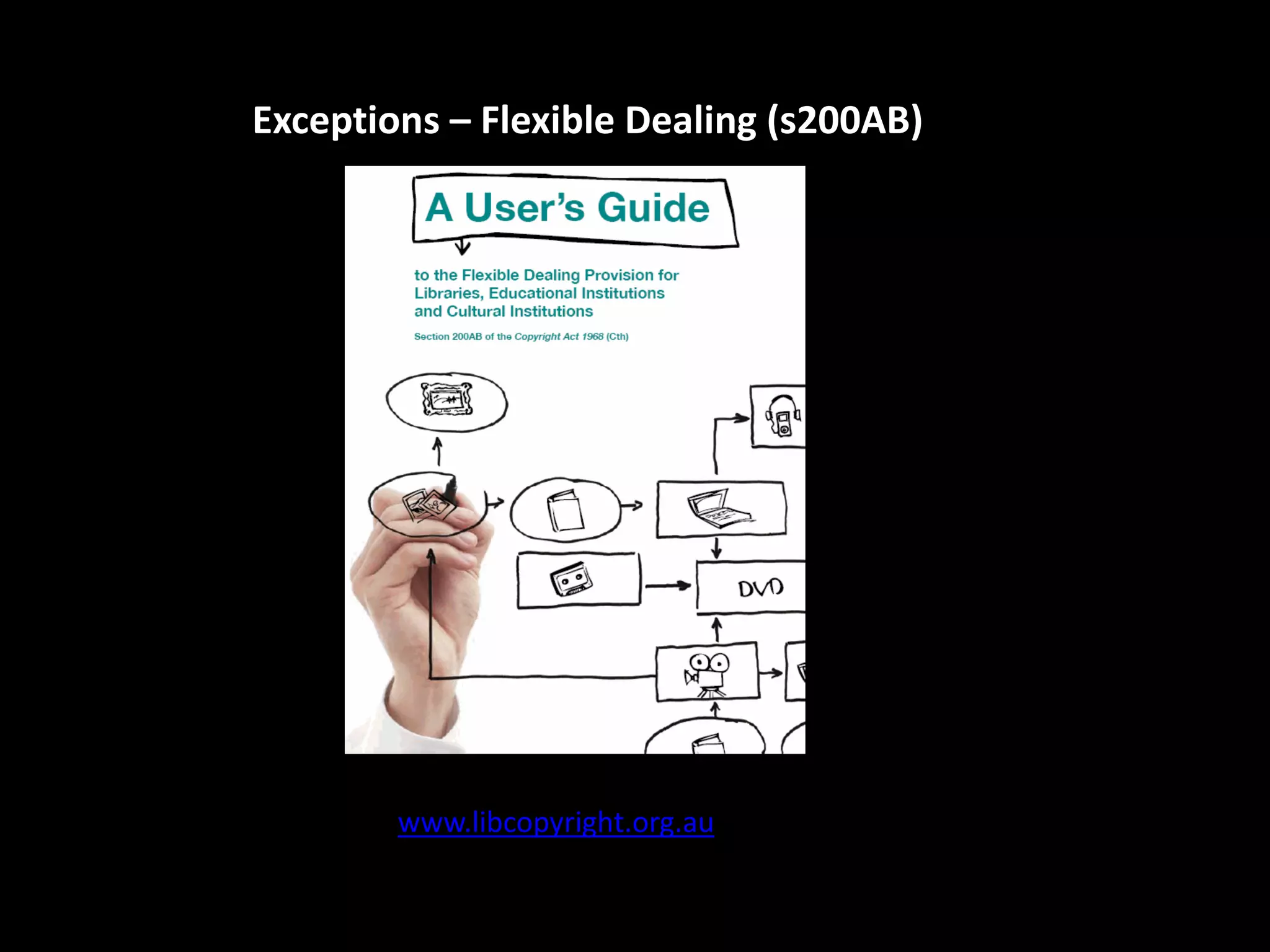
Exceptions – Flexible Dealing (s200AB)
www.libcopyright.org.au
Exceptions – Flexible Dealing (s200AB)
A. Is the use allowed under another section of the
Copyright Act? Fair dealing, library and archival
copying, statutory licence, consumer exceptions,
section 183
B. For the purposes of “maintaining or operating”
the library or archives? Or for “educational
instruction”?
C. Does the use meet the requirements of
s200AB? The use must:
• Not conflict with normal exploitation of the
work;
• Not unreasonably prejudice the copyright
holder; and
• Be a special case.
What’s left outside exceptions?
• Cloud computing
• Data and text mining
• Social media use of content
• Digitisation (outside of section
200AB)
• Uses involving digital locks
with no corresponding
Schedule 10A exception
• Indexing and caching
• Digital content licensing
• Web 3.0? ‘Push’ data?
Locating the copyright holder
Before turning to the three step test under s200AB, you need to
demonstrate you’ve taken reasonable steps to contact the copyright holder:
• Nature of the work – commercial or non-commercial
• Age of the work
• Published or unpublished work
• Potential concerns of the creator – deceased, alive, interests of the
estate
• Extent of the planned use
• Reasonable enquiries of others
• Common sense
AND THEN BE POLITE AND ENGAGE!
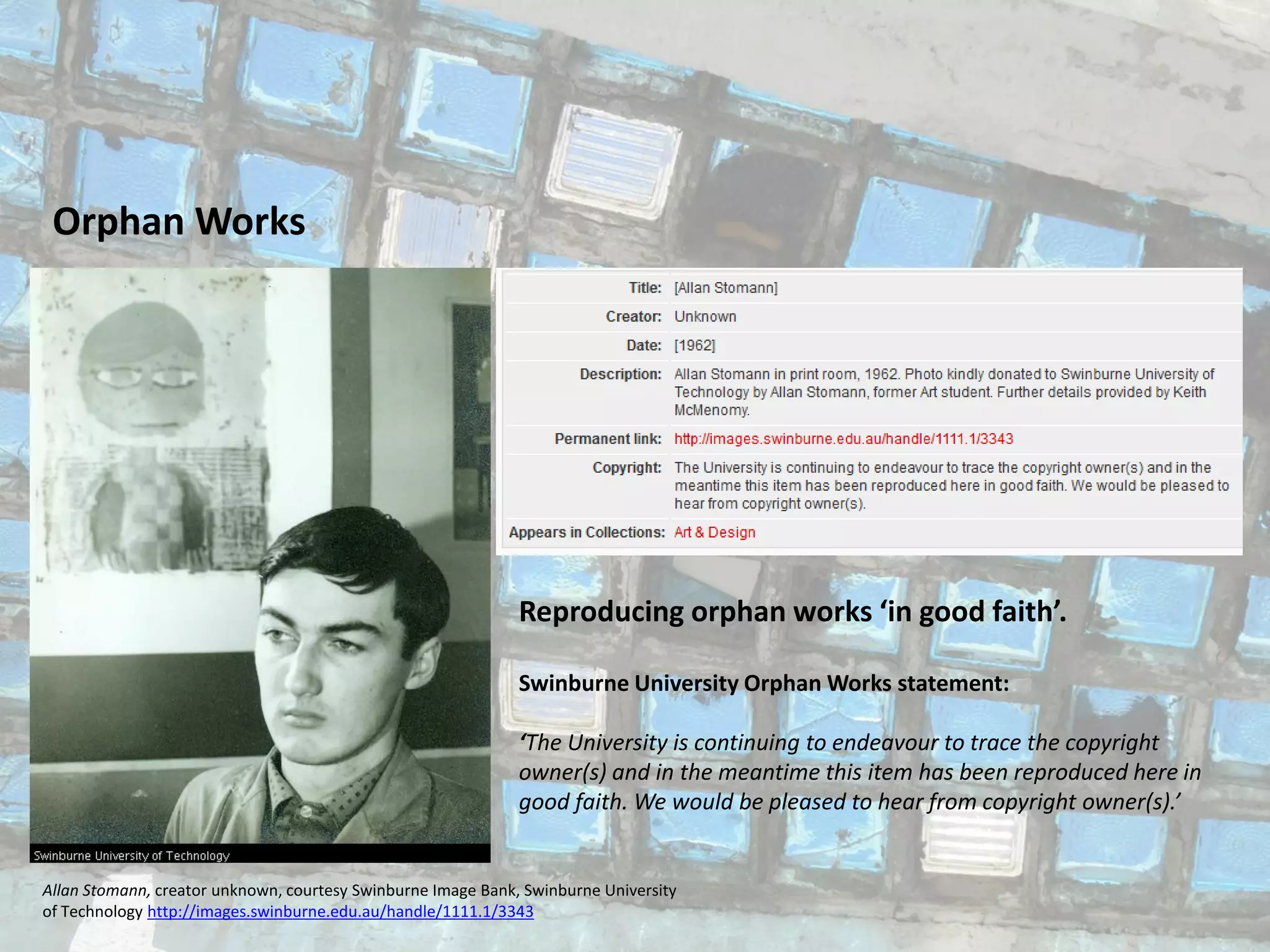
Orphan Works
Allan Stomann, creator unknown, courtesy Swinburne Image Bank, Swinburne University
of Technology http://images.swinburne.edu.au/handle/1111.1/3343
Reproducing orphan works ‘in good faith’.
Swinburne University Orphan Works statement:
‘The University is continuing to endeavour to trace the copyright
owner(s) and in the meantime this item has been reproduced here in
good faith. We would be pleased to hear from copyright owner(s).’
Managing digital content licences
• Consortial purchasing – Electronic Resources
Australia, CAUL/CEIRC
• Individual subscriptions
• Terms of use, prohibited/restricted uses
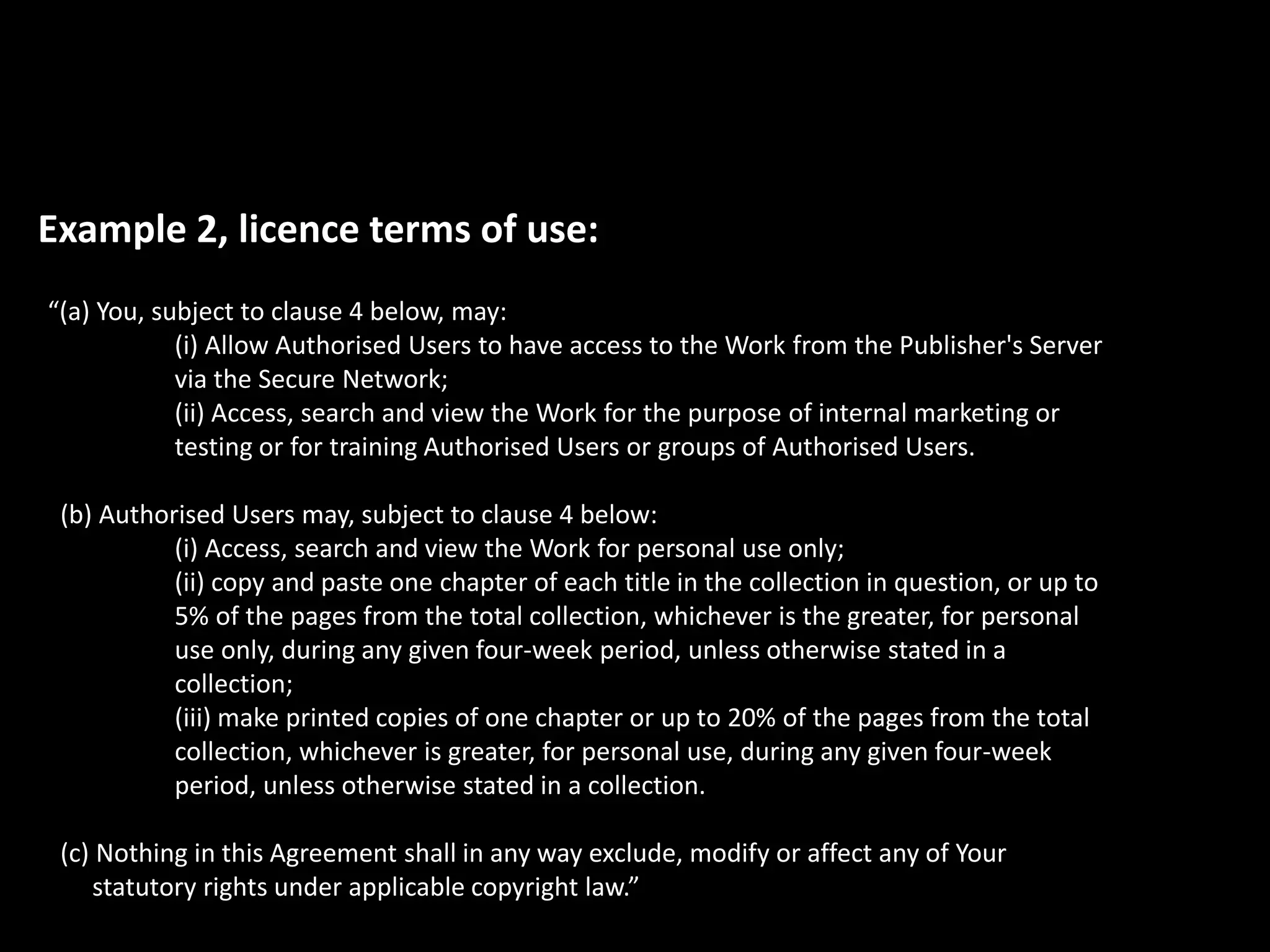
Example 2, licence terms of use:
“(a) You, subject to clause 4 below, may:
(i) Allow Authorised Users to have access to the Work from the Publisher's Server
via the Secure Network;
(ii) Access, search and view the Work for the purpose of internal marketing or
testing or for training Authorised Users or groups of Authorised Users.
(b) Authorised Users may, subject to clause 4 below:
(i) Access, search and view the Work for personal use only;
(ii) copy and paste one chapter of each title in the collection in question, or up to
5% of the pages from the total collection, whichever is the greater, for personal
use only, during any given four-week period, unless otherwise stated in a
collection;
(iii) make printed copies of one chapter or up to 20% of the pages from the total
collection, whichever is greater, for personal use, during any given four-week
period, unless otherwise stated in a collection.
(c) Nothing in this Agreement shall in any way exclude, modify or affect any of Your
statutory rights under applicable copyright law.”
Other digital challenges
•Accessing withdrawn/retracted works
•Contract overriding copyright exceptions
•Mass digitisation
•Collecting digital-borne material
Acquisition/deposit agreements
• Seeking permissions
• Develop a template for permitted uses of
copyright materials
• i.e. Series of tick boxes for the copyright holder
listing permitted uses of material: publication
online, use in catalogue, marketing materials, etc
What is the Risk of Breaching Copyright?
What is the Risk of being sued?
What are the possible outcomes?
What risk reduction strategies can you put in place?
What is the Risk of Breaching Copyright?
What is the Risk of being sued?
What are the possible outcomes?
What risk reduction strategies can you put in place?
What is the Risk of Breaching Copyright?
What is the Risk of being sued?
What are the possible outcomes?
What risk reduction strategies can you put in place?
What is the Risk of Breaching Copyright?
What is the Risk of being sued?
What are the possible outcomes?
What risk reduction strategies can you put in place?
Remember
Moral Rights
Is Copyright Broken?
The Australian copyright reform agenda
• Fair Use
• Reform of Statutory Licences
• Orphan works
• Preservation Copying
• Document Supply
Is the use fair?
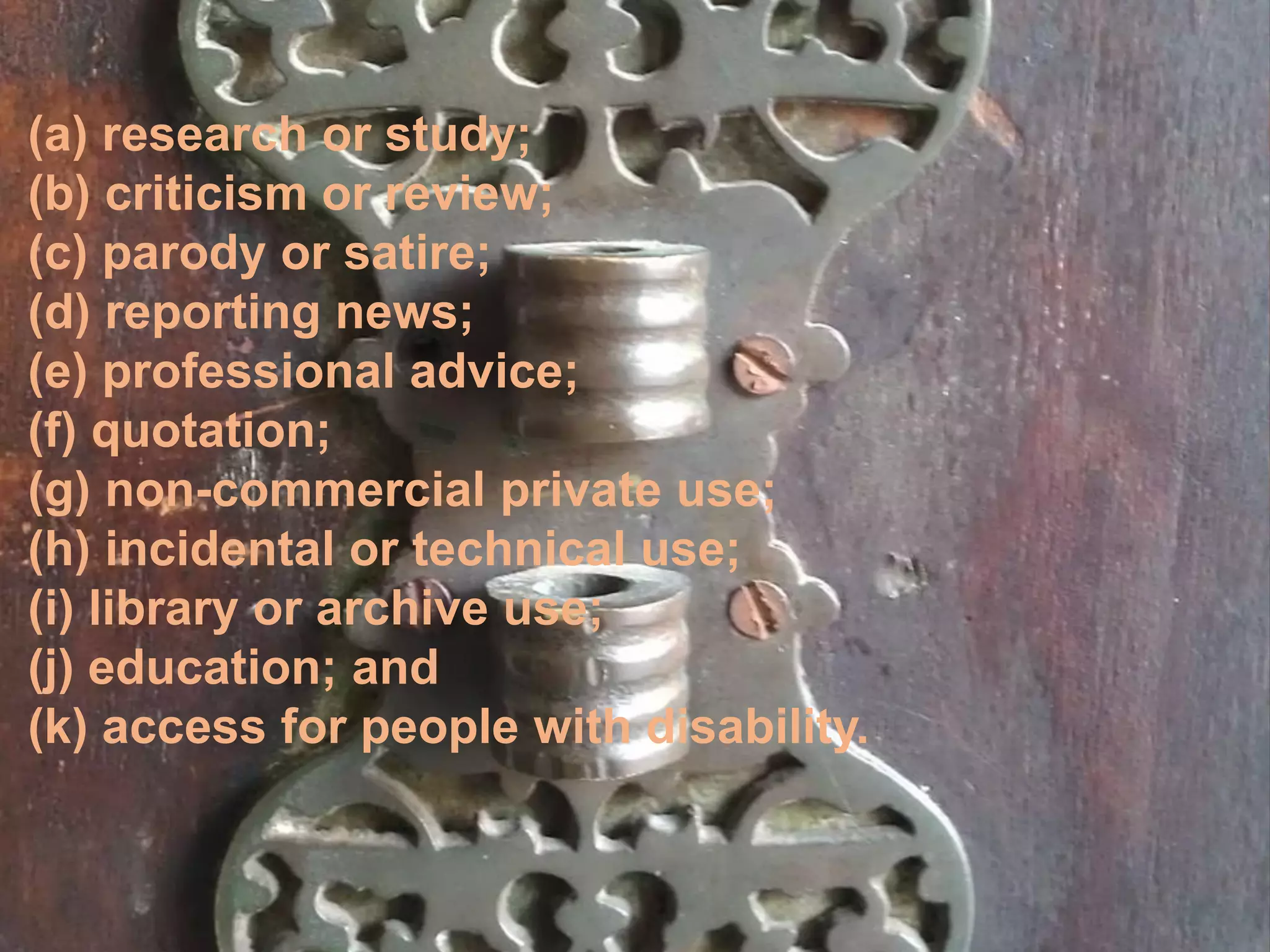
(a) research or study;
(b) criticism or review;
(c) parody or satire;
(d) reporting news;
(e) professional advice;
(f) quotation;
(g) non-commercial private use;
(h) incidental or technical use;
(i) library or archive use;
(j) education; and
(k) access for people with disability.
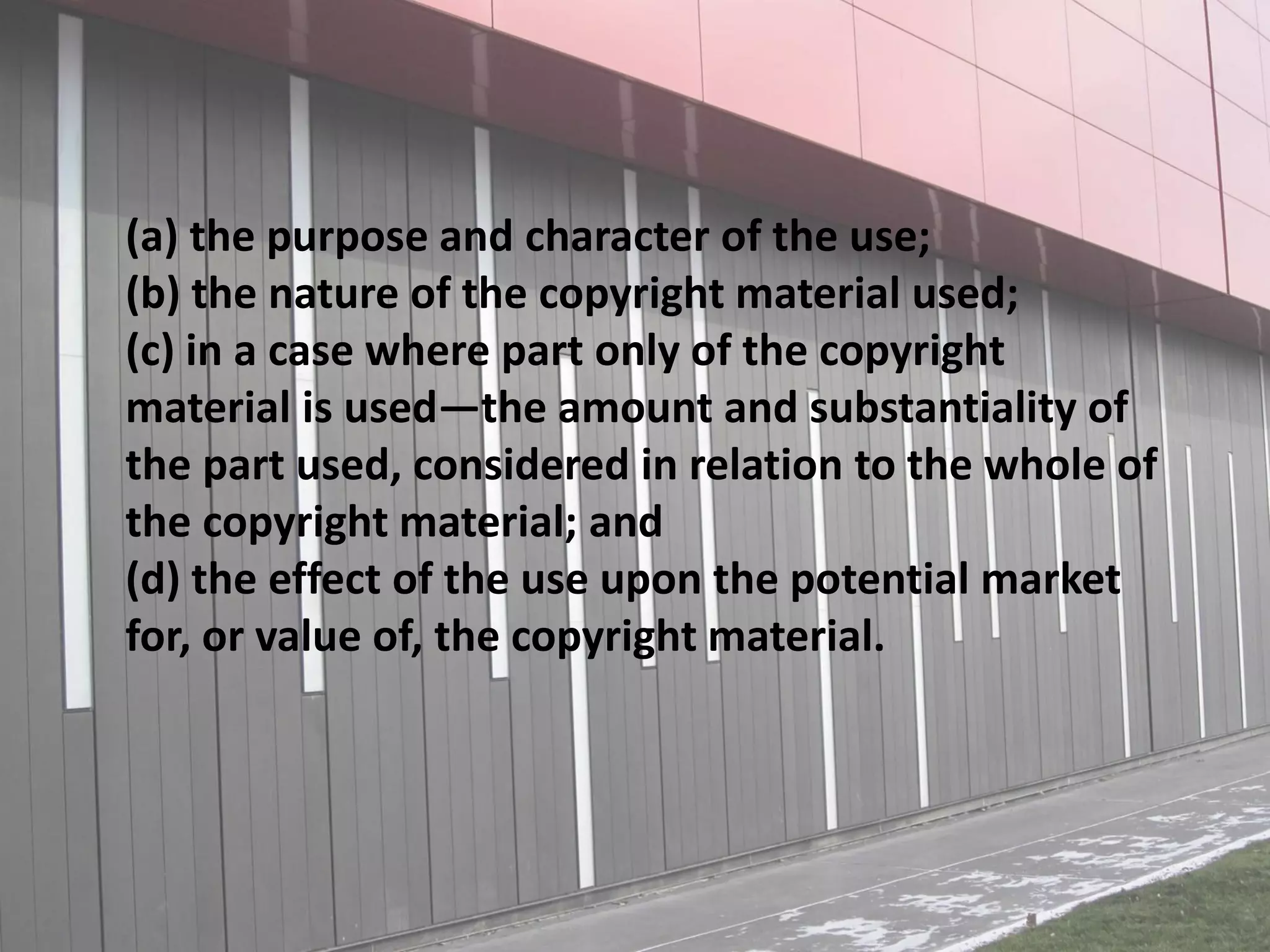
(a) the purpose and character of the use;
(b) the nature of the copyright material used;
(c) in a case where part only of the copyright
material is used—the amount and substantiality of
the part used, considered in relation to the whole of
the copyright material; and
(d) the effect of the use upon the potential market
for, or value of, the copyright material.
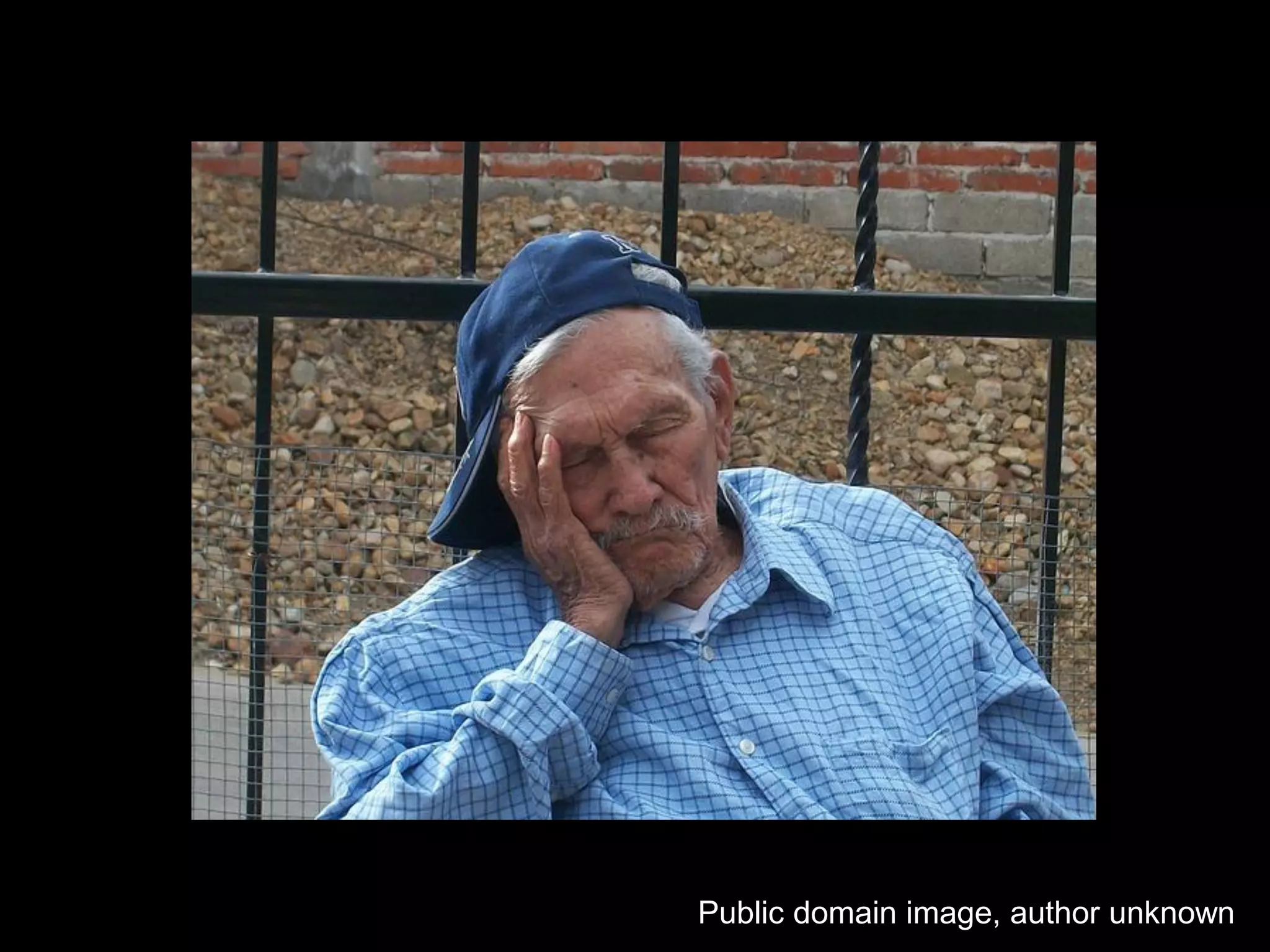
Public domain image, author unknown
• What are you doing?
• What are you using?
• How much are you using?
• What about the copyright holder?
Orphan works
The Copyright Act should be amended to clarify that the
statutory licences in pts VA, VB and VII div 2 do not apply to a
use of copyright material which, because of another
provision of the Act, would not infringe copyright. This
means that governments, educational institutions and
institutions assisting people with disability, will be able to
rely on unremunerated exceptions, including fair use or the
new fair dealing exception, to the extent that they apply.
lost or stolen--for the purpose of replacing the work
if the officer is satisfied that a copy (not being a
second-hand copy) of another edition of the work
"photograph" includes photo-lithograph and
a work produced by a process similar to photography.
3 photographic reproductions of the work
Preservation copying
Document Supply and Inter-library loan
Voluntary/negotiated licences
Fair Use
Industry Codes of Conduct
Copyright and
Contract
TPMs
Safe Harbours
Internet Piracy
WIPO Treaty for Libraries
and Archives
Image – Mimi & Eunice
http://mimiandeunice.com/2011/05/23/copyri
ght-reform/

Alcc copyright extended

  • 1.
    Copyright Extended Except whereotherwise noted, this presentation is licensed under a Creative Commons Attribution 4.0Licence, photos Trish Hepworth, presentation ALCC
  • 2.
    Copyright – aproperty right that protects expression Separate from moral rights
  • 3.
    Copyright is Automatic,it just needs to be: • form of expression of information; • in material form; • created by an author(s); and • original
  • 4.
    Works Subject Matter otherthan works • Literary • Dramatic • Artistic • Musical Films Films, animations computer games Sound recordings Any recording of sound Radio & TV broadcasts Published editions Layout, typesetting
  • 5.
    • Reproduce: copyingof a work in any format, including electronic • Publication: right to make the work public for the first time • Public performance and communication: including electronic communications • Adaptation: i.e. translations, TV series
  • 6.
    Duration of copyright 70years after death Film and sound recordings – Depends on which rights! 1955, 1955-1968, 1968+ Television and sound broadcast – 50 years from end of year in which broadcast made Photographs – generally, 70 years after the end of the year of author’s death Orphan works? ...unpublished works? toa267
  • 7.
  • 8.
    (1) Private copying (2)Fair dealing (3) Crown Copying s 183 (NOT FREE) (4) Educational Licenses (NOT FREE) (5) Library and archive exceptions (6) Flexible dealing Exceptions
  • 9.
    Exceptions – FlexibleDealing (s200AB) www.libcopyright.org.au
  • 10.
    Exceptions – FlexibleDealing (s200AB) A. Is the use allowed under another section of the Copyright Act? Fair dealing, library and archival copying, statutory licence, consumer exceptions, section 183 B. For the purposes of “maintaining or operating” the library or archives? Or for “educational instruction”? C. Does the use meet the requirements of s200AB? The use must: • Not conflict with normal exploitation of the work; • Not unreasonably prejudice the copyright holder; and • Be a special case.
  • 11.
    What’s left outsideexceptions? • Cloud computing • Data and text mining • Social media use of content • Digitisation (outside of section 200AB) • Uses involving digital locks with no corresponding Schedule 10A exception • Indexing and caching • Digital content licensing • Web 3.0? ‘Push’ data?
  • 12.
    Locating the copyrightholder Before turning to the three step test under s200AB, you need to demonstrate you’ve taken reasonable steps to contact the copyright holder: • Nature of the work – commercial or non-commercial • Age of the work • Published or unpublished work • Potential concerns of the creator – deceased, alive, interests of the estate • Extent of the planned use • Reasonable enquiries of others • Common sense AND THEN BE POLITE AND ENGAGE!
  • 13.
    Orphan Works Allan Stomann,creator unknown, courtesy Swinburne Image Bank, Swinburne University of Technology http://images.swinburne.edu.au/handle/1111.1/3343 Reproducing orphan works ‘in good faith’. Swinburne University Orphan Works statement: ‘The University is continuing to endeavour to trace the copyright owner(s) and in the meantime this item has been reproduced here in good faith. We would be pleased to hear from copyright owner(s).’
  • 14.
    Managing digital contentlicences • Consortial purchasing – Electronic Resources Australia, CAUL/CEIRC • Individual subscriptions • Terms of use, prohibited/restricted uses
  • 15.
    Example 2, licenceterms of use: “(a) You, subject to clause 4 below, may: (i) Allow Authorised Users to have access to the Work from the Publisher's Server via the Secure Network; (ii) Access, search and view the Work for the purpose of internal marketing or testing or for training Authorised Users or groups of Authorised Users. (b) Authorised Users may, subject to clause 4 below: (i) Access, search and view the Work for personal use only; (ii) copy and paste one chapter of each title in the collection in question, or up to 5% of the pages from the total collection, whichever is the greater, for personal use only, during any given four-week period, unless otherwise stated in a collection; (iii) make printed copies of one chapter or up to 20% of the pages from the total collection, whichever is greater, for personal use, during any given four-week period, unless otherwise stated in a collection. (c) Nothing in this Agreement shall in any way exclude, modify or affect any of Your statutory rights under applicable copyright law.”
  • 16.
    Other digital challenges •Accessingwithdrawn/retracted works •Contract overriding copyright exceptions •Mass digitisation •Collecting digital-borne material
  • 17.
    Acquisition/deposit agreements • Seekingpermissions • Develop a template for permitted uses of copyright materials • i.e. Series of tick boxes for the copyright holder listing permitted uses of material: publication online, use in catalogue, marketing materials, etc
  • 18.
    What is theRisk of Breaching Copyright? What is the Risk of being sued? What are the possible outcomes? What risk reduction strategies can you put in place?
  • 19.
    What is theRisk of Breaching Copyright? What is the Risk of being sued? What are the possible outcomes? What risk reduction strategies can you put in place?
  • 20.
    What is theRisk of Breaching Copyright? What is the Risk of being sued? What are the possible outcomes? What risk reduction strategies can you put in place?
  • 21.
    What is theRisk of Breaching Copyright? What is the Risk of being sued? What are the possible outcomes? What risk reduction strategies can you put in place?
  • 22.
  • 23.
    Is Copyright Broken? TheAustralian copyright reform agenda
  • 24.
    • Fair Use •Reform of Statutory Licences • Orphan works • Preservation Copying • Document Supply
  • 25.
  • 26.
    (a) research orstudy; (b) criticism or review; (c) parody or satire; (d) reporting news; (e) professional advice; (f) quotation; (g) non-commercial private use; (h) incidental or technical use; (i) library or archive use; (j) education; and (k) access for people with disability.
  • 27.
    (a) the purposeand character of the use; (b) the nature of the copyright material used; (c) in a case where part only of the copyright material is used—the amount and substantiality of the part used, considered in relation to the whole of the copyright material; and (d) the effect of the use upon the potential market for, or value of, the copyright material.
  • 28.
    Public domain image,author unknown
  • 29.
    • What areyou doing? • What are you using? • How much are you using? • What about the copyright holder?
  • 30.
  • 31.
    The Copyright Actshould be amended to clarify that the statutory licences in pts VA, VB and VII div 2 do not apply to a use of copyright material which, because of another provision of the Act, would not infringe copyright. This means that governments, educational institutions and institutions assisting people with disability, will be able to rely on unremunerated exceptions, including fair use or the new fair dealing exception, to the extent that they apply.
  • 32.
    lost or stolen--forthe purpose of replacing the work if the officer is satisfied that a copy (not being a second-hand copy) of another edition of the work "photograph" includes photo-lithograph and a work produced by a process similar to photography. 3 photographic reproductions of the work Preservation copying
  • 34.
    Document Supply andInter-library loan
  • 35.
    Voluntary/negotiated licences Fair Use IndustryCodes of Conduct Copyright and Contract
  • 36.
    TPMs Safe Harbours Internet Piracy WIPOTreaty for Libraries and Archives
  • 37.
    Image – Mimi& Eunice http://mimiandeunice.com/2011/05/23/copyri ght-reform/