N. Niharika al. Int. Journal of Engineering Research and Application www.ijera.com
Vol. 3, Issue 5, Sep-Oct 2013, pp.218-220
www.ijera.com 218 | P a g e
Fast Data Collection in Multipath Routing With Independent
Directed Acyclic Graphs
N. Niharika1
, R.V. SubbaRayudu2
, K. Manjula3
1, 3
M. Tech students, 2.
Assistant Professor
Global College of Engineering & Technology, Kadapa
Abstract— in this paper, we introduce the concept of Independent Directed Acyclic Graphs (IDAGs) to
achieve resilient multipath routing. The algorithm developed in this paper: (1) achieves multipath routing; (2)
guarantees recovery from single link failure. The multipath routing scheme consists of an algorithm to
determine a set of multiple disjoint or partially disjoint paths and a mechanism for distributing traffic over a
multipath route to reduce the traffic load on a congested link. Multipath routing is capable of aggregating the
resources of multiple paths and reducing the blocking capabilities in QoS oriented networks, allowing data
transfer at higher rate when compared to single path. To improve the failure resiliency without jeopardizing the
routing stability, we propose a local rerouting based approach called failure insensitive routing. Under this
approach, upon a link failure, adjacent router suppresses global updating and instead initiates local rerouting.
We demonstrate that the proposed approach provides higher service availability than the existing routing
schemes.
I. INTRODUCTION
The unprecedented growth of the Internet
has lead to a growing challenge among the ISPs to
provide a good quality of service, achieve operational
efficiencies and differentiate their service offerings.
Multipath routing is a technique that exploits the
underlying physical network resources by utilizing
multiple source- destination paths. Traffic
engineering has been used to imply a range of
objectives, including load- balancing, constraint-
based routing, multi-path routing, fast re-routing,
protection switching etc. In data network the idea of
using multiple paths for end-to-end transport first
appeared in. The use of multipath routing is to
minimize the overall delay in the network. The
Internet today provides only a single path between
any pair of hosts that fundamentally limits the
throughput achievable between them. Multipath
routing can be effectively used for maximum
utilization of network resources. It gives the node a
choice of next hops for the same destination.
Multipath routing is capable of aggregating the
resources of multiple paths and reducing the blocking
capabilities in QoS oriented networks, allowing data
transfer at higher rate when compared to single path.
It also increases the reliability of delivery.
Techniques developed for multipath routing are often
based on employing multiple spanning trees or
directed acyclic graphs. One approach that offers
resiliency from single link failure and provides
multipath routing to some degree is the “colored
trees”. The colored tree approach allows every node
to split its traffic between the two trees, thus offering
disjoint multipath routing. In this approach, two trees
are constructed per destination node such that the
paths from any node to the destination on the two
trees are disjoint. Multipath routing is a promising
routing scheme to accommodate these requirements
by using multiple pairs of routes between a source
and a destination. When multiple routing tables are
employed, a packet has to carry in its header the
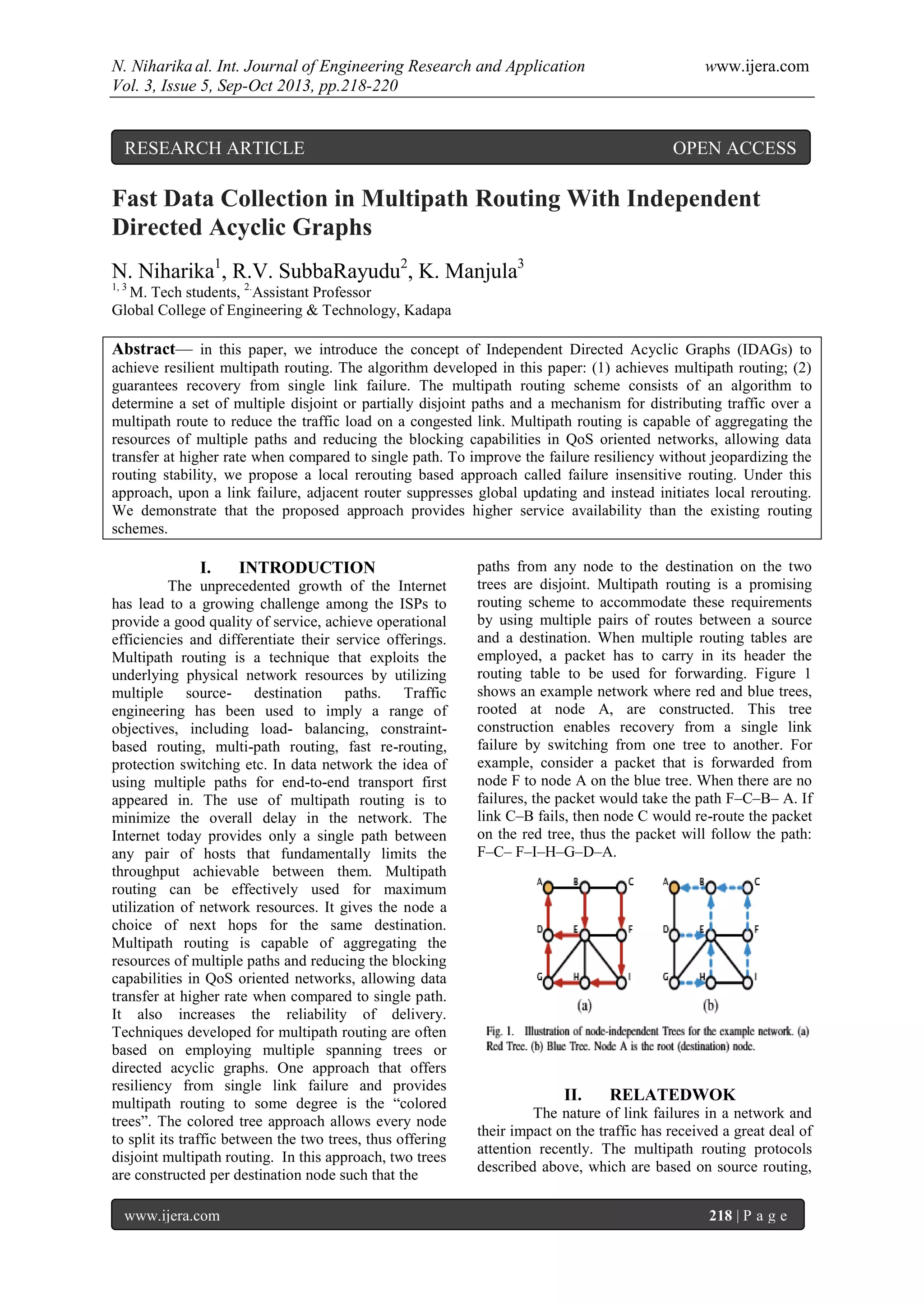
routing table to be used for forwarding. Figure 1
shows an example network where red and blue trees,
rooted at node A, are constructed. This tree
construction enables recovery from a single link
failure by switching from one tree to another. For
example, consider a packet that is forwarded from
node F to node A on the blue tree. When there are no
failures, the packet would take the path F–C–B– A. If
link C–B fails, then node C would re-route the packet
on the red tree, thus the packet will follow the path:
F–C– F–I–H–G–D–A.
II. RELATEDWOK
The nature of link failures in a network and
their impact on the traffic has received a great deal of
attention recently. The multipath routing protocols
described above, which are based on source routing,
RESEARCH ARTICLE OPEN ACCESS
N. Niharika al. Int. Journal of Engineering Research and Application www.ijera.com
Vol. 3, Issue 5, Sep-Oct 2013, pp.218-220
www.ijera.com 219 | P a g e
allow the source node to compute multiple node or
edge-disjoint paths.
Basic concepts:
A network can be represented by a directed
graph G = (V, E) with node set V and link or edge set
E. The number of nodes and links in the network are
denoted by |V | and |E|, respectively. A path p is a
sequence of nodes such that from each node in the
path, there is a link to the next node in the sequence.
As an example, the path p = {s, i1, i2, ···, in, d}.
The Equal-Cost Multipath (ECMP) protocol
ECMP is a routing strategy where next-hop
packet forwarding to a single destination can occur
over multiple "best paths" which tie for top place in
routing metric calculations. Multipath routing can be
used in conjunction with most routing protocols,
since it is a per-hop decision that is limited to a single
router. With ECMP, a router potentially has several
available next hops towards a given destination.
A new gateway is chosen for each new
source/destination IP pair. The ECMP routes can be
created by routing protocols (RIP or OSPF), or by
adding a static route with multiple gateways,
separated by a comma (e.g., /ip route add
gateway=192.168.0.1, 192.168.1.1). The below is
architecture of ECMP. Thus with ECMP, OSPF can
route packets in a round robin fashion to the
destination via multiple equal cost paths.
In ECMP, a node implements multipath routing when
it discovers two or more shortest paths (of equal
length) to a destination node. This is a multi- path
routing extension for Internet routing protocols such
as OSPF and RIP. There are several drawbacks of
this approach:
(1) ECMP is not guaranteed to determine a multipath
route for each source-destination pair.
(2) The characteristics of the multipath route are not
taken into account.
(3) Packets are forwarded in equal proportion, on a
packet-by-packet basis.
Over view of Multipath Routing:
Multipath routing has been explored in
several different contexts. Traditional circuit switched
telephone networks used a type of multipath routing
called alternate path routing. Multiple paths can also
provide load balancing and route failure protection by
distributing traffic among a set of disjoint paths. The
below is example diagram of multipath routing.
Multipath routing has also been addressed in
data networks which are intended to support
connection-oriented service with QoS. Alternate or
multipath routing has typically lent itself to be of
more obvious use to connection-oriented networks;
call blocking probability is only relevant to
connection oriented networks.
Benefits of Multipath Routing:
 As mentioned before, multiple paths can provide
load balancing, fault-tolerance, and higher
aggregate bandwidth.
 Load balancing can be achieved by spreading the
traffic along multiple routes. From a fault
tolerance perspective, multipath routing can
provide route resilience.
III. INDEPENDENT DIRECTED
ACYCLIC GRAPHS
In order to achieve resilient multipath
routing, we introduce the concept of independent
directed acyclic graphs (IDAGs) in this paper. Link-
independent (node-independent) DAGs satisfy the
property that any path from a source to the root on
one DAG is link-disjoint (node-disjoint) with any
path from the source to the root on the other DAG.
Given a network, we develop polynomial-time
algorithms to compute link-independent and node-
independent DAGs. The algorithm developed in this
paper:
1) Provides multipath routing.
N. Niharika al. Int. Journal of Engineering Research and Application www.ijera.com
Vol. 3, Issue 5, Sep-Oct 2013, pp.218-220
www.ijera.com 220 | P a g e
2) Utilizes all possible edges
3) Guarantees recovery from single link failure
We show the effectiveness of the proposed IDAGs
approach by comparing key performance indices to
that of the independent trees and multiple pairs of
independent trees techniques through extensive
simulations.
IV. PERFORMANCE EVALUATION
OF INDEPENDENT DIRECT
ACYCLIC GRAPHS
A graph-based modeling technique has been
developed for the stochastic analysis of systems
containing concurrency. The basis of the technique is
the use of directed acyclic graphs. These graphs
represent event-precedence networks where activities
may occur serially, probabilistically, or concurrently.
When a set of activities occurs concurrently, the
condition for the set of activities to complete is that a
specified number of the activities must complete. We
consider four performance metrics:
(1) Average path length
(2) Number of paths
(4) Average link load. Multipath routing mechanism
creates more overheads but provides better
performance in congestion and capacity provided that
the route length is within a certain upper bound
which is derivable.
V. CONCLUSION
In this paper, we introduced the concept of
independent directed acyclic graphs (IDAGs) and
developed a methodology for resilient multipath
routing using two IDAGs. Through simulations, we
showed that the IDAGs approach performs
significantly better than the independent trees
approach in terms of increasing number of paths
offered. We proposed a failure insensitive routing
approach where routers infer link failures from the
packet’s flight and pre compute interface specific
forwarding tables avoiding the potentially failed
links. We also provide descriptions of a number of
multipath routing schemes proposed for wireless ad
hoc networks, aiming at showing various strategies of
utilizing multiple routings in wireless networks.
However, the method is impractical since it needs
many overhead bits in the packet header.
REFERENCES
[1] S. Cho, T. Elhourani,and S.
Ramasubramanian, “Resilient multipath
routing with independent directed
acyclic graphs,” in Proc. IEEE Int. Conf.
Commun., Cape Town, South Africa,
May 2010, pp. 1–5.
[2] Z. Ye, S. V. Krishnamurthy, and S. K.
Tripathi, “A framework for reliable
routing in mobile ad hoc networks,” in
Proc. IEEE INFOCOM, Apr. 2003, pp.
270–280.
[3] P. P. Pham and S. Perreau,
“Performance analysis of reactive
shortest path and multi-path routing
mechanism with load balance,” in Proc.
IEEE INFOCOM, 2003, pp. 251–259.
[4] J. Tsai and T. Moors, “A review of
multipath routing protocols: From
wireless ad hoc to mesh networks,” in
Proc. ACoRN Early Career Res.
Workshop Wireless Multihop Netw.,
Jul. 17–18, 2006, pp. 17–22.
[5] S. Murthy and J. Garcia-Luna-Aceves,
“Congestion-oriented shortest multipath
routing,” in Proc. IEEE INFOCOM,
Mar. 1996, vol. 3, pp.1028–1036.
[6] W. Lou, W. Liu, and Y. Fang, “A
simulation study of security
performance using multipath routing in
ad hoc networks,” in Proc. IEEE Veh.
Technol. Conf., Oct. 2003, vol. 3, pp.

Al35218220

  • 1.
    N. Niharika al.Int. Journal of Engineering Research and Application www.ijera.com Vol. 3, Issue 5, Sep-Oct 2013, pp.218-220 www.ijera.com 218 | P a g e Fast Data Collection in Multipath Routing With Independent Directed Acyclic Graphs N. Niharika1 , R.V. SubbaRayudu2 , K. Manjula3 1, 3 M. Tech students, 2. Assistant Professor Global College of Engineering & Technology, Kadapa Abstract— in this paper, we introduce the concept of Independent Directed Acyclic Graphs (IDAGs) to achieve resilient multipath routing. The algorithm developed in this paper: (1) achieves multipath routing; (2) guarantees recovery from single link failure. The multipath routing scheme consists of an algorithm to determine a set of multiple disjoint or partially disjoint paths and a mechanism for distributing traffic over a multipath route to reduce the traffic load on a congested link. Multipath routing is capable of aggregating the resources of multiple paths and reducing the blocking capabilities in QoS oriented networks, allowing data transfer at higher rate when compared to single path. To improve the failure resiliency without jeopardizing the routing stability, we propose a local rerouting based approach called failure insensitive routing. Under this approach, upon a link failure, adjacent router suppresses global updating and instead initiates local rerouting. We demonstrate that the proposed approach provides higher service availability than the existing routing schemes. I. INTRODUCTION The unprecedented growth of the Internet has lead to a growing challenge among the ISPs to provide a good quality of service, achieve operational efficiencies and differentiate their service offerings. Multipath routing is a technique that exploits the underlying physical network resources by utilizing multiple source- destination paths. Traffic engineering has been used to imply a range of objectives, including load- balancing, constraint- based routing, multi-path routing, fast re-routing, protection switching etc. In data network the idea of using multiple paths for end-to-end transport first appeared in. The use of multipath routing is to minimize the overall delay in the network. The Internet today provides only a single path between any pair of hosts that fundamentally limits the throughput achievable between them. Multipath routing can be effectively used for maximum utilization of network resources. It gives the node a choice of next hops for the same destination. Multipath routing is capable of aggregating the resources of multiple paths and reducing the blocking capabilities in QoS oriented networks, allowing data transfer at higher rate when compared to single path. It also increases the reliability of delivery. Techniques developed for multipath routing are often based on employing multiple spanning trees or directed acyclic graphs. One approach that offers resiliency from single link failure and provides multipath routing to some degree is the “colored trees”. The colored tree approach allows every node to split its traffic between the two trees, thus offering disjoint multipath routing. In this approach, two trees are constructed per destination node such that the paths from any node to the destination on the two trees are disjoint. Multipath routing is a promising routing scheme to accommodate these requirements by using multiple pairs of routes between a source and a destination. When multiple routing tables are employed, a packet has to carry in its header the routing table to be used for forwarding. Figure 1 shows an example network where red and blue trees, rooted at node A, are constructed. This tree construction enables recovery from a single link failure by switching from one tree to another. For example, consider a packet that is forwarded from node F to node A on the blue tree. When there are no failures, the packet would take the path F–C–B– A. If link C–B fails, then node C would re-route the packet on the red tree, thus the packet will follow the path: F–C– F–I–H–G–D–A. II. RELATEDWOK The nature of link failures in a network and their impact on the traffic has received a great deal of attention recently. The multipath routing protocols described above, which are based on source routing, RESEARCH ARTICLE OPEN ACCESS
  • 2.
    N. Niharika al.Int. Journal of Engineering Research and Application www.ijera.com Vol. 3, Issue 5, Sep-Oct 2013, pp.218-220 www.ijera.com 219 | P a g e allow the source node to compute multiple node or edge-disjoint paths. Basic concepts: A network can be represented by a directed graph G = (V, E) with node set V and link or edge set E. The number of nodes and links in the network are denoted by |V | and |E|, respectively. A path p is a sequence of nodes such that from each node in the path, there is a link to the next node in the sequence. As an example, the path p = {s, i1, i2, ···, in, d}. The Equal-Cost Multipath (ECMP) protocol ECMP is a routing strategy where next-hop packet forwarding to a single destination can occur over multiple "best paths" which tie for top place in routing metric calculations. Multipath routing can be used in conjunction with most routing protocols, since it is a per-hop decision that is limited to a single router. With ECMP, a router potentially has several available next hops towards a given destination. A new gateway is chosen for each new source/destination IP pair. The ECMP routes can be created by routing protocols (RIP or OSPF), or by adding a static route with multiple gateways, separated by a comma (e.g., /ip route add gateway=192.168.0.1, 192.168.1.1). The below is architecture of ECMP. Thus with ECMP, OSPF can route packets in a round robin fashion to the destination via multiple equal cost paths. In ECMP, a node implements multipath routing when it discovers two or more shortest paths (of equal length) to a destination node. This is a multi- path routing extension for Internet routing protocols such as OSPF and RIP. There are several drawbacks of this approach: (1) ECMP is not guaranteed to determine a multipath route for each source-destination pair. (2) The characteristics of the multipath route are not taken into account. (3) Packets are forwarded in equal proportion, on a packet-by-packet basis. Over view of Multipath Routing: Multipath routing has been explored in several different contexts. Traditional circuit switched telephone networks used a type of multipath routing called alternate path routing. Multiple paths can also provide load balancing and route failure protection by distributing traffic among a set of disjoint paths. The below is example diagram of multipath routing. Multipath routing has also been addressed in data networks which are intended to support connection-oriented service with QoS. Alternate or multipath routing has typically lent itself to be of more obvious use to connection-oriented networks; call blocking probability is only relevant to connection oriented networks. Benefits of Multipath Routing:  As mentioned before, multiple paths can provide load balancing, fault-tolerance, and higher aggregate bandwidth.  Load balancing can be achieved by spreading the traffic along multiple routes. From a fault tolerance perspective, multipath routing can provide route resilience. III. INDEPENDENT DIRECTED ACYCLIC GRAPHS In order to achieve resilient multipath routing, we introduce the concept of independent directed acyclic graphs (IDAGs) in this paper. Link- independent (node-independent) DAGs satisfy the property that any path from a source to the root on one DAG is link-disjoint (node-disjoint) with any path from the source to the root on the other DAG. Given a network, we develop polynomial-time algorithms to compute link-independent and node- independent DAGs. The algorithm developed in this paper: 1) Provides multipath routing.
  • 3.
    N. Niharika al.Int. Journal of Engineering Research and Application www.ijera.com Vol. 3, Issue 5, Sep-Oct 2013, pp.218-220 www.ijera.com 220 | P a g e 2) Utilizes all possible edges 3) Guarantees recovery from single link failure We show the effectiveness of the proposed IDAGs approach by comparing key performance indices to that of the independent trees and multiple pairs of independent trees techniques through extensive simulations. IV. PERFORMANCE EVALUATION OF INDEPENDENT DIRECT ACYCLIC GRAPHS A graph-based modeling technique has been developed for the stochastic analysis of systems containing concurrency. The basis of the technique is the use of directed acyclic graphs. These graphs represent event-precedence networks where activities may occur serially, probabilistically, or concurrently. When a set of activities occurs concurrently, the condition for the set of activities to complete is that a specified number of the activities must complete. We consider four performance metrics: (1) Average path length (2) Number of paths (4) Average link load. Multipath routing mechanism creates more overheads but provides better performance in congestion and capacity provided that the route length is within a certain upper bound which is derivable. V. CONCLUSION In this paper, we introduced the concept of independent directed acyclic graphs (IDAGs) and developed a methodology for resilient multipath routing using two IDAGs. Through simulations, we showed that the IDAGs approach performs significantly better than the independent trees approach in terms of increasing number of paths offered. We proposed a failure insensitive routing approach where routers infer link failures from the packet’s flight and pre compute interface specific forwarding tables avoiding the potentially failed links. We also provide descriptions of a number of multipath routing schemes proposed for wireless ad hoc networks, aiming at showing various strategies of utilizing multiple routings in wireless networks. However, the method is impractical since it needs many overhead bits in the packet header. REFERENCES [1] S. Cho, T. Elhourani,and S. Ramasubramanian, “Resilient multipath routing with independent directed acyclic graphs,” in Proc. IEEE Int. Conf. Commun., Cape Town, South Africa, May 2010, pp. 1–5. [2] Z. Ye, S. V. Krishnamurthy, and S. K. Tripathi, “A framework for reliable routing in mobile ad hoc networks,” in Proc. IEEE INFOCOM, Apr. 2003, pp. 270–280. [3] P. P. Pham and S. Perreau, “Performance analysis of reactive shortest path and multi-path routing mechanism with load balance,” in Proc. IEEE INFOCOM, 2003, pp. 251–259. [4] J. Tsai and T. Moors, “A review of multipath routing protocols: From wireless ad hoc to mesh networks,” in Proc. ACoRN Early Career Res. Workshop Wireless Multihop Netw., Jul. 17–18, 2006, pp. 17–22. [5] S. Murthy and J. Garcia-Luna-Aceves, “Congestion-oriented shortest multipath routing,” in Proc. IEEE INFOCOM, Mar. 1996, vol. 3, pp.1028–1036. [6] W. Lou, W. Liu, and Y. Fang, “A simulation study of security performance using multipath routing in ad hoc networks,” in Proc. IEEE Veh. Technol. Conf., Oct. 2003, vol. 3, pp.