Trends in Air Quality

            •        Our air quality has been improving
                     -         Air quality in ‘Good’ range 96% of the time in 2011 compared
                               to 82% 10 years ago
                                                      AIR QUALITY IN TERMS OF PSI
                                                            ( 1993 TO 2011 )

            100
                                                                                                    93 88    88              95   96
                                                                                       83                              85              91   93   96
                                                                                              82
                80                                           70                  70
                         68
% of Days


                                            64                         65
                                      61
                60             4946                   4948
                                       39
                40        32                     36                         35
                                                                  30              30

                                                                                         17    18
                20                                                                                      12        12    14
                                                                                                    7                        5    4    9    7    4
                0
                         93 94 95 96 97 98 99 00 01 02 03 04 05 06 07 08 09 10 11

                                             Good                                     Moderate                    Unhealthy
Trends in Air Quality
                                            PM10 (Annual Mean)
         80   Transboundary haze with
              Unhealthy air quality days                       Transboundary haze with
                                                               Unhealthy air quality
 µg/m3


         60
                                                               days

         40

         20

          0
           1994 1995 1996 1997 1998 1999 2000 2001 2002 2003 2004 2005 2006 2007 2008 2009 2010 2011

                                           PM2.5 (Annual Mean)
        45                                                  Euro IV Emission
                                            Ultra Low       Standards for
                                            Sulphur         Diesel Vehicles
        35                                  Diesel          from Oct 2006
                                            (<0.005% S)
µg/m3


                                            from Dec
        25                                  2005

        15

         5
         1998 1999 2000 2001 2002 2003 2004 2005 2006 2007 2008 2009 2010                        2011
Trends in Air Quality
                                 Sulphur Dioxide (Annual Mean)
        50

        40             Limit S content n                             Ultra Low
                                             Natural gas for power   Sulphur Diesel
                       fuel oil to 1% from   generation
        30             Dec 2005.                                     (<0.005% S)
                                                                     from Dec 2005
        20

        10

         0
          1994 1995 1996 1997 1998 1999 2000 2001 2002 2003 2004 2005 2006 2007 2008 2009 2010 2011

        50
                                     Ozone (Annual Mean)
        40
µg/m3


        30

        20

        10

         0
         1994 1995 1996 1997 1998 1999 2000 2001 2002 2003 2004 2005 2006 2007 2008 2009 2010 2011
Trends in Air Quality

                                  Carbon Monoxide (Annual Mean)
        10

         8

         6
mg/m3


         4

         2

         0
          1994 1995 1996 1997 1998 1999 2000 2001 2002 2003 2004 2005 2006 2007 2008 2009 2010 2011
                                 Nitrogen Dioxide (Annual Mean)
        50

        40
µg/m3


        30

        20

        10

         0
          1994 1995 1996 1997 1998 1999 2000 2001 2002 2003 2004 2005 2006 2007 2008 2009 2010 2011
Air Quality Benchmarked Against Asian Cities - Asian Green City Index


The Asian Green City Index, a 2011 research project by the Economist Intelligence
Unit, sponsored by Siemens, assessed the environmental performance of 22 Asian cities
across       8      criteria       (Energy      and         CO2,    Land       use     and
Buildings, Transport, Waste, Water, Sanitation, Air Quality, and Environmental Governance).
The chart compares the air quality data presented in the report.
Air Quality Benchmarked Against European and US Cities

                 80


                 70                                                   SO2        NO2   PM10   PM2.5

                 60
Annual Average


                 50


                 40


                 30


                 20


                 10


                 0
                                     Los Angeles (2011)   Washington DC (2011)


                 Compiled by NEA from various published sources
2   Air Pollution and Control Strategies
Air Pollution and Control Strategies

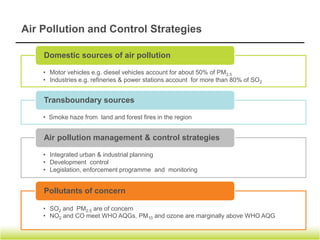
    Domestic sources of air pollution

    • Motor vehicles e.g. diesel vehicles account for about 50% of PM2.5
    • Industries e.g. refineries & power stations account for more than 80% of SO2


    Transboundary sources

    • Smoke haze from land and forest fires in the region


    Air pollution management & control strategies

    • Integrated urban & industrial planning
    • Development control
    • Legislation, enforcement programme and monitoring


    Pollutants of concern

    • SO2 and PM2.5 are of concern
    • NO2 and CO meet WHO AQGs. PM10 and ozone are marginally above WHO AQG
3   Air Quality Targets for Singapore
2020 Air Quality Targets for Singapore

 Pollutant                    Singapore Targets                   Long Term Targets
                                  By 2020
 Sulphur dioxide (SO2)    24-hour mean : 50 µg/m3             24-hour mean : 20 µg/m3
                          (WHO Interim Target)                (WHO Final)
                          Annual mean : 15 µg/m3
                          (Sustainable Singapore Blueprint)
 PM2.5                    Annual mean: 12 µg/m3               Annual mean: 10 µg/m3
                          (Sustainable Singapore Blueprint)   24-hour mean: 25 µg/m3
                          24-hour mean: 37.5 µg/m3            (WHO Final)
                          (WHO Interim Target)
 PM10                                             Annual mean: 20 µg/m3
                                                  24-hour mean: 50 µg/m3
                                                       (WHO Final)
 Ozone                                            8-hour mean: 100 µg/m3
                                                       (WHO Final)

 Nitrogen dioxide (NO2)                           Annual mean: 40 µg/m3
                                                  1-hour mean: 200 µg/m3
                                                       (WHO Final)
 Carbon monoxide (CO)                             8-hour mean: 10 mg/m3
                                                  1-hour mean: 30 mg/m3
                                                       (WHO Final)
3   Roadmap to Achieve Targets
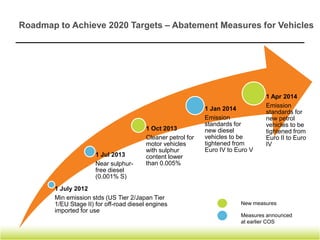
Roadmap to Achieve 2020 Targets – Abatement Measures for Vehicles


                                                                                  1 Apr 2014
                                                                                  Emission
                                                              1 Jan 2014
                                                                                  standards for
                                                              Emission            new petrol
                                                              standards for       vehicles to be
                                         1 Oct 2013           new diesel          tightened from
                                         Cleaner petrol for   vehicles to be      Euro II to Euro
                                         motor vehicles       tightened from      IV
                                         with sulphur         Euro IV to Euro V
                      1 Jul 2013         content lower
                      Near sulphur-      than 0.005%
                      free diesel
                      (0.001% S)
       1 July 2012
       Min emission stds (US Tier 2/Japan Tier
       1/EU Stage II) for off-road diesel engines                         New measures
       imported for use
                                                                          Measures announced
                                                                          at earlier COS
Roadmap to Achieve 2020 Targets – Abatement Measures for Industries


 Reduce SO2 emissions from refineries

  • Cleaner fuels such as natural gas and lower sulphur fuel oil

  • Improve sulphur recovery processes

  • Adopt cost effective measures and practices to further reduce emissions eg.
    SO2 scrubbing system


 Reduce SO2 emissions from power stations

   •Currently, gencos use mainly natural gas (NG) and some fuel oil for
   power generation
   • Gencos will increase use of NG and lower sulphur fuel oil
4   Enhancements to Air Quality
    Reporting
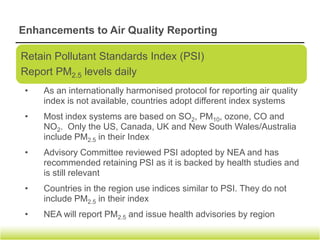
Enhancements to Air Quality Reporting

Retain Pollutant Standards Index (PSI)
Report PM2.5 levels daily
 •   As an internationally harmonised protocol for reporting air quality
     index is not available, countries adopt different index systems
 •   Most index systems are based on SO2, PM10, ozone, CO and
     NO2. Only the US, Canada, UK and New South Wales/Australia
     include PM2.5 in their Index
 •   Advisory Committee reviewed PSI adopted by NEA and has
     recommended retaining PSI as it is backed by health studies and
     is still relevant
 •   Countries in the region use indices similar to PSI. They do not
     include PM2.5 in their index
 •   NEA will report PM2.5 and issue health advisories by region
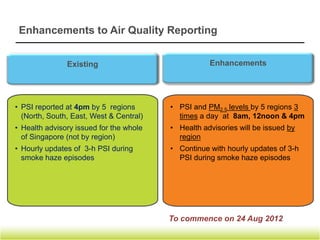
Enhancements to Air Quality Reporting


               Existing                             Enhancements


• PSI reported at 4pm by 5 regions       • PSI and PM2.5 levels by 5 regions 3
  (North, South, East, West & Central)     times a day at 8am, 12noon & 4pm
• Health advisory issued for the whole   • Health advisories will be issued by
  of Singapore (not by region)             region
• Hourly updates of 3-h PSI during       • Continue with hourly updates of 3-h
  smoke haze episodes                      PSI during smoke haze episodes


                                         To commence on 24 Aug 2012
Example of Air Quality Information Posted on NEA Website
       PSI               Pollutant Concentration

                          Air Quality at 8 am on 17 Aug 2012
       Region                                                                                       Health Advisory
                                               24-hour PM2.5
                               PSI
                                            Concentration (µg/m3)

                                                                        None for the general population. Unusually sensitive people
         North                 44                       34
                                                                        should consider reducing prolonged or heavy exertion.
                                                                        None for the general population. Unusually sensitive people
        South                  34                       20
                                                                        should consider reducing prolonged or heavy exertion.
                                                                        None for the general population. Unusually sensitive people
         East                  42                       26
                                                                        should consider reducing prolonged or heavy exertion.
                                                                        None for the general population. Unusually sensitive people
         West                  41                       27
                                                                        should consider reducing prolonged or heavy exertion.
                                                                        None for the general population. Unusually sensitive people
        Central                39                       19
                                                                        should consider reducing prolonged or heavy exertion.
 Overall Singapore           34 - 44                 19 - 34                                               -

*Sensitive groups : People with heart and lung diseases, older adults (ages 65 and above) and children.
 Note: Air quality based on PSI is as follows:
 PSI Value        Air Quality Descriptor
 0 – 50                  Good
 51 – 100               Moderate
 101 – 200              Unhealthy
 201 – 300            Very unhealthy
 Above 300              Hazardous
Safeguard • Nurture • Cherish

Air quality 2012

  • 1.
    Trends in AirQuality • Our air quality has been improving - Air quality in ‘Good’ range 96% of the time in 2011 compared to 82% 10 years ago AIR QUALITY IN TERMS OF PSI ( 1993 TO 2011 ) 100 93 88 88 95 96 83 85 91 93 96 82 80 70 70 68 % of Days 64 65 61 60 4946 4948 39 40 32 36 35 30 30 17 18 20 12 12 14 7 5 4 9 7 4 0 93 94 95 96 97 98 99 00 01 02 03 04 05 06 07 08 09 10 11 Good Moderate Unhealthy
  • 2.
    Trends in AirQuality PM10 (Annual Mean) 80 Transboundary haze with Unhealthy air quality days Transboundary haze with Unhealthy air quality µg/m3 60 days 40 20 0 1994 1995 1996 1997 1998 1999 2000 2001 2002 2003 2004 2005 2006 2007 2008 2009 2010 2011 PM2.5 (Annual Mean) 45 Euro IV Emission Ultra Low Standards for Sulphur Diesel Vehicles 35 Diesel from Oct 2006 (<0.005% S) µg/m3 from Dec 25 2005 15 5 1998 1999 2000 2001 2002 2003 2004 2005 2006 2007 2008 2009 2010 2011
  • 3.
    Trends in AirQuality Sulphur Dioxide (Annual Mean) 50 40 Limit S content n Ultra Low Natural gas for power Sulphur Diesel fuel oil to 1% from generation 30 Dec 2005. (<0.005% S) from Dec 2005 20 10 0 1994 1995 1996 1997 1998 1999 2000 2001 2002 2003 2004 2005 2006 2007 2008 2009 2010 2011 50 Ozone (Annual Mean) 40 µg/m3 30 20 10 0 1994 1995 1996 1997 1998 1999 2000 2001 2002 2003 2004 2005 2006 2007 2008 2009 2010 2011
  • 4.
    Trends in AirQuality Carbon Monoxide (Annual Mean) 10 8 6 mg/m3 4 2 0 1994 1995 1996 1997 1998 1999 2000 2001 2002 2003 2004 2005 2006 2007 2008 2009 2010 2011 Nitrogen Dioxide (Annual Mean) 50 40 µg/m3 30 20 10 0 1994 1995 1996 1997 1998 1999 2000 2001 2002 2003 2004 2005 2006 2007 2008 2009 2010 2011
  • 5.
    Air Quality BenchmarkedAgainst Asian Cities - Asian Green City Index The Asian Green City Index, a 2011 research project by the Economist Intelligence Unit, sponsored by Siemens, assessed the environmental performance of 22 Asian cities across 8 criteria (Energy and CO2, Land use and Buildings, Transport, Waste, Water, Sanitation, Air Quality, and Environmental Governance). The chart compares the air quality data presented in the report.
  • 6.
    Air Quality BenchmarkedAgainst European and US Cities 80 70 SO2 NO2 PM10 PM2.5 60 Annual Average 50 40 30 20 10 0 Los Angeles (2011) Washington DC (2011) Compiled by NEA from various published sources
  • 7.
    2 Air Pollution and Control Strategies
  • 8.
    Air Pollution andControl Strategies Domestic sources of air pollution • Motor vehicles e.g. diesel vehicles account for about 50% of PM2.5 • Industries e.g. refineries & power stations account for more than 80% of SO2 Transboundary sources • Smoke haze from land and forest fires in the region Air pollution management & control strategies • Integrated urban & industrial planning • Development control • Legislation, enforcement programme and monitoring Pollutants of concern • SO2 and PM2.5 are of concern • NO2 and CO meet WHO AQGs. PM10 and ozone are marginally above WHO AQG
  • 9.
    3 Air Quality Targets for Singapore
  • 10.
    2020 Air QualityTargets for Singapore Pollutant Singapore Targets Long Term Targets By 2020 Sulphur dioxide (SO2) 24-hour mean : 50 µg/m3 24-hour mean : 20 µg/m3 (WHO Interim Target) (WHO Final) Annual mean : 15 µg/m3 (Sustainable Singapore Blueprint) PM2.5 Annual mean: 12 µg/m3 Annual mean: 10 µg/m3 (Sustainable Singapore Blueprint) 24-hour mean: 25 µg/m3 24-hour mean: 37.5 µg/m3 (WHO Final) (WHO Interim Target) PM10 Annual mean: 20 µg/m3 24-hour mean: 50 µg/m3 (WHO Final) Ozone 8-hour mean: 100 µg/m3 (WHO Final) Nitrogen dioxide (NO2) Annual mean: 40 µg/m3 1-hour mean: 200 µg/m3 (WHO Final) Carbon monoxide (CO) 8-hour mean: 10 mg/m3 1-hour mean: 30 mg/m3 (WHO Final)
  • 11.
    3 Roadmap to Achieve Targets
  • 12.
    Roadmap to Achieve2020 Targets – Abatement Measures for Vehicles 1 Apr 2014 Emission 1 Jan 2014 standards for Emission new petrol standards for vehicles to be 1 Oct 2013 new diesel tightened from Cleaner petrol for vehicles to be Euro II to Euro motor vehicles tightened from IV with sulphur Euro IV to Euro V 1 Jul 2013 content lower Near sulphur- than 0.005% free diesel (0.001% S) 1 July 2012 Min emission stds (US Tier 2/Japan Tier 1/EU Stage II) for off-road diesel engines New measures imported for use Measures announced at earlier COS
  • 13.
    Roadmap to Achieve2020 Targets – Abatement Measures for Industries Reduce SO2 emissions from refineries • Cleaner fuels such as natural gas and lower sulphur fuel oil • Improve sulphur recovery processes • Adopt cost effective measures and practices to further reduce emissions eg. SO2 scrubbing system Reduce SO2 emissions from power stations •Currently, gencos use mainly natural gas (NG) and some fuel oil for power generation • Gencos will increase use of NG and lower sulphur fuel oil
  • 14.
    4 Enhancements to Air Quality Reporting
  • 15.
    Enhancements to AirQuality Reporting Retain Pollutant Standards Index (PSI) Report PM2.5 levels daily • As an internationally harmonised protocol for reporting air quality index is not available, countries adopt different index systems • Most index systems are based on SO2, PM10, ozone, CO and NO2. Only the US, Canada, UK and New South Wales/Australia include PM2.5 in their Index • Advisory Committee reviewed PSI adopted by NEA and has recommended retaining PSI as it is backed by health studies and is still relevant • Countries in the region use indices similar to PSI. They do not include PM2.5 in their index • NEA will report PM2.5 and issue health advisories by region
  • 16.
    Enhancements to AirQuality Reporting Existing Enhancements • PSI reported at 4pm by 5 regions • PSI and PM2.5 levels by 5 regions 3 (North, South, East, West & Central) times a day at 8am, 12noon & 4pm • Health advisory issued for the whole • Health advisories will be issued by of Singapore (not by region) region • Hourly updates of 3-h PSI during • Continue with hourly updates of 3-h smoke haze episodes PSI during smoke haze episodes To commence on 24 Aug 2012
  • 17.
    Example of AirQuality Information Posted on NEA Website PSI Pollutant Concentration Air Quality at 8 am on 17 Aug 2012 Region Health Advisory 24-hour PM2.5 PSI Concentration (µg/m3) None for the general population. Unusually sensitive people North 44 34 should consider reducing prolonged or heavy exertion. None for the general population. Unusually sensitive people South 34 20 should consider reducing prolonged or heavy exertion. None for the general population. Unusually sensitive people East 42 26 should consider reducing prolonged or heavy exertion. None for the general population. Unusually sensitive people West 41 27 should consider reducing prolonged or heavy exertion. None for the general population. Unusually sensitive people Central 39 19 should consider reducing prolonged or heavy exertion. Overall Singapore 34 - 44 19 - 34 - *Sensitive groups : People with heart and lung diseases, older adults (ages 65 and above) and children. Note: Air quality based on PSI is as follows: PSI Value Air Quality Descriptor 0 – 50 Good 51 – 100 Moderate 101 – 200 Unhealthy 201 – 300 Very unhealthy Above 300 Hazardous
  • 18.

Editor's Notes

  • #13 Notes:-WHO does not set standard for SO2 annual mean. The annual mean of 15μg/m3 to be met by 2020 as set out under SSB is retained.-WHO IT-3 target of 37.5 µg/m3 for PM2.5 (24-hour mean) and 15 µg/m3 for PM2.5 (annual mean) is recommended by Advisory Committee. SSB target for PM2.5 annual mean of 12μg/m3 supersede WHO IT-3 of 15μg/m3, and corresponding 24-h target of 37.5μg/m3 is retained.-The WHO AQG Global Update 2005 recommend revised limits for the concentration of selected air pollutants: PM10, PM2.5, ozone, NO2 and SO2, but the earlier WHO AQG update in 1997 for the rest of the air pollutants, including CO is retained.
  • #14 Notes:-WHO does not set standard for SO2 annual mean. The annual mean of 15μg/m3 to be met by 2020 as set out under SSB is retained.-WHO IT-3 target of 37.5 µg/m3 for PM2.5 (24-hour mean) and 15 µg/m3 for PM2.5 (annual mean) is recommended by Advisory Committee. SSB target for PM2.5 annual mean of 12μg/m3 supersede WHO IT-3 of 15μg/m3, and corresponding 24-h target of 37.5μg/m3 is retained.-The WHO AQG Global Update 2005 recommend revised limits for the concentration of selected air pollutants: PM10, PM2.5, ozone, NO2 and SO2, but the earlier WHO AQG update in 1997 for the rest of the air pollutants, including CO is retained.