11
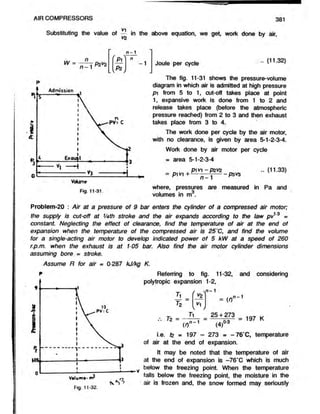
AIR COMPRESSORS
11.1 Introduction
Air compressors are used for supplying high-pressure air. There are many uses of
high-pressure air in the industry. The main uses of high-pressure (compressed) air are :
.. to drive compressed air engines (air motors) used in coal mines,
.. to inject or spray fuel into the cylinder of a Diesel engine (air injection Diesel engine),
to operate drills, hammers, air brakes for locomotives and railway carnages, water
pumps and paint sprays,
.. to start large (heavy) Diesel engines,
.. to clean workshop machines, generators, automobile vehicles, etc.,
.. to operate blast furnaces, gas turbine plants, Bessemer convertors used in steel plants,
etc.,
.. to cool large buildings and air crafts, and
.. to supercharge I.C. engines.
There are mainly two types of air compressors viz. reciprocating air compressors
and rotary air compressors. Reciprocating air compressors are similar to reciprocating
engines where a piston reciprocates inside a cylinder. In rotary air compressors, air is
compressed due to rotation of impeller or blades inside a casing. Air compressors are
driven by engines or electric motors. In this chapter the theory of reciprocating air
compressors is discussed in details and principles of working of reciprocating compressed
air motors and rotary compressors are explained in brief.
11.2 Reciprocating Air Compressors
The principal parts of a reciprocating air compressor are the same as that for a
engine. The reciprocating air compressor may be single-acting (air is admitted to one
side of the piston only) or double-acting (air is admitted to each side of the piston
alternatively), and may be single-stage or multi-stage. In a multi-stage compressor, the
air is compressed in several stages instead of compressing the air fully in a single
cylinder. This is equivalent to a number of compressors arranged in series. The pressure
of air is increased in each stage. Single-stage compressors are used for delivery
pressures upto 10 bar, three-stage compressors for pressure upto 200 bar and two-stage
compressors for pressures in between 10 to 200 bar. The average piston speed of a
reciprocating air compressor is limited to about 300 to 400 metres per minute to reduce
friction wear.
11.3 Single-stage Air Compressor
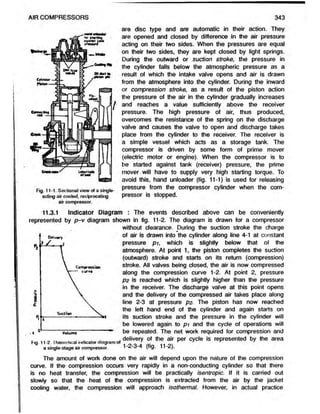
The sectional view of an air cooled, single-stage, single-acting reciprocating air
compressor is shown in fig. 11-1. Both intake (suction) and discharge (delivery) valves
AIR COMPRESSORS 343
CyliMtr
Piston
Fig. 11-1. Sectional view of a single-
acting air cooled, reciprocating
air compressor.
are disc type and are automatic in their action. They
are opened and closed by difference in the air pressure
acting on their two sides. When the pressures are equal
on their two sides, they are kept closed by light springs.
During the outward or suction stroke, the pressure in
the cylinder falls below the atmospheric pressure as a
result of which the intake valve opens and air is drawn
from the atmosphere into the cylinder. During the inward
or compression stroke, as a result of the piston action
the pressure of the air in the cylinder gradually increases
and reaches a value sufficiently above the receiver
pressure. The high pressure of air, thus produced,
overcomes the resistance of the spring on the discharge
valve and causes the valve to open and discharge takes
place from the cylinder to the receiver. The receiver is
a simple vessel which acts as a storage tank. The
compressor is driven by some form of prime mover
(electric motor or engine). When the compressor is to
be started against tank (receiver) pressure, the prime
mover will have to supply very high starting torque. To
avoid this, hand unloader (fig. 11-1) is used for releasing
pressure from the compressor cylinder when the com-
pressor is stopped.
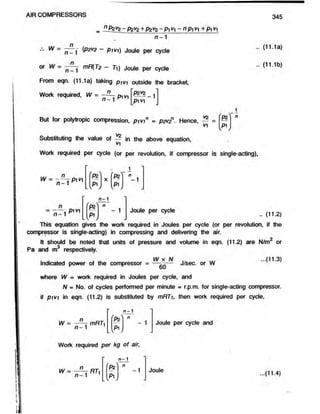
11.3.1Indicator Diagram : The events described above can be conveniently
represented byp-vdiagram shown in fig. 11-2. The diagram is drawn for a compressor
without clearance. During the suction stroke the charge
of air is drawn into the cylinder along line 4-1 at constant
pressure pi, which is slightly below that of the
atmosphere. At point 1, the piston completes the suction
(outward) stroke and starts on its return (compression)
stroke. All valves being closed, the air is now compressed
along the compression curve 1-2. At point 2, pressure
P2 is reached which is slightly higher than the pressure
in the receiver. The discharge valve at this point opens
and the delivery of the compressed air takes place along
line 2-3 at pressure p2. The piston has now reached
the left hand end of the cylinder and again starts on
its suction stroke and the pressure in the cylinder will
be lowered again to p i and the cycle of operations will
be repeated. The net work required for compression and
.delivery of the air per cycle is represented by the area
Fig. 11-2. I heorotical indicator diagram of i i O V
a single-stage air compressor. l-Z -o -4 (tig. 11-2).
The amount of work done on the air will depend upon the nature of the compression
curve. If the compression occurs very rapidly in a non-conducting cylinder so that there
is no heat transfer, the compression will be practically isentropic. If it is carried out
slowly so that the heat of the compression is extracted from the air by the jacket
cooling water, the compression will approach isothermal. However, in actual practice
344 ELEMENTS OF HEAT ENGINES Vol.l
neither of these conditions can be fulfilled and the actual compression will be between
isentropic and isothermal.
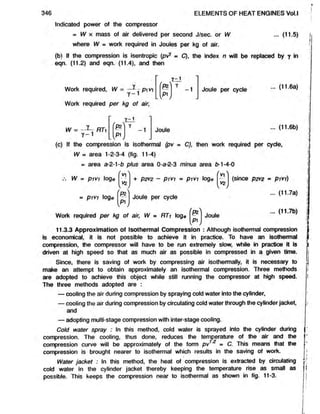
11.3.2 Isothermal Compression Versus Isentropic Compression : The slope of
the compression curve, represented by the law pt/1 = C, depends upon the value of
the index n. A large value of n will give comparatively a steeper curve. The law for
an isothermal or hyperbolic compression is pv = C, where the value of index n is
unity.The law for an isentropic compression is pvy = C. Since the value of y for air
is 1.4,the isentropic curve will be steeper than isothermal curve. Figure 11-3 shows
curves representing an isentropic compression (1-2’) and an isothermal compression
(1-2"). The middle curve (1-2) shows curve, which is obtained in actual practice. The
curve is polytropic (pi/1 = C) having a value of n nearly equal to 1-3 for the water
cooled cylinder.
The isentropic work required to be done per cycle
on the air is represented by the area 4-1-2’-3 (fig. 11-3).
If the compression carried out had been isothermal, the
slope of the compression curve would be less than that
of isentropic and the isothermal work done would be
represented by the area 4-1-2"-3 which is evidently less
than the isentropic work done represented by the area
4-1-2-3. Therefore, it follows that an isothermal com-
pression is economical and efficient, since less work is
required to carry it out, while an isentropic compression
requires more amount of work to be supplied. Compres-
sion curve with values of index n between 1 and 1.4
will fall within the isothermal and isentropic curves. Thus,
it will be seen that the work required for compression
and delivery of air per cycle decreases as the value of
Fig. 11 3. Effect of nature of compression p decreases,
curve on work required for compression.
The theoretical indicator diagram for a single-stage compressor without clearance
is shown in fig. 11-4. Let p i in N/m2 (newtons per square metre) or Pa (pascals) and
*3 represent initial
C o m p ressed air
discharge to receiver
c
0
Q
.
Piston driven
from external
so u rce
V s / / / / / u r n
PV-. constant
^cJuu^u
h Y H
E==—1
a
- V ,-------
b
Volum
e
Fig. 11-4. Single-stage air compressor without clearance.
vy in m
condition of the air before
compression, and pz in
N/m = Pa, the final
delivery pressure after
compression, Then,
(a) Work required to
be done on the air W,
per cycle assuming com-
pression curve to be
polytropic,i.e., pt/* = C, is
given by area 1-2-3-4 of
fig. 11-4.
Now area, 1-2-3-4 = area 0-a-2-3 plus area a-2-1-fc minus area £
>
-1-4-0
P2V
0—
Pi V]
= p2V2+ ^ 2
- ; ^ - p i V i
AIR COMPRESSORS 345
= 0P2V
2 - PzV2+ P2V
2 - P M - " P M +P1^1
n -1
n
^ ~ n _'- (P2V
2 - pivi) Joule per cycle
o r w = mR(T2 - 7i) Joule per cycle
From eqn. (11.1a) taking pjy* outside the bracket,
.. (1i:ia)
.. (11.1b)
Work required, W =
n
n - 1 Pivi 1
pw
But for polytropic compression, pivin = p2V
2n. Hence, — =
v
Substituting the value of £ in the above equation,
Work
w
S 's
v
-1
required per cycle (or per revolution, if compressor is single-acting),
1
us n
W = - - — p i vt X
'k '1 n
- 1
W [ p i j
n —1
P1V1
1
c
(p z )
-----------
1
1
c
&
Joule per cycle
.. (11.2)
This equation gives the work required in Joules per cycle (or per revolution, if the
compressor is single-acting) in compressing and delivering the air.
It should be noted that units of pressure and volume in eqn. (11.2) are N/m2 or
Pa and m3 respectively.
. ^ W x N ... ...(11.3)
Indicated power of the compressor = —- - — J/sec. or W
where W = work required in Joules per cycle, and
N - No. of cycles performed per minute - r.p.m. for single-acting compressor,
if p ivi in eqn. (11.2) is substituted by mRTi, then work required per cycle,
n -1
(Pz
1
1
c
( p ij
W = — mRTi
n - 1
Work required per kg of air,
Joule per cycle and
W =
n
n - 1
RT,
-
n - 1
'P i
1
1
c
[ p ij
Joule ...(11.4)
Indicated power of the compressor
= W x mass of air delivered per second J/sec. or W ... (11.5)
where W = work required in Joules per kg of air.
(b) If the compression is isentropic (pvT = C), the index n will be replaced by y in
eqn. (11.2) and eqn. (11.4), and then
346 ELEMENTS OF HEAT ENGINES Vol.l
Work required, W =
Work required per kg of air,
W =
Y - 1
.1-1 1
— pv
y -1 r
pst 7 -1 Joule per cycle ... (11.6a)
n
Y -1
Pi
V J
Joule (11.6b)
(c) If the compression is isothermal (pv = C), then work required per cycle,
W » area 1-2-3-4 (fig. 11-4)
= area a-2-1-b plus area 0-a-2-3 minus area b-1-4-0
Y
V
2
.
W = P 1 V1 loge
= P1V1 loge
+ P2V2 - P 1 V1 rn P1V1 loge
py
Joule per cycle
(since P2V
2 - pivi)
... (11.7a)
Work required per kg of air, W - RTi loge v
pi
Joule
(11.7b)
11.3.3 Approximation of Isothermal Compression : Although isothermal compression
is economical, it is not possible to achieve it in practice. To have an isothermal
compression, the compressor will have to be run extremely slow, while in practice it is
driven at high speed so that as much air as possible in compressed in a given time.
Since, there is saving of work by compressing air isothermally, it is necessary to
make an attempt to obtain approximately an isothermal compression. Three methods
are adopted to achieve this object while still running the compressor at high speed.
The three methods adopted are :
— cooling the air during compression by spraying cold water into the cylinder,
— cooling the air during compression by circulating cold water through the cylinderjacket,
and
— adopting multi-stage compression with inter-stage cooling.
Cold water spray : In this method, cold water is sprayed into the cylinder during
compression. The cooling, thus done, reduces the temperature of the air and the
compression curve will be approximately of the form pv1 = C. This means that the
compression is brought nearer to isothermal which results in the saving of work.
Water jacket : In this method, the heat of compression is extracted by circulating
cold water in the cylinder jacket thereby keeping the temperature rise as small as
possible. This keeps the compression near to isothermal as shown in fig. 11-3.
AIR COMPRESSORS 347
Multi-stage compression : In this method, the compression of air is carried out in
two ormore stages in separate cylinders. The pressure of the air is increased in each
stage. It is a common practice to provide intercoolers between the cylinders of multi-stage
compressor, for the purpose of cooling the compressed air to atmospheric (intake)
temperature before entering the succeeding (next) stage. It is this cooling between the
cylinders that keeps the compression very near to isothermal as shown in fig. 11-6.
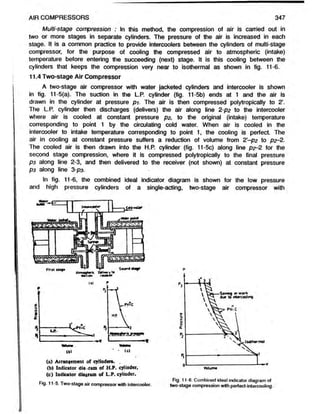
11.4 Two-stage Air Compressor
A two-stage air compressor with water jacketed cylinders and intercooler is shown
in fig. 11-5(a). The suction in the L.P. cylinder (tig. 11-5b) ends at 1 and the air is
drawn in the cylinder at pressure pi. The air is then compressed polytropically to 2’.
The L.P. cylinder then discharges (delivers) the air along line 2-p2 to the intercooler
where air is cooled at constant pressure pa to the original (intake) temperature
corresponding to point 1 by the circulating cold water. When air is cooled in the
intercooler to intake temperature corresponding to point 1, the cooling is perfect. The
air in cooling at constant pressure suffers a reduction of volume from 2'-p2 to p2- 2.
The cooled air is then drawn into the H.P. cylinder (fig. 11-5c) along line p2- 2 for the
second stage compression, where it is compressed polytropically to the final pressure
P3 along line 2-3, and then delivered to the receiver (not shown) at constant pressure
P3 along line 3-p3.
In fig. 11-6, the combined ideal indicator diagram is shown for the low pressure
and high pressure cylinders of a single-acting, two-stage air compressor with
(«
) *
lb) • •«*
(a) Arrangement of cylinder*.
(b) Indicator dia<ram of H.P. cylinder,
(c) Indicator diagram of L.P. cylinder.
p
iKBlilrit M mh i Ii
M
Ri«l rfttidr
Fig. 11-5. Two-stage air compressor with intercooler.
Fig. 11-6. Combined ideal indicator diagram of
two-stage compression with perfect-intercooling.
348 ELEMENTS OF HEAT ENGINES Vol.l
perfect-intercooling. The low pressure cylinder diagram is shown as pr-1-2’-p2, and
high pressure cylinder diagram as p2-2—
3-p3. The reduction of work required due to
intercooling is shown by the shaded are 2-3-3’-2’ (fig. 11-6). When cooling is perfect,
i.e., when air is cooled to intake temperature in the intercooler (Ti = T2), the point 2
will lie on the isothermal line 1 - 3" as shown in fig. 11-6.
It may be noted that each stage will increase the pressure of air while the intake
temperature Ti (corresponding to point 1) is maintained same at the end. The isothermal
line during the process has been approximated as shown by the diagram, and the
shaded area 2-3-3’-2’ shows the saving of work as a result of this approximated
isothermal.
11.4.1 Imperfect-lntercoollng
Fig. 11-7. Combined indicator diagram of
two-stage compression with imperfect
intercooling.
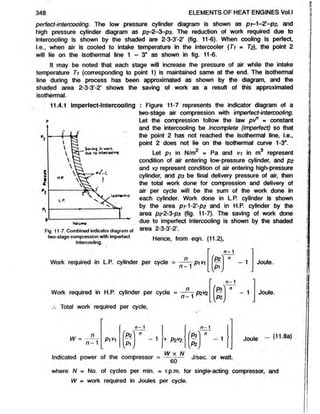
: Figure 11-7 represents the indicator diagram of a
two-stage air compression with imperfect-intercooling.
Let the compression follow the law p i/1 = constant
and the intercooling be incomplete (imperfect) so that
the point 2 has not reached the isothermal line, i.e.,
point 2 does not lie on the isothermal curve 1-3”.
Let p i in N/m2 = Pa and vi in m3 represent
condition of air entering low-pressure cylinder, and p2
and V
2 represent condition of air entering high-pressure
cylinder, and p3 be final delivery pressure of air, then
the total work done for compression and delivery of
air per cycle will be the sum of the work done in
each cylinder. Work done in L.P. cylinder is shown
by the area pj-1-2’-p2 and in H.P. cylinder by the
area p2-2-3-p3 (fig. 11-7). The saving of work done
due to imperfect intercooling is shown by the shaded
area 2-3-3’-2’.
Hence, from eqn. (11.2),
Work required in L.P. cylinder per cycle = —
rp iv i
1
c
n
- 1
W
Joule.
Work required in H.P. cylinder per cyde = —
—- pzvs.
Total work required per cycle,
' p3'
i y f * j
n z _ l
n
- 1 Joule.
W =
n
n - 1 P ih
n - 1
P2
P
1
- 1 + P2V
2
n - 1
w
W x N
indicated power of the compressor = —- - — J/sec. or watt.
Joule 01-®a)
where N = No. of cydes per min. = r.p.m. for single-acting compressor, and
W = work required in Joules per cycle.
AIR COMPRESSORS 349
If pivi and P2V
2 in eqn. (11.8a) are substituted by mRTi and mRT2 respectively,
then work done per kg of air can be written as
W =
n
n - 1
RT
n- 1
£2
v*1,
- 1 + RT2
n - 1
n
- 1 Joules. ... (11.8b)
If the compression is isentropic, y should be substituted for n in eqns. (11.8a) and
(11.8b).
11.4.2 Perfect-lntercooling : If intercooling is perfect or complete (fig. 11-6), the
point 2 will lie on the isothermal line, i.e., point 2 will coincide with point 2", then
P1V1 = P2V2.
Substituting this in eqn. (11.8a), total work required per cycle,
W
n
n - 1
pi V
1
n - 1 n - 1
'pz''
lvP V
f - 
P3
02,
v
- 2 Joules. ... (11.9a)
W x N
Indicated power of the compressor = — —— J/sec. or W.
where, N = no. of cycles per min. = r.p.m. for single-acting compressor,
and W m work required in Joules per cycle.
If pivi in eqn. (11.9a) is substituted by mRTi, then work required per kg of air
may be written as
n- 1 n - 1
n —1 1
'P2
w
n
+
w
H
n
- 2 Joules. - <
119b>
•
Indicated power of the compressor
= W x mass of air delivered per second J/sec or watt. ... (11.9c)
where, W= work required in Joule per kg of air.
Referring to fig. 11-6,
Heat rejected to intercooler per min. = mkp (Td - T2) kJ ... (11.10)
where, m= mass of air compressed per minute,
kp = specific heat of air at constant pressure,
T2’ = temperature of air before entering the intercooler, and
T2 = temperature of air after leaving the intercooler.
11.4.3 Ideal Intercooler Pressure : It may be noted from fig. 11-6 thatsaving in
work increases as intercooling is increased. When intercooling is perfect, i.e., when air
is cooled to intake temperature in the intercooler, point 2 lies on isothermal curve and
there is maximum saving. In this case, work required is given by eqn. (11.9a). It may
be further noted that this saving in work required also varies with the chosen intercooler
pressure p2- When the initial pressure pi and final pressure ps are fixed, the best
value of the intercooler pressure p2 shall be fixed to give minimum work. This value
350 ELEMENTS OF HEAT ENGINES Vol.l
of p2 can be found by differentiating expression of W (eqn. 11.9a) with respect to P2
and equating it to zero.
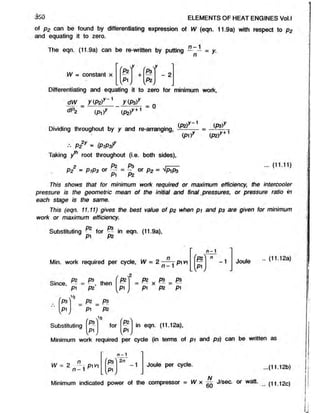
The eqn. (11.9a) can be re-written by putting — — = y.
W = constant x
rPz*
i f ' ,
to
. t o ,

- 2
Differentiating and equating it to zero for minimum work,
dW y(P2)y 1 y(p3)y
dP2 (P ir (P2>
r + 1
7 = 0
Dividing throughout by y and re-arranging,
P2y » (P/PaY
Taking y*h root throughout (i.e. both sides),
P2 Ps
ipz)r-1
(p i) r +1
(P2)
= P 1P3 or B ^ or p2 = ^PiP3
Pi P2
(11. 11)
777/s shows that for minimum work required or maximum efficiency, the intercooler
pressure is the geometric mean of the initial and final.pressures, or pressure ratio in
each stage is the same.
This (eqn. 11.11) gives the best value of p2 when p i and p3 are given for minimum
work or maximum efficiency
Substituting ^ for in eqn. (11.9a),
Min. work required per cycle, W = 2 pi vy
r _ 2
n - 1
'l * ' - 1
Since, ^ , then
p i P2
P2
yp' j
= P? x A* = P3
p i P2 P1
/
P3
01
v y
P2 m P3
P1 P2
( V'*
P3 for in
( p ij W
Joule - <
11-12a>
in eqn. (11.12a),
Substituting
Minimum work required per cyde (in terms of pi and pa) can be written as
n
W = 2 n —- p i vi
n - 1
2n
-1 Joule per cycle. ..(11.12b)
A/
Minimum indicated power of the compressor = W x — J/sec. or watt. (i 1.12c)
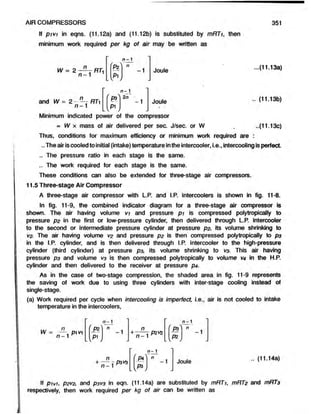
If pivi in eqns. (11.12a) and (11.12b) is substituted by mRTi, then
minimum work required per kg of air may be written as
AIR COMPRESSORS 351
n - 1
n ( n
W = 2 — —RT< - - -1 Joule
n - 1 Pi
...(11.13a)
L  /
n - 1
and .. (11.13b)
Minimum indicated power of the compressor
= W x mass of air delivered per sec. J/sec. or W ..(11.13c)
Thus, conditions for maximum efficiency or minimum work required are :
..The airiscooled to initial (intake) temperature inthe intercooler, i.e.,intercooling is perfect.
.. The pressure ratio in each stage is the same.
.. The work required for each stage is the same.
These conditions can also be extended for three-stage air compressors.
11.5 Three-stage Air Compressor
A three-stage air compressor with L.P. and I.P. intercoolers is shown in fig. 11-8.
In fig. 11-9, the combined indicator diagram for a three-stage air compressor is
shown. The air having volume vi and pressure pi is compressed polytropically to
pressure p2 in the first or low-pressure cylinder, then delivered through L.P. intercooler
to the second or intermediate pressure cylinder at pressure p2, its volume shrinking to
V
2. The air having volume V
2 and pressure p2 is then compressed polytropically to p$
in the I.P. cylinder, and is then delivered through I.P. intercooler to the high-pressure
cylinder (third cylinder) at pressure p3, its volume shrinking to vs. This air having
pressure pa and volume v3 is then compressed polytropically to volume V
4 in the H.P.
cylinder and then delivered to the receiver at pressure p4-
As in the case of two-stage compression, the shaded area, in fig. 11-9 represents
the saving of work due to using three cylinders with inter-stage cooling instead of
single-stage.
(a) Work required per cycle when intercooling is imperfect, i.e., air is not cooled to intake
temperature in the intercoolers,
If pivi, P2V
2, and P3V
3 in eqn. (11.14a) are substituted by mRTi, mRT2 and mRT3
respectively, then work required per kg of air can be written as
n - 1
+ ^ - P3V* Joule
.. (11.14a)
352 ELEMENTS OF HEAT ENGINES Vol.l
W =
n
n -1
n-1
P?
L V
-1
n
n -1
RTz
n - 1
P3
n
n -1
RT3
n - 1
P4
-1
-1
Joule .. (11.14b)
c
P
H
t
v
t
r
y
t
o
f
«
c
»
<
v
»
f tmmu* l
e
u
f
l
H
® < S s)
JM
.RpitlonJ
• •
thro* Hr
<
7
-
A T
«
u
c
t
>
o
n
^ 
.M il.. 1
vOlvf
I*
I
f p
f e n
i
« f
LP
.
p
i
s
t
o
n
■ucfton
Volvo
I J
t
f
W
o
l
f
f
•>- .
■8*.9
e. •.
it:'*-
st
o;.t .
i t
t
i .
V
tfn
i f 3
A!
OfOtn cocks
Fig. 11-8. Arrangement of three-stage air compressor
with intercoolers.
to t*
Dull*
V
o
lw
m
o
Fig 11-9. Indicator diagram of three-stage
compression with perfect intercooling.
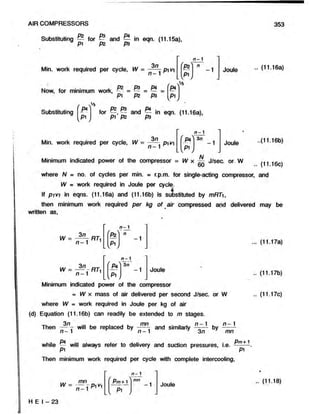
(b) When intercooling is perfect, ptVi = P2V
2 - P3V
3 Hfe 11-9).
Substituting pivi lor p2v2 and P3V
3 in eqn. (11.14a), work required per cycle,
W
n - 1 n - 1 n - 1
n
pi v
n - 1
fpz n
+
(f*) n
+
n
- 3 Joule
[p i J W w _
... (11.15a)
If p/Vf in eqn. (11.15a) is substituted by mRTh then work required per kg air may
be written as,
n - 1 n - 1 n - 1
= n
~. RT
n - 1
' Pz'
[ p i j
n
+ 'pa'
[pz]
n
+
f Pa ' n
- 3 Joule
.. (11.15b)
(c) Work required is minimum when
Pz _ 03 _ Pa
Pi “ Pz ~ P3
AIR COMPRESSORS 353
Substituting for ~ and ^ in eqn. (11.15a),
Min. work required per cycle, W = pi v'i
n-1
' b ?
L y " ,
Now, for minimum work,
0 2 P 3 P4
P i P2 “ P3
Substituting J *
P1
for —, ^ and — in eqn. (11.16a),
pi P2 P3 7
Joule
Min. work required per cycle, W = pivi
n - 1
3n
-1
A/
Joule
Minimum indicated power of the compressor = W x — J/sec. or. W
60
where N = no. of cycles per min. = r.p.m. for single-acting compressor,
W = work required in Joule per cycle.
If pivi in eqns. (11.16a) and (11.16b) is substituted by mRTi,
then minimum work required per kg of air compressed and delivered
written as,
w = - ^ - n r ,
n —1 1
n - 1
(- 
P2
L V *,
-1
w = — - RTi
n -1 1
. v
E*
Pi
n - 1
3 n
-1 Joule
Minimum indicated power of the compressor
= IV x mass of air delivered per second J/sec. or W
where W = work required in Joule per kg of air
(d) Equation (11.16b) can readily be extended to m stages.
Then will be replaced by and similarly by ~ ~ -
n -1 r J n - 1 7 3n mn
Pm4
*1
while - will always refer to delivery and suction pressures, i.e. —.
Then minimum work required per cycle with complete intercooling,
..(11.16b)
(11.16c)
and
may be
(11.17a)
(11.17b)
(11.17c)
. (11.16a)
All the expression derived above for work required refer to the work actually done
or required to be done onthe air, and the power derived from these expressions will
be referredto as indicated power or air power.
11.5.1 Advantages of multi-stage compression : The advantages of multi-stage
compression are as follows :
- Reduction in power required to drive the compressor owing to compression being
approximated to isothermal,
- Better mechanical balance of the whole unit and uniform torque,
- Increased volumetric efficiency as a result of the lower delivery pressure in the
L.P. cylinder clearance space,
- Reduced leakage loss owing to reduced pressure difference on either sides of
the piston and valves,
- Less difficulty in lubrication due to the lower working temperature, and
- Lighter cylinders.
11.6 Air Compressor Terminology
The following terminology should be well understood before attempting to estimate
the performance of the air compressor.
Free air delivered is the volume of air delivered under the conditions of temperature
and pressure existing at the compressor intake, i.e., volume of air delivered at surrounding
air temperature and pressure. In the absence of any given free air conditions, these
are generally taken as 1 01325 bar and 15‘C.
Capacity of a compressor is the quantity of the free air actually delivered by a
compressor in cubic metres per minute.
Piston displacement is the volume in cubic metre (m ) obtained asthe product of
the piston area in m2 and the piston stroke in metre.
Displacement per minute is the product of the piston displacement and working
strokes per minute. For multi-stage compressors, the displacement is based on low-pressure
cylinder only, since it determines the amount of air passing through the other cylinder.
Indicated power or air power is the power determined from the actual indicator
diagram taken during a test on the compressor. It is calculated in the same manner
as is done in the case of a steam engine and internal combustion engine.
Shaft or brake power is the power delivered to the shaft of the compressoror
the power required to drive the compressor. The compressor may be driven by an
engine or an electric motor.
[Shaft or brake power] - [Air or indicated power] = [Friction power]
, „ . . . „. . Air (indicated) power
and Mechanicalefficiency, rim = o. - . —.-, --------
1 1 Shaft (brake) power
Isothermalpower of acompressor is calculated from the theoretical indicator diagram
drawn on the basis of an assumption that the compression is isothermal.
(a) Referring to eqn. (11.7a) for a single-stage compressor without clearance,
354 ELEMENTS OF HEAT ENGINES Vol.l
Isothermal work required per cycle, W = p vi loge'( *
Pi Jou,e .. (11.19a)
Isothermal power = pw  log©
AIR COMPRESSORS
v * ,
x J/sec. or W
60
355
.. (11.19b)
where N = no. of cycles per minute.
If pivi in eqn. (11.19a) is substituted by mRTi, then isothermal work required per
kg of air may be written as,
W = RTy log, Joule
Isothermal power » W x mass of air delivered per sec. J/sec. or W
(b) For a two-stage compressor,
Isothermal work required per cycle, W = pi vi loge
N
Isothermal power = pi v loge v
vP1,
V * ,
Joule
x - - J/sec. or W
60
(11.20a)
(11.20b)
(11.21a)
(11.21b)
If pivi in eqn. (11.21a) is substituted by mRTi, then isothermal work required per
kg of air may be written as
.. (11.22a)
W = RTi ogew
V * /
Joule
Isothermal power = W x mass of air delivered per sec. J/sec. or W .. (11.22b)
(c) Similarly, for a three-stage compressor,
.. (11.23a)
Isothermal work required per cycle, W = pi vi log0
N
Isothermal power = pi v ioge
/_ ,
P4
fp ^
S ',
Joule
,P1
v
x — J/sec. or W
.. (11.23b)
where N * no. of cycles per min.
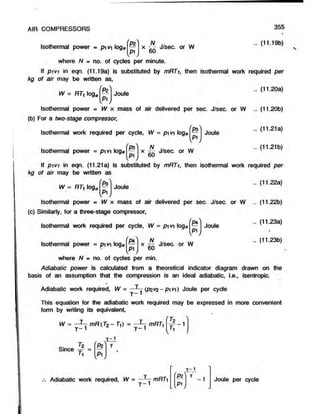
Adiabatic power is calculated from a theoretical indicator diagram drawn on the
basis of an assumption that the compression is an ideal adiabatic, i.e., isentropic.
Adiabatic work required, W = (pzvz-pivtf Joule per cyde
This equation for the adiabatic work required may be expressed in more convenient
form by writing its equivalent,
W = mR(Tz -TO = mRT,
f Tr '
f r '
Tz
Since -=- =
»
1
v * /
I z l
Adiabatic work required, W
fPz
i_-1
W = —Y
— mRT}
y -1
7 -1
W
Joule per cycle
356 ELEMENTS OF HEAT ENGINES Vol.l
y -1
PiV-1
Thus, for a single-stage air compressor,
l v * 
Y~1
-1 Joule per cyde
..(11.24a)
Adiabatic (isentropic) power = pi v
Y - 1
P2
Y -1
[ P lj
X £ J/sec. or W 24b)
where A/ = no. of cydes per min.
■ . * __. „ . Isothermal power in watts
Isothermal efficiency = ,---------- . —
Indicated or actural power in watts
Overall isothermal efficiency or
Compressor efficiency .
Isothermal power_
Shaft power or brake power required to]
drive the compressor j
pi vi loge
N „
*6 0
Shaft power or brake power required in watt to drive the compressor
where N = no. of cydes per min.
Isentropic efficiency or ideal
adiabatic efficiency
Isentropic power in watt
Shaft power required in watt
(11.25a)
(11.25b)
Y - 1
P1V1
Y - 1
P?
P1
1
N „
X 60 (11.26)
Shaft power or Brake power required in watt to drive the compressor
where N = no. of cydes per min.
Volumetric efficiency of an air compressor is the ratio of the adual volume of the
free air at standard atmospheric conditions discharged in one delivery stroke, to the
volume swept by the piston during the stroke. The standard atmospheric conditions
(S.T.P.) is actually taken as pressure of760 mm Hg (1 01325 bar) and temperature
15‘C in this connection. Thus,
. Volume of free air delivered per stroke .. (11.27)
Volumetric efficiency = — ;-----------zz— -------- r izr~
Volume swept by piston per stroke
The value of volumetric efficiency varies between 70 to 85 per cent according to
the type of compressor.
The volumetric efficiency decreases as the dearance volume increases. Other factors
that lower the volumetric efficiency are :
- Valve leakage, specially at the inlet valve,
- Obstruction at inlet valves,
- Piston ring leakage, which allowsair to pass from one side of the cylinder to
the other,
- Heating of air by contact with hot cylinder walls, and
AIR COMPRESSORS 357
- Very high speed of rotation.
With the decrease of volumetric efficiency, the capacity (quantity of free air delivered)
of the compressor decreases.
Problem-1 : A single-cylinder, single-acting reciprocating air compressor has a cylinder of
24 cm diameter and linear piston speed of 100 metres per minute. It takes in air at 100
kPa (100 kN/m2) and delivers at 1 MPa ( 1 MN/rrP), Determine the indicated power of
the compressor. Assume the law of compression to be pv
ture of air at inlet is 288 K. Neglect clearance effect.
1.25
■ constant. The tempera-
Given p i = 100 kPa « 100 x 10 Pa; p2 = 1 MPa = 1,000 kPa - 1,000 x 103 Pa.
P*
Pi
1,000 x 10J 1,000
100 x 10J 100
= 10
Swept volume in m3/min. - - x I x r.p.m.
(where, I - piston strokes in metre, and d=
diameter of the cylinder in metre)
2
It
Swept volume = ^ x
f 24 '
100
/
100 3..
x m /min.
( v piston speed = 2 x I x r.p.m. = 100
metres/min.)
_ . . . 3. 2-261 3.
= 2-261 m /min. = m /sec.
Referring to fig. 11-10 and using eqn. (11.2),
Work required per sec.,
W = pyV] x
n
n - 1
n - 1
S '
L V /
-1 J/sec.
[where, pi is pressure in Parcals (Pa) and volume of air compressed, vi is in m
per sec.]
W = (too x to3) x 2f l X
' ± 000)
100
 /
1 2 5 -1
1 25
- 1
= 1,88616 x (1 5848 - 1) - 11,030 J/sec. or 11,030 W
.-. Indicated power of the compressor = 11,030 W i.e. 11-03 kW
Problem-2- : A single-acting, single-stage air compressor developing indicated power of
11 kW, runs at 200 r.p.m. and has a linear piston speed of 100 metres per min. If
the suction pressure and temperature are 100 kPa and 15‘C respectively and delivery
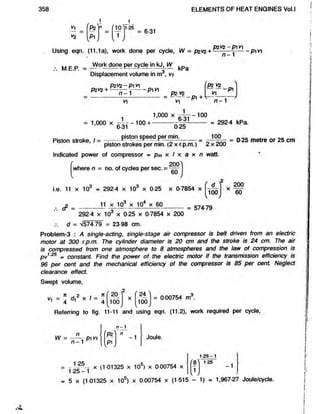
pressure is 1,000 kPa, calculate the dimensions of the compressor cylinder. Assume
the law of compression to be pv125 = constant. Neglect clearance effects.
Referring to fig. 11-10, and considering polytropic compression 1-2, pivin = p2V2n,
358 ELEMENTS OF HEAT ENGINES Vol.l
V
1 _
n 10'
V
z [p .j 1
V /
1
1*26
= 6 31
P2VZ- P1V1
Using eqn. (11.1a), work done per cycle, W = pzvz + - — -------pivi
^ p Work done per cycle in kJ, W ^pa
-3
Displacement volume in m , vi
P2 vz
p zvz - p i vi
pzva+ p in
V
1 V
1
-P1 +
p z y z
Vi -P i
1
1,000 x
1
= 1,000 x £ “ -100 +
631
-100
0-25
Piston stroke, I =
piston speed per min.
n - 1
= 292 4 kPa
100
piston strokes per min. (2 x r.p.m.) 2 x 200
Indicated power of compressor = pm x I x a x n watt.
200N
= 0-25 metre or 25 cm
where n = no. of cycles per sec. ^
60
i.e. 11 x 103 - 292 4 x 103 x 0 25 x 0-7854 x
11 x 103 x 104 x 60
r < n
100
200
60
292 4 x 103 x 0-25 x 0-7854 x 200
= 574 79
d = V574 79 = 23-98 cm.
Problem-3 : A single-acting, single-stage air compressor is belt driven from an electric
motor at 300 r.p.m. The cylinder diameter is 20 cm and the stroke is 24 cm. The air
is compressed from one atmosphere to 8 atmospheres and the law of compression is
pv125 = constant. Find the power of the electric motor if the transmission efficiency is
96 per cent and the mechanical efficiency of the compressor is 85 per cent Neglect
clearance effect.
Swept volume,
f 20
100
2
X
24
100
= 000754 m
Referring to fig. 11-11 and using eqn. (11.2), work required per cycle,
... n
W = pi vi
n - 1
n - 1
P2
P1
-1 Joule.
x (101325 x 105) x 0 00754 x
1-25-1
1 25
-1
= 5 x (1 01325 x 105) x 0-00754 x (1-515 - 1) - 1,967-27 Joule/cycle.
AIR COMPRESSORS 359
= 12 05 kW
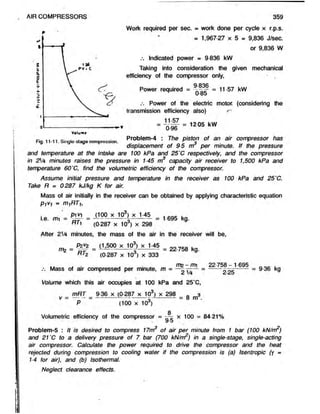
Work required per sec. = workdoneper cycle x r.p.s.
» 1,967-27 x 5 = 9,836 J/sec.
or 9,836 W
Indicated power = 9 836 kW
Taking into consideration the given mechanical
efficiency of the compressor only,
Power required = | “f§P = 11-57 kW
0-85
Power of theelectric motor, (considering the
transmission efficiency also) s'
11-57
0-96
Problem-4 : The piston of an aircompressor has
displacement of 9-5 m per minute. If thepressure
and temperature at the intake are 100 kPa and 25‘C respectively, and the compressor
in 2V4 minutes raises the pressure in 1-45 m3 capacity air receiver to 1,500 kPa and
temperature 60'C, find the volumetric efficiency of the compressor.
Assume initial pressure and temperature in the receiver as 100 kPa and 25'C.
Take R = 0287 kJ/kg K for air.
Mass of air initially in the receiver can be obtained by applying characteristic equation
P M = m,f?T,,
pivi (100 x 103) x 1-45 . .
i.e. mi = = ---------------  ------------= 1695 kg.
(0-287 x 103) x 298
After 2V4 minutes, the mass of the air in thereceiver will be,
P2*2 d
A“ |
r t 2 (0 287 x 10°) x 333
Fig. 11-11. Single-stage compression.
m2 = iLgOO X J .45 . 22.753 k
W v
it Mass of air compressed per minute, m = — — =
Volume which this air occupies at 100 kPa and 25’C,
mRT 9 36 x (0-287 x 103) x 298 0 3
v = ------ = ------------5
1
------------- = 8 m .
22 758 - 1695
2 25
= 9 36 kg
(100 x 10°)
8
Volumetric efficiency of the compressor = ~ x 100 = 84-21%
w'O
Problem-5 : It is desired to compress 17m3 of air per minute from 1 bar (100 kN/m2)
and 21'C to a delivery pressure of 7 bar (700 kN/nrr) in a single-stage, single-acting
air compressor. Calculate the power required to drive the compressor and the heat
rejected duhng compression to cooling water if the compression is (a) Isentropic (y =
1-4 for air), and (b) Isothermal.
Neglect clearance effects.
Given: p i = 1 bar = 1 x 10s Pa; p2 - p2 = 7 bar = 7 x 10s Pa; — = -= = 
Pi 1x10⁵ 1
(a) Isentropic compression : '
Referring to fig. 11-12 and using eqn. (11.6a),
isentropic work required per sec.,
360 ELEMENTS OF HEAT ENGINES Vol.l
W = pi vi
Y~ *
I r l
Y
LVP1V
-1 J/sec.
—
— — x (1 x 10®) x —
—
1-4_1 u x lu } x60
'7 X
1
v /
14 -1
14
-1
■ x <
1 x 105) x x [1744-1]
Fig. 11 12. Single stage compression. = 73,750 J/sec. or 73,750 W
/. Power required to drive the compressor
= 73,750 W i.e. 73 75 kW
No heat is rejected during isentropic compression.
(b) Isothermal Compression
Referring to fig. 11-12 ?nd using eqn. (11.7a), isothermal work required/sec.,
fPz
P^
W = pi V) log< = (1 x 10⁵) x ~ x loge
= (1 x 105) x x 1-9459 = 55,080 J/sec. or 55,080 W
60
Required power input = 55,080 W i.e. 55-08 kW
In isothermal compression, as the temperature remains constant, there is no change
in internal energy and the entire work of compression, i.e. 55-08 kJ/sec. is rejected to
jacket cooling water. Heat rejected during isothermal compression = 55-08 kJ/sec.
Problem-6 : A two-stage air compressor delivers 145 m3 of free air per hour. The
pressure and temperature in the cylinder at the start of compression are 1 bar and
34'C respectively. The diameter of the low-pressure cylinder is twice that of the high
pressure cylinder. The air enters the high-pressure cylinder at a temperature of 40’C
and is then compressed to 17-5 bar, the law of compression being pv1 « constant
for both stages. Neglecting the effects of clearance, estimate :■ (a) the intercooler
pressure, (b) the air power required, and (c) the ratio of cylinder diameters for minimum
work making the usual assumptions regarding the intercooler conditions.
The free air conditions are 101325 bar and 15'C. Take R = 0287 kJ/kgK for air.
(a) Since, the diameter of L.P. cylinder is twice that of theH.P. cylinder, the ratio
of L.P. to H.P. cylinder volumes will be 4, i.e. vt = 4v^
Applying characteristic equations at points of suction in L.P. and H.P. cylinders,
P1V
1 P2V2
AIR COMPRESSORS
i.e.
1 x 4v2 P2 x vz
h T2
Intercooler pressure, pz =
(34 + 273) (40 + 273)
1 x 4 x 313
307
= 4 078 bar
(b) Using characteristic equation for free air conditions, pv - mRT
i.e. (1 01325 x 10s) x —Jf = m x (0287 x 103) x (15 + 273)
60
m = 2 963 kg of air per minute.
Referring to fig. 11-13, and using eqn. (11.8b) for imperfect intercooling,
. . . . . . . ... fWork required in] , [Work required ini
Total w o* required per kg of air, W = | Hp ^ |jnder j +j LP J
.-. W = RTi - —
n —1
t
c
1
|
c
[p i J
+ RTz
n
n - 1
n- 1
P3^ n
v /
-1
= R
n
n - 1
n- 1 n - 1
V
"P2^
W
n
- 1 + r2 M
W
n
- 1
= 0-287 x 307
122
1 2 2 -1
= 290 kJ per kg of air
' 4-078
1
v
0-22
>1-22
- 1 + 313
0 22
f I 7.5  l-22
4078
- 1
o.ggo
Work done per sec. = W x m = 290 x —
—- = 14-32 kJ/sec.
60
Air power = 14-32 kW
Fig. 11-13. Two-stage compression with
imperfect intercooling
Fig. 11-14.
362 ELEMENTS OF HEAT ENGINES Vol.l
(c) Using eqn. (11.11),
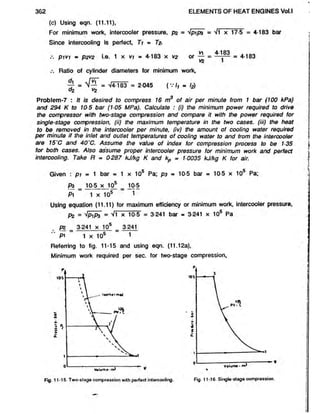
For minimum work, intercooler pressure. p2 = Vpip3 = V1 x 17 5 = 4-183 bar
Since intercooling is perfect, Ti - T2.
vi 4-183
A p iv i • p2V
2 i.e. 1 x vi * 4-183 x V
2 or — = —j— = 4-183
Ratio of cylinder diameters for minimum work,
~ = = V4-183 = 2-045 ( V /, = l2)
°2 v2
Problem-7 : It is desired to compress 16 m3 of air per minute from 1 bar (100 kPa)
and 294 K to 105 bar (105 MPa). Calculate : (i) the minimum power required to drive
the compressor with two-stage compression and compare it with the power required for
single-stage compression, (ii) the maximum temperature in the two cases, (iii) the heat
to be removed in the intercooler per minute, (iv) the amount of cooling water required
per minute if the inlet and outlet temperatures of cooling water to and from the intercooler
are 15'C and 40'C. Assume the value of index for compression process to be 135
for both cases. Also assume proper intercooler pressure for minimum work and perfect
intercooling. Take R = 0287 kJ/kg K and kp - 10035 kJ/kg K for air.
Given : p i - 1 bar = 1x 10s Pa;pa »10-5 bar * 10-5 x 10⁵ Pa;
P3 = 10:5 * J 0 ! = IQ-5
Pi 1 x 10s 1
Using equation (11.11) for maximum efficiency or minimum work, intercooler pressure,
Pz = Vpipa = V1x 10-5= 3-241bar*3-241 x 10s Pa
pz 3 241 x 10s = 3 241
" P1 1 x 10⁵ 1
Referring to fig. 11-15 and using eqn. (11.12a),
Minimum work required per sec. for two-stage compression.
Fig. 11-15. Two-stage compression with perfect intercooling. Fig. 11-16. Single-stage compression.
AIR COMPRESSORS 363
n
W = 2 x ------- x m vi
n -1 r
'
1
C
*
1
1
1
------------------------
[p .J
J/sec.
(where, p* is pressure in pascals (Pa) and v-i is volume of air compressed in m per
sec.)
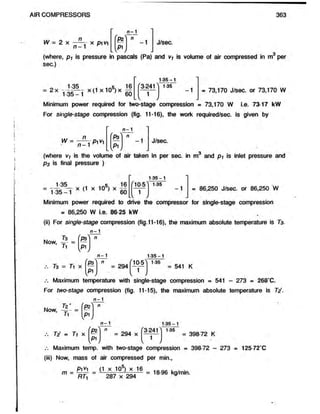
o 135 /A <n5v 16
= 2 x 135^T x <1x1(n x 60
3-241
1 3 5 - 1
1 35
-1 = 73,170 J/sec. or 73,170 W
Minimum power required for two-stage compression = 73,170 W i.e. 73-17 kW
For single-stage compression (fig. 11-16), the work required/sec. is given by
w = j- P i Vi
n - 1
t ~ 
P3
-1 J/sec.
(where v1 is the volume of air taken in per sec. in m and p i is inlet pressure and
P3 is final pressure )
135 <n5, 16
i l s - T x <
1 x 1° ) x 60
1 3 5 - 1
10-5
L
V
1-35
- 1 = 86,250 J/sec. or 86,250 W
Minimum power required to drive the compressor for single-stage compression
- 86,250 W i.e. 86-25 kW
(ii) For single-stage compression (fig.11-16), the maximum absolute temperature is T3.
Ts
n - 1
Now,
73 = Ti x V
yP',
n - 1
= 294
f 10-51
1
1 -3 5 - 1
1-35
m 541 K
 / X r
#
» Maximum temperature with single-stage compression = 541 - 273 = 268 C.
For two-stage compression (fig. 11-15), the maximum absolute temperature is T2’.
n - 1
Tz'
Now,
Ti
T2’ = Ti x
tpi
V
n - 1 1 -3 5 - 1
n
= 294 x
f3-241 ^
H
1
^ /
1-35
= 398-72 K
(iii) Now, mass of air compressed per min.,
364 ELEMENTS OF HEAT ENGINES Vol.l
Referring to fig. 11-15 and using eqn. (11.10),
Heat rejected by air to the intercooler water per min. with two-stage compression
= mkp (T2' - T2) kJ/min.
= 18 96 x 1 0035 x (398 72 - 294) - 1,995 kJ/min.
Heat gained by cooling water in the intercooler per min.
= x 4-187 x (fe - tt) where, my = mass of cooling water/min.
= m-, x 4-187 x (40 - 15) kJ/min.
Heat rejected by air/min. = Heat gained by cooling water/min.
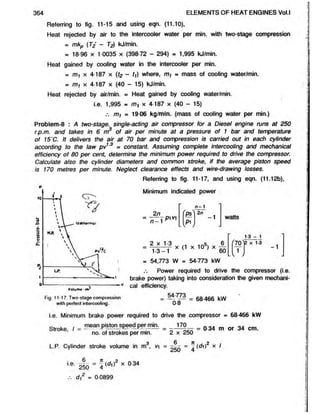
Problem-8 : A two-stage, single-acting air compressor for a Diesel engine runs at 250
r.p.m. and takes in 6 m3 of air per minute at a pressure of 1 bar and temperature
of 15'C. It delivers the air at 70 bar and compression is carried out in each cylinder
according to the law pv13 m constant. Assuming complete intercooling and mechanical
efficiency of 80 per cent, determine the minimum power required to drive the compressor.
Calculate also the cylinder diameters and common stroke, if the average piston speed
is 170 metres per minute. Neglect clearance effects and wire-drawing losses.
i.e. 1,995 = m, x 4-187 x (40 - 15)
m/ = 19-06 kg/min. (mass of cooling water per min.)
p
Referring to fig. 11-17, and using eqn. (11.12b),
Minimum indicated power
watts
1-3 - 1
L V /
- 54,773 W = 54-773 kW
Power required to drive the compressor (i.e.
e
Volume -m*
brake power) taking into consideration the given mechani-
v cal efficiency.
Fig. 11-17. Two-stage compression
with perfect intercooling.
= - 4
^7
o— = 68466 kW
08
i.e. Minimum brake power required to drive the compressor m 68-466 kW
Stroke, = o 34 m or 34 cm.
Q 6 It 2
L.P. Cylinder stroke volume in m , v = - - = (</i) x I
AIR COMPRESSORS 365
L.P. cylinder dia, di = V00899 » 0-3 m, or 30 cm.
Now, for perfect-intercooling, p ivi = p2V
2,
i.e. p i x di2 = p2 x d22 (h = I?)
fdz
di
(dz
di
2
£ l = -jB L - = = 0-1196
P2 VP!P3 P3 70
= Vo 1196 = 0-346
H.P. cylinder dia., d2 = di x 0-346 «
* 0-3 x 0-346 = 0-1038 m, or 10-38 cm.
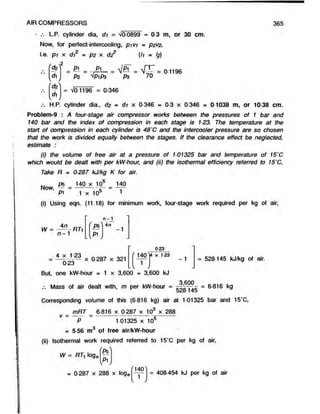
Problem-9 : A four-stage air compressor works between the pressures of 1 bar and
140 bar and the index of compression in each stage is 123. The temperature at the
start of compression in each cylinder is 48'C and the intercooler pressure are so chosen
that the work is divided equally between the stages. If the clearance effect be neglected,
estimate :
(i) the volume of free air at a pressure of 101325 bar and temperature of 15'C
which would be dealt with per kW-hour, and (ii) the isothermal efficiency referred to 15‘C,
Take R = 0287 kJ/kg K for air.
Now,
ps 140 x 10“ 140
1
P1 1 x 10s
(i) Using eqn. (11.18) for minimum work, four-stage work required per kg of air,
4n
W = — - R7i
n - 1
4 x 123
0-23
P5
p i
L V /
4n
-1
x 0 287 x 321
023
( 1401
4 x 123
1
V
= 528-145 kJ/kg of air.
But, one kW-hour = 1 x 3,600 = 3,600 kJ
Mass of air dealt with, m per kW-hour =
Corresponding volume of this (6-816 kg) air at 1-01325 bar and 15'C,
_3*6?9_ _ 6 316 kg
528145 a
v =
mRT = 6 816 x 0 287 x 10 x 288
P ~ 101325 x 105
= 5 56 m3 of free air/kW-hour
(ii) Isothermal work required referred to 15*C per kg of air,
W = RTi loge
rP5^
V /
= 0-287 x 288 x loge
140
= 408-454 kJ per kg of air
366 ELEMENTS OF HEAT ENGINES Vol.l
Isothermal efficiency = Workreqwed when compression is isothermal
isothermal efficiency Actual work required to be done on the air
408-454
= 07734, or 77 34%
528-145
Problem-10 : The following particulars apply to a two-stage, single-acting air compressor :
Stroke = 28-5 cm; Low pressure cylinder = 23 cm;
Final pressure = 25 bar; Intermediate pressure - 5 bar;
Temperature of air leaving the intercooler = 35'C
If the air drawn in the compressor is at 1 bar and 15'C, find the power expended
(used) in compressing air when running at 350 r.p.m. Assume law of compression as
pv1
'3 - constant for both stages.
Swept volume of the L.P. cylinder, vi = ^ & x I = ^
f 23
100
x = OOf189 m3.
100
Referring to fig. 11-18, and considering polytropic compression 1-2',
p vn = pzvz'n
f p r
n m 1-3
vz ' — X V j=
Oil
X
n - 1
Again,
Tz'
T i = Ti x
PZ
Pi
&
K
n - 1
= (15 + 273) x
NoW
, P2V2^
Tz Tz'
0-3
1-3
= 417 3 K
Fig. 11-18. Two-stage compression with imper-
fect intercooling.
vz = T2 x = (35 + 273) x
= 0 00254 m3.
Referring to fig. 11-18 and using eqn. (11.8a* for two-stage compression with
imperfect intercooling,
-r » . , .,J, M/ [Work done in] . fWork done in]
Total work required per cycle, W = | L p cy||nder j +| H p
n - 1
= P1V1
"
n - 1
n ' Pz n
-1
n -1
Ip1J
+ P2H2
n
n - 1
/ _
P3
w
1
AIR COMPRESSORS 367
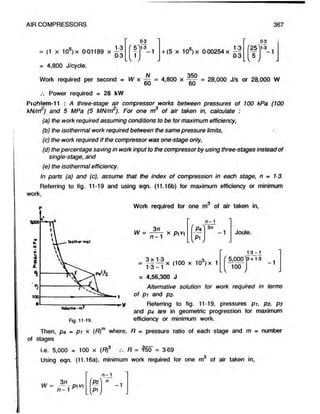
= (1 x 105) x 0 01189 x ~
= 4,800 J/cyde.
'5 '
1
L V /
0-3
1-3
-1 + (5 x 105) x 0 00254 x
5
L V /
0-3
1-3
AI 350
Work required per second = W x — = 4,800 x — = 28,000 J/s or 28,000 W
bO oO
Power required = 28 kW
Pioblem-11 : A three-stage air compressor works between pressures of 100 kPa (100
kN/rr?) and 5 MPa (5 MN/m2). For one m3 of air taken in, calculate :
(a) the work required assuming conditions to be for maximum efficiency,
(b) the isothermal work required between the same pressure limits,
(c) the work required if the compressor was one-stage only,
(d) the percentage saving in work input to the compressorby using three-stages instead of
single-stage, and
(e) the isothermal efficiency.
In parts (a) and (c), assume that the index of compression in each stage, n - 13.
Referring to fig. 11-19 and using eqn. (11.16b) for maximum efficiency or minimum
work,
p Work required for one m of air taken in,
■*/ 3n
W = — - x p,vi
1
C
M
i
1
c
C
O
H
Joule.
1-3-1
f 5,000^3x1-3
100
v
. J
Fig. 11-19.
= X (100 x 103) x 1
= 4,56,300 J
Alternative solution for work required in terms
of p i and p2.
Referring to fig. 11-19, pressures pi, p2, p3
and p4 are in geometric progression for maximum
effidency or minimum work.
Then, p4 = p i x (R) where, R = pressure ratio of each stage and m = number
of stages
i.e. 5,000 - 100 x {R)3 R = $50" = 3-69
Using eqn. (11.16a), minimum work required for one m3 of air taken in,
■*/ 3n
W = — -p i vi
n - 1
i
i
__
i
P2
—
i
i
c
H
368 ELEMENTS OF HEAT ENGINES Vol.l
Fig. 11-20
Q y 1.0 T 1-3-1 I
= .j 3 _ ^ X (100 x 103) x 1 L (3 .6 9 n .3 --l J
a 4,56,300 J ( same as before)
(b) Referring to fig. 11-20 and using eqn. (11-23), isothermal
work required for one m of air,
W = p m log3
'_P4n
P i
= (100 x 103) x 1 x loge
5,0001
100
= 3,91,210 J
(c) Referring to fig. 11-20, single-stage work required for
one m of air,
W =
n
n - 1
Pi^i
1
c
1
c
[ p , J
13
1-3-1
x (100 x 10d) x 1 x
f5,000"!
1-3-1
100
1-3
-1 = 6,37,000 J
(d) Saving in work input to the compressor by adopting three-stages instead of
single-stage compression = 6,37,000 - 4,56,300 = 1,80,700 J.
Percentage saving in work input = = 0-2835 or 28-35%
6,3 7 ,0 0 0
,  , m
l. , u- ■ the isothermal work input 3,91,210 nocts „ oc eo, ,
(e) Isothermal efficiency = — r— —
—?— -r-.— . = , = 0-856 or 85-6%
' ' J the actual work input 4,56,300
11.7 Effect of Clearance on Volumetric Efficiency
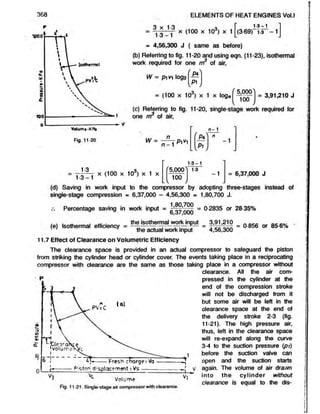
Theclearance space is provided in anactual compressor to safeguard the piston
from striking the cylinder head or cylinder cover. Theevents taking place in a reciprocating
compressor with clearance are the same as those taking place in a compressor without
clearance. All the air com-
pressed in the cylinder at the
end of the compression stroke
will not be discharged from it
but some air will be left in the
clearance space at the end of
the delivery stroke 2-3 (fig.
11-21). The high pressure air,
thus, left in the clearance space
will re-expand along the curve
3-4 to the suction pressure (pr)
before the suction valve can
Fresh charge: Va------------^ open and the suction starts
Pisttrf displacementsVS------------------- -J v again. The volume of airdrawn
Vi into the cylinder without
0 jme . , clearance is equal to the dis-
Fig. 11-21. Single-stage air compressor with clearance.
AIR COMPRESSORS 369
placement volume corresponding to full stroke vs. However with clearance, the volume
of fresh air drawn into the cylinder is only va corresponding to stroke 4-1.
Thus, the effect of clearance in a compressor is to decrease the amount of fresh
air that can be drawn into the cylinder during the suction stroke. Therefore, there is a
considerable reduction in the volumetric efficiency of the compressor due to clearance.
In practice the clearance volume is limited to, two or three per cent of the displacement
or swept volume (va) of the piston.
11.7.1 Expression for work done : Assuming that the value of the index n for
expansion curve 3-4 (fig. 11-21) is the same as that for the compression curve 1-2,
and making use of eqn. (11.2),
Net work required per cycle, W = area 1-2-3-4 = area 1-2-5-6 minus area 5-3-4-6
•mi n
W = — - pivi
n- 1 n-1
1
c
aT
~ n -  P' V
A
n
-1
i
5.
w
n
n - 1
P?
P1
n
n -1
pi va
1
c
--------
1
1
c
w
Joule per cycle. .. (11.28)
It may be noted that eqn.(11.28) is same as eqn. (11.2).
This shows that the work required to compress and deliver the same volume of
air, va (volume of fresh air drawn in the cylinder) in a compressor with clearance, is
same as that required in a compressor without clearance.
In other words, the introduction of clearance does not theoretically increase work
of compression as the work done in compressing theclearance space air will be
regained during the expansion of the clearance air from V
3 to va at the beginning of
the suction stroke.
N
Net work required in = W x — J/sec. or W where N = no. of cycles per min.
» 60
watts
Indicated power of the compressor = ^OOO ^
.. (11.29)
If piva in eqn. (11.28) is substituted by mRTi, then net work required per kg of
air may be written as
W = ——r RT]
n —1
-1
LV
Joule.
n -1
fP?) n
which is same as eqn. (11.4).
Net work required in J/sec.
= W x mass of air delivered per second J/sec. or W
H E I - 24
.. (11.30)
370 ELEMENTS OF HEAT ENGINES Vol.l
11.7.2 Expression for Volumetric Efficiency : Let vc and vs be the clearance
volume and swept volume respectively of the compressor, p2 - pressure in N/nrP « pa
of air in the clearance space, p i = pressure in N/nr? ■ pa of clearance air at the end
of expansion, and n is the index of expansion.
Referring to fig. 11-21, Volume of clearance air at the end of re-expansion,
M
n
Vc
W
H [p i J
v4 = v3
The volume of fresh charge of air, va = vi - V
4
1 i
va = v - vc
= vs- vc
P2
pi
= Vs + Vc - Vc
_P2
P1
[ V V1 m Vs + V$
1
( * )
n
- 1
l^J
Volumetric efficiency, iv =
vi ~ va
Vs
Va
Vs
V s -V c
1
/ » ]
n
- 1
p i J
Vs
1
^
Vc (p z )
n
-1
vs [p iJ
(11.31)
Thus, the volumetric efficiency depends upon the pressure ratio, pz /p  and the
clearance ratio, vc/v s.Volumetric efficiency decreases as the pressure ratio increases.
It also decreases as clearance volume (as a percentage of swept volume) increases
or volumetric efficiency decreases as the clearance ratio increases.
Problem-12 : A compressor has 20 cm bore and 30 cm stroke. It has a linear clearance
of 15 cm. Calculate the theoretical volume of air taken in per stroke when working
0 between pressures of 1 bar and 7 bar. The index
of compression and expansion is same and its
value is 125.
Referring to fig. 11-22,
Clearance volume vc = V
3
va » Area of cylinder x linear clearance.
= - S x linear clearance
4
= J (0-2)2 x 1-5 = 0000471 m3.
100
Considering polytropic expansion (3-4),
P3*3n = P4V4°
Fig. 11-22. Single-stage air compressor with
clearance.
V4 = V3
P4
AIR COMPRESSORS 371.
V
4 = 0 000471 x
1 25 3
= 0 002233 m3.
Now, vi = stroke volume, vs + clearance volume = 7 < ^ x /+V9
4
= - (0 2)2 x 0-3 + 0 000471 = 0 009891 m3.
Theoretical volume of air taken in per stroke,
va = v, - v4 = 0 009891 - 0 002233 = 0 007658 m3.
Problem-13 : The clearance volume in a single cylinder single-acting reciprocating
compressor is 5% of the swept volume. Air is drawn in at 100 kPa (100 kN/rr?) and
311 K. Compression and expansion curves follow the lawpv1'2 = C. Thedelivery
pressure is 700 kPa (700 kN/trr) and the atmospheric pressureand temperature are
101325 kPa and 15'C respectively. Estimate :
(a) the volumetric efficiency,
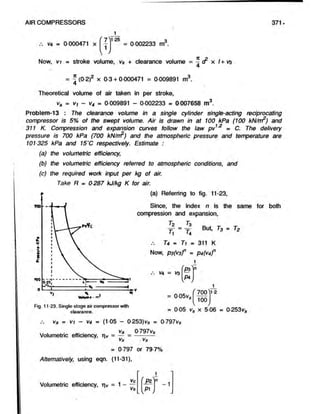
(b) the volumetric efficiency referred to atmospheric conditions, and
(c) the required work input per kg of air.
Take R = 0287 kJ/kg K for air.
(a) Referring to fig. 11-23,
Since, the index n is the same for both
compression and expansion,
T2 73
Y = y But, T3 = T2
'1 '4
74 - Ti m 311 K
Now, ps(V3f * P4(V4f
V
4 = V
S
P3
P4
= 0 05v<
Fig. 11-23. Single-stage air compressor with
clearance.
700
100
1-2
= 0 05 V
o x 5 06 = 0 253vc
Va = vi - v4 = (1 05 — 0-253)vs = 0-797vs
Va 0-797vs
Volumetric efficiency, ri^ = — = ----------
vs vs
= 0-797 or 79 7%
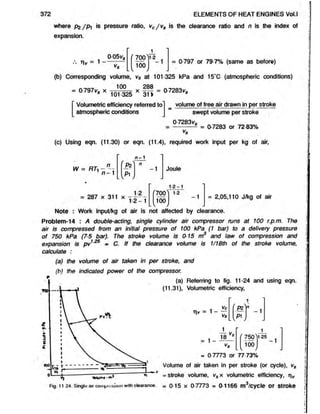
Alternatively, using eqn. (11-31),
Volumetric efficiency, = 1-
Vc
vs
L V
.PI
- 1
where pg /p  is pressure ratio, vc/v s is the clearance ratio and n is the index of
expansion.
372 ELEMENTS OF HEAT ENGINES Vol.l
005v« (700
100
12
1 = 0-797 or 79-7% (same as before)
(b) Corresponding volume, v$ at 101-325 kPa and 15‘C (atmospheric conditions)
100
= 0 797V, x
101 325 311
>
x I? ? = 0-7283vs
[Volumetric efficiency referred to
atmospheric conditions
volume of free air drawn in per stroke
swept volume per stroke
0-7283vs
= ---------- 5 = 0-7283 or 72 83%
(c) Using eqn. (11.30) or eqn. (11.4), required work input per kg of air,
n - 1
n /%' n
- 1
n - 1
H
W = RTi Joule
1-2-1
r700 '
100
= 2,05,110 J/kg of air
Note : Work input/kg of air is not affected by clearance.
Problem-14 : A double-acting, single cylinder air compressor runs at 100 r.p.m. The
air is compressed from an initial pressure of 100 kPa (1 bar) to a delivery pressure
of 750 kPa (75 bar). The stroke volume is 015 m and law of compression and
expansion is pv1
"25 = C. If the clearance volume is 1/18th of the stroke volume,
calculate :
(a) the volume of air taken in per stroke, and
(h) the indicated power of the compressor.
(a) Referring to fig. 11-24 and using eqn.
(11.31), Volumetric efficiency,
1
Vc ( P * ) in
- 1
VS
IP1J

f 750>
’ “ -1
100
V b lu m t - m 1
s 1 _ 18 V
s
= 0-7773 or 77-73%
Volume of air taken in per stroke (or cycle), vs
= stroke volume, vsx volumetric efficiency, ti^
Fig. 11 24. Single air coniptussion with clearance. = 0-15 X 0-7773 = 0-1166 m /cycle Of Stroke
AIR COMPRESSORS
(b) Using eqn. (11.28), work required per cycle,
373
IA t ^
W = — T p , v .
n - 1
'P i n
- 1
w
Joule
l v
750
100
= T x (100 x 103) x 0-1166 (7S0^ 125
1-25 —1
= 28,920 Joule per cycle.
Work required in Joules per second
N
= W x (where, N = no. of cycles per min. = 2 x 100 = 200)
= 28,920 x = 96,400 J/sec. or 96,400 W
60
Indicated power of the compressor = 96,400 W or 96-4 kW.
Problem-15 : A single-cylinder air compressor compresses air from 1 bar to 7 bar.
The clearance volume is 2 litres and law of compression and expansion is pv12 =
constant. If the volumetric efficiency of the compressor is 80 per cent, determine : (i)
the stroke volume and (ii) the cylinder dimensions. Assume stroke of the piston equal
Jo diameter of the cylinder.
Here p i = 1 bar, p2 = 7 bar, vc = 2 litres, n - 1-2 and rv = 80 per cent.
Vc
Using eqn. (11.31), Volumetric efficiency, rv = 1 - —
Vs
Pz - 1
Substituting the values, wet get, 0-8 = 1 -
i.e. 0 8 = 1 - - [4 06] or — = - “ p
vs l 1 v, 406
vs
1
( 7 '
1
l v y
0-2
406
1-2
2 x 4 06
Vs = ------- ------
02
7
C
Now, vs = ‘i x cr x d
4
= 40 6 litres = 40 6 x 103 cm.
( v I = d)
i.e. 40 6 x 103 = V
4
d = i f I 0 6 x- = ^51,693-5 = 37 25 cm.
7C
—1
.-. Cylinder diameter, d = 37-25 cm, and piston stroke, I » d - 37-25 cm.
Problem-16 : A single-acting, single-cylinder air compressor is to deliver 15 kg of air
per minute at 7 bar from suction conditions of 1 bar and 30'C. The clearance volume is
5% of the stroke volume and the law of compression and expansion is pv = constant.
374 ELEMENTS OF HEAT ENGINES Vol.l
The compressor is direct coupled to a four-cylinder, four-stroke petrol engine which runs
at 1,400 r.p.m. with a brake mean effective pressure (b.m.e.p.) of 7 bar. If the stroke
and bore are equal for both engine and compressor and mechanical efficiency of the
compressor is 85 per cent, calculate the required cylinder dimensions of the compressor
and engine. %
Take R = 0287 kJ/kg K for air.
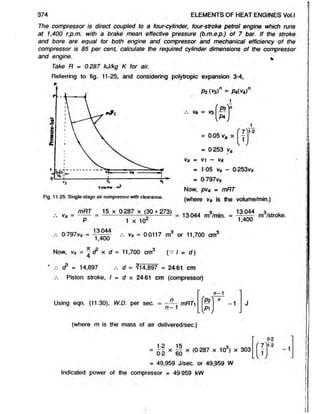
Referring to fig. 11-25, and considering polytropic expansion 3-4,
PS(^3)" = P4(V4)n
VA = V3 P3
P4
= 0 05 Va X
1
f 7 y 2
T
V
mRT 15 x 0-287 x (30 + 273)
Va = I =
= 0-253 vs
va » vi - V
4
= 1-05 vs - 0-253Vs
» 0-797vs
Now, pva = mRT
(where va is the volume/min.)
13-044
1 x 10*
= 13-044 m /min. =
1,400
m /stroke.
0-797Vs =
13 044
1,400
vs = 0 0117 m3 or 11,700 cm3
Now, Vs = v <? x d = 11,700 cm3 (’• ' / = d)
(? = 14,897 d = $14,897 = 24-61 cm
Piston stroke, I = d = 24-61 cm (compressor)
n
Using eqn. (11.30), W.D. per sec. = —
—- mf?Ti
n - 1
P2
,pi
L V /
-1
(where m is the mass of air delivered/sec.)
= ~ x x (0-287 x 103) x 303
= 49,959 J/sec. or 49,959 W
Indicated power of the compressor = 49 959 kW
f l '
1
L V /
0-2
12
- 1
Brake power of the compressor
Indicated powe r 49-959
Mechanical efficiency ~ 0-85
AIR COMPRESSORS
— = 58-775 kW (input power to compressor)
4
375
But, brake power of engine,
= pm x I x a x no. of working cycles of the engine per sec. x no. of cylinders
where pm = brake mean effective pressure in pa,
d3 * 0-002291 d » 0-1318 m or 13-18 cm, and I = 13-18 cm. .
Problem-17 : A single-cylinder, single-acting air compressor is required to deliver 7 m3
of free air per minute at a mean, piston speed of 200 m per minute. The air is to be
compressed from an initial pressure of 1 bar to a delivery pressure of 75 bar and the
index of compression and expansion may be assumed to be 125. Assuming the stroke
of piston to be 15 times the bore of the cylinder, clearance volume to be 1/18th of
the swept volume per stroke, and suction pressure and temperature to be equal to the
atmospheric air pressure and temperature, find the volumetric efficiency, bore, stroke
and speed of the compressor.
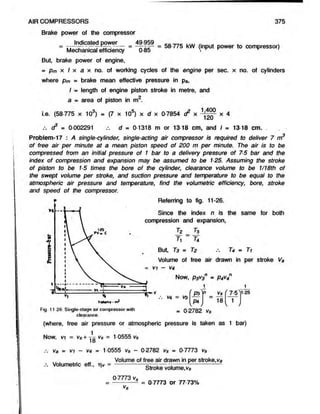
* Referring to fig. 11-26.
I = length of engine piston stroke in metre, and
a - area of piston in m2.
i.e. (58-775 x 103) . (7 x 10s) x d x 0-7854 d2 x x 4
*
Votant-ml
compression and expansion,
- VI - V4
Ti r4
But T3 = T2 T4 = Ti
Volume of free air drawn in per stroke Va
Since the index n is the same for both
Now, p3v3n = P4V
4
t 2 7
-3
Fig. 11 26 Single-stage air compressor with
clearance.
- 0 2782 Vs
(where, free air pressure or atmospheric pressure is taken as 1 bar)
Now, vi = vs+ 70 vs = 1-0555 Vs
Va = vi — V
4 *= 1-0555 vs — 0-2782 Vs = 0-7773 Vs
j». Volumetric eff., =
Volume of free air drawn in per stroke,V
a
Stroke volume,vs
0-7773 vs
-----------5 = 0 7773 or 77 73%
V
s
376 ELEMENTS OF HEAT ENGINES Vol.l
Now, = -A £ x / = ^ cF x 1-5 d = 1-18 (?
4 4
Also mean piston speed per min. = 200 m/min. ■ 21 x r.p.m.
200
3d
.3
„ . , 200 200
Speed of compressor, r.p.m. = - — = - — -
fc/ c X 1 D u
Volume of air delivered in m per minute, Va » (v/ - V
4) x r.pm. = 7
i.e. 0-7773 vs x r.p.m. = 7
i.e. 0-7773 (1-18^) x 200
3d
= 7
.-. d = 0-3382 m or 33-82 cm. Thus, stroke, I = 1-5 x 0-3382 = 0-5073 m or
50 73 cm.
Speed of the compressor, r.p.m. = = 3 x 0 3382 = 197 r p m‘
Problem-18 : The following particulars refer to a two-stage, single-acting air compressor :
Capacity, 5 m3 per minute measured under free air conditions of 15'C and 101325
bar; Delivery pressure, 17 bar; Pressure during suction stroke, 098 bar; Temperature
of air at the start of compression in each stage, 30'C; Clearance volume of low-pressure
cylinder is 6% ot the swept volume; Index of compression and expansion, 125 throughout,
Speed, 125 r.p.m.
Assuming that the intercooler pressure is so chosen that theoretically the work is
shared equally between the two cylinders, find : (a) the indicated power, and (b) the
dimensions of the low-pressure cylinder if the bore is equal to the stroke. Take Ft =
287 J/kg K for air.
(a) Referring to fig.11-27,
Mass of air dealt with,
_ I™ _ (1 01325 x 10s) x 5
1
7
1 ~ RT ~ 287 x 288
= 6-129 kg per minute.
From eqn. (11.11) for work to be shared equally
between the two cylinders, intercooler pressure is
given by
pz = Vpip3 = VO-98 x 17 = 4-08 bar.
Tz
Now, y - =
Fig. 11-27. Two-stage air compressor with
clearance.
Tz = Ti
n - 1
f p *
‘ n
V >
[ > ') n
[ P l j
= 303
025
f 4 08^ 25
098
= 303 x 133 = 403 K.
Work done in L.P. cylinder per kg of air is given by
W = - - 7 R(Tz - T ,) = x 287(403 - 303) - 1,43,500 J.
n —l j'<Lo
Since, the work is equally shared between the two cylinders,
The total work done per kg of air - 1,43,500 x 2 = 2,87,000 J
Work required in Joule per sec. = work done perkg of air x massof air per sec.
= 2,87,000 x = 29,320 J/sec. or 29,320 W
d u
.-. Indicated power = 29 32 kW.
(b) Let stroke volume of L.P. cylinder, v-f - v3= 100 m3, then v3 =6 m3 and Vi
= 106 m3 (fig. 11-27).
Mass of air dealt with per stroke, for a single-acting compressor with 100 m3 stroke
volume, m = m* -
P1^1 0-98 x 105 x 106 , .
mi = 287~>T303— = 119 46 k9 (mass ^ r compressed)
Pav3 4 08 x 105 x 6 0< .■ j »
m3 = — - = — 287 x 403— = 21*17 kg (mass of air left in the cylinder)
m = m -m ,3 = 119-46-21-17 = 98-29 kg per 100 m3 stroke volume and assuming
that-the temperature remains constant during delivery, i.e. from point 2 to 3,
Actual stroke volume per minute = x 6-129 = 6-236 m3/min.
98*29
Now, stroke volume permin. = ^ & x d x r.p.m.
i.e. 6-236 = ^ c? x d x 125 (the bore being equal to the stroke)
.*. dP= 0-0636 d- 0-3991 m or 39-91 cm, and I = d = 39-91 cm.
Problem-19 : Atwo-stageair compressor delivering air at 175 bar has aclearance
volume of 4% of the swept volume. The atmospheric conditions are 101 bar and 18"C,
and at the start of compression the pressure in the cylinder is 1 bar. The temperature
at the start of compression in each stage is 30"C, and the intercooler pressure is 4-04
bar. The law of compression and expansion for both
stages is pv1 = constant.
Find : (a) the volumetric efficiency referred to
atmospheric conditions,
(b) the work required per kg of air delivered by the
compressor, and
(c) the isothermal efficiency referred to isothermal
compression from atmospheric temperature and pres-
sure. (R * 0287 kJ/kg K for air).
Referring to fig. 11-28,
Let the stroke volume, vi - V3 - 100 units,
then V
3 =4 units and vi = 104 units,
c n00 t itK T1 = Ts = (30 + 273) = 303 K
f-ig. 11-28. Two-stage air compression with
clearance. ( v cooling is perfect)
AIR COMPRESSORS 377
-n?
ELEMENTS OF HEAT ENGINES Vol.l
(a) Considering polytropic compression 1-2 in L.P. cylinder.
n - 1
Ik 'P z
S ',
n - 1
Tz = 7i x P*
S ' j
= 303 x
404
125 - 1
125
= 400 5K
V
1
Now, p iv in = D2V
2n or - - =
V
Z
P2
S ' ,
vz =
V1 104
[ > I
1 f 4-04^
n
1
k y
104
3056
34 03 units
1-25
Volume of air delivered = v2 - v3 = 34-03 - 4 = 30-03 units measured at 4-04
bar and 400-5 K,
also j (measured conditions) = — ^ (free air conditions)
Volume of free air (at atmospheric conditions i.e. at 1-01 bar and 291 K) delivered
404 291
= 30 03 x x = 87 28 units.
1 01 400-5
[Volumetric efficiency referred
to atmospheric conditions
Volume of free air delivered per stroke
Swept volume of L.P. cylinder per stroke
87-28
100
= 0 8728 or 87 28%
(b) Work done per kg of air in LP. cylinder
n
n - 1
1 25
1 25-1
x 0-287(400-5 - 303) = 139-91 kJ
n - 1
76
Considering polytropic compression 5-6 in H.P. cylinder, y =
_P6
ps
n-1
76 = Ts P6
PS
= 303
17-5^1
025
1-25
404
= 303 x 1-341 = 406-3 K
Work done per kg of air in H.P. cylinder
= — R{T6- 7c) = x 0-287 (406-3 - 303) = 148-24 kJ
n —1 1-25 —1
Therefore, total work required per kg of air
= work required in L.P. cylinder + work required in H.P. cylinder
= 139 91 + 148 24 » 28815 kJ per kg of air.
(c) Isothermal work done per kg of air for the same range of pressure and compression
from atmospheric pressure and temperature,
f P6 )
PatmJ
= 0 287 x 291 x loge
AIR COMPRESSORS 379
W m
mR X Tatm x loge
101
= 0-287 x 291 x 2-852 = 238-19 kJ per kg of air.
Isothermal efficiency m Work done when compression is isothermal per kg of air
Actual work done on the air per kg of air
238 19
= 0 8266 or 82 66%
28815
11.8 Actual Indicator Diagram of a Single-Stage Air Compressor
Actual air compressor differs from the ideal
compressor in many respects, because the
cylinder, the valves and the piston, store and
release energy in the form of heat and further
because air is throttled through the valves. An
indicator diagram of an actual air compressor
is shown in fig. 11-29 superimposed upon an
ideal one (shown dotted) for the same com-
pressor. The air pressure is to be raised from
atmospheric pressure pi to a receiver pres-
sure P2-
The ideal indicator diagram is drawn for
isothermal compression of air in the cylinder
and for isothermal expansion of the clearance
air. In actual compressor, isothermal compres-
Fig. 11 29. Actual indicator diagram of single-stage sion is not Obtained, instead polytropiC COm-
air compressor. pression is obtained, i.e. the compression falls
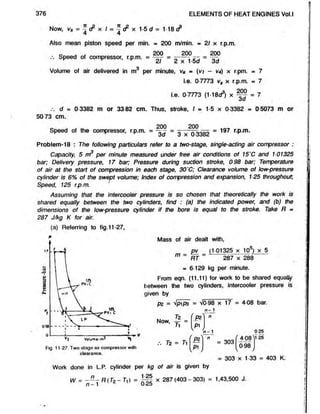
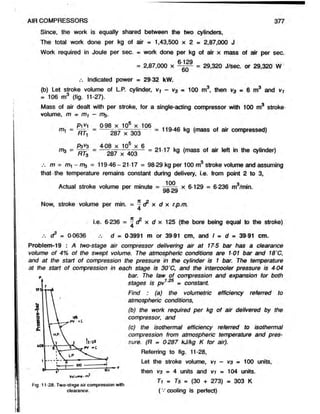
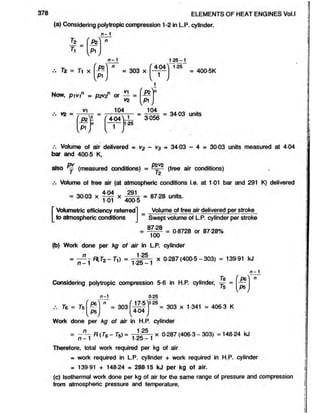
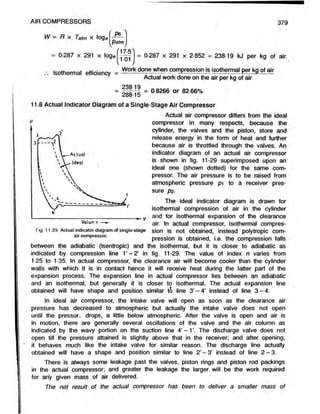
between the adiabatic (isentropic) and the isothermal, but it is closer to adiabatic as
indicated by compression line 1’ - 2 ’ in fig. 11-29. The value of index n varies from
125 to 1-35. In actual compressor, the clearance air will become cooler than the cylinder
walls with which it is in contact hence it will receive heat during the latter part of the
expansion process. The expansion line in actual compressor lies between an adiabatic
and an isothermal, but generally it is closer to isothermal. The actual expansion line
obtained will have shape and position similar to line 3’ - 4 ’ instead of line 3 -4 .
In ideal air compressor, the intake valve will open as soon as the clearance air
pressure has decreased to atmospheric but actually the intake valve does not open
until the pressur. drops, a little below atmospheric. After the valve is open and air is
in motion, there are generally several oscillations of the valve and the air column as
indicated by the wavy portion on the suction line 4’ -1 ’. The discharge valve does not
open till the pressure attained is slightly above that in the receiver; and after opening,
it behaves much like the intake valve for similar reason. The discharge line actually
obtained will have a shape and position similar to line 2’ - 3 ’ instead of line 2 -3 .
There is always some leakage past the valves, piston rings and piston rod packings
in the actual compressor; and greater the leakage the larger will be the work required
forany given mass of air delivered.
The net result of the actual compressor has been to deliver a smaller mass of
380 ELEMENTS OF HEAT ENGINES Vol.l
air than that handled by the ideal compressor and to require an expenditure of work
in excess of that of the ideal one as shown by greater area.
11.9 Reciprocating Compressed Air Motor
Air motor is in effect a reversed air compressor. The compressed air to be used
in an air motor is taken from the compressor reservoir (receiver). The most common
form of compressed air motor is the cylinder and double-acting piston type. The air is
admitted into the motor cylinder through a mechanically operated inlet valve and drives
the piston forward but after a portion of the stroke of the piston has been performed,
the air supply is cut-off and the stroke is completed under decreasing pressure as the
air expands in the cylinder. After the expansion stroke is completed, the air which has
done the work is allowed to escape into atmospheric through a mechanically operated
discharge valve. The return stroke is performed by compressed air acting on the other
side of the piston. A motor of this type works like a reciprocating double-acting steam
engine.
The important application of air motor is the
use in mines where use of electric motor is
dangerous. There will be a fall in the pressure
of air due to friction in the pipe, the fall being
greater, the greater the distance of the air motor
from the compressor reservoir (receiver).
Figure 11-30 shows the pressure-volume
diagram for a compressed air motor (air engine)
in which clearance is neglected. Air is admitted
at high pressure pi from 4-1, cut off takes place
at point 1. From 1 to 2 air expands from pressure
p i to atmospheric pressure p2 and expansive
work is done. The law of expansion is polytropic,
voium
« i.e. pv° m c. Exhaust takes place from 2 to 3.
Fig. 11 30. Compressed air motor without clearance.
The work done per cycle by the air motor with no clearance is given by area
4-1-2-3.
P1V1 —
P2V2
Work done per cycle = p i v + - — pzvz
nPl V1 ~ P l y1 + P1 y1 ~ P * V2 ~ nP z v2 ± P2V
2
n -1
= T T rrfp i^ -P 2V
2 ]
Pi^i
n
n -1
P2V
2
P2 V
2
-1 Joule
But for polytropic expansion 1- 2,
Pivi" = P2*2 S
v2
1
n
AIR COMPRESSORS 381
Vi
Substituting the value of — in the above equation, we get, work done by air,
V2
W =
n
n - 1 02^2
L V
r P±
Pz
n-1
n
-1 Joule per cycle (11.32)
The fig. 11-31 shows the pressure-volume
diagram in which air is admitted at high pressure
pi from 5 to 1, cut-off takes place at point
1, expansive work is done from 1 to 2 and
release takes place (before the atmospheric
pressure reached) from 2 to 3 and then exhaust
takes place from 3 to 4.
The work done per cycle by the air motor,
with no clearance, is given by area 5-1-2-3-4.
Work done by air motor per cycle
= area 5-1-2-3-4
P1V1 - P2V2
n - 1 -------------------- P 3 4 / 3
(11.33)
Fig. 11-31.
where, pressures are measured in Pa and
volumes in m .
Problem-20 : Air at a pressure of 9 bar enters the cylinder of a compressed air motor;
the supply is cut-off at V4th stroke and the air expands according to the law pv13 =
constant. Neglecting the effect of clearance, find the temperature of air at the end of
expansion when the temperature of the compressed air is 25"C, and find the volume
for a single-acting air motor to develop indicated power of 5 kW at a speed of 260
r.p.m. when the exhaust is at 105 bar. Also find the air motor cylinder dimensions
assuming bore = stroke.
Assume R for air = 0-287 kJ/kg K.
Referring to fig. 11-32,
polytropic expansion 1-2,
y i - 1
and considering
T
Tz
Tz = -
*z
^1
vn - 1
= (I)
25 + 273
vO-3
n- 1
= 197 K
(')""• (4f
i.e. tz = 197 - 273 = -76*C , temperature
of air at the end of expansion.
It may be noted that the temperature of air
at the end of expansion is -76*C which is much
below the freezing point. When the temperature
falls below the freezing point, the moisture in the
air is frozen and, the snow formed may seriously
382 ELEMENTS OF HEAT ENGINES Vol.l
interfere with the working of the discharge (exhaust) valve of the air motor.
The most satisfactory method of preventing too low a temperature at the end of
expansion is to heat the air (before the air enters the motor cylinder) at constant
pressure by passing it through a suitable pre-heater. By pre-heating the air, not only
the freezing effect is prevented but the volume of air is increased, the volume being
proportional to the absolute temperature and consequently a large proportion of the heat
expended (used up) in the heater is converted into work in the motor cylinder, i.e. the
work done in the motor cylinder, for the consumption of same mass of air increases,
when ,the air is pre-heated.
Now, p m " = pzvzn ••• pz = P1
Vz
P
1
(0n (4)
1-3
= 1485 bar
Using eqn. (11.33), Work done/stroke = pivi +
pi vi - pzvz
n - 1
P3V3
= io V 2
= 10 V
2
Pl*1
p m V2
v2
Pz
__________________ * 3
n - 1 v2
n -7 - 1-485
9 4_______
4 + 0 3
105 = 3,75,000 v2 J per stroke
Indicated power (work done in J/sec or W) = Work done per stroke x
260
i.e. 5 x 103 = 3,75,000 x vz x (for a single-acting motor)
oO
.-. vz = 0 003077 m3.
But, vz = *5 & x I 0 003077 = £ x (? ( I = d)
4 4
N
60
= 0 0039177
0-7854
.*. Dia. of cylinder, d = $0-0039177 « 01576 m or 15-76 cm and stroke, I
15-76 cm.
= d
11.10 Classification of Air Compressors
The compressors can be mainly classified as, depending on the type of mechanism,
the nature of their motion, the flow of fluid, etc. Fig. 11-33 shows the classification of
compressors.
In a positive displacement compressor, displacement of a fixed amount of fluid
(positively contained during its passage through the machine), takes place. In that type,
work changes are effected by the displacement of a boundary, i.e., by pressure and
volume changes. All reciprocating compressors are positive displacement type, while
rotary compressors may be positive displacement or non-positive displacement type.
In reciprocating positive displacement compressors, the displacement of a boundary
reduces the volume and increases the pressure. In rotary positive displacement compressors
the increase in pressure is by backflow of fluid as in Root’s blower, or both by variation
in volume and by backflow as in vane type blower.
AIR COMPRESSORS
Fig. 11 33.
operating speed,
In non-positive dis-
placement or steady flow
compressors, the fluid is
continuously in a steady-
flow through the
machine, undergoing
changes in pressure
primarily by means of
dynamic effects. In this
type of compressor, work
changes are effected by
means of velocity chan-
ges. Therefore, operating
speed affects directly the
operating efficiency of a
non-positive displace-
limits, has little effect on
383
ment compressor; while operating speed, within reasonable
the efficiency of a positive displacement compressor.
Reciprocating compressors have the following advantages over non-positive displace-
ment rotary compressors :
- Capacity of delivering higher pressures,
- Greater flexibility in capacity and pressure range,
- Somewhat higher efficiency for pressure ratios > 2, and
- Less susceptibility to change in gas composition and density.
Reciprocating compressors are suitable for delivering small quantities of air at high
pressure. The maximum free air delivery is limited to 300 m /min but the pressure may
be as high as 1,000 bar. It is a low speed machine due to the inertia of the reciprocating
parts.
Because of large quantities of air at relative low pressure (3 to 10 bar) required
in gas turbine plants, reciprocating compressors, though they have above mentioned
advantages are not employed.
Positive displacement rotary or displacement blowers are also not suitable for gas
turbine plants as they, in general, are noisy, subject to wear, and also of limited capacity
compared with the non-positive displacement or steady flow rotary compressors (centrifugal
and axial flow compressors).
Non-positive displacement rotary or steady flow compressors, Centrifugal and axial
flow compressors, offer the following advantages :
.. Handle large quantities of air or gas, at relatively lower pressure,
.. Being high speed machines, they are small in size,
.. Provide uniform delivery without requiring a large receiver,
.. Deliver clean air as there are fewer sliding parts requiring lubrication,
.. Present no balancing problems,
.. Lower maintenance expenses, and
.. Less operating attention.
384 ELEMENTS OF HEAT ENGINES
11.11 Rotary Air Compressors
Do
Depending on their pressure ratio, rp= —, rotary air compressors may be classified
Pi
as follows :
Fans ( rp = ^ to 1*1 ) - The main purpose of a fan is to move air or to circulate
air through the ducts of an air conditioning system and to supply low-pressure air blast.
As the fluid passing through the unit does not suffer appreciable change in density, it
can be treated as incompressible like water. Principally, fans are axial-flow compressors
without casing around the impeller periphery.
Blowers ( rp m 1-1 to 4 ) and compressors ( rp > 3 ) - If compressibility effect
is considerable, it is to be taken into account while designing the unit and the unit is
known as blower or a compressor proper depending on the pressure ratio. Blower may
be positive displacement rotary compressor (Root’s blower, lysholm, vane type, screw
type, etc.) or non-positive displacement rotary compressor (centrifugal compressor).
The purposes of a blower is to furnish forced draught to furnaces, besemer
convertors, cupolas, etc.
The purpose of compressor (centrifugal or axial flow) 'is to supply compressed air
in large quantity, such as in gas turbine plants.
11.12 Non-positive Displacement Rotary or Steady Flow Compressors
Centrifugal and axial flow compressors come under this heading. In all forms of
turbo-machinery, whether expanders (called turbines or centrifugal and axial flow
compressors), work changes are effected by means of velocity changes instead of by
displacement changes of a boundary, such as with a piston. If the air enters at the
centre axially and flows radially outward towards the circumference, the compressor is
known as centrifugal compressor. On the other hand if the air flows parallel to the
shaft, it is called axial flow compressor.
11.12.1 Centrifugal Air Compressors : A centrifugal compressor, mainly, consists
of impeller and diffuser. The impeller consists of an impeller disc and impeller vanes,
attached on the impeller disc radially, forming radial diverging passages as shown in
fig. 11-34(a). The impeller rotates with the shaft at high speed and air is drawn into
the impeller eye in an axial direction. The air then flows radially outwards through the
impeller passages due to centrifugal force, and kinetic energy in imparted to the air
with some static pressure rise as shown in fig. 11-34(b). The remainder of the pressure
rise is obtained in the diffuser. The diffuser which is stationary, consists of a number
of fixed diverging passages. The air leaves the impeller tip with high velocity and enters
the diffuser. The diffuser, in its fixed diverging passages, reduces the high velocity.
Thus, by the diffusion process or deceleration of air in the diffuser, kinetic energy is
converted into pressure energy.
The flow from the diffuser is collected in a spiral passage from which it is discharged
from the compressor.
Single-stage centrifugal compressor can develop a pressure ratio as high as 4 : 1.
Pressure ratio as high as 10 : 1 can be developed with the help of multi-stage
centrifugal compressors.
The impeller may be single or double sided. The impeller illustrated in fig. 11-34(a)
is single sided one. The single sided impeller sucks in air from one side only. A double
AIR COMPRESSORS 385
Velocity i ».
Rg. 11-34. ( * )
sided Impeller consists of vanes on both sides and air is drawn in from both sides. A
double sided impeller is used often when larger flows are to be handled.
The centrifugal compressor has the following advantages as compared with axial
flow compressor :
(i) It is more rugged.
(ii) It is simpler.
(iii) It is less expensive.
(iv) It is smaller in length.
(v) It attains higher pressure ratio per stage.
(vi) It is not liable to loss of performance by the effects of deposits left on the surfaces of
flow passages of air when working in a contaminated atmosphere.
(vii) It is able to operate efficiently over a wider range of mass flow at any particular speed.
However, it suffers from disad-
vantages of large frontal area, lower
maximum efficiency, and less adap-
tability to multi-staging.
Centrifugal compressor is mainly
used in, (i) Oil refinery, (ii) Petrochemi-
cal plants, (iii) Natural gas transmis-
sion system, (iv) Refrigeration plants,
(v) Supercharging of Petrol and Diesel
engines, etc.
11.12.2 Axial Flow. Air Com-
pressors : Axial flow compressor
consists of a rotor and a casing or
stator. Blades mounted on the rotor
C
o
m
p
r
e
s
s
e
d
o
i
r
F
i
x
e
d
b
l
a
d
e
s
C
a
s
i
o
?
T ShoM
Pressur
V
e
l
o
c
i
t
y
ft s R s R s
*5 <7
1 1
(•)
B »
E125.
Fig. 11 35.
386 ELEMENTS OF HEAT ENGINES
are moving blades (rotor blades) and blades fixed on the inner face of the casing are
known as stationary blades (stator blades). Air enters the blades axially and also leaves
them in the axial direction as shown in fig. 11-35(a).
An axial flow compressor is designed according to the reaction principle (diffusion
in both rotor and stator). Thus, the rise in pressure through the stage (rotor and stator)
is in general, attributable to both blade rows, moving as well as fixed. As a measure
of the extent to which the rotor itself contributes to this pressure rise, the term “degree
of reaction" is used. Thus, degree of reaction is defined as the ratio of pressure rise
in rotor to the total pressure rise.
A single-stage compressor (one row of moving blades and one row of fixed blades)
does not give appreciable pressure ratio. Axial flow compressor are mostly multi-stage
compressors. Pressure ratio which can be produced per stage of an axial flow compressor
is 1 : 2.
Figure 11-35(a) represents a three-stage, axial flow compressor. The moving blades,
receive the air and increase its velocity, and also act as a diffuser to increase the
pressure, while the fixed blades continue the diffuser action. Figure 11-35(b) shows the
increase in pressure of air during its passage through rotor blades (R) and stator blades
(S).
Axial flow type compressors are given preference over the centrifugal type in the
application of aircraft and industrial gas turbine power plants. This is because axial flow
compressor has a higher efficiency, less frontal area, and is capable of producing higher
pressure ratio on a single shaft by increasing the number of stages. However, the axial
flow compressors run at lower speeds, their weight is greater, have higher starting
torque, are sensitive to any deposit formation on blades, and are complicated as
compared with centrifugal compressors.
Tutorial - 11
1. (a) Estimate the amount of work required for compression of one kg of air for single-stage compression.
(b) What are the uses of high pressure air?
(c) A single-stage, single-acting air compressor deals with 85 m3 of free air per hour at 1 01325 bar and
15‘C. The pressure and temperature in the cylinder during the suction stroke remains constant at 1 bar and
40*C respectively. The index of compression is 1-22 and the delivery pressure is 5-5 bar. If the mechanical
efficiency is 85%, find, neglecting clearance volume, the power required to drive the compressor.
[6-107 kW]
2. A single-acting, single-cylinder, air compressor has a cylinder diameter 18 cm and a stroke of 25 cm. Air is drawn
into the cylinder at 102 kPa (102 kN/m2), 288 K. It is then compressed isentropically to 632 kPa (632 kN/m2).
Find : (a) the power required to drive the compressor if its speed is 120 r.p.m; and (b) the mass of air
compressed per hour. Take y = 1-4 and R = 0-287 kJ/kg K for air. Neglect clearance effects.
[3-112 kW; (b) 56 54 kg/hr ]
3. It is desired to compress 15 m3 of air per minute at 100 kPa (100 kN/m2) and 297 K to 700 kPa (700 kN/m )
in a single-stage, single-acting air compressor. Calculate the power required to drive the compressor if the
compression is :
(a) Isothermal.
(b) Polytropic with index n - 1-3, and
(c) Isentropic.
Take y = 1-4 for air. Neglect clearance effects.
[(a) 48 648 kW; (b) 61 533 kW; (c) 651 kW]
AIR COMPRESSORS 387
4. (a) A single-stage, single-acting air compressor is belt driven from an electric motor at 400 r.p.m. The cylinder
diameter is 15 cm and stroke is 18 cm. The air is compressed from 1 05 bar to 7-5 bar and the law of compression
is pv13 = constant. Find the power of the motor, if the transmission efficiency is 97% and the mechanical efficiency
of the compressor is 90%. Neglect the clearance effects.
[6 354 kW]
(b) A single-cylinder, double-acting air compressor is of 24 kW. The law of compression is pv12 = constant.
The air is compressed from 1 bar to 8 bar. The compressor runs at 200 r.p.m. and average piston speed
may be taken as 160 m/min. Find the dimensions of the cylinder required. Neglect the effect of clearance.
[d = 21-47 cm; I = 04 m]
5. (a) Define volumetric efficiency of a compressor.
(b) Find the diameter and stroke of a single-stage, double-acting air compressor from the following data :
Capacity * 20 m of free air per minute at atmospheric pressure and temperature; Delivery pressure = 7-5
bar; Inlet pressure = 1 bar; Inlet temperature = 32*C; Atmospheric pressure = 1 01325 bar; Atmospheric
temperature = 15*C; Speed = 300 r.p.m.; Index of compression = 1-3; Stroke : bore = 0-9 : 1.
Also find the indicated power of the compressor. Neglect clearance effects.
[d m 36-99 cm; I = 33 291 cm; 91-753 kW]
6. A two-stage, single-acting air compressor draws air at 1-05 bar and temperature of 16’C. The air is compressed
in the L.P. cylinder to a pressure of 5-25 bar. After compression, the air is cooled in the intercooler at constant
pressure to a temperature of 30*C, before being taken to H.P. cylinder from which it is delivered at 20 bar. The
compression is carried out each cylinder according to the law pv135 = C. Find the indicated work required in kJ
to compress one kg of air. Take R - 0-287 kJ/kg K for air. Neglect clearance.
[304 92 kJ]
7. What are the conditions for obtaining maximum efficiency in the case of a two-stage reciprocating air compressor ?
A two-stage, single-acting air compressor deals with 5-75 m3 of air per minute under atmospheric conditions.
It delivers air at 40 bar. The compressor runs at 300 r.p.m. The stroke is equal to L.P. cylinder diameter.
Assuming complete intercooling and compression in each stage according to the law py*35 = C and mechanical
efficiency of 85 per cent, calculate the cylinder diameters and minimum power required to drive the compressor.
Assume atmospheric conditions as 1-01325 bar and 15‘C. Neglect clearance.
[dLp. = 29 cm; <to.P. = 11-56 cm; 53-758 kW]
8. A two-stage, single-acting air compressor takes in 3 m3 of air per minute at atmospheric pressure of 1 bar abd
temperature of 288 K. It delivers air at 35 bar (3-5 MPa). The compression is carried out in each cylinder according
to the law pv1
'25 = C. Assuming complete intercooling and mechanical efficiency of 80 per cent, calculate the
minimum power required to drive the compressor and the heat carried away from the intercooter per minute by
cooling water. If the inlet and outlet temperatures of the cooling water are 15‘C and 40*C, calculate the amount
of cooling water required per minute. Also compare the volumes of the two cylinders. Neglect clearance effects.
Take R = 0-287 kJAtg K and kp = 1-0035 kJ/kg K for air.
[26-688 kW; 44793 kJ/min.; 4 28 kg/min.; 5-916]
9. What is the object of compressing air in stages?
Derive an expression for the minimum work required to compress and deliver 1 kg of air in a two-stage
compressor. State carefully the assumptions made.
10. What are the advantages of multi-stage compression ?
Determine the minimum driving power required for three-stage compression from 1-05 bar to 42 bar if the
delivery is 4-5 m3 of free air per min. Compression in each stage is carried out according to law pv 3 =
constant. Suction temperature is 21‘C and mechanical efficiency is 80%. Take free air conditions as 1-01325
bar and 15‘C. The air compressor is single-acting. Neglect clearance.
[41 346 kW]
11. A three-stage, single-acting air compressor with perfect intercooling deals with 23 m3 of air per minute at 1-01325
bar and 288 K. The L.P. cylinder suction pressure and temperature are 1 bar and 305 K and the final delivery
pressure is 25 bar. If the stage pressures are in geometric progression and index of compression in each stage
is 1 35, find the power required to drive compressor. Also find the heat rejected to the intercoolers per minute
and isothermal efficiency of the compressor. Neglect clearance. Take R = 0-287 kJ/kg K and Kp= 1-0035 kJ/Kg K
for air.
[152 3 kW; 2,760 kJ/min; 86 86%]
12. What is meant by the term ‘perfect cooling’ ?
A three-stage, single-acting compressor has perfect intercooling. The pressure and temperature at the end
of suction stroke in the L.P. cylinder is 1-01325 bar and 15’C respectively. The delivery pressure is 70 bar.
Compression in each stage is carried out according to pv12 = C, and 8-5 m9 of free air (1-01325 bar and
15’C) are delivered per min. If the work done is minimum, calculate :
(i) the L.P. and I.P. delivery pressures,
(ii) the ratio of cylinder volume, and
(iii) the indicated power of the compressor.
Neglect clearance
[(i)4-158 bar, 17-059 bar; (ii) 16-835 : 4-103 : 1; (iii) 68-73kW]
13. A three-stage, single-acting air compressor works between 1-05 bar and 42 bar. For one cubicmetre of air
taken in, calculate:
(i) the indicated work required in kJ for maximum efficiency,
(ii) the isothermal work required in kJ between the same pressure limits,
(iii) the indicated work required if the compressor were of one-stage only,
(iv) the isothermal efficiency ofthe compressor, and
(v) the percentage saving in work required due to using three-stages instead ofone.
In parts (i) and (iii), assume the index of compression, n = 1-25.
Neglect clearance.
[(i) 438-64 kJ; (ii) 387-34 kJ; (iii) 572-78 kJ; (iv) 88-3%; (v) 23-42%]
14. (a) Explain the effect of clearance on the performance of air compressor.
(b) Explain that volumetric efficiency depends on clearance volume and pressure ratio for a single-stage
compressor.
The clearance volume in a single-stage, single-acting air compressor is 5% of the swept volume. Air is
drawn ‘
m at constant pressure of 1 bar and temperature of 43*C. Compression and expansion follow the
la«*£V125 = constant. The delivery pressure is 6-5 bar and atmospheric pressure and temperature are
1-01325 bar and 15*C respectively. Estimate.
(a) the volumetric efficiency.
(b) the volumetric efficiency referred to atmospheric conditions, and
(c) the work required per kg of air.
Take R = 0-287 kJ/kg K for air.
[(a) 82 65%; (b) 74-34%; (c) 205 87 kJ/kg]
15. A single-acting, single-cylinder air compressor compresses air from 1 bar to 6-5 bar. Compression and expansion
follow the law pv125 = constant. The clearance volume is 1 litre. If the volumetric efficiency of the compressor
is 80%, calculate the stroke volume. If the ratio of diameter of cylinder to stroke of piston is 1-5, calculate diameter
of the cylinder and stroke of the piston.
(0 0173 m3; 24 52 cm; d = 36-78 cm]
16. A single-acting, single-cylinder air compressor runs at 100 r.p.m. The air is compressed from 1 to 8 bar. The
stroke volume is 0-125 m3 and the law of compression and expansion is pv1'3 = C. If the clearance volume is
5% of the stroke volume, calculate :
(i) the volumetric efficiency,
(ii) the volume of air taken in per minute, and
(iii) the indicated power of the compressor.
l(i) 80-245%; (ii) 10-031 m3
/min.; (iii) 44-55 kWJ
17. In an air compressor, show that cylinder clearance does not affect the theoretical work required to compress
and deliver one kg of air, provided that delivery and suction pressures remain constant, and that the indices of
compression and expansion have the same value.
A single-stage, single-acting air compressor is required to deliver 6 m of free air per minute at a mean
piston speed of 165 m per min. The air is to be compressed from an initial pressure of 1-05 bar to deljvery
pressure of 7 bar and index of compression and expansion is assumed to be 1-3. Assuming stroke of piston
to be 1-25 times the bore of the cylinder, clearance volume to be 1/15th of the swept volume per stroke
and suction pressure and temperature to be equal to atmospheric pressure and temperature, find : (i) the
volumetric efficiency, (ii) the speed, and (iii) the bore and stroke.
[(i) 78%; (ii) 191 64 r p.m.; (iii) d = 34-47 cm, I = 43 08 cm)
388 ELEMENTS OF HEAT ENGINES
AIR COMPRESSORS 389
18. A single-stage, double-acting air compressor has a stroke volume of 0 06 m3 and a clearance volume of 0 003
m3. Find its volumetric efficiency referred to atmospheric conditions (1-01325 bar and 15’C) and the mass of air
delivered per hour when the speed is 200 r.p.m. The suction pressure is 0-92 bar and suction temperature is
50*C and the delivery pressure is 6 bar. Also determine the indicated power of the compressor. Assume com-
pression and expansion law as pv135 = constant. Take R = 0-287 kJ/kg K for air.
[68-77%; 1,2139 kg/hr; 75476 kW]
19. A single-acting, single-stage air compressor is required to compress 5 kg of air per minute from 0-95 bar and
30’C to a pressure of 7-6 bar. The clearance volume is 5% of the stroke volume and the index of both the
expansion and compression curves is 1-25. If the stroke and bore are equal and compressor runs at 120 r.p.m.,
find the size of the cylinder.
Take R = 0-287 kJ/kg K for air. [d = I = 39 53 cm]
20. A two-stage, single-acting air compressor has to deal with 3 m3 of air per minute under atmospheric conditions
(1-01325 bar and 15*C) at 220 r.p.m. and delivers at 85 bar. Assuming complete intercooling between the stages,
find the minimum power required to drive the compressor, the cylinder diameters and the common stroke. Assume
a piston speed of 165 m per min. mechanical efficiency of compressor as 80% and volumetric efficiency of 85%
for each stage. Compression in each cylinder is carried out according to the law pv19 = constant. Neglect
clearance.
[36 553 kW; dip. = 23 34 cm; ckp. = 7 712 cm; I = 37 5 cm]
21. In a two-stage, single-acting air compressor, the delivery pressure is 17-5 bar and the suction pressure is 1
bar. The temperature at the start of compression in each stage is 30*C and the index of compression in each
stage is 1 25. The clearance volume of the low-pressure cylinder is 5 per cent of the swept volume and the
diameter of low-pressure cylinder is 0-8 of the stroke..The mass of air delivered by the compressor is 5 kg/min.
and the intercooler pressure has the ideal value. Find :
(a) the bore of the L.P. cylinder if the speed of the compressor is 110 r.p.m., and
(b) the indicated power of the compressor.
The expansion of the clearance air may be assumed to follow the same law as that for compression.
[(a) 35-59 cm; (b) 23-988 kW]
22. The following particulars apply to a two-stage, single-acting air compressor: Stroke = 25-4 cm; Low-pressure
cylinder diameter = 29-2 cm; Final pressure = 25 bar; Intermediate pressure = 5 bar; Temperature of air leaving
the intercooler * 35'C.
If the volume of air drawn in the compressor and measured at 1 bar and 15*C, is 80% of the low-pressure
cylinders swept volume, find the power expended (used) in compressing the air when running at 250 r.p.rri.
Assume law of compression as pv13 = C in each stage. [22-88 kW]
23. Plot actual and theoretical indicator diagrams of a single-stage reciprocating air compressor. Discuss why they
differ.
24. Describe briefly the working of an air motor (compressed air engine), Where it is used ?
Air at pressure of 8-5 bar enters the cylinder of an air motor; the supply is cut-off at quarter stroke and
expands according to the law pv = constant. Neglecting the effect of clearance, find the temperature at
the end of expansion when the initial temperature erf air is 30’C. Calculate also the cylinder volume for a
single-acting air motor to develop 3-7 kW power at a speed of 250 r.p.m., when exhaust is at 1-05 bar.
Take R = 0 287 kJ/kg K for air. [-86-5*C; 2,604 9 cm3]
25. What are rotary compressors? Differentiate between blowers and compressors. What are axial flow compressors ?
26. (a) How are compressors classified ?
(b) Distinguish between :
(i) Reciprocating and rotary compressors, and
(ii) Positive displacement and non-positive displacement compressors.
27. (a) Differentiate between a fan, a blower, and a compressor.
(b) What is the difference between centrifugal and axial flow compressors ?
28. Sketch and describe the operation of a single-stage centrifugal compressor ?
29. (a) What are the advantages and disadvantages of centrifugal compressors ?
(b) Sketch and describe the operation of an axial flow air compressor.
(c) What are the advantages and disadvantages of axial flow compressors as compared with centrifugal
compressors ?

Air comprosser

  • 1.
    11 AIR COMPRESSORS 11.1 Introduction Aircompressors are used for supplying high-pressure air. There are many uses of high-pressure air in the industry. The main uses of high-pressure (compressed) air are : .. to drive compressed air engines (air motors) used in coal mines, .. to inject or spray fuel into the cylinder of a Diesel engine (air injection Diesel engine), to operate drills, hammers, air brakes for locomotives and railway carnages, water pumps and paint sprays, .. to start large (heavy) Diesel engines, .. to clean workshop machines, generators, automobile vehicles, etc., .. to operate blast furnaces, gas turbine plants, Bessemer convertors used in steel plants, etc., .. to cool large buildings and air crafts, and .. to supercharge I.C. engines. There are mainly two types of air compressors viz. reciprocating air compressors and rotary air compressors. Reciprocating air compressors are similar to reciprocating engines where a piston reciprocates inside a cylinder. In rotary air compressors, air is compressed due to rotation of impeller or blades inside a casing. Air compressors are driven by engines or electric motors. In this chapter the theory of reciprocating air compressors is discussed in details and principles of working of reciprocating compressed air motors and rotary compressors are explained in brief. 11.2 Reciprocating Air Compressors The principal parts of a reciprocating air compressor are the same as that for a engine. The reciprocating air compressor may be single-acting (air is admitted to one side of the piston only) or double-acting (air is admitted to each side of the piston alternatively), and may be single-stage or multi-stage. In a multi-stage compressor, the air is compressed in several stages instead of compressing the air fully in a single cylinder. This is equivalent to a number of compressors arranged in series. The pressure of air is increased in each stage. Single-stage compressors are used for delivery pressures upto 10 bar, three-stage compressors for pressure upto 200 bar and two-stage compressors for pressures in between 10 to 200 bar. The average piston speed of a reciprocating air compressor is limited to about 300 to 400 metres per minute to reduce friction wear. 11.3 Single-stage Air Compressor The sectional view of an air cooled, single-stage, single-acting reciprocating air compressor is shown in fig. 11-1. Both intake (suction) and discharge (delivery) valves
  • 2.
    AIR COMPRESSORS 343 CyliMtr Piston Fig.11-1. Sectional view of a single- acting air cooled, reciprocating air compressor. are disc type and are automatic in their action. They are opened and closed by difference in the air pressure acting on their two sides. When the pressures are equal on their two sides, they are kept closed by light springs. During the outward or suction stroke, the pressure in the cylinder falls below the atmospheric pressure as a result of which the intake valve opens and air is drawn from the atmosphere into the cylinder. During the inward or compression stroke, as a result of the piston action the pressure of the air in the cylinder gradually increases and reaches a value sufficiently above the receiver pressure. The high pressure of air, thus produced, overcomes the resistance of the spring on the discharge valve and causes the valve to open and discharge takes place from the cylinder to the receiver. The receiver is a simple vessel which acts as a storage tank. The compressor is driven by some form of prime mover (electric motor or engine). When the compressor is to be started against tank (receiver) pressure, the prime mover will have to supply very high starting torque. To avoid this, hand unloader (fig. 11-1) is used for releasing pressure from the compressor cylinder when the com- pressor is stopped. 11.3.1Indicator Diagram : The events described above can be conveniently represented byp-vdiagram shown in fig. 11-2. The diagram is drawn for a compressor without clearance. During the suction stroke the charge of air is drawn into the cylinder along line 4-1 at constant pressure pi, which is slightly below that of the atmosphere. At point 1, the piston completes the suction (outward) stroke and starts on its return (compression) stroke. All valves being closed, the air is now compressed along the compression curve 1-2. At point 2, pressure P2 is reached which is slightly higher than the pressure in the receiver. The discharge valve at this point opens and the delivery of the compressed air takes place along line 2-3 at pressure p2. The piston has now reached the left hand end of the cylinder and again starts on its suction stroke and the pressure in the cylinder will be lowered again to p i and the cycle of operations will be repeated. The net work required for compression and .delivery of the air per cycle is represented by the area Fig. 11-2. I heorotical indicator diagram of i i O V a single-stage air compressor. l-Z -o -4 (tig. 11-2). The amount of work done on the air will depend upon the nature of the compression curve. If the compression occurs very rapidly in a non-conducting cylinder so that there is no heat transfer, the compression will be practically isentropic. If it is carried out slowly so that the heat of the compression is extracted from the air by the jacket cooling water, the compression will approach isothermal. However, in actual practice
  • 3.
    344 ELEMENTS OFHEAT ENGINES Vol.l neither of these conditions can be fulfilled and the actual compression will be between isentropic and isothermal. 11.3.2 Isothermal Compression Versus Isentropic Compression : The slope of the compression curve, represented by the law pt/1 = C, depends upon the value of the index n. A large value of n will give comparatively a steeper curve. The law for an isothermal or hyperbolic compression is pv = C, where the value of index n is unity.The law for an isentropic compression is pvy = C. Since the value of y for air is 1.4,the isentropic curve will be steeper than isothermal curve. Figure 11-3 shows curves representing an isentropic compression (1-2’) and an isothermal compression (1-2"). The middle curve (1-2) shows curve, which is obtained in actual practice. The curve is polytropic (pi/1 = C) having a value of n nearly equal to 1-3 for the water cooled cylinder. The isentropic work required to be done per cycle on the air is represented by the area 4-1-2’-3 (fig. 11-3). If the compression carried out had been isothermal, the slope of the compression curve would be less than that of isentropic and the isothermal work done would be represented by the area 4-1-2"-3 which is evidently less than the isentropic work done represented by the area 4-1-2-3. Therefore, it follows that an isothermal com- pression is economical and efficient, since less work is required to carry it out, while an isentropic compression requires more amount of work to be supplied. Compres- sion curve with values of index n between 1 and 1.4 will fall within the isothermal and isentropic curves. Thus, it will be seen that the work required for compression and delivery of air per cycle decreases as the value of Fig. 11 3. Effect of nature of compression p decreases, curve on work required for compression. The theoretical indicator diagram for a single-stage compressor without clearance is shown in fig. 11-4. Let p i in N/m2 (newtons per square metre) or Pa (pascals) and *3 represent initial C o m p ressed air discharge to receiver c 0 Q . Piston driven from external so u rce V s / / / / / u r n PV-. constant ^cJuu^u h Y H E==—1 a - V ,------- b Volum e Fig. 11-4. Single-stage air compressor without clearance. vy in m condition of the air before compression, and pz in N/m = Pa, the final delivery pressure after compression, Then, (a) Work required to be done on the air W, per cycle assuming com- pression curve to be polytropic,i.e., pt/* = C, is given by area 1-2-3-4 of fig. 11-4. Now area, 1-2-3-4 = area 0-a-2-3 plus area a-2-1-fc minus area £ > -1-4-0 P2V 0— Pi V] = p2V2+ ^ 2 - ; ^ - p i V i
  • 4.
    AIR COMPRESSORS 345 =0P2V 2 - PzV2+ P2V 2 - P M - " P M +P1^1 n -1 n ^ ~ n _'- (P2V 2 - pivi) Joule per cycle o r w = mR(T2 - 7i) Joule per cycle From eqn. (11.1a) taking pjy* outside the bracket, .. (1i:ia) .. (11.1b) Work required, W = n n - 1 Pivi 1 pw But for polytropic compression, pivin = p2V 2n. Hence, — = v Substituting the value of £ in the above equation, Work w S 's v -1 required per cycle (or per revolution, if compressor is single-acting), 1 us n W = - - — p i vt X 'k '1 n - 1 W [ p i j n —1 P1V1 1 c (p z ) ----------- 1 1 c & Joule per cycle .. (11.2) This equation gives the work required in Joules per cycle (or per revolution, if the compressor is single-acting) in compressing and delivering the air. It should be noted that units of pressure and volume in eqn. (11.2) are N/m2 or Pa and m3 respectively. . ^ W x N ... ...(11.3) Indicated power of the compressor = —- - — J/sec. or W where W = work required in Joules per cycle, and N - No. of cycles performed per minute - r.p.m. for single-acting compressor, if p ivi in eqn. (11.2) is substituted by mRTi, then work required per cycle, n -1 (Pz 1 1 c ( p ij W = — mRTi n - 1 Work required per kg of air, Joule per cycle and W = n n - 1 RT, - n - 1 'P i 1 1 c [ p ij Joule ...(11.4)
  • 5.
    Indicated power ofthe compressor = W x mass of air delivered per second J/sec. or W ... (11.5) where W = work required in Joules per kg of air. (b) If the compression is isentropic (pvT = C), the index n will be replaced by y in eqn. (11.2) and eqn. (11.4), and then 346 ELEMENTS OF HEAT ENGINES Vol.l Work required, W = Work required per kg of air, W = Y - 1 .1-1 1 — pv y -1 r pst 7 -1 Joule per cycle ... (11.6a) n Y -1 Pi V J Joule (11.6b) (c) If the compression is isothermal (pv = C), then work required per cycle, W » area 1-2-3-4 (fig. 11-4) = area a-2-1-b plus area 0-a-2-3 minus area b-1-4-0 Y V 2 . W = P 1 V1 loge = P1V1 loge + P2V2 - P 1 V1 rn P1V1 loge py Joule per cycle (since P2V 2 - pivi) ... (11.7a) Work required per kg of air, W - RTi loge v pi Joule (11.7b) 11.3.3 Approximation of Isothermal Compression : Although isothermal compression is economical, it is not possible to achieve it in practice. To have an isothermal compression, the compressor will have to be run extremely slow, while in practice it is driven at high speed so that as much air as possible in compressed in a given time. Since, there is saving of work by compressing air isothermally, it is necessary to make an attempt to obtain approximately an isothermal compression. Three methods are adopted to achieve this object while still running the compressor at high speed. The three methods adopted are : — cooling the air during compression by spraying cold water into the cylinder, — cooling the air during compression by circulating cold water through the cylinderjacket, and — adopting multi-stage compression with inter-stage cooling. Cold water spray : In this method, cold water is sprayed into the cylinder during compression. The cooling, thus done, reduces the temperature of the air and the compression curve will be approximately of the form pv1 = C. This means that the compression is brought nearer to isothermal which results in the saving of work. Water jacket : In this method, the heat of compression is extracted by circulating cold water in the cylinder jacket thereby keeping the temperature rise as small as possible. This keeps the compression near to isothermal as shown in fig. 11-3.
  • 6.
    AIR COMPRESSORS 347 Multi-stagecompression : In this method, the compression of air is carried out in two ormore stages in separate cylinders. The pressure of the air is increased in each stage. It is a common practice to provide intercoolers between the cylinders of multi-stage compressor, for the purpose of cooling the compressed air to atmospheric (intake) temperature before entering the succeeding (next) stage. It is this cooling between the cylinders that keeps the compression very near to isothermal as shown in fig. 11-6. 11.4 Two-stage Air Compressor A two-stage air compressor with water jacketed cylinders and intercooler is shown in fig. 11-5(a). The suction in the L.P. cylinder (tig. 11-5b) ends at 1 and the air is drawn in the cylinder at pressure pi. The air is then compressed polytropically to 2’. The L.P. cylinder then discharges (delivers) the air along line 2-p2 to the intercooler where air is cooled at constant pressure pa to the original (intake) temperature corresponding to point 1 by the circulating cold water. When air is cooled in the intercooler to intake temperature corresponding to point 1, the cooling is perfect. The air in cooling at constant pressure suffers a reduction of volume from 2'-p2 to p2- 2. The cooled air is then drawn into the H.P. cylinder (fig. 11-5c) along line p2- 2 for the second stage compression, where it is compressed polytropically to the final pressure P3 along line 2-3, and then delivered to the receiver (not shown) at constant pressure P3 along line 3-p3. In fig. 11-6, the combined ideal indicator diagram is shown for the low pressure and high pressure cylinders of a single-acting, two-stage air compressor with (« ) * lb) • •«* (a) Arrangement of cylinder*. (b) Indicator dia<ram of H.P. cylinder, (c) Indicator diagram of L.P. cylinder. p iKBlilrit M mh i Ii M Ri«l rfttidr Fig. 11-5. Two-stage air compressor with intercooler. Fig. 11-6. Combined ideal indicator diagram of two-stage compression with perfect-intercooling.
  • 7.
    348 ELEMENTS OFHEAT ENGINES Vol.l perfect-intercooling. The low pressure cylinder diagram is shown as pr-1-2’-p2, and high pressure cylinder diagram as p2-2— 3-p3. The reduction of work required due to intercooling is shown by the shaded are 2-3-3’-2’ (fig. 11-6). When cooling is perfect, i.e., when air is cooled to intake temperature in the intercooler (Ti = T2), the point 2 will lie on the isothermal line 1 - 3" as shown in fig. 11-6. It may be noted that each stage will increase the pressure of air while the intake temperature Ti (corresponding to point 1) is maintained same at the end. The isothermal line during the process has been approximated as shown by the diagram, and the shaded area 2-3-3’-2’ shows the saving of work as a result of this approximated isothermal. 11.4.1 Imperfect-lntercoollng Fig. 11-7. Combined indicator diagram of two-stage compression with imperfect intercooling. : Figure 11-7 represents the indicator diagram of a two-stage air compression with imperfect-intercooling. Let the compression follow the law p i/1 = constant and the intercooling be incomplete (imperfect) so that the point 2 has not reached the isothermal line, i.e., point 2 does not lie on the isothermal curve 1-3”. Let p i in N/m2 = Pa and vi in m3 represent condition of air entering low-pressure cylinder, and p2 and V 2 represent condition of air entering high-pressure cylinder, and p3 be final delivery pressure of air, then the total work done for compression and delivery of air per cycle will be the sum of the work done in each cylinder. Work done in L.P. cylinder is shown by the area pj-1-2’-p2 and in H.P. cylinder by the area p2-2-3-p3 (fig. 11-7). The saving of work done due to imperfect intercooling is shown by the shaded area 2-3-3’-2’. Hence, from eqn. (11.2), Work required in L.P. cylinder per cycle = — rp iv i 1 c n - 1 W Joule. Work required in H.P. cylinder per cyde = — —- pzvs. Total work required per cycle, ' p3' i y f * j n z _ l n - 1 Joule. W = n n - 1 P ih n - 1 P2 P 1 - 1 + P2V 2 n - 1 w W x N indicated power of the compressor = —- - — J/sec. or watt. Joule 01-®a) where N = No. of cydes per min. = r.p.m. for single-acting compressor, and W = work required in Joules per cycle.
  • 8.
    AIR COMPRESSORS 349 Ifpivi and P2V 2 in eqn. (11.8a) are substituted by mRTi and mRT2 respectively, then work done per kg of air can be written as W = n n - 1 RT n- 1 £2 v*1, - 1 + RT2 n - 1 n - 1 Joules. ... (11.8b) If the compression is isentropic, y should be substituted for n in eqns. (11.8a) and (11.8b). 11.4.2 Perfect-lntercooling : If intercooling is perfect or complete (fig. 11-6), the point 2 will lie on the isothermal line, i.e., point 2 will coincide with point 2", then P1V1 = P2V2. Substituting this in eqn. (11.8a), total work required per cycle, W n n - 1 pi V 1 n - 1 n - 1 'pz'' lvP V f - P3 02, v - 2 Joules. ... (11.9a) W x N Indicated power of the compressor = — —— J/sec. or W. where, N = no. of cycles per min. = r.p.m. for single-acting compressor, and W m work required in Joules per cycle. If pivi in eqn. (11.9a) is substituted by mRTi, then work required per kg of air may be written as n- 1 n - 1 n —1 1 'P2 w n + w H n - 2 Joules. - < 119b> • Indicated power of the compressor = W x mass of air delivered per second J/sec or watt. ... (11.9c) where, W= work required in Joule per kg of air. Referring to fig. 11-6, Heat rejected to intercooler per min. = mkp (Td - T2) kJ ... (11.10) where, m= mass of air compressed per minute, kp = specific heat of air at constant pressure, T2’ = temperature of air before entering the intercooler, and T2 = temperature of air after leaving the intercooler. 11.4.3 Ideal Intercooler Pressure : It may be noted from fig. 11-6 thatsaving in work increases as intercooling is increased. When intercooling is perfect, i.e., when air is cooled to intake temperature in the intercooler, point 2 lies on isothermal curve and there is maximum saving. In this case, work required is given by eqn. (11.9a). It may be further noted that this saving in work required also varies with the chosen intercooler pressure p2- When the initial pressure pi and final pressure ps are fixed, the best value of the intercooler pressure p2 shall be fixed to give minimum work. This value
  • 9.
    350 ELEMENTS OFHEAT ENGINES Vol.l of p2 can be found by differentiating expression of W (eqn. 11.9a) with respect to P2 and equating it to zero. The eqn. (11.9a) can be re-written by putting — — = y. W = constant x rPz* i f ' , to . t o , - 2 Differentiating and equating it to zero for minimum work, dW y(P2)y 1 y(p3)y dP2 (P ir (P2> r + 1 7 = 0 Dividing throughout by y and re-arranging, P2y » (P/PaY Taking y*h root throughout (i.e. both sides), P2 Ps ipz)r-1 (p i) r +1 (P2) = P 1P3 or B ^ or p2 = ^PiP3 Pi P2 (11. 11) 777/s shows that for minimum work required or maximum efficiency, the intercooler pressure is the geometric mean of the initial and final.pressures, or pressure ratio in each stage is the same. This (eqn. 11.11) gives the best value of p2 when p i and p3 are given for minimum work or maximum efficiency Substituting ^ for in eqn. (11.9a), Min. work required per cycle, W = 2 pi vy r _ 2 n - 1 'l * ' - 1 Since, ^ , then p i P2 P2 yp' j = P? x A* = P3 p i P2 P1 / P3 01 v y P2 m P3 P1 P2 ( V'* P3 for in ( p ij W Joule - < 11-12a> in eqn. (11.12a), Substituting Minimum work required per cyde (in terms of pi and pa) can be written as n W = 2 n —- p i vi n - 1 2n -1 Joule per cycle. ..(11.12b) A/ Minimum indicated power of the compressor = W x — J/sec. or watt. (i 1.12c)
  • 10.
    If pivi ineqns. (11.12a) and (11.12b) is substituted by mRTi, then minimum work required per kg of air may be written as AIR COMPRESSORS 351 n - 1 n ( n W = 2 — —RT< - - -1 Joule n - 1 Pi ...(11.13a) L / n - 1 and .. (11.13b) Minimum indicated power of the compressor = W x mass of air delivered per sec. J/sec. or W ..(11.13c) Thus, conditions for maximum efficiency or minimum work required are : ..The airiscooled to initial (intake) temperature inthe intercooler, i.e.,intercooling is perfect. .. The pressure ratio in each stage is the same. .. The work required for each stage is the same. These conditions can also be extended for three-stage air compressors. 11.5 Three-stage Air Compressor A three-stage air compressor with L.P. and I.P. intercoolers is shown in fig. 11-8. In fig. 11-9, the combined indicator diagram for a three-stage air compressor is shown. The air having volume vi and pressure pi is compressed polytropically to pressure p2 in the first or low-pressure cylinder, then delivered through L.P. intercooler to the second or intermediate pressure cylinder at pressure p2, its volume shrinking to V 2. The air having volume V 2 and pressure p2 is then compressed polytropically to p$ in the I.P. cylinder, and is then delivered through I.P. intercooler to the high-pressure cylinder (third cylinder) at pressure p3, its volume shrinking to vs. This air having pressure pa and volume v3 is then compressed polytropically to volume V 4 in the H.P. cylinder and then delivered to the receiver at pressure p4- As in the case of two-stage compression, the shaded area, in fig. 11-9 represents the saving of work due to using three cylinders with inter-stage cooling instead of single-stage. (a) Work required per cycle when intercooling is imperfect, i.e., air is not cooled to intake temperature in the intercoolers, If pivi, P2V 2, and P3V 3 in eqn. (11.14a) are substituted by mRTi, mRT2 and mRT3 respectively, then work required per kg of air can be written as n - 1 + ^ - P3V* Joule .. (11.14a)
  • 11.
    352 ELEMENTS OFHEAT ENGINES Vol.l W = n n -1 n-1 P? L V -1 n n -1 RTz n - 1 P3 n n -1 RT3 n - 1 P4 -1 -1 Joule .. (11.14b) c P H t v t r y t o f « c » < v » f tmmu* l e u f l H ® < S s) JM .RpitlonJ • • thro* Hr < 7 - A T « u c t > o n ^ .M il.. 1 vOlvf I* I f p f e n i « f LP . p i s t o n ■ucfton Volvo I J t f W o l f f •>- . ■8*.9 e. •. it:'*- st o;.t . i t t i . V tfn i f 3 A! OfOtn cocks Fig. 11-8. Arrangement of three-stage air compressor with intercoolers. to t* Dull* V o lw m o Fig 11-9. Indicator diagram of three-stage compression with perfect intercooling. (b) When intercooling is perfect, ptVi = P2V 2 - P3V 3 Hfe 11-9). Substituting pivi lor p2v2 and P3V 3 in eqn. (11.14a), work required per cycle, W n - 1 n - 1 n - 1 n pi v n - 1 fpz n + (f*) n + n - 3 Joule [p i J W w _ ... (11.15a) If p/Vf in eqn. (11.15a) is substituted by mRTh then work required per kg air may be written as, n - 1 n - 1 n - 1 = n ~. RT n - 1 ' Pz' [ p i j n + 'pa' [pz] n + f Pa ' n - 3 Joule .. (11.15b) (c) Work required is minimum when Pz _ 03 _ Pa Pi “ Pz ~ P3
  • 12.
    AIR COMPRESSORS 353 Substitutingfor ~ and ^ in eqn. (11.15a), Min. work required per cycle, W = pi v'i n-1 ' b ? L y " , Now, for minimum work, 0 2 P 3 P4 P i P2 “ P3 Substituting J * P1 for —, ^ and — in eqn. (11.16a), pi P2 P3 7 Joule Min. work required per cycle, W = pivi n - 1 3n -1 A/ Joule Minimum indicated power of the compressor = W x — J/sec. or. W 60 where N = no. of cycles per min. = r.p.m. for single-acting compressor, W = work required in Joule per cycle. If pivi in eqns. (11.16a) and (11.16b) is substituted by mRTi, then minimum work required per kg of air compressed and delivered written as, w = - ^ - n r , n —1 1 n - 1 (- P2 L V *, -1 w = — - RTi n -1 1 . v E* Pi n - 1 3 n -1 Joule Minimum indicated power of the compressor = IV x mass of air delivered per second J/sec. or W where W = work required in Joule per kg of air (d) Equation (11.16b) can readily be extended to m stages. Then will be replaced by and similarly by ~ ~ - n -1 r J n - 1 7 3n mn Pm4 *1 while - will always refer to delivery and suction pressures, i.e. —. Then minimum work required per cycle with complete intercooling, ..(11.16b) (11.16c) and may be (11.17a) (11.17b) (11.17c) . (11.16a)
  • 13.
    All the expressionderived above for work required refer to the work actually done or required to be done onthe air, and the power derived from these expressions will be referredto as indicated power or air power. 11.5.1 Advantages of multi-stage compression : The advantages of multi-stage compression are as follows : - Reduction in power required to drive the compressor owing to compression being approximated to isothermal, - Better mechanical balance of the whole unit and uniform torque, - Increased volumetric efficiency as a result of the lower delivery pressure in the L.P. cylinder clearance space, - Reduced leakage loss owing to reduced pressure difference on either sides of the piston and valves, - Less difficulty in lubrication due to the lower working temperature, and - Lighter cylinders. 11.6 Air Compressor Terminology The following terminology should be well understood before attempting to estimate the performance of the air compressor. Free air delivered is the volume of air delivered under the conditions of temperature and pressure existing at the compressor intake, i.e., volume of air delivered at surrounding air temperature and pressure. In the absence of any given free air conditions, these are generally taken as 1 01325 bar and 15‘C. Capacity of a compressor is the quantity of the free air actually delivered by a compressor in cubic metres per minute. Piston displacement is the volume in cubic metre (m ) obtained asthe product of the piston area in m2 and the piston stroke in metre. Displacement per minute is the product of the piston displacement and working strokes per minute. For multi-stage compressors, the displacement is based on low-pressure cylinder only, since it determines the amount of air passing through the other cylinder. Indicated power or air power is the power determined from the actual indicator diagram taken during a test on the compressor. It is calculated in the same manner as is done in the case of a steam engine and internal combustion engine. Shaft or brake power is the power delivered to the shaft of the compressoror the power required to drive the compressor. The compressor may be driven by an engine or an electric motor. [Shaft or brake power] - [Air or indicated power] = [Friction power] , „ . . . „. . Air (indicated) power and Mechanicalefficiency, rim = o. - . —.-, -------- 1 1 Shaft (brake) power Isothermalpower of acompressor is calculated from the theoretical indicator diagram drawn on the basis of an assumption that the compression is isothermal. (a) Referring to eqn. (11.7a) for a single-stage compressor without clearance, 354 ELEMENTS OF HEAT ENGINES Vol.l Isothermal work required per cycle, W = p vi loge'( * Pi Jou,e .. (11.19a)
  • 14.
    Isothermal power =pw log© AIR COMPRESSORS v * , x J/sec. or W 60 355 .. (11.19b) where N = no. of cycles per minute. If pivi in eqn. (11.19a) is substituted by mRTi, then isothermal work required per kg of air may be written as, W = RTy log, Joule Isothermal power » W x mass of air delivered per sec. J/sec. or W (b) For a two-stage compressor, Isothermal work required per cycle, W = pi vi loge N Isothermal power = pi v loge v vP1, V * , Joule x - - J/sec. or W 60 (11.20a) (11.20b) (11.21a) (11.21b) If pivi in eqn. (11.21a) is substituted by mRTi, then isothermal work required per kg of air may be written as .. (11.22a) W = RTi ogew V * / Joule Isothermal power = W x mass of air delivered per sec. J/sec. or W .. (11.22b) (c) Similarly, for a three-stage compressor, .. (11.23a) Isothermal work required per cycle, W = pi vi log0 N Isothermal power = pi v ioge /_ , P4 fp ^ S ', Joule ,P1 v x — J/sec. or W .. (11.23b) where N * no. of cycles per min. Adiabatic power is calculated from a theoretical indicator diagram drawn on the basis of an assumption that the compression is an ideal adiabatic, i.e., isentropic. Adiabatic work required, W = (pzvz-pivtf Joule per cyde This equation for the adiabatic work required may be expressed in more convenient form by writing its equivalent, W = mR(Tz -TO = mRT, f Tr ' f r ' Tz Since -=- = » 1 v * / I z l Adiabatic work required, W fPz i_-1 W = —Y — mRT} y -1 7 -1 W Joule per cycle
  • 15.
    356 ELEMENTS OFHEAT ENGINES Vol.l y -1 PiV-1 Thus, for a single-stage air compressor, l v * Y~1 -1 Joule per cyde ..(11.24a) Adiabatic (isentropic) power = pi v Y - 1 P2 Y -1 [ P lj X £ J/sec. or W 24b) where A/ = no. of cydes per min. ■ . * __. „ . Isothermal power in watts Isothermal efficiency = ,---------- . — Indicated or actural power in watts Overall isothermal efficiency or Compressor efficiency . Isothermal power_ Shaft power or brake power required to] drive the compressor j pi vi loge N „ *6 0 Shaft power or brake power required in watt to drive the compressor where N = no. of cydes per min. Isentropic efficiency or ideal adiabatic efficiency Isentropic power in watt Shaft power required in watt (11.25a) (11.25b) Y - 1 P1V1 Y - 1 P? P1 1 N „ X 60 (11.26) Shaft power or Brake power required in watt to drive the compressor where N = no. of cydes per min. Volumetric efficiency of an air compressor is the ratio of the adual volume of the free air at standard atmospheric conditions discharged in one delivery stroke, to the volume swept by the piston during the stroke. The standard atmospheric conditions (S.T.P.) is actually taken as pressure of760 mm Hg (1 01325 bar) and temperature 15‘C in this connection. Thus, . Volume of free air delivered per stroke .. (11.27) Volumetric efficiency = — ;-----------zz— -------- r izr~ Volume swept by piston per stroke The value of volumetric efficiency varies between 70 to 85 per cent according to the type of compressor. The volumetric efficiency decreases as the dearance volume increases. Other factors that lower the volumetric efficiency are : - Valve leakage, specially at the inlet valve, - Obstruction at inlet valves, - Piston ring leakage, which allowsair to pass from one side of the cylinder to the other, - Heating of air by contact with hot cylinder walls, and
  • 16.
    AIR COMPRESSORS 357 -Very high speed of rotation. With the decrease of volumetric efficiency, the capacity (quantity of free air delivered) of the compressor decreases. Problem-1 : A single-cylinder, single-acting reciprocating air compressor has a cylinder of 24 cm diameter and linear piston speed of 100 metres per minute. It takes in air at 100 kPa (100 kN/m2) and delivers at 1 MPa ( 1 MN/rrP), Determine the indicated power of the compressor. Assume the law of compression to be pv ture of air at inlet is 288 K. Neglect clearance effect. 1.25 ■ constant. The tempera- Given p i = 100 kPa « 100 x 10 Pa; p2 = 1 MPa = 1,000 kPa - 1,000 x 103 Pa. P* Pi 1,000 x 10J 1,000 100 x 10J 100 = 10 Swept volume in m3/min. - - x I x r.p.m. (where, I - piston strokes in metre, and d= diameter of the cylinder in metre) 2 It Swept volume = ^ x f 24 ' 100 / 100 3.. x m /min. ( v piston speed = 2 x I x r.p.m. = 100 metres/min.) _ . . . 3. 2-261 3. = 2-261 m /min. = m /sec. Referring to fig. 11-10 and using eqn. (11.2), Work required per sec., W = pyV] x n n - 1 n - 1 S ' L V / -1 J/sec. [where, pi is pressure in Parcals (Pa) and volume of air compressed, vi is in m per sec.] W = (too x to3) x 2f l X ' ± 000) 100 / 1 2 5 -1 1 25 - 1 = 1,88616 x (1 5848 - 1) - 11,030 J/sec. or 11,030 W .-. Indicated power of the compressor = 11,030 W i.e. 11-03 kW Problem-2- : A single-acting, single-stage air compressor developing indicated power of 11 kW, runs at 200 r.p.m. and has a linear piston speed of 100 metres per min. If the suction pressure and temperature are 100 kPa and 15‘C respectively and delivery pressure is 1,000 kPa, calculate the dimensions of the compressor cylinder. Assume the law of compression to be pv125 = constant. Neglect clearance effects. Referring to fig. 11-10, and considering polytropic compression 1-2, pivin = p2V2n,
  • 17.
    358 ELEMENTS OFHEAT ENGINES Vol.l V 1 _ n 10' V z [p .j 1 V / 1 1*26 = 6 31 P2VZ- P1V1 Using eqn. (11.1a), work done per cycle, W = pzvz + - — -------pivi ^ p Work done per cycle in kJ, W ^pa -3 Displacement volume in m , vi P2 vz p zvz - p i vi pzva+ p in V 1 V 1 -P1 + p z y z Vi -P i 1 1,000 x 1 = 1,000 x £ “ -100 + 631 -100 0-25 Piston stroke, I = piston speed per min. n - 1 = 292 4 kPa 100 piston strokes per min. (2 x r.p.m.) 2 x 200 Indicated power of compressor = pm x I x a x n watt. 200N = 0-25 metre or 25 cm where n = no. of cycles per sec. ^ 60 i.e. 11 x 103 - 292 4 x 103 x 0 25 x 0-7854 x 11 x 103 x 104 x 60 r < n 100 200 60 292 4 x 103 x 0-25 x 0-7854 x 200 = 574 79 d = V574 79 = 23-98 cm. Problem-3 : A single-acting, single-stage air compressor is belt driven from an electric motor at 300 r.p.m. The cylinder diameter is 20 cm and the stroke is 24 cm. The air is compressed from one atmosphere to 8 atmospheres and the law of compression is pv125 = constant. Find the power of the electric motor if the transmission efficiency is 96 per cent and the mechanical efficiency of the compressor is 85 per cent Neglect clearance effect. Swept volume, f 20 100 2 X 24 100 = 000754 m Referring to fig. 11-11 and using eqn. (11.2), work required per cycle, ... n W = pi vi n - 1 n - 1 P2 P1 -1 Joule. x (101325 x 105) x 0 00754 x 1-25-1 1 25 -1 = 5 x (1 01325 x 105) x 0-00754 x (1-515 - 1) - 1,967-27 Joule/cycle.
  • 18.
    AIR COMPRESSORS 359 =12 05 kW Work required per sec. = workdoneper cycle x r.p.s. » 1,967-27 x 5 = 9,836 J/sec. or 9,836 W Indicated power = 9 836 kW Taking into consideration the given mechanical efficiency of the compressor only, Power required = | “f§P = 11-57 kW 0-85 Power of theelectric motor, (considering the transmission efficiency also) s' 11-57 0-96 Problem-4 : The piston of an aircompressor has displacement of 9-5 m per minute. If thepressure and temperature at the intake are 100 kPa and 25‘C respectively, and the compressor in 2V4 minutes raises the pressure in 1-45 m3 capacity air receiver to 1,500 kPa and temperature 60'C, find the volumetric efficiency of the compressor. Assume initial pressure and temperature in the receiver as 100 kPa and 25'C. Take R = 0287 kJ/kg K for air. Mass of air initially in the receiver can be obtained by applying characteristic equation P M = m,f?T,, pivi (100 x 103) x 1-45 . . i.e. mi = = --------------- ------------= 1695 kg. (0-287 x 103) x 298 After 2V4 minutes, the mass of the air in thereceiver will be, P2*2 d A“ | r t 2 (0 287 x 10°) x 333 Fig. 11-11. Single-stage compression. m2 = iLgOO X J .45 . 22.753 k W v it Mass of air compressed per minute, m = — — = Volume which this air occupies at 100 kPa and 25’C, mRT 9 36 x (0-287 x 103) x 298 0 3 v = ------ = ------------5 1 ------------- = 8 m . 22 758 - 1695 2 25 = 9 36 kg (100 x 10°) 8 Volumetric efficiency of the compressor = ~ x 100 = 84-21% w'O Problem-5 : It is desired to compress 17m3 of air per minute from 1 bar (100 kN/m2) and 21'C to a delivery pressure of 7 bar (700 kN/nrr) in a single-stage, single-acting air compressor. Calculate the power required to drive the compressor and the heat rejected duhng compression to cooling water if the compression is (a) Isentropic (y = 1-4 for air), and (b) Isothermal. Neglect clearance effects.
  • 19.
    Given: p i= 1 bar = 1 x 10s Pa; p2 - p2 = 7 bar = 7 x 10s Pa; — = -= = Pi 1x10⁵ 1 (a) Isentropic compression : ' Referring to fig. 11-12 and using eqn. (11.6a), isentropic work required per sec., 360 ELEMENTS OF HEAT ENGINES Vol.l W = pi vi Y~ * I r l Y LVP1V -1 J/sec. — — — x (1 x 10®) x — — 1-4_1 u x lu } x60 '7 X 1 v / 14 -1 14 -1 ■ x < 1 x 105) x x [1744-1] Fig. 11 12. Single stage compression. = 73,750 J/sec. or 73,750 W /. Power required to drive the compressor = 73,750 W i.e. 73 75 kW No heat is rejected during isentropic compression. (b) Isothermal Compression Referring to fig. 11-12 ?nd using eqn. (11.7a), isothermal work required/sec., fPz P^ W = pi V) log< = (1 x 10⁵) x ~ x loge = (1 x 105) x x 1-9459 = 55,080 J/sec. or 55,080 W 60 Required power input = 55,080 W i.e. 55-08 kW In isothermal compression, as the temperature remains constant, there is no change in internal energy and the entire work of compression, i.e. 55-08 kJ/sec. is rejected to jacket cooling water. Heat rejected during isothermal compression = 55-08 kJ/sec. Problem-6 : A two-stage air compressor delivers 145 m3 of free air per hour. The pressure and temperature in the cylinder at the start of compression are 1 bar and 34'C respectively. The diameter of the low-pressure cylinder is twice that of the high pressure cylinder. The air enters the high-pressure cylinder at a temperature of 40’C and is then compressed to 17-5 bar, the law of compression being pv1 « constant for both stages. Neglecting the effects of clearance, estimate :■ (a) the intercooler pressure, (b) the air power required, and (c) the ratio of cylinder diameters for minimum work making the usual assumptions regarding the intercooler conditions. The free air conditions are 101325 bar and 15'C. Take R = 0287 kJ/kgK for air. (a) Since, the diameter of L.P. cylinder is twice that of theH.P. cylinder, the ratio of L.P. to H.P. cylinder volumes will be 4, i.e. vt = 4v^ Applying characteristic equations at points of suction in L.P. and H.P. cylinders,
  • 20.
    P1V 1 P2V2 AIR COMPRESSORS i.e. 1x 4v2 P2 x vz h T2 Intercooler pressure, pz = (34 + 273) (40 + 273) 1 x 4 x 313 307 = 4 078 bar (b) Using characteristic equation for free air conditions, pv - mRT i.e. (1 01325 x 10s) x —Jf = m x (0287 x 103) x (15 + 273) 60 m = 2 963 kg of air per minute. Referring to fig. 11-13, and using eqn. (11.8b) for imperfect intercooling, . . . . . . . ... fWork required in] , [Work required ini Total w o* required per kg of air, W = | Hp ^ |jnder j +j LP J .-. W = RTi - — n —1 t c 1 | c [p i J + RTz n n - 1 n- 1 P3^ n v / -1 = R n n - 1 n- 1 n - 1 V "P2^ W n - 1 + r2 M W n - 1 = 0-287 x 307 122 1 2 2 -1 = 290 kJ per kg of air ' 4-078 1 v 0-22 >1-22 - 1 + 313 0 22 f I 7.5 l-22 4078 - 1 o.ggo Work done per sec. = W x m = 290 x — —- = 14-32 kJ/sec. 60 Air power = 14-32 kW Fig. 11-13. Two-stage compression with imperfect intercooling Fig. 11-14.
  • 21.
    362 ELEMENTS OFHEAT ENGINES Vol.l (c) Using eqn. (11.11), For minimum work, intercooler pressure. p2 = Vpip3 = V1 x 17 5 = 4-183 bar Since intercooling is perfect, Ti - T2. vi 4-183 A p iv i • p2V 2 i.e. 1 x vi * 4-183 x V 2 or — = —j— = 4-183 Ratio of cylinder diameters for minimum work, ~ = = V4-183 = 2-045 ( V /, = l2) °2 v2 Problem-7 : It is desired to compress 16 m3 of air per minute from 1 bar (100 kPa) and 294 K to 105 bar (105 MPa). Calculate : (i) the minimum power required to drive the compressor with two-stage compression and compare it with the power required for single-stage compression, (ii) the maximum temperature in the two cases, (iii) the heat to be removed in the intercooler per minute, (iv) the amount of cooling water required per minute if the inlet and outlet temperatures of cooling water to and from the intercooler are 15'C and 40'C. Assume the value of index for compression process to be 135 for both cases. Also assume proper intercooler pressure for minimum work and perfect intercooling. Take R = 0287 kJ/kg K and kp - 10035 kJ/kg K for air. Given : p i - 1 bar = 1x 10s Pa;pa »10-5 bar * 10-5 x 10⁵ Pa; P3 = 10:5 * J 0 ! = IQ-5 Pi 1 x 10s 1 Using equation (11.11) for maximum efficiency or minimum work, intercooler pressure, Pz = Vpipa = V1x 10-5= 3-241bar*3-241 x 10s Pa pz 3 241 x 10s = 3 241 " P1 1 x 10⁵ 1 Referring to fig. 11-15 and using eqn. (11.12a), Minimum work required per sec. for two-stage compression. Fig. 11-15. Two-stage compression with perfect intercooling. Fig. 11-16. Single-stage compression.
  • 22.
    AIR COMPRESSORS 363 n W= 2 x ------- x m vi n -1 r ' 1 C * 1 1 1 ------------------------ [p .J J/sec. (where, p* is pressure in pascals (Pa) and v-i is volume of air compressed in m per sec.) o 135 /A <n5v 16 = 2 x 135^T x <1x1(n x 60 3-241 1 3 5 - 1 1 35 -1 = 73,170 J/sec. or 73,170 W Minimum power required for two-stage compression = 73,170 W i.e. 73-17 kW For single-stage compression (fig. 11-16), the work required/sec. is given by w = j- P i Vi n - 1 t ~ P3 -1 J/sec. (where v1 is the volume of air taken in per sec. in m and p i is inlet pressure and P3 is final pressure ) 135 <n5, 16 i l s - T x < 1 x 1° ) x 60 1 3 5 - 1 10-5 L V 1-35 - 1 = 86,250 J/sec. or 86,250 W Minimum power required to drive the compressor for single-stage compression - 86,250 W i.e. 86-25 kW (ii) For single-stage compression (fig.11-16), the maximum absolute temperature is T3. Ts n - 1 Now, 73 = Ti x V yP', n - 1 = 294 f 10-51 1 1 -3 5 - 1 1-35 m 541 K / X r # » Maximum temperature with single-stage compression = 541 - 273 = 268 C. For two-stage compression (fig. 11-15), the maximum absolute temperature is T2’. n - 1 Tz' Now, Ti T2’ = Ti x tpi V n - 1 1 -3 5 - 1 n = 294 x f3-241 ^ H 1 ^ / 1-35 = 398-72 K (iii) Now, mass of air compressed per min.,
  • 23.
    364 ELEMENTS OFHEAT ENGINES Vol.l Referring to fig. 11-15 and using eqn. (11.10), Heat rejected by air to the intercooler water per min. with two-stage compression = mkp (T2' - T2) kJ/min. = 18 96 x 1 0035 x (398 72 - 294) - 1,995 kJ/min. Heat gained by cooling water in the intercooler per min. = x 4-187 x (fe - tt) where, my = mass of cooling water/min. = m-, x 4-187 x (40 - 15) kJ/min. Heat rejected by air/min. = Heat gained by cooling water/min. Problem-8 : A two-stage, single-acting air compressor for a Diesel engine runs at 250 r.p.m. and takes in 6 m3 of air per minute at a pressure of 1 bar and temperature of 15'C. It delivers the air at 70 bar and compression is carried out in each cylinder according to the law pv13 m constant. Assuming complete intercooling and mechanical efficiency of 80 per cent, determine the minimum power required to drive the compressor. Calculate also the cylinder diameters and common stroke, if the average piston speed is 170 metres per minute. Neglect clearance effects and wire-drawing losses. i.e. 1,995 = m, x 4-187 x (40 - 15) m/ = 19-06 kg/min. (mass of cooling water per min.) p Referring to fig. 11-17, and using eqn. (11.12b), Minimum indicated power watts 1-3 - 1 L V / - 54,773 W = 54-773 kW Power required to drive the compressor (i.e. e Volume -m* brake power) taking into consideration the given mechani- v cal efficiency. Fig. 11-17. Two-stage compression with perfect intercooling. = - 4 ^7 o— = 68466 kW 08 i.e. Minimum brake power required to drive the compressor m 68-466 kW Stroke, = o 34 m or 34 cm. Q 6 It 2 L.P. Cylinder stroke volume in m , v = - - = (</i) x I
  • 24.
    AIR COMPRESSORS 365 L.P.cylinder dia, di = V00899 » 0-3 m, or 30 cm. Now, for perfect-intercooling, p ivi = p2V 2, i.e. p i x di2 = p2 x d22 (h = I?) fdz di (dz di 2 £ l = -jB L - = = 0-1196 P2 VP!P3 P3 70 = Vo 1196 = 0-346 H.P. cylinder dia., d2 = di x 0-346 « * 0-3 x 0-346 = 0-1038 m, or 10-38 cm. Problem-9 : A four-stage air compressor works between the pressures of 1 bar and 140 bar and the index of compression in each stage is 123. The temperature at the start of compression in each cylinder is 48'C and the intercooler pressure are so chosen that the work is divided equally between the stages. If the clearance effect be neglected, estimate : (i) the volume of free air at a pressure of 101325 bar and temperature of 15'C which would be dealt with per kW-hour, and (ii) the isothermal efficiency referred to 15‘C, Take R = 0287 kJ/kg K for air. Now, ps 140 x 10“ 140 1 P1 1 x 10s (i) Using eqn. (11.18) for minimum work, four-stage work required per kg of air, 4n W = — - R7i n - 1 4 x 123 0-23 P5 p i L V / 4n -1 x 0 287 x 321 023 ( 1401 4 x 123 1 V = 528-145 kJ/kg of air. But, one kW-hour = 1 x 3,600 = 3,600 kJ Mass of air dealt with, m per kW-hour = Corresponding volume of this (6-816 kg) air at 1-01325 bar and 15'C, _3*6?9_ _ 6 316 kg 528145 a v = mRT = 6 816 x 0 287 x 10 x 288 P ~ 101325 x 105 = 5 56 m3 of free air/kW-hour (ii) Isothermal work required referred to 15*C per kg of air, W = RTi loge rP5^ V / = 0-287 x 288 x loge 140 = 408-454 kJ per kg of air
  • 25.
    366 ELEMENTS OFHEAT ENGINES Vol.l Isothermal efficiency = Workreqwed when compression is isothermal isothermal efficiency Actual work required to be done on the air 408-454 = 07734, or 77 34% 528-145 Problem-10 : The following particulars apply to a two-stage, single-acting air compressor : Stroke = 28-5 cm; Low pressure cylinder = 23 cm; Final pressure = 25 bar; Intermediate pressure - 5 bar; Temperature of air leaving the intercooler = 35'C If the air drawn in the compressor is at 1 bar and 15'C, find the power expended (used) in compressing air when running at 350 r.p.m. Assume law of compression as pv1 '3 - constant for both stages. Swept volume of the L.P. cylinder, vi = ^ & x I = ^ f 23 100 x = OOf189 m3. 100 Referring to fig. 11-18, and considering polytropic compression 1-2', p vn = pzvz'n f p r n m 1-3 vz ' — X V j= Oil X n - 1 Again, Tz' T i = Ti x PZ Pi & K n - 1 = (15 + 273) x NoW , P2V2^ Tz Tz' 0-3 1-3 = 417 3 K Fig. 11-18. Two-stage compression with imper- fect intercooling. vz = T2 x = (35 + 273) x = 0 00254 m3. Referring to fig. 11-18 and using eqn. (11.8a* for two-stage compression with imperfect intercooling, -r » . , .,J, M/ [Work done in] . fWork done in] Total work required per cycle, W = | L p cy||nder j +| H p n - 1 = P1V1 " n - 1 n ' Pz n -1 n -1 Ip1J + P2H2 n n - 1 / _ P3 w 1
  • 26.
    AIR COMPRESSORS 367 =(1 x 105) x 0 01189 x ~ = 4,800 J/cyde. '5 ' 1 L V / 0-3 1-3 -1 + (5 x 105) x 0 00254 x 5 L V / 0-3 1-3 AI 350 Work required per second = W x — = 4,800 x — = 28,000 J/s or 28,000 W bO oO Power required = 28 kW Pioblem-11 : A three-stage air compressor works between pressures of 100 kPa (100 kN/rr?) and 5 MPa (5 MN/m2). For one m3 of air taken in, calculate : (a) the work required assuming conditions to be for maximum efficiency, (b) the isothermal work required between the same pressure limits, (c) the work required if the compressor was one-stage only, (d) the percentage saving in work input to the compressorby using three-stages instead of single-stage, and (e) the isothermal efficiency. In parts (a) and (c), assume that the index of compression in each stage, n - 13. Referring to fig. 11-19 and using eqn. (11.16b) for maximum efficiency or minimum work, p Work required for one m of air taken in, ■*/ 3n W = — - x p,vi 1 C M i 1 c C O H Joule. 1-3-1 f 5,000^3x1-3 100 v . J Fig. 11-19. = X (100 x 103) x 1 = 4,56,300 J Alternative solution for work required in terms of p i and p2. Referring to fig. 11-19, pressures pi, p2, p3 and p4 are in geometric progression for maximum effidency or minimum work. Then, p4 = p i x (R) where, R = pressure ratio of each stage and m = number of stages i.e. 5,000 - 100 x {R)3 R = $50" = 3-69 Using eqn. (11.16a), minimum work required for one m3 of air taken in, ■*/ 3n W = — -p i vi n - 1 i i __ i P2 — i i c H
  • 27.
    368 ELEMENTS OFHEAT ENGINES Vol.l Fig. 11-20 Q y 1.0 T 1-3-1 I = .j 3 _ ^ X (100 x 103) x 1 L (3 .6 9 n .3 --l J a 4,56,300 J ( same as before) (b) Referring to fig. 11-20 and using eqn. (11-23), isothermal work required for one m of air, W = p m log3 '_P4n P i = (100 x 103) x 1 x loge 5,0001 100 = 3,91,210 J (c) Referring to fig. 11-20, single-stage work required for one m of air, W = n n - 1 Pi^i 1 c 1 c [ p , J 13 1-3-1 x (100 x 10d) x 1 x f5,000"! 1-3-1 100 1-3 -1 = 6,37,000 J (d) Saving in work input to the compressor by adopting three-stages instead of single-stage compression = 6,37,000 - 4,56,300 = 1,80,700 J. Percentage saving in work input = = 0-2835 or 28-35% 6,3 7 ,0 0 0 , , m l. , u- ■ the isothermal work input 3,91,210 nocts „ oc eo, , (e) Isothermal efficiency = — r— — —?— -r-.— . = , = 0-856 or 85-6% ' ' J the actual work input 4,56,300 11.7 Effect of Clearance on Volumetric Efficiency Theclearance space is provided in anactual compressor to safeguard the piston from striking the cylinder head or cylinder cover. Theevents taking place in a reciprocating compressor with clearance are the same as those taking place in a compressor without clearance. All the air com- pressed in the cylinder at the end of the compression stroke will not be discharged from it but some air will be left in the clearance space at the end of the delivery stroke 2-3 (fig. 11-21). The high pressure air, thus, left in the clearance space will re-expand along the curve 3-4 to the suction pressure (pr) before the suction valve can Fresh charge: Va------------^ open and the suction starts Pisttrf displacementsVS------------------- -J v again. The volume of airdrawn Vi into the cylinder without 0 jme . , clearance is equal to the dis- Fig. 11-21. Single-stage air compressor with clearance.
  • 28.
    AIR COMPRESSORS 369 placementvolume corresponding to full stroke vs. However with clearance, the volume of fresh air drawn into the cylinder is only va corresponding to stroke 4-1. Thus, the effect of clearance in a compressor is to decrease the amount of fresh air that can be drawn into the cylinder during the suction stroke. Therefore, there is a considerable reduction in the volumetric efficiency of the compressor due to clearance. In practice the clearance volume is limited to, two or three per cent of the displacement or swept volume (va) of the piston. 11.7.1 Expression for work done : Assuming that the value of the index n for expansion curve 3-4 (fig. 11-21) is the same as that for the compression curve 1-2, and making use of eqn. (11.2), Net work required per cycle, W = area 1-2-3-4 = area 1-2-5-6 minus area 5-3-4-6 •mi n W = — - pivi n- 1 n-1 1 c aT ~ n - P' V A n -1 i 5. w n n - 1 P? P1 n n -1 pi va 1 c -------- 1 1 c w Joule per cycle. .. (11.28) It may be noted that eqn.(11.28) is same as eqn. (11.2). This shows that the work required to compress and deliver the same volume of air, va (volume of fresh air drawn in the cylinder) in a compressor with clearance, is same as that required in a compressor without clearance. In other words, the introduction of clearance does not theoretically increase work of compression as the work done in compressing theclearance space air will be regained during the expansion of the clearance air from V 3 to va at the beginning of the suction stroke. N Net work required in = W x — J/sec. or W where N = no. of cycles per min. » 60 watts Indicated power of the compressor = ^OOO ^ .. (11.29) If piva in eqn. (11.28) is substituted by mRTi, then net work required per kg of air may be written as W = ——r RT] n —1 -1 LV Joule. n -1 fP?) n which is same as eqn. (11.4). Net work required in J/sec. = W x mass of air delivered per second J/sec. or W H E I - 24 .. (11.30)
  • 29.
    370 ELEMENTS OFHEAT ENGINES Vol.l 11.7.2 Expression for Volumetric Efficiency : Let vc and vs be the clearance volume and swept volume respectively of the compressor, p2 - pressure in N/nrP « pa of air in the clearance space, p i = pressure in N/nr? ■ pa of clearance air at the end of expansion, and n is the index of expansion. Referring to fig. 11-21, Volume of clearance air at the end of re-expansion, M n Vc W H [p i J v4 = v3 The volume of fresh charge of air, va = vi - V 4 1 i va = v - vc = vs- vc P2 pi = Vs + Vc - Vc _P2 P1 [ V V1 m Vs + V$ 1 ( * ) n - 1 l^J Volumetric efficiency, iv = vi ~ va Vs Va Vs V s -V c 1 / » ] n - 1 p i J Vs 1 ^ Vc (p z ) n -1 vs [p iJ (11.31) Thus, the volumetric efficiency depends upon the pressure ratio, pz /p and the clearance ratio, vc/v s.Volumetric efficiency decreases as the pressure ratio increases. It also decreases as clearance volume (as a percentage of swept volume) increases or volumetric efficiency decreases as the clearance ratio increases. Problem-12 : A compressor has 20 cm bore and 30 cm stroke. It has a linear clearance of 15 cm. Calculate the theoretical volume of air taken in per stroke when working 0 between pressures of 1 bar and 7 bar. The index of compression and expansion is same and its value is 125. Referring to fig. 11-22, Clearance volume vc = V 3 va » Area of cylinder x linear clearance. = - S x linear clearance 4 = J (0-2)2 x 1-5 = 0000471 m3. 100 Considering polytropic expansion (3-4), P3*3n = P4V4° Fig. 11-22. Single-stage air compressor with clearance. V4 = V3 P4
  • 30.
    AIR COMPRESSORS 371. V 4= 0 000471 x 1 25 3 = 0 002233 m3. Now, vi = stroke volume, vs + clearance volume = 7 < ^ x /+V9 4 = - (0 2)2 x 0-3 + 0 000471 = 0 009891 m3. Theoretical volume of air taken in per stroke, va = v, - v4 = 0 009891 - 0 002233 = 0 007658 m3. Problem-13 : The clearance volume in a single cylinder single-acting reciprocating compressor is 5% of the swept volume. Air is drawn in at 100 kPa (100 kN/rr?) and 311 K. Compression and expansion curves follow the lawpv1'2 = C. Thedelivery pressure is 700 kPa (700 kN/trr) and the atmospheric pressureand temperature are 101325 kPa and 15'C respectively. Estimate : (a) the volumetric efficiency, (b) the volumetric efficiency referred to atmospheric conditions, and (c) the required work input per kg of air. Take R = 0287 kJ/kg K for air. (a) Referring to fig. 11-23, Since, the index n is the same for both compression and expansion, T2 73 Y = y But, T3 = T2 '1 '4 74 - Ti m 311 K Now, ps(V3f * P4(V4f V 4 = V S P3 P4 = 0 05v< Fig. 11-23. Single-stage air compressor with clearance. 700 100 1-2 = 0 05 V o x 5 06 = 0 253vc Va = vi - v4 = (1 05 — 0-253)vs = 0-797vs Va 0-797vs Volumetric efficiency, ri^ = — = ---------- vs vs = 0-797 or 79 7% Alternatively, using eqn. (11-31), Volumetric efficiency, = 1- Vc vs L V .PI - 1
  • 31.
    where pg /p is pressure ratio, vc/v s is the clearance ratio and n is the index of expansion. 372 ELEMENTS OF HEAT ENGINES Vol.l 005v« (700 100 12 1 = 0-797 or 79-7% (same as before) (b) Corresponding volume, v$ at 101-325 kPa and 15‘C (atmospheric conditions) 100 = 0 797V, x 101 325 311 > x I? ? = 0-7283vs [Volumetric efficiency referred to atmospheric conditions volume of free air drawn in per stroke swept volume per stroke 0-7283vs = ---------- 5 = 0-7283 or 72 83% (c) Using eqn. (11.30) or eqn. (11.4), required work input per kg of air, n - 1 n /%' n - 1 n - 1 H W = RTi Joule 1-2-1 r700 ' 100 = 2,05,110 J/kg of air Note : Work input/kg of air is not affected by clearance. Problem-14 : A double-acting, single cylinder air compressor runs at 100 r.p.m. The air is compressed from an initial pressure of 100 kPa (1 bar) to a delivery pressure of 750 kPa (75 bar). The stroke volume is 015 m and law of compression and expansion is pv1 "25 = C. If the clearance volume is 1/18th of the stroke volume, calculate : (a) the volume of air taken in per stroke, and (h) the indicated power of the compressor. (a) Referring to fig. 11-24 and using eqn. (11.31), Volumetric efficiency, 1 Vc ( P * ) in - 1 VS IP1J f 750> ’ “ -1 100 V b lu m t - m 1 s 1 _ 18 V s = 0-7773 or 77-73% Volume of air taken in per stroke (or cycle), vs = stroke volume, vsx volumetric efficiency, ti^ Fig. 11 24. Single air coniptussion with clearance. = 0-15 X 0-7773 = 0-1166 m /cycle Of Stroke
  • 32.
    AIR COMPRESSORS (b) Usingeqn. (11.28), work required per cycle, 373 IA t ^ W = — T p , v . n - 1 'P i n - 1 w Joule l v 750 100 = T x (100 x 103) x 0-1166 (7S0^ 125 1-25 —1 = 28,920 Joule per cycle. Work required in Joules per second N = W x (where, N = no. of cycles per min. = 2 x 100 = 200) = 28,920 x = 96,400 J/sec. or 96,400 W 60 Indicated power of the compressor = 96,400 W or 96-4 kW. Problem-15 : A single-cylinder air compressor compresses air from 1 bar to 7 bar. The clearance volume is 2 litres and law of compression and expansion is pv12 = constant. If the volumetric efficiency of the compressor is 80 per cent, determine : (i) the stroke volume and (ii) the cylinder dimensions. Assume stroke of the piston equal Jo diameter of the cylinder. Here p i = 1 bar, p2 = 7 bar, vc = 2 litres, n - 1-2 and rv = 80 per cent. Vc Using eqn. (11.31), Volumetric efficiency, rv = 1 - — Vs Pz - 1 Substituting the values, wet get, 0-8 = 1 - i.e. 0 8 = 1 - - [4 06] or — = - “ p vs l 1 v, 406 vs 1 ( 7 ' 1 l v y 0-2 406 1-2 2 x 4 06 Vs = ------- ------ 02 7 C Now, vs = ‘i x cr x d 4 = 40 6 litres = 40 6 x 103 cm. ( v I = d) i.e. 40 6 x 103 = V 4 d = i f I 0 6 x- = ^51,693-5 = 37 25 cm. 7C —1 .-. Cylinder diameter, d = 37-25 cm, and piston stroke, I » d - 37-25 cm. Problem-16 : A single-acting, single-cylinder air compressor is to deliver 15 kg of air per minute at 7 bar from suction conditions of 1 bar and 30'C. The clearance volume is 5% of the stroke volume and the law of compression and expansion is pv = constant.
  • 33.
    374 ELEMENTS OFHEAT ENGINES Vol.l The compressor is direct coupled to a four-cylinder, four-stroke petrol engine which runs at 1,400 r.p.m. with a brake mean effective pressure (b.m.e.p.) of 7 bar. If the stroke and bore are equal for both engine and compressor and mechanical efficiency of the compressor is 85 per cent, calculate the required cylinder dimensions of the compressor and engine. % Take R = 0287 kJ/kg K for air. Referring to fig. 11-25, and considering polytropic expansion 3-4, PS(^3)" = P4(V4)n VA = V3 P3 P4 = 0 05 Va X 1 f 7 y 2 T V mRT 15 x 0-287 x (30 + 273) Va = I = = 0-253 vs va » vi - V 4 = 1-05 vs - 0-253Vs » 0-797vs Now, pva = mRT (where va is the volume/min.) 13-044 1 x 10* = 13-044 m /min. = 1,400 m /stroke. 0-797Vs = 13 044 1,400 vs = 0 0117 m3 or 11,700 cm3 Now, Vs = v <? x d = 11,700 cm3 (’• ' / = d) (? = 14,897 d = $14,897 = 24-61 cm Piston stroke, I = d = 24-61 cm (compressor) n Using eqn. (11.30), W.D. per sec. = — —- mf?Ti n - 1 P2 ,pi L V / -1 (where m is the mass of air delivered/sec.) = ~ x x (0-287 x 103) x 303 = 49,959 J/sec. or 49,959 W Indicated power of the compressor = 49 959 kW f l ' 1 L V / 0-2 12 - 1
  • 34.
    Brake power ofthe compressor Indicated powe r 49-959 Mechanical efficiency ~ 0-85 AIR COMPRESSORS — = 58-775 kW (input power to compressor) 4 375 But, brake power of engine, = pm x I x a x no. of working cycles of the engine per sec. x no. of cylinders where pm = brake mean effective pressure in pa, d3 * 0-002291 d » 0-1318 m or 13-18 cm, and I = 13-18 cm. . Problem-17 : A single-cylinder, single-acting air compressor is required to deliver 7 m3 of free air per minute at a mean, piston speed of 200 m per minute. The air is to be compressed from an initial pressure of 1 bar to a delivery pressure of 75 bar and the index of compression and expansion may be assumed to be 125. Assuming the stroke of piston to be 15 times the bore of the cylinder, clearance volume to be 1/18th of the swept volume per stroke, and suction pressure and temperature to be equal to the atmospheric air pressure and temperature, find the volumetric efficiency, bore, stroke and speed of the compressor. * Referring to fig. 11-26. I = length of engine piston stroke in metre, and a - area of piston in m2. i.e. (58-775 x 103) . (7 x 10s) x d x 0-7854 d2 x x 4 * Votant-ml compression and expansion, - VI - V4 Ti r4 But T3 = T2 T4 = Ti Volume of free air drawn in per stroke Va Since the index n is the same for both Now, p3v3n = P4V 4 t 2 7 -3 Fig. 11 26 Single-stage air compressor with clearance. - 0 2782 Vs (where, free air pressure or atmospheric pressure is taken as 1 bar) Now, vi = vs+ 70 vs = 1-0555 Vs Va = vi — V 4 *= 1-0555 vs — 0-2782 Vs = 0-7773 Vs j». Volumetric eff., = Volume of free air drawn in per stroke,V a Stroke volume,vs 0-7773 vs -----------5 = 0 7773 or 77 73% V s
  • 35.
    376 ELEMENTS OFHEAT ENGINES Vol.l Now, = -A £ x / = ^ cF x 1-5 d = 1-18 (? 4 4 Also mean piston speed per min. = 200 m/min. ■ 21 x r.p.m. 200 3d .3 „ . , 200 200 Speed of compressor, r.p.m. = - — = - — - fc/ c X 1 D u Volume of air delivered in m per minute, Va » (v/ - V 4) x r.pm. = 7 i.e. 0-7773 vs x r.p.m. = 7 i.e. 0-7773 (1-18^) x 200 3d = 7 .-. d = 0-3382 m or 33-82 cm. Thus, stroke, I = 1-5 x 0-3382 = 0-5073 m or 50 73 cm. Speed of the compressor, r.p.m. = = 3 x 0 3382 = 197 r p m‘ Problem-18 : The following particulars refer to a two-stage, single-acting air compressor : Capacity, 5 m3 per minute measured under free air conditions of 15'C and 101325 bar; Delivery pressure, 17 bar; Pressure during suction stroke, 098 bar; Temperature of air at the start of compression in each stage, 30'C; Clearance volume of low-pressure cylinder is 6% ot the swept volume; Index of compression and expansion, 125 throughout, Speed, 125 r.p.m. Assuming that the intercooler pressure is so chosen that theoretically the work is shared equally between the two cylinders, find : (a) the indicated power, and (b) the dimensions of the low-pressure cylinder if the bore is equal to the stroke. Take Ft = 287 J/kg K for air. (a) Referring to fig.11-27, Mass of air dealt with, _ I™ _ (1 01325 x 10s) x 5 1 7 1 ~ RT ~ 287 x 288 = 6-129 kg per minute. From eqn. (11.11) for work to be shared equally between the two cylinders, intercooler pressure is given by pz = Vpip3 = VO-98 x 17 = 4-08 bar. Tz Now, y - = Fig. 11-27. Two-stage air compressor with clearance. Tz = Ti n - 1 f p * ‘ n V > [ > ') n [ P l j = 303 025 f 4 08^ 25 098 = 303 x 133 = 403 K. Work done in L.P. cylinder per kg of air is given by W = - - 7 R(Tz - T ,) = x 287(403 - 303) - 1,43,500 J. n —l j'<Lo
  • 36.
    Since, the workis equally shared between the two cylinders, The total work done per kg of air - 1,43,500 x 2 = 2,87,000 J Work required in Joule per sec. = work done perkg of air x massof air per sec. = 2,87,000 x = 29,320 J/sec. or 29,320 W d u .-. Indicated power = 29 32 kW. (b) Let stroke volume of L.P. cylinder, v-f - v3= 100 m3, then v3 =6 m3 and Vi = 106 m3 (fig. 11-27). Mass of air dealt with per stroke, for a single-acting compressor with 100 m3 stroke volume, m = m* - P1^1 0-98 x 105 x 106 , . mi = 287~>T303— = 119 46 k9 (mass ^ r compressed) Pav3 4 08 x 105 x 6 0< .■ j » m3 = — - = — 287 x 403— = 21*17 kg (mass of air left in the cylinder) m = m -m ,3 = 119-46-21-17 = 98-29 kg per 100 m3 stroke volume and assuming that-the temperature remains constant during delivery, i.e. from point 2 to 3, Actual stroke volume per minute = x 6-129 = 6-236 m3/min. 98*29 Now, stroke volume permin. = ^ & x d x r.p.m. i.e. 6-236 = ^ c? x d x 125 (the bore being equal to the stroke) .*. dP= 0-0636 d- 0-3991 m or 39-91 cm, and I = d = 39-91 cm. Problem-19 : Atwo-stageair compressor delivering air at 175 bar has aclearance volume of 4% of the swept volume. The atmospheric conditions are 101 bar and 18"C, and at the start of compression the pressure in the cylinder is 1 bar. The temperature at the start of compression in each stage is 30"C, and the intercooler pressure is 4-04 bar. The law of compression and expansion for both stages is pv1 = constant. Find : (a) the volumetric efficiency referred to atmospheric conditions, (b) the work required per kg of air delivered by the compressor, and (c) the isothermal efficiency referred to isothermal compression from atmospheric temperature and pres- sure. (R * 0287 kJ/kg K for air). Referring to fig. 11-28, Let the stroke volume, vi - V3 - 100 units, then V 3 =4 units and vi = 104 units, c n00 t itK T1 = Ts = (30 + 273) = 303 K f-ig. 11-28. Two-stage air compression with clearance. ( v cooling is perfect) AIR COMPRESSORS 377 -n?
  • 37.
    ELEMENTS OF HEATENGINES Vol.l (a) Considering polytropic compression 1-2 in L.P. cylinder. n - 1 Ik 'P z S ', n - 1 Tz = 7i x P* S ' j = 303 x 404 125 - 1 125 = 400 5K V 1 Now, p iv in = D2V 2n or - - = V Z P2 S ' , vz = V1 104 [ > I 1 f 4-04^ n 1 k y 104 3056 34 03 units 1-25 Volume of air delivered = v2 - v3 = 34-03 - 4 = 30-03 units measured at 4-04 bar and 400-5 K, also j (measured conditions) = — ^ (free air conditions) Volume of free air (at atmospheric conditions i.e. at 1-01 bar and 291 K) delivered 404 291 = 30 03 x x = 87 28 units. 1 01 400-5 [Volumetric efficiency referred to atmospheric conditions Volume of free air delivered per stroke Swept volume of L.P. cylinder per stroke 87-28 100 = 0 8728 or 87 28% (b) Work done per kg of air in LP. cylinder n n - 1 1 25 1 25-1 x 0-287(400-5 - 303) = 139-91 kJ n - 1 76 Considering polytropic compression 5-6 in H.P. cylinder, y = _P6 ps n-1 76 = Ts P6 PS = 303 17-5^1 025 1-25 404 = 303 x 1-341 = 406-3 K Work done per kg of air in H.P. cylinder = — R{T6- 7c) = x 0-287 (406-3 - 303) = 148-24 kJ n —1 1-25 —1 Therefore, total work required per kg of air = work required in L.P. cylinder + work required in H.P. cylinder = 139 91 + 148 24 » 28815 kJ per kg of air. (c) Isothermal work done per kg of air for the same range of pressure and compression from atmospheric pressure and temperature,
  • 38.
    f P6 ) PatmJ =0 287 x 291 x loge AIR COMPRESSORS 379 W m mR X Tatm x loge 101 = 0-287 x 291 x 2-852 = 238-19 kJ per kg of air. Isothermal efficiency m Work done when compression is isothermal per kg of air Actual work done on the air per kg of air 238 19 = 0 8266 or 82 66% 28815 11.8 Actual Indicator Diagram of a Single-Stage Air Compressor Actual air compressor differs from the ideal compressor in many respects, because the cylinder, the valves and the piston, store and release energy in the form of heat and further because air is throttled through the valves. An indicator diagram of an actual air compressor is shown in fig. 11-29 superimposed upon an ideal one (shown dotted) for the same com- pressor. The air pressure is to be raised from atmospheric pressure pi to a receiver pres- sure P2- The ideal indicator diagram is drawn for isothermal compression of air in the cylinder and for isothermal expansion of the clearance air. In actual compressor, isothermal compres- Fig. 11 29. Actual indicator diagram of single-stage sion is not Obtained, instead polytropiC COm- air compressor. pression is obtained, i.e. the compression falls between the adiabatic (isentropic) and the isothermal, but it is closer to adiabatic as indicated by compression line 1’ - 2 ’ in fig. 11-29. The value of index n varies from 125 to 1-35. In actual compressor, the clearance air will become cooler than the cylinder walls with which it is in contact hence it will receive heat during the latter part of the expansion process. The expansion line in actual compressor lies between an adiabatic and an isothermal, but generally it is closer to isothermal. The actual expansion line obtained will have shape and position similar to line 3’ - 4 ’ instead of line 3 -4 . In ideal air compressor, the intake valve will open as soon as the clearance air pressure has decreased to atmospheric but actually the intake valve does not open until the pressur. drops, a little below atmospheric. After the valve is open and air is in motion, there are generally several oscillations of the valve and the air column as indicated by the wavy portion on the suction line 4’ -1 ’. The discharge valve does not open till the pressure attained is slightly above that in the receiver; and after opening, it behaves much like the intake valve for similar reason. The discharge line actually obtained will have a shape and position similar to line 2’ - 3 ’ instead of line 2 -3 . There is always some leakage past the valves, piston rings and piston rod packings in the actual compressor; and greater the leakage the larger will be the work required forany given mass of air delivered. The net result of the actual compressor has been to deliver a smaller mass of
  • 39.
    380 ELEMENTS OFHEAT ENGINES Vol.l air than that handled by the ideal compressor and to require an expenditure of work in excess of that of the ideal one as shown by greater area. 11.9 Reciprocating Compressed Air Motor Air motor is in effect a reversed air compressor. The compressed air to be used in an air motor is taken from the compressor reservoir (receiver). The most common form of compressed air motor is the cylinder and double-acting piston type. The air is admitted into the motor cylinder through a mechanically operated inlet valve and drives the piston forward but after a portion of the stroke of the piston has been performed, the air supply is cut-off and the stroke is completed under decreasing pressure as the air expands in the cylinder. After the expansion stroke is completed, the air which has done the work is allowed to escape into atmospheric through a mechanically operated discharge valve. The return stroke is performed by compressed air acting on the other side of the piston. A motor of this type works like a reciprocating double-acting steam engine. The important application of air motor is the use in mines where use of electric motor is dangerous. There will be a fall in the pressure of air due to friction in the pipe, the fall being greater, the greater the distance of the air motor from the compressor reservoir (receiver). Figure 11-30 shows the pressure-volume diagram for a compressed air motor (air engine) in which clearance is neglected. Air is admitted at high pressure pi from 4-1, cut off takes place at point 1. From 1 to 2 air expands from pressure p i to atmospheric pressure p2 and expansive work is done. The law of expansion is polytropic, voium « i.e. pv° m c. Exhaust takes place from 2 to 3. Fig. 11 30. Compressed air motor without clearance. The work done per cycle by the air motor with no clearance is given by area 4-1-2-3. P1V1 — P2V2 Work done per cycle = p i v + - — pzvz nPl V1 ~ P l y1 + P1 y1 ~ P * V2 ~ nP z v2 ± P2V 2 n -1 = T T rrfp i^ -P 2V 2 ] Pi^i n n -1 P2V 2 P2 V 2 -1 Joule But for polytropic expansion 1- 2, Pivi" = P2*2 S v2 1 n
  • 40.
    AIR COMPRESSORS 381 Vi Substitutingthe value of — in the above equation, we get, work done by air, V2 W = n n - 1 02^2 L V r P± Pz n-1 n -1 Joule per cycle (11.32) The fig. 11-31 shows the pressure-volume diagram in which air is admitted at high pressure pi from 5 to 1, cut-off takes place at point 1, expansive work is done from 1 to 2 and release takes place (before the atmospheric pressure reached) from 2 to 3 and then exhaust takes place from 3 to 4. The work done per cycle by the air motor, with no clearance, is given by area 5-1-2-3-4. Work done by air motor per cycle = area 5-1-2-3-4 P1V1 - P2V2 n - 1 -------------------- P 3 4 / 3 (11.33) Fig. 11-31. where, pressures are measured in Pa and volumes in m . Problem-20 : Air at a pressure of 9 bar enters the cylinder of a compressed air motor; the supply is cut-off at V4th stroke and the air expands according to the law pv13 = constant. Neglecting the effect of clearance, find the temperature of air at the end of expansion when the temperature of the compressed air is 25"C, and find the volume for a single-acting air motor to develop indicated power of 5 kW at a speed of 260 r.p.m. when the exhaust is at 105 bar. Also find the air motor cylinder dimensions assuming bore = stroke. Assume R for air = 0-287 kJ/kg K. Referring to fig. 11-32, polytropic expansion 1-2, y i - 1 and considering T Tz Tz = - *z ^1 vn - 1 = (I) 25 + 273 vO-3 n- 1 = 197 K (')""• (4f i.e. tz = 197 - 273 = -76*C , temperature of air at the end of expansion. It may be noted that the temperature of air at the end of expansion is -76*C which is much below the freezing point. When the temperature falls below the freezing point, the moisture in the air is frozen and, the snow formed may seriously
  • 41.
    382 ELEMENTS OFHEAT ENGINES Vol.l interfere with the working of the discharge (exhaust) valve of the air motor. The most satisfactory method of preventing too low a temperature at the end of expansion is to heat the air (before the air enters the motor cylinder) at constant pressure by passing it through a suitable pre-heater. By pre-heating the air, not only the freezing effect is prevented but the volume of air is increased, the volume being proportional to the absolute temperature and consequently a large proportion of the heat expended (used up) in the heater is converted into work in the motor cylinder, i.e. the work done in the motor cylinder, for the consumption of same mass of air increases, when ,the air is pre-heated. Now, p m " = pzvzn ••• pz = P1 Vz P 1 (0n (4) 1-3 = 1485 bar Using eqn. (11.33), Work done/stroke = pivi + pi vi - pzvz n - 1 P3V3 = io V 2 = 10 V 2 Pl*1 p m V2 v2 Pz __________________ * 3 n - 1 v2 n -7 - 1-485 9 4_______ 4 + 0 3 105 = 3,75,000 v2 J per stroke Indicated power (work done in J/sec or W) = Work done per stroke x 260 i.e. 5 x 103 = 3,75,000 x vz x (for a single-acting motor) oO .-. vz = 0 003077 m3. But, vz = *5 & x I 0 003077 = £ x (? ( I = d) 4 4 N 60 = 0 0039177 0-7854 .*. Dia. of cylinder, d = $0-0039177 « 01576 m or 15-76 cm and stroke, I 15-76 cm. = d 11.10 Classification of Air Compressors The compressors can be mainly classified as, depending on the type of mechanism, the nature of their motion, the flow of fluid, etc. Fig. 11-33 shows the classification of compressors. In a positive displacement compressor, displacement of a fixed amount of fluid (positively contained during its passage through the machine), takes place. In that type, work changes are effected by the displacement of a boundary, i.e., by pressure and volume changes. All reciprocating compressors are positive displacement type, while rotary compressors may be positive displacement or non-positive displacement type. In reciprocating positive displacement compressors, the displacement of a boundary reduces the volume and increases the pressure. In rotary positive displacement compressors the increase in pressure is by backflow of fluid as in Root’s blower, or both by variation in volume and by backflow as in vane type blower.
  • 42.
    AIR COMPRESSORS Fig. 1133. operating speed, In non-positive dis- placement or steady flow compressors, the fluid is continuously in a steady- flow through the machine, undergoing changes in pressure primarily by means of dynamic effects. In this type of compressor, work changes are effected by means of velocity chan- ges. Therefore, operating speed affects directly the operating efficiency of a non-positive displace- limits, has little effect on 383 ment compressor; while operating speed, within reasonable the efficiency of a positive displacement compressor. Reciprocating compressors have the following advantages over non-positive displace- ment rotary compressors : - Capacity of delivering higher pressures, - Greater flexibility in capacity and pressure range, - Somewhat higher efficiency for pressure ratios > 2, and - Less susceptibility to change in gas composition and density. Reciprocating compressors are suitable for delivering small quantities of air at high pressure. The maximum free air delivery is limited to 300 m /min but the pressure may be as high as 1,000 bar. It is a low speed machine due to the inertia of the reciprocating parts. Because of large quantities of air at relative low pressure (3 to 10 bar) required in gas turbine plants, reciprocating compressors, though they have above mentioned advantages are not employed. Positive displacement rotary or displacement blowers are also not suitable for gas turbine plants as they, in general, are noisy, subject to wear, and also of limited capacity compared with the non-positive displacement or steady flow rotary compressors (centrifugal and axial flow compressors). Non-positive displacement rotary or steady flow compressors, Centrifugal and axial flow compressors, offer the following advantages : .. Handle large quantities of air or gas, at relatively lower pressure, .. Being high speed machines, they are small in size, .. Provide uniform delivery without requiring a large receiver, .. Deliver clean air as there are fewer sliding parts requiring lubrication, .. Present no balancing problems, .. Lower maintenance expenses, and .. Less operating attention.
  • 43.
    384 ELEMENTS OFHEAT ENGINES 11.11 Rotary Air Compressors Do Depending on their pressure ratio, rp= —, rotary air compressors may be classified Pi as follows : Fans ( rp = ^ to 1*1 ) - The main purpose of a fan is to move air or to circulate air through the ducts of an air conditioning system and to supply low-pressure air blast. As the fluid passing through the unit does not suffer appreciable change in density, it can be treated as incompressible like water. Principally, fans are axial-flow compressors without casing around the impeller periphery. Blowers ( rp m 1-1 to 4 ) and compressors ( rp > 3 ) - If compressibility effect is considerable, it is to be taken into account while designing the unit and the unit is known as blower or a compressor proper depending on the pressure ratio. Blower may be positive displacement rotary compressor (Root’s blower, lysholm, vane type, screw type, etc.) or non-positive displacement rotary compressor (centrifugal compressor). The purposes of a blower is to furnish forced draught to furnaces, besemer convertors, cupolas, etc. The purpose of compressor (centrifugal or axial flow) 'is to supply compressed air in large quantity, such as in gas turbine plants. 11.12 Non-positive Displacement Rotary or Steady Flow Compressors Centrifugal and axial flow compressors come under this heading. In all forms of turbo-machinery, whether expanders (called turbines or centrifugal and axial flow compressors), work changes are effected by means of velocity changes instead of by displacement changes of a boundary, such as with a piston. If the air enters at the centre axially and flows radially outward towards the circumference, the compressor is known as centrifugal compressor. On the other hand if the air flows parallel to the shaft, it is called axial flow compressor. 11.12.1 Centrifugal Air Compressors : A centrifugal compressor, mainly, consists of impeller and diffuser. The impeller consists of an impeller disc and impeller vanes, attached on the impeller disc radially, forming radial diverging passages as shown in fig. 11-34(a). The impeller rotates with the shaft at high speed and air is drawn into the impeller eye in an axial direction. The air then flows radially outwards through the impeller passages due to centrifugal force, and kinetic energy in imparted to the air with some static pressure rise as shown in fig. 11-34(b). The remainder of the pressure rise is obtained in the diffuser. The diffuser which is stationary, consists of a number of fixed diverging passages. The air leaves the impeller tip with high velocity and enters the diffuser. The diffuser, in its fixed diverging passages, reduces the high velocity. Thus, by the diffusion process or deceleration of air in the diffuser, kinetic energy is converted into pressure energy. The flow from the diffuser is collected in a spiral passage from which it is discharged from the compressor. Single-stage centrifugal compressor can develop a pressure ratio as high as 4 : 1. Pressure ratio as high as 10 : 1 can be developed with the help of multi-stage centrifugal compressors. The impeller may be single or double sided. The impeller illustrated in fig. 11-34(a) is single sided one. The single sided impeller sucks in air from one side only. A double
  • 44.
    AIR COMPRESSORS 385 Velocityi ». Rg. 11-34. ( * ) sided Impeller consists of vanes on both sides and air is drawn in from both sides. A double sided impeller is used often when larger flows are to be handled. The centrifugal compressor has the following advantages as compared with axial flow compressor : (i) It is more rugged. (ii) It is simpler. (iii) It is less expensive. (iv) It is smaller in length. (v) It attains higher pressure ratio per stage. (vi) It is not liable to loss of performance by the effects of deposits left on the surfaces of flow passages of air when working in a contaminated atmosphere. (vii) It is able to operate efficiently over a wider range of mass flow at any particular speed. However, it suffers from disad- vantages of large frontal area, lower maximum efficiency, and less adap- tability to multi-staging. Centrifugal compressor is mainly used in, (i) Oil refinery, (ii) Petrochemi- cal plants, (iii) Natural gas transmis- sion system, (iv) Refrigeration plants, (v) Supercharging of Petrol and Diesel engines, etc. 11.12.2 Axial Flow. Air Com- pressors : Axial flow compressor consists of a rotor and a casing or stator. Blades mounted on the rotor C o m p r e s s e d o i r F i x e d b l a d e s C a s i o ? T ShoM Pressur V e l o c i t y ft s R s R s *5 <7 1 1 (•) B » E125. Fig. 11 35.
  • 45.
    386 ELEMENTS OFHEAT ENGINES are moving blades (rotor blades) and blades fixed on the inner face of the casing are known as stationary blades (stator blades). Air enters the blades axially and also leaves them in the axial direction as shown in fig. 11-35(a). An axial flow compressor is designed according to the reaction principle (diffusion in both rotor and stator). Thus, the rise in pressure through the stage (rotor and stator) is in general, attributable to both blade rows, moving as well as fixed. As a measure of the extent to which the rotor itself contributes to this pressure rise, the term “degree of reaction" is used. Thus, degree of reaction is defined as the ratio of pressure rise in rotor to the total pressure rise. A single-stage compressor (one row of moving blades and one row of fixed blades) does not give appreciable pressure ratio. Axial flow compressor are mostly multi-stage compressors. Pressure ratio which can be produced per stage of an axial flow compressor is 1 : 2. Figure 11-35(a) represents a three-stage, axial flow compressor. The moving blades, receive the air and increase its velocity, and also act as a diffuser to increase the pressure, while the fixed blades continue the diffuser action. Figure 11-35(b) shows the increase in pressure of air during its passage through rotor blades (R) and stator blades (S). Axial flow type compressors are given preference over the centrifugal type in the application of aircraft and industrial gas turbine power plants. This is because axial flow compressor has a higher efficiency, less frontal area, and is capable of producing higher pressure ratio on a single shaft by increasing the number of stages. However, the axial flow compressors run at lower speeds, their weight is greater, have higher starting torque, are sensitive to any deposit formation on blades, and are complicated as compared with centrifugal compressors. Tutorial - 11 1. (a) Estimate the amount of work required for compression of one kg of air for single-stage compression. (b) What are the uses of high pressure air? (c) A single-stage, single-acting air compressor deals with 85 m3 of free air per hour at 1 01325 bar and 15‘C. The pressure and temperature in the cylinder during the suction stroke remains constant at 1 bar and 40*C respectively. The index of compression is 1-22 and the delivery pressure is 5-5 bar. If the mechanical efficiency is 85%, find, neglecting clearance volume, the power required to drive the compressor. [6-107 kW] 2. A single-acting, single-cylinder, air compressor has a cylinder diameter 18 cm and a stroke of 25 cm. Air is drawn into the cylinder at 102 kPa (102 kN/m2), 288 K. It is then compressed isentropically to 632 kPa (632 kN/m2). Find : (a) the power required to drive the compressor if its speed is 120 r.p.m; and (b) the mass of air compressed per hour. Take y = 1-4 and R = 0-287 kJ/kg K for air. Neglect clearance effects. [3-112 kW; (b) 56 54 kg/hr ] 3. It is desired to compress 15 m3 of air per minute at 100 kPa (100 kN/m2) and 297 K to 700 kPa (700 kN/m ) in a single-stage, single-acting air compressor. Calculate the power required to drive the compressor if the compression is : (a) Isothermal. (b) Polytropic with index n - 1-3, and (c) Isentropic. Take y = 1-4 for air. Neglect clearance effects. [(a) 48 648 kW; (b) 61 533 kW; (c) 651 kW]
  • 46.
    AIR COMPRESSORS 387 4.(a) A single-stage, single-acting air compressor is belt driven from an electric motor at 400 r.p.m. The cylinder diameter is 15 cm and stroke is 18 cm. The air is compressed from 1 05 bar to 7-5 bar and the law of compression is pv13 = constant. Find the power of the motor, if the transmission efficiency is 97% and the mechanical efficiency of the compressor is 90%. Neglect the clearance effects. [6 354 kW] (b) A single-cylinder, double-acting air compressor is of 24 kW. The law of compression is pv12 = constant. The air is compressed from 1 bar to 8 bar. The compressor runs at 200 r.p.m. and average piston speed may be taken as 160 m/min. Find the dimensions of the cylinder required. Neglect the effect of clearance. [d = 21-47 cm; I = 04 m] 5. (a) Define volumetric efficiency of a compressor. (b) Find the diameter and stroke of a single-stage, double-acting air compressor from the following data : Capacity * 20 m of free air per minute at atmospheric pressure and temperature; Delivery pressure = 7-5 bar; Inlet pressure = 1 bar; Inlet temperature = 32*C; Atmospheric pressure = 1 01325 bar; Atmospheric temperature = 15*C; Speed = 300 r.p.m.; Index of compression = 1-3; Stroke : bore = 0-9 : 1. Also find the indicated power of the compressor. Neglect clearance effects. [d m 36-99 cm; I = 33 291 cm; 91-753 kW] 6. A two-stage, single-acting air compressor draws air at 1-05 bar and temperature of 16’C. The air is compressed in the L.P. cylinder to a pressure of 5-25 bar. After compression, the air is cooled in the intercooler at constant pressure to a temperature of 30*C, before being taken to H.P. cylinder from which it is delivered at 20 bar. The compression is carried out each cylinder according to the law pv135 = C. Find the indicated work required in kJ to compress one kg of air. Take R - 0-287 kJ/kg K for air. Neglect clearance. [304 92 kJ] 7. What are the conditions for obtaining maximum efficiency in the case of a two-stage reciprocating air compressor ? A two-stage, single-acting air compressor deals with 5-75 m3 of air per minute under atmospheric conditions. It delivers air at 40 bar. The compressor runs at 300 r.p.m. The stroke is equal to L.P. cylinder diameter. Assuming complete intercooling and compression in each stage according to the law py*35 = C and mechanical efficiency of 85 per cent, calculate the cylinder diameters and minimum power required to drive the compressor. Assume atmospheric conditions as 1-01325 bar and 15‘C. Neglect clearance. [dLp. = 29 cm; <to.P. = 11-56 cm; 53-758 kW] 8. A two-stage, single-acting air compressor takes in 3 m3 of air per minute at atmospheric pressure of 1 bar abd temperature of 288 K. It delivers air at 35 bar (3-5 MPa). The compression is carried out in each cylinder according to the law pv1 '25 = C. Assuming complete intercooling and mechanical efficiency of 80 per cent, calculate the minimum power required to drive the compressor and the heat carried away from the intercooter per minute by cooling water. If the inlet and outlet temperatures of the cooling water are 15‘C and 40*C, calculate the amount of cooling water required per minute. Also compare the volumes of the two cylinders. Neglect clearance effects. Take R = 0-287 kJAtg K and kp = 1-0035 kJ/kg K for air. [26-688 kW; 44793 kJ/min.; 4 28 kg/min.; 5-916] 9. What is the object of compressing air in stages? Derive an expression for the minimum work required to compress and deliver 1 kg of air in a two-stage compressor. State carefully the assumptions made. 10. What are the advantages of multi-stage compression ? Determine the minimum driving power required for three-stage compression from 1-05 bar to 42 bar if the delivery is 4-5 m3 of free air per min. Compression in each stage is carried out according to law pv 3 = constant. Suction temperature is 21‘C and mechanical efficiency is 80%. Take free air conditions as 1-01325 bar and 15‘C. The air compressor is single-acting. Neglect clearance. [41 346 kW] 11. A three-stage, single-acting air compressor with perfect intercooling deals with 23 m3 of air per minute at 1-01325 bar and 288 K. The L.P. cylinder suction pressure and temperature are 1 bar and 305 K and the final delivery pressure is 25 bar. If the stage pressures are in geometric progression and index of compression in each stage is 1 35, find the power required to drive compressor. Also find the heat rejected to the intercoolers per minute and isothermal efficiency of the compressor. Neglect clearance. Take R = 0-287 kJ/kg K and Kp= 1-0035 kJ/Kg K for air. [152 3 kW; 2,760 kJ/min; 86 86%]
  • 47.
    12. What ismeant by the term ‘perfect cooling’ ? A three-stage, single-acting compressor has perfect intercooling. The pressure and temperature at the end of suction stroke in the L.P. cylinder is 1-01325 bar and 15’C respectively. The delivery pressure is 70 bar. Compression in each stage is carried out according to pv12 = C, and 8-5 m9 of free air (1-01325 bar and 15’C) are delivered per min. If the work done is minimum, calculate : (i) the L.P. and I.P. delivery pressures, (ii) the ratio of cylinder volume, and (iii) the indicated power of the compressor. Neglect clearance [(i)4-158 bar, 17-059 bar; (ii) 16-835 : 4-103 : 1; (iii) 68-73kW] 13. A three-stage, single-acting air compressor works between 1-05 bar and 42 bar. For one cubicmetre of air taken in, calculate: (i) the indicated work required in kJ for maximum efficiency, (ii) the isothermal work required in kJ between the same pressure limits, (iii) the indicated work required if the compressor were of one-stage only, (iv) the isothermal efficiency ofthe compressor, and (v) the percentage saving in work required due to using three-stages instead ofone. In parts (i) and (iii), assume the index of compression, n = 1-25. Neglect clearance. [(i) 438-64 kJ; (ii) 387-34 kJ; (iii) 572-78 kJ; (iv) 88-3%; (v) 23-42%] 14. (a) Explain the effect of clearance on the performance of air compressor. (b) Explain that volumetric efficiency depends on clearance volume and pressure ratio for a single-stage compressor. The clearance volume in a single-stage, single-acting air compressor is 5% of the swept volume. Air is drawn ‘ m at constant pressure of 1 bar and temperature of 43*C. Compression and expansion follow the la«*£V125 = constant. The delivery pressure is 6-5 bar and atmospheric pressure and temperature are 1-01325 bar and 15*C respectively. Estimate. (a) the volumetric efficiency. (b) the volumetric efficiency referred to atmospheric conditions, and (c) the work required per kg of air. Take R = 0-287 kJ/kg K for air. [(a) 82 65%; (b) 74-34%; (c) 205 87 kJ/kg] 15. A single-acting, single-cylinder air compressor compresses air from 1 bar to 6-5 bar. Compression and expansion follow the law pv125 = constant. The clearance volume is 1 litre. If the volumetric efficiency of the compressor is 80%, calculate the stroke volume. If the ratio of diameter of cylinder to stroke of piston is 1-5, calculate diameter of the cylinder and stroke of the piston. (0 0173 m3; 24 52 cm; d = 36-78 cm] 16. A single-acting, single-cylinder air compressor runs at 100 r.p.m. The air is compressed from 1 to 8 bar. The stroke volume is 0-125 m3 and the law of compression and expansion is pv1'3 = C. If the clearance volume is 5% of the stroke volume, calculate : (i) the volumetric efficiency, (ii) the volume of air taken in per minute, and (iii) the indicated power of the compressor. l(i) 80-245%; (ii) 10-031 m3 /min.; (iii) 44-55 kWJ 17. In an air compressor, show that cylinder clearance does not affect the theoretical work required to compress and deliver one kg of air, provided that delivery and suction pressures remain constant, and that the indices of compression and expansion have the same value. A single-stage, single-acting air compressor is required to deliver 6 m of free air per minute at a mean piston speed of 165 m per min. The air is to be compressed from an initial pressure of 1-05 bar to deljvery pressure of 7 bar and index of compression and expansion is assumed to be 1-3. Assuming stroke of piston to be 1-25 times the bore of the cylinder, clearance volume to be 1/15th of the swept volume per stroke and suction pressure and temperature to be equal to atmospheric pressure and temperature, find : (i) the volumetric efficiency, (ii) the speed, and (iii) the bore and stroke. [(i) 78%; (ii) 191 64 r p.m.; (iii) d = 34-47 cm, I = 43 08 cm) 388 ELEMENTS OF HEAT ENGINES
  • 48.
    AIR COMPRESSORS 389 18.A single-stage, double-acting air compressor has a stroke volume of 0 06 m3 and a clearance volume of 0 003 m3. Find its volumetric efficiency referred to atmospheric conditions (1-01325 bar and 15’C) and the mass of air delivered per hour when the speed is 200 r.p.m. The suction pressure is 0-92 bar and suction temperature is 50*C and the delivery pressure is 6 bar. Also determine the indicated power of the compressor. Assume com- pression and expansion law as pv135 = constant. Take R = 0-287 kJ/kg K for air. [68-77%; 1,2139 kg/hr; 75476 kW] 19. A single-acting, single-stage air compressor is required to compress 5 kg of air per minute from 0-95 bar and 30’C to a pressure of 7-6 bar. The clearance volume is 5% of the stroke volume and the index of both the expansion and compression curves is 1-25. If the stroke and bore are equal and compressor runs at 120 r.p.m., find the size of the cylinder. Take R = 0-287 kJ/kg K for air. [d = I = 39 53 cm] 20. A two-stage, single-acting air compressor has to deal with 3 m3 of air per minute under atmospheric conditions (1-01325 bar and 15*C) at 220 r.p.m. and delivers at 85 bar. Assuming complete intercooling between the stages, find the minimum power required to drive the compressor, the cylinder diameters and the common stroke. Assume a piston speed of 165 m per min. mechanical efficiency of compressor as 80% and volumetric efficiency of 85% for each stage. Compression in each cylinder is carried out according to the law pv19 = constant. Neglect clearance. [36 553 kW; dip. = 23 34 cm; ckp. = 7 712 cm; I = 37 5 cm] 21. In a two-stage, single-acting air compressor, the delivery pressure is 17-5 bar and the suction pressure is 1 bar. The temperature at the start of compression in each stage is 30*C and the index of compression in each stage is 1 25. The clearance volume of the low-pressure cylinder is 5 per cent of the swept volume and the diameter of low-pressure cylinder is 0-8 of the stroke..The mass of air delivered by the compressor is 5 kg/min. and the intercooler pressure has the ideal value. Find : (a) the bore of the L.P. cylinder if the speed of the compressor is 110 r.p.m., and (b) the indicated power of the compressor. The expansion of the clearance air may be assumed to follow the same law as that for compression. [(a) 35-59 cm; (b) 23-988 kW] 22. The following particulars apply to a two-stage, single-acting air compressor: Stroke = 25-4 cm; Low-pressure cylinder diameter = 29-2 cm; Final pressure = 25 bar; Intermediate pressure = 5 bar; Temperature of air leaving the intercooler * 35'C. If the volume of air drawn in the compressor and measured at 1 bar and 15*C, is 80% of the low-pressure cylinders swept volume, find the power expended (used) in compressing the air when running at 250 r.p.rri. Assume law of compression as pv13 = C in each stage. [22-88 kW] 23. Plot actual and theoretical indicator diagrams of a single-stage reciprocating air compressor. Discuss why they differ. 24. Describe briefly the working of an air motor (compressed air engine), Where it is used ? Air at pressure of 8-5 bar enters the cylinder of an air motor; the supply is cut-off at quarter stroke and expands according to the law pv = constant. Neglecting the effect of clearance, find the temperature at the end of expansion when the initial temperature erf air is 30’C. Calculate also the cylinder volume for a single-acting air motor to develop 3-7 kW power at a speed of 250 r.p.m., when exhaust is at 1-05 bar. Take R = 0 287 kJ/kg K for air. [-86-5*C; 2,604 9 cm3] 25. What are rotary compressors? Differentiate between blowers and compressors. What are axial flow compressors ? 26. (a) How are compressors classified ? (b) Distinguish between : (i) Reciprocating and rotary compressors, and (ii) Positive displacement and non-positive displacement compressors. 27. (a) Differentiate between a fan, a blower, and a compressor. (b) What is the difference between centrifugal and axial flow compressors ? 28. Sketch and describe the operation of a single-stage centrifugal compressor ? 29. (a) What are the advantages and disadvantages of centrifugal compressors ? (b) Sketch and describe the operation of an axial flow air compressor. (c) What are the advantages and disadvantages of axial flow compressors as compared with centrifugal compressors ?