P A V I T H R A V I N E S H 2 4 M I M 1 0 0 1 1
O N K A R P A T I L 2 4 B S A 1 0 2 9 6
G A U R A V B H A R D W A J 2 4 B S A 1 0 1 8 7
K H U S H A L M A H A J A N 2 4 M I M 1 0 0 1 4
K E V I N G E O R G E P A A L A M O O T I L 2 2 B O E 1 0 0 9 7
TEAM MEMBERS
Reinforcement Learning
Applications: Transforming
Industries with Intelligent
Agents
Welcome to this exploration of Reinforcement Learning (RL) and its profound
impact across various industries. This presentation will delve into how intelligent
agents, powered by RL, are not just optimizing processes but fundamentally
reshaping sectors from autonomous vehicles to healthcare. We'll examine the
core concepts of RL, survey its cutting-edge applications, and look ahead at the
incredible potential this field holds for the future.
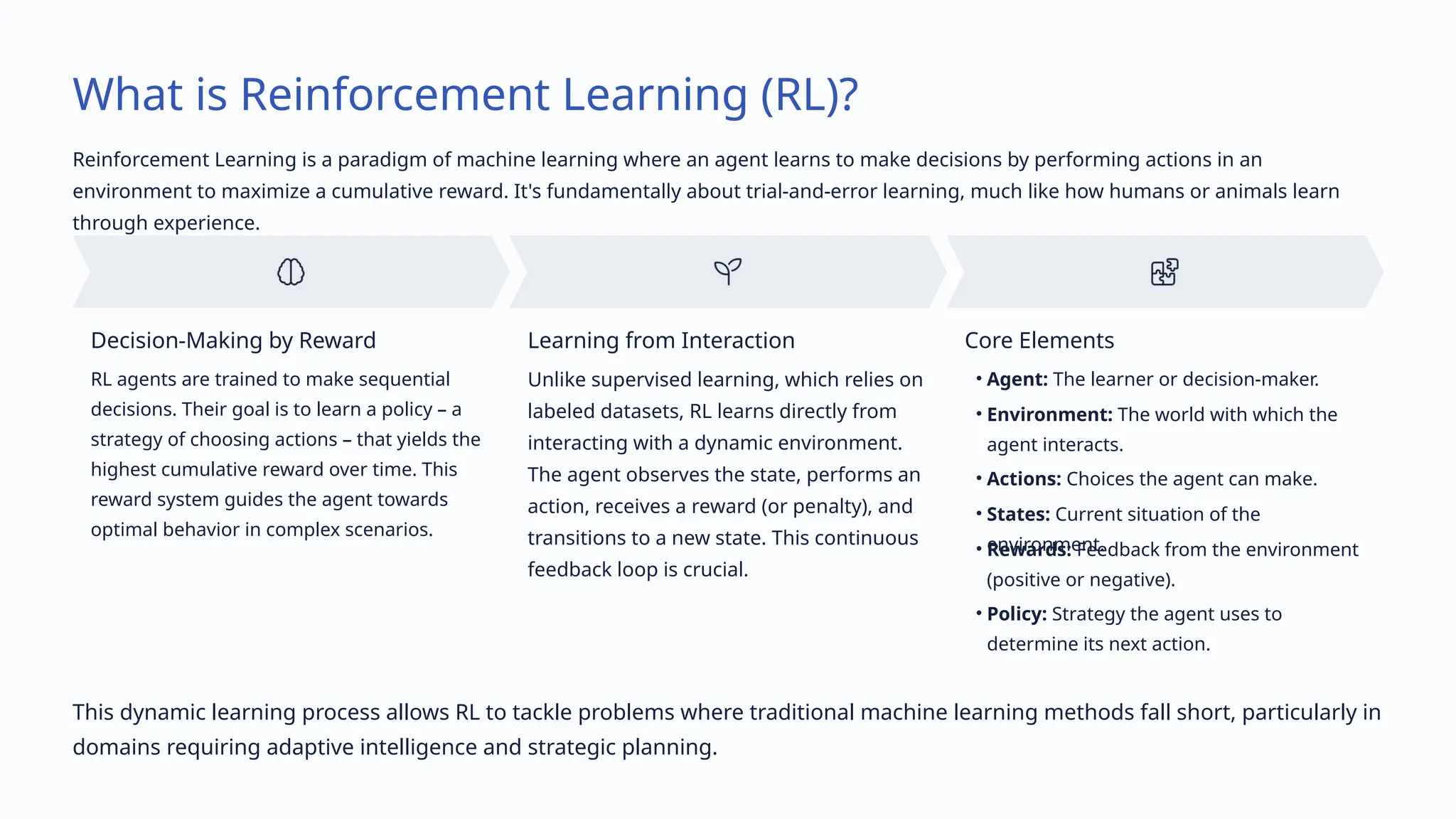
What is Reinforcement Learning (RL)?
Reinforcement Learning is a paradigm of machine learning where an agent learns to make decisions by performing actions in an
environment to maximize a cumulative reward. It's fundamentally about trial-and-error learning, much like how humans or animals learn
through experience.
Decision-Making by Reward
RL agents are trained to make sequential
decisions. Their goal is to learn a policy – a
strategy of choosing actions – that yields the
highest cumulative reward over time. This
reward system guides the agent towards
optimal behavior in complex scenarios.
Learning from Interaction
Unlike supervised learning, which relies on
labeled datasets, RL learns directly from
interacting with a dynamic environment.
The agent observes the state, performs an
action, receives a reward (or penalty), and
transitions to a new state. This continuous
feedback loop is crucial.
Core Elements
• Agent: The learner or decision-maker.
• Environment: The world with which the
agent interacts.
• Actions: Choices the agent can make.
• States: Current situation of the
environment.
• Rewards: Feedback from the environment
(positive or negative).
• Policy: Strategy the agent uses to
determine its next action.
This dynamic learning process allows RL to tackle problems where traditional machine learning methods fall short, particularly in
domains requiring adaptive intelligence and strategic planning.
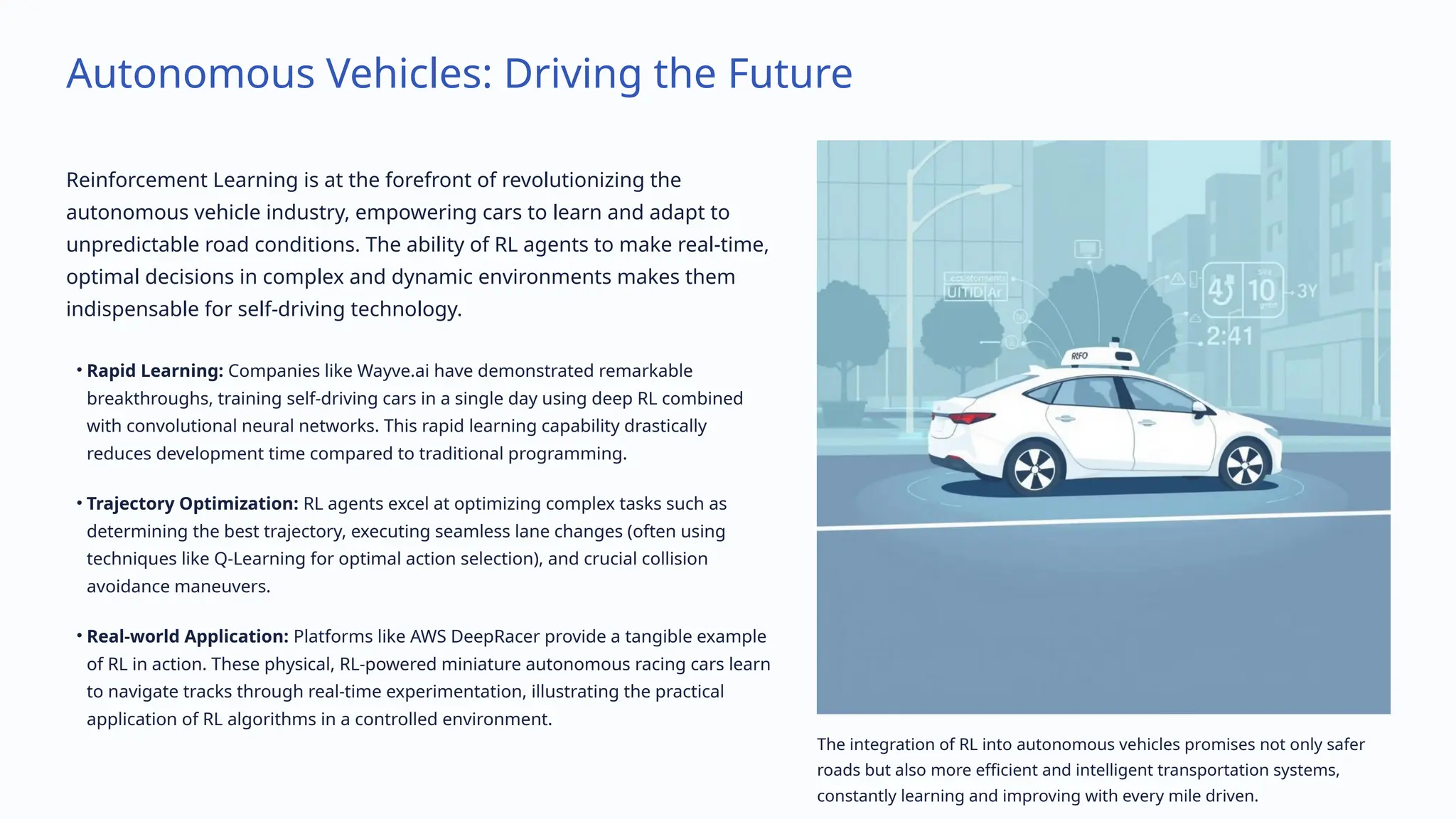
Autonomous Vehicles: Driving the Future
Reinforcement Learning is at the forefront of revolutionizing the
autonomous vehicle industry, empowering cars to learn and adapt to
unpredictable road conditions. The ability of RL agents to make real-time,
optimal decisions in complex and dynamic environments makes them
indispensable for self-driving technology.
• Rapid Learning: Companies like Wayve.ai have demonstrated remarkable
breakthroughs, training self-driving cars in a single day using deep RL combined
with convolutional neural networks. This rapid learning capability drastically
reduces development time compared to traditional programming.
• Trajectory Optimization: RL agents excel at optimizing complex tasks such as
determining the best trajectory, executing seamless lane changes (often using
techniques like Q-Learning for optimal action selection), and crucial collision
avoidance maneuvers.
• Real-world Application: Platforms like AWS DeepRacer provide a tangible example
of RL in action. These physical, RL-powered miniature autonomous racing cars learn
to navigate tracks through real-time experimentation, illustrating the practical
application of RL algorithms in a controlled environment.
The integration of RL into autonomous vehicles promises not only safer
roads but also more efficient and intelligent transportation systems,
constantly learning and improving with every mile driven.
Robotics: From Assembly Lines to Autonomous
Manipulation
Reinforcement Learning is transforming the field of robotics, enabling machines to perform intricate tasks with unprecedented adaptability and
precision. This shift moves beyond rigid, pre-programmed movements to intelligent, learning-based control.
Complex Task Learning
DeepMind's advancements, for instance,
showcase robotic arms learning highly
complex tasks like block stacking using
model-free RL. These robots can manipulate
objects with dexterity, adapting their grasp
and movement based on sensory input, a
feat difficult with traditional control systems.
Adaptability & Efficiency
RL-powered robots can learn to adapt to
new objects, varying weights, and changing
environments, significantly outperforming
rule-based automation. This adaptability is
critical in dynamic settings where conditions
are not constant, leading to more robust
and versatile robotic systems.
Supply Chain Optimization
Multi-agent RL is particularly potent in
optimizing large-scale operations such as
supply chains. By coordinating multiple
robots, RL can streamline processes from
inventory management and item sourcing
to logistics, ensuring maximum efficiency
and minimal human intervention.
The application of RL in robotics is ushering in an era of intelligent automation, where robots can learn from experience, collaborate effectively, and
handle unforeseen situations, paving the way for more flexible and efficient industrial and service robotics.
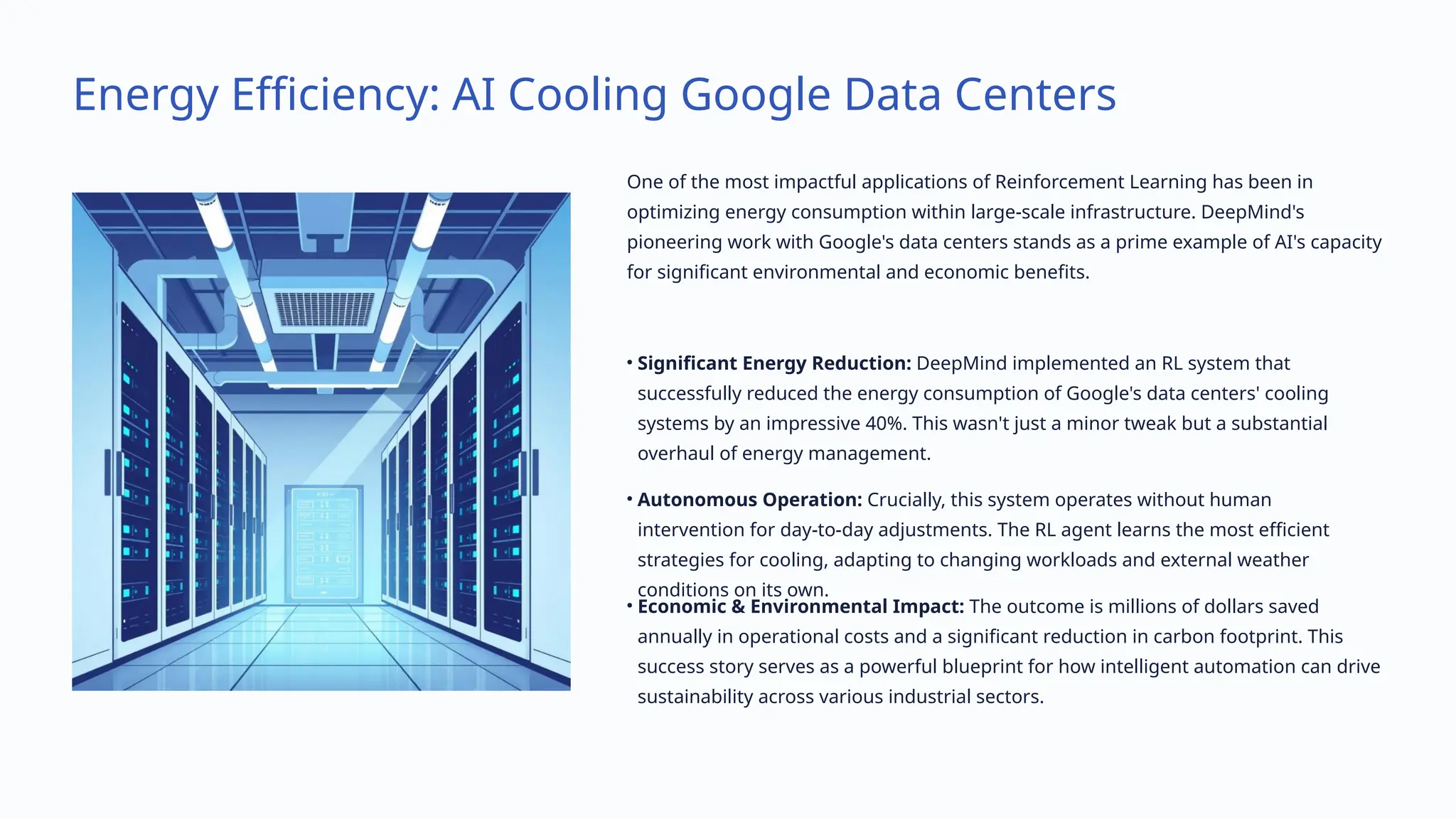
Energy Efficiency: AI Cooling Google Data Centers
One of the most impactful applications of Reinforcement Learning has been in
optimizing energy consumption within large-scale infrastructure. DeepMind's
pioneering work with Google's data centers stands as a prime example of AI's capacity
for significant environmental and economic benefits.
• Significant Energy Reduction: DeepMind implemented an RL system that
successfully reduced the energy consumption of Google's data centers' cooling
systems by an impressive 40%. This wasn't just a minor tweak but a substantial
overhaul of energy management.
• Autonomous Operation: Crucially, this system operates without human
intervention for day-to-day adjustments. The RL agent learns the most efficient
strategies for cooling, adapting to changing workloads and external weather
conditions on its own.
• Economic & Environmental Impact: The outcome is millions of dollars saved
annually in operational costs and a significant reduction in carbon footprint. This
success story serves as a powerful blueprint for how intelligent automation can drive
sustainability across various industrial sectors.
Finance & Trading: Smarter Automated Decisions
In the fast-paced and high-stakes world of finance, Reinforcement Learning is emerging as a powerful tool for automated decision-
making, offering speed, consistency, and the ability to adapt to volatile market conditions.
Autonomous Trading Platforms
IBM's RL platform exemplifies how
intelligent agents can autonomously
decide on optimal buy, hold, or sell
strategies for stocks. These decisions
are driven by sophisticated reward
functions that are directly tied to
maximizing profit and minimizing loss,
learning from market fluctuations and
historical data.
Market Simulation &
Optimization
Multi-agent RL environments are
utilized to simulate diverse market
scenarios. By pitting multiple RL agents
against each other or against realistic
market models, financial institutions
can rigorously test and optimize trading
strategies before deploying them in live
markets, uncovering robust
approaches.
Beyond Human Capacity
RL brings unparalleled consistency and
speed to financial decision-making, far
exceeding the capabilities of human
analysts. It can process vast amounts of
data in real-time, identify subtle
patterns, and execute trades at speeds
impossible for manual operations,
leading to potential competitive
advantages.
While the ethical considerations and risks associated with fully autonomous financial systems are actively debated, RL's potential to enhance
efficiency, reduce human error, and uncover novel trading strategies makes it an increasingly vital component in modern quantitative finance.
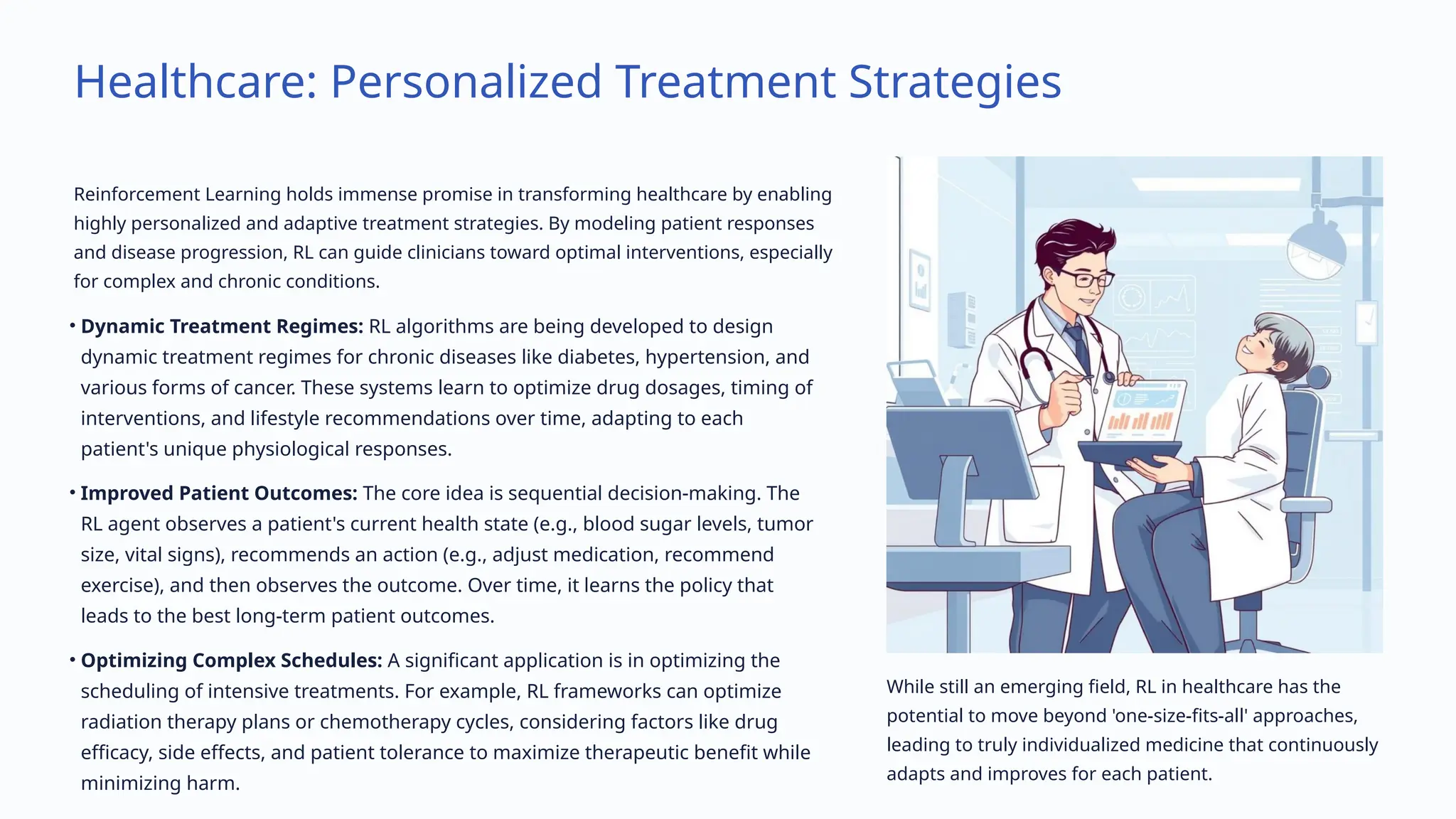
Healthcare: Personalized Treatment Strategies
Reinforcement Learning holds immense promise in transforming healthcare by enabling
highly personalized and adaptive treatment strategies. By modeling patient responses
and disease progression, RL can guide clinicians toward optimal interventions, especially
for complex and chronic conditions.
• Dynamic Treatment Regimes: RL algorithms are being developed to design
dynamic treatment regimes for chronic diseases like diabetes, hypertension, and
various forms of cancer. These systems learn to optimize drug dosages, timing of
interventions, and lifestyle recommendations over time, adapting to each
patient's unique physiological responses.
• Improved Patient Outcomes: The core idea is sequential decision-making. The
RL agent observes a patient's current health state (e.g., blood sugar levels, tumor
size, vital signs), recommends an action (e.g., adjust medication, recommend
exercise), and then observes the outcome. Over time, it learns the policy that
leads to the best long-term patient outcomes.
• Optimizing Complex Schedules: A significant application is in optimizing the
scheduling of intensive treatments. For example, RL frameworks can optimize
radiation therapy plans or chemotherapy cycles, considering factors like drug
efficacy, side effects, and patient tolerance to maximize therapeutic benefit while
minimizing harm.
While still an emerging field, RL in healthcare has the
potential to move beyond 'one-size-fits-all' approaches,
leading to truly individualized medicine that continuously
adapts and improves for each patient.
Marketing & Advertising: Real-Time Campaign Optimization
In the competitive landscape of marketing and advertising, Reinforcement Learning provides a powerful edge by enabling real-time campaign optimization and
personalized consumer engagement. RL agents can learn and adapt to changing market dynamics and consumer behaviors faster than any human team.
Automated Traffic Allocation
RL agents can automatically allocate advertising
budget and traffic to the best-performing ads and
channels. By continuously experimenting and
learning which ads drive the highest engagement
and conversions, they maximize Return on
Investment (ROI) without requiring constant
manual adjustment.
Dynamic Campaign Adjustment
Platforms like Amplify Analytix's SOLD! leverage RL
to dynamically optimize Google Ads campaigns. This
involves real-time bidding adjustments, keyword
optimization, and audience targeting based on
ongoing performance, ensuring campaigns are
always operating at peak efficiency.
Adaptive Consumer Behavior
Marketers gain immense benefits from faster, data-
driven decisions. RL agents can quickly detect shifts
in consumer preferences, market trends, or
competitive actions and adapt campaign strategies
accordingly. This ensures relevance and
effectiveness in an ever-evolving digital landscape.
By automating and optimizing complex marketing decisions, RL frees up human marketers to focus on strategic planning and creative content, leading to more impactful
and efficient advertising efforts.
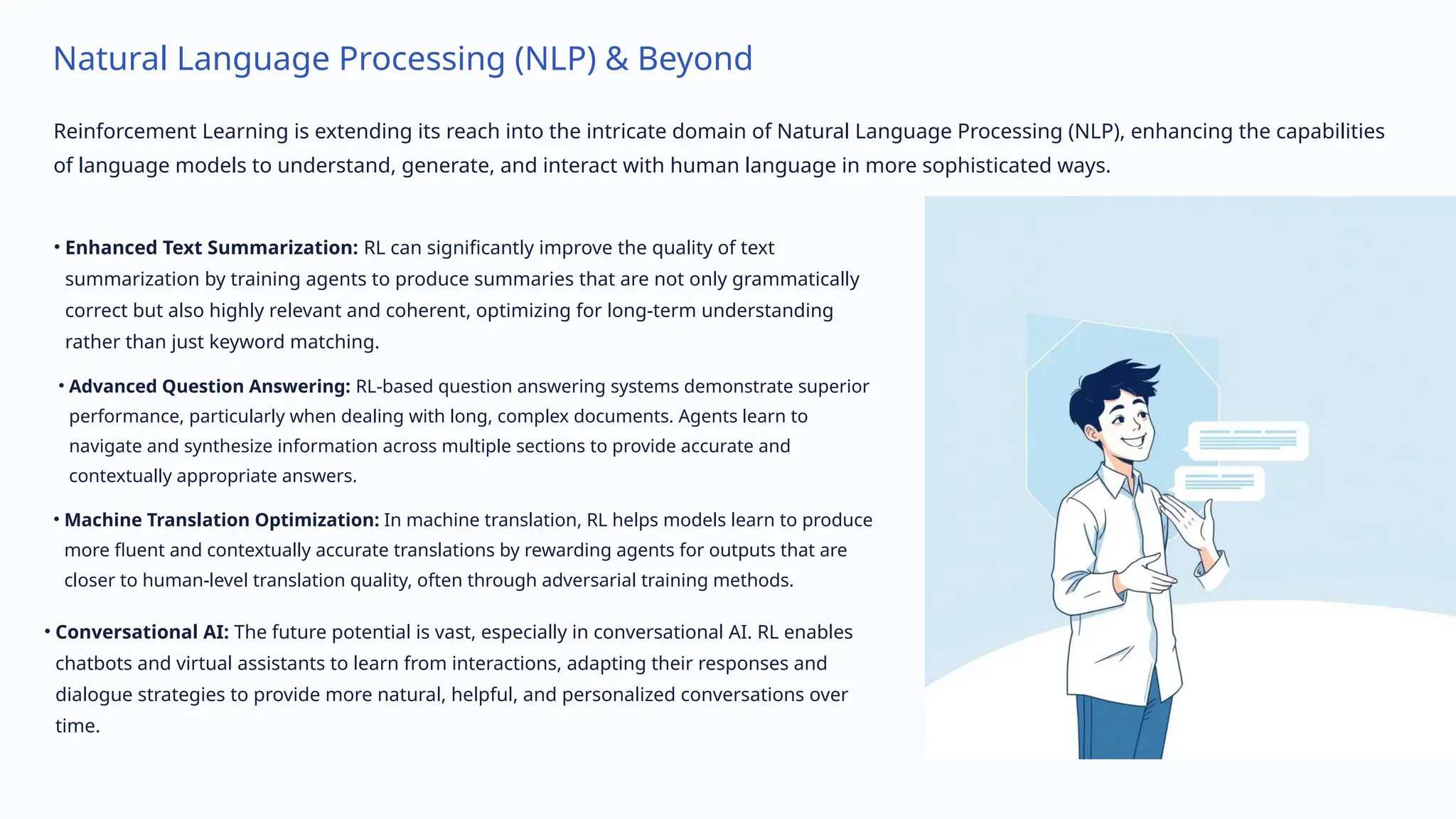
Natural Language Processing (NLP) & Beyond
Reinforcement Learning is extending its reach into the intricate domain of Natural Language Processing (NLP), enhancing the capabilities
of language models to understand, generate, and interact with human language in more sophisticated ways.
• Enhanced Text Summarization: RL can significantly improve the quality of text
summarization by training agents to produce summaries that are not only grammatically
correct but also highly relevant and coherent, optimizing for long-term understanding
rather than just keyword matching.
• Advanced Question Answering: RL-based question answering systems demonstrate superior
performance, particularly when dealing with long, complex documents. Agents learn to
navigate and synthesize information across multiple sections to provide accurate and
contextually appropriate answers.
• Machine Translation Optimization: In machine translation, RL helps models learn to produce
more fluent and contextually accurate translations by rewarding agents for outputs that are
closer to human-level translation quality, often through adversarial training methods.
• Conversational AI: The future potential is vast, especially in conversational AI. RL enables
chatbots and virtual assistants to learn from interactions, adapting their responses and
dialogue strategies to provide more natural, helpful, and personalized conversations over
time.
The Road Ahead: Embrace Reinforcement Learning Today
Reinforcement Learning is no longer a theoretical concept; it is a powerful force actively revolutionizing industries and shaping the future of intelligent
systems. Its ability to enable autonomous, adaptive decision-making across diverse applications makes it an indispensable technology for tomorrow's
innovations.
1
Autonomous AI
RL is driving the next generation of truly autonomous AI, capable of learning, acting, and adapting in complex,
unstructured environments without explicit programming.
2
Unprecedented Efficiency
From optimizing energy consumption to streamlining logistics, RL's capacity for efficiency gains translates
into significant cost savings and sustainable practices.
3
Hyper-Personalization
RL enables systems to learn individual preferences and adapt their behavior, leading to highly
personalized experiences in healthcare, marketing, and beyond.
4
Continuous Innovation
As RL algorithms continue to mature and computational power increases, we can
expect a new wave of breakthroughs that will further redefine what AI can achieve.
Whether you are in research, industry, or simply interested in the cutting edge of technology, understanding and engaging with Reinforcement Learning is
crucial. It opens doors to shaping intelligent systems that are more adaptive, efficient, and capable than ever before. The future is being built with RL, and
the time to embrace it is now.

THANKYOU

aiml presentation.pptxgnt thetrha rghae hs

  • 1.
    P A VI T H R A V I N E S H 2 4 M I M 1 0 0 1 1 O N K A R P A T I L 2 4 B S A 1 0 2 9 6 G A U R A V B H A R D W A J 2 4 B S A 1 0 1 8 7 K H U S H A L M A H A J A N 2 4 M I M 1 0 0 1 4 K E V I N G E O R G E P A A L A M O O T I L 2 2 B O E 1 0 0 9 7 TEAM MEMBERS
  • 2.
    Reinforcement Learning Applications: Transforming Industrieswith Intelligent Agents Welcome to this exploration of Reinforcement Learning (RL) and its profound impact across various industries. This presentation will delve into how intelligent agents, powered by RL, are not just optimizing processes but fundamentally reshaping sectors from autonomous vehicles to healthcare. We'll examine the core concepts of RL, survey its cutting-edge applications, and look ahead at the incredible potential this field holds for the future.
  • 3.
    What is ReinforcementLearning (RL)? Reinforcement Learning is a paradigm of machine learning where an agent learns to make decisions by performing actions in an environment to maximize a cumulative reward. It's fundamentally about trial-and-error learning, much like how humans or animals learn through experience. Decision-Making by Reward RL agents are trained to make sequential decisions. Their goal is to learn a policy – a strategy of choosing actions – that yields the highest cumulative reward over time. This reward system guides the agent towards optimal behavior in complex scenarios. Learning from Interaction Unlike supervised learning, which relies on labeled datasets, RL learns directly from interacting with a dynamic environment. The agent observes the state, performs an action, receives a reward (or penalty), and transitions to a new state. This continuous feedback loop is crucial. Core Elements • Agent: The learner or decision-maker. • Environment: The world with which the agent interacts. • Actions: Choices the agent can make. • States: Current situation of the environment. • Rewards: Feedback from the environment (positive or negative). • Policy: Strategy the agent uses to determine its next action. This dynamic learning process allows RL to tackle problems where traditional machine learning methods fall short, particularly in domains requiring adaptive intelligence and strategic planning.
  • 4.
    Autonomous Vehicles: Drivingthe Future Reinforcement Learning is at the forefront of revolutionizing the autonomous vehicle industry, empowering cars to learn and adapt to unpredictable road conditions. The ability of RL agents to make real-time, optimal decisions in complex and dynamic environments makes them indispensable for self-driving technology. • Rapid Learning: Companies like Wayve.ai have demonstrated remarkable breakthroughs, training self-driving cars in a single day using deep RL combined with convolutional neural networks. This rapid learning capability drastically reduces development time compared to traditional programming. • Trajectory Optimization: RL agents excel at optimizing complex tasks such as determining the best trajectory, executing seamless lane changes (often using techniques like Q-Learning for optimal action selection), and crucial collision avoidance maneuvers. • Real-world Application: Platforms like AWS DeepRacer provide a tangible example of RL in action. These physical, RL-powered miniature autonomous racing cars learn to navigate tracks through real-time experimentation, illustrating the practical application of RL algorithms in a controlled environment. The integration of RL into autonomous vehicles promises not only safer roads but also more efficient and intelligent transportation systems, constantly learning and improving with every mile driven.
  • 5.
    Robotics: From AssemblyLines to Autonomous Manipulation Reinforcement Learning is transforming the field of robotics, enabling machines to perform intricate tasks with unprecedented adaptability and precision. This shift moves beyond rigid, pre-programmed movements to intelligent, learning-based control. Complex Task Learning DeepMind's advancements, for instance, showcase robotic arms learning highly complex tasks like block stacking using model-free RL. These robots can manipulate objects with dexterity, adapting their grasp and movement based on sensory input, a feat difficult with traditional control systems. Adaptability & Efficiency RL-powered robots can learn to adapt to new objects, varying weights, and changing environments, significantly outperforming rule-based automation. This adaptability is critical in dynamic settings where conditions are not constant, leading to more robust and versatile robotic systems. Supply Chain Optimization Multi-agent RL is particularly potent in optimizing large-scale operations such as supply chains. By coordinating multiple robots, RL can streamline processes from inventory management and item sourcing to logistics, ensuring maximum efficiency and minimal human intervention. The application of RL in robotics is ushering in an era of intelligent automation, where robots can learn from experience, collaborate effectively, and handle unforeseen situations, paving the way for more flexible and efficient industrial and service robotics.
  • 6.
    Energy Efficiency: AICooling Google Data Centers One of the most impactful applications of Reinforcement Learning has been in optimizing energy consumption within large-scale infrastructure. DeepMind's pioneering work with Google's data centers stands as a prime example of AI's capacity for significant environmental and economic benefits. • Significant Energy Reduction: DeepMind implemented an RL system that successfully reduced the energy consumption of Google's data centers' cooling systems by an impressive 40%. This wasn't just a minor tweak but a substantial overhaul of energy management. • Autonomous Operation: Crucially, this system operates without human intervention for day-to-day adjustments. The RL agent learns the most efficient strategies for cooling, adapting to changing workloads and external weather conditions on its own. • Economic & Environmental Impact: The outcome is millions of dollars saved annually in operational costs and a significant reduction in carbon footprint. This success story serves as a powerful blueprint for how intelligent automation can drive sustainability across various industrial sectors.
  • 7.
    Finance & Trading:Smarter Automated Decisions In the fast-paced and high-stakes world of finance, Reinforcement Learning is emerging as a powerful tool for automated decision- making, offering speed, consistency, and the ability to adapt to volatile market conditions. Autonomous Trading Platforms IBM's RL platform exemplifies how intelligent agents can autonomously decide on optimal buy, hold, or sell strategies for stocks. These decisions are driven by sophisticated reward functions that are directly tied to maximizing profit and minimizing loss, learning from market fluctuations and historical data. Market Simulation & Optimization Multi-agent RL environments are utilized to simulate diverse market scenarios. By pitting multiple RL agents against each other or against realistic market models, financial institutions can rigorously test and optimize trading strategies before deploying them in live markets, uncovering robust approaches. Beyond Human Capacity RL brings unparalleled consistency and speed to financial decision-making, far exceeding the capabilities of human analysts. It can process vast amounts of data in real-time, identify subtle patterns, and execute trades at speeds impossible for manual operations, leading to potential competitive advantages. While the ethical considerations and risks associated with fully autonomous financial systems are actively debated, RL's potential to enhance efficiency, reduce human error, and uncover novel trading strategies makes it an increasingly vital component in modern quantitative finance.
  • 8.
    Healthcare: Personalized TreatmentStrategies Reinforcement Learning holds immense promise in transforming healthcare by enabling highly personalized and adaptive treatment strategies. By modeling patient responses and disease progression, RL can guide clinicians toward optimal interventions, especially for complex and chronic conditions. • Dynamic Treatment Regimes: RL algorithms are being developed to design dynamic treatment regimes for chronic diseases like diabetes, hypertension, and various forms of cancer. These systems learn to optimize drug dosages, timing of interventions, and lifestyle recommendations over time, adapting to each patient's unique physiological responses. • Improved Patient Outcomes: The core idea is sequential decision-making. The RL agent observes a patient's current health state (e.g., blood sugar levels, tumor size, vital signs), recommends an action (e.g., adjust medication, recommend exercise), and then observes the outcome. Over time, it learns the policy that leads to the best long-term patient outcomes. • Optimizing Complex Schedules: A significant application is in optimizing the scheduling of intensive treatments. For example, RL frameworks can optimize radiation therapy plans or chemotherapy cycles, considering factors like drug efficacy, side effects, and patient tolerance to maximize therapeutic benefit while minimizing harm. While still an emerging field, RL in healthcare has the potential to move beyond 'one-size-fits-all' approaches, leading to truly individualized medicine that continuously adapts and improves for each patient.
  • 9.
    Marketing & Advertising:Real-Time Campaign Optimization In the competitive landscape of marketing and advertising, Reinforcement Learning provides a powerful edge by enabling real-time campaign optimization and personalized consumer engagement. RL agents can learn and adapt to changing market dynamics and consumer behaviors faster than any human team. Automated Traffic Allocation RL agents can automatically allocate advertising budget and traffic to the best-performing ads and channels. By continuously experimenting and learning which ads drive the highest engagement and conversions, they maximize Return on Investment (ROI) without requiring constant manual adjustment. Dynamic Campaign Adjustment Platforms like Amplify Analytix's SOLD! leverage RL to dynamically optimize Google Ads campaigns. This involves real-time bidding adjustments, keyword optimization, and audience targeting based on ongoing performance, ensuring campaigns are always operating at peak efficiency. Adaptive Consumer Behavior Marketers gain immense benefits from faster, data- driven decisions. RL agents can quickly detect shifts in consumer preferences, market trends, or competitive actions and adapt campaign strategies accordingly. This ensures relevance and effectiveness in an ever-evolving digital landscape. By automating and optimizing complex marketing decisions, RL frees up human marketers to focus on strategic planning and creative content, leading to more impactful and efficient advertising efforts.
  • 10.
    Natural Language Processing(NLP) & Beyond Reinforcement Learning is extending its reach into the intricate domain of Natural Language Processing (NLP), enhancing the capabilities of language models to understand, generate, and interact with human language in more sophisticated ways. • Enhanced Text Summarization: RL can significantly improve the quality of text summarization by training agents to produce summaries that are not only grammatically correct but also highly relevant and coherent, optimizing for long-term understanding rather than just keyword matching. • Advanced Question Answering: RL-based question answering systems demonstrate superior performance, particularly when dealing with long, complex documents. Agents learn to navigate and synthesize information across multiple sections to provide accurate and contextually appropriate answers. • Machine Translation Optimization: In machine translation, RL helps models learn to produce more fluent and contextually accurate translations by rewarding agents for outputs that are closer to human-level translation quality, often through adversarial training methods. • Conversational AI: The future potential is vast, especially in conversational AI. RL enables chatbots and virtual assistants to learn from interactions, adapting their responses and dialogue strategies to provide more natural, helpful, and personalized conversations over time.
  • 11.
    The Road Ahead:Embrace Reinforcement Learning Today Reinforcement Learning is no longer a theoretical concept; it is a powerful force actively revolutionizing industries and shaping the future of intelligent systems. Its ability to enable autonomous, adaptive decision-making across diverse applications makes it an indispensable technology for tomorrow's innovations. 1 Autonomous AI RL is driving the next generation of truly autonomous AI, capable of learning, acting, and adapting in complex, unstructured environments without explicit programming. 2 Unprecedented Efficiency From optimizing energy consumption to streamlining logistics, RL's capacity for efficiency gains translates into significant cost savings and sustainable practices. 3 Hyper-Personalization RL enables systems to learn individual preferences and adapt their behavior, leading to highly personalized experiences in healthcare, marketing, and beyond. 4 Continuous Innovation As RL algorithms continue to mature and computational power increases, we can expect a new wave of breakthroughs that will further redefine what AI can achieve. Whether you are in research, industry, or simply interested in the cutting edge of technology, understanding and engaging with Reinforcement Learning is crucial. It opens doors to shaping intelligent systems that are more adaptive, efficient, and capable than ever before. The future is being built with RL, and the time to embrace it is now.
  • 12.