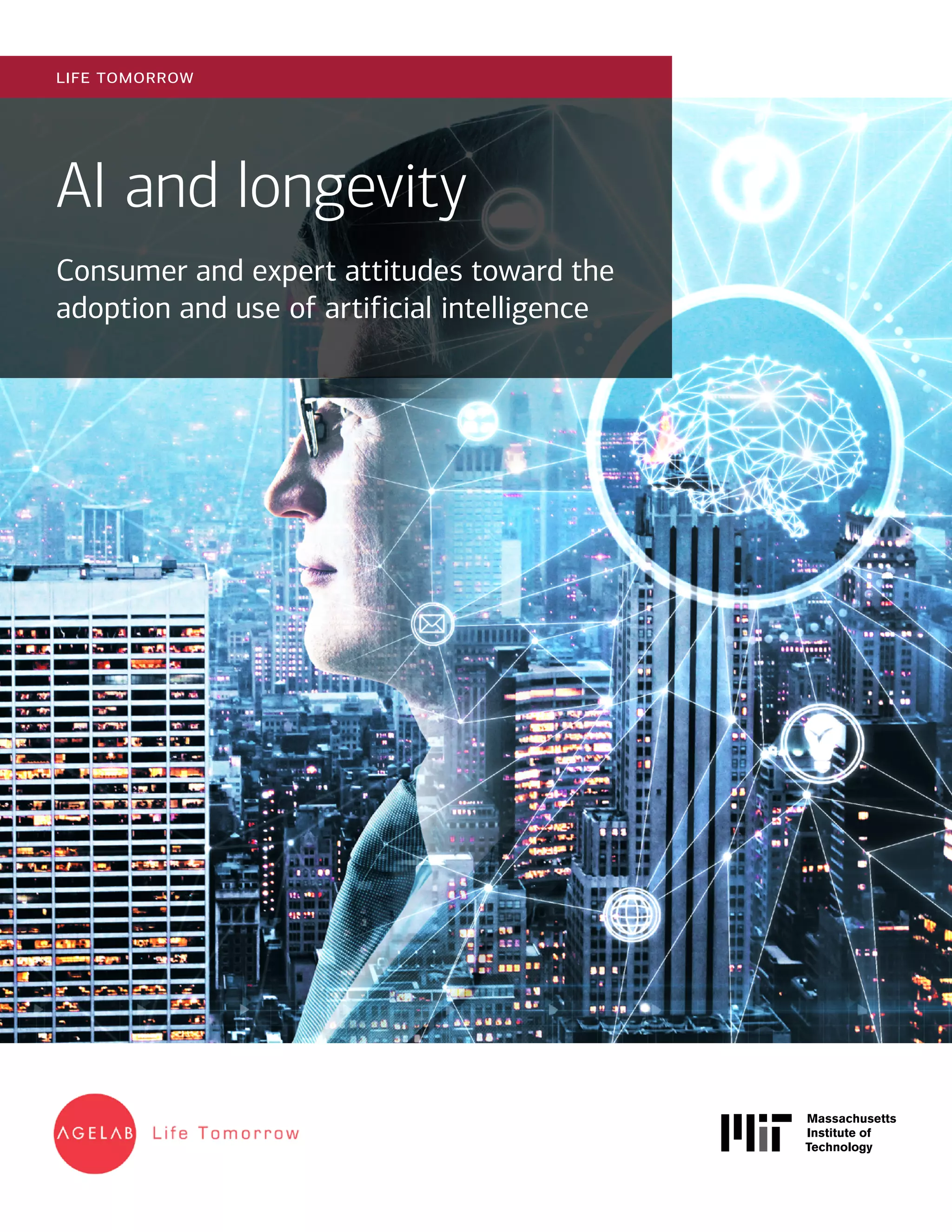
AI and longevity
Consumer and expert attitudes toward the
adoption and use of artificial intelligence
life tomorrow
This research was conducted by MIT AgeLab and supported by Bank of America.
Introduction . . . . . . . . . . . . . . . . . . . . . . . . . . . . . . . . . . . . . . . . . . . . . . . . . . . . . . . . . . . . . . . . . . . . . . . . . . . . .3
Section 1: Implementing AI into life, work and care—consumer attitudes . . . . . . . . . . . . . . . . . . . . . 4
Section 2: Using AI for financial planning and management—consumer attitudes . . . . . . . . . . . . . 8
Section 3: Using AI for financial planning and management—expert perspectives . . . . . . . . . . . .12
Section 4: Integrating AI into community and infrastructure—consumer attitudes . . . . . . . . . . . .16
Section 5: Integrating AI into community and infrastructure—expert perspectives. . . . . . . . . . . .20
Section 6: Implementation of AI in the workplace—consumer attitudes . . . . . . . . . . . . . . . . . . . . .24
Section 7: Implementation of AI in the workplace—expert perspectives . . . . . . . . . . . . . . . . . . . . .28
Section 8: Use of AI in health care and caregiving—consumer attitudes . . . . . . . . . . . . . . . . . . . . .32
Section 9: Use of AI in health care and caregiving—expert perspectives . . . . . . . . . . . . . . . . . . . . .36
Section 10: Use of AI for information seeking and social interactions—consumer attitudes. . . . . . .40
Section 11: Use of AI for information seeking and social interactions—expert perspectives . . . . . .44
Summary . . . . . . . . . . . . . . . . . . . . . . . . . . . . . . . . . . . . . . . . . . . . . . . . . . . . . . . . . . . . . . . . . . . . . . . . . . . . . . 48
Contents
Section
1
Section
2
Section
3
Section
4
Section
5
Section
6
Section
7
Section
8
Section
9
Section
10
Section
11
3
Artificial intelligence (AI) is poised to disrupt
many established industries, disciplines
and practices, and potentially create new
ones. At the same time, significant
advancements in life expectancy have
resulted in dramatic changes in the
life course. Both AI and the longevity
economy are affecting areas such
as transportation, finance, health
care and caregiving, urban planning,
education and work, and home and
personal technology.
Bank of America has been working with the
MIT AgeLab to better understand AI’s impact
on the ways we’ll live, work and play. This effort has
included research into consumer and expert views about the intersection of AI
and the longevity economy. The findings are outlined in the pages that follow.
Introduction
“Our exploration in this report is going to
be as much about revealing the power and
the potential of AI as it is to show the
possible perils to our privacy, our safety
and our independence.”
– Joseph F. Coughlin
Founder and Director
MIT AgeLab
“With the real possibility of 100-year lives,
existing and future technology driven by
AI will help people with more engaged
longer lives”
– Lorna Sabbia
Head of Retirement and Personal Wealth Solutions
Bank of America
4
Implementing AI into life, work
and care—consumer attitudes
People are living longer than ever before—and this era
of longevity is being shaped by rapid advancements
in technologies driven by artificial intelligence (AI).
This report describes findings from the MIT AgeLab’s
AI and Longevity study, which surveyed a group of
consumers and experts on the anticipated effects of AI
across a longer life course. Here, we focus on consumer
attitudes and beliefs regarding implementation of AI
with related comments from experts.
section 1
SECTIONS:
SECTIONS:
5
1. Life, work and care
(consumer attitudes)
Implementing AI into life, work and care—
consumer attitudes
Consumer knowledge and definition of AI
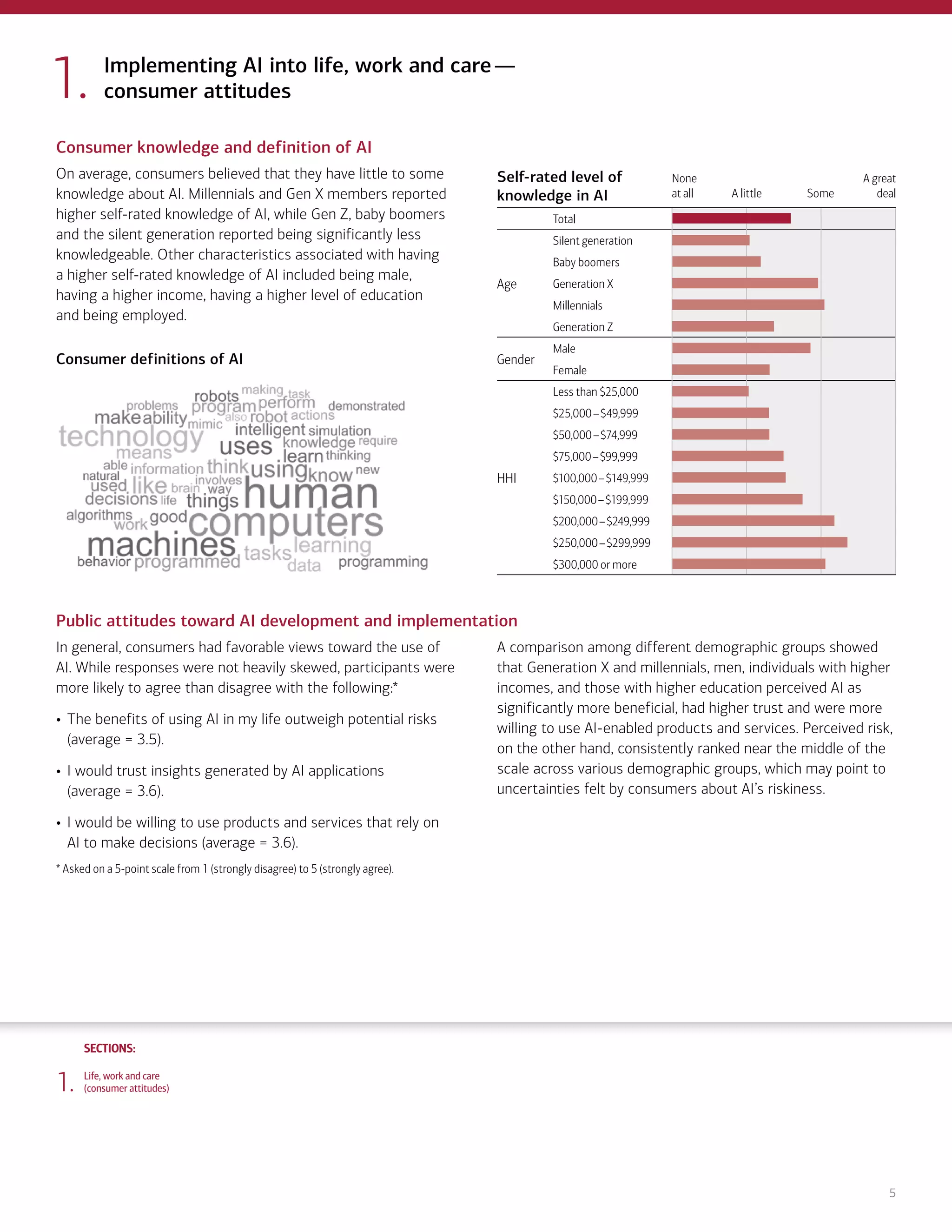
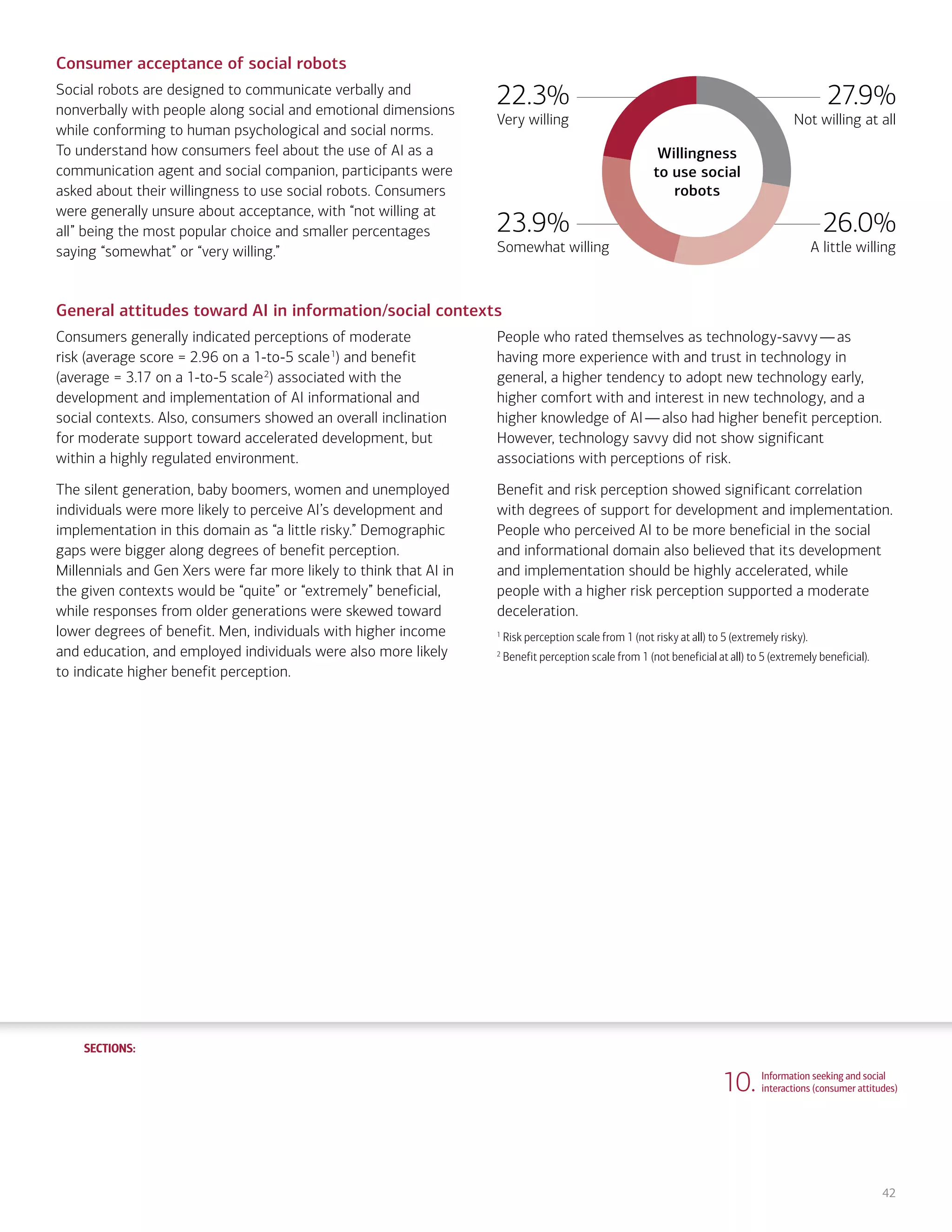
On average, consumers believed that they have little to some
knowledge about AI. Millennials and Gen X members reported
higher self-rated knowledge of AI, while Gen Z, baby boomers
and the silent generation reported being significantly less
knowledgeable. Other characteristics associated with having
a higher self-rated knowledge of AI included being male,
having a higher income, having a higher level of education
and being employed.
Consumer definitions of AI
Self-rated level of
knowledge in AI
Total
Age
Silent generation
Baby boomers
Generation X
Millennials
Generation Z
Gender
Male
Female
HHI
Less than $25,000
$25,000–$49,999
$50,000–$74,999
$75,000–$99,999
$100,000–$149,999
$150,000–$199,999
$200,000–$249,999
$250,000–$299,999
$300,000 or more
None
at all
A great
deal
A little Some
Public attitudes toward AI development and implementation
In general, consumers had favorable views toward the use of
AI. While responses were not heavily skewed, participants were
more likely to agree than disagree with the following:*
• The benefits of using AI in my life outweigh potential risks
(average = 3.5).
• I would trust insights generated by AI applications
(average = 3.6).
• I would be willing to use products and services that rely on
AI to make decisions (average = 3.6).
* Asked on a 5-point scale from 1 (strongly disagree) to 5 (strongly agree).
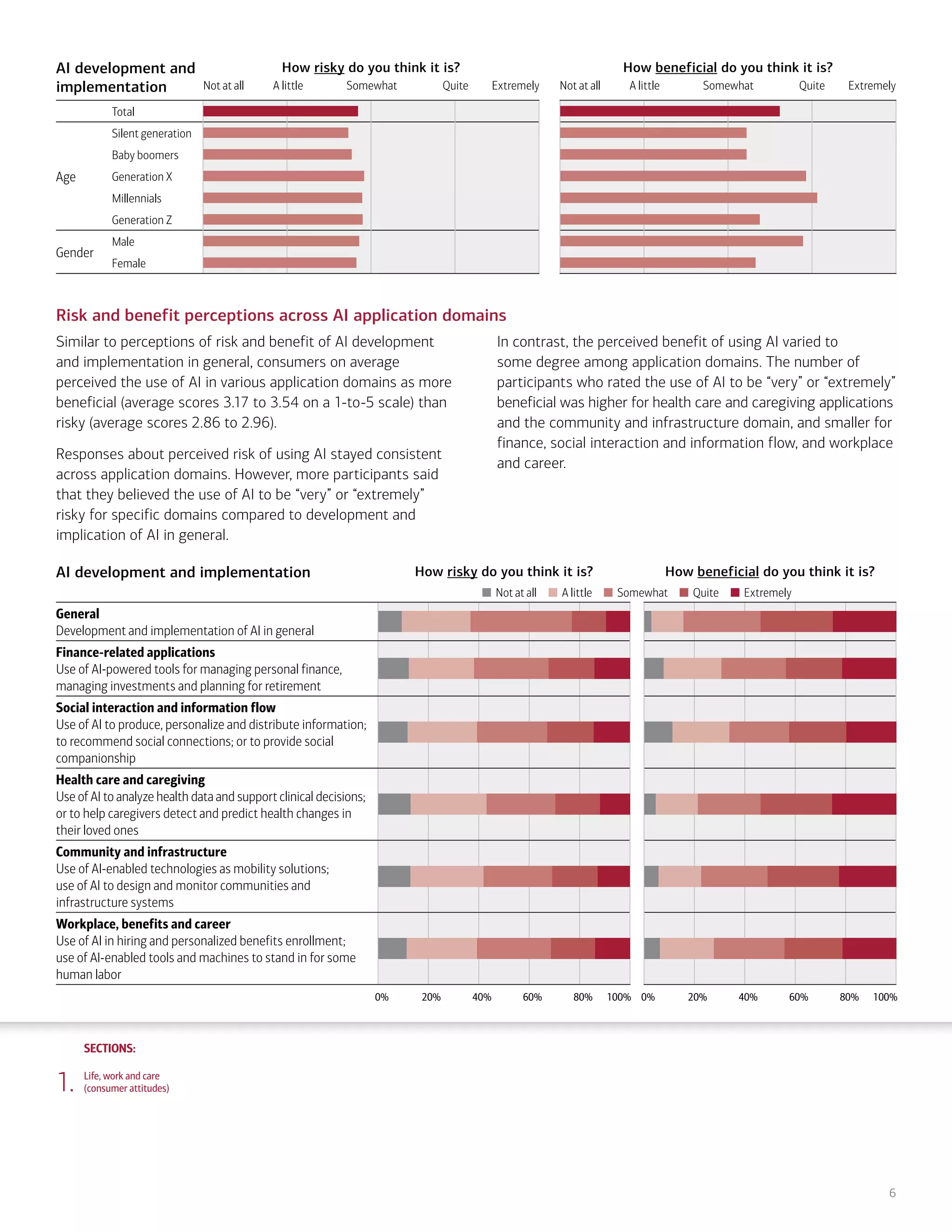
A comparison among different demographic groups showed
that Generation X and millennials, men, individuals with higher
incomes, and those with higher education perceived AI as
significantly more beneficial, had higher trust and were more
willing to use AI-enabled products and services. Perceived risk,
on the other hand, consistently ranked near the middle of the
scale across various demographic groups, which may point to
uncertainties felt by consumers about AI’s riskiness.
1.
2. Financial planning and management
(consumer attitudes)
3. Financial planning and management
(expert perspectives)
4. Community and infrastructure
(consumer attitudes)
5. Community and infrastructure
(expert perspectives)
6. The workplace
(consumer attitudes)
7. The workplace
(expert perspectives)
8. Health care and caregiving
(consumer attitudes)
9. Health care and caregiving
(expert perspectives)
10. Information seeking and social
interactions (consumer attitudes)
11. Information seeking and social
interactions (expert perspectives)
Introduction Summary
SECTIONS:
SECTIONS:
6
AI development and
implementation
How risky do you think it is? How beneficial do you think it is?
Total
Age
Silent generation
Baby boomers
Generation X
Millennials
Generation Z
Gender
Male
Female
Not at all Not at all
Extremely Extremely
A little A little
Somewhat Somewhat
Quite Quite
Risk and benefit perceptions across AI application domains
Similar to perceptions of risk and benefit of AI development
and implementation in general, consumers on average
perceived the use of AI in various application domains as more
beneficial (average scores 3.17 to 3.54 on a 1-to-5 scale) than
risky (average scores 2.86 to 2.96).
Responses about perceived risk of using AI stayed consistent
across application domains. However, more participants said
that they believed the use of AI to be “very” or “extremely”
risky for specific domains compared to development and
implication of AI in general.
In contrast, the perceived benefit of using AI varied to
some degree among application domains. The number of
participants who rated the use of AI to be “very” or “extremely”
beneficial was higher for health care and caregiving applications
and the community and infrastructure domain, and smaller for
finance, social interaction and information flow, and workplace
and career.
AI development and implementation How risky do you think it is? How beneficial do you think it is?
Not at all A little Somewhat Quite Extremely
General
Development and implementation of AI in general
Finance-related applications
Use of AI-powered tools for managing personal finance,
managing investments and planning for retirement
Social interaction and information flow
Use of AI to produce, personalize and distribute information;
to recommend social connections; or to provide social
companionship
Health care and caregiving
Use of AI to analyze health data and support clinical decisions;
or to help caregivers detect and predict health changes in
their loved ones
Community and infrastructure
Use of AI-enabled technologies as mobility solutions;
use of AI to design and monitor communities and
infrastructure systems
Workplace, benefits and career
Use of AI in hiring and personalized benefits enrollment;
use of AI-enabled tools and machines to stand in for some
human labor
0% 0%
20% 20%
40% 40%
60% 60%
80% 80%
100% 100%
1. Life, work and care
(consumer attitudes)
2. Financial planning and management
(consumer attitudes)
3. Financial planning and management
(expert perspectives)
4. Community and infrastructure
(consumer attitudes)
5. Community and infrastructure
(expert perspectives)
6. The workplace
(consumer attitudes)
7. The workplace
(expert perspectives)
8. Health care and caregiving
(consumer attitudes)
9. Health care and caregiving
(expert perspectives)
10. Information seeking and social
interactions (consumer attitudes)
11. Information seeking and social
interactions (expert perspectives)
Introduction Summary
SECTIONS:
SECTIONS:
7
Related expert thoughts and opinions
Defining AI:
“The most useful definition is one that uses algorithms and
statistical models to allow computers to make decisions without
having to explicitly program the computer to perform the task.
Machine learning algorithms build a model on sample data used as
training data in order to identify and extract patterns from data, and
therefore acquire their own knowledge. Most AI today is not totally
autonomous, but requires some human intervention.”
– An intellectual property lawyer
Benefits:
“By far, I think the most important benefits to society from AI will be
in the area of health and medical care. Humans are prone to many
small mistakes in this area and missing small pieces of information.
AI may not be prone to these same mistakes and could greatly
enhance our lifespan and quality of life.”
– Director of data science and AI in the finance industry
“If designed and implemented with care, [AI systems] can benefit
society tremendously. Some examples are detecting illnesses
before symptoms manifest themselves, discovering new drugs that
are more effective and less toxic to the body, finding new ways
processes can be optimized to reduce waste while producing more
value, and revealing suspicious behavior that could indicate bad
intent (on the web or in the real world). More generally, the biggest
benefit of AI is its potential role as an assistant with quasi-limitless
computational resources that can support us humans in solving
challenges for a happier and fairer society.”
– Head of computer vision at an augmented reality company
“AI should ideally allow people to make better and more-informed
decisions. Electronic systems also can optimize allocations
of resources, which should lead to increased efficiencies and
optimization of effort/focus.”
– A genomics researcher at Harvard University
Challenges:
One expert noted four challenges associated with AI: “(1) Lack of
control: Humans will have no control in many situations that will
affect their lives. (2) Lack of understanding: It will be difficult (or
even impossible) to understand why certain decisions have been
made when the AI models become more complex. (3) Faking reality:
The current AI systems can fake reality (e.g., deepfakes). (4) Bias:
The model’s accuracy depends on the characteristics of the data set
used for building the model, which may result in biases when tested
on new data.”
– A research scientist at MIT
Summary and implications for practice
• Public attitudes reflect a general belief that AI is likely to
be beneficial.
• Self-reported understanding of AI and perception of its
benefits are highest among millennial and Gen X men with
higher household incomes.
• Despite a belief in AI benefits, the public remains somewhat
concerned about its potential risks, which may reflect
public uncertainty.
• Wider public education on what AI is, as well as its potential
benefits, may be necessary to bridge a new digital divide
that may affect every industry and policy sector.
1. Life, work and care
(consumer attitudes)
“There is definitely a need for establishing an
accurate and consistent public knowledge of AI to
clearly communicate the potential benefits and to
address the uncertainties around risk.”
– Chaiwoo Lee
Research Scientist, MIT AgeLab
2. Financial planning and management
(consumer attitudes)
3. Financial planning and management
(expert perspectives)
4. Community and infrastructure
(consumer attitudes)
5. Community and infrastructure
(expert perspectives)
6. The workplace
(consumer attitudes)
7. The workplace
(expert perspectives)
8. Health care and caregiving
(consumer attitudes)
9. Health care and caregiving
(expert perspectives)
10. Information seeking and social
interactions (consumer attitudes)
11. Information seeking and social
interactions (expert perspectives)
Introduction Summary
8
Using AI for financial planning
and management—
consumer attitudes
AI is changing how consumers are managing and
talking about money, including how people carry out
transactions, find information and seek advice, and
plan for retirement. This section focuses on consumer
attitudes toward and acceptance of AI implementations
and applications in the finance domain.
section 2
SECTIONS:
SECTIONS:
9
2. Financial planning and management
(consumer attitudes)
AI for general financial management and transactions
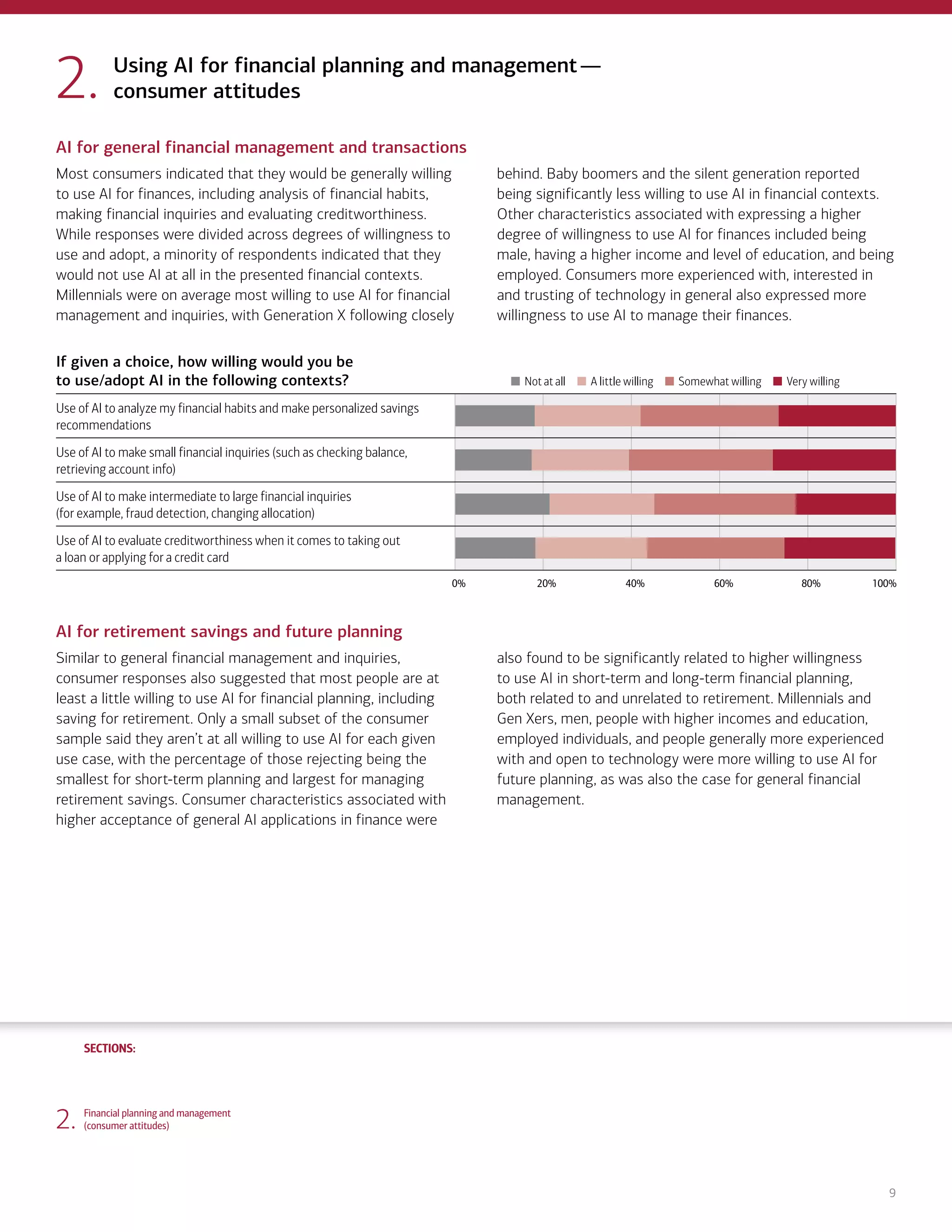
Most consumers indicated that they would be generally willing
to use AI for finances, including analysis of financial habits,
making financial inquiries and evaluating creditworthiness.
While responses were divided across degrees of willingness to
use and adopt, a minority of respondents indicated that they
would not use AI at all in the presented financial contexts.
Millennials were on average most willing to use AI for financial
management and inquiries, with Generation X following closely
behind. Baby boomers and the silent generation reported
being significantly less willing to use AI in financial contexts.
Other characteristics associated with expressing a higher
degree of willingness to use AI for finances included being
male, having a higher income and level of education, and being
employed. Consumers more experienced with, interested in
and trusting of technology in general also expressed more
willingness to use AI to manage their finances.
If given a choice, how willing would you be
to use/adopt AI in the following contexts? Not at all A little willing Somewhat willing Very willing
Use of AI to analyze my financial habits and make personalized savings
recommendations
Use of AI to make small financial inquiries (such as checking balance,
retrieving account info)
Use of AI to make intermediate to large financial inquiries
(for example, fraud detection, changing allocation)
Use of AI to evaluate creditworthiness when it comes to taking out
a loan or applying for a credit card
0% 20% 40% 60% 80% 100%
AI for retirement savings and future planning
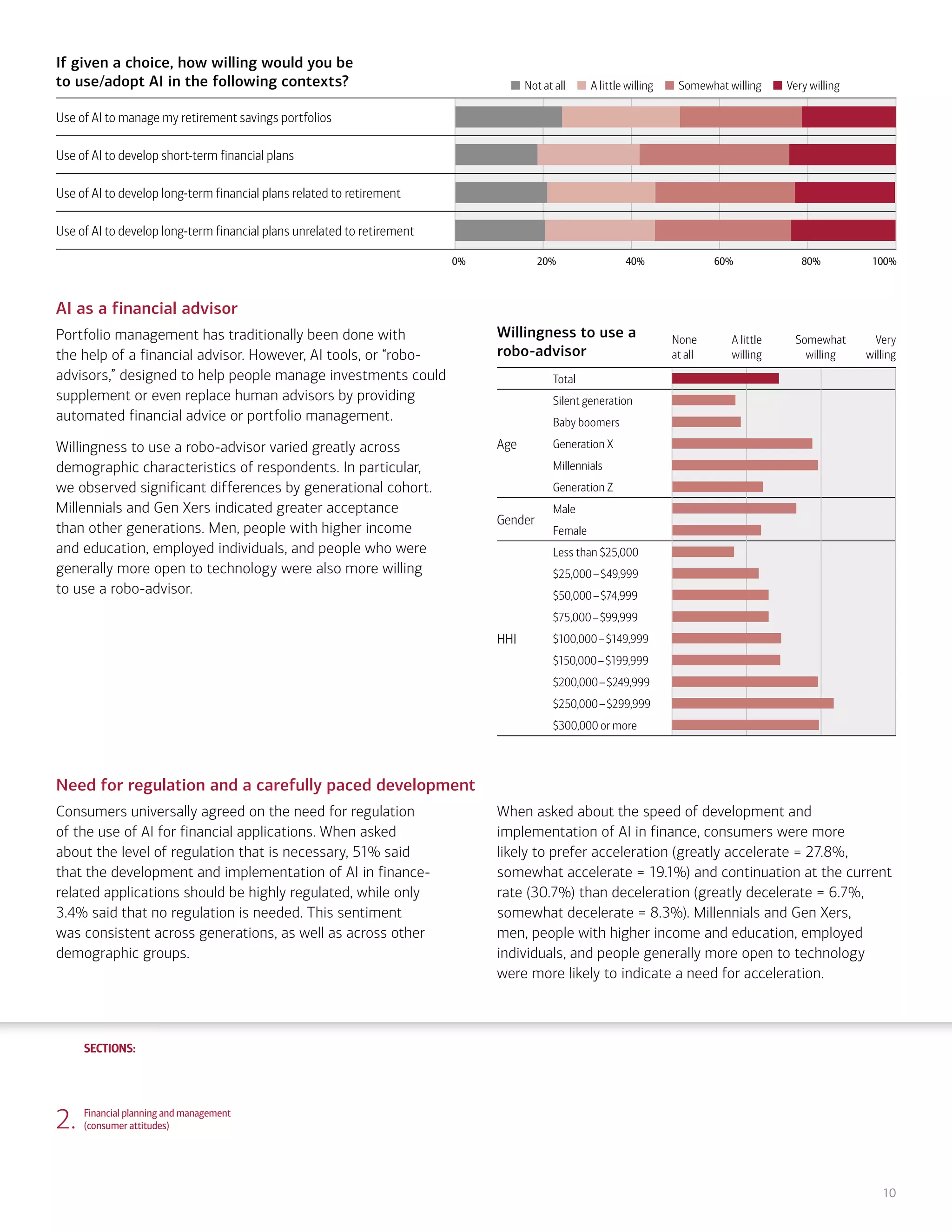
Similar to general financial management and inquiries,
consumer responses also suggested that most people are at
least a little willing to use AI for financial planning, including
saving for retirement. Only a small subset of the consumer
sample said they aren’t at all willing to use AI for each given
use case, with the percentage of those rejecting being the
smallest for short-term planning and largest for managing
retirement savings. Consumer characteristics associated with
higher acceptance of general AI applications in finance were
also found to be significantly related to higher willingness
to use AI in short-term and long-term financial planning,
both related to and unrelated to retirement. Millennials and
Gen Xers, men, people with higher incomes and education,
employed individuals, and people generally more experienced
with and open to technology were more willing to use AI for
future planning, as was also the case for general financial
management.
Using AI for financial planning and management—
consumer attitudes
2.
1. Life, work and care
(consumer attitudes)
3. Financial planning and management
(expert perspectives)
4. Community and infrastructure
(consumer attitudes)
5. Community and infrastructure
(expert perspectives)
6. The workplace
(consumer attitudes)
7. The workplace
(expert perspectives)
8. Health care and caregiving
(consumer attitudes)
9. Health care and caregiving
(expert perspectives)
10. Information seeking and social
interactions (consumer attitudes)
11. Information seeking and social
interactions (expert perspectives)
Introduction Summary
SECTIONS:
SECTIONS:
10
If given a choice, how willing would you be
to use/adopt AI in the following contexts? Not at all A little willing Somewhat willing Very willing
Use of AI to manage my retirement savings portfolios
Use of AI to develop short-term financial plans
Use of AI to develop long-term financial plans related to retirement
Use of AI to develop long-term financial plans unrelated to retirement
0% 20% 40% 60% 80% 100%
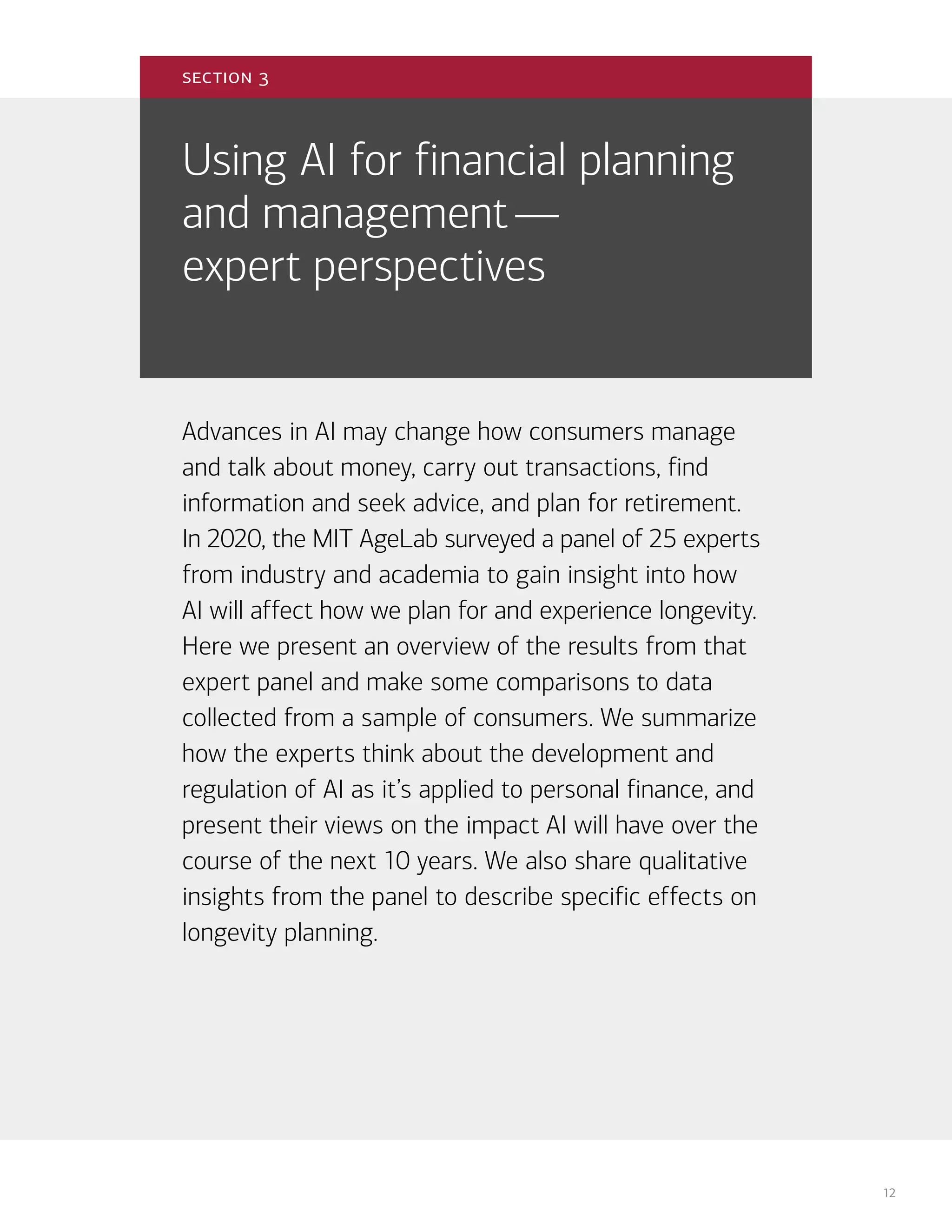
AI as a financial advisor
Portfolio management has traditionally been done with
the help of a financial advisor. However, AI tools, or “robo-
advisors,” designed to help people manage investments could
supplement or even replace human advisors by providing
automated financial advice or portfolio management.
Willingness to use a robo-advisor varied greatly across
demographic characteristics of respondents. In particular,
we observed significant differences by generational cohort.
Millennials and Gen Xers indicated greater acceptance
than other generations. Men, people with higher income
and education, employed individuals, and people who were
generally more open to technology were also more willing
to use a robo-advisor.
Willingness to use a
robo-advisor
Total
Age
Silent generation
Baby boomers
Generation X
Millennials
Generation Z
Gender
Male
Female
HHI
Less than $25,000
$25,000–$49,999
$50,000–$74,999
$75,000–$99,999
$100,000–$149,999
$150,000–$199,999
$200,000–$249,999
$250,000–$299,999
$300,000 or more
None
at all
Very
willing
A little
willing
Somewhat
willing
Need for regulation and a carefully paced development
Consumers universally agreed on the need for regulation
of the use of AI for financial applications. When asked
about the level of regulation that is necessary, 51% said
that the development and implementation of AI in finance-
related applications should be highly regulated, while only
3.4% said that no regulation is needed. This sentiment
was consistent across generations, as well as across other
demographic groups.
When asked about the speed of development and
implementation of AI in finance, consumers were more
likely to prefer acceleration (greatly accelerate = 27.8%,
somewhat accelerate = 19.1%) and continuation at the current
rate (30.7%) than deceleration (greatly decelerate = 6.7%,
somewhat decelerate = 8.3%). Millennials and Gen Xers,
men, people with higher income and education, employed
individuals, and people generally more open to technology
were more likely to indicate a need for acceleration.
2. Financial planning and management
(consumer attitudes)
1. Life, work and care
(consumer attitudes)
3. Financial planning and management
(expert perspectives)
4. Community and infrastructure
(consumer attitudes)
5. Community and infrastructure
(expert perspectives)
6. The workplace
(consumer attitudes)
7. The workplace
(expert perspectives)
8. Health care and caregiving
(consumer attitudes)
9. Health care and caregiving
(expert perspectives)
10. Information seeking and social
interactions (consumer attitudes)
11. Information seeking and social
interactions (expert perspectives)
Introduction Summary
SECTIONS:
SECTIONS:
11
Related expert thoughts and opinions
AI for general financial management and transactions
In general, members of the expert panel looked favorably on the use
of AI in the context of financial management and customer service.
One expert pointed out that the increased integration of AI in finance
represents an opportunity to change how people save, writing:
“We don’t really provide financial education in school. [Our] culture
constantly entices people to spend beyond their means, then we
expect people to save responsibly. AI might help people save and
educate [people on] how to do better using one’s own judgment.”
Experts also discussed how the automation of customer service is
already prevalent, and that younger consumers might be particularly
willing to use these services. Two experts did note, however, that
some customers will probably want to be able to talk with another
human, especially for substantial issues like fraud.
A need for transparency and fairness in AI systems
As artificial intelligence is utilized for increasingly important
tasks (for example, managing large amounts of money, assessing
creditworthiness), experts emphasized the need for fair and
transparent systems, as well as the benefit of having humans
in the loop when it comes to decision-making:
“I think this depends on how the AI is used. If it’s an algorithm that
then gets communicated through a person, people may be more
willing to use it, but they may be reluctant to not have a human in
the loop at all.”
“The reality is people will be forced into using these systems
whether they want to or not . . . they need to be fair, equitable and
perhaps even [used to] correct for past transgressions, like redlining
and property theft.”
AI as a financial advisor
Some experts were doubtful about consumers’ willingness to use a
robot advisor, noting that people may “lack trust [in an] algorithm’s
intentions,” “[be] worried about losing money” or “think they are
smarter than the machines.” In addition, one expert emphasized the
importance of human involvement, saying, “I think people would feel
more comfortable with a pair of human eyes engaged with the system.”
On the other hand, the experts noted the power and allure of
automated financial technologies, as well as consumers’ comparable
distrust in bankers. “[I’m] not sure which the public trusts more:
human Wall Street types or robots,” one expert said. “I’m guessing
robots at the moment, but I don’t know.”
AI and accessibility
We asked experts explicitly about the role that AI can play in making
financial services more accessible.
One expert highlighted the barriers to access that AI can help
people overcome:
“There are many [limiting] aspects to how one interacts with
financial advisors (for example, intimidation due to lack of education
in the domain, trust issues, not wanting to be vulnerable, etc.). The AI
layer removes a big chunk of the emotional implications.”
Another expert was less enthusiastic about equity’s prospects in the
long run:
“I think [improved equity] may be the case only in the early
development phase. For example, some free apps [will] appear as
an alternative to costly financial advisors. But as the market on this
grows, paid services will probably appear and create the same gaps
in access to advising like we had before.”
Summary and implications for practice
• Regardless of the scenario or application, certain key
demographic characteristics were consistently associated
with acceptance of AI in the domain of finance. Men,
millennials and Gen Xers, people with higher incomes and
levels of education, and those who were comfortable with
new technologies were more likely to accept financial
applications of AI.
• While AI-enabled financial applications are positioned as
tools to make financial services more accessible, lower-
income and unemployed individuals who may already have
limited access are less accepting of AI-enabled applications.
• Consumers are generally accepting of AI in the domain of
finance and also of an accelerated pace of development,
but acceptance may be conditional on having regulations
in place.
2. Financial planning and management
(consumer attitudes)
1. Life, work and care
(consumer attitudes)
3. Financial planning and management
(expert perspectives)
4. Community and infrastructure
(consumer attitudes)
5. Community and infrastructure
(expert perspectives)
6. The workplace
(consumer attitudes)
7. The workplace
(expert perspectives)
8. Health care and caregiving
(consumer attitudes)
9. Health care and caregiving
(expert perspectives)
10. Information seeking and social
interactions (consumer attitudes)
11. Information seeking and social
interactions (expert perspectives)
Introduction Summary
12
Using AI for financial planning
and management—
expert perspectives
Advances in AI may change how consumers manage
and talk about money, carry out transactions, find
information and seek advice, and plan for retirement.
In 2020, the MIT AgeLab surveyed a panel of 25 experts
from industry and academia to gain insight into how
AI will affect how we plan for and experience longevity.
Here we present an overview of the results from that
expert panel and make some comparisons to data
collected from a sample of consumers. We summarize
how the experts think about the development and
regulation of AI as it’s applied to personal finance, and
present their views on the impact AI will have over the
course of the next 10 years. We also share qualitative
insights from the panel to describe specific effects on
longevity planning.
section 3
SECTIONS:
SECTIONS:
13
3. Financial planning and management
(expert perspectives)
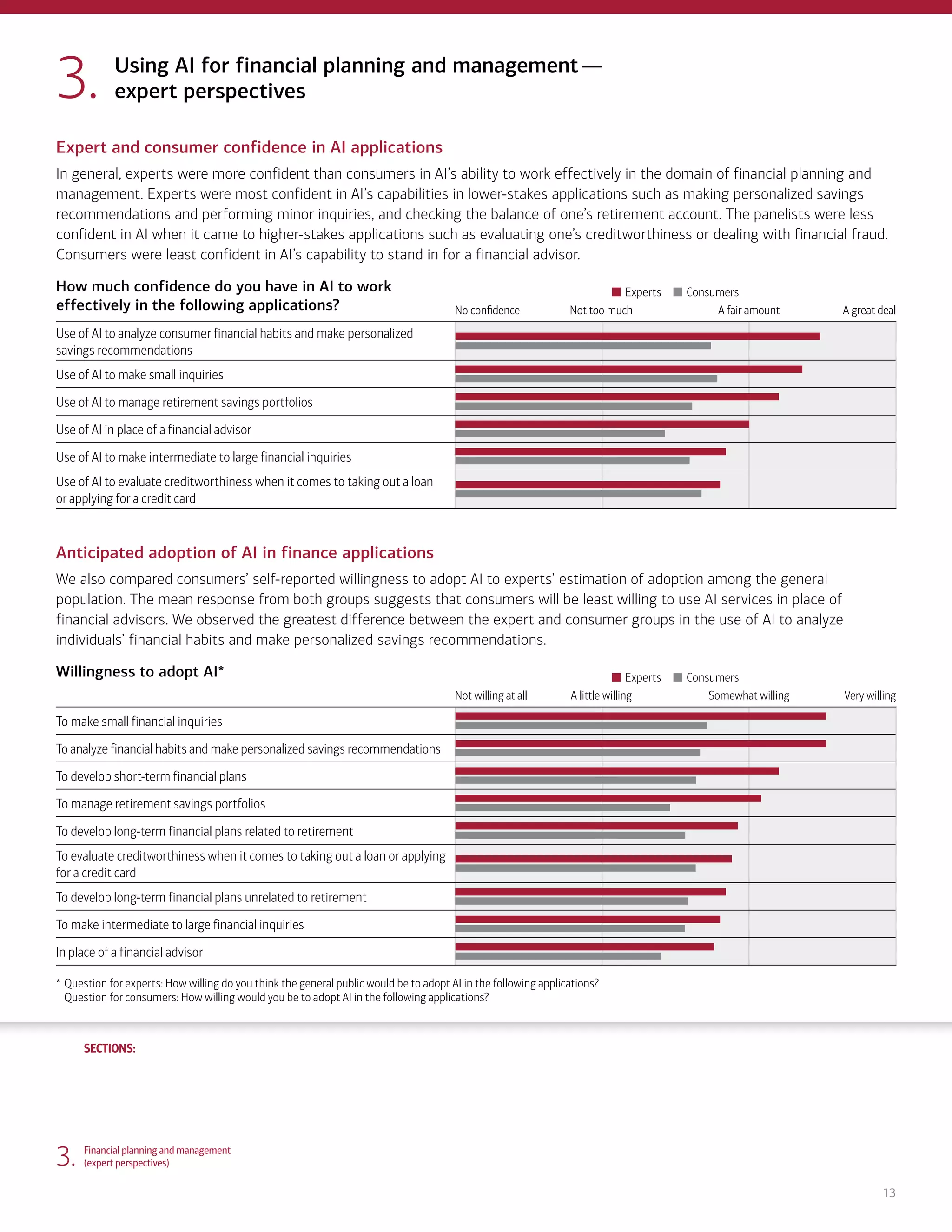
Expert and consumer confidence in AI applications
In general, experts were more confident than consumers in AI’s ability to work effectively in the domain of financial planning and
management. Experts were most confident in AI’s capabilities in lower-stakes applications such as making personalized savings
recommendations and performing minor inquiries, and checking the balance of one’s retirement account. The panelists were less
confident in AI when it came to higher-stakes applications such as evaluating one’s creditworthiness or dealing with financial fraud.
Consumers were least confident in AI’s capability to stand in for a financial advisor.
How much confidence do you have in AI to work
effectively in the following applications?
Experts Consumers
No confidence Not too much A fair amount A great deal
Use of AI to analyze consumer financial habits and make personalized
savings recommendations
Use of AI to make small inquiries
Use of AI to manage retirement savings portfolios
Use of AI in place of a financial advisor
Use of AI to make intermediate to large financial inquiries
Use of AI to evaluate creditworthiness when it comes to taking out a loan
or applying for a credit card
Anticipated adoption of AI in finance applications
We also compared consumers’ self-reported willingness to adopt AI to experts’ estimation of adoption among the general
population. The mean response from both groups suggests that consumers will be least willing to use AI services in place of
financial advisors. We observed the greatest difference between the expert and consumer groups in the use of AI to analyze
individuals’ financial habits and make personalized savings recommendations.
Willingness to adopt AI* Experts Consumers
Not willing at all A little willing Somewhat willing Very willing
To make small financial inquiries
To analyze financial habits and make personalized savings recommendations
To develop short-term financial plans
To manage retirement savings portfolios
To develop long-term financial plans related to retirement
To evaluate creditworthiness when it comes to taking out a loan or applying
for a credit card
To develop long-term financial plans unrelated to retirement
To make intermediate to large financial inquiries
In place of a financial advisor
* Question for experts: How willing do you think the general public would be to adopt AI in the following applications?
Question for consumers: How willing would you be to adopt AI in the following applications?
Using AI for financial planning and management—
expert perspectives
3.
1. Life, work and care
(consumer attitudes)
2. Financial planning and management
(consumer attitudes)
4. Community and infrastructure
(consumer attitudes)
5. Community and infrastructure
(expert perspectives)
6. The workplace
(consumer attitudes)
7. The workplace
(expert perspectives)
8. Health care and caregiving
(consumer attitudes)
9. Health care and caregiving
(expert perspectives)
10. Information seeking and social
interactions (consumer attitudes)
11. Information seeking and social
interactions (expert perspectives)
Introduction Summary
SECTIONS:
SECTIONS:
14
Benefits, risks, development, and regulation
Overall, both consumer and expert groups perceived the application of AI in personal finance applications as beneficial. Compared
to data on anticipated abilities and adoption, there were few differences between the consumer sample and expert panel; we
observed no significant difference between the two groups when it came to the perception of risks and benefits of AI. There were
no significant differences between the groups in terms of their responses to questions about the speed of development and level
of regulation. Among experts, the perception of benefits—but not risks—in this domain significantly influenced opinions on
the speed of development and the need for regulation. In particular, greater benefit was associated with supporting accelerated
development and decreased regulation.
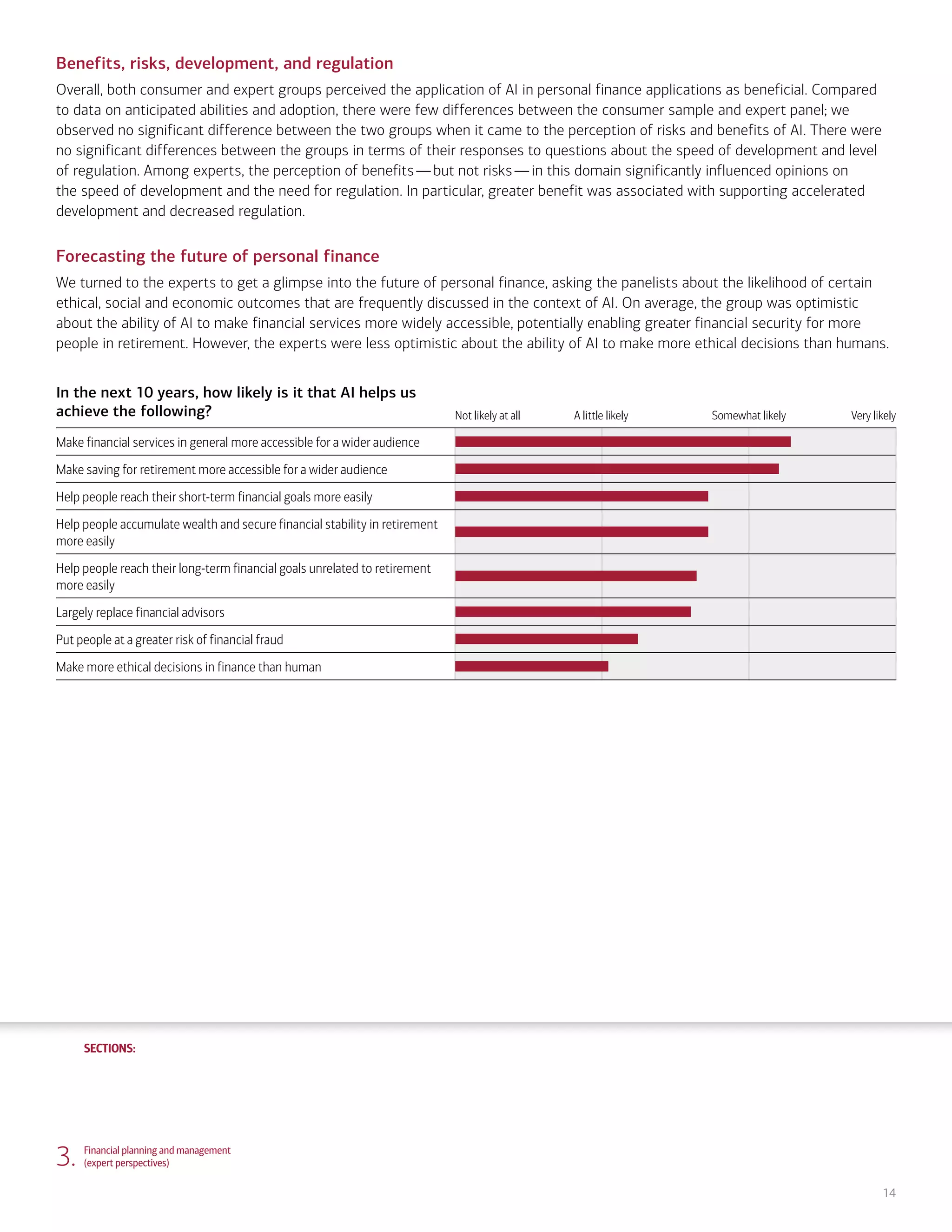
Forecasting the future of personal finance
We turned to the experts to get a glimpse into the future of personal finance, asking the panelists about the likelihood of certain
ethical, social and economic outcomes that are frequently discussed in the context of AI. On average, the group was optimistic
about the ability of AI to make financial services more widely accessible, potentially enabling greater financial security for more
people in retirement. However, the experts were less optimistic about the ability of AI to make more ethical decisions than humans.
In the next 10 years, how likely is it that AI helps us
achieve the following? Not likely at all A little likely Somewhat likely Very likely
Make financial services in general more accessible for a wider audience
Make saving for retirement more accessible for a wider audience
Help people reach their short-term financial goals more easily
Help people accumulate wealth and secure financial stability in retirement
more easily
Help people reach their long-term financial goals unrelated to retirement
more easily
Largely replace financial advisors
Put people at a greater risk of financial fraud
Make more ethical decisions in finance than human
3. Financial planning and management
(expert perspectives)
1. Life, work and care
(consumer attitudes)
2. Financial planning and management
(consumer attitudes)
4. Community and infrastructure
(consumer attitudes)
5. Community and infrastructure
(expert perspectives)
6. The workplace
(consumer attitudes)
7. The workplace
(expert perspectives)
8. Health care and caregiving
(consumer attitudes)
9. Health care and caregiving
(expert perspectives)
10. Information seeking and social
interactions (consumer attitudes)
11. Information seeking and social
interactions (expert perspectives)
Introduction Summary
SECTIONS:
SECTIONS:
15
How will AI affect the ways people save and plan
for retirement?
A psychologist working on human computer interaction noted, “There
is a dizzying array of retirement schemes, some of which are quite
complicated. Presumably an AI can help with [sorting] it all out.”
An informatics professor noted that institutions have a role in using
AI to help people save for retirement. Instead of leaving individuals
to use AI tools or apps for themselves, firms such as banks can
implement tools to help their customers. “Many people don’t think
about retirement investing because they kind of block it out. Finding
ways to nudge people at the paycheck level is hard, but it can be
possible at the bank level.”
Other participants emphasized that to make a real impact on
peoples’ financial lives, we must think about the systems in which
AI may be embedded.
A professor working at the intersection of art and technology wrote,
“To help people save more consistently and realize a better return
on investment . . . education should accompany automation to help
people learn more about their financial futures.”
A technologist added, “A key factor in the effectiveness of
[retirement planning] tools will be the interface: how clearly and
persuasively they can be in communicating information and making
recommendations for action.”
Potential risks
As we asked the experts how people’s life savings might be managed
by an AI and to discuss its benefits, we also took time to ask about
the risks associated with the technology.
Bias and inequality
A data scientist emphasized that if used to make judgments about
creditworthiness, an AI may “[perpetuate] existing inequality [via]
inadvertent codification of bias.” Further, as AI is implemented in
a way that allows individuals to accumulate wealth, ”differences in
access” to the technology may also maintain inequality if only groups
with more education or preexisting wealth are able to use AI in
financial applications.
Individual and systemic risk
A machine learning researcher also expressed concern about AI’s
ability to make sure that people are secure in retirement. At the
scale of individual investors, experts mentioned that “poor picks can
cause people to lose retirement savings” and cited “opportunities for
financial loss based on fraud or hacking.”
A professor of informatics noted that “individuals may put more faith
in algorithms, [impacting] their perception of risk.”
Finally, a legal scholar noted that if this effect persists and
accumulates, an “excessive confidence in predictions” may result
in “systemic risk due to overleverage.”
Summary and implications for practice
• Overall, the experts were optimistic about the use of AI
in the context of financial planning and management.
The expert panel was consistently more confident than
consumers in AI’s ability to work effectively, and they
consistently estimated consumer adoption higher than
consumers’ self-reported willingness to adopt AI in finance-
related applications.
• At the same time, some experts expressed concern about
the effectiveness and implications of the use of AI. Notably,
members of the panel expressed concern about the risk of
bias and the perpetuation of socioeconomic inequality.
• To ensure equitable outcomes, practitioners can take
steps to ensure that stakeholders are well educated on the
benefits of AI, make sure that AI-enabled services are widely
available, and invest in reducing AI bias.
• In order to limit systemic risk, practitioners may also want to
take steps to evaluate the accuracy and effectiveness of AI
investing strategies.
3. Financial planning and management
(expert perspectives)
“The combination of a personal touch from human
interaction and scaling through AI could very well
drive the democratization of financial advice.”
– Surya Kolluri
Head of Thought Leadership
Bank of America
1. Life, work and care
(consumer attitudes)
2. Financial planning and management
(consumer attitudes)
4. Community and infrastructure
(consumer attitudes)
5. Community and infrastructure
(expert perspectives)
6. The workplace
(consumer attitudes)
7. The workplace
(expert perspectives)
8. Health care and caregiving
(consumer attitudes)
9. Health care and caregiving
(expert perspectives)
10. Information seeking and social
interactions (consumer attitudes)
11. Information seeking and social
interactions (expert perspectives)
Introduction Summary
16
Integrating AI into community
and infrastructure—
consumer attitudes
AI has the potential to reshape our homes, cities and
transportation. Autonomous vehicles are transferring
the task of driving from humans to computers; smart
home technologies can make our dwellings more livable;
urban planners may use AI to design and monitor built
environments and infrastructure systems. The MIT
AgeLab’s AI and Longevity study investigated consumer
attitudes on the use of AI applications in various areas
and aspects of community and infrastructure, including
mobility solutions such as the self-driving car, as well as
applications for the home and community. This section
provides results from the consumer survey.
section 4
SECTIONS:
SECTIONS:
17
4. Community and infrastructure
(consumer attitudes)
Consumer acceptance of AI applications in the context of community and infrastructure
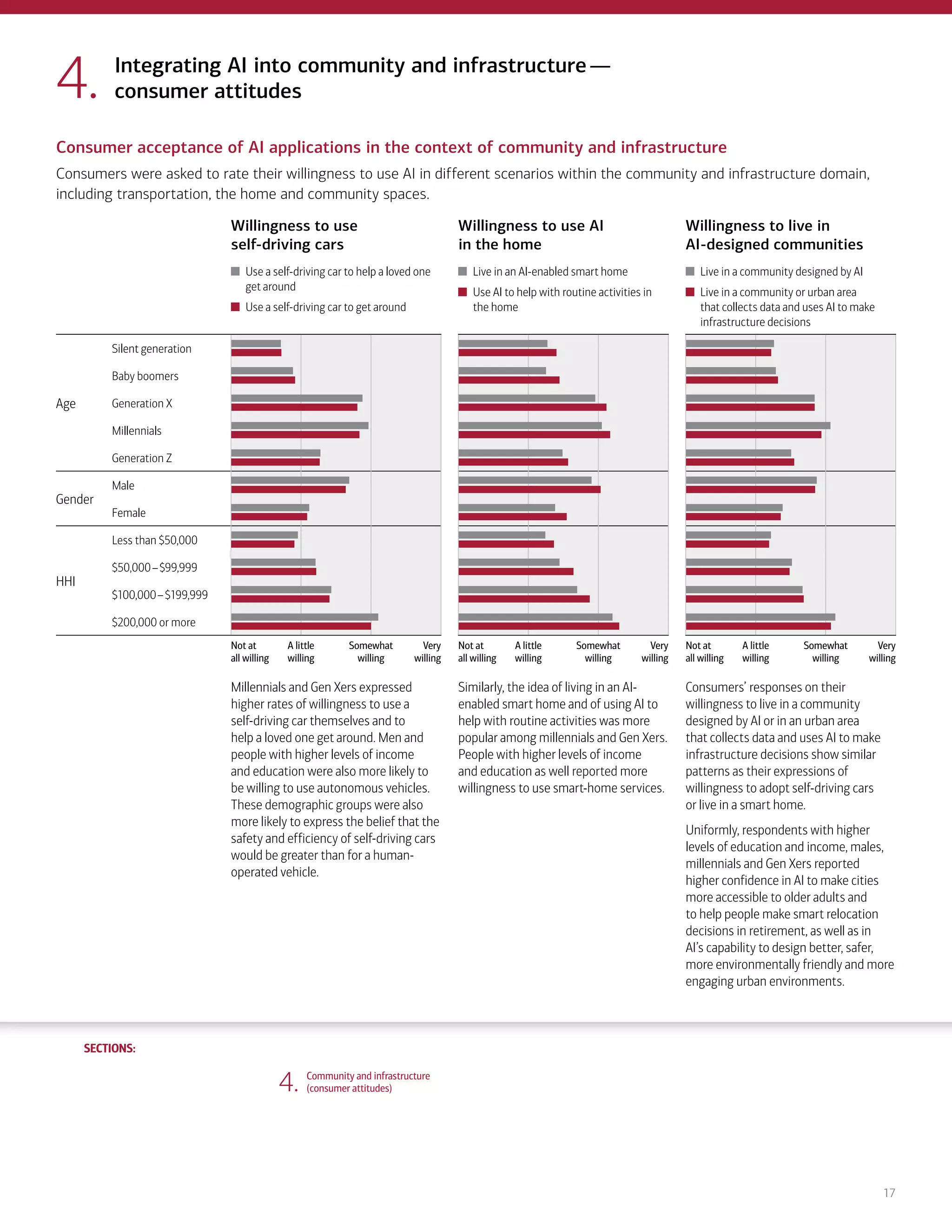
Consumers were asked to rate their willingness to use AI in different scenarios within the community and infrastructure domain,
including transportation, the home and community spaces.
Willingness to use
self-driving cars
Willingness to use AI
in the home
Willingness to live in
AI-designed communities
Use a self-driving car to help a loved one
get around
Use a self-driving car to get around
Live in an AI-enabled smart home
Use AI to help with routine activities in
the home
Live in a community designed by AI
Live in a community or urban area
that collects data and uses AI to make
infrastructure decisions
Age
Silent generation
Baby boomers
Generation X
Millennials
Generation Z
Gender
Male
Female
HHI
Less than $50,000
$50,000–$99,999
$100,000–$199,999
$200,000 or more
Not at A little Somewhat Very
all willing willing willing willing
Not at A little Somewhat Very
all willing willing willing willing
Not at A little Somewhat Very
all willing willing willing willing
Millennials and Gen Xers expressed
higher rates of willingness to use a
self-driving car themselves and to
help a loved one get around. Men and
people with higher levels of income
and education were also more likely to
be willing to use autonomous vehicles.
These demographic groups were also
more likely to express the belief that the
safety and efficiency of self-driving cars
would be greater than for a human-
operated vehicle.
Similarly, the idea of living in an AI-
enabled smart home and of using AI to
help with routine activities was more
popular among millennials and Gen Xers.
People with higher levels of income
and education as well reported more
willingness to use smart-home services.
Consumers’ responses on their
willingness to live in a community
designed by AI or in an urban area
that collects data and uses AI to make
infrastructure decisions show similar
patterns as their expressions of
willingness to adopt self-driving cars
or live in a smart home.
Uniformly, respondents with higher
levels of education and income, males,
millennials and Gen Xers reported
higher confidence in AI to make cities
more accessible to older adults and
to help people make smart relocation
decisions in retirement, as well as in
AI’s capability to design better, safer,
more environmentally friendly and more
engaging urban environments.
Integrating AI into community and infrastructure—
consumer attitudes
4.
1. Life, work and care
(consumer attitudes)
2. Financial planning and management
(consumer attitudes)
3. Financial planning and management
(expert perspectives)
5. Community and infrastructure
(expert perspectives)
6. The workplace
(consumer attitudes)
7. The workplace
(expert perspectives)
8. Health care and caregiving
(consumer attitudes)
9. Health care and caregiving
(expert perspectives)
10. Information seeking and social
interactions (consumer attitudes)
11. Information seeking and social
interactions (expert perspectives)
Introduction Summary
SECTIONS:
SECTIONS:
18
Consumer perceptions of risks and benefits
Risky Beneficial
Silent generation
Baby boomers
Generation X
Millennials
Generation Z
Not at all A little Somewhat Quite Extremely
Across generational cohorts, consumers’ responses on average
show a perception of moderate risk in the development
and implementation of AI in the context of community and
infrastructure. However, there were some differences in
generational perceptions of benefits. Younger generations,
specifically millennials and Generation X, were more likely
than older generations to indicate that the development and
implementation of AI for community and infrastructure would
be beneficial.
Need for regulation and pace of development
Consumer opinion on the pace of AI development
and implementation in the context of community and
infrastructure differed across generations. Millennials and
Generation Xers were likelier to report that AI should be
more rapidly developed and integrated for community and
infrastructure applications, while older generations were
more hesitant. Generation Z’s response patterns were
similar to those of older generations. Interestingly, a very
small percentage of consumers in each of the generations
believe that AI development and implementation should be
decelerated in the community and infrastructure context.
In general, consumers agreed on the need for regulation around
the use of AI in the context of community and infrastructure.
When asked about the degree of regulation necessary, 45%
said that the development and implementation of AI should be
highly regulated, 38% said it should be somewhat regulated,
while only 3.2% said that no regulation is needed. This pattern
is similar across generations and regardless of level of
education and income.
Related expert thoughts and opinions
AI risks
While the integration of AI into the context of community and
infrastructure may hold promise, experts did note some risks.
One expert highlighted potential risks across domains:
“Loss of privacy; bad designs that lead to environmental degradation;
potential for cascading problems from unexpected problems in highly
interconnected and overly automated systems; implementation of
systems that increase inequality by serving the privileged and leaving
out the disadvantaged; increased vulnerability to cyber attacks.”
Benefits of AI for resource allocation
and community engagement
Expert insights into potential applications of AI in community
contexts highlighted the improvements in efficiency that AI may
bring, as well as new opportunities for public engagement.
As one expert wrote, “[The] ability to engage residents to leverage
existing infrastructure is considerable . . . [For] example, most do not
utilize their libraries. The amount of social programs and resources
provided by libraries alone are not widely used . . .”
Another expert provided additional details describing how an AI
system might work: “For people who don’t always have access to
services or resources, the AI system could make them more scalable
and accessible. For instance, an intelligent chatbot could interact
with its user to find the most appropriate services for the user
instead of burdening the user to understand all possible options,
pros/cons and details available for them.”
AI has the potential to provide personalized engagement with
city residents and visitors, including “increased participation . . .
[an AI could] poll people about roads/services they use or could
use, improve traffic/parking through personalized incentives/
disincentives, improve core services and identify opportunities
for new services, self/assisted driving.”
Potential for community planning
One panelist described how AI could help us reimagine what is
possible when it comes to the design of community infrastructure:
“Community and infrastructure design are very much bounded by the
currently fashionable (or current regulations). Introducing AI into the
planning process would introduce a wider range of possibilities. If an
especially attractive set of alternatives arises, regulations might be
adjusted to accommodate such alternatives.”
Another expert, however, was less optimistic, emphasizing the
lack of a one-size-fits-all approach when it comes to community
planning: “I don’t see great strides in this space made through AI.
In my opinion the work that needs to be done in community and
infrastructure needs to have nuance to the people who live there
and their specific situations.”
4. Community and infrastructure
(consumer attitudes)
1. Life, work and care
(consumer attitudes)
2. Financial planning and management
(consumer attitudes)
3. Financial planning and management
(expert perspectives)
5. Community and infrastructure
(expert perspectives)
6. The workplace
(consumer attitudes)
7. The workplace
(expert perspectives)
8. Health care and caregiving
(consumer attitudes)
9. Health care and caregiving
(expert perspectives)
10. Information seeking and social
interactions (consumer attitudes)
11. Information seeking and social
interactions (expert perspectives)
Introduction Summary
SECTIONS:
SECTIONS:
19
Summary and implications for practice
• Results of the national survey showed that consumers
from younger generations (specifically millennials and
Generation Xers), males, and people with higher levels
of income and education were more willing to adopt
autonomous vehicles and smart-home technologies,
and were more willing to live in an AI-designed city.
• Comparing consumers’ attitudes across generations also
shows that millennials and Generation Xers stood out
from other groups in their preference for the accelerated
development of AI for community and infrastructure and
their belief in its benefits.
• Although consumers reported high perceived benefits and
relatively few risks for the development and implementation
of AI in the context of community and infrastructure
in general, their willingness to use and adopt related
applications was lower. Additional analysis from other parts
of the survey data suggest that this hesitance may be
related to consumers’ lack of experience with or knowledge
of these technologies and to concerns over data security.
4. Community and infrastructure
(consumer attitudes)
1. Life, work and care
(consumer attitudes)
2. Financial planning and management
(consumer attitudes)
3. Financial planning and management
(expert perspectives)
5. Community and infrastructure
(expert perspectives)
6. The workplace
(consumer attitudes)
7. The workplace
(expert perspectives)
8. Health care and caregiving
(consumer attitudes)
9. Health care and caregiving
(expert perspectives)
10. Information seeking and social
interactions (consumer attitudes)
11. Information seeking and social
interactions (expert perspectives)
Introduction Summary
20
Integrating AI into community
and infrastructure—
expert perspectives
AI has the potential to reshape our homes,
communities and transportation systems. In this
section, we present an overview of how the experts
think about the development, regulation and
future of AI as it’s applied to urban planning and
transportation systems, and make some comparisons
to data collected from a consumer sample. We also
share qualitative findings from the panel to describe
specific effects of AI on our ability to construct
residential environments that are sustainable,
engaging and accessible for all.
section 5
SECTIONS:
SECTIONS:
21
5. Community and infrastructure
(expert perspectives)
Confidence in AI applications in home and community contexts
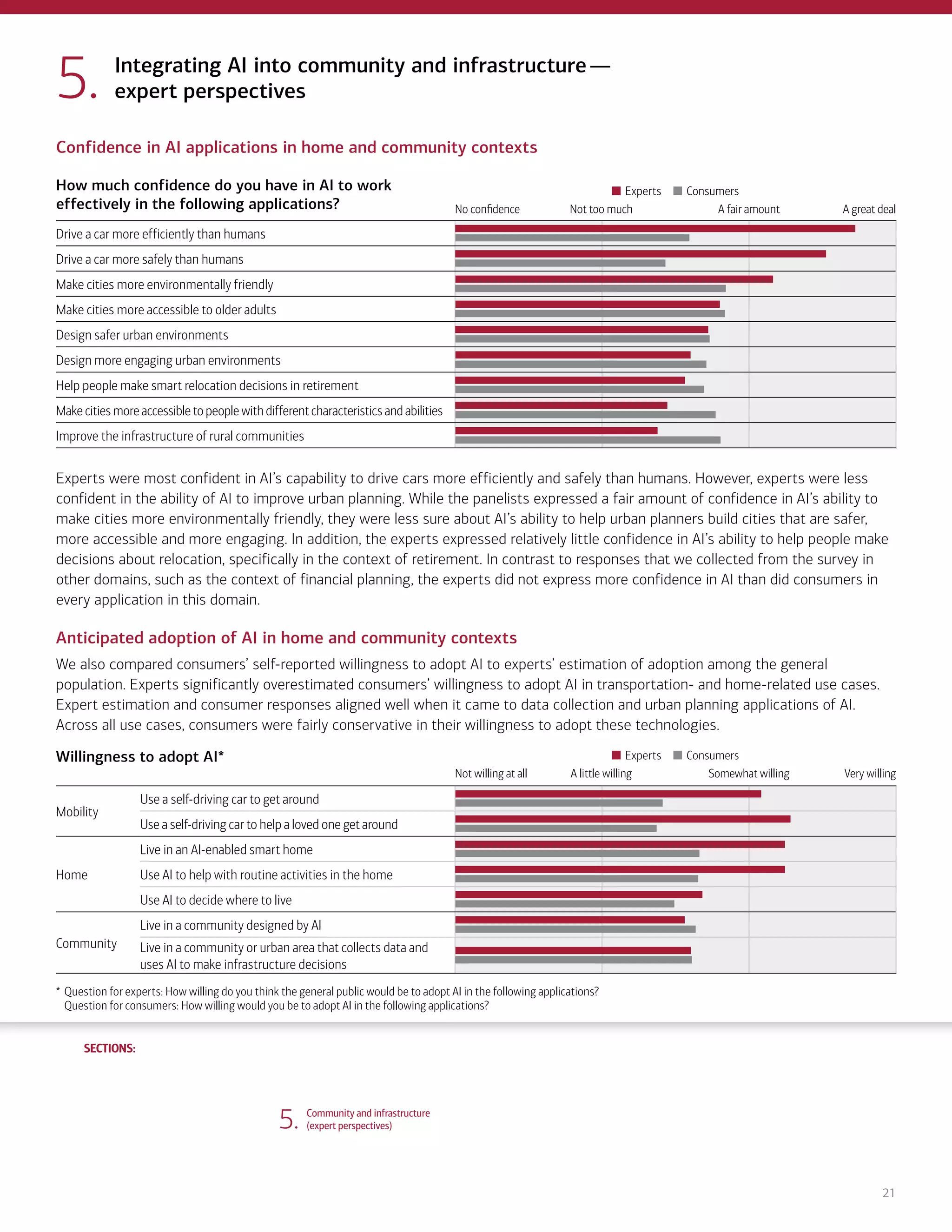
How much confidence do you have in AI to work
effectively in the following applications?
Experts Consumers
No confidence Not too much A fair amount A great deal
Drive a car more efficiently than humans
Drive a car more safely than humans
Make cities more environmentally friendly
Make cities more accessible to older adults
Design safer urban environments
Design more engaging urban environments
Help people make smart relocation decisions in retirement
Make cities more accessible to people with different characteristics and abilities
Improve the infrastructure of rural communities
Experts were most confident in AI’s capability to drive cars more efficiently and safely than humans. However, experts were less
confident in the ability of AI to improve urban planning. While the panelists expressed a fair amount of confidence in AI’s ability to
make cities more environmentally friendly, they were less sure about AI’s ability to help urban planners build cities that are safer,
more accessible and more engaging. In addition, the experts expressed relatively little confidence in AI’s ability to help people make
decisions about relocation, specifically in the context of retirement. In contrast to responses that we collected from the survey in
other domains, such as the context of financial planning, the experts did not express more confidence in AI than did consumers in
every application in this domain.
Anticipated adoption of AI in home and community contexts
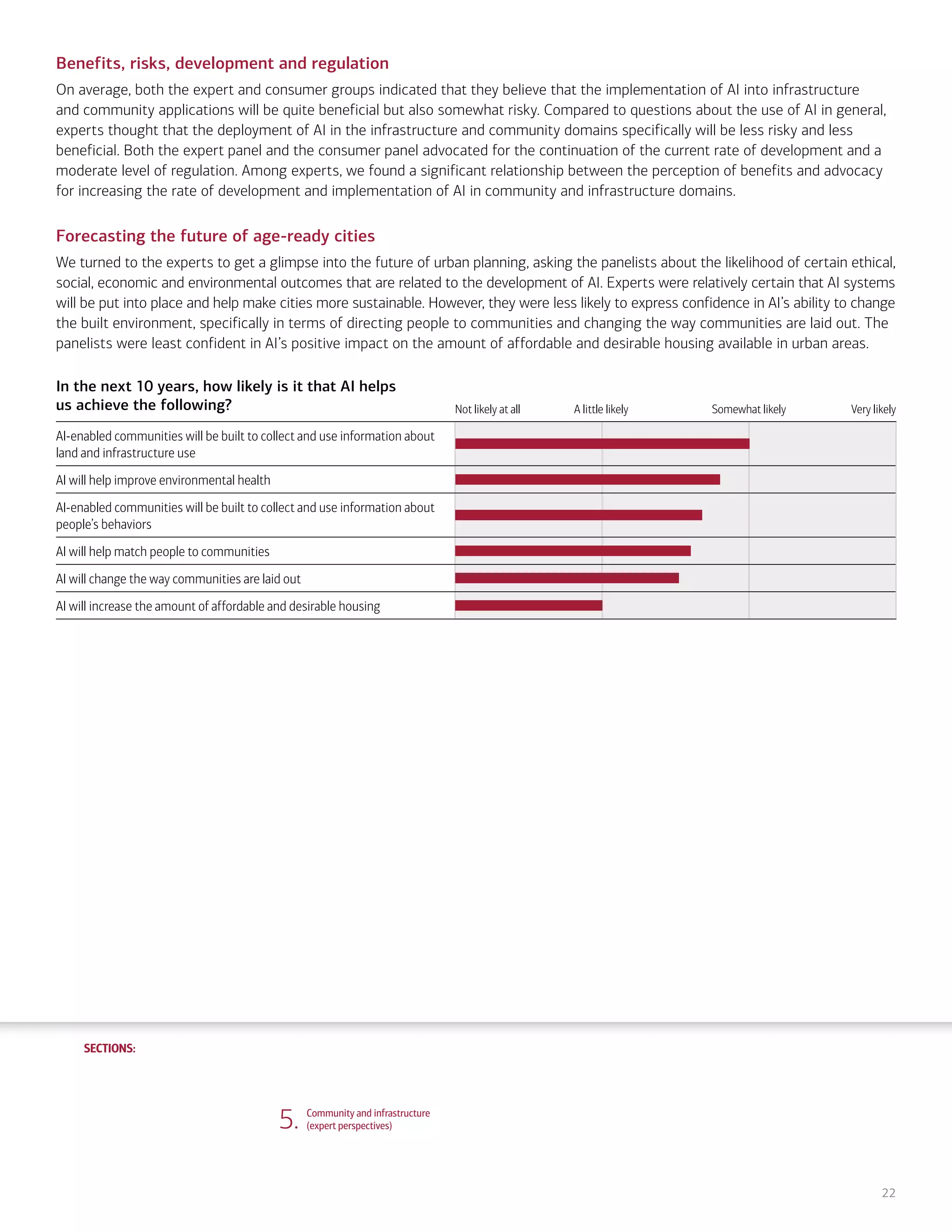
We also compared consumers’ self-reported willingness to adopt AI to experts’ estimation of adoption among the general
population. Experts significantly overestimated consumers’ willingness to adopt AI in transportation- and home-related use cases.
Expert estimation and consumer responses aligned well when it came to data collection and urban planning applications of AI.
Across all use cases, consumers were fairly conservative in their willingness to adopt these technologies.
Willingness to adopt AI* Experts Consumers
Not willing at all A little willing Somewhat willing Very willing
Mobility
Use a self-driving car to get around
Use a self-driving car to help a loved one get around
Home
Live in an AI-enabled smart home
Use AI to help with routine activities in the home
Use AI to decide where to live
Community
Live in a community designed by AI
Live in a community or urban area that collects data and
uses AI to make infrastructure decisions
* Question for experts: How willing do you think the general public would be to adopt AI in the following applications?
Question for consumers: How willing would you be to adopt AI in the following applications?
Integrating AI into community and infrastructure—
expert perspectives
5.
1. Life, work and care
(consumer attitudes)
2. Financial planning and management
(consumer attitudes)
3. Financial planning and management
(expert perspectives)
4. Community and infrastructure
(consumer attitudes)
6. The workplace
(consumer attitudes)
7. The workplace
(expert perspectives)
8. Health care and caregiving
(consumer attitudes)
9. Health care and caregiving
(expert perspectives)
10. Information seeking and social
interactions (consumer attitudes)
11. Information seeking and social
interactions (expert perspectives)
Introduction Summary
SECTIONS:
SECTIONS:
22
Benefits, risks, development and regulation
On average, both the expert and consumer groups indicated that they believe that the implementation of AI into infrastructure
and community applications will be quite beneficial but also somewhat risky. Compared to questions about the use of AI in general,
experts thought that the deployment of AI in the infrastructure and community domains specifically will be less risky and less
beneficial. Both the expert panel and the consumer panel advocated for the continuation of the current rate of development and a
moderate level of regulation. Among experts, we found a significant relationship between the perception of benefits and advocacy
for increasing the rate of development and implementation of AI in community and infrastructure domains.
Forecasting the future of age-ready cities
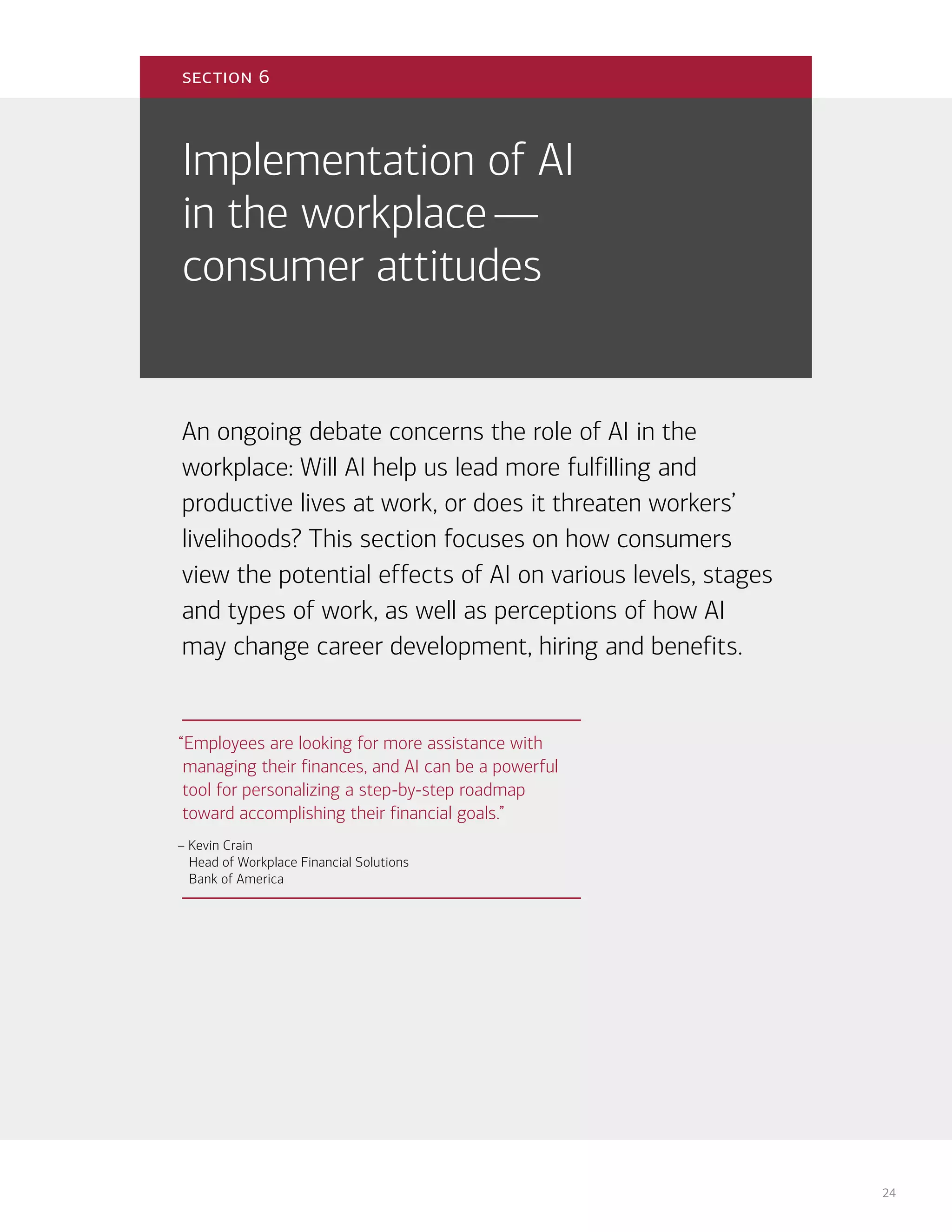
We turned to the experts to get a glimpse into the future of urban planning, asking the panelists about the likelihood of certain ethical,
social, economic and environmental outcomes that are related to the development of AI. Experts were relatively certain that AI systems
will be put into place and help make cities more sustainable. However, they were less likely to express confidence in AI’s ability to change
the built environment, specifically in terms of directing people to communities and changing the way communities are laid out. The
panelists were least confident in AI’s positive impact on the amount of affordable and desirable housing available in urban areas.
In the next 10 years, how likely is it that AI helps
us achieve the following? Not likely at all A little likely Somewhat likely Very likely
AI-enabled communities will be built to collect and use information about
land and infrastructure use
AI will help improve environmental health
AI-enabled communities will be built to collect and use information about
people’s behaviors
AI will help match people to communities
AI will change the way communities are laid out
AI will increase the amount of affordable and desirable housing
5. Community and infrastructure
(expert perspectives)
1. Life, work and care
(consumer attitudes)
2. Financial planning and management
(consumer attitudes)
3. Financial planning and management
(expert perspectives)
4. Community and infrastructure
(consumer attitudes)
6. The workplace
(consumer attitudes)
7. The workplace
(expert perspectives)
8. Health care and caregiving
(consumer attitudes)
9. Health care and caregiving
(expert perspectives)
10. Information seeking and social
interactions (consumer attitudes)
11. Information seeking and social
interactions (expert perspectives)
Introduction Summary
SECTIONS:
SECTIONS:
23
How will AI affect the ways we plan communities?
We asked the expert panelists to describe how AI can be applied to
help urban planners build the age-ready city. Responses emphasized
that, while it’s improbable that algorithms will design the cities of
the future, the integration of AI into urban environments can help
make cities more livable.
An author who writes about philosophy and artificial intelligence
wrote that “a wholesale redesign of living environments is unlikely,
but small incremental improvements in dwellings can help
the aging—robotic assistance and better communications
of health systems.”
A technologist focused on aging discussed the benefits that these
changes may bring, “The biggest potential is in development of AI
systems that support individual autonomy—mobility, security, health
[and] safety. AI could potentially make environments more accessible
to older adults if they are designed with this purpose in mind.
Otherwise, they could become less hospitable and more difficult
to navigate.”
Connecting people to resources
One expert discussed how AI systems can help residents interact
with infrastructures and services that already exist in some urban
environments, “We do not know what we do not know. [For] example,
most do not utilize their libraries. The social programs and resources
provided by libraries alone are not widely used. Additionally, parks,
programs that local and state government provide, and existing
resources can be leveraged through engaged residents in a much
more effective manner. AI can be used to engage residents relative
to interests . . . which would have physical and mental health benefits.”
Potential risks and inclusion
While the development and implementation of AI can help us build
more sustainable and accessible communities, experts were keen to
mention potential challenges in this domain.
A data scientist highlighted a number of issues. “Community and
infrastructure are places where users often don’t have a choice to
participate in these systems . . . crafting thoughtful solutions will
require lots of different stakeholders to work together in an inclusive
manner. In the past, it’s been difficult for many design disciplines
to do that effectively. We are still living in the shadow of things like
redlining.” He added, “In the context of aging, I think that we have to
consider what inclusion means within these systems for the elderly
and the intersectionality of aging with other axes of diversity.”
Summary and implications for practice
• Experts were moderately optimistic about the use of AI in
the context of infrastructure and community. The panel
perceived moderate benefits and relatively small risk
associated with the development and implementation
of AI systems in this domain.
• Experts were more optimistic than consumers about
the potential of autonomous vehicles and overestimated
consumers’ willingness to adopt these technologies for
themselves and their loved ones. Experts reported higher
confidence in AI within narrow and task-centered contexts,
such as driving, than in broad application areas, such as
urban planning and decision-making.
• The panelists believe that AI will improve the sustainability of
cities but did note that technologists and other stakeholders
should take steps to ensure that AI helps us build more
accessible, engaging and affordable communities.
• Financial services professionals can take an active role by
providing economic support to current residents in order to
limit residential displacement.
5. Community and infrastructure
(expert perspectives)
1. Life, work and care
(consumer attitudes)
2. Financial planning and management
(consumer attitudes)
3. Financial planning and management
(expert perspectives)
4. Community and infrastructure
(consumer attitudes)
6. The workplace
(consumer attitudes)
7. The workplace
(expert perspectives)
8. Health care and caregiving
(consumer attitudes)
9. Health care and caregiving
(expert perspectives)
10. Information seeking and social
interactions (consumer attitudes)
11. Information seeking and social
interactions (expert perspectives)
Introduction Summary
24
Implementation of AI
in the workplace—
consumer attitudes
An ongoing debate concerns the role of AI in the
workplace: Will AI help us lead more fulfilling and
productive lives at work, or does it threaten workers’
livelihoods? This section focuses on how consumers
view the potential effects of AI on various levels, stages
and types of work, as well as perceptions of how AI
may change career development, hiring and benefits.
section 6
“Employees are looking for more assistance with
managing their finances, and AI can be a powerful
tool for personalizing a step-by-step roadmap
toward accomplishing their financial goals.”
– Kevin Crain
Head of Workplace Financial Solutions
Bank of America
SECTIONS:
SECTIONS:
25
6. The workplace
(consumer attitudes)
Perception of benefits and risks regarding AI in the workplace
Responses to questions on the risks and benefits of AI in the workplace revealed uncertainty about the development and
implementation of AI in the context of workplace, benefits and career. On average, the consumer sample felt that it would
be both somewhat risky and somewhat beneficial to develop and implement AI in the work domain.
Benefit perception varied significantly among different demographic groups. Millennials and Gen Xers, men, individuals with
higher incomes and those who are currently employed (full time, part time or self-employed) perceived AI in the work domain as
significantly more beneficial. In contrast, risk perception did not differ among consumers of different demographic characteristics,
suggesting that the uncertainties about potential risks of using AI in the work context may be felt universally.
Development/implementation of AI in the context of workplace, benefits and career
How risky? How beneficial?
Not at all A little Somewhat Quite Extremely Not at all A little Somewhat Quite Extremely
Total
Age
Silent generation
Baby boomers
Generation X
Millennials
Generation Z
Gender
Male
Female
Need for a regulated development and implementation
Consumers of all characteristics agreed that AI in work-related
applications needs to be regulated. Just under half (43.6%) of the
consumer sample said that the development and implementation
should be highly regulated, while only 3.4% said that no
regulation is needed. This may point to the possible role
of regulation as a method to manage uncertainties that
consumers are feeling about use of AI in the work domain.
Overall, consumers indicated that the development and
implementation of AI in the work domain need to accelerate
(greatly accelerate = 27.3%, somewhat accelerate = 21.8%)
rather than continue at the current rate (28.2%) or decelerate
(greatly decelerate = 6.0%, somewhat decelerate = 9.9%).
Millennials and Gen Xers, men, people with higher income
and education, employed individuals, and people generally
more open to technology were more likely to indicate a need
for acceleration, while others preferred development to stay
the course. Interestingly, some of the demographic groups
most likely to say that AI development and implementation in
the work domain need to greatly accelerate (Gen Xers, men,
employed individuals, tech-savvy consumers) also showed a
tendency to skew toward a need for higher regulation.
The development and implementation of AI for
workplace-related applications need to (be) .
Implementation of AI in the workplace—
consumer attitudes
6.
100%
0%
20%
40%
60%
80%
No sure/no opinion
Greatly decelerate
Somewhat accelerate
Continue at its
current rate
Somewhat accelerate
Greatly accelerate
A little regulated
Somewhat regulated
Highly regulated
Not regulated at all
1. Life, work and care
(consumer attitudes)
2. Financial planning and management
(consumer attitudes)
3. Financial planning and management
(expert perspectives)
4. Community and infrastructure
(consumer attitudes)
5. Community and infrastructure
(expert perspectives)
7. The workplace
(expert perspectives)
8. Health care and caregiving
(consumer attitudes)
9. Health care and caregiving
(expert perspectives)
10. Information seeking and social
interactions (consumer attitudes)
11. Information seeking and social
interactions (expert perspectives)
Introduction Summary
SECTIONS:
SECTIONS:
26
Consumer perceptions of capabilities of AI for the workplace
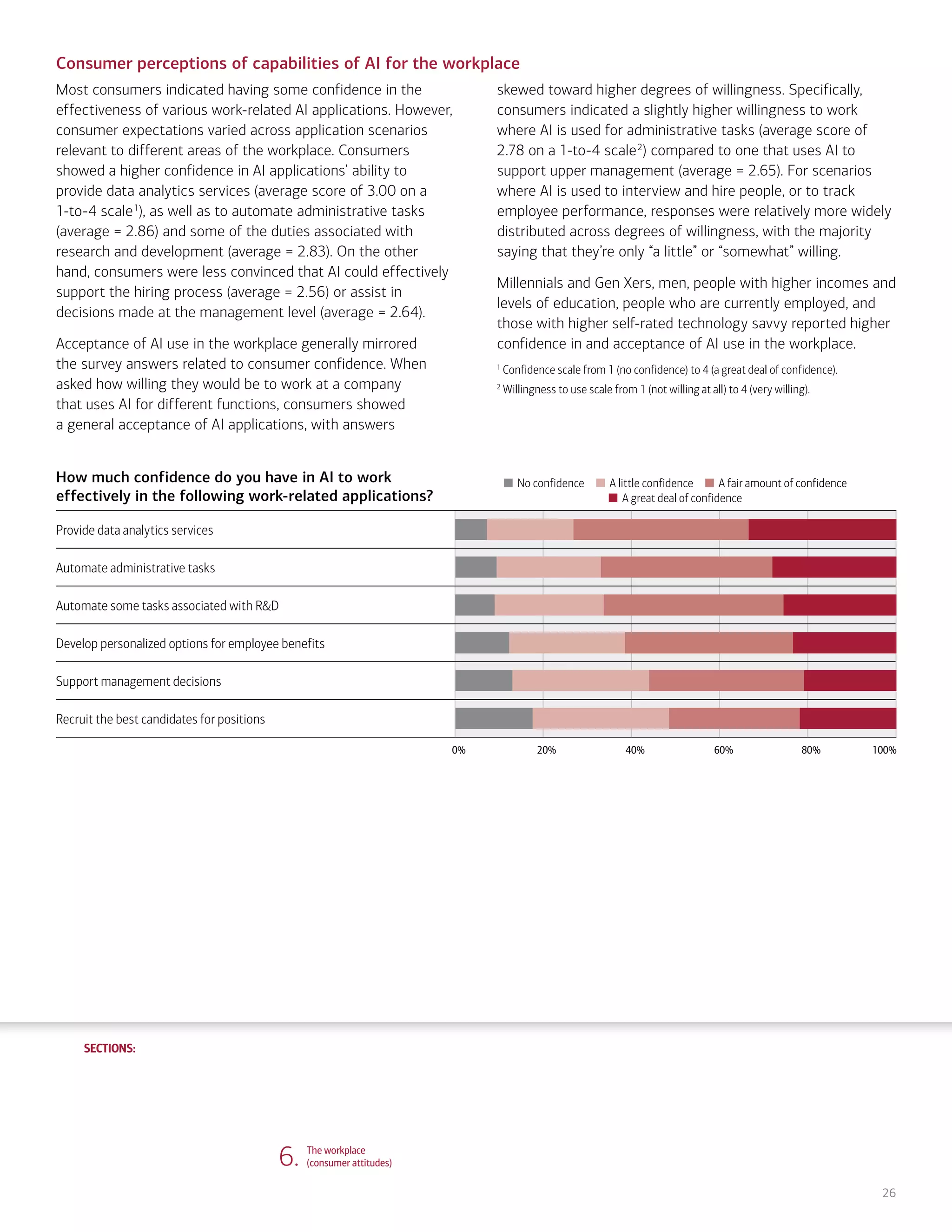
Most consumers indicated having some confidence in the
effectiveness of various work-related AI applications. However,
consumer expectations varied across application scenarios
relevant to different areas of the workplace. Consumers
showed a higher confidence in AI applications’ ability to
provide data analytics services (average score of 3.00 on a
1-to-4 scale1
), as well as to automate administrative tasks
(average = 2.86) and some of the duties associated with
research and development (average = 2.83). On the other
hand, consumers were less convinced that AI could effectively
support the hiring process (average = 2.56) or assist in
decisions made at the management level (average = 2.64).
Acceptance of AI use in the workplace generally mirrored
the survey answers related to consumer confidence. When
asked how willing they would be to work at a company
that uses AI for different functions, consumers showed
a general acceptance of AI applications, with answers
skewed toward higher degrees of willingness. Specifically,
consumers indicated a slightly higher willingness to work
where AI is used for administrative tasks (average score of
2.78 on a 1-to-4 scale2
) compared to one that uses AI to
support upper management (average = 2.65). For scenarios
where AI is used to interview and hire people, or to track
employee performance, responses were relatively more widely
distributed across degrees of willingness, with the majority
saying that they’re only “a little” or “somewhat” willing.
Millennials and Gen Xers, men, people with higher incomes and
levels of education, people who are currently employed, and
those with higher self-rated technology savvy reported higher
confidence in and acceptance of AI use in the workplace.
1
Confidence scale from 1 (no confidence) to 4 (a great deal of confidence).
2
Willingness to use scale from 1 (not willing at all) to 4 (very willing).
How much confidence do you have in AI to work
effectively in the following work-related applications?
No confidence A little confidence A fair amount of confidence
A great deal of confidence
Provide data analytics services
Automate administrative tasks
Automate some tasks associated with RD
Develop personalized options for employee benefits
Support management decisions
Recruit the best candidates for positions
0% 20% 40% 60% 80% 100%
6. The workplace
(consumer attitudes)
1. Life, work and care
(consumer attitudes)
2. Financial planning and management
(consumer attitudes)
3. Financial planning and management
(expert perspectives)
4. Community and infrastructure
(consumer attitudes)
5. Community and infrastructure
(expert perspectives)
7. The workplace
(expert perspectives)
8. Health care and caregiving
(consumer attitudes)
9. Health care and caregiving
(expert perspectives)
10. Information seeking and social
interactions (consumer attitudes)
11. Information seeking and social
interactions (expert perspectives)
Introduction Summary
SECTIONS:
SECTIONS:
27
Related expert thoughts and opinions
AI benefits
Expert insights into potential applications of AI in the workplace
highlighted the potential for increased productivity and reduced bias.
One expert indicated that AI may make for more fulfilling careers
while benefiting employers:
“Most sales professionals spend less time selling and more time on
administrative aspects of the job . . . [At] a time [of] margin pressures
across most industries, reducing costs, raising employee satisfaction
and having them focus on core functions of the roles will benefit
employees and companies considerably.”
Another expert was optimistic that AI may be able to help “re-create
meaningful interaction, [prevent] burnout and [provide] structure to
the day.”
AI risks
While AI may hold promise for improved working conditions, experts
highlighted a number of risks that its implementation may present,
including bias in hiring and potential job loss:
“AI bias is already an issue in the workplace, and I see that getting
much worse. If you were to train an AI on what a CEO should be,
there’s a good chance it would limit itself to Ivy league business-
school white men from rich families. That’s an extreme case, but
much smaller biases that will be harder to detect will exist in any AI
used in this space to effect workplace outcomes.
Another risk is the loss of jobs. If AI moves far enough along that AI
can take over many simple tasks, this will immediately result in loss
of jobs around the world. How society reacts could determine the
impact, but it’s still a risk in deploying AI heavily in the workplace.”
Another expert added that the use of AI may help firms ”[justify]
poor behavior through algorithmic decision-making” and make
decision processes more opaque.
Managing career paths with AI
We also asked experts to describe how AI will help people navigate
their career path. One expert noted that firms have a responsibility
(and incentive) to implement human-centered AI:
“Humans have only lived with electricity “at scale” for less than
100 years, and the pace of change has been considerable . . . We can
bet that change management will need to play a considerable role
within organizations to get the most benefits for BOTH employees
and companies, as ‘culture is everything’ in a company and relative
to its success. Helping employees to find the path to effectively
co-exist will be done by those successful organizations. Ignoring
or hoping it will all play out is a recipe for failure.”
Navigating retirement decisions with AI
When it comes to navigating benefits decisions and considering
retirement, some experts were optimistic about AI’s ability to
prioritize what’s important:
“If used well, AI could help prepare paths toward shorter, more
abundant work lives. This implies a holistic take on AI ecosystems
that prioritize the health, well-being and quality of life of those
impacted by the systems. This also implies the goals of abundance
for all as opposed to survival of the fittest.”
Another expert, however, was not quite as enthusiastic:
“I think job layoffs due to AI will affect older employees with higher
salaries much more than younger, entry-level employees. Companies
will seek to downsize, particularly right before employees are eligible
for certain retirement benefits, as a way of saving money. AI will
facilitate and accelerate this.”
Summary and implications for practice
• Across different scenarios for AI use in the workplace,
certain demographic characteristics were consistently
associated with higher confidence and acceptance. Men,
millennials and Gen Xers, people with higher incomes and
levels of education, currently employed individuals, and those
who were comfortable with new technologies were more
likely to believe in the effectiveness of AI in work-related
applications and more willing to work at a company that
uses AI for various functions.
• Consumers are more accepting of using AI to provide
administrative and analytical task support than they are
of using AI to support management decisions or recruit
candidates for positions.
• Based on their reported willingness to work in settings in
which AI is used for various applications, consumers appear
generally accepting of AI in the domain of workplace, career
and benefits. But they also believe that an accelerated pace of
development should be accompanied by necessary regulations.
6. The workplace
(consumer attitudes)
1. Life, work and care
(consumer attitudes)
2. Financial planning and management
(consumer attitudes)
3. Financial planning and management
(expert perspectives)
4. Community and infrastructure
(consumer attitudes)
5. Community and infrastructure
(expert perspectives)
7. The workplace
(expert perspectives)
8. Health care and caregiving
(consumer attitudes)
9. Health care and caregiving
(expert perspectives)
10. Information seeking and social
interactions (consumer attitudes)
11. Information seeking and social
interactions (expert perspectives)
Introduction Summary
28
Use of AI in the workplace—
expert perspectives
AI is changing many aspects of our lives, and working
life is no exception. In particular, AI has already made
its way into recruiting and onboarding processes, and
algorithmic management is becoming increasingly
common in work contexts. The technology can also be
used to help people develop skills, choose benefits and
improve their productivity. With these developments
as the backdrop, an ongoing debate concerns the
consequences of AI in the workplace. Will AI help us
lead more fulfilling lives at work, or does it threaten
workers’ well-being and livelihoods? In this section,
we present an overview of how experts think about
the capabilities, development, regulation and future
of AI in the workplace. We make some comparisons
to data collected from a sample of the public and
share qualitative findings from the experts to describe
specific ways in which AI will influence workers’ lives.
section 7
SECTIONS:
SECTIONS:
29
7. The workplace
(expert perspectives)
Confidence in AI applications in workplace contexts
Experts were most confident in the ability of AI to provide data analytics services and automate administrative tasks. For all the
work-related applications asked about in the survey, experts were more confident than the public in AI’s effectiveness. Differences
between experts and the public were statistically significant for confidence in AI’s ability to provide data analytics services, automate
administrative tasks, track security breaches within organizations and develop personalized employee benefit options.
How much confidence do you have in AI to work
effectively in the following applications?
Experts Consumers
No confidence Not too much A fair amount A great deal
Provide data analytics services
Automate administrative tasks
Track security breaches within organizations
Develop personalized options for employee benefits
Automate some tasks associated with research and development
Support management decisions
Recruit the best candidates for positions
Anticipated adoption of AI in workplace contexts
We compared the sample of the public’s self-reported willingness to adopt AI to experts’ estimation of adoption by the general
population. For the most part, in comparison to responses from the public, experts significantly overestimated people’s willingness
to work at a company that uses AI in various ways. However, we found no significant difference between the public and experts
when it came to a company using AI to make decisions about benefits. In addition, experts underestimated people’s willingness
to work at a company that uses AI to track employee productivity and performance.
Willingness to work at a company
that uses AI to:*
Experts Consumers
Not willing at all A little willing Somewhat willing Very willing
Accomplish administrative tasks
Develop and offer options for employee benefits
Support executive decision-making
Make hiring decisions
Make decisions regarding employee compensation and benefits
Track employee productivity and performance
* Question for experts: How willing do you think the general public would be to adopt AI in the following applications?
Question for consumers: How willing would you be to adopt AI in the following applications?
Use of AI in the workplace—
expert perspectives
7.
1. Life, work and care
(consumer attitudes)
2. Financial planning and management
(consumer attitudes)
3. Financial planning and management
(expert perspectives)
4. Community and infrastructure
(consumer attitudes)
5. Community and infrastructure
(expert perspectives)
6. The workplace
(consumer attitudes)
8. Health care and caregiving
(consumer attitudes)
9. Health care and caregiving
(expert perspectives)
10. Information seeking and social
interactions (consumer attitudes)
11. Information seeking and social
interactions (expert perspectives)
Introduction Summary
SECTIONS:
SECTIONS:
30
Benefits, risks, development and regulation
Compared to the application of AI in general, experts thought that its application to the workplace would bring fewer benefits but
also be less risky. On average, both the experts and the public indicated that they believe the implementation of AI in the workplace
will be slightly more beneficial than it will be risky. Members of the public advocated for both accelerated development and
increased regulation of AI systems in the workplace more strongly than experts did.
Forecasting the future of AI in the workplace
We turned to the experts to try to get a glimpse of the future of AI in the workplace and its effect on people’s working lives, asking
the panelists about the likelihood of certain outcomes that are frequently discussed. The experts were relatively certain that AI will
influence how companies hire and that it will decrease the operating expenses of organization and companies. Experts believed that
it was relatively likely that these changes will decrease the number of workers. The panelists were least likely to believe that AI will
help to reduce bias and discrimination in the workplace.
In the next 10 years, how likely is it that AI helps us achieve the following?
Skills and career planning Workplace operations Social aspects
Very likely
Somewhat
likely
A little likely
Not likely at all
Change the way people are hired
Decrease operating expenses of
organizations and companies
Decrease the number of workers in
organizations in general
Change how compensations, benefits
and incentives are provided
Make remote work the norm
Improve social interactions and intergenerational
connections in the workplace
Increase the value of older employees in the workplace
Help eliminate bias and discrimination in the workplace
Place increased emphasis on technical skills
Place an increased emphasis on ”soft skills”
in the workplace
Change our conception of career paths and retirement
Force people to retire early
Increase the value of experience
Allow people to retire later
7. The workplace
(expert perspectives)
1. Life, work and care
(consumer attitudes)
2. Financial planning and management
(consumer attitudes)
3. Financial planning and management
(expert perspectives)
4. Community and infrastructure
(consumer attitudes)
5. Community and infrastructure
(expert perspectives)
6. The workplace
(consumer attitudes)
8. Health care and caregiving
(consumer attitudes)
9. Health care and caregiving
(expert perspectives)
10. Information seeking and social
interactions (consumer attitudes)
11. Information seeking and social
interactions (expert perspectives)
Introduction Summary
SECTIONS:
SECTIONS:
31
How will AI affect our work lives?
Responses anticipate a mix of benefits and challenges associated
with increasing use of AI in the workplace.
A machine learning researcher wrote, “AI will be used in a myriad of
different small ways to optimize operations and management, but
in ways that are not immediately evident to everyday people and
employees. I think it is unpredictable how a widespread adoption of
AI will affect people, except that I think it will put a lot of people out
of work.”
AI is often discussed in terms of its ability to help employers sort
through hiring processes, but some experts are skeptical of the
fairness of these practices. A data scientist wrote, “AI bias is already
an issue in the workplace, and I see that getting much worse. If you
were to train an AI on what a CEO should be, there’s a good chance it
would limit itself to Ivy-League-business-school white men from rich
families. That’s an extreme case, but much smaller biases that will
be harder to detect will exist in any AI used in this space to effect
workplace outcomes.”
A computer scientist described “increasing bias in processing CV
data (for example, gender or racial bias, where research has shown
that resumes with female or African American names receive
fewer callbacks). I can also see a risk in AI being used for employee
surveillance and infringing on their privacy.”
Another expert was optimistic about AI’s use for career planning.
“AI could be helpful much earlier in the process of realistic career
path navigation for students at every level, and then into the entry-
level workplace . . . It doesn’t need to be a threat—’You’ll end up
working in fast food’—it needs to be realistic and also potentially
engaging so that people can do some career discovery that may
stretch their horizons.”
How will AI affect workplace operations and culture
and how people navigate their career paths?
Some experts highlighted how AI can help workers plan for retirement
or a second career. Others focused on cultural and social challenges
that may accompany the integration of AI in the workplace.
A health care technologist emphasized the important role that AI
may have in benefits planning. He wrote that “the retirement piece
is incredibly important. All 401(k) financial institutions will NOT
provide guidance on how to invest, and most people do not have a
financial planner. It is like asking a passenger to be the pilot. There
is little to no subject matter expertise in retirement planning or
decisions. Leveraging AI that can pull from daily-life decisions and
actual spending, moving from [educated guesses] to actual day-to
day-financial actions to feed the AI will provide much better analysis
and decision-making augmentation. Allowing people to make these
massive decisions without help is almost cruel.”
A computer scientist wrote, “I think [AI] can help [older adults] be
better integrated [into their workplace] through providing them with
aid (for example, better hearing aids).”
A machine learning researcher was pessimistic about AI’s impact
on older workers. “I think job layoffs due to AI will affect older
employees with higher salaries much more than younger, entry-level
employees. Companies will seek to downsize, particularly right before
employees are eligible for certain retirement benefits, as a way of
saving money. AI will facilitate and accelerate this.”
Summary and implications for practice
• Experts were optimistic about the ability of AI to support
and automate routine tasks in the workplace. The panel was
less confident that AI could be effectively used to support
management decisions or recruit the best candidates
for positions.
• The panelists believe that AI will affect the way people are
hired and the valuation of skills in the workplace. However,
the experts are doubtful that AI will improve social relations
and eliminate bias and discrimination in work settings.
• As they think about the workplace of the future, financial
services organizations can take careful measures in
deploying AI systems. For example, firms can take steps
to make sure that vulnerable workers are not pushed out
of their jobs due to technological advancements.
7. The workplace
(expert perspectives)
1. Life, work and care
(consumer attitudes)
2. Financial planning and management
(consumer attitudes)
3. Financial planning and management
(expert perspectives)
4. Community and infrastructure
(consumer attitudes)
5. Community and infrastructure
(expert perspectives)
6. The workplace
(consumer attitudes)
8. Health care and caregiving
(consumer attitudes)
9. Health care and caregiving
(expert perspectives)
10. Information seeking and social
interactions (consumer attitudes)
11. Information seeking and social
interactions (expert perspectives)
Introduction Summary
32
Use of AI in health care
and caregiving—
consumer attitudes
Artificial intelligence has applications in both clinical
health care and home care settings, with potential
capabilities and benefits including health data
monitoring for preventative care, more precise and
efficient diagnoses, and improved medical research.
This section looks at how consumers view the potential
effects and benefits and risks of AI in health care.
section 8
SECTIONS:
SECTIONS:
33
8. Health care and caregiving
(consumer attitudes)
Perception of benefits and risks regarding development/implementation
of AI in the context of health care and caregiving
Consumers were optimistic about the benefits that AI
may offer in the context of health care and caregiving, but
uncertain about its risks. On average, the sample perceived
the application of AI in health care and caregiving settings as
“somewhat risky” but also somewhere between “somewhat
beneficial” and “quite beneficial.” We observed similar patterns
in respondents’ risk perception across demographic subgroups,
but benefit perception varied significantly across these groups.
In particular, millennials and Generation Xers, men, individuals
with higher incomes, and those with more knowledge of
computer science and technology perceived AI in the health
care domain as significantly more beneficial.
The lack of demographic variation in risk perception related to
AI in health care suggests that the perception of risks of using
AI in this domain may be felt universally regardless of age,
gender, background and other demographic factors.
How beneficial/risky do you think it is to develop and
implement AI in health care and caregiving contexts?
Beneficial
Risky
Not at all A little Somewhat Quite Extremely
Use of AI in health care and caregiving—
consumer attitudes
8.
Consumer perception of AI capabilities and willingness to adopt in the context of health and caregiving
How willing would you be to use/adopt AI in the
following health care-related contexts? Not at all A little willing Somewhat willing Very willing
Use AI in genomics
Trust an algorithmic prediction of my life expectancy
Trust an algorithmic prediction of potential health issues
Allow AI-enabled technology to assist in caring for my family
Use in-home monitoring for my own health issues
Use in-home monitoring for health issues of a loved one
Visit a doctor who uses AI for making diagnoses
Allow a medical professional to use AI for medical record
Follow a treatment plan developed by AI
Trust a diagnosis provided by an AI
Consumers indicated little to some willingness to trust a
diagnosis and follow a treatment plan developed by AI, allow
a medical professional to use AI for recording data and as a
decision support tool, use in-home monitoring on the health
issues of their own, and trust an AI prediction on potential
health issues and life expectancy. Similar patterns were found
for respondents’ willingness to allow AI-enabled technology to
assist in caregiving activities such as in-home monitoring to
track health issues of a loved one.
Similarly, on average, respondents indicated having some
confidence in the effectiveness of various health care-related
AI applications, such as the ability of AI to make accurate
medical diagnoses, develop treatment plans, process medical
records, provide useful decisions, predict future health issues,
provide in-home monitoring, and support unpaid and personal
caregivers. Millennials and Gen Xers, men, people with higher
incomes, and individuals with more knowledge of computer
science and technology reported higher confidence in and
acceptance of the use of AI in health care.
1. Life, work and care
(consumer attitudes)
2. Financial planning and management
(consumer attitudes)
3. Financial planning and management
(expert perspectives)
4. Community and infrastructure
(consumer attitudes)
5. Community and infrastructure
(expert perspectives)
6. The workplace
(consumer attitudes)
7. The workplace
(expert perspectives)
9. Health care and caregiving
(expert perspectives)
10. Information seeking and social
interactions (consumer attitudes)
11. Information seeking and social
interactions (expert perspectives)
Introduction Summary
SECTIONS:
SECTIONS:
34
Need for regulated development and implementation
Consumers across demographic subgroups agreed that AI in
health-related applications needs to be regulated. Around half
(51.5%) of the consumer sample said that the development
and implementation of AI in health care should be highly
regulated, while only 2.5% said that no regulation is needed.
However, more consumers indicated that the development
and implementation of AI in the health care domain needs to
accelerate rather than continue at the current rate or decelerate.
Demographic differences were observed in preferences toward
the development and implementation of AI. Millennials and
Gen Xers, men, people with higher income, and people with
more knowledge of computer science and technology were
more likely to indicate a need for acceleration.
The development and implementation of AI for health care and caregiving applications need to (be) .
Not regulated at all A little regulated Somewhat regulated
Highly regulated
Greatly decelerate Somewhat decelerate
Continue at their current rate Somewhat accelerate Greatly accelerate
Silent generation
Baby boomers
Generation X
Millennials
Generation Z
0% 0%
20% 20%
40% 40%
60% 60%
80% 80%
100% 100%
8. Health care and caregiving
(consumer attitudes)
1. Life, work and care
(consumer attitudes)
2. Financial planning and management
(consumer attitudes)
3. Financial planning and management
(expert perspectives)
4. Community and infrastructure
(consumer attitudes)
5. Community and infrastructure
(expert perspectives)
6. The workplace
(consumer attitudes)
7. The workplace
(expert perspectives)
9. Health care and caregiving
(expert perspectives)
10. Information seeking and social
interactions (consumer attitudes)
11. Information seeking and social
interactions (expert perspectives)
Introduction Summary
SECTIONS:
SECTIONS:
35
Related expert thoughts and opinions
AI benefits
Members of the expert panel expressed excitement about the use of
AI in health care and caregiving contexts.
Several experts mentioned the ability of AI to provide “more affordable
care” while providing the tools for “better epidemiological modeling”
and the “ability to model more complex phenomena,” highlighting the
positive impact that AI may have in terms of improving population health.
Another expert mentioned that AI may help meet the increasing
demand for care, noting the opportunity for human-AI partnership:
“AI [could] do things that current staffing cannot do or augment what
they do, rather than displace human jobs.”
One expert also noted that “more automated systems can make it a lot
easier for people to remain independent longer,” enabling greater quality
of life while allowing a greater variety of older adults to age in place.
AI risks
While AI may have many benefits, experts raised a few concerns
about its use in health care and caregiving applications. One expert
noted the high stakes involved in the health care domain:
“Health care and caregiving are, traditionally, intensely human
activities that depend on the skill and professionalism of care
givers. Any system that replaces a human with an algorithm has the
potential of making incorrect decisions that can threaten human
health. Because health care literally involves life and death decisions,
it is critical to build in enough redundancy and resilience in AI-based
systems to ensure that these systems do no harm.”
Another expert noted that when an AI is trained on past data,
the system “may learn spurious associations that are based on
socioeconomic indicators and then exacerbate inequalities along
racial or class lines.”
Health and caregiving across the life course
We asked the experts to describe how AI will influence the way
people experience health care and caregiving through the life course.
An expert in the health care industry emphasized the ways that AI
can enhance clinical and home care: “My highest expectation is that
AI will assume many time-consuming, lower-level tasks that will
free up the time of professional providers and [family] caregivers
to spend less time in routine tasks and more time in interpersonal
communication/support for patients/care recipients. AI also has the
potential of increasing the (average) quality of care while making
it more affordable, which could expand access to good care. But
this will depend not on the technology per se as much as how it is
implemented and the ability and willingness of care providers to
embrace it in their practices.”
Health and caregiving for older adults
In addition, we wanted to know how AI will affect health care and
caregiving practices for older adults.
One expert noted the promise that AI may have in addressing the
loneliness that many older adults experience: “One could imagine an
AI companion that might assuage that loneliness at many levels of
companionship, from the level of a pet dog to a genuinely interactive
companion.”
Another expert highlighted the benefits that AI may have for
caregivers: “I think AI can also help predict risk of caregiver burden,
using clinical data of the person being cared for and perhaps the
caregiver as well, in addition to [social determinants of health] data.”
Summary and implications for practice
• Consumers’ perceptions of the benefits of AI-enabled
systems in health care suggest a promising view from a
technology acceptance standpoint. On the other hand,
consumers’ middling willingness to have AI involved in their
own care may suggest some resistance toward adoption.
• Across different scenarios for the use of AI in health care,
certain key demographic characteristics were consistently
associated with higher confidence and acceptance. Men,
millennials and Gen Xers, people with higher incomes and
levels of education, currently employed individuals, and those
who were comfortable with new technologies were more
likely to believe in the effectiveness of AI in health care-
related applications.
• Generational differences in confidence in and acceptance of
AI in health care may point to possible changes in how care
is provided and received in the future, especially as more Gen
Xers and millennials will likely take on responsibilities for
taking care of older family members in the near term.
• Interestingly, respondents show higher agreement on
accelerating the development and implementation of AI for
health care and caregiving applications than for providing
regulations and standards for it.
8. Health care and caregiving
(consumer attitudes)
1. Life, work and care
(consumer attitudes)
2. Financial planning and management
(consumer attitudes)
3. Financial planning and management
(expert perspectives)
4. Community and infrastructure
(consumer attitudes)
5. Community and infrastructure
(expert perspectives)
6. The workplace
(consumer attitudes)
7. The workplace
(expert perspectives)
9. Health care and caregiving
(expert perspectives)
10. Information seeking and social
interactions (consumer attitudes)
11. Information seeking and social
interactions (expert perspectives)
Introduction Summary
36
Use of AI in health care
and caregiving—
expert perspectives
AI has applications in both clinical health care and
home care settings, with the potential to monitor
health data for better preventive care, provide more
precise and efficient diagnoses, and improve medical
research. In this section, we present an overview of
how experts think about the capabilities, development,
regulation and future of artificial intelligence as it’s
applied in health and caregiving contexts.
section 9
SECTIONS:
SECTIONS:
37
9. Health care and caregiving
(expert perspectives)
Confidence in AI applications in health care and caregiving activities
For all health care and caregiving-related applications that we asked about in the survey, experts were more confident than
consumers about AI’s effectiveness. Experts were most confident in the ability of AI to provide decision support tools to medical
professionals, support unpaid personal care in nonmedical settings, and process medical records seamlessly and efficiently.
Experts were least confident in an AI system’s ability to detect and provide insight on health irregularities in a home-based
setting—but they expressed a fair amount of confidence in AI’s effectiveness for this application as well.
How much confidence do you have in AI to work
effectively in the following applications?
Experts Consumers
No confidence Not too much A fair amount A great deal
Providing useful decision support tools to medical professionals
Supporting unpaid personal care provided in nonmedical settings
Processing medical records seamlessly and efficiently
Making accurate medical diagnoses
Developing treatment plans for patients facing multiple conditions
Providing in-home monitoring to detect and provide insight
on health irregularities
Anticipated adoption of AI in health care and caregiving
We compared the sample of consumers’ self-reported willingness to adopt AI to experts’ estimation of adoption by the general
public. Experts estimated (and consumers expressed) the highest levels of willingness to adopt AI in applications where it supported
decisions made by medical professionals rather than providing advice or diagnoses on its own.
Willingness to trust and adopt AI* Experts Consumers
Not willing at all A little willing Somewhat willing Very willing
Home care
Use in-home monitoring to maintain perspective on the
health issues of a loved one
Allow AI-enabled technology to assist in caring for family
Clinical
health care
Visit a doctor or medical health professional who uses AI as a
decision support tool
Allow a medical professional to use AI to add data to my
electronic medical record
Use in-home monitoring to maintain perspective on my own
health issues
Trust an algorithmic prediction of potential health issues
Trust a diagnosis provided by an AI
Follow a treatment plan developed by AI
Trust an algorithmic prediction of life expectancy
* Question for experts: How willing do you think the general public would be to adopt AI in the following applications?
Question for consumers: How willing would you be to adopt AI in the following applications?
Use of AI in health care and caregiving—
expert perspectives
9.
1. Life, work and care
(consumer attitudes)
2. Financial planning and management
(consumer attitudes)
3. Financial planning and management
(expert perspectives)
4. Community and infrastructure
(consumer attitudes)
5. Community and infrastructure
(expert perspectives)
6. The workplace
(consumer attitudes)
7. The workplace
(expert perspectives)
8. Health care and caregiving
(consumer attitudes)
10. Information seeking and social
interactions (consumer attitudes)
11. Information seeking and social
interactions (expert perspectives)
Introduction Summary
SECTIONS:
SECTIONS:
38
Benefits, risks, development and regulation
Experts and consumers thought that AI in health and caregiving applications would bring greater benefits compared to the
application of AI in general. Both groups believed that the application of AI in health care and caregiving contexts will be more
beneficial than risky. Accordingly, experts and consumers supported acceleration of development; however, both groups also
advocated for a moderate level of regulation.
Forecasting the future of AI for health care and caregiving
We turned to the experts to get a glimpse of the impact that AI will have on older adults, caregivers and people receiving medical
care. Specifically, we asked the panelists about the likelihood of certain outcomes that are frequently discussed in the context of
the application of AI to health care and caregiving. In terms of effects on caregiving, the experts were relatively certain that AI will
help people stay independent and improve quality of life in old age. When it came to health care, the experts believed that it’s most
likely that AI will help improve the effectiveness of medical treatments and play a role in determining the cost of health insurance
for individuals.
In the next 10 years, how likely is it that
AI helps us achieve the following? Not likely at all A little likely Somewhat likely Very likely
Longer lives
Help people stay more independent in old age
Increase quality of life in old age
Extend people’s lifespans
Supporting
care
Improve the effectiveness of medical treatments
Affect how family caregivers provide care for loved ones
Provide direct health care recommendations instead of
through a medical professional
Health care
accessibility
Greatly affect the cost of health insurance for individuals
Decrease the cost of care
Make health care more accessible for everyone
Make health care more equitable for people of all
characteristics
9. Health care and caregiving
(expert perspectives)
1. Life, work and care
(consumer attitudes)
2. Financial planning and management
(consumer attitudes)
3. Financial planning and management
(expert perspectives)
4. Community and infrastructure
(consumer attitudes)
5. Community and infrastructure
(expert perspectives)
6. The workplace
(consumer attitudes)
7. The workplace
(expert perspectives)
8. Health care and caregiving
(consumer attitudes)
10. Information seeking and social
interactions (consumer attitudes)
11. Information seeking and social
interactions (expert perspectives)
Introduction Summary
SECTIONS:
SECTIONS:
39
How will AI affect health care and caregiving
across the life course?
Experts were optimistic about AI’s potential to improve outcomes in
both home and clinical care contexts.
A computer vision researcher wrote that AI may “[encourage] us to
prevent medical conditions by making healthier lifestyle choices,
[connect] us with those who may be at risk of the same conditions,
and [provide] mindfulness tools to help us attain better mental and
physical health.”
A data scientist and visualization artist wrote that AI will help in two
way. “First, being able to get a better diagnosis faster, especially
in remote areas. Second, [the] ability to live a longer, healthier and
more productive life through more comprehensive care for chronic
conditions through AI.”
A doctor focused on the effects that AI will have on pre- and
postnatal care. “The largest potential is in pregnancy and infant care.
Those are some of the areas where people are already willing to
invest a great deal and willing to use technology. I could see more
tech use . . . [to] reduce stress with monitoring. There is a potential
to catch developmental concerns in infants and toddlers much
more quickly.”
A medical professor and computational geneticist wrote that AI may
provide “advice about disease surveillance (for example, colonoscopies
for people with increased risk of colorectal cancer, echocardiograms
for people with risk factors for cardiomyopathies), personalized
advice applications for daily health promotion and intervention
activities, and integration of personalized health [and] activity data
into guidance (for example, Fitbit, Apple Watch, smart home).”
How will AI affect older adults and caregivers?
A technologist wrote, “My highest expectation is that AI will assume
many time-consuming, lower-level tasks that will free up the time of
professional providers and informal caregivers to spend [less] time
on routine tasks and more time on interpersonal communication and
support for care recipients. AI also has the potential of increasing
the average quality of care while making it affordable, which could
expand access to good care.” The expert added, “But this will
depend on the technology per se as much as how it is implemented
and the ability and willingness of care providers to embrace it in
their practices.”
An author who writes about the philosophical significance of
artificial intelligence and the future of engineering presented a
unique perspective. “I can imagine an AI program that grows more
comprehensive as an individual declines. This would be incremental,
and therefore less scary, and the individual’s successful use of it in
its early phases would build confidence that as the app covers more
territory, it’s trustworthy.”
Another expert wrote, “Of particular promise is the ability of AI to
predict potential problems (such as dementia, falls, depression) early
and trigger interventions that could delay the onset of problems
or diminish their impact.” He also emphasized the benefits that
naturalistic user interfaces may bring. “AI-based voice response
systems have the potential of providing stimulation and even
companionship for isolated [older adults].”
Summary and implications for practice
• Both experts and consumers see health care and caregiving
as a context in which AI may deliver significant benefits to
the public.
• Experts were fairly confident in AI’s ability to support rather
than replace medical professionals and family caregivers.
Accordingly, the experts believed that consumers will
be willing to visit a medical professional who uses AI to
augment their practice.
• The panelists were less confident in AI’s ability to effectively
monitor patients in their homes and provide insights into
health irregularities. Despite this, the experts did estimate
that consumer adoption will be highest for products that
monitor a loved one.
• Despite a relatively optimistic outlook on the capabilities and
adoption of AI systems, the experts were least confident in
AI’s ability to provide more equitable access to health care.
9. Health care and caregiving
(expert perspectives)
1. Life, work and care
(consumer attitudes)
2. Financial planning and management
(consumer attitudes)
3. Financial planning and management
(expert perspectives)
4. Community and infrastructure
(consumer attitudes)
5. Community and infrastructure
(expert perspectives)
6. The workplace
(consumer attitudes)
7. The workplace
(expert perspectives)
8. Health care and caregiving
(consumer attitudes)
10. Information seeking and social
interactions (consumer attitudes)
11. Information seeking and social
interactions (expert perspectives)
Introduction Summary
40
Use of AI for information seeking
and social interactions—
consumer attitudes
AI is reshaping how information is processed
and delivered to its users, as well as how people
communicate and engage with others. In the future,
we may see products and services that use AI to curate
and create information, to help people meet each
other, and even to act as a social companion itself.
This section examines how consumers feel about the
implementation of AI in assisting with information
seeking and facilitating or providing social interactions.
section 10
SECTIONS:
SECTIONS:
41
10. Information seeking and social
interactions (consumer attitudes)
Attitudes toward applications of AI for information seeking and social interactions
How much confidence do you have
in AI to work effectively in the
following applications?
If given a choice, how willing
would you be to use/adopt AI
in the following contexts?
No confidence A little confidence
A fair amount of confidence
A great deal of confidence
Not willing at all A little willing
Somewhat willing Very willing
Help to remember things and accomplish other tasks
through a virtual personal assistant
Recommend products, services or content that matches
people’s interests
Determine whether news or information is trustworthy
Help to communicate with existing connections
(friends, groups people already belong to)
Help to make new social connections (new people,
new groups that share interests)
As a meaningful social companion
Use of AI for information seeking and social interactions—
consumer attitudes
10.
0% 0%
20% 20%
40% 40%
60% 60%
80% 80%
100% 100%
When asked about various possible AI applications, consumer
responses were divided in terms of confidence in AI working
effectively as well as in their own willingness to use AI. While
the majority of respondents indicated at least a fair amount
of confidence in and were somewhat willing to use most of
the presented applications and contexts, a significant portion
of people remained skeptical of and unwilling to use AI for
information seeking and social interactions.
Among scenarios describing AI applications in task and
information support, consumers were more likely to indicate
higher degrees of confidence in and acceptance of AI’s providing
memory and task support in the form of a virtual assistant and
AI making recommendations to match people’s interests while
having a less positive perspective toward AI’s ability to determine
the reliability of news or other information. Also, while many
consumers indicated that they generally feel confident in and
accepting of AI’s ability to support existing and new social
connections, fewer people agreed on the effectiveness and
acceptability of AI’s serving as a social companion.
Consumer perspectives toward various AI applications in
informational and social contexts were found to vary by
demographic characteristics as well as general technology
experience and attitudes. Millennials and Gen Xers, men,
individuals with higher income and education, employed
people, and individuals with higher self-rated technology savvy
were more likely to indicate that they have higher confidence
in and willingness to use AI in the presented contexts.
Generational differences were larger when asked about the
potential for AI to provide meaningful social companionship.
When compared on a 4-point scale (1 = not willing at all, 2 =
a little, 3 = somewhat, 4 = very willing), average scores from
the silent generation (1.84), baby boomers (1.74) and Gen Z
(2.10) were significantly lower than millennials (2.85) and Gen
Xers (2.81). While expert discussions explore how AI-enabled
products such as social robots can be used to support the
social well-being of older adults, findings from this survey
suggest that consumer support and readiness for such
applications remain low among older generations.
1. Life, work and care
(consumer attitudes)
2. Financial planning and management
(consumer attitudes)
3. Financial planning and management
(expert perspectives)
4. Community and infrastructure
(consumer attitudes)
5. Community and infrastructure
(expert perspectives)
6. The workplace
(consumer attitudes)
7. The workplace
(expert perspectives)
8. Health care and caregiving
(consumer attitudes)
9. Health care and caregiving
(expert perspectives)
11. Information seeking and social
interactions (expert perspectives)
Introduction Summary
SECTIONS:
SECTIONS:
42
Consumer acceptance of social robots
Social robots are designed to communicate verbally and
nonverbally with people along social and emotional dimensions
while conforming to human psychological and social norms.
To understand how consumers feel about the use of AI as a
communication agent and social companion, participants were
asked about their willingness to use social robots. Consumers
were generally unsure about acceptance, with “not willing at
all” being the most popular choice and smaller percentages
saying “somewhat” or “very willing.”
General attitudes toward AI in information/social contexts
Consumers generally indicated perceptions of moderate
risk (average score = 2.96 on a 1-to-5 scale1
) and benefit
(average = 3.17 on a 1-to-5 scale2
) associated with the
development and implementation of AI informational and
social contexts. Also, consumers showed an overall inclination
for moderate support toward accelerated development, but
within a highly regulated environment.
The silent generation, baby boomers, women and unemployed
individuals were more likely to perceive AI’s development and
implementation in this domain as “a little risky.” Demographic
gaps were bigger along degrees of benefit perception.
Millennials and Gen Xers were far more likely to think that AI in
the given contexts would be “quite” or “extremely” beneficial,
while responses from older generations were skewed toward
lower degrees of benefit. Men, individuals with higher income
and education, and employed individuals were also more likely
to indicate higher benefit perception.
People who rated themselves as technology-savvy—as
having more experience with and trust in technology in
general, a higher tendency to adopt new technology early,
higher comfort with and interest in new technology, and a
higher knowledge of AI—also had higher benefit perception.
However, technology savvy did not show significant
associations with perceptions of risk.
Benefit and risk perception showed significant correlation
with degrees of support for development and implementation.
People who perceived AI to be more beneficial in the social
and informational domain also believed that its development
and implementation should be highly accelerated, while
people with a higher risk perception supported a moderate
deceleration.
1
Risk perception scale from 1 (not risky at all) to 5 (extremely risky).
2
Benefit perception scale from 1 (not beneficial at all) to 5 (extremely beneficial).
22.3%
Very willing
23.9%
Somewhat willing
27.9%
Not willing at all
26.0%
A little willing
Willingness
to use social
robots
10. Information seeking and social
interactions (consumer attitudes)
1. Life, work and care
(consumer attitudes)
2. Financial planning and management
(consumer attitudes)
3. Financial planning and management
(expert perspectives)
4. Community and infrastructure
(consumer attitudes)
5. Community and infrastructure
(expert perspectives)
6. The workplace
(consumer attitudes)
7. The workplace
(expert perspectives)
8. Health care and caregiving
(consumer attitudes)
9. Health care and caregiving
(expert perspectives)
11. Information seeking and social
interactions (expert perspectives)
Introduction Summary
SECTIONS:
SECTIONS:
43
Related expert thoughts and opinions
AI benefits in informational/social contexts
The expert panel indicated that AI has the potential to improve
people’s lives when deployed in the context of information seeking
and social interactions. In terms of social interactions, experts
emphasized the potential of AI to build online communities through
matching like-minded individuals. When it came to information
seeking, several experts noted that AI may be used to identify and
stop dis- and misinformation.
Experts also emphasized the potential benefits of AI in preventing
social isolation. A bioinformatician noted, “Finding ways to help
people with isolation is critical to keeping people healthy and aging
well. AI may be able to identify times that people need that critical
hello or interaction or thing, and if so, it could provide the pushes or
pulls for those interventions.”
A data scientist noted that technology can increase equity if
deployed properly. “Technology is either a vector of inclusion or
exclusion: greater accessibility, more accountability, broader inclusion
of voices, more local autonomy [and] decision-making all become
possible by allowing systems to become more responsive and
personalized.” This panelist added that these advances may
“help individuals live with greater independence for longer.”
AI risks in informational/social contexts
While AI may have many benefits, experts did mention that there are
some risks and challenges associated with its use.
An AI researcher noted the risk of technology’s magnifying our
worst social tendencies while reducing accountability. “Because AI
learns from past data, AI applications run the risk of reproducing all
the current negative aspects of social interaction and information
flow we would like to avoid, such as trolling, bias, racism, sexism,
homophobia, etc. Even worse, AI applications could do this at scale,
with no one being held accountable or responsible because no
human is making decisions after all.”
A technologist highlighted the stakes of implementing AI in social
contexts: “Bad AI could disrupt and corrupt information flows that
people depend on.” The expert also highlighted the risk of perverse
economic incentives: “AI, driven by economic considerations, could
be used as a substitute for ‘real’ human interaction (providing what
Robert Putnam calls ‘pseudo-social interactions’). AI is already being
used by social media to shape content and interactions for business
purposes (revenue maximization), not to enhance the quality of life.”
Summary and implications for practice
• Consumers generally believe that AI can support informational
tasks and facilitate social interactions, and are moderately
willing to use AI under these scenarios. However, consumer
support for the use of AI as a social companion remains low.
• While AI-enabled technologies are posited as a solution for
the issues of social isolation and loneliness among older
adults, findings indicate that older adults themselves are
skeptical of the possibility.
• Similar to AI in other domains, demographic groups
reporting higher benefit perception and acceptance of AI
development and implementation in the informational and
social contexts include millennials and Gen Xers, men,
individuals with higher income and education, and employed
individuals. Higher levels of self-rated technology experience
and knowledge of AI were also associated with higher support
for the use of AI in the information and social domain.
10. Information seeking and social
interactions (consumer attitudes)
1. Life, work and care
(consumer attitudes)
2. Financial planning and management
(consumer attitudes)
3. Financial planning and management
(expert perspectives)
4. Community and infrastructure
(consumer attitudes)
5. Community and infrastructure
(expert perspectives)
6. The workplace
(consumer attitudes)
7. The workplace
(expert perspectives)
8. Health care and caregiving
(consumer attitudes)
9. Health care and caregiving
(expert perspectives)
11. Information seeking and social
interactions (expert perspectives)
Introduction Summary
44
Use of AI for information seeking
and social interactions—
expert perspectives
AI is reshaping how information is processed
and delivered to its users, as well as how people
communicate and engage with each other. Here we
present an overview of how experts think about AI
as it’s applied in information and communication
contexts. We make some comparisons to data
collected from a consumer sample and share
qualitative findings from the experts to describe
specific ways in which AI will influence people’s lives.
section 11
SECTIONS:
SECTIONS:
45
11. Information seeking and social
interactions (expert perspectives)
Confidence in AI applications in informational/social contexts
For all the social- and information-related applications that we asked about in the survey, both consumers and experts were most
confident in AI’s ability to recommend products and content to people. Both groups were least confident in AI’s ability to provide
meaningful social companionship. Except for social companionship, experts were more confident than consumers in AI’s abilities.
Differences were statistically significant for helping people remember things, recommending products and services, and bringing
people to new groups.
How much confidence do you have in AI to work
effectively in the following applications?
Experts Consumers
No confidence Not too much A fair amount A great deal
Information
Recommending products, services or content that
matches people’s interests
Determining whether news and other information
is trustworthy
Social
Bringing people to new groups on the basis of
similar interests
Connecting people with existing friends and groups that
they’re already a part of
Providing meaningful social companionship
Anticipated adoption of AI in informational/social contexts
We compared the sample of the public’s self-reported willingness to adopt AI to experts’ estimation of adoption by consumers.
Experts believed that consumers would be most willing to adopt AI for recommending products, services or content and least likely
to use AI as a social companion. In all application areas, experts overestimated consumers’ willingness to adopt AI. Interestingly,
experts’ ratings of anticipated adoption closely tracked their levels of confidence in AI’s abilities across most questionnaire items.
Willingness to adopt AI* Experts Consumers
Not willing at all A little willing Somewhat willing Very willing
Information
Recommending products, services or content to
match interests
Making new social connections
Social
Communicating with existing social networks
Determining whether or not news or information
is trustworthy
Using AI as a social companion
* Question for experts: How willing do you think the general public would be to adopt AI in the following applications?
Question for consumers: How willing would you be to adopt AI in the following applications?
Use of AI for information seeking and social interactions—
expert perspectives
11.
1. Life, work and care
(consumer attitudes)
2. Financial planning and management
(consumer attitudes)
3. Financial planning and management
(expert perspectives)
4. Community and infrastructure
(consumer attitudes)
5. Community and infrastructure
(expert perspectives)
6. The workplace
(consumer attitudes)
7. The workplace
(expert perspectives)
8. Health care and caregiving
(consumer attitudes)
9. Health care and caregiving
(expert perspectives)
10. Information seeking and social
interactions (consumer attitudes)
Introduction Summary
SECTIONS:
SECTIONS:
46
Benefits, risks, development and regulation
Experts thought that the use of AI in social and informational contexts will be less beneficial but also less risky when compared
to the use of AI in general. However, within the social and informational domain, both experts and consumers believe that the
implementation of AI will be slightly more beneficial than it will be risky. Both groups advocated for accelerated development
and moderate levels of regulation regarding AI in these contexts.
Forecasting the future of AI in informational/social contexts
We turned to the experts to get a glimpse of the impact that AI will have on social interactions, asking panelists about the likelihood
of certain outcomes related to the application of AI in the context of social interaction and information networks. The experts were
relatively certain about the ability of AI to curate news and information for people, anticipate consumer needs, and facilitate social
engagement for older adults. The experts were less confident in an AI’s ability to carry on conversations with people and facilitate
social interactions with existing connections.
In the next 10 years, how likely is it that
AI helps us achieve the following? Not likely at all A little likely Somewhat likely Very likely
Information
Curate relevant news and information for people with a high
level of accuracy
Send people products they want before they know they
want or need them
Social
Help people stay socially active and engaged in old age
Match compatible strangers for activities, friendships and
relationships
Carry on conversations at the level of a human interlocutor
Facilitate communications within existing relations
11. Information seeking and social
interactions (expert perspectives)
1. Life, work and care
(consumer attitudes)
2. Financial planning and management
(consumer attitudes)
3. Financial planning and management
(expert perspectives)
4. Community and infrastructure
(consumer attitudes)
5. Community and infrastructure
(expert perspectives)
6. The workplace
(consumer attitudes)
7. The workplace
(expert perspectives)
8. Health care and caregiving
(consumer attitudes)
9. Health care and caregiving
(expert perspectives)
10. Information seeking and social
interactions (consumer attitudes)
Introduction Summary
SECTIONS:
SECTIONS:
47
How will AI improve the way people interact with
others, share experiences and find information?
In general, experts were optimistic about AI’s ability to build
more inclusive social networks and stop disinformation. The panel
was less confident in AI’s ability to serve as a substitute for
human interaction.
A computer scientist working on algorithmic fairness wrote, “I think
AI can be used in very beneficial ways: It can learn social network
structures from online platforms to improve social recommendations,
connect people with those who may [share] similar interests, or
connect them to relevant groups or jobs.” The expert mentioned
other ways that AI can facilitate social interaction for people with
disabilities. “I think AI can help those deficient in hearing or sight to
communicate better both online and offline; for example, to create
devices that receive environmental data and transform it into audio
cues for people, or to create real-time transcripts for them in online
talks and presentations.”
An author who writes about the philosophical significance of AI
wrote, ”AI can explain tradeoffs: yes, you’d love this person, but she
lives 50 miles away. No, this person’s ego is out of control, and you’ve
already shown you can’t abide that. But if you’re willing to travel, or if
you think the stimulation regardless of the ego will be fun, go for it.”
A technologist who focuses on technologies for older adults had
a different perspective. He wrote, “The biggest promise is for
development of an AI-based personal assistant, something like the
old Apple Knowledge Navigator (1987) that can expand people’s
use of information in ways that interest them. I see AI as much
less appropriate, except in limited ways, in enhancing interpersonal
relationships, which are probably best left to people themselves.”
How will AI affect the way that older adults
socialize and seek information?
We asked the experts to describe how AI will affect the lives of older
adults specifically.
Potential benefits
A user experience researcher who focuses on applications for older
adults wrote, “AI could power cognitive-support systems that enable
people to function independently for longer, even in the face of
cognitive declines. [AI may] help them to remember important events
or obligations [or] keep track of relationships with others.”
A computer scientist wrote about the ability of AI to improve
video-chatting experiences, “I think video-chatting services have
the potential to be the most comforting tool in lieu of actual human
contact. Video-chatting tech still suffers from lag that degrades the
quality of the interaction. AI could be used to optimize these systems
and adapt them to the individual.”
A psychiatrist who studies human-computer interaction wrote,
“AI can help you indulge in your passion (for example, recommending
the next best history biography and sending it to you or reading it
to you, or finding a film made from the book). AI could also facilitate
difficult life challenges during this stage—managing finances or
anticipating health needs.”
Risks
While AI may improve the lives of older adults, experts did mention
several challenges involved in implementation.
A computer scientist wrote, “I can see several risks in using AI improperly
for facilitating social interaction and flows of information. First, AI
could reproduce biases that already exist; for example, in flow of
information, it may suppress voices of minorities in online forums.
I could also see a risk for AI in facilitating social interaction, as relying
too much on AI devices could deter people from communicating to
each other and normalize communication with an AI instead.”
Summary and implications for practice
• The expert panelists believe that consumers will be most
willing to adopt AI when it comes to recommending products,
services or content that matches consumer interests.
• On the other hand, experts estimated that consumers will
be least willing to use AI as a social companion, which was
supported by results from the consumer panel. Notably,
experts’ estimations about adoption tracked their confidence
in AI’s abilities.
• The experts believe that within the next 10 years, AI will
advance sufficiently to curate news and information for
people and anticipate people’s needs. In fact, experts
didn’t dismiss the idea that an AI may provide human-level
conversation in 10 years.
• Given these findings, we may see the potential for firms
to adopt AI for matching, recommending and curating
content behind the scenes while retaining a more human
or traditional interface on the consumer-facing front end.
• AI could help older adults stay socially engaged and manage
challenging life transitions, but potential risks need to be
considered with moderate regulations.
11. Information seeking and social
interactions (expert perspectives)
1. Life, work and care
(consumer attitudes)
2. Financial planning and management
(consumer attitudes)
3. Financial planning and management
(expert perspectives)
4. Community and infrastructure
(consumer attitudes)
5. Community and infrastructure
(expert perspectives)
6. The workplace
(consumer attitudes)
7. The workplace
(expert perspectives)
8. Health care and caregiving
(consumer attitudes)
9. Health care and caregiving
(expert perspectives)
10. Information seeking and social
interactions (consumer attitudes)
Introduction Summary
48
The AgeLab-Bank of America partnership has studied a range of longevity
domains that AI has affected and will further shape in the future. In addition
to developments in technology, many aspects of our norms, politics and
infrastructure must also be reimagined for AI to become as truly widespread
and revolutionary as its proponents imagine.
Technology developers must also guard against
the potential risks stemming from unchecked
computer decision-making and bias.
No matter how prevalent AI becomes,
it will remain human beings who are
responsible for determining its ends
and its guiding values.
This study examined the implications of AI
in the following domains: financial planning and
management, community and infrastructure, work
and career, health care and caregiving, and information seeking and social
interactions. Consumer attitudes and expert views were explored across these
domains encompassing life, work and care.
Summary
“How do we bring the human along?”
– Joseph F. Coughlin
Director, MIT AgeLab
©2021 Massachusetts Institute of Technology AgeLab. All rights reserved. WP-04-21-1357
The MIT AgeLab is working with Bank of America to explore these questions and to better understand AI’s current effects and to envision future applications and implications.
Panels of subject matter experts and consumers have been surveyed to gather perspectives and thoughts around possible applications, future outlooks, related costs, trust issues
and possible biases in multiple domains of AI implementation.
The consumer data presented in this report were collected from 911 adults in the United States through an online survey. The sample represented various age groups (Silent
Generation born on or before 1945: 13.5%, Baby Boomers born 1946 to 1964: 27.2%, Generation X born 1965 to 1980: 25.2%, Millennials born 1981 to 1997: 24.1%, and Generation Z
born 1998~: 9.9%), household income brackets ($25,000 annually: 12.7%, $25,000 to $49,999: 12.6%, $50,000 to $74,999: 13.0%, $75,000 to $99,999: 9.5%, $100,000 to $149,999:
11.7%, $150,000 to $199,999: 13.1%, $200,000 to $249,999: 8.9%, $250,000 to $299,999: 4.7%, $300,000+: 12.1%, and no answer: 1.6%), and education levels (high school or less:
12.9%, some college or associate’s degree: 22.2%, college degree: 23.5%, some graduate education: 5.2%, and graduate or professional degree: 36.1%). The sample had an even
gender split (male: 51.0%, female: 48.6%, and gender nonconforming: 0.3%), was 58.6% employed (full or part time), and was 63.8% white. In the online survey, AI was defined as
“machines that are able to make predictions and decisions when presented with novel information within a defined task setting.” The expert panel was composed of 25 experts
working in both academia and industry, all based within the US. Expert responses were collected through an online survey and short phone interviews.
For more information about the MIT AgeLab and the AI  Longevity study, please contact us at agelabinfo@mit.edu or visit our website at agelab.mit.edu.

AI Technology Longevity Wealth Planning

  • 1.
    AI and longevity Consumerand expert attitudes toward the adoption and use of artificial intelligence life tomorrow
  • 2.
    This research wasconducted by MIT AgeLab and supported by Bank of America. Introduction . . . . . . . . . . . . . . . . . . . . . . . . . . . . . . . . . . . . . . . . . . . . . . . . . . . . . . . . . . . . . . . . . . . . . . . . . . . . .3 Section 1: Implementing AI into life, work and care—consumer attitudes . . . . . . . . . . . . . . . . . . . . . 4 Section 2: Using AI for financial planning and management—consumer attitudes . . . . . . . . . . . . . 8 Section 3: Using AI for financial planning and management—expert perspectives . . . . . . . . . . . .12 Section 4: Integrating AI into community and infrastructure—consumer attitudes . . . . . . . . . . . .16 Section 5: Integrating AI into community and infrastructure—expert perspectives. . . . . . . . . . . .20 Section 6: Implementation of AI in the workplace—consumer attitudes . . . . . . . . . . . . . . . . . . . . .24 Section 7: Implementation of AI in the workplace—expert perspectives . . . . . . . . . . . . . . . . . . . . .28 Section 8: Use of AI in health care and caregiving—consumer attitudes . . . . . . . . . . . . . . . . . . . . .32 Section 9: Use of AI in health care and caregiving—expert perspectives . . . . . . . . . . . . . . . . . . . . .36 Section 10: Use of AI for information seeking and social interactions—consumer attitudes. . . . . . .40 Section 11: Use of AI for information seeking and social interactions—expert perspectives . . . . . .44 Summary . . . . . . . . . . . . . . . . . . . . . . . . . . . . . . . . . . . . . . . . . . . . . . . . . . . . . . . . . . . . . . . . . . . . . . . . . . . . . . 48 Contents Section 1 Section 2 Section 3 Section 4 Section 5 Section 6 Section 7 Section 8 Section 9 Section 10 Section 11
  • 3.
    3 Artificial intelligence (AI)is poised to disrupt many established industries, disciplines and practices, and potentially create new ones. At the same time, significant advancements in life expectancy have resulted in dramatic changes in the life course. Both AI and the longevity economy are affecting areas such as transportation, finance, health care and caregiving, urban planning, education and work, and home and personal technology. Bank of America has been working with the MIT AgeLab to better understand AI’s impact on the ways we’ll live, work and play. This effort has included research into consumer and expert views about the intersection of AI and the longevity economy. The findings are outlined in the pages that follow. Introduction “Our exploration in this report is going to be as much about revealing the power and the potential of AI as it is to show the possible perils to our privacy, our safety and our independence.” – Joseph F. Coughlin Founder and Director MIT AgeLab “With the real possibility of 100-year lives, existing and future technology driven by AI will help people with more engaged longer lives” – Lorna Sabbia Head of Retirement and Personal Wealth Solutions Bank of America
  • 4.
    4 Implementing AI intolife, work and care—consumer attitudes People are living longer than ever before—and this era of longevity is being shaped by rapid advancements in technologies driven by artificial intelligence (AI). This report describes findings from the MIT AgeLab’s AI and Longevity study, which surveyed a group of consumers and experts on the anticipated effects of AI across a longer life course. Here, we focus on consumer attitudes and beliefs regarding implementation of AI with related comments from experts. section 1
  • 5.
    SECTIONS: SECTIONS: 5 1. Life, workand care (consumer attitudes) Implementing AI into life, work and care— consumer attitudes Consumer knowledge and definition of AI On average, consumers believed that they have little to some knowledge about AI. Millennials and Gen X members reported higher self-rated knowledge of AI, while Gen Z, baby boomers and the silent generation reported being significantly less knowledgeable. Other characteristics associated with having a higher self-rated knowledge of AI included being male, having a higher income, having a higher level of education and being employed. Consumer definitions of AI Self-rated level of knowledge in AI Total Age Silent generation Baby boomers Generation X Millennials Generation Z Gender Male Female HHI Less than $25,000 $25,000–$49,999 $50,000–$74,999 $75,000–$99,999 $100,000–$149,999 $150,000–$199,999 $200,000–$249,999 $250,000–$299,999 $300,000 or more None at all A great deal A little Some Public attitudes toward AI development and implementation In general, consumers had favorable views toward the use of AI. While responses were not heavily skewed, participants were more likely to agree than disagree with the following:* • The benefits of using AI in my life outweigh potential risks (average = 3.5). • I would trust insights generated by AI applications (average = 3.6). • I would be willing to use products and services that rely on AI to make decisions (average = 3.6). * Asked on a 5-point scale from 1 (strongly disagree) to 5 (strongly agree). A comparison among different demographic groups showed that Generation X and millennials, men, individuals with higher incomes, and those with higher education perceived AI as significantly more beneficial, had higher trust and were more willing to use AI-enabled products and services. Perceived risk, on the other hand, consistently ranked near the middle of the scale across various demographic groups, which may point to uncertainties felt by consumers about AI’s riskiness. 1. 2. Financial planning and management (consumer attitudes) 3. Financial planning and management (expert perspectives) 4. Community and infrastructure (consumer attitudes) 5. Community and infrastructure (expert perspectives) 6. The workplace (consumer attitudes) 7. The workplace (expert perspectives) 8. Health care and caregiving (consumer attitudes) 9. Health care and caregiving (expert perspectives) 10. Information seeking and social interactions (consumer attitudes) 11. Information seeking and social interactions (expert perspectives) Introduction Summary
  • 6.
    SECTIONS: SECTIONS: 6 AI development and implementation Howrisky do you think it is? How beneficial do you think it is? Total Age Silent generation Baby boomers Generation X Millennials Generation Z Gender Male Female Not at all Not at all Extremely Extremely A little A little Somewhat Somewhat Quite Quite Risk and benefit perceptions across AI application domains Similar to perceptions of risk and benefit of AI development and implementation in general, consumers on average perceived the use of AI in various application domains as more beneficial (average scores 3.17 to 3.54 on a 1-to-5 scale) than risky (average scores 2.86 to 2.96). Responses about perceived risk of using AI stayed consistent across application domains. However, more participants said that they believed the use of AI to be “very” or “extremely” risky for specific domains compared to development and implication of AI in general. In contrast, the perceived benefit of using AI varied to some degree among application domains. The number of participants who rated the use of AI to be “very” or “extremely” beneficial was higher for health care and caregiving applications and the community and infrastructure domain, and smaller for finance, social interaction and information flow, and workplace and career. AI development and implementation How risky do you think it is? How beneficial do you think it is? Not at all A little Somewhat Quite Extremely General Development and implementation of AI in general Finance-related applications Use of AI-powered tools for managing personal finance, managing investments and planning for retirement Social interaction and information flow Use of AI to produce, personalize and distribute information; to recommend social connections; or to provide social companionship Health care and caregiving Use of AI to analyze health data and support clinical decisions; or to help caregivers detect and predict health changes in their loved ones Community and infrastructure Use of AI-enabled technologies as mobility solutions; use of AI to design and monitor communities and infrastructure systems Workplace, benefits and career Use of AI in hiring and personalized benefits enrollment; use of AI-enabled tools and machines to stand in for some human labor 0% 0% 20% 20% 40% 40% 60% 60% 80% 80% 100% 100% 1. Life, work and care (consumer attitudes) 2. Financial planning and management (consumer attitudes) 3. Financial planning and management (expert perspectives) 4. Community and infrastructure (consumer attitudes) 5. Community and infrastructure (expert perspectives) 6. The workplace (consumer attitudes) 7. The workplace (expert perspectives) 8. Health care and caregiving (consumer attitudes) 9. Health care and caregiving (expert perspectives) 10. Information seeking and social interactions (consumer attitudes) 11. Information seeking and social interactions (expert perspectives) Introduction Summary
  • 7.
    SECTIONS: SECTIONS: 7 Related expert thoughtsand opinions Defining AI: “The most useful definition is one that uses algorithms and statistical models to allow computers to make decisions without having to explicitly program the computer to perform the task. Machine learning algorithms build a model on sample data used as training data in order to identify and extract patterns from data, and therefore acquire their own knowledge. Most AI today is not totally autonomous, but requires some human intervention.” – An intellectual property lawyer Benefits: “By far, I think the most important benefits to society from AI will be in the area of health and medical care. Humans are prone to many small mistakes in this area and missing small pieces of information. AI may not be prone to these same mistakes and could greatly enhance our lifespan and quality of life.” – Director of data science and AI in the finance industry “If designed and implemented with care, [AI systems] can benefit society tremendously. Some examples are detecting illnesses before symptoms manifest themselves, discovering new drugs that are more effective and less toxic to the body, finding new ways processes can be optimized to reduce waste while producing more value, and revealing suspicious behavior that could indicate bad intent (on the web or in the real world). More generally, the biggest benefit of AI is its potential role as an assistant with quasi-limitless computational resources that can support us humans in solving challenges for a happier and fairer society.” – Head of computer vision at an augmented reality company “AI should ideally allow people to make better and more-informed decisions. Electronic systems also can optimize allocations of resources, which should lead to increased efficiencies and optimization of effort/focus.” – A genomics researcher at Harvard University Challenges: One expert noted four challenges associated with AI: “(1) Lack of control: Humans will have no control in many situations that will affect their lives. (2) Lack of understanding: It will be difficult (or even impossible) to understand why certain decisions have been made when the AI models become more complex. (3) Faking reality: The current AI systems can fake reality (e.g., deepfakes). (4) Bias: The model’s accuracy depends on the characteristics of the data set used for building the model, which may result in biases when tested on new data.” – A research scientist at MIT Summary and implications for practice • Public attitudes reflect a general belief that AI is likely to be beneficial. • Self-reported understanding of AI and perception of its benefits are highest among millennial and Gen X men with higher household incomes. • Despite a belief in AI benefits, the public remains somewhat concerned about its potential risks, which may reflect public uncertainty. • Wider public education on what AI is, as well as its potential benefits, may be necessary to bridge a new digital divide that may affect every industry and policy sector. 1. Life, work and care (consumer attitudes) “There is definitely a need for establishing an accurate and consistent public knowledge of AI to clearly communicate the potential benefits and to address the uncertainties around risk.” – Chaiwoo Lee Research Scientist, MIT AgeLab 2. Financial planning and management (consumer attitudes) 3. Financial planning and management (expert perspectives) 4. Community and infrastructure (consumer attitudes) 5. Community and infrastructure (expert perspectives) 6. The workplace (consumer attitudes) 7. The workplace (expert perspectives) 8. Health care and caregiving (consumer attitudes) 9. Health care and caregiving (expert perspectives) 10. Information seeking and social interactions (consumer attitudes) 11. Information seeking and social interactions (expert perspectives) Introduction Summary
  • 8.
    8 Using AI forfinancial planning and management— consumer attitudes AI is changing how consumers are managing and talking about money, including how people carry out transactions, find information and seek advice, and plan for retirement. This section focuses on consumer attitudes toward and acceptance of AI implementations and applications in the finance domain. section 2
  • 9.
    SECTIONS: SECTIONS: 9 2. Financial planningand management (consumer attitudes) AI for general financial management and transactions Most consumers indicated that they would be generally willing to use AI for finances, including analysis of financial habits, making financial inquiries and evaluating creditworthiness. While responses were divided across degrees of willingness to use and adopt, a minority of respondents indicated that they would not use AI at all in the presented financial contexts. Millennials were on average most willing to use AI for financial management and inquiries, with Generation X following closely behind. Baby boomers and the silent generation reported being significantly less willing to use AI in financial contexts. Other characteristics associated with expressing a higher degree of willingness to use AI for finances included being male, having a higher income and level of education, and being employed. Consumers more experienced with, interested in and trusting of technology in general also expressed more willingness to use AI to manage their finances. If given a choice, how willing would you be to use/adopt AI in the following contexts? Not at all A little willing Somewhat willing Very willing Use of AI to analyze my financial habits and make personalized savings recommendations Use of AI to make small financial inquiries (such as checking balance, retrieving account info) Use of AI to make intermediate to large financial inquiries (for example, fraud detection, changing allocation) Use of AI to evaluate creditworthiness when it comes to taking out a loan or applying for a credit card 0% 20% 40% 60% 80% 100% AI for retirement savings and future planning Similar to general financial management and inquiries, consumer responses also suggested that most people are at least a little willing to use AI for financial planning, including saving for retirement. Only a small subset of the consumer sample said they aren’t at all willing to use AI for each given use case, with the percentage of those rejecting being the smallest for short-term planning and largest for managing retirement savings. Consumer characteristics associated with higher acceptance of general AI applications in finance were also found to be significantly related to higher willingness to use AI in short-term and long-term financial planning, both related to and unrelated to retirement. Millennials and Gen Xers, men, people with higher incomes and education, employed individuals, and people generally more experienced with and open to technology were more willing to use AI for future planning, as was also the case for general financial management. Using AI for financial planning and management— consumer attitudes 2. 1. Life, work and care (consumer attitudes) 3. Financial planning and management (expert perspectives) 4. Community and infrastructure (consumer attitudes) 5. Community and infrastructure (expert perspectives) 6. The workplace (consumer attitudes) 7. The workplace (expert perspectives) 8. Health care and caregiving (consumer attitudes) 9. Health care and caregiving (expert perspectives) 10. Information seeking and social interactions (consumer attitudes) 11. Information seeking and social interactions (expert perspectives) Introduction Summary
  • 10.
    SECTIONS: SECTIONS: 10 If given achoice, how willing would you be to use/adopt AI in the following contexts? Not at all A little willing Somewhat willing Very willing Use of AI to manage my retirement savings portfolios Use of AI to develop short-term financial plans Use of AI to develop long-term financial plans related to retirement Use of AI to develop long-term financial plans unrelated to retirement 0% 20% 40% 60% 80% 100% AI as a financial advisor Portfolio management has traditionally been done with the help of a financial advisor. However, AI tools, or “robo- advisors,” designed to help people manage investments could supplement or even replace human advisors by providing automated financial advice or portfolio management. Willingness to use a robo-advisor varied greatly across demographic characteristics of respondents. In particular, we observed significant differences by generational cohort. Millennials and Gen Xers indicated greater acceptance than other generations. Men, people with higher income and education, employed individuals, and people who were generally more open to technology were also more willing to use a robo-advisor. Willingness to use a robo-advisor Total Age Silent generation Baby boomers Generation X Millennials Generation Z Gender Male Female HHI Less than $25,000 $25,000–$49,999 $50,000–$74,999 $75,000–$99,999 $100,000–$149,999 $150,000–$199,999 $200,000–$249,999 $250,000–$299,999 $300,000 or more None at all Very willing A little willing Somewhat willing Need for regulation and a carefully paced development Consumers universally agreed on the need for regulation of the use of AI for financial applications. When asked about the level of regulation that is necessary, 51% said that the development and implementation of AI in finance- related applications should be highly regulated, while only 3.4% said that no regulation is needed. This sentiment was consistent across generations, as well as across other demographic groups. When asked about the speed of development and implementation of AI in finance, consumers were more likely to prefer acceleration (greatly accelerate = 27.8%, somewhat accelerate = 19.1%) and continuation at the current rate (30.7%) than deceleration (greatly decelerate = 6.7%, somewhat decelerate = 8.3%). Millennials and Gen Xers, men, people with higher income and education, employed individuals, and people generally more open to technology were more likely to indicate a need for acceleration. 2. Financial planning and management (consumer attitudes) 1. Life, work and care (consumer attitudes) 3. Financial planning and management (expert perspectives) 4. Community and infrastructure (consumer attitudes) 5. Community and infrastructure (expert perspectives) 6. The workplace (consumer attitudes) 7. The workplace (expert perspectives) 8. Health care and caregiving (consumer attitudes) 9. Health care and caregiving (expert perspectives) 10. Information seeking and social interactions (consumer attitudes) 11. Information seeking and social interactions (expert perspectives) Introduction Summary
  • 11.
    SECTIONS: SECTIONS: 11 Related expert thoughtsand opinions AI for general financial management and transactions In general, members of the expert panel looked favorably on the use of AI in the context of financial management and customer service. One expert pointed out that the increased integration of AI in finance represents an opportunity to change how people save, writing: “We don’t really provide financial education in school. [Our] culture constantly entices people to spend beyond their means, then we expect people to save responsibly. AI might help people save and educate [people on] how to do better using one’s own judgment.” Experts also discussed how the automation of customer service is already prevalent, and that younger consumers might be particularly willing to use these services. Two experts did note, however, that some customers will probably want to be able to talk with another human, especially for substantial issues like fraud. A need for transparency and fairness in AI systems As artificial intelligence is utilized for increasingly important tasks (for example, managing large amounts of money, assessing creditworthiness), experts emphasized the need for fair and transparent systems, as well as the benefit of having humans in the loop when it comes to decision-making: “I think this depends on how the AI is used. If it’s an algorithm that then gets communicated through a person, people may be more willing to use it, but they may be reluctant to not have a human in the loop at all.” “The reality is people will be forced into using these systems whether they want to or not . . . they need to be fair, equitable and perhaps even [used to] correct for past transgressions, like redlining and property theft.” AI as a financial advisor Some experts were doubtful about consumers’ willingness to use a robot advisor, noting that people may “lack trust [in an] algorithm’s intentions,” “[be] worried about losing money” or “think they are smarter than the machines.” In addition, one expert emphasized the importance of human involvement, saying, “I think people would feel more comfortable with a pair of human eyes engaged with the system.” On the other hand, the experts noted the power and allure of automated financial technologies, as well as consumers’ comparable distrust in bankers. “[I’m] not sure which the public trusts more: human Wall Street types or robots,” one expert said. “I’m guessing robots at the moment, but I don’t know.” AI and accessibility We asked experts explicitly about the role that AI can play in making financial services more accessible. One expert highlighted the barriers to access that AI can help people overcome: “There are many [limiting] aspects to how one interacts with financial advisors (for example, intimidation due to lack of education in the domain, trust issues, not wanting to be vulnerable, etc.). The AI layer removes a big chunk of the emotional implications.” Another expert was less enthusiastic about equity’s prospects in the long run: “I think [improved equity] may be the case only in the early development phase. For example, some free apps [will] appear as an alternative to costly financial advisors. But as the market on this grows, paid services will probably appear and create the same gaps in access to advising like we had before.” Summary and implications for practice • Regardless of the scenario or application, certain key demographic characteristics were consistently associated with acceptance of AI in the domain of finance. Men, millennials and Gen Xers, people with higher incomes and levels of education, and those who were comfortable with new technologies were more likely to accept financial applications of AI. • While AI-enabled financial applications are positioned as tools to make financial services more accessible, lower- income and unemployed individuals who may already have limited access are less accepting of AI-enabled applications. • Consumers are generally accepting of AI in the domain of finance and also of an accelerated pace of development, but acceptance may be conditional on having regulations in place. 2. Financial planning and management (consumer attitudes) 1. Life, work and care (consumer attitudes) 3. Financial planning and management (expert perspectives) 4. Community and infrastructure (consumer attitudes) 5. Community and infrastructure (expert perspectives) 6. The workplace (consumer attitudes) 7. The workplace (expert perspectives) 8. Health care and caregiving (consumer attitudes) 9. Health care and caregiving (expert perspectives) 10. Information seeking and social interactions (consumer attitudes) 11. Information seeking and social interactions (expert perspectives) Introduction Summary
  • 12.
    12 Using AI forfinancial planning and management— expert perspectives Advances in AI may change how consumers manage and talk about money, carry out transactions, find information and seek advice, and plan for retirement. In 2020, the MIT AgeLab surveyed a panel of 25 experts from industry and academia to gain insight into how AI will affect how we plan for and experience longevity. Here we present an overview of the results from that expert panel and make some comparisons to data collected from a sample of consumers. We summarize how the experts think about the development and regulation of AI as it’s applied to personal finance, and present their views on the impact AI will have over the course of the next 10 years. We also share qualitative insights from the panel to describe specific effects on longevity planning. section 3
  • 13.
    SECTIONS: SECTIONS: 13 3. Financial planningand management (expert perspectives) Expert and consumer confidence in AI applications In general, experts were more confident than consumers in AI’s ability to work effectively in the domain of financial planning and management. Experts were most confident in AI’s capabilities in lower-stakes applications such as making personalized savings recommendations and performing minor inquiries, and checking the balance of one’s retirement account. The panelists were less confident in AI when it came to higher-stakes applications such as evaluating one’s creditworthiness or dealing with financial fraud. Consumers were least confident in AI’s capability to stand in for a financial advisor. How much confidence do you have in AI to work effectively in the following applications? Experts Consumers No confidence Not too much A fair amount A great deal Use of AI to analyze consumer financial habits and make personalized savings recommendations Use of AI to make small inquiries Use of AI to manage retirement savings portfolios Use of AI in place of a financial advisor Use of AI to make intermediate to large financial inquiries Use of AI to evaluate creditworthiness when it comes to taking out a loan or applying for a credit card Anticipated adoption of AI in finance applications We also compared consumers’ self-reported willingness to adopt AI to experts’ estimation of adoption among the general population. The mean response from both groups suggests that consumers will be least willing to use AI services in place of financial advisors. We observed the greatest difference between the expert and consumer groups in the use of AI to analyze individuals’ financial habits and make personalized savings recommendations. Willingness to adopt AI* Experts Consumers Not willing at all A little willing Somewhat willing Very willing To make small financial inquiries To analyze financial habits and make personalized savings recommendations To develop short-term financial plans To manage retirement savings portfolios To develop long-term financial plans related to retirement To evaluate creditworthiness when it comes to taking out a loan or applying for a credit card To develop long-term financial plans unrelated to retirement To make intermediate to large financial inquiries In place of a financial advisor * Question for experts: How willing do you think the general public would be to adopt AI in the following applications? Question for consumers: How willing would you be to adopt AI in the following applications? Using AI for financial planning and management— expert perspectives 3. 1. Life, work and care (consumer attitudes) 2. Financial planning and management (consumer attitudes) 4. Community and infrastructure (consumer attitudes) 5. Community and infrastructure (expert perspectives) 6. The workplace (consumer attitudes) 7. The workplace (expert perspectives) 8. Health care and caregiving (consumer attitudes) 9. Health care and caregiving (expert perspectives) 10. Information seeking and social interactions (consumer attitudes) 11. Information seeking and social interactions (expert perspectives) Introduction Summary
  • 14.
    SECTIONS: SECTIONS: 14 Benefits, risks, development,and regulation Overall, both consumer and expert groups perceived the application of AI in personal finance applications as beneficial. Compared to data on anticipated abilities and adoption, there were few differences between the consumer sample and expert panel; we observed no significant difference between the two groups when it came to the perception of risks and benefits of AI. There were no significant differences between the groups in terms of their responses to questions about the speed of development and level of regulation. Among experts, the perception of benefits—but not risks—in this domain significantly influenced opinions on the speed of development and the need for regulation. In particular, greater benefit was associated with supporting accelerated development and decreased regulation. Forecasting the future of personal finance We turned to the experts to get a glimpse into the future of personal finance, asking the panelists about the likelihood of certain ethical, social and economic outcomes that are frequently discussed in the context of AI. On average, the group was optimistic about the ability of AI to make financial services more widely accessible, potentially enabling greater financial security for more people in retirement. However, the experts were less optimistic about the ability of AI to make more ethical decisions than humans. In the next 10 years, how likely is it that AI helps us achieve the following? Not likely at all A little likely Somewhat likely Very likely Make financial services in general more accessible for a wider audience Make saving for retirement more accessible for a wider audience Help people reach their short-term financial goals more easily Help people accumulate wealth and secure financial stability in retirement more easily Help people reach their long-term financial goals unrelated to retirement more easily Largely replace financial advisors Put people at a greater risk of financial fraud Make more ethical decisions in finance than human 3. Financial planning and management (expert perspectives) 1. Life, work and care (consumer attitudes) 2. Financial planning and management (consumer attitudes) 4. Community and infrastructure (consumer attitudes) 5. Community and infrastructure (expert perspectives) 6. The workplace (consumer attitudes) 7. The workplace (expert perspectives) 8. Health care and caregiving (consumer attitudes) 9. Health care and caregiving (expert perspectives) 10. Information seeking and social interactions (consumer attitudes) 11. Information seeking and social interactions (expert perspectives) Introduction Summary
  • 15.
    SECTIONS: SECTIONS: 15 How will AIaffect the ways people save and plan for retirement? A psychologist working on human computer interaction noted, “There is a dizzying array of retirement schemes, some of which are quite complicated. Presumably an AI can help with [sorting] it all out.” An informatics professor noted that institutions have a role in using AI to help people save for retirement. Instead of leaving individuals to use AI tools or apps for themselves, firms such as banks can implement tools to help their customers. “Many people don’t think about retirement investing because they kind of block it out. Finding ways to nudge people at the paycheck level is hard, but it can be possible at the bank level.” Other participants emphasized that to make a real impact on peoples’ financial lives, we must think about the systems in which AI may be embedded. A professor working at the intersection of art and technology wrote, “To help people save more consistently and realize a better return on investment . . . education should accompany automation to help people learn more about their financial futures.” A technologist added, “A key factor in the effectiveness of [retirement planning] tools will be the interface: how clearly and persuasively they can be in communicating information and making recommendations for action.” Potential risks As we asked the experts how people’s life savings might be managed by an AI and to discuss its benefits, we also took time to ask about the risks associated with the technology. Bias and inequality A data scientist emphasized that if used to make judgments about creditworthiness, an AI may “[perpetuate] existing inequality [via] inadvertent codification of bias.” Further, as AI is implemented in a way that allows individuals to accumulate wealth, ”differences in access” to the technology may also maintain inequality if only groups with more education or preexisting wealth are able to use AI in financial applications. Individual and systemic risk A machine learning researcher also expressed concern about AI’s ability to make sure that people are secure in retirement. At the scale of individual investors, experts mentioned that “poor picks can cause people to lose retirement savings” and cited “opportunities for financial loss based on fraud or hacking.” A professor of informatics noted that “individuals may put more faith in algorithms, [impacting] their perception of risk.” Finally, a legal scholar noted that if this effect persists and accumulates, an “excessive confidence in predictions” may result in “systemic risk due to overleverage.” Summary and implications for practice • Overall, the experts were optimistic about the use of AI in the context of financial planning and management. The expert panel was consistently more confident than consumers in AI’s ability to work effectively, and they consistently estimated consumer adoption higher than consumers’ self-reported willingness to adopt AI in finance- related applications. • At the same time, some experts expressed concern about the effectiveness and implications of the use of AI. Notably, members of the panel expressed concern about the risk of bias and the perpetuation of socioeconomic inequality. • To ensure equitable outcomes, practitioners can take steps to ensure that stakeholders are well educated on the benefits of AI, make sure that AI-enabled services are widely available, and invest in reducing AI bias. • In order to limit systemic risk, practitioners may also want to take steps to evaluate the accuracy and effectiveness of AI investing strategies. 3. Financial planning and management (expert perspectives) “The combination of a personal touch from human interaction and scaling through AI could very well drive the democratization of financial advice.” – Surya Kolluri Head of Thought Leadership Bank of America 1. Life, work and care (consumer attitudes) 2. Financial planning and management (consumer attitudes) 4. Community and infrastructure (consumer attitudes) 5. Community and infrastructure (expert perspectives) 6. The workplace (consumer attitudes) 7. The workplace (expert perspectives) 8. Health care and caregiving (consumer attitudes) 9. Health care and caregiving (expert perspectives) 10. Information seeking and social interactions (consumer attitudes) 11. Information seeking and social interactions (expert perspectives) Introduction Summary
  • 16.
    16 Integrating AI intocommunity and infrastructure— consumer attitudes AI has the potential to reshape our homes, cities and transportation. Autonomous vehicles are transferring the task of driving from humans to computers; smart home technologies can make our dwellings more livable; urban planners may use AI to design and monitor built environments and infrastructure systems. The MIT AgeLab’s AI and Longevity study investigated consumer attitudes on the use of AI applications in various areas and aspects of community and infrastructure, including mobility solutions such as the self-driving car, as well as applications for the home and community. This section provides results from the consumer survey. section 4
  • 17.
    SECTIONS: SECTIONS: 17 4. Community andinfrastructure (consumer attitudes) Consumer acceptance of AI applications in the context of community and infrastructure Consumers were asked to rate their willingness to use AI in different scenarios within the community and infrastructure domain, including transportation, the home and community spaces. Willingness to use self-driving cars Willingness to use AI in the home Willingness to live in AI-designed communities Use a self-driving car to help a loved one get around Use a self-driving car to get around Live in an AI-enabled smart home Use AI to help with routine activities in the home Live in a community designed by AI Live in a community or urban area that collects data and uses AI to make infrastructure decisions Age Silent generation Baby boomers Generation X Millennials Generation Z Gender Male Female HHI Less than $50,000 $50,000–$99,999 $100,000–$199,999 $200,000 or more Not at A little Somewhat Very all willing willing willing willing Not at A little Somewhat Very all willing willing willing willing Not at A little Somewhat Very all willing willing willing willing Millennials and Gen Xers expressed higher rates of willingness to use a self-driving car themselves and to help a loved one get around. Men and people with higher levels of income and education were also more likely to be willing to use autonomous vehicles. These demographic groups were also more likely to express the belief that the safety and efficiency of self-driving cars would be greater than for a human- operated vehicle. Similarly, the idea of living in an AI- enabled smart home and of using AI to help with routine activities was more popular among millennials and Gen Xers. People with higher levels of income and education as well reported more willingness to use smart-home services. Consumers’ responses on their willingness to live in a community designed by AI or in an urban area that collects data and uses AI to make infrastructure decisions show similar patterns as their expressions of willingness to adopt self-driving cars or live in a smart home. Uniformly, respondents with higher levels of education and income, males, millennials and Gen Xers reported higher confidence in AI to make cities more accessible to older adults and to help people make smart relocation decisions in retirement, as well as in AI’s capability to design better, safer, more environmentally friendly and more engaging urban environments. Integrating AI into community and infrastructure— consumer attitudes 4. 1. Life, work and care (consumer attitudes) 2. Financial planning and management (consumer attitudes) 3. Financial planning and management (expert perspectives) 5. Community and infrastructure (expert perspectives) 6. The workplace (consumer attitudes) 7. The workplace (expert perspectives) 8. Health care and caregiving (consumer attitudes) 9. Health care and caregiving (expert perspectives) 10. Information seeking and social interactions (consumer attitudes) 11. Information seeking and social interactions (expert perspectives) Introduction Summary
  • 18.
    SECTIONS: SECTIONS: 18 Consumer perceptions ofrisks and benefits Risky Beneficial Silent generation Baby boomers Generation X Millennials Generation Z Not at all A little Somewhat Quite Extremely Across generational cohorts, consumers’ responses on average show a perception of moderate risk in the development and implementation of AI in the context of community and infrastructure. However, there were some differences in generational perceptions of benefits. Younger generations, specifically millennials and Generation X, were more likely than older generations to indicate that the development and implementation of AI for community and infrastructure would be beneficial. Need for regulation and pace of development Consumer opinion on the pace of AI development and implementation in the context of community and infrastructure differed across generations. Millennials and Generation Xers were likelier to report that AI should be more rapidly developed and integrated for community and infrastructure applications, while older generations were more hesitant. Generation Z’s response patterns were similar to those of older generations. Interestingly, a very small percentage of consumers in each of the generations believe that AI development and implementation should be decelerated in the community and infrastructure context. In general, consumers agreed on the need for regulation around the use of AI in the context of community and infrastructure. When asked about the degree of regulation necessary, 45% said that the development and implementation of AI should be highly regulated, 38% said it should be somewhat regulated, while only 3.2% said that no regulation is needed. This pattern is similar across generations and regardless of level of education and income. Related expert thoughts and opinions AI risks While the integration of AI into the context of community and infrastructure may hold promise, experts did note some risks. One expert highlighted potential risks across domains: “Loss of privacy; bad designs that lead to environmental degradation; potential for cascading problems from unexpected problems in highly interconnected and overly automated systems; implementation of systems that increase inequality by serving the privileged and leaving out the disadvantaged; increased vulnerability to cyber attacks.” Benefits of AI for resource allocation and community engagement Expert insights into potential applications of AI in community contexts highlighted the improvements in efficiency that AI may bring, as well as new opportunities for public engagement. As one expert wrote, “[The] ability to engage residents to leverage existing infrastructure is considerable . . . [For] example, most do not utilize their libraries. The amount of social programs and resources provided by libraries alone are not widely used . . .” Another expert provided additional details describing how an AI system might work: “For people who don’t always have access to services or resources, the AI system could make them more scalable and accessible. For instance, an intelligent chatbot could interact with its user to find the most appropriate services for the user instead of burdening the user to understand all possible options, pros/cons and details available for them.” AI has the potential to provide personalized engagement with city residents and visitors, including “increased participation . . . [an AI could] poll people about roads/services they use or could use, improve traffic/parking through personalized incentives/ disincentives, improve core services and identify opportunities for new services, self/assisted driving.” Potential for community planning One panelist described how AI could help us reimagine what is possible when it comes to the design of community infrastructure: “Community and infrastructure design are very much bounded by the currently fashionable (or current regulations). Introducing AI into the planning process would introduce a wider range of possibilities. If an especially attractive set of alternatives arises, regulations might be adjusted to accommodate such alternatives.” Another expert, however, was less optimistic, emphasizing the lack of a one-size-fits-all approach when it comes to community planning: “I don’t see great strides in this space made through AI. In my opinion the work that needs to be done in community and infrastructure needs to have nuance to the people who live there and their specific situations.” 4. Community and infrastructure (consumer attitudes) 1. Life, work and care (consumer attitudes) 2. Financial planning and management (consumer attitudes) 3. Financial planning and management (expert perspectives) 5. Community and infrastructure (expert perspectives) 6. The workplace (consumer attitudes) 7. The workplace (expert perspectives) 8. Health care and caregiving (consumer attitudes) 9. Health care and caregiving (expert perspectives) 10. Information seeking and social interactions (consumer attitudes) 11. Information seeking and social interactions (expert perspectives) Introduction Summary
  • 19.
    SECTIONS: SECTIONS: 19 Summary and implicationsfor practice • Results of the national survey showed that consumers from younger generations (specifically millennials and Generation Xers), males, and people with higher levels of income and education were more willing to adopt autonomous vehicles and smart-home technologies, and were more willing to live in an AI-designed city. • Comparing consumers’ attitudes across generations also shows that millennials and Generation Xers stood out from other groups in their preference for the accelerated development of AI for community and infrastructure and their belief in its benefits. • Although consumers reported high perceived benefits and relatively few risks for the development and implementation of AI in the context of community and infrastructure in general, their willingness to use and adopt related applications was lower. Additional analysis from other parts of the survey data suggest that this hesitance may be related to consumers’ lack of experience with or knowledge of these technologies and to concerns over data security. 4. Community and infrastructure (consumer attitudes) 1. Life, work and care (consumer attitudes) 2. Financial planning and management (consumer attitudes) 3. Financial planning and management (expert perspectives) 5. Community and infrastructure (expert perspectives) 6. The workplace (consumer attitudes) 7. The workplace (expert perspectives) 8. Health care and caregiving (consumer attitudes) 9. Health care and caregiving (expert perspectives) 10. Information seeking and social interactions (consumer attitudes) 11. Information seeking and social interactions (expert perspectives) Introduction Summary
  • 20.
    20 Integrating AI intocommunity and infrastructure— expert perspectives AI has the potential to reshape our homes, communities and transportation systems. In this section, we present an overview of how the experts think about the development, regulation and future of AI as it’s applied to urban planning and transportation systems, and make some comparisons to data collected from a consumer sample. We also share qualitative findings from the panel to describe specific effects of AI on our ability to construct residential environments that are sustainable, engaging and accessible for all. section 5
  • 21.
    SECTIONS: SECTIONS: 21 5. Community andinfrastructure (expert perspectives) Confidence in AI applications in home and community contexts How much confidence do you have in AI to work effectively in the following applications? Experts Consumers No confidence Not too much A fair amount A great deal Drive a car more efficiently than humans Drive a car more safely than humans Make cities more environmentally friendly Make cities more accessible to older adults Design safer urban environments Design more engaging urban environments Help people make smart relocation decisions in retirement Make cities more accessible to people with different characteristics and abilities Improve the infrastructure of rural communities Experts were most confident in AI’s capability to drive cars more efficiently and safely than humans. However, experts were less confident in the ability of AI to improve urban planning. While the panelists expressed a fair amount of confidence in AI’s ability to make cities more environmentally friendly, they were less sure about AI’s ability to help urban planners build cities that are safer, more accessible and more engaging. In addition, the experts expressed relatively little confidence in AI’s ability to help people make decisions about relocation, specifically in the context of retirement. In contrast to responses that we collected from the survey in other domains, such as the context of financial planning, the experts did not express more confidence in AI than did consumers in every application in this domain. Anticipated adoption of AI in home and community contexts We also compared consumers’ self-reported willingness to adopt AI to experts’ estimation of adoption among the general population. Experts significantly overestimated consumers’ willingness to adopt AI in transportation- and home-related use cases. Expert estimation and consumer responses aligned well when it came to data collection and urban planning applications of AI. Across all use cases, consumers were fairly conservative in their willingness to adopt these technologies. Willingness to adopt AI* Experts Consumers Not willing at all A little willing Somewhat willing Very willing Mobility Use a self-driving car to get around Use a self-driving car to help a loved one get around Home Live in an AI-enabled smart home Use AI to help with routine activities in the home Use AI to decide where to live Community Live in a community designed by AI Live in a community or urban area that collects data and uses AI to make infrastructure decisions * Question for experts: How willing do you think the general public would be to adopt AI in the following applications? Question for consumers: How willing would you be to adopt AI in the following applications? Integrating AI into community and infrastructure— expert perspectives 5. 1. Life, work and care (consumer attitudes) 2. Financial planning and management (consumer attitudes) 3. Financial planning and management (expert perspectives) 4. Community and infrastructure (consumer attitudes) 6. The workplace (consumer attitudes) 7. The workplace (expert perspectives) 8. Health care and caregiving (consumer attitudes) 9. Health care and caregiving (expert perspectives) 10. Information seeking and social interactions (consumer attitudes) 11. Information seeking and social interactions (expert perspectives) Introduction Summary
  • 22.
    SECTIONS: SECTIONS: 22 Benefits, risks, developmentand regulation On average, both the expert and consumer groups indicated that they believe that the implementation of AI into infrastructure and community applications will be quite beneficial but also somewhat risky. Compared to questions about the use of AI in general, experts thought that the deployment of AI in the infrastructure and community domains specifically will be less risky and less beneficial. Both the expert panel and the consumer panel advocated for the continuation of the current rate of development and a moderate level of regulation. Among experts, we found a significant relationship between the perception of benefits and advocacy for increasing the rate of development and implementation of AI in community and infrastructure domains. Forecasting the future of age-ready cities We turned to the experts to get a glimpse into the future of urban planning, asking the panelists about the likelihood of certain ethical, social, economic and environmental outcomes that are related to the development of AI. Experts were relatively certain that AI systems will be put into place and help make cities more sustainable. However, they were less likely to express confidence in AI’s ability to change the built environment, specifically in terms of directing people to communities and changing the way communities are laid out. The panelists were least confident in AI’s positive impact on the amount of affordable and desirable housing available in urban areas. In the next 10 years, how likely is it that AI helps us achieve the following? Not likely at all A little likely Somewhat likely Very likely AI-enabled communities will be built to collect and use information about land and infrastructure use AI will help improve environmental health AI-enabled communities will be built to collect and use information about people’s behaviors AI will help match people to communities AI will change the way communities are laid out AI will increase the amount of affordable and desirable housing 5. Community and infrastructure (expert perspectives) 1. Life, work and care (consumer attitudes) 2. Financial planning and management (consumer attitudes) 3. Financial planning and management (expert perspectives) 4. Community and infrastructure (consumer attitudes) 6. The workplace (consumer attitudes) 7. The workplace (expert perspectives) 8. Health care and caregiving (consumer attitudes) 9. Health care and caregiving (expert perspectives) 10. Information seeking and social interactions (consumer attitudes) 11. Information seeking and social interactions (expert perspectives) Introduction Summary
  • 23.
    SECTIONS: SECTIONS: 23 How will AIaffect the ways we plan communities? We asked the expert panelists to describe how AI can be applied to help urban planners build the age-ready city. Responses emphasized that, while it’s improbable that algorithms will design the cities of the future, the integration of AI into urban environments can help make cities more livable. An author who writes about philosophy and artificial intelligence wrote that “a wholesale redesign of living environments is unlikely, but small incremental improvements in dwellings can help the aging—robotic assistance and better communications of health systems.” A technologist focused on aging discussed the benefits that these changes may bring, “The biggest potential is in development of AI systems that support individual autonomy—mobility, security, health [and] safety. AI could potentially make environments more accessible to older adults if they are designed with this purpose in mind. Otherwise, they could become less hospitable and more difficult to navigate.” Connecting people to resources One expert discussed how AI systems can help residents interact with infrastructures and services that already exist in some urban environments, “We do not know what we do not know. [For] example, most do not utilize their libraries. The social programs and resources provided by libraries alone are not widely used. Additionally, parks, programs that local and state government provide, and existing resources can be leveraged through engaged residents in a much more effective manner. AI can be used to engage residents relative to interests . . . which would have physical and mental health benefits.” Potential risks and inclusion While the development and implementation of AI can help us build more sustainable and accessible communities, experts were keen to mention potential challenges in this domain. A data scientist highlighted a number of issues. “Community and infrastructure are places where users often don’t have a choice to participate in these systems . . . crafting thoughtful solutions will require lots of different stakeholders to work together in an inclusive manner. In the past, it’s been difficult for many design disciplines to do that effectively. We are still living in the shadow of things like redlining.” He added, “In the context of aging, I think that we have to consider what inclusion means within these systems for the elderly and the intersectionality of aging with other axes of diversity.” Summary and implications for practice • Experts were moderately optimistic about the use of AI in the context of infrastructure and community. The panel perceived moderate benefits and relatively small risk associated with the development and implementation of AI systems in this domain. • Experts were more optimistic than consumers about the potential of autonomous vehicles and overestimated consumers’ willingness to adopt these technologies for themselves and their loved ones. Experts reported higher confidence in AI within narrow and task-centered contexts, such as driving, than in broad application areas, such as urban planning and decision-making. • The panelists believe that AI will improve the sustainability of cities but did note that technologists and other stakeholders should take steps to ensure that AI helps us build more accessible, engaging and affordable communities. • Financial services professionals can take an active role by providing economic support to current residents in order to limit residential displacement. 5. Community and infrastructure (expert perspectives) 1. Life, work and care (consumer attitudes) 2. Financial planning and management (consumer attitudes) 3. Financial planning and management (expert perspectives) 4. Community and infrastructure (consumer attitudes) 6. The workplace (consumer attitudes) 7. The workplace (expert perspectives) 8. Health care and caregiving (consumer attitudes) 9. Health care and caregiving (expert perspectives) 10. Information seeking and social interactions (consumer attitudes) 11. Information seeking and social interactions (expert perspectives) Introduction Summary
  • 24.
    24 Implementation of AI inthe workplace— consumer attitudes An ongoing debate concerns the role of AI in the workplace: Will AI help us lead more fulfilling and productive lives at work, or does it threaten workers’ livelihoods? This section focuses on how consumers view the potential effects of AI on various levels, stages and types of work, as well as perceptions of how AI may change career development, hiring and benefits. section 6 “Employees are looking for more assistance with managing their finances, and AI can be a powerful tool for personalizing a step-by-step roadmap toward accomplishing their financial goals.” – Kevin Crain Head of Workplace Financial Solutions Bank of America
  • 25.
    SECTIONS: SECTIONS: 25 6. The workplace (consumerattitudes) Perception of benefits and risks regarding AI in the workplace Responses to questions on the risks and benefits of AI in the workplace revealed uncertainty about the development and implementation of AI in the context of workplace, benefits and career. On average, the consumer sample felt that it would be both somewhat risky and somewhat beneficial to develop and implement AI in the work domain. Benefit perception varied significantly among different demographic groups. Millennials and Gen Xers, men, individuals with higher incomes and those who are currently employed (full time, part time or self-employed) perceived AI in the work domain as significantly more beneficial. In contrast, risk perception did not differ among consumers of different demographic characteristics, suggesting that the uncertainties about potential risks of using AI in the work context may be felt universally. Development/implementation of AI in the context of workplace, benefits and career How risky? How beneficial? Not at all A little Somewhat Quite Extremely Not at all A little Somewhat Quite Extremely Total Age Silent generation Baby boomers Generation X Millennials Generation Z Gender Male Female Need for a regulated development and implementation Consumers of all characteristics agreed that AI in work-related applications needs to be regulated. Just under half (43.6%) of the consumer sample said that the development and implementation should be highly regulated, while only 3.4% said that no regulation is needed. This may point to the possible role of regulation as a method to manage uncertainties that consumers are feeling about use of AI in the work domain. Overall, consumers indicated that the development and implementation of AI in the work domain need to accelerate (greatly accelerate = 27.3%, somewhat accelerate = 21.8%) rather than continue at the current rate (28.2%) or decelerate (greatly decelerate = 6.0%, somewhat decelerate = 9.9%). Millennials and Gen Xers, men, people with higher income and education, employed individuals, and people generally more open to technology were more likely to indicate a need for acceleration, while others preferred development to stay the course. Interestingly, some of the demographic groups most likely to say that AI development and implementation in the work domain need to greatly accelerate (Gen Xers, men, employed individuals, tech-savvy consumers) also showed a tendency to skew toward a need for higher regulation. The development and implementation of AI for workplace-related applications need to (be) . Implementation of AI in the workplace— consumer attitudes 6. 100% 0% 20% 40% 60% 80% No sure/no opinion Greatly decelerate Somewhat accelerate Continue at its current rate Somewhat accelerate Greatly accelerate A little regulated Somewhat regulated Highly regulated Not regulated at all 1. Life, work and care (consumer attitudes) 2. Financial planning and management (consumer attitudes) 3. Financial planning and management (expert perspectives) 4. Community and infrastructure (consumer attitudes) 5. Community and infrastructure (expert perspectives) 7. The workplace (expert perspectives) 8. Health care and caregiving (consumer attitudes) 9. Health care and caregiving (expert perspectives) 10. Information seeking and social interactions (consumer attitudes) 11. Information seeking and social interactions (expert perspectives) Introduction Summary
  • 26.
    SECTIONS: SECTIONS: 26 Consumer perceptions ofcapabilities of AI for the workplace Most consumers indicated having some confidence in the effectiveness of various work-related AI applications. However, consumer expectations varied across application scenarios relevant to different areas of the workplace. Consumers showed a higher confidence in AI applications’ ability to provide data analytics services (average score of 3.00 on a 1-to-4 scale1 ), as well as to automate administrative tasks (average = 2.86) and some of the duties associated with research and development (average = 2.83). On the other hand, consumers were less convinced that AI could effectively support the hiring process (average = 2.56) or assist in decisions made at the management level (average = 2.64). Acceptance of AI use in the workplace generally mirrored the survey answers related to consumer confidence. When asked how willing they would be to work at a company that uses AI for different functions, consumers showed a general acceptance of AI applications, with answers skewed toward higher degrees of willingness. Specifically, consumers indicated a slightly higher willingness to work where AI is used for administrative tasks (average score of 2.78 on a 1-to-4 scale2 ) compared to one that uses AI to support upper management (average = 2.65). For scenarios where AI is used to interview and hire people, or to track employee performance, responses were relatively more widely distributed across degrees of willingness, with the majority saying that they’re only “a little” or “somewhat” willing. Millennials and Gen Xers, men, people with higher incomes and levels of education, people who are currently employed, and those with higher self-rated technology savvy reported higher confidence in and acceptance of AI use in the workplace. 1 Confidence scale from 1 (no confidence) to 4 (a great deal of confidence). 2 Willingness to use scale from 1 (not willing at all) to 4 (very willing). How much confidence do you have in AI to work effectively in the following work-related applications? No confidence A little confidence A fair amount of confidence A great deal of confidence Provide data analytics services Automate administrative tasks Automate some tasks associated with RD Develop personalized options for employee benefits Support management decisions Recruit the best candidates for positions 0% 20% 40% 60% 80% 100% 6. The workplace (consumer attitudes) 1. Life, work and care (consumer attitudes) 2. Financial planning and management (consumer attitudes) 3. Financial planning and management (expert perspectives) 4. Community and infrastructure (consumer attitudes) 5. Community and infrastructure (expert perspectives) 7. The workplace (expert perspectives) 8. Health care and caregiving (consumer attitudes) 9. Health care and caregiving (expert perspectives) 10. Information seeking and social interactions (consumer attitudes) 11. Information seeking and social interactions (expert perspectives) Introduction Summary
  • 27.
    SECTIONS: SECTIONS: 27 Related expert thoughtsand opinions AI benefits Expert insights into potential applications of AI in the workplace highlighted the potential for increased productivity and reduced bias. One expert indicated that AI may make for more fulfilling careers while benefiting employers: “Most sales professionals spend less time selling and more time on administrative aspects of the job . . . [At] a time [of] margin pressures across most industries, reducing costs, raising employee satisfaction and having them focus on core functions of the roles will benefit employees and companies considerably.” Another expert was optimistic that AI may be able to help “re-create meaningful interaction, [prevent] burnout and [provide] structure to the day.” AI risks While AI may hold promise for improved working conditions, experts highlighted a number of risks that its implementation may present, including bias in hiring and potential job loss: “AI bias is already an issue in the workplace, and I see that getting much worse. If you were to train an AI on what a CEO should be, there’s a good chance it would limit itself to Ivy league business- school white men from rich families. That’s an extreme case, but much smaller biases that will be harder to detect will exist in any AI used in this space to effect workplace outcomes. Another risk is the loss of jobs. If AI moves far enough along that AI can take over many simple tasks, this will immediately result in loss of jobs around the world. How society reacts could determine the impact, but it’s still a risk in deploying AI heavily in the workplace.” Another expert added that the use of AI may help firms ”[justify] poor behavior through algorithmic decision-making” and make decision processes more opaque. Managing career paths with AI We also asked experts to describe how AI will help people navigate their career path. One expert noted that firms have a responsibility (and incentive) to implement human-centered AI: “Humans have only lived with electricity “at scale” for less than 100 years, and the pace of change has been considerable . . . We can bet that change management will need to play a considerable role within organizations to get the most benefits for BOTH employees and companies, as ‘culture is everything’ in a company and relative to its success. Helping employees to find the path to effectively co-exist will be done by those successful organizations. Ignoring or hoping it will all play out is a recipe for failure.” Navigating retirement decisions with AI When it comes to navigating benefits decisions and considering retirement, some experts were optimistic about AI’s ability to prioritize what’s important: “If used well, AI could help prepare paths toward shorter, more abundant work lives. This implies a holistic take on AI ecosystems that prioritize the health, well-being and quality of life of those impacted by the systems. This also implies the goals of abundance for all as opposed to survival of the fittest.” Another expert, however, was not quite as enthusiastic: “I think job layoffs due to AI will affect older employees with higher salaries much more than younger, entry-level employees. Companies will seek to downsize, particularly right before employees are eligible for certain retirement benefits, as a way of saving money. AI will facilitate and accelerate this.” Summary and implications for practice • Across different scenarios for AI use in the workplace, certain demographic characteristics were consistently associated with higher confidence and acceptance. Men, millennials and Gen Xers, people with higher incomes and levels of education, currently employed individuals, and those who were comfortable with new technologies were more likely to believe in the effectiveness of AI in work-related applications and more willing to work at a company that uses AI for various functions. • Consumers are more accepting of using AI to provide administrative and analytical task support than they are of using AI to support management decisions or recruit candidates for positions. • Based on their reported willingness to work in settings in which AI is used for various applications, consumers appear generally accepting of AI in the domain of workplace, career and benefits. But they also believe that an accelerated pace of development should be accompanied by necessary regulations. 6. The workplace (consumer attitudes) 1. Life, work and care (consumer attitudes) 2. Financial planning and management (consumer attitudes) 3. Financial planning and management (expert perspectives) 4. Community and infrastructure (consumer attitudes) 5. Community and infrastructure (expert perspectives) 7. The workplace (expert perspectives) 8. Health care and caregiving (consumer attitudes) 9. Health care and caregiving (expert perspectives) 10. Information seeking and social interactions (consumer attitudes) 11. Information seeking and social interactions (expert perspectives) Introduction Summary
  • 28.
    28 Use of AIin the workplace— expert perspectives AI is changing many aspects of our lives, and working life is no exception. In particular, AI has already made its way into recruiting and onboarding processes, and algorithmic management is becoming increasingly common in work contexts. The technology can also be used to help people develop skills, choose benefits and improve their productivity. With these developments as the backdrop, an ongoing debate concerns the consequences of AI in the workplace. Will AI help us lead more fulfilling lives at work, or does it threaten workers’ well-being and livelihoods? In this section, we present an overview of how experts think about the capabilities, development, regulation and future of AI in the workplace. We make some comparisons to data collected from a sample of the public and share qualitative findings from the experts to describe specific ways in which AI will influence workers’ lives. section 7
  • 29.
    SECTIONS: SECTIONS: 29 7. The workplace (expertperspectives) Confidence in AI applications in workplace contexts Experts were most confident in the ability of AI to provide data analytics services and automate administrative tasks. For all the work-related applications asked about in the survey, experts were more confident than the public in AI’s effectiveness. Differences between experts and the public were statistically significant for confidence in AI’s ability to provide data analytics services, automate administrative tasks, track security breaches within organizations and develop personalized employee benefit options. How much confidence do you have in AI to work effectively in the following applications? Experts Consumers No confidence Not too much A fair amount A great deal Provide data analytics services Automate administrative tasks Track security breaches within organizations Develop personalized options for employee benefits Automate some tasks associated with research and development Support management decisions Recruit the best candidates for positions Anticipated adoption of AI in workplace contexts We compared the sample of the public’s self-reported willingness to adopt AI to experts’ estimation of adoption by the general population. For the most part, in comparison to responses from the public, experts significantly overestimated people’s willingness to work at a company that uses AI in various ways. However, we found no significant difference between the public and experts when it came to a company using AI to make decisions about benefits. In addition, experts underestimated people’s willingness to work at a company that uses AI to track employee productivity and performance. Willingness to work at a company that uses AI to:* Experts Consumers Not willing at all A little willing Somewhat willing Very willing Accomplish administrative tasks Develop and offer options for employee benefits Support executive decision-making Make hiring decisions Make decisions regarding employee compensation and benefits Track employee productivity and performance * Question for experts: How willing do you think the general public would be to adopt AI in the following applications? Question for consumers: How willing would you be to adopt AI in the following applications? Use of AI in the workplace— expert perspectives 7. 1. Life, work and care (consumer attitudes) 2. Financial planning and management (consumer attitudes) 3. Financial planning and management (expert perspectives) 4. Community and infrastructure (consumer attitudes) 5. Community and infrastructure (expert perspectives) 6. The workplace (consumer attitudes) 8. Health care and caregiving (consumer attitudes) 9. Health care and caregiving (expert perspectives) 10. Information seeking and social interactions (consumer attitudes) 11. Information seeking and social interactions (expert perspectives) Introduction Summary
  • 30.
    SECTIONS: SECTIONS: 30 Benefits, risks, developmentand regulation Compared to the application of AI in general, experts thought that its application to the workplace would bring fewer benefits but also be less risky. On average, both the experts and the public indicated that they believe the implementation of AI in the workplace will be slightly more beneficial than it will be risky. Members of the public advocated for both accelerated development and increased regulation of AI systems in the workplace more strongly than experts did. Forecasting the future of AI in the workplace We turned to the experts to try to get a glimpse of the future of AI in the workplace and its effect on people’s working lives, asking the panelists about the likelihood of certain outcomes that are frequently discussed. The experts were relatively certain that AI will influence how companies hire and that it will decrease the operating expenses of organization and companies. Experts believed that it was relatively likely that these changes will decrease the number of workers. The panelists were least likely to believe that AI will help to reduce bias and discrimination in the workplace. In the next 10 years, how likely is it that AI helps us achieve the following? Skills and career planning Workplace operations Social aspects Very likely Somewhat likely A little likely Not likely at all Change the way people are hired Decrease operating expenses of organizations and companies Decrease the number of workers in organizations in general Change how compensations, benefits and incentives are provided Make remote work the norm Improve social interactions and intergenerational connections in the workplace Increase the value of older employees in the workplace Help eliminate bias and discrimination in the workplace Place increased emphasis on technical skills Place an increased emphasis on ”soft skills” in the workplace Change our conception of career paths and retirement Force people to retire early Increase the value of experience Allow people to retire later 7. The workplace (expert perspectives) 1. Life, work and care (consumer attitudes) 2. Financial planning and management (consumer attitudes) 3. Financial planning and management (expert perspectives) 4. Community and infrastructure (consumer attitudes) 5. Community and infrastructure (expert perspectives) 6. The workplace (consumer attitudes) 8. Health care and caregiving (consumer attitudes) 9. Health care and caregiving (expert perspectives) 10. Information seeking and social interactions (consumer attitudes) 11. Information seeking and social interactions (expert perspectives) Introduction Summary
  • 31.
    SECTIONS: SECTIONS: 31 How will AIaffect our work lives? Responses anticipate a mix of benefits and challenges associated with increasing use of AI in the workplace. A machine learning researcher wrote, “AI will be used in a myriad of different small ways to optimize operations and management, but in ways that are not immediately evident to everyday people and employees. I think it is unpredictable how a widespread adoption of AI will affect people, except that I think it will put a lot of people out of work.” AI is often discussed in terms of its ability to help employers sort through hiring processes, but some experts are skeptical of the fairness of these practices. A data scientist wrote, “AI bias is already an issue in the workplace, and I see that getting much worse. If you were to train an AI on what a CEO should be, there’s a good chance it would limit itself to Ivy-League-business-school white men from rich families. That’s an extreme case, but much smaller biases that will be harder to detect will exist in any AI used in this space to effect workplace outcomes.” A computer scientist described “increasing bias in processing CV data (for example, gender or racial bias, where research has shown that resumes with female or African American names receive fewer callbacks). I can also see a risk in AI being used for employee surveillance and infringing on their privacy.” Another expert was optimistic about AI’s use for career planning. “AI could be helpful much earlier in the process of realistic career path navigation for students at every level, and then into the entry- level workplace . . . It doesn’t need to be a threat—’You’ll end up working in fast food’—it needs to be realistic and also potentially engaging so that people can do some career discovery that may stretch their horizons.” How will AI affect workplace operations and culture and how people navigate their career paths? Some experts highlighted how AI can help workers plan for retirement or a second career. Others focused on cultural and social challenges that may accompany the integration of AI in the workplace. A health care technologist emphasized the important role that AI may have in benefits planning. He wrote that “the retirement piece is incredibly important. All 401(k) financial institutions will NOT provide guidance on how to invest, and most people do not have a financial planner. It is like asking a passenger to be the pilot. There is little to no subject matter expertise in retirement planning or decisions. Leveraging AI that can pull from daily-life decisions and actual spending, moving from [educated guesses] to actual day-to day-financial actions to feed the AI will provide much better analysis and decision-making augmentation. Allowing people to make these massive decisions without help is almost cruel.” A computer scientist wrote, “I think [AI] can help [older adults] be better integrated [into their workplace] through providing them with aid (for example, better hearing aids).” A machine learning researcher was pessimistic about AI’s impact on older workers. “I think job layoffs due to AI will affect older employees with higher salaries much more than younger, entry-level employees. Companies will seek to downsize, particularly right before employees are eligible for certain retirement benefits, as a way of saving money. AI will facilitate and accelerate this.” Summary and implications for practice • Experts were optimistic about the ability of AI to support and automate routine tasks in the workplace. The panel was less confident that AI could be effectively used to support management decisions or recruit the best candidates for positions. • The panelists believe that AI will affect the way people are hired and the valuation of skills in the workplace. However, the experts are doubtful that AI will improve social relations and eliminate bias and discrimination in work settings. • As they think about the workplace of the future, financial services organizations can take careful measures in deploying AI systems. For example, firms can take steps to make sure that vulnerable workers are not pushed out of their jobs due to technological advancements. 7. The workplace (expert perspectives) 1. Life, work and care (consumer attitudes) 2. Financial planning and management (consumer attitudes) 3. Financial planning and management (expert perspectives) 4. Community and infrastructure (consumer attitudes) 5. Community and infrastructure (expert perspectives) 6. The workplace (consumer attitudes) 8. Health care and caregiving (consumer attitudes) 9. Health care and caregiving (expert perspectives) 10. Information seeking and social interactions (consumer attitudes) 11. Information seeking and social interactions (expert perspectives) Introduction Summary
  • 32.
    32 Use of AIin health care and caregiving— consumer attitudes Artificial intelligence has applications in both clinical health care and home care settings, with potential capabilities and benefits including health data monitoring for preventative care, more precise and efficient diagnoses, and improved medical research. This section looks at how consumers view the potential effects and benefits and risks of AI in health care. section 8
  • 33.
    SECTIONS: SECTIONS: 33 8. Health careand caregiving (consumer attitudes) Perception of benefits and risks regarding development/implementation of AI in the context of health care and caregiving Consumers were optimistic about the benefits that AI may offer in the context of health care and caregiving, but uncertain about its risks. On average, the sample perceived the application of AI in health care and caregiving settings as “somewhat risky” but also somewhere between “somewhat beneficial” and “quite beneficial.” We observed similar patterns in respondents’ risk perception across demographic subgroups, but benefit perception varied significantly across these groups. In particular, millennials and Generation Xers, men, individuals with higher incomes, and those with more knowledge of computer science and technology perceived AI in the health care domain as significantly more beneficial. The lack of demographic variation in risk perception related to AI in health care suggests that the perception of risks of using AI in this domain may be felt universally regardless of age, gender, background and other demographic factors. How beneficial/risky do you think it is to develop and implement AI in health care and caregiving contexts? Beneficial Risky Not at all A little Somewhat Quite Extremely Use of AI in health care and caregiving— consumer attitudes 8. Consumer perception of AI capabilities and willingness to adopt in the context of health and caregiving How willing would you be to use/adopt AI in the following health care-related contexts? Not at all A little willing Somewhat willing Very willing Use AI in genomics Trust an algorithmic prediction of my life expectancy Trust an algorithmic prediction of potential health issues Allow AI-enabled technology to assist in caring for my family Use in-home monitoring for my own health issues Use in-home monitoring for health issues of a loved one Visit a doctor who uses AI for making diagnoses Allow a medical professional to use AI for medical record Follow a treatment plan developed by AI Trust a diagnosis provided by an AI Consumers indicated little to some willingness to trust a diagnosis and follow a treatment plan developed by AI, allow a medical professional to use AI for recording data and as a decision support tool, use in-home monitoring on the health issues of their own, and trust an AI prediction on potential health issues and life expectancy. Similar patterns were found for respondents’ willingness to allow AI-enabled technology to assist in caregiving activities such as in-home monitoring to track health issues of a loved one. Similarly, on average, respondents indicated having some confidence in the effectiveness of various health care-related AI applications, such as the ability of AI to make accurate medical diagnoses, develop treatment plans, process medical records, provide useful decisions, predict future health issues, provide in-home monitoring, and support unpaid and personal caregivers. Millennials and Gen Xers, men, people with higher incomes, and individuals with more knowledge of computer science and technology reported higher confidence in and acceptance of the use of AI in health care. 1. Life, work and care (consumer attitudes) 2. Financial planning and management (consumer attitudes) 3. Financial planning and management (expert perspectives) 4. Community and infrastructure (consumer attitudes) 5. Community and infrastructure (expert perspectives) 6. The workplace (consumer attitudes) 7. The workplace (expert perspectives) 9. Health care and caregiving (expert perspectives) 10. Information seeking and social interactions (consumer attitudes) 11. Information seeking and social interactions (expert perspectives) Introduction Summary
  • 34.
    SECTIONS: SECTIONS: 34 Need for regulateddevelopment and implementation Consumers across demographic subgroups agreed that AI in health-related applications needs to be regulated. Around half (51.5%) of the consumer sample said that the development and implementation of AI in health care should be highly regulated, while only 2.5% said that no regulation is needed. However, more consumers indicated that the development and implementation of AI in the health care domain needs to accelerate rather than continue at the current rate or decelerate. Demographic differences were observed in preferences toward the development and implementation of AI. Millennials and Gen Xers, men, people with higher income, and people with more knowledge of computer science and technology were more likely to indicate a need for acceleration. The development and implementation of AI for health care and caregiving applications need to (be) . Not regulated at all A little regulated Somewhat regulated Highly regulated Greatly decelerate Somewhat decelerate Continue at their current rate Somewhat accelerate Greatly accelerate Silent generation Baby boomers Generation X Millennials Generation Z 0% 0% 20% 20% 40% 40% 60% 60% 80% 80% 100% 100% 8. Health care and caregiving (consumer attitudes) 1. Life, work and care (consumer attitudes) 2. Financial planning and management (consumer attitudes) 3. Financial planning and management (expert perspectives) 4. Community and infrastructure (consumer attitudes) 5. Community and infrastructure (expert perspectives) 6. The workplace (consumer attitudes) 7. The workplace (expert perspectives) 9. Health care and caregiving (expert perspectives) 10. Information seeking and social interactions (consumer attitudes) 11. Information seeking and social interactions (expert perspectives) Introduction Summary
  • 35.
    SECTIONS: SECTIONS: 35 Related expert thoughtsand opinions AI benefits Members of the expert panel expressed excitement about the use of AI in health care and caregiving contexts. Several experts mentioned the ability of AI to provide “more affordable care” while providing the tools for “better epidemiological modeling” and the “ability to model more complex phenomena,” highlighting the positive impact that AI may have in terms of improving population health. Another expert mentioned that AI may help meet the increasing demand for care, noting the opportunity for human-AI partnership: “AI [could] do things that current staffing cannot do or augment what they do, rather than displace human jobs.” One expert also noted that “more automated systems can make it a lot easier for people to remain independent longer,” enabling greater quality of life while allowing a greater variety of older adults to age in place. AI risks While AI may have many benefits, experts raised a few concerns about its use in health care and caregiving applications. One expert noted the high stakes involved in the health care domain: “Health care and caregiving are, traditionally, intensely human activities that depend on the skill and professionalism of care givers. Any system that replaces a human with an algorithm has the potential of making incorrect decisions that can threaten human health. Because health care literally involves life and death decisions, it is critical to build in enough redundancy and resilience in AI-based systems to ensure that these systems do no harm.” Another expert noted that when an AI is trained on past data, the system “may learn spurious associations that are based on socioeconomic indicators and then exacerbate inequalities along racial or class lines.” Health and caregiving across the life course We asked the experts to describe how AI will influence the way people experience health care and caregiving through the life course. An expert in the health care industry emphasized the ways that AI can enhance clinical and home care: “My highest expectation is that AI will assume many time-consuming, lower-level tasks that will free up the time of professional providers and [family] caregivers to spend less time in routine tasks and more time in interpersonal communication/support for patients/care recipients. AI also has the potential of increasing the (average) quality of care while making it more affordable, which could expand access to good care. But this will depend not on the technology per se as much as how it is implemented and the ability and willingness of care providers to embrace it in their practices.” Health and caregiving for older adults In addition, we wanted to know how AI will affect health care and caregiving practices for older adults. One expert noted the promise that AI may have in addressing the loneliness that many older adults experience: “One could imagine an AI companion that might assuage that loneliness at many levels of companionship, from the level of a pet dog to a genuinely interactive companion.” Another expert highlighted the benefits that AI may have for caregivers: “I think AI can also help predict risk of caregiver burden, using clinical data of the person being cared for and perhaps the caregiver as well, in addition to [social determinants of health] data.” Summary and implications for practice • Consumers’ perceptions of the benefits of AI-enabled systems in health care suggest a promising view from a technology acceptance standpoint. On the other hand, consumers’ middling willingness to have AI involved in their own care may suggest some resistance toward adoption. • Across different scenarios for the use of AI in health care, certain key demographic characteristics were consistently associated with higher confidence and acceptance. Men, millennials and Gen Xers, people with higher incomes and levels of education, currently employed individuals, and those who were comfortable with new technologies were more likely to believe in the effectiveness of AI in health care- related applications. • Generational differences in confidence in and acceptance of AI in health care may point to possible changes in how care is provided and received in the future, especially as more Gen Xers and millennials will likely take on responsibilities for taking care of older family members in the near term. • Interestingly, respondents show higher agreement on accelerating the development and implementation of AI for health care and caregiving applications than for providing regulations and standards for it. 8. Health care and caregiving (consumer attitudes) 1. Life, work and care (consumer attitudes) 2. Financial planning and management (consumer attitudes) 3. Financial planning and management (expert perspectives) 4. Community and infrastructure (consumer attitudes) 5. Community and infrastructure (expert perspectives) 6. The workplace (consumer attitudes) 7. The workplace (expert perspectives) 9. Health care and caregiving (expert perspectives) 10. Information seeking and social interactions (consumer attitudes) 11. Information seeking and social interactions (expert perspectives) Introduction Summary
  • 36.
    36 Use of AIin health care and caregiving— expert perspectives AI has applications in both clinical health care and home care settings, with the potential to monitor health data for better preventive care, provide more precise and efficient diagnoses, and improve medical research. In this section, we present an overview of how experts think about the capabilities, development, regulation and future of artificial intelligence as it’s applied in health and caregiving contexts. section 9
  • 37.
    SECTIONS: SECTIONS: 37 9. Health careand caregiving (expert perspectives) Confidence in AI applications in health care and caregiving activities For all health care and caregiving-related applications that we asked about in the survey, experts were more confident than consumers about AI’s effectiveness. Experts were most confident in the ability of AI to provide decision support tools to medical professionals, support unpaid personal care in nonmedical settings, and process medical records seamlessly and efficiently. Experts were least confident in an AI system’s ability to detect and provide insight on health irregularities in a home-based setting—but they expressed a fair amount of confidence in AI’s effectiveness for this application as well. How much confidence do you have in AI to work effectively in the following applications? Experts Consumers No confidence Not too much A fair amount A great deal Providing useful decision support tools to medical professionals Supporting unpaid personal care provided in nonmedical settings Processing medical records seamlessly and efficiently Making accurate medical diagnoses Developing treatment plans for patients facing multiple conditions Providing in-home monitoring to detect and provide insight on health irregularities Anticipated adoption of AI in health care and caregiving We compared the sample of consumers’ self-reported willingness to adopt AI to experts’ estimation of adoption by the general public. Experts estimated (and consumers expressed) the highest levels of willingness to adopt AI in applications where it supported decisions made by medical professionals rather than providing advice or diagnoses on its own. Willingness to trust and adopt AI* Experts Consumers Not willing at all A little willing Somewhat willing Very willing Home care Use in-home monitoring to maintain perspective on the health issues of a loved one Allow AI-enabled technology to assist in caring for family Clinical health care Visit a doctor or medical health professional who uses AI as a decision support tool Allow a medical professional to use AI to add data to my electronic medical record Use in-home monitoring to maintain perspective on my own health issues Trust an algorithmic prediction of potential health issues Trust a diagnosis provided by an AI Follow a treatment plan developed by AI Trust an algorithmic prediction of life expectancy * Question for experts: How willing do you think the general public would be to adopt AI in the following applications? Question for consumers: How willing would you be to adopt AI in the following applications? Use of AI in health care and caregiving— expert perspectives 9. 1. Life, work and care (consumer attitudes) 2. Financial planning and management (consumer attitudes) 3. Financial planning and management (expert perspectives) 4. Community and infrastructure (consumer attitudes) 5. Community and infrastructure (expert perspectives) 6. The workplace (consumer attitudes) 7. The workplace (expert perspectives) 8. Health care and caregiving (consumer attitudes) 10. Information seeking and social interactions (consumer attitudes) 11. Information seeking and social interactions (expert perspectives) Introduction Summary
  • 38.
    SECTIONS: SECTIONS: 38 Benefits, risks, developmentand regulation Experts and consumers thought that AI in health and caregiving applications would bring greater benefits compared to the application of AI in general. Both groups believed that the application of AI in health care and caregiving contexts will be more beneficial than risky. Accordingly, experts and consumers supported acceleration of development; however, both groups also advocated for a moderate level of regulation. Forecasting the future of AI for health care and caregiving We turned to the experts to get a glimpse of the impact that AI will have on older adults, caregivers and people receiving medical care. Specifically, we asked the panelists about the likelihood of certain outcomes that are frequently discussed in the context of the application of AI to health care and caregiving. In terms of effects on caregiving, the experts were relatively certain that AI will help people stay independent and improve quality of life in old age. When it came to health care, the experts believed that it’s most likely that AI will help improve the effectiveness of medical treatments and play a role in determining the cost of health insurance for individuals. In the next 10 years, how likely is it that AI helps us achieve the following? Not likely at all A little likely Somewhat likely Very likely Longer lives Help people stay more independent in old age Increase quality of life in old age Extend people’s lifespans Supporting care Improve the effectiveness of medical treatments Affect how family caregivers provide care for loved ones Provide direct health care recommendations instead of through a medical professional Health care accessibility Greatly affect the cost of health insurance for individuals Decrease the cost of care Make health care more accessible for everyone Make health care more equitable for people of all characteristics 9. Health care and caregiving (expert perspectives) 1. Life, work and care (consumer attitudes) 2. Financial planning and management (consumer attitudes) 3. Financial planning and management (expert perspectives) 4. Community and infrastructure (consumer attitudes) 5. Community and infrastructure (expert perspectives) 6. The workplace (consumer attitudes) 7. The workplace (expert perspectives) 8. Health care and caregiving (consumer attitudes) 10. Information seeking and social interactions (consumer attitudes) 11. Information seeking and social interactions (expert perspectives) Introduction Summary
  • 39.
    SECTIONS: SECTIONS: 39 How will AIaffect health care and caregiving across the life course? Experts were optimistic about AI’s potential to improve outcomes in both home and clinical care contexts. A computer vision researcher wrote that AI may “[encourage] us to prevent medical conditions by making healthier lifestyle choices, [connect] us with those who may be at risk of the same conditions, and [provide] mindfulness tools to help us attain better mental and physical health.” A data scientist and visualization artist wrote that AI will help in two way. “First, being able to get a better diagnosis faster, especially in remote areas. Second, [the] ability to live a longer, healthier and more productive life through more comprehensive care for chronic conditions through AI.” A doctor focused on the effects that AI will have on pre- and postnatal care. “The largest potential is in pregnancy and infant care. Those are some of the areas where people are already willing to invest a great deal and willing to use technology. I could see more tech use . . . [to] reduce stress with monitoring. There is a potential to catch developmental concerns in infants and toddlers much more quickly.” A medical professor and computational geneticist wrote that AI may provide “advice about disease surveillance (for example, colonoscopies for people with increased risk of colorectal cancer, echocardiograms for people with risk factors for cardiomyopathies), personalized advice applications for daily health promotion and intervention activities, and integration of personalized health [and] activity data into guidance (for example, Fitbit, Apple Watch, smart home).” How will AI affect older adults and caregivers? A technologist wrote, “My highest expectation is that AI will assume many time-consuming, lower-level tasks that will free up the time of professional providers and informal caregivers to spend [less] time on routine tasks and more time on interpersonal communication and support for care recipients. AI also has the potential of increasing the average quality of care while making it affordable, which could expand access to good care.” The expert added, “But this will depend on the technology per se as much as how it is implemented and the ability and willingness of care providers to embrace it in their practices.” An author who writes about the philosophical significance of artificial intelligence and the future of engineering presented a unique perspective. “I can imagine an AI program that grows more comprehensive as an individual declines. This would be incremental, and therefore less scary, and the individual’s successful use of it in its early phases would build confidence that as the app covers more territory, it’s trustworthy.” Another expert wrote, “Of particular promise is the ability of AI to predict potential problems (such as dementia, falls, depression) early and trigger interventions that could delay the onset of problems or diminish their impact.” He also emphasized the benefits that naturalistic user interfaces may bring. “AI-based voice response systems have the potential of providing stimulation and even companionship for isolated [older adults].” Summary and implications for practice • Both experts and consumers see health care and caregiving as a context in which AI may deliver significant benefits to the public. • Experts were fairly confident in AI’s ability to support rather than replace medical professionals and family caregivers. Accordingly, the experts believed that consumers will be willing to visit a medical professional who uses AI to augment their practice. • The panelists were less confident in AI’s ability to effectively monitor patients in their homes and provide insights into health irregularities. Despite this, the experts did estimate that consumer adoption will be highest for products that monitor a loved one. • Despite a relatively optimistic outlook on the capabilities and adoption of AI systems, the experts were least confident in AI’s ability to provide more equitable access to health care. 9. Health care and caregiving (expert perspectives) 1. Life, work and care (consumer attitudes) 2. Financial planning and management (consumer attitudes) 3. Financial planning and management (expert perspectives) 4. Community and infrastructure (consumer attitudes) 5. Community and infrastructure (expert perspectives) 6. The workplace (consumer attitudes) 7. The workplace (expert perspectives) 8. Health care and caregiving (consumer attitudes) 10. Information seeking and social interactions (consumer attitudes) 11. Information seeking and social interactions (expert perspectives) Introduction Summary
  • 40.
    40 Use of AIfor information seeking and social interactions— consumer attitudes AI is reshaping how information is processed and delivered to its users, as well as how people communicate and engage with others. In the future, we may see products and services that use AI to curate and create information, to help people meet each other, and even to act as a social companion itself. This section examines how consumers feel about the implementation of AI in assisting with information seeking and facilitating or providing social interactions. section 10
  • 41.
    SECTIONS: SECTIONS: 41 10. Information seekingand social interactions (consumer attitudes) Attitudes toward applications of AI for information seeking and social interactions How much confidence do you have in AI to work effectively in the following applications? If given a choice, how willing would you be to use/adopt AI in the following contexts? No confidence A little confidence A fair amount of confidence A great deal of confidence Not willing at all A little willing Somewhat willing Very willing Help to remember things and accomplish other tasks through a virtual personal assistant Recommend products, services or content that matches people’s interests Determine whether news or information is trustworthy Help to communicate with existing connections (friends, groups people already belong to) Help to make new social connections (new people, new groups that share interests) As a meaningful social companion Use of AI for information seeking and social interactions— consumer attitudes 10. 0% 0% 20% 20% 40% 40% 60% 60% 80% 80% 100% 100% When asked about various possible AI applications, consumer responses were divided in terms of confidence in AI working effectively as well as in their own willingness to use AI. While the majority of respondents indicated at least a fair amount of confidence in and were somewhat willing to use most of the presented applications and contexts, a significant portion of people remained skeptical of and unwilling to use AI for information seeking and social interactions. Among scenarios describing AI applications in task and information support, consumers were more likely to indicate higher degrees of confidence in and acceptance of AI’s providing memory and task support in the form of a virtual assistant and AI making recommendations to match people’s interests while having a less positive perspective toward AI’s ability to determine the reliability of news or other information. Also, while many consumers indicated that they generally feel confident in and accepting of AI’s ability to support existing and new social connections, fewer people agreed on the effectiveness and acceptability of AI’s serving as a social companion. Consumer perspectives toward various AI applications in informational and social contexts were found to vary by demographic characteristics as well as general technology experience and attitudes. Millennials and Gen Xers, men, individuals with higher income and education, employed people, and individuals with higher self-rated technology savvy were more likely to indicate that they have higher confidence in and willingness to use AI in the presented contexts. Generational differences were larger when asked about the potential for AI to provide meaningful social companionship. When compared on a 4-point scale (1 = not willing at all, 2 = a little, 3 = somewhat, 4 = very willing), average scores from the silent generation (1.84), baby boomers (1.74) and Gen Z (2.10) were significantly lower than millennials (2.85) and Gen Xers (2.81). While expert discussions explore how AI-enabled products such as social robots can be used to support the social well-being of older adults, findings from this survey suggest that consumer support and readiness for such applications remain low among older generations. 1. Life, work and care (consumer attitudes) 2. Financial planning and management (consumer attitudes) 3. Financial planning and management (expert perspectives) 4. Community and infrastructure (consumer attitudes) 5. Community and infrastructure (expert perspectives) 6. The workplace (consumer attitudes) 7. The workplace (expert perspectives) 8. Health care and caregiving (consumer attitudes) 9. Health care and caregiving (expert perspectives) 11. Information seeking and social interactions (expert perspectives) Introduction Summary
  • 42.
    SECTIONS: SECTIONS: 42 Consumer acceptance ofsocial robots Social robots are designed to communicate verbally and nonverbally with people along social and emotional dimensions while conforming to human psychological and social norms. To understand how consumers feel about the use of AI as a communication agent and social companion, participants were asked about their willingness to use social robots. Consumers were generally unsure about acceptance, with “not willing at all” being the most popular choice and smaller percentages saying “somewhat” or “very willing.” General attitudes toward AI in information/social contexts Consumers generally indicated perceptions of moderate risk (average score = 2.96 on a 1-to-5 scale1 ) and benefit (average = 3.17 on a 1-to-5 scale2 ) associated with the development and implementation of AI informational and social contexts. Also, consumers showed an overall inclination for moderate support toward accelerated development, but within a highly regulated environment. The silent generation, baby boomers, women and unemployed individuals were more likely to perceive AI’s development and implementation in this domain as “a little risky.” Demographic gaps were bigger along degrees of benefit perception. Millennials and Gen Xers were far more likely to think that AI in the given contexts would be “quite” or “extremely” beneficial, while responses from older generations were skewed toward lower degrees of benefit. Men, individuals with higher income and education, and employed individuals were also more likely to indicate higher benefit perception. People who rated themselves as technology-savvy—as having more experience with and trust in technology in general, a higher tendency to adopt new technology early, higher comfort with and interest in new technology, and a higher knowledge of AI—also had higher benefit perception. However, technology savvy did not show significant associations with perceptions of risk. Benefit and risk perception showed significant correlation with degrees of support for development and implementation. People who perceived AI to be more beneficial in the social and informational domain also believed that its development and implementation should be highly accelerated, while people with a higher risk perception supported a moderate deceleration. 1 Risk perception scale from 1 (not risky at all) to 5 (extremely risky). 2 Benefit perception scale from 1 (not beneficial at all) to 5 (extremely beneficial). 22.3% Very willing 23.9% Somewhat willing 27.9% Not willing at all 26.0% A little willing Willingness to use social robots 10. Information seeking and social interactions (consumer attitudes) 1. Life, work and care (consumer attitudes) 2. Financial planning and management (consumer attitudes) 3. Financial planning and management (expert perspectives) 4. Community and infrastructure (consumer attitudes) 5. Community and infrastructure (expert perspectives) 6. The workplace (consumer attitudes) 7. The workplace (expert perspectives) 8. Health care and caregiving (consumer attitudes) 9. Health care and caregiving (expert perspectives) 11. Information seeking and social interactions (expert perspectives) Introduction Summary
  • 43.
    SECTIONS: SECTIONS: 43 Related expert thoughtsand opinions AI benefits in informational/social contexts The expert panel indicated that AI has the potential to improve people’s lives when deployed in the context of information seeking and social interactions. In terms of social interactions, experts emphasized the potential of AI to build online communities through matching like-minded individuals. When it came to information seeking, several experts noted that AI may be used to identify and stop dis- and misinformation. Experts also emphasized the potential benefits of AI in preventing social isolation. A bioinformatician noted, “Finding ways to help people with isolation is critical to keeping people healthy and aging well. AI may be able to identify times that people need that critical hello or interaction or thing, and if so, it could provide the pushes or pulls for those interventions.” A data scientist noted that technology can increase equity if deployed properly. “Technology is either a vector of inclusion or exclusion: greater accessibility, more accountability, broader inclusion of voices, more local autonomy [and] decision-making all become possible by allowing systems to become more responsive and personalized.” This panelist added that these advances may “help individuals live with greater independence for longer.” AI risks in informational/social contexts While AI may have many benefits, experts did mention that there are some risks and challenges associated with its use. An AI researcher noted the risk of technology’s magnifying our worst social tendencies while reducing accountability. “Because AI learns from past data, AI applications run the risk of reproducing all the current negative aspects of social interaction and information flow we would like to avoid, such as trolling, bias, racism, sexism, homophobia, etc. Even worse, AI applications could do this at scale, with no one being held accountable or responsible because no human is making decisions after all.” A technologist highlighted the stakes of implementing AI in social contexts: “Bad AI could disrupt and corrupt information flows that people depend on.” The expert also highlighted the risk of perverse economic incentives: “AI, driven by economic considerations, could be used as a substitute for ‘real’ human interaction (providing what Robert Putnam calls ‘pseudo-social interactions’). AI is already being used by social media to shape content and interactions for business purposes (revenue maximization), not to enhance the quality of life.” Summary and implications for practice • Consumers generally believe that AI can support informational tasks and facilitate social interactions, and are moderately willing to use AI under these scenarios. However, consumer support for the use of AI as a social companion remains low. • While AI-enabled technologies are posited as a solution for the issues of social isolation and loneliness among older adults, findings indicate that older adults themselves are skeptical of the possibility. • Similar to AI in other domains, demographic groups reporting higher benefit perception and acceptance of AI development and implementation in the informational and social contexts include millennials and Gen Xers, men, individuals with higher income and education, and employed individuals. Higher levels of self-rated technology experience and knowledge of AI were also associated with higher support for the use of AI in the information and social domain. 10. Information seeking and social interactions (consumer attitudes) 1. Life, work and care (consumer attitudes) 2. Financial planning and management (consumer attitudes) 3. Financial planning and management (expert perspectives) 4. Community and infrastructure (consumer attitudes) 5. Community and infrastructure (expert perspectives) 6. The workplace (consumer attitudes) 7. The workplace (expert perspectives) 8. Health care and caregiving (consumer attitudes) 9. Health care and caregiving (expert perspectives) 11. Information seeking and social interactions (expert perspectives) Introduction Summary
  • 44.
    44 Use of AIfor information seeking and social interactions— expert perspectives AI is reshaping how information is processed and delivered to its users, as well as how people communicate and engage with each other. Here we present an overview of how experts think about AI as it’s applied in information and communication contexts. We make some comparisons to data collected from a consumer sample and share qualitative findings from the experts to describe specific ways in which AI will influence people’s lives. section 11
  • 45.
    SECTIONS: SECTIONS: 45 11. Information seekingand social interactions (expert perspectives) Confidence in AI applications in informational/social contexts For all the social- and information-related applications that we asked about in the survey, both consumers and experts were most confident in AI’s ability to recommend products and content to people. Both groups were least confident in AI’s ability to provide meaningful social companionship. Except for social companionship, experts were more confident than consumers in AI’s abilities. Differences were statistically significant for helping people remember things, recommending products and services, and bringing people to new groups. How much confidence do you have in AI to work effectively in the following applications? Experts Consumers No confidence Not too much A fair amount A great deal Information Recommending products, services or content that matches people’s interests Determining whether news and other information is trustworthy Social Bringing people to new groups on the basis of similar interests Connecting people with existing friends and groups that they’re already a part of Providing meaningful social companionship Anticipated adoption of AI in informational/social contexts We compared the sample of the public’s self-reported willingness to adopt AI to experts’ estimation of adoption by consumers. Experts believed that consumers would be most willing to adopt AI for recommending products, services or content and least likely to use AI as a social companion. In all application areas, experts overestimated consumers’ willingness to adopt AI. Interestingly, experts’ ratings of anticipated adoption closely tracked their levels of confidence in AI’s abilities across most questionnaire items. Willingness to adopt AI* Experts Consumers Not willing at all A little willing Somewhat willing Very willing Information Recommending products, services or content to match interests Making new social connections Social Communicating with existing social networks Determining whether or not news or information is trustworthy Using AI as a social companion * Question for experts: How willing do you think the general public would be to adopt AI in the following applications? Question for consumers: How willing would you be to adopt AI in the following applications? Use of AI for information seeking and social interactions— expert perspectives 11. 1. Life, work and care (consumer attitudes) 2. Financial planning and management (consumer attitudes) 3. Financial planning and management (expert perspectives) 4. Community and infrastructure (consumer attitudes) 5. Community and infrastructure (expert perspectives) 6. The workplace (consumer attitudes) 7. The workplace (expert perspectives) 8. Health care and caregiving (consumer attitudes) 9. Health care and caregiving (expert perspectives) 10. Information seeking and social interactions (consumer attitudes) Introduction Summary
  • 46.
    SECTIONS: SECTIONS: 46 Benefits, risks, developmentand regulation Experts thought that the use of AI in social and informational contexts will be less beneficial but also less risky when compared to the use of AI in general. However, within the social and informational domain, both experts and consumers believe that the implementation of AI will be slightly more beneficial than it will be risky. Both groups advocated for accelerated development and moderate levels of regulation regarding AI in these contexts. Forecasting the future of AI in informational/social contexts We turned to the experts to get a glimpse of the impact that AI will have on social interactions, asking panelists about the likelihood of certain outcomes related to the application of AI in the context of social interaction and information networks. The experts were relatively certain about the ability of AI to curate news and information for people, anticipate consumer needs, and facilitate social engagement for older adults. The experts were less confident in an AI’s ability to carry on conversations with people and facilitate social interactions with existing connections. In the next 10 years, how likely is it that AI helps us achieve the following? Not likely at all A little likely Somewhat likely Very likely Information Curate relevant news and information for people with a high level of accuracy Send people products they want before they know they want or need them Social Help people stay socially active and engaged in old age Match compatible strangers for activities, friendships and relationships Carry on conversations at the level of a human interlocutor Facilitate communications within existing relations 11. Information seeking and social interactions (expert perspectives) 1. Life, work and care (consumer attitudes) 2. Financial planning and management (consumer attitudes) 3. Financial planning and management (expert perspectives) 4. Community and infrastructure (consumer attitudes) 5. Community and infrastructure (expert perspectives) 6. The workplace (consumer attitudes) 7. The workplace (expert perspectives) 8. Health care and caregiving (consumer attitudes) 9. Health care and caregiving (expert perspectives) 10. Information seeking and social interactions (consumer attitudes) Introduction Summary
  • 47.
    SECTIONS: SECTIONS: 47 How will AIimprove the way people interact with others, share experiences and find information? In general, experts were optimistic about AI’s ability to build more inclusive social networks and stop disinformation. The panel was less confident in AI’s ability to serve as a substitute for human interaction. A computer scientist working on algorithmic fairness wrote, “I think AI can be used in very beneficial ways: It can learn social network structures from online platforms to improve social recommendations, connect people with those who may [share] similar interests, or connect them to relevant groups or jobs.” The expert mentioned other ways that AI can facilitate social interaction for people with disabilities. “I think AI can help those deficient in hearing or sight to communicate better both online and offline; for example, to create devices that receive environmental data and transform it into audio cues for people, or to create real-time transcripts for them in online talks and presentations.” An author who writes about the philosophical significance of AI wrote, ”AI can explain tradeoffs: yes, you’d love this person, but she lives 50 miles away. No, this person’s ego is out of control, and you’ve already shown you can’t abide that. But if you’re willing to travel, or if you think the stimulation regardless of the ego will be fun, go for it.” A technologist who focuses on technologies for older adults had a different perspective. He wrote, “The biggest promise is for development of an AI-based personal assistant, something like the old Apple Knowledge Navigator (1987) that can expand people’s use of information in ways that interest them. I see AI as much less appropriate, except in limited ways, in enhancing interpersonal relationships, which are probably best left to people themselves.” How will AI affect the way that older adults socialize and seek information? We asked the experts to describe how AI will affect the lives of older adults specifically. Potential benefits A user experience researcher who focuses on applications for older adults wrote, “AI could power cognitive-support systems that enable people to function independently for longer, even in the face of cognitive declines. [AI may] help them to remember important events or obligations [or] keep track of relationships with others.” A computer scientist wrote about the ability of AI to improve video-chatting experiences, “I think video-chatting services have the potential to be the most comforting tool in lieu of actual human contact. Video-chatting tech still suffers from lag that degrades the quality of the interaction. AI could be used to optimize these systems and adapt them to the individual.” A psychiatrist who studies human-computer interaction wrote, “AI can help you indulge in your passion (for example, recommending the next best history biography and sending it to you or reading it to you, or finding a film made from the book). AI could also facilitate difficult life challenges during this stage—managing finances or anticipating health needs.” Risks While AI may improve the lives of older adults, experts did mention several challenges involved in implementation. A computer scientist wrote, “I can see several risks in using AI improperly for facilitating social interaction and flows of information. First, AI could reproduce biases that already exist; for example, in flow of information, it may suppress voices of minorities in online forums. I could also see a risk for AI in facilitating social interaction, as relying too much on AI devices could deter people from communicating to each other and normalize communication with an AI instead.” Summary and implications for practice • The expert panelists believe that consumers will be most willing to adopt AI when it comes to recommending products, services or content that matches consumer interests. • On the other hand, experts estimated that consumers will be least willing to use AI as a social companion, which was supported by results from the consumer panel. Notably, experts’ estimations about adoption tracked their confidence in AI’s abilities. • The experts believe that within the next 10 years, AI will advance sufficiently to curate news and information for people and anticipate people’s needs. In fact, experts didn’t dismiss the idea that an AI may provide human-level conversation in 10 years. • Given these findings, we may see the potential for firms to adopt AI for matching, recommending and curating content behind the scenes while retaining a more human or traditional interface on the consumer-facing front end. • AI could help older adults stay socially engaged and manage challenging life transitions, but potential risks need to be considered with moderate regulations. 11. Information seeking and social interactions (expert perspectives) 1. Life, work and care (consumer attitudes) 2. Financial planning and management (consumer attitudes) 3. Financial planning and management (expert perspectives) 4. Community and infrastructure (consumer attitudes) 5. Community and infrastructure (expert perspectives) 6. The workplace (consumer attitudes) 7. The workplace (expert perspectives) 8. Health care and caregiving (consumer attitudes) 9. Health care and caregiving (expert perspectives) 10. Information seeking and social interactions (consumer attitudes) Introduction Summary
  • 48.
    48 The AgeLab-Bank ofAmerica partnership has studied a range of longevity domains that AI has affected and will further shape in the future. In addition to developments in technology, many aspects of our norms, politics and infrastructure must also be reimagined for AI to become as truly widespread and revolutionary as its proponents imagine. Technology developers must also guard against the potential risks stemming from unchecked computer decision-making and bias. No matter how prevalent AI becomes, it will remain human beings who are responsible for determining its ends and its guiding values. This study examined the implications of AI in the following domains: financial planning and management, community and infrastructure, work and career, health care and caregiving, and information seeking and social interactions. Consumer attitudes and expert views were explored across these domains encompassing life, work and care. Summary “How do we bring the human along?” – Joseph F. Coughlin Director, MIT AgeLab
  • 49.
    ©2021 Massachusetts Instituteof Technology AgeLab. All rights reserved. WP-04-21-1357 The MIT AgeLab is working with Bank of America to explore these questions and to better understand AI’s current effects and to envision future applications and implications. Panels of subject matter experts and consumers have been surveyed to gather perspectives and thoughts around possible applications, future outlooks, related costs, trust issues and possible biases in multiple domains of AI implementation. The consumer data presented in this report were collected from 911 adults in the United States through an online survey. The sample represented various age groups (Silent Generation born on or before 1945: 13.5%, Baby Boomers born 1946 to 1964: 27.2%, Generation X born 1965 to 1980: 25.2%, Millennials born 1981 to 1997: 24.1%, and Generation Z born 1998~: 9.9%), household income brackets ($25,000 annually: 12.7%, $25,000 to $49,999: 12.6%, $50,000 to $74,999: 13.0%, $75,000 to $99,999: 9.5%, $100,000 to $149,999: 11.7%, $150,000 to $199,999: 13.1%, $200,000 to $249,999: 8.9%, $250,000 to $299,999: 4.7%, $300,000+: 12.1%, and no answer: 1.6%), and education levels (high school or less: 12.9%, some college or associate’s degree: 22.2%, college degree: 23.5%, some graduate education: 5.2%, and graduate or professional degree: 36.1%). The sample had an even gender split (male: 51.0%, female: 48.6%, and gender nonconforming: 0.3%), was 58.6% employed (full or part time), and was 63.8% white. In the online survey, AI was defined as “machines that are able to make predictions and decisions when presented with novel information within a defined task setting.” The expert panel was composed of 25 experts working in both academia and industry, all based within the US. Expert responses were collected through an online survey and short phone interviews. For more information about the MIT AgeLab and the AI Longevity study, please contact us at agelabinfo@mit.edu or visit our website at agelab.mit.edu.