Artificial Insemination in Small Ruminants
Dan Severson
University of Delaware
New Castle County Extension Agent
severson@udel.edu
302-831-8860
AI
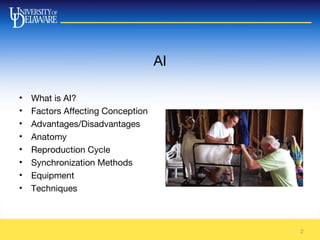
• What is AI?
• Factors Affecting Conception
• Advantages/Disadvantages
• Anatomy
• Reproduction Cycle
• Synchronization Methods
• Equipment
• Techniques
2
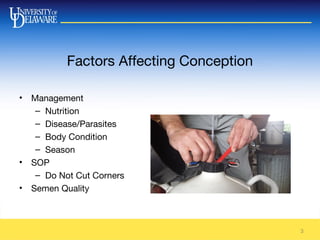
Factors Affecting Conception
• Management
– Nutrition
– Disease/Parasites
– Body Condition
– Season
• SOP
– Do Not Cut Corners
• Semen Quality
3
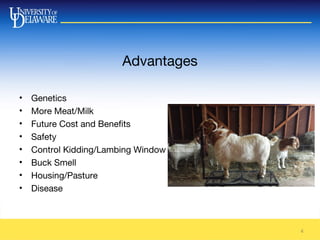
Advantages
• Genetics
• More Meat/Milk
• Future Cost and Benefits
• Safety
• Control Kidding/Lambing Window
• Buck Smell
• Housing/Pasture
• Disease
4
Disadvantages
• Start-Up Costs
• Management
• Time
– Heat Detection
– Record keeping
– Skill
• Poor sires
5
Female Reproduction
• Female serves several functions in reproduction:
1. Provide ova (eggs)
2. Provide proper environment for fertilization
3. Nurture the embryo/fetus (gestation)
4. Deliver fetus to exterior
5. Feed the young goat (lactation)
6. Provide for proper behavior patterns
• Attracting male and mating
• Demonstrating maternal functions
6
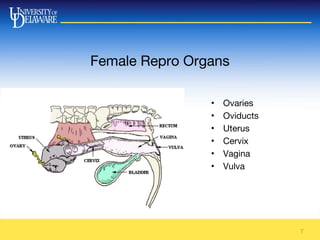
Female Repro Organs
7
• Ovaries
• Oviducts
• Uterus
• Cervix
• Vagina
• Vulva
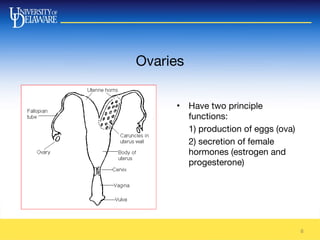
Ovaries
8
• Have two principle
functions:
1) production of eggs (ova)
2) secretion of female
hormones (estrogen and
progesterone)
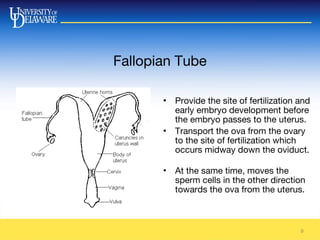
Fallopian Tube
9
• Provide the site of fertilization and
early embryo development before
the embryo passes to the uterus.
• Transport the ova from the ovary
to the site of fertilization which
occurs midway down the oviduct.
• At the same time, moves the
sperm cells in the other direction
towards the ova from the uterus.
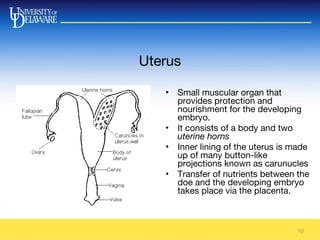
Uterus
10
• Small muscular organ that
provides protection and
nourishment for the developing
embryo.
• It consists of a body and two
uterine horns
• Inner lining of the uterus is made
up of many button-like
projections known as carunucles
• Transfer of nutrients between the
doe and the developing embryo
takes place via the placenta.
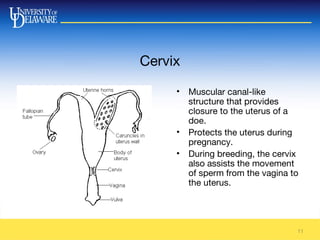
Cervix
11
• Muscular canal-like
structure that provides
closure to the uterus of a
doe.
• Protects the uterus during
pregnancy.
• During breeding, the cervix
also assists the movement
of sperm from the vagina to
the uterus.
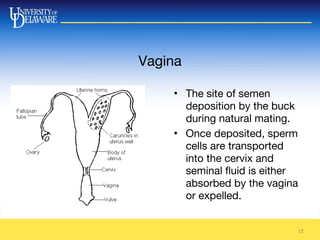
Vagina
12
• The site of semen
deposition by the buck
during natural mating.
• Once deposited, sperm
cells are transported
into the cervix and
seminal fluid is either
absorbed by the vagina
or expelled.
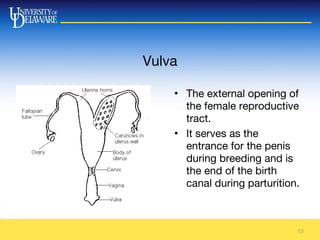
Vulva
13
• The external opening of
the female reproductive
tract.
• It serves as the
entrance for the penis
during breeding and is
the end of the birth
canal during parturition.
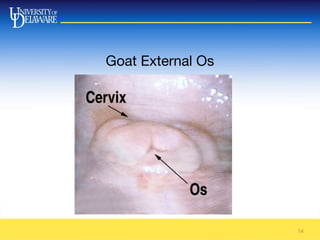
Goat External Os
14
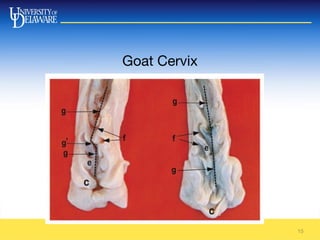
Goat Cervix
15
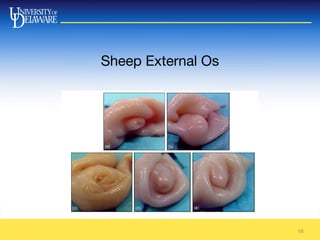
Sheep External Os
16
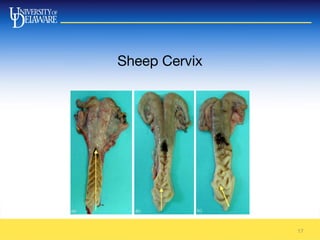
Sheep Cervix
17
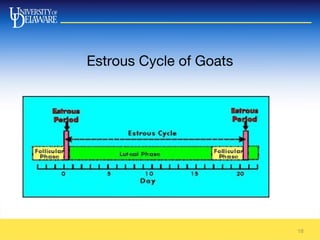
Estrous Cycle of Goats
18
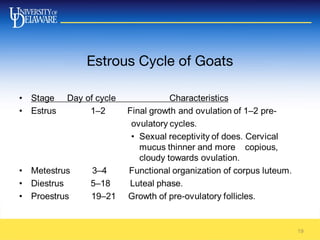
Estrous Cycle of Goats
19
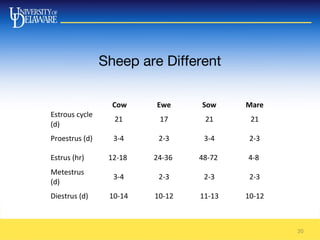
Sheep are Different
   Cow Ewe Sow Mare
Estrous cycle 
(d)
21 17 21 21
Proestrus (d) 3-4 2-3 3-4 2-3
Estrus (hr) 12-18  24-36  48-72  4-8 
Metestrus 
(d) 
3-4 2-3 2-3 2-3
Diestrus (d)  10-14 10-12 11-13 10-12
20
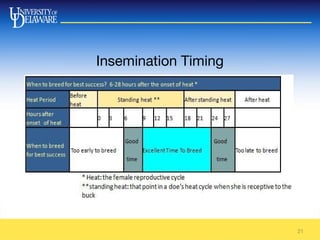
Insemination Timing
21
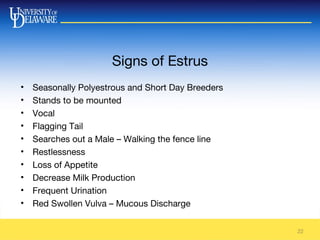
Signs of Estrus
• Seasonally Polyestrous and Short Day Breeders
• Stands to be mounted
• Vocal
• Flagging Tail
• Searches out a Male – Walking the fence line
• Restlessness
• Loss of Appetite
• Decrease Milk Production
• Frequent Urination
• Red Swollen Vulva – Mucous Discharge
22
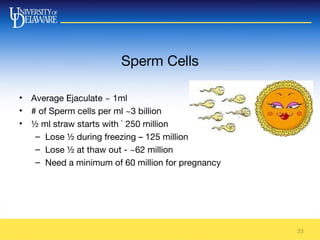
Sperm Cells
• Average Ejaculate ~ 1ml
• # of Sperm cells per ml ~3 billion
• ½ ml straw starts with ` 250 million
– Lose ½ during freezing – 125 million
– Lose ½ at thaw out - ~62 million
– Need a minimum of 60 million for pregnancy
23
Approved Drugs for Sheep and Goats
• Mention or display of a trademark, proprietary product, or firm in text
or figures does not constitute an endorsement by the University of
Delaware Extension and does not imply approval to the exclusion of
other suitable products or firms.
• Very few approved
– $
• Extra-label drug use
• Valid Veterinary-Client-Patient-Relationship (VCPR)
College or Department name here 24
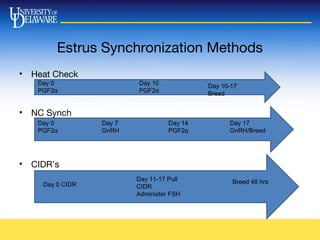
Estrus Synchronization
• Heat Check
– Series of Prostaglandin shots 10 days apart with heat check
and breeding
• NC Synch
– Combination of Prostaglandin and GnRH shots followed by AI
• CIDR’s
– Insertion of a Progesterone control device with a combination of
Prostaglandin and FSH shots
Estrus Synchronization Methods
• Heat Check
• NC Synch
• CIDR’s
Day 0
PGF2α
Day 10
PGF2α
Day 10-17
Breed
Day 0
PGF2α
Day 7
GnRH
Day 14
PGF2α
Day 17
GnRH/Breed
Day 0 CIDR
Day 11-17 Pull
CIDR
Administer FSH
Breed 48 hrs
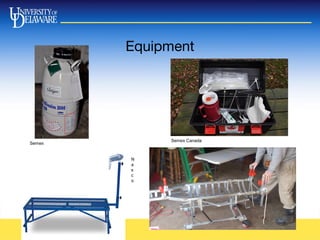
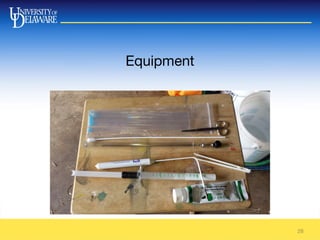
Equipment
Semex
Canada
Semex Canada
N
a
s
c
o
Equipment
28
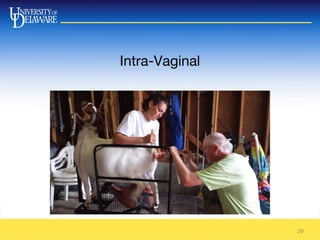
Intra-Vaginal
29
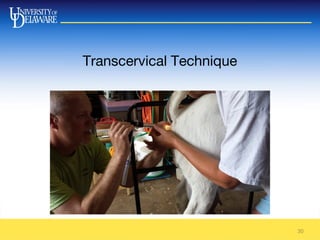
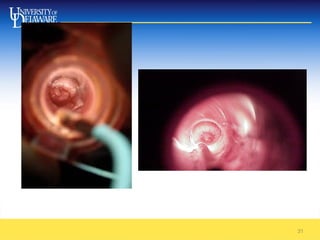
Transcervical Technique
30
31
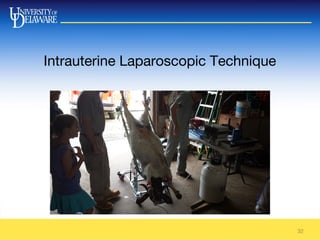
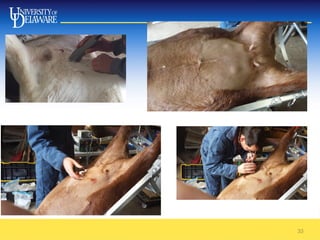
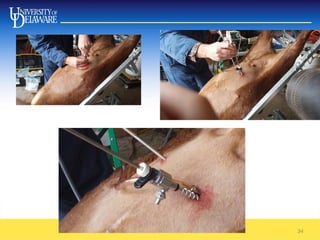
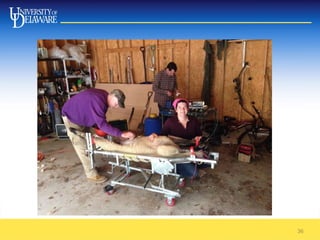
Intrauterine Laparoscopic Technique
32
33
34
35
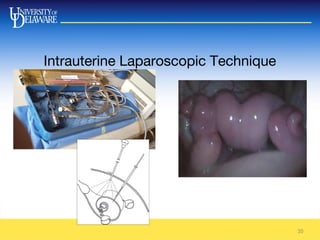
Intrauterine Laparoscopic Technique
36
37
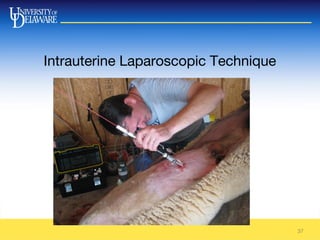
Intrauterine Laparoscopic Technique
Is AI Right for You?
Thank You
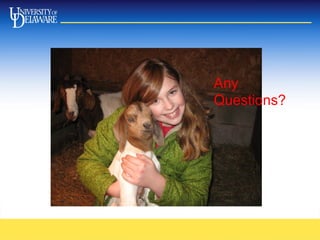
Any
Questions?
References
• Greyliing, J. (2000). Reproduction traits in the Boer goat doe. Small
Ruminant Research, 36, 171-177.
• Kershaw, C., Khalid, M., Mcgowan, M., & Ingram, K. (2013). The
anatomy of the sheep cervixand its influence on yhe transcervical
passage of an inseminating pipette into the uterine lumen. Small
Ruminant Research, 110, 42-45.
• Faigl, V., Voss, N., Javor, A., Kulcsar, M., & Solti, L. (2012). Artificial
insemination in small ruminants - a review. Acta Veternaria
Hungarica, 60, 115-129.
• Sparks, D. (n.d.). Meat Goat Reproduction. Retrieved August 15,
2015, from shsu.edu/.../GoatReproduction-Sparks.ppt
40

Ai small rum_15

  • 1.
    Artificial Insemination inSmall Ruminants Dan Severson University of Delaware New Castle County Extension Agent severson@udel.edu 302-831-8860
  • 2.
    AI • What isAI? • Factors Affecting Conception • Advantages/Disadvantages • Anatomy • Reproduction Cycle • Synchronization Methods • Equipment • Techniques 2
  • 3.
    Factors Affecting Conception •Management – Nutrition – Disease/Parasites – Body Condition – Season • SOP – Do Not Cut Corners • Semen Quality 3
  • 4.
    Advantages • Genetics • MoreMeat/Milk • Future Cost and Benefits • Safety • Control Kidding/Lambing Window • Buck Smell • Housing/Pasture • Disease 4
  • 5.
    Disadvantages • Start-Up Costs •Management • Time – Heat Detection – Record keeping – Skill • Poor sires 5
  • 6.
    Female Reproduction • Femaleserves several functions in reproduction: 1. Provide ova (eggs) 2. Provide proper environment for fertilization 3. Nurture the embryo/fetus (gestation) 4. Deliver fetus to exterior 5. Feed the young goat (lactation) 6. Provide for proper behavior patterns • Attracting male and mating • Demonstrating maternal functions 6
  • 7.
    Female Repro Organs 7 •Ovaries • Oviducts • Uterus • Cervix • Vagina • Vulva
  • 8.
    Ovaries 8 • Have twoprinciple functions: 1) production of eggs (ova) 2) secretion of female hormones (estrogen and progesterone)
  • 9.
    Fallopian Tube 9 • Providethe site of fertilization and early embryo development before the embryo passes to the uterus. • Transport the ova from the ovary to the site of fertilization which occurs midway down the oviduct. • At the same time, moves the sperm cells in the other direction towards the ova from the uterus.
  • 10.
    Uterus 10 • Small muscularorgan that provides protection and nourishment for the developing embryo. • It consists of a body and two uterine horns • Inner lining of the uterus is made up of many button-like projections known as carunucles • Transfer of nutrients between the doe and the developing embryo takes place via the placenta.
  • 11.
    Cervix 11 • Muscular canal-like structurethat provides closure to the uterus of a doe. • Protects the uterus during pregnancy. • During breeding, the cervix also assists the movement of sperm from the vagina to the uterus.
  • 12.
    Vagina 12 • The siteof semen deposition by the buck during natural mating. • Once deposited, sperm cells are transported into the cervix and seminal fluid is either absorbed by the vagina or expelled.
  • 13.
    Vulva 13 • The externalopening of the female reproductive tract. • It serves as the entrance for the penis during breeding and is the end of the birth canal during parturition.
  • 14.
  • 15.
  • 16.
  • 17.
  • 18.
  • 19.
  • 20.
    Sheep are Different   Cow Ewe Sow Mare Estrous cycle  (d) 21 17 21 21 Proestrus (d) 3-4 2-3 3-4 2-3 Estrus (hr) 12-18  24-36  48-72  4-8  Metestrus  (d)  3-4 2-3 2-3 2-3 Diestrus (d)  10-14 10-12 11-13 10-12 20
  • 21.
  • 22.
    Signs of Estrus •Seasonally Polyestrous and Short Day Breeders • Stands to be mounted • Vocal • Flagging Tail • Searches out a Male – Walking the fence line • Restlessness • Loss of Appetite • Decrease Milk Production • Frequent Urination • Red Swollen Vulva – Mucous Discharge 22
  • 23.
    Sperm Cells • AverageEjaculate ~ 1ml • # of Sperm cells per ml ~3 billion • ½ ml straw starts with ` 250 million – Lose ½ during freezing – 125 million – Lose ½ at thaw out - ~62 million – Need a minimum of 60 million for pregnancy 23
  • 24.
    Approved Drugs forSheep and Goats • Mention or display of a trademark, proprietary product, or firm in text or figures does not constitute an endorsement by the University of Delaware Extension and does not imply approval to the exclusion of other suitable products or firms. • Very few approved – $ • Extra-label drug use • Valid Veterinary-Client-Patient-Relationship (VCPR) College or Department name here 24
  • 25.
    Estrus Synchronization • HeatCheck – Series of Prostaglandin shots 10 days apart with heat check and breeding • NC Synch – Combination of Prostaglandin and GnRH shots followed by AI • CIDR’s – Insertion of a Progesterone control device with a combination of Prostaglandin and FSH shots
  • 26.
    Estrus Synchronization Methods •Heat Check • NC Synch • CIDR’s Day 0 PGF2α Day 10 PGF2α Day 10-17 Breed Day 0 PGF2α Day 7 GnRH Day 14 PGF2α Day 17 GnRH/Breed Day 0 CIDR Day 11-17 Pull CIDR Administer FSH Breed 48 hrs
  • 27.
  • 28.
  • 29.
  • 30.
  • 31.
  • 32.
  • 33.
  • 34.
  • 35.
  • 36.
  • 37.
  • 38.
    Is AI Rightfor You?
  • 39.
  • 40.
    References • Greyliing, J.(2000). Reproduction traits in the Boer goat doe. Small Ruminant Research, 36, 171-177. • Kershaw, C., Khalid, M., Mcgowan, M., & Ingram, K. (2013). The anatomy of the sheep cervixand its influence on yhe transcervical passage of an inseminating pipette into the uterine lumen. Small Ruminant Research, 110, 42-45. • Faigl, V., Voss, N., Javor, A., Kulcsar, M., & Solti, L. (2012). Artificial insemination in small ruminants - a review. Acta Veternaria Hungarica, 60, 115-129. • Sparks, D. (n.d.). Meat Goat Reproduction. Retrieved August 15, 2015, from shsu.edu/.../GoatReproduction-Sparks.ppt 40